
Work Text:
A veritable wall of heat hit veteran painter Victor Nikiforov square in the face on the morn of the twelfth of June, 1793, the very moment he stepped off the gangplank onto the docks of bustling Fukuoka Harbor.
It was heat like he’d never experienced. Heat like he’d never imagined. Being from the frigid lands of Mother Russia, he had of course expected some amount of adjustment would be required.
But nothing like this. Never like this.
In fact, he spent the better part of the next week held up in a seaside inn with ice chips pressed to the back of his neck, leaning out the window like a man sick to the gills, and with a outwardly lovely but insultingly amused Japanese handmaiden fanning at the thin section of skin just above his ankles that polite society allowed him to show.
Truly, by the middle of day six, he was about ready to pack up his paints and label the whole trip a wash.
But then he saw him.
Really, with all the time Victor had been spending with his head out the window, it would have been impossible to miss him. Victor couldn’t tell from the man’s dress whether he was a patron or staff, but in whatever regard, the stranger apparently found the grounds of the inn quite agreeable. The courtyard was the man’s domain; he cavorted around its contours and crevasses with ease, in an absentminded sort of way. The silk of his kimono acted as an echo to his steps, swaying around his ample, smooth-toned thighs; and there, a small dog too furry for the weather danced at his bare feet, yipping at the ankles.
The pup was after the brocade, that much was apparent. The man teased him with the sway of it before pulling it out of his reach each time, in a clever ruse. Then he’d dissolve into peals of laughter as warm as the sun when the dog yelped at this, to voice his indignance.
Only once, the dog caught his master by the tail. Only once, the pup managed to grasp the garment between his jowls and give it a tug, bringing the man to the ground in a heap of raucous laughter. The silk of his robe was yanked down with him, of course; and as well, the skin of his bare chest was exposed, revealing an elegant clavicle, sparkling perspirant at the indent of his muscles, a blush-pink peony of an areola peeking out from underneath the edge of his collar, soft and vulnerable for a voracious bite.
It would be so simple, Victor thought. Like pulling at the flesh of a too-ripe peach.
And the artist in him was entranced.
A tableau: That’s what this man had been. A masterpiece already in his own right—so much so that Victor almost dared not put brush to canvas, in a bid not to spoil the image.
Almost.
In replicating the vision that after that moment lived so vividly in his mind it almost maintained its own ecosystem within the confines of his amygdala—the wet heat of the air, the soft almond shape of the man’s eyes, the cotton-puff coif of the stranger’s beloved pup—he attempted some drafts first on his own canvases but found them wanting. Western linen wasn’t the medium for this, Victor decided; he would have to search harder, if he were to craft the perfect home for this image.
And so he went into town—finally—in search of more ideal material.
It seemed even the weather agreed with his plans. Just as Victor was packing up all his items into a neat bag to throw over his shoulder while venturing into the market, the sky opened up—at last yielding, abating—and dropped a torrential downpour on the town of Fukuoka. Victor reconsidered then, just for a moment, if he should postpone his trip, but then he sampled the rain with an open palm and found it tepid as bathwater.
So it was pleasant enough, he decided.
Despite the rain, Victor found the market was awash with activity. Locals were out in droves, winding their way through narrow alleyways in the company of colorful paper umbrellas. With their faces completely obscured in a bid to avoid the rain, they appeared less human and more like paint upon an ever-moving canvas: the swish of silk kimono, brushstrokes; the demurring of ornamental fans, carefully placed dabs of ink.
Victor, in contrast, looked very much out of place indeed.
For one, he didn’t own an umbrella, nor did he bring one—and so the rain was pelting him every which way. His hair was soon enough in his face, sodden and a dark gray with saturation. In no time at all, he was practically running down the main throughway, having eyes only for a tree or an awning he could shelter himself under for a moment’s time.
Just enough to collect his thoughts, at least.
“Gah—!”
“Oh, my apologies—” But the words died on his lips.
Because before him was the man from the courtyard—the beloved master of the mischievous pup—and he was wincing under the rim of his umbrella, cutely wrinkling his nose in displeasure at having been barreled into at full speed by a soaking wet one hundred eighty-two centimeter-tall foreigner in an undue hurry.
His legs—the other man’s—were akimbo, Victor noticed then. It seemed to him that he had only just avoided punting this stranger straight into the mud in his haste.
Victor reached out, righting the man by his forearms. “That was—” Victor started, “—entirely my fault. Please forgive me.”
The stranger blinked up at him, prettily. “Wait,” he said, in halting Russian, “aren’t you that guest…? At the ryokan?”
“‘Ryokan’?”
“Ah… hotel.”
“Yes!” Victor took a step forward; the stranger took one back, though it didn’t appear out of intimidation. More like they were both readying themselves for a dance they inexplicably already knew the steps to. “And you’re that geisha I saw in the courtyard.”
“‘Geisha’?” For a moment, Victor feared he’d butchered the word to hell and back; but then the man merely laughed, his umbrella trembling with the motion. “I’m no geisha, certainly! Where on earth did you get that impression?”
“Uh–” Victor fumbled. “I—I just assumed. Since geisha are supposed to be beautiful entertainers, I thought you must be one.”
The man twirled his umbrella; little droplets misted the air with his gesture, granting the stranger an ethereal glow. “You think I’m beautiful?”
“Enough to be a geisha, yes.”
With this, he blushed a charming hue.
“Um, would you—?” The words were tumbling out of Victor’s mouth now, like an inexorable tide. “Would you consider posing for a picture?”
The man tilted his head, consideringly. “Pose… for a picture?”
“You know—” Victor found heat rising to his own cheeks, with the inelegance of his explanation. “—modeling? Letting me paint you, in a particular position?”
“Oh, I see.” The stranger held a thumb to his bottom lip. “You’re… some kind of artist?”
“Yes! And—ah, where are my manners?” Victor patted down his waistcoat for some form of identification but found none. “Uh, Victor Nikiforov. I’m a painter by trade.” He stuck out his arm, to accept the man’s hand.
The other merely blinked at his proffered arm, wonderingly. After a moment, he slowly lowered his head, his umbrella dipping with him and depositing a not-inconsiderable amount of water straight onto the ground. “Yuuri Katsuki. My parents own the inn in which you are staying.”
“And it’s a lovely inn!” Victor was quick to say, despite the fact that he’d only had the chance to thoroughly inspect a singular window pane and the inside of an ice bucket since his arrival.
Yuuri—yes, Yuuri—giggled at this, holding a delicate hand to his mouth as though to muffle the sound. “I’m sure my parents will be pleased that you think so.”
“Would you be willing, then?” Victor swallowed heavily. “To be my model…?”
Yuuri rolled his eyes heavenwards, as though giving proper consideration to the notion. “Me, a model? I can hardly imagine it. But… if you insist, I feel as though I must accept.”
“Thank you!” It was most probably a cultural taboo, but Victor embraced Yuuri then, holding him tightly around the shoulders. The umbrella plunked onto the packed dirt of the marketplace floor, in the other’s abrupt shock.
And yet, neither one of them managed to feel cold.
“Tell me, how is it you know Russian?”
With the question, Victor took a brush to his newly acquired Japanese canvas. There, he followed the outline of the delicate curve of Yuuri’s cheek, watching as the real-life man flushed exactly where he was casting his most fervent attention.
And yet, Yuuri resolutely kept his pose, the ever-faithful muse.
“It, ah, may be hard to believe, but…” Yuuri swallowed, being sure to keep his gaze steadfastly upon the ground. “I just sort of… caught on? Fukuoka is a port town. We get lots of foreigners—first the Portuguese, then the Dutch, then the Chinese and Koreans. Russians are… typically not as well received, but I hear them speak often in the market, haggling prices, and amongst themselves when staying at my parents’ inn. It benefited me to know a little bit of their language for business, you see, so I tried to pick up what I could here and there.”
Victor chuckled, reaching for another color upon his palette. “I think you are dodging the question. No one could speak a language as eloquently as you without thorough study. So I shall ask again: How is it you know Russian?”
Yuuri made a wounded noise, wringing his hands upon his lap. “P–poetry. I like poetry. I read Russian poetry.”
“Oh?” Victor clutched at his chest, transferring a glob of paint onto the lapel. “If only I’d been a poet!”
Yuuri laughed, in turn. “No, thank you. I like you just the way that you are.”
It was Victor’s time, then, to blush, mixing paints upon the back of his hand. “Russian poetry has done you well, I see. You know how to flatter, if nothing else.”
“Thank you?” Yuuri squirmed, minutely. “And if I might ask you a question in return, what brings you to Japan?”
“Furthering my studies,” Victor answered, distracted; he delicately placed bristles on painting-Yuuri’s face, emulating its counterpart’s unique complexion. “I had grown bored with Western art styles, you see. I wanted a change—to find something that set my very heart on fire.”
“Inspiration, you mean?”
“More or less.”
“And have you found it?”
Victor glanced over the top of his canvas, smirking. “Well, it’s still early. We will have to see, won’t we?”
Summer reigned, then retreated, slowly. The days became not quite so oppressive; now Victor could freely take seaside walks with Yuuri, share in Japanese delicacies and play shogi with him upon the veranda. He acclimated to it all: wearing a jinbei around the inn, taking his shoes off at the door, sipping sake with his meals instead of vodka. He and Yuuri would sit across from each other in the foyer and mimic their respective languages at each other, feeling out the syllables, rounding the hard consonants and elongating the vowels. They would inch towards each other with every well pronounced word, practically in the other’s lap by the end of their sessions. Then, inevitably, one would tickle the other—under the chin, around the armpit—and the tension would snap like a twig, dissolving in uncontrollable laughter.
And between these activities, Victor would, of course, paint.
Yuuri would read from his poetry books, more often than not, during these times. The soft timber of his voice would accompany Victor’s brushstrokes; and sometimes, even, the painter would have to pause and close his eyes—lean against the easel, with full, staggering breaths—to fully appreciate his mother tongue in Yuuri’s mouth. Then he would pick up his utensils again, with twice his usual vigor.
The process was slow, but undeniably fruitful.
In the span of only a few months, Victor had amassed what he considered no less than an absolute treasure trove of art studies—and all to the tune of one Yuuri Katsuki. He had pen sketches, charcoal drawings, watercolors, pastels, oils; if one could name it, Victor had a version of it depicting Yuuri Katsuki in all his beauty.
Yuuri using chopsticks. Yuuri drinking tea. Yuuri laughing coquettishly from behind a large folding fan. Yuuri turning down beds in the pale morning light. Yuuri walking the courtyard with fireflies following a half-step behind. Every movement he made, a stroke of brilliance; every pose, a fresco.
A portfolio, a most thorough dossier: That’s what Victor had on his hands. A magnum opus one could easily hand over to a master with pride.
And the painting—the original masterwork, the one that Victor had sunk his most ardent efforts into—was to be the pièce de résistance.
There was one little problem though: Victor did not want to finish it.
And this sentiment was certainly not going unnoticed.
“Forgive my forwardness,” Yuuri prefaced, from his usual position before Victor’s canvas, “but are you not nearly done with the piece? You’ve been at it for months now.” He fiddled with the bent corner of one of his poetry books, idly rolling the soft parchment underneath his fingers like a loose tooth.
Victor paused, his brush upon one of Vicchan’s curls as he leapt after his master. “Almost,” he said, finally. His hand resumed its motion; though it trembled now, with a sense of unease. “I want it to be perfect, of course.”
Yuuri lowered his head, demurely. “Of course.” He swallowed hard, once. “And then?”
Victor’s hand stopped again. “‘And then’?”
“And then…” Yuuri lifted his chin, boring the full force of his eyes directly into Victor’s soul. “And then will you leave, when you are through?”
Victor blinked, for a moment too long. “Perhaps.”
“Perhaps.” Yuuri rolled the foreign word over his tongue, sampling the flavor. He evidently found it sour, grimacing and lowering his head once more. “I see.”
The rest of the session was carried out in an impenetrable silence.
To paint in front of the ocean was a bit of a cliché, but Victor was nothing if not an adherent to aesthetics, above all.
Besides, it was quiet, cool, and blessedly, without distraction here.
It was somewhere Victor could contemplate the more difficult aspects of the temporary artistic post he had taken up here, in the Empire of Japan.
Aspects such as the fact that he no longer wished for it to be “temporary.”
Barring the weather, Victor had acclimated well. The sun was imparting onto him a healthy color; his hair was growing out, well into his eyes and tickling at the back of his neck. A thin layer of flesh had settled just beneath his navel, as well as into the prior hollow of his cheeks; and too, his skin had grown soft and dewy, whipped clean of blemishes by the humid sea air. He woke up every morning to Yuuri’s soft humming and went to bed every night to Yuuri’s “oyasumi,” whispered fiercely like a prayer.
The thought of boarding a boat back to Russia—returning to his bachelor’s apartment, devoid of light and full of dust—sent a shiver down his spine that could not be repressed. He only had his fellow artists in residence there, to ask after him—and the landlady, who occasionally made him tea. If he were to return, no family would greet him at the dock; when and if he undid the lock to his flat, no person would run to the door to welcome him home.
There would be no Yuuri, a man and memory made distant by the thousands of miles between him. Would he forget Victor, he wondered? Or would he sit exactly where Victor was sitting now, staring out at the horizon—where the sky met the sea—and wonder after Victor’s well being, petting his dog and nursing a maw in the chest that could never again be filled?
The brush in Victor’s hand snapped; the head bristles fell off, forced in two through the sheer force of Victor’s fingers applying pressure to it against the canvas. Victor looked down upon the fragment, almost outside of himself—only for a gull to swoop down at that very moment and pick it up between the clamp of its beak, flying off to presumably add the prize to the interior of its nest.
Funny, Victor thought. He did not even consider it was a gull, when he first saw it. He only thought, “kamome,” in that moment, as that was how Yuuri referred to it.
Even words—something Victor thought infallible, unyielding—were mere putty in Yuuri’s hands.
Victor finished his masterwork on a brisk, autumnal day, with very little fanfare.
Yuuri was not around to bear witness. He was at the marketplace with his sister, presumably, leaving Victor in the center of the courtyard to whittle away at the finer details of his piece.
Little did he know Victor would be finishing it, then.
Artists rarely knew for certain when a piece was “done,” in the traditional sense. Part of Victor sensed he could chip away at the proverbial marble for another ten years and still be content with the process. But like a blind man fumbling in the dark, he had finally set his hands upon every ridge and contour of the previously formless entity that had since alluded him. It was now thoroughly filled out in his mind: its texture, its weight, its shape.
And it was upon his canvas too.
“You’ve finished it?”
Victor turned; his palette dropped to the ground with a clatter, delicate pinks and whites clashing harshly against blackest blacks.
It seemed Yuuri was well in possession of this artist’s skill himself: a pre-knowing of the finality, a proper feeling out of the end.
“Yes.”
Yuuri stepped forward, to better survey Victor’s work. He traced the brushstrokes with his eyes, following over the careful swoops, the sharp edges. When he came to the center of the piece—where Yuuri’s chest was rendered, on careful, reverent display—color came to his own cheeks, the expression forming there not at all unlike his painting’s counterpart.
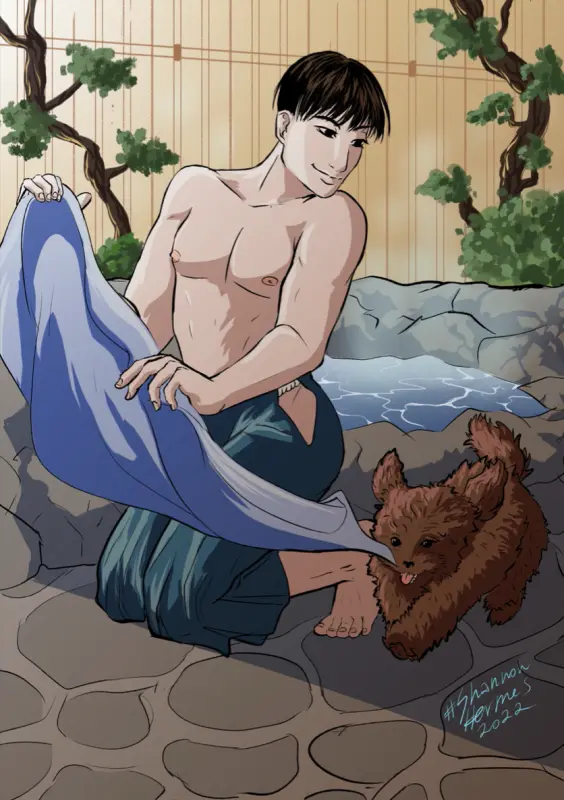
“You did not inform me I would be… be…”
“Beautiful?”
“In dishabille.”
Victor startled, slightly—then barked out a laugh. Rather than take offense, he was only amused Yuuri knew of that particular term—and that he used it well and to great effect, even if the French was clumsy upon his tongue. Perhaps, he thought, Yuuri was reading a broader range of poetry than Victor had initially imagined. “Well of course! It’s true to life. It’s how I first saw you, when I arrived in Fukuoka Harbor.”
“You—” Yuuri flushed brighter still. “You saw me… like this?”
“Yes.” And Victor somehow knew, then, that Yuuri did not only mean “like this” in the physical sense—but also in the emotional one, the one in which Victor had depicted Yuuri’s state in its most flattering rendition, lovingly.
Yuuri folded his hands. “What shall you do with it?”
“It will be going back to Russia.”
“Oh.”
“But I shall not be.”
“Wha—?” Yuuri blinked, owlishly. Victor could almost look past Yuuri’s eyes into the inner mechanisms of his mind, going over each of Victor’s words for somewhere he had erred, in his understanding. “You will—?”
“Not be returning to Russia,” Victor finished. He took up a cloth from where it was pinched between the legs of his easel and went about wiping his hands with it. “At least, not yet. I’ll be packaging up this piece and sending it home for my colleagues to view, but I shall not be going with it.”
Yuuri took a breath, held it steady. Did he dare hope?
Victor smiled. “There’s so much more for me to see here. Your country and family have welcomed me warmly, and you—” He swallowed, even as moisture sprang to the corners of his eyes. “Well… I’ve always wanted to experience a Japanese wedding, if you’ll have me.”
Despite his efforts, paint inevitably got all over Yuuri, as the man leapt into Victor’s arms. It was on the outside of his thighs, where Victor caught him; the back of his neck, where he caressed him; his cheeks and chin, as Victor held him there and kissed him.
On the night of their wedding, Victor would explore these splotches with the tips of his fingers, as gently and adoringly as he would paint the surface of a canvas with a brush.