
Work Text:
I’ve been sitting on this idea of spirits vs personhood for a while now (i.e. months) and the way Dragon Age: Inquisition portrays the dilemma. I have a lot of frustrations with how spirits are portrayed in this game, so I figured I would take some time to look over the question the game posits: Do spirits qualify as people or not.
Full disclosure: I opted for Cole to remain as a spirit in the game and while I criticize the idea of making Cole human this isn’t a judgment on how other players are playing the game. It’s more a critique of how the writing addressed the dilemma to begin with. Also, this post meanders … a lot. It has kind of become a general post about spirits in Dragon Age. I haven’t read the books, so if anything here is completely misinformed or if there’s info I’m lacking, feel free to let me know.
With that out of the way let’s get into it! At a certain point of the game we have to help Cole decide whether he will be more of a spirit or more of a human. I really wish we’d gotten a chance to just ask Cole what it was he wanted at some point. Granted, at the time he really just wanted to murder a guy and he very well could have turned into a demon afterwards, so I suppose that wasn’t an option.
So instead of the ideal, we’re given two viewpoints on the matter to fill the void: Solas’s and Varric’s.
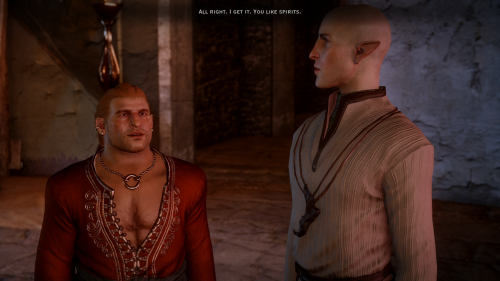
Solas, our resident expert on spirits, believes it’s important that Cole accept himself for who he is. This way the ideal he aspires to, compassion, won’t be corrupted.
Varric thinks Cole should have a chance at being a person and phrases it to Solas as such: “All right. I get it. You like spirits. But he came into this world to be a person. Let him be one.” It kind of makes it sound like Solas’s appreciation of spirits is akin to a fondness for cats.
More to the point, Varric sees Cole remaining a spirit as robbing him of any chance to be a real person. But why? Why would being a spirit automatically make Cole less of a person?
The simple answer, at least for Varric, is that spirits simply aren’t people to begin with. I think Varric’s opinion about spirits is similar to a lot of people of Thedas: they’re concepts and they’re frequently dangerous. In other words, Varric doesn’t see spirits as people because most people of Thedas don’t see them as people. It’s the dominant opinion.
In DA2 Anders was one of the few people who didn’t follow this simple logic—he saw Justice as a friend and that’s the reason he did so much for him in the first place—but no one in DA2 got a chance to interact with Justice one-on-one. They just saw him as Anders’s weird, alternate personality that was causing trouble. I suppose most of the Awakening cast also saw Justice as a person; they spent a great deal of time with him after all, but none of them are people Varric has met.
The one other person from DA2 who I think sees spirits as people is Merrill. She said they’re like people: good and bad. It’s why she doesn’t refer to the bad ones as “demons.” You just need to exercise some caution like you would with anyone else.
What all of this means is that Varric can only come at this from the perspective of someone who has never really dealt with spirits, never really thought of their personhood, and the people he knows who did are those he feels made extremely poor life decisions (particularly Anders).
So, that’s Varric’s background on the situation but he has good intentions. He wants Cole to have the freedom of being a person, but the basis he uses for his argument is faulty. Cole isn’t worried about whether or not he’s a person (I kind of doubt this is a dilemma Cole is even having), he’s worried about becoming a demon. So, when Varric says “Cole came to this world to be a person,” he’s not actually correct. According to Cole: “I came through to help … and I couldn’t. So I became him.” Cole’s motivations are those of a spirit trying to fulfill his purpose. It’s very similar to other spirits we’ve seen in previous games.
For example, if we look at the spirit of faith from DA:O we see that Cole (Compassion) is quite similar to her. We never really met Faith properly but we saw her work through Wynne throughout the game. She helped preserve Wynne’s life, actually resurrected her when she died fighting a demon in the Circle Tower, and apparently watched over her for her entire life since she was a child. Faith cared for Wynne so much she allowed herself to weaken over time to preserve her. I think Compassion wanted to do something like this for the human Cole but wasn’t strong enough to sustain it.
Cole also some similarities to Justice in Awakening: Justice was trying to fulfill his purpose by helping the spirits of the dead move on by righting a wrong. He inadvertently comes to the mortal world and is trapped within a corpse.
However, Cole purposefully enters the mortal world in an effort to fulfill his own purpose, much like Faith. For him, his purpose was easing the suffering of a man trapped and forgotten.
Things get a little confusing at this point of the story. Did Cole possess a dead body the way Justice did or didn’t he? I would be inclined to say yes, he has, but Solas doesn’t even seem to think this is a possibility: “Cole, this man cannot have killed you. You are a spirit. You have not even possessed a body.”
Hasn’t he though? How else could he “become him?”
I’ll admit it doesn’t make complete sense to say he’s possessing a body, much as I’m inclined to think he is. The body isn’t decomposing in the way Justice’s was. And yet, Cole creating his own flesh and blood body all on his own doesn’t make a whole lot of sense either, so I’m a little lost on this one. I guess the game wants me to assume this is what happened but I’m not entirely convinced. There’s no precedent and it’s never fully explored. It’s simply taken as a given.
Continuing on, Cole says this to the man he wants to kill: “You forgot. You locked me in the dungeon in the Spire, and you forgot, and I died in the dark!” It’s followed by “He killed me. He killed me. That’s why it doesn’t work. He killed me and I have to kill him back.” Whoever the original Cole was, he’s long gone and Compassion misses him and wants to right that wrong. His desire is still firmly within a spirit’s domain, but it’s becoming perverted. Hence, the danger of becoming a demon.
Now, Solas can be closed-minded about a lot of things (so many things…) but when it comes to spirits he is refreshingly open-minded. He sees them as people albeit different types of people with different problems and aspirations. He befriends them and talks to them regularly and Cole is facing a problem that only affects spirits: the possibility he could become a demon.

This is something Varric refuses to even consider. He thinks Cole is just a step away from becoming a human not a demon, and as such he needs to sort things out like a human. He phrases it like this:
Varric: But he isn’t a spirit, is he? He made himself human, and humans change. They get hurt, and they heal. He needs to work it out like a person.
Solas: You would alter the essence of what he is.
The game shows us making Cole human is a valid way of doing things–neither path results in a devastated Cole at least–but is it the right way of doing things?
For me, that’s the big point here. Is it all right to change who someone is so completely simply because you can’t fathom them being “real” any other way?
We could easily flip the script, of course, and say Solas is being closed-minded as well. He doesn’t think it’s possible for Cole to be a “person” in the way Varric does, thus preventing him from any kind of change whether it benefits him or not. But he also isn’t dismissing Cole as an individual just because he’s not mortal, and I think that’s key here.
Of course, Varric thinks Cole changed himself already but to me this shows his lack of experience with spirits. It also shows the game itself seems to have forgotten the depth they’ve given previous spirits, e.g. Justice.
I’m not sure why the game seems to think spirits behave strangely and can wipe themselves clean of their memories over and over. This was never something Justice needed to do and no one ever disputed the fact he was a person. In Awakening Justice was single-minded but he was willing to look at things from different angles when necessary and he grew as an individual. He didn’t “become a person” and he certainly didn’t stop being a spirit. Every single issue he faces in DA2 is because he’s a spirit living in the mortal world.
Also, if Cole can create his own flesh and blood body (presumably) why couldn’t Justice? Why don’t other spirits? How does this work? How–???
*ahem* The problem with the whole setup is that it didn’t need to be framed this way. Cole is already a person. The question isn’t “Should he be a person or should he be a spirit?” The question is “Is this guy mortal (and how did that happen if so?) and should we treat him, medically speaking, like a mortal or a spirit?”
Everyone except for Varric seems to be in agreement that if Cole isn’t treated like a spirit he will become a demon if he kills a human out of vengeance. Varric doesn’t actually address this; he’s treating the situation as if it’s not even a possibility. According to him, Cole is angry and depressed and he needs to sort through his emotions.
The game doesn’t let us see what would have happened if Cole had killed that man. Would he have become a demon or wouldn’t he have? Ultimately, that is the only way of getting an actual answer to the question of “is he human or is he spirit?”
Also, Varric didn’t even stop to consider what kind of spirit Cole might have been:
Solas: As the young man starved to death in a dungeon, his pain caught the attention of a spirit… Likely one of compassion.
Varric: Compassion?
Solas: An uncommon spirit, certainly… and all too fragile, when its efforts to help proved to be in vain.

And if you do make him a spirit Varric says: “Have you talked to him since? Have you heard what he sounds like?”
Solas: He sounds like a spirit.
I’m going to take this as an opportunity to disagree with both of them essentially. Cole does not sound like any of the spirits we’ve met previously. They all talked in a far more natural manner. Also, Varric is acting like Cole died, which is kind of unnecessary.
Varric: “He could have been a person.”
Solas: “Possibly. Would that have made him happier, child of the stone?”
Cole doesn’t feel like he’s lost anything and has this to say on returning to being more of a spirit: “There was someone. Before. He was my friend. But he didn’t know what I was. When he found out, he changed. I lost him. You found out, but you didn’t change, didn’t make me change. You let me be this, be more. Thank you for helping me find this again. For believing in me. You don’t know what it means.”
He also says, “I’m me, more me than I was. I can care and comfort but keep clean, no shackles. They feel, forgive, forget, and I am free. Finally. Thank you.”

There’s an awful lot of talk about forgetting though and I’m not sure how I feel about that. Is this something only spirits of compassion need to do? Cole seems to think it’s something spirits need to do in general, to avoid becoming demons, but could this be a belief he’s picked up from humans? That the only way to avoid being a demon is by being a perfect version of a spirit?
We could use this as an explanation for how Justice became a demon (Vengeance) but we also hear so little from Justice in DA2 that I’m not wholly convinced he became a demon in the first place. To me, it always seemed more like Anders was letting his own fear of that happening run away with him.
When we see Justice in the Fade he acts exactly as you’d expect a spirit of justice to: concerned for the welfare of others, not a huge fan of demons, wants to help. The only other time we really hear from him is if you’re rivalmancing Anders and he thinks you’re confusing Anders unnecessarily. And honestly, rivalmances aren’t exactly healthy, so I’m inclined to think Justice was defending his friend. The entire rivalmance made Anders more and more off kilter: he has more missing time and he claims to be losing control more readily. I think the game wants me to assume this is a more honest take on his relationship with Justice but to me it indicates how stressful his relationship with Hawke was more than anything else.
The only instance where Justice really seemed like a demon to me was when he became enraged at being called a demon. And to me that seemed like a very human response—perhaps, like Anders, he is also terrified of becoming a demon. Perhaps, in their merge, his responses are closer to Anders’s. Regardless, this was a singular instance, a bad one to be sure, but not enough to actually draw any real conclusions from.
Getting back to Cole, I’m not entirely sure whether he’s forgetting as much as he says he is. If he had, would he have any idea what the Inquisitor even meant when she asked if he could tell her about the real Cole? I would say no, but he knows exactly what she meant and claims he forgot it.
Perhaps he doesn’t forget so much as he makes the details fuzzier. If all spirits went around forgetting everything none of them would be able to interact with humans and we know for a fact they do.

But let’s take a look at Cole when he’s human. If we do that he’s happy, but a little more unsure of himself. He has more pronounced regrets, has fewer abilities, seems more “normal.”
Cole: That was enough for me. Now they remember, and I’m not sure… Ah. (chuckles)
Inquisitor: Cole?
Cole: I told you about Rhys, the mage who could see me. My friend. My only friend, for a long time. Evangeline showed me that templars could be kind, but even she…” (sighs)
Inquisitor: Cole, if this is troubling, we don’t have to talk about it.
Cole: Gentle. You watch me walk into darkness over and over, and you always worry. Thank you. But this isn’t about them. It’s about… When I found out I wasn’t human, when I grew, I lost Rhys. I lost my only friend. That’s why I was scared about letting all these people see me. That’s why I laughed.
Inquisitor: You’re laughing at yourself?
Cole: Yes. This world taught me that changing means losing your friends. But now I know that doesn’t have to be true. I have enough self to know that what I felt was foolish. Isn’t it wonderful? I might like being human. What do you think I’ll learn next?”
It’s a good message and I’m glad Cole realizes what happened wasn’t his fault and that he doesn’t need to erase himself from people’s minds to be good. I just don’t understand why this isn’t something he could have learned as a spirit as well.
I’d say the main difference between the two routes is that as a spirit, he speaks of freedom and of being able to better help others; he thanks the Inquisitor for not being like his last friend by forcing him to change.
As a human, he says he was foolish to think he was destined to always lose his friends and that it might not be true now that he’s changed. The implication is that he can only keep friends now that he’s changed. “I have enough self to know that what I felt was foolish.”
What that really means is that, even as a spirit, he was having very real, very “human” doubts. And this path is saying that the only reason he can now maintain those friendships is because he’s changed himself so completely. It’s not said directly, but it is the implication.

Ultimately, the game never outright says whether spirits are people and the whole thing is left to the player’s interpretation, but to me Cole seems a touch more downtrodden as a human. He’s now faced with all the typical problems that plague humans and he doesn’t have that barrier that allows him to help without it hurting.
Some would say that’s a good thing. For humans, it can be. But for a spirit… And once again, I’m right back where I started. Why is the game insisting we use the same, human logic on things that aren’t human in any form?
This is very similar to the problem I had with Star Trek: TNG insisting Data needed an emotion chip when, to me, Data was already feeling things. He was just feeling things in a different capacity than a human. But why should that automatically be viewed as lesser or worse?
All right, to finish off I’ll go over one last tidbit that relates to Anders and, indirectly, Cole. It’s a conversation from the DLC, Jaws of Hakkon:
Augur: Every mage in the hold is made one with the gods until they’re strong enough.
Inquisitor: You let spirits possess your mages on purpose?
Augur: What better teacher than one woven from magic? The spirits in the hold have helped us in this way for hundreds of years. Once a mage masters their powers, their teacher departs, duty ended. Unless the mage is weak.
Inquisitor: What happens to these “weak” mages?
Augur: Their teachers stay with them and the other gods watch them both, so neither soul turns sick. If one does sicken, or the mage stands in risk of harming the hold… One day, they do not wake in their bed. It is very sad. It is what must be done.
Solas: It is kinder than what happens in many mage Circles.
Cole: You give them every chance, spirits watchful, wary, waiting until you’re both sure. It’s always cold in the hut then.
Augur: Who is this one? He is blood and bone, but there are bonds about his form.
Cole: Yes. I am compassion. I know that now. I want to be here.
Okay. You know, how DA2 made a big deal out of Anders merging with Justice and how this was bad and couldn’t be undone, etc. etc.?
Guess that was wrong! 8D With this one, singular conversation we’ve learned that the Avvar people have been doing that exact thing for centuries, have an entire ceremony, and sometimes even allow the merge to be permanent as long as no one starts going off the rails.
Think about how much more relaxed Anders might have been if he realized he hadn’t damned himself as completely as everyone says he has and, even more importantly, there’s a way to separate them both? And this isn’t even the first time separation has been possible??? In DA:O we can help free a boy from possession by separating him from a demon by using tons of lyrium and sending someone into the Fade. Spirit/mortal interactions are possible and they don’t have to be as devastating as DA2 made it out to be.
So, why is DA2 so determined to act like this is the worst possible scenario? It isn’t! They’ve shown us at least twice now that things could be rectified!
But how is this important for Cole? There are two things from that conversation that stand out:
1) The Avvar have no idea how Cole exists either. They’ve never seen a spirit take on its own physical form, so who knows how this is possible.
2) Cole approves of what the Avvar do and how they handle spirits merging with humans. Imagine if he ever met Anders? It would be utterly fascinating. They both have pretty odd circumstances (although Cole’s are apparently much stranger) and they could sort out so many things. I really need to see this.
All in all, I just want to see more spirits in the game and I want them to receive better treatment, I suppose. This might be the main thing Solas and I kind of agree on. XD I also feel like that, seeing as the game as built up a couple character that are involved with spirits in some way, we should explore this a lot more and see what can be done. And I also think, at some point, Thedas is going to have to acknowledge their personhood.