
Chapter Text
New Mexico Territory and Colorado, June 7th, 1882
As the train pulled out of the station, heading north to Antonito in Colorado, Paula pulled a book out of her knitting bag. Looking up in surprise to see that everyone was looking at her, she said, “I brought something to read, or of course, Lillian and I can talk. I assumed that since there are six of you men, you’d want to play poker for some of the journey, at least.” She met her husband’s eyes with a spurious look of concern. “Heyes, it’s been over ten days since you had a game, hasn’t it? That big game with Doc Holliday in Ashford? If you don’t play some poker soon, you’re going to break out in little diamond- and heart-shaped spots.”
This got a general laugh. “You mean you don’t mind?” Heyes asked.
“Of course I don’t mind. Go along through to the parlour car and play your game.”
As Heyes broke into a delighted smile, Kid met Lillian’s eyes briefly and shook his head at his partner. “I think I’ll let you play without me. Lillian and Richard have to change trains at Antonito. That doesn’t give her and me much time to talk, and I don’t know how soon we’ll see each other again. You’ve got Paula for ever now, Heyes. We’re not there yet.”
“Oh—oh, sure.” Accompanied by Trevors, MacKenzie, Wellington, and Bancroft, Heyes walked toward the back of the train, heading for the parlor car, usually the last car before the caboose.
Paula smiled at Lillian. “Why don’t you and Kid sit over there, where you can talk by yourselves? I’ll read my book, and chaperone you from the other side of the coach.”
Union Station, Denver, Colorado, Thursday, June 8th
Dr. MacKenzie exchanged hearty handshakes with the two outlaws, his friends. Their arrival in Denver had brought another change of trains and another parting, as the doctor prepared to transfer to a Colorado Central train for the final forty miles to Idaho Springs. “You sure you don’t need me for anything here in Denver, before I go?” He looked at Lom Trevors. “You’re planning to take them to the Merchants’ Bank to make that offer of restitution, aren’t you? Could you use me as a character witness?”
Trevors shook his head. “Not to say you wouldn’t be a good one, Doctor, but I think the fewer of us along on that visit, the better. The bank president is going to find the whole business hard to deal with as it is. I will mention the foiled robbery in Idaho Springs, and say that if he wants a reference from a leading citizen of Idaho Springs, he can contact you.”
“Of course. That’ll do. Mrs. Heyes, gentlemen—until we meet again, which I hope will be soon.”
“We’ll keep in touch,” Curry assured him. They watched as the doctor turned away to get to the Colorado Central platform, a procedure now requiring only a walk across the spacious new station rather than taking a cab across town to a separate depot.
Turning back to Trevors and Wellington, Heyes said, “Are you leaving, too, Paul? You should have gone with him, if you are. You take the Colorado Central in the other direction, to Boulder.”
“I think I’d better stay with you until you’ve seen the chaps at the Merchants’ Bank,” the Englishman replied. “I can tell them that you’ve married into a partnership with me at the C Bar W and thus can expect to have a source of income to back your offer of restitution. And if they want you to do something to prove your good faith, such as opening accounts with the bank, I can give you access to some more of the money Armendáriz sent you last summer. Right now I’m the only one who can get hold of it easily, since it’s not in an account under your names.”
“Let’s find a hotel, then,” Heyes suggested, and led the way to where a couple of porters stood near the wall. They would need help with their luggage.
At Paula’s suggestion, as soon as they had checked in at the Tremont Hotel, they sent a telegraph to Belle and Jesse Jordan, saying that they were in Denver for a few days and would like to get together some evening for dinner and conversation, or perhaps to attend a concert together. The Jordans accepted with alacrity, offering to meet the party for dinner that very evening at the hotel where they were staying. Afterward, they could decide whether to take in a concert or a play. And yes, Jesse assured them, they would bring Bridget and Beth, who were anxious to congratulate the Heyeses, and to talk to Kid about Miss O’More.
The Merchants’ Bank, Friday, June 9th, 10:00 a.m.
Dressed in their best suits once again, Heyes and Curry followed Lom Trevors as he stepped down from the street car in front of the Merchant’s Bank on 16th Street. Heyes turned to hand Paula down. In support of their need to appear as honest, upright, and as prosperous as possible, she had dressed with extraordinary care in a rather severe dress of dark green trimmed with black piping. It was rather warm for June, but she wanted to make a good impression on the bankers. Paul Wellington, also wearing the suit that he had worn for his sister’s wedding, followed them, a leather briefcase containing Richard Bancroft’s and Chester Brubaker’s letter to the bankers, together with some currency he thought might come in useful, in his hand.
Observing the entrance of a well-dressed young lady accompanied by four equally well-dressed businessmen, one of the bank’s confidential clerks hurried toward them across the lobby. “Madam? Gentlemen? How may we serve you?”
Trevors stepped forward, flipping back his lapel to display his badge. “I’m Sheriff Lom Trevors from Porterville, Wyoming. I’d like to speak to the president of the bank on a confidential matter of considerable importance. If my friends can sit down to wait while we talk? He’ll probably wish to see them as well, but there are a few things I need to explain first.”
“Yes, Sheriff, certainly. Right this way, madam, gentlemen.” The clerk showed them to seats in a carpeted alcove near the door to the back offices. “I’ll let Mr. Taylor know you’re waiting.”
A few minutes later, he was back. “Sheriff Trevors? Mr. Taylor will be delighted to see you. This way, please.”
Taking the letter Wellington held out to him, Trevors followed the clerk into the back premises, shutting the door behind him.
“Something just occurred to me,” said Heyes in a low voice. “Lom’s supposed to protect us by saying we’re in his custody, once he tells the banker we’re waiting to see him. What if someone recognizes us while he’s in there and we’re out here?”
“Do you expect anyone to recognize you?” Wellington asked. “Did anyone see you the night you robbed the bank?”[1]
“Yeah,” said Kid. “The night watchman. Nobody else, as far as we know. He’s not here, though. I looked when we came in.”
“Then we’ll just have to wait, and try to look like businessmen who are here to open an account. I might do that anyway. I came prepared, Heyes, in case they need some evidence that I regard you as a business partner.”
In the bank president’s office, Lom Trevors accepted a chair and laid his hat to one side. “I’ll get right to the point, Mr. Taylor. I have a letter here for you from Messrs. Bancroft and Brubaker, Counsellors-at-Law. Mr. Bancroft practises law in Colorado and Mr. Brubaker in New Mexico. They have a proposition for you on behalf of their clients, Hannibal Heyes and Jedidiah Curry.”
“Heyes and Curry! The outlaws who robbed this bank almost four years ago?” At the sheriff’s nod, Taylor continued, “And their attorneys are writing to me? This I have to see!” He extracted the letter from its envelope and read it over quickly. “Restitution?” He looked up, meeting Lom’s eyes. “Sheriff, is this a joke?”
“No, no joke. Bancroft and Brubaker have enclosed their business cards, as you can see, in case you want to get in touch with them. And you can contact anyone in Porterville and they’ll vouch for me being who I say I am.” Lom paused, waiting for the banker to digest what had been said so far. Then he added, “If you’d like to talk to Mr. Heyes, and Mr. Curry, and Mrs. Heyes, and her brother Mr. Wellington, who owns a horse ranch up north of here, they’re all waiting in the lobby. And just so you understand—Heyes and Curry are in my custody, so please don’t go tryin’ to have ’em arrested. Can I tell them you’ll see them?”
“I … Sure. I’ll see them. Mrs. Heyes, did you say?”
“Yeah, Heyes got married last Saturday. I was one of the witnesses.” Trevors rose to his feet. “I’ll be right back with all four of them, if you’ll tell your clerk to let us in. And Mr. Taylor? Part of this conversation is confidential.”
“Oh, uh, yes, certainly.” The banker seemed bemused. “I’ll see we’re not disturbed.”
A few minutes later, the clerk showed all the visitors into Taylor’s private office. As he was preparing to shut the door behind him on the way out, the bank president said, “Ernest, just a minute.” Taylor turned to his guests. “May I offer you anything? Coffee or tea? Water?” His eyes were on the lady, whose married name he didn’t care to mention in front of his clerk. “Ma’am?”
“Thank you, Mr. Taylor. Hot tea would be marvellous if it can be obtained.” Mrs. Heyes smiled graciously at him.
Telling the clerk to fetch four cups of coffee and two cups of hot tea, and to knock before he re-entered the office, Taylor shut the door behind him and turned to his unexpected guests.
Lom spoke quickly. “Mr. Taylor, this is Mr. Hannibal Heyes, who has been going by the name of Joshua Smith, and Mr. Jedidiah Curry, going by the name of Thaddeus Jones.” Taylor shook hands with the outlaws, feeling very strange as he did so.
“And this is my wife, Paula,” said Heyes, “and her brother, Mr. Wellington.”
Taylor bowed to the lady and he and Wellington shook hands. “Mrs. Heyes, gentlemen, please be seated.” He motioned to the chairs he had had brought in. Looking at Heyes and Curry, he added, “I won’t say ‘tell me what I can do for you,’ since I understand that it’s you who wish to do something for me, or at least for the bank. I do have quite a number of questions, but I’ll say only that I’ve read the letter your attorneys sent, and I’d like to hear more.” He gestured expansively to indicate that Heyes had the floor.
“Well, sir, the Kid and I would like to make restitution for what we stole back in ’seventy-nine. But if you accept our offer, there’d have to be two conditions. On our part,” Heyes added. “Naturally, you may have some of your own to suggest.”
“Mr. Heyes, you’ve intrigued me already. Please continue. What are your conditions?”
“Well, the first one is that my partner and I don’t have permanent jobs right now, so we can’t pay back the entire fifteen thousand at one time, unless we win a big poker game or something. We’ll probably have to make payments, and they probably won’t be on a regular schedule. All we can promise you is that we will pay back the entire amount as soon as we can. Sheriff Trevors here can vouch for it that we’ll keep our words, and …” Heyes paused. “I think Counsellor Bancroft has included a promissory note with that letter that we’d be willing to sign. You’d have to keep it confidential, of course.”
“Of course,” said Taylor, more astonished than ever. He had never expected a notorious outlaw to be such a smooth-talking businessman, but it matched what he had heard of Hannibal Heyes’s reputation. “And the other condition?”
Heyes exchanged a quick glance with his partner, and another with his wife. “That’s really what we’re doing this for. At least, it’s what gave Mr. Bancroft the idea to offer restitution. We’d like to see all charges withdrawn for that robbery, along with your promise that you won’t say anything more about it. Then we’d only be wanted in Wyoming—that’d clear us in Colorado.” He stopped, because Taylor had bent his head over his desk and was engaged in writing a note. When he looked up again, Heyes finished, “Those are the only things we’re concerned about.”
About to reply, the bank president was interrupted by a knock on the door. He got up to admit his clerk with the coffee and tea. “Make sure everyone understands I’m not to be disturbed. This is a confidential business discussion. And, Ernest, take this note, and have someone hand-deliver it to old Mr. Coggins right away. When he comes, show him right in here, if you please.”
“I’ll see to it right away, Mr. Taylor.” The door shut behind the clerk.
Serving out the coffee and tea, together with the pastries and a dish of fruit that the enterprising clerk had produced from somewhere upon seeing that a lady was one of his employer’s guests, Taylor said, “You’ll have to forgive me. I was so intrigued with this restitution proposal that I neglected my manners. Mrs. Heyes, Mr. Heyes, allow me to offer my congratulations. Sheriff Trevors here tells me you’ve been married less than a week.”
Heyes nodded. “Thank you.”
“That’s very kind of you, Mr. Taylor.” Paula Heyes was applying all the dignified charm of which she was capable, knowing they needed to get this pleasant-spoken banker on their side if they could.
“Perhaps this is none of my business, but since you and your partner are using aliases, pardon me, but which name were you married in, Mr. Heyes?”
“My own. We were married in New Mexico by a judge who knows our real names.”
“Then—I suppose I hardly need to ask—it seems fairly obvious that you’ve both gone straight, as the saying is?”
“Yes, sir, we have. More ’n’ two years now.” Curry, previously silent, answered the question.
“And is there a Mrs. Curry?” Taylor took advantage of this to ask a question about which he had been curious since the party entered his office.
Kid smiled. “Not yet, but there will be. My betrothed lives in Telluride, over on the western slope. Mr. Bancroft is her attorney—that’s how we got to know him.”
The mention of a judge who knew their names, and the acquaintance with the Colorado attorney, nearly confirmed a suspicion that Taylor had. He turned to Trevors.
“Sheriff Trevors, what with a judge and two lawyers involved, and your saying they’re in your custody, but they’re walking around as free men, engaged to be married or getting married, I think there’s something more I should know about.”
“There is something more,” agreed Trevors. “I’m not sure whether you should know about it or not.”
“Look,” said Taylor. “I’ll agree to this restitution proposal, and to Mr. Heyes’s two conditions, though I have some of my own that we need to discuss. And I’ll agree to keep the entire business confidential. But don’t you think you ought to tell me if there’s some kind of an arrangement with the law in Wyoming? If it’s confidential, which I can see it might well be, I promise to keep it quiet. Bankers deal with confidential information all the time,” he added, favoring the group with a smile.
“It’s my fault, Lom,” said Heyes. “I brought up Judge Hanley.”
“It’s not your fault. Like Mr. Taylor said, sometimes there’s a whole bunch of things pointin’ the same direction. I think you’ve done pretty well tryin’ to keep to what the governor asked. This is confidential, Mr. Taylor. There are several people who know, including the judge who married them, as Heyes said. Governor Hoyt promised them an amnesty if they could stay out of trouble for a while. Originally he said about a year. It’s been longer than that, but …”
“How much longer?”
“Well, let’s see.” Lom thought back. “They came to see me in October of ʼseventy-nine to ask about the Wyoming amnesty program. I talked to the governor that same week and he agreed.”
Taylor frowned. “So, about two and a half years. Sounds to me like somebody ought to put some pressure on Hoyt.”
“We can’t,” replied Heyes bluntly.
“As a matter of fact, sir,” Wellington intervened, “their attorneys agree with you, rather, and it’s my understanding they have something in mind. I understand this restitution proposal is a part of that plan.”
The gray-haired banker looked from one to the other of the party. “Tell you what. If you agree to my conditions, and get the restitution accomplished, even if you just start making payments, I’ll do what I can to help. Maybe I can write a letter of reference. You bear that in mind, Sheriff.”
Lom nodded. “I will. Now you’d better tell us the conditions you have in mind.”
The two outlaws exchanged worried glances. When bankers got to setting conditions, anything could happen.
Passing the plates of pastries and fruit around, Taylor leaned back in his chair. “The first condition is that I want the two of you to talk to the man who was night watchman when you robbed the bank. I’ve sent for him to come in—he should be here shortly. If he agrees with your idea of not pressing charges, that will be more than satisfactory with me. Don’t look so worried, Mr. Heyes. There’s something I don’t think you’re aware of. The bank never made any formal charges as a result of that robbery. Mr. Coggins gave the story to a reporter from the Rocky Mountain News, but when the police asked him to file a formal report, he refused. So what I’m going to ask him today is if he’s still unwilling to substantiate a charge.”
“In other words,” said Heyes, “you think we threatened him or have some kind of hold over him?”
“Not that, Mr. Heyes, especially now that I’ve met you. I can see that neither of you is the type to threaten harm to an elderly man. But I’ve been curious for years as to why he wouldn’t file a report, and with your help, we’re going to get to the bottom of it.”
“And the other conditions?” Curry asked.
“I want to ask both of you a couple of questions about the robbery, and I want some straight answers. And as a part of that, I want you to tell me, or show me, how you broke into that safe, when the company that built it assured me that it couldn’t be done. You’ll write that out in detail, so I can send the description to Pierce and Hamilton.”
“And that’s it?” Kid exchanged a glance with his partner.
“That’s all.”
Heyes’s ready smile illuminated his face. “You’ve got a deal, Mr. Taylor. I’ll show you right now, if you’ll take us to your safe. Even if it isn’t a Pierce and Hamilton, I can explain how I did it.”
The entire party followed the banker into the room where the bank’s big safe was kept. Heyes was surprised to see that a new Pierce & Hamilton 1878 had been purchased to replace the one he had blown. “You got the same model again?”
“Yes, and it’s been justified. No one except you has ever managed to get into it. The bank hasn’t been the victim of a successful robbery since you were here.”
Heyes grinned, and proceeded to explain in detail how to break into a safe whose tumblers were shielded to keep them quiet, whose door and walls had been reinforced against the use of explosives, and whose locks included a six-tumbler sequential action that no one had successfully cracked. He showed them how a vacuum could be created using quick-drying putty and a bicycle pump, creating a method whereby nitro-glycerine could be introduced into the interior and coaxed to cling to the inside of the door frame.
“How do you know how long you have to operate the pump in order to create a vacuum?” asked Taylor, fascinated.
“Ah.” Heyes never tired of boasting of his cleverness. “I calculated that with mathematics.”
“But that would still take a lot of guessing,” objected Taylor, “because the volume of air in the safe constantly changes as you pump.”
“It would, unless you use differential calculus. When I was a kid I was indentured to a fellow who turned out to be a confidence man—an Englishman named Seymour. He didn’t use mathematics in his confidence schemes—it was just a hobby of his—but when he found out that I liked mathematics and was good at it, he taught me a lot of things, including some calculus. I’m the one who figured out how to apply that to blowing a safe. And if you’re wondering how I knew the interior dimensions of the safe—well, it would have been just an estimate, made from the day I was in here and saw it open, except that Kid and I found a salesman here in Denver who was offering a P and H ʼseventy-eight for bankers and prosperous citizens to examine and maybe buy. He let me look it over pretty closely, so I took measurements while I was at it. Kid distracted his attention while I did that. Easy when you know how.”
“We gave our names as Barton and Slattery,” Kid explained, “and told him we were travelling salesmen.[2] Said our company dealt with some pretty valuable merchandise, so we were looking into the idea of a strong safe to hold the goods here in Denver while the salesmen went out on their rounds. He bought the story, no trouble.”
“If you could write all that down,” began Taylor. He broke off as he saw the clerk approaching with an older man trailing him. Standing up from where he had been crouched in front of the safe during Heyes’s explanation, he nodded in a friendly way to the night watchman. “Mr. Coggins, thanks for taking time out of your sleep, and coming in at such short notice. If you’ll all come back to my office?” He motioned toward the door and led the way. Once the door was shut, the bank president looked at the newcomer.
The older man, after one quick look at the two outlaws, turned back to Taylor, his face expressionless. “Was there something special you wanted, Mr. Taylor?”
“I wanted to ask you some more about that robbery back in ’seventy-nine, the one where you said you thought it was Hannibal Heyes and Kid Curry who did it.”
The man’s face remained impassive. “Mr. Taylor, I don’t know nothin’ more than I told the paper. And it’s like I told you. I can’t make no police report. I don’t ...”
Heyes interrupted. “I think this is where we come in.”
Looking from Heyes to the watchman, Taylor said dryly, “I’m very remiss. Ma’am and gentlemen, this is Mr. Coggins, who’s been the night watchman here for over fifteen years.” He gestured to his guests. “Mr. and Mrs. Joshua Smith, Mr. Thaddeus Jones, Mr. Paul Wellington, and Sheriff Lom Trevors.”
“Don’t bother with our aliases, Mr. Taylor,” said Kid. “Mr. Coggins knows who we are. But Heyes did just get married six days ago—that part’s true enough.”
“Yes, this is my wife,” confirmed Heyes, smiling at Paula with a tenderness that transformed his expression.
“Congratulations, both of you,” said Coggins.
“Thank you,” murmured Paula.
“Thanks,” added her husband. “Mr. Coggins, I guess you’ve been protecting us for four years. We just found out today that no police report was ever filed on that robbery we pulled here because you were the only witness and you couldn’t, or wouldn’t, supply any details. We appreciate that—don’t think we don’t—but I’d like to know why. Whatever your reasons, it doesn’t matter now, because we came to talk to Mr. Taylor here about setting up a plan to make restitution, in return for him agreeing to withdraw charges, make sure the city police know he has no robbery complaint to make. He’s agreed to that, so we can talk about it now. Like I said, we’d like to know why. We didn’t threaten you, make you promise you wouldn’t say …” Heyes trailed off, hoping that the watchman would back those statements up; otherwise, they’d be in a lot of trouble. He really was wondering why the man had never given evidence against them.
“No, you didn’t threaten me or put any pressure on me. You were just real good to me. Once you’d got the drop on me and tied me up, there wasn’t any reason you’d have had to give me another thought, but you did. You went out of your way to send help.”
He turned to his employer. “Mr. Taylor, they broke into the bank that night, must have been around two in the morning, real quiet, and started to work on the safe. I almost didn’t hear ʼem. But I saw the lantern they’d set up, so I tried to sneak up on ʼem. Mr. Curry here was on the lookout and got the drop on me with his gun. I ain’t never seed nothin’ like that fast draw of his.”
Taylor nodded. “Go on.”
“Well, you’d expect outlaws to hit me over the head or somethin’, make it easier on them, but they didn’t. They just tied me up and gagged me, real gentle, and went on about their business. From where I was sittin’, I couldn’t see exactly what they was doin’ with the safe, but eventually they came back over and sat down next to me to wait for the explosion. They didn’t make no secret about callin’ each other Heyes and Kid, so I knew who they must be, since Hannibal Heyes and Kid Curry were pretty well known up in Wyoming at the time, and the papers here talked about them. Once they got the safe open, they took the money and left. Wasn’t more ʼn twenty minutes later that a cop came in the front door of the bank, which Heyes and Curry had left unlocked when they went out that way. He came right over and turned me loose. Said that a couple of men, concerned citizens, had come up to him in the street while he was walkin’ his beat. They told him they’d seen lights in the Merchants’ Bank, and heard some noises inside, and thought there might be burglars. The cop said the men was afraid to go back with him to check on the bank—said the robbers might still be there, maybe armed—but he came as quick as he could. When we got out in the street, there was no sign of ’em.”
The watchman stopped and drank about half of the coffee in the cup Taylor had poured for him. “Mr. Taylor, I’m gettin’ along in years. If I’d stayed tied up until somebody found me next morning, I think I might have been near dead. It was hard to breathe through that gag, and even after bein’ tied up for only about an hour, I was awful stiff. But them two risked bein’ caught, just so’s they could tell a cop to come and check on the bank. I figure they did that so I’d be found.”
The banker looked over at Heyes. “Well, Mr. Heyes?”
“That’s it exactly,” said Heyes. “I mean, we’ve been tied up all night before, Kid and me, and you do get pretty stiff. And we’re thirty years younger than he is. We thought it was the least we could do. No need to be rougher than we had to be. But we never figured he’d refuse to testify against us. We were just doing what anybody would.”
There was a slight silence. Paula pressed her husband’s arm. What she had heard gave her one more reason to love him. He really was a good man, retired bank robber though he was.
The banker shook his head silently, amused in spite of himself. Though he naturally was obliged to deplore their exploit of robbing the bank, he was glad to have made the outlaws’ acquaintance. They were already proving to be interesting to know. “Mr. Coggins, thank you for coming in to answer questions, and for finally telling the rest of the story. You may be assured that your forthrightness won’t affect your job here, nor will it lead to adverse consequences for Mr. Heyes and Mr. Curry if I can help it. Go ahead and go home now. We’ll expect you at the usual time this evening.”
As the man departed, Kid said, a little worried, “Now, wait a minute. What’s gonna happen to him? You can’t blame him for doing what he did.”
“Nothing will happen to him,” replied Taylor, “although that’s primarily because what little he did tell us the next morning led us to put better procedures in place, so we wouldn’t be making it so easy for bank robbers the next time. But I have another question for you. You two got away with no more than fifteen thousand dollars. It would have been fairly easy for you to find out when we were handling a large payroll or a delivery of gold, and to have timed your robbery to occur when we had more money available. You could even have waited until the end of the month, when there would have been more money here. Why didn’t you? Why settle for the fifteen thousand? And the securities were left untouched.”
“Oh.” Heyes looked a little embarrassed. He shot a quick glance at Kid.
“I’ll answer that, Heyes, if you don’t want to.” Kid was chuckling. “As far as the securities are concerned, Mr. Taylor, they would have been hard for us to turn into cash. Better just to leave ’em alone. And about the timing of the robbery…,”
“That’s enough, Kid. I’ll tell him.” Heyes gave in. “See, when we were examining the safe at the salesman’s place, and making calculations and all that, I got a chance to try opening it the way I usually would—listening for the fall of the tumblers, trying to do it quietly. Didn’t work. The salesman showed me how it couldn’t be blown by just attaching some dynamite to the door handle or anything like that, because the door had been strengthened and the lock mechanism was shielded. I got to feelin’ kinda stubborn about it. So when I thought I had a way figured out, using calculus, I couldn’t wait to try. I just wanted to prove I could do it. The money was incidental. Later, when we saw the write-up the Rocky Mountain News gave us, I have to admit we were both pretty pleased with ourselves. We were tryin’ to build up our reputations, and that was a big help.” He sighed. “Now those big reputations are coming back to bite us. Folks keep tryin’ to hang bank robberies on us when we weren’t anywhere near the place. I suppose you can’t have everything, but we weren’t thinkin’ about that in those days.”
Taylor couldn’t help himself. He burst out laughing. Trevors joined in, knowing better than anyone else how much it had cost Heyes to make that admission, and how true it was. Opening the letter from Bancroft and Brubaker, Taylor extracted the enclosed form which would allow Heyes and Curry to promise to adhere to a plan of restitution, without making them liable for further charges or causing them to admit to anything a lawyer could use against them. There was a place for the bank president’s signature, and a true copy of the form, which they were all three to sign and return to Mr. Brubaker, who had made himself responsible for forwarding the funds as Heyes and Curry sent them to him.
“Before we fill these out,” said Taylor, “I had one more question. Where do you plan to get the income to make these payments? If you’re still wanted by the law until the governor of Wyoming puts that amnesty arrangement through, I’d imagine you’re rather limited in the types of jobs you can take.”
“That’s at least partly my concern,” said Wellington. “Mr. Heyes has married into a half-ownership of the horse ranch belonging to my sister and me. That is one source of income. We haven’t filed the change of ownership papers yet, for obvious reasons, but I have the documents here, showing his inclusion in the ownership of the ranch and the operating partnership.” He drew two sheaves of legal paper from his leather case and passed them across the desk. “Mr. Bancroft drew these up for us when we were in Telluride last winter. As far as Mr. Curry is concerned, it’s my understanding that he intends to buy into the ranch, the three of us having expressed our agreement with that plan, but any final arrangements will naturally depend on discussions between him and Miss O’More, his betrothed. Mr. Bancroft has drawn up an agreement to cover that contingency as well. At this time, I merely wish to make the point that they both have reason to anticipate an income from their association with the C Bar W.” He took the papers and stowed them away again.
Heyes nodded to the banker. “All that’s true enough, and meanwhile, Kid and I take what jobs we can, and we play a fair amount of poker.”
“Poker?” Taylor frowned. “Gambling isn’t usually regarded as a reliable source of income.”
“Well, it wouldn’t be,” explained Heyes, “if we actually gambled. But poker, played properly, isn’t a gambling game. It’s an odds game. All you need to make money in an odds game is a good knowledge of mathematics and a good memory. And I’ve got both of those.” His crooked smile peeped out.
“I have another idea about a possible source of funds,” said Paula, “which I have not yet discussed with my husband.” This got her a curious look from Heyes, but he said nothing. “You may be assured, Mr. Taylor, that they will pay back every cent.”
“Yes, of course. I’m not worried about that,” said the banker, somewhat inaccurately. “There is one other thing. Mr. Wellington, Mr. Heyes, Mrs. Heyes, now that I’ve seen the partnership agreement, I’d like to ask if you would have any objection to opening a business account for the ranch here, with this bank. We would use the Joshua Smith name on the account records, naturally, and keep the matter confidential, but I think you will find that the Merchants’ Bank can give you better service than the institution which currently handles your funds.”
“You’re thinking of using the assets in the ranch account to protect yourself if we default on the restitution agreement?” asked Heyes bluntly.
“No, nothing of that nature. It’s more of a good faith arrangement.”
Wellington glanced quickly at his sister and her husband. Both nodded. “We should be happy to do that, Mr. Taylor, provided that a limit was placed on the amount of money that could be drawn against Mr. Heyes’s name, or, indeed, against any of the partners’ names.”
“You want a limited liability partnership account, in other words. Certainly, we can do that.”
“Not the normal limited liability arrangement, where each partner is responsible up to the amount he put in,” Wellington objected. “I was thinking of up to a third of the balance available for each partner, no matter who lodges the funds with the bank.”
“Half.” Heyes thought he could see where this was going. “Half of the balance to you, and half against our names, as a married couple. That way you don’t lose if something happens to me.”
His brother-in-law hesitated. “We’d have to alter that arrangement after the restitution is paid. For now, I’ll agree to it.”
“Excellent. I’ll have the papers drawn up while you are writing out that document for Pierce and Hamilton, Mr. Heyes. Oh, and we’ll need some money to open the account.”
Heyes felt something bump against his back. Reaching back for the pocket in his trousers, he was able to surreptitiously get hold of the wallet Wellington was handing to him. The money in it, he knew, would be his own, drawn from the account Wellington had set up to hold the money Ernesto Armendáriz had sent the previous summer. He had told Wellington to return the funds left over from providing for the wedding to his private account, not foreseeing this eventuality. Opening the wallet, he extracted federal bills totalling a thousand dollars and laid them on the banker’s desk. From a small bag wedged into his trousers pocket, containing the money Paula had turned over to him on the occasion of their marriage, he drew gold pieces worth another two hundred and sixty. Wellington laid gold and currency on the desk beside his, bringing the total to twenty-eight hundred dollars. Kid quietly contributed another hundred, his look challenging his partner to object.
Taylor counted over the money without comment, wrote out three receipts, gathered up the money, and left the room to put it away and to get the forms to open the account, while Heyes continued to write his description of how he had blown the safe.
After Taylor had left the office, Heyes said quietly, “Kid, there’s no reason for you to contribute right now.”
“I know, but the restitution agreement is in my name, too—and in spite of what he said, I think that’s what he’s worryin’ about,” said Curry. “Besides, like you said, Lillie and I will probably be settling down at the C Bar W some day. We’ve already talked about it.” A thought occurred to him. “Paula, did you and she discuss that, too?”
“Of course we did. We came to the conclusion that the top priority must be to make certain the two of you were not separated, even temporarily. That means Heyes and I would take up residence in Telluride, or you and Lillian would move to Estes Park. We both thought it would be easier if we planned to live in Estes Park, whether the Currys actually live at the ranch or somewhere nearby. I’d have thought she would have told you about that by now.”
Kid nodded. “She said something about it in January, but I didn’t ask for details.”
“I’d have brought some of the money you received from Señor Armendáriz,” said Wellington apologetically, “but you weren’t the one being married.”
“That’s all right,” said Kid. “We can get to it later. ’Sides, Heyes and I don’t intend to use that money for this restitution. We’ll get this another way.”
When Taylor returned, they filled out the account forms and Heyes presented him with the finished description of the robbery technique, complete with the necessary formulæ to calculate the volume of air in the safe and the number of minutes required to pump it out completely. Then they parted amicably with the banker, Heyes and Curry promising to keep in touch through their attorney.
Before they left the bank, Mrs. Heyes asked the banker if he could recommend a church to attend on the upcoming Sunday. She and her brother, she explained, usually attended church in Boulder when they were not in Estes Park, but on this occasion there wouldn’t be time to travel to Boulder, since they planned to leave for Wyoming with Lom Trevors by train on Sunday evening. As her primary purpose for asking was to convey to Mr. Taylor the information that the party were all church-goers, she refrained from mentioning that her brother had already discussed his desire to be ordained with Bishop Spalding, and that therefore he would normally be attending Episcopal services at St. John’s Cathedral when in Denver. Besides, Wellington had asked her to keep his plans confidential.
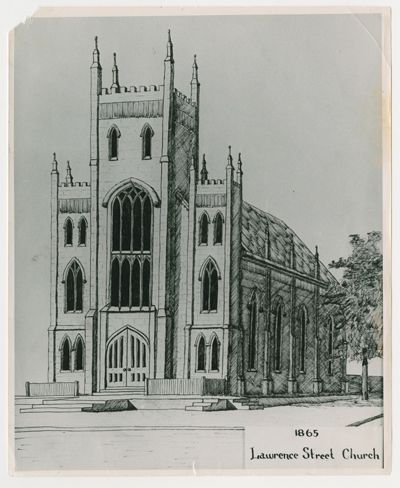
Lawrence Street M. E. Church
Surprised and pleased, Taylor asked if the entire party would be attending church. Assured that they would, he invited them to attend with him at the Lawrence Street Methodist Episcopal Church[3], offering to send his town carriage to pick them up at their hotel. Heyes gracefully accepted the invitation for everybody.
As they left the bank and prepared to board the street car, Heyes said, “I think we’re accidentally turning into Methodists. That’s the third Methodist Episcopal church we’ve been to in the last three months. I know why you asked him, Paula.”
“You do?”
“Yeah, I think you wanted to show him that Heyes and Curry are willing to go to church. I bet he still doesn’t believe it. That’s probably why he offered to send his carriage. He’s afraid we won’t come otherwise. You don’t mind, do you? It’s a Methodist Episcopal church, so you and Paul can take communion. That’s right, isn’t it?”
Wellington replied, “You mustn’t worry about us. I agree with Paula—her reason for asking, and agreeing to attend, was to create a good impression.”
“I don’t worry about you,” responded Heyes sardonically. “It’s just Paula I worry about. I promised to cherish her, remember? That includes finding a church where she can take communion, if I can. Let’s talk about the bank,” he continued, changing the subject. “I never imagined opening an account would be so much trouble.”
“It’s not, in the usual way,” said Paul, chuckling. “But it’s not every day they have a pair of retired bank robbers opening an account, or even one retired bank robber. Kid, if it works out for us to keep the primary ranch account there, which it may well if the two of you establish a good relationship with Mr. Taylor, we can just add your name to the account later if you come into partnership with us at the ranch.”
“Thanks. It depends on what Lillie wants to do—I know she’s got money in savings she’ll want to put somewhere. We’ll have to open a separate account for that. For now, I’ll just leave that money Armendáriz returned to us in the account where you put it.”
That evening, in their hotel room, Heyes turned to his wife. “Now you’d better tell me what you meant by saying to that banker that you had thought of another source of funding you hadn’t discussed with me yet.”
“Certainly.” Her eyes searched his face. “Hannibal, I’m sorry. I believe I’ve been rather tactless. I should never have said anything of the kind to a stranger. It made you look bad. Will you forgive me?”
“Oh, I—of course I forgive you. I’m not worried about what Taylor thinks.” He gave her a kiss. Stripping off his suit coat, waistcoat, and tie, Heyes sat down to pull off his boots. “But I am curious.”
“I was just wondering. Didn’t you and Kid try to stash away some of the money you stole? Or did you spend it all? If you put some of it away somewhere, you could use that money to make restitution.”
“I never thought of that.” Heyes stared at her. “That’s a good idea. We did put some money away—some of it was from that very robbery, in fact. We hid it in a small cave in a rock outcropping about half a day’s ride from the hideout, up in Devil’s Hole. It’s up higher than where the gang keeps their lookouts. We did take care to hide it properly. It oughta still be there. I suppose we could go up and get it. Lom wants us to go to Wyoming with him anyway. We could just take a little side trip up to Devil’s Hole—Kid and I could.”
“That would be a nice honeymoon trip for you and me, don’t you think? Kid could go part way with us, perhaps go to visit the gang and distract them from wondering what we’re doing up there.” She removed her hat and began unbuttoning her bodice as she spoke.
“He could just tell them we’re on our honeymoon.” Heyes waited until she had unbuttoned the bodice, then came up behind her to take it from her hands and loosen the laces of her corset. “Then they won’t have to wonder what we’re doing. And they’d leave us alone, too. No, don’t unpin your hair. I want to do that.” Putting his arms around her from behind, he unhooked the busk and removed the corset. As her skirt and petticoat dropped to the floor, she turned and stepped forward into his arms.
[1] q.v. the second-season episode “How to Rob a Bank in One Hard Lesson.”
[2] That has to be the explanation of the story that was told to Blanche Graham in the first-season episode “Journey from San Juan.” The informant had met Heyes and Kid, as “Barton and Slattery,” while they were planning to blow the P & H ’78.
[3] Properly the Denver First Methodist Episcopal Church, but called the Lawrence Street church until its move to 18th and Broadway in 1883, where a new stone church building was constructed. It is still there, occupied by Trinity United Methodist Church, the descendant of the Lawrence Street congregation. http://www.trinityumc.org/who-we-are/our-history