
Work Text:
This post is in honor of the introduction of Cogita and Enamorus to the Pokemon Trading Card Game, and of Enamorus soon arriving in Pokemon Home! Here’s the secret rare of Cogita and Enamorus that dropped two days ago, May 13th, in Japan:

I have been wondering for weeks now about why Game Freak chose Cogita as the character to introduce Enamorus. I adore the Forces of Nature for reasons I discuss below, and fairy-types certainly deserve the status of a “force of nature,” but why Cogita? Why are they such close friends, so close that Cogita almost takes her for granted, going so far as to “loan” Enamorus to you and assume that she will simply return once her time with you is up? I’d like to share my favorite theory and introduce the deep backstory of the Forces of Nature.
This post explores the connection between scholarly figures and major deities of nature in Japanese history, especially lightning, wind, and fertility. In my previous post, I discussed how Cogita is represented as a scholarly figure and even fulfils multiple ideals of a scholar through her mastery of poetry, knowledge of ancient Chinese texts, and distance from society. Before I begin, however, I want to acknowledge that the Forces of Nature are designed as original creatures. Those designs are very complex and have multiple references, including to genies and the Chinese Four Guardians. This is not a unified theory of all aspects of the Forces of Nature. I’m specifically interested in why a scholarly figure like Cogita is shown to have a close relationship to a Force of Nature, and that’s what I explore below.
Let’s begin with the Forces of Nature, especially the duo of Tornadus and Thundurus. It has been established in interviews with Game Freak that these two are based on the Shinto gods Fujin (the God of Wind) and Raijin (the God of Thunder). Game Freak also decided to include these two well before deciding to also add Landorus.
Here’s a very famous painting (by Tawaraya Sōtatsu, c 1600) that shows Fujin and Raijin as a pair:

This painting, originally made circa 1600, is so famous in Japan that artists have copied it, at times almost exactly, throughout the following centuries. It’s also extremely popular in Kyoto, for reasons we'll get to in a moment. At least one department store has decorated itself with the image, and you can find it within stores at times as well! Pokemon has borrowed some important details from this painting in inventing their legendaries, such as the fierce expressions of the monsters, the attributes of the gods (drums for the thunder god and gusts of wind for the wind god), the linear curve of the attributes and how they wrap around each legendary, Tornadus’ green color—and, if you look closely, you can see that they swapped the gods’ horns to adorn Thundurus and Tornadus! Here’s all four together, the gods and the legendaries:
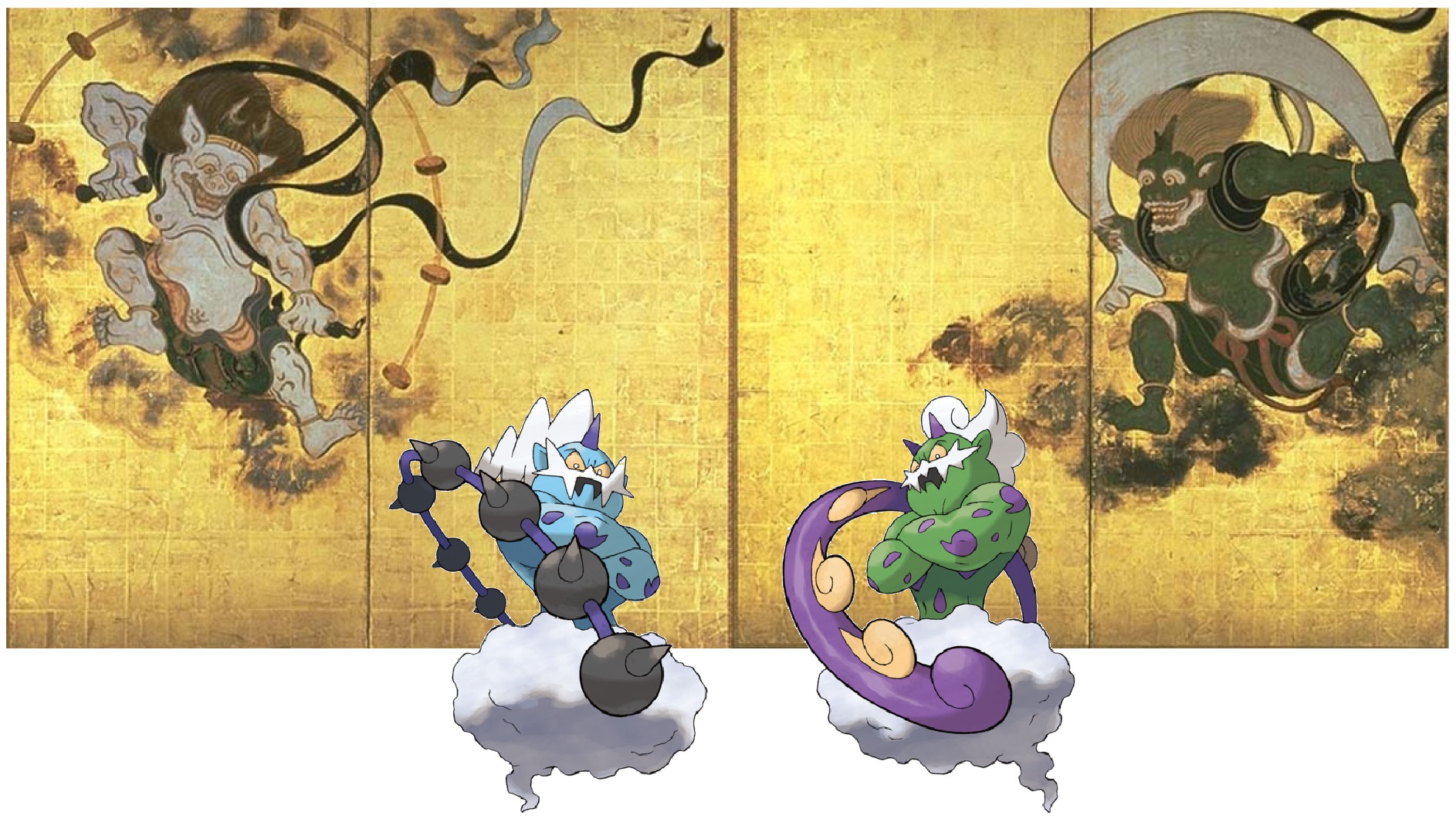
(Image by Dr. Lava)
So how do these Gods fit into the world of Pokemon? Most explanations of the original Forces of Nature trio focus on the presence of Fujin and Raijin in the Kojiki. In this interpretation, Fujin and Raijin are thought to be two of the eight thunder gods that emerged from the rotting corpse of Izanami, which her husband Izanagi witnesses as a haze of crackling electricity surrounding her decaying form in the underworld. Enraged at Izanagi for viewing her corpse, Izanami sends these same gods to hunt him down, but he successfully escapes to the world of the living. These events are described in the Kojiki, compiled c. 700 CE.
But there are a few problems with this interpretation. First, the Kojiki doesn’t explicitly refer to Fujin and Raijin, but to eight thunder gods. How did a haze of thunder gods become the well-defined and celebrated personalities of Fujin and Raijin? Second, Pokemon is not just a catalog of mythological creatures. Some logic motivates the invention of these legendary monsters and their reference to popular gods. So what can we say about the popularity of Fujin and Raijin in Japan?
These two forces of nature have a major role in popular worship through their connection to the religious figure of Tenjin, who has an especially strong tie to Kyoto. The story of Tenjin describes a specific act of cruelty that unleashes a series of natural catastrophes, which are personified as gods of the natural world seeking revenge for this wrongdoing. Only when the culprits recognize the wrath of the gods and seek to pacify them do they relent and take up the role of projectors of Kyoto and larger Japan. In the Pokemon anime and in the Gen 5 games, we see these gods rampaging, bringing storms and wind across the world. Humans, and at times, Landorus, have to intervene to pacify them, effectively retelling the story of Tenjin as the need for people and Pokemon to co-exist for their mutual benefit.
Who is Tenjin? Tenjin’s name means “the heavenly deity,” and he is very closely associated with Raijin and a host of other natural forces. Tenjin is the patron god of poetry and literature, of scholarship, and of students and academics, and every year thousands of students visit his shrine to pray for success on their entrance exams. Tenjin used to be a human. The god was once a noble, Sugawara no Michizane (845-903), who began his career at the court of the emperor, in Kyoto, in 867. Michizane had exceptional skill in classical Chinese, the main language of law and the imperial court, and quickly distinguished himself in poetry, diplomacy, and as a politician. He was an exceptional poet, and the anthologies of poetry he compiled remain a valuable subject of study in the present day. He rose rapidly through the ranks of court officials and quickly gained the trust of the emperor. His ambition and skill woke the jealousy of the Fujiwara family, the dominant faction at the court, and to preserve their own power they schemed to have Michizane unfairly exiled in 901. He died in exile in 903.
As the story goes, Michizane enacted his revenge from beyond the grave. The area around Kyoto was immediately struck with calamity: imperial territories were affected by plague and drought, while Kyoto itself was afflicted with severe storms and flooding. The emperor’s son, the crown prince, was possessed by Michizane's vengeful spirit. When a Buddhist priest attempted to calm the spirit, snakes twisted out of the prince’s ears and terrified the priest, scaring him off and bringing about the death of the prince. In the midst of the storms over Kyoto, lightning rained down and struck the palace twice, killing Michizane’s greatest rivals. This story shows the open rebellion of several forces of nature: life, the fertility of the land, storms, and lightning.
Notably, representations of these natural cataclysm provided the basis for the visual pairing of Fujin and Raijin. The original scroll describing this origin of Tenjin, dates from roughly 1219 CE. It has been copied more than thirty times over the course of history, and has thus defined the memory of Michizane and his vengeance. One such copy, from the late 13th century, clearly shows the gods of wind and thunder together, as emanations of the same being: the vengeful spirit of Michizane, raining chaos down on his enemies. Importantly, this shows him bearing the attributes of both the Wind and Thunder Gods—the bag of winds of Fujin and the lightning and drums of Raijin. It is possible that he was once considered to be or to control both beings, although this is unclear from the available records. In any case, the role of the Wind and Thunder Gods in this mytho-historical episode seems to define much of how they are understood and portrayed in the present day.


It took decades for Michizane to be fully pacified. In sympathy with his plight, Kyoto commoners began to worship him, at times directly acknowledging him as the thunder god. So did nobles, but they did so out of fear for his wrath and a sense of guilt. These worshippers thus firmly associated Michizane with the lightning, the storms, and the direct destruction of his enemies. The Buddhist priesthood struggled to mollify his raging spirit. In 970 they ultimately established a shrine, Kitano Tenjin-mangu, where they deified Michizane as the god Tenjin. Tenjin is thus very closely associated with the thunder god Raijin. Stories tell that he himself explained this connection further, as he appeared a Buddhist priest in a vision to clarify that Raijin was under his command along with several other unnamed entities. After Michizane’s family was put in charge of the shrine, the catastrophes ceased. Over time, worship transformed to recognize him as a protective deity and as a benevolent patron god of scholarship. This began with poetry societies that brought their compilations to the shrine to ask for Tenjin (the deified Michizane)'s blessing! In the present era, school kids and trained professionals come to Tenjin’s shrine to pray for success in their studies and careers. It’s for all these reasons that he is widely venerated in Kyoto.
This is why it is so compelling that Cogita is the one to introduce you to the Forces of Nature in Hisui, and to be the character who reveals the presence of a fourth Force of Nature and even seems to have it under her command. On the one hand, Cogita very much fulfills the image of a scholarly noble woman from Heian-era Japan—through her knowledge of and apparent skill in poetry, her familiarity with the classics, and her apparent restraint and taste. When it comes to Enamorus specifically, this puts her in the ranks of women who wrote frequently on matters of love and romance (without getting into the weeds, I’m thinking of Sei Shōnagon and Murasaki Shikibu), potentially placing Enamorus’ connection to love and romance in their cultural lineage. Meanwhile, her representation as a reclusive scholar, and her familiarity with in-game ancient history and religion and real-life classical Chinese and texts such as the Huainanzi, appeals directly to the very skills for which Michizane is (over a thousand years later) still admired. This scholarly image is directly associated with Tenjin, and the mythic history of his vengeance through the gods of nature itself. It’s extremely fitting that a scholarly figure such as Cogita, living in kind of self-imposed exile, would be the one who best understands and can even control the Forces of Nature.
Thank you for reading, and here's a bonus image of a Tokugawa-era woodblock illustration showing the snakes twisting out of the Crown Prince's ears (from the book listed below):

For a translation of the developer interview that discusses how Thundurus and Tornadus are based on Raijin and Fujin, and that they pre-date the inclusion of Landorus : http://lavacutcontent.com/ken-sugimori-nintendo-dream/
Here's a link to the scroll I showed above, which is held at the Metropolitan Museum of Art! https://www.metmuseum.org/art/collection/search/45428
For more on Michizane and how his worship changed over time, take a look at Borgen, Robert. 1994. Sugawara No Michizane and the Early Heian Court. University of Hawaii Press. Chapter 8, "Michizane as Tenjin," is especially helpful!