
Work Text:
Overture
“I go to London in a fortnight.”
“A girl like you in London? Don’t be taken in by the first silver tongue you meet. Lechers and rakes can see country girls like you a mile away.”
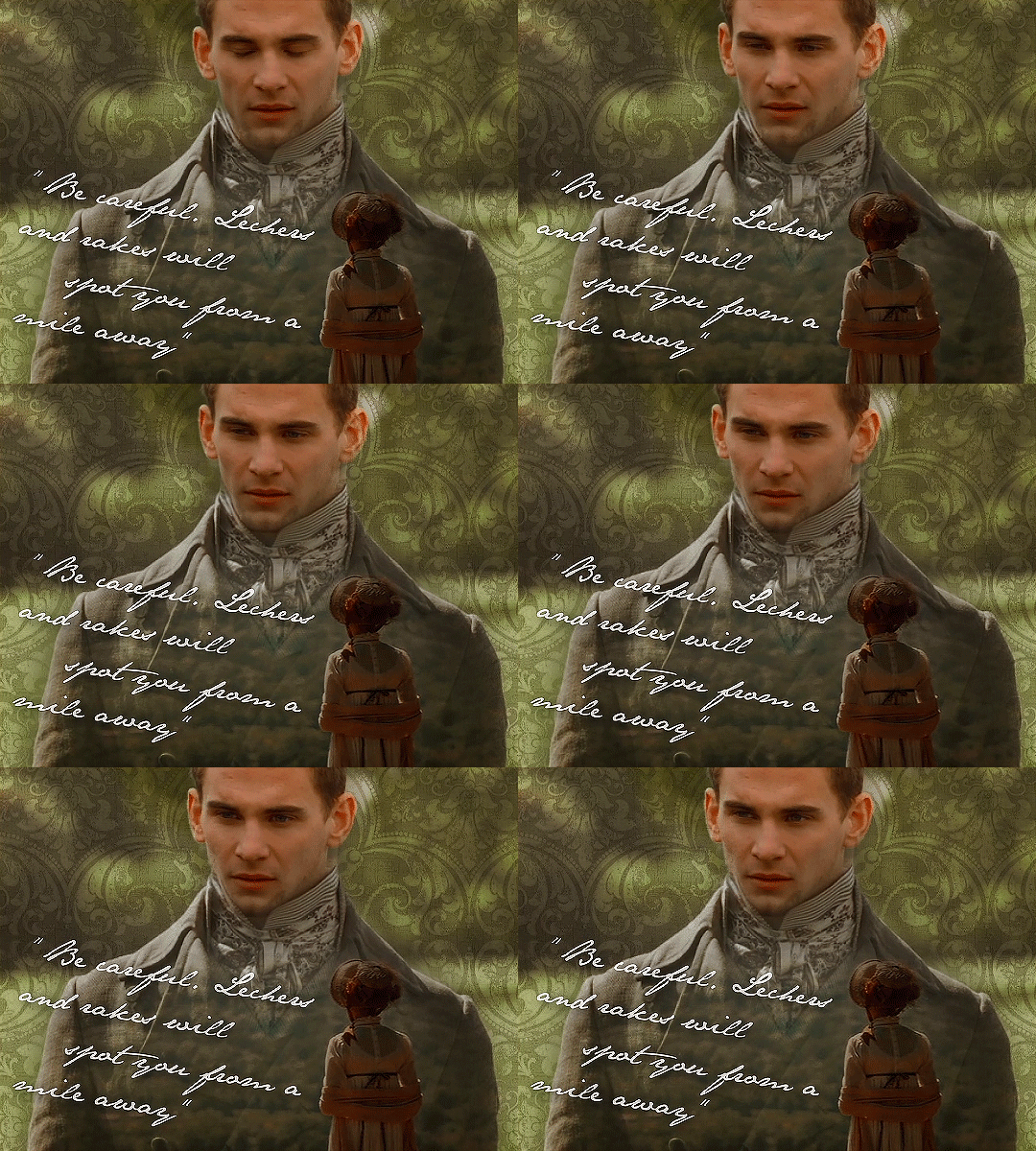
She hesitates, and then the anticipation of the coming summer takes over her mind and, unabashed, she speaks. “I was hoping to see you there. At a ball.”
He pauses, a sudden hardness freezing his brow.
“See… me?”
“Yes. I’m staying with the Peters’, they were ever so kind as to invite me to stay with them. It will be Bloom’s second season, but my first.”
Another shadow passes over his face, puzzling her, as do his words: “I don’t know why you’d see me.”
Confusion rattles through her bones.
“Because… because you go to London for the season too.”
There’s an interminable pause in which Musa feels like she’s hanging off the edge of a cliff.
“I’m going to London, yes,” he concedes. “But I don’t think I’ll see you there.”
She blinks, more bemused than ever. “Why not?”
“Because our families don’t go to the same balls, Musa.”
There’s a tension in his tone, a flinty edge whose origin she can’t understand. Instead she latches onto the last part. “It’s Miss Bishop, actually.” Or it will be in two weeks. She won’t be “Musa” to him, she’ll be the lady with all the formality that the London season abides.
“Alright,” he acquiesces but his smile is strained, like he doesn’t believe her. Like he’s indulging her. Like he’s indulging a child.
Anger flares through her, annoyed at his condescension. “Are you saying you’re choosing not to see me the whole time you’re in London?”
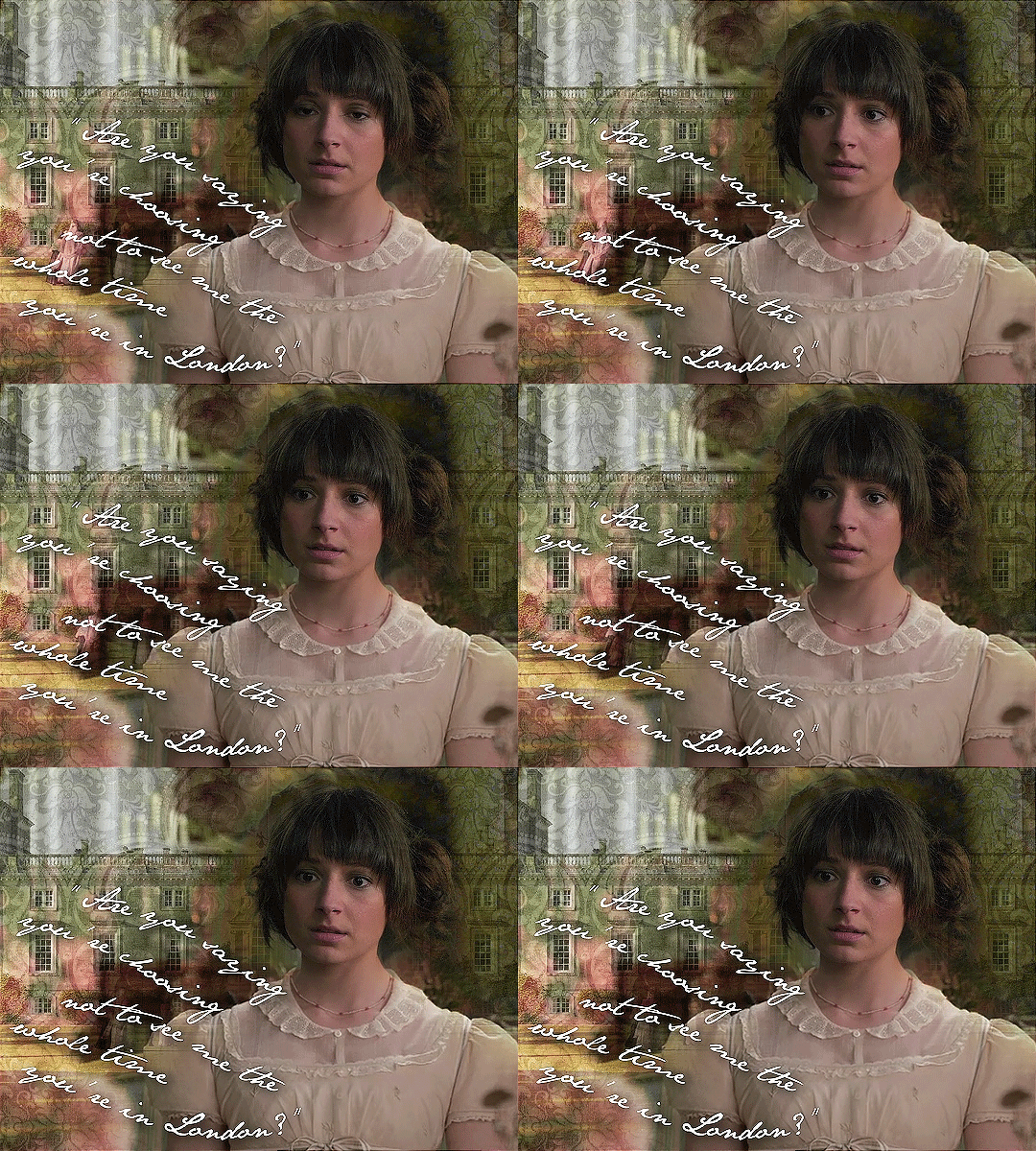
He’s trying to let her down easy but it’s the worst way to go about it. She’d rather he simply shout in her face.
“I don’t expect you to understand.”
“Then tell me. I’m not a fool, Riven. I’m not from Town but I’m not a fool.”
“It’s not important,” he says and his voice is as harsh as it’s ever been. “Don’t try to call on me. You won’t be received, and you’ll only embarrass yourself in front of the ‘ton.”
There’s hot pressure behind her eyes, and it leeches out in pinpricks at the corners. “What are you saying? That London turns gentlemen into scoundrels?”
“No,” he says tartly. “It turns simple girls into fools.”
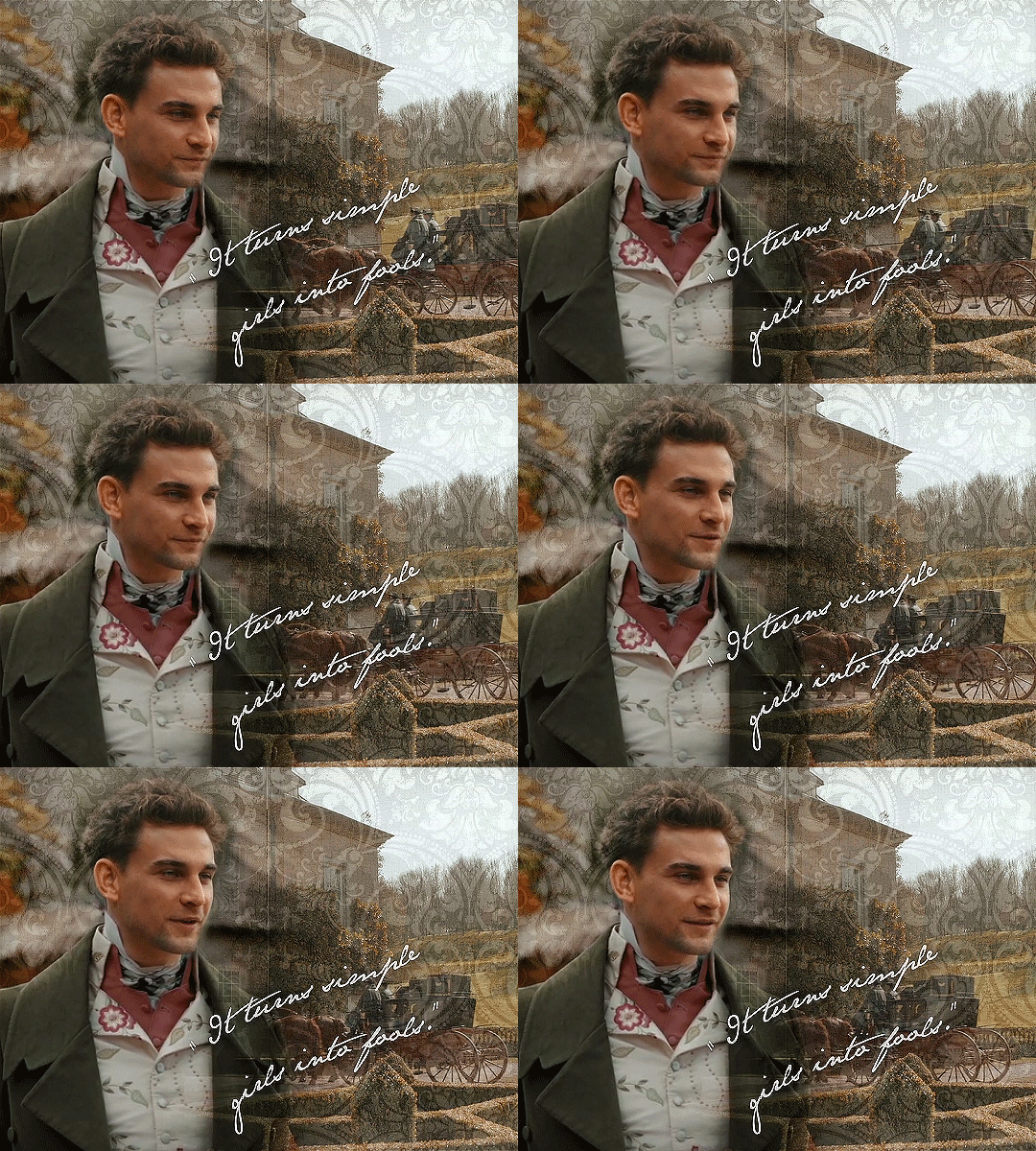
Without another word he turns on his heel, his jacket sweeping over his shoulder as he lopes away into the rain, his body receding with her hopes for the future.
Act I, Scene II
Dearest gentlereaders,
The ‘ton are abuzz with the beginning of the London Season, officially commenced at the Tennyson Grand Ball last Saturday eve. Congratulations are in order for many parties in attendance, some of which may be more well known to you than others. The handsome Sir Egbert the Younger, for example, deserves many accolades for his line of succession, which includes not yet his progeny but both the Ladies Pennyfarthing and Charmondeley, who each enjoyed his attention that night but not, I suspect, the company of each other.
Of course, all eyes are on the next ball hosted by the Grand Marchioness of Haxton. What fortunes await the young lads and ladies of the ‘ton in the Marquis’ labyrinthian palace and gardens? My sources delightfully inform me that the young Mr Sanderson has been calling on the Haxton household all throughout the winter. While his presence was missed at the Tennyson Grand Ball, undoubtedly all eyes will be on who will escort Miss Elizabeth Haxton at the opening of their long-anticipated promenade.
I, like my readers, will keep eyes and ears open for next week’s column. I might even provide an update on the lurid details that the Gwynfred family has attempted to hide from myself, their servants… even themselves, if the penniless Lady Whitford is to be believed.
Yours Sincerely,
Lady Whistledown
This wasn’t her first ball, and yet Musa could hardly manage to take in the brilliant colours, elaborate music, and swirling gowns and suits on the ballroom’s marbled dance floor. Over two months in London and she still marvelled daily at the formality and grandeur of her first London Season.
She knew the steps to most of the dances, at least. Bloom had ensured she mastered the basics, which gave her enough of a foothold to impel her way through the more obscure waltzes and line dances. Although she worried, she had not embarrassed herself beyond the normal mortifications required by the marathon that was courtship and introductions in the ‘ton.
Musa clutched at her left sleeve as she watched the revolving partners, the pattern of each step in sway with the lively reel proffered by the string quartet. She resisted the urge to tap her foot and imagined her own motions—a gloved hand on an elbow here, then just a finger against his next—
Even as she watched the dance she could not stop her gaze from flitting to the doors. She had memorised the face and fashion of every person at this ball, even though there were nigh on two hundred. She’d studied each countenance and each cravat and coattail ever since Bloom had left her at the door, scolded into various dances by her mother. She’d danced a half-dozen songs, respectable for a woman of her regrettably minimal station. Just as in the nine weeks past, she kept her eyes on the door, in anticipation—
“If I may be so bold,” came a mellow voice to her left.
Startled, Musa glanced to the side, certain as the sun that the speaker was not directed at her. To her surprise, the brunette was staring back at her, burnished face looking somewhat earnest above the high collar of his mauve suit. “You seek someone in particular.”
“I—” Musa caught herself before the inane denial slipped out. If this stranger was saying such to her, then she couldn’t have been as subtle as she’d been inclined to think she was. While her cheeks flushed she was careful to raise her chin. While some gentlemen were inclined to blushing daisies who fell apart upon a curious eye, she knew that such gentlemen were not for her; she was not a flower who wilted in the sunlight however scorching.
“I am caught out,” she finally admitted with a small smile. “And who might be my detective?”
“Dane Graham, miss…”
He trailed off while his right hand extended, and Musa supplied hers. His hand closed around her silk glove and he raised it to his lips while she curtsied. “Miss Bishop,” she replied. “Thank you for the pleasure.”
“I’m unsure you can make that assertion, miss,” Dane replied with a grin somewhere between smug and sly. “I am already at a disadvantage, for I am not the man for which you search.”
She swallowed, willing herself not to redden further. Nine weeks. Nine weeks she’d spent in Town, in the company of the Peters’, squeezed with Bloom into the same bedroom, the same narrow bed. She didn’t loathe it, of course. Her prospects had multiplied twentyfold in Town relative to life in the country. And Bloom was as dear a friend as anyone could hope for, sharing her bed and her home and her excitement for the Season.
But nine weeks. Nine weeks she’d attended balls and regattas and badminton matches decided by croquet rematches and picnics in Hyde Park and luncheons in the homes of families that invited the Peters.
Nine weeks, and neither hide nor hair of Riven Sanderson.
Not one ball. Not one regatta. Not one luncheon.
He’d told her not to look. He’d warned her away. So why, two months later, was she standing against the wall of yet another private ball, wearing her second-finest dress and gloves and shoes and fan—just to keep peering around the tailcoats and suit jackets for Riven Sanderson?
He was not here. He was not here, and she was being every bit the country fool he thought she was by advertising her earnestness.
She blinked and forced her expression into a polite smile, which was thankfully made all the easier by the dancing amusement in the gentleman’s eyes. “You are not he,” she replied, knowing she was courting fate but deciding that the man valued honesty over pretence. “Because, for the first item, you are here.”
Again, brown eyes twinkled merrily. Mr. Graham was here. Mr. Sanderson was not. That made Mr. Graham infinitely more appealing—not just here and now, but also for her prospects.
“And the second?” he queried.
Of course, Musa would not leave her praise of the man as his mere presence before her. “You have a kind countenance,” she replied. “I am unsurprised to have seen you dance with many a lady tonight.”
To this the man’s eyebrow rose, again his smile turning upwards into something more satisfied—almost sultry.
“Nay,” he answered. “Many a woman, perhaps, but not yet a lady.” Again he extended his hand. “Until present, I hope. I beg you, Miss Bishop, for your hand in the next dance.”
Act II, Scene VI
Dearest gentlereaders,
Here we stand at the conclusion of yet another London Season, and to whom shall we toss the joyous rice down the aisle? My first handful would be to the esteemed Dane Graham, who despite a noble birthright remains a somewhat surprising choice as the forever partner of the rather vapid Duchess of Roxbury. My congratulations as well to Lord Asteron for his marriage to the lovely Lady Fortinbras from Upper Saxony. I suspect that Lord Asteron will find his wife somewhere beneath her buxom neckline within a fortnight of their honeymoon!
And as always, while the success of certain families in the ‘ton sparked your loyal author’s penchant for gossip, so also did certain noted absences. One might wonder why the last two seasons have been missing the reputed Sanderson family. Indeed, one might presume that Lord Riven or his two sisters did not want to be found, despite the youngest Sanderson’s sudden marriage to Sir Ernest Waldrip. Many happy returns to the couple, whom no-one spied chaperoned or un-chaperoned the entire season! Perhaps the brevity of the courtship has to do with the senior Sir Sanderson’s disappearance from society?
Dear readers, I leave you with this news and look forward to another sensational season of the ‘ton come spring!
Yours sincerely,
Lady Whistledown
“You will find a smart match, Musa. I am sure of it.”
Musa breathed a deep sigh, luscious air feeding her starved lungs as Bloom loosened the corset. With her breathing stabilised she could not help but languish in the implications of her friend’s words instead of the substance.
“You have told me so for two years,” she frowned into the mirror.
Bloom’s firm gaze didn’t falter. “You could not be so beautiful and kindhearted and genteel for nothing,” she replied determinedly. She gently pushed Musa forward so she could step out of the gown, the petticoat, and her chemise all at once. “Mother has made new acquaintances, you will see.” Shoving the many layers of fabric towards the wall, she raised one hand to squeeze Musa’s elbow. “The Silvas are quite respectable. I am confident.”
“Wars could be won with your confidence, Bloom,” Musa sighed. She stared at her reflection in the mirror and raised both hands to her rouged cheeks. As if she hadn’t stared at herself in the mirror for three months, wondering what could be improved, what a marriageable man would want to see. She already knew the answer. She was too tanned, too thin, too… wanting. In other words, she was too poor.
Disgusted, she turned from the mirror to approach the basin of water at the window. “Will you not let me weep, first?” She gripped the basin much harder than necessary and immersed a cloth to scrub her face clean. “Then I will join you in your battle for my marital success.”
Bloom remained entirely unperturbed by her despondence. “Dane Graham was a mismatch,” she conceded. “But there are so many other gentlemen in the ‘ton. You will see. The Silvas are a good start. I’ve already corresponded with Sky, as you know. He promised to make introductions to the Harveys. That’s two families.”
Musa scoured harder at the rouge on her cheeks and the kohl at her eyes. “Always you plot,” she mumbled, mostly to the basin but Bloom was at her side in the span of a second, helping her hold back her hair to keep it dry from the water.
“Always I look out for my friends.”
That much was true. It was her second season with the Peters’ and yet they remained exceedingly generous with their time and their resources, extending to Musa the same invitations they received for the stunning and yet particular Bloom, who had turned down three separate marriage proposals in just as many seasons.
But how long would their generosity last? When Bloom finally found a man to her satisfaction and Musa remained, plain and penniless, at her side like a useless parasol on an overcast day?
“I’m sorry, Bloom,” Musa finally straightened up, the ice grip on her heart clenching tighter. “I simply worry. I’m a burden, and I always will be until I find a smart match. But no smart match will have anything to do with me.”
It hurt to say it out loud, to give voice to her fears, but it also served as a release to the pent-up stress from the last few months. Her lack of station and fortune weighed relentlessly around her neck like a millstone. The lack of opportunity constricted her lungs tighter than any corset. Tomorrow eve she would return home to Yorkshire; to the farm, to potatoes, to nothing. To worse than nothing: to dirt.
She had closed her second season with hardly a sniff in her direction. If she did not find a suitable young gentleman—forsooth, even an older gentleman—by the close of next season, then her fate would be decided for her. And it would involve Rowlf the pig farmer down the lane, or Mother’s ancient, decrepit second-cousin—or was it third, once removed—Mr Cuthbert of Bagnell Hall.
Spinsterhood would be better. At least she knew her brothers, even if she had to exist as a burden to them.
But neither fate stirred anything but utter panic in her. She would spend the winter practising, she resolved. She would practise her dancing; her manners and her curtsy and her guarded giggle behind a fan and her eyelash batting. Perhaps… Perhaps the Sandersons would return in the between-seasons, and she could ask Riven for assistance. Something could always be improved, she knew. She would mimic Bloom’s coyness and charms and guile. She had to; she could not bear another season of losing hope and increasing desperation—
A knock sounded on the door.
In their states of undress the women exchanged a look and Bloom, still mostly covered, hurried to the doorway and opened it a crack. In the dim light Musa could make out Cassandra the housemaid holding forth an envelope.
“A letter for Miss Bishop.”
Bloom tucked the loose hem of her chemise up to her underarms. “From whom?”
The housemaid squinted at the parchment. “A…a Sir Alfred Bishop. Stamped from Bombay.”
The two ladies stared at each other, Musa unsure if her own eyes or Bloom’s were more widened in shock.
Uncle Alfred? Musa had not heard from him since his letter to her father three years ago, that his position in India had been extended. And then nothing at all since her parents’ funeral. She had surmised that he had perished either in his state or on the transport ship back home. Otherwise he would have written regarding his brother’s death, would he not?
So stricken was Musa by the announcement of the letter’s origin that she did not, could not move from her position in front of the window. It was Bloom that reached out a hand to accept the envelope from Cassandra.
She at least had the strength to hold out one hand as Bloom returned to her. The words blurred but she recognized her uncle’s scrawled handwriting on the exterior of the envelope. That meant it was from him and not from the government, informing her of his death. She looked up at her friend blankly.
“Open it,” Bloom admonished, closing Musa’s hands around the beige parchment. “For my sake if not for yours! You’re white as a sheet.”
Finger by finger Musa’s hand unclenched, until she had enough wherewithal to slit the envelope open at the seam. The letter unfurled, succinct but precise, hardly half a page in her uncle’s miniscule script. Her eyes dashed over the page, scarcely absorbing the words.
“Musa?” Bloom pressed after a solid minute of Musa’s mind internalizing the letter and devolving into screeching mush. “Musa, what is it?”
She could hardly find the words. “My uncle,” she said, dumbfounded. With the state of her mind, her astoundment, she could not embellish, expound, or refine. She could only communicate exactly what was said in the letter. She handed it to Bloom so she could read it and confirm it.
“He wants to bequeath his fortune to me.”
Entr’Acte
The London season from the perspective of a young woman from wealth was decidedly more diverting than seasons past. For one, it was decidedly easier to secure a gentleman’s attention, which dramatically decreased the pressure to do so in the first place. For another, while Musa had not rushed out to every shop in Mayfair, she had upgraded her wardrobe to include ten evening gowns instead of the two she previously had on rotation. She felt physically lighter in them, from both the higher quality fabric and from the lack of weight of the future on her shoulders.
And now she could join Bloom elsewhere besides balls. She learned to ride, she learned croquet, she learned to stand and simper at the Cambridge-Oxford Regatta, waving a fan beneath a parasol while the men skulled up the canals. The Peters’ invited her on their trips to the lakes, not as Bloom’s companion but a guest of her own.
A relief, because Bloom’s correspondence with Sky had evolved from literary to full-on courtship. While she did approve of the young if contemplative blond, a part of her remained locked and tense when she joined them on chaperoned outings. His continued presence, and Bloom’s increasingly obvious approval to said presence, meant Musa’s days as Bloom’s companion were numbered.
Still, the days in general were improved from the last season. She had very few days to sit and embroider while waiting and waiting for suitors to call. But that did not mean that when she had moments to spare, she did not reflect on the reversal of her fortune, at how gentlemen that did not glance twice at her at balls of the seasons past now filled up her dance card in advance. She did not forget, and she would never forget, she resolved as she danced with some forgettable gentleman while dodging the anguished looks of Dane Graham. These men had not deigned to acknowledge her until she became something of potential value to them. She would not forget that.
And on top of her already-full social calendar, there was navigating her relationship with Uncle Alfred. He was kind enough to not to attempt to usurp her life, to ask her to live under his roof and bow to his every whim and fancy—nay, he preferred his solitude and to leave Musa as undisturbed as possible with her shared wealth. His service in India and a bout of malaria had left him somewhat faded, as if the sun had scorched some embers of life out of him. Musa made sure to call on him every Sunday afternoon, sometimes alone and sometimes with Bloom, always grateful for the fortune he shared with her and lack of demands he made along with it.
Luckily for her, Uncle Alfred still maintained some knowledge of life of the ‘ton before his service in India. For example, he recalled with fondness his kinship with the Harvey family, improving her introduction with them beyond the tenuous relationship represented by Bloom’s fiance Sky. For example, he approved of her increasingly serious courtship with the gentleman Samuel Harvey.
Act III, Scene III
Dearest gentlereaders,
My fondest compliments to the Lady Featherstone for breaking off her engagement to the rapscallion Sir Henry Midfield last week. As my loyal readers know, Sir Henry’s malfeasance against his own servants is a terrible example for newer members of the ‘ton. One will wonder, which will happen first: Sir Henry become a gentleman, or he sweeps a new naive gentlelady off her unsteady feet?
I also compliment the young mistress Musa Bishop on ensnaring her engagement to Sir Samuel Harvey. While the young lady has the benefit of a large fortune, she has not the fortune of beneficial breeding…but perhaps this is not necessary for the dashing and agreeable Mr Harvey!
In other news, rumours have swirled that Sanderson House is once again let. Its residents have been obtrusively absent the last two Seasons with hardly the whisper of a dormouse about their whereabouts. How long until Sir Sanderson once again twirls his moustache at a ball? Must we wait weeks to again witness the exploits of the young master Riven?
Dear readers, you know what I must say. Keep your eyes on this column for the latest gossip!
Yours sincerely,
Lady Whistledown
“I heard him say it was a smart match to his friend, Sir Grey,” Bloom said.
“Hush!” Musa remonstrated, putting a finger to her friend’s lips. Just because they were below the scaffolding of the grand ball didn’t mean anyone with beady eyes couldn’t spot them.
“What is so scandalous of a near-imminent match?” Bloom teased with a coy grin. “I’ll hear wedding bells by April. Mr and Mrs Samuel I. Harvey.”
“You are—”
Bloom smirked, and Musa wished to push aside her own self-satisfaction to wipe the grin off of her friend’s face but found she couldn’t bear it. “You are merely jealous our wedding will overshadow your own.”
“Nonsense,” the redhead teased again. “You put too much stock in a wedding, anyway.”
Musa’s reply was sharp. “I do not,” she denied.
Well. Perhaps she had ideas about her wedding. It would cement her as part of the ‘ton, for one, and not as a fortunate but undeserving outsider who fell into her station. And it represented a life above the Yorkshire dirt for once and for all.
And…
The girlish part of her still had daydreams about her wedding. Perhaps when she imagined it, she still saw a vague, indiscernible shape when she perceived her groom. Perhaps, no matter how she tried, she could not envision Samuel Harvey in that position.
Perhaps…perhaps she saw another man, one with a loping stride and sideways smirk, and flashing green eyes that gave away every detail of his inner life, instead of masked brown eyes that only reflected her own.
One that, despite the papers, she still hadn’t seen in three years.
Bloom smirked. “Ah, Musa. Are you considering… what happens after?” Her voice dropped even lower. “After the wedding, of course.”
Musa’s thoughts screeched to a halt although the vision of Riven didn’t leave. The vision of Riven, his smile and his cravat halfway undone and his gaze dropping from hers to somewhere below her neckline.
“I’m sure I don’t know what you mean,” Musa smiled back. “You think such a tall specimen as Sky Silva will concern himself with anything below his shoulder?”
Bloom’s eyes flashed with excitement. “I do think that,” she leaned in conspiratorially. “Because, if you’d like to know—”
But what exactly Musa was desperate to know stopped abruptly at the iridescent tones of Samuel Harvey’s posh London accent.
“She is handsome enough,” the man argued, while his friend—Grey, Musa recognized from the jawline and coif of his hair—scoffed in complete and utter derision.
The force of his antipathy made Musa freeze, her blood turning to ice, and although there was a roaring in her ears she could hear every word of Grey’s reply.
“Handsome enough to endure four decades of ridicule? Her inheritance is but a farce.” He turned to face Sam, away from the rest of the ball. “Sam, you old fool, I hope you’re looking forward to forty years of ill-gotten-gains.”
Ill-gotten gains? Whatever could he mean? Musa could not think clearly. Her fortune came from her uncle, came from her blood—
“What say you, you rake?” Sam’s voice was slightly put-out, but still determined like he had to prove a point. “Aisha is naught but a plaything for you.”
“Aye,” Grey agreed. All too willingly, although Musa’s gut instantly dropped for the sake of this gentlewoman Aisha. “And that’s why I discourage you naught, good sir. She will serve a good cover to those who don’t matter. And to those who do matter, they know you will continue notching the bedpost of Madam François. Men like us deserve playthings.”
Again Musa’s belly dropped—probably to somewhere in the cellar of this lavish household—and knew that her expression must resemble Bloom’s in front of her, pale as ghosts. “You call her a plaything,” Sam cut in, and a wild part of Musa hoped for salvation.A wild part soon dashed.
“A plaything she may be,” Sam continued, “but she also has just enough breeding to be a handsome wife.”
“Aye, she’ll take care of house and home,” Grey said smugly. “Meanwhile I’ll see you in Covent Garden… what, every fortnight?”
Sam grunted in agreement. “You know François will always have my calling card.”
“She is a whore of the highest art, I commend you—”
Musa heard little else. For one, because of the torrid ringing in her ears. For another, because Bloom grabbed her wrists and pulled her away, out from beneath the scaffolding, away from the torchlight and music and chattering ‘ton. She yanked Musa out in the garden regardless of their chance of being seen by the gentlemen.
Gentlemen. They were anything but. Musa’s skin crawled and her stomach roiled at the thought of either of them, much less the vision of Sam nary six hours earlier, smiling at her within the gazebo, his face a mask of joy and—and—
Smarminess.
Musa bent over and Bloom held her hair back while she retched into the horse’s food trough. A long silence passed, along with Bloom’s handkerchief with which Musa wiped her mouth. She could not think, could not give voice to the turmoil of excrement and filth within her.
“Bloom,” she stammered. “I—I cannot—”
“You cannot marry such a vile man,” Bloom finished her sentence for her, so firm and definitive Musa was spared having to feign an argument. “He is worse than a rake. He is… he is a fool and a lech and a godswound’s prick! You have a fortune, Musa,” she said, breathless with constrained rage. “You may choose whomst you love. You should not settle for less than you deserve.”
The rage was easy. The rage came as innate as breathing, that a gentleman—she should learn to stop using that word—would use her for her fortune and not for her— her. Full stop. Her qualities, her personality, her soul. Her.
She burned for days, weeks. A month went by and beneath the rage began to burn something harsher and more bitter.
Doubt.
Before she had been just Musa, with naught but her name and her self to market to young marriageable men. Then, this past season, she became Musa with a fortune, Musa with something measurable and desirable.
And yet she still ended the season as a spinster. The desperation crept in louder than before, with more black webs than she could fend off. She had something to offer, and she could still only land the worst of the worst. Bloom married Sky. She had no one but herself and her fortune, and soon she knew she would only have her fortune, for after much longer there would be little of Musa to go along with it.
Act IV, Scene V
Dearest gentlereaders,
Have you heard? The Queen’s Ball is nearly upon us! The season is nearing its end, my readers, and we shall find out for certain if Wilhelm Stuttgart is a suitable match for Miss Katherine Beckinsale. My only concern is that their engagement will upstage the to-be-certain announcement of Sir Craig Habersham with the elderly—I mean, elegant—Musa Bishop. I’m also told the Queen has her eye on which gentleman that Tiffany Parkinson will settle for come the turn of the evening.
Yours sincerely,
Lady Whistledown
Musa’s expectations remained low coming into her fourth and final season. Four was already stretching the limits of respectability; every time she appeared at a ball she knew to presume just as many appraising looks hidden behind fans as she was invitations to dance. After all she was two and twenty, well past the age of many blushing young ladies making their debut in society.
And what chance had she of anything besides the lowest of expectations? She had been utterly abandoned by Dane Graham at the opportunity of a wealthier woman. She had broken off her engagement with Samuel Harvey for what she knew to be justifiable reasons, but the rest of the ‘ton had considered whimsical and far-fetched. Musa received the message loud and clear, hating every syllable of it: Of course a lady should expect her husband to step out on occasion. She should be grateful he sought the attentions of a whore, whom everyone knew not to take seriously, and not a respectable mistress, who might tempt him away from marriage.
Really, she should be grateful to be married to such a lech.
That is what they told her, but Musa could never take such a sentiment in stride. Spinsterhood was better. Her brothers might work in the dirt, but their work—their lives—weren’t dirty. She knew their marriages and she knew her brothers and she would rather be an unwanted woman under their homely roofs than a desired woman under a gilded one. Not if it meant she had to live a lie.
And her confidence was already dashed given that this season was her first without Bloom. The redhead was a happily married woman now, and although Musa didn’t begrudge her her happiness with the Silva family, she did begrudge her own loneliness. Even the few occasions Bloom and Sky managed to attend Musa knew were numbered; while Bloom wasn’t yet with child Musa knew it was only a matter of time.
So it was with a new emotional low that Musa returned to the ballrooms, the picnics, the regattas. All bursting with people and yet somehow more lonely than before.
Because every eye that turned her way, Musa regarded with extreme suspicion. Was this a gentleman in search of a fortune and a wife, but not a companion? Or worse, someone who saw her age as desperation and thought she would settle?
Maybe she would, she thought as she returned to Uncle Alfred’s Kew Gardens apartments to make light conversation with the maids and turn in just a few hours before the master of the house rose for the morning.
What would be worse? A life of spinsterhood with her brothers, or a life with a gentleman she could only hope she could salvage?
She was going through the motions, she realised a few weeks in. Did she really intend to find someone? Or was she merely practising the role she’d idolised for years before Samuel Harvey had punctured the balloon that was life in the ‘ton?
Or—
She realised late one night. It had actually been punctured long before. Punctured by a loping stride and gentle smirk that turned wry and bitter as the rain fell harder.
It wasn’t life in the ‘ton that she had envied for her childhood years. It was life in which she might be married to Riven.
What a child she’d been. What a fool. It made her toss and turn at night, burning with humiliation and sheepishness. There were rumours aplenty that the Sandersons had returned to society and yet she had only glimpsed him once, a few weeks ago, at Reginald Harfinger’s garden party and he had never once looked her way. Not once. And she knew, because she kept him in her sights the whole time.
She hated being a fool. She’d already been a fool for Dane and for Samuel. The realisation that she’d been a fool for Riven since she could walk was enough to set her heart aflame with passionate ire. She was not going to remain a fool.
So she stepped back into the motions. She flirted harder, she titillated with her fan, she happily enjoyed the attentions of the older but well-meaning Sir Craig Habersham. He was prone to crankiness when the hour turned late, but until then he was a gentleman. He had his own respectable fortune. And he cared about her.
The engagement was coming, the aristocratic gossip Stella told her. It would be any day now. Craig had been seen leaving Uncle Alfred’s house alone in his finest tailcoat and hat. The moment was nigh. At the Queen’s ball, the rumours said. The grandest ball of the season.
It was, as luck would have it, also the second time in four years that Musa saw Riven.
How perfect that she had spent four long years craning her neck this way and that for Riven Sanderson only for him to finally appear when her head was fully turned towards another, towards comfort, towards security. Right when her well-deserved rest was in arm’s reach did Musa find herself at the Queen’s Ball, having just stepped away from the punch bowl to return her empty glass, and she turned and almost walked straight into a stiff chest and starched shirt.
She knew before she looked up to whom the chest belonged. Of course he would appear at the most dignified ball of the Season. And of course he would corner her when she had no defence.
She was no fool, she resolved, and drew herself up to her full height to meet Riven Sanderson’s jade green eyes for the first time in half a decade.
It might breach protocol, but she refused to speak first. She simply waited, her heart beating in her chest and her breath suddenly constricted beyond tell by her corset. Music from the ten-piece orchestra drifted between them, the distance of a thousand suns, a dance of mistaken tempos four years long. The moon shone brilliantly from above, making the shadows florid against his rich green tailcoat while the moonlight reflected her pale evening gown.
The music stretched, one long viola note accompanied by a chorus of violins. Musa held her breath, afraid her heartbeat might become visible against her throat, but she refused to blink. Not when she finally beheld those eyes she’s pined after for nearly two decades of her life.
Finally, when she thought the pressure in her chest might crack, he was the one to break. His head tipped downward and his knee baulked in, shifting his long and lean figure down into an unmistakable bow.
“My lady,” he said.
How strange. She’d heard those words countless times since she’d entered the ‘ton, but they sounded utterly foreign on Riven’s lips. Riven, who had called her a cad, a pirate, a princess in their childhood games. Now addressing her as a lady.
Perhaps it was sincere—as it was from the lips of every other gentleman present—but from Riven’s mouth she only heard a mockery. And so a mockery she returned, bending into a rough curtsy and speaking in a tone that conveyed anything but civility. “Good sir.”
He registered her antipathy at once, and although the Riven she knew was likely to return rancour tenfold, he allowed the sentiment to roll off of him with one genteel wave of his hand.
“I am… I am here to offer my congratulations,” he said with all the stiffness of a century-old mantle. “Regarding a Mr. Craig Habersham.”
“Thank you,” Musa returned in equal rigidity. “I accept your congratulations.”
“This is… a pleasant evening, do you agree?”
Gods, saints, and angels. Riven Sanderson waltzed back into her life to attempt inanities and chitchat.
She glanced around at the carved ice swans, the hundreds of lanterns, the servants milling about bearing the finest French champagne and canapes. “Yes, Sir Riven, in general the queen is known to put on pleasantries.”
Something seemed to slide off of his face at that—the veneer of vacant niceness that balls typically required. A ball of both relief and thrill rode through Musa’s stomach; the false chatter would be no more, and the real reason for Riven’s appearance would be revealed.
“Tell me, Musa. Is it a sure thing? Not for you, but… is he truly a good man?”
At the easy slide into her Christian name, at the bald faced, guiltless question, Musa’s apprehension curdled instantly into indignation.
The gall. The gall of this man to return to her life and ask her if the engagement she’d sought since she set foot in London was what she truly intended to do. Not to mention that he’d appeared now, in her fourth season, when she was at the end of her eligibility and with an added fortune to boot.
He stank of Samuel Harvey—except worse, because up until a few weeks ago Musa had thought that she missed that odious scent.
“And why, might I ask, would an absent scoundrel like yourself concern yourself with whether or not my fiance is a good man?”
A strained look darted across his features, darkening his expression not from irritation but from guilt. “Because… Because I want to ensure the best for you, Musa.”
“And not because you have some hairbrained, cockamamie idea about courting me instead of Mr Habersham?”
He froze, his shoulders cocked as if he was about to step towards her but halted himself just in time. His Adam’s apple bobbed and Musa’s indignance flew into panic.
It was true. He was here to court her. In the eleventh hour, right after she was one step from securing her future.
Of course. Of course Riven would again ruin the one thing she looked forward to: if not her first season, which he ruined with his haughtiness and pride, then her engagement—nay, her marriage because his whim was tickled?
“Musa,” he started again, his voice hoarse with sincerity. “I know how ridiculous it may sound. But please, I come to you stripped bare, laying out my life to your judgement.”
“Then I judge you as wanting.”
She spun on her heel and strode forward but—astonishingly—Riven’s ungloved hand reached out and caught her elbow.
Whirling she hopped back as if struck by lightning, and Riven had the manners to do the same, releasing her arm at once and granting her several feet of distance.
“Musa,” he said, and Musa could hear a foreign note of pleading on his tongue. “My intentions are nothing but beneficent—”
She shook her head, her breath tightening as she swelled with anger. “Oh, is that true? Where was this beneficence, as you so call it, when I was the one beseeching you?” She had to fight to keep her voice level and not spit the words forth. “Nothing has changed in me, only my circumstances."
"That was years ago,” Riven argued back, and although Musa hated the words, at least he returned to the argumentative rascal she had come to know, and not this strange supplicant she hardly recognized. “We both have changed, do not try to deny it---"
"You are right,” she shot back, crossing her arms over her chest so she didn’t point an accusing finger at his. “I am much more cynical now. The world lost its lustre when you rejected me so cruelly."
Something deflated in his posture, and Musa relished it. She revelled in the hurt she was imposing on him, even if it was a fraction of the anguish of her last four years.
"I was never cruel,” he said after a beat. “I was realistic."
She shook her head again, brow furrowed in equal parts confusion and frustration. "What does that make me, now? Am I more real to you now that I have connexions?"
"Musa, please---"
"Why should I listen to you?"
"You shouldn't."
Whatever reply she was expecting, it wasn’t this. Unnerved, she fell silent, caught off guard by his acquiesce. He flexed his shoulders beneath his tailcoat, clearly uncomfortable but still determined.
"I am aware that this reversal is cruel and unfortunate. I am aware I sound like a monster and a lech." He swallowed. "If I may speak, not as a suitor but as a friend."
She surveyed him with narrowed eyes, ready to condemn him for the sins he so readily confessed, but something stayed her hand. "You may."
"When I... rejected your advances, those years ago. Perhaps I was cruel. But I only did it to protect myself, and my family."
Although this was news to Musa—an excuse, of course—she did not speak, not deigning to beg him to continue.
He stretched a hand out as if asking her to remain in place and listen to him. "The Sanderson line is bankrupt. We were—some might say still are—living on borrowed time and borrowed money.”
The news barrelled through Musa like a draft horse. The Sanderson family, bereft of their fortune? The horses, the servants, the acres and acres of grounds—bankrupt?
“My parents I care not,” Riven continued despite Musa’s bewilderment. “For it is because of them we are in the direst of circumstances. But I do care for the safety and security of my sisters."
Her breath caught in her throat, transfixed despite herself.
"I loved you then, as I profess to love you now. But I could not entertain your interest. A marriage of love was not in my cards. I thought only of Rachel and Charlotte and their safety. Not even their comfort, mind you, but their safety.”
A roaring, red sound filled her ears. How many nights had she lain awake wishing for the exact same thing?
“I am certain you saw the news, as everyone did. Charlotte has secured a most advantageous marriage.”
Another freight ship’s worth of emotions slammed into Musa. Jealousy at Charlotte’s success; disgust that her security had to come the way it did. Anger that Riven felt the need to explain his family’s fortunes so explicitly.
“Please, Musa. I know that look,” he said with a pained expression that marred his brow. “You must believe that I know my sister. It is not just an economically advantageous match; would you believe she is also happy? And that Rachel is also happy to live with her while she seeks her own husband?”
Begrudgingly Musa forced herself to recall their past summers, Riven’s overprotectiveness of his sisters; even the time they put on a play for the rest of the town and Riven allowed them to dress him as Rapunzel in all the costuming the role entailed.
At last, she swallowed, acknowledging Riven’s point with a simple, “I did send her my regards. I am happy for her.”
He paused, eyes on her and…flickering? In the lantern light behind her. It was almost too dim to read his expression, but she knew Riven. She knew the tension he still held in his jaw, his shoulders.
“I thank you for… believing me. About Charlotte.”
Despite her bitterness, Musa relented against the accusation. “You know I care for your sisters. I am not heartless.”
He shifted his weight, his arms swinging forward to clasp his hands together and then swinging back open. Musa blinked at his obvious discomfort although she was still disinclined to indulge him.
“To tell the truth, Musa. Miss Bishop.” He cleared his throat. “Seeing Charlotte happy finally allowed me to consider my own.”
A flame crept up along Musa’s insides. She had done this dance before, she had experience with this part.
So why did it feel… less bound when with Riven?
“My own missed happiness, Miss Bishop.” He lifted a hand to rub across his brow and then swiped it away as if suddenly settling his mind on an important matter.
“My own missed happiness that is my own fault. Would—” he faltered and blinked, then stepped towards her. “Would that I had the courage to propose to you at the time of your first season. In truth, Miss Bishop, I am a coward. I let my fears overcome my desires.” He tugged at the collar of his tailcoat. “You must accept that they were in pursuit of the safety of the ones who depend on me."
She let the words wash through her, steep like chamomile in her stormy teacup of a mind. Riven, adrift, seeking her in his own gale.
He was a self-admitted coward… but… was he? If it was in pursuit of his sisters’ security?
She rubbed two fingers of her gloved hands together, searching for a suitable response. In the vexatious cacophony of her mind, nothing came—nothing but the most basic, nothing but the truth, much as Riven had ripped off his own mask.
“So,” her breath caught and her gaze flicked away before returning to his. “I was right. You did love me, then."
"I did,” he answered immediately. “I do."
He stepped towards her, heat overcoming her senses, his broad chest filling her vision. She had to lift her chin to keep his earnest gaze in her sights, the tension with which his green eyes bored into her. Not her gowns or her fans or her satin gloves… her.
"You have every right to spurn me. I was a coward. Perhaps I still am. But I am no longer afraid to say what is in my heart.” He was only a half-step away from her, barely a heated breath between them. “You are, Musa,” he murmured, and although the volume of his voice dropped the intensity remained. “You are carved in every inch of its surface. Your name, your kindness, your beauty.” He lifted one hand to trace the long tendril that arced from her brow to her jaw.
“If you reject me now I will be silenced forever more. I have ensured my sisters are cared for. I will rest, even if I will not rest easy. But my heart will always be etched with your name."

“Riven,” she breathed.
She wanted to hate him, every fibre of her. Four long years of long days and longer nights seeking him, missing him, aching for him. And finally he was here before her, and she was not sure she could close that half-step.
“Musa,” he reached for her hair again but then let his hand drop. “More than my happiness, I value your own. I have said my piece. You may make your choice. But please.”
He trailed one hand down her arm, the warmth radiating like a beam of sunlight where his flesh met the satin, sending shivers up to her shoulder and goose pimples down to her fingers.
“Consider me, Musa. I want to make you happy. I want to make my marks on you the way you have impressed upon me. Think of me, Musa.”
His fingers intertwined with hers and he lifted it to his lips, pressing plush lips surrounded by fine scruff that she could feel through the fabric.
“Please, Musa. Consider me.”
Reprise
Dearest gentlereaders,
You are most likely just as surprised as I to see this column appear in your letters outside of the London Season. And you are likely just as surprised as I to read about the marriage of Sir Riven Sanderson with the young Musa Bishop. Our greatest compliments to their nuptials and forthcoming life in Sanderson House. This might be my last column involving this uncommon pairing.
Yours sincerely,
Lady Whistledown