
Work Text:
[Continued]
...
X was playing in the Playground with Four as usual. They went for a walk with each other, Four was enjoying his time but X seemed once again down.
His face filled with worries as he noticed X's expression, he asked,
"X, what's wrong? You look distressed!"
"Oh, I don't know, I just don't know what I am, what my value is..."
"Then... Let's go to the equation playground!"
[*Radio Martini by Kevin MacLeod starts playing*]
So...
"So X, would you like to use the bench like last time, or use the see-saw?"
"I think I'm more comfortable with the see-saw."
"Sure! So we put you on one side... take something else... and put it on the other!"
Suddenly, the see-saw started swaying back and forth uncontrollably, making X dizzier and dizzier.
"Four!... Stop this please..."
"Sorry X! Let me try this instead..."
4x2 + 7x - 15 = 0
"Hey, it's equal! But how could we ever solve this, it doesn't look like there's anything to do!"
"Don't worry, we can make a formula so that we can find your values quicker in the future! I'll turn the numbers next to you, which are the coefficients, and constant each into a, b and c!a"
ax2 + bx + c = 0
"Four, why did you make it + c, I thought it would stay - c because we had - 15?"
"Well, we're making a formula so c could equal -15 and that would be the same as minus 15! Anyways, I'm going to have to add some more to do this!"
4a2x2 + 4abx + b2 = b2 - 4ac
(subtract c, multiply by 4a, add b2 on both sides)
"It looks way too complicated! We could never figure this out?"
"Don't be scared, X, we can! First, I'm going to split the left side a bit."
(2ax)2 + 2*2ax*b + b2 = b2 - 4ac
"Wait, how did the 4a2x2 turn into (2ax)2?"
"You see, (2ax)2 is the same as (2ax) times (2ax), and we can calculate that! 2*2 is 4, a*a is a2 and x*x is x2! So that's why we can turn it into (2ax)2! And for the 4abx, it's also just 2*2 and I split the b out!"
"Ohhh... But what did you do all of that for?"
"Well, that's the next step! If we look closely, we can see that it's a sum of two squares, and it's 2ax and b in this case! We can turn that right into this...!"
(2ax + b)2 = b2 - 4ac
"Four... What do you mean a sum of two squares? How did you turn something like that into something so simple like this?"
"We have the following formula:"
(a + b)2 = a2 + 2ab + b2
"But how could they possibly be equal?"
"They are if you just calculate it out! Watch!"
(a + b)2 = (a + b)(a + b) = a*a + a*b + b*a + b*b
= a2 + ab + ab + b2
"With multiplication, we can change the position, and when something is added twice, it's the same as multiplying by two!"
a2 + 2ab + b2 = (a + b)2
"And there we have it! But anyways let's get back to the equation!"
(2ax + b)2 = b2 - 4ac
"X, do you know what the next step is?"
"Oh Oh! I think we have to get rid of the square. So... we put a square root on both sides, the left cancels out and we're just left with 2ax + b!"

"Oof!"
The see-saw started shaking and the sign turned into not equal.
"X! Remember when you square any number, the result will always be positive. That means when you square a negative number, it'll turn positive too! So we have to take that into account here too, by adding a ± sign!"

"Oh I get it! Now we can put b on the other side! But we have to switch its sign!"

"That's right! I'm glad you learned your lesson from last time! Now finally we can divide the other side by 2a!"
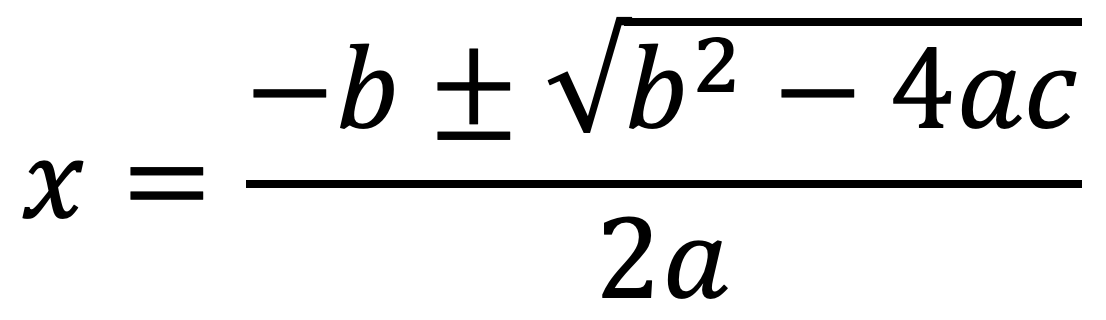
"Oh hey, it's just me on this side now!"
"Yeah, and we also have the formula! We can use this to solve for our original equation! We can turn all the a, b and c back into our coefficients and constant, that is 4, 7 and -15!"
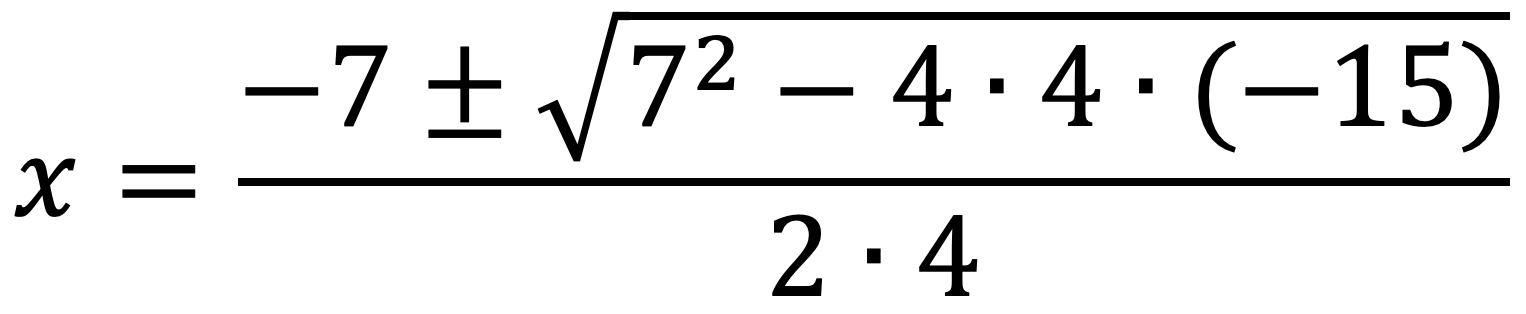
"Four, it looks complicated again!"
"It's easy if we work from the inside out! X, could you do the multiplication of the 4*4*(-15) and 2*4?"
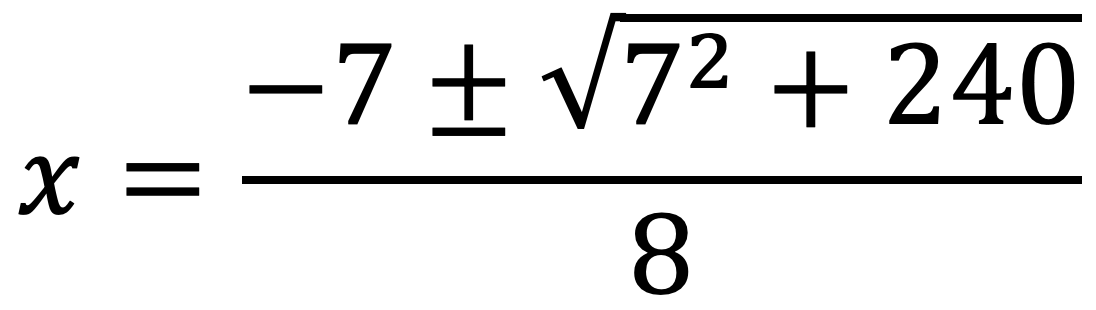
"I think I can! 2*4 is 8, 4*4 is 16 and 16*(-15) is... negative... 240! And we put it like this!"
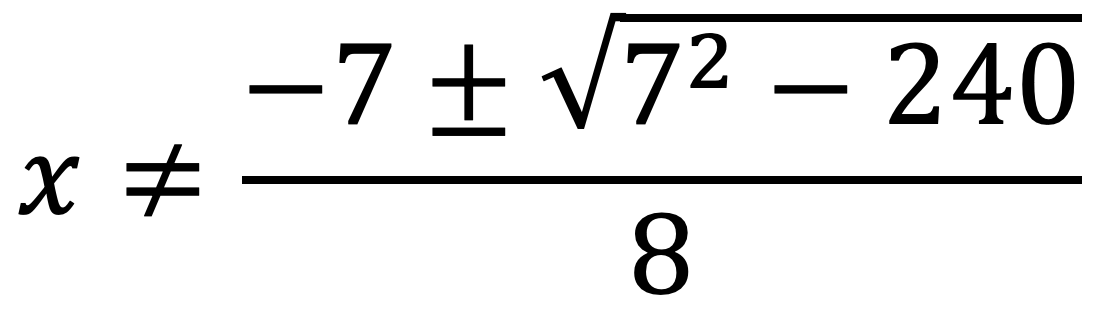
The square root started wobbling violently, making the whole see-saw shake as well.
"What did I do wrong, Four?"
"You're subtracting 240 from 72, giving a negative number in a square root. Negative numbers in square roots are very dangerous! You're supposed to subtract by negative 240 or add 240!"
"Sorry..."
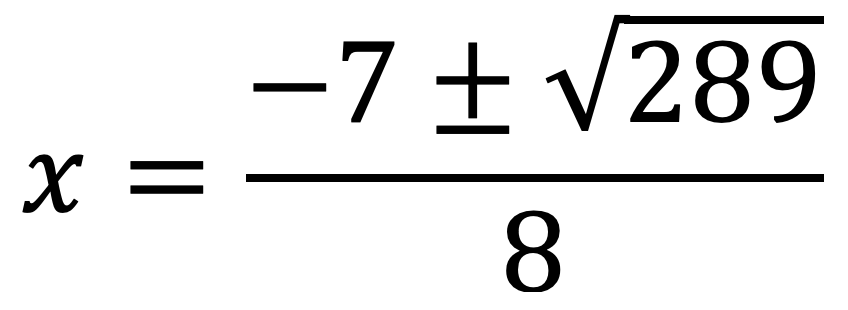
"It's fine, we all make mistakes but we can learn and fix from them! Next, we calculate 72 which is 7*7 or 49! Add that 240 to it and we have 289!"
"Now what, Four?"
"We have to find the square root of 289. I'm sure it's an integer so we can just find the square root by making a squares table. We know that 289 is larger than 102 or 100 and smaller than 202 or 400, so we can just list the squares from 11 to 19!"
(Just use the square root on your calculator)
Four feeds the range into a machine that squares the numbers, it then displays:
112 = 121
122 = 144
132 = 169
142 = 196
152 = 225
162 = 256
172 = 289
182 = 324
192 = 361
"We can see that the square root of 289 is 17 so we put in 17!"
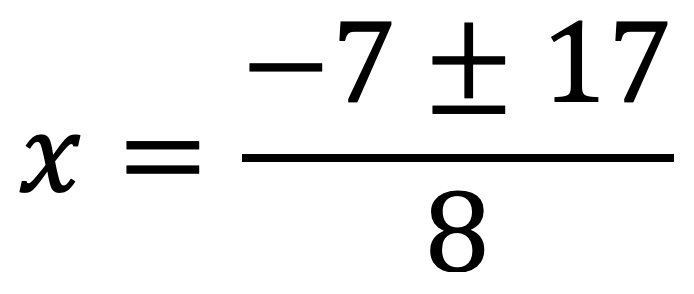
"Now you can decide on this part X! Are you feeling more positive or negative?"
"I think I'm feeling closer to negative!"
"Okay, so that gives us -7 minus 17 which is -24!"
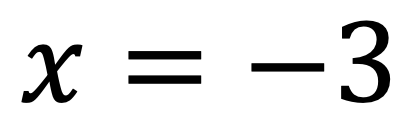
"Oh I know! Now we divide -24 by 8 and get -3! What's next, Four?"
"What's there left to do!"
"Oh! So I'm -3!"
"Yeah! But remember how I said you can choose between positive and negative?"
"Yeah?"
"Well if you're ever feeling like you're not -3 anymore, you could go back to the previous step, add 17 instead and do everything else the same, see if that helps then!"
(The other root is (-7 + 17)/8 = 10/8 = 5/4 or 1.25)
"Alright! But I'm happy knowing who I am now, what my value is!"
"Yeah, and I'm happy being with you too!..."
[The End]