
Work Text:
Prologue: Two Women
London, May 1892
Isobel fell in love with the circus the day after her 16th birthday. It wasn’t a conscious, well-considered decision, unlike the three times she allowed herself to fall in love with a man in years to come. No, the circus took her heart without asking permission, without applying, without obeying to Isobel’s rules. She would neither check the circus’ references, nor would she ever question what her heart told her. The circus just happened to her, and she let it be.
That glorious day her father honours his promise and takes her to the field outside the city where the big top has been set up. It’s quite a sight: the large main tent is surrounded by many smaller versions of itself, the heavy turquoise-and-yellow-striped canvas hiding secrets and wonders and miracles Isobel has never seen before. The tents form a large half-circle around the big top, inviting those spectators that came too early for the show to begin to walk around in between the tents and spend some time, and hopefully some money as well. Isobel takes the arm of her father as they slowly enter the grounds illuminated by the mysterious light of a hundred or more torches. The sound of their flickering lights burning in the mild northern wind of that mellow May evening merges with a dozen other sounds, the shuffling of feet on the grass, the sound of wild animals hidden away in cages, the brass sound of a band rehearsing in the chapiteau. Getting deeper inside, the sounds start to mingle with scents, even more mysterious and promising than the noises: the smell of sand and popcorn, sawdust and caramel apples, animals and lemonade.
Each smaller tent’s entrance curtain is wide open, a torch by each side, so the passers-by can see the little miracles inside: whether they sell ginger beer, roasted almonds, or a look into the future by a beautiful gypsy woman.
But the tents are not the only place the colourfully clad circus people can be found – strolling around the pathways in amongst the spectators are jugglers, ballerinas with balloons they give to the smaller children, and clowns doing silly pantomimes, suddenly appearing right next to you, and gone before you can take a second look.
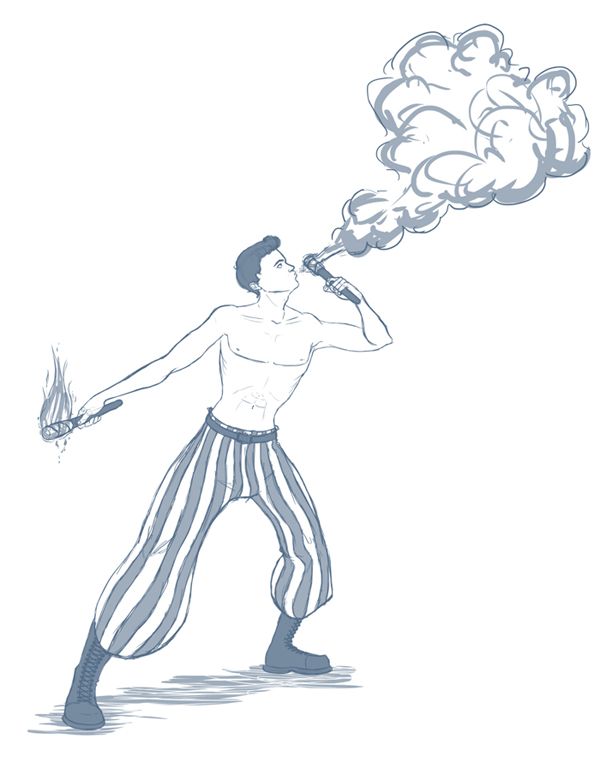
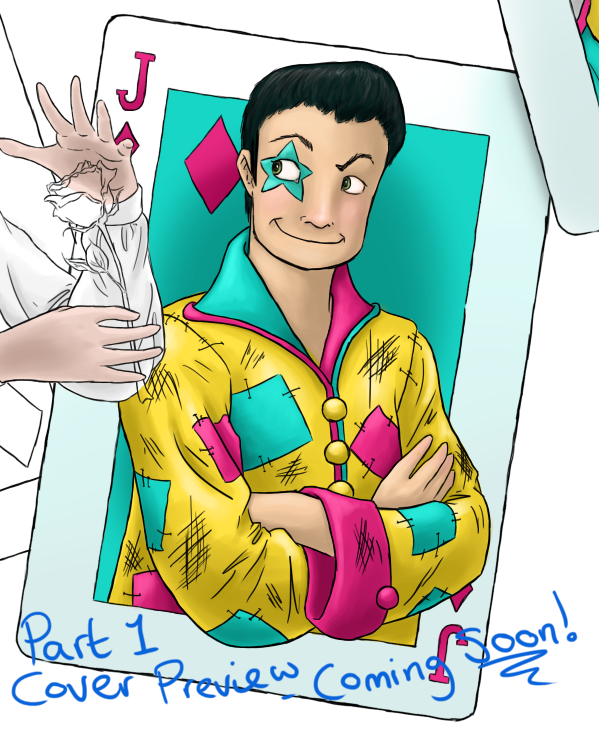
Passing another tent, Isobel’s eyes catch a young man in red-and-white striped baggy trousers and heavy black leather boots, his broad chest bare and strangely gleaming, his muscular arms holding something that Isobel thinks to be a burnt-out torch. As if he’d noticed her questioning eyes he holds up the torch to her and looks at her with big blue eyes and a small smile on his face. His lips purse and form an “O”, and he breathes to light the torch with a fire so white it nearly blinds Isobel. The white flame leaves the torch, lifts up into the sky, and cracks into a million little flickering stars that softly fall back to the earth. When Isobel looks back at the fire-breather, he’s gone. Right next to her, a cheeky voice with a northern tongue screeches “where’s he gone, where’s he gone!!?” Isobel turns and looks into the painted white face of a young lad, an expression of utmost bewilderment in his face, his green eyes sparkling with mischief. A black star is painted around his left eye and his suit is so large he’d fit in it three times, sewn out of so many different colourful patches he could probably be seen from the moon. “Where’s he gone!?” Isobel looks back to where the fire-breather was before and when she turns back to say “I don’t know either!” the clown is gone. Where he was another young boy in a black suit with a long frock-coat, polished black boots and a black top hat is now standing, smiling at her, the brightest and sunniest smile Isobel has ever seen. He waves her closer, and since he’s a lot smaller than the clown Isobel slightly bends towards him while he moves closer to her, sends his hand out and grabs a single red rose from behind her ear. He lets out a small “ooh”, smiles delightedly and hands her the flower. Then he takes his hat off, bows politely and walks on. Isobel is glad that he doesn’t disappear like the other artists, but within no time she can’t make out the man in his top hat in amongst the crowd of people. She turns back to her father, who smiles at her, takes her arm again and leads her further into the grounds. In another tent a young man with bright blonde hair sits behind a polished black piano and plays a slow tune. He’s wearing a red hussar’s uniform jacket with golden buttons and epaulettes. This tent has a wooden floor and Isobel soon finds out why – seemingly out of nowhere a beautiful blonde ballerina in a white tulle dress dances in and starts dancing and pirouetting around the piano. At one point she allows herself to sit down next to the pianist, gracefully, carefully, so to not interrupt his play, one hand on his shoulder, swaying with the music. The pianists’ fingers tinkle on, but his eyes are on the ballerina only. He smiles at her in a sad way that makes Isobel’s heart miss a beat. She would love to watch the ballerina dance longer, but her father softly steers her away. “There’s still so much more to see, Isobel.”
And the show hasn’t even started yet.
Outside the tent the fire-breather stands, waiting for someone who wants to see the fire. Isobel sees another young man approaching him, tall, dark and handsome, and though he’s not wearing some sort of costume, the way he moves reveals he’s a circus artist, too. “One for me?” she hears him ask. The fire-breather smiles and nods.
This time the sparkles don’t fall back to the earth, they lift off and dance around above the two men’s heads, before slowly dying down.
The show has begun.
Three years earlier
With one last careful stroke Jan Williams smooths the dark green silk of her dress, straightens her back, puts on her most confident smile and knocks on the black wooden door of No. 45. This is not a courtesy visit and will most likely not be a very pleasant meeting, but some things just need to be done. This was yet one more of these things Jan would've never imagined herself doing, not for herself and surely not for someone else. But ever since Sally and Robert became part of her life, she has found herself doing things she would've despised herself for before being a mother. If this was the way forward for Robert, so be it.
The door is opened by an elderly man in the livery of a butler. The respectable neighbours around here probably thought Hudson was a respectable butler. Jan supposed they wouldn't even believe half of what she knew about him.
“Good afternoon, Bernie.” The smile on Jan's lips belies the completely insincere character of her cordiality. She isn’t an inch interested in him having a good afternoon, nor is she unaware that you don't address a butler by his first name.
“Hudson.” Bernie answers with a sour expression on his face.
“No, Bernie, it's 'Good afternoon, Mrs Williams', actually. I see you still have a lot to learn about your new profession.” Jan doesn't fail to accompany her lesson in etiquette with a sweet smile.
“What do you want?”
“And again, Bernie, I hate to correct you, but that surely isn't the appropriate question. And it's not very polite either. How about 'Who would you like to see, madam?' It's friendly and adequate.” This time Jan's smile is so affectionate that Bernie momentarily believes she might be really well-meaning.
“You come to see Nigel?”
Jan decides against correcting his grammar, or the fact that 'Hudson' has just called his master by his first name. After all, she hasn't got all day and the last train back to Stoke is in only three hours.
“Yes, Hudson, I'd like to see Mr Martin-Smith, please.”
With a grunt of disgust Bernie lets her in and leads her through the hall, up the main stairs, and down a corridor into the parlour. He points at a small sofa and leaves. Jan doesn't blame him for his rude behaviour and lack of manners. He's never learnt it any other way.
She decides against sitting down. Anything that could stress the delicate state of this quickly sewn dress needs to be avoided. For a moment she's nervous; Nigel is always well informed about the latest fabrics and styles. If there is one man on this street of wealthy families who would notice that the silk of this dress was a curtain until two days ago and know that green is neither this nor was last season’ fashion, it was Nigel. Jan shakes out her white gloves and with them shoos the fear away. Fear is something for silly women, she tells herself.
“Good afternoon, madam.”
Jan is so lost in her thoughts that she hasn't heard someone has entered the room. With a sigh she turns around only to face a very small, very young and very sweet boy, who looks at her shyly with bright eyes and holds a silver plate in his slightly shaking hands.
“Good afternoon. Are you Mr Martin-Smith's secretary?”
The young boy shakes his head nervously and is quick to answer “no, no, madam! I'm Mr Martin-Smith's secretary's assistant. Mr Carpenter isn't feeling well today.”
Jan avoids a chuckle. As long as she’s known Carpenter he's never been feeling well. He’s usually drunk.
“I see, dear boy, let's hope he gets well soon. What's your name?” She's asked before she even knows it and she wonders why. Is it because he could be Robert's age? Or is it because he's so shy and sweet?
The boy blushes. He's obviously not used to being noticed. Or being treated nicely. If he's working for Nigel, Jan muses, this must come as a pleasant change for the poor boy.
“My name is Mark, madam.” He pauses, as if to see if this revelation causes him any trouble. Jan smiles reassuringly. Another flush of fear strikes her heart – is it really a good idea for Robert to work for Nigel? She knows what he can do to people, in fact there was a time when this knowledge would keep her awake at night. That was before she met Peter. Before she had Sally and Robert. But no, no – Robert is strong and secure and talented and determined, he'll be able to deal with Nigel. He will have to, because Jan knows Nigel is about to create the biggest and best and most expensive show the country has seen so far, and if Robert thinks his future is the circus, then at least it should be the biggest and best and most expensive show in the country he's joining. His talent deserves no less. He deserves no less. And Jan deserves no less either. That's why she's here today, that's why she’s sacrificed her pride, her curtains, her last savings. And her last business card. The last of the expensive white cards of snow-white, thick, exclusive vat paper with the exquisite silver imprint, that she now slowly takes out of her reticule. Mark quickly hands her the silver plate and with a graceful move of her hand she places the card on it, the writing facing Mark, so that he can read and learn her name. And remember it, eventually. You never know when you'll need friends that are close to Nigel. You never know.
Mark hides his surprise, most of Nigel's guests don't even have business cards, and if they happen to, they usually place them upside down, so that Nigel has to turn them around to see who's come to see him and Mark never finds out their names. This lady, however, doesn't seem to have to hide anything.
Janet Farrell Williams
is imprinted on the card in elegant silver letters. No titles, no location, no further information. Mark's impressed. He wouldn't be if he knew that her name is all Jan has. Her name, a sick husband, a daughter and a son.
“I’ll tell Mr Martin-Smith you're here, madam.”
“Thank you, Mark.” This is the first time Mark's been called by his name since he started working for Nigel Martin-Smith and he can't quite believe how happy it makes him to not be referred to as “boy!”, “eh, you!” or “little fella!” The smile he graces Jan with feeds her opinion that you win over people with the small things that make them feel appreciated. Also she notices that his smile is probably the nicest smile she's ever seen. And she'd always thought Robert's smile couldn't be beaten.
Mark heads over to the other side of the room, to a large double door and knocks carefully, making sure he doesn't knock too loud, then hesitantly enters. As always he could swear that Nigel's room is a few degrees cooler than the rest of the house. He coughs.
“Mr Martin-Smith?”
“Saying my name is not a question, boy, when will you ever learn this? Just come in and say what you want, for goodness sake!”
“I'm sorry, sir, sorry, erm, there's a visitor to see you.”
“I didn't know we had any appointments today?” Nigel Martin-Smith looks up from the books on his desk for the first time since Mark came in. Mark's heart misses a beat, he knows his boss hates to be interrupted when he's working. Was he supposed to turn visitors down today and tell them to make an appointment? He tries to remember what was said this morning, but all that springs back to his mind is a fight between Nigel and Carpenter about some circus whose location Carpenter still hasn't found. Mark purses his lips.
“The lady's come without an appointment, sir.” Mark's voice trembles. He hates when it does that, because he knows it'll only make Nigel more angry. The silver plate in his hand shakes. Nigel Martin-Smith lets out a sigh and gestures impatiently.
“Let me see.”
Mark hands over the silver plate, and Nigel takes the card. His eyes widen as he reads the imprint, and his face turns a pale white. He jumps up from his seat. “Where is she?!”
Mark's confused, but still answers, “In the entrance hall, sir, where else...”
“What does she look like?” Nigel interrupts him.
“Umm, lovely, she's dressed in green silk and...”
“That's not what I mean, silly boy!”
Mark feels his heart beating fast now. He knows Nigel will get unbearably irrational now, for reasons unbeknown to Mark, and he'll ask questions Mark couldn't answer if his life depended on it. It's yet again one of those situations that make Mark wake up scared in the middle of the night and dread entering this house every morning. It's one of the reasons why so far he's refused to move into a room here, using his mother's bad health as an excuse. It's the reason why he spends three hours every day getting here and home again. And it's the reason why he smiles far less than he used to.
Mark braces himself as good as he can to stand up to Nigel, whatever it may be that upsets him this time.
“Does she...,” Nigel seems more worried than angry this time, “...does she...does she look like a.... like a lady?”
Mark frowns, but he's still relieved that this time he can at least answer the question properly. “Yes, sir, she looks like a real lady.”
“Goddamnit!” Nigel paces the room. “Goddamnit.”
Mark realizes that knowing the answer hasn't helped him. He's not sure if knowing this will make his job any easier.
Nigel stops in the middle of the room and snaps a finger. “What do I look like?”
Panic flushes over Mark. This most definitely is a question he cananswer, but it also is a question no one really should answer ever. There is no thinkable answer that will not upset Nigel. How on earth will he get out of this? The truth is, Nigel looks like a caricature of the men that live on this street, all of them wealthy, respectable businessmen, who know how to dress and behave and speak like a gentleman, even if their wealth isn't hundreds of years old yet. Nigel, however, looks and acts and speaks differently. He's not an entirely unattractive man, but greed and paranoia have left lines on his face that make him look as if he were constantly frowning and smiling falsely. And there's a slightly wrong, somewhat effeminate swing in his gestures and some of his moves, something Mark hasn't seen in a man before and doesn't know what to make of it. Nigel seems to try to avoid these gestures and moves, but isn't always quite able to, especially when he's upset. And Nigel is upset a lot.
So, how to answer this question? Mark swallows and dares and prays to the Lord that for once he'll manage to make his answer not sound like a question. “Like a gentleman.” (Praise the Lord!)
Nigel is searching for signs of deceit in Mark's face, but can't find any, which leaves him more satisfied with the answer than he would've guessed. He straightens his back.
“Well then, boy, let Mrs Williams in.”
Mark feels the same kind of relief as always when he's allowed to leave any room Nigel's in.
“Madam? Mr Martin-Smith is ready to meet you now.”
Jan graces Mark with a grateful smile before she disappears into Nigel's office. He closes the door behind her and sighs. Another situation mastered.
“Janet, dear!” Nigel fakes a smile and forces himself to kiss her hand. As expected, Jan is not impressed.
“Nigel, please. Don't act the gentlemen we both know you're not.”
“I see you haven't changed a bit, dear. Still painfully honest. You look good, one wouldn't guess you had two children...how many years ago? You look no older than...”
“I am 45 and I have no problem with that. Nice try, though. I see you haven't changed either and are still the same prick you were back then.”
“The prick that's made you a lot of money, mind you.” Even after all these years Nigel can't help but feel offended. How dare she call him a prick? His voice is still dripping with false sweetness.
“My husband's made me a lot of money, Nigel. Your contribution was more...well, play money?” Jan smiles a smile that is about as sweet as Nigel's voice. And as fake.
“Ah, your husband, yes. How's he doing? He is still alive, I hope...?”
“Very alive, Nigel, and doing very well, thank you.” A lie, and Jan hopes Nigel doesn't know just how sick her husband is, and how long he's been in that state.
“I heard he was ill?”
“You have? Well, he was, in fact, the heart you know? But he's recovered nicely. We spent some time in Blackpool, and that's done him very good.” It's a good thing Jan learnt to lie without blushing early in life.
“Now, that's good news. Staying healthy is so important, isn't it? Especially at his age...how old is he now? In his eighties, I suppose...” Nigel doesn't even try to hide the smirk twitching around his lips.
“He's 78, Nigel, but unlike you looks a lot younger than his actual age.” Jan knows it's better to stop Nigel's venom early on. And fighting fire with fire always works with Nigel, he's just too vain.
“I bet his young wife keeps him that good in shape.” If Nigel's offended he doesn't let it show. Still he knows that this battle is lost. “I see you've kept your maiden name? Printed it proudly on your cards like a respectable woman...”
“And why not, Nigel, why not? I've got nothing to hide, remember?”
Oh yes, Nigel remembers.
“Can you say the same about yourself, Nigel?”
No, actually Nigel can't and he knows she knows. She's got him. Again.
“As I was walking down your street I was wondering, my dear Nigel, do the good people who live here right next to you, do they know where you come from?”
Nigel doesn't answer.
“You know, it's funny, but as I was walking down this pretty road with all its pretty houses I was thinking to myself, Janet, I thought, what would these good people, who live their peaceful lives here, what would they do if they ever found out how good old Nigel made the money that bought him into their pretty neighbourhood? I wondered if perhaps, if they ever found out, would they think you don't deserve to live around here? And if that ever happened, would they find ways to make it clear they don't want you as a neighbour?”
Nigel's face has turned from white to grey.
“Wouldn't it be a shame, after all those years of working so hard and finally moving here,” Jan swings around herself with one arm stretched out, marking the vast outlines of the room, “if you were forced to leave again, only because...say, a maid happens to suddenly remember to know a man who once worked for you...”
Nigel snaps.
“...or, say, there's a stable boy, who's heard somewhere that you prefer men over...”
“Shut up!”
“And you know, my dear friend, the world is so very small, isn't it? Just the other day I swear I heard my maid say she knows a maid who works in exactly this street...”
“I said shut up!”
Jan knows she’s almost there. Who'd have thought it wouldn't be half as unpleasant as she'd expected?
“What do you want?” She can see it takes him a lot to ask this. This is really very satisfying. Careful now, not ruin it by rushing things. She knows how quickly he recovers, how sharp he is in spotting a weakness, and how he's got no scruples holding him back from using everything against you that will help him.
“Nothing much, dear. Nothing much.” Jan lets her fingers casually run over the mantelpiece, playing around the little pieces of bibelot that are artfully gathered there.
Nigel snorts.
“I heard you're putting together a circus show?” She carefully lifts up a little snow globe, shaking it softly, letting it snow on a dancing ballerina.
“Where have you heard that...?”
“Ah, that doesn't really matter, does it?” Jan carefully places the snow globe back at its place, watching the little heaps of snow gather around the ballerina's tiny feet, before she continues. “Let's just say I know people who’ve been talking...?”
Nigel's lips twirl.
“It's true then. Very good!” Jan claps her hands together in an annoyingly staged fake excitement. Still this time she doesn't have to fake her smile. One more sign of superiority now, carefully placed, just to be sure the power doesn't switch back to him, just to make her advantage crystal clear.
“What a lovely idea this is! I mean if there's one man who knows how to put together a circus show without having grown up in a circus it's surely you! Who else could do it? Who else has run businesses like you have and loves...”
Nigel grabs her arm and hisses another “shut up!” at her.
Jan knows she's won. She can have whatever she wants now. Robert can have what he wants now.
And all Robert wants is to be a magician in a great circus show.
So be it. He will be the greatest magician the world has ever seen.
In the greatest show on earth.
Part I: Come One, Come All
Chapter 1: The Circus Rises
London, May 1892
The house is dark and everyone’s fast asleep when Isobel silently tip-toes down the stairway, carefully avoiding the spots she knows will squeak. At the foot of the stairs she pauses, listens into the silence, then heads on. When her bare feet touch the cold of the marble in the hall she suppresses an outcry and shudders. Opening the door to the library without waking up the whole house is an art of its own, but the countless times she’s sneaked into her favourite room of the house while the rest of her family was happily enjoying their after-lunch naps made her a master in that art. She closes the door behind her and breathes out. Now to find the right book! Isobel puts the candle down and carefully places the rose the magician’s assistant has given to her right next to it. Then she paces the room, brings the ladder into position and climbs up. What she’s looking for is a book that is boring enough that no member of her family will ever take it away from the library. She lets her fingers run over the backs of the leather-bound volumes in the least frequented section of the shelves. Books about architecture, warfare, theology, gardening…gardening? That’s it, this one’s perfect. No one in Isobel’s family is the least interested in gardening and where better to press a beautiful flower than in a book about gardening? Isobel takes the book, dances back to the table with the candle and the rose and sinks down in the armchair next to it, a dreamy smile on her face. What a night! She embraces the book, brings her knees to her chest, and lets her mind run back to the circus…
It was a sublime show for certain, the finest and most famous artists all gathered together – tightrope artists from Russia, jugglers from America, contortionists from China. The world-famous lion-tamer Henry Wallace. The Great Elton, flamboyant and mysterious, the greatest magician of the age. The Mazzini Brothers from Italy, trapeze artists in a league of their own, Gustave Fountainbleu, the funniest of all clowns, Johnson & Johnson, the daring knife-thrower and his fearless wife, to name but a few. Highlight after highlight after highlight – only interrupted by the slightly dull ringmaster, whose name Isobel had forgotten right after hearing it. And the music – oh, the music! Lead by the pianist she had seen in one of the tents before the show, the band had played a music so dashing and thrilling it had taken Isobel’s breath away.
And still, it hadn’t been all the great names and sweeping acts the show had to offer that had made this night so special for her. Those were lovely and exciting and funny and whatever else they wanted to be, but what really had mesmerized her, so much she couldn’t even think of sleeping now, were small glimpses of talent, passion, and radiance she had witnessed in some of the artists that stood second in line behind the big names. The band leader, playing his organ, smiling and swaying to the music, making the audience hum along and clap their hands. The clown’s sidekick, the green-eyed boy who’d scared her half to death when she first saw him out between the tents, hilariously stealing the show from the stiff Gustave, rolling in the sand, pulling faces, smirking cheekily. No matter how often the clown would kick him, he’d do another funny roll-over, landing on his back, his large clown shoes pointing up in the air. The young trapeze artist who accompanied the Mazzini Brothers, the very same handsome young man who’d requested a flame from the fire-breather earlier that night, outshining the famous Italians with an act on the aerial silk of such beauty and grace it made the audience hold their breaths. And then The Great Elton’s assistant, the lovely boy with the wonderful smile, who gave Isobel the pretty rose she intends to keep precious. With impeccable timing and a vast variety of expressions covering everything between mischief and disbelief, he’d not just helped The Great Elton’s tricks seem even more astonishing, but had also enchanted everyone in the tent that night. Just thinking of him made Isobel smile again. The only one she had missed in the show was the fire-breather who could make the flames dance so prettily. But Isobel had seen him in the tent during the trapeze act, standing by the entrance, half hidden behind the curtain, intently looking up to the rigging. The moment the trapeze artists had taken their last bow and left the ring, he’d disappeared again too.
In the years to come every time Isobel tries to explain to her father why she has to go and see the circus again and again and again, she will always say that she’s fallen in love with the circus, and that you can’t keep a girl away from her one true love. But in her heart, when she’s honest with herself, she knows it’s not the circus she’s fallen in love with – it’s five boys, five showmen, who’ve stolen her heart, each of them in his very own way, with his unique talents and radiance. This, of course, she can not tell her father – Isobel has fallen in love, not lost her mind. By keeping a clear head and using all her charms she will manage to see the circus as often as she can, eagerly awaiting new announcements, carefully planning journeys, joyfully anticipating the beginning of each show.
But none of that she knows now, as she’s curled up on her favourite chair in the candle-lit library, remembering every little moment of the show. And wondering who these five boys are and where they come from.
That night, even though she doesn’t move until the first rays of sunlight find their way through the heavy curtains, Isobel runs away with the circus.
Paris, June 1889
Kim checks his bow-tie for the fifth time, as if finding out it's not done properly could save him from tonight's duty. Helen approaches him slowly from behind and slings her arms around him. “Penny for your thoughts?” she asks softly. Something is worrying him, and she doesn't like to see him worried.
“I don't know, it's just...” Kim stops. Lately he finds it hard to express this slightly awkward feeling he has when he's about to go out for a night of shows with Nigel. He had been fascinated with this man's vision from day one on, now a little more than a year ago.
“I want this to be the greatest and best show the country has ever seen, Mr Gavin. It's got to be sophisticated and artistic, nothing dodgy, nothing cheap. More a theatre than a circus, with skilled artists, no sideshow exhibits. Talent, Mr Gavin, not monstrosities. No bearded ladies, no elephant men, no dwarfs. People are supposed to gasp in excitement, not stare at beasts.”
Nigel Martin-Smith had a vision and a way with words that told Kim all about that vision, and everything about this vision sounded appealing to Kim. It would be a show no one had ever put together before. It would be the show Kim had always wanted to see. And to be a part of the creating, a part of this show – it was a chance of a lifetime. Kim didn't have to think twice when Nigel offered him this job.
But now, eleven months later, the words are followed by deeds. And as well-chosen and nice as Nigel's words are, Kim wishes the same could be said about his deeds. The problem, Kim soon figured, was that Nigel Martin-Smith was not a circus man. He hadn't grown up in a circus, and he hadn't run away to the circus when he heard the call. And these were the only ways one would get to be one of them, the circus people, and understand their code. Hundreds of unwritten, but well-known rules all those who had dedicated their life to the circus knew by heart. As unstable as the life of circus people may appear to those standing outside, it still had a safe and stable structure, held together by this unwritten code.
Only Nigel Martin-Smith was not willing to acknowledge this code and Kim was dreading the repercussions a little bit more every day.
Over the last months they had been travelling the country and half of Europe together, seeing all the great circuses on their tours. They had watched all the shows, some of them several times, and Nigel had taken notes and asked lots of questions. Six months ago, Nigel had started re-visiting them all again, and Kim's job had been to make appointments with the directors after each show. Every time they left, Nigel had bought another artist, always mysteriously knowing exactly how much he'd have to offer so the deal couldn’t be declined. Times were tough for circus directors, and money seemed to be no problem for Nigel. Part of the contract was always that the artist had to immediately leave and travel to Nigel's new circus' winter camp just outside of Manchester. It wasn't common for artists to leave in the middle of the season, but Kim silenced his conscience with thinking of how much money they made the circus when they left.
And then, three months ago, they started travelling again. Slowly, very slowly, Kim saw the pattern. Nigel didn't just buy one of the best of each circus' ensemble, no, one by one, he bought all the best artists of each show. Kim didn't yet know how exactly Nigel convinced the directors to sell more of their artists, but the longer he knew Nigel, the more he feared the means didn't follow the circus' code. And the more artists they bought, the more Kim worried.
“If you want to create something, my dear Gavin, you have to think big, spend a lot of money and watch your competitors.” Nigel told him one night in a hotel bar in Brighton, when they had just bought Dawn Andrews, one half of “Roy & Dawn”, trapeze artists in “Simon Moghan's Fantastic Show of Awe and Glitter”.
“And, dear Gavin, you don't buy artists that are too old to fit in your show.” Referring to the other half of this famous duo, Roy Lewis, 42 years old and rumoured to suffer from arthritis in both his knees. Still, Kim knew, it was wrong to only buy one half of a duo. It'll come back to you one day and haunt your circus.
Even more worrying was that there was one circus Nigel had insisted on seeing more times than any other: The Brothers Fratelli. With the instinct of a pit viper Nigel had realized this show was the closest to what his own show should look like, his main rival. Kim feared the worst, he knew this circus very well. He had travelled with The Fratelli Show for three seasons, back in the days when both Fratelli brothers were still alive. But that was almost two decades ago and today Giacomo Fratelli, the surviving brother, was an old man and though he still knew how to put together a show, he had never been a good businessman. That had been his brother Luigi’s role. Yes, Kim feared the worst.
Nigel had already bought three of his minor acts for more money than they were worth, but his eyes had always been the brightest when the show's highlight started: a trapeze show in a league of its own, where the Russian brothers Oleg and Pavel Djorkov were joined by the “Flying Dutchman” Tuin van Heuvel and a young lad from England, whose name would always be unheard over the overwhelming applause the Russians and the Dutch got. A tall, skinny, dark-haired boy of 19 years who was more than just a raw diamond. Kim was not surprised when Nigel turned to him one night, pointed at this boy and said “I want him”. But when he came back from his meeting with the old Fratelli, he had only bought an over-the-hill clown. Maybe the old Fratelli had more negotiation skills than they all had suspected.
They went to see Fratelli two more times and every time they left with artists Kim didn't know how to ever fit in to their show. But Kim didn't ask, because he saw the look in Nigel's eyes when he watched the dark-haired trapeze artist and it made him hope that the old Fratelli wouldn't sell this boy. Then, without warning, Fratelli's show left the country and for no one knew where. It took Nigel's men weeks and weeks to track them down and the longer it took, the more impatient Nigel grew.
Kim remembered the day Carpenter came in with the “good news” very well. It was the day the magician from Stoke-on-Trent had arrived, the boy whom Nigel had hired without consulting him. And as if the day hadn’t been bad enough already, Carpenter had interrupted them in Nigel's office to break the news that Fratelli was in Paris.
Paris, the city of love. And here, in a hotel not far from the Champs Elysees, Kim tries to explain to his wife what worries him.
“Do you think he'll be able to buy this boy tonight?” Helen tightens the hug around her husband.
“I don't know, darling, I don't know. Is it wrong if I hope Fratelli won’t sell him?”
But Fratelli does.
That night Nigel Martin-Smith buys the trapeze artist Jason Orange.
Because he wants him.
And not just for the show.
Near Manchester, April 1889
Slowly, one by one, the artists arrive. Some come in their own carriages, some have rented a ride from Manchester station, some simply walk. One of those walking into the grounds of the winter camp on a rainy day in April is a tall, young lad who’s swearing vilely while dragging his heavy trunk over the rain-drenched, muddy field on his way to the carriage that has “DIRECTOR” written on it in large, red letters. When he’s reached the stairs that lead to the entrance, he sinks down on the trunk for a while, catching his breath. He allows himself to have a look around and he isn’t too impressed with what he sees – everything’s grey, murky, and in a somewhat bad state, from the sky above him, to the tents and carriages around him, to the soil beneath his feet. “Home, sweet home”, he thinks, a cheeky smile creeping up on his lips. He pushes himself up from the trunk, straightens his shoulders, walks up the stairs, and knocks.
At first Kim thought it was a good sign that Nigel insisted on welcoming every arriving artist personally. Maybe he was about to become something close to a real circus director. After a while, though, it dawned on him that Nigel only wanted to see all the “numbers” he had bought, because he didn’t trust his own judgement and was genuinely worried he might have “mis-purchased” someone. The fact that Nigel still called the artists “numbers” and didn’t speak of hiring them, or assigning them, but of having “bought” or “purchased” them, never fails to make Kim cringe. And the fact that Nigel didn’t only mistrust his own judgement, but also Kim’s, didn’t do anything to warm Kim’s heart towards Nigel either. The more days they spent huddled together in the cold director’s carriage “welcoming” arriving artists, the more Kim worries. And the more he feels sorry for Mark.
If Mark had thought that working for Nigel in Nigel’s house was bad, he soon found out that working for Nigel in Nigel’s carriage is even worse. In the carriage there’s no door between him and Nigel and the constantly drunk and grumpy Carpenter and the worried-looking Kim. No safety zone, no hiding place, and the only chance to breathe out and try and relax, is going for a pee. Which, given the low temperatures and the constant rain of this time of the year in this part of the country, isn’t exactly much of a comfort either. And so, without breaks to restore Mark’s energy and general belief in mankind, whatever bad news or annoying rumours Carpenter brings in, whatever unexpected cost-explosion Kim reports, or whatever new artist that doesn’t live up to Nigel’s expectations – it’s Mark who gets the blame. It’s never Carpenter’s fault, because, frankly, Nigel’s scared to death of Carpenter. It isn’t ever Kim’s fault either, because Nigel knows fully well that he needs Kim. And of course it’s never ever ever Nigel’s fault, because…that’s just unthinkable. Which leaves only one person in the carriage who can be blamed.
Mark envies the artists, because, unlike him, they can leave the carriage after a couple of unpleasant minutes. When they leave they’re scared, and embarrassed, and feeling a bit smaller than when they’ve got in, but they are free to go. Oh, how Mark begrudged them that freedom!
His days are long, and filled with fear of what could possibly turn out to be the next thing he’d do wrong and cause another temper tantrum by Nigel. It’s either too hot (“Don’t waste coals, boy, how often do I have to tell you?!”), or too cold (“You want to kill us all, no? You want us to freeze to death, don’t you?!”), too dark (“D’ya think we can see in the dark or what?! Think, little ‘un, think for a minute!!”), or too bright (“How many times do I need to repeat this?! I get a headache from all these candles!! You’ll only be satisfied when you’ve set the whole carriage on fire, won’t you?!”). Mark is solely responsible for the carriage being messy, the tea being cold, the soup lacking salt, the coffee being too strong, the rain never ending, the wind howling, and the moon being full.
He’s just about getting used to being some weird mixture of Mephistopheles and Mother Hulda, and crying himself to sleep at night alone in his draughty tent, when suddenly things change. All it takes to turn Mark’s life into something that’s worth living is one day and two men.
The day’s a rather ordinary, rainy, chilly, god-awful April-day that didn’t really seem to hold anything good in store for Mark. The two men are both in a league of their own, and their arriving on the very same day is one of the countless, and actually quite funny surprises the universe, or God, or whatever you believe creates fate, throws out into our world.
The first one has only just pushed himself up from his trunk and is fairly tired after an early start and a long journey when he knocks on the door of the carriage. Mark rises and hurries to open the door before he gets rudely told to do so. The lad outside obviously isn’t a circus man, hasn’t taken into account that the door would swing out, and not in, and hasn’t stepped back on the small landing in front of the door, and so Mark nearly knocks him out.
“Oi, careful!” The lad yells out and jumps back.
“Oooh, I’m terribly sorry! Did I hurt you?” Mark reaches out a hand and pats the lad on the arm.
“No, no, I’m fine,” the lad’s breathing out before he continues, “all fine, just…whoa! Didn’t see that coming!” He grins and shakes his head. “Stupid git, me, eh?!” Mark can’t help but smile.
And that’s when the universe stops for a small moment, that small moment in which somewhere on that island in the North Sea two souls meet – again? – and their eyes meet and their smiles mirror each other, because somehow they both know that something is happening right here and right now, something that is bigger than the two of them, and the circus forming around them, and the clouds hovering above them. They’re young and inexperienced and so neither of them quite knows just what’s happening. Mark’s got no idea why his heart is pounding so madly and why his palms have suddenly turned sweaty. And Robert can’t figure out why there’s this strange fluttery feeling in his stomach and this sudden, uncontrollable urge to grin like a daft thing. They stand and watch each other, their bodies in an uproar they don’t quite understand, both of them nervous, but both of them feeling strangely safe at the same time, because there’s something there, between them, floating, wavering, something old, something well-known, something they can’t quite grasp but still know is there – an understanding, a knowing, a familiarity. Something that’s way too big, way too much to have it fully understood by two nervous boys on the landing of a circus carriage, gazing at each other in the April rain. But it’s there and they can feel it, prickling on their skin, and quickening their breaths, and making them inexplicably happy. Unfortunately, even the universe can only stop time for so long and, way too soon for Mark’s and Robert’s liking, the wonder of the moment is broken, quickly and properly.
“Owen! Bring that lad in and close the door before we’re all frozen to death! Goodness sake, when will you ever learn it?!” Nigel’s voice is far from pretty when he’s annoyed and freezing.
Mark blushes to a very deep red, but still somehow manages to finally break their eye-contact, usher the new lad inside and shut the door.
Robert stumbles into the carriage, still stunned by what’s just happened.
“And who have we got the pleasure of meeting here?” Nigel asks, a sleazy smile on his face. He may be cold and grumpy, but he still knows a pretty boy when he sees one.
Robert hears the question, but it doesn’t quite sink in. He turns around to the now closed door, his eyes scanning the dark carriage behind him for that boy whose name he forgot to ask. The director coughs, reminding Robert why he’s here. He turns his head, startles, shrugs, turns around, faces the man in the back of the carriage, and finally answers, “My name is Robert Williams.” There’s another pause, before Robert remembers something his mother has told him many times. “Sir.” He’s got a natural problem with accepting authority, and he’s not very good at hiding that.
Interestingly the instant he hears the name, Nigel’s face loses all colour. It’s usually of a pale grey-white that isn’t exactly a pleasure for one’s sight, but at least it’s some kind of colour. But now even these last shades of hue have left his face. And if anyone thought his voice couldn’t become any colder, they were wrong too.
“Everyone out. I’ll talk to Mr Williams alone.” Funnily, Carpenter is the first one who’s out the carriage. Mark would never have believed he’d be able to move this fast. He walks backwards towards the door to follow Carpenter, his eyes as long as possible on Robert. Robert Williams. As scared as he is, Mark’s smiling while he’s climbing down the stairs. Kim’s the last to leave and close the door behind him. And there they stand, three confused men in the rain, one drunk, one strangely happy, and one worried more than ever.
Inside the carriage the conversation is polite, but halting.
“So, Robert…May I call you Robert?”
“Sure.” Again a pause. “Sir.”
“Because I’ve known you since you were…” Nigel’s hand marks the height of a four year old in the air. Which is very appropriate, because Robert was four the only time Nigel’s met him.
“Sure. No problem.” Robert shrugs his shoulders. He doesn’t bother to add a “sir” this time, though.
“And your parents are…well?” Not that Nigel was interested in that at all.
“They’re fine,” Robert doesn’t feel like sharing the hurtful truth with this man, but he’s willing to add a polite “thank you very much.”
“Very good, very good. I like them a lot. Good people. Your mother’s fine?”
Robert glances him a suspicious “you’ve-already-asked-that-no?”-look before answering “Yes, she is. She sends her regards and best wishes for your show.” He smiles.
“Does she? Now that’s very nice, isn’t it?” Nigel can’t help but wonder how Jan and Peter managed to produce such a pretty boy. Tall and dark and big bright eyes, that’s exactly how Nigel likes his boys. Who’d have thought he’d get two for his show? But this one, he reminds himself, must be handled with care. He knows too much, or at least his mother knows too much. Who knows how much she’s told him?
“But that’s not much of a surprise, is it? Your mother is a lovely, lovely woman. Yes.” Nigel has walked up to Robert, measuring him from head to toe. “You don’t look very much like her…” And before Robert can say anything in return he adds a vile “come to think of it, you don’t look very much like your father either…not that that’s got something to say…many people don’t look much like their parents, do they?” Nigel’s sleazy smile has grown, the unspoken, hidden insult of Jan Williams hovering in the air between them. A hint of an insult like that would be enough to make any young lad, who hasn’t yet learned to control their temper, lose it. And, sure enough, Robert hasn’t yet learned how to keep his emotion stored inside – but all he does is twist his upper lip in disgust. Because Nigel, in his fear-fuelled shrewdness, has made a mistake – he’s underestimated the lad. Also he couldn’t know that there’s a large, full-sized portrait of Peter Williams in the hall of Burslem Hall, the Williams’ large estate overlooking the same called park in their hometown. This portrait doesn’t just show the then 25-year-old heir of Burslem Hall, it’s also a spitting image of the young man with the fierce green eyes now standing right in front of Nigel. And this lad, the 14th Williams to be born in Burslem hall, right now feels more pity for this sad, ugly man who’s trying to insult his mother and father, than he feels rage or a need for revenge. And there’s his mother’s voice in his head as well, as she reminded him before he left “be careful, love, he’s not to be trusted, don’t rise to provocation, and don’t give away too much of yourself”. He won’t, so all he answers is “I dunno…but if you say so…”, again nodding vaguely.
Nigel feels this isn’t working out the way he’d hoped and he doesn’t like that. But he’s already made his plan on how to make Jan’s son realize where his place in this circus is – at the very bottom of it.
“Your mother has told me you are aiming to be a magician one day. That’s a very noble cause indeed.”
“Sir, I am a magician…”
“Yes, Robert, that’s what you think. But it takes a lot to be a magician sublime enough to be an act in my circus, no offence, boy, but I’ve only just signed the best and most famous magician in the world…”
“You’ve signed Herrmann The Great?!” It’s difficult to tell whether Robert is really impressed, or a really good actor.
“No, you silly boy, of course I’ve not signed Herrmann The Great. Everyone knows he’s got his own show. I’ve signed The Great Elton.”
This time Robert can’t stop himself. “Who?”
If there ever was a chance for friendship between Nigel and Robert this was the last nail in its coffin. Every child in the country knew The Great Elton. His best days were long gone, but still everyone knew him.
“The Great Elton.”
“Oh, him. I thought I misheard, sorry.” The unspoken “you’re telling me you’re setting up the greatest show this country has ever seen and then you sign the biggest has-been magician for it?” is now hovering in the air between them just like Nigel’s unspoken insult of Robert’s mother earlier. They’re even now.
Which is something Nigel won’t accept. “I had thought of assigning you as The Great Elton’s assistant, which, as you may realize, would have been a huge honour I’d only grant you because I feel so strongly for your dear mother. Unfortunately you are far taller than I’d have thought you to be, being the son of Jan and Peter…” Nigel shakes his head slowly, mimicking a compassion he doesn’t really feel. “Unfortunately The Great Elton refuses to work with assistants who are taller than him, you know, dear boy? He’s a bit…” Nigel rises a hand to his temple and with his index finger paints circles in the air, “…a bit…peculiar like that. Awww, artists, right?!” He beams at Robert, who’s trying to let this sink in.
“And what does that mean for me?”
“First of all, and I’m really sorry about this, but, well, I’m afraid you can’t be The Great Elton’s assistant. But secondly, I’ve got a very good job for you and it’s very close to what you aspire to be. You can learn a lot for your career, believe me!”
“And this job will be…?”
“The auguste, dear boy!”
“The…auguste…?”
“The white clown’s side-kick, Robert!”
“I know what the auguste is, I just don’t quite see how…”
“We have a very famous, grand white clown, who knows his business, I bought him from, erm, I mean I signed him while he was still working for The Fratelli Brothers, he’s French and, well, you can learn a lot from him!”
“What’s his name?” Robert hasn’t heard that Jean-Francois Le Busoir had left Fratelli’s. He’s been keeping up with all circus news over the last months, and the greatest of all clowns leaving one of the greatest shows in Europe would’ve been in the news for sure.
“I’ve momentarily forgotten it seems…Guillaume Something…or Gusbert Something? I’d say you ask him yourself when Mr Gavin introduces you. You’ll find Mr Gavin outside the carriage, he’ll lead you to the clown’s carriage. Do you have a tent? Well, tell Mr Gavin, he’ll take care of you.”
Robert understands a “this-is-the-end-of-this-conversation-now-leave” when he gets one. He wouldn’t wish to spend any longer in this carriage anyway, so getting invited to leave as quickly as possible meets his own wishes perfectly. With a short “thank you” he turns and heads to the door, only to be stopped there by a seemingly negligible “ahh, Robert, one more thing?”
“Yes?” Robert tries but the “sir” just won’t come over his lips.
“Did your mother ever mention she worked for me once?” Fifteen minutes of idle talk and finally Nigel gets to the heart of the matter. Robert turns around on the threshold.
“No, she never mentioned that.” He manages to add a glimpse of surprise to the honest look of his big green eyes.
“Oh, I see. Well, it wasn’t for very long, so I guess she didn’t find it interesting enough to tell you.” Nigel’s relieved, and smiling to himself. Jan was clever enough not to speak to her son about the less honourable parts of her life.
“You’re probably right there, sir.” Robert likes the smug grin on Nigel’s face, it’s proof he’s played his part well. The part where he lets Nigel Martin-Smith believe he doesn’t know anything about his past.
With a small smile playing around his lips he leaves the carriage and steps out into his new world. “Home, sweet home!”
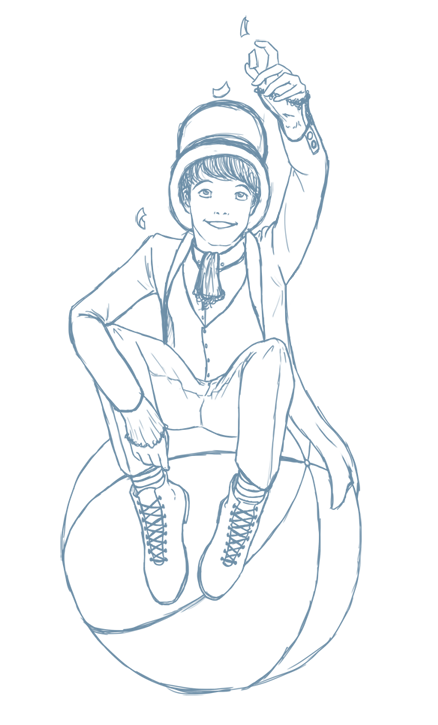
Of the three men that had to leave the carriage earlier, only one is left on the grounds before the carriage. Mark sits cross-legged on Robert’s trunk and fumbles around with what seems to be a long band of knotted foulards in various colours.
“What you’re doing with those?” Robert asks him, intrigued.
Mark quickly hides the cloths in the pockets of his trousers. “Nothing much…just a little trick, it’s not quite working yet…”
“You’re a magician, too?”
“No, no, not really, I’m just…playing around a bit, y’know?” Mark gets up from the trunk, happily changing the subject. He’s only known Robert for ten minutes now, but he still feels that nothing he can do could ever match any of Robert’s accomplishments. Looking down at his shoes – the best way to survive a day with Nigel and Carpenter – he misses the excited and inviting look in Robert’s eyes.
“I’ll show you the clown’s tent. And where you can build your tent. You’ve got a tent, right?”
“I’m afraid no, I don’t. Didn’t know I’d need one…”
“We’ll find you one. We’ll ask the builders, they’ve always got some spare canvas. Might take a couple of days, though…” Mark bites his lips; an idea has just crossed his mind that is so overwhelmingly exciting that he doesn’t quite dare to speak it out loud.
“I’m to sleep outside then?” Robert looks up to the skies with its grey clouds, feels the drizzle of rain dripping on his face, and isn’t all too happy at the prospect of a couple of nights spent in the cold and the rain without any shelter.
“No, no! There’s always someone who’s got some spare room in their carriages or tents. Circus people stick together, you know?”
“But I don’t know anyone here.” Robert gestures into the grounds of the winter camp.
“You know me.” The words have slipped out of Mark’s lips before he can control them and hold them back. He’s almost slapped a hand over his mouth. What’s he done? But Robert just smiles at him fondly, happily.
“So, I can stay in your tent for now? Really?”
“Ummm, yes…sure.” Mark can’t quite believe his luck.
“That’s great. Brilliant. Great.” Robert nods a lot to that. “We’ll have fun!”
It’s a long long time since someone told Mark they’d have fun together.
“Well, we’ll better carry your trunk over to my tent before the rain gets worse.”
Mark hopes he hasn’t forgotten how to have fun.
The second man the universe has sent to change Mark’s destiny for the better arrives in a plush carriage two hours later: The Great Elton. Dressed in a ridiculously colourful suit and a bright purple, full-length cloak he enters the director’s carriage without knocking. He only survives this faux-pas and doesn’t immediately get axed for this, because Nigel isn’t present at this very moment. When he returns from his daily inspection of the camp with Kim and Carpenter in tow, The Great Elton has already taken a shine to Nigel’s lovely, joyfully gleaming assistant, who’s made him an immaculate cup of tea, admired his ultramodern black snakeskin boots, and showed him a lovely, if a little simple trick with an endless string of knotted cloths appearing and disappearing in his sleeves and collar.
In the course of the following conversation Nigel fails to point out to The Great Elton that Mark is his assistant, not The Great Elton’s. Or maybe The Great Elton just didn’t want to understand. This way or another, before this rainy April day is ended, Mark’s got a new job, a new room-mate, less fear and more butterflies in his tummy.
And a big, wonderful, all-illuminating smile on his face.
Paris, May 1889
“Grazie, Donatella, grazie mille.”
Donatella smiles at her grandfather, pours another cup of steaming hot espresso for Jason, graces him with a smile too, then leaves the carriage as silently as she’d come in.
Giacomo Fratelli spoons sugar into his cup and stirs absentmindedly. “You know, this is far better than your Earl Grey. I’ve been trying all my life to convince you crazy English people to try my coffee, but no. You’re a stubborn lot.”
Jason’s always and again fascinated at how the strong Italian accent Signore Fratelli uses all day long – throughout shows, while talking to the artists, or negotiating with merchants – disappears as soon as he closes the door of his carriage behind him and makes way for his flawless English pronunciation. “When you speak with an accent,” he’d told Jason once, “everyone automatically underestimates you and thinks they can get the better of you. And you can let them feel superior, and then use their smugness against them without them even noticing. Most people aren’t half as clever as they think they are, always keep that in mind.” Jason wished he’d written down this and all the other wisdoms Signore Fratelli has shared with him. As it is he can only rely on his memory.
“I like your coffee, I do.”
“I know, son, but you still won’t give up this dishwater you call tea, will you?”
“Probably not…” They smile at each other through the steam of their coffee cups. It’s a comfortable silence between them for a while, but Jason knows tonight he’s not only here for a game of chess and a cigar. And right, Fratelli doesn’t waste time beating around the bush.
“Jason, I’ll be honest with you, and I’ll do something my mother has told me never to do – talk bad about someone.” He pauses and takes another sip of his coffee. “This man, the proprietor of your new circus, he…he’s no good. Trust an old man on this one. You’ll soon see for yourself, I’m sure, but you’re young and still believe in the good in mankind. And that’s a noble trait, don’t get me wrong. But us circus people are too trusting at times, too naïve, not worldy enough, you know? We live in our little circus world and…” He waves his hand in the air, a gesture to describe the floating nature of circus people. Jason nods thoughtfully. Fratelli takes a long, deep breath, and continues, “I’m very pleased you’re joining his show. It will be good for you, it will be a superb show – he’s got a vision, that man, he’ll make something really wonderful happen and you more than deserve to be part of this, shape it, mark your name all over it. That’s why I wanted you to take his offer.” He places one of his large hands on the young man’s arm, softly, almost stroking him. “But I urge you to be careful, this man, he’s got too much malice and not enough love in his heart. He’ll steal your soul if you let him. I know this may sound like an old man’s bitterness to you, and you don’t have to take my word. You judge for yourself, you’re old and smart enough. I just want you to be careful. Will you promise me that, son?”
Jason chokes. He wouldn’t allow anyone else to call him “son”. For a boy who lost his father early in life, accepting a father figure has never been easy for him. But Giacomo Fratelli has slowly won his heart over, being a kind, caring man, and a gent through and through. Hearing these words of advice, of genuine care and worry from him makes him realize just how much he’s going to lose when he leaves.
“Promise,” is all he can mutter, looking down into his almost empty cup.
“You’ll make it, son, you’ll make it big, trust me. Just stay true to yourself and don’t ever sell your soul.”
Jason just nods, tears welling up in his eyes, tears he desperately tries to hide.
Fratelli sees Jason’s shoulders slightly shaking, his jaw clenching, and he understands. He gives his arm an affectionate pat, then claps his hands together and calls out, “now, away with them cups! Where’s our board? I’d love to see how you’ll wriggle yourself out of your quite desperate situation! I think two more moves and I’ll have you checkmated!”
Oh yes, Fratelli knows his boy well. If there’s something that’ll make Jason forget all his worry, it’s competition – he just can’t resist it. The tears are quickly swallowed, as quickly as the chessboard is positioned on the table between them, and the game goes on.
About to make his second move of the night (but not his last one), Giacomo Fratelli remembers something. “By the way, son, and I hope you don’t mind, but I’ve arranged in your contract that you’re not paid a fee, but in percentage of the take. You may have to use some of your savings until the first profits come in, but trust me, they will come.”
He doesn’t mention the sour expression on Nigel Martin-Smith’s face when that clause was added to the contract. It was a sure sign that Giacomo Fratelli’s business instinct was right.
Fratelli had to smile then, and he’s smiling now too.
Jason makes another move, declares “Check!”, looks up and beams. He very much looks like the eager, fourteen year old boy he was when he first joined Fratelli’s circus – he has the same excited smile when he’s happy, the same sparkle of ambition in his eyes. How the years have flown by! How unbelievably fast they’ve come and gone and turned the boy into a man. A young man, who’s restless, and hears the world call him, and who’s about to leave the safe harbour of Giacomo Fratelli’s circus and guidance. But luckily, he won’t go all alone.
“You win again, son.”
“Just because you let me.” Jason still beams. “You didn’t have your heart in it!”
“And I’m found out again!” Fratelli chuckles. “But if that was the reason for me losing, you shouldn’t have won either…”
Jason shoots him a bewildered glance.
“Your heart, son, isn’t really in this carriage either, is it?”
Jason looks away and Fratelli could swear he blushes a bit.
“I was a little surprised to find out that the young man I recommended to Mr Gavin as your training partner had already been hired for a fire-breathing-act…”
Jason squirms on his seat, but he can’t wipe the smile off his face.
“I didn’t even know Howard could do fire-breathing! You learn something new every day!”
“He’s learned to do it last year, Anthony taught him. He’s brilliant at it!”
“I bet he is, son. And I’m glad he’s going with you.”
Yes, Fratelli’s glad Howard’s going with Jason. Like every good Italian man he’s got a soft spot for young love. And he’s very proud of Jason for choosing a truly good man like Howard to fall in love with. He likes Howard as much as he envies him for having Jason, when he has to let him go.
Fratelli knows Jason needs to go. Fratelli urges him to go.
But still Fratelli wishes he could make him stay. And he wishes he wasn’t going to miss him so very much.
Blackpool, June 1889
“I’ll be quite honest with you, my dear Gavin, I don’t like circus music very much. To be completely truthful – I despise it. I pity it. It’s not music, it’s…noise, nothing more. Annoying noise.”
Kim takes in a sharp breath. One more thing on the sheer endless list of things Nigel Martin-Smith doesn’t like. How can anyone not like music?
They’re sitting in the bar of the proud and luxurious Imperial Hotel, next to each other in huge armchairs, facing the small stage, empty of everything but a piano.
“Didn’t you say we were here to hear our new bandleader play?” Kim is still confused about all of this. How are they going to find a bandleader for a circus in the bar of a deluxe hotel by the sea? Where the only instrument is a piano?
“Have a little patience, Gavin, and you’ll see. Or should I say: you’ll hear?” Nigel sniggers and takes another sip of his brandy. Kim suppresses the urge to roll his eyes.
It’s another unpleasant half hour until finally a hotel employee comes in and carefully places a golden candlestick on the grand piano. Kim shuffles in his seat, anxious about what’ll happen next.
A very young man in a neat black suit walks onto the stage, takes a small bow, sits down, and with a small “good evening, ladies and gentlemen” greets his audience, then starts playing a mid-tempo tune Kim’s never heard before. Before he realizes it, he’s tapping his foot along to the melody. Looking around the bar, Kim notices that everyone here sways to the music, this way or another: men tapping their fingers against their glasses, women swaying their heads.
Nigel leans over to him and whispers, “See? I told you he’s good!”
“But how”, Kim whispers back, “is this supposed to work in a circus? You can’t support a circus show with only a piano.”
“Dear Mr Gavin, where’s your vision? Of course we’ll let him gather a fine band, I happen to know he knows a bunch of very good musicians. They’ll be loud enough, don’t you worry.”
“Has he ever played in a circus? Or have any of his musicians? Does he know how to lead an orchestra? How to support the acts? Does he know people do not come to hear the band when they come to see the circus?”
“So much negativity, Gavin! Of course he’s not played in a circus yet…but he knows how to please an audience that is…well, distracted. And how to support an act.” Nigel giggles again, which does nothing to make feel Kim any better.
“What kind of audience was that?”
“I never knew you were that nosy, my dear friend!”
“I’m only trying to see if and how this can work.”
“Clubs, Gavin, night clubs.” He shoots Kim a knowing glance. “Entertainment for gentlemen.” Briefly Nigel considers telling him that it was entertainment for gentlemen by gentlemen, but, studying his associate’s baffled face, decides against it. “Trust me, he’s eminently suitable for this position.”
Eminently suitable? Because he played in some sort of louche nightclub? Kim orders another drink.
His feet are still tapping along to the music, though.
“Circus music, as we know it, is dead, I’m telling you. It’s outdated, I’d even say it’s obsolete. If we want to reinvent the circus experience – and that was our aim, wasn’t it? – if we want to reinvent the game, we’ve got to go to extremes, cut out the old and dare to try new things. You told me so, my dear Gavin, didn’t you?”
There’s nothing else for Kim to do but nod and down his drink.
The pianist has finished his first set for the evening and accepts his applause with a quiet smile on his face. Nigel waves at him, and the young man heads to their table, his smile broadening.
“Nigel! So good to see you!”
“My pleasure, Gary!” They shake hands. “Gary, this is Mr Kim Gavin, my associate on the circus project I’ve told you about – Mr Gavin, please meet our new bandleader Gary Barlow.”
“Nice to meet you, sir!” Gary Barlow may not be an experienced circus-bandleader, but he’s a polite young man and he’s got a firm handshake and a winning smile. Kim likes him immediately.
“Mr Barlow.”
“Oh, please call me Gary!”
“Well, Gary, I hear from Nigel you’ve already got your band together for our circus?”
“Right, yes. Well, I’ve got to pick them all up, they’re scattered all over the country, but that’ll be no problem.” Gary beams. “They’re a hell of a brilliant lot!”
Kim is fairly sure they are. “Has any of them ever played in a circus before?” It’s worth a try.
“No, sir, I don’t think so. In fact, we’re all quite excited by it! All the travelling and staying in different hotels and having a moving theatre – it’s going to be quite something, right?”
Kim bites his lip and looks over at Nigel, who’s smiling serenely.
Kim clears his throat and composes himself. “We’re not exactly staying in hotels while we’re travelling, and the circus isn’t generally called a “moving theatre”, but I’m sure it’s going to be “quite something”, yes.”
“Ah, you know, sir, as long as we can play our music, we’re fine! We really don’t need much.” There’s an honesty in Gary Barlow’s earnest eyes that amazes Kim, but still the worry in his head won’t stop just now and so he just nods and smiles an uneasy smile.
Nigel’s smile, however, is the complete opposite of uneasy as he sits back and orders another drink.
Near Manchester, June 1889
“Ouch!” Rob hates training when the trapeze artists are in the tent too. While they stretch and flex their muscles and then fly elegantly through the sky, he gets knocked out, pushed around, and then flies un-elegantly into the sand. It’s not one of his favourite pastimes any given time, but with the lords of the air defying gravity above his head, it’s ten times worse. And Gustave, the white clown, is in a particularly bad mood today. Not that Rob had ever found him in a good mood, but at least there’s different grades of bad mood with Gustave. Properly pronounced “Juis-taaaaf”, he has informed Rob. “Juis-taaaaf, Rrobbearrrr, it’s Frrrrentch, you morrrron!”
Six weeks in and “Rrobbearrrr” already hates “Juis-taaaaaf” with a passion.
Just now he’s gotten another kick in the arse from the Frenchman and finds himself face flat in the sand once more. He’s getting used to eating sand. Wouldn’t be half as bad if he didn’t know all the animals peeing on it are right now being lazy in their cages.
“Enufff forrrr today, I’m ex-austed!” Gustave emphasizes his important pronouncement with a dramatic gesture.
Rob mutters a quiet “What you got to be exhausted about…??”
“Excuse moi?” Gustave isn’t the youngest anymore but he’s hearing’s still impeccable. Darn it. Rob tries to back-pedal, but it’s too late, he can feel Gustave’s foot on the back of his neck already, pushing him deep into the sand. “Oww menny times ‘ave I told you to shut up, you twit?! HOW MANY TIMES?!” It’s funny, Rob thinks, sand in his nose, how Gustave’s English pronunciation improves the angrier he gets.
“ANSWER!!!”
“How’s he supposed to answer with his mouth in the sand?” a soft-spoken voice asks, pointing out exactly what Rob is thinking. Only far more politely.
“C’mon, Gustave, let him go.”
“Oh, you…!” Gustave complains and curses and snorts all the way out of the tent. “Can I really be forced to be working with people like that? I’ll have a word with Mr Martin-Smith. I’m one of the main attractions, white clown par excellence, I was famous long before…” The disappearance of his French accent shows just how upset he still is.
Rob lets out a sigh into the sand, then turns around, only to face the owner of the soft-spoken voice who offers him his hand to help him up. Rob cringes. It’s one of the trapeze artists.
“I’ve worked in the same circus with him before – he’s always like that. I guess he was born grumpy.”
“He says I’m the most annoying and clumsiest side-kick he’s ever worked with.” Rob pouts.
“Well, I dunno ‘bout you being annoying, but you’re clumsy for sure…”
“Oh..., I’d like to see you when you’re being pushed around like that!”
“Okay…try me.” The trapeze artist grins at Rob. And Rob tries. Without much thinking he gives the artist a shove. The artist falls on his back, rolls over backwards with his legs spread wide in the air and lands on his bum with a soft thud, both legs still spread wide apart and a playful mock-surprised look on his face.
“Hey…I didn’t push you that hard…?”
The trapeze artist grins widely.
“Help me up?” He holds out a hand, and Rob, still stunned, takes it and tries to lift him up – instead finds himself dragged down and turned over and lands, once more, this time flat on his back.
“You’re too slow, mate, you’ve gotta learn to anticipate.”
“Yeah, brilliant…you…”
“You’ve got good instincts, you know, and charisma, and I think with a bit of training you could pull it off.” They’re lying on the sand, side by side, one pissed-off, one grinning.
“I could teach you a few tricks, if you like.”
Rob snorts. The last thing he needs is an arrogant trapeze artist bossing him around. He’s already got an insane white clown giving him hell every day. There’s only so much you can take.
“You know, I used to be the side-kick when I was younger. It’s the hardest job in the world.”
Rob turns his head to see if he’s still grinning. He isn’t.
“I wasn’t very good at it, you know? I don’t have what it takes, I’m not funny enough. Too serious, me. Can’t really make the audience laugh. But I know how to move so you don’t hurt yourself all the time, you know?”
He offers his hand again, this time to seal the deal. Rob hesitates.
“I’m Jason.”
Rob accepts. “Robert. I’m a magician, really.” Best make it clear early that he doesn’t plan a career as professional side-kick.
“You are? That’s amazing, you’ve got to show me some of your tricks, yes?”
“Jason?”
“Yes?”
“Jason Orange?”
“That’s me.”
“The Jason Orange?”
“Erm, yes…”
Rob rolls on his side to take a closer look. The great trapeze artist is offering to teach him? And wants to see some of his tricks? Nothing, he muses, is impossible, in a circus.
“You really think I can learn this?”
One moment of hesitation on Jason’s side and Rob would know he doesn’t really believe it. But Jason doesn’t falter for a second. “Yeah.”
“Okay then.”
“Brilliant.”
“Jason?”
“Yes?”
“He’s not really French, is he?”
“Aww, Rrrobberr, offf courrse not – ‘e’s ffrromm Woofer’amptonnn!”
“I knew it!!”
Four weeks later
It gets harder and harder to avoid Nigel. Jason tip-toes around the grounds of the winter camp, constantly wary, constantly scared. After weeks of hiding and ducking away Jason knows every corner, every tent, every little niche he can hide in, and another couple of weeks later he can literally disappear.
Signore Fratelli had warned him, but he'd never have thought it would get this difficult. It's not that he hasn't had admirers before, he's a well-sculptured trapeze artist and his stage outfits are tight. And Nigel isn't the first man amongst his admirers either. Jason has no problem with male adulation –he was raised in a circus where nothing was ever wrong or unthinkable. He grew up between artists, animals and human exhibits. An elephant man taught him to read and a bearded lady sang him to sleep. Jason understands the concept of love – it has nothing to do with gender, age or physical appearance. But still there's a difference between admiration and love, and yes, it's okay if Nigel wants to admire him, but love has got to be a mutual feeling. And Jason doesn't feel anything remotely close to love when it comes to Nigel – respect, yes, for his vision, and dedication, and hard work.
And even the respect is slowly fading. With every sleazy smile Nigel gives him, and every needy look, and every unintended intended touch, a little bit of respect fades away, bit by bit. Nigel has a way of making everyone around him feel inferior, and worthless, at the best of times. But if you happen to be someone he showed his affection for, and you dared not to return it, or least pretend to feel the same, you get it even worse. You won’t mess with Nigel Martin-Smith’s feelings, that’s for sure.
Jason knows he’s not the only one who gets the sharp edge of Nigel’s bitterness. He’s seen Rob being told off in front of the whole cast, for nothing other than fooling around. Pernilla, the fortune teller, is a constant target of Nigel’s worst jokes. Gary, their new bandleader and a really nice chap, has been wound up about his weight so often that Jason stopped counting. And Jason knows that Nigel has managed more than once to make Mark cry, silently and hidden in some corner of the circus ground. A corner like the one Jason is hiding in right now.
It’s still different, though. At least they don’t feel like it’s all their fault, and that somehow they deserve this treatment. There’s a big lump of misery and guilt in Jason’s stomach and he hates himself for having been such a coward, when there was the chance to put it all straight and tell the truth. It would’ve been easy to stand up for Howard, to say “I’m taken, sir, I’m sorry, but that’s why I can’t return your feelings”. It would’ve been a proud moment. But he chickened out, for reasons he doesn’t quite understand, no matter how much he thinks about it.
And he’s thought about it a lot.
Instead, that evening several weeks ago, in the bigger one of the two rehearsal tents, he took the easy way out. Nigel had entered the tent and watched them rehearse for a while, and he’d looked pale and his eyes were red and he seemed a bit upset. And Jason was soon to find out why, Nigel’s hand heavy on his shoulder as he stopped him from leaving the tent.
”So, dear boy, I hear you’re taken?”
“Ummm…” He should’ve known, this is a circus where nothing can be kept secret. But how on earth has he found out about him and Howard?
“You could’ve just told me, you know?”
“I…I didn’t think it was this…ummm…”
“This serious?” A glance of hope in Nigel’s eyes.
Jason swallows. He’d actually had wanted to say “…this important.” But he couldn’t, because actually it is important to Jason.
“Look,” Jason feels Nigel’s breath on his face as he whispers in his ear, “I understand if you like girls too, many of us do, and it’s good cover, because not everyone understands, do they? I don’t mind about her, okay? We can still…”
Her? Nigel misunderstands Jason’s shudder as he lets his hand run down Jason’s back and he doesn’t notice Jason’s confused frown. Her? Who’s he talking about?
“I was confused by it all when I was your age, too, and thought if I take up with a girl, the desire will go away, that’s nothing to be ashamed of…” Ashamed? Nigel’s hands wander deeper, down Jason’s lower back and below. Jason jumps backwards.
“I’m not sure I know what you’re talking about?”
“Your trapeze partner, dear boy, everyone knows…what’s her name again?”
And that’s when it happened – Jason can still feel Nigel’s touch on his bum, and he shudders again, and feels dirty, and worthless, and he doesn’t want this, and all of a sudden there’s a way out. It means denying Howard, it means lying, it means using a lovely friend, but, holy heavens, if it means he won’t touch him again – can it really be that wrong?
“Dawn. Her name is Dawn.”
“Mmmh… However, I don’t mind her being your cover and…”
“She’s not my cover.”
“Sorry?”
“She’s not my cover.”
“Ah, I see…”
So far he hasn’t lied. For a moment he thinks, he hopes, he could get away with this. No harm done, so far. But this is Nigel, after all. Nigel, who comes closer again, making Jason back away in a desperate attempt to keep distance between them. And again, Nigel misunderstands.
“I know it’s difficult, heaven knows I know! But you know your needs, don’t you? You can’t run away from it forever, it’s going to haunt you, it won’t let go.” He reaches out a hand, attempting to stroke Jason’s cheek. “I could teach you, no need to worry…” His hand is coming closer and Jason feels the canvas of the tent in his back, he can’t possibly back away any further, and Nigel’s hand is almost touching him again and before he knows it, the lie slips out of the heart of his fear and over his lips and is in the world, undeniable and irreversible: “Thank you, sir, but I’m really just not into men. I’m sorry. I just don’t, I…I like girls.”
Nigel’s hand is still up in the air and for a moment Jason thinks he’s going to slap him. Instead he just looks him in the eyes, intently, and Jason manages somehow to look back. That’s the moment this lump in his stomach formed and it got bigger and bigger by the minute.
Finally Nigel’s hand falls down and he stands there for a while, almost defenceless, almost vulnerable. Almost. His eyes turn a darker shade, and they narrow, and he takes another step closer again, and then he says the one sentence that still makes the blood in Jason’s veins run cold whenever he remembers the moment.
”You better make sure I never find out you lied to me.”
He doesn’t add a warning or a threat. He doesn’t have to. His voice is warning enough.
And then Nigel turns and leaves Jason with the sure feeling he’s made a terrible mistake.
The terrible mistake of lying to Nigel, of denying what Howard is to him, and of dragging Dawn into this struggle of complicated emotions with him.
They’ve both since laughed it off, Howard said he understands, and actually thought it was a bit funny, and Dawn said she’d feel honoured to be his “cover girl”. But Jason knows they only said this because of the state he was in when he told them what had happened. He knows it hurt Howard, and he knows it’s difficult for Dawn, who happens to like the new bandleader a lot more than she would ever admit.
Jason could just smack himself for what he did. For being such a coward. For causing fuss and trouble to those he loves the most.
On top of all that Nigel looks at him in that way he’s reserved for those who’ve fallen from his grace. Which is but one of the reasons Jason tip-toes around the grounds, trying to avoid him.
And he knows he’s only got himself to blame. The lump in his stomach grows a little bigger. Jason tilts his head back and looks up into the dark clouds above him, as if they could give him absolution. They can’t. They only remind him that he can’t hide forever.
So Jason carefully checks if the coast is clear and leaves his latest hideout with a sigh.
London, September 1889
Gary’s music still resounds in Kim’s ears, though the band has left ten minutes ago. The workers have already begun to dismantle the stage, and the tent altogether. In a few days they’ll start to travel and until yesterday Kim still wasn’t so sure if they were ready, and if it made much sense to start a season when the season really is almost over. But after the full-run dress rehearsal he’s just watched, he has to agree with Nigel: it would be a shame to settle for the winter and wait until next spring. Everyone’s worked so hard in the last weeks, and everyone, every artist, every animal, is in top form. This show needs to be seen by the world as soon as possible. This show is too sublime, too sophisticated, too fantastic to be held back by something as fickle and unpredictable as the weather.
And even if he disagreed – the announcements have been printed and right now towns all over the north of England and beyond are plastered with them: Come one, come all!
There’s no way back.
Chapter 2: The Cracks
London, October 1895
Something is wrong, Isobel can feel it.
None of her boys have been out between the tents before the show tonight, and in Gary’s and Dawn’s tent the piano stood abandoned. In the show everything seems to go slower, even the music. Gary looks pale and tense and he confuses his musicians with unsteady conducting. Rob’s introductions are as funny and seemingly effortless as ever, but when he comes closer while walking around the ring, Isobel can see his eyes are red, and he smells of booze. Once again Mark takes over for The Great Elton, and he does it perfectly, but when you watch as closely as Isobel does, you can see his hands are shaking and he bites his lips when he thinks no one can see it. The trapeze act is still stunning and breathtaking, but Isobel notices how nervous Jason is while he’s taking his bows, and she can see the dark rings under his eyes, telling of worry and sleepless nights. And Howard, who usually watches the trapeze act with a joyful, proud expression, now watches with a creased brow and concern.
It pains Isobel to see her boys like this. They make people happy, so they should be happy people, too. They deserve all the happiness in the world.
Something is wrong, and Isobel worries.
Bournemouth, March 1895
Jason loves the places by the sea the most and so it doesn’t come as a surprise to Howard that he has put up their tent as close to the waterline as possible. Which, conveniently, at the same time means it’s the furthest away from the big top and the director’s carriage. Finding a space for your tent that’s the furthest away from the director’s carriage is a new favourite pastime of the artists, but Jason most definitely is the most talented scout of this art. And as sad as it is that they have to do this, that most of them only feel halfway comfortable when they’re out of the sight of a man who gets grumpier and more bitter by the hour, Howard still can’t help but smile when he sees their little, red-and-blue tent, safely tied on the beach, braving the wind and the rain. Nigel can make their lives a living hell throughout the daytime, but when the night comes they’re all safe in their tents and carriages, closing the curtains and shutting the doors, lighting a candle and holding on to each other. Because no one’s alone in this circus. No one but Nigel.
Howard quickens his step, the rain has set in again and heavy drops are falling on his head. At the entrance he hurries to close the curtains, before the rain finds its way into the tent, then turns around and glances into the dimly space.
“Jay?” Howard moves deeper inside, slowly. Something tells him Jason’s there, though there’s no sign of him and he doesn’t answer. “Jay?” He’s almost reached their mattress, which marks the centre of their living space when he hears the howl. Howard snaps, but before he knows it, Jason, coming out of the dark behind him, has jumped on him and hurled him over on the bed, pinning him down with his full body weight. Which, if Howard’s honest, isn’t completely unpleasurable.
“Hah! Gotcha!”
“Oh, you…!”
“You’re getting slow, mister!”
“Slow!?? Me?!? Wait, you…!”
“Oi!”
In no time Howard has turned the situation in his favour, they fight, and roll all over the bed, but in the end it’s Howard who’s pinned down Jason. They’re both breathless and they love it.
“Who’s slow, eh?”
“I gotcha!”
“Yeah, but now I got you!”
“You think…!”
Jason wiggles and struggles, but Howard’s stronger. For now.
“Admit defeat!”
“Never!”
Howard moves his head very close to Jason’s, rubbing their noses together, but careful not to let go of the grip around his arms. He plants a quick kiss on Jason’s lips, then whispers “you won’t get what you want if you don’t…”
“Bastard.” Jason’s voice is quiet and hoarse. His body belies his words and surrenders, though.
Howard smiles as he feels he’s won. “No, actually the word’s ‘surrender’…”
“Oh, will you shut up and kiss me?”
Jason doesn’t have to ask twice.
With all the places they see, all the people they meet, all the shows they do, and all the applause they receive – still the nights in their tent will be Howard’s fondest memory in years to come. It’s when they’re together and safe, and everything’s easy, and everything that’s not easy is shut out until the next morning. It’s warm and cosy and he’s got Jason to hold on to and Jason who holds on to him. There’s love and desire and tenderness and challenge, and really nothing ever comes close to the sensation and the happiness he feels here. This is why they both still hang on, this is what gives them the strength and the power, when sometimes all they want to do is run away from it all, from Nigel’s whims, and the constant fear of being found out, and all the things around them, that they see every day and know are not all right.
But Howard won’t complain – they’ve got their happy place and they’re together. He doesn’t need much more.
Amsterdam, June 1894
“What’s he saying?” Nigel hates being abroad, not least because he doesn’t understand a single word the locals say.
“My Dutch ain’t very good, sir, but I think he’s saying something like “it’s not sick, just old…” Skippy scratches his head.
“Well, we knew that before now, didn’t we?” Nigel is fuming, this Dutch lad is clearly trying to rip him off. And Nigel hates being ripped-off even more than being abroad. Especially on paydays, because nothing makes him feel more ripped-off than paydays. He doesn’t know what he hates more – the pleading eyes of those who think they deserve more, or the smug grins on the faces of those who are clearly over-paid. There’s only four people in the whole circus who don’t look either pleading or smug. There’s Robert, who gets paid too much, but only looks at him with his boozed-up, red eyes. There’s Mark, who doesn’t get paid enough, but seemingly couldn’t care less, which is something that really drives Nigel up the wall, because how can you not care about money? There’s Howard, who doesn’t get paid enough, but doesn’t show any reaction about that at all, he just takes the little pile of bank notes without looking at Nigel, nods slightly and leaves. And then there’s Jason. Who gets paid a ridiculous amount, because the circus is successful and Nigel was weak that one moment when Fratelli had demanded Jason was paid a percentage of the take rather than a regular payment. He’d looked at him and said with that thick Italian accent “you know he’s worth it.” And Nigel could still smack himself for agreeing to that. What was he thinking? Now every four weeks he has to pay Jason a huge amount of money, and all that ungrateful prick does is come in and take the money as if he deserves it. Oh yes, Nigel hates paydays far more than being abroad.
The Dutch vet shifts from one foot to the other uncomfortably. Even without speaking much English, he knows there’s trouble about. And this circus director doesn’t look like someone you’d want to get into trouble with. Not for an old pony, anyway.
“Ask him whether it’ll recover and be able to do shows again.”
Skippy scratches his head once more. “Erm, sir, I don’t know how to translate that and I don’t know if I’d understand the answer…”
“Why the hell didn’t you go and find a vet that speaks our language?”
“Well, I tried, sir, but I couldn’t find one. I’ve told you from the beginning it’d be better to have our own vet travelling with us like any other circus has. We’d not have this problem if…”
“Oh, shut up!” Number three on the list of things Nigel Martin-Smith hates: being reminded that he doesn’t know how a circus show is properly run.
Skippy folds his arms in front of his chest. The vet pats the pony’s head as if to say “shh, don’t worry, it’s not your fault”. The pony looks scared. Big brown eyes almost hidden underneath a tousled brown fringe.
All of the shouting has attracted a little crowd of circus people, who have stopped whatever it was they were doing and are watching the scene from a safe distance. One of them is Howard, who, sitting on the fence of the zebra compound, is eating an apple and wondering what’s going on. Looking around at his employees, Nigel decides to try his luck.
“Any of you speak Dutch? We need to find out what’s wrong with the pony.”
The circus people shake their heads, shrug, or don’t do anything at all. Howard takes another bite of his apple, suppressing a grin. He knows at least five of the artists are really good at Dutch, and one was born and bred in Holland. Still no one reacts, until finally someone steps up out of the crowd.
“I do, sir.”
Howard almost chokes on his last bite of apple.
“You? How do you know any Dutch?” Nigel’s surprised, too.
“My grandmother was Dutch, sir.” Mark’s perfected his ability to lie bluntly straight into Nigel’s face to a degree that would scare him if he ever thought about it. But like all the other abilities Mark’s perfected and that are essential for his and Rob’s surviving in this circus but maybe not exactly ethical he carefully doesn’t think about it all. And so Mark has unconsciously just turned his Irish grandmother into a lovely Dutch lady. His grandmother adored horses and ponies, and she adored Mark even more, and Mark is fairly sure she wouldn’t mind too much about this little hoax. She loved seeing men like Nigel taken down a peg or two.
“Well, then, ask him what’s wrong with the pony.”
Mark turns to the scared vet and the scared pony.
“Goede dag, meneer. Ik wil graag een pannenkoek, alstublieft?“* With his most serious expression Mark is trying to cover the fact that he has just used the only two Dutch sentences he’s picked up while they’ve been touring Holland. The vet is more than slightly surprised that Mark has just ordered a pancake.
“Ik ben niet zeker of ik begrijp wat u bedoelt...?”** The vet wrinkles his forehead, clearly confused.
Mark pats the pony’s head affectionately and shoots the vet a conspiratorial look. “Een pannenkoek voor de pony?”***
“Pannenkoeken zijn niet good for de pony.”**** The vet decides to stick to the facts, and he knows for certain that pancakes are not good for a pony.
Mark nods thoughtfully, then turns around to Nigel and Skippy and says “he says it’s just a matter of time and she’ll recover, just needs a bit of rest and tending.” He turns around to the vet again and adds “right? No pannenkoeken?”
The vet, still convinced pancakes aren’t good for any pony, nods. “Right.”
“Well, I won’t spend any money or time on an old pony. I run a circus, not a farm. We’ll leave it here.” Nigel’s on the verge of turning around and leaving this scene. He thinks he’s spent too much time with the silly old pony anyway.
“If I spent the money and the time on the pony, could it stay with us?” Mark’s voice is more matter-of-fact than he’s feeling. Inside he’s fuming, about the lack of decency, and the insensitivity. The thought of leaving a helpless creature that worked for you all its life and got little in return behind, just leave it at first sign of weakness, leave it to die, without caring, without even considering what you owe to the animal...it makes Mark angry enough to find the courage to not give up.
Nigel stops in his tracks. Once more he realizes there’s more to this little fella than he’d thought when he first hired him, back in Manchester. And Nigel’s not too sure whether he likes that. Generally Nigel isn’t too fond of finding out he’s misjudged someone. He frowns.
“You want to pay for it?”
Mark doesn’t know what annoys him more: the way Nigel pronounces the “you” or the way he calls the pony “it”, as if the idea of Mark taking care of the pony was ridiculous, and as if the pony was a thing. “Yes, Mr Martin-Smith, I am going to pay for her.”
This announcement is followed by a moment of complete silence. Everybody who’s watching the scene seems to be holding their breaths. Even the Dutch vet, who still wonders what pancakes have got to do with it.
Nigel looks around and decides quickly not to give the lad and the silly pony more time in front of an audience. “You pay for it, you keep it.”
“Her, sir. She’s a girl. Her name is Polly.” Mark dares a slight hint of smile.
Nigel turns around once more and stares daggers at Mark. “I seriously couldn’t care less.” He looks at the pony, then back at Mark. “And you better make sure I don’t regret this. I don’t want to see, hear, or smell this creature anymore. You got that?”
Mark doesn’t break the eye contact, and he manages to keep his chin up. “I got that.”
“Good.” With that Nigel turns and leaves.
The crowd breathes out. Suddenly everyone’s very busy, artists dissipating into every direction. The vet thrusts the pony’s reins into Mark’s hand and disappears more quickly than anyone could say “pannenkoeken”.
Howard jumps from the fence, the half-eaten apple still in his hand, and approaches Mark and the pony. “What have you just done?”
“I always wanted a pony.”
“Are you kidding?”
“Of course, ‘Ow. But look at her, look her in the eyes and tell me you wouldn’t have tried to save her.”
Howard bends and looks and with one hand lifts up Polly’s fringe to see those pretty eyes. Polly takes the chance and snatches the rest of the apple from Howard’s other hand.
“Hey! You...!”
Mark bursts out laughing. “See? She’s clever!”
“Yeah, brilliant. Seriously, Markie, why did you do this?”
Mark tenderly pets the happily chewing pony. “Don’t you ever feel like you want to take care of someone?”
“Mmmh...” Howard knows this feeling, but he’s not sure he should admit this here and now. “A pony’s a lot of work, I’m telling you.” Change the subject when talk gets too deep, that’s one of Howard’s unspoken truths.
“Everything here’s a lot of work.” Mark shrugs his shoulders. “I think I know a place where she can stay.” Howard’s not surprised, he’s sure Mark could even find a place for an elephant to stay – Howard knows everyone in this circus, and he doesn’t know anyone who’d turn Mark down if he asked for a favour. Not even Nigel, interestingly.
Later that evening Howard tells Jason what had happened. They lie in their tent in the far end of the grounds, side by side, watching the starlight shine through the canvas.
“..and you know what he said? ”Don’t you ever feel like you want to take care of someone?” That’s why he did it.” Howard shakes his head.
“He’s a very caring person, Mark is. I wonder why he feels he needs to care for someone else...”
“Mmh?”
“One should think he’s got enough to do with taking care of Rob.”
Howard lifts himself up on his elbows and looks at Jason. “How do you always do that?!”
“Do what?” Jason looks at him confusedly.
“Get right to what I can’t put my finger to!”
“I don’t...”
“You do! Always! I think about something forever and just can’t get my head around it and then I tell you and you just...” Howard snaps his fingers, “...you just say it as if it was the most obvious thing and it’s just...”
“Annoying?” Jason tries carefully.
“No! I mean, yes! No, not annoying, just...” Howard’s let himself fall back. “Just...” He’s got no words to properly describe this feeling of inferiority.
Now it’s Jason lifting himself up and taking a long look at Howard. “But, How, you do the same for me, don’t you realize? Whenever I over-think things and talk to you about them, you put them into the right perspective and help me see them clearly.” He pauses, searching Howard’s face for signs of whatever emotion it is that’s upsetting him so much. “You know that, right?”
Howard needs to let that sink in.
It’s nice.
Really nice.
More than nice.
Brilliant.
He coughs. “Yeah, right.”
Jason smiles and lies back down. Then he feels Howard’s hand taking his, sure, firm, warm.
”Don’t you ever feel like you want to take care of someone?” The words are resounding in Howard’s head ever since Mark spoke them. He thinks about it, it’s so Mark, and it’s so true. He snuggles up a little closer to Jason. “I think we should help Mark with the pony.”
Jason nods. “I think we should help Mark with Rob as well.”
For a moment Howard isn’t sure whether he wants to throttle or kiss Jason.
The moment’s not very long.
Unlike the kiss.
_________________________________________________
1 “Good afternoon, sir. I’d like a pancake, please?”
2 “I’m not sure I know what you mean…?”
3 “A pancake for the pony?”
4 “Pancakes are no good for the pony.”
Stoke-on-Trent, August 1893
“Rob! Will you stand still now!” Mark knows Rob’s nervous before shows and knowing his mum will be in the audience tonight doesn’t help to make him feel calmer, but still that’s no reason to step on Mark’s feet while he’s trying to fix Rob’s gigantic bow-tie, Mark thinks.
“Sorry, Markie, sorry…”
“Goodness! She’s your mum, she’ll love you no matter what.”
“But I need to be good tonight, make her proud, what if I fail…?”
“You never fail – and if you do you make it part of your act, as usual.” Mark giggles. “No one fails more professionally than you do…”
“Eh, watch it!” Rob looks at Mark with mock-indignation, but can’t hold that stare very long. He’s too nervous.
Mark inspects his efforts on the bow-tie and decides he’s satisfied with the result.
“There you go!” Mark beams at Rob, his signature beam, wide and bright and happy, the one he reserves for Rob alone, the one only Rob can cause. “You look so pretty!” Mark stands up on tiptoes and graces Rob with a soft kiss.
“Pretty?!?” Rob turns around to take a look in the mirror behind him, studying himself in his big, silly clown costume. “Pretty??”
Mark wraps his arms around him, buries his face between his shoulder-blades, and mumbles “you’re the prettiest boy in town.”
Rob frowns and turns his head. “And you,” he untangles Mark’s arms from around him and turns, holding both of Mark’s arms, “you are the deadest magician in town!”
Mark giggles. “You can’t be deader than dead!”
“Wait and see!”
When this fight is over, Mark’s still alive, even though the huge love bite on his neck looks as if it was conducive to killing the person who wears it, and Rob’s still the prettiest boy in town, though his costume needs a complete overhaul. Mark doesn’t complain, neither about the extra make-up he’ll have to use on his neck in the days to come, nor about starting the fight with the rebellious bow-tie once more. Every night he manages to relax Rob enough to not have him need a drink or two before a show is a win.
It’s the last night Mark and Rob have to fight with the clown costume, for later that night, after having hugged her son and told him how brilliant he’d been, and after having hugged Mark and told him how brilliant he’d been, Jan Williams goes to visit her old friend Nigel in his director’s carriage. It’s a pleasantly short parley and ends with a very satisfying result for Jan, and a far less satisfying result for Nigel. And a new costume for Rob.
No more of the colourful suit, the oversized shoes, and the rebellious bow-tie. Ringmaster Robert Williams, the youngest ringmaster in the history of the circus, will now wear an elegant dark-blue coat, black, polished patent leather shoes, and a black top hat every night.
He will take the audiences by storm, sweet, and funny, and charming, and cheeky, and announcing every act with a pride and joy that gives the word ‘anticipation’ a whole new meaning. And no one who sees him do his job will ever guess how much it takes him to go out there every night and do what he makes look so easy. No one will guess how much he suffers, no one but Mark, who tries hard, but can’t always find ways to keep the booze from Rob’s carriage.
While Nigel watches every night how a 20-year-old does his job better than him, frowning and chewing on his lip, his heart full of envy and greed, Rob misses the safety of his silly clown costume. He could hide behind the make-up and get lost in the oversized ridiculousness, while now he’s exposed and unsheltered in his coat and top hat, never quite knowing how he got this role, always scared these shoes might be too big for him, even though they’re much smaller than the ones he used to wear when he was still the unnamed auguste, and not Robert Williams, the ringmaster.
How funny and cruel life is – you leave behind what you thought you hated, only to find out you loved it, really. And you get what you thought you wanted, only to find out that you’re not ready for it.
Rob keeps the clown costume in his trunk. You never know.
Paris, May 1893
Who’d have thought it would take four grown men and the scenery of gay Paris in May to get a painfully shy trapeze artist and ballerina, and a heads-in-sheet-music bandleader to realize they’re meant for each other? In all fairness it has to be said, though, that the four ‘grown men’ described here aren’t exactly what you’d expect when you think of ‘grown men’ as such.
“Is that enough, what do you think?” Jason steps back from the bed in the Royal Suite of the Hôtel Westminster that will cost them a small fortune, but is in Rob’s words “proper posh”. Following Mark’s orders, Jason has carefully sprinkled the bed with dark red rose petals and is now waiting for affirmation that he did a good job of it.
“How am I supposed to know?” Howard asks unhelpfully, still adjusting the champagne bucket on a table by the window. “I’m not a girl.” He shrugs. He’s still not quite over the amount of French francs that have changed hands between Jason and the waiter when he delivered the champagne, or in Rob’s words “the fizzy plonk”.
“Mark?” Rob, sitting in one of the expensively upholstered armchairs, or in his words “plush pillow”, is holding a richly ornamented silver platter, on which Mark is busy arranging delicious-smelling chocolate truffles.
“I’m not a girl either, Rob.”
“But you’re as close to a girl as any of us…” Mark momentarily forgets about the precious platter and the delicate truffles and gives Rob a decent cosh around the head. But then he still turns around and oversees Jason’s efforts with a nod. “Looks fine, mate.” He claps his hands. “Right, we better dash! They’ll be coming any minute…”
“I’d not be so sure ‘bout that, Gary won’t be leaving that restaurant without dessert….” Howard chuckles, and ultimately they all join in.
“You know, if it helps getting them together he can have as many desserts as he wants to.” Jason states, matter-of-factly.
“This, my friend,” Rob tells him, just as matter-of-factly, “can only come from someone who doesn’t have to tailor his clothes.”
Overhearing their conversation, no one would believe that these four ‘grown-ups’ are actually able to play Cupid. But they do. Successfully.
Two days later
Dawn, Jason muses while watching her warming up, has always been a beautiful girl, but now she’s far beyond that. She’s radiating, beaming, glowing from inside – like one of the bright white flames Howard breathes for Jason every night before the show, she lights up the darkness around her and sparkles. Pure, sheer beauty. Oh, the things love can do.
“I’m terribly sorry I’m late, Jay, terribly sorry.”
She’s said this half a dozen times since she’s arrived late for the first time since Jason has known her. He smirks. “Don’t be, darling, s’alright.” Oh, the things love can do.
“Won’t happen again, promise.”
Jason bites his lip to stifle the giggle. “You sure, love? You shouldn’t make promises you’re not sure you can keep, you know?”
She slaps him playfully. “Oh, you…”
“Silly bastard?” Jason tries, helpfully.
“No.” She smiles at him, shyly. “Good friend.”
He smiles back, and waves his hand. “Naww. I’m just glad to see you that happy.”
“And I haven’t even thanked you yet. Any of you.”
“Your smile is thanks enough, really.” Jason throws his arms around her and hugs her tightly. “I’m so glad you two finally got going,” he mumbles into her hair.
“We just need to make sure he never finds out,” Dawn whispers into his ear. “I’ve told Gary he can never tell Nigel and he promised he wouldn’t. If Nigel ever finds out...”
“He won’t. Don’t worry, no one here will ever tell him…” Jason’s surprised how convincing he sounds, when in fact he’s only repeating what Howard said to him this morning, when Jason uttered the very same, dark fear. ”If he ever finds out… There it is again, the lump in his stomach, the guilt, the result of his cowardice. Jason swallows.
“I have to thank you, Dawn. All those years you…” Dawn places a finger on his lips, “shhh, hush, no, no. That’s what friends do, no?”
If you only watched them, say, from a distance, and couldn’t hear what they were saying, you’d probably think they’re just a very pretty couple in love, beaming at each other, whispering, tightly embraced.
And that’s exactly what Nigel thinks they are, while he watches them from his place at the entrance of the tent.
No one knows what he’d do if he ever found out…
Dover, October 1895
Skippy loves the circus, and this one in particular. He loves everyone around the grounds, every artist, every animal, every single costume, and every single prop. He loves his workers, and the boys who tend the animals, and the girls who sew the costumes. The only one he doesn’t love is the director. He hasn’t from day one, not always quite knowing why maybe, but his gut told him to stay wary when it came to Nigel. And today he’s found out why, and he wishes, he really desperately wishes he hadn’t.
While he oversees the unloading of the ferry, making sure animals and props are being treated as carefully as possible, he ponders how to tell Mark what’s happened. Because someone has to, better sooner than later, before Nigel spills the beans himself.
But how to tell him? Mark’s one of the sweetest people Skippy has ever met, such a fine lad. And he’s taken such good care of the old girl, he quite loved her. And Skippy’s sure she loved him too. Why she’d refused to set foot on the ferry, Skippy doesn’t know. God knows he tried to make her. It hadn’t been the first time Polly didn’t want to enter a ship, but this time she’d been even more stubborn than usual. He’s still sure he could’ve made her, sooner or later, but then Nigel passed them by, asking what the fuss was about, spotting her, and Skippy could swear he saw the devil in his eyes. The Lord alone knows why this man’s so bitter, he thought.
“I think I made it absolutely clear I didn’t want to see, hear, or smell this creature ever again?”
What else could Skippy do but nod?
“Well, I can see, hear, and smell her right now, Skippy, can I not?” There was an edge in Nigel’s voice that had made Skippy shiver. Again he could only nod.
“Carpenter!” Nigel had yelled, and mysteriously Carpenter had appeared out of nowhere; just when you don’t need him, he’s always around.
“Yes, sir?”
“Hand me your gun.”
“Yes, sir.”
“Please, Nigel, don’t…”
“Out of the way, Skippy, or I’ll shoot you too.”
Skippy had backed away and closed his eyes, he couldn’t stand to see this, but the sound of the shot still resounds in his head now. Skippy’s sure he’s never heard anything that was louder.
Tears well in his eyes. Poor, old, silly, stubborn Polly!
What keeps Skippy going is his deeply held belief that there’s a special place in hell for people like Nigel.
The ferry is fully unloaded now, the circus is back on the rails, and Skippy knows he’s got no excuse to stay in the harbour any longer.
He lets out a deep sigh and with a heavy heart he goes to find Mark.
Manchester, February 1896
If you could see your fate, somewhere in the stars at night, or maybe in the way the sun comes up in the morning, if there was an indicator of any kind to warn you about the woes and worries and even more horrible things that might be awaiting you – what would you do? Would you panic and try to run from your life? Or would you stay as still as possible, hoping fate wouldn’t see you if you didn’t move? Or would you look it right in the eye, would you cherish what you’ve got and live the life you knew so far to the fullest, smile at everyone and be happy until the moment that changes everything?
No one knows and so everyone only thinks about this question in retrospect, often with a sad smile, almost always with regret and a heavy heart. And a feeling of loss, stinging in the chest, hurting every day from that day on.
Every time Gary looks back on this cold, grey, rainy day he wonders if he’d done anything differently if he’d known. And he wonders if he should have noticed anything in the clouds hanging over the circus’ grounds, or in the way the wind was blowing that morning when he stepped out of his carriage. Many times he’s wondered if the air smelt differently, or if the animals had been nervous, or if Pernilla had looked at him strangely. But as long and as hard as he thinks about it, he can’t remember.
“Good morning, Pernilla! How’s the fates today?”
“We will see, Gary, we will see.” Was her answer more hesitant than usually? Had she smiled less happily at him? Gary doesn’t know, and he didn’t sense anything peculiar then. He just passed her by and walked on to the morning rehearsal in the chapiteau.
The day passes slowly, heavy rain dripping on the tents and the carriages, making the grounds heavy and muddy. The rain and winter winds bring a wet, stinging cold that makes everyone, artists, workers, animals, and spectators shiver. As if they knew. But after all, it’s only the cold.
Everything seems to be the same as every other day – rehearsals, maintenance, counting of money. Everyone eats, and drinks, and smiles, and tries to avoid the rain. And then it gets dark, and the lights are lit, and the ticket booth opens, and the popcorn starts popping in the heavy copper kettle.
Howard has sought shelter from the rain in Gary’s and Dawn’s tent. There’s no way of breathing fire in this heavy rain. There’s no need to either, there are hardly any spectators walking around the grounds tonight. Not having spectators isn’t a good enough reason for Dawn not to dance, or for Gary not to play the piano, and so Howard watches them for a while, happily. Dawn uses the dancing to warm up for her part in the show later, and Howard knows Jason is warming up right now too. He knows Mark will be in his carriage trying to get the grumpy Elton into his stage attire (and very probably failing once more and instead preparing to do his act for him once more), while Rob bites his nails, paces his caravan and thinks about having a drink.
Dawn has stopped dancing and sunk down next to Gary and maybe it’s the happy intimacy between them, maybe it’s the impression that the rain has eased a bit and chances are better to not get completely soaking – whatever it was, Howard thinks later, it made him leave and started the chain of events. Because, maybe, if he had stayed where he was, he’d have seen Nigel coming and then maybe nothing bad would’ve happened. But Howard leaves, runs back to the large tent next to the big top where the trapeze artists warm up. And so he doesn’t see Nigel.
Who’d have guessed that Nigel would walk around for an inspection in this weather? Nigel loathes the cold and the rain and the wind, too, and heaven only knows why he left his carriage that night. Maybe there’s a strange feeling in his chest, a longing, a kind of despair he’s been feeling over the last weeks and months, rejection and anger. It’s not a healthy combination that makes him wander around his circus and finally, already soaking wet, enter the nearest tent. Gary’s and Dawn’s tent, of all tents.
Nigel’s relief at being out of the rain doesn’t last long when he sees Gary and Dawn, not only in a tight and loving embrace, but also kissing each other deeply. Nigel is surprised about how angry he is with Dawn – how dare she kiss someone else?!
“What’s going on here?” The words come out sharply and his voice is cold.
Gary and Dawn jump, move away from each other, and Nigel notices that they look more worried than guilty.
“Nothing…” Gary tries weakly.
“How long has this been going on?”
Dawn shakes her head, while Gary just looks confused and bites his lip.
“Nigel, this isn’t what it looks like…” he tries again, but quickly realizes this is about as unhelpful as his earlier denial.
“Does he know?” A happy thought forms in Nigel’s head – oh, sweet revenge. You’re not interested in men, no, Mr Orange? Well, it seems the woman’s no longer interested in you…
“Who?” It’s slipped over Dawn’s lips before she can stop herself. But all Nigel understands is he doesn’t know.
“You better get ready for the show now. It’s time.” Nigel turns to leave, but before he does he smiles at them in a way that sends a shiver down both their spines.
Nigel is fuming and weirdly happy at the same time. Fuming because no one has told him and surely everyone knew. Happy because…this will hurt someone who’s hurt him more than anyone in his life. It will hurt someone who Nigel thinks deserves nothing but hurt.
In his head he’s forming ideas and plans of how to use what he knows to cause the greatest hurt to Jason and the greatest satisfaction to himself. Good ideas. Brilliant ideas. Evil ideas. Nigel loves every one of them. In order to make them work out best, he knows he needs more information first. While he’s storming through the rain he’s wondering who’ll serve him best for that purpose. Who always knows everything and can never keep his mouth shut? Another evil smirk curls Nigel’s lips as he turns and changes direction.
Mark is tired and drained of all energy and the last thing he needs tonight, before he steps in for The Great Elton, who is “indisposed” once more, is a nosy spectator knocking on their door.
“The Great Elton does not sign autographs before the show. He needs to concentrate. Please come back later!” he shouts through the door. Which doesn’t stop Nigel from entering, of course.
“Good evening, my precious magicians!”
Mark smiles at Nigel uneasily. There is one thing he even loathes more than an annoyingly obtrusive autograph hunter. One person to be precise. Mark takes two steps back before he even knows it. Just like every time he sees Nigel.
“Mr Martin-Smith.” The smile is as fake as the courtesy.
“Well, well, dear boy, where is our great magician?” Nigel’s eyes scan the carriage.
“He’s had to retire, I’m afraid. He wasn’t feeling well.”
“Again?” Nigel frowns. “What’s wrong this time?”
Mark feels anger rise inside of him and an urgent need to slap Nigel straight in the face. They both know very well what’s wrong with The Great Elton. Mark has to watch The Great Elton smoke his opium every night. The opium he buys from Nigel.
“The usual.” Mark snaps.
“Oh,” Nigel throws back his head and stares at the ceiling, as if the answer to his problem was hovering underneath the roof, “how very inconvenient. Especially tonight.”
“Especially tonight?” Mark feels the repressed hatred filling his head, gnawing at his heart and his soul, and squeezing out all other feelings, all fear, all caution, all nervousness. His eyes narrow dangerously, but Nigel’s too oblivious to notice. “I’ve been replacing him for two months now. And you think it’s particularly inconvenient tonight?!” Mark’s voice is colder than ever before in his life, though neither of them notices.
“Yes, boy, I really needed to ask him something. This is…” in his head Nigel goes through the list of his employees. There must be someone else who can’t keep a secret? “Where’s that friend of yours, Robert?”
Mark panics, not Rob, please no! Rob’s a total wreck at this time of the night anyway – the last thing he needs now is a visit from Nigel. “I don’t know”, he mutters.
“Probably getting ready for the show now, right?” Nigel’s high spirits are not only unusual, they are alarming.
“You shouldn’t interrupt his warm-up, he’s…”
“Oh, what does he need to warm up for? He’s only announcing the acts, not performing Shakespeare! I’ve done it a hundred times!” And none of them very well, Mark thinks.
“It’s just that he’s nervous before shows and…”
“Humbug! I’ll go see him!”
“No!” This time they both are aware of the cold in Mark’s voice. Somehow Nigel’s impressed, and suddenly interested.
“No?” he asks with a smirk.
“No, you won’t go and make him even more nervous. Can’t this wait until after the show?” The moment he’s asked it, he knows how silly the question is. Who knows better than Mark that Nigel’s anything but rational and reasonable? Who knows better that he’s vile and cold-hearted to the bone? Mark thinks of Polly, of her big, faithful, trusting brown eyes. Hatred, Mark knows, tastes of bile and pepper and stings in your throat.
“Well, well, dear boy, let’s see…if you can answer me a couple of questions I might not have to bother your Mr Nervous Wreck.” Nigel smiles sweetly.
“Okay.”
“How long is this thing between Barlow and that Dawn-girl going on?”
The hatred, poisonous and destructive, has wiped out all emotion in Mark’s heart, and most of the thoughts in his head. “Since Paris ‘93.” He isn’t able to think of the consequences, all he can think of is this wreck of a man lying in his bed behind the curtain, and Rob, who’s right now probably drinking just to stop biting his nails, and Polly, innocent and defenceless and dead.
“Does Jason know?”
Green. The colour of hatred when it forms in your brains is green, a very dark green. There’s a lot of very dark green fog in Mark’s head. “Of course he does. We all do.” Knowing something Nigel doesn’t makes Mark feel better. Telling Nigel that everyone knows something he doesn’t know almost feels good. And seeing the disappointment on Nigel’s face is very, very satisfying.
“He knows?”
“Yes.”
“He knows but he doesn’t seem to mind?”
“Why should he mind?”
Somewhere in the back of his head, somewhere underneath the loathing and the revulsion, there’s a small warning trying to break through. Mark can sense it somehow, but he can’t quite locate it. There’s a chance of hurting Nigel, and that overwhelms everything else, buries all his caution underneath the hatred that’s filling all of Mark’s body.
“Why should he mind? He’s happy with Howard, and unlike you he can be happy for others too.”
Words. They come out so fast and once they’re out you can’t take them back, can’t make them unheard.
“Howard?” Nigel’s voice is as ice-cold as his expression.
The fact that Mark doesn’t say anything now, but that his eyes widen, and that his lips form an “o” he tries to hide by clapping both his hands over his mouth, and that he takes another two steps back, is enough to answer Nigel’s question.
He stares daggers at Mark, his lips twitching. He nods, acknowledging what’s slowly sinking in.
“I knew it. I knew it!”
He breathes heavily, his hands are shaking.
“Not interested in men, hah?!” Nigel’s voice cracks, hurt seeping through the anger and the rage. “Not interested in men! He’s going to pay for that!” He spits the words out, shaking his fist. “I’ll make him regret lying to my face!”
And before Mark knows he’s gone. He must’ve slammed the door on his way out, but Mark hasn’t heard it. Nigel’s words are still resounding in his head. ”He’s going to pay for that…” Mark shudders. ”…pay for that…” Mark runs for the door.
He runs. Faster than he’s ever run in his life. Everything inside him tells him something terrible is going to happen, and that it’s his fault. When he reaches Rob’s carriage he can hardly speak, his breath rattles while he’s trying to catch some air.
Rob just looks at him, slightly befuddled and obviously tipsy already.
“Are the hounds of hell chasing you?” Rob giggles slightly. He always thinks he’s very funny when he’s drunk. He isn’t, but no one’s told him so far.
Mark’s still catching breath, “…kind of…, Rob!” He grabs his lapels with both of his hands, dragging Rob close to him. And something in the urgency of that gesture, or maybe something in the wild fear in Mark’s eyes, makes Rob stand still and wait.
“Nigel! He’s…I’ve…he’s found out…I’ve told him…oh no! I can’t believe I…he….”
“What? Nigel’s found out what?” Rob tries to stay calm, but Mark’s panic is highly contagious, and besides, whenever Mark is unsettled, Rob is unsettled too.
“Howard!” Mark cries out helplessly.
“Howard?”
“Jason!” Mark nods wildly, but still can’t get the breath to form more words. First Rob is frustrated by the jigsaw Mark offers him, but then he accepts the challenge and begins to string the words together.
“Nigel has found out about Howard and Jason?” he tries, not really believing that his first attempt will be right.
“Yes!” Mark nods his head slower now, relieved, but still breathless.
“Nigel has found out about Howard and Jason. Okay.” Rob lets the confirmed information sink in. It takes some time, the bottle on the table behind him is still three quarters full, but there’s enough of it in Rob’s system already to slow down his thinking. “Nigel has found out about Howard and Jason.” Repeating information, Rob has learned, helps finding out what meaning lies within the information. And this bit of information, it slowly dawns to him, is not a good bit of information. “Nigel has found out about…!??? Holy…!” It scares Rob so much he can’t even curse properly. And heaven knows he’s a master of cursing. The shock is enough to turn him sober within seconds. It’s not a good feeling.
“Do they know?”
Mark could kiss him. That’s one of the things he loves about Rob so much – there’s no question about why and how and who’s responsible. There’s bad facts and friends in trouble and that’s all that counts for Rob now.
“No, I came here first.” Mark answers quietly, his fingers still holding a firm grip on Rob’s lapels. He needs something to hold on to.
Rob tilts his head slightly, then moves his arms and takes Mark’s face in his hands, his thumbs stroking over Mark’s cheeks.
“We need to tell them.”
“We need to stop Nigel first.”
“What’s he up to?”
“I don’t know, but he was in a total fury and he said something about making Jason pay and it was…” Rob can feel Mark shudder.
“Scary.” Rob has a very vivid imagination.
“Okay,” he looks firmly at Mark, “we need to stay calm now. We need a plan, right?”
Mark nods, but doesn’t look calm at all.
“You go and warn Howard and Jay. And I go and see what’s the old scumbag is up to. Okay?” While he’s talking Rob notices the white of Mark’s knuckles and feels he’s pulling even harder at his lapels. There’s not a chance Mark’s going anywhere on his own right now. They need help.
“Right, we can warn them later – first we go and see where Nigel is. Come on!” With this, Rob drags Mark to the door. Enough talking, they both need some action, just to stop them from thinking. ”Just get things done” – how many times has Gary told him that? And Jason? And Howard? Rob’s stopped counting somewhere along the way and maybe tonight for the first time he understands what they meant.
As soon as they’re outside Rob runs to the first person he sees stumbling through the pouring rain. Rowan, the lion tamer.
“Rowan, Rowan! Wait! Have you seen Nigel?”
“No, lads, sorry.” Rowan looks around and shakes his head, then heads on.
Rob turns around, looking out for someone, anyone. Surely someone must’ve seen Nigel? But there’s no one around. The rain is keeping everyone inside who doesn’t necessarily have to leave their shelter. Rob turns once more, thinking about which tent to enter, grabs Mark’s hand and starts running – only to bump into Carpenter. Rob can’t quite believe his luck. If there’s someone in this circus who always knows where Nigel is, it’s Carpenter. Any other circumstance Rob would rather bite his tongue off than ask that bastard a question, but right now he can’t be picky.
“Carpenter! Mate!” Rob pats him on the shoulder. Carpenter looks at him suspiciously.
“You don’t happen to know where our big boss is, no?” Rob can’t believe his luck, but he even manages a wry smile. It more than distracts Carpenter from the sheer look of horror in Mark’s face.
Carpenter never liked any of these boys, neither the little one who’s always smiling (Carpenter learned never to trust smiling people early in life), nor that annoying foul-mouthed lad that’s constantly hanging around with him. He doesn’t feel any need or obligation to help them. But if they’re asking for Nigel…maybe it’s better to send them his way. If Nigel wanted to see them and they’re not coming, he’d get sent out later to go and find them. And Carpenter thinks he’s already spent enough time in the rain now. “Chapi…big tent.” Six years in and Carpenter still hasn’t learned how to pronounce “chapiteau” correctly. He doesn’t really see why he should anyway. It’s just a big stripy tent. No need to give it a French name. Strangely, the tall one doesn’t crack a joke about it, like Carpenter would’ve expected him to. Instead he just says “thank you”, grabs the little one’s hand and runs off to the chapi…big tent. Carpenter frowns, but only briefly, before another big drop of rain falls on his flat, several-times-broken nose and reminds him to get into a dry place as quick as possible.
When Mark and Rob bolt into the chapiteau, rehearsals are in full swing, despite the fact that due to the heavy rain the first spectators are already being let in. They thread their way through the crowd of nervous artists and the wet audience, until Rob, again the one who can act cool, sees one of the contortionists and walks up to her. “Mitsuki, love! How are you, dear? Getting ready?”
She smiles at him, she loves these cheeky English lads a lot. “Getting ready, yes. Aren’t you?”
“Ah, umm, yeah, later, yes. Listen, you haven’t seen Nigel around here, have you?”
“Oh, I have! He seemed to be in a hurry and rushed past us without a greeting. Went straight to the back…” She points into the direction of the curtain, leading to the area behind the circus ring.
Mark’s already started moving before Rob can thank her properly. They’re almost running now, as if they knew something bad is happening behind the curtain. But when they get there – only silence. Rob lets out a sigh. They both know about the sheer endless labyrinth of niches and alleys all around behind the large room behind the curtain. The heart and the lungs and the bones and the muscles of the circus, all hidden behind canvas, so the spectators’ don’t guess what makes the magic they see happen. If Nigel’s back here, it might take them forever to find him. But what on earth could he want here? Who or what is he looking for?
They both stand, panting, puzzled, frustrated. What now? They can’t stand here forever.
And that’s when they hear it, a whimper, one of pain, somewhere behind the canvas to their right. They move as fast as they can and head to the small entrance of this area where the safety ropes of the rigging for the trapezes come together and where Skippy carefully checks every single one of them before the show. Skippy never allows anyone in. “You don’t mess with them ropes, lad, coz them artists rely on me, you know? Can’t let them down, can I?” He never fails to giggle along to his little pun, but behind his giggle he’s dead serious about “them ropes”. Everyone knows that.
That’s why Rob and Mark only hesitantly enter his area, but another whimper tells them they did the right thing. “Skippy?” Mark asks tentatively.
“Here, boy.” Skippy’s voice, but quieter than usual and somehow – rattling. They head through the sea of ropes into the direction of his voice only to find him sitting with his back against the canvas of the walling, legs outstretched, holding his belly with both hands. There’s a strange mixture of pain and surprise on his face.
“Skippy! What are you doing…what’s happened?”
“I’m alright, boys, just a scratch.” He smiles, a strange, other-wordly smile. “It’s just…” he takes a rattling breath, “you have to do something quickly.”
Mark has crouched down beside him and with a pang of horror notices a thick, dark fluid coming out between Skippy’s fingers. It takes a while until he realizes that it is blood. Mark suppresses an outcry and looks over to Rob, who has stopped in his tracks by the curtain, unable to move any further. As if he knows.
“Is this blood? What’s happened?” Mark’s voice is surprisingly matter-of-factly. “We need to get you help!”
“He was very angry, Nigel was.” The rattling in Skippy’s voice gets worse from minute to minute. “And I couldn’t hold him back, Christ knows I’ve tried. There’s no arguing with a knife, boy.”
“I’ll go find a doctor!” Rob cries out, remembering what he came here for.
“No, wait!” Skippy breathes heavily, “Mark can do that. You go and warn Jason, tell him he can’t do the aerial silk tonight, and to stay away from Nigel and…”
Rob’s already run off, but even if he had listened to the detail Skippy was trying to give him, he wouldn’t have remembered half of it until he got to Jason’s tent anyway. Skippy lets out a sigh.
“I’ll go get help now, I’m sure there’s a doctor in the audience…” Mark is almost on his feet, but Skippy grabs his arm with one hand and drags him back down. The very instant more blood starts running through the fingers of his other hand and the rattling breath increases.
“Please, Mark, don’t go…don’t leave me alone…”
“But you need help!” Mark presses his free hand on the wound next to Skippy’s hand, shocked by the amount of blood spilling out. He feels it on his hand, warm and thick. Tears are welling up in Mark’s eyes.
Skippy inhales slowly, with difficulty. “It’s too late for help, boy.” He looks at Mark with an apologetic smile, as if to apologize for the inconvenience he causes him. And with a plea in his eyes to not be left alone. Mark swallows hard. Not Skippy. He had nothing to do with any of this. He’s always been good to everyone, never says a bad word against anyone, always a smile for whoever needed one.
“Skippy…I’m so…don’t…”
“I’ve watched you every night, you know? Always loved it.” The words come out slowly, each interrupted by Skippy’s attempts to catch a breath. “You are so very talented. It’s a pleasure to watch you.” He has to stop and cough. When he looks up at Mark again, a trickle of blood is running out of the corner of his mouth. Mark bites his lips, hard, to suppress his tears. His head is almost empty right now but something tells him you don’t cry in front of a dying man. He carefully strokes Skippy’s hand, and slings his arm around him, stroking his neck, whispering, “Thank you, means a lot…”
“Promise me you won’t forget how gifted you are. Never.” Another rattling breath. “Promise!”
Mark nods. “Promise, Skippy! I’ll never forget!”
“Good. That’s good.” He manages another of his crooked smiles for Mark, then there’s one last deep exhale and Skippy’s head tilts forward and his hands fall down. Mark can feel the life leaving Skippy’s tortured body, a stream of energy rising to the top of the tent, and then it’s gone.
Skippy is gone.
Mark holds on to his body, cradles him like a baby, and cries uncontrollably.
If Rob had known any of this, who knows? Maybe he’d have turned on his heels to run and comfort Mark. But he doesn’t know, and so he’s running, through the rain and the mud and the wind. His lungs hurt but he runs on. He’s got to find Jason.
Jason likes the quiet before the show, that’s why he always warms up on his own. Alone in his tent he stretches and breathes and tries to warm his muscles and calm his nerves. It’s just like every other night, until Rob dashes through the curtain and almost bumps into him with a force Jason hasn’t yet seen from him.
“What the hell?!” he cries out, startled but also alarmed.
Rob tries to grab his arms and pull him towards him, but Jason escapes from his grip and jumps backwards. Rob doesn’t back down, though, instead tries again. “You’ve got to get outta here! Now! Come on!”
“I’m not going anywhere with you! I’ve got a show to do.”
Rob doesn’t seem to listen and grabs his arm, “we gotta go, come on, quick!”
“Rob, are you drunk? What’s this about?!”
“Nigel! He knows! He’s coming for ya! Come on!”
“This isn’t funny anymore, Rob! I’ve told you not to drink before a show!”
“I’m not drunk! Do you hear me?! Nigel knows!! ‘Bout you and Howard! Come on now! No time to waste!” Rob is frantic, but still somehow convincing. Unfortunately Jason isn’t one to back down easily.
“He knows?”
“Yes! And he’s done something horrible to Skippy and he’s going to do something even more horrible to you!”
“What’s Skippy got to do with it?”
“Who cares? Now come on!” Rob is getting angry now, this is no the time to discuss details. Can’t Jason just for once simply do what he’s told?
He can’t. “Look, I dunno what you’re so scared about, but even if Nigel’s found out about myself and Howard, he can’t be that angry. And anyway that’s no excuse to skip a show, and Nigel knows that. We can talk about this after the show, I’m sure we can sort it out.” He’s not so sure, if he’s honest, but running away doesn’t seem appropriate either.
Rob can’t believe he’s seriously discussing this with him now. “So you’re not coming?”
“No, not before the show.”
“You are one stubborn bastard! You can’t do the show, don’t you understand? Something horrible will happen if you do!”
“Oh, c’mon Rob, don’t…”
“Remember you left me no choice, okay?”
That’s the last thing Jason hears before Rob knocks him out with a solid right hook.
“Stupid git!” Rob yells out, shaking his awfully hurting fist. “Stupid, stubborn son of a…!” He looks at the unconscious Jason lying at his feet. “Why’d you make me do that, you silly bastard?” He’s almost crying. “Silly, silly bastard.” Rob bites his lips and kneels down beside Jason, stroking his cheek, the one he’s only just hit so hard it’s going to turn all colours of the rainbow soon. Then he forces himself to remember why he’s here, pulls Jason up, lifts him over his shoulder and carefully carries him out of the tent, over the circus grounds away from the big top, and into town. The further away from Nigel and the circus, the better.
It’s funny how in amongst all these people no one sees Mark and Rob disappear behind the curtain, and no one sees Rob and Jason disappear from the circus. Maybe it’s the rain, or the anticipation, or some strange feeling that tells you to look the other way when these things happen. But no one sees, and no one knows.
All Kim knows is that the show is about to begin and his ringmaster isn’t there. Neither is his magician, nor his most important trapeze artist. He sends people out to look for them, but they all come back with empty hands. And through the noise of artists getting ready and the nervous discussion about missing artists, no one hears Mark crying beneath the safety ropes.
Kim doesn’t know what’s going on around him, but he’s got a show to keep going. He can’t replace Mark, because by now The Great Elton isn’t able to do a show on his own anymore. But he can replace Rob and Jason if it’s really necessary. So he sends out Carpenter to go and find Nigel and calls for Luke to discuss the changes in costumes. But before that he goes and finds Dawn, who’s warming up, with Gary very close to her.
“We can’t seem to find Jason, dear.”
She seems to be almost relieved. “Oh, so the act is cancelled for tonight?”
“No, no, we can’t do that. I was thinking of asking Howard to step in? He’s trained with you and seen the act a hundred times, so I thought maybe you could…?”
“Oh, yes,” Dawn says, unconvincingly. She looks over at Gary, who just shrugs his shoulders helplessly. “I’m sure Howard can do it. I trust him.”
“Good, good, then I’ll go and ask him.”
While he’s heading back there’s a moment in which Kim contemplates calling the trapeze act off. He’s sure Howard can do the act, and Dawn trusts him, and they’ve done parts of it in training. But still…there’s a voice in his head, nagging, telling him to cancel the act. But then Nigel’s there, with a smug grin on his face, and Luke tugging at his ringmaster’s uniform. And Luke tells him he can fit one of Jason’s costumes for Howard, “no problem, Kimmy, no problem!” And there’s excited artists asking hundreds of questions, and suggesting substitute acts for the missing magician’s act and Kim briefly wonders how it is that everyone already seems to know who’s missing, but no one knows why they’re missing or where the hell they are. And then he starts taking a hundred decisions and more and forgets about how wrong it all feels and can’t hear the voice in his head anymore.
And he can’t hear Mark crying behind the canvas, only a few steps away from him.
In the years to come he will regret not having listened carefully enough. Regret it deeply.
* * * * *
Taking all her savings, she heads to the station and buys a return ticket to Manchester. It’s an unpleasant journey in the third class section, where she has never been in before. Everybody is staring at her, the elegant young girl who doesn’t quite fit in. She feels so uncomfortable and alone and scared and would love to just leave the train at the next station and take a train home. But then she thinks about what she would miss if she gave up now and that’s enough to make her soldier on, smile at the other passengers and make the best of it.
Would she have turned and headed back home if she had known what she was about to witness later that day? Possibly. She would ask herself the same question and never really find an answer.
As it is she survives the train ride, and the long walk through Manchester until she has finally found the oh-so-familiar big top. She survives the cheap dinner in the tatty tea room around the corner from where the circus stands. She survives the rain and the wind and the cold on her way back to the tent. She queues like so many times before to be let in and takes her seat and waits for the show to begin. Was the feeling of anticipation and joy different that night? Isobel can’t remember, no matter how often she thinks about it.
All she knows is she feels the atmosphere is tense, there’s something in the air that night before the show starts that’s different from the other nights. Isobel sees Gary, pale and nervous, on the band stand, and she knows straight away that something’s wrong. Gary’s never this pale and nervous, he’s always beaming and radiating, clearly enjoying what he’s doing. But not tonight. Then the ringmaster enters and it’s not Rob, but the old one, the grumpy one from many years ago. And Rob, cheeky, funny Rob is nowhere to be seen and the new old ringmaster doesn’t say a word about why he isn’t there. Isobel begins to worry. When the time comes for the magician’s act, there’s a strange show with a lady and her trained poodles. The audience thinks it’s funny and applauds loudly, but Isobel is fuming silently. Where’s Mark? What’s this rubbish with the poodles? And why is Gary still so nervous and constantly looking over his shoulder? Is he looking out for Mark and Rob as well? The only one not acting nervous or appearing uncomfortable is the old new ringmaster. The way he’s smiling after announcing each act is so disturbingly creepy it sends a shiver down Isobel’s spine every time. She can hardly watch him.
When the trapeze act is announced Isobel lets out a sigh and turns around to the entrance, knowing Howard, the silent fire-breather, will be standing there, half-hidden behind the curtain, staring at the ceiling.
But he isn’t. Isobel is close to screaming out loud “no, wait! You can’t start the trapeze act if he’s not watching!”, but then she realizes that no one would understand. No one but her and Howard. Howard, who isn’t where he’s supposed to be. Which scares Isobel more than all the other signs of something going wrong tonight.
She almost can’t bring herself to look up at the trapeze artists. Someone who doesn’t look like Jason does his act, it seems. Isobel stares and tries to comprehend why he seems familiar to her and as he starts circulating with the aerial silk, she finally figures out who it is: Howard. Howard is doing Jason’s act. That’s why he’s not watching tonight.
But where’s Jason? Where’s Mark? And where’s Rob?
What’s going on?
Isobel watches Howard, and she marvels at the sight. He’s not quite as elegant and effortless as Jason, but more powerful, stronger, more physical, and it’s a pleasure to watch him. With all of what she’s missing tonight, she still gets something exciting and new. She tries to enjoy it, but still…the feeling of worry won’t leave completely.
Howard goes on with the act and Isobel can see the concentration in his eyes when he stretches out his arms to catch Dawn, who’s swinging towards him on a trapeze, lets go in the exact right moment and grips Howard’s outstretched hands and is safe. The audience lets out a delighted “Awww!” and applauds and Isobel can see Dawn giving Howard a reassuring smile.
And Howard smiles back at her, his hands firmly gripping her hands while they’re swinging and preparing for the next move.
Another swing forward.
A crackling noise, almost unheard.
They’re swinging backwards.
A louder crackling noise while they’re swinging forward again.
And then the silk rips.
And the audience screams.
And they fall.
Part II: The Show Must Go On
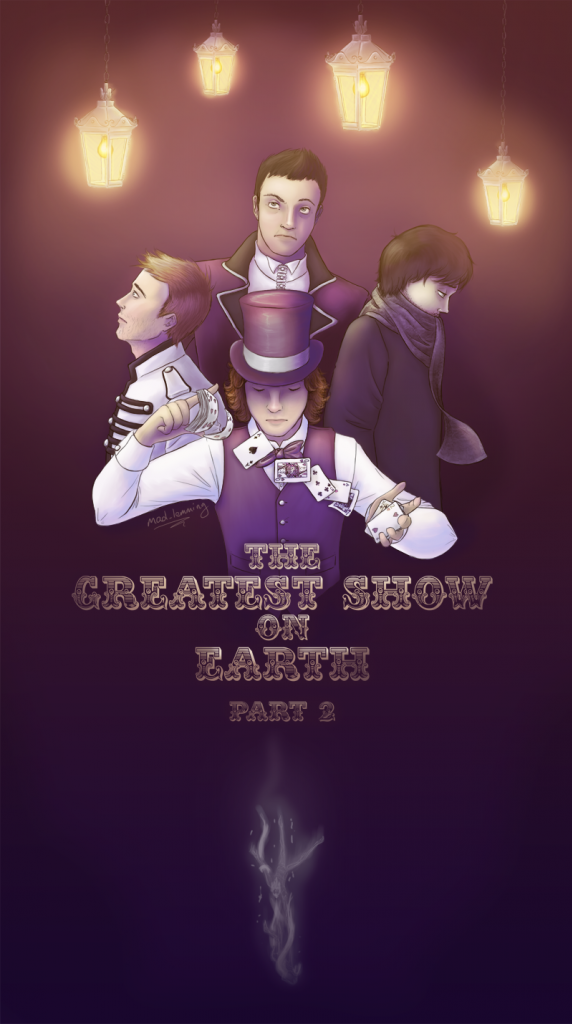
Chapter 1: Home And Away
London, September 1896
It’s all over the papers, for months. Of course it is, the circus is beloved, a national treasure. No on in the country, no one in any country they’ve ever toured, can believe what has happened. And even Isobel, who saw it with her own eyes, finds it hard to acknowledge. How has something so beautiful turned so sour? How could someone who created something so sublime, so inspiring, so wonderful, cause such hurt and pain? Isobel tries to avoid the articles, especially those with a picture of that man, that Nigel Martin-Smith. When they’re staring at her from the front page, his eyes scare her, so small, dark and ice cold.
Only slowly Isobel accepts what’s happened. In the first weeks after, every time she even thinks about it, she starts crying. And it is in her thoughts all the time. At night, when she falls into a restless sleep, she dreams about it – always the same dream, the same vision: Howard and Dawn, falling. And then she wakes up, screaming.
She wonders what has happened to them, to all of them, where they are now, how they are doing. She wonders if she’ll ever see any of them ever again. She wonders how she’s going to live without them, and the circus, in her life.
Today it’s in the papers again, maybe for the last time now. Isobel sees Nigel’s picture and the headline “Former circus director sentenced for murder”. Life imprisonment, she reads. She doesn’t read any further, she doesn’t want to know.
They should have sentenced him to death.
Near Bournemouth, November 1896
Jason had always loved the places by the sea the most and so it didn’t come as a surprise to Howard that he had bought this house. Or his care home, as he would call it when no one could hear him. Howard wasn’t keen on staying in hospital, but he wasn’t keen on “going home” either. Most of the time he wished he could simply disappear into thin air, not bother anyone anymore, just vanish and be gone. Gone to a place where having useless legs wouldn’t matter. Gone to a place where having useless legs wouldn’t bother him anymore. Instead he had to “go home” with Jason, to this house by the sea that couldn’t possibly become a home to him, nor to Jason. They’d not lived in a place with foundations in ten years or longer, they were circus people, living in tents and wagons, and sleeping in the open whenever they could. Home could never be a place built of bricks, with a roof that wasn’t wooden or canvas. But still Jason insisted on calling it “home”, as if that would make the idea of living in one immobile place from now on any easier to bear for either one of them. As if that term alone could erase the memory of what their lives had been like before.
Before.
Howard chokes. He always does when he thinks of what was before. When he thinks of that night, five months ago, that changed everything. When he thinks of this strange, empty new life that lies ahead of Jason and him and his useless legs. This new life they hardly ever talk about and that will start by “going home”.
The term itself is wrong and it makes Howard so angry it hurts in his stomach and tightens his chest. He won’t be goinghome, in fact he won’t be going anywhere ever again in his life. He will push the wheels of this silly wooden chair on wheels they built for him, and the chair will roll and will take Howard with him. That’s what it comes down to: his arms will do his legs’ job. And Howard will hate his arms for that. And he’ll hate his legs for refusing to move. And he’ll hate himself for not being able to move his legs. And sooner or later he’ll hate Jason for looking at him that way, with his big blue eyes all compassion and affection and love. Because how can you love someone who has to let his arms do his legs’ job?
There’s someone else he would hate with all his heart, if only he could. But Howard has found out hate isn’t a strong enough emotion for what he feels for Nigel. It’s something so deep and dark and painful and so way beyond loathing and revulsion and even rage that there’s no name for it, and no words exist to describe the full depths of this feeling. It’s so overwhelmingly gigantic in its repulsiveness that neither of them have yet found a way of talking about it. Instead they talk “homes”.
“It’s a beautiful place, How, you’ll love it,” Jason had told him a few weeks ago. He’d described the house in a million pretty words and made Howard believe it was everything they ever wanted. “It’s high up on a cliff, at the end of a winding road, and two sides of it face the ocean, with a porch to sit on and watch the sea, and the sunset, and the waves, and the tide going in and out. It’s got a large garden, and vast windows, and all the rooms are bright and big and sunlit.” He’d paused there, searching for any kind of emotion in Howard’s face, only to find doubt and resignation. Still he’d continued. “It’s a beautiful place.”
“I bet it is,” was all Howard could muster in response.
They’d stayed in lots of beautiful places in their former lives, and Jason had never failed to point out the particular beauty of each of them. But that was when they both knew they were going to leave soon again, for the next new, fascinating, exciting, beautiful place. How do you rate a place you’re bound to for the rest of your life? Circus people like them had no concept of that. So how were they going to make it?
Then had come the day they went “home”. And Jason had been right, it was a beautiful place. A proud, majestic, but sturdy house of red bricks and black tiles and large white windows, drenched in sunlight and a salty breeze and the sound of the waves and the seagulls. A house that was as close as possible to a striped tent in the shadow of the large big top, smelling of sand, and sawdust, and buttered popcorn, and resounding of the shrieks of animals, and laughter, and brass music.
Close, but not the same.
Howard wondered how long it would take Jason to get edgy, how long he’d be able to stay in one place. And he also wondered how long it would take him to get sick of himself, and this wooden chair and his useless legs. They lived in this house, listened to the sound of the waves and marvelled at the sunsets, both sleepless most of the time. Jason arranged a series of building works, to make sure Howard could move as freely as possible, and that kept him occupied for a couple of months, supervising all efforts to widen doorways and even out irregularities and turn all stairs into slopes. And when the builders had gone he would keep them busy by cooking and decorating and cleaning and taking Howard into the small village down the road to visit the local shops, and the pub, and the market on Fridays. Jason would smile at everyone and chat and before Howard knew it they were well-liked and respected neighbours. No one in town really believed their story of being cousins, but no one really cared much about that either. They had too much respect for the way the healthy one was taking care of the crippled one, and too much sympathy for the way the crippled one would take his fate and move his wheel-chair around town to think about judging them. Not even when one night in the pub after too many pints the builders told them that there was only one bedroom in this house, only one bedroom, with only one large bed. The builders were surprised by how bad the villagers’ hearing was. The villagers were glad when the builders left town.
One fine day in late August, though, all the work was done, all the colourful trunks were unpacked, all the circus memorabilia was safely stored away in the unused upper floor. Everything had its place, even Howard and his wooden wheel-chair on the porch. The weeks and months had passed and, slowly and quietly, this house had become a home.
Still Howard knew it would only be a matter of time now. You can’t keep a bird in a cage, at least not all the time, not when the bird’s wings aren’t broken. Howard knew this, and one late summer night, while they’re sitting side by side, watching the sun go down, he takes all his courage and fights all his frustration and bitterness.
“Don’t you miss travelling, Jay?”
“Travelling?” As if he’d never heard that word before. Howard knows he’s only trying to win a little time, to sort his thoughts and figure what to say.
“Yes, Jason, tra-ve-lling, packing a few things and going to another place for a while, you know?” He even manages to give him a slight, playful slap on the arm. If he fails at making this work, he’ll never forgive himself.
For a moment Jason is tempted to say “nawww, why should I?”, but the way Howard pretends to mock him teaches him better than that. Honesty is what’s kept them safe so far, it was brutal at times, and hurtful, but always necessary, and by God, it got them here, still together. So, he answers honestly “yeah. I guess I do.”
“Then you have to travel.” Neither a plea, nor an order, just a matter of fact.
“Yeah.”
That’s how Jason’s journeys start. They live in their house by the sea, they spend the springs on the porch, the summers in the garden, and the winters in the library, they talk and they think, they visit the town and paint their fences, they lie on the beach and they train their muscles, they cook and they read, they laugh and they cry, they argue and they make love, in their very own way, tender and carefully choreographed around Howard’s useless legs. But with every first leaf falling off the giant black alder in the back of the garden, they both know it’s time for Jason to get the trunks down from the attic and wipe the dust off his heavy travelling coat. They don’t speak much while Jason’s packing, and Jason won’t tell Howard where he’ll be going, and really Howard doesn’t want to know. If he doesn’t tell him where he’s going, he’ll have to come back to tell him where he’s been. That’s the unspoken agreement between them, and Jason never tells Howard that it breaks his heart every time.
Once Jason’s gone the time ticks away slower in the red brick house by the sea. The waves come in softer and the moon doesn’t climb up as high as usual and Howard’s arms do his legs’ jobs slower than usual. The woman who does the laundry on Wednesdays bakes him pies and hums sad tunes, and the boy from the village shop stocks the supplies for another week away in the pantry without ever asking Howard when his cousin will be back. Villagers pop up every now and again, claiming the lawn needs cutting, or a shutter needs fixing, or the leaves need raking. They work slowly and talk a lot while they do and then they sit down next to him on the porch, breathing heavily, and talk endlessly about how sunny this September was, and how sweet the blackberries are this year, and how early the birds are leaving for the south.
At night, Howard sits on the porch, his heart full of sadness and his chest full of longing, wondering where Jason is right now. He sits, cursing his useless legs, and Jason’s itchy feet, and the stars, and the sky, and the whole damn universe. He thinks and he prays and he hopes that he doesn’t forget him, and his useless legs, and their home by the sea.
The nights pass slowly while Howard tries to keep the faith.
He’ll come back.
He always does.
New York, October 1910
There’s a small hole in the curtain, and those that have worked longer in this theatre know that it’s only used in the autumn. Unlike many other magicians, The Great Owen isn’t paranoid about his audience, at least not all the time. That’s not what the hole is for. He only uses it a couple of nights in mid-September every year. He shoos everyone off the stage 15 minutes before the show begins and stares through the hole. Any onlooker would believe he’s expecting rivals to come and nose out his show. It’s quite common in this business for magicians to spy on their rivals. It’s also quite common for magicians to counter-spy. And then get completely paranoid.
But The Great Owen doesn’t spy, counter-spy or get paranoid about being spied on. He’s got no reason to. Every magic trick he invents is new in the business, and so many times better than everything other magicians can do that it takes even the best of his rivals at least three years to make a bad copy of it. They can come and watch his show whenever they want to. In fact, Mark regularly sends them invites. He’s not only the most brilliant magician, but also very polite.
No, the hole in the curtain hasn’t got anything to do with paranoia. It’s got to do with homesickness, heartfelt loss, and inerasable shadows from the past. One of these shadows is a bearded man in an elegant grey suit, and he usually comes to see the show a couple of times in the early autumn. He always sneaks in quite late, and has a bad seat in one of the last rows, close to the exit. He sits very quiet throughout the show, and he doesn’t applaud, all in an effort to be more or less invisible. It’s hard to say whether he doesn’t wish to be noticed, or doesn’t wish to disturb anyone.
If Mark didn’t know any better, he’d think he’s one of the spies the other great magicians send out. But Mark knows that silhouette, and he knows that face – he may try to hide in a pale suit and behind his facial hair, but Mark knows this man too well to be fooled by appearances. And even if he managed to distract him with his “disguise” – his body betray him. After all, there’s only one man in the whole wide world who moves like that. He could wear a long hood and a mask and Mark would still know it’s him.
Mark would love to know why he comes. Where he lives now. If he’s with Howard. How Howard is. If they’re together. If they’re fine. As good as they can be. Those few shows every September are hard for Mark. He finds it so difficult to concentrate on his cues and tricks and moves when all he wants to do is jump from the stage, run through the audience and give that skinny lad in the last row a long and very tight hug.
His crew notice that The Great Owen’s always a bit distracted and slightly off when that time of the year arrives, when he stares through the little hole in the curtain ahead of the show. Sometimes on stage, they have to give him a nudge, because he kind of stops in his tracks in the middle of a routine. And goodness, timing is everything in The Great Owen’s magic!
They don’t know why it’s so hard for him. They don’t know where he comes from, or what he’s been through. To them, The Great Owen is a man without feelings and without a past. They never wonder and they never ask. It’s only appropriate that a magician like him seems to just have materialised out of nowhere. One day he wasn’t there, and the next day he was, and that’s that. Asking who he is, and where he’s from would only destroy the aura of mystery around him that ultimately is part of his act. Some of the people working for him and most of his audience aren’t too sure he’s entirely human anyway.
For a few days every September, though, they get a hint of the man behind The Great Owen.
A man who can be anxious; a man who can, on rare occasions and for reasons unbeknown to them, smile.
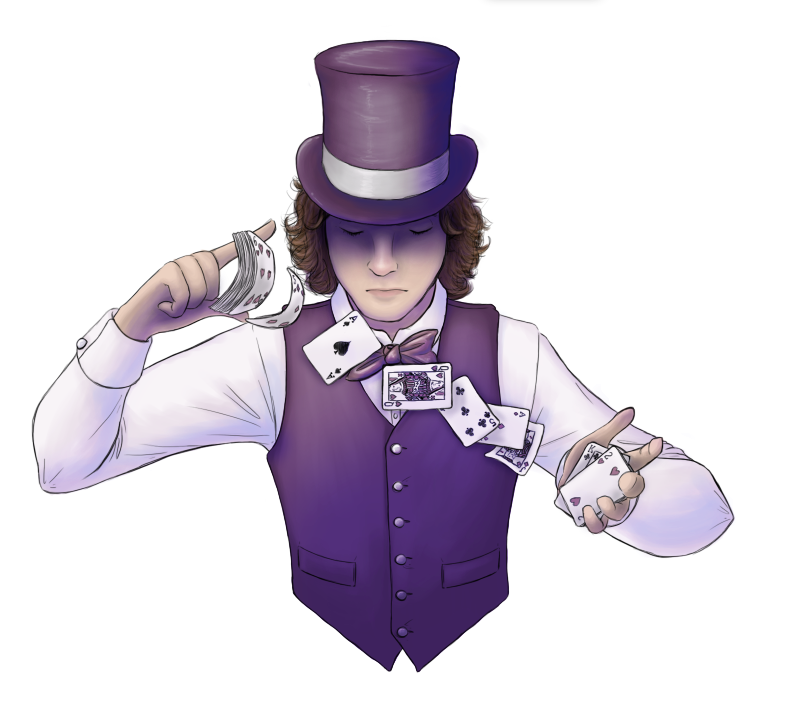
The man in the grey suit always leaves early. When he picks up at his coat, the hatcheck girl can’t help but ask if he didn’t like the show. No one ever leaves this show early who isn’t in labour or on the run.
“Didn’t you enjoy the show, sir?”
“I loved it, dear.”
“Then you shouldn’t leave now – the encore is breathtaking!”
The man in the grey suit smiles. “I know, they always have been.”
“You’ve seen Mr Owen’s shows before he came to New York?”
He looks at her for a while, with thoughtful blue eyes, then simply nods and hands her the tip.
The girl looks at the two bank notes in her hands. Two bisons. He’s given her two ten dollar notes…twenty bucks! “Thank you, sir, that’s very…”
But when she looks up the man is gone, the money in her hand and the still slightly swinging revolving door the only visible proof that he ever was there.
Near Bournemouth, December 1907
It’s a game they play. Jason had started it when Howard was still in hospital. Out of necessity. Because Howard refused to speak about what the doctors had said. Whenever Jason came in and asked if there was news, what the latest examination had revealed, or if the new x-ray image showed something they hadn’t seen before, Howard would just lie and shake his head and wave a hand.
“I’m hungry, have you brought food?” The first couple of days Jason had thought the fact that Howard had his appetite back was a good sign. But then he had figured it was just Howard’s not very subtle way of changing the subject. “Two can play this game,” Jason had thought and that’s when he invented their little game. It was simple, really, all he had to do was combine two things Howard couldn’t resist – their bodies close together and secrets.
One day, after Howard had gulped down a huge bowl of bangers and mash, and still refused to talk about anything but how the chirping blackbird outside his window would do his head in, Jason had tried his luck.
“All day long, Jay, it never stops. It’s the most stupid bird on the planet, I’m sure.”
Jason had taken the empty bowl, packed it back into the basket he brought every day and then had drawn the curtain, even though Howard’s neighbour in the next bed hadn’t been in the room.
Howard had looked at him suspiciously. “What you up to?”
But this time it had been Jason who refused to speak, he had simply taken off his boots, lifted the bedspread and with a soft “c’mon, shift a little…” lain down next to him, and pulled the blanket over them. And there, in what reminded them both of their little tent back in the day, where they’d hide from the circus, and the world, and Nigel, and would lie together and whisper and plot the future and touch each other a lot, right there underneath the hospital duvet, the late sunlight coming through the window creating strange shadows, and the stupid blackbird singing endlessly, Jason would pull Howard close and hold him tight and whisper “a secret for a secret” in his ear. And it had worked. Howard just couldn’t resist.
This way Jason had always found out what the doctors had said, what Howard’s legs did and what they refused to do, and how Howard felt about that. In return Howard would learn that Jason worried too much and thought too much, but never once came down on him for that, because all of his sorrows and all of his thoughts seemed to be about Howard, and Howard alone. They both got the affirmation they so desperately needed, close together and safe underneath the bedspread, and they both learned to love this game.
Tonight is no different. Jason’s back from another long journey, he’s tanned and tired, and his trunks are still unpacked in the hall, but here he is, lying close to Howard, pulling up the duvet, playing their game. “A secret for a secret.”
Howard sighs, nothing really happened while Jason was away. It’s a quiet place, their house by the sea, and the town. And there aren’t any secrets in Howard left that Jason doesn’t know of. “Mrs Buchanan is in love with George Forrester.”
“Howard!”
“It’s true, Jay, and it’s a secret. She’s made me promise not to tell anyone.” Howard grins.
“It’s not your secret, though….does George know?”
“Of course not!” They both giggle. Mrs Buchanan, who runs the local haberdashery, is ten years older than George Forrester, the new teacher – if this ever “happened” they would be the talk of the town. “It makes her smile, though, so I guess it’s a good thing, as long as no one knows.”
“I wonder why she told you?”
“I’m a poor, sad man in a wheelchair, people think I need to hear good news all the time. You’d be amazed about all the things they tell me…”
“You’re trustworthy, that’s it. I’d tell you my secrets if I were them too.”
“You tell me your secrets because you want my body.”
They both giggle. That’s one of the reasons the love this game, it’s easy, it’s carefree, it’s safe. It makes them forget the outside world, the sorrow, the pain, the aching, all of the things that went so terribly wrong. At least for a while.
“Your turn, Jay.” Jason runs his fingers down Howard’s back, slowly, delighted to feel Howard shudder slightly under his touch. He takes a deep breath and keeps on stroking Howard’s back, trying to distract Howard from the fact he’s hesitating now. All the way back from America he’s been pondering how much of his secret he’ll share with Howard. How much of his secret is Howard ready for? How much can he deal with? They still don’t talk all too much about the people they are missing, after all.
Jason moves even closer towards Howard, softly placing his hand on Howard’s face now, gently stroking his cheek with his thumb. “I have been to New York and I…I’ve…” He purses his lips, again hesitating for a moment, “I…I went and watched Mark’s show.” He pauses.
Howard’s eyes widen. “You seen Markie?”
Jason nods slowly. “And I’ve not only seen Mark. I also went to Chicago and saw…Rob.” He thinks about mentioning Kim, whom he’s seen in Paris, and Luke, whom he’s seen in Vienna, and Pernilla, whom he’s seen in Berlin, or about the private investigator he’s met in London and whom he’s hired to find out where Gary is, but that would possibly make Howard remember the whole circus, and with it, Nigel. Better stick to Markie and Rob for now.
Howard swallows hard. And Jason sees his big blue eyes well up, even here covered by their blanket, in the dark, he can see this. He can feel it. He knows it. Howard swallows again. His voice trembles. “Are they…are they…well? Do they look good?”
Jason avoids the full truth. “They both have great shows going on. Rob is ringmaster at Ringling’s! Ringling’s, Howard!” Howard beams – tears in his eyes, but smiling broadly, because someone he truly loves is somewhere he truly should be. Jason adores how selflessly Howard loves people, he always has. He could just hug him, and kiss him, and hold him forever right now. He feels his heart pounding and ready to jump out of his mouth, overwhelmingly in love with this man. His man. They lie, smiling at each other, until Howard remembers the secret and Mark. “How about Markie? He’s in a show, Jay? Tell me all about it?”
“Markie’s got his own show and it’s…How, it’s brilliant. Fantastic. He’s a star, a real star.”
“He always was.” Howard’s eyes fill with tears again, happy tears, Jason knows. He’s so relieved Howard’s taking this so well, he’s soaking the news up, he can’t get enough of them.
“They’re both touring?”
“Only Rob.”
“Are they still together?”
“I…I don’t know…I’m not sure…”
“Did they see you?
“I don’t know, I hope not. I don’t know if…if…they’re ready?”
“I hope they are still together.”
“Me too.”
Now it’s Howard who pulls Jason closer. He pulls him closer and kisses his forehead. It’s Howard’s way of saying “well done” and “I’m so glad we’re together” and “I’m even happier you’re back”. Jason sighs happily and leans in to kiss Howard, softly and deeply. It’s his way of saying “I’m glad we’re together too” and “It’s good to be back home again” and “I love you too”. There’s so many things they don’t need to say to be understood.
There’s still so many secrets that need to be shared. But the night is still young and they’re safe underneath the blanket.
It’s a good game.
Chicago, September 1910
Halfway through the show the tall, bearded man in the grey suit can't stand it anymore and silently leaves the tent. Outside he stands, bent forward, watching his right hand shaking uncontrollably. He tries to steady his breathing and suppress the panic. It's obvious Rob's drinking again, and it breaks his heart. Rob's become the greatest ringmaster in the history of ringmasters in the greatest circus in the history of the circus, he's Robert Williams, the star of Ringling's, he's got a crowd of a thousand each night hanging on every word he says, but he needs to get drunk again before he can face them, obviously. And no one in the audience even notices. The man in the grey suit is the only one who knows the signs. The only one here who knows the greatest ringmaster of all that well. And still he can't just go and face him, talk to him, tell him how much he misses him, how much he wishes he would come back home.
The man in the grey suit watches his shaking hand. He hasn't reacted this strongly to anything in a long time. He had so hoped Rob had managed to put the past behind and survive without alcohol. That, he assumes, was probably a bit naïve. By now he should have learned that the past – their past – always and again manages to sneak into their lives, this way or another. To still think, or hope that past would just be gone one day is a bit ludicrous, really. Slowly his hand steadies, as does his breathing.
He wishes he was home right now. God, he misses home, more than ever. Not long now, he tells himself, not long now.
Thoughts run through his head, about what he could do now, about what they should've done back then, about how they did it all wrong. And about how he’s worried that all he’s been planning these days, these last years, is going nowhere. He’s failing, once again, trying so hard to do what’s right but never quite knowing if it really is…right. Who’s he to judge what’s right and what’s wrong? It’s no miracle all of this travelling and planning and plotting isn’t successful. He's just too...ludicrous. Naïve. Silly. Hanging on to the past too much, dreaming of the present as something it clearly isn't, and still being ridiculously worried about the future.
It’s clearly time to call this journey off and travel home. But leaving Rob behind here, in a state like this, it doesn't feel right either. But what can he do? He wouldn't come with him; he's too proud for that. And far too stubborn. Or isn’t he?
His thoughts are interrupted by a noise behind him, a certain shuffling of rubber on grass, somewhat familiar and still strange, and he turns around to see what it is. A tall man in a wheel-chair is rolling towards him (oh, how well he knows that sound). The man looks at him in a concerned way and asks “are you all right, sir?”
“Oh, yeah, thank you,” the man in the grey suit answers and tries a slight smile. “I'm fine.”
The man in the wheel-chair nods and prepares to turn around. “If you need anything...”
“Wait a minute…aren't you...haven't I seen you in the show?”
Now it's the man in the wheel-chair's turn to smile. “Yeah, maybe.” His smile broadens, proudly. “I'm Nathan, from Tall Nathan and Little Louis.” The man in the grey suit remembers that act, a clown duo – a dwarf and a tall man on stilts, hilariously funny, both of them.
“The tall man on the stilts – that's you?”
Nathan rolls the wheels of his chair a little forward, “yeah, that's me. Hard to believe, eh?”
“Forgive me if I come across impolite and ask you this bluntly, but...”
“Go on then!” Nathan grins widely.
“How do you do this?”
“The stilts. They work like a prosthesis, kinda. I'm not a technician, ya know? But they work.” He shrugs. “I can work them, I should say.”
The man in the grey suit’s jaw drops. “That's amazing! I'd love to know how they work! Can you tell me who’s constructed them? Where you got them?”
“Can a bird fly? Of course I can! But why on earth would you wanna know?”
The man in the grey suit smiles a sad smile. “I ...I've got my reasons.”
“Well, your reasons are good enough for me as long as they come with a drink and a cigar, if ya know what I mean?” Nathan winks. The man in the grey suit nods, “whatever you want, Nathan.”
His hand still shakes slightly while he's searching his pockets for money and his small black notebook. He’s going to need both.
Near Bournemouth, October 1910
When Martin Kelley leaves his house that morning he knows it’s going to be a glorious autumn day. The sun is slowly fighting its way through the small white blanket of clouds that’s hanging over the village like sheets covering furniture in a house abandoned for the winter. And there’s a light wind from north-west, always a good sign down here. Martin takes a deep breath and walks on.
He’s a bit later than usual, maybe. The cat had dragged in a vole and he hadn’t wanted to leave before the mess was cleaned up. But maybe that was good for something, after all, because by the time Martin has reached the beach, the sun has come out through the clouds and is warming his face. The sun must’ve blinded him temporarily, because he only sees the sunk-down figure on the beach when he’s just a few yards away from him. What the hell…? Isn’t that…? How did he…? Martin quickens his pace. How on earth did he get there? On his own?
Martin makes his way over the pebbles and doesn’t slow down until he’s reached the wheel-chair. And Howard. Howard, who must’ve heard him coming closer, but doesn’t look up, instead keeps on staring intently at the sea. Martin’s heart beats louder than the town’s church bells on Sunday mornings, but he manages to keep the panic out of his voice.
“Howard.”
“Martin.”
“Wonderful weather, eh?”
“Absolutely brilliant.”
“How about we smoke one before I bring you back?”
“Good idea.”
There’s no discussing how to best bring Howard and the wheel-chair back to the pier. There’s no talking about how Howard got there, and why. Martin’s not a man of many words and Howard’s got nothing to say anyway. They smoke silently for a while until Martin flicks his cigarette into the sea.
“I can’t push you back in the wheel-chair. The stones…”
“I know, Martin.”
“I could go back into town and find someone to…”
“No.” Howard interrupts him brusquely, then takes a breath and tries to cushion his rudeness.
“Please don’t.”
Martin isn’t someone to let a grown man beg. And he had already taken the decision to carry Howard back and then get the wheel-chair without getting help anyway. There’s things in life not everyone needs to know. And so Martin Kelley, a short but sturdy 62-year-old joiner with a grey crewcut and large, calloused hands, carefully lifts up Howard from his wheel-chair and carries him safely back to the pier. On his way back to the abandoned wheel-chair, the whole magnitude of Howard’s despair dawns on him. It must’ve taken him an hour or more and all of his strength to get his wheel-chair there, over the pebbles and against the wind. On his own. Poor bastard.
While he’s dragging the wheel-chair back to Howard, Martin makes an important decision.
“He’s gone longer than usual, isn’t he?” Martin says after he’s helped Howard back into the wheelchair and started pushing him back to his house. He may not be a master of conversation, and subtlety may not be one of his strengths, but for a man who’s been living on his own for almost thirty years he’s doing all right.
“He left earlier than usual, that’s all.” Martin grins. Howard’s need to protect Jason is still unbroken. He’s hurting deeply, but he won’t have anyone say a bad word about him.
“I’m sure he’ll be back soon.”
“Yeah…wait! Where are we going?” Howard’s trying to turn around in his wheel-chair as Martin pushes him past their house and further on up the road.
“Just a quiet little place I’d like you to see. I go there every day.”
“What…?”
“Did you know I used to go to sea?”
“No…”
“I did. I wasn’t a carpenter all my life, you know? Well, in fact I was, but I was a sea-faring carpenter. Yes, Howard, I was a sailor when I was young. I loved to go to sea. I loved the sea, the wind, the world. I’ve sailed all seven seas, seen it all.”
This is news to Howard indeed.
“My wife used to joke I loved the sea more than I loved her.” More news for Howard – he never knew Martin had been married. He doesn’t dare asking, though, something in the way Martin speaks, wistful and despairing somehow, makes him keep quiet. Martin will tell him what needs to be said. And show him what needs to be shown.
“She made that joke quite often and I always told her it wasn’t true. And I meant it, it wasn’t true. But I still left her behind time and time again, because I wanted to earn enough money quickly, so I could build her a pretty house, as pretty as she deserved. A large house with enough room for children.”
While he’s speaking Martin has pushed Howard halfway to town, then turned right and followed the path that leads to the cemetery.
“I was so busy earning money I never noticed how sad she was, you know? And when I told her about my plans she always said “I don’t need a big house, Martin, I need you here with me. I don’t mind where we’re living as long as we’re together.” You know how women talk? I didn’t take it seriously.” Martin’s voice cracks a little. Howard swallows hard, his head is spinning from the emotions inside of him, and all his effort of not letting it show.
“And then one day I came back from one of my journeys and she was gone.” Martin has turned left once more, to a path surrounding the cemetery, leading to a little black iron-gate almost hidden in a hedge, marking the east border of the graveyard. He opens the gate and pushes Howard inside. What looks like a small, over-grown garden really is the pocket of land that’s reserved for the poor lost souls who took their own lives and thus are not allowed to find their rest in blessed soil. Most of the graves, Howard notices, are unkempt and abandoned. Only few dare to visit, let alone adorn the graves of those sinners. In amongst them is one that looks different. Autumn flowers bloom in warm colours, an eternal light flickers, and a delicately made wooden cross looks over it. Martin pushes Howard in front of it and gives him a moment to read the inscription on the cross:
Margaret Charlotte Kelley
Beloved wife, daughter, sister and aunt.
1850-1878
“She left me a note, apologizing for having lost faith in us. I keep it under my pillow.” Howard is overwhelmed by how matter-of-factly Martin can share this with him.
“I never knew, Martin…I’m…I’m very sorry…”
“Few people do. Most of those who knew have long forgotten. And hardly anyone ever comes here. I know, because I’m here every day.”
Howard cringes in his chair.
“Every day since she left me.” Martin carefully picks up a few autumn leaves from in between the flowers.
“I’ve brought you here, Howard, and I’m telling you this, because…”, for the first time since they left the beach Martin seems to falter, “…because…forgive me if I offend you, but when I saw you on the beach today…I…I…just…” His voice cracks, and he has to cough to clear his throat. Howard would love to tell him it’s okay and to go on, but he’s frozen in his chair, scared and full of fear and sadness and regret and longing. But he manages a nod. Martin takes a deep breath and continues, “in her note she said, my Meg, she said “I’m setting you free”. That’s what she wanted, set me free. Because she thought I loved the sea more than her. That’s how much she loved me.”
He doesn’t ask if that’s why Howard was on the beach this morning. He doesn’t have to, and Howard’s grateful he doesn’t need to explain.
“If you ever…feel this way again, I’d like you to remember one thing, right?”
Howard manages another nod.
“I’ve never set foot on a ship ever again.”
A few tears are forming in Howard’s eyes, and they fall, heavily, down on his hands.
“I know that’s not what she wanted, but I can’t leave her alone here, I just can’t.” He shuffles his feet. “I’ve always loved her more than the sea. Always.”
One day Howard will thank him for what he did for him that day. He’ll pay him back, repay every hurting emotion he so bravely dragged out of the place in his mind where he’s safely stored them, to share them with him, to save him from making the same mistakes. To save him from giving up, from losing faith.
For now he’s just thankful Martin leaves him alone in the abandoned graveyard, leaves him alone with the poor lost souls, and his tears, and his shame. He cries, silently, lets it all out, then apologizes to Margaret and all the others put to rest in this quiet place, turns his wheelchair and leaves without looking back.
I’ll be here when he comes back.
Two weeks later
It’s his favourite sound in the world – the combination of the clatter of horseshoes and the rattling of a carriage out on the street to their house. When Howard first hears it he sits up in his chair, then quickly wheels to the front door, just to check that he’s not dreaming. He isn’t. Mr Carmichael’s carriage, drawn by two of his finest horses, is approaching at high speed. Lots of trunks are loaded on top of the carriage, dangerously sliding in every curve of the road. Howard smiles broadly.
Only a minute later the carriage comes to a halt before the house and the door opens and Jason jumps out, never minding the steps or gravity. He runs up the drive and up the stairs onto the porch and almost knocks Howard in his wheelchair over. There’s a lot of hugging and mumbled words and quick kisses and Mr Carmichael’s rolling his eyes at the sight of it, though he can’t help but smile.
Jason on his lap, Howard takes his face in his hands and studies him intently, like he always does when Jason comes back, as if to make sure he’s still his Jason. Jason knows the procedure and sits still until Howard has ended his inspection and is satisfied with the result. Eyes – blue and shining. Check. Hair and beard – too long and in need of a barber. Check. Smile – still there and functioning. Check. New wrinkles – a few. Check. No bruises – good. Check. All’s well. Howard smiles. “Welcome home, bastard.”
“Love to see you too, sunshine.”
“About time you got home…”
Jason shuffles slightly on Howard’s lap. Howard frowns.
“What is it, Jay?”
“I’m afraid I can’t stay for long…”
Howard’s lips tighten, his eyes narrow, but Jason smiles at him.
“Don’t worry, you won’t even notice I’m not there! I’ve brought you something, you know?” He gestures towards the carriage. “C’mon, take a look!” He gets up from Howard’s lap and pushes the wheelchair down the slope they’ve constructed for him. He stops the wheelchair close to the stairs that lead up to the still open carriage door and helps Howard get up in order to be able to look inside the carriage.
“Shh, he’s still asleep.” Jason mumbles while he’s steadying Howard. “And I’m glad he is, he barely slept a single minute on the ship.”
Howard has no idea what Jason’s talking about and he struggles with keeping his balance but he’s intrigued now, and curious. He looks into the carriage and almost immediately wells up. He bites his lips and grabs Jason’s arm very tightly. “You brought him home.”
In the carriage, strangely curled up on the seat, covered up with Jason’s travelling coat, and peacefully asleep, lies the greatest ringmaster of all time. Robert Williams is back home.
“I said you’d be busy.” Jason grins.
“Bastard!”
Later that evening, after Jason has carried Rob out of the carriage and into one of the formerly abandoned rooms on the upper floor, they talk.
“You should’ve seen him – all showman, the audience hanging on every word he said, but as soon as he was out of the ring, he could hardly stand on his own feet!” Jason shakes his head. “Trust me, all you’d do with that much booze in your body is snore.”
“I never snore.”
“Of course you do.”
“I don’t!”
“Especially when you’re drunk.”
“I do NOT snore!”
“Don’t worry, I still love you.”
“Bastard.”
“You’re saying that a lot today.”
“Wonder why?”
“No, no…”
For a while they sit in silence, next to each other by the fireside. Jason enjoys the quiet and the peace and Howard’s nearness. He’s going to miss it soon enough again. At least for another while. Better enjoy it best you can.
“I was surprised he immediately agreed to come with me. I’m really glad I went to ask him.”
“Well done, Jay.” Howard takes Jason’s hand.
“He suffered on the ship, he really did. But he didn’t drink. You’ve got to keep him away from the alcohol.”
“Do you really think that’s all?”
“Probably not.”
“What exactly is his problem?”
“Mmh, Mark, to start with. You. Me. Gary.”
“The past.”
“The past. And…”
“And?”
“Nigel.”
Howard squirms. All those years, but still hearing his name hurts, almost physically.
So much hurt. So many years. So much suffering. It’s not right. It’s time to end all this misery, to live again, heal, be happy.
And if it means that Jason has to travel some more and Howard has to keep Rob away from the booze, it’s a small enough price to pay.
New York, November 1910
The hatcheck girl smiles fondly at the man in the grey suit.
“Leaving early again, sir?”
“You remember me and my habits?” The mischievous smile on his face suits him well and makes him look a lot younger, though she notices there’s more grey in his hair and his beard than just a year ago.
“I do, sir. There aren’t so many people from Mr Owen’s past around here.” She’s collected his coat and hands it over to him.
“Are you that interested in Mr Owen’s past?” he asks while slipping into his coat.
“Well, ummm,” she hesitates, “I don’t want to appear nosy, but he’s an interesting man, and it would be…but it’s none of my business, of course.”
He looks at her absentmindedly, then says, slowly, “Who knows, maybe one day he’ll write a book and you can read all about it.” He’s lost in his thoughts for a moment, then shrugs off whatever it was he was thinking about, off, and hands her a tip just as generous as the one he gave her last time.
“Thank you, sir, you’re very kind.”
“Mmh.” He looks unconvinced. “If you say so. It was nice seeing you again. Good night.”
“Good night, sir.”
He turns to leave and has made his way halfway to the door when suddenly he feels something change in the air around him and he stops in his tracks.
“I can’t believe you want to leave without watching my encore.”
The man in the grey suit startles and looks up to where the voice came from, but can’t see anything in the darkness. He’s sure he knows this voice, it’s a voice he’s long hoped he would hear again, and he’s scared it’s just his hope that tricks him, because obviously the show is still running and there’s no way the star of the show could be out here right now, talking to him. Or could he?
“Mark?”
“The encore is the best part of the show, you know, and you always leave without watching it. I’m gutted.” Slowly, The Great Owen emerges out of the dark, his face still half hidden in the shadows. He folds his arms in front of his chest. “Really gutted, Jay. I mean, why do I make the effort?”
“Shouldn’t you be…?” The man in the grey suit turns his head again, “shouldn’t you be in there?” He points in the direction of the theatre.
“I’m a magician, remember?”
“I have heard rumours to that effect.”
“And you’re training on a new act, then?”
“Pardon?”
“The Invisible Man?”
“No, no…I…”
“You…?”
“I just try not to cause any fuss.”
“Ah.” The Great Owen nods. “I’ve tried that number too for a couple of years. Didn’t do very well, to be honest. Called it a day just recently.” His voice cracks a little, almost inaudibly, but Jason’s got good ears and he knows Mark very well, even after all these years, and this little crack in his voice is enough for Jason to know for sure that the earlier playfulness was only feigned. It breaks his heart a little, because why does Mark think he’s got to pretend? Has he waited too long? Should Jason have tried to talk to him earlier? And why hadn’t he? Why had he never stayed for the encores? Jason swallows, tilts his head slightly, and stretches his arms out, in a somewhat helpless gesture, the palms of his hands very white in the darkness around them. Jason wished he could see Mark’s face more clearly, to see if his eyes are sad and if there’s this little, crooked smile around his lips that he used to put on when he wanted to pretend he was all right, but really wasn’t.
“Mark, I’m…I’m really sorry. I’m sure I missed a lot of…” He wants to say “you”, and he means it, but then still changes the words before they slip over his lips. “I’m sure I missed a lot of fantastic encores, didn’t I?”
“You sure did.” Mark takes one step out of the safety of the darkness. He’s not smiling. No more hiding, and he seems to mean it.
They stand and look at each other for a while, before The Great Owen continues, “How about not disappearing for a change? How about telling me all about your plans?”
“My plans? What do you know about my plans?”
“And again you forgot I’m a magician.”
“Ah, of course, silly me.”
“It’s time we talked about your plans, it really is.” Mark’s eyes are darker than Jason has ever seen them. “At least if I’m part of your plans.”
Is he really doubting that? “Of course you are! If you want to and have the time and…”, Jason sighs. “That’s why I never watched the encores, Mark. You’re way too good for anything we could ever plan. Your show outshines everything anyone of us has ever done or can ever do.”
“That’s not true.”
“Mark, I’m 40 years old and scared of trapezes! Howard can’t move his legs! We still haven’t managed to find Gary and without him and his music we’ll get nowhere! And…” Jason stops, a bit breathless.
“And?”
“Nothing.” Jason shakes his head, a little exhausted from his outburst.
Mark tries to catch his eyes, but Jason keeps his head down. Mark bites his lip until it hurts. He knows what he needs to ask, but the answer to that question might hurt so much that he’d rather keep silent. But he doesn’t. His voice is a bit shaky at first. “What about Rob?”
“Rob can only go out on stage when he’s drunk.” Jason would’ve liked to avoid the bitter truth, but he can’t.
Mark swallows hard. “That’s no good. I never knew it was that bad again.”
Jason can only imagine what they’ve been through. “Like I said, we’re nothing compared to you.”
And that’s when Mark rests all cautiousness and worry and steps forward and simply hugs Jason, quickly, but tightly. “Silly bastard.” He takes a step back and looks at him sternly. “I want to be part of your plans, no matter what.”
Jason nods, for once unable to speak, sad and happy and defenceless and relieved all at the same.
“Good. After the show we’ll talk, okay?”
Jason nods again.
“And now you go back and watch my encore! Seriously, leaving before the encore…” The Great Owen’s voice fades out and with a small pop he disappears in a silver cloud of fog.
The man in the grey suit hands the baffled hatcheck girl his coat once more and slowly walks back into the theatre.
No one can resist The Great Owen.
London, December 1910
The rain patters on the glass roof of the conservatory at the back of Kim’s house. Its monotonous sound, the high humidity in this room full of exotic plants, and the aftermath of a huge portion of Helen’s excellent roast has made the four men around the iron table sleepy. The formerly vivid discussion has died down a bit, and each of them is hanging on to their own thoughts, and ideas. Helen has just served coffee and Kim’s humidor is slowly handed around. So far they’ve discussed financial aspects, heard Jason’s report from his latest trip to America, and studied Desmond’s plans for a hinged stage and a trapeze rigging that can be completely hidden under a suspended ceiling. Just before Helen had called them for dinner Kim had summarized their efforts jokingly, “I see it’s all going to plan – now all we need are artists!” They’d all looked at Jason, almost instinctively. And he had nodded and slowly mumbled, “working on that.”
Now, two sips into his coffee, Jonathan dares to ask what’s on his mind. “Jason, do you really think they’ll join? And is there anything we can do to help you?”
Two difficult questions, and then again, not that difficult at all. Jason lights the cigar he’s been rolling between his fingers and takes a drag. “Yes and no, Jonathan. I do believe they’ll join, but no, I don’t think there’s anything you can do to help, it’s…complicated, you know?”
Jonathan nods thoughtfully and takes another sip of coffee. “I see…”
“But there is something I need help with.” Jason gets up and searches through the pockets of his coat until he’s found his notebook. “Desmond, could you have a look at these, please? I saw them at Ringling’s – a clown act on stilts, only that the clown who used them couldn’t…, he couldn’t walk.” Desmond, Kim and Jonathan look at Jason with raised eyebrows.
“I mean, he couldn’t walk without them. He sat in a wheelchair.”
“He was paralysed?” Kim asks.
“Yeah, an accident when he was a teenager.” Jason has found the pages in the notebook where he’d tried to write down as much information about the stilts as he could. “See? They look like normal stilts, but there’s a mechanism at the top of each that makes them more flexible,” he points at one of his drawings, “and there’s a special way they get attached to the legs, with a kind of a brace to the hips”, he points a another, more detailed drawing. “I’m sorry, Des, I’m afraid my drawings aren’t any good.” He sighs, but Desmond has already taken up the notebook and reads through the notes with great interest.
“Do you think you’d be able to construct something like this?” Jason asks him after a while. So far no one mentioned his name, but everyone is well aware who these stilts are for.
“I think I understand the principle, and I think if you give me a few weeks time, I could build something, but, you see, Jason, whoever uses them needs to be able to move their hips.”
“I was guessing, yes.”
Desmond looks a bit uncomfortable, and it’s Kim who asks the question Desmond doesn’t quite dare asking.
“Are you thinking of Howard, Jason?”
“Yes, Kim.”
“As far as I understand Desmond, Howard needs to be able to move his hips in order to move these stilts…”
“I know, Kim, I heard that.”
“Are you sure he can…I mean…do you know if he…”
“He can move his hips.”
Everyone’s either intently staring at Jason or at the floor, but no one asks how he can be so sure about that.
“All right, very good. Well, then….I’ll try and have a prototype ready for our next meeting.”
“Thank you, Des, that would be really fantastic.”
The following silence is broken by a man storming into the conservatory, a little out of breath and a bright smile on his face. James Galloway, private investigator, and by now, after working for Jason and Kim for almost three years, a good friend.
“James! What brings you here?”
“Good news, Mr Gavin, very good news!”
“Good news is always welcome!” Jonathan grins. “C’mon, spill!”
“I think I’ve finally found Gary Barlow.”
“Are you absolutely sure?” Jason asks, carefully trying not to be delighted too early, “The last Gary Barlow you found took me three weeks of travelling only to find a 82-year-old man who nearly shot me down when I knocked on his door.”
“I know, Mr Orange, and I’m still terribly sorry about that – but this time I’m almost 100 % sure it’s really him. I should tell you straight away, though, that the journey to go and find him will be even longer.”
“Where have you found him?”
“Australia, sir.”
“Australia?”
“Good heavens!”
“I’ll go and get the brandy. We need a drink.”
Near Bournemouth, January 1911
Rob could watch Howard forever. He’s totally amazed at how Howard gets everything done, how perfectly he’s mastered his wheel-chair, up and down ramps, around corners, and even through the heavy soil of the garden. Howard’s got a routine for everything he needs to do, from getting out of bed, to shopping, and cooking, and even gardening. His arms are strong and somehow he makes it all look easy. Makes it look as if it was the most normal way of living. Rob’s sure that people who didn’t know Howard before the thing-that-happened never wondered how he’d been before. But for Rob, who more or less blames himself for what happened to him, it is as heartbreaking as it is admirable.
“Make yourself useful and hand me a towel.” Howard has finished his shave and is cleaning the razor blades in the basin.
“Sure, How.”
“And stop staring at me like that.”
Rob hands Howard the towel and looks down, shifting on his feet. “I don’t…I’m sorry, it’s just…”
“Christ, I’m not a monstrosity! I just can’t move my legs, that’s all. Time you got used to it.”
Rob blushes. “No, no, that’s not it! I’m not staring…”
“No?”
“Well, maybe I am…but not because I think you’re a monstrosity! I’m just…impressed.”
Howard’s put his shirt back on and turns the wheelchair around. “Impressed, eh?” He shakes his head slowly. “I’ve heard some rubbish in my life, but that’s…”
“Seriously, How! The way you do it all, the way you move the wheelchair and…I’d just bump into everything and…”
“Curse all the time?”
“You bet your life I would!”
Howard grins. “No, I wouldn’t.” And, after a little pause adds silently, “I like my life too much for that.”
“I just think it’s amazing how you do it all and I …I just think you’re amazing.”
“You better don’t say that when Jason’s around, he doesn’t like other men flirting with me…”
“I bet he doesn’t!”
“He’d probably give you a cosh around the head.”
“He should, he really should.”
They’ve left the house for the porch, and Rob sits down in a chair next to Howard. “You know, I don’t even think I’ve ever apologized to him for knocking him out…that night.” The last two words he can only speak with difficulty. “And I never apologized to you.”
Howard turns his head and looks at Rob. “What would you have to apologize to me for?”
Rob chokes. “If I…if I hadn’t knocked him out, you wouldn’t have…and then you wouldn’t be…”
“Rob?”
“Yes?”
“If you hadn’t knocked Jason out, he’d probably have died that night. You know, Rob, actually I don’t think I’ve ever thanked you for that.”
Rob blinks confusedly. He’s never quite seen it that way before. “I always thought I did it all wrong, I only made things worse.”
“You saved Jay’s life. And it was my decision to do the act for him that night. You couldn’t have seen that coming.” A bad suspicion forms in Howard’s head. “You’ve not been thinking it was your fault all these years, have you?”
Rob doesn’t answer.
“You silly…fool. What are you going to tell me next? That Mark thinks it’s all his fault?”
Rob doesn’t answer this question either. Howard can’t remember having seen Rob sit so still for so long. “Why would he think that?”
Rob wonders why Howard can’t guess, but then he remembers he wasn’t at the trial, when he and Mark went into the witness box. “Has Jason never told you?”
“What?”
“That it was Mark who told Nigel…?”
“Of course he told me, but…I still don’t see… You two have been battering yourselves all these years for this?” Of all the things Howard’s thought of about that night, and he thought about it a lot, this has never crossed his mind.
“What else? You’ll tell me Gary thinks it’s all his fault because Nigel saw him kissing Dawn? That’s why he disappeared after the trial?”
Rob shrugs, and nods. “That’s what Mark and I assumed, kind of.”
So much hurt, so much regret. And so much still under the rug. Howard shudders and wonders if this will ever end. The more he thinks about it, the more it disgusts him. And the more he understands why Jason’s travelling.
“Rob?”
“Yes?”
“I’ll tell you now once and for all: there’s only one person responsible for what has happened, and he’s rotting away in a prison cell in Wandsworth. Don’t you ever dare think it was your fault! You and Mark, you’re my heroes, you were brave that night, braver than anyone else I know, and you should be nothing but proud of yourselves. You got that?”
Rob bites his lips. “I got that.”
“Good. Now let’s hope Jason finds Gary and convinces Mark to come home, and then we’ll tell them too.”
“Yeah.”
“You two have had a really hard time, no?”
“Me and Mark?”
Howards nods.
Rob hesitates. “I…I didn’t make it easy for him.” He looks sadder than ever.
“Life isn’t always easy.” Coming from anyone else it would sounds like an awful truism, but with Howard speaking, it’s a simple truth. He knows what he’s talking about.
They sit in silence for a while and Howard thinks they’re on a good way.
Rob lets out a heavy sigh. “God, I’d fancy a drink now.”
“You can have a cosh around the head instead.”
“No, thank you.”
“And stop staring at me.”
“Can’t promise that.”
The next morning a man called Desmond arrives with a lot of boxes and trunks full of tools and strange-looking devices. Rob watches as he takes measurements of Howard. Rob helps Desmond adjust the leather straps on the brace and the springs on the stilts. And then Rob helps Howard put the brace and the stilts on. Even though Howard’s constantly mocking everything Desmond and Rob do, Rob can feel he’s excited. Rob prays that whatever it takes to makes these stilts work will happen.
His prayers are heard. Two days later Howard makes his first, wobbly steps with the brand-new stilts. Rob can’t stop staring at him.
Life isn’t always easy, but it is beautifully strange sometimes.
Scone, New South Wales, Australia, February 1911
The only passenger that has got off the train at Scone station is a tall, bearded man in a grey suit. He looks around to find someone he could ask about where Gary Barlow lives, but the station is deserted, the ticket booth closed. He steps out on the street, shielding his eyes with one hand against the bright midday sun, when he’s almost run over by a little girl with long blonde hair. She giggles, and hides behind him, wrapping her arms around his left leg. “Hide me!” she whispers.
The reason for that request comes running around the corner of the street, and is quite obviously her older brother, the similarity is unmistakable. “Emily! You come here! Now!”
Emily giggles. “Catch me if you can!”
“I won’t! You come here, or I’ll tell dad!
Emily steps out from behind the man in the grey suit, who watches their showdown with interest. There’s something about these kids…
“You won’t!”
“You’ll see I will!”
“No, no, no!” Emily stamps her foot with each word.
“Why don’t you want to go with your brother?” he asks her, kneeling down on one knee beside her.
Emily is baffled. “He’s not my brother.”
The boy shouts from the other side of the street, “oh, yes, I am!”
“No,” she shouts over to him, “not when you’re nasty like that!”
The boy rolls his eyes. “Oh, well, then stay here while I go home for lunch…” He pretends to turn and walk away.
“Dan! No! Wait!!” Emily runs after him. The man in the grey suit smiles, the power of a lunch-mention can never be underestimated. He gets up from his knee and decides to follow Emily and Dan. Something tells him it might be worth it.
He follows them up the street, around a corner, and around another corner, along another street that leads them out of the centre until they’ve reached the last house, a vast, white farmhouse, surrounded by large paddocks.
The man in the grey suit watches from the open gate how the children run up the driveway and sees how the front door opens to let them in. He stands very still, as does the woman, who has opened the door. Then she lets out a small cry, presses her hands to her mouth, unbelieving. The man in the grey suits smiles.
This time James has got it right.
Four days later
“Do you really have to leave again already?” She’s asked it a dozen times already, and Gary’s rolling his eyes.
“Dawn! Leave him alone now.”
“Oh, you, grumpy man!” Gary tries to drag her into a hug, but she uses her cane to keep him at safe distance. Jason could watch them bickering forever, it’s so good to see them, to have them around.
They’ve been talking the nights through, these last three days, and at some point, finally, Gary had to admit that the idea of coming back to England, at least for a while wasn’t maybe all that bad. Jason doubted it had anything to do with all the plans he’d laid out for him, all the ideas he’d explained in a million words, but more with Dawn’s bright eyes getting brighter and bigger with every new idea elaborated. Sure, there’s peace here, and quiet, and the house is beautiful, and they have horses, and dogs, and cats, and even a goat, and the neighbours are friendly, and the sun shines a lot – but it’s still no circus. And there’s a piano in the hall, and note-sheets all over the house – but there’s no band, and no audience. All things Jason has promised them.
In a quiet moment, when Dawn was up in the first floor to get the children to bed, Gary told him his worries.
“She can’t move her leg, Jay, and her back isn’t stable. She’s got to wear a corset all the time. The pregnancies were hell for her, but she insisted. I can’t deny her anything, you know? But she can’t dance, and she can’t be an artist anymore – I thought it’s better I take her as far away from any circus as possible. And now she wants back!”
“There’s a hundred jobs she could do, Gaz. Or more.”
“But it’s not the same, what if…”
“Gary.”
“Yes?”
“Have you seen how she beams, how her face brightens up when we talk about the circus?”
“Yes.”
“Have you ever seen her shine like that?”
Gary only answers hesitantly, “yes…, twice.”
“And when was that?”
“When she was pregnant…”
“There was a third time, you know?”
“Huh? When was that?”
Jason smirks. “When she got together with you.”
“Oh…bastard.”
“It’s funny, but I’ve been hearing that word a lot lately…”
Near Bournemouth, April 2011
With Rob in the house, it’s later than usual before they can shut the bedroom door behind them, lock the world out, and play their game. Now that the booze is out of Rob’s system, he’s full of beans and his head is full of ideas. And he wants to know everything about Australia, and Gary, and Dawn, and their children, and their horses, and dogs, and cats, and the goat. They talk and they giggle and wind each other up until far past midnight, but then finally Rob starts yawning and retires. As do Howard and Jason.
For the first time it’s Jason who has to share the first secret. Howard waits until Jason has settled next to him and the blanket has safely covered them, and then he pulls Jason close and whispers, “a secret for a secret.”
Jason takes a deep breath. Until this afternoon he didn’t even have a new secret for Howard, but then after unpacking the trunks he’d finally found the time to go through his mail, waiting for him on his desk, all letters piled up in a neat stack by Howard, as per usual when he was gone. In the pile had been this one special letter, and all of a sudden he had a big, bright, sunshiny, wonderful, fantastic, marvellous, overwhelming new secret and he couldn’t wait to spill it.
“You won’t ever guess this one!”
“Jay, this isn’t about guessing, it’s about sharing a secret.” Howard can’t quite believe that he’s got to explain the rules to Jason. “Now, come on.” Maybe Howard is a bit less playful tonight, but he’s got a very big, very dark secret to share, and he’s nervous and a bit scared.
“Sorry, How. Okay…you ready? Guess who’s coming to see us?”
“Jason!”
“Sorry, sorry…it’s Mark! Mark’s coming! I talked to him in New York and he said he’d think about it and he has and he’s written a letter that he’s coming – in a few weeks already!”
Howard feels a bit silly now. Of course he’s happy, he’s happy for Mark, for Rob, for Jason, and for himself, and this is great news. Just like all the other news Jason has brought – Gary and Dawn, the new big top being almost finished, and the break-through Desmond has had with those strange stilts – they’re all wonderful. It’s coming together, things are on the up. It now seems ridiculous how he thought he didn’t want to live anymore and briefly he contemplates simply keeping it to himself.
But that’s not how things between them work. Lying, avoiding, being scared – every time they let that happen it only meant more harm and hurt for everyone involved. At the time he felt this way and if there’s one person he needs to know this secret, it’s Jason. Howard sighs. He doesn’t like to destroy the happy mood Jason’s in. He loves to see him smile.
“Your turn, How.”
“Yeah.” He pauses. “You know when you were gone so long, before you brought Rob home?”
“Yeah.”
“We didn’t have time to share a secret then, so it had to wait until now, you know?”
“Okay.”
And then Howard gathers all his strength and tells Jason his biggest secret, how he had lost hope and how he was saved by a sailor.
They don’t get any sleep and it’s a long, long night, but when the first rays of sunlight shine through their blanket cover they’re both stronger than before.
And nothing will ever again come between them.
Six weeks later
No one answers his knock, and after a short moment of hesitation he dares and opens the front door and carefully steps inside. Inside, the house is very silent, but everything tells him that it usually isn’t. The hall is cluttered with boots in all colours and sizes, half-open and half-emptied trunks, one of them almost hidden under a huge stack of coats and scarves, and all sorts of clobber and props, so many things that it reminds him of Skippy’s carriage, back in the day.
Oh, Skippy.
He wanders around slowly, to find a huge kitchen, the sink full of cups and plates and tea pots, a living room, also filled with all sorts of circus props, a pair of bright red, oversized clown shoes left right in the middle of the coffee table, and, finally, a large room that used to be a library, obviously, but is now used for a completely different purpose. The books are mostly hidden beneath a variety of different costumes, suits and dresses hanging from the shelves. In the middle of the room stands a large wooden table covered with books, and catalogues, and patterns of cloth, and models of wood, some of which he can’t make out what they are supposed to be. This room, too, is cluttered with all sorts of props, juggling balls, rings, stilts, an over-sized pair of scissors, a torch. A guitar leans on the side of an armchair and there’s an accordion by the window. There are signs that children live here too – like the wooden toy car on the table and a pair of small yellow wellies by the door. The room smells mostly of leather, paint, and cigars, but underneath it he senses a hint of lavender and violet – at least one woman lives here, he’s sure.
He turns to explore the rest of the room. On the far end, on a wooden stand, there’s a large black board and he steps closer to read what’s written down on it. On the left there’s a list of names, and next to each name someone’s scribbled down tasks and locations. The first name is Gary, and next to it someone has written “Blackpool, rehearsals, auditions”. The second name is Howard, who is in “Paris, with Des and Luke, research, auditions”. He catches his breath before he reads on. Next in line is Jason, “London, with Kim, bank, tent, insurance”. He notices the next line is his own name, and he skips it, almost expecting it to be empty anyway, and too excited to see what the last line says. “Rob – training, avoiding food” and then, in different handwriting “clean house!”. He smiles. As if! Howard’s handwriting, for sure. He straightens his back and inhales, his eyes go up one line on the black board. “Mark – Coming soon!!” It’s the second exclamation mark that gets him, it’s like the first one is to make a statement, but the second one, well, the second one is only there to express a happiness. Isn’t it?
Mark looks around, sees the effort, the dedication, the joy and the happiness. Even though no one’s here right now, but he can feel the spirit, and it’s a good one. This is a good place to work and be creative in. His eyes catch sight of something he’s missed so far. On a small table by the window sits another model – a small but very detailed and precise model of an elegant white-and-grey-striped circus tent with a purple flag on each of its two tops. If ever there was doubt in his mind, whether he could ever return, it’s now wiped away, flushed away by a shower of emotion rolling all over him.
He’s home.
He walks back into the living room and notices the door to the garden is half open. It hadn’t been when he’d been in this room earlier, he’s sure. But then he sees it swing in the soft breeze that comes from the ocean, almost shutting close, then swinging open again. He steps up, and walks out into the garden, looks around. It’s large and dark and green, full of old trees, wild flowers, and unkempt hedges. In the back he can see the start of the wooden boardwalk that leads to the beach. And somewhere, from behind one of the overgrown hedges, he hears a voice, singing. “Today this could be”, a pause, “the greatest day of our lives”, another pause, “before it all ends”, the voice sounds a bit breathless now, “before we run out of time”, and a pause and the sound of heavy breathing again.
Mark knows this voice, very well. He’d almost forgotten how much Rob loves to sing, and how much he loves hearing him belt out a tune. Deliberately he walks deeper into the garden, closer to the voice. “Stay close to me”, heavy breathing, “stay close to me”. Mark turns around another of the hedges, finally realising that these hedges were a maze once. He’s reached the centre of it now, where someone’s constructed different types of staging, wooden trestles with iron bars of different sizes. On one of these hangs, head upside down, his hands folded behind his head, the greatest ringmaster of all, doing sit-ups and singing a song along to it. “Watch the world come alive tonight”, heavy breathing.
Mark’s heart misses a beat. Rob looks so good, so healthy. Even hanging upside down and breathing heavily, he still is far from the wreck of a man he was when he left Mark, the last time of many times one of them left the other. Whatever it is that Howard, or Jason, or Gary, or all of them have done for him, it’s worked. It’s worked so much better, obviously, than living with Mark, a bundle of insecurity, fear, and self-hatred. The bundle of insecurity, fear, and self-hatred he used to be, before he decided not to let the insecurity, the fear, and the self-hatred reign his life. No more of that, he’s sworn himself.
“Stay close to me.” Rob exhales as he touches his knees with his nose, then lets himself fall back once more. He opens his eyes and sees a man in a black coat and a top hat, standing upside down. “What the hell…!” The next thing he knows is he’s falling, face flat in the grass. He knew Mark would come, one day, and he thought he was ready for this, but…
Rob sorts his limbs, and jumps and gets up and tries to look good. But then he stands there and spits grass out and is green in the face and sweaty and dirty and half-naked and feels all kinds of silly.
And that’s exactly what Mark needs to chase away his fear and the lurking feeling of what-if-he-doesn’t-want-me-anymore, because, goodness, how much he’s missed this clumsy clown! And who’d have thought a lump in the throat could be giggled away?
“’Ello, Rob.”
Rob pouts a little. This isn’t how he imagined it would be.
But then Mark smiles his smile, his signature smile, wide and bright and happy, the one that’s reserved for Rob alone, the one only Rob can cause.
And that’s when Rob decides that it’s perfectly all right to ruin Mark’s pristine black coat and hug him as if there was no tomorrow.
It’s a very long, very tight hug.
Chapter 2: The Greatest Show On Earth
London, May 1912
He only notices his wife isn’t by his side anymore when he realises he can’t hear her shoes clacking on the pavement next to him. He turns around and looks out for her. Where’s she stopped now again? He loves her for loving life and everything that goes on in the world, he does. But at times, it’s a challenge. She gets distracted by almost anything – a pretty flower in a front garden of a house they pass, a duckling on a pond in the park, the display in the shop window of her favourite book store. She just stops and he walks on and he’s stopped counting how many times he’s run back, looking for her, only to find her admiring a chalk painting on the pavement or a nest full of little redbreasts in a hedge. He wonders what it is this time.
He turns and walks back to find her staring at an announcement pinned to the door of their local market place. Black, red, and silver writing announce
“THE CIRCUS IS BACK”
and underneath the picture of a striped chapiteau with two flags
Gary Barlow & his band
Howard Donald
Mark Owen
Jason Orange &
Robert Williams
Nothing more. He’s confused. What kind of a circus is that supposed to be? And how is this announcement going to attract anyone? There’s no other picture besides the one of the circus tent. No hint of the sensations, the animals, the acts. Most peculiar.
The only thing that’s even more confusing is that his wife, Isobel, is staring at it, open-mouthed, one hand on her heart.
And that she’s crying.
HM Prison Wandsworth, London, April 1912
It’s the first time ever that someone has asked to visit the prisoner no. 4086. Herb knows, because he’s worked in this place for more than 20 years now, and half of that time 4086 has been one of his prisoners. And no one ever wanted to see him. Herb can feel 4086 is nervous, but he can’t bring himself to say something soothing as he would with any of the other inmates. 4086 never shows and never has shown any sign of emotion, or regret. Everyone here knows he killed a man and hurt two others severely and in the most awful way and even the most hardened inmates despise how 4086 just shrugs it all off and carries on wearing an opaque mask of arrogance.
Herb unlocks the door of the visiting room and ushers 4086 in. The visitor is standing in the shadow of the other door to the room, a tall, bearded man in a grey suit. When he takes a step forward and his face is lit by the fading daylight that comes through the small, barred windows, 4086 stumbles backwards and bumps into Herb. Herb is almost delighted to see the fear in his eyes – finally the hint of an emotion, after all these years. And all it took was the sight of this man by the door, who still stands silently, and watches how Herb almost drags the prisoner to the chair on one side of the small wooden table that marks the middle of the room. He unlocks the handcuff of 4086’s right hand and fastens it to the chair, then steps back to the wall and says “You’ve got fifteen minutes.”
The man in the grey suit nods his head and says “thank you, sir.” He watches 4086 from his safe distant for a while, but 4086 only looks down at the tabletop. Slowly the man in the grey suit walks forward and sits down on the chair on the other side of the table. He sits very upright, his hands folded before him. A minute passes by in silence, with 4086 still intently staring at the tabletop, the man in the grey suit intently watching the prisoner before him.
Herb can’t quite make out what it is that’s in the man’s eyes: a softened grief, pity, a shimmer of fear, maybe, and regret. But then again, Herb’s only guessing. He’s surprised by the softness in his voice when he finally speaks.
“Hello, Nigel.”
Herb’s not surprised he doesn’t get an answer, but he’s sure he saw 4086 shudder when he heard his name. Or was it the man’s voice that caused it?
The man in the grey suit doesn’t seem to expect an answer either. He frowns and nods and then looks away while his tongue starts nervously licking his upper lip.
4086 sits very still now, his head down.
The visitor turns his head to look at him again and takes a deep breath.
“I’ve only come to…,” he pauses, thinks, tries again, “we have…,” he pauses once more, exhales, inhales, bites his lip.
4086 doesn’t move an inch.
The man in the grey suit straightens his back. “We’re putting together a new show, we just wanted you to know and…” He stops, because 4086 has looked up, and looks at him, but doesn’t speak. The visitor looks back at him, and waits, waits for a question, a word, a nod, anything. But nothing comes. He sighs, and gets up, a look of I-should-have-known-better in his dark blue eyes.
“Would you please unlock the door for me, sir? I think I’ve stayed too long already.”
Herb nods and hurries over to him, the heavy key-ring rattling in his hand. In passing, he sees prisoner 4086 is still staring at the man in the grey suit, with an unreadable expression, that is disturbing and pitiful at the same time.
Before he leaves the visitor turns around again, looks back, ponders, hesitates, but finally speaks.
“I just came here, because…I…I wanted you to know that you’re forgiven.”
For the first time since the man in the grey suit entered this room all tension is gone from his face. The furrow in his brow has softened, and his lips are not pressed into a thin line anymore. He looks content now, calm, and happy.
And then he leaves without another word.
Herb locks the door behind him and turns around to see something he thought he’d only get to see if hell ever froze over.
No. 4086 is crying.
London, May 1912
On a plain field close to the River Thames five men stand and watch a circus tent. Actually, only four men stand, the fifth sits in a wheelchair. They’ve all lost track of time and the sun is already going down; soon it will be dark. The epressions of the five men couldn’t cover a wider variation of feelings – one smiles a wide, happy smile, repeating “it’s so pretty!” all over again. One’s smile is a little smaller, but genuine, his eyes sparkle, he’s tapping with one foot nervously. “What a beauty.” he can be heard at one point. One stands open-mouthed, unbelievingly shaking his head. “Wow. Just…wow…” he utters. One has his jaw clenched, his lips tight, his big blue eyes mirroring all sorts of emotion from awe to worry to sheer horror. The one in the wheelchair looks the most content, his face shines with pride and anticipation and a glimpse of nervousness.
“Christ, what have we done…?” the worried-looking man mutters.
The man in the wheelchair takes his hand.
The two flags on top of the tent flutter in the wind.
There’s no doubt about it – the circus is back in town.
* * * * *
Epilogue
Isobel remembers the day she fell in love with the circus very well. She knows what she wore that day, how her father offered her his arm as they slowly walked around the striped tents. She remembers every motion, every scent, every noise. Most of all she remembers how magical it was, how enchanting. Slightly unreal. And so innocent. Every time she’s passed the poster and saw their names on it, she wondered if they could recreate it, if that’s what they wanted, if that’s why they got back together.
The moment she crosses the hill and gets her first glimpse of the big top she can feel it: it’s back, the magic, the excitement, the innocence. There it is, right in front of her, one large, majestic chapiteau of white-and-grey-striped canvas, with two tops, crowned by two dark purple flags, flying in the mild June winds. In a circle around, it silver lanterns have been raised and their soft candlelight surrounds the elegant big top and bathes it in a peaceful shimmer.
It feels like coming home.
The visitors gather around the entrance, shuffling their feet quietly in anticipation. A thick purple carpet leads the way to the curtain, but it’s still closed. Thirty minutes before the show starts, two men in white suits, grey shoes and purple ties come through the curtain, take a bow and open the curtain. They stand by each side of the curtain and nod and smile and invite the people in. “Please come in, take a seat.” The people walk in, slowly, there’s no need for hurry, the poster promised and the ticket confirmed there’s a seat for everyone and all seats are equally comfortable and offer good sight.
Isobel takes her husband’s arm and walks in with the crowd. Inside the tent is white, the floor is laid out with a thick white carpet that cushions their steps. The roof is of the same dark purple as the curtain and the ring. The ring itself has a bright wooden floor. From the ceiling hang hundreds of silver lanterns, softly swinging, as if there was a light breeze. The seats are arranged in circles around the ring, small, but comfortable armchairs of purple velvet.
While the spectators take their seats they’re gazing around in astonishment. No one has ever seen a circus quite like this. The mysterious lights, the cushioned seats, the wooden ring – even the music’s different. Somewhere behind the ring’s curtain someone plays a slow tune on a clarinet. And in between the armchairs, young girls and boys in white and grey and purple dresses and suits wander about carrying silver trays filled with drinks and food. With friendly smiles and soft nods they offer steaming hot coffee, delicious smelling oriental tea, ice cold sparkling wine and thick and sweet mango juice. From other trays the spectators can choose between small bowls with caramel popcorn, chocolate covered strawberries, skewers of cheese and pineapple, and little sandwiches with grilled chicken and sweet onions. The smell of all these delicacies mingles with the smell of the brand-new canvas, the wooden floor, the burning candles, and the unmistakable scent of greasepaint and mothballs.
The people make themselves comfortable in their chairs, watching the beautifully lit ceiling with its ever-changing lights, and enjoying their snacks and drinks. There’s hardly any talking, not even whispering, anticipation has everyone in a happy state of awe. Some of the more curious, less patient ones, like Isobel, are sitting very upright in their seats, eyeing up the heavy curtain, trying to get the very first glimpse of action.
But the show doesn’t start with the curtain. The show starts with a change of light in the ceiling, the bright lights turning to dark purple, while the clarinet gets louder and more dramatic. While everyone is looking up the band has silently sneaked into its place above the curtain – the clarinet player in his white suit and purple tie up front, behind him the other musicians, all in sharp white suits with their black instruments neatly polished. A drummer, a huge, beautiful black man with a funny white cap, two guitarists, both with long hair, one softly strumming his guitar along to the playing of the clarinet, one with a four-string bass, still waiting for his cue. The clarinet player is a grey-haired man with a friendly face, though his eyes are closed while the music is flowing out of his instrument. On the piano sits a young man with a soft brown fringe that falls in his eyes every now and again. He’s tickling the ivories here and there, giving the clarinet and the guitar a bit of edge and depth. The audience only notices them when the light from the ceiling slowly turns into a spot, straight on the band. Though they’re surprised applause sets in immediately. With the first hand clap the music changes, the drummer gives a small rhythm, the guitars set in, shortly followed by the piano. The clarinet player has changed instruments and is playing a guitar now too.
Isobel can’t quite believe her eyes – she knows them all. They’re all back, all the musicians! Only the bandleader is missing now and Isobel looks around, eyes up and down the ring and the curtain and the whole tent. Then the curtain opens and a dozen artists in white and grey and purple costumes bring in a huge balloon, formed out of many colourful balloons in all sizes, from small to large, each of them carrying at least three, if not more. The balloons dance in the air, as if they were dancing around to the arising music. And with one more bang from the drums the artists let go of the balloons, they rise up to the ceiling, leaving the artists behind, looking at them sadly, when in between them a man in a white hussar’s uniform starts singing with an angelic voice that Isobel knows so well…
“Tonight this could be…the greatest night of our lives…”
The applause roars up while the artists dance along to the song.
“Before it all ends, before we run out of time…”
There’s not one face in the crowd that’s not smiling by now. And the show has only just begun.
Isobel stares at Gary, she remembers him so well, Gary Barlow, the bandleader, the man who let the circus band play music the audiences had never heard before. The man who disappeared after the circus had crashed down. The man she’d seen playing the piano for a pretty ballerina in a tent. The pretty ballerina that would fall so far.
There he is, back, singing a song of anticipation and joy. “Watch the world come alive tonight…” Gladly, Isobel thinks, gladly.
Gary walks around the artists and he steps on the ring and over it and starts greeting people in the audience, welcoming them to the circus. Inviting them by song. He walks through the crowd slowly, his voice clear and bright, the song hovering through the tent you can almost feel it mingling with the lights from the ceiling. At first it seems he walks around aimlessly, but finally he stops at a seat where a beautiful blonde woman in a purple dress sits up very straight. He stops and takes her hand and kisses it very tenderly. Isobel recognizes the woman right away and as she does her heart misses a beat. She may be a bit older, but she still looks as pure and beautiful and shy as all those many years ago when Isobel saw her for the first time. There’s a glimpse of sadness in Gary’s gesture, but the ballerina smiles at him in the most loving way, and his love for her shines through every part of him, his eyes, his voice, his hands. Isobel watches them with a smile on her face now too and it makes her happy and sad at the same time. The things they must’ve gone through, she thinks. And still here they are, together, supporting each other. “…when you stay close to me”, he sings and looks at her with his eyes shining. They’ve come very far.
Reluctantly he turns away from her and faces the audience again. Or maybe that’s only Isobel’s romantic perception. Then he slowly walks back towards the crowd and the ring while the band plays the last notes of the song. At the curtain he turns around and takes a deep bow. For a moment there is quiet and peace, but then Gary makes a sudden, and not quite voluntary jump forwards while a loud and very northern tongue exclaims “yesss, yesss, yessss, we get it, greatest day and all, lovely, lovely….”
The voice belongs to the very same cheeky clown who almost scared her to death on her first ever visit. And more excitingly – he’s wearing almost exactly the same costume! It’s tighter now, more elegantly sown, a fine piece of suit, but still completely made from single rags in all colours the rainbow offers. The man who wears it is bulkier than the boy he used to be, his hair is greying, and his face has more lines now than a man his age should have – but his eyes are still the same bright and dazzling green and his smile is still as mischievous and saucy as it was back then. Isobel’s heart misses another beat. The clown, who’s given the poor bandleader a kick in the bum through the curtain, has then sneaked through it and is now busy shooing the poor bandleader through the ring, constantly babbling –
“stay close to me, lalalala, la la, wonderful, wonderful, but now move! Move, c’mon, little faster! Move! Up! Up!” The bandleader tries his best to look terrified, but fails miserably. It’s just too obvious how much he enjoys this. And with a grin on his face he runs around the ring, the clown always on his heels, until he’s back at the curtain and escapes by climbing up the stairs to the bandstand, while the clown still runs around the ring like a dervish – “up! Up the stairs you go! Back to your band where you belong! Make way for the ringmaster I say! Move! Run! Little quicker, c’mon, c’mon, c’mon!”
Once the bandleader is up the bandstand, the clown turns around to face the audience. He looks around, slowly, in a way that makes every single member of the audience feel he’s looking directly at them. Just as back then, his face is painted white and a black star painted around his left eye. And just as back then Isobel is scared of and fascinated by him in equal shares. She still doesn’t know whether she’d rather give him a smack in the face for being so loud and cheeky, or a hug and a kiss for being so charming and lovely. The clown takes in the audience, or so it seems, and for a moment Isobel could swear she saw his eyes welling up. He takes a bow before he reveals too much of his feelings and it’s accompanied by a classical ta-daa of the band when, while he’s moving forwards he falls over, takes a roll and ends up sitting flat on his back, both legs outstretched in front of him, the toecaps of his ridiculously over-sized shoes pointing skywards. For a moment he plays the confused one, looking around, scratching the back of his head, wondering how that happened. Then the smile creeps back on his face, he shrugs his shoulders and gets up again. “Ladies and gentlemen, please welcome – the ringmaster!”
While the clown ducks away and sits down on the ring, facing the curtain like the audience does, the curtain opens to dramatic music from the band and from behind a very tall man emerges. He’s got longish hair that falls around his bearded face in untameable curls and makes him look younger than he is. He’s clad all in black – shirt, tailcoat, and very baggy pants. The man majestically walks into the ring to the audiences applause, takes a bow and looks around, a warm smile on his face. Unlike the clown, the ringmaster isn’t ashamed to show his affection and reveal the tears that are welling up in his big blue eyes. He walks in a somewhat peculiar way and his legs seem to be extraordinarily long – and this is why it takes Isobel a minute or two to recognize him as the handsome fire-breather and athlete he used to be. The man who fell. Isobel squeezes her husband’s hand so hard that he moans a quiet “ouch!” In the ring Howard takes another bow and tries to calm the applauding audience down. Many have gotten up from their seats, clapping their hands, whistling. Others sit with their mouth’s open, bewilderment on their faces. Howard seems to smile warmly at everyone. Isobel’s eyes are tear-filled now too. He can walk!
When the applause slowly dies down, the ringmaster takes another step forward and opens his arms open wide. “Beautiful ladies and true gentlemen – I welcome thee to the circus!”
From the ring the annoyed voice of the clown parrots “Beautiful ladies and true gentlemen, I welcome thee to the circus!”
The ringmaster silences him with a gesture of his hand and a stern look, before he continues “prepare yourselves for a night of magic, light, adventure and music in the…” His attempt to make a dramatic pause is rudely interrupted by the clown once more…”prepare yourselves? Didn’t you mean to say ‘prepare thee well’? - Thee”, the clown breaks into a giggle. Isobel can’t help but giggle too, it’s rude, yes, but still so funny. The ringmaster is having none of it, though. He rolls his eyes, then looks sideways and snaps a finger. Nothing happens.
The clown giggles madly and slaps his thighs. “Oooh! Are your snaps out of order?! Or should I say thy snaps?!”
The ringmaster gives him another stern look, then snaps once more. This time next to him a cloud of white fog appears out of nowhere. When the fog slowly disappears it reveals a petite man in a purple velvet tailcoat, black trousers, and pointy shoes of black patent leather. He wears a black top hat, a purple-sequinned scarf, and a smile that could light the tent all by itself. The audience goes bonkers and Isobel can’t remember ever having been happier in a circus. It’s the Great Owen! He’s back from his fame in America! He’s not forgotten about the others! He’s here! Isobel’s so happy she almost misses the ringmaster asking him: “Mark, would you please be so kind and get rid of him?”
The Great Owen, the greatest magician on earth, looks up to the ringmaster with an affectionate smile and a nod and slowly approaches the clown on the ring. The clown pouts, folds his arms up in front of him and shakes his head, as if to say “I’m not leaving, no no…” The magician comes closer and closer and the audience falls silent, expecting some sort of blow to happen that’ll make the clown disappear. Or a spell that’ll turn the clown into a frog, croaking “ri-bitt, ri-bitt” on the ring. Or a trapdoor to open and swallow the clown and then close behind him as if nothing had happened. The anticipation is palpable.
But all The Great Owen does is tilt his head and lend out his hand. The pouting clown looks at him and shakes his head some more. The magician just smiles at him and nods and that’s enough to make the clown lose his grumpiness. He takes the hand and the magician drags the clown up and slowly leads him out of the ring, giving the ringmaster another nod as he passes him by. The band is playing a slow and somehow out-of-tune version of “Entry of the Gladiators” and while they do, the bandleader is grinning from ear to ear.
The audience is in stitches and everyone, including Isobel, is sure this is the funniest thing they’ve ever seen. Little do they know – there’s still so much more to come.
Undisturbed now, the ringmaster continues. “Prepare yourselves now for a night of magic, light, adventure, and music – in the greatest show on earth!”
With a wide gesture of his hand the ringmaster seems to collect all light in the ring, gather it with his hands and form a ball out of it. When he’s satisfied with the size of the ball, he grabs it with both hands and slowly lifts it up, and with one last gentle push releases it to ascend into the air and up to the dark top of the tent. The band plays a small, sparkling tune along to its journey, carefully crescendoing. When it’s almost reached the top, the ball explodes into a million small lights that illuminate the dark velvet and reveal there are ropes and trapezes and aerial silk, but mysteriously no rigging, no platforms, or swivels. The swings and trapezes seem to come out of nowhere, straight out of the top.
And one of them is now slowly lowered to the ring, a trapeze, and casually sitting on it as if it were a swing on a children’s playground is a tall athlete, with hair that was once dark and is now going grey, and a clean-shaven face that looks as if it was carved out of marble. Isobel lets out a deep sigh. The man who was supposed to fall. The greatest trapeze artist the world had ever seen. Gone for ten years. Ten long years. Isobel blinks, she’s not sure if her eyes are to be trusted. Is it really him? Is he really back on the trapeze? It is, she’s sure. The closer he’s lowered down to the ring, the more sure she gets, until she can finally see his eyes – still of the same bright blue, but somehow darker, sadder, and as Isobel notices, filled with worry. He’s nervous. He was never nervous. Isobel knows it’s not good for an athlete with a dangerous task to be nervous, and she wishes there was something she could do for him, cheer him on without breaking his concentration. Just like the rest of the audience she decides to remain silent.
The moment he starts to swing is the moment he seems to visibly relax and forget his worry. It’s as if with every swing of the trapeze energy flows back to him, the energy he needs to forget about whatever it was that worried him. He swings, and jumps, from one trapeze to another, mysteriously coming out of the dark, swinging towards him. Sometimes it’s not a trapeze, but an aerial silk, or a simple rope, or a larger trapeze, so wide he can take a few steps on it. He flies, he does somersaults, and salti, and he hangs with one hand, or two, or in the back of his knees, he stretches, and bends, and rolls over and swings forwards and backwards, gracefully, but vigorously, and with just the right amount of jeopardy to keep the audience transfixed.
Isobel stares and marvels at the beauty of his moves. All these years, she thinks, and he can still make it look effortless. All that has happened and he still loves it.
One last jump and one last backflip and he lands safely on the ground. He saves his stand, straightens his back, and opens his arms wide. Then he takes a very deep bow and one more and while the audience rises to a rapturous applause, he moves backwards, slowly, shyly. Isobel watches him intently and she can see he’s trying to steady his breathing, letting out a deep sigh of relief with every step he takes backwards. At the curtain he bows once more, mumbles “thank you” and disappears quickly.
The music sets in quickly, as if trying to divert the audience’s attention from the athlete’s quite sudden exit. The ringmaster returns, his steps more confident now, but there’s a tremble in his voice when he recapitulates his last act:
“Ladies and gentlemen, the fantastic Jason Orange! Defying the laws of gravity – only for you!”
He takes in the new round of applause for Jason, and Isobel sees the pride in his –quite watery- eyes.
The rest of the show rushes past in a blur – Isobel later remembers images of acts, of silver fog and purple confetti when The Great Owen appeares and disappeares, of Rob in his colourful suit, suddenly sitting in admidst the audience, shouting “where’s he gone, where’s he gone?” An image of the circus ring turning into a gigantic chessboard, with dancers and artists in wonderful costumes, dressed as chessmen, playing their very own version of chess. Gary playing a slow tune on a black grand piano in the middle of the ring, surrounded by artists and contortionists, while brightly illuminated Saturn rings are being lowered from the ceiling, with artists on them, throwing glittery ticker tape into the audience. A gigantic mechanical elephant arising in the ring, mysteriously moving and splashing water into the audience. And more. So much more, Isobel finds it hard to have it all sink in. But whatever new impression unveils before her eyes – every single one is beautiful and rich in detail. Rich in love.
Everything bears the hallmark of Gary, and Howard, and Jason, and Mark, and Robert. No matter who’s helped them, no matter how many artists and musicians and dancers take to the stage, it’s still all about them.
It is them. They are the circus and the circus is them.
When the show nears its end, an old wooden trunk, scratched and worn with use, is being carried into the ring and placed in the middle. Before the lights go down, those sitting near enough can see a name painted on one side of it, the paint as worn-out and old as the trunk itself. “Skippy Bradshaw”, it says. The band plays a slow, sad song, and along to it, the lid of the trunk slowly opens to the music, and a small band of bright white lights emerges from it, going up in the air, swirling around, and finally forming two words:
Never Forgotten
Isobel cries, heavy tears roll down her face, and she’s not ashamed. They are tears of sadness, and grief, but also of happiness, and gratitude. Sadness for all they’ve been through, and she with them. Grief, for all they lost and can never have back. Happiness, that they’re back, like Phoenix from the ashes, bigger and better than ever before. And gratitude, for all the joy they’ve given her and for their willingness to dare and try again.
The show is over, and the audience rises and applauds for minutes. The boys, her boys, come out and take a bow, and then another, just the five of them, in a row, taking each other’s hands.
Isobel applauds and applauds until the palms of her hands hurt. Little does she care.
She’s just seen the greatest show on earth.