
Work Text:
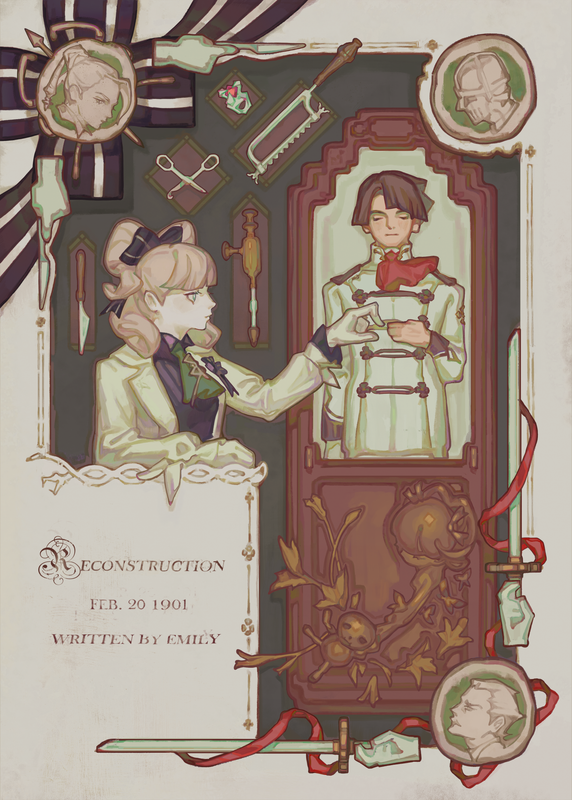
Kazuma could go through the hospital rather than the graveyard, but to do so feels like cowardice. He passes his father’s prison grave each time he visits the Scotland Yard forensics laboratory.
After that trial, the moment he knew to, Lowgate Cemetery was the first place he’d gone. He’d knelt before Genshin Asogi’s nameless grave that night until he was as cold as the dead himself: praying, promising, paying him the respect he’d long been due. Kazuma had spent everything he had to make the pilgrimage.
The pilgrimage is just across town now. Anytime he wants he can hop on an omnibus over to see his father. Somehow that makes it easier not to—like it’s an opportunity he no longer has to seize, a right he no longer has to fight for. But when his work happens to lead him there…the memory rises up in his lungs again. The feeling he’d gone years submerged in: the weight of obligation.
He bows to his father and proceeds into the hospital basement.
Dr. Gorey’s door is open. Their victim’s skeleton lies neatly arranged on the slab, but Kazuma’s eyes wander: upon a table nearby sits an odd, rubbery, translucent cube. The coroner herself has her mask on. She’s intently sifting powder into a container on the counter, and she doesn’t look up even as Kazuma knocks on the doorframe.
“…Good afternoon, Doctor,” he says.
She continues to sift. “Good afternoon.”
He waits a moment to see if she’ll acknowledge him further, then Kazuma drops his stack of files on the surface nearest. “Middle-aged women reported missing, 1885 through 1895,” he says. “As requested.”
This week they have a victim with no case. The bones were found beneath brush in a city park, dug up by a family beagle who’d trotted back to its master with a scapula between its teeth. Dr. Gorey had painstakingly unburied each bone and placed them together. She’d given Scotland Yard a list of known characteristics to identify the victim…but there were so many unsolved cases in a place like London that ten years' worth of missing women had come out to a considerable amount. They'd been sorting through them at the office all morning.
The repeated sharp force trauma to the breastbone and ribs was their largest clue. If not for that, Kazuma would not have been involved: it fit the modus operandi of a killer Van Zieks had prosecuted nine years previously. The defendant had won the case—and therefore, of course, had long since been found floating dead in a pond—but Van Zieks, clearly anxious, had made sure to investigate this potential victim. Kazuma couldn’t blame him for worrying. Both of them knew the sickening sensation of learning too late they were wrong.
“Thank you,” says Dr. Gorey. She pauses sifting to give the side of her carton a firm tap. “I’ll look them over when I’m finished.”
“Alright,” Kazuma replies. He’d turn to go, but he’s still too curious. He can’t help asking. “…Finished with what, exactly?”
Dr. Gorey finally looks up and lifts her mask. “That’s a gelatin mold,” she says. “I’m casting the skull in gypsum plaster.”
“Oh,” says Kazuma. He looks down into the hole at the top of the mold, and he can see it now: the shape of a human skull, face down. “…What for, exactly?”
“I’m going to use it as a base to sculpt,” says Dr. Gorey. “To reconstruct the specimen’s face. It wouldn’t do to use the original skull, of course, in case I need to look at it again afterward.”
“I see,” says Kazuma, still inspecting the mold. And after a second, he blinks. She’d spoken of generating a face from bone so simply that the fanciful nature of the idea had taken time to sink in. He looks back up to her in surprise. “Wait—is that really possible?”
Her lips twitch. The faintest concession to awkwardness. “It’s experimental,” she admits. “And it’s approximate. But there are doctors in Germany who’ve developed a method I’m keen to try.”
“That’s amazing,” says Kazuma. He might have been more skeptical—he feels sure Van Zieks would be—but after looking through all those files... If there’s nothing else she can do, he wants her to do this.
“I want to find out whether or not it’s amazing.” Slowly and carefully, Dr. Gorey begins to stir her plaster mixture. “Mama never thought much of the practice. She always called it guesswork. But I wanted to try anyways, so I’ve been taking my own tissue depth measurements in the hospital morgue for years.”
“You’ve—what?”
Dr. Gorey nods. “When Dr. His at the University of Leipzig reconstructed the face of Bach, he used average measurements of tissue depth at fifteen different points on the skull. After I read about it, I thought I should collect my own data to use myself.”
She steps over to the table and begins to pour the plaster slurry into the gelatin. Kazuma watches, grimly transfixed, as the skull slowly fills in white.
“Perhaps it may be nothing but guesswork in the end,” Dr. Gorey says. “But, personally, I feel the way to discover that is to try it.”
Kazuma nods. He does find this an admirable way of looking at it—at least at the present moment, when there’s nothing more reliable they can spend their time on. “I’m pleased you have an opportunity to test your data,” he says.
“Oh, me as well,” she replies, brightly earnest. She lifts the original skull from the head of the autopsy table and looks down into the empty sockets. “I’ve been wanting to for so long, but each body I receive still has most of its flesh. It’s terribly inconvenient.”
“…I’m sorry.”
“That is—” She glances back up to Kazuma. “Except for your father, of course.”
He bows his head. Of course.
“Though obviously, when you’ve met the specimen, you know what their face will have looked like. When that knowledge is guiding your interpretation, it’s much less useful as a field test.”
After the Van Zieks trial, the Professor’s bones had been exhumed: a formality to corroborate their new findings. Dr. Gorey had done the examination. Kazuma, incapable of resisting, had come to see, and she’d told him that his father had been polite and considerate. Made the process easy. His bones all neatly contained, the decomposition of his flesh impeccable.
Looking down at his father’s skeleton, Kazuma hadn’t been able to recognize him. He didn’t have the training or the instinct to see whatever Maria Gorey can see in a skull. He had barely even felt a connection to the bones, as he might have expected to after the half-spiritual hunger that had driven his search. But the recognition of a son didn’t matter, then. There had been no need to further identify the bones found in plot 139 with a perimortem bullet hole through the sternum—there was no one but Genshin Asogi that skeleton could have been. And even if there had been, Kazuma understands what Dr. Gorey is getting at: a suspected identity in the sculptor’s mind would affect their objectivity. Fifteen tissue measurements still leaves room for a great deal of artistic interpretation. And Dr. Gorey had met his father, of course—
“What do you mean, met?” Kazuma asks abruptly.
“A photograph gives some idea,” she says, “but when constructing a three-dimensional model, even that isn’t truly comparable—”
“You knew my father!?”
“…Yes. Of course I did.” Dr. Gorey stares back at him, lightly perplexed. She’d clearly assumed this was obvious. “Mama was quite friendly with Detective Asogi when I was young.”
Stunned, Kazuma struggles to speak. “...I had no idea.”
It probably could have been obvious, if he’d thought on it. While the other conspirators had risked their careers to see Genshin Asogi hanged, Dr. Sithe had risked her own to see him free. Why wouldn’t they have been friendly?
Dr. Gorey tilts her head. “I told you he was considerate.”
“I thought you’d only meant…the way that he’d chosen to decompose.”
“Well, yes, that also. I said so because it was very like him, don’t you think? To decompose neatly?”
Kazuma almost wants to laugh. He can almost hear his father’s laugh—it’s the sort of audacious thing he would have found funny.
“…You knew him well?” he asks.
“As well as a child could, I suppose,” she replies. She carefully sets the victim’s skull back down and gazes back into her curing mold. Kazuma can’t tell whether she finds it difficult to look at him, or whether she simply doesn’t feel she needs to.
“He went out of his way to be kind to me,” she says. “As adults often do with children. But he never condescended the way that others did.”
And Kazuma can see him clearly now. More clearly than he ever could have when looking down at his bones. He knows exactly the manner that she’s trying to describe—he’d grown up with it. He’d loved it. Had Genshin Asogi met Dr. Sithe’s young daughter and thought of his young son? Made the decision to treat her strange child the way he’d treated his own?
“I’m sorry that I didn’t realize you’d known him,” he murmurs. Most of his colleagues had never worked with Genshin Asogi, but Kazuma knows those who had still see the detective they’d known in his face. And then, of course, Van Zieks…is its own matter entirely. “I’d have been more sensitive.”
“Sensitive?”
He’d have gone to see his father’s bones and not acted like the only one grieving. “I… I imagine it must have been strange. To be reminded of…”
“Reminded of him?” replies Dr. Gorey. “I don’t think you’re like him at all.”
He’s stunned. On one hand, he’s impressed with her for seeing it—seeing it when no one else seems to, least of all himself. But on the other… She admits that she and Genshin Asogi had been acquaintances at most. She and Kazuma are the same. She would claim to have that understanding of either of them?
“At all?” he asks.
“You do look similar, of course, in a skeletal sense,” she says. “Some similar mannerisms. But obviously Detective Asogi was much older, and he dressed very differently.”
Oh. If it’s only down to that, then… He supposes he can understand. Of course that’s the way she’d see it. In the simple physical characteristics—as if she were identifying a body.
“And he was nicer than you are,” Dr. Gorey continues.
Oh. Kazuma snorts softly—he wants to be offended, but she’s right. God, she’s right.
“But he was also…” She pauses, considering her words. “…More mysterious than you are, I think.”
To hear this surprises him even more. “…Mysterious? How so?”
“Not like Mama is, or Lord van Zieks. He wasn’t cold. But he was…impenetrable. I knew him as well as a child could, but that wasn’t well at all.”
“…Ah,” Kazuma says quietly. “I see.”
“He was kind to me,” she says once more. “But I did believe that he’d been the Professor. It was easy to believe he could hide it.”
Kazuma breathes in slowly, then out, then in. Dr. Gorey pauses.
“I like that you’re different,” she says. “I do think people should be easier to understand. It frustrates me when they’re too mysterious.”
Kazuma wants to be offended by this as well. The thought that he’s somehow simple, or else simply that all the effort he’d ever gone to to keep his heart from his sleeve had been for naught. But his own job is, at its root, to figure out the thoughts of others. To read them and interpret them. He can’t deny the pride and pleasure of it, and he supposes he’s pleased to give her that.
“Mama would always get cross with me,” says Dr. Gorey. “I’ve never been very good at understanding anyone.”
“But—” replies Kazuma, “I don’t think that’s true at all.”
He knows exactly why she’d have been told that. By colleagues, acquaintances, strangers. By a concerned mother who feared her daughter facing the consequences of strangeness. Her manner is unfit for polite society, and she doesn’t seem to understand why it shouldn’t be. Kazuma has spent enough time perfecting his manners to understand why the lack of them can be disabling.
But polite society isn’t the Alpha and Omega of understanding, nor should it be. Maria Gorey’s perceptiveness is different. Where Kazuma is concerned, this is a woman who’d cut him open just now as easily as a corpse on her table, with that same unique skill.
“That’s very nice of you to say,” she says.
“It’s not nice,” Kazuma replies. “It’s true.”
Dr. Gorey smiles.
Kazuma smiles back at her over the hardening plaster skull, and he finds himself wondering about the friendship their parents had had. How alike they’d been to themselves, how different. How different Dr. Gorey considers herself from her mother, despite their skeletal similarity. How similar the friendship they could build themselves might be.
This is a strange, foreign thought to him: he isn’t sure it matters.
“I’m grateful for your insight,” he says, bowing politely. “Thank you, Doctor.”