Work Text:
Strong hands, feather-light, extended Barok’s arms. “Don’t lean so close to it,” said Klint. “It isn’t a hunting rifle. You shouldn’t have to sight your target like that.”
Barok looked down his outstretched arms over the pondside, at the revolver in his hands. Though he knew it wasn’t even uncommon for more confident men to do it one-handed, this felt nonetheless like an unstable way to shoot. “How do I aim, in that case?”
Looking over his shoulder, Klint delicately tapped the tip of the barrel. “You see the posts on each end? You’ll want the barrel aligned such that the front sight appears in the center of the back. You should be able to aim at arm’s length.”
“This seems inconvenient for combat,” said Barok, closing one eye to more accurately judge. “Unless my theoretical attacker is so polite as to wait while I tilt my gun about?”
Klint chuckled. “If you find yourself in close enough quarters for it to matter, I don’t believe pinpoint accuracy is such a concern.”
Barok swallowed.
The northwestern portion of the Van Zieks estate surrounded a large pond on the forest’s edge. On occasion their father had shot waterfowl over it, but neither Klint nor Barok kept up the habit. Klint preferred stalking deer in the forest itself, when the mood struck. The mood had never struck Barok.
Of course—he’d been hunting. Mainly as a young teenager: after their father’s death Klint had been more likely to allow him to sit out. But even then he’d been little more than moral support. Barok could count on his fingers the number of times he’d fired the rifle himself. And never a pistol, and never at a person—this was a different beast.
But as a Crown prosecutor, issued this revolver specifically, he felt somewhat obligated to at least learn how to use it.
“Practice will help,” said Klint, stepping back to inspect his form. “But frankly, I’d wait until you’ve learned how the thing works to worry about aiming.” From the corner of his eye, Barok caught a brief smile flickering across his brother’s lips. “There’s no need to take on too much at once, Barok. God knows you’re prone to.”
That explained shooting over the pond, then, rather than at bottles on the lawn or suchlike. Barok snorted weakly, embarrassed. Klint knew him well. Introducing targets before he’d ever pulled a trigger would have scuttled the entire process with insurmountable perfectionism.
Klint was walking around him, chin in one hand. “Good,” he said slowly. “That’s the way you want to hold it, at least until you know you can handle the recoil. Though—mind you keep your finger off the trigger.”
“The gun isn’t even loaded.”
“Even so, you don’t want to develop the habit,” Klint replied. “It’ll feel too difficult at first to worry much, but I assure you, Barok, shooting a pistol is far too easy.”
Barok shifted his trigger finger and pressed his lips together. He certainly wouldn’t have minded if it were easier.
“Alright—you can take it down now, take a look at the chambers.” Klint pointed out a small lever. “This releases the cylinder.”
“This?” The belly of the gun spun out into Barok’s palm.
“Precisely.” Klint reached out to spin the cylinder with a flick of his finger. “Elegant, isn’t it?”
Nothing so elegant as a blade, but Barok nodded anyhow.
Klint shook out a handful of rounds and held his hand open for Barok to pick them one by one. “One in each chamber,” he said, “back to front. Yes, just like that. When they’re all in you can click the cylinder back.”
He did so.
“Lift it again… Good… And then you pull the hammer right here all the way back to cock it.”
“They really must come up with a better word for that,” muttered Barok, flushed.
Klint laughed aloud. “Why, Barok, don’t be vulgar.”
“Guns are vulgar,” he mumbled.
“…They are, aren’t they?” Thoughtful, Klint looked out over the pond. “I’m not fond of them either. With respect to the Crown, I haven’t carried mine since I received it.”
“Not at all?”
He sighed. “It’s true that this is a dangerous position. You know that.” Good lord, did Barok know that. “But I suppose I never took to firearms as a solution to it.”
“I’m thankful you at least learned to use them,” said Barok, closing one eye again and tentatively pulling back the hammer. “Who taught you? Father?”
“Yes,” said Klint. “And you’re a damn sight luckier.”
Klint had never seemed to mourn their father, for reasons Barok hadn’t seen enough of the man to know. By the time he was born there was already a budding prodigy to micromanage. Over the years he had gotten the impression that the way Klint had been parented had informed his tender lenience with Barok. Barok, whom both of them knew would crack under the pressure that Klint had hardened under.
“Did he carry his?” he asked.
“I can’t imagine most of us do,” said Klint, shaking his head. “Certainly not daily. Just the worst sort of men who like to feel the power of it.”
“…Load of good it did Lord Barrington,” said Barok, with a low scoff.
Lord Prosecutor Martin Barrington had been exactly that worst sort. And whatever feeling of power he’d enjoyed—upon the Scotland Yard inspection of his blood-soaked, throatless corpse, his judiciary pistol had been found in his coat undrawn.
Klint’s hands dropped from his shoulders.
When Barok glanced back to him out of the corner of his eye, his brother had gone ashen. God, of course he had—what had he been thinking? “Forgive me,” he mumbled. “I shouldn’t have brought it up so frivolously…”
“No, there’s no better example.” With a snort, Klint turned away and shook his head. “The man once drew his pistol on me, for God’s sake.”
Barok lowered the gun to stare back at him.
“Oh, goodness, did I never tell you?”
“Where?”
“After a debate, outside the House of Peers.”
“Outside the—” Barok gaped. “My God, what a loathsome man.” When Martin Barrington had been the only body in the Professor’s wake—before there’d even been a wake, or a name for one—Barok had been entirely inclined to believe he’d done something to deserve it. “When?”
Nonchalant, Klint waved a hand. “I don’t know, six or seven years ago. You were away at school and by the time you returned I suppose I’d nearly forgotten.”
“You forgot?”
“Well, nothing came of it,” said Klint. “He never shot. That idiot Richie Willingham did more damage in our third year when he got handed down his grandpapa’s antique dueling pistols. Poor old Billy Richardson’s still got a limp.”
Barok had always heard tales of tomfoolery of this nature occurring on Eton grounds, but he hadn’t experienced it himself. Perhaps Klint had simply been more open to tomfoolery as a schoolboy than he had. And for that matter, as a prosecutor.
“How on earth does this always happen to you?”
Stiff-shouldered, Klint straightened his back. “If it must happen to someone, I’d rather it be me.”
“I’m not a child,” said Barok. “There’s no need to keep on…shielding me.” Nor whatever else he believed he was shielding, taking on the worst of London alone. Barok admired Klint’s dedication and selflessness… But he couldn’t help but wonder whether some of it was simple condescension. A refusal to trust that anyone could do it but himself.
Klint finally turned back to him, and he didn’t speak for a long while. Barok knew he could read the thought.
“I hope you’ll forgive me for worrying,” Klint said eventually. “As a brother… I admit it’s difficult to accept how much you’ve grown.”
“I do hope you’ll try,” Barok replied.
Klint gave him a tight smile. “It’s far easier these days. Watching you finish school, come into your own…”
“…And if you must continue worrying,” said Barok, “at least there’s one fewer mad lawman to pull his gun on me as of late.”
Klint’s lips twitched.
“…Indeed.”
“If Lord Barrington had to be a menace, he could have at least been a quicker draw,” said Barok. He raised his pistol again, aligning the sights. “If he’d gotten a shot at the Professor then…” Good men could have lived. London could have breathed again.
Softly, Klint scoffed. “…Lord,” he muttered, “if only.”
Barok’s finger eased onto the trigger. “Perhaps I’ll have the chance.”
There was a long silence.
“Don’t say that,” muttered Klint.
“Why shouldn’t I?” Barok replied. “Don’t I fit the profile?”
“You haven’t even tried a case.”
“I’ll admit it’s arrogant of me,” said Barok. “But even so...”
He shot.
The force shook through his arms. Half-stunned and oddly giddy, Barok looked instinctively back to his brother. Klint didn’t meet his gaze—he was still looking out over the water, glassy-eyed.
“…Just like that?” Barok asked.
Klint’s eyes flicked back to him, and he nodded. “Precisely,” he said, so quietly Barok had to strain his ringing ears. “You’ll need to cock it again before each shot. Try again—all six.”
Barok pulled the hammer once more, and once more he squeezed the trigger back. He felt Klint’s hands return to his shoulders.
“Breathe,” he said. “Don’t anticipate.”
“How can’t I?” Barok muttered, making a futile effort to loosen his tense muscles.
“Practice,” said Klint. “You’ll get used to it. Keep going...”
Barok shot again. And again, and again, and again and then the cylinder was empty. In the silence after the last crack, the pair of them stared across the pond at the ripples where the bullets fell.
“Finger off the trigger,” said Klint.
“There aren’t any bullets left—"
“It’s the habit.” His voice was sharper, harder than usual.
Barok lay his pointer finger carefully along the trigger guard.
Klint breathed in deeply, his hands tightening over Barok’s shoulders. “If ever you do feel the urge to use this, I want you to think very carefully about the consequences,” he said. “A gun isn’t something to handle on impulse. I want you to think into the future, consider what will become of—"
Barok laughed lightly. “Shall I brush up on my tea leaves and palmistry?”
“Barok, I’m serious.” Klint released him, shaking his head. “None of us can truly see what’s to come. But making an effort to try…”
“The nerve of you,” replied Barok. “To lecture me on foresight as if you can beat me at chess.”
Klint gave a thin laugh, unsmiling.
“You never will stop worrying, will you?” Barok asked.
“I don’t mean to patronize—"
“And yet you are.” Barok wouldn’t hold it against him, but neither would he lie to him. “Frankly,” he said, “it’s an insult to yourself as well. I’m the man you made me, aren’t I? You ought to trust in that.”
Klint looked at him for a long, long time.
“You are,” he said. “I suppose you are.”
“And you’ll let me join this fight of yours?”
“I… Of course.” He shook his head once more. “I’d have no one else.”
Barok caught his eye, and he smiled.
“…Right, then,” said Klint after one more swollen moment, clapping his back. “How about we find somewhere for you to practice aiming that wretched thing?”
When Lord Klint van Zieks’s body was found in a pool of blood on his family manor’s ballroom floor, his sword had shown signs of use. His revolver, locked in his study drawer, hadn’t been touched.
At the time Barok had been carrying his own. Whatever his brother’s opinion, some part of him had enjoyed the power of it. And in the climate of fear that had smothered them for so long… What had been the harm, he thought, in feeling a bit of power? Even though Klint had instructed him not to worry. Even though it had felt presumptuous to consider himself important enough to become the Professor’s next target. But… But now it was sickeningly possible that he could have been. When Asogi had saved his life…what if he’d done so for the pleasure of taking it himself?
In his last moments, Klint had seen the future. He had incriminated his killer in the only way he could, and he had put his revenge in Barok’s hands. Barok had taken that trust and he had done everything he could. Genshin Asogi had been hanged. Justice had been done. But after the trials, after his righteous rage had begun to collapse into hollow pain… The power in his hands was different now.
He’d wanted to keep the gun on him at first. Perhaps if Klint had, it could have changed his fate. Barok could not die so uselessly now, after all, now that he was all that remained of his brother’s hopes. But as he lived with something like that in his hands, something so lethal and so, so easy… His blade was one thing, but a pistol was a different beast. He could see the consequences of keeping it. He could see the temptation overwhelming him, in a weak moment he wouldn’t be able to return from.
He couldn’t allow himself to fail his brother in so cowardly a fashion.
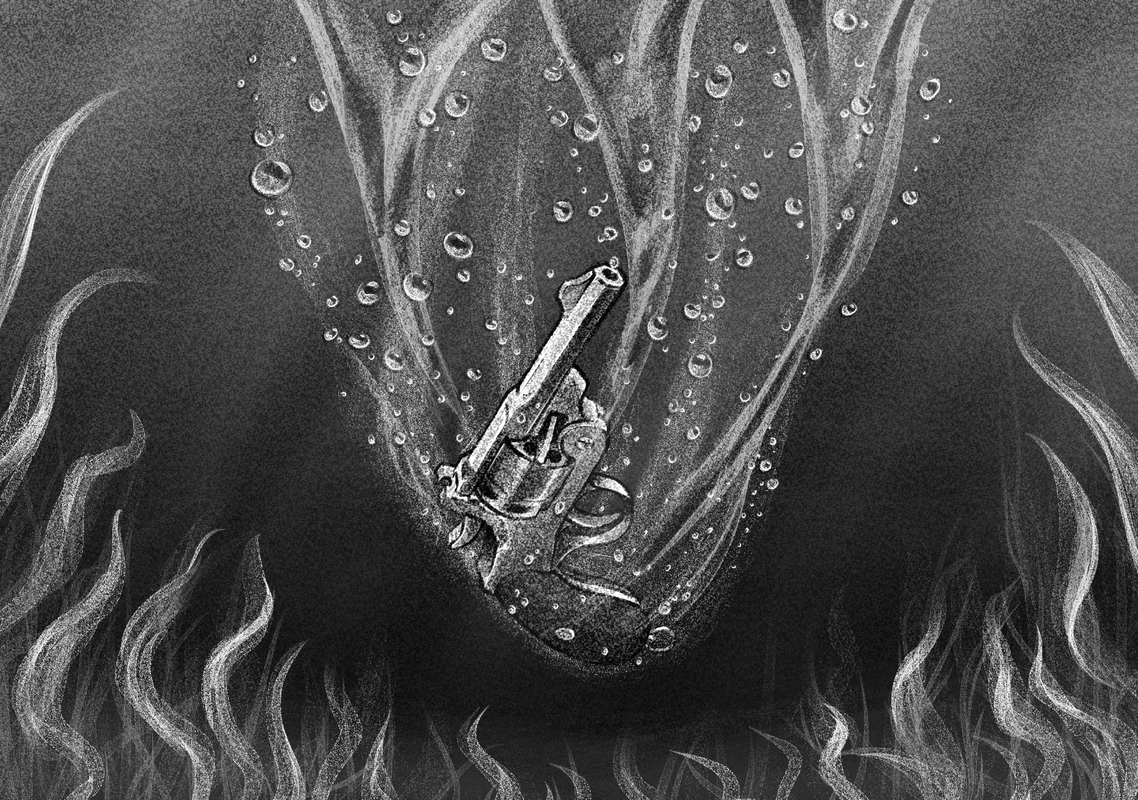
Barok looked out over the pond where he and Klint had stood together barely a month ago. He hurled the revolver as far as he could. It arced over the water and dropped in the middle, ripples fanning out with an absurd, delicate grace, from the point of impact to the bank where he now stood alone.
He stared at the water until it was still, and he turned stiffly on his heel.