Work Text:
It had been more than likely from the outset that the trial of Barok van Zieks would become something far larger than its alleged scope. It was clear from the first day that it would. Asogi had laid the groundwork. If Stronghart hadn’t instructed him to, he’d allowed him to. Given the dedicated framing that had already gone on, the skillful construction of Barok’s guilt… Naruhodo and his assistant had their work cut out for them.
Barok suspected that Gregson had been the one keeping him innocent in the eyes of the law. A privilege it looked as if he no longer held. Perhaps a kindness, Barok wondered, sick to his stomach, that had necessitated Gregson’s murder.
At least in jail he had the time to think it over.
Prison was really no different from inside a cell as it was from outside of one. Less agreeable lodgings than Barok was used to, obviously, but the atmosphere of it didn’t put him on edge in the way it tended to do to others. He’d seen plenty of that. Suspects shaken by the dark and the damp and the destitution. It was always men like himself that took it the worst—men who’d never lived a day of discomfort. Men unused to being treated as common.
These were the men he’d most often seen die. This comparison put Barok on edge as little as the prison did. He’d been long familiar with the thought. When I’m brought to trial, and someday I will be…would my acquittal affect a thing?
Should it?
A murder afterward would certainly be poetic, whether or not he deserved it.
Barok had spent so many years weighing the concept of deserving. Of sin, of judgment. It was one of the pressures that had driven him to retirement: by prosecuting with the Reaper’s power behind him, was he any less a premeditated murderer than the men he sent to the gallows? Did his personal belief in the victim’s guilt truly justify their deaths? Did he have the right to wield that power? If he didn’t, did anyone? After long enough it had become difficult to separate the Reaper’s executions from the executions of the Crown. To see a great difference between a life in one man’s hands or six.
He'd been drawn out from his indecision by the son of Genshin Asogi. His guilt hadn’t mattered. And now, the son of Genshin Asogi would hold him accountable for that decision.
In all his introspection and all his remorse, frankly the biggest surprise had been that he still had allies. A handful of Scotland Yarders had kept him informed at great personal risk. He’d done everything but draw his sword on Naruhodo and he wasn’t sure even that would have deterred the man. Albert’s letter had been a complete coincidence, but it was tucked fondly in his breast pocket all the same.
But the girl who stood before his cell now... He hadn’t been able to speak with her enough to ascertain where her opinion on him lay. Were he in her position he’d have distrusted Barok van Zieks at best. He’d have taken the opportunity to solidify that distrust. However… Her closest friends seemed convinced of his innocence. He didn’t remember enough of friendship to say how likely she might be to listen to them.
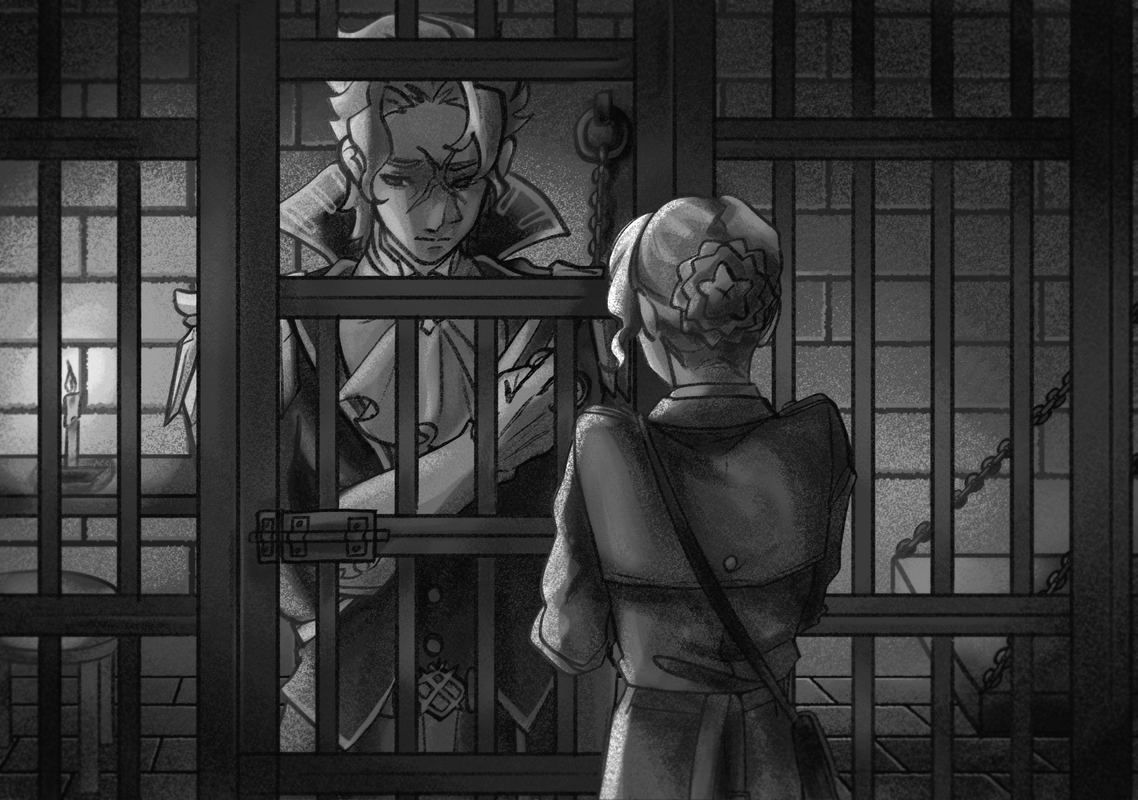
Barok looked up at her from the low, flickering glow of his lamp. “Good afternoon, Miss Lestrade.”
She sniffed.
Lestrade was tense, every thin muscle on edge, as she stood outside the bars of his cell. It was obvious why. For those who were less unfamiliar with discomfort, it was the confinement of prison that did it. Barok knew that it had gotten to Lestrade during her time there. The oppressive nature of incarceration would weigh heavy on a child like her—who’d soothed the ache of her poverty with the sweetness of her freedom. In the early days of her apprenticeship Barok had still been able to see the scar of it. He could see it again now.
A feeling so focused as jealousy hadn’t occurred to him at that age, but in his youth Barok had been…fascinated by those children that darted around them in the city. Wild and unmanaged. In his life he had tasted many sweetnesses, most denied to many, but that one had always been denied to him. As he looked up at Lestrade he supposed that that, too, was a privilege.
She swallowed, thickly.
“You knew where to find ‘im,” she said. “You know wot ‘e was up to, then, on Fresno Street?”
Barok could hear the hope in her voice. The desperation for none of it to be true. Is this what Genshin Asogi had heard from him, all those years ago? And he’d sat there unmoved?
The situation was different, of course. Barok and Lestrade had never even been close—in fact, he’d hidden from it. She hadn’t ever seemed to dislike him. On occasion, rather the opposite. But Barok could not indulge this girl whose death warrant he’d signed. He’d had a great deal of practice at civility with colleagues of all stripes, but he couldn’t bring himself to treat her as any more than that. He couldn’t bear to grow attached.
Lestrade had not been included in his questioning. Of course she hadn’t. She was a half-trained apprentice with no master, and Barok did not imagine Scotland Yard had much interest in assigning her another one. This put her in graver danger than ever. Prison kept one reasonably safe from outside threat, and under the Reaper’s wing had been a close alternative. The broadest wing Gina Lestrade could claim to be under now was that of Herlock Sholmes. The wing that Gregson had been under himself when he was shot in the chest.
His fear for her was all-consuming, now that they were face to face. He could think of nothing but. If he had to watch the murder he’d committed six months ago play out from a prison cell, Barok… He would name a feeling, but he wasn’t sure his heart would still remain to feel it.
“Oi,” she snapped. “You ‘ard of ‘earin?”
He didn’t want to give her nothing. He had little to give. All he could say could be taken as slander, and for that matter, as motive. Asogi had already made his intentions on that front clear.
But he knew how it felt, to be given nothing.
“...I had a suspicion,” said Barok. One he’d been hoping that Gregson himself could prove, but he’d been unlucky.
“You were investigatin’ ‘im?”
“Yes.”
Her voice was strained, trembling. “About the Reaper?”
For one flashing moment he wished for a mask to hide his guilt behind.
“Yes.”
“Then you’re cracked,” she said. Sharp and sure again, forcing herself to be. “You think the boss’d do something like that? To you? That’s wot you thought of ‘im, eh?”
Barok lowered his head. He’d been telling himself the same for years. If he’d been able to move past it, could he have put the bane of his existence to rest before it was put to rest for him?
“Miss Lestrade,” he murmured, “I’ve been investigating the Reaper killings for nearly a decade.”
“So’s the Yard been!” Lestrade barked back. “And we’ve got more evidence that you killed ‘im than we’ve got that the boss ever did nuffin’ out of order!”
He could not blame her for believing it. It was what she’d been taught, after all. She was following where the evidence led, like Inspector Gregson’s proper protégée. But the evidence had been laid by someone who knew how to create a path.
Barok had been thinking it over himself. The body hidden at first glance. Was the vendors’ entrance a part of the plan? Naruhodo had proven the gunshot a clever ruse—but the gun itself gave Barok the most pause. It had confounded him just as much in the moment. Whether or not it had been fired… There were only so many of those to be found, especially from the years before serial numbers. It certainly wasn’t his own. He personally knew every man in London who would would have that specific pistol.
Lestrade knew he knew something. She could smell it on him.
“…If it weren’t you,” she said, “you’d be ‘elpin.’”
Barok closed his eyes. He’d said something very similar, long ago. A grieving child’s understanding of justice.
“You’d explain yerself!” snapped Lestrade. “You wouldn’t be keepin’ your trap shut about every little thing you can!”
He breathed in, then out. “I’ve given Scotland Yard all the relevant information I have.”
“My eye!” she snarled, reaching out to grip a bar in frustration. “The boss loved you, ‘e did! ‘E was the only bloke in the world who loved you, an’ you repay ‘im like this?”
He loved you. It was what Naruhodo had told him. It was what he had told himself. It was true, and yet impossible.
And yet…
Gregson had told him, not long before his death, that he’d put through a transfer to Paris. That he planned to take Lestrade along with him, and he was waiting to tell her.
Barok knew Tobias Gregson. He’d never have willingly gone to live in France unless he had a life-or-death reason. They’d spoken of it on the day Albert set sail. Lestrade was in danger on English soil, everyone in London knew that…but knowing what he knew now about Gregson, Barok could see his actions in a different light. He wanted her safe—and in doing so, he was forfeiting his own safety. The Reaper was more than one person, and Gregson was not in charge.
He was a murderer, yes. Barok had spent the last decade being tortured by him, yes. But Gregson had been afraid, and he’d found something worth protecting.
He loved you, Miss Lestrade.
“You’ve searched the scene, have you?” asked Barok. “Properly?”
“’Course we ‘ave,” she replied at once, defensive.
He looked up into her face again. “Search his office.”
“Wot, like you did?”
“Yes. The inspector was a thorough man; you know he was. Far too precise to keep it all in his head.” To claim a perfect memory was the domain of arrogance. Gregson had been talented, exceptionally so—but at heart he’d always been a humble man.
Barok had carefully returned the Reaper’s datebook to the false bottom of Gregson’s second drawer. Lestrade would find it. She would learn, in his own hand, that the only adult she’d ever trusted had been a liar and a killer. Barok didn’t envy her the discovery. His own similar one had shaken him so profoundly in his youth that the echo of it still rang in his ears.
Part of him felt she might be stronger.
“You’re the detective he made of you, Miss Lestrade,” he said. He gazed up at her, as seriously as he could. “I beg you to act like it.”
She looked back at him with shadowed, sunken eyes. Clearly unsure whether or not to trust him.
He wanted her to. To this girl he’d mistreated so greatly, he wanted to be worthy of it.