
Work Text:
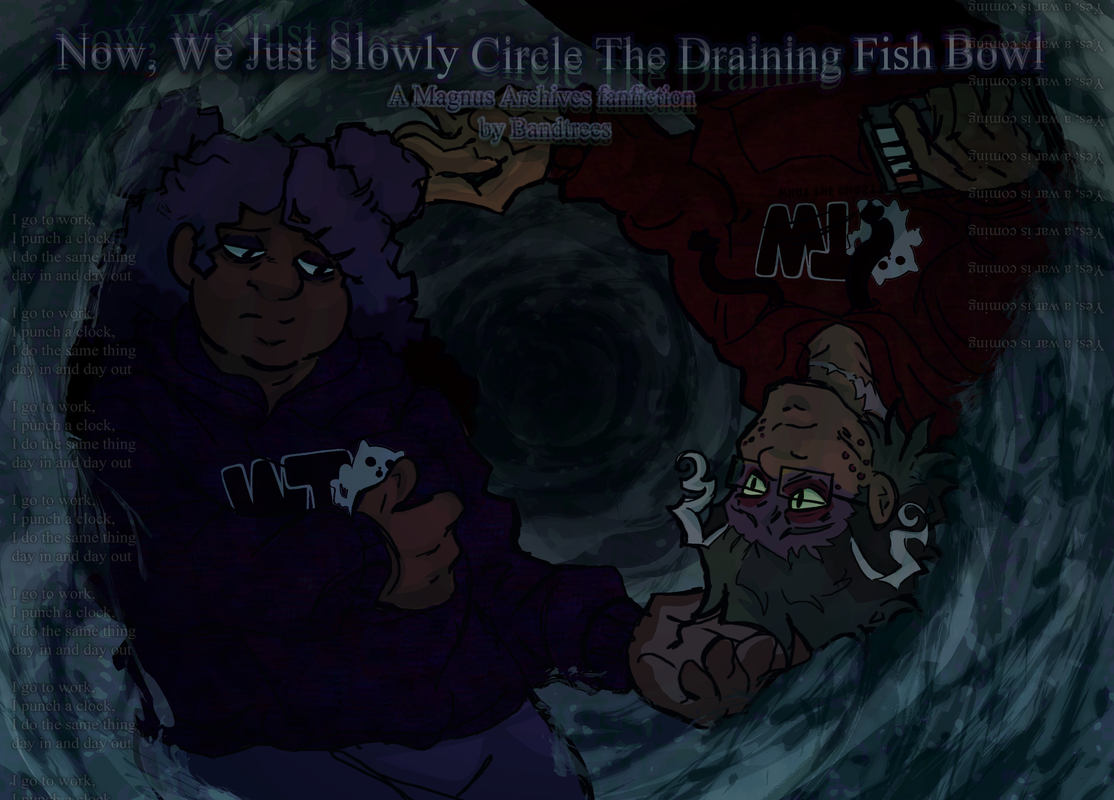
He knew how she felt about Knowing. To Georgie, John Sims was her ex-boyfriend fallen on hard times, and no amount of spooky set dressing could make her budge on that. It wasn’t as if she didn’t care about what he was going through — but he was no savior. What he did when squirreled away into her guest bedroom, droning on the contents of mysterious envelopes into an ever-listening tape recorder, was a nasty habit like any other. She’d been around enough and met enough people, too, to understand nasty habits.
Some people couldn’t kick drugs, or binge drinking, or porn or sports betting. None of these were any greater evil than the other. All stupid mistakes and nasty habits — it’d be impossible to meet up with an old friend from uni and not find them acquainted with one over the years.
The simplicity was as insulting as it was a relief. It was human, to be regarded in such a way, and among being chased by worms and taking axes to changelings, it was easy to forget. You could save the world, but what would you do when the smoke cleared, when the holes in your face and the burn on your hand began to ache? It was a terrifying possibility, one John could almost smell in the air before it hit: he’d already burned just about every bridge he could have with his coworkers.
They think I’m a murderer. He sank into her guestroom’s shitty mattress, holding one of the Admiral’s cat toys up to the light. That my — hff, my paranoia, reached such a point that I took an axe to Sasha and a pipe to an old man. And they saw me following her. Searching her desk again. And then we go into the tunnels and only one of us comes out.
It’s a natural conclusion, right? God. Even that aside, I’m lucky Tim never went to the police about the— stalking. I suppose I should get used to calling it that.
He tipped his head. The Admiral’s eyes were huge as he rattled a stuffed mouse in his hands. A muffled bell jingled from inside — the round-faced tabby’s pupils darted from left, right, and center as he lolled the toy around, then lazily pitched it into the doorway.
At that, the Admiral took off, hefty little limbs launching off the mattress to go pumping against the hardwood. The noise made Georgie, perched on the edge of his bed with her head tucked into her Twitter feed, look up and smile after him.
Then, she turned to John, still smiling, a silent nudge to watch the Admiral dart around with her. His claws were out, eyes glittering, as he pummeled that poor toy.
Is that just another nasty habit?
Well, he’d come to her because she was reliable. Far from lovey teenagers in their first relationship, bombarding eachother with cheesy texts and anniversary gifts — the newfound, overdrawn insecurity of a sheltered English student and the smartass prick she’d managed to dig out of the mud like a duckling in a feelgood animal rights commercial. No — even as the years passed on, when they texted just about a tenth of that time, there was something solid in the minimalism. It’d take a bit, swamped as they both were — but they would always answer when the other asked. The idea that he’d do the same for her was one of the only things keeping John from staying up at night in guilt.
(…no, maybe he wouldn’t do it for anyone else. Even Sasha would have been a stretch. Coming to terms with his own cruelty hadn’t been easy. But he hoped even the man his coworkers regarded as an unstable, murderous mental case wouldn’t have turned down Georgie—…)
Her voice was light and chirpy as he remembered it, though with it came some twang he couldn’t place, developed over time. Little inside jokes with friends she’d quoted like he’d been there to listen. She took her tea differently, too, found a new favorite cereal, and What The Ghost?! had gone from a dinky one-woman passion project to wind down between essays (doing the studying she really wanted to do, so she said) to an entire production. Online stores and official websites. Trending hashtags. Everything she could have dreamed of, really: even when her face bore the exhaustion of someone whose creative ambitions had since become another 9-5, he was happy for her. Unimaginably so.
Her hoodies, various dark shades and stamped with that new, colorful logo, dwarfed him, sleeve cuffs hiding some of the scars up to his knuckles. She had new bulk to her, having gained quite a bit of weight since uni, and it showed on her clothes — but with it, too, came confidence. More assured, comfortable, in the life she was living, to the point where it felt wrong for John to intrude upon it. Much as she reassured him that he didn’t need to clam up while she was recording: her studio was soundproofed, after all.
He was happy to pitch in when she asked: with catsitting the Admiral, with editing podcast episodes. But he always felt he had to do more — he was the one tracking the horrors into her house, after all. That was the kind of danger people hid in tunnels for decades to avoid. And yet—
It felt like coming home, for only a moment. Like, despite the gnarls and scars nicking his bones, the frightful look in his eye, the years hadn’t gone by at all.
Like he was still the same man she knew.
…
He really, really couldn’t thank her enough. All he could do was gently thread his fingers through the Admiral’s fur, letting him flop into his lap. Massage the tabby’s belly and try not to think about doppelgangers, or corrupt cops, or freefalling. Pawpads gently squeezed between his fingertips, claws sinking into old scabs.
And he couldn’t exactly pinpoint where those old uni feelings began to rear their heads again. Nor could he know, for sure, if it was anything but the relief of a prey animal finally taken out of its habitat. Where simple admiration at everything she’d managed to do with her life over the years shifted into something different — not more, but different.
Maybe it was when she insisted on dressing his hand. The first night, he’d told her nothing — because he’d rather die than drive her right into the arms of the Desolation — but for all they’d changed, they were both how they’d been back in uni: dreadfully stubborn. He’d told her nothing, but by God she wouldn’t do nothing. She’d threatened to hammer his battered hand to the rim of her bathtub if he tried to wave it off and retreat to the guest room one more time, and he got the feeling she wasn’t bluffing.
She’d shouldered off her jacket as she worked, gently rinsing the injury, spreading his fingers in hers to catch the shape of it. Her breath was close against the crook of his neck, quiet and furious as she turned the tap off to lightly squeeze at his ragged hand with a rag. With him, yes, but moreso at whatever had taken him away, set fire to his hand, and carved at his throat. He shivered with embarrassment when she nudged his chin back to get a look at the ugly gash running through his neck: Daisy had gone through from the side, and hacked like she was prying meat from the bone, to reach his larynx. A hypocritical blend of blind fury and surgical precision: the thin line between the Hunt and the Slaughter. He thought Georgie might have smote her where she stood, if she’d known.
He knew she wasn’t going to offer him pity. That simply wasn’t her style. But where the shallow platitudes weren’t, the softness, concern, lingered in the way she nudged aside the collar of his shirt, frowned at the already-forming red strains of irritation around the blackened, scabbed centipede wrapping around the perimeter of his throat.
A part of him wanted to cry. I’m sorry I’m making you do this. I should have left you out of it. I should have stood my ground.
But he wasn’t going to make her wipe his tears, too.
So instead he held his breath, tried to stay out of her way. Her hair, dark, dyed a sheer purple that grew muddy as it faded to black, tugged aside by a colorful scrunchie that crammed coils into a bun at the back of her head, some of it still falling out as she moved — she’d thrown it on in a hurry before setting John at the side of her tub. Her jacket, patterned with a peeling skeleton graphic, was haphazardly crumpled into a corner. Beneath it, a T-shirt of her own merch (hey, if they were giving her it for free). And it was her house, she could do whatever she damn well wanted, but he averted his eyes upon realizing she wasn’t wearing a bra.
And this was what he was focusing on? Shock did some things to you, apparently. He could hardly feel his hand.
“…I’m going to guess you didn’t go to a hospital.” She finally said, releasing his head to rummage through bottles on the wicker shelf.
No, Basira took me. John remembered thinking this must not have been the first time she’d brought a half-dead victim into the ER at night, just tugged out from beneath her partner’s knife. The ones who didn’t bleed out, packed beneath layers of soil. He didn’t mention Michael Crew to either of them. He didn’t like what he may have heard.
But there was no space to fret about that now: the point was, Georgie was clever. Georgie would go name-hunting. You had to be a good researcher in her line of work, even if it wasn’t as gilded as the Institute.
“No, I- I did.”
Georgie peered up at him, in the middle of dribbling a thick green moisturizer into her palm.
“What did they say?”
“What—” John gave a rueful little laugh, “do you think I’m lying?”
“I think you’re shady, yeah.” She admitted, words easy as she worked her fingers into the folds of his hand, even when he sucked in an inhale at the sting of aloe vera. “I’m not gonna lecture you, but I think whatever shit you’re in is above a podcaster’s paygrade. And I think you should respect me more than you do.”
At herself, she blinked, hands momentarily stilling, before continuing with a sniff. “Sorry. Just blurted there, for a moment.”
“I-I don’t disrespect you, I—…” John pouted, taken for a moment: before the realization came. His free hand twisted with unease at his thigh. “N-never mind. But I did— I did get help. I’m alright.”
Her lips turned to a thin line for only a moment.
Their friendship was the kind that didn’t need words: why he came to her to begin with, after years of low-contact. But he wasn’t naive. He saw something simmering, faint beneath her carefully-constructed apathy. Just because she wasn’t the type for pointed comments — unlike Tim, thank Christ — didn’t mean it wasn’t there. He would catch footsteps, lingering too long outside his door, when he finished off a statement. He would catch a certain look in her eye when she passed him his tapes, resigned to the fact he would be playing them, but making sure he knew where she stood on the matter.
Not in my house.
You didn’t tend to appreciate people doing drugs in your place, or drinking, or watching porn or betting on football. Understandable as those nasty habits could be. But there was only so much you could do to control what other people did. Maybe she didn’t want to be cruel to him.
Maybe she didn’t want it to sour what they had.
Though her work was never truly over — when not going out for her real job, she was working on What The Ghost?!, and when she wasn’t working on What The Ghost?!, she was networking with those involved with What The Ghost?! — when she was free, she drifted to the couch. Sprawling across it with the confidence of someone who hadn’t shared their space with someone in years: often, this led to her legs propped up against John’s lap, a little too absorbed in her phone, or Netflix, to look up and ask, oh, I’m not bothering you, am I?
But it was funny, to see the ever-unflappable Georgie Barker not realize the space she took up. She wasn’t a tall girl, especially next to John, but she would still stretch enough to cram him into an uncomfortable sidelean in the corner of the couch. His torso would ache a little, while she rattled on about her latest Tinder date, or the show she was watching, or what some Internet wisecracker had told her. The lattermost stories were her favorite, as ill-acquainted with online spheres as John was. She said something always tickled her about how seriously he took it, to which he responded that it sure sounded serious, the way she spoke about it. The woman delivered Reddit drama with the intonation one would give a debriefing on a terrorist attack.
And John became her favorite pillow on those lazy days. There were moments where he’d be pinned down by her and the Admiral both. It was funny: she was keeping him posted on that Hungarian dude, to which he laughed and insisted he could just take her to a Hungarian restaurant and cut out the middleman, and she jabbed at him again for how much he didn’t like Hungarian food, to which he insisted, yet again, that he wouldn’t mind, he was sure they’d have something he actually felt like eating, just because he was picky didn’t mean he was an asshole to date — and then they were going on about it being a date…
He’d say it was a joke, until it wasn’t — but even when it wasn’t a joke, it was funny. It was hard to not be funny with Georgie, uptight and cold as you could be. Serious as it felt, in the moment, to say it: we could try again. Her laugh, her eye-roll, didn’t make it feel daunting at all. So much so that he wondered how seriously she was taking it, even as she kissed him for the first time in years, with all the renowned vigor of someone who’d done her learning on the subject since then. Someone who was confident.
He didn’t know what he was thinking, letting it happen: as if he’d forgotten where he was, what had driven him here in the first place. And he didn’t know what she was thinking, either. Maybe she’d let him in because she was lonely. Maybe it was just something to do with her time.
Or maybe it mattered, no matter where he’d come from. Maybe whatever she saw in him had nothing to do with the Eye. Maybe she missed moments like these, oncoming apocalypse be damned.
That thought scared him the most.
“Wh—what—” he began, red-faced. Her hand was on a bony hip, and she was smiling at the dark flush on his cheeks like it was the stupidest, simplest thing in the world. “Are we, er— anything, then?”
“Do you want to be?” Georgie asked. “I mean, I’m expecting that Hungarian, if nothing else.”
“Yes, yes, you’ll get your— goulash, or whatever the hell.” He huffed out through his nose, unable to keep himself from smiling, even if only for a moment. “But I— I don’t want to— tie you down, as it were. I know I’m…” He laughed. “…a lot of baggage.”
“Really?” A thumb traced the lash across his throat, making goosebumps raise along his arms. “Shocker.”
“I mean it.”
“Yeah. I know.” Georgie responded, and as she leaned down with a mischievous smile, his hoodie strings twirling around her finger, it was as simple as that.
She seemed to love flustering him as much as she used to. Wobbling the pedestal the local smartass put himself on — because his eyes were adorable when they got big. Ever-apologetic about the space he took up, ever-eager to clean without being asked, ever-eager to catch her on the way out the door in the morning even when he’d only just then rolled out of bed.
It was so stupid, for a man on the run from two accused murders, under the thumb of an eldritch horror of a boss, to be caught up in something as silly and trite as this. But it was everything.
They were watching TV — some ghost hunting documentary Georgie could mark off as a business expense, even when she was more focused on their shared platter of pepperjack cheese crackers than taking notes — when a knock on the door came. Something slid through the mail slot, and footsteps receded.
Neither of them needed to look up to see what it was, that small, flat package. The serpent still ate.
“That’s probably mine.” John said, panged with some guilt to see Georgie’s expression drop. She nodded, shifted aside to let him get up.
He scoffed at the thought of Elias — on one of the few days they were off, no less — but all of that was discarded with the rip of the package, some mouth-drying need coming over him as he felt the smooth plastic of an unmarked tape, smears of smooth, unbroken transcript in neatly-folded parcel behind it. Had he been this thirsty the entire time?
Elias, am I still human?
God damn it. Their dream had been short-lived. Shame at what was happening to him didn’t make it go away. The pity in his stomach as he darted to Georgie’s guestroom for the tape recorder, suddenly all that mattered, didn’t make it go away.
The statement (Stranger-aligned, predictably) was a long one. It hadn’t been more than three pages, but he could feel the presence outside his door as it stretched on. He’d always fretted about the Institute making him feel watched — maybe it wasn’t the Institute at all. Maybe it wasn’t even the statements.
The fear was familiar — feeling the concern and terror like his own was electric. Lively: like cold water after a run. This statement-giver had passed away in 2013, and now their words, their dying fear, was his. He swallowed on nothing as he parsed what was before him. These days, though, the content didn’t matter as much. You could feel life-ending terror, you could feel freefall, you could have a knife twisted through your larynx by someone you thought you could, however loosely, trust: yet, if you felt it enough times, it would always wane. You wouldn’t be able to feel your hand once the melting, screaming pain had disappeared, and that hurt more than the pain itself. And you would always need more. The knowledge of how the layers of your skin had contorted, seared away, your fingernails melting into their tips. Thirsty. Thirsty.
When he closed his eyes, he could feel it. He realized, just then, that nothing in the package had said anything about the statement-giver’s death — and he knew, some withered part of him, that he hadn’t simply overheard talk of this one in the library over the years.
The Unknowing was close, but not enough to grasp the shape of it. Just enough to hang overhead. If you are to stop them, you need to get better at seeing. John twitched at the thought. He hadn’t been able to see Sasha. Even old candids in his phone gallery showed the face he knew he shouldn’t have felt familiar around: no amount of straining his Eyes could bring her back.
The Stranger had taken enough from him. It was easy to say he wouldn’t let it happen again: but the stalking had been his first nasty habit. Either he Saw, or he didn’t. The Eye did not know the difference between victim and agent, and he reckoned it did not care, either. He remembered how Tim arranged his closet. He remembered the way Sasha made her bed.
When the recorder clicked off, Georgie knocked — but the door stayed locked behind him.
If the world turned in the Archivist’s favor, something he had learned over and over by now that it hadn’t, he would have woken up in the morning just in time to offer Georgie a consolatory kiss on the way out the door. Of course, she wasn’t the type of person to take something like that and forget her grievances: but it would’ve done something for his heart.
But she was already gone to work when he rose from the guestroom. Usually she was tidy with her things: now, the box of crackers still sat on her coffee table, as did a can of soda she must have had with dinner. The TV was on her streaming service’s idle menu, and next to the sleeve of crackers twisted shut at the top were her notes. He didn’t know if it ached more to think that she hadn’t been attending to them since his absence, or that she was trying to tell him something.
There was no space to ask. John’s brain twitched. He had work to get to, and he’d skipped dinner the night before. He hadn’t yet weaned off of Georgie’s clothes, while she was offering them — thankful Elias didn’t give him trouble beyond amused bafflement at the sight of his Head Archivist showing up to work in a patterned sweater, the closest thing to formal attire the podcaster owned. Not like her job required dressing up, and her day-to-day work clothes were in active use.
He knew she was concerned. Of course she was. She’d felt the heat in his mangled hand as much as he felt the soft, smooth touch of hers: the fear that strikes you when you realize the people you love are finite. A feeling he’d grown familiar with, after Prentiss. But he knew, too, she had a life of her own, and one that couldn’t afford to become entwined with the Institute. She sure as hell hadn’t asked him to call that night, terrified of something watching over his shoulder, seeing straight through his insistence of an employment dispute.
The pity would only carry him so far. And that was fine. He was used to running peoples’ patience thin: he’d done it ever since he was a child. Even Martin got fed up with him at points, and underestimating Tim’s emotions was…
…coldly, the man passed him without a hello as he trod through the Archives. John thought there may have even been a scowl on his face.
He would be out of Georgie’s hair soon, he’d told her from the beginning. This was a stepping stone for them both. Soon, she would regard all of this as little more than the odd spring her ex had shown up at her door begging for sanctuary from his weird cult job, and her guest room would be cleared, with not even a waiting tape recorder as show he had been there.
(And if it came to it, he would rather be found dead in a ditch than paint a target onto her back. Where he went, she was sure to follow — and he thought about Daisy. The knife wrenched into his neck, a wound an oncoming Avatar could patch up but never a human. No. No. God forbid.)
If this had happened before, he was sure Tim, even Sasha, would’ve eaten up the gossip. Oh, what a parade it would be: austere John Sims who spent his days with his head tucked into books and snapping at his coworkers, with such a hidden soft-spot — for his university ex-girlfriend, no less?! The simplicity of it made him crack a smile. Maybe that could’ve been the world they lived in: then again, if it weren’t for Elias, Leitner, the Not-Sasha, he may never have spoken to Georgie again in his life barring those reliable calls. Maybe he would’ve been invited to her wedding someday, at most, some nice guy or gal she’d met over her Internet work.
Someone who didn’t have nasty habits like him.
He deserved safety, didn’t he? A part of him dimly asked. And Georgie’s safety told him he was still human: that maybe not all had changed since uni. He could grow and change like any other human, as could she. It could be a nice story, even.
But what was it, too, but a story?
For once, he resented today’s statements recording to digital, the kind of nonsense he could discard with the rest of the Institute’s junk mail. It was shallow. When he read those statements, it felt—
—well, it felt like how reading someone else’s words aloud was supposed to feel. Like any other mundanity. Funny how the world could split apart at the seams around you and you’d still have to go to work.
If nothing else, there sat in his pocket the statement Elias had given him the other day. A real one.
He didn’t know why he was sitting on it.
But when he was done with it, he would…
He would leave.
He would leave, and she would never have to think about any of it ever again.
But of course, it was never going to go like that.
Of course, when Lester Chang’s statement was finished, the doorknob clicked, turned behind him, and she was there. Watching him with the air of someone who’d been turning over the words in their head for a very long time.
He was at the end of his stockpile, and she was more clever than he’d given her credit for. And she made him cough it all up. Look ahead at the inevitable horizon. Ends and Strangers and Eyes.
And she’d given her statement, and it was beautiful. A sprawling, unfeeling tale, as the layers of her peeled back, even the ones he’d known: she’d been so very afraid, but it was gone now. Often, statement-givers refused followup, like they’d vomited out all their demons there and could finally move on with their lives. Like the Archivist they’d regaled it to was little more than their sin-eater, who would take that disease and miasma, that loss and confusion, that pain of losing a friend, a family member, or even just the shock of witnessing something unexplainable, and swallow it whole. Like they were absolved, and then, they could finally lay down and die.
This wasn’t that. Across from him, even in that skeleton-hoodie, even in the words of embalming chemicals and moments that will feel exactly the same as this one, she was alive. Even in the dim look in her eyes, in what he’d once believed to be confidence but was now the unshakable look of someone who’d had a fundamental part of their brain excised, she was alive. He didn’t realize he’d gulped down all of the tea she’d made before even finishing her statement until he felt his mouth go dry.
I’m sorry, he wanted to say. I’m sorry that happened to you, he wanted to say, feeling somehow retroactively responsible for it. But all he could manage was awe: then, the crawling chill of the realization that he wasn’t far from the Institute at all. That her home had been as much a temple to the End as his was to the Eye.
It was dizzying. Like the electricity buzzing through his head at her words had fizzled out at the final, ceremonious punctuation of “statement ends.”
She let him shamble to her couch — like he was the one who’d vomited out his demons. The world whirled around him: the Admiral was waiting at the end of the couch, sight disdain in those big beady eyes at his Dad intruding on his space. He lurched forward to scratch him behind the ears, bleary as he watched Georgie clean up.
Like she hadn’t just—
…
“I’m sorry.” He murmured.
“Mm? It was years ago. It happened, and…” For a moment, he imagined bitterness in her expression. “It’s out there. Nothing to be done about it.” Then, she added, with a little huff of laughter as she gathered the dishes: “Well, I avoid morgues. And I feel weird when you sleep, sometimes. You hold your hands like you’re in a casket, you know.”
“Well, maybe it…” He started, then realized his voice was too slurred with exhaustion to try and flirt, “…maybe it would be… easier if I had someone to sleep with.”
Georgie stared at him, cheeks bunched in the way they did when she was trying not to laugh. It looked like it took great effort on her part to keep the faux-coldness in her voice when she finally stated, “Two out of ten.”
“Two out of ten?” John whined, throwing an arm over his eyes and sounding like he was- ahem, on death’s door. “I could have gone for something worse, you know. I could have made some joke about rigor mortis.”
“I don’t want to think about your rigor mortis.”
“I don’t either…!” John wheezed, too solidly exhausted to raise his voice: but there was laughter in it. Moments like these where he wondered why they let the years pass to begin with. “We went to the same queer club at uni…! You got into fights about what the A stood for…!”
“That I did.” Georgie chirped. “And you’re not thankful I fought for your honor? You’re a cruel man, Jonathan Sims.”
“It got really awkward.” John laughed, as he could hear the faucet beginning to run. “You did not need to try and explain it to a staff member. That was wholly unnecessary.”
“Hey, you heard what I’d gone through last year. You’d deprive me of the right to explain queer infighting to our senile professor after the most traumatic experience of my life?”
“I don’t think they took your fear, I think they took your shame.”
“HA!” Dishes clattered — plastic ones, thankfully.
In and out, John dozed. Her TV still ran. A cable weather channel, something he’d take to the grave that he was thankful for: because love her to pieces he may have, there were only so many Netflix documentaries and twelve-hour YouTube essays by younger twenty-somethings he was willing to put up with. The Admiral was curled up at his feet — then woke him up to crawl all over him with weighty paws, just to plop down on his chest.
When he looked up, it was dark outside. Georgie was in her pajamas now, colored and patterned like you had crammed a fistful of crayons into a grinder: smiling at them both, phone held up like she was taking a picture.
He should have smiled, too. He should have let her have her moment. It was only fair, after everything she’d told him.
Instead, mouth dry, head a blur and skin sticky, sweaty, between a blanket he hadn’t remembered tugging onto himself and the Admiral sat flat on his chest as he dimly stroked its back, he asked, hair falling down the couch’s arm like a drunk—
“Do you hate that I’m here?”
And like that, her smile faded.
“I think you’re difficult.” She finally said, and he tried not to think about how she would never volunteer it. “But I think difficulty is a part of loving someone. I’m happy you’re here. I’m happy I can be there, before I lose you again.”
His limbs felt like jelly. John shut his eyes and nodded, melting into the couch.
“And you do love me?” He whispered, feeling sick.
She did not hear it, but the Eye did.
“More than I was prepared to.”
“Mmhm.” He hummed, and the hand stroking the Admiral limply dropped aside. He wet his lips, and dozed off for good.
Something nudged John’s shoulder. His eyelids coarsely closed in on themselves, trying to block out the painful light of something that was decidedly not Georgie’s living room.
“You been doing okay?” Martin asked, as John sighed into his sleeves and rose into his desk chair.
It was nice to be cared for, he’d begun to understand. But only in that house. He was thankful Martin didn’t have tea with him this time: he didn’t know anything about brewing, and much of it may have been placebo, but he could always tell, lately, it wasn’t right.
“Fine, Martin.” He mumbled, dimly looking down at his notes. He hadn’t been reading a statement, these were… something he’d meant to ask Melanie to look into. Right. “I just slept odd last night.”
Martin’s eyes — dark things that seemed to be swallowed up by oversized glasses — were murky. Like there was some profound sadness to John’s words he hadn’t gleaned yet. He fidgeted with the cuff of his sweater, as John ducked his head back into his arms. Hiding the irritation on his face was a moot point.
“…Did you mean to leave your recorder running?” Martin finally asked.
“Mm?” John barely lifted his head, eyes still shut. “No.”
“Do…” Martin started, then trailed off. That eggshells-tone from him John knew so well. “…do you want me to shut it off?”
“No.” He murmured again. “It’s alright.”
“A-alright.” Martin nodded, and here John wished he could do a damn thing without making sure he knew he was there.
Elias’ doing. Or the Eye’s. Or the Institute itself’s. At a point, though, what difference did it make?
Only when Martin left did he stop the recording and play the tape back.
No statement had been recorded: rather, hours upon hours of John’s breathing, pencil scratches, distant footsteps and doors opening. The Institute’s idle bustle. No overheard conversations, none that mattered anyway. He caught Melanie and Martin going back and forth about something too muffled to hear, fading in and out as they walked through the hallway. But Melanie had laughed, which was welcome as it was unfamiliar.
An instinct John didn’t miss let out a breath of relief.
It wasn’t as if his paranoia had helped anything. He could’ve turned his eyes and ears wherever, but the Not-Sasha had been his blind spot. Even someone huffing the fumes this place produced wasn’t immune to their own biases: and it hadn’t been John’s paranoia that had exposed the thing, but Melanie’s assertions, coupled with Gertrude's old tapes. All John’s months of stalking did, in the end, was wrench a solid, ugly tear between him and his coworkers. Open something he couldn’t close again.
But, when he counted his steps those sleepless days, when he spent his lunch breaks rummaging through public records and old social media accounts, he was alive. Manic, jittering, open-mouthed and open-eyed. Wanting.
It went from his coworkers, to Gertrude, to the Unknowing, always feeling as if there was something to dig his nose into. He hadn’t felt relaxed, free to slump his shoulders and let out the breaths he hadn’t realized he was holding, until Georgie — and even then, she’d needed to pry it out of him.
And even then —…
As the Institute moved around him, John thought about cadavers.
She avoided his scars when they kissed. Idly, her gaze would drift there, just to keep an eye on it — the throat-slash was impossible to ignore, after all — but she was careful not to put pressure on it. Her lips stayed firmly at his jaw, his mouth, careful not to disrupt the worm scars either.
He was not what had happened to him, after all. Marked by— whatever ruled over dirt, bugs, rot, he still didn’t know.
And it shouldn’t have mattered. Not while he was there.
But it did. The thing in her house, it clung to its humanity by its gnarled, half-melted hand. It felt itself slipping, more and more with every dream — every statement.
His tapes sat locked up in her closet. The information had flowed, unbidden, into his head. That they were in her closet, and there was a key she kept in her purple jacket, the one with the thumb-holes in the sleeves: and she did it because she cared. Because something was happening to the thing in her house, she thought, every time she laughed at his awkward jokes, every time she caressed the bony small of his hip and smelled him on her hoodies. There was no stopping what was to come, only slowing it — because, ultimately, Georgie Barker was a distraction. Something cute, plush, and familiar, to hold to its chest and convince itself the gentle thrum of her pulse was his.
And it, too, was temporary. The thought crushed her more and more by the day: vulnerability that had never been her style. But she didn’t want John to go. Didn’t want to lose him to the evils of the world he rattled on about. Didn’t want to lose him to his horrible boss and to the thing in the woods that had tried bleeding him out like a deer. Not now- not so soon. He was not a martyr, god damn it, he was her stupid, dweeby ex-boyfriend from university who would piss off the wrong people and would go on about her favorite books with her and analyze them in this infuriating, backwards way, for he really was the smartest person in the room, something he thought about himself but even he had the self-awareness to not say aloud, but it was cute how you could tell he was thinking it anyway, and cuter still how he would temper his ego around her, because she was one of the only people in the world who he cared about the opinion of — and even now he cared, even now at the end of the world he went to her, the half-alive second year who never quite slotted in with the rest of the world in the same way he did, and they were stupid kids and stupid adults who never stopped to think that they were wrong, not the rest of the world, because how could the dates and the cheesy texts and the pretentious ice cream flavors and the debates about the book she was reading ever be wrong when it was the only thing that made her feel like a person again, how could any of it have ever been wrong?
She was a blur above him, all black and fuzzy shadows, old hair dye haloed by the dimming yellow light of the ceiling fan. Her fingers had side-stepped the scabs roaming up either side of his throat, pitching at the sides of the gash like a macabre hammock. Like Daisy had been playing connect-the-dots. She’d slipped off his glasses, holding them over his head, an exhaled huff from her nostrils as he squinted up at her.
“Some all-seeing Eye, eh?” She laughed, and he snorted.
“Stupid.” He accented, then craned his head up to kiss her again. Embarrassing how much someone like him liked to do it: hesitant, chaste, at first, as one would probably imagine. But self-discipline had never been something John Sims was good at.
Not that Georgie ever complained: it made her feel wanted. Pathetic as thumbing through dates only to settle on the haunted librarian from when she was, like, nineteen could be. But it was nice— god damn it, why couldn’t the world have just let it be nice? You never hear about eldritch beings feeding on joy, do you?
When he finally pulled away, he caught the dimmest of moving shadows as she hung his glasses off the nearest lamp — and then there they were again, chest to chest. The blur of two What The Ghost?! hoodies, one in black and one in the ugly red color she’d sold the least of. The little cartoon sheet ghosts, pressed together like they were kissing, too. For a moment, John looked down at it, visibly amused, and Georgie’s gaze followed like she didn’t quite get it, but she still snickered. A pair of twenty-nine-year-old nineteen-year-olds.
John was reminded of the Admiral, when Georgie adjusted herself, rubbing her head against the crook of his chin, settling on top of him with her entire body weight. He rolled his eyes at her content sigh — but if she was going to play cat, then he would at least scratch her behind the ear. The world was a haze of warmth. He couldn’t read the calendar on her far wall, or the grocery list on the table.
“I don’t want you to move out.” She murmured, while it could still be written off as the sentimental shlock of a twenty-nine-year-old nineteen-year-old.
He couldn’t see the wetness of her eyes. But a twisting part of him he couldn’t turn off felt it. His burnt hand with fingers that couldn’t unfurl all the way kept carding through the muddy mess of color that was her hair, spooling out in every direction. He tried to memorize the feeling while it was there: he’d been foolish enough to not do the same with Sasha.
The moment that you die will feel exactly the same as this one.
He understood her fear — the well of it that swelled until it popped, in her case.
But he remembered Sasha. He remembered the death that permeated each and every statement. He remembered the man who’d died at sea, then not at all. He remembered heart attacks and spider webs. He remembered Jurgen Leitner’s assistants, and then the man himself. Crushed, over and over and over and over. Your brain, all that you were, caved in in the slowest instant of your life, as the first blow takes your vision, and the second takes your memory, as everything that has ever mattered to you all splatters out around you.
And he thought to die with a feeling like this one would have been a mercy.
But such a death was not made for him.
“…sorry.” He muttered.
A little detail about the Barker-Sims household was that it was headphones-free. At first, it was a surprise to John: and then he remembered Georgie lived alone, and hadn’t exactly expected to share her space with anyone. The recording studio of What The Ghost?!, a redecorated study, was mostly soundproofed anyway, and John had never bothered with headphones with his statements unless they recorded to digital — it felt anachronistic, to bring something like that into the Archives.
This made moments like these hard. He could tell Georgie was smiling at the disgusted face he was making, bending his neck a little to squint at the Audacity file like that would make it make any more sense to him. Kneading the inside of his cheek in his teeth as he mulled over how politely to put this.
If it were Martin, he would have ripped this affront to his auditory senses a new one. But Georgie always had a way of making him doubt himself — like she’d pre-thought all of his arguments, and came prepared to fire back at them. A worse version of talking to Basira, sometimes.
Still, the sudden lurch of string instruments in a horror sting that felt out of a schlocky exploitation flick, was too much for John as he shut his eyes and hit the pause button at the first note.
“Do you expect people to take your work seriously like this?” He huffed.
“It— it’s called What The Ghost?!, John. I’m talking about Halloween spooks, not murderers. I’m gonna ham it up.”
“Yes, of course, but—…” He glared into the computer screen, trying to find the words. Of the two of them, she had always been the one with more of a creative eye. He hoped his lack of it would prove some valuable insight, but it didn’t seem she was having it. “It’s kitschy. Distracting. It’s an insult to the research you evidently put in.”
Georgie shrugged. “It’s what sells. And it’s fun to do. Plus, I bought that library of sound effects in, like, 2012 and I’ll be damned if I don’t get my money’s worth.”
“I just don’t understand how anyone can tolerate it.”
“Hey, I can e-mail you the folder and you’ll change your mind. I’m sure your creepy boss would get a kick out of you stuffing Big Man Screams Twelve Dot Wav into your recordings.”
John gave a small, breathy laugh. “I’m sure he would kill me.”
Still — still, corny as it could be, he liked his place here. The sounding board for her episodes: if she made him cringe back with her forced ad reads and her cheesy sound effects and dumb puns, then it was a win in her book. He kept up with them, but the style was borderline unlistenable at times, in his eyes dampening what could’ve been an honest, interesting production, if she’d really put her heart into it — and her response?
“Good. I think pissing off the snooty academics is fun.”
And she’d said that with a smile, too. Not the biggest smile she’d given with regards to What The Ghost?!, for in the promo pictures she had the fakest grins, ear to ear — but the most real one, a smarmy, thin-lipped thing that said look, I’ve outsmarted Mr. Smart Guy. One he missed and resented in equal measure.
“Those snooty academics,” John started, in audible air quotes, “are potential listeners, aren’t they?”
“Not the kinds of listeners I want.” Georgie waved a hand.
“Well, it doesn’t sound like you have fun attracting people who can only buy your merch in youth sizes, either.”
“Yeah, but they’re easier to get hooked. And hey, one of Melanie’s friends listens. She told me.”
Basira, the Eye offered him, and any distress at the intrusion into his head was offset by the mental image of Basira sitting through a 17 minute podcast episode with a whopping four ad reads in it. And the thought that the world was, so it seemed, literal miles wide.
“It’s your work, though. I remember the Georgina who’d break her back doing research for this thing. Unless you’ve forgotten the time you dragged me through twelve bookstores in a day looking for a ghost hunting guide from the 40s.”
“And I found it, didn’t I?” She smiled, though his point had been thoroughly proven. These days she combed Wikipedia, PDFs and what have you. Still time-consuming, and she fact-checked all of it — but she hadn’t bought a book for the show in years. Netflix documentaries weren’t the most reliable sources in the world, but they made the work feel less like work. Anything to push episodes out before the sponsor deadline at the end of the month.
“No, I mean— creative work. You made it.” John said. “You should treat it more respectfully than this.”
“It’s camp, love. If people want dry education, they can go to, like, Casefile.”
“Casefile’s true crime, though.” John sat up. “There are a million goofy ghost podcasts out there. Because people don’t take the supernatural seriously.”
Georgie’s eyebrows raised, and she stuck up a hand in mock-offense. “Woah, tell me I’m not hearing this from the guy who would get up and argue with people in class about if the student who thought he saw Jack the Ripper’s ghost was a latent schizophrenic.”
“It’s because I take it seriously that I’m uppity about it. Had this conversation with Martin and it was like Greek to him.”
She laughed. “It took a monster tearing your throat open for you to stop playing skeptic.”
“Okay, well, it wasn’t a monster—”
“Right, an Avatar, whatever. I could make a What The Ghost?! on that.”
“There are approximately,” he let out a breathy snicker, remembering Basira, “ten billion reasons why you shouldn’t.”
They’d had a talk about the tapes. An emotional thing where she touched his scars and insisted no more, for he may not have believed it but it was killing him, and if any creepy Institute cultists came knocking on her door for anything more than tapes that would end up locked away, then she’d slam the door in their face and tell them that John belonged to her as much as he did that cesspit of an organization.
The Unknowing, he’d countered, he needed to know how to stop the Unknowing, that was why Elias sent him the tapes, Jesus, Georgie, it was the world they were talking about. He didn’t do it because he liked it.
And of course Georgie, in that level way she did, like she’d practiced this conversation in the mirror — or perhaps because he was just that easy to figure out — asked him what it had been like before he learned about the Unknowing. Told him she didn’t know about his Institute work but she knew about him, obsessive and self-neglecting, and that this was a sign. He justified it, but it was a sign.
And here John crumpled, because work had been painfully, maddeningly uneventful, because suddenly the uselessness of staying in this flat cuddling his girlfriend while the Stranger moved as they pleased hit him, in every shameful, infuriating spot, and he’d dealt with enough condescending Mother-Knows-Best pity from Martin and didn’t want to get it at home, either. He thought about what he, Tim, would think — hell he thought about Daisy, Melanie, and how he had a luxury they didn’t.
— Everything went to hell – and when you actually needed to be in charge, you just hid down here and played with your tape recorder —
He was trying to help people, he bit, and the raise to his voice made Georgie’s expression change. It wasn’t just him suffering, he was trying to do the right thing, for once in his life, they were down there because of him and he couldn’t run from it, Elias had killed two people and he wasn’t afraid of killing more, how would Georgie feel if that blood was on his hands, she would judge him like she’s judging him now —
But she wasn’t judging him! she retorted, sounding honestly hurt. He wasn't a monster! Nothing he did made him a monster! She didn’t care about whatever spooky lore it came packaged with, he was a person, damn it! One person! It wasn’t on him, making him think it was on him was how Elias got him hooked on — and here she snatched up a statement he’d reread and waved it in his face — this!
Don’t touch those! he started.
You’ve read them already, John, what the hell could she even do with them? she asked, in that deadpan, vaguely irritated, outsmarted Mr. Smart Guy way, and suddenly the flat felt so small, cramped.
And here he asked her, politely, he’ll add, not to take that tone with him. To which she made a face and said he was the one who’d been shouting.
And here he said he did not ask for Georgie’s help to be looked down on.
At this, she stammered on about how she wasn’t looking down on him — then backpedaled to admit that yeah, she was angry. She had been for a while. Because she knew he was better than this, and it hurt to see him like it.
Well, you got what you paid for, John sneered. A monster. And he was sorry someone in his situation, God forbid, wasn’t easy to be around. But he had important things to do and he cared about her but she was always going to be second to them. And his voice dropped when he heard himself say it, say that he, himself, was second to them. And he didn’t like it but that was how it had to be. And he asked, again, for his tapes back.
She said, then, that he didn’t have to let Elias win.
He insisted he wasn’t, and there she was with that tone again.
She asked what tone. She was talking to him.
And he said that tone like she knew better than him about what to do with his life.
And she asked, then, what he expected from her. Was she just there to sit around and make him feel better? Did he want a girlfriend or a grandmother? She loved him too much to let him suffer in silence. She thought he wanted her help. She thought he valued her opinion.
And he told her not to look at him like that. Not to talk to him like that. He was not stupid and he was not blind.
All she could muster, then, was a muttering of his name — and then he said she was thinking it. She was thinking how much of a goddamn pity he was.
She said his name again, began to backpedal yet again, go on about concern and love in that cold, glaring way. Something she must have thought was a gentle firmness that only felt like a knife raised to his throat, and he realized that he’d hated Martin, hated that cloying, saccharine, doe-eyed pity, but he may have hated this more.
Bitter words out of a self-help book. They wouldn’t sound out of place in a TV intervention. They were not her words, John knew. They were the kid gloves with which she handled a basket case like him.
John rose, crossed the room, soundly seized her shoulders, and commanded her.
“Tell me the truth.”
And the truth she gave was no news. But it was the truth, and he drank it in all the same. His fingers relaxed, eyes shut with contentment as he vivisected her. Heard every syllable of that cloying pity, dripping with hate. A better statement than the one she’d given before.
Some things it doesn’t help to know more about, she had said. But if she’d gone on like this from the beginning, he wouldn’t have had to yell. He rubbed gentle circles into her shoulders.
And before he could ask if that was so hard after all, she tore away from him, marched away, out through his bedroom, out into the living room, then slammed the door like she wanted to hurt it.
The paranoid days of the Not-Sasha were long behind him.
But his nervous system felt like they were still there.
When he made it to the Institute, it was raining. Dripping from the second floor balcony when he looked out the window. Melanie was using the printer.
Her head tipped up when the door opened, then retreated into her shoulders, eyes hidden behind the slump of her bangs, when she saw him.
Is it paranoia if they’re really out to get you?
No. No — he wished it could be something as grand, dramatic, as that.
Sometimes you were just a person.
When he returned home, there his tapes were. The recorder. Coffee table. Sheet of paper from the back of a grocery list, on it simply written — doing wtg stuff. sorry about yesterday.
No recording was happening behind the locked studio door.
That was okay.
He couldn’t bring himself to make his own, either.
He lifted his head and, through the fuzzy shapes of the ceiling, could feel it. The Admiral kneading on a pillowcase in her bed. A bit of rust on the pipes in the bathroom. A Notepad document of scrapped What The Ghost?! episode ideas. Plastic clacking of the footsteps of something that shouldn’t have them. The glassy, Trophy Room look in the eyes of Sarah Baldwin.
Dimly, he traced the macabre hammock across his throat.
It took a monster—…
Yes, John supposed, it had. But there was nothing to be done about it, was there? He would have morning small talk with that monster like none of it had happened at all. He remembered Sarah’s interrogation and thought Daisy might have had a tendency to use people’s weapons against them. Maybe it was a power play — maybe it worked into her gentle schtick. Like the fancy coffees she bought in the morning, like her colored pens, like every little, menial thing that made her human.
Was it so wrong to have a part of his life he could call his? A place to claim for his own?
Georgie.
When she gave her statement, she wondered if that was why he came to her. Some subconscious, Eye-fueled urge to find another statement: the feelings simple set dressing. It could have been anyone else, if they’d come face-to-face with the cadaver that walked their university. What had his urges to get closer to her, to let her dress his injuries, to play with the Admiral and clean her kitchen, been, but glorified homing instincts?
No. No. I love her. I do. The Eye, the Watcher, whatever, doesn’t have anything to do with it.
Why her, then?
I love her.
When have you loved anything?
I loved her.
You’re twenty-nine, Jonathan Sims, and the Head Archivist of the Magnus Institute. Why do you think she mattered to you all of a sudden? Did you think you could run away that easily?
I wanted to.
Why?
I don’t know. I was afraid of losing myself.
…
I wanted to feel like a person.
…
I wanted to be told it didn’t matter. That I wasn’t beyond saving.
And?
And…
And she did. And what did you say to her?
…
You’re hopeless, Jonathan Sims.
…I know.
You’re sickening.
I know.
You’re a monster.
I know.
Daisy, Basira, every statement-giver… he’d reached into their heads whether he intended to or not. His existence spilled out radiation, gnarled hands digging in through peoples’ brains through their eye sockets: a disgusting voyeur who wouldn’t permit his victims even their own thoughts to themselves. He was a monster, so Daisy had said: it was what monsters did. He was gone to the Eye from the moment he stepped into the Institute, the moment he read his first statement.
He didn’t want to hurt them. He was curious, investigative, paranoid at worst — but he didn’t want to hurt them. If he’d known, then he wouldn’t have…—
…
—…then why had he done it to Georgie?
Because he was- he was desperate, and she was being difficult.
Because it felt right?
No. No, no, it- it didn’t. He wasn’t like that. He interrogated people because Daisy’s knife was to his throat, and he took statements because— because getting it out helped people. They came to him first, and he only helped them along: doing what an Archivist was meant to do. His job. And that hadn’t been a crime, had it? He hadn’t — and would never have — chosen any of this. It had just been his misfortune and he would live with it.
Because it feels good. It feels real.
Because the uncertainty, the paranoia, killed you.
Because it took a real, solid, definitive answer for you to escape. You’d listened for Gertrude’s words and pushed Basira and found her voice and you used your Eyes and you won.
This is who you are, Archivist.
You’re tired of hurting.
It doesn’t have to hurt.
But the hurt meant he could feel it.
And God could he feel it, alive as anything.
But you can feel the relief, too. The certainty.
Why can’t you just let it feel good?
Because he wasn’t a monster.
Not yet.
Anchors. Georgie. He loved her. He loved her.
How many statements have been “one more”?
When have you let her do right by you?
Because she didn’t understand.
You told her everything.
She still didn’t understand. The way she looked at him — he could screw up his eyes and remember that expression in Melanie. In Martin. In Tim, in the Not-Sasha. The look you gave something too disgusting to even pity anymore. The look you gave when you were forced to outstretch a hand for the animal trying to bite your fingers off.
And yet you love her because she tries.
Because the part of her head that tells her to run is gone.
It’s the Eye on the End on the Eye on the End.
The humans in this equation are dead. They died in a mediocre podcast and dusty textbooks and mall food courts and ditching parties to watch vintage YouTube.
And you’re twenty-nine and dragging around their corpses.
No.
Georgie.
He had Georgie.
He had Georgie.
Are you going to have her forever?
Are you going to have her at the Unknowing? What about after? Are you going to have her when you’re gone for good?
You’re back at work and already slipping away.
Use those Eyes and take a good long look at yourselves.
He didn’t want to.
By the torn threads of his fingernails, he would say he didn’t want to.
At nearly ten PM that night, Georgie would emerge from her studio to find John, back to the kitchen counter, slumped to the floor, tape recorder wordlessly clutched to his chest, still in the clothes he’d brought to work. The only outfit he could call his: the one he’d shown up to her house in. The frumpy sweater over a button-up he’d broken the Not-Sasha’s table in, dress shoes and dark, neatly-cuffed pants he could never entirely shake being spotted in Jurgen Leitner’s blood. But they were familiar, in the moments where it hit him he didn’t have a home anymore, or at least would not for a very long time. They were the only things in his wardrobe he didn’t look too small in: even then, now, he was bony, frail, wide-eyed as his head shot up to face Georgie.
She looked tired. She looked like whatever words she’d been spinning in her head all disappeared at the sight of him. Just one day, that expression, pitiful, said. Just one day without this shit.
Still, she stepped closer.
“John?” She asked, voice soft.
“I-I-…”
“I’m not going to sit on it if you don’t want to either.” She said, as gently she knelt down to be level with him. Settled to the floor.
John swallowed.
“No, I- I can’t go without acknowledging it, I was—”
“John.” Georgie repeated. “Look at me. I don’t care. You’re the one going through it.”
Slowly, John blinked, throat dry. He shook his head.
“No, it’s- it’s not right. It’s my problem and I shouldn’t have made it yours.” He huffed out. Self-help books and TV interventions. “I’ll find an apartment or something, I’ll, I’ll find a hotel, I promise. I’m sorry for everything, truly I am, but I can…”
The mental image struck him: perched, alone, in a cheap apartment, or stepping into a hotel room after talking with the owner about spending yet another month there. Or his old flat, with rotting food and a space that suddenly felt so vast. Him, the darkness, and his tape recorder, in the clothes Jurgen Leitner had died in, collecting sweat from his ugliest crevices. The light of a laptop catching his eyes in the ways an animal’s would: breathing in the musty smell of the tunnels like he’d never left. Recordings that spoke into nothing but the hanging dust in the air.
It felt as right as it did wrong. He swallowed on nothing.
“I’ll be gone. And you, and the Admiral, can forget all of it. I promise. I’m sorry for everything.”
At that, Georgie was silent, mouth parted as she searched him with her eyes. Her hands were tucked into her lap, and he caught her fingers gripping the pocket of her jacket.
“…I don’t want that.” She said, and he swore her voice cracked… but in an instant, it was gone. “I-I mean, I can’t stop you, if that’s what you think is best, but… I like having you around. I don’t care about the spooky shit. I like…”
Her lips pressed together as she cut herself off.
“I care about you, John. I care about what… what we- seem- to have. And— I don’t know, maybe I’m putting too much stock into it. But I’m not gonna leave you out in the cold. And I’m not gonna let you worry about me. I have people. You don’t.”
John shut his eyes. The police. The Institute. Nikola. The Stranger.
“And I can care as much as I want, but it’s not going to help anything if you don’t accept it.”
When he opened his eyes, they were wet. Damn it. God damn it.
His breath hitched, and when he lurched for her, he felt like the worst person in the world. But the tears were already spilling out. His voice was jittering and hiccuping and he couldn’t stop his bony arms from choking the life out of her shoulders: wordless, choking syllables, attempts at apology, attempts at explanation — none of them made it coherently out of his mouth.
“Yeah — yeah. You’re alright.” Georgie muttered, sounding unsure if he could even hear her. “We work through it. You ‘n’ me. That right?”
Solidly, she squeezed him, like she was trying to choke the sadness out — hold it down until it stopped writhing, twitching.
The “yes” he pushed out was labored, wet, inaudible amidst huffs and sobs. He didn’t even know what he was crying for by the time the tears ran dry: but he clung to her all the same.
You’ll do something stupid again, and this’ll be the last chance before you do.
“Thank you,” he whimpered, at the clawing uncertainty — it made even Georgie’s grasp begin to feel wrong. He was hurting her, wasn’t he? She was holding him, so tightly, like she never held anything else — yet still, he doubted, still, still…
…because Martin had wanted to hold him. Because the Not-Sasha had wanted to hold him. Because love, as Jane Prentiss had told it, was consuming and horrible. Because his nose was too clogged to smell anything but wasps.
“Do you…” he sniffed, trying to nudge the smearing of wetness away from his glasses — in practice only rubbing them into Georgie’s hair, blinking the tears from his Eyes. “Do you hate me?”
The building static was their blanket, warm and smothering —
“I don’t.”
— and it held him softer than she did.
Statement of Georgina Barker, regarding the last words of a possible corpse.
Statement of Georgina Barker, regarding honesty.
Statement of Georgina Barker, regarding love.
Statement of Georgina Barker, regarding resentment.
Statement of Georgina Barker, regarding the mental health of her loved ones.
Statement of Georgina Barker, regarding how much it hurts.
“How are things at home, John?”
There it was — the voice that prepared him, instinctually, to hear the worst news of his life.
Elias Bouchard was a monster: and yet, even knowing, even looking at him, there wasn’t a thing “off” about him.
The man who settled in the chair across from John, offering a cursory smile hidden by carefully-groomed facial hair, was the picture of bland, inoffensive bureaucracy. A tall man who seemed meek for his height, who would rather be seen as a bumbling idiot at the top of the food chain than an active threat — even when he held their beating hearts in his hands, every last one of them. There was something disarming to his eyes John was revulsed by.
The kind of boss you can tell anything. What was the line, then, between these fears and their patrons? If everything was a symptom, then was there even a point in cataloguing them? Was the sudden worry of forgetting your bus stop in the morning something of the “Spiral”, too?
…John never thought he would find himself missing the uncertainty. He felt the words pushing against his head: not painfully. Perhaps that was the worst part, how swiftly the answer came.
“They’re difficult. I want to be more grateful. I never feel like I do enough.”
“Well, you certainly have a lot on your plate.” Elias steepled his hands, a bit awkwardly. “I know I’m the last person you want to hear it from, but I’m proud. I knew I was right to promote you. Troubles aside. I’m happy for your improvement.”
“Happy I’m losing my mind.” John replied, with a mirthless little smile.
Elias made an inquisitive noise. “Is that how it feels?”
Pins and needles, rising up the back of John’s neck. “Yes. Yes, you- you told me I chose this. You talked like this was some- impossible, butterfly effect consequence. Like it was always going to happen this way.” He felt like a petulant child, crying at the feet of the unmoving temple he’d been chained to. But if Elias was going to ask him how he felt… “Like I’m your goddamn lab rat.”
At that, Elias had the gall to chuckle. “If the world was that simple, John, there would be no need for the Archives. There are things I don’t understand any more than you do. You are not a puppet. Your choices are your own, and you are a living creature who breathes and thinks. Your choices are of the Eye, but the Eye is not a being that can force your hand. What you are doing is existing.”
“Then what about the questions? The statements? The…”
“The Institute did not reach into your brain and make you paranoid. Nor does it hold a gun to your head to make you read statements.” Elias said — all too simply. “I know looking for answers and labels is in your nature. But the Watcher feeds on your pre-existing behavior. It does not cause it. If that were the case, I could have promoted any one of you to the same results.”
For a moment, John shuddered at the thought. Tim, Martin, Sasha, in his place… He’d never seen eye to eye with Martin, but he knew that if he was too fragile for this, that poor sap would’ve been thoroughly crushed beneath the pressure. To say nothing of Tim, bitter and easily stressed — or Sasha, who John remembered what she’d done with Michael. His relative benevolence was an exception that proved the rule: when he was done watching his sport, John was sure he would discard each and every one of them.
In that sense, he understood more.
“…I feel like a monster.”
“And if you were?” Elias asked. “What would that change?”
“I…” John began, mouth uselessly working. “I hurt Georgie.”
“Something I’m sure you would do with or without compulsion. You obsess, and you hurt others as much as you hurt yourself. That’s not something the Institute instilled in you. Much as I’m sure you wish it were.”
Nothing he hadn’t heard before. But hearing it from someone else stung all the same. John’s gaze was on his wringing fingers. “She can’t say no to me.”
“And you believe your development is why?”
“When I compel her, yes.” John said, feeling like it was obvious. “And it frightens me. She’s not someone who regards her own safety as much as she does mine.”
“I see.” Elias hummed, in a way that sounded like he didn’t see much at all. John supposed he was grateful to be disconnected from someone like him. Not gone yet. Not gone yet. “I’m going to ask you another question, now.”
Warily, John eyed him, but said nothing — and continued to say nothing in the moments after Elias leaned forward to ask —
“Do you hate it?”
The clock ticked on. John had to give it thought.
“…No. I don’t.”
Georgie had a way of dismantling him.
It was true that John was as unused to sharing peoples’ company as she was. How humbling it had been, for someone who’d been such a — here, he dug for Tim’s words, pompous idiot — to be stripped of his title, his clothes, his home, to live on the same level as her. It was as comforting as it was humiliating.
He didn’t need to lie around her — and lying wasn’t something he realized he’d done around his coworkers until now. He didn’t need to keep his back straight and shoes shined around her. When he talked about Martin around her, he found himself honestly surprised by the venom in his voice: the exhaustion, bone-deep, that place pressed into him. Used as he was to baring his teeth up at the people he was sure plotted to kill him — or were, if nothing else, sick of his presence. He hadn’t gotten a good night’s sleep in months.
Georgie was the closest person alive to knowing the “real” Jonathan Sims — a terrifying prospect, for even Jonathan Sims did not know the “real” Jonathan Sims.
She, however, was unreadable. He was in her world, not his — and the thought made him queasy. Like he was back in those goddamn tunnels.
How nice it would be, if love cured all.
It was simple: in those picture-perfect, comforting moments, perhaps the ones where she insisted on taking him to every restaurant under the sun (for, and she noted this with some pride, she could finally cut out the middleman of shitty Tinder dates to get what she wanted), or when they were having dinner, or when they were simply coexisting on their laptops on either end of the room —
In those moments, he would ask. If she loved him. If she hated him. Perhaps, if the situation called for it — why she’d been quiet earlier. Why she hadn’t texted on her way home from work. What was on her mind that she couldn’t look him in the eye. The little situational oddities you always wanted to ask about, but knew they might take the wrong way. The moments, in the days of the tunnels and the Not-Sasha, where John had wished for powers like these.
And he would ask these questions like any other, maybe with his head on her shoulder, maybe lacing her fingers in his, or maybe simply lingering in her presence. And he would be smiling as he asked, no matter what her answer would be.
Sometimes I wish the Stranger would come. Or the End, or- whatever else you call them. Some unpredictable tragedy that takes you out of my hands, so I don’t have to worry about it ever again. So I can wipe my hands and blame it on you. I blame it on you a lot.
And there would be enough lingering comfort, enough softness, with his head still on her shoulder, to make the words coming out of her mouth feel like daggers. To make her hate herself for ruining a moment like this one. To make her miss their feeble little status quo.
And sometimes she would even cry, with those outsmarted Mr. Smart Guy eyes — ugly and red with tears. It was unfamiliar on her face, but not in a way John found unpleasant. It made her seem almost human. Like the cauterized part of her head had never left to begin with.
And John’s smile wouldn’t leave, the sad little self-derisive thing it was. Of course, and I’m sorry, it said. But I love you anyway, you know? it said. If you hate me so much you can give me another scar, it said.
No, she would plead, I’m sorry, it’s been hard, but that doesn’t mean anything, I love you, John, I’m sorry, how silly that babbling sounded out of the unflappable Georgie Barker, but the way she reached forward and squeezed him was tight as ever, as she would repeat — I love you, I love you, I love you,
And that was the only time he could believe it.
And there those picture-perfect, comforting moments would crack, forever stained, and they would go to a restaurant, or have dinner, or simply coexist on their laptops, and the thought would come, again, unbidden — remember what you said? Remember those horrible feelings?
And she would bury herself. She would go quiet. She would avoid eye contact. She would sit and ruminate and train her head, and try her damnedest to cage her own skull, to quiet her thoughts, for even they weren’t safe from John’s Eye.
And their moment would be picture-perfect, comforting, for just long enough. She would begin to manage a smile. They would laugh about nothing, the kinds of things that reminded her why she stayed. They would try gimmicky foods and debate about books and talk about nonsensical Internet drama, slip into that faint domesticity she’d wanted all along, the mundane, human kindness Jonathan Sims knew, down to the bone, that he did not deserve.
And then he would ask again.
This was his payment for sharing her space, for driving her mad with his presence: as monsters often did. He would give her the knife to score him through and through with: he would take her hand and shape her fingers around the handle, asking if this was how she wanted it all along. And there was nothing but love in her hesitance. More love than he would’ve ever known.
To John, this was penance — never mind the malformed smile, the perverse schadenfreude, it gave him when she sounded as lost as he did. Taking pictures of Tim’s house, rummaging through Martin’s trash and Sasha’s desk: the things that quenched his horrible thirst.
To Georgie — …
…well, if he was curious?
He could always ask.
Statement of Georgina Barker, regarding a dispute with her boyfriend over finances.
Statement of Georgina Barker, regarding where she goes out drinking at night.
Statement of Georgina Barker, regarding a comment she thought I wouldn’t hear.
Statement of Georgina Barker, regarding how she’s beginning to hate herself as much as she hates me.
Statement of Georgina Barker, regarding why it never worked.
Statement of Georgina Barker, regarding her boyfriend’s nasty habits.
In the low, seductive way a boyfriend may have asked you like that?, John asked her, again, if she hated him.
In the soft, breathy way a girlfriend may have answered the same thing, she said yes, and that she wanted her life back.
John smiled, kissing the softness of her neck, her chin, and told her that she was his life.
Rueful, empty, she said she knew.
He didn’t deserve her. But he thanked her. He thanked her for everything. And he loved her, and did she know that he loved her?
And she said with a little laugh that she couldn’t forget it if she tried.
And here the Archivist breathed it all in: the throb of her head, the exhaustion in her bones, the soft, low hum of contentment in her chest that told her, despite everything, things were not immediately wrong, not yet — because he was here.
He asked why she hated him.
And she said it was because he was a dickhead, simple as. He always had been. Where he hadn’t stagnated since uni, he’d grown into something worse. She hated that she couldn’t stop it, as much as she hated that she couldn’t leave it alone. She didn’t think anyone who respected themselves more than she did would ever want him.
To which he nodded, her face cupped in his hands, as he listened with nothing but affection. Yes, yes, that was alright, he breathed in and out, wetting his lips for a moment, because he would never have anyone but her, would he?
And the little noise she let out was a self-deprecating huff, but the no she said came out easily. Because she was the only person he could stand anymore. And she was stupid enough to think he’d grown. And she loved him, and it had gotten her here.
Yes, the truth was never going to be easy to hear. But certainty brought such wonderful things with it, too. Things that made it worthy enough.
He asked her if she loved him, and she confirmed, and his shoulders relaxed.
There, she found herself again, ruffling her head as if to clear it of the static. Her voice sounded wrong without the low hum of the Eye, when she muttered that she wished he wouldn’t do that. There were some things it didn't help to know more about.
And there John smiled, because it really was funny, the things humans thought.
