
Chapter Text
The birth of the electric guitar
The first electric guitar
Although guitars have a long history, they had fallen behind the times in a way-especially in terms of volume-as many others instruments had been modified over the years.
It was around 1936 when a jazz guitarist named Charlie Christian (1916-1942) began using an acoustic guitar with a pickup attached to the body, with the intention of playing guitar solos in his band. This is said to be the birth of the electric guitar.
Reference: "The Fun Guitar Encyclopedia" (Yamaha Music Media)
The first solid-body guitar
A major difficulty for the first electric guitars with pickups attached to their bodies was the acoustic phenomenon called "feedback," where sound amplified by an amplifier causes the instrument to resonate, creating a cacophony of sound. A clever way to solve this issue is to remove the hollow cavity from the guitar body, making it difficult for sound to resonate. This led to the creation of the solid-body guitar, in which the body is carved from a single piece of wood.
People had already been thinking about solid-body guitars by the beginning of the 1940s and had begun working on creating them. However, the first such instrument on the market was by designed by Leo Fender, the famous manufacturer of guitar amplifiers. Released in 1949, his Fender Esquire is now regarded as the first solid-body guitar.
Reference: "The Fun Guitar Encyclopedia" (Yamaha Music Media)
The past, present, and future of the electric guitar
During the 1950s new and innovative instruments were released one after another, with what we consider the modern electric guitar being (mostly) completed in 1960. Although there was more experimentation after this date (such as using plastic or glass fiber for the body instead of wood, or even developing headless guitars), these developments did not gain much traction.
Having said that, modern instruments have indeed benefited from a variety of improvements, such as reduced noise, more easily tuned string pitches, and more attractive/longer lasting coatings. However, 21st century technology (such as touch sensors for timbre control) may make these instruments easier to play as time goes on. Of course, this all depends on whether such innovations are accepted by guitarists. After all, the future of electric guitars is closely tied with what the players of these instruments actually want.
The electric guitar family
Three major types of instruments
There are three major types of electric guitars: the hollow body guitar, semi-acoustic guitar, and solid-body guitar. Each type differs by timbre and body thickness.
The hollow body guitar has the longest history
Full acoustic guitars are acoustic guitars with pickups attached, so that they can produce enough volume to be played outdoors or in large halls. Their bodies are hollow, so feedback is an ever-present issue. Created in the 1930s, these instruments boast the longest history of all electric guitars. They are often used to play jazz or the blues.
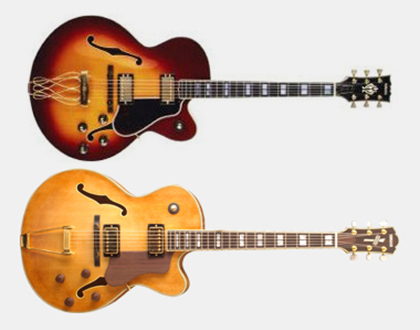
A hollow body guitar with a sound chamber and violin-like f-holes"
Semi-acoustic guitars have thinner bodies than hollow body guitars
Semi-acoustic guitars have thinner bodies than hollow body guitars, and are also called "semi hollow guitars." The central portion of the body is filled with wood, while the left and right sides are hollow. Semi-acoustic guitars produce a sound that is somewhere between that of a hollow body guitar and a solid-body guitar.
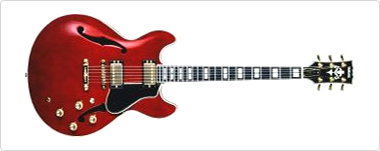
Semi-acoustic guitar
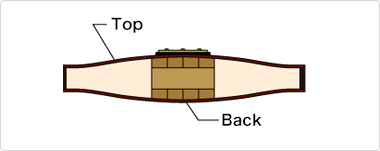
Semi-acoustic guitar cross-section view
Solid-body guitars feature solid bodies
Solid-body guitars are formed from a solid piece of wood, or from several types of wood joined together and a body filled with wood to eliminate the hollow cavity. When most people think of an electric guitar, they are picturing a solid-body guitar. These instruments come in a variety of shapes. Two examples are introduced below.
The body features distinctive gouges around the base of the fingerboard, so that the guitarist can more easily reach the higher pitch frets. There are typically 21 to 24 frets. However, some instruments can have up to 26 frets! The pitch increases by one semitone each fret. As the pitch increases the space between the frets narrows, making it more and more difficult to press.
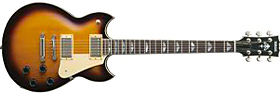
A solid-body guitar with three tuning keys on either side of the head
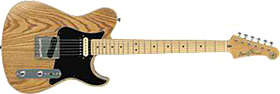
A solid-body guitar with all six tuning keys on one side of the head
The electric bass is responsible for low tones and rhythm
With a lower pitch than an electric guitar, the electric bass is responsible for the bass register of the song, and also plays a role in providing a sense of rhythm. Although electric guitars tend to have six strings, most electric bass guitars have four. However, there are electric bass guitars with five or six strings. The strings of electric bass guitars are thick and tense and need to be strung with great force. This means that the body needs to be large enough to withstand the vibration of the strings, so electric bass guitars tend to be slightly larger than electric guitars. The neck is also quite long in order to support the longer strings. Placed side by side with an electric guitar, an electric bass appears noticeably larger.
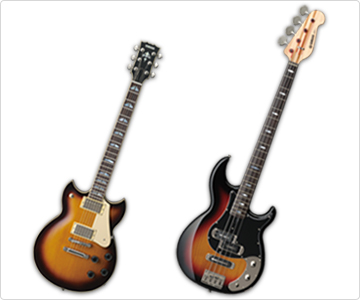
Left: Electric guitar; Right: Electric bass