Chapter Text
There are days — and then there are those that are less good.
The world is shrouded in a grey veil that shifts from light to dark, wrapping itself around everything.
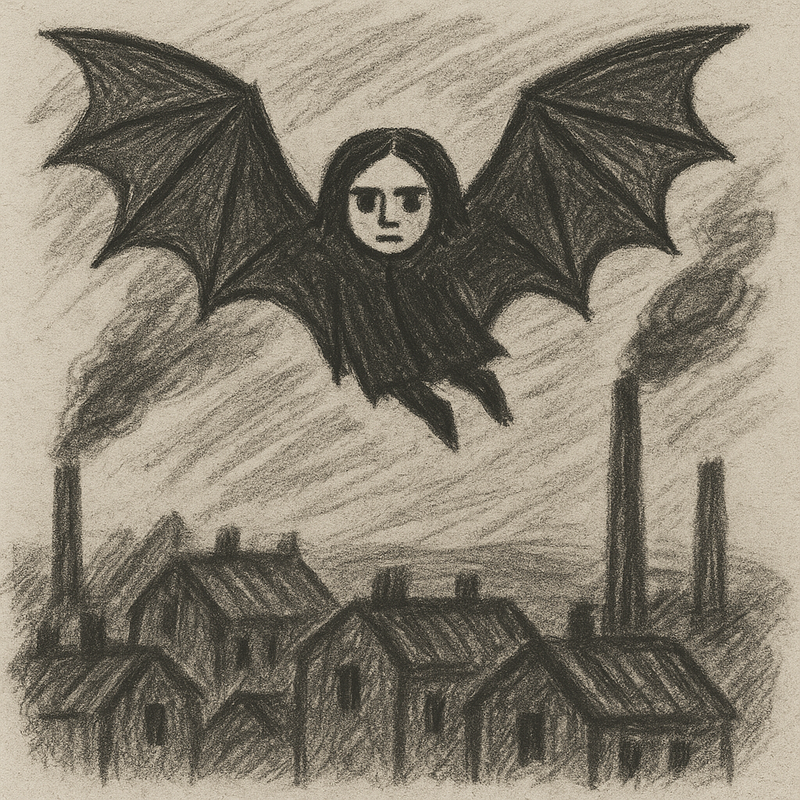
Grey wisps of fog rise from a distant chimney and drift, slow but relentless, down to the earth.
Dust settles on facades, meadows, and plants, only to be washed away in the next rain into the river, whose banks overflow with rubbish.
Machines need oiling, workers groan, the air reeks of waste — the same house fronts, lined endlessly along straight streets.
A scene of constant repetition.
In short: Cokeworth.
Spinner’s End is no exception.
This street, too, is built from repetition.
Grey upon grey.
Most of the street lamps are broken, their glass shards sharp and dangerous, having shifted over time from the road toward the doorsteps and walls.
Among the shattered lamps are coloured fragments of wine and beer bottles, refuse from abandoned houses, industrial waste, and discarded scraps left behind by passers-by and vagrants who hurry through the neighbourhood.
The houses still inhabited have drawn curtains and less rubbish before the doors.
The tiny backyards are crowded with washing lines and serve no other purpose.
So it is with the last house on the street.
Upstairs, too, the curtains are drawn and the windows closed, shutting out curious eyes, the roar of the surrounding factories, and the foxes that rummage through the rubbish.
Behind those faded curtains lies a bare, sparsely furnished room.
By the window stands a wooden child’s bed — mahogany, old, its frame covered in scratches and notches.
At the head rests a small, frilled pillow with a torn cover, and the rest of the bed is piled high with thin, ragged blankets.
At the other end stands a wardrobe, once painted with blossoms now faded beyond recognition.
Inside, it mirrors the bed’s neglect — a jumbled mess of clothes: patched work shirts, stained blouses, aprons tied at the back.
Most are colourless, faded, crumpled from careless stacking.
On a small wooden stool lie pieces of charred wood, their ends worn down.
Charcoal drawings hang from every wall — mostly of plants, though here and there a spider hides among them.
The lines are sharp, reduced to essentials, each rendered in the same tone: black.
Scattered across the floor are unfinished sketches, some abandoned from lost interest, others awaiting missing ideas or references.
Though childlike in skill, they lack the imagination and playfulness one would expect from a child.
They are copies of reality.
Before a small mirror stands a thin boy, black greasy hair hanging over his face.
Dark eyes study his reflection with mild interest.
The hooked nose from his father does nothing to improve his disheveled appearance, nor the long face from his mother.
With a defiant look, he turns away and crouches beside a shattered beer bottle near his bed.
A faint spark glimmers in his eyes as he spots the spider inside.
The dead flies from the previous night are now wrapped neatly in silk, and his pet rests in the bottle’s darkest corner.
The corners of his mouth twitch faintly before he turns away, grabs an empty jar from the nightstand, and slips it into the oversized pocket of his jacket.
His walk resembles that of a spider — halting, uneven.
He pauses at irregular intervals, his steps varying in length.
The quiet creak of the staircase announces his descent before he appears.
The flat is bare and utilitarian.
The kitchen holds a stove and a few plates in otherwise empty cupboards.
A couple of pots stand on the table, a wooden spoon forgotten by the sink.
Like everything else in the house, the room shows heavy signs of wear.
He stops when he notices a book lying open on the windowsill — diagrams, lines, pictures that bring order to complexity, clear rules and structures.
He bites his lip in frustration, remembering his last attempt to read it.
So many words he didn’t understand.
But he wanted to — to grasp them, to use them, to create something new from their ingredients.
A glimmer appears in his black onyx eyes — and vanishes as a monotone voice cuts through his thoughts.
“Severus.”
The light in his eyes fades as quickly as it came.
He turns and walks into the living room.
His mother stands by a bookshelf, reading from a thick tome.
When she senses his presence, she marks her page with a long, bony finger and looks up.
Her expression remains unreadable as she studies him.
Noting his father’s absence, his posture relaxes slightly.
“I’ll need your help tonight. Mrs. McDonnel requires new sleeping draughts.”
He looks at her in surprise.
“Will you show me how—”
She cuts him off impatiently, ignoring his curiosity.
“I also have to prepare dye for the weavers. There’s money on the table — go to Mr. Smith’s shop and buy seven red cabbages, five packets of baking powder, and one bottle of vinegar. You’ll make the dye while I work on the potion.”
The boy’s lips tighten, hurt flickering in his eyes.
“Didn’t I show you last time that I—”
Again she silences him with a gesture.
“What you showed me was that you can follow orders — and that your hands tremble. We need money, Severus. It doesn’t earn itself through failed experiments. Go now. Be back before dark.”
Her gaze drops back to her book. The boy in front of her ceases to exist.
He hesitates for a moment, countless replies forming and dying on his tongue.
He bites his lip, turns toward the table, and pockets the coins.
When he steps outside, he exhales in quiet relief.
At home he always feels as if he’s suffocating — every movement, every word, every breath carries the threat of consequence.
He probably made the right choice not to argue.
Still, he’s certain he could have brewed the potion himself.
He remembers the last time he had brewed with her.
She had stood behind him, her hands on his shoulders as he added ingredients.
It was a gesture he had longed for — her touch, her attention, her voice.
He wanted more of it. He wanted—
That was when his hands had started to shake.
The pressure on his shoulders increased, and her monotone voice cut through the air:
“Control your emotions. Discipline your mind.”
The trembling hadn’t stopped.
But thanks to her interference, the potion hadn’t failed.
She neither praised nor scolded him, merely gestured for him to leave the kitchen.
He blinks and finds himself back in the present.
His feet have carried him into the abandoned industrial district.
In summer, vagrants sleep and live here; in winter, only the remnants of their shelters remain among the ruins.
His mother had told him to return on time.
With his father gone since early afternoon, chances were high he wouldn’t come back until late night.
The river beside the factories stinks of chemicals and pulp.
The heaps of trash at its banks grow higher each day.
His eyes linger on the old, deserted weaving mill.
Some of its walls have collapsed; the ceiling sags dangerously.
He steps inside, careful among the rubble, eyes scanning the shadows for something interesting — a distraction from the everyday.
He finds old framed photos: smiling faces, happy families, pets, holidays.
His expression remains stoic as he flips through them, but inside, resentment stirs — envy of their joy.
The frame feels cold in his hand, dust clinging to his fingers.
The glass cracks with a sudden snap.
Control your emotions. Discipline your mind.
He drops it to the floor and moves on.
Most of the looms are destroyed, the wood long burned for warmth.
Charred rings mark the floor where fires once burned.
He sifts through the remains, searching for wood fit for drawing.
Then he sees it — a large, black denim jacket draped over a chair.
He approaches slowly. The fabric is intact.
He slips it on over his own faded coat and looks down.
The sleeves are far too long, almost brushing the floor.
His pale skin contrasts starkly with the deep black.
It is different — not washed out, not colourless.
Though much too big, it feels right.
It envelopes him, cloaks him in shadow, makes him look larger, stronger — like a great bat.
A shy smile touches his lips.
When he grows up, he’ll dress like this.
It will make him look powerful.
People will respect him.
A single word will be enough to command attention — not like his father’s shouting, but quiet words that make others listen.
He straightens, face serious, eyes gleaming with something like superiority.
The jacket billows around him as he strides through the ruin, its sleeves flaring like wings.
He feels untouchable.
The blue, disdainful eyes of Mr. Smith drag him back to reality.
“Severus Snape. What brings you here?”
The boy’s gaze is no less disdainful.
“Red cabbage, baking powder, and vinegar.”
Smith sneers. “Didn’t your mother teach you manners? You greet people. You’re just like your father — rude, no manners, no decency.”
Severus’s dark eyes seem to look through him — twin tunnels revealing nothing.
He says nothing.
Silence is a weapon; adults grow restless under it.
His father is no exception.
He lets his eyes wander over the meagre shelves before settling back on Smith.
The man huffs in irritation and begins gathering the items.
“One, two, three…” he mutters, letting the cabbages roll onto the counter without a glance at the boy.
Severus steps closer, inspecting the produce.
“Your mother’s dyeing the neighbourhood again, eh? With her other hocus-pocus?”
He spits the last word out like poison.
The boy’s fingers twitch on the counter.
Control your emotions. Discipline your mind.
“Probably can’t stand to leave the house,” Smith goes on, “just like your father can’t stand being sober.”
He slams the rest of the goods down.
“That’ll be eleven pounds forty.”
Severus silently counts the coins and slides them over.
When he reaches for the bag, Smith keeps a hand on it.
“Tell me, boy,” he says, leaning close, breath heavy with stale tobacco and tea. “Is it true what they say? That strange lights burn in your house at night? That green smoke rises from your chimney? That your mother talks to things that aren’t there?”
Slowly, Severus lifts his gaze and meets the man’s eyes.
He doesn’t speak.
He doesn’t smile.
He doesn’t frown.
His look is flat — the kind that sees things Smith cannot imagine.
The man’s sneer falters; unease flickers across his face.
The boy isn’t angry — he’s unsettling.
Smith lets go of the bag as if burned.
“The money’s short,” he snaps, trying to recover. “You’ll pay, or I’ll teach you some manners myself.”
Had he not been so fixated on the boy’s eyes, he might have noticed the slight tremor in the pale, slender hands.
“Is it usual,” Severus says quietly, “to sell spoiled goods at full price?”
Smith freezes.
“They feel like wet cardboard,” the boy continues. “And the smell... good cabbages don’t smell like that. I won’t pay full price for rubbish.”
The words are not his own; he has heard his mother say them before.
He repeats them with the calm certainty of a child who knows injustice when he sees it.
He lifts the bag, turns, and walks to the door.
The bell jingles sharply as it closes behind him.
“Mad family!” Smith shouts after him. “The apple doesn’t fall far! You’ll end up just like your father!”
The door slams, cutting the words off.
Outside, the stillness of the street feels like a blessing.
He inhales deeply — the stench of Cokeworth filling his lungs.
What beats in his chest isn’t anger but triumph.
Smith had been afraid.
Of him.
He walks on, spider-like, the oversized jacket trailing behind him like the wings of a great bat.
It is more than clothing — it is a promise.
One day, his silence alone will command respect.
He won’t need to shout like his father.
His power will lie in quietness.
Only the weak need to scream to be heard.
Until that day, silence will be his sharpest blade.
The door clicks softly shut behind him — a small sound, yet in the silence of the flat it echoes like a warning.
The safety of the jacket and the thrill of victory fade instantly as the heavy air of home settles around him again.
The smell of dust, old wood, and sharp, chemical fumes from the kitchen turns him back into the small boy he is.
A faint clinking, the hiss of boiling liquid — his mother is already at work.
He sets the bag quietly on the table.
She doesn’t turn.
Her shoulders are tense as she adds a pinch of powdered root to her pot.
A pearly steam rises, sharp with mint and metal.
He stands still, watching.
The precision of her hands, the calm focus of her movements — it is a kind of perfection he longs for, and despairs of ever reaching.
In these moments, she seems alive, almost radiant.
“You’re late.”
Her voice carries no reproach, only fact.
“Smith was… slow,” he mutters, placing the change on the sill.
She glances at the coins, then back to her work.
The words tried to cheat me die in his throat.
She’d have called them excuses.
He wants her respect, not pity.
“The ingredients for the dye are on the table,” she says. “You know what to do. The cabbage must be finely cut. No chunks. The colour has to extract evenly.”
He takes the knife and begins slicing, careful, precise.
His hands, so steady in the factory, now feel clumsy under her unseen gaze.
He focuses on each stroke, on the rhythm of the blade against the board.
Cabbage, water, vinegar, baking powder — boil, strain, bottle.
He repeats the steps in his head.
Silence fills the room, broken only by the hiss of the potion, the tap of the knife, the slow breathing of his mother.
The quiet is thick with all that remains unsaid: his craving for praise, her quiet disappointment, the unspoken fear of his father’s return.
After a while, as he pours the chopped cabbage into the pot, she speaks again, eyes still fixed on her brew.
“The jacket…”
He freezes. He had hoped she wouldn’t mention it.
“I found it,” he says softly. “In the old mill.”
“It’s too big. It makes you… noticeable.”
That’s the point, he thinks, but says instead, “It’s warm.”
That, at least, is true.
She doesn’t answer.
She stirs her potion once more, the liquid shifting from milky green to deep violet.
Satisfied, she removes it from the heat.
“The sleeves are too long. Roll them up so they don’t get in your way.”
She pours the finished potion into old jars, their labels layered with others beneath.
“Men like Mr. Smith only understand two things: superiority and the absence of fear,” she says at last. “You showed neither today. You let yourself be provoked.”
Her eyes meet his for a brief, piercing moment.
“Your anger is a leash, Severus. And fools like him will always pull it to control you. Unless you learn to cut it, you’ll live your life at the mercy of others.”
She turns away, washing the pot clean.
“The potion for Mrs. McDonnel is simple — a mild sleeping draught. The third ingredient, after moonstone dust and dried serpent tongue, is lavender. Not the flowers — the oil. Two drops, no more.”
He stops breathing.
Her back is still to him, but her words are an offering — small, precious.
A fragment of trust.
He returns to his dye, the faintest flicker of satisfaction in his chest.
He suppresses it immediately.
Control your emotions.
Yet as the scent of vinegar and cabbage fills the room, the silence between them feels, for once, less like a prison — and more like an unspoken form of understanding.
Biting his lip, he asks, “The books in the living room… may I look at them?”
She freezes.
Her rough hands still on the drying pot.
The question hangs between them.
After a long pause, she adjusts her tied-back hair and answers softly, “Which book interests you so much?”
“The one with the diagrams,” Severus says quickly. “On the windowsill. With the lines and… the structures.”
He doesn’t dare say the word magic. Not here, not where the walls might listen.
She turns slowly.
Her pale, thin face is unreadable, but in her dark eyes — so like his own — something flickers: curiosity, perhaps even concern.
“That is no toy, Severus,” she says carefully. “It’s Theoretical Foundations of Magical Structures. The concepts are… advanced.”
“I know,” he whispers. His hands tremble, sleeves slipping down again. “I saw the pictures. The way everything connects. I want to understand why.”
“Why?” she repeats, studying him.
For the first time that evening, she seems to truly see him.
“Why moonstone calms the mind? Why serpent tongue clears dreams? Those are not questions for a boy whose hands can’t stay still.”
It is a rejection — but not the cold kind. It feels almost like a test.
She waits for his answer.
He forces his hands still, pressing them to his thighs.
“Because they’re rules,” he says softly. “Like cooking — but stronger. If you understand the rules, you can’t break them. You can… bend them.”
He bites his tongue too late. Too ambitious. Too revealing.
Silence fills the room again.
Her eyes drift toward the memory of his black charcoal drawings — the harsh lines, the obsession with precision.
Maybe she recognizes something of herself in him.
She sighs.
Then she goes to the bookshelf — not to the windowsill — and runs her thin fingers along the spines until she pulls out a smaller, worn volume.
The cover is stained, its title almost erased.
“The book on the windowsill is not suitable for you,” she says evenly, and his heart sinks.
But then she places the smaller one before him on the table.
“This one is An Introduction to Magical Botany for the Young Scholar. Before you understand structures, you must understand ingredients — every plant, every mineral, its nature, its origins, its interactions.”
She meets his gaze, unreadable.
“You may read it. But under two conditions.”
She raises one finger. “First: it never leaves this house. No one must see it.”
A second finger joins. “Second: if you have questions, you come to me. You do not experiment alone. One wrong step, one misidentified herb — the consequences go far beyond a ruined dye. Do you understand? I won’t have people gossiping about you and your… experiments.”
Severus nods so hard his hair falls into his face.
His heart pounds, eyes bright with barely contained joy.
“Yes,” he breathes. “I understand.”
“Good.”
She turns away, signalling the conversation’s end.
“Now finish your dye. Then wash up and go to bed. If your father finds you up when he comes home, there’ll be trouble again.”
As she leaves, her eyes linger for a brief moment on the book lying on the table.
There’s something wistful in her expression — a shadow of a smile before she disappears down the hall.
When everything is cleaned and bottled, Severus reaches out with a trembling hand and touches the worn cover.
The silence around him no longer feels oppressive.
It feels full of possibilities.
That night, beneath his bed, lies a new drawing.