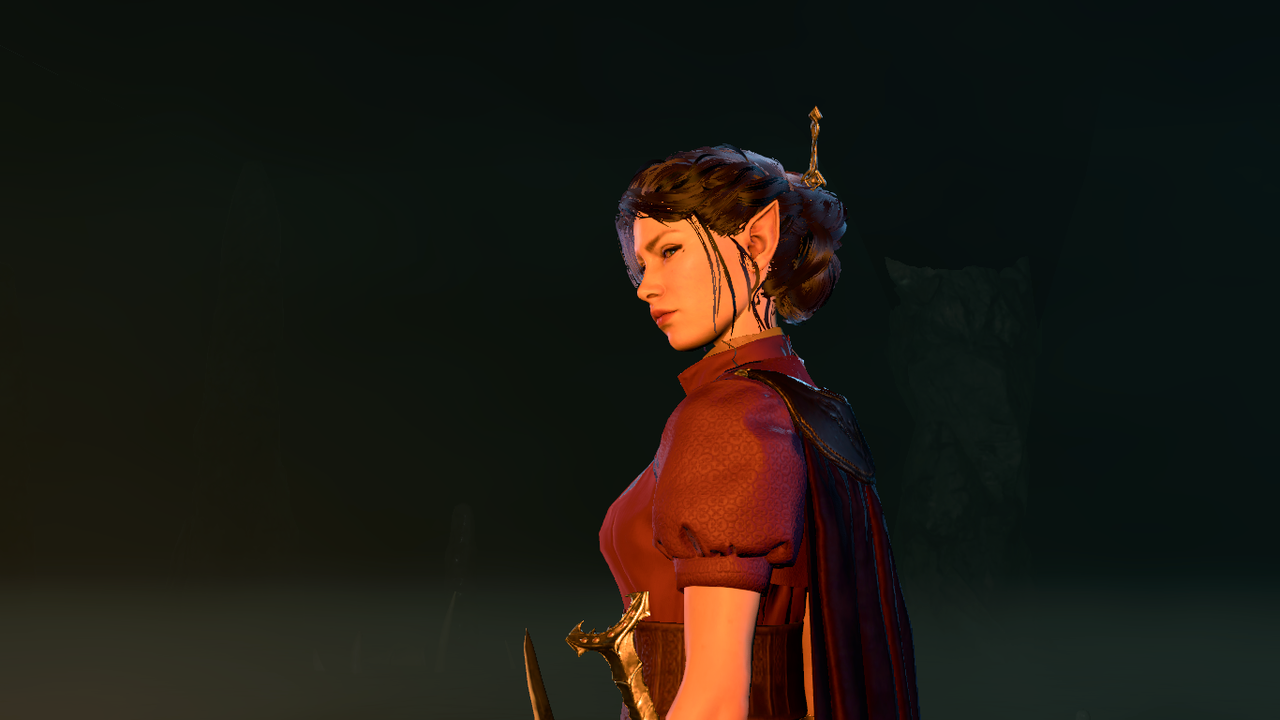
Work Text:
(i. having)
When Vermillia Lash is fifteen, she sprawls on her bed in the silvery shadow of a rented apartment and spins the sort of plans a fifteen-year-old makes when life has so far been pleasant and defeat still feels theoretical.
She decides this: she isn’t going back to the house where she grew up, and she will not live in the sewers like a thing that creeps. She will sell her foster-parents’ valuables without ceremony, keeping only what pleases her: steel, stone, fabric. She will be a great lady of the Upper City; will have blood and jewels in equal measure.
From her bed, Vermillia hears the street. Children chant a nursery song. A dog barks at the end of his master’s leash. She thinks: what are their lives, compared to mine?
She's wearing her foster-mother's nacré velvet. Vermillia's always liked it better than satin or taffeta: dark, plush, woven thick enough to hide what holds it together. Velvet takes warmth, takes pressure, takes touch, and gives nothing back.
I can be velvet, she thinks.
Vermillia is young and selfish. She will change over the years, enough to stop being one of those things. The other though—
Selfishness is woven deep into every last one of Bhaal’s children.
-
She is born from Bhaal’s own viscera, but Vermillia does not know this for a long time.
Until she is fifteen, she lives in an Upper City house with tall windows and carpets too pale to walk on without slippers. The patriars who raise her tell visitors she is a foreign viscountess, displaced by politics better left unexplained. They repeat the story often enough that it never contradicts itself.
They are good to her. They dress her in silk and hire tutors who correct her posture with a tap of knuckles against her spine. She learns which fork to use, how long to wait before answering a question, and to sit at the edge of a chair without ever leaning back, even when her legs ache.
Vermillia knows nothing of her own history until Orin appears one afternoon and calls her sister.
The whole ugly story spills out from there: a divine Father, Lord of Murder, who fashioned a daughter from blood and offal. Vermillia’s dark hair and green eyes, which everyone always said were so fine, are not any kind of inheritance; her violent temper is.
That night she waits until the house is asleep. She tries to think about duty, and the careful life she has been trained to perform. But her mind circles the same thing: the lie, the years of it, and how neatly it has been laid over her like cloth.
She takes her foster-father’s hunting knife from where it sits by the door to the kennels. It fits her hand easily, the handle warm and balanced. Vermillia kills her foster parents in their bed, careful not to wake the servants. She’s proud of the cuts she makes. They’re neat, undramatic. Blood pours down from their throats to their fine dressing gowns, turning them gory.
It's the height of summer. The next morning, Vermillia walks beyond the gardens and buries the knife in the baking ground, the sky dripping brilliant blue above her. The dirt is dry and resists her. She presses down anyway until the blade disappears.
When she returns she washes her hands. Then she goes inside and eats breakfast.
Vermillia leaves the next day.
-
Later, she regrets their deaths. Not the killing itself: the debt. The people who raised her did her a good turn, and Vermillia paid them back in nothing but blood.
-
Her foster-parents weren't the ones that named her. It must have been the Bhaalists, she realizes now, or maybe Bhaal himself.
It makes sense to her. Vermillion is a family of red dyes— red like blood— but also a toxin.
And Lash— meant to be the Lash of Bhaal, clearly. But Vermillia, who learned to bat her eyes before she was out of pigtails, knows better.
-
Sceleritas Fel tells her that she will live in the Bhaal temple now. He is very insistent.
Vermillia does not argue or bargain. She turns on her heel and walks past him instead, straight toward the altar, because this is not a matter for intermediaries.
“You made me to kill,” she says, quite plainly. “And I will.”
She does not say it the way Orin would have, foaming with ecstasy and devotion. She says it the way one states a certainty, like gravity, like debt. As though there is no possible future in which this does not come to pass.
“The bodies of the great and the good will be richer meat than anything skulking in alleys. I will cut my teeth on the Upper City, and when I am finished there, I will drown the world in blood for you.”
She does not kneel. She does not look back to see whether Sceleritas Fel is listening.
Vermillia Lash is used to being indulged. Bhaal, for his own reasons, indulges her now.
-
Orin is furious with Vermillia for leaving. Or maybe, somehow, she is hurt by it. It doesn’t matter especially. At fifteen Vermillia is sleek and self-contained, dressed in velvets and pleased with the clean line of her own choices. She does not yet know how to be sorry for other people. Orin does not know how brittle her own heart can grow.
They will both learn.
-
Five years pass, and Vermillia learns that above all else, killing is easy.
She lives well. She keeps lavish, comfortable rooms in the Upper City and employs servants who know when not to ask questions. Her gowns smell faintly of perfume and crushed flowers. She attends parties because she enjoys them, and accepts contracts because they amuse her.
The murders are indulgences: ways to burn off temper, to sharpen her claws and remind herself that the world will always answer when she applies pressure. She chooses her victims with a mild, almost idle cruelty. People who bore her, or slight her, or irritate her. People who think themselves untouchable.
If there is a flaw in this life, it is that nothing pushes back.
-
The first time she meets Enver Gortash, it’s at a middling ball and she’s bored. She’s seated between two politicians who don’t even have the manners to ask her to dance before wasting her time with pointless drivel. Vermillia has already decided that one of them will die by poison and the other by scandal; she is only working out which deserves which.
And then her eye drifts, and she sees a stranger.
He’s standing just off the edge of the dance floor, close enough to be seen yet far enough to avoid the crowd. Darkly complected. Broad-shouldered. His chin is lifted a fraction too high for someone without a title, and he hasn’t bothered to school it down. He watches the room like a man taking inventory.
“Ah,” the man on her right says, leaning closer. “I see you’ve noticed him too.”
“Have I?” Vermillia asks pleasantly.
“Master Gortash,” he continues, lowering his voice. “A procurer. Arms, mostly. A necessary sort of man, but hardly the company one expects at a gathering like this.”
Vermillia tilts her head. “And yet here he is.”
“Yes, well. Someone must have invited him.”
What interests her most about Master Gortash is that he is not trying to belong by deference, or by mimicry, or by fraud. He scans the room like he intends to make everyone else bow to him: like that is how he plans to belong.
Vermillia stands. Sidesteps a woman reaching for her sleeve, asking for her next waltz. “I’m afraid I’m already promised.”
The music shifts. A reel, faster now. She crosses the floor without hurrying.
“Master Gortash,” she says, stopping just within his casual reach. “You look as though you might dance.”
The effect is immediate and gratifying. Adjacent conversations stall. Eyes turn. Master Gortash blinks once— only once— and then inclines his head.
“Lady Lash,” he says, recognizing her by reputation if nothing else. “I was about to ask the same.”
Liar, she thinks, delighted.
He offers her his hand. She takes it.
-
“You dance splendidly, Master Gortash,” she coos, midway through the second reel. “Big men seldom do.”
“A skill hard-won, Lady Lash. I dislike being outpaced.”
-
It is not at a party that she hears his name again.
The Bhaal temple is hushed in the way quiet rooms devoted to violence often are. Vermillia sits on the edge of a long stone table, idly cleaning her nails with a thin blade while one of her Unholy Assassins kneels before her, head bowed.
“There’s a man,” he says. “Operating out of the Lower City. Arms, mostly. Black market, but organized. He’s been blundering into our business left and right these past few weeks and—”
He hesitates.
Vermillia glances up. “His name?”
“Gortash.”
“Oh,” she says.
The assassin frowns slightly, uncertain how to interpret that. “My lady?”
“Nothing,” she replies, already smiling faintly. “Go on.”
“He’s not one of ours,” he continues. “But he’s been asking questions. Careful ones. About the temple. And about you.”
Vermillia slides off the table and paces a few steps, the motion restless rather than deliberate.
“How rude,” she says. “To inquire without introducing oneself.”
The assassin waits.
“And?” she prompts.
“And,” he says, “he’s ambitious.”
She laughs then, a short, delighted sound that echoes off the stone.
“Well,” she says. “That’s hardly a crime.”
-
She goes to his workshop instead of his Upper City apartment. Partly because she enjoys a surprise, but mostly because she enjoys watching control slip from other people’s hands. Catching the beast in its den, and all that.
The servant announces her name, and Vermillia hears a pause before the reply, brief but unmistakable. She recognizes it the way she recognizes a lie when someone sweetens their voice too much.
“Send her in,” Gortash says at last.
He greets her in shirtsleeves, his hands still damp from the wet cloth he cleaned them on. There’s still the record of a scowl on his face, pasted over with a gentleman’s smile.
“This is a workshop, Lady Lash,” he says, voice mild but pointed. “Not a drawing room. I’d have thought you’d prefer my apartment.”
Vermillia smiles her favorite smile— the one that shows her dimples— and flicks her gaze past him, over the scarred benches and oil-stained tools. Then she looks back at him.
“Master Gortash,” she says brightly. “There you are.”
-
Enver Gortash walks with a limp, when he thinks no one is watching.
It appears when he turns too quickly, or forgets to distribute his weight, or when he’s focused on a diagram or a thought and not on the body carrying him between one place and the next. The correction is practiced, but the habit of it gives him away.
Vermillia sees it once. Then again.
He is selfish, like her, but he wears it differently. Where hers is indulgence, his is insistence. His ambition sits on him like steel armor: well-fitted, adjusted by hand until it looks perfect. But the armor pinches. She notices where.
They are standing close enough now that he could reach for her if he chose. He doesn’t. Instead, he angles his body to favor the stronger leg, unconsciously presenting the version of himself that he prefers to believe in.
“You didn’t pick Bane for power,” she says softly. “You picked him for control. That’s different.” She tilts her head, smile faint. “You picked Bane because the idea of being at anyone’s mercy makes you positively ill.” A pause. “Why is that, I wonder?”
“That’s an odd observation for a socialite,” he deflects, scowling.
Vermillia wrinkles her nose. “Don’t call me that. It makes me sound decorative.”
This is the first intimacy between them: not a kiss, not a confession. A shared understanding that the world is a machine with faulty parts, and that faulty parts can be replaced.
-
Vermillia’s true problem is that she is good at nearly everything she puts her mind to. Bladework, archery, dancing; she can hold a tune with ease, and ride horses without much thought, and even her magic is not too shabby. Most pursuits bore her once mastery ceases to challenge her.
Alchemy does not.
She stays with it longer than anything else. She likes the fragrances best: bitter roots and sharp oils, sweetness cut clean with poison. She likes that the work requires exactness, not inspiration.
Coating ratio: reduce bitterness, increase adherence. If it tastes like medicine, they’ll stop chewing.
Vermillia is not sentimental about alchemy. She is devoted to it.
Later, when she hears Enver Gortash speak about his inventions with that same reverence, the way his voice changes when he talks about mechanisms that answer to him, recognition settles in her chest with a quiet click.
Enver has always liked impressing people, particularly those that are not easily impressed: Vermillia, as a Bhaalspawn and a partner both, is good at pricking Enver’s pride into producing ever finer objects. When he first shows her the schematics for the automatons he will one day build, she studies them with happy recognition. Ah, she thinks again. There you are.
-
“I’ve heard,” Enver says once, mildly, “that some Bhaalspawn suffer from violent urges. Is there any truth to it?”
Vermillia’s mouth tightens. “I do not have violent urges,” she replies tartly. “I have a temper. There’s a difference.”
-
They form a plan together. Mostly Enver’s.
He reads everything. Books, broadsheets, intercepted mail that still smells faintly of wax and perfume. He annotates margins until the paper gives up. He keeps notebooks. Writes lists, refines them, annotates, and writes them again, as if repetition might hammer the future into shape.
Vermillia refuses to read any of it. She listens instead, stretched out and half-attentive, enjoying the cadence of his voice more than the content. Knowing things is Enver’s job. Numbers interest her more than words anyway.
Time moves sideways after that.
They leave each other calling cards, gifts. Stillmaker in Banite green. The fine coat and shoes to match her favorite gown in bright, Bhaalist red.
Vermillia visits Enver’s apartment, then his townhouse. She learns which servants avert their eyes properly and which do not. Enver learns that she will always find her way back to his workshop, no matter how pointedly he suggests she meet him elsewhere.
She irritates him by touching unfinished things. He irritates her by locking drawers that don't need locking. “How did a lady of your breeding become such an incorrigible sneak?” he asks, half grinning.
One night, Enver unrolls a map of Baldur’s Gate across the desk and sets a coin on each district.
Vermillia hums. “Planning a tour?”
“Planning a chokehold,” Enver replies, and nudges one coin an inch. “They’ll call it governance.”
When Bane recognizes Enver as his chosen at last, Vermillia notices it first in his shoulders. The constant, coiled tension eases, as though something's finally settled into place. It’s the Absolute plot that solidifies his new standing, more than restoring Bane’s church ever did.
It doesn’t take much to bring Vermillia into it.
“It’s not as if it matters anyway,” she says blithely. “In five years, or ten, or a hundred, everyone will be gone. Dead. As my Father wills it.”
Enver inclines his head. “If you say so, my dear.”
-
Bhaal's blessing on Vermillia comes almost as an afterthought. His voice cuts cleanly into one of her dreams, deep as summer thunder. “Vermillia Lash,” he says, with a father's fondness. “You always were my favorite.”
-
Enver Gortash is not a generous lover, and neither is she. They make no pretense of gentleness: velvet and armor grind close, each insisting on their own way.
Vermillia’s wrists are pinned. “Hold still.” Enver leans in, forcing her flush against the bedframe.
She lets her head tip back, eyes fixed on his like a dare. “Make me.”
He does.
Vermillia gives nothing for free— no sigh, no hum— only the sharp satisfaction of making Enver earn each concession, breath by breath. He answers in kind, hands firm where hers are precise, gripping her by the wrist, the jaw, exactly hard enough to remind her that he can.
Later, he sets her on a table’s edge like a piece on a board. Vermillia hooks her fingers into his collar and tugs, hard.
“Careful,” he warns, half a breath from her mouth.
Vermillia chuckles low against his skin, and for a moment she doesn’t move. She waits until his hand tightens, until his patience frays into want. Only then does she lean in and leave a row of bruises on his neck, spaced like neat stitches. "You did say to be careful."
When he tries to kiss her into silence, she turns her head just enough to deny him the angle he wants. He answers by lifting her skirts, and like a challenge Vermillia tugs off Enver's own trousers and waistcoat. Her nails rake down his side, slow like poison. His body jerks once, betrayed, then stills.
Vermillia has never known a desire she did not seize and consume. Enver Gortash has never known a thing he did not break apart to remake in his image. They are cruel to each other and to themselves, these chosen of the gods. Peace has never been in their blood.
-
“Where did the limp come from?” Vermillia asks one afternoon, pestle in hand as she grinds corpse roses and pretends not to watch him work.
Enver freezes halfway across his workshop floor. “I was not aware you had noticed it.”
“Give me a bit of credit, Enver. You of all people should know I’m cleverer than I appear.”
For a long while, he says nothing.
Then, evenly: “I was poor as a boy. My parents sold me to a devil to cover their debts. I acquired the limp in the hells.”
It’s a very bland, factual recounting of a life Vermillia can scarcely imagine. She can hear the desperation underneath it.
The chosen of Bhaal has never been desperate before. Not like that.
“Well,” she huffs at last, deliberately flippant. “No wonder you’re so obsessed with coin.”
Enver exhales, and the tension loosens by a degree. “I am not obsessed, my dear Slayer,” he replies. “You are merely unpardonably careless with it.”
-
She goes to nearly every party on his arm, these days. Lady Lash and Saer Gortash. Soon to be Lady Lash and Lord Gortash.
“When they give you the peerage,” Vermillia smirks on the carriage ride home one night, “I suppose I’ll have to decide whether to keep you.”
That’s a lie, of course. Enver Gortash is already hers.
-
They stole artifacts from the Hall of Wonders amid polished marble and magical tripwires, beneath frescoes meant to inspire reverence. Vermillia remembers thinking it all smelled faintly of dust and oil, like reverence that had gone stale.
Hell, by contrast, smells of sulfur, frost, and iron. The overwarm metal of the crown burns her hands even through gloves, and Enver laughs when she drops it and swears.
“What a pair we make,” he sighs after.
Vermillia closes her eyes. What a pair indeed. Twinned blades, the two of them; tools forged by different gods for the same work.
In the back of her mind, she feels her Father’s displeasure. She should not care so much for this man.
“Indeed,” murmurs Vermillia. She rests her palm on his, and takes comfort in the soft, silver light of the moon. “I wonder, sometimes— if Father ever truly tired of me, what would happen?"
“Your Father would never,” Enver says. He flips his palms over, and grips her own. There are calluses between them: of Enver’s pliers, clamps, and vises. Vermillia’s own hands are soft as baby skin, in spite of her poisons, her blades.
This is all that she can remember now: the choices she has made, all her life, which mean that Bhaal loves her most of all his children; and that Vermillia, if she loves at all, loves only Enver Gortash. Then she looks up at her lover and his gaze is a terrible thing: soft and fond. “But if He did, there shall always be room in my home for you.”
Vermillia swallows. It’s a grand thing he’s offering. Defiance, of the Father who loves her so well. Who they both know will never let her go. A grand thing. Perhaps too grand of a thing. But Vermillia finds that she is selfish enough to love Bane’s chosen first, and most. For tonight at least.
-
Her body aches like an open wound in the hours after she leaves him. Blood begins to seep from her lips, her nostrils. Vermillia makes it to the Bhaal temple and falls down at his altar, and for the first time in her life she begins to make the necessary penance.
At the end of this all, Father, there will be not a single creature living. Everyone will die. Everyone will die for YOU. I will make you proud.
-
Vermillia has never loved Orin, could not love anyone weaker than herself. She does not even especially like her sister. But Orin is her bloodkin, part of her, and for that reason Vermillia never imagined betrayal.
She never mentioned Orin to Enver. In retrospect, perhaps she should have.
(ii. losing)
Vermillia regains consciousness in a pod, deep in the illithid colony. She knows dimly that she has been here before, on the other side of the transparent wall hemming her in. She cannot remember what here is called, but she knows this much: it is an affront. She was not made to be caged.
She thrashes against her bonds. Strength answers her, even if she can't remember where it comes from. If she can only get free, something in her knows she will not have to look far for help.
Sharp eyes and an easy smile— they played with a skin-slack head together didn’t they? Or is that, too, a lie her mind is telling itself?
She has never been helpless before. Vermillia Lash was born to be indulged, denied nothing she wanted. Now she is bound and sick, her body reduced to a thing that hurts. Rage surges hot and useless in her chest.
She thrashes.
The pod shudders. Something cracks, and fluid spills. She pulls once more and the wall gives way with a wet, yielding sound.
It is Kressa Bonedaughter who finds her.
-
There are moments when Vermillia’s mind tries to flee her body and cannot. There are moments when her body tries to die and is refused.
If there is prayer in it, it isn’t to Bhaal. It is the animal prayer of any creature pinned to a table:
Not yet. Not like this.
-
Aboard a nautiloid in hell, Vermillia Lash wakes.
Her joints ache. Her head throbs. She hates that her body feels like a thing with limits, hates that she can’t fix it immediately.
But she can still move, and that’s enough.
-
The day her life splits open, Vermillia makes a decision so clean it could have been an oath. She’s going to live. She will not be helpless again.
Allies will be necessary. She doesn’t waste time being selective.
Shadowheart is the first reasonable option: a talented cleric who’s already watched Vermillia’s back when it mattered. She shares what she knows without begging for trust, and does not chatter to fill silence. Vermillia decides she will do.
Astarion, on the other hand, tries to take Vermillia’s life with a bit of misdirection and a half-sharp knife. She inhales sharply as she glares at him, feeling the warm, familiar snake of anger uncoiling in her veins. Deep breath, she tells herself, forcing the feeling down. He’s too useful to kill.
The less that’s said about Lae’zel the better. She has a habit of making demands of Vermillia, as if she’s earned the right. She has not.
And then there’s Gale, a mage dragged bodily out of his own magical mistake. A woolheaded dolt, with the irritating advantage of being a wizard.
None of them are ideal, but all of them are useful. And useful is all that matters now.
-
They make camp badly that night. The fire smokes and never quite catches. The ground is hard and uneven and there is nothing to eat, but Vermillia doesn't complain about it.
She doesn't sleep that night. She sits with her back to a tree, dagger across her knees, listening to the sound of the wind worrying in the leaves. In the dark, Vermillia knows herself to be an indulgent, frivolous thing.
But still, even as she feels stroked-thin, she isn't threadbare. Velvet holds its beauty under bruising; it takes and takes and gives nothing back. Somehow, even without her memory, Vermillia knows that she’s dense pile and sturdy backing, strong and selfish.
Perhaps that’s all she is.
In the morning, she will find a healer worthy of the name, or else she will learn how to live with the thing in her skull. Either way, she will survive.
-
Time to cut my losses, she thinks, fighting a pointless battle near the nautiloid crash site.
Vermillia drags her aching body over to a smooth stone overhang that’ll shield her from any vengeful arrows if the vagabonds are stupid enough to return, and then fishes a pale pink vial from her bag. All the last day, she’d stopped to pick every bit of rogue’s morsel she spotted.
She grimaces as she tears her tunic apart to get at the ribs: Vermillia has no clean clothes left. She’ll have to submit to the indignity of going half-clothed until she reaches a town, or wear bloodied rags. In the old days, she knows without knowing, she never had to worry about supplies half this much.
-
Wyll is a ridiculous, posturing idealist, all knotted up in honor and stories of what a good man ought to be. “You have a remarkable talent,” he tells Vermillia, hand to his chest as though addressing an audience, “for making virtues sound like embarrassing affectations.”
“But virtues are embarrassing affectations,” Vermillia says tartly. “Justice tastes fine enough if you bake it into a pie, especially if you put meringue on top. People swallow it easier that way.”
But she’s grudgingly forced to admit that Wyll’s Eldritch Blasts are worth the inconvenience.
Karlach, on the other hand, surprises her. Vermillia likes her in spite of herself. There is no guile in her, no pretense; only a ferocious, incandescent insistence on the future. It’s not pretty, or polite, or especially sensible; it is, Vermillia realizes with a faint jolt of recognition, exactly the kind of instinct that keeps a person from dying.
She makes a mental note to watch for infernal iron. Not out of kindness. Out of respect.
-
In the Emerald Grove, they greet her like a hero for winning a single fight.
Vermillia listens with polite attention. She accepts the praise with a small, practiced smile. She doesn't interrupt. When the noise finally ebbs, she asks what they are offering in return.
When they speak of Halsin, the healer who might remove the parasite, Vermillia follows the lead without complaint. When they find him, battered but alive, he offers only sympathy and more work. Kill the goblins. Visit Moonrise Towers.
Vermillia does not argue.
She slays goblins until the ground is slick with blood and the air stinks of poison. She kills quickly when she can and messily when she cannot. She uses her blades until her wrists ache and alchemy until her satchel is light. She also calls Volo a sugar-livered, brittle-boned twit, but she’s fairly certain he’s too outraged by her earlier statements to hear it.
When she returns to the grove, gratitude spills everywhere, messy and sincere. Children stare and grasp at her ankles. Adults nod their thanks.
Vermillia accepts it because it costs her nothing.
-
The night they bed down in the emptied goblin camp, Lae’zel puts a sword to Vermillia’s throat. Her first thought is practical: turn, hook the wrist, gut Lae’zel on her own blade. But she doesn’t. Not yet.
Vermillia listens, and with every word her temper climbs until it erupts, sudden, like oil taking a spark. Mercy, the gith hisses. A clean kill before the parasite makes monsters of us all. It’s as if Lae’zel has reached into Vermillia’s chest to snuff out the one thing she is most determined to keep.
“Don’t you see how far gone you are?” Vermillia croons from sweet lips. “Give me the blade. I’ll make it quick.”
She slits Lae’zel’s throat in a single, smooth gesture.
Afterward, the sweetness in her mouth startles her, so much cleaner and brighter than all the goblin slaughter that came before. In the morning, she claims self-defense. And because Lae’zel was Lae’zel and Vermillia is Vermillia, no one presses.
-
Flirting, for Vermillia, is an easy, practiced habit. Hand to the gods, she's not actually trying to seduce any of her companions; and so she’s genuinely surprised when she finds herself fielding three lingering looks and two invitations to bed the night of the tiefling party.
Somewhere in the back of her mind is the dim impression that, once, making people fall in love with her required more than a few batted lashes and a warm smile. That there had been dinners, and dances, and careful cruelty in— wherever she came from. Baldur’s Gate, presumably.
It's Shadowheart she accepts, because a bottle of wine after the camp has gone quiet sounds pleasant enough. Vermillia does not especially care that the cleric worships Shar. Gods are gods; they are all the same, save one. Shadowheart is guarded, but not unpleasant, and Vermillia enjoys the company more than she expects.
-
Sceleritas Fel is rude enough to interrupt Vermillia’s sleep uninvited. She comes awake already reaching for her blade and finds, instead, a creature bowing at the foot of her bedroll with an enthusiasm that suggests this is not the first time he has done so. He introduces himself as her loyal and ever-adoring butler.
Vermillia studies him openly: the hunched posture, the eager, servile smile. If she ever employed a butler, she thinks, she would at least have the decency to choose one that did not offend the eye.
Someone employed on her behalf, then. “What in the Hells do you mean, you’re my butler?”
“The most unprincipled servant you could hope for,” he answers her, beaming. “You have always struggled to conduct yourself properly without me.”
Bullshit, Vermillia thinks. She cannot remember much, but she is certain of this: proper conduct was never a failing of hers. If she broke rules, it was because they deserved breaking.
“Oh, don’t be a goose,” she scoffs. “If I really cared about manners like that, the bard would still be alive.”
The Deathstalker Mantle he leaves behind is theatrical nonsense, all whisper and shadow and implied subtlety. Vermillia scoffs. Still, the craftsmanship is sound, and she is not sentimental enough to discard a useful tool simply because it offends her pride.
-
Camp life settles, improbably.
In the mornings, Wyll wakes fresh-faced at an hour Karlach calls absurd but is awake for anyway. When they leave for their morning jaunt the sky is still dark; when they come back, it’s light and Vermillia sips her third cup of tea, feeling for the way Karlach’s engine-heart still beats, steady and strong.
Gale takes charge of the cookpot every night, splashing stew down the front of his robe and muttering apologies to no one in particular, while Shadowheart is somewhere in the brush with the dog, allegedly foraging. Vermillia closes her eyes, sees dust billow, the sound of something heavy being dragged. She opens them again. Gale is still stirring. The stew smells tolerable.
Sometimes she wakes late to voices by the fire: Karlach is talking about Fytz and dancing, Gale about Tara and a mephit loose in the house. Once Baldur’s Gate comes up, Wyll begins mapping each anecdote to a street or a pub or one of his father’s old maxims.
Astarion rolls his eyes, and Vermillia is pleased with him for saving her the trouble. Shadowheart chimes in too sometimes, wry or morose, though like Vermillia she has no memories to spend. She uses her hands when she talks.
Vermillia lets her shoulders ease, cross-legged in the dirt. She takes the pint Karlach offers. It tastes like swill, but Vermillia drinks it anyway.
-
There are gaps in her mind. Some of them ache.
She does not remember faces, but she remembers methods. She reaches for fiddly tools without knowing why. She inventories supplies obsessively. She remembers odd bits of arcana and history, though she’s certain she doesn’t have the patience to read those things in books.
Occasionally, a thought surfaces unbidden: Someone would know how to plan this better.
She doesn’t know who that someone is. She resents the thought anyway.
-
“Life changes,” Karlach murmurs, very tiredly over the fire one night. “Life changes in an instant. You go to work one day and life as you know it ends.”
-
Jaheira puts klauthgrass in Vermillia’s goblet, sitting across from her in Last Light. Vermillia notices at once and almost takes offense.
“It doesn’t spoil the taste, if that’s what you’re wondering.”
“I prefer Venian’s Breath for interrogations,” Vermillia says lightly. “It doesn’t carry a scent.”
“No, but it does leave the subject paralyzed. Whatever comes next, I would have you standing on your own two feet.”
Vermillia considers this. Then she drinks. The klauthgrass doesn’t affect her, but neither does she lie.
-
The second time Sceleritas Fel appears, it’s with instructions: kill the pretty cleric.
Vermillia bristles a bit. Not at the task: killing is killing, and even her ruined brain is sure that she enjoys it. But if there’s one thing Vermillia hates above all, it’s when decisions are made for her.
When she finally meets Isobel, something in Vermillia twists. Not pity or mercy. Isobel is useful. Alive, she anchors the Last Light Inn against the dark pressing in on all sides. Dead, she would doom everyone within its walls, and that would make survival in the Shadow-Cursed lands so much unnecessarily harder.
Vermillia all but snarls at her absent handler. Who was I before, she wonders, shoving the urge to swipe her blade at Isobel down into something colder and more disciplined. Who was I before, that I had the luxury of killing so thoughtlessly?
She turns away from the cleric with her temper leashed tight.
-
Vermillia doesn’t kill Karlach the following night. She startles her awake with a thrown decanter of wine, and from there the whole sorry story comes spilling out.
Oh hells. Before something stops her— Vermillia still won’t say she likes her companions, but they’re hers. She won’t lose them like this.
She forces her breathing into something slower, shallower, teeth clenched against the shakes. “Whatever this thing is inside me,” she grinds out between spasms, “it’s worse than a temper.”
Karlach bares her teeth. “Yeah, I can see that. Breathe anyway.”
-
Vermillia is selfish. When she murdered the bard, she lied to her companions’ faces, so guilefully that they actually believed a rampaging boar might have gored the poor girl with only Vermillia Lash awake to see it.
She’s velvet, pile and backing. The morning after she nearly kills Karlach, she guilts and cajoles the other woman until she promises not to tell the others.
“Okay. I’ve got you,” Karlach says. “But don’t make me regret it, yeah, soldier?”
-
Here’s what Vermillia doesn’t understand about necromancy: what is the point of retrieving what’s dead if it means you never stop turning around to look at it?
She understands loss well enough. But an assassin knows that loss is a thing you must accommodate. You adjust your balance. You learn new habits. You move on, because standing still is the thing that kills you.
Ketheric Thorm did not move on.
Sure, it would have been ideal for him if his wife and daughter had lived. But why—ye gods— spend a century clawing backward until there is nothing left in you but memory? Why shackle the present to a corpse and call it devotion?
When she meets him again, after trudging past her old pod with its spiderwebbed glass, and Kressa’s blood-scented laboratory, and Enver Gortash’s slack-skinned head gazing knowingly from a corner, Vermillia has no patience left for answers. She isn’t here to understand Ketheric Thorm.
She’s fighting a dead man. Worse: a man dead by the hand of his own idiocy, kept upright only by borrowed divinity. He talks about love and loss as if they are virtues in themselves, as if suffering is proof of worth. Vermillia feels only the drag of it, the way every word pulls the conversation backward, away from the simple fact that he has already lost.
Vermillia Lash isn’t afraid of becoming like Ketheric Thorm. She wants too much for the future to reach for the bones of the dead.
-
Before leaving Moonrise, Vermillia inventories supplies.
They’re well set for food now, between foraging and theft and what little she’s been able to purchase at Last Light. Her alchemy pouch feels light; she’ll need to gather more belladonna and bullywug trumpets on the road to Baldur’s Gate. The fight with Ketheric burned through most of their enchanted arrows. She should ask the quartermaster if there are any left to buy before tomorrow’s departure.
Astarion will need more arrows of Ilmater. Shadowheart should carry stronger healing potions, if any can be found.
Vermillia’s hand shifts at last over the scraps of paper that she keeps stashed away, should they become useful. Notes, mostly, and correspondence they’ve intercepted between their enemies. She pauses. There is one note that none of her companions have seen.
It’s a prayer, or something like one: Forgive me, Father, for I cannot help but admire the Chosen of your sworn foe: Enver Gortash's genius will take us far, but fear not— those of Bane always fall to the same folly: they cannot see the beauty of obliteration.
Vermillia swallows. It’s written in her own hand.
(iii. keeping)
The revelation that she’s a Bhaalspawn is more underwhelming the second time. There is no lie to puncture, no parents to kill, no clean pivot into devotion. It all feels rather inevitable, really.
Bhaal made her from viscera. Blood and offal. A daughter shaped to lead a murder-cult, to spend a life killing and to die at the end of it, as if her own survival were an afterthought.
How do you live your life with the end written into you? How do you keep moving when you know the story only finishes when you are alone enough to be disposable?
Being a Bhaalspawn is terribly overwrought, Vermillia decides. And profoundly impractical. She wonders if her former self ever laughed at that.
-
She doesn’t tell a soul what she is, but Jaheira figures it out on her own. The old Harper wakes her from a nightmare, fear and concern fighting for dominance in her face. Her scimitar is drawn, but she isn’t pointing it at Vermillia’s throat.
“Last time,” she says, “we found a better way.”
Jaheira wants Vermillia to be saveable. She wants everything to be saveable. She is searching for the version of Vermillia that fits the work she knows how to do. Jaheira looks at her and sees a bright young girl who hadn't yet learned that charm is only the first trick. Perhaps, in a way, Vermillia even reminds her of herself.
Vermillia falls asleep under Jaheira’s watch. She doesn’t argue, but she doesn’t promise anything.
“It was Bhaalspawn who threatened the Coast,” Jaheira says later, as if naming a fact can make it useful. “And Bhaalspawn who saved it. It is possible to live outside your father’s shadow.”
Jaheira wants to save her. Vermillia finds it easy to forgive her for not being able to. Why would she need forgiveness for a thing Vermillia never wanted in the first place?
-
Does it make a person selfish, not wanting to die?
-
On a strange, guttering impulse, she attends Gortash’s coronation alone.
She slips away from camp before dawn, unseen, and makes her way toward Wyrm’s Rock dressed in red. The invitation she filched at Sharess’s Caress is folded small and tucked into her alchemy pouch, creased soft from being handled too often.
When he greets her in the grand hall, Vermillia understands why she came. Enver Gortash gives her a quick, sideways smirk and Vermillia thinks, I know that smile, I knew that smile, I knew it from the inside out once
Free from Karlach’s fury and Wyll’s watchful disappointment, Vermillia answers his questions lightly. She pledges herself to an alliance after a handful of exchanges that feel almost playful. The ease of it unsettles her. She thinks, obscurely, that closing the distance between them may always have been this simple.
“Join me in my office,” he orders with a smile, once the last of the ceremony’s applause has faded. “A celebratory drink.”
From a back shelf, he produces a bottle of her favorite brandy. “You’re alive,” he says again, studying her as if confirming a theory.
“Yes,” Vermillia replies. “Alive, and a Bhaalspawn. And your partner, apparently. Karlach will be furious.”
He doesn’t react to the name. His attention never leaves her face. “What do you remember?”
Vermillia clings to the quiet pause with two white-knuckled hands. Then: “I promised my Father I would kill you last.”
“I wonder,” Enver says, “if anyone but me realizes what goes on behind that deceptively sweet exterior of yours. Come now, Vermillia. Tell me everything. You should have no secrets from me. Surely I already know the worst of you.”
She realizes, with a jolt of clarity, that she wants to tell him. “There is one thing,” she says hoarsely, the words tearing free before she can weigh them. “One thing I haven’t told anyone.”
He leans in, just slightly.
“I want to live,” Vermillia gasps. “Gods help me, Enver. I want to live.”
She waits for her Father’s wrath to descend. For the pressure, the punishment she has always assumed would come.
Nothing happens.
Enver Gortash only smiles, slow and knowing, as if she has confirmed something he suspected all along.
-
He calls for dinner once it becomes clear that Vermillia is in no hurry to leave. The food arrives hot and plentiful: rich, fatty cuts of meat, decadent sauces, vegetables seared and spiced. Vermillia eats until nothing remains.
“Don’t scrape the plate, Vermillia,” Enver chides softly as she finishes the last of her entree. “There’s plenty more in the kitchens.” But she only puts out her tongue at him and reaches for a toffee pudding, sticky with sugar and covered in custard.
The newly anointed Archduke does not comment on taking his coronation banquet in an office. There is no impatience, no agitation in him. Vermillia folds her cold hands in her lap and pretends that the weight in her chest is only gratitude.
-
“Do you like my Steel Watch?” he asks at last, before she goes. “You were supposed to have had the first go at them, after all.”
Their glasses sit empty on the hardwood desk, alongside an array of dishes. She's stayed much longer than she meant to.
She considers the question. “I suppose,” she says, “I won’t know if I like them until I’ve fought one.”
Enver chuckles. “I would very much like to see that, my dear.”
-
Baldur’s Gate does not feel like coming home. It’s not a revelation, or the moment the amnesiac gets hit on the head to find her memory perfectly restored. But as they go, Vermillia keeps finding little pieces of herself, strewn like breadcrumbs.
There was a woman on the steps dressed in red who wanted to kill a flute player. Boredom comes easy when you’re a twenty-two year old princess lost inside a giant castle. She had blood all over her hands and she wanted to kill her, wanted to kill her, wanted to—
Banite green glinting in lamplight—Stillmaker cradled like a promise—Don’t waste it on anyone dull—
Chiffon velvet under her fingertips, chosen over satin without even looking, because velvet survived being—
Vermillia knows this tune.
She keeps moving. She writes herself notes and burns them. She scrawls reminders in the bubbles of potions and watches them pop and vanish. The city doesn’t notice her, or, if it does, it doesn’t care.
-
Somewhere in the mix, Vermillia acquires a single dismembered hand. Figaro Pennygood, proprietor of a damned Lower City fashion boutique, looks her up and down and tells her she’s been dressed in a potato sack. And, well— he’s on the list.
She kills him quickly, without dramatics. There is only the neat removal of the hand and the quiet understanding that Figaro will not be critiquing anyone’s wardrobe again.
She doesn't acquire a second hand.
Inspector Devella suggests that Vermillia might like to help by running around the city warning people about the assassins after them. Vermillia sneers at her and asks, “Isn’t that your job?” Jaheira and Wyll go haring off without her, and Vermillia's perfectly fine with that arrangement.
The only other hit list name she encounters organically is Roveer, the chef at the Elfsong Tavern. He feeds her party every night without comment and remembers who likes their food spicy and who does not. Vermillia decides she is not killing him.
So. One hand. Vermillia thinks that sounds about right.
-
She’d almost forgotten about Orin. Now, she remembers.
Orin keeps— popping up as if she expects a revelation. Bloodkin. Victory. Some grand statement about Vermillia’s death, delivered with knives and theatrical pauses. She never attacks, because she doesn’t really want Vermillia dead. She just wants her to look.
Well. If that was the goal, she should have taken better care with the blow to Vermillia’s head. It’s difficult to notice someone you don’t remember. Not in the way Orin seems to want.
Vermillia remembers pieces, at least. The knife is pretty and perfectly balanced, and so was she. Favored daughter, hated sister: she took up her first blades at fifteen. She tells Jaheira that. In her mouth, it feels nothing like a confession.
She remembers Orin telling her the truth the first time. Orin, looking at her sideways, already measuring herself against her. Back when Vermillia Lash didn’t belong in a sewer temple, and Orin hated her for it.
Now Orin waits in the camp, blades drawn, forcing everyone to hold their breaths. Enver says she’s close.
Vermillia thinks: Orin has never known what to do without a stage.
-
“It is every Harper’s hope to be a light that drives out darkness,” Jaheira says after their impromptu visit to her home. “But I’ve lived long enough to see so many of those lights burn out, while the shadows cling stubbornly on. Knowing that— isn’t it our duty to burn on if we can? To fight for as long as we are able?”
And Vermillia isn’t fighting for Jaheira’s cause, isn’t fighting for anyone but herself. Yet still, the shape of the argument settles in her chest and stays there.
A duty to live. She likes that more than she cares to admit.
At her parents’ graves, Karlach asks Vermillia what she thinks death is like. What it means. The stone markers are warm from the sun, and Karlach’s tail flicks restlessly through the grass.
“Death is the end of life,” Vermillia answers. And it’s true. Life, she thinks, is the sum of all forces by which death is resisted.
-
Halfway to Cazador Szarr’s palace, a Steel Watcher turns its head and speaks with Enver Gortash’s voice. “Have you made any progress, Vermillia?”
Of course. He never tolerated delay.
“Plenty,” she huffs. “But not enough toward the Stone. Tonight we’re dealing with a vampire lord.”
“You’d make better time,” the Watcher says sharply, “if you rid yourself of those followers. Their petty problems distract from the real work.”
“Probably,” Vermillia admits. “But they’re mine. So no.”
The Steel Watcher goes very still.
“Not to worry, Enver, ” Vermillia adds, turning after Astarion toward the gothic monstrosity she only half-remembers. “You’re mine too.”
-
It's Gale Orin steals away, and as much as Vermillia is quite put out with her bloodkin for abducting her wizard, she can't help admiring the irony of it.
If Gale dies now, the orb in his chest will detonate, and won't that be an anticlimax? Vermillia allows herself a brief, private satisfaction at the thought of Orin denied her spectacle, then sets it aside. Gale’s too good at conjuring fireballs, the steady drone of his voice too pleasant. She won’t lose him.
And besides: if the orb goes off, there is every chance it will kill Vermillia too.
-
One hand, as it turns out, is entirely sufficient to enter Bhaal’s murder tribunal, provided you’re willing to kick in the door and kill whoever thinks they deserve it more.
-
“You look on murder’s progeny, child,” says Sarevok Anchev, and all Vermillia can think to say is, How very observant of you.
She doesn’t say that, of course. She presses the remark flat, tucks it away, and lets her older brother—half-brother? What is Sarevok supposed to be to her, exactly?—finish his speech without interruption.
“Tell me, are you here to have vengeance on my granddaughter?” he says at last.
“If I don’t recall my past,” retorts Vermillia, “what need have I for vengeance?”
“It is your right,” Sarevok growls, low and deep. She feels it in her bones, like a shift in old masonry. “I believe you will slay Orin. But you will need my help.”
Vermillia draws herself up and addresses Sarevok with her parlor-room voice. Her spine straightens; her chin lifts a fraction. “I am the very spawn of Bhaal. I need no leading.”
I am the daughter of gods, she does not say. I know my inheritance.
Sarevok inclines his head. “Forgive me, child of Bhaal. I forget myself.”
He leads her into an adjacent room, where Inspector Valeria is chained like livestock trussed for the knife. “She will make a fine pair of ivory daggers,” Vermillia says, balancing Stillmaker in her palm. Her companions stiffen behind her; she doesn’t turn around.
Vermillia bathes in the celestial’s blood. It runs viscous through her hair, mats at the nape of her neck, gathers warm and sticky between her fingers and toes. The smell hits first, metallic and faintly sweet, and then the certainty follows: she has done this before. Fifteen years old, her hair in a plait so it wouldn’t drag in the mess.
The recognition needles her. Why should she have to earn the same god’s favor twice over? And why should Sarevok—a failed Chosen, already dead once—get to congratulate her, as though he himself bestows it?
When she emerges from the pool of blood, her clothes ruined and clinging, Vermillia pauses only long enough to pry every scrap of information she can from Sarevok and the dragonborn who serves him. Then she turns her blades on her brother.
In the end, Vermillia is Bhaal’s daughter too, and she has pride like blood in her veins.
-
Sarevok’s blood still clings to her as she follows the last directions deeper, down toward the temple proper.
The undercity disgusts her; the trek to the Bhaal temple is nothing but wet sewer-stink and the slow descent into decrepit, crumbling old masonry that looks like it has been waiting centuries to collapse. Sceleritas Fel meets her beaming at the door and tells her how he re-stacked every pile of skulls in preparation for her duel with Orin. Vermillia has to bite the inside of her cheek to keep from making a face.
She files it away for later, the way she files away everything that offends her. When she gets out of this alive—when, not if—she’ll mention this place to Enver with all the delicacy it deserves. I didn’t actually live in the sewers, did I?
She has a feeling he'll say no. While the Bhaal temple does feel achingly familiar, it doesn’t for an instant feel like she belongs there.
-
When the duel with Orin commences, someone loudly proclaims the Lord of Murder will have no interference; Vermillia will fight her sister without backup, or face the wrath of the cultists. All around them, Bhaalists lean in, eager and reverent, already tasting the moment Vermillia slips.
And then Bhaal breaks his own fairness in the same breath he demands hers.
Orin swells into a towering, many-armed beast, wet muscle knitting itself into something built to tear. The stench of fresh blood hits the air.
Screw that, Vermillia thinks, because she intends to win.
“Shadowheart,” she snaps, without looking away, “unchain Gale.” She hears the clink of manacles, the quickened breath behind her, and then Karlach surges forward with a roar, soul coin burning bright in her engine. Somewhere behind her, Jaheira conjures a thicket of thorns.
Cultists begin to move at the perimeter, readying arrows and raising blades. Good. Let them. If Bhaal wants obedience, he can pry it out of Vermillia’s living hands.
-
When at last Orin lies in a pile of gore, the stone slick with what’s left of her sister, Vermillia wipes her blade on the hem of her ruined clothes.
Bhaal addresses her. “I have a gift for you, Child. You will use it to lacerate the world.”
Once, Vermillia remembers, she used to like gifts. Now, all she can see are strings. “No god gives selflessly,” she says. “What do you ask in return?”
She already knows what her Father will say.
“You must destroy this world. It is what you were made for.”
Right. Her inheritance. To die, alone, beneath a red sun at the end of the world. Vermillia crosses her arms, blood drying tacky at her knuckles. “I’m not interested.”
“You refuse me?” Bhaal’s voice bellows. “Your life is mine. Accept your inheritance, or I will reclaim it.”
“I’ll die anyway,” Vermillia retorts. So there. The words are as churlish and childish as she feels.
The only inheritance I have ever had was your blood. Offal and viscera. And so with blood as my inheritance, my path was written before me: to bring ruin, and to do it well.
And I did. I was your blade, and maybe if you held me less tightly you could have kept me.
Now, Jergal lays chill fingers on her chest. She returns to life with a lurch, air tearing back into her lungs. Vermillia doesn’t thank him, doesn’t make any promises save one:
She will not end the world. She has plans for it.
People will call that heroism, but it isn’t. It is only the most honest form of selfishness she has ever managed: the refusal to let gods and monsters burn down the house she intends to live in.
She has always been the sort of woman who survives.
-
“I know you won’t necessarily believe me,” she tells Enver, after, “But I did this for me.”
“Believe you?” Enver’s mouth tilts. “Vermillia dear, I wouldn’t insult you by assuming otherwise.”