
Chapter Text
Mirie it is while sumer ilast
ƿið fugheles song.
oc nu necheð ƿindes blast
and ƿ[ed]er strong.
Ey ey ƿhat þis nicht [is] long.
And ich ƿið ƿel michel wrong
soregh and murne and wast.
[Merry it is while the summer it lasts / with sweet birds' song. / Oh but now the cold wind blasts, / it blows so strong. / Oh, oh, but this night is long. / And it does to me much wrong, / sorrow and mournful and wasted.]
The famous paladin was feeling like the last rose of summer, and that wasn’t just because, in the colder wind of September, the autumn was clearly arriving. He had valiantly fought for his entire life for his people, to protect the poor and powerless from the clutches of tyrants and criminals, but eventually had to undertake the moment for which nothing can prepare you: burying the person you love the most.
Already dug a grave for his beloved wife, he then proceeded burying her lifeless body, completely clad in cloths, with just a pledge of their unbreakable bond enshrouded between them: a piece of his trusted Lincoln Green tunic, which now was bearing a hole near its hem in memory of her.
Two were the things he could find consolation: first, there was a solid legacy of them in the form of what they left done for their people, and particularly that Magna Charta Libertatum for which they fought so hard besides one each other, but also their kits and grandkits, also present to give their homage to the decesead matriarch of their family, and the whole matter of heaps and legends about them which was already beginning to be told and to spread; and second, he knew that day it wasn’t bid a farewell, rather a see-you-later…
Dawn was coming once again in the eternal spring, and already a vixen was frolicking around in the endless flowery meadow, singing and dancing to the tune of a saltarello:
“On recouillons les fleurs dans la plaine,
On recouillons les fleurs dans la plaine,
pour tresser des,
pour tresser des,
pour tresser des couronnes de printemps. ”
(“We are gathering flowers from the meadows, / We are gathering flowers from the meadows, / to weave, / to weave, / to weave spring [flower] crowns.”)
And there certainly was no shortage of flowers and fruits to choose from: roses, daisies, dandelions from the ground, peaches, cherries and magnolias on trees constantly blossoming year-around. And now, that it was that moment of the year on Earth as well, she wanted to celebrate with those still on their earthly pilgrimage that brief window of anticipation of what was waiting for the well-doers in the afterlife.
She had one last flower to gather, the most beautiful crowning jewel to her crown; but as soon as she had the thought of it, all of her joyous frolicking came crashing down: it reminded her a moment in her mortal life, a night in the Sherwood Forest, when she also was roaming green forests and pastures, and she was having her heart full of joy in it, except this time there was one difference.
He wasn’t there.
The vixen stopped just in front of the lake, filled to the brim with flowering waterlilies, with the muzzle on a paw. She clearly had suddenly turned sad, even sore, and only one of her fellow Blessed Souls was already awake that early of an hour, and there to listen to her worries:
“Bonjour, Madame Marion!” (“Good morning, Miss Marian!”), greeted her with a curtsey Folquet de Marseille, troubadour, Bishop and also recently moved on to a better life – “Porquoi etez-vous si sombre ajourd-hui?” (“Why are you so somber today?”)
“Bonjour, Monsieur Folquet.” (“Good morning, Mr. Folquet.”), Marian politely replied – “Je me ne suis pas réveillé de cet humeur : j’était joyeuse pour l’arrive du printemps dans la terre aussi, et je veut me préparer une couronne de fleurs pour il célébrer, quand je m’apercevait…” (“I didn’t wake up of this mood: I was rejoicing for the arrival of spring on the Earth as well, and I wanted to prepare a flower crown to celebrate it, when I realized…”)
“Que vôtre bien aimé Robin n’est pas ici.” (“That your beloved Robin isn’t here.”)
Marian jolted, and then asked: “Comme vous avait faites à deviner ?...” (“How could you had guessed it?...”)
Folquet let off a smile, then explained: “Vous ne serez pas une âme du Sphère de Vénus, si vous ne sentiez pas incomplète sans votre aimées – C’est valide pour tous les Âmes Bénies, mais ici c’est logiquement encore plus valid : sommes-nous les Amants, or sommes-nous pas ils ? ” (“You wouldn’t be a soul of the Sphere of Venus if you wouldn’t feel incomplete without your beloved ones – It’s valid for all the Blessed Souls, but logically it’s even more valid here: are we the Lovers, or aren’t we?”)
“Oh…”, was the only, faint answer Marian can gave.
“Bien, Madame… Votre couronne est déjà sur la bonne voie. Continuez, je me sens qu’aujourd’hui elle poirat être complété… Tous les deux pourraient. À plus tard!” (“Well, Milady… Your crown already is at a good point. Proceed with it, I’m feeling like today it might be completed… Both of you might be completed. See you later!”)
Marian was partially baffled, and partially reassured: maybe, Robin wasn’t there yet; maybe, some year still had to pass before that moment came; but for the moment by, the craft she had started undertaking had to be completed. The only thing she refrained from was putting a waterlily in the composition: not until Robin was with her again, would have she used the flower he carved a ring for her, that night in the Sherwood Forest, to weave a crown. She instead pulled out of her shin-long tunic, the same she was dressed with for her burial, the fragment of Lincoln green fabric one her beloved one cut from his own tunic to “gift” her as a last pledge, undecided whether using it or not, when a voice came from behind, making her freezing in awe:
“Oh-de-lally! I was wondering ‘till when would have I had to wear a torn tunic, and you couldn’t have touched a waterlily…”
“Robin?...”
“Yes, Marian… We eventually are together once again.”
No further answers were given, just she turned around and the two of them ran into one each others’ arms, eventually able to reunite once and for all, shedding tears of joy in the process:
“And this time it’s forever… I promise you!”
“You don’t have to promise – It’s the Law of this Place.”
Every other soul gathered, to give their welcome to the newcomer, which still had some questions about it:
“Thank you for the welcome, but… I still am a bit confused; I thought I was supposed having to spend some time in the Purgatory, to amend my sins… Didn’t I?”
Having been introduced to the rules by the expert Folque some time ago, Marian was now able to explain him in turn: “Robin, your love for me, everything good you did for the others, and the periods during which we had to endure our distance, that’s been enough to purge your sins. Also, you have done questionable things, but always only as an answer to plainly evil things done by others: don’t furtherly bother yourself, you are now among us, and we all want to cheer for you to eventually have joined our number.”
Robin paused a moment, then started again: “Marian, I actually left my mortal body late in yesterday’s evening, just after having fallen asleep… But I waited until this morning to present myself because I had a further gift for you…”
He then pulled something out his tunic: a ring crafted out of a waterlily flower, similar to that he made her when they reunited for the first time, in the Sherwood Forest.
Marian said nothing: she just accepted it being put to her finger, and then also wore the crown of flower she herself had fashioned out.
Robin stopped for a moment, then uttered: “I’m struck. No amount of jewels can compare to these flowers, and you are the best in wearing them – Your sober elegance has always been what has conquered me, and I owe to you everything I’ve achieved in life.”
Marian replied: “Whom we loves, reveals something about us. I loved you because you were the one with which I finally could fight together for justice, and you loved me because I never wanted to revel in luxuries and excesses at the expense of anyone – I could have never lived without you, and that’s what also has always prevented us from turning cynical, jaded, or cold: we have always thought to people first, not to money, or power, or whatever. Now come with me, Robin, I have to introduce you back to our friends, and many other people I’ve came to know here.”
Robin and Marian started dancing hand in hand, to the perfect tune and beat of the same saltarello she was singing at dawn, and everyone else joined: their afterlife reunion, as it is for everyone else’s, was acclaimed with jubilation, and everyone rejoiced for another couple having finally reunited for eternity, in endless love and joy.
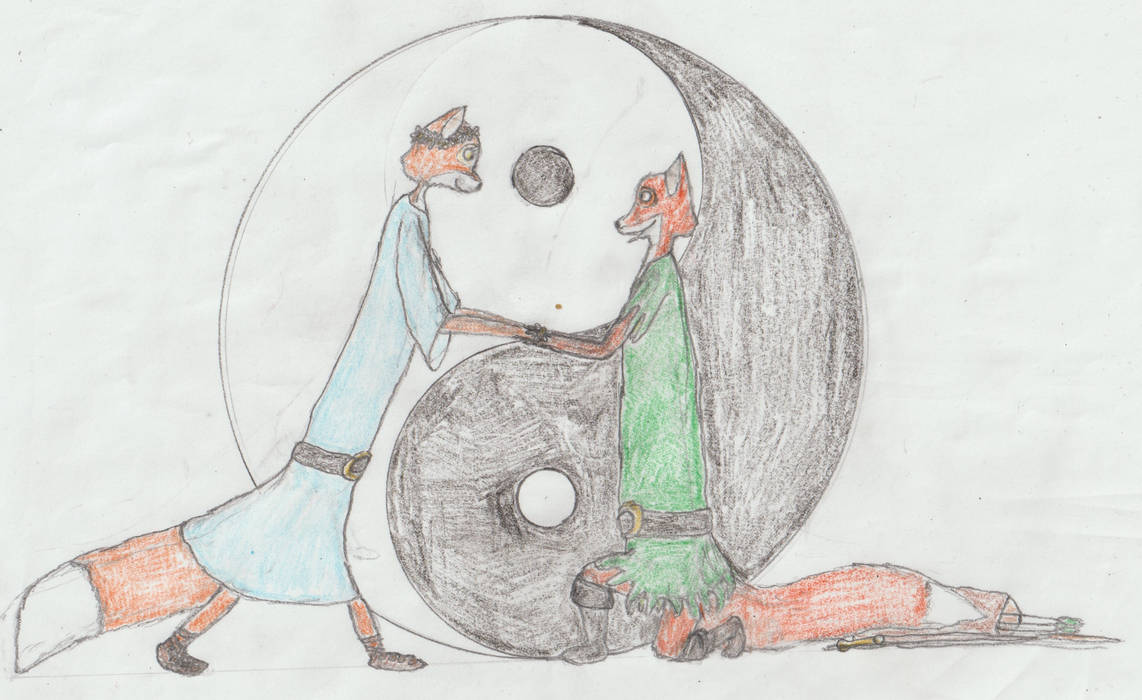
The moment of the final reunion for Robin Hood and Maid Marian. The Chinese iconography of the Yīn (the dark, but with a hint of light in it) and the Yáng (the light, but with a hint of darkness in it) represents the personalities of the two characters, which I always have found to be very well-shaded and polyfaceted in regards.
King Henry III, the son and heir to the throne to Prince John, fully paid the expenses for the funerals of Maid Marian first and Robin Hood then, as a sign of complete reconciliation between the two parts.
It was Lionel, the first-born son of the couple, which had to bury his father in the same way the latter did with his mother, and in a grave just besides that of hers, both on the same ground patch where the last arrow his father ever shot, as it was in their will. Together with him, paying memory to the couple, was his wife Theodora, their kits, and all of the other kits and grandkits of Robin Hood and Maid Marian.
As the last farewell was bid to their mortal bodies, their legacy started actually going down through history: not a history of evil having being paid into evil, but one of evil having been defeated by love, both for each other and for the others. As per Virgil’s words, “Omnia vincit amor”, “Love wins [on] everything”: that's what their story has always been about, and that's their final legacy for the posterity to come.