
Work Text:
“Where are they?”
“Dunno.” James adjusts his rucksack on his back, craning his head. “What’s the time?”
Peter takes out his pocket watch with a flourish, because of course, because it is new and because he is so proud of it. Remus sees Sirius roll his eyes, over James’ shoulder.
“Five past,” says Peter. “Weren’t they supposed to be here by now?”
James shrugs. “Good ol’ mum and dad. Always fucking late.”
“The next Portkey window’s not for another hour,” says Peter.
“So, we’ll just wait for them, won’t we?”
“We’re going to miss—”
“Shut up, Wormy,” Sirius groans.
Remus is already distracted, by the strangeness of the place they have ended up in, where the Portkey spat them out. He is struck by its emptiness and echoes and its accumulation of odd graffiti and garbage and organic overgrowth, and he finds himself much more intrigued by the way the large roman-numeral’d clock on the wall has apparently stopped at 12:43 than by Sirius and Peter’s bickering.
“Where are we?” he says to James, who is digging through his pack, coming up triumphant with a bag of Bertie’s. His Harpies facepaint—gold streaks on his cheeks, green on his nose and forehead—is already smudged.
James shrugs. “Dunno. Just some Portkey hub, innit?” He says, mouth full. “Oh, blech, burnt toast.”
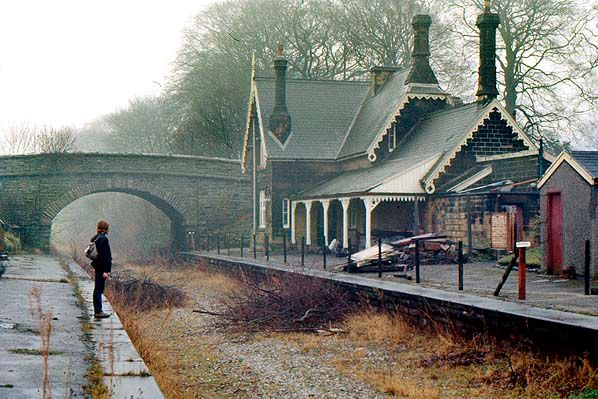
“It looks like a railway station,” says Remus, running his hand over a ledge by a boarded-up window. It comes away dusty, and he rubs it clean on his trousers.
“Sure,” says James. “Look: ‘Great Longstone-for-Ashford.’”
There is a sign, where James is pointing, over the doorway: paint flaking away and smudged with grime. Remus turns, where he is, in a slow circle, taking in the little main room: the boarded-up windows and the empty vestibules, and the Muggle payphone in the corner, and the scattered scraps of timetables scuttled in the corners like someone has swept them there, as if they are old straw, beetle-casings, dust. The door has gone, come at some point straight off its hinges, and beyond he can see the concrete of the old platform and a marsh of grass beyond, waving in the summer wind.
“Ugh, whatever, this is fucking dull!” announces Sirius, who grabs James by the wrist and hauls him out the broken door with a hollering whoop. They leap off the edge of the old platform, into the well of grass, Peter following with a warcry of: “Harpies! Holyhead! Harpies! Holyhead! Harpies!”
Remus follows, more slowly. He sits on the edge of the platform, setting his rucksack beside his hip, and watches them attempt a scrimmage (without any brooms, and only Sirius’s quaffle at hand). He’s still a little sore, from the moon a week ago, and anyway James—who now fancies himself a proper adult who does things like worry and take care of people—would probably tell Sirius to stop roughhousing, if Remus tried to join in.
He is glad to have this, though, whatever form it comes in. He is glad they are back together, if only for the weekend. He is glad they are going to see the Harpies play, glad the Potters got them all tickets and let them meet first, together, although he has recently stopped feeling as though he needs to care as much about Quidditch as other things that are happening in the world. He has felt cooped up since sixth year ended, in the attic of the farmhouse, devouring the semi-regular daily post from the others like he had been suffering from some grand and ravenous starvation. Peter in Ibiza for three weeks with his grandmother, James and Sirius for two weeks at the country house in Brighton. They wrote him jointly almost everyday, and then Sirius, once, additionally, by himself. It arrived in the evening like a secret only they were supposed to know about, and Sirius had written about a flat he’d found, in London. He had also sent Remus, inexplicably, three seashells and a scuttleblack seaweed pod, brittle with salt. Remus had put them carefully on the windowsill of his bedroom and tried not to think about what it meant.
He closes his eyes, and tilts his head back. There is a rare cleanliness and brightness to the sun, this morning. The air smells good: woodsy and sharp. He can catch the scent of clear water and dusty rock on the wind, and flowers, from somewhere—perhaps a wild meadow nearby.
“Oi! Moony!”
He hears Sirius call him; when he opens his eyes he sees Sirius waving at him from the far end of the abandoned, overgrown platform. James and Peter are tossing the Quaffle now, off to his right, hollering the Harpies fightsong. He leaves his rucksack where it is and clambers to his feet.
“What is it?” he calls, as Sirius ducks around the corner of the platform into the long growth of grass, nearly up to his waist in the deepest parts. “Sirius—”
“C’mon,” Sirius says, not turning around. “Wanna show you something.”
He rolls his eyes, but scoots off the edge of the platform anyway, into the long grass. It tickles at his ankles where the cuffs of his jeans are too short, and he can hear the buzz of insects mating, the scuttling of voles in the earth, and the burbling of water, still. Sirius, in front of him, is a long, lean whip of a boy, darting through hillocks and brambles like an arrow.
“Pads—”
Sirius’s hand suddenly darts out from the grass, closing on Remus’s wrist and tugging at him. Remus trips and stumbles to the damp ground with a little oof, knees twinging. He ends up on his arse, dirt smeared on his palms, and Sirius is grinning at him from where he’s on his knees in front of him, messy black hair haloed with sun and waving bleached-brittle grass.
“What are you doing, you know we’ve—”
“Shut up,” says Sirius, and kisses him.
Oh, he thinks. Right. Yes. This is that thing we’re doing now, sometimes.
They have only been doing this, sometimes, for a little while. Sirius seems lit with an even more mercurial sort of fire that Remus finds himself alternatively scared of, and entranced by. Sirius is not sure what he is doing, he keeps telling himself. Sirius is scrabbling at ledges and trying not to fall, he keeps telling himself. Next year is their last. Things are changing very quickly. Sirius is getting a flat, apparently. Sirius is sending him seashells. There have been some wounds, recently, that none of them believe confidently to have truly closed up and neatly knitted clean. There is a Daily Prophet in his rucksack from this morning, Remus thinks, dated 6 August, 1977, that announces two more attacks and the rumblings of Ministry instability.
Sirius doesn’t actually want to kiss him, he keeps telling himself, except that he keeps doing it, and so Remus sometimes finds himself at a loss for words to explain why it is happening at all.
They were drunk, when Sirius kissed him first, at the end of the school year. They didn’t talk about it, afterward, with the assumption being that perhaps—Remus had thought—that it had been a mistake. But then Sirius did it again, tugging him into the downstairs loo at the Potters’ cottage at the Hollow, when they had met for Peter’s birthday, and crowding him up against the closed door. Sirius had shoved both hands up under the hem of Remus’s shirt, and Remus had ended up making some very funny sounds into Sirius’s mouth, which seemed to make the tips of Sirius’s ears go very red, and his eyes very dark.
“Oops, ha-ha,” Sirius says, when he pulls away now, mouth puffy and red and slick with spit. He rubs at Remus’s cheek, with his thumb; it comes away with a smear of paint. Sirius’s own green-and-gold designs on his cheek, his nose, are smudged. His lashes are very dark, his eyes a little wild. “Got a little bit of—”
Remus grabs at Sirius’s collar with both hands, and tugs him back in for another kiss. Sirius makes a dark little mmph, into his mouth, and over-balances. Remus ends up on his back and Sirius perched over him, one hand one Remus’s hip and the other fisting into the soft, damp, black earth beside Remus’s head. Remus can feel the heat of him, of his whole body, like a great and suffocating weight. It makes something in his heart skitter, tightly, to realize that Sirius Black has now kissed him for the third time, this time in an overgrown mess of nettles and fieldgrass and full of boyish joy.
Maybe, he thinks, and he slides the fingers of one hand from Sirius’s collar to graze at the warm line of his jaw. Maybe this is—
“Oi! Wankers!”
Sirius’s head snaps up so fast, Remus thinks it’s given him whiplash. He’s on his feet before Remus even has time to catch his breath, and he’s tugging Remus up after him with a rough hand by the sharp curve of Remus’s elbow.
“Coming!” he yells, back to James. And then he’s off.
Remus stumbles, behind him, only finding his footing if he thinks very carefully about the rhythm of his own breathing and not about how quickly Sirius can go ricocheting from one sensation to another in the space of a heartbeat.
They clamber out of the grass, up onto the platform again, and James and Peter are waiting for them there under the shade of the dilapidated overhang, the Quaffle at their feet. Remus is suddenly very conscious of the dirt on his palms and the smudge of paint on his cheek, and the flush in his face. At his side, Sirius looks like he has been rolling about in an entire field of burrs because of the frankly extravagant number of them clinging to his hair and stuck about the edges of his jacket, and also he looks like he could not possibly be more pleased about it.
“What the fuck,” says James, gesturing at them and their general state.
“Moony won,” says Sirius, grinning. As if they had been fighting.
“Of course he won,” says Peter. “He’s a giant.”
Sirius cuffs him. James rolls his eyes.
“Be careful with him, will you,” he says.
“I’m fine,” says Remus. He is not fine. He is disoriented and a little weak at the knees and he can still taste the lingering edge of Sirius’s mouth in his own. He is not fine. But perhaps he will be. “I won, didn’t I?”
Later, this memory will be reconfigured. For a while, Remus will think that he has won, indeed, something very precious. They will go see the Harpies. They will return to school. Sirius will kiss him, again, and again, and again. And sometimes, Remus will kiss him. They will almost get caught many times, and then one day, Sirius will make it very clear that it isn’t just kissing he’s interested in, and so they will do that too. And Remus will consider it to be something like a trophy or a ribbon or a badge on his chest that no one else in the entire world can see, even though he will never be quite sure that he has earned it.
And later still, he will think of it—all of it completely—as a form of loss.
--
Longsdune is full of holes. Drilled into the earth by water, water chewing at black limestone like teeth. It is a quarry of wells and a great cave of marble. When King William sent his men out under the banner of the Domesday, they perhaps were lost for a while in the labyrinth of it. They could feel the crevasses under their boots, the way the earth below them had been carved away into tombs already empty and already full. They must have felt frightened, at the way their footprints left great traces in the soft black rock.
When they built St. Giles under the banner of Gregorian reform they must have wondered whether the souls they buried there would stay put or float away, finding their new paths in the maze of the watertable. They must have wondered whether there was movement under the ground, whether the dead had found a new way to move about inside the earth. They must have wondered whether there were bodies in the wells.
--
He comes upon it by accident. Later, he will not even remember what year it is, although he will think that it was probably 1989, because of the way he remembers unpopular Thatcherite tax reform blaring from broadsheets, and the way the Iron Curtain seemed to be melting, and because that morning at the St Crispin pub he’d picked at a bag of crisps and listened to “Eternal Flame” crackle, tinny and saccharine, over the wireless.
He’d shouldered his pack and stepped out into the grey morning. He’d walked over the bridge and then through the woods, not sure exactly where he was headed, except that he is very careful now not to wear out his welcome anywhere, and the time has come to move along again, after a while. Later, he will not remember what month it was either, except that it was probably November, because he’d found an old coat not that long before in a charity shop in Derby, and had had enough Muggle money to pay for it, which was a small victory. In the woods, he stops for a while and listens to the sound of rainwater dripping from the leaves. He finds an old stone well, collapsed, in the midst of what must be abandoned farmland, grown over now with lichen and rolled stone and sprouted oak and beech. The ground is black with wet mulch and Ashford limestone.
He comes upon it by accident then, very near to the old well. He steps out of the woods and there it is, like a little puff of air on the back of his neck, like a stinging slap on the cold meat of his cheek, like a spark of static electricity made from rubbing his sad and stockinged feet along the carpets of old memorial corridors.
It looks the same. Teetering gabled roofs lined with stained-white poorman’s Victorian gingerbread. The straight-backed empty chimneys pointing vertically to the sky like the disapproving fingers of angels. The little veranda overhang, where they had sheltered from the sun. The red door of the shed. The black stone bricks and the overgrown and crumbling overpass, and in front: the dry river of the old railway, ties long ago tugged up and lugged away for repurposed sheep fencing, the banks of it peppered with twiggy detritus and pale tan wet grasses, and the gravel center of it traveling straight on away into the fog, like a compass arrow in the dusk.
Oh, he thinks. Oh no.
It was inevitable, he thinks, that these moments would eventually happen to him. Perhaps increasingly, now that he and the rest of the world had worked so hard to forget that this thing had happened. It was inevitable that the earth would disgorge something like this: coated with the bile of memories tainted unpleasant, a large hulking impasse that he would have to cross through, go over, go under. He had not had his guard up, and so of course, it would come for him now.
He stands there, at the edge of the abandoned platform, and looks at the old station. The sign is still there, to his right, but cracked in the middle and riddled with ivy vine. The letters are broken up: Gre—t L—gstone-for-Ash—d. Holes in the world, great gaps of emptiness where he has tried to take very certain particular things and hide them away.
His bones creak, when he sits. There on the edge of the damp platform, with grasses tickling at his ankles. He supposes that this is what is expected of him, to sit here and listen to wetness sinking into the earth and remember how it felt when it was sunny, and there were four of them, and Sirius Black looked at him like he was a piece of the universe he wanted to understand so badly that he was willing to take Remus apart completely and then put him back together.
Much, much later, many years to come yet, in the dust and the dark of a London house that haunts them both, but mostly Sirius, he will ask:
Do you remember—
And Sirius will look up and say: Hm?
And Remus will shake his head and say: No. Never mind. Because he imagines they will have remembered it differently, after all, and that everyone has a different place, a different fulcrum around which the rest of the world rotates.
--
In the spring the children and the women, they dress the wells. They gather sprigs of lavender and petals from wildflower meadows and green leaves and they dress the wells like young girls on their way to their weddings. They paint faces on the wells, paint saints and make mosaics of nature. They paint the Mother Mary, and her Son. They give thanks that their skin is clear of plague and that their water is clean and that the water from the earth that they drink does not swallow them whole and carry them away.
Long black holes into the navel of the world, haloed with life, and faith. They dress the wells up to remember some things. They do it to worship the water and the holes under the ground. They are told, sometimes, that they are not supposed to do this, and so they do it anyway. They flower the wells and they garland the wells and they paint the wells with faces of loved ones and loved saints and loved worlds. They use bits of the earth and its bounty: seeds and burrs and needles from pine, they use daisies and Queen Anne’s and other wild carrots and also underneath it is all is soft wet clay from the earth.
They must imagine that this will keep them safe. They must imagine that devotion and memory are the same. They must imagine that if they continue the traditions of visitation they will be granted clean skin and pure lungs and good health, and also entrance into Heaven. They must imagine that underneath, deep in the black water, the bones there are happy, to be remembered with such joy.
--
It is dark. His body is cold. And then, he opens his eyes.
He thought perhaps he had been laying down, but he is not. He is standing on the edge of a platform, and there is a heavy fog around him: white and thick and strange. He thinks there may be a soft breeze, but he cannot say for certain that he can feel it with his skin. It is as if he is somewhere very deep down inside the belly of the world and that perhaps he is not really seeing, or feeling, or sensing at all.
The mist thins, a little. He finds that if he thinks about walking, he is. But he is not moving, in the way that he can feel his bones and muscles respond to nerve-call. And yet, he is walking and the mist is thinning around him, and he can see—as if he has eyes, perhaps, although he is not sure he is seeing with him—he can see Great Longstone-for-Ashford melt out of the fog.
The old railway track, empty of function, stretches out in a wide, infinite curve. The station is like a little picture, a photograph, that he thinks perhaps he could reach out and touch or pluck from the air and hold in front of him, except that he is standing in front of it, and there is someone there, on the platform, waiting for him.
“Hello,” he says. It has in it the echo of a pebble dropped into a dark hole, from a very great height.
“Hallo, Moony,” says Sirius, because it is him. He is sitting on the edge of the platform and he looks very young and very old all at once, something about his face flickering in and out of solidity. Remus feels a surging ripple—the pebble hitting the surface of the water—somewhere inside his loose and insubstantial body. He is very glad to see him.
“Where are we?” he says, after what must be a very long while.
“Been waiting for you,” says Sirius, because that is the answer.
“Oh,” he says.
“Ready to go?” asks Sirius.
“I don’t know,” he says.
“That’s all right,” says Sirius. His body beside Remus is all light and warmth; Remus can feel coldness dropping away from his skin like water evaporating from the surface of a well. “We can stay here, for a little while longer. For as long as you like, Moony.”
In the distance, there is the sound of a train whistle. But it seems unhurried and patient, and so Remus closes his eyes again, and he smiles.