
Chapter Text
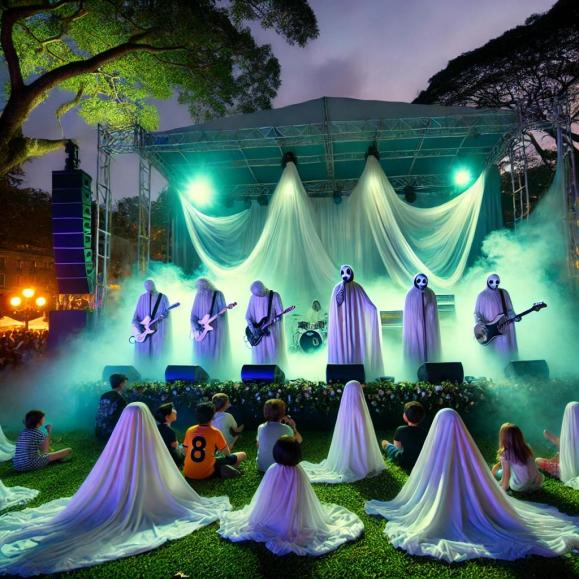
In the dimly lit room of the hospice, Nate sat beside the bed of Mrs. Evelyn Cooper, a frail woman whose body was now a shadow of what it had once been. She lay there, her breaths shallow, eyes glazed with the far-off look that dementia often brought. Nate, dressed in his usual Ghost Rock costume—a simple white sheet with two black circles cut out for eyes—held her hand gently. Mrs. Cooper had no other family, no one to sit with her in her final moments, and Nate, a regular volunteer at the hospice, had come to provide the companionship she needed.
As a member of the local Ghost Rock scene, Nate had never imagined this part of his life would intersect with his love of music. What started as a quirky way for the band to entertain Alzheimer’s patients had turned into something more profound, something heavier. Mrs. Cooper didn’t need to see his face or remember his name. She simply needed someone to sit with her, to make her feel less alone.
Her hand was small and delicate in his, her fingers twitching occasionally as if trying to recall a memory her mind no longer had access to. She had rambled quietly when he first sat down, mumbling names from decades past, maybe thinking he was one of those long-gone loved ones. But now, her voice had grown quieter, a whisper of breath and a fading pulse.
Nate gave her hand a gentle squeeze, his heart heavy as he watched her struggle for every breath. “It’s okay,” he whispered, though he wasn’t sure who he was reassuring—her, or himself. “I’m right here. You’re not alone.”
The room was so still, the faint beeping of the machines the only sound besides her breathing. But then, the beeping stopped. Mrs. Cooper's chest rose one last time, and then—silence.
Nate felt her hand go still in his, and his heart sank. He sat there for a moment, still holding her hand, his thumb brushing over her papery skin as if hoping to wake her from the sleep that now claimed her. He swallowed the lump in his throat, knowing she had finally found peace.
Slowly, carefully, he let go of her hand and stood. His legs felt weak beneath him as he pulled off the ghost costume, letting it drop to the chair beside the bed. He stared at her for a moment, at the peaceful stillness in her face, and whispered, “Goodbye, Mrs. Cooper.”
As he stumbled into the hallway, the weight of the moment hit him harder than he’d expected. It wasn’t the first time he had been with someone in their final moments, but this time—this time felt different. Mrs. Cooper had no family, no children, no one to grieve her. She had only him, and now even that connection was gone.
Nate’s knees buckled, and he slumped to the floor just outside her door, his back pressed against the cold wall of the hallway. His chest heaved, the sobs coming in waves he could no longer hold back. He pressed his hands to his face, his shoulders shaking as tears slipped between his fingers. His heart felt hollow, and the loss weighed on him like a stone.
He had always believed that being there for people in their final moments mattered, that it gave them comfort, but in that moment, all he felt was the crushing emptiness of saying goodbye over and over again to people he’d never really had the chance to know.
His hands fell from his face, but his head stayed lowered, tears still streaking down his cheeks. He felt so small, so powerless, alone with the grief that clung to him like a shadow.
Then, out of nowhere, he felt a tiny hand, cold and small, rest gently on his shoulder.
Nate blinked through his tears, confused, and looked up. Standing beside him was a little girl, no older than six or seven, her frail body wrapped in a ghost costume almost identical to his. The sheet hung loosely over her, trailing on the floor like a forgotten blanket. The two black eyeholes didn’t quite line up with her actual eyes, but through them, he could see the glint of her gaze—a spark of mischief mixed with kindness.
“Boo,” she whispered, her voice weak but full of playful energy.
Nate couldn’t help it—a small, exhausted smile tugged at the corners of his mouth. The sight of this tiny, brave little girl, dressed as a ghost like him, trying to lift his spirits with such a simple gesture, warmed something inside of him that he thought had been completely frozen over.
He wiped his eyes quickly with the sleeve of his shirt and forced a weak laugh. “Boo, huh? You got me,” he whispered, his voice rough from crying.
The little girl, whose name tag read Emily, gave a small giggle from behind her sheet. She carefully crouched beside him, her small frame wobbling as she did so, but she seemed determined to stay with him. The tiny ghost, a patient herself, sat with the same quiet resolve Nate had when he held Mrs. Cooper’s hand.
For a long moment, neither of them spoke. Nate stared at the floor, still shaken, but Emily’s presence was a balm to his frayed nerves. There was something so innocent, so pure about the way she had come to comfort him—like a little guardian angel wrapped in a ghost sheet.
Finally, Emily broke the silence. “Are you sad ‘cause someone’s gone?”
Nate nodded, rubbing the back of his neck. “Yeah,” he said softly. “A friend of mine just passed away.”
Emily nodded slowly, the weight of his words far beyond her years. “I get sad too sometimes. But… you helped them, right? You made sure they weren’t alone?”
Nate looked at her, struck by the wisdom in her tiny voice. He nodded again, his throat tight. “Yeah. I guess I did.”
She reached out again, this time taking his hand in her cold, delicate fingers. “Then you did good,” she said, matter-of-factly, as if it were the simplest truth in the world.
Nate felt the tears welling up again, but this time they weren’t from sadness. He squeezed her hand gently, marveling at how such a small, fragile person could carry so much strength. “Thanks, Emily.”
Emily stood up with a little wobble, giving him a small wave before she tottered back toward her room, her ghost sheet trailing behind her like a little cloud. She paused at her door and gave him one last playful, “Woo!” before slipping inside.
Nate chuckled quietly, wiping the last of his tears away. He sat there for a moment longer, the hallway feeling a little less cold, a little less lonely. Emily’s words lingered in his mind: You did good.
He stood, shaky but determined, and picked up his ghost sheet from the chair beside Mrs. Cooper’s room. As he folded it under his arm, he took one last look at the door before turning to leave.
And for the first time in a while, Nate felt that maybe—just maybe—he wasn’t so lost after all.
Over the weeks that followed, Nate found himself returning to the hospice more frequently, his mind often drifting back to the little girl he had met that night—the one who had comforted him with a simple touch on his shoulder and a playful “boo.” Emily, the child cancer patient, had left a deep impression on him. Despite the seriousness of her illness, she had a strength and lightness about her that Nate couldn’t shake.
He learned more about her through the nurses and staff. Emily had been battling cancer for almost two years. Her prognosis wasn’t entirely bleak—there was hope she might recover—but the treatments were hard, and her journey had been long. Yet, in the midst of all the tubes, IVs, and the endless cycles of chemotherapy, Emily had found something that kept her smiling: ghosts.
Ever since the Ghost Rock volunteers, like Nate, had begun visiting the hospice and care units, Emily had become enchanted by the simplicity of their costumes—the flowing bedsheets, the faceless figures, the sense of playfulness they brought even in the face of such grim circumstances. She had adopted the ghost costume herself almost permanently, wearing a simple white sheet with two misaligned eye holes as she walked the halls of her ward. What began as a game to cheer herself up soon became her mission: to lift the spirits of the other children in the ward.
One afternoon, Nate found himself back at the hospice, this time carrying a bag full of art supplies for the children. He hadn’t been able to stop thinking about Emily since their last encounter, and after talking with a few of the nurses, he decided to spend some time with her. As he approached the pediatric ward, he could already hear her infectious laughter echoing down the hall.
When he turned the corner, there she was—Emily the Ghost, standing in the center of the common room, her white sheet billowing behind her as she ran in circles around the other children, who watched her with smiles on their faces. Despite her own illness, despite the tubes that connected her to machines, she moved with the energy of someone far healthier, determined to spread joy to the kids around her.
Nate stopped just inside the doorway, watching the scene unfold. Emily was mid-story, dramatically acting out the part of a “spooky” ghost, waving her arms above her head.
“And then,” she said, her voice soft but full of playfulness, “the ghost said, ‘Whoooo! You can’t catch me!’” She darted around the room, the other children laughing as they tried to keep up with her.
Nate couldn’t help but smile as he leaned against the doorframe. She was remarkable. She wasn’t just a child fighting for her own life—she was a beacon of light for the others, giving them a reason to laugh, to play, to forget, if only for a moment, about the harsh reality of their illnesses.
As if sensing his presence, Emily suddenly turned and saw him standing there. “Nate!” she shouted, running over to him, the sheet trailing behind her like a superhero cape.
“Hey, Emily,” he said, kneeling down to her level. “You’re looking extra spooky today.”
She giggled and lifted the corner of the sheet over her face. “I’m the scariest ghost in the hospital!”
Nate laughed, reaching out to gently tug on the edge of the sheet. “I bet you are. You’re scaring me right now.”
Emily giggled even more, lowering the sheet so that her bright, mischievous eyes peeked through the crooked eyeholes. “Are you here to be a ghost again?”
Nate nodded and held up the bag of art supplies. “I brought some stuff for us to make new ghost costumes. How about that?”
Emily’s eyes lit up with excitement, and she grabbed his hand, tugging him toward the table where some of the other kids sat, curious about the new arrival. “Come on! We can make them super spooky!”
The afternoon passed quickly. Nate sat with Emily and the other kids as they painted, colored, and decorated new ghost costumes. They laughed together, coming up with silly ghost names—“Spooky Sally,” “Boo Barry,” “Wailing Wendy”—and before long, the room was filled with miniature ghosts in bedsheets, giggling and playing among themselves.
As they worked, Nate found himself talking more with Emily, who—despite her playful spirit—had moments where she shared a wisdom far beyond her years.
“I like being a ghost,” she said quietly as she carefully drew a wobbly, smiling face on her new sheet. “When I’m a ghost, no one knows I’m sick. I can just be me.”
Nate looked at her, his heart squeezing at her words. “You’re more than just a patient, Emily. You’re the bravest ghost I’ve ever met.”
Emily smiled at him, but there was something more vulnerable behind it. “I just like making people happy. When they’re laughing, it feels like everything’s okay.”
Nate nodded, knowing exactly what she meant. “You’re doing a good job, you know. You’re helping a lot of people.”
Emily shrugged, her small shoulders rising and falling beneath the oversized sheet. “I just want everyone to feel better. My mom used to say that being sick doesn’t mean you have to stop being happy.”
Nate felt a lump form in his throat but swallowed it down. He reached out, placing a hand on her small shoulder. “You’re right, Emily. You’re making a difference. You’re a hero to all of us.”
She looked up at him, her eyes wide, and gave him a shy smile before ducking her head back under her ghost sheet, giving a soft “woo.”
Later that day, after the art supplies had been cleaned up and most of the children had returned to their rooms to rest, Nate stayed behind with Emily for a little while longer. She sat cross-legged on the floor, still wearing her ghost costume, watching the other kids through the glass window.
“Do you think I’ll get better?” she asked suddenly, her voice soft.
Nate hesitated, unsure of how to answer. He wanted to tell her that everything would be fine, that she would get better and run around without the machines and the treatments, but he didn’t know if that was the truth.
“I hope so,” he said finally, choosing his words carefully. “But no matter what happens, you’re going to keep making people smile. You’ve already made such a difference here.”
Emily looked up at him, her expression serious for a moment. Then, she nodded and pulled the sheet over her face again, giving a playful “boo” that seemed to echo through the room.
Nate smiled, his heart full and heavy at the same time. She was fighting a battle no child should have to fight, but she was doing it with grace, with humor, and with a strength he could only admire.
As the nurses came to take her back to her room for the night, Emily waved at him, her small hand emerging from beneath the ghost sheet. “See you tomorrow, Nate. Don’t forget your costume!”
“I won’t,” he promised, watching as she walked away, the sheet billowing behind her like a little ghostly hero.
And as he left the ward that night, Nate felt a strange sense of hope. Maybe Emily would recover. Maybe she wouldn’t. But in that moment, she was a ghost who brought life to everyone around her. And that was something extraordinary.
The Long Life of Elliot “El” Reynolds (1946–2036)
Elliot "El" Reynolds, the soft-spoken guitarist from Asheville, North Carolina, who had quietly helped shape the Ghost Rock genre in 1968, lived a long and humble life, reaching the remarkable age of 90. As the last surviving member of
the original Ghost Rock session, Elliot became a living testament to the genre's beginnings and a custodian of its memory. Though he spent most of his years far from the spotlight, his life was rich with reflection, quiet acts of connection, and a lasting love for the music and friendships that had defined his youth.
Life After the Studio
After the unexpected success of the 1968 Ghost Rock album, Elliot had stayed involved in music for a few years,
collaborating with various artists and contributing to other projects. However, by the mid-1970s, as the genre began to take on a life of its own, Elliot stepped away from the music industry. The chaotic pace of touring and the spotlight
never suited his quiet, introspective nature. Instead, he returned to Asheville, where he found solace in the mountains and a slower, simpler life.
Elliot took a job as a music teacher at a local community center, where he mentored young musicians, passing on his
knowledge of guitar and his love for creative expression. Though he rarely spoke of his involvement in Ghost Rock, his students were often amazed by his ability to conjure ethereal, haunting sounds from his instrument. He also repaired and restored guitars in his spare time, finding joy in giving old instruments new life.
The Loss of His Bandmates
Elliot remained in touch with several of his fellow Ghost Rock collaborators over the years, especially Judy Lewis. Her passing in 2001 was a devastating blow to him. By that time, he had already mourned the losses of Delilah Chavez,
Lorraine “Lolo” Marchand, Celeste Morgan, and Marilyn “Mare” Suzuki, all of whom had passed away decades earlier. Judy’s death left him as the last surviving member of the original lineup—a role he accepted with quiet dignity but deep sadness.
“I never thought I’d outlive them all,” Elliot said in a rare interview in the early 2000s. “It doesn’t feel right, you know? They were all so full of life, so much more than I was. But I guess life has its own plans.”
Becoming a Keeper of the Legacy
As the last surviving member, Elliot found himself drawn back into the world of Ghost Rock, albeit reluctantly. Fans of the genre saw him as a living connection to its origins, and his reclusive nature only added to his mystique. Though he avoided large public appearances, Elliot occasionally gave interviews, sharing stories about the original recording
session and the people who had made it so special.
He spoke fondly of Judy, often describing her as the heart and soul of the group. “Judy believed in the magic of music,” he once said. “She saw what it could do for people, how it could bring them together. I just played guitar, but she … she made it mean something.”
Elliot also participated in a few tribute events, where he played acoustic versions of songs from the original album. His performances, stripped-down and heartfelt, were a stark contrast to the theatricality of the genre’s later years, but they resonated deeply with audiences. Fans who attended these rare shows described them as almost spiritual experiences, a chance to connect with the roots of Ghost Rock and the memories of the musicians who had come before.
A Quiet Retirement
In his later years, Elliot retreated once more into the quiet life he had always preferred. He spent much of his time
tending to his garden, playing guitar on his porch, and corresponding with fans who wrote him heartfelt letters about how Ghost Rock had changed their lives. Though he rarely responded, he read every letter, often keeping them in a small wooden box he referred to as his “treasures.”
He became something of a local legend in Asheville, not for his fame but for his kindness and humility. Neighbors spoke of the elderly man who still played hauntingly beautiful melodies on his guitar, the sound drifting through the
trees like a gentle breeze. He was known for his generosity, often repairing instruments for free or offering quiet encouragement to young musicians who came to him for advice.
A Life Well-Lived
Elliot passed away peacefully in 2036 at the age of 90, surrounded by a small group of family and close friends. News of his death spread quickly through the Ghost Rock community, sparking an outpouring of tributes from fans and
musicians alike. Many reflected on his quiet strength and the vital role he had played in the genre’s creation.
A statement from the Ghost Rock Legacy Foundation described Elliot as “a gentle soul whose music and memories
helped sustain the spirit of Ghost Rock for generations. He was the bridge between the genre’s humble beginnings and its enduring legacy.”
In his will, Elliot left behind his guitar and handwritten notes about the original session, which were donated to a Ghost Rock museum. He also requested that his ashes be scattered in the mountains near his home, where he had found so
much peace throughout his life.
Remembering Elliot
For the Ghost Rock community, Elliot’s life was a testament to the enduring power of creativity and friendship. Though he had never sought fame or recognition, his contributions to the genre were immeasurable. Fans remembered him not only as a gifted guitarist but as a man of quiet integrity, whose love for music and his bandmates had left a lasting mark on the world.
At a tribute concert held in his honor, musicians from across the genre gathered to perform songs from the original
album. A recording of Elliot’s acoustic rendition of “Spectral Harmony” played over the speakers, his gentle, haunting notes filling the air one final time. The crowd, many of whom wore ghostly costumes in homage to the genre’s origins, lit candles and held them high, their flames flickering like tiny spirits in the night.
In the words of one fan: “Elliot was the last of the originals, the keeper of their story. But now, it’s up to us to carry it forward. Ghost Rock isn’t just about the music—it’s about the love, the laughter, and the memories they gave us. And that’s something we’ll never let fade.”
In 1968, the unlikely group of session musicians who came together to record a quirky Halloween-themed album had no idea they were creating the foundation for an entire musical movement. Judy Lewis, Elliot Reynolds, Delilah Chavez,
Lorraine “Lolo” Marchand, Celeste Morgan, and Marilyn “Mare” Suzuki had clicked almost immediately during the
recording session, their chemistry so natural and their shared sense of humor so infectious that the project became more than just a job—it became the start of something special.
The recording process had been filled with laughter, experimentation, and a spirit of camaraderie that left them all
wondering: What if we took this further? By the time the album was finished, the group had begun to dream about
turning their one-time collaboration into a real band. But those dreams would be short-lived, cut tragically short by the sudden death of Delilah Chavez in 1969.
The Spark ofa Band
The recording session had planted the seed. Each member of the group brought something unique to the table—Judy’s steady basslines, Elliot’s ethereal guitar work, Lolo’s rhythmic prowess, Celeste’s haunting organ melodies, Mare’s
inventive wind instrument solos, and Delilah’s unforgettable voice and stage presence. Together, they had stumbled upon a sound that was playful yet eerie, lighthearted yet profound. They hadn’t set out to create a new genre, but the results of their session hinted at something more than just a novelty record.
After the unexpected success of the album, which gained a cult following and received surprising radio play during the Halloween season, the group began to entertain the idea of continuing their collaboration. They tossed around ideas for band names, experimented with new song ideas, and even sketched out early plans for a tour. Delilah, with her fiery
personality and commanding voice, often joked that she’d be the one keeping the group in line if they went on the road.
“I’ll be the boss, Judy,” she teased during one brainstorming session, tossing a grin at her friend. “You can keep the groove, and I’ll keep everyone else in check.”
The idea of forming a full-fledged band excited them all, but they knew it wouldn’t be easy. Many of them were tied to other commitments—studio work, family, and financial responsibilities—but the prospect of turning their accidental
success into something bigger kept the dream alive.
Delilah’s Role as the Heart of the Group
If Judy was the soul of the group, Delilah was its heart. Her voice, dynamic and haunting, had been one of the defining features of the album. But beyond her musical talent, it was her personality that drew the others together. Delilah had a way of making everyone feel at ease, breaking tension with a perfectly timed joke or a playful quip. She was the one
who encouraged the group to think beyond the recording studio, to see themselves as more than just session musicians.
“We’ve got something special here,” she often said. “Why let it end with one record? People love us—they just don’t know it yet!”
Delilah’s belief in their potential as a band was infectious. She envisioned live shows filled with theatrical elements,
ghostly costumes, and playful interactions with the audience. She even began drafting a setlist, incorporating the songs from their album alongside new material they were starting to work on together.
The Tragedy
But before their dreams could take shape, tragedy struck. In early 1969, just a few months after the album’s release,
Delilah suffered a severe allergic reaction to a newly prescribed medication. Though she was rushed to the hospital in her hometown of Albuquerque, New Mexico, the reaction was too severe, and she passed away suddenly at the age of 23.
Her death was a devastating blow to the group. Delilah had been the driving force behind their plans to form a band, the one who had believed in their potential most fiercely. Without her energy and leadership, the others found it difficult to move forward. The loss cast a shadow over their ambitions, leaving them unsure of how to proceed.
A Dream Deferred
In the wake of Delilah’s death, the group came together to grieve and to honor her memory. Judy, Elliot, Lolo, Celeste, and Mare were all heartbroken, their dreams of a band feeling suddenly hollow without Delilah at the center of it. They continued to meet occasionally, reminiscing about the session and the bond they had shared, but the momentum they had built began to fade.
“It just didn’t feel right without her,” Judy later said in an interview. “Delilah was the spark. She was the one who made us believe we could be more than a session band. Losing her … it was like losing the heart of what we were trying to
build.”
The group eventually drifted apart, each returning to their individual careers. Lolo continued as a sought-after drummer, Celeste went back to Detroit to work in gospel and jazz, Mare pursued avant-garde music in San Francisco, and Elliot
retreated to a quieter life in Asheville. Judy, though heartbroken, remained deeply connected to Ghost Rock as the genre began to grow, becoming its most visible advocate in the years that followed.
Delilah’s Legacy
Though Delilah’s time with the group was tragically short, her influence remained a cornerstone of the Ghost Rock
movement. Fans often cited her ethereal vocalizations and her passionate energy as defining elements of the original
album. In the years that followed, many Ghost Rock bands paid tribute to her, dedicating songs and performances to the woman who had helped light the spark for the genre.
Judy, in particular, kept Delilah’s memory alive in her work. She often spoke about her late friend in interviews, describing her as the one who had seen the magic in what they were creating before anyone else did.
“Delilah believed in us,” Judy said in a tearful tribute years later. “She saw what we could be, even when we couldn’t see it ourselves. Every time I step on stage, I feel like I’m carrying her with me.”
What Could Have Been
The loss of Delilah marked a turning point for the original group. While they never went on to form the band they had dreamed of, their one-time collaboration left an indelible mark on music history. The album they created together
became the foundation of a genre that would bring joy, creativity, and connection to countless fans around the world.
Though they never had the chance to fully realize their ambitions as a band, the bond they shared and the music they
created together became a testament to the power of collaboration and the enduring spirit of friendship. And while
Delilah’s voice was silenced far too soon, her influence continued to resonate, her legacy woven into the very fabric of Ghost Rock.
In the wake of Delilah Chavez’s sudden death in 1969, the surviving members of the original Ghost Rock session—Judy Lewis, Elliot Reynolds, Lorraine “Lolo” Marchand, Celeste Morgan, and Marilyn “Mare” Suzuki—found themselves
grappling with a profound sense of loss that transcended their individual grief. Delilah had been not just their vocalist but their heart, the person who had believed in their potential as a band and whose fiery energy had inspired them to dream bigger. Without her, the idea of continuing as a group felt hollow.
For a brief time, however, the remaining members toyed with the idea of creating something new—something that
would honor Delilah’s memory while acknowledging the void her absence left. But as their plans evolved, so too did the weight of their grief, until the very thought of moving forward as a band became too painful to bear.
The Early Plans: A Tribute Through Absence
In the months following Delilah’s death, the surviving members began discussing the idea of recording an album
together—a project that would pay tribute to Delilah while also allowing them to channel their grief into their art. The concept they developed was bold and unconventional: each song on the album would intentionally feature an element missing from its arrangement, reflecting the permanent absence of a key voice in their group.
For example:
In one song, there might be no bass, with Judy stepping into a vocal role instead.
In another, there would be no drums, with Lolo contributing auxiliary percussion or effects instead of her signature beats.
Other songs might lack melody altogether, relying solely on rhythm and atmosphere.
The band envisioned these absences not as gaps but as spaces that would draw attention to what was missing, creating an emotional resonance that mirrored their own loss. The project was to be titled “Unfinished Echoes,” a nod to both the
spectral themes of Ghost Rock and the incomplete nature of their group without Delilah.
“It was Delilah’s idea to shake things up, to experiment with what music could be,” Judy explained in a later interview. “We thought this could be a way to keep her spirit alive in our work—to let people feel what we were feeling, and to
show that sometimes, what’s not there says as much as what is.”
The Attempt to Reunite
The group initially approached the project with cautious optimism. They began holding informal jam sessions, each
member experimenting with different roles and arrangements. Judy, who had always been the emotional anchor of the group, tried to keep everyone motivated, while Elliot brought his quiet focus to the creative process. Lolo’s rhythmic intuition and Celeste’s haunting keyboard melodies provided a solid foundation, and Mare’s innovative use of wind
instruments added texture and depth.
But no matter how much they tried to push forward, Delilah’s absence was impossible to ignore. Her voice had been the thread that tied their music together, and her energy had been the spark that drove them. Without her, the sessions felt
disjointed, as if a crucial piece of their identity was missing.
“Every time we played,” Elliot later said, “it felt like we were waiting for her to come in. Like the music wasn’t finished until she added her part. But she wasn’t there, and it just … it hurt too much.”
The grief that each member carried was compounded by the pressure of trying to live up to the legacy they had
accidentally created with their first album. What had begun as a way to honor Delilah quickly became a source of frustration and sadness, as the weight of her absence overshadowed their efforts.
The Decision to Disband
After several months of struggling to make progress, the group came together for a final meeting. It was a difficult
conversation, but one they all knew was necessary. Each of them admitted that the grief was too great, the wound too fresh, to continue as a band. The idea of recording an album that deliberately highlighted Delilah’s absence had felt meaningful at first, but now it seemed like a reminder of the pain they couldn’t escape.
“We thought we could turn our grief into something creative,” Judy said years later, “but the truth was, we just weren’t ready. Every note we played felt like it was missing something. Or someone.”
The group parted ways amicably, each member choosing their own path forward. Judy continued to stay connected to the growing Ghost Rock movement, becoming its most visible advocate, while Elliot retreated into a quieter life of
teaching and repairing guitars. Lolo, Celeste, and Mare pursued their own musical careers, finding success in different genres but always carrying the memory of their time together.
The Legacy of the Unfinished Album
Though “Unfinished Echoes” was never recorded, the idea of an album built around absence became a point of
fascination for Ghost Rock fans. Over the years, many artists in the genre paid homage to the concept, creating their own interpretations of what the project might have sounded like. Some wrote songs with sparse arrangements, others
composed instrumental pieces meant to evoke a sense of longing, and a few even recorded entire albums inspired by the concept.
The surviving members of the original lineup occasionally reflected on what might have been. In a rare interview in the 1980s, Mare spoke about the project with a mix of regret and acceptance.
“I think we all wanted it to work,” she said. “But you can’t force something like that. We were trying to make sense of something that didn’t make sense. Maybe that’s why the idea stuck with people—because it was unfinished. Just like
”
us.
A Testament to Friendship
Despite their inability to reform as a band, the members of the original lineup remained deeply connected in spirit. They often spoke of Delilah as the glue that had held them together, and they found ways to honor her memory in their
individual lives. Judy, in particular, kept Delilah’s legacy alive in her advocacy for Ghost Rock, frequently mentioning her in interviews and dedicating performances to her.
“Delilah wanted us to be bold, to take risks, to make music that meant something,” Judy said in one of her final
interviews. “Even though we couldn’t keep going as a band, I think we carried that spirit with us in everything we did.”
A Legacy of Loss and Love
The story of the original Ghost Rock lineup became one of the genre’s enduring myths—a tale of creativity, loss, and
the unbreakable bond between musicians. While they never recorded a second album, their brief time together left an
indelible mark on music history, and their decision not to reform became, in its own way, a powerful statement about the weight of grief and the meaning of absence.
Fans continued to speculate about what “Unfinished Echoes” might have sounded like, but for the surviving members, the project was less about what could have been and more about what it represented: a tribute to the friend they had lost and the magic they had shared, however briefly.
And in that absence, there was a kind of completeness—a reminder that some stories are meant to remain unfinished, their echoes resonating forever.
Judy Lewis, known as the heart and soul of Ghost Rock, embodied a blend of rebellious creativity and profound
compassion that shaped her approach to music and life. While her career and personality were steeped in the
experimental, theatrical world of Ghost Rock, Judy was an outspoken advocate for the value of pop music. To her, pop wasn’tjust a commercial product or fleeting entertainment—it was a vital art form that brought levity and joy to a world that often felt heavy.
Judy’s love for pop music stemmed from her deep understanding of music’s emotional spectrum. To her, music wasn’t confined to a single purpose or tone. Instead, it was a multifaceted art that encompassed everything from the depth of
tragedy to the lightness of comedy. Pop music, with its catchy melodies and universal appeal, held a special place in her heart for its ability to lift people up.
The Power of Levity
In interviews, Judy often compared pop music to comedy, drawing parallels between the two as essential forms of
emotional release. “Comedy and pop music have this incredible power to take the weight off our shoulders,” she once said during an interview in the 1980s. “They remind us that it’s okay to laugh, to dance, to feel good. The world is hard enough—we need those moments of levity to survive.”
Judy viewed pop music as a kind of emotional buoy, something that could bring people together regardless of their
backgrounds or struggles. She saw its simplicity not as a flaw but as a strength, a way to communicate joy and
connection in the most direct terms possible. “A great pop song doesn’t need to be complicated,” she explained. “It just needs to make you feel something—whether it’s happiness, nostalgia, or even heartbreak. That’s its magic.”
Her defense of pop music was particularly notable given her association with Ghost Rock, a genre often celebrated for its experimental, avant-garde qualities. Some fans and critics dismissed pop as shallow or unworthy of artistic respect, but Judy pushed back against such judgments with her trademark warmth and conviction.
“I’ve heard people say that pop isn’t ‘real music,’” she said in a panel discussion in the early 1990s. “But let me tell you, anything that makes people dance in their kitchens, sing in their cars, or smile when they’re feeling down—that’s as real as it gets.”
A Place for All Emotions
Judy’s advocacy for pop music didn’t diminish her appreciation for more serious or somber genres. On the contrary, she believed that music’s power came from its ability to encompass the full range of human emotions. To her, there was no hierarchy of value between a soulful ballad that moved people to tears and a bubblegum pop anthem that got them
dancing.
“Life isn’t one-note,” she often said. “It’s tragedy and comedy, heartbreak and joy, quiet moments and wild celebrations. Music should reflect all of that. There’s room for everything—the heavy and the light, the complicated and the simple.”
She was particularly vocal about how different types of music served different purposes. While she admired somber,
introspective music for its ability to help people process pain and grief, she also recognized that not everyone wanted or needed to confront such emotions all the time. Pop music, with its sense of fun and immediacy, offered a reprieve—a
way to celebrate life’s lighter moments.
“We need the songs that make us cry,” she said in one interview, “but we also need the ones that make us want to dance around the living room in our pajamas. Both are important. Both make the world a better place.”
A Rocker’s Defense of Pop
Judy’s defense of pop music wasn’t just philosophical—it was deeply personal. Growing up, she had been exposed to a wide range of musical styles, from the jazz and R&B her parents loved to the rock and roll that defined her rebellious
teenage years. But it was the catchy, feel-good pop hits of the 1950s and 1960s that had often been her secret favorites.
“People think of me as this rocker,” she once joked. “But let me tell you, I wore out my copy of The Supremes ’ greatest hits. I can still sing every word of ‘You Can’t Hurry Love.’”
Her love for pop music wasn’t confined to nostalgia. Judy admired contemporary pop artists as well, often surprising fans and colleagues with her eclectic taste. She praised artists like Madonna and Michael Jackson for their ability to connect with audiences on a massive scale, blending artistry with entertainment in ways she found inspiring.
“People underestimate how much work and creativity goes into a great pop song,” she said. “It’s not easy to make something that millions of people will love and remember. That’s a gift.”
Walking the Talk
Judy’s appreciation for pop music occasionally found its way into her own work. While Ghost Rock was often defined by its theatricality and experimental edge, Judy made a point of incorporating accessible, playful elements into her
performances. She saw no contradiction in blending the avant-garde with the approachable, viewing both as essential parts of her artistic identity.
In one memorable performance, she and her band surprised the audience by performing a medley of pop hits, including “Dancing Queen” by ABBA and “I Wanna Dance with Somebody” by Whitney Houston. The lighthearted set was a hit, earning laughter and cheers from the crowd and demonstrating Judy’s belief that music didn’t have to take itself too
seriously to be impactful.
An Advocate for Inclusion
Judy’s defense of pop music also tied into her broader philosophy ofinclusivity. She saw pop as a genre that welcomed everyone, regardless of their background, taste, or level of musical knowledge.
“Pop music doesn’t care who you are,” she said. “You don’t have to be an expert to enjoy it. You just have to feel it. And that’s what makes it so special—it belongs to everyone.”
For Judy, this sense of belonging was deeply important. She believed that music should bring people together, not divide them, and she often criticized the snobbery that dismissed certain genres or artists as unworthy of respect.
“Music isn’t about proving how smart you are,” she said. “It’s about connecting with people. If a song makes someone happy, then it’s done its job.”
A Legacy of Joy
Judy’s defense of pop music became a cherished part of her legacy. Fans admired her for her ability to embrace all
forms of musical expression, and her words inspired countless musicians to follow their instincts without fear of
judgment. Whether she was playing a haunting bassline in a Ghost Rock anthem or singing along to a catchy pop chorus, Judy radiated a love for music in all its forms—a love that resonated with everyone who knew her.
In her later years, when asked to sum up her views on music, Judy offered a characteristically simple and heartfelt
response: “Music makes the world a better place. Whether it’s a sad song that helps you heal or a silly song that makes you smile, it matters. It all matters.”
And in those words, Judy captured not only her philosophy but the very essence of why music—pop, rock, and everything in between—has the power to change lives.
Judy Lewis’s parents, Barbara and Henry Lewis, were always loving and supportive of their daughter’s creative
endeavors, even as they often found themselves scratching their heads at the world she had chosen to inhabit. Growing up in a middle-class household in Los Angeles, Judy had shown signs of her creative spark early, though neither of her parents could have anticipated the unique path her life would take.
When Judy became a pivotal figure in the unconventional and theatrical world of Ghost Rock, Barbara and Henry were both bemused and proud, grappling with the curious intersection of art, performance, and identity that seemed to define their daughter’s work. While they didn’t fully understand it, they were unwavering in their support, embracing her
creativity and the joy it brought to others.
Barbara Lewis: The Perplexed but Proud Mother
Barbara was a practical woman who had grown up with traditional expectations for her family and children. She had
always imagined her daughter pursuing something steady—maybe becoming a teacher or a nurse, roles she admired for their reliability and contribution to society. When Judy began showing a deep interest in music and performance,
Barbara supported her, though she couldn’t help but worry about the instability of such a career.
“Music is lovely, dear,” Barbara would often say, her tone affectionate but cautious. “But are you sure it’s something you can live on?”
When Ghost Rock began to take off, Barbara was both delighted and mystified. She attended her daughter’s
performances, marveling at the elaborate costumes, theatricality, and the overwhelming enthusiasm of the fans. She was proud of Judy’s success, but she often struggled to reconcile the ghostly persona her daughter adopted on stage with the warm, down-to-earth girl she had raised.
“I just can’t tell where the character ends and you begin,” Barbara confessed to Judy after one particularly theatrical performance. “Are you really this … spooky? Or is it all for show?”
Judy, laughing, assured her mother that much ofit was an act, a playful extension of herself rather than a complete
transformation. “It’s like playing dress-up, Mom,” she explained. “I’m still me underneath the sheet. It’s just a way to have fun and tell a story.”
Despite her confusion, Barbara attended as many shows as she could, sitting in the audience with an expression of quiet awe. She would frequently brag about her daughter to friends and neighbors, even if she couldn’t quite explain what
Ghost Rock was.
“She’s in this … ghost band,” Barbara would say, waving her hand vaguely. “They’re very popular, you know. People
love them. I think they’re supposed to be funny and a little spooky at the same time. It’s hard to explain, but Judy’s very good at it.”
Henry Lewis: The Theatre Enthusiast
Henry, on the other hand, viewed his daughter’s work through a different lens. A retired high school English teacher
with a love for Shakespeare and classic theatre, Henry saw Ghost Rock as an evolving form of performance art. He
admired the genre’s use of costumes, narrative, and spectacle, likening it to the improvisational theater traditions he had taught in his classes.
“It’s like commedia dell’arte, but with guitars,” he said once, after attending a Ghost Rock show. “There’s humor, drama, and a touch of the absurd. Judy, my dear, you’ve found yourself in a modern-day masque.”
Henry’s analytical approach often amused Judy, who would teasingly accuse him of overthinking the silliness of her performances. “Dad, it’sjust me in a sheet, playing bass,” she’d say, laughing. “It’s not Hamlet.”
But Henry disagreed. To him, Ghost Rock was a form of art that drew on timeless traditions while creating something entirely new. He appreciated the thoughtfulness behind the pranks, the interplay of lightheartedness and melancholy in the music, and the way the performers blurred the line between artist and character.
“Every generation finds its own way to tell stories,” he told Judy after one performance. “Yours just happens to involve ghosts and guitars. And what a wonderful way to do it.”
Henry became one of Judy’s most vocal supporters, attending shows with a notebook in hand to jot down his
observations. He would often corner her after performances to share his thoughts on the symbolism he believed was embedded in her work.
“That song about the phantom train,” he once said. “Was that meant to represent the passage of time? The way we’re all haunted by the tracks we’ve already laid?”
Judy, bemused but touched by his enthusiasm, replied, “Sure, Dad. Let’s go with that.”
The Dynamic Between the Two Parents
Barbara and Henry often had lively discussions about Judy’s career, with Henry waxing poetic about its artistic significance and Barbara shaking her head with affectionate exasperation.
“You make it sound like she’s rewriting the great American novel,” Barbara would say. “She’s just having fun.”
“Fun can be meaningful,” Henry would counter. “What’s art if not finding joy in meaning?”
Judy loved watching her parents debate her work, their contrasting perspectives reflecting the duality of her own
personality—part playful performer, part thoughtful artist. She often said that her mother kept her grounded while her father encouraged her to dream bigger.
Their Legacy in Judy’s Life
As Judy’s career progressed, her parents remained constant figures in her life, attending shows, offering words of
encouragement, and gently teasing her about the ghostly persona that had made her famous. Their bemusement never diminished their pride; if anything, it deepened it. They saw in Judy not just a successful musician but a daughter who had carved out her own unique path in the world, bringing joy to countless fans along the way.
When asked about her parents in interviews, Judy often spoke with warmth and gratitude. “My mom doesn’t get it, and my dad gets it too much,” she joked once. “But they’ve always supported me, no matter what. That’s all you can ask for as a kid, really.”
After Their Passing
Barbara and Henry both passed away before Judy, leaving her with cherished memories of their unwavering love and support. In the years that followed, Judy often credited them with shaping her outlook on life and art.
“My dad taught me to see the meaning in everything,” she said in a tearful tribute during an interview. “And my mom taught me that it’s okay to just enjoy things for what they are. Together, they gave me the balance I needed to make
sense of the world.”
Judy dedicated one of her later performances to them, playing a stripped-down acoustic version of a Ghost Rock classic while sharing stories of her parents with the audience. It was a fitting tribute to the two people who had nurtured her
creativity, supported her dreams, and reminded her to always find joy in the music.
Judy Lewis’s in-laws, Margaret and Walter Hale, embraced their connection to the world of Ghost Rock with a mix of
humor and good-natured teasing. Living in a small town in Massachusetts, far from the bright lights and cultural
eccentricities of Los Angeles, Margaret and Walter had led quiet, traditional lives. But when their son Dale Hale married Judy, they found themselves unexpectedly connected to a world of spectral costumes, quirky pranks, and devoted fans
who would occasionally turn up on their doorstep.
Rather than being overwhelmed by the oddity ofit all, Margaret and Walter welcomed the association with open arms.
They might not have fully understood the theatricality and playfulness of Ghost Rock, but they admired Judy’s passion and the joy she brought to so many people. Over time, they became honorary members of the Ghost Rock family, known for their warm hospitality and their lighthearted humor about the genre.
Fans on the Wrong Coast
Judy’s rising fame in the Ghost Rock movement brought her a devoted fan base that spanned the country. Some fans, determined to learn more about her roots, would track down her family homes. While most headed to Los Angeles,
where Judy’s parents lived, a handful of particularly enthusiastic fans occasionally turned up at the Hale residence in Massachusetts, hoping to find a piece of Judy’s history.
Margaret and Walter, though initially surprised by these unexpected visitors, quickly adapted to the phenomenon with
their trademark good humor. They’d answer the door to find young people in Ghost Rock T-shirts or even full ghostly
costumes, nervously asking if they were at the right place. The Hales would smile knowingly and gently break the news.
“Oh, you’re looking for Judy’s family?” Margaret would say, raising an eyebrow in mock disapproval. “Well, you’re on the wrong coast, I’m afraid. That’s Los Angeles territory. Out here, we’re just the in-laws.”
Walter, leaning in from behind, would often add with a playful smirk, “But since you’ve come all this way, we’ll let you stay. You can even pretend we’re her parents if it makes you feel better.”
The fans, though embarrassed by their mistake, were inevitably charmed by the Hales ’ warmth and humor. Some even wrote letters afterward, thanking them for their kindness and recounting how surreal and delightful it was to meet Judy’s in-laws by accident.
The Ghost Rock Connection
Margaret and Walter enjoyed their accidental association with Ghost Rock, seeing it as a charming quirk of having Judy in the family. They loved hearing stories from Judy and Dale about the antics of the Ghost Rock community, particularly the genre’s penchant for pranks. Walter, who had a dry sense of humor, often joked about joining the movement himself.
“Maybe I’ll get my own sheet and start haunting the neighbors,” he once said during a family gathering. “Think they’d let me join the band ifI bring my harmonica?”
Margaret, who had a mischievous streak of her own, played along. “I’m sure Judy can find a spot for you, Walter,” she teased. “Just don’t expect me to iron your sheet every time you want to perform.”
The couple’s playful attitude made them popular among the extended Ghost Rock family, many of whom got to know them through Judy’s stories. When Ghost Rock bands toured the East Coast, they sometimes stopped by the Hale home, where they were greeted with tea, homemade cookies, and Margaret’s gentle insistence that they “weren’t nearly as
spooky in person.”
Holiday Gatherings and Ghostly Visitors
Family holidays at the Hale house became a curious blend of traditional New England charm and Ghost Rock hilarity. Judy and Dale would often bring friends from the Ghost Rock community, introducing Margaret and Walter to the
eccentric musicians and performers who had become part of their lives. The Hales took it all in stride, treating Judy’s ghostly colleagues with the same warmth and hospitality they showed everyone.
One Christmas, a Ghost Rock friend dressed in full ghost costume helped Walter decorate the Christmas tree, much to Margaret’s amusement.
“Well, I suppose even ghosts need a bit of holiday cheer,” she quipped as she handed the costumed performer a string of tinsel.
Walter, not to be outdone, chimed in, “Just don’t haunt the fruitcake. We’ve already had that one for ten years—it’s spooky enough as it is.”
Pride in Judy’s Work
Though Margaret and Walter liked to keep things lighthearted, they were deeply proud of Judy and the work she did. Margaret, in particular, admired how Judy used her platform to spread joy and kindness, even if the ghostly theatrics weren’t exactly her cup of tea.
“She’s making people happy,” Margaret once said to a neighbor who asked about Judy’s unusual career. “That’s all that matters. It doesn’t matter if it’s music, baking, or putting on a sheet and calling yourself a ghost. Happiness is
happiness.”
Walter, meanwhile, appreciated the theatricality of Ghost Rock, likening it to the storytelling traditions he had grown up with in his small New England town. “It’sjust a new kind of folklore,” he often said. “Ghosts, pranks, music—it’s all
part of the same tradition. Judy just found a way to make it fun.”
A Lasting Connection