
Work Text:
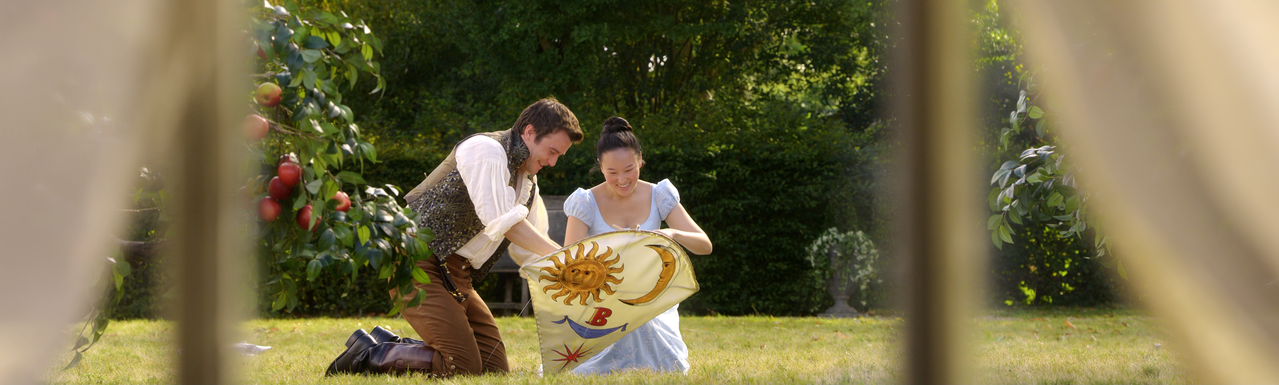
The kite was found in the library. Not by Sophie, and that, perhaps, was the first difference.
The first time, Sophie had been the one to find it. Half-hidden, half-forgotten, caught between Benedict’s books, loose sheets of paper, old pencils, rolls of canvas, and several objects he insisted were not clutter, but evidence of a mind in active communion with the world. At first, she had thought the kite belonged to Gregory.
It seemed like the sort of thing that would belong to Gregory. A boy’s forgotten treasure. A broken thing left behind in a country house because boys were always leaving pieces of themselves scattered about: a glove in the corridor, a pall mall ball beneath a chair, a ribbon stolen from someone and denied under interrogation.
But Benedict had only looked at the kite, then at Sophie, with that look of his. The look that turned an answer into a game before he had even opened his mouth. Gregory, he had told her, was already at Eton. And no, he had never truly finished mending the kite for him.
So, precisely when he was wounded, bored, impossible, and utterly incapable of obeying any sensible instruction that required him to remain in bed, Benedict had taken the kite from the library and gone in search of string.
Sophie had been reading in the sitting room when he found her. He entered the room without his coat and slightly ungainly, his hair disordered, his expression far too innocent to be trusted, and the air of a man who had decided that Mrs Crabtree, his own injury, common sense, and Sophie’s very clear opinion on the matter were all unfortunate inconveniences standing between him and amusement.
Sophie had told him he should not go outside, that he needed to rest, and Benedict had said he would go outside and that she would have to keep his secret. In the end, Sophie saw no alternative but to follow him. At the time, she still did not understand that a great deal of loving Benedict Bridgerton would consist of supporting him in things he should not do, but which would do him good.
The kite did not fly the first time.
It shuddered, trembled, rose with great promise, and then collapsed into the grass with an indignity so complete that Sophie laughed before she could stop herself. Benedict looked wounded in an entirely different way, so she tried to help, and he insisted he could manage on his own.
And then, somehow, because Benedict’s confidence was ridiculous enough to bend reality in his favour, the kite rose. He looked at it, then at Sophie, and made that small triumphant sound.
“Ha.” As if the sky had been personally defeated.
Benedict came closer to her, offering the string, and Sophie said she would only watch. He insisted. He said he had mended the kite for her, but perhaps, he said, she was afraid to have fun.
Sophie wanted to deny it.
She wanted to say that fun was not something one feared. That fear belonged to locked doors, cruel voices, hidden letters, names one was not permitted to use. Not to sunlit grass. Not to a kite. Not to a man looking at her as if joy were a language he could teach if only she stopped refusing the first lesson.
But she took the string and thanked him for the moment and they ran.
Years later, Sophie would still remember that particular laugh.
It had not been dignified. It had not been cautious. It had come out of her with such startled force that she had almost looked over her shoulder to see who had made that sound. It had belonged to a version of herself she had not known was still alive, or perhaps to a version of herself Benedict had been foolish enough, stubborn enough, kind enough to believe could still be found.
Now, three years after Violet Bridgerton had first slept in a cradle too large for her, the kite was found again.
And this time, by Violet.
“Mama.”
Sophie did not look up immediately.
That was the sort of mistake one only made after three years of motherhood. In the beginning, every sound had pulled her upright. Every sigh, every rustle, every small interruption in Violet’s breathing had seemed to demand an answer from Sophie’s entire body. She had slept in pieces, loved in a state of alertness, and learned the weight of a silence no one else could hear.
Now, she could distinguish between danger, hunger, mischief, and a question about to become an inconvenience.
This was the last of the four.
Sophie turned a page. “Yes, my love?” There was a pause.
Not a guilty pause. Violet was not very accomplished at guilt. She tended to announce her mistakes with such solemnity that it hardly counted as hiding anything.
This pause was different. Interested. Which was worse.
“Mama,” Violet said again, closer this time, “what is this?”
Sophie lifted her eyes.
Violet stood near the shelves by the windows, where the afternoon light entered in wide, golden rectangles and fell across Benedict’s library as if trying to turn disorder into art. Her daughter had one hand closed around the end of a wooden frame. The other held a piece of faded fabric, painted with a sun, a moon, and small curling lines that Sophie recognised before her mind had even given the object a name.
For a moment, she did not move.
My — or rather, Our Cottage — had changed in four years.
Not entirely. Some houses resisted change because they were stubborn in their walls, and Our Cottage had always possessed a kind of quiet firmness that Sophie loved. It still kept its corners of dust, no matter how many times anyone cleaned. It still smelled of paper, wood, summer rain, and the faint ghost of whatever Benedict had decided to use in his work that week. The floor still complained under certain steps. The library still served, depending on Benedict’s mood, as office, atelier, refuge, storage room, hiding place, and proof that a man could be married and still be absolutely ungovernable in the matter of loose drawings.
But the house was not what it had been when Sophie had first arrived there.
There were ribbons in rooms where ribbons had no reason to be. A little wooden horse lived beneath Benedict’s desk. One of Violet’s shoes had been missing for two days and was, at that moment, inside a vase, because Violet had decided the shoe wanted privacy. There were children’s books among Sophie and Benedict’s volumes, pressed violets between pages, a child’s cup on a shelf too high for a child to reach without help, which meant Benedict was responsible and had forgotten.
Our Cottage had once held Sophie like a secret. Then it had held her like a promise.
Now it held the three of them as if it had waited, patiently, to become a home.
And still, there were objects there capable of opening a door without warning.
The kite was one of them.
Violet pulled it a little farther out of the corner.
“Careful,” Sophie said, rising immediately.
Violet froze, her eyes wide.
“I am being careful.”
“You are being enthusiastic.”
“That is careful.”
“It is not always the same thing.”
Violet looked at the kite, considering whether that was unfair. She was three, almost four in the determined way children announce themselves closer to the next age than the last, and she had recently developed the expression of someone prepared to argue before she even understood the subject. Benedict said that came from Sophie. Sophie knew perfectly well it came from every Bridgerton who had ever breathed.
“What is it?” Violet asked again.
Sophie crossed the room and crouched beside her.
The kite looked older than Sophie remembered, or perhaps Sophie herself had changed around the memory. One edge was frayed. The painted sun had faded at the tips, and the moon, once bright against the fabric, had softened into something more ghostly. The frame had held better than it should have, though one joint had loosened, and one ribbon of the tail had tangled around itself in a knot so determined it could only have been made by time or Benedict.
Sophie touched the fabric with two fingers.
“A kite.”
Violet blinked.
“For birds?”
Sophie laughed, very softly.
“No.”
“For the sky?”
“Yes,” Sophie said. “For the sky.”
Violet looked at it again, with immediate reverence. “Oh.”
That was how Violet received the world when it pleased her. Not loudly, at first. Not with chatter. Only with that small rounded oh, as if a door had opened somewhere inside her and she intended to look through before deciding what to say.
Then, inevitably, came the rest.
“Was it mine?”
“No.”
“Was it yours?”
Sophie paused.
The answer should have been simple.
It had not been hers. Not truly. She had not bought, made, broken, abandoned, or discovered that kite as a child. It did not belong to her in the ordinary way things belonged to people, but Benedict had mended it for her.
And Sophie had learned, slowly and with much resistance, that sometimes being loved meant receiving things she had not known how to ask for.
A room. A name. A place at the table. A moment in the sun.
So she answered: “A little.”
Violet accepted this with the seriousness of a judge.
“Was it Papa’s?”
“Yes.”
“Did he break it?”
“Probably.”
“I heard that,” Benedict said from the doorway.
Sophie turned.
He was leaning against the frame with one shoulder, without his coat, sleeves rolled up, a pencil still tucked behind his ear. There was a charcoal mark near his wrist and another, more suspicious one, near the collar of his shirt. His hair had already abandoned any formal allegiance to order at some point before luncheon.
Sophie looked at him and felt, as she still sometimes did, the strange double vision of marriage.
The Benedict before her was familiar in a hundred daily ways. The man who forgot tea until it went cold, who sang nonsense to Violet when he thought no one was listening, who tucked flowers into Sophie’s hair because he liked finding excuses to touch her. The man whose hands had learned the shape of their daughter’s fears, whose voice could soften a room, whose shirts Violet used as handkerchiefs with scandalous possession.
But, over him, for one brief second, Sophie saw another Benedict. Paler. Wounded. Restless. Too handsome for his own good and far too pleased with himself for someone who should not have been standing, much less going outside with a kite.
“You broke it,” Sophie said.
“I did not.”
“You said you never mended it for Gregory.”
“That is not the same as breaking it.”
Violet looked from one to the other. “Uncle Gregory?”
“Yes, Uncle Gregory,” Sophie replied solemnly.
“He said I could have cake before dinner.”
Benedict’s eyebrows rose. Sophie slowly turned her head towards him.
Benedict looked alarmed. “I did not know that.”
“You did know. You laughed.”
“I laughed in a general sense. Not in approval.”
Violet tugged at the kite.
“Was it Uncle Gregory’s?”
Benedict entered the room, and the light moved over him as he came.
“That was the accusation your mother once made.”
“It was a reasonable assumption,” Sophie said.
“It wounded me deeply.”
“You recovered.”
“With great courage.”
Violet frowned. “Was it?”
Benedict crouched opposite Sophie, so that Violet stood between them with the kite like some bright, damaged treaty.
“No,” he said. “It was not Gregory’s. Gregory was already at Eton.”
“What is Eton?”
“A place where young gentlemen are sent to become insufferable.”
“Benedict,” Sophie warned.
“What? It worked beautifully in several cases.”
Violet did not care about Eton. She cared about the kite.
“Why did you not fix it?”
Benedict’s expression changed. Only a little.
Enough for Sophie, who had spent years learning the small weather of his face, to see memory pass through him. A corner of his mouth. A slight lowering of his eyes. The smallest pause before humour returned, gentler this time.
“I suppose I had not yet found the right person to fix it for.”
Violet looked at Sophie. Sophie looked at the kite.
She knew he meant her. He knew she knew.
And still he did not say it aloud, because some tendernesses became stronger when they were not displayed too quickly in the open air.
Violet, however, had no patience for the unsaid. “Was Mama the right person?”
Benedict smiled.
“Yes,” he said. “She was.”
Sophie looked down, but not quickly enough. Benedict saw her face. Of course he did. It was very inconvenient to be married to a man who noticed happiness when she tried to hide it.
Violet touched the loose wooden joint.
“Can you fix it for me?” The question landed lightly. Then not lightly at all.
Benedict looked first at Violet. Then at the kite. Then at Sophie.
Sophie’s hand, still resting on the faded fabric, went still.
There it was. The next thing.
How absurd that it could arrive disguised as a child’s question in a sunlit library. Sophie had expected life’s difficult moments to announce themselves with a little more dignity. A fever at night. A letter. A fall. Some great, obvious terror that gave the body permission to be afraid.
But motherhood had never been so considerate. It hid fear inside ordinary things: A silence. A step. A closed door. A kite.
“Please, Papa,” Violet said.
Benedict’s whole face changed. It always did when Violet said please. Sophie had once accused him of having no defence against their daughter’s manners. Benedict had replied, very seriously, that he had no defence against their daughter in general, and that it was cruel of Sophie to expect military discipline in a lost war.
“I can certainly try,” he said.
Violet lit up. “Now?”
Sophie opened her mouth. Benedict looked at her. She closed it again.
It was not that she wanted to say no. Not exactly.
The word simply lived closer to the front of her mouth more often than she liked. Not out of cruelty or lack of joy, but because no was sometimes the quickest shape protection took. No, not so high. No, not so fast. No, wait for me. No, do not climb there. No, leave the dog’s tail. No, you cannot put a beetle in your pocket simply because it seems lonely.
No, the world is too large, and I only have two hands.
Violet looked at her with expectation. Benedict looked at her with understanding. Which was worse.
“What?” Sophie asked.
Benedict curved his mouth.
“I said nothing.”
“You are looking.”
“I look at my wife often.”
“You are looking in a specific way.”
“In a loving way, I hope.”
“In a knowing way.”
“Ah.” He glanced at the kite. “That is less innocent.”
Violet sighed dramatically. “Can we fix it?”
Benedict turned to her immediately.
“Yes, darling. We can fix it.”
“We?”
“If you are willing to accept the grave responsibility.”
Violet nodded with such seriousness that the ribbon slipped further from her hair. “I am.”
“Excellent. Your first duty is to carry nothing sharp.”
Violet looked disappointed. Sophie laughed despite herself.
And so the kite was placed on Benedict’s worktable.
This required moving three sketchbooks, two cups, a box of pencils, a small wooden animal whose species remained disputed, several crumpled papers, and one very important-looking sheet that Benedict claimed was not important precisely when Sophie reached for it. Violet helped by carrying one pencil at a time to the other side of the room, for reasons she did not explain.
The repair itself took longer than it should have. Not because the kite was especially damaged, but because Benedict believed in explaining every step to Violet, and Violet believed every explanation deserved an interruption.
“This,” Benedict said, lifting the loose joint, “is where the frame has weakened.”
“Why?”
“Because time is cruel.”
“Why?”
“Because it has not yet met your mother.”
Sophie, who had returned to her chair with the book open and unread in her lap, lifted her eyes.
“That makes no sense.”
“It makes emotional sense.”
Violet nodded as if that were perfectly acceptable.
Benedict continued: “We need to secure it here.”
“With this?”
“No, darling, not with my good brush.”
“With this?”
“No, that is also a brush.”
“With this?”
“That is your mother’s bookmark.”
Sophie extended a hand. Violet surrendered it without remorse.
“You are a menace,” Benedict told his daughter fondly.
“I am helping.”
“You are. Terrifyingly.”
Sophie watched them over the top of her book. She had not meant to sit down again. She had meant to be useful. To bring thread, scissors, perhaps cloth. To assist in a sensible and orderly manner, because someone in the room ought to make certain Benedict did not glue himself to the furniture or allow Violet to walk away with a blade.
But she found herself still, watching. It was a terrible habit, love.
It turned the simplest scene into something one could not bear to interrupt.
Benedict bent over the kite with Violet standing on a small chair beside him, one of his hands resting lightly behind her back without seeming to think about it. His voice was low and patient. Violet’s forehead was furrowed. The sunlight touched the side of her face and made the loose strands of her hair look almost black. She held a small strip of fabric in both hands as if it were precious.
Sophie looked at the two of them and remembered the first night. The cradle. The dark. Violet’s chest rising and falling beneath the blanket.
Benedict behind her, his arms around her waist, saying not that nothing would ever happen, not that they could protect their daughter from the whole world, but that they would face the next thing. Only the next.
At the time, the next thing had been a breath. A night. A possible fever. A cry.
Now the next thing stood on a chair beside Benedict, asking whether a kite could be sad.
“Possibly,” Benedict said.
“Because it was broken?”
“Perhaps.”
“Will it be happy now?”
“If we do our work well.”
Violet thought about that.
“Was Mama sad when it was broken?”
Benedict looked at Sophie, and Sophie went still.
“I was not sad,” she said after a moment.
“No?” Benedict asked softly.
Sophie heard the question beneath the question.
“No,” she repeated. “I do not think so.”
Afraid, perhaps. Guarded. Too aware of every reason not to accept joy when it was handed to her, but not sad. Not exactly.
Violet looked at the kite, then at Sophie.
“Were you happy?”
Sophie’s fingers tightened around the edge of the book. There were several answers.
She had been confused. Startled. Frightened by the ease of it. Irritated with Benedict. Amused by Benedict. Drawn to Benedict. Suspicious of happiness because happiness had so often behaved, in Sophie’s life, like something that disappeared the moment she touched it.
But in the end, beneath all that, there had been one small, bright truth.
“Yes,” Sophie said. “I was.”
Benedict’s expression softened in a way that made her wish, suddenly and foolishly, that Violet were not in the room so that she could cross it and kiss him.
Violet accepted the answer and returned to the kite.
“Then it was a happy kite.”
Benedict smiled down at the frame.
“Yes. It was.”
By the time the repair was finished, Sophie had read the same paragraph eight times and understood none of it. Violet had acquired a smear of glue on her wrist, Benedict had gained two more charcoal marks in places charcoal had no reason to be, and the kite looked, if not new, then at least willing.
“There,” Benedict said, leaning back with satisfaction.
Violet clapped. The repaired kite rested on the table, its sun and moon faded but still visible, its tail untangled and its frame firm again. Benedict touched the edge as if greeting an old friend.
Sophie stood before she truly meant to.
“It may not fly,” she said.
Benedict looked at her.
“I did not say it would.”
“You looked as if you believed it would.”
“I generally look as if I believe things will go my way. It is part of my charm.”
“It is part of your problem.”
“Also possible.”
Violet bounced on her toes.
“Can we make it go to the sky?”
Sophie felt the word no rise again. It did not reach her mouth this time, but she felt it. The small inward tightening.
The wind. The uneven lawn. The way Violet ran with more determination than balance. The string. The possibility of falling. The possibility of disappointment. The possibility of Benedict being far too delighted to be cautious.
“It is nearly time for tea,” Sophie said.
Benedict looked at the clock. It was not.
Sophie knew it was not, and Benedict knew she knew.
Violet did not know, because time remained, to her, a system invented by adults to delay joy.
“It is not,” Benedict said mildly.
Sophie narrowed her eyes. He smiled.
Violet tugged at his sleeve. “Please.”
Sophie looked at the kite. Then at the windows, beyond which the lawn of Our Cottage stretched bright and green beneath the afternoon sun. The same lawn.
Not unchanged. Nothing remained truly unchanged. There was a small patch near the lavender where Violet had once decided to dig for treasure and found only worms. The old bench had been moved because Benedict had stubbed his toe against it twice and declared it his personal enemy. Sophie had planted more flowers near the path, not because Our Cottage had lacked flowers before, but because she liked watching things return every year without needing permission.
Still, she remembered the shape of that day.
Benedict going out with the kite and Sophie following him. The absurdity of it and the fear of having fun. The moment she took the string.
“My love,” Benedict said.
His voice had changed. Not much, just enough.
Sophie turned.
He was no longer smiling quite so widely. Violet, impatient, had begun examining the kite’s tail. Benedict’s attention was entirely on Sophie.
“Are you afraid of the kite,” he asked gently, “or afraid she might enjoy it?”
Sophie’s breath caught. For one strange second, the room folded in on itself.
Another afternoon. Another version of herself. Benedict standing in the sunlight with a mended kite and a question she had not wanted to answer.
Perhaps you are afraid to have fun. She had been. A little. More than a little.
Sophie looked at Violet.
Her daughter had wrapped one ribbon from the kite’s tail around her wrist and was whispering something to it. Encouragement, perhaps. Or instructions. With Violet, the distinction was often unclear.
“She is very small,” Sophie said.
Benedict did not laugh. That was one of the reasons she had married him. “She is,” he said.
“She runs too quickly.”
“She does.”
“She does not look where she is going.”
“Rarely.”
“She may fall.”
“She may.”
The answer should have been useless. It was not.
Sophie looked at him, and Benedict simply held her gaze with that same quiet kindness he had given her in the dark three years earlier. No impossible promise, no easy lie. Only presence.
“And then?” Sophie asked, though she already knew.
Benedict took a step closer. He still did not touch her, perhaps because he knew that if he did, she might lean into him and make a fortress of his body instead of walking out into the afternoon.
“Then we go to her.”
Sophie closed her eyes for a moment.
Violet pulled the ribbon free from her wrist.
“Mama?”
Sophie opened her eyes. Her daughter was looking at her now, head tilted, the kite leaning against her legs. Not frightened or pleading. Only waiting.
That trust undid Sophie more deeply than any tears could have. Violet expected the world to open.
Not always. Not entirely. She knew no. She knew bedtime, vegetables, washing behind her ears, and the very firm rule that beetles belonged outside. But beneath all that, deeper than disappointment, Violet still believed that joy was something one asked for and often received.
Sophie had given her that. Benedict had given her that. Our Cottage had given her that.
A house where a child could find a kite and assume it was meant to fly.
Sophie drew a slow breath.
“Very well.”
Violet sighed as if Sophie had granted her a kingdom. Benedict, traitor that he was, looked exactly the same.
The three of them went outside, with Benedict carrying the kite. Violet carried the spool of string in both hands, though Benedict had tied it properly and kept a careful eye on the way it unwound. Sophie carried nothing, which made her feel unprepared.
The afternoon welcomed them with warmth.
Summer had not yet reached its full weight, but it had already touched Our Cottage with gold. The air smelled of grass, lavender, and the faint sweetness of something blooming near the wall. A breeze moved across the lawn, gentle at first, then stronger near the open stretch beyond the trees.
Violet ran three steps ahead, stopped, remembered she had been told not to run with string, and turned back with exaggerated innocence.
“I am walking.”
“You are vibrating in place,” Benedict said.
“I am walking fast.”
“Of course.”
Sophie followed them more slowly. She looked at the lawn and, for a moment, saw both afternoons at once.
Benedict then, wounded and far too pleased with himself.
Benedict now, only a few years older and yet changed in ways no stranger would see. Softer around the eyes. Quicker to kneel. More careful with certain silences. Still dramatic. Still impossible. Still the man who had once taken a broken kite and turned it into a moment of fun for Sophie.
Violet ran to the middle of the grass.
“Here?”
Benedict looked up at the sky with exaggerated expertise.
“A little farther.”
Violet took one step.
“A little farther than that.”
She took another.
“Miss Bridgerton, you negotiate like your mother.”
Sophie raised an eyebrow.
“Should I be offended?”
“Never. I admire your tactics, even when they are used against me.”
Violet took three more steps and declared:
“Here.”
“Here,” Benedict agreed, because he was not foolish enough to challenge a commander twice.
He placed the kite on the ground and examined it once more. Sophie stood a little behind them, her arms lightly crossed, trying not to look as if every nerve in her body had moved to the surface of her skin.
It was only a kite. It was only a lawn. It was only a child laughing because her father had set the spool on the grass and made a show of testing the wind with one hand.
But Violet had once only been sleeping, too, and Sophie had still stood over her in the dark, afraid.
Benedict looked back.
“You may laugh if it falls,” he said.
“I know.”
“You laughed last time.”
“You were very proud for a man whose kite was on the ground.”
“I was wounded.”
“You used that excuse often.”
“It was a useful wound.”
“It was not useful to me.”
Benedict’s eyes warmed. “No?”
Sophie should not have blushed after years of marriage.
And yet, Violet stamped one foot.
“Make it fly.”
Benedict straightened.
“Do you hear that, Sophie? The artist has been commanded by his patroness.”
“Your patroness is three.”
“An exacting age.”
He lifted the kite. The first attempt failed, of course it failed.
Benedict took a few steps back, released it, and for half a glorious second the kite rose as if it remembered itself. Then the breeze shifted, the frame tilted, the sun flashed once, and it fell nose-first into the grass.
Violet shrieked with laughter. Sophie covered her mouth. Benedict slowly turned towards her.
“Not one word.”
Sophie shook her head, but the laughter escaped anyway. “I said not one.”
“I did not say anything.”
“You are laughing loudly with your eyes.”
“It is not my fault you are familiar.”
Violet ran to the kite and patted it.
“It fell.”
“Thank you, darling,” Benedict said. “I noticed.”
“Try again.”
“I intended to.”
“Better.”
Sophie made a sound. Benedict pointed at her.
“Your influence.”
“My honesty.”
He retrieved the kite, checked the joint, adjusted the tail, and became very serious in that way he became when play mattered. Sophie watched the shift in him. The narrowing attention. The careful hands. The refusal to treat a child’s delight as something small merely because it would not survive into history.
That was also part of why she loved him.
Benedict Bridgerton could make nonsense feel dignified.
The second attempt did not fail. The kite rose. Not gracefully, at first. It shuddered, pulled, dipped, and for one alarming moment seemed as if it might return to the ground in protest. Then the wind caught it completely.
Up. The line tightened, the tail opened behind it.
Violet’s mouth fell open.
Benedict watched the kite rise and then, exactly as he had years before, turned to Sophie with absurd triumph. “Ha.”
Sophie laughed, not because the sound was ridiculous, though it was. But because, for a moment, time had been kind enough to repeat itself without taking anything from her.
Benedict crossed the grass towards her, the spool in his hands, the line running from him to the sky.
Sophie knew what he would do before he did it. Her heart softened around the memory. He would offer her the line. He would insist. He would look at her as if the world were easier than she feared.
Only he did not reach her first. Violet stepped between them and lifted her hands.
“I want it.”
Benedict stopped.
The kite pulled once, and his hand tightened around the spool. Sophie saw.
She saw the father in him rise before the artist, before the playful man, before the boy who wanted to make his daughter laugh. Benedict looked at Violet, then at the spool, then back at her little hands, already outstretched.
“I want it,” Violet repeated.
Benedict crouched. “It pulls quite strongly.”
“I am strong.”
“You are.”
“I can hold it.”
“With help.”
Violet frowned. “By myself.”
There it was. So small. So enormous.
Sophie’s body moved before thought did. A step, perhaps. Not enough to reach them. Enough for Benedict to look at her.
He would say no if she needed him to say it.
That knowledge settled in Sophie’s chest like a stone and a gift.
Violet was looking at the sky, not at them. The kite pulled in Benedict’s hands.
“I can,” she said again, lower now. Not angry. Certain.
Sophie remembered another certainty.
Violet’s hand opening against her nightdress on the first morning. Her little body settling against Sophie’s chest as if she knew what mattered before she knew words. Warmth. Voice. Scent. Heartbeat. You.
And now?
Now she knew wind. Sky. Want. Mine.
Sophie swallowed.
“Benedict.”
He looked at her, and Sophie nodded once. His expression changed in a way so brief no one else would have seen it. Pride, fear, gratitude. All three at once.
Then he turned back to Violet.
“Very well. But first, you listen.”
Violet nodded solemnly.
“You hold here.”
He placed the spool in her hands. Her fingers looked impossibly small around it. Scandalously small, Sophie thought, and the memory hurt so sweetly she nearly smiled.
Benedict kept his own hands over Violet’s. Not taking the kite from her, and not handing it over entirely either. Something between one thing and the other. A father’s agreement with the wind.
“If it pulls too hard, you tell me.”
“I tell you.”
“If it hurts your hand, you let me know.”
“I let you know.”
“If it starts carrying you to Scotland—”
“Benedict.”
Violet gasped.
“Can it?”
“No,” Sophie said.
“Not unless you refuse vegetables for three consecutive days,” Benedict said.
Sophie gave him a look. He gave her innocence, poorly performed.
Violet did not care about vegetables. The kite had shifted above them, and the line answered in her hands.
Her face changed.
“Oh.” That same small sound from the library, but fuller now. The world opening again. “It pulls me.”
“A little,” Benedict said.
“It wants to go.”
“Yes.”
“Why?”
Benedict looked at the kite.
“Because it was made for that.”
Violet considered this.
“Was I?”
Sophie’s breath caught. Benedict did not answer quickly.
When he did, his voice was very gentle.
“In some ways, yes.”
Violet looked at the spool, then back at the kite, as if accepting a private contract with the sky.
Sophie could not move.
Her daughter stood before her, three years old, dark curls loose around her face, Benedict’s hands covering hers, the kite flying above Our Cottage as if the house itself had exhaled.
She used to fit inside a cradle. The thought came with such force that Sophie pressed one hand against the middle of her body.
She had been so small. So quiet. So terrifyingly still. Now she pulled against the wind.
Benedict looked back immediately. He always looked. Sophie tried to smile before he could worry. It did not work very well.
Violet tugged the spool.
“Mama, look!”
“I am looking,” Sophie said.
And she was. She had been looking for three years.
At sleep. At waking. At first steps. At fevered cheeks. At scraped knees. At Violet feeding birds with crumbs and calling it hospitality. At Violet demanding stories and then correcting the endings. At Violet reaching for Benedict’s face with sticky fingers and saying, Papa, listen, before telling him something entirely incomprehensible.
Sophie had watched her daughter grow and felt, each time, both pride and loss.
No one had warned her properly that childhood was a series of goodbyes so small the world expected mothers not to mourn them.
The last time Violet needed to be rocked to sleep. The last time she mispronounced a word. The last time she lifted her arms automatically to be carried and then remembered she wanted to walk. The last time her whole body fit against Sophie’s chest in exactly the same way.
And now this.
By herself.
“Mama!”
Sophie blinked. Violet was extending one hand. Not the spool; she did not let that go. Only one hand, reaching.
“Come.”
Sophie crossed the grass to them.
“Are you inviting me or commanding me?”
“Yes.”
Benedict laughed softly.
“A politician.”
“A Bridgerton,” Sophie said.
“Cruel, but accurate.”
Violet took Sophie’s hand and pulled her closer.
“You hold it too.”
“Oh.” Sophie looked at Benedict. “Do I have permission?”
Violet nodded.
“You can help me.”
Benedict’s mouth curved. There was something too knowing in it.
“What?” Sophie asked.
“You once said you would only observe.”
Sophie felt the memory warm her face.
“And you were very irritating then as well.”
“And yet.”
“Do not say it.”
“I was right.”
“You said it.”
“I restrained myself for as long as I could.”
“Which was not very long.”
“No,” Benedict agreed cheerfully. “But longer than usual.”
Violet placed Sophie’s hand on the spool. Sophie’s fingers slid over Benedict’s, then beneath Violet’s, then around the wood. For a moment, the three of them held the string together, their hands layered awkwardly, warmly, imperfectly.
The kite pulled.
Sophie felt it through Violet before she felt it through the string.
The small bracing of her daughter’s body. The startled delight. The instinct to hold tighter.
Then Benedict’s hand came over Sophie’s. Not because she needed help with the kite, because he knew she needed help with the feeling.
The gesture was so quiet that Sophie nearly came undone.
“Do you remember?” he asked, low enough that Violet, absorbed in the sky, did not hear.
Sophie watched the kite. “Yes.”
“I was very impressive.”
“You fell.”
“I recovered magnificently.”
“You were wounded and impossible.”
“I was charming and wounded. The distinction matters.”
Sophie smiled, then the smile softened. “You said I was concerned to have fun.”
Benedict’s thumb moved once against her hand. “You were.”
“I was.” The admission did not hurt as it might once have.
Perhaps because the woman who had been afraid now stood in the same garden, with her daughter’s hands beneath hers and her husband’s hand over them both. Perhaps because joy, once so suspicious, had become ordinary enough to leave toys in vases and crumbs beneath chairs.
Or perhaps because Sophie had finally learned that feeling fear did not mean being incapable of joy.
Only that joy needed to be invited gently.
“You mended it for me,” she said.
Benedict was quiet. “Yes.”
“And now for her.”
“Yes.”
The kite rose higher. Violet laughed.
Sophie looked at her daughter’s face and felt the old fear change shape again.
Before, it had been a cradle. Now, it was string.
“She used to fit inside a cradle,” Sophie whispered.
Benedict’s hand tightened over hers. Not in alarm. In memory.
“She did.”
“She does not anymore.”
“No.”
Violet leaned forward, delighted by some movement of the kite.
Sophie’s throat ached. “She keeps becoming more herself.”
Benedict’s voice came low beside her. “That is generally what one hopes children will do.”
“I know.”
“But knowing does not always help.”
“No.”
He turned his face slightly towards her. “Now we give her more string.”
Sophie closed her eyes.
For a moment, she let the words settle. More string. Again.
Not letting go. Not abandonment. Not the cruel sort of freedom that leaves a child to understand the world alone. Only more space to feel the wind.
Sophie watched Violet straighten, enchanted.
“I want to run.”
Sophie opened her eyes.
“No,” she said immediately.
Violet’s face fell.
Sophie regretted it at once, but fear had spoken faster than tenderness. Benedict did not correct her or contradict her. He only waited.
Violet looked from Sophie to Benedict and back to Sophie. Her eyes were large now, uncertain in a way Sophie hated more than disobedience.
“I know how to run,” she said.
“I know,” Sophie answered, softer.
“Then why not?”
A very good question. Too good.
Because you are my heart, Sophie thought. Because I remember when your head fit beneath my hand. Because once I had no one who ran after me quickly enough. Because every time you move away, some old, foolish part of me believes you may not come back.
But she could not say that to a child with a kite.
Benedict’s hand remained over hers. Steady and without pushing. Only there. Sophie breathed.
“Because the string can pull,” she said. “And because the ground is uneven.”
Violet looked down at the ground as if it had betrayed her.
“But,” Sophie continued, the word costing more than it should have, “you may walk quickly.”
Violet considered the offer. “Very quickly?”
“No.”
“A little quickly?”
“A little.”
“With Papa?”
“With Papa.”
“With you?”
Sophie’s heart softened.
“With me.”
Violet nodded, satisfied with the agreement. Then she walked quickly.
Which, in the language of a three-year-old, meant running badly while pretending not to.
Benedict moved with her immediately, bent awkwardly so that his hands could remain near hers without taking control. Sophie followed, one hand still on the spool, her skirts brushing the grass, her breath caught between laughter and alarm.
The kite dipped. Violet shrieked. Benedict adjusted the string. Sophie almost stepped on his foot, and he almost tripped.
Violet shouted: “Faster!”
“Not faster,” Sophie and Benedict said together.
Violet laughed at their unity. The kite pulled again, stronger this time.
Violet stumbled.
Not enough to fall. Enough.
Sophie’s body surged forward.
Benedict took her hand with his free one. Only for a second.
Only to say, without words, wait.
Violet steadied herself. The kite held.
Benedict let go of Sophie’s hand. Sophie released her breath so sharply she almost laughed.
Benedict looked at her. “She is all right.”
“I know.”
“You did not.”
“Now I know.”
Violet did not notice. She was too busy announcing to the sky: “I have you!”
Benedict’s face changed. Sophie saw it happen.
There were expressions of his she had known before Violet. Desire. Mischief. Amusement. Restlessness. That open, devastating attention he gave Sophie when he was not trying to be clever. But fatherhood had created new expressions. Or perhaps it had deepened the old ones until they were unrecognisable.
This was one of them.
The look he wore when Violet said something that would mean nothing to anyone else and everything to him.
I have you. As if Benedict had not been whispering that, in one form or another, since the day she was born.
Violet moved again, and the kite lowered a little.
“Oh,” she said, offended. “No.”
“It needs more wind,” Benedict told her.
“Tell it.”
“I beg your pardon?”
“Tell the wind.”
“I am not certain the wind accepts instructions from me.”
“It should.”
Sophie laughed.
“She inherited that from you.”
“My authority over the weather?”
“Your confidence in being obeyed by forces beyond reason.”
“That sounds like Anthony.”
“It sounds like all of you.”
Benedict looked wounded.
“I am the moderate Bridgerton.”
Sophie did not answer.
Violet did. “No.”
Benedict turned to his daughter. “Traitor.”
She smiled.
The kite gave a sudden, sharp pull. This time, Violet fell.
It happened quickly and not quickly enough.
The spool tugged. Benedict’s hands moved, but Violet, in her determination to hold on, twisted one foot in the grass. She fell backwards onto her bottom with a soft thud, the string slipping from her hands into Benedict’s.
For half a second, there was silence. Sophie’s heart stopped so completely that the world seemed to narrow to one small child in the grass.
Then Violet looked down at her dress. Grass stained one side. Her lower lip trembled.
Sophie was already moving. Benedict let the kite fall. The spool hit the grass beside him, forgotten in the same instant.
They reached Violet together, but Sophie dropped to her knees first.
“My love.”
Violet looked at her, enormous green eyes wide.
Sophie’s hands moved over her before she could think. Arms. Shoulders. Face. No blood. No terrible angle. No immediate cry of pain.
Only surprise. Only a fall. Only childhood.
“Are you hurt?”
Violet looked down at herself again.
“My dress.”
Sophie almost laughed and cried in the same breath.
“Your dress can be washed.”
“It is green.”
“It is.”
“Will it stay?”
“No.”
Violet considered that tragedy.
Then she looked at Benedict, who was crouched beside them with such visible concern that it almost frightened Sophie all over again.
“The kite fell too,” Violet said.
Benedict looked over his shoulder. The kite lay in the grass a few steps away, face down, its tail tangled around one corner.
“So it did.”
“Is it hurt?”
“I shall examine it.”
Violet sniffed once. A dangerous sound.
Sophie drew her gently closer, and for one brief, aching instant Violet allowed it. Her little body pressed against Sophie’s chest, warm and solid and still small enough to fit there if Sophie curved herself carefully around her.
Not a cradle. Not anymore. But still hers.
Always hers, even while running.
Sophie lowered her mouth to Violet’s hair. “You frightened me.”
Violet pulled back enough to look at her. “I fell.”
“Yes.”
“But I am here.”
The sentence struck with such force that Sophie could not answer.
I am here. As if Violet had somehow reached into the past, into that first night, the cradle, the room where Benedict had needed to hear Sophie say the same thing after childbirth.
I came back. I am here. And so is she.
Sophie held Violet’s face between her hands.
“Yes,” she managed. “You are.”
Violet placed one sticky hand on Sophie’s face.
“Do not cry.”
“I am not crying.”
“You are nearly.”
Benedict made a very small sound. Sophie looked at him. He was looking down, wisely pretending great interest in the grass.
“Do not laugh,” Sophie warned.
“I would not dare.”
“You are nearly.”
Violet patted Sophie’s face.
“Mama is nearly crying and Papa is nearly laughing.”
Benedict nodded solemnly.
“A precise report.”
Violet seemed proud of herself. Then she looked back at the kite.
“It is sleeping.”
Benedict followed her gaze.
“Is that what it is doing?”
“Yes. It is tired.”
“Understandable. It has had a demanding afternoon.”
Violet leaned against Sophie again, not with the helpless weight of infancy, but with the casual certainty of a child who knew she could leave and return.
That, Sophie thought, was love too. Not only holding. Returning.
After a moment, Violet wriggled.
“I want to see.”
Sophie let her go. Not quickly or easily, but she let her go.
Violet crawled the short distance to the kite before standing, apparently recovered from both injury and betrayal. Benedict rose with her and began examining the frame with grave seriousness.
Sophie remained in the grass. Her knees were damp. Her heart was still moving too quickly. Her palms remembered Violet’s shoulders, her face, the frantic checking that had lasted less than a second and contained every fear Sophie had ever known.
Benedict looked back. This time, he did not ask with his eyes. He came to her.
Violet was too busy scolding the kite for sleeping without permission, so Benedict crouched beside Sophie and took her hand.
“Are you hurt?” he asked softly.
Sophie released a breath that almost became a laugh.
“I did not fall.”
“No.”
His thumb moved over her knuckles.
“But are you hurt?”
That was Benedict. Always lighting a candle in the room she had not admitted was dark.
Sophie looked at Violet. Their daughter had lifted the kite into her lap and was stroking it with stern affection.
“I thought it would be easier by now,” Sophie said.
Benedict did not pretend not to understand.
“What would?”
Sophie swallowed.
“Watching her move away.”
His hand tightened around hers.
“She is only across the lawn.”
“I know.”
“And still.”
“And still.”
Benedict sat beside her in the grass, heedless of the fact that his trousers would likely never recover. Sophie leaned her shoulder against his arm before deciding to do so, and he accepted the weight as if he had been waiting for it.
For a while, they watched Violet, and she had begun explaining something to the kite. It involved sleep, falling, and an accusation that the wind had behaved rudely.
“I used to be afraid she would disappear if I looked away,” Sophie said.
Benedict’s breathing changed.
“I remember.”
“You found me by the cradle.”
“Yes.”
“I thought that if I stopped looking at her, something would happen.”
“I know.”
“I thought that would pass.”
“Did it?”
Sophie considered lying. Then she rested her head lightly on his shoulder.
“No. It changed.”
Benedict kissed her hair.
“It changed for me too.”
Sophie turned her face enough to look at him.
He was watching Violet, but not with the easy amusement he had shown moments before. His expression was quieter. More vulnerable. Three years had made Benedict better at hiding some fears and worse at hiding others. Fatherhood had not given him the dignity of being unafraid. It had only given him someone small enough to make fear feel sacred.
“I still look for her first,” he said.
“When?”
“When I wake. When a room goes quiet. When I hear a door. When I do not hear a door and think perhaps I should.”
Sophie’s throat tightened.
“You too?”
Benedict looked at her then.
“My love,” he said, almost smiling, “did you think you were alone in becoming ridiculous?”
A laugh escaped her, low. The ache eased a little. Not because it disappeared, but because it was shared. As it had been from the beginning.
“She said she is here,” Sophie whispered.
Benedict’s face changed immediately.
“I heard.”
“She does not know what that means.”
“No.”
“She only meant she fell and was still sitting there.”
“Yes.”
“And still.” He brought her hand to his mouth and kissed her fingers.
“And still.” Sophie looked at Violet.
“I do not want to hold too tightly.”
“I know.”
“I also do not know how not to.”
Benedict was quiet for a moment. Then he said: “Perhaps we do not begin by letting go.”
Sophie looked at him.
“No?”
“No.” His thumb moved slowly over the back of her hand. “Perhaps we begin by giving more string.”
The words entered her gently. More string. Again.
Not complete release. Not abandonment. Not the cruel freedom that leaves a child to understand the world alone. Only more space to feel the wind.
Sophie watched Violet rise, the kite held in both hands, her dress stained, her hair coming loose, her face bright with the importance of having survived a fall and acquired a story.
“She has what I did not,” Sophie said.
Benedict’s expression softened. “What?”
Sophie’s eyes remained on their daughter.
“The certainty that someone will come.”
Benedict did not answer immediately. There was no easy answer to that. No cleverness gentle enough. No joke that would not break in the middle. So he simply held her hand, and that was enough.
Violet suddenly turned.
“Mama! Papa!”
They both straightened. Violet lifted the kite above her head as if presenting proof.
“It woke up!”
Benedict answered: “A miraculous recovery.”
“It wants you.”
“Me?”
“All of us.”
Sophie wiped beneath one eye before standing.
Benedict saw. He said nothing.
He rose first and offered his hand, though she did not need help. Sophie accepted it anyway.
Marriage, she had learned, was full of such things. Help one did not need and accepted because being loved was not always about necessity.
They walked together to Violet.
The kite had, in fact, survived. The frame was still firm, though the tail had tangled again, and one of Benedict’s repairs looked a little less elegant after its impact with the earth.
Violet held it out.
“Fix it again.”
Benedict took it gravely.
“A familiar command.”
“Can it fly?”
“I believe so.”
“Better?”
“Possibly.”
“Can Mama hold it?”
Sophie blinked, and Benedict looked at her. Violet picked up the spool from the grass and offered it with both hands.
For a moment, Sophie was back in the sun of another afternoon. Benedict standing beside her. The string extended. His voice saying that he insisted. The kite mended for her. Her own voice, happier than she expected, thanking him for the moment.
Now Violet stood in his place. Small. Stained. Expectant. Loved.
Sophie crouched before her.
“For me?”
Violet nodded. “You can have fun too.”
Benedict made a sound behind them. It was not exactly laughter.
Sophie looked up at him and found his face open, struck, unbearably tender.
He remembered. Of course he remembered.
Sophie looked back at Violet.
“I can?”
Violet nodded with great authority.
“Papa said.”
“Did he?”
“He says many things.”
“That is true.”
Benedict, behind them, murmured: “I am wounded by the accuracy.”
Violet placed the spool in Sophie’s hands. Sophie closed her fingers around it.
The wood was warm from the grass, from Benedict’s touch, and from Violet’s small determined grip. For a moment, Sophie simply held it.
Then Violet placed her hands over Sophie’s. Benedict came to stand behind them. Not too close. Only close enough.
“Ready?” he asked.
“No,” Sophie said.
Violet said: “Yes.”
Benedict laughed softly.
“That seems right.”
He lifted the kite, walked a few steps back, waited for the wind, and released it.
The kite dipped. Violet gasped. Sophie’s fingers tightened, and then the wind caught it.
The line pulled. The kite rose. This time, Sophie felt it first.
Not through Benedict’s hand. Not through invitation. Through her own.
The tug was sudden and alive, a small resistance between earth and sky. Violet shrieked and pressed her hands harder over Sophie’s. Benedict stepped closer from behind, one hand resting lightly at Sophie’s waist, the other reaching around to cover Violet’s hands without taking the spool.
There they were. Layered together again.
Violet in front, Sophie around her, Benedict around them both.
The kite above Our Cottage in the clear sky.
The house before them filled with the ordinary evidence of their life: books left open, chairs out of place, a ribbon somewhere it did not belong, the first letter Sophie had written to Violet kept safely in a drawer upstairs, beginning with a night, a cradle, and a mother who loved so much she could not sleep.
Sophie breathed. For once, the next thing was not a breath in the dark.
It was this.
A child in the sun. A kite in the wind. A fall that ended in grass stains. A father pretending not to cry.
A mother learning, slowly, that protection could be a hand nearby instead of a cage.
“Higher,” Violet whispered.
The kite rose.
“Higher,” she said again, louder now.
Benedict bent close to her ear.
“You are very demanding.”
“I am big.”
“You are enormous.”
“Like the kite.”
“Bigger.”
Sophie smiled. Violet leaned back against her, trusting that Sophie’s body would be there. Sophie looked at the sky.
The kite was not graceful all the time. It trembled. It shifted. It dipped when the wind changed. Its mended frame held, but visibly. Its tail was crooked. One faded ribbon fluttered stubbornly to the side.
Still, it flew.
Perhaps that was better than grace. Perhaps mended things deserved the sky more than all others.
Benedict’s mouth brushed Sophie’s temple.
“You are crying,” he murmured.
“I am not.”
“You are nearly.”
Sophie laughed, and the laugh broke in the middle, but softly.
Violet looked up. “Mama?”
“I am happy,” Sophie said quickly.
Violet studied her. “Happy crying?”
“Yes.”
Violet considered that as if considering a weather phenomenon. Then she nodded.
“I do that too.”
“You do?”
“When Papa eats my biscuit.”
Benedict recoiled. “That happened once.”
“It was mine.”
“I believed it had been abandoned.”
“It had not.”
Sophie laughed truly then. Benedict smiled against her hair.
The kite pulled harder, and Violet tightened her hands over Sophie’s.
“I have it,” she said.
“You do,” Sophie answered.
“Papa is helping.”
“Yes.”
“You are helping.”
“Yes.”
“But I have it.”
Sophie looked at her daughter’s hands. Small still.
Larger than they had been and capable of holding.
“Yes,” she said, her voice softer now. “You have it.”
Benedict’s hand pressed once at her waist.
Not possession. Not restraint. A reminder.
Warmth. Voice. Heartbeat. Here.
For a long while, they remained like that.
The afternoon moved slowly over Our Cottage. The light shifted across the grass. Somewhere among the trees, a bird called and was answered. Violet gave instructions to the kite, to the wind, to Benedict, and once to Sophie’s arm, which had brushed her cheek and apparently behaved rudely.
Benedict obeyed very few instructions and apologised for every failure. Sophie held the string until Violet wanted it back.
Then Violet held it until she forgot to be careful, Benedict held it while Sophie untangled the tail, and the three of them held it together again because Violet declared that the kite preferred family.
When they went back inside, Violet was flushed, grass-stained, and speaking too quickly about how the kite had slept, woken, flown, fallen, listened, disobeyed, and forgiven everyone. Benedict carried the kite in one hand and Violet in the other, because she had insisted she was not tired until the exact moment her feet decided otherwise.
Sophie followed them through the door. For a moment, she stopped on the threshold. The library waited ahead. The same room. The same house.
Not the same life.
Benedict noticed, as he always did. He adjusted Violet higher against his body. She was already half-asleep, her face hidden in his neck, one hand still gripping a ribbon from the kite’s tail.
“Sophie?”
She looked at him. The afternoon had left his hair worse than before. There was grass on one knee, a new smudge on his cheek, and a softness in his expression that made her ache.
One day, in that house, Benedict had mended a kite because Sophie had been afraid to have fun.
Now their daughter slept against his shoulder, fearless enough to ask for the string and loved enough to know someone would answer if the wind pulled too hard.
Sophie stepped inside.
“I am here,” she said, though he had not asked.
Benedict’s face changed. He understood that too.
“I know.”
“And so is she.”
His gaze dropped to Violet.
“So is she.”
The house settled around them.
Our Cottage, which had once held broken things, hidden things, almost-joys and almost-confessions, now held the three of them in the silence after the light.
The kite would need mending again. So would they, sometimes.
A frightened mother. A foolish father. A child determined to negotiate with the wind.
But Sophie was beginning to understand that this was not failure. It was family. Not the absence of breaking, but the choice to mend. Not the promise that no one would fall, but the certainty that someone would come.
Benedict crossed the room and laid the kite carefully on the table. Violet stirred.
“More tomorrow,” she murmured.
Sophie smiled. Benedict looked at her over their daughter’s head.
“More tomorrow,” he promised.
Violet slept.
Sophie reached for the loose ribbon still caught in her daughter’s hand and freed it carefully, finger by finger. Violet did not wake. She merely sighed in that dramatic way she had possessed since birth, as if the world remained a great inconvenience she had graciously agreed to endure.
Benedict’s eyes met Sophie’s.
“She inherited that from you,” Sophie whispered.
“I know better than to argue.”
“Since when?”
“Since I became outnumbered.”
Sophie smiled and stepped closer.
Benedict adjusted Violet carefully between them, and for a moment they stood in the library with their sleeping daughter in the shared space of their arms. Not so different from that first night. Not so different from the dark room, the cradle, the terror, the promise.
Only now there was sun on the floor. Grass on Violet’s dress. A kite on the table. More string.
Sophie touched Violet’s cheek, then Benedict’s sleeve.
“Thank you,” she said.
Benedict’s brows drew together.
“For what?”
Sophie looked at the kite. Then at the man who had mended it twice, and perhaps had been mending some small part of her all along without ever making her feel broken.
“For the moment.” The words were old. The feeling was new.
Benedict’s expression softened until humour left him completely. Then he leaned forward, careful because of Violet, and kissed Sophie with great delicacy.
“Always,” he said.
This time, Sophie believed the word not as a promise against loss, but as a promise of return.
Always did not mean nothing would happen. Always meant he would come to find her in the dark, that they would go to Violet when she fell, and that the kite could break, sleep, wake, and fly again.
Outside, the wind moved through the grass of Our Cottage, and the house held its breath around them, full of light.