
Chapter Text
Among the many beliefs held by the people of Snezhnaya, there existed one which outsiders often dismissed as a mere fairy tale, a sentimental superstition preserved by grandmothers and storytellers who feared the advance of reason. Yet the Snezhnayans themselves rarely laughed when the subject arose. Even those who claimed not to believe in fate would lower their voices when speaking of it, and those who openly mocked it tended to do so with a peculiar unease, as though they feared attracting the attention of something listening beyond mortal perception.
The belief concerned what was known simply as the Red String.
According to tradition, every person born beneath the rule of the Tsaritsa entered the world carrying an invisible thread woven by the Goddess of Love herself. This thread connected them to another soul somewhere beneath the heavens– a person not chosen by preference, convenience, circumstance, family, status, or even mutual affection, but by fate itself. The individual at the other end of the thread might live in the neighbouring village or upon the opposite side of the world. They might be a beggar or a king, a saint or a criminal, beloved or hated. None of those things mattered to fate. The string did not concern itself with happiness. It concerned itself only with inevitability.
Yet if the thread truly existed, people would naturally ask why no one could see it.
The answer, according to Snezhnayan tradition, revealed much about the nature of love itself.
The Tsaritsa, in her wisdom, had hidden the thread from mortal eyes because love obtained without sacrifice possessed no value. If every person could immediately identify their destined partner, affection would become obligation. Courtship would become calculation. Marriage would become administration. People would follow fate not because they loved, but because they feared being left behind by it.
Hence the string remained invisible.
Not forever, however.
Only until suffering had fulfilled its purpose.
No one had ever discovered the true catalyst that revealed the string. Some first saw it after believing their beloved dead. Others discovered it during years of separation. There were accounts of soldiers witnessing the appearance of crimson threads upon battlefields soaked with blood, widows seeing them while kneeling before graves, lovers discovering them in the aftermath of betrayal so severe that it permanently altered the course of their lives. The event varied. The pain did not.
Indeed, every recorded appearance of the string shared one constant feature.
The revelation was always preceded by heartbreak.
Not ordinary disappointment. Not the temporary wounds of pride. Something deeper. Something transformative. The sort of suffering that divided existence into before and after.
For this reason, Snezhnayans regarded the Red String with a strange mixture of reverence and dread. To see it meant that fate had spoken. It meant that the Tsaritsa herself had judged one’s suffering sufficient to reveal a hidden truth. Yet it also meant that one had already endured the very pain required to uncover that truth.
Children dreamed of seeing the string.
Adults prayed they never would.
For what comfort could destiny offer that would compensate for the anguish necessary to reveal it?
And yet, despite such fears, the belief endured; beneath every prayer never to witness the crimson thread lurked a quieter hope.
The hope that if suffering must come, it would at least mean something.
The hope that heartbreak was not merely heartbreak.
The hope that somewhere in this vast and indifferent world existed another soul whose fate had become inseparably bound to one’s own.
Whether that bond led to salvation or ruin was another matter entirely.
The Tsaritsa, after all, was the Goddess of Love, the people of Snezhnaya knew better than anyone that love and suffering had never been strangers.
The Northland Bank seemed immeasurably larger after everyone else had gone.
The Traveler’s departure had taken with it the final remnants of movement and noise. Signora had left carrying the Gnosis. The contract had been fulfilled. The nation of Liyue continued to exist. Every objective established at the beginning of the game had been accomplished with remarkable precision.
By every rational measure, the plan had succeeded.
Yet, Childe found himself standing amidst the aftermath with the peculiar sensation that he had lost something far more valuable than victory.
He remained motionless for a long time. Perhaps a minute, perhaps several. The distinction hardly mattered anymore. All whist Zhongli still stood across from him.
Could he really call the man Zhongli anymore?
Morax, the Geo Archon himself. The architect behind all the deception, the man who Childe once trusted. The man he thought he loved.
The realisation continued to strike him in waves. Each time he thought he had adjusted to it, another implication emerged and reopened the wound.
He remembered dinners shared beneath lantern light, the long conversations concerning history and philosophy.
He remembered the infuriating habit Zhongli possessed of speaking as though every ordinary object contained some hidden significance worth contemplating.
He remembered laughter, all the gentle smiles. The rare moments when Zhongli’s composure softened and something unexpectedly warm revealed itself beneath the elegance and restraint.
Each memory now carried the lingering feeling of uncertainty, and uncertainty, Childe thought bitterly, was infinitely crueler than lies.
A lie could be rejected whilst a certainty could be accepted. Uncertainty? It clung to one like poison.
At length Zhongli spoke. “Childe.”
The name sounded exactly as it always had. The same calm tone that felt so much more affectionate coming from Zhongli.
Perhaps, under different circumstances Childe might have found comfort in that voice.
Now he nearly laughed.
Not because anything was amusing; the alternative would have been considerably less dignified.
“Do not call me that as though nothing has happened.” The words emerged quietly.
Zhongli’s expression tightened almost imperceptibly. “I understand that you are hurt.”
“You understand.”
Childe repeated the phrase slowly, tasting its absurdity.
Then he laughed, shattering something within himself. “You understand.” He looked away and pressed a hand against his forehead.
For several moments he simply stood there collecting himself, because he suddenly understood with alarming clarity that if he permitted himself to speak freely, he might never stop.
The thought should have encouraged restraint.
Instead it had the opposite effect.
When he finally raised his head again, his eyes remained fixed upon the floor rather than Zhongli. “Do you know what is most remarkable about all of this? It is not the deception itself. Gods deceive mortals. Politicians deceive nations. Harbingers deceive practically everyone they encounter. If I am honest, I should probably admire the elegance of the scheme. Under usual circumstances I would. Signora certainly will. The Tsaritsa undoubtedly will. In a few years this entire affair will probably be studied as an example of political genius. The Geo Archon desired retirement, the Cryo Archon desired a Gnosis, and somehow both parties achieved their objectives while preserving the stability of an entire nation. It is impressive.”
His smile appeared. “That is not what bothers me.”
At last he looked directly at Zhongli. “What bothers me is that I cannot determine where the performance ended.”
The silence that followed felt dense enough to touch.
“When you asked me about my family, was that genuine curiosity or information gathering? When you listened to me speak about Snezhnaya, were you interested in my homeland or merely observing a useful political actor? When you accompanied me through the harbour, when you spent entire evenings in my company, when you accepted every invitation I offered despite having absolutely no reason to do so– were those choices made by Zhongli, or were they made by Morax because they served some purpose I was too blind to perceive?”
Zhongli opened his mouth.
Childe raised a hand. “No. Please. I have listened to you for months. I think I have earned the right to finish speaking.”
For the first time, Zhongli fell silent.
Childe continued; Zhongli remained silent, because he did not interrupt and did not attempt to defend himself immediately, Childe found that the pressure which had been building within him ever since the truth had emerged finally began to escape.
The sensation was not unlike the release of blood from a wound that had been tightly bound for too long; painful, certainly, but accompanied by a strange inevitability. He had spent the entirety of his life swallowing injuries before they could settle. The Abyss had taught him that. The Fatui had reinforced it.
Every battlefield upon which he had stood had demanded it. Pain ignored was survivable. Pain examined became weakness. Consequently, he had become extraordinarily skilled at transforming hurt into anger, disappointment into mockery, betrayal into determination.
Yet, this injury resisted such treatment. Every attempt to convert it into something simpler collapsed beneath the weight of a single unbearable fact.
He missed Zhongli already.
The realisation disgusted him.
There he stood before the architect of his humiliation, before the man who had manipulated him more thoroughly than any opponent he had ever faced, and still some foolish part of him remained stubbornly attached to the months they had spent together. His pride demanded hatred. His reason supplied ample justification for hatred. Even his dignity insisted that hatred would be preferable.
Yet beneath all of that, somewhere deeper and infinitely more humiliating, existed grief.
“I keep discovering new ways in which this becomes worse,” Childe said, and although his voice remained controlled, a subtle strain had begun to appear beneath it. “Every time I think I have found the most painful interpretation, another presents itself. At first I was angry because I had been deceived. Then I became angry because everyone else seemed aware of the truth except me. Then I became angry because I realised I had been used. Those reactions at least made sense. They were familiar emotions.”
He laughed quietly and shook his head.
“Unfortunately, none of those things turned out to be the real problem.”
Zhongli’s expression had become very still and Childe noticed it immediately.
He noticed everything about him.
The slight tension around his eyes.
The rigid angle of his shoulders.
The manner in which his hands remained folded behind his back with almost unnatural precision, as though composure had become something he was physically holding together.
The observations arrived automatically.
Another humiliation.
Even now he was paying attention.
Even now he cared.
“The real problem,” he continued, “is that every pleasant memory has become a question.”
His gaze drifted briefly toward the distant marble floor.
“I remember introducing you to things from Snezhnaya. I remember explaining customs that most people outside the nation find strange. I remember telling you stories about my siblings because you listened in a way that made me believe you genuinely wished to hear them. Looking back, I cannot determine whether those moments belonged to reality or whether they existed only because I misunderstood the situation.”
A shadow crossed his face.
“Do you understand how absurd that is? I am standing here wondering whether conversations about my little brother were somehow fake. I am examining memories that should have been harmless and discovering that I no longer know how to interpret them.”
Finally Zhongli spoke.
“They were real.” The answer emerged immediately.“They were real, Childe. Every conversation, every walk, every meal we shared. Whatever else may be true, those moments were real.”
For a brief instant Childe closed his eyes.
Not because the words comforted him. They hurt.
If Zhongli had sounded uncertain, anger would have been easier. If Zhongli had appeared indifferent, resentment would have been easier.
Instead there was sincerity, that seemed to complicate everything.
When he looked up again, the bitterness in his expression had deepened.
“You continue speaking as though reality can be separated into neat compartments. You speak as though deception occupied one room and affection occupied another, and somehow I should accept that the existence of one does not contaminate the other. Perhaps that reasoning satisfies you. It does not satisfy me.”
“Ajax–”
“No, allow me to finish. You owe me at least that much.”
The words were not loud, yet, they carried enough force that Zhongli immediately fell silent.
Childe drew a slow breath. “I have spent most of my life around liars. The Fatui are not famous for honesty. Diplomats lie. Politicians lie. Harbingers lie. I lie. The difference is that I always understood the nature of those relationships. The deception was acknowledged even when unspoken. It existed as part of the arrangement.”
His eyes remained fixed upon Zhongli.
“You changed the arrangement.”
The statement landed between them with startling clarity. “You convinced me that something existed beyond politics. That is the part I cannot forgive.”
A flicker of pain crossed Zhongli’s face.
This time Childe saw it clearly.
For reasons he could not entirely explain, that expression nearly shattered his resolve. It looked genuine.
It looked human.
It looked very much like the face of a man who regretted what had happened.
The possibility should have offered comfort.
Instead it only deepened the tragedy.
“If I had merely admired you,” Childe said more quietly, “this would not matter. If I had considered you an ally, a colleague, a useful acquaintance, then I would leave this room irritated and nothing more. The difficulty is that somewhere along the way I became attached to you.”
The confession hung heavily in the air.
Neither man looked away.
“I dislike admitting that.” A faint smile touched his lips. “I hate it actually.” The smile disappeared. “But it remains true.”
For the first time since the confrontation had begun, Zhongli took a step toward him.
“Childe, I never intended for this outcome.”
“There is that word again.”
“What word?”
“Intended.”
The exhaustion returned immediately. “You continue speaking about intentions as though intentions possess the power to alter consequences. Perhaps they do for gods. They do not for ordinary people.”
His voice had softened, yet somehow the softness made every word sharper.
“If a man strikes another and then claims he never intended harm, the injury remains. If a friend reveals a secret and later insists he never intended betrayal, the trust remains broken. Intentions may comfort the person who acted. They offer remarkably little assistance to the person wounded.”
Zhongli’s composure wavered.
Childe recognized the change.
The former Archon was struggling.
Good.
Part of him wanted Zhongli to struggle. Part of him wanted every pleasant memory they had shared to become equally painful for both of them.
The realisation filled him with shame but he chose to ignore it.
“You wish to know what I think?” Childe continued. “I think you never expected this to happen. I think you entered your contract with complete confidence that you could manage every variable. I think you believed yourself capable of controlling the situation from beginning to end. Perhaps you were. You controlled the Traveler. You controlled Signora. You controlled me.”
“I did not control you.” The interruption emerged more sharply than anything Zhongli had yet said.
The reaction surprised both of them.
For a moment silence returned.
Then Childe laughed. “Do you know what makes that response so unfortunate?”
“Childe–”
“It means there are only two possibilities.” He took several steps forward until very little distance remained between them. “If you did control me, then every kindness was manipulation.”
His gaze never left Zhongli’s.
“And if you did not control me, then everything happened exactly as it appears to have happened. I trusted you voluntarily. I cared for you voluntarily. I opened myself to you voluntarily.” His voice dropped lower. “And you deceived me anyway.”
The words struck harder than any accusation that had preceded them.
Because they were simple.
Because they were true.
Because neither of them possessed an answer.
The silence stretched.
At length Zhongli spoke and when he did, his voice sounded different. “I deceived you regarding my identity.”
Childe almost smiled.
The distinction was so painfully inadequate that it bordered upon absurdity.
Yet Zhongli continued. “I deceived you regarding the contract. I deceived you regarding my intentions concerning Liyue. Those things are true, and I will not deny them. However, when it comes to everything else, I ask you to believe me.”
The gold of his eyes seemed unusually bright.
Unusually vulnerable.
“There was nothing false about my affection for you.”
The statement settled between them.
For one terrible moment Childe felt his heart react.
A sensible person would have remembered the deception, acknowledged the obvious contradiction, and rejected the statement without further consideration.
Unfortunately, Childe had never been particularly sensible.
The realization arrived with such clarity that he almost laughed.
Months ago, had someone informed him that he would one day stand in a vault beneath Liyue Harbour arguing about feelings with a six-thousand-year-old god, he would have challenged them to a duel for insulting his intelligence. Yet here he was, exhausted beyond measure, attempting to determine whether a man who had orchestrated a national crisis had nevertheless been sincere when offering him tea.
The absurdity might have been amusing under different circumstances.
Instead it merely hurt.
“I never viewed our time together as a performance.”
“Then what did you view it as?” The question came immediately. “What precisely was I to you?”
Zhongli did not answer immediately. The hesitation lasted only a few seconds, yet it felt much longer.
Childe watched every passing moment.
The silence became its own response.
Something inside him tightened.
“There,” he said softly. “There it is again.”
“What do you mean?”
“I mean that expression.” A tired smile appeared. “I have become very familiar with it.”
The smile held no warmth.
“It appears whenever you reach the edge of something you are unwilling to say.”
A shadow crossed Zhongli’s face.
Childe pressed onward. “Do you know what is remarkable? Until today I interpreted that hesitation as thoughtfulness. I considered it one of your virtues. I believed you chose your words carefully because you respected them.”
His gaze lowered briefly.
“I now find myself wondering how many of those silences concealed calculations rather than reflections.”
The statement landed harder than he intended.
For the first time, genuine distress became visible in Zhongli’s expression.
The sight should have satisfied him.
It did not. Even now, despite everything, Childe could not enjoy causing him pain.
What a pathetic state of affairs.
A part of him almost wished Zhongli would become angry.
Instead the former Archon continued looking at him with that unbearable mixture of sorrow and concern, as though Childe were the one suffering.
Which, infuriatingly, he was.
“Ajax,” Zhongli said carefully, “there are truths which become difficult to express not because they are false but because they are inadequate.”
For several moments Childe simply stared.
“So now we arrive at philosophy.” The bitterness in his voice deepened. “Naturally.”
“I am being sincere.”
“I know.” That answer escaped before he could stop it.
The admission surprised them both.
An odd silence followed.
At length Childe shook his head. “That is the problem, isn’t it?”
He looked away. “Do you understand how much easier this would be if I believed you were lying now?”
His voice had grown quieter.
“If I thought your concern was fabricated, I could leave. If I thought your affection was another manipulation, I could hate you. If I thought every smile had been false, every conversation rehearsed, every moment shared merely another step in some elaborate scheme, then at least I would possess certainty.”
His hand curled into a fist.
“But every instinct I possess insists otherwise.” The confession felt like defeat.“And that makes everything worse.”
The words lingered.
Neither spoke, neither moved.
Eventually Childe continued. “When I first came to Liyue, I thought you were amusing.”
A faint smile touched his lips despite himself.
“I remember wondering how a man could survive while possessing absolutely no understanding of money. I remember following you through the city and thinking that you attracted disasters in a remarkably elegant manner.”
For a moment the memory softened him.
Then reality returned.
“I liked you long before I intended to.” His eyes closed briefly. “That is another humiliation I suppose.”
“Ajax–”
“Please.” The interruption lacked hostility, instead it sounded tired. “Allow me this much.”
Zhongli fell silent again.
Childe drew a breath.
“When affection develops gradually, one rarely notices it. There is no single moment. No dramatic revelation. Instead a hundred insignificant details accumulate until one day the person’s presence has become important and one cannot identify precisely when the transformation occurred.”
His gaze lifted.
“You became important.”
The honesty hurt.
Still he continued. “I trusted your judgment. I enjoyed your company. I looked forward to our conversations. I found myself seeking excuses to spend more time with you.”
A strained smile appeared.
“I even began imagining futures.”
The words emerged so quietly that they nearly vanished.
Yet Zhongli heard them.
The visible impact was immediate.
Something changed in his expression. Something desperate.
Suddenly Childe regretted speaking, this was a confession that was never intended to see the light of day.
Yet there it was.
“I imagined introducing you properly to my family.”
His voice remained calm through sheer force of will.
“I imagined bringing you to Snezhnaya under circumstances that did not involve Fatui business. I imagined arguments, conversations, the usual inconveniences, all of the tedious things people experience when they build lives alongside one another.”
He laughed softly.
“I even imagined you meeting Teucer again, although I suspect that would have ended disastrously.”
For an instant genuine amusement flickered between them. Then it vanished, the memory only making reality crueler.
“I allowed myself those thoughts because I believed there existed a future in which they might matter.” The words slowed. “And now I find myself wondering whether you ever imagined anything at all.”
The question struck with more force than any accusation.
The carefully maintained restraint Zhongli was desperately trying to uphold began to fracture beneath something far more emotional.
“Ajax.” The name sounded strained.
“Do not say that.” Childe stared and a strange feeling settled in his chest.
Zhongli stepped forward, the distance between them shrinking significantly.
“I imagined more than I should have.” The confession emerged quietly. Yet every word carried weight. “I imagined futures that had no right to exist. I imagined conversations that would occur after my contract concluded. I imagined journeys. I imagined introducing you to places I had not visited in centuries.”
His voice lowered.
“I imagined remaining.” Something flickered across his features. “That was my mistake.”
The silence that followed felt almost physical.
Childe’s heart sank, some wounded and treacherous part of him still wanted those words to matter, anger surged through him with renewed force.
Because affection was one thing.
Affection could perhaps be forgiven.
What he needed to know was something far uglier.
Something he had avoided asking because he already feared the answer.
When he finally spoke again, his voice had become very still.
“There is one question I have not asked.”
Zhongli immediately sensed the shift.
“I believe the reason I avoided it is because I already know how much the answer might hurt.”
His gaze locked onto Zhongli’s.
Neither looked away, neither could.
“Unfortunately, I find that I would rather endure the pain than continue imagining possibilities.”
A long silence followed.
Then Childe asked, with terrible gentleness.
“When you courted me… when you accepted my affection… when you shared my bed…”
His voice never wavered.
“Was bedding the Harbinger also part of the contract?”
The question seemed to alter the very atmosphere of the chamber.
Until that moment, despite everything that had been said, despite the accusations and confessions and wounds laid bare between them, some fragile structure had remained intact. They had been speaking about trust. About deception. About affection. About futures imagined and futures lost. Painful subjects, certainly, but still distant enough to permit a degree of restraint.
This question destroyed that distance.
The cruelty of it lay not in its wording but in its necessity.
Childe would not have asked it if he did not already fear the answer.
Zhongli knew that.
Childe knew that Zhongli knew.
And because both of them understood that there existed no response capable of undoing the fact that the question had become necessary at all.
For the first time since the confrontation began, Zhongli looked genuinely shocked. Wounded.
Childe observed the reaction with all of his undying attention.
Months ago he might have immediately looked away out of guilt. He had never particularly enjoyed hurting people he cared about.
Now he forced himself to continue watching.
He wanted to see.
He needed to see.
If Zhongli possessed even the slightest hesitation, even the briefest pause before answering, Childe suspected something inside him would finally break.
For several seconds neither man spoke.
The silence lengthened.
Something dark and miserable began to unfurl within Childe’s chest.
Of course.
Of course there would be hesitation.
How foolish he had been to expect otherwise.
Then Zhongli moved.
Not away.
Toward him.
The motion was so immediate, so instinctive, that it almost appeared unconscious.
“Ajax.”
His voice sounded wrong.
The composure was gone.
Not entirely, but enough that the difference was unmistakable.
“Ajax, do not say that.”
The response struck Childe with unexpected force.
Not because it answered the question.
Because it didn’t.
A bitter laugh escaped him.
“You see? That is precisely the problem.”
His smile returned.
That terrible smile which seemed to hurt him as much as everyone forced to witness it.
“I ask whether sharing my bed was merely another component of your arrangement and your response is not denial. Your response is distress.” The words sharpened.“Can you truly blame me for finding that concerning?”
“I am distressed because you believe such a thing.”
“And why shouldn’t I?”
The question emerged more fiercely than intended.
Months of accumulated emotion suddenly pressed against the boundaries of his self-control.
“Tell me honestly, Zhongli, why should I not believe it?”
He took a step forward.
The distance between them nearly vanished.
“You lied about your identity.”
Another step.
“You lied about your involvement.”
Another.
“You lied about the purpose of everything happening in Liyue.”
His voice rose.
“If I am expected to accept that all of those deceptions were permissible, then why should I assume that this particular boundary remained sacred? Why should I believe that affection was genuine when everything surrounding it was built upon concealment?”
Zhongli’s expression tightened.
“Ajax, listen to me.”
“No.” The refusal came immediately.
“For months I listened.”
The exhaustion in his voice returned.
“I listened because I respected you. Because I admired you. Because every time you spoke I felt as though I might learn something worth knowing.”
His gaze lowered briefly.
When it rose again, the hurt visible there seemed almost unbearable.
“And now I find myself standing here begging for certainty regarding whether the person I loved ever truly existed.”
The word slipped out before he could stop it.
A strange expression crossed Zhongli’s face.
The sight nearly destroyed Childe’s resolve. Nearly.
“Answer me.” The request emerged quietly. “Please.”
The final word was perhaps the most devastating thing he had said all evening.
It revealed just how desperately he wanted the answer. The permission to believe that at least one memory remained untouched.
The permission to mourn honestly instead of wondering whether he had imagined everything.
For a long moment Zhongli simply looked at him.
Looked at him in a manner that made Childe wish he would stop; there was far too much emotion in it.
When Zhongli finally spoke, his voice had become almost painfully soft.
“No.” The answer arrived without hesitation. “No, Ajax. No contract ever spoke of such things.”
His gaze never wavered.
“Your affection was never requested.” The words continued. “I did not seek it.” A faint tremor entered his voice. “And I certainly never anticipated receiving it.”
Something in Childe’s chest tightened.
“I accepted it because by the time I realised what it meant, I had already begun returning it.”
Silence followed.
The statement settled between them like a stone dropped into deep water.
Childe stared.
For several moments he genuinely forgot how to breathe.
Not because he had never imagined hearing such words.
Because he had imagined them too often.
A terrible laugh escaped him. “Do you realise how unfair that is?” The question sounded almost broken. “Do you have any idea how unfair it is to tell me that now?”
Zhongli closed his eyes briefly. The gesture appeared exhausted. When he opened them again, something had changed.
The restraint that had characterized him for months seemed increasingly difficult to maintain.
“I know.”
“No.”
Childe shook his head.
“I don’t think you do.”
His emotions were slipping.
“You say these things now, after everything has already happened. After the deception. After the contract. After I’ve started questioning every memory I possess.”
His voice became rough.
“You tell me you returned my feelings only after ensuring that I no longer know whether I can trust the statement.”
The observation struck with brutal accuracy.
It was true.
The worst part was that Zhongli knew it was true.
For perhaps the first time in centuries, the former Archon found himself confronted with a problem that wisdom alone could not solve.
Eventually he spoke. “I know my words are insufficient.” The admission sounded painfully sincere. “I know they cannot undo what has occurred.”
A faint bitterness entered his expression.
“I know I have no right to ask anything of you.”
Childe listened despite himself.
Always listening.
Always paying attention.
A weakness he could no longer seem to overcome.
“But there is one thing I must ask.”
The formality disappeared.
The measured elegance disappeared.
What remained sounded startlingly human.
“When you remember us, do not convince yourself that it was false.”
The request seemed to cost him something.
Childe could see it.
Every word appeared dragged from somewhere deep and reluctant.
“Believe whatever else you wish about me. Condemn my decisions. Condemn my deception. Condemn my judgment.”
His gaze lowered briefly.
Then returned.
“But do not condemn those moments.”
The intensity in his voice deepened.
“Do not rewrite them into something they were not simply because the ending has become painful.”
Something flickered across his features then.
So brief that Childe almost missed it.
An expression impossible to identify.
A look directed not entirely at Childe but toward something unseen beyond him.
The former Archon’s eyes lingered there for the smallest fraction of a second before returning.
The movement was so strange that under ordinary circumstances Childe might have questioned it.
Tonight he had no energy left for mysteries.
His own suffering occupied too much space.
“You ask for quite a lot.”
The observation emerged quietly.
Zhongli gave a faint, humorless smile.
“I am aware.”
“And if I cannot?” The question escaped before he could stop it. “If I cannot separate the affection from the deception?”
For the first time, genuine helplessness appeared in Zhongli’s expression. Helplessness.
The sight was so foreign that it startled Childe.
“Then I suppose,” Zhongli said slowly, “that I shall have to live with that.”
The answer landed harder than any defense could have; there was no attempt to excuse himself. Just acceptance.
Somehow, that hurt more.
The silence that followed stretched endlessly.
Neither moved, neither seemed capable of leaving.
The confrontation had reached that terrible stage where every necessary word had already been spoken and yet neither person possessed the strength to end the conversation.
For the first time all night, Childe realised with dreadful clarity that Zhongli was suffering too.
The realisation should have comforted him. Instead it merely made everything infinitely sadder.
The realisation settled heavily between them, and once it had arrived Childe found himself unable to dismiss it.
Throughout the confrontation he had been so consumed by his own injury that he had scarcely permitted himself to consider the possibility of pain existing elsewhere. This was not cruelty on his part. Human beings rarely possessed the luxury of examining another person’s suffering while actively drowning in their own. Yet now, standing only a few feet away from Zhongli, he could no longer ignore what had become increasingly obvious.
The man before him was not unaffected.
The observation should not have mattered.
Indeed, Childe almost resented the fact that it did.
If Zhongli had appeared indifferent, everything would have been simpler. Anger required remarkably little maintenance when its target remained comfortably villainous. One could nourish resentment indefinitely under such conditions. The difficulty arose when the object of one’s resentment insisted upon remaining painfully human.
And Zhongli, for all his divinity, looked painfully human.
The sight produced an emotion Childe desperately wished not to feel.
Sympathy.
He hated it immediately.
Not because Zhongli did not deserve sympathy. Perhaps he did. Perhaps he did not. Childe no longer trusted his own judgment enough to decide.
He hated it because sympathy weakened his resolve.
Every expression of pain crossing Zhongli’s face reminded him of evenings spent together beneath lantern-lit skies, of conversations that had stretched long past midnight, of quiet moments in which words had become unnecessary.
Memories again. Every path seemed to lead back to them.
“You know what the truly ridiculous part is?” Childe asked after a long silence.
His voice had grown quieter, the exhaustion now outweighed the anger.
“I think if anyone else had done this to me, I would already be gone.”
A faint smile touched his lips.
“You however, made me care.”
The honesty of the statement seemed to wound both of them.
For several moments neither spoke.
Then Zhongli took another step forward.
The movement was cautious now, almost hesitant.
As though he feared that any sudden motion might cause the fragile conversation to shatter completely.
“Ajax.”
“No.” Childe shook his head. “I have thought about this for the last hour without realising I was thinking about it.”
For a moment silence returned.
Then Childe continued.
“Do you know what the worst part of all this is?” The question required no answer. “I still understand you.”
His expression twisted slightly.
“After everything I learned today, after every revelation, after every lie, I still understand why you did it.”
The confession seemed almost absurd.
Yet it remained true.
“You believed Liyue needed to stand without you. You believed your people deserved the opportunity to prove their independence. You fulfilled your contract with the Tsaritsa because you considered it necessary. Every decision possesses its own logic.”
His gaze finally returned to Zhongli.
“And that is precisely the problem.”
The sadness deepened.
“Because if I hated you, leaving would be easy.”
The words settled heavily in the air.
“If I believed you were cruel, leaving would be easy.”
Another pause.
“If I believed your feelings were false, leaving would be easy.”
His voice lowered.
“But I do not believe any of those things.”
For the first time, something fragile appeared beneath the exhaustion.
Something dangerously close to heartbreak.
“I think you cared.”
The statement nearly broke.
“I think you still do.”
Zhongli closed his eyes.
The gesture seemed involuntary.
When he opened them again, the restraint he had maintained for months appeared dangerously thin.
“Ajax.”
The name sounded strained.
“I do.”
There was no hesitation.
“I do.”
The repetition emerged even softer.
And because Childe had wanted to hear those words for so long, because some traitorous part of his heart still responded to them despite everything, he felt tears threatening for the first time all evening.
He refused them immediately.
The effort hurt.
“I know.”
The answer surprised both of them.
A faint laugh escaped him. “I know.” His eyes dropped to the floor. “And that is why I have to leave.”
For a moment Zhongli simply stared.
The meaning arrived gradually.
Then all at once.
“No.”
The response emerged before thought could restrain it. Immediate. Human.
Childe looked up.
The reaction startled him.
Zhongli rarely spoke without consideration.
Rarely allowed emotion to reach the surface before examining it thoroughly.
Yet that answer had arrived instinctively.
As though it had escaped.
As though it had not been intended.
Something inside Childe tightened.
“Yes.”
“Ajax, please–”
“If I stay, I will forgive you.”
The words cut through the room with devastating simplicity.
Silence followed.
Complete silence.
Both of them immediately recognised the truth.
Childe laughed softly. “There.” He rubbed a hand across his eyes. “At least one thing has become clear tonight.”
The exhaustion in his voice seemed immeasurable.
“If I remain in Liyue, we will continue this conversation tomorrow. Then the next day. Then the day after that.”
His smile returned.
“And eventually I will forgive you.”
The statement hung between them.
“Perhaps not immediately. Perhaps not willingly. I will resist it. I will argue. I will complain. I will make your life miserable for months.”
A flicker of amusement briefly appeared.
Then vanished.
“But eventually I will forgive you.” His gaze locked onto Zhongli’s. “And I do not know whether that would be wisdom or weakness.”
The silence stretched.
Zhongli said nothing.
Perhaps because there was nothing to say.
Perhaps because hearing those words had injured him in ways Childe could not fully understand.
Eventually Childe continued.
“I need distance.”
The statement sounded final.
“I need enough distance to determine whether what I feel survives the absence of your presence.”
His eyes lowered briefly.
“And if it does…”
He stopped.
The unfinished sentence lingered.
Neither completed it.
Neither dared.
The future contained too many uncertainties.
“There is no point asking you to take care of yourself.” A faint smile touched Childe’s lips. “You have survived six thousand years. I suspect you can manage without my advice.”
The attempt at humor landed awkwardly.
Yet Zhongli’s expression softened nonetheless.
“I would have preferred hearing it.” The response emerged quietly.
The honesty nearly undid them both.
For a moment neither moved.
Neither spoke.
Neither seemed capable of ending the conversation. All because endings, once chosen, become real and reality had already taken enough from them tonight.
Eventually Childe drew a slow breath.
“I suppose this is a farewell.”
The words felt wrong the moment they left his mouth.
Not because they were false; they sounded too small, far too small for everything being lost.
Zhongli stared at him for a very long time.
Long enough that Childe briefly wondered whether he intended to argue. To persuade. To stop him.
Instead the former Archon merely looked at him with an expression Childe suspected he would remember for the rest of his life.
When Zhongli finally spoke, his voice was so quiet it almost blended with the silence.
“I hope it isn’t.”
The answer hurt more than any farewell could have.
Snezhnaya did not receive travellers in the same manner as Liyue, nor did it pretend to. Where other nations wrapped themselves in the illusion of hospitality, allowing warmth to function as a kind of civic language, Snezhnaya preferred honesty in its harshest form. Cold did not ask permission before entering a body. It simply proved whether the body deserved to remain intact.
Childe had always considered this clarity to be one of his homeland’s more admirable qualities.
It was easier, in such a place, to understand what one was made of.
Yet on the evening of his return, even Snezhnaya’s familiarity felt strangely distant, as though he were walking through a memory of himself rather than an environment he had once inhabited without question. The corridors of the family home, the disciplined silence of its architecture, the faint creak of timber that had known his childhood steps, all of it remained unchanged, and yet none of it greeted him with the familiarity it ought to have offered. He passed through it as one passes through an argument that has already been concluded, hearing only echoes of positions he no longer occupied.
His family had welcomed him with relief, with questions, with the careful attentiveness of people accustomed to his absences. They had spoken of minor matters, of his siblings’ routines, of weather and supply and the ongoing trivialities of domestic life that acquire significance only in retrospect. Childe had responded appropriately, even warmly when required, performing the role of returning son with the ease of long practice.
And yet throughout it all, a quiet absence persisted within him, like a note in music that should have resolved but did not.
Instead, he retreated to his room under the simple feeling of tiredness, a justification no one questioned because it required no emotional interpretation. Fatigue was always acceptable, it belonged to the body, not the soul. It could be addressed, measured, and left undisturbed.
His room had remained untouched during his absence.
Snezhnayan discipline extended even to absence; objects waited without complaint for their owners to return, as though time itself were merely another subordinate assigned to maintain order. The desk stood where it had always stood, facing the window that revealed only the pale indifference of northern light. The chair remained precisely aligned with it. Even the ink bottle appeared to have preserved its exact position relative to all other objects, as though deviation might constitute a form of betrayal.
Childe lit two candles, he did so without conscious deliberation, as though his hands had remembered a ritual his mind had not yet agreed to acknowledge. Their light spread across the desk in overlapping halos, softening the edges of the room just enough to make it feel momentarily less absolute.
He sat at his desk. There was paperwork before him, though he could not have later described its contents with any meaningful accuracy. It belonged to the category of documents that existed primarily to reassure others that the machinery of authority continued functioning regardless of internal state. He signed where signatures were expected. He read where reading was required. He turned pages with the appropriate intervals of attention.
It was, in every observable sense, a successful return to routine.
Until his hand paused.
The interruption was so slight that it did not initially register as meaningful. A hesitation in motion, nothing more. The quill hovered above the page without committing to descent. Ink gathered at its tip in patient anticipation. The candles flickered once, as if acknowledging some minor atmospheric disturbance.
Childe frowned faintly, as one might at an error in calculation.
Then he looked down.
At first there was nothing unusual. His hand rested upon the desk in a posture both familiar and unremarkable. The fingers were steady. The skin bore the expected marks of travel, cold, exertion. Nothing about it suggested deviation from normality.
And yet.
On the smallest finger of his left hand, there appeared something faint.
A line.
It was so subtle that for several seconds his mind refused to classify it as existing at all. Instead, it was interpreted as a trick of light, an artifact of candle placement, a misalignment of perception produced by fatigue and emotional strain. The brain, in its habitual desire to preserve coherence, offered explanations in rapid succession, each one more reasonable than the last.
Childe turned his hand slightly.
The line remained.
He narrowed his eyes.
It did not disappear.
Very slowly, almost reluctantly, he brought his hand closer to the candlelight.
The faintness resolved into certainty.
A thread.
Not drawn upon the skin, but emerging from it, as though the body had always contained it and only now permitted its visibility. It was delicate beyond description, thinner than any physical fibre could reasonably be expected to achieve, yet undeniably present. Its colour was not immediately stable. At certain angles it appeared almost colourless, a suggestion rather than a fact. At others, when the candlelight struck it at precisely the correct angle, it deepened into something unmistakably red.
“No way,” he said softly, though there was no one present to contradict him.
He lowered his hand slightly, then raised it again, as though repetition might reveal inconsistency in what he was seeing. The thread followed the motion without resistance. It did not break. It did not tremble. It did not behave like an illusion that might be dispelled through insistence.
Childe leaned back in his chair.
For a long time, he said nothing.
The implications arrived in layers rather than as a single thought. First came the memory of Snezhnayan belief, fragments of stories told in childhood with the formality reserved for things too old to question. The red string of fate, invisible until revealed through rupture, binding individuals through trauma that forced recognition. A myth, he had once assumed, designed to give emotional suffering the dignity of explanation.
He had never believed it literally.
He had believed it metaphorically, as one believes in poetry that occasionally resembles truth.
And yet here it was.
Anchored to him.
He flexed his finger slightly, watching the thread respond with patient continuity. There was no sensation of attachment, no physical pull, no pain. It simply existed, as though existence were the only requirement it had ever been asked to fulfill.
Then, slowly, a second realisation arrived.
The thread was not random.
Childe followed it with his eyes, tracing its invisible extension beyond the room, beyond the estate, beyond Snezhnaya itself. Of course, he could not truly see its destination. The world did not offer itself so generously. And yet his mind supplied an answer with unsettling certainty, as though some part of him had always known where such a line must inevitably lead.
Zhongli.
The thought did not arrive as accusation. Nor as surprise.
It arrived as confirmation of something already endured.
He closed his eyes briefly.
When he opened them again, the thread remained unchanged.
“So it is you,” he murmured.
There was no bitterness in the words. Only a strange clarity.
He rose from his chair and moved toward the desk again, though not to resume work. Instead, he stood before it, staring at the scattered documents as though they belonged to another life entirely. The candles cast elongated shadows across the wood, stretching and retracting with each subtle movement of air.
After a time, he sat once more.
But this time, he did not take up the quill immediately.
Instead, he placed his hand flat upon the desk, studying the faint red line as though it were an unfamiliar script written in a language he had only just begun to recall.
The Tsarista, the name carried weight in this room in a way few other words could. It did not require reverence in its tone; it simply imposed it by existence.
He reached for parchment. Dipped the quill. Paused.
The ink gathered again at the tip, heavy with potential.
For a long moment, he did not write.
Then, very carefully, as though selecting each word from a place deeper than thought, he began.
The letter did not begin as a request.
It began as an admission that something within the known structure of his life had ceased to obey its former logic.
He wrote of observation. Of something persistent that did not behave according to established understanding of fate or contract.
He did not yet name Zhongli.
The candles burned lower as he wrote.
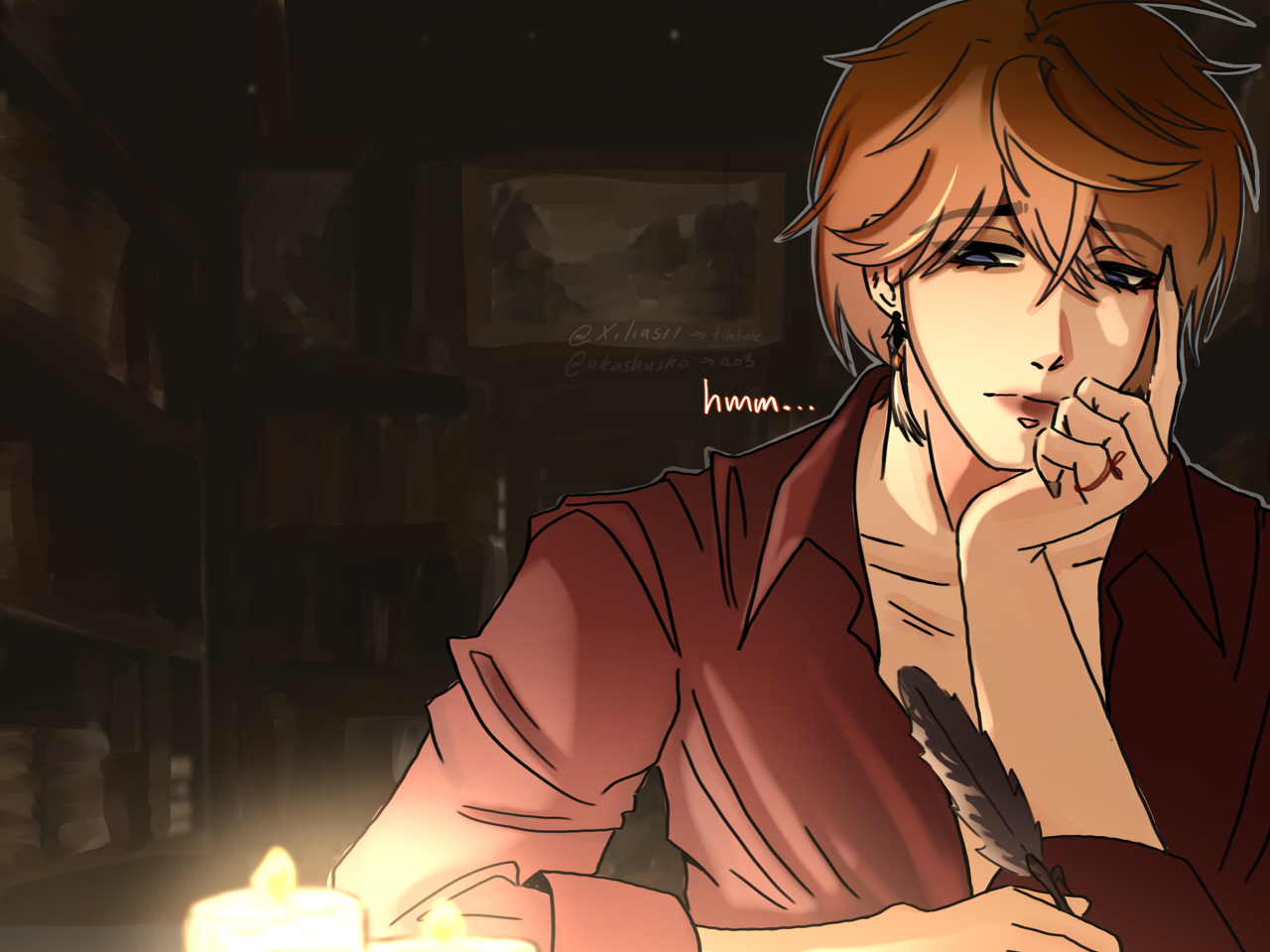
Childe wrote steadily, the quill moving with increasing assurance as thought gave way to articulation and all the while, on his smallest finger, the faint red thread remained, neither tightening nor loosening, simply present.
Waiting, as though it had always been waiting for the moment it would finally be acknowledged not as myth, but as consequence.