
Work Text:
The thing about a name is that you don't really get to pick one.
Somebody picks it for you, and then it lives in your house growing up like a piece of furniture, and you don't really notice it for years until one day you walk past it and you realize the chair has been the wrong size for your body since you were eight. You realize people have been calling you the wrong word your whole life. You realize you've been answering to a sound that does not, in any meaningful way, mean you.
Then one day, somebody you love uses your name in a way that fits, and your whole life rearranges itself in your head, and you do not, ever, recover.
Buck thinks about this on a random Wednesday night.
He thinks about it because Eddie has just gotten home from a twenty-four and is at the sink, doing the unconscious thing he does where he runs his hands under the water for a long second before he does anything else with them, and Buck, leaning against the kitchen island, holding a coffee mug, in the soft warm gold of the under-cabinet lights — said hey, you without thinking, and Eddie, without looking up, said “Hey, Evan.”
Just that.
Hey, Evan.
It hit Buck the way it always hits him.
Which is to say, it hit Buck like a clean blow under the ribs, the kind of pleasant ache that makes you go still for a second to register the feeling. The kind of thing Buck has come to recognize over the last several years as this is what it's supposed to sound like.
Eddie does not, currently, know he's done anything.
Eddie is drying his hands on the dish towel. Eddie is asking about dinner. Eddie is doing what Eddie does; operating from the assumption that the man across from him has heard his question and will answer him accordingly, when in fact the man across from him is, for one second, fifteen years deep in his own life, thinking about the shape of his own name in other people's mouths.
"Buck?"
"Mm." Buck mummers, awaken from his stupor.
"I asked about dinner?"
"Yeah. Yeah — uh — I'm making pasta. The pasta thing."
"The pasta thing?" He asks with a chuckle.
"Yes, Eddie, I'm making Cacio e Pepe."
Eddie, drying his hands, looks at him sideways. The corner of his mouth lifts up. Then he reaches into the fridge for a beer, and Buck has, by then, recovered enough to be present in his own kitchen again, and the moment ends.
But it stays with him.
It stays with him through dinner, through the dishes, through the quiet evening of Eddie on the couch reading a book and Buck pretending to read his phone and actually just listening to his own name in his head on a loop, in twelve different voices, like a song he can't shake.
* * * * *
The earliest Evans are not about love.
He doesn't remember the first time he heard his own name. Nobody does. But he remembers, by elementary school, the shape of it — the way it lived in his mother's mouth like an accusation already half-formed, the way it lived in his father's mouth like a verdict that had just been entered.
“Evan, get down from there.”
“Evan, what did you do?”
“Evan, what is wrong with you!”
“Evan, again? Really?”
He fell out of a tree when he was seven and broke his arm. The cast was bright blue. He remembers his father in the hospital corridor saying Evan, and the way the Evan landed before the rest of the sentence did, and how he understood, even at seven, that the Evan was the actual content of the sentence and the rest of the words were just dressing.
He got Cs in third grade. Evan. He didn't make the soccer team. Evan. He came home with a black eye from a fight he hadn't started, but that the school had decided he had. Evan.
His mother said his name like she was tired of saying it. His father said his name like a man closing a door.
He learned, early, that Evan was a sound you didn't want to hear. You didn't want it from teachers. You didn't want it from coaches. You didn't want it from your parents. Evan meant something was wrong, and the something was usually you.
By the time he was old enough to understand what other kids' names sounded like coming out of their parents' mouths, he understood that something was wrong with his.
He didn't have the language for it then. He just knew his name was a thing that happened to him.
* * * * *
The first Evan that ever sounded like love came from Maddie.
He was nine, maybe ten. He'd done, well, he doesn't remember exactly what, the incident in question has been lost to time the way most childhood things get lost, but he remembers the consequence, the closed bedroom door and the rule against dessert and the kind of crying you do when you are nine and you are inside your own head and you cannot get out. But then, Maddie came in.
She didn't knock.
She didn't ask if he was okay.
She just came in, and sat on the edge of his bed, and put her hand on his back, and said;
"Hey, Evan."
That's it.
Hey, Evan.
But Evan, in Maddie's mouth, was an Evan he had never heard before. It was warm, soft. It had nothing in it that was about him being wrong. It was just his name, said by a person who loved him, used the way a name is supposed to be used; as a specific call to attention from one human to another that means you are here, and I see you.
He cried harder, he cried louder and Maddie just sat there with her hand on his back and let him.
When he stopped, eventually, she said it again.
"Evan. Look at me, please?" She said with that smile that always reassured him.
He looked at her.
"No matter what, you will always have me, and I will always have your back. Always Evan, Always."
He remembers thinking, with the innocent clarity of a nine-year-old, Oh. So that's what it's supposed to sound like.
* * * * *
Maddie still says it that way.
She says it on the phone when Buck is in the truck on his way back from picking up Theo from a soccer game, and she's calling to check in about the weekend — she and Chim are taking the boys, both of them, so Buck and Eddie can have a couple of days alone.
"How are you holding up?”
"I'm great."
"Are you?”
"Maddie."
"I'm just asking."
"I'm great. I am — I am, in fact, better than great. I am very close to married, I have Theo in the backseat asking for McDonald's, my fiancé is at home making something for dinner that probably smells amazing, and you and Chim are taking my children for the weekend so I can do what I want with the man I love. I am, by every objective measure, thriving." He said with perhaps a little too much enthusiasm.
"Okay." She laughs.
"Okay?"
"I said okay, Evan."
He smiles. He can't help it. The smile is automatic now, a thing his face just does when his sister says his name the way his sister says his name. He's been hearing it from her this way for, in some sense, his entire life. It doesn't get old.
"Maddie."
"Yeah?"
"Are you gonna feed them dinner Friday night?"
"What kind of question is that, Evan?"
"They are, both of them, very particular —"
"Evan —"
"Theo will only eat the chicken nuggets from —"
"Evan, my sweet, sweet brother, I have two children and if you remember, we grew up together and I made dinner you a number of times. I will figure it out. I always do."
"Okay." Buck concedes.
"Okay. Tell Theo I love him."
"Love you, auntie!!!” Theo screams from the backseat, lifting his head momentarily from his picture book.
"Love you, Evan," Maddie says through her chuckle.
"Love you too, Mads."
He hangs up.
In the rearview mirror, Theo, who is wearing his soccer uniform and has grass stains on both knees and an expression of deep cosmic outrage about something he heard on the radio, meets his eyes.
"Dad."
"Yeah, bud."
"Why does Auntie Maddie call you Evan?"
Buck huffs.
"Because that's my name — "
"But your name is Buck."
"Sure, I'm Buck now, but I was Evan first. Buck is — Buck is more of a nickname. Like how Theo is short for Theodore."
"Nah-uh. Theo isn't short for Theodore." Theo says, giggling.
"It absolutely is! What are you talking about…Theodore.” Buck says menacingly.
"MY NAME IS THEO!!!” Theo exclaims, before very quietly whispering, “Mr.Poop.”
"Okay, we are not doing that again," Buck says as he reaches back blindly and tries to swat at Theo's leg. Theo dodges, laughing. Buck laughs. The light turns green.
"Either way, kid. Buck is a nickname. Evan is what I started with."
Buck thought that would be the end of it. It was not.
"Does Papa Eddie call you Evan?"
Buck's stomach fills with butterflies at the very thought of it.
"Yeah, bud, he does."
"Why?"
"Because he —" Buck pauses. He thinks about how to say it. He decides on the simplest version. "Because he means it."
Theo, in the rearview, looks at him for a second longer than he needs to. Theo is seven years old and has, in the last year, started doing this thing where he catches the meaning of an adult sentence about half a second before Buck has finished saying it. It is, Buck decided, one of the great unanticipated pleasures of fatherhood.
"Okay" Theo says.
Then he asks about McDonald's again.
* * * * *
The fire academy was where Buck started.
It was a Wednesday morning. Roll call. The instructor, a guy named Sutton, who had a mustache and a clipboard and the precise affect of a man who had been doing this exact job for fourteen years and considered it the only thing worth doing — was reading down the list.
“Evan Albright.” Albright’s hand went up.
“Evan Buckley.” Buck’s hand went up.
“Evan Garcia.” Garcia’s hand went up.
Sutton, looking up over his clipboard with the air of a man being personally aggrieved by demography, realized there was a structural problem with this class.
He kept going through the list. He landed back on Buckley. He looked at him.
"Buckley."
"Yes, sir?"
"You’re gonna go by Buck from now on." He said as a fact, not a question.
It wasn't a question. Buck — who had not, up to that point, ever been called Buck by anyone, who had been Evan for twenty-four years, who was at this exact moment thinking about how his coffee was getting cold and wondering whether he was going to fail PT, opened his mouth to say no, sir, I go by Evan, and then he closed it again.
Then he said, "Yes, sir, Buck."
Sutton checked something on his clipboard.
"All right. Buck it is."
And that was it.
Buck stood there for the rest of roll call, thinking about it. He had not, until that moment, considered that he could just decide. He had not considered that a name was a thing a person could choose. He had spent twenty-four years answering to Evan because Evan was what was on his birth certificate and on his school records and in his parents' mouths, and it had never occurred to him that you could simply, on a Wednesday morning at the fire academy in Los Angeles, just change the name people call you.
After roll call, he went to the bathroom and stood at the sink for a minute and looked at himself in the mirror.
He said, very quietly; “Buck.”
The name did not, on the first try, feel like his.
But it didn't feel wrong either. It felt like a shirt he had pulled on without checking the size, and the size was — not exactly right, but not wrong, and the longer he wore it, the more it would settle on his shoulders.
He said it again. “Buck.”
The second time, he liked it better.
By the end of the first week, the other recruits called him Buck. By the end of the first month, he introduced himself as Buck. By the end of the first year, Buck was who he was — the name had grown into him and he had grown into it, and somewhere in there he had stopped being a man who had spent his life cringing at the sound of his own name and started being a man who walked into rooms with his name held out in front of him like a thing he was proud of.
His parents kept calling him Evan.
He let them.
He didn't have the energy to ask them to stop.
* * * * *
Then there was Tommy.
He doesn't think about Tommy a lot anymore. There was a period — after the breakup, where he thought about Tommy constantly, despite busying himself with baking, in the useless way you think about a thing you have not yet finished metabolizing. He thought about the things Tommy had said. He thought about the things Tommy had not said. He thought, mostly, about the way Tommy had said his name.
Tommy had called him Evan.
Always.
Never Buck.
Never babe or honey or any of the small pet names people in relationships hand each other to wear. Evan, like a fact, like a piece of paperwork. Evan, in his ear in bed. Evan, in the kitchen. Evan, at the start of every sentence Tommy ever delivered to him.
Buck had not, at the time, been able to name what was wrong about it.
He had a vague feeling. He had the unsettled feeling you get when you're wearing a shoe that's almost the right size but isn't, that you don't notice for the first half of the day and then by the end of the day your foot is killing you and you can't figure out why. The Evan, in Tommy's mouth, was almost right. It was a name. It was his name. Tommy was using it. That should have been enough.
It wasn't enough.
He remembers, maybe the third month of dating. They had gone out to brunch at a place in Studio City, the kind of brunch place that had a line, the kind of brunch place Tommy liked because Tommy liked things that had lines. There were four other people at the table that Buck was meeting for the very first time, two of Tommy's friends and their wives. Everyone was on their second mimosa, Buck was on his first.
One of the wives, Linda, turned to Buck and nonchalantly said, “And so what should we call you? Can’t keep calling you ‘Tommy’s boyfriend’ anymore.”
"Buck," he said, without thinking. "Everyone calls me Buck."
There was a slight pause at the table.
Tommy laughed; the dry single-syllable laugh that was not a laugh, and said, “Buck is like — that’s what they call him at work. But he’ll always be my Evan.”
Linda looked at Buck, Buck looked at Linda.
Buck, corrected himself and said, "Yeah, it's Evan, actually."
But it landed wrong in his mouth. He could feel it land wrong and he could feel Tommy's friends register the correction, and he could feel his face tightening the way it did when his name had been used as a thing to correct.
He didn't push back, he nodded, he smiled and his first mimosa quickly turned into his second.
* * * * *
It happened again at a coffee shop a month later.
He doesn't remember the place, he doesn't remember what they were getting, but He remembers the barista; a guy in his early twenties with a tattoo of a moth on his forearm, asking for the name on the order. Buck opened his mouth to say “Buck”, and Tommy, beside him, beat him to the finish line and said, "Evan."
The barista smiled at Buck , wrote Evan on the cup in cursive and moved on to the next customer.
Buck stood there for a second with the uneasy feeling rising up in his chest in a way he could not, at the time, name. Tommy was on his phone. Tommy had answered for him in the way you answer for someone whose name you have decided is, in some sense, your business. Tommy had not looked at him when he said it.
Buck told himself it was nothing. That it was just a name and there was no reason to make a thing of it. That it definitely wasn’t passive-aggressive.
But he sat at the table afterward, with the cup in front of him with Evan in black Sharpie across the white paper, and he could not, for several minutes, bring himself to drink the coffee. The Evan, in Tommy's mouth at the counter, had sounded — Buck recognized this only later, with the gift of hindsight — exactly like his father's Evan. Curt. Possessive. The Evan of a man closing a door.
He just drank his coffee, eventually, and went home with Tommy, and let the name keep landing wrong for another few months until the day Tommy decided Buck was too much for him.
It took Buck most of the year, after the breakup, to fully understand what had been wrong.
Tommy had said Evan the way people said Evan to him when they wanted to make a point.
“Evan, come here.”
“Evan, I told you already.”
“Evan, are you listening to me?”
“Evan.”
“Evan.”
“Evan.”
Tommy's Evan was the Evan of every adult who had ever made Buck feel like he was a problem to be managed.
It was the Evan of his childhood.
It just took him longer than he’d like to admit to see it.
* * * * *
The first time Eddie ever called him Evan was in a hospital room.
Buck does not remember everything about that day. He remembers the specifics that matter — the fluorescent light flickering, the smell of the room, which was the smell every hospital room in Los Angeles has, and which Buck has, in his life since, come to think of as the smell you associate with almost losing someone.
He remembers Eddie sitting on top of his hospital bed.
He remembers Eddie in a v-neck, his right arm in the sling, waiting for the paperwork to come through. He remembers the blooming bruise on the back of Eddie’s other hand where the IV had been taken out. Eddie had just told him about the will.
He had said it — Buck remembers this — casually. Or, no, not casually. Deliberately casually. The specific studied evenness of a man who had made a decision and was, on the record, going to deliver the decision to the person it concerned like it was a normal Tuesday and not the most enormous thing that would happen in either of their lives that year.
“So I went to my attorney, and changed my will. So someday, if I didn’t make it, Christopher would be taken care of. By you.”
Buck had, for a second, not been able to make a sound.
“What?” Buck says quietly, still trying to process the words that had come out of Eddie’s mouth.
“It’s in my will that if I die, you become Christopher’s legal guardian.”
“H — how does that even work? Don’t you need my consent?”
“My attorney said you could refuse.”
“You know I wouldn’t,” Buck says sincerely, his eyes doing their best to keep the tears at bay.
“I knew you wouldn’t.”
“He has grandparents. Other family.” Buck says as a rebuttal.
“Yeah, but after Shannon left, they tried to guilt me into giving Christopher to them. It’s not what I wanted then, it’s not what I want now.”
“If - it came to that. Wouldn’t they fight for him?”
“I dunno,” Eddie chuckles, “Maybe. Probably. But no one will ever fight for my son as hard as you. That is what I want for him.”
Buck remembers not being able to look at him for a second when Eddie said it. Buck remembers the water cup on the tray table blurring.
Buck remembers, then, asking.
“You said you did this last year. Why are you just now telling me?”
Eddie had looked up at him.
The pause that followed was, Buck now understands in retrospect, Eddie deciding whether or not to bring it back up. Buck did not know, at the time, what Eddie was deciding. Buck was just a man with a question in his mouth and his heart doing the thing it did around Eddie Diaz.
“Because, Evan, you came in here the other day and you said you thought it would have been better if it had been you who was shot. You act like you are expendable, but you’re wrong.”
Buck sat there and let it echo within him.
He has, since that afternoon, replayed the beat more times than he is going to admit out loud, even to Eddie. He has tried to reconstruct exactly what he heard first. The because, or the Evan. He thinks — though he cannot prove it — that he heard the Evan first. He thinks the Evan landed before the rest of the sentence, the way names tend to land, the way you hear your name a half-second before you hear what the name is attached to. He thinks the Evan landed and his whole nervous system stopped.
Because the Evan — in Eddie Diaz’s mouth —was not the Evan of his mother.
It was not, even, exactly the Evan of Maddie, though it had Maddie’s same warmth underneath.
The Evan of Eddie was its own thing.
The Evan of Eddie was a man calling another man by his given name because that man had something that could not, in Eddie’s kitchen or Eddie’s truck or the apparatus floor at the 118, be answered.
The Evan was the answer.
It was Eddie choosing the version of Buck who had said he was expendable — the underneath version, the one Buck did not hand out — and speaking directly to him. You. The one who said that. I heard you. And I want you to hear me back.
The Evan of Eddie meant I am talking to the part of you that lives under everything, and the you that lives under everything has to hear this. Because I have made you the person my son goes to if I die. Because that is not a decision I could have made about a man who was expendable. Because you are wrong about yourself.
Buck had nothing to say back. He had nothing that would fit.
He just sat there and looked at Eddie and felt the Evan sit in his chest like a warm coal.
He said okay. He thinks he said okay. He remembers eventually helping Eddie out to the truck. He remembers driving him home. He remembers going back to his own place that night and standing in his kitchen for a long time with the lights off and not being able to eat.
He remembers, most of all, that Eddie did not use his name again, in that register, for a long time after.
The Evan had been load-bearing.
Eddie was — Buck understood this later, when he had the language for it — a man who used load-bearing words only when the load was there. The Evan, in that hospital room, had been the load. It stayed there, in Buck’s chest, for years afterward.
He did not talk about it.
But he thought about it, in the unguarded moments before sleep, more times than he was going to admit.
* * * * *
The Evans, after that, were rare.
For years, when Buck and Eddie were friends and not yet anything else — when Buck was still in the long quiet wilderness of being in love with his best friend and pretending, very thoroughly, that he wasn't — Eddie called him Buck. Always Buck. Buck on the apparatus floor, Buck in the kitchen at the firehouse, Buck on the phone, Buck in the truck on the way to a call, Buck when he was being praised, Buck when he was being chewed out.
Just Buck.
The Evans, when they came, came at specific moments. Buck kept a mental file of them.
There was the Evan after the lightning strike, in the hospital, when Buck had not woken up yet but he could still hear- he could hear Eddie. And Eddie was sitting in the chair next to the bed with his head in his hands, and Eddie pleaded with a higher power, “Please, Evan, please wake up.”
He said Evan like a prayer that had been answered before he had finished saying it.
There were maybe four or five of these, scattered across the years. Buck remembers each one. He has, on more than one occasion, in the private moments before sleep, taken them out and looked at them like a man with a private collection of rare stones.
* * * * *
Then they finally got together, and the Evans — multiplied.
Not all at once. Eddie did not suddenly start using Buck's full name like a man who had discovered a new toy. Eddie used the Evans, still, with care. They still meant something. They still landed.
But the contexts multiplied.
There was the Evan in bed.
Buck has, since the first time he heard it, become a quiet expert on Eddie's Evans in bed, they came in a specific shapes. There was the murmured Evan when Eddie was half-asleep, and Buck had come up behind him and put his arm around him. There was the gasped Evan when Buck was doing something with his mouth that Eddie was not, on principle, going to admit he liked as much as he liked.
And then there were the others.
There was, for example, a few months in, when Buck had Eddie on his back in the bed they were not yet sharing every night but had been increasingly sharing — Buck above him, Eddie's hands in Buck's hair, the lamp on the nightstand turned low, and Eddie, somewhere in the middle of it, looked up at him with his eyes dark and his mouth open and said, ragged, into the inch between their mouths —
"E - Evan — fuck." Eddie said breathlessly, his hand caressing Buck’s face.
Buck nearly came on the spot.
It wasn't even, it wasn't a dirty Evan. It wasn't a come on or a please. It was just his name, said low and breathless and like Eddie meant every letter of it, said in the middle of a moment that Eddie was, by every objective measure, deeply enjoying. Evan was the only thing Eddie said for the next thirty seconds. He said it again, Evan, with his hand fisted in Buck's hair and his hips coming up off the mattress, and Buck — Buck, who had spent his entire life learning what Evan sounded like in other people's mouths; discovered that Evan could also sound like this.
He thought about it for the rest of the week.
He thought about it the way a man thinks about a thing he has just learned about himself.
* * * * *
There was the Evan of teasing.
This one came up unexpectedly, maybe four months into them being together. They were at the firehouse, sitting around the kitchen table on a slow morning between calls. Buck was in the middle of telling a story, a good story, or so he thought.
"— so we get the call, and we roll up on it, and there is a lady standing on her porch, holding a chihuahua, and behind the chihuahua — behind this tiny, angry chihuahua, is a pit bull. But not an ordinary pit bull, guys, this pit bull is huge. It is the largest pit bull I have seen in my life. It is taller than the lady. It is taller than me."
"It was not taller than you, Buck," Hen said as she rolled her eyes.
"Hen, I am telling you, this thing was —"
"How tall was it, Buck?"
"Seven feet." He said with absolutely certainty.
"Seven feet?"
"At the shoulder, Hen. Not counting the head."
Ravi, delighted, mouth full of pineapple, "What the f—?"
"I am telling you what I saw. I saw a seven-foot pit bull standing on this lady's porch behind a chihuahua that could fit in a coffee mug, and I —"
Eddie, from the coffee machine across the kitchen, without turning around:
"Evan Buckley, c’mon, it was not seven feet tall."
Just that, in a register Buck had, until that moment, never heard him use.
It wasn't the load-bearing Evan. It wasn't the bed Evan. It was an Evan of mild correction; it was an Evan that came with the implied eye-roll Eddie had never quite let out in front of the team.
Buck stopped mid-sentence.
He looked at Eddie's back. He looked at Hen and Chim and Ravi.
“Eddie just used your government name." Ravi blurted.
Eddie turned around with his coffee. He leaned back against the counter. The corner of his mouth was doing the corner thing. He took a sip of his coffee like a man who had not, in any sense, just rearranged the dynamics of his fiancé's afternoon.
"The dog was maybe four feet; he was standing on top of the stairs."
"It was seven feet, Eddie."
"It was the size of a medium retriever."
"It was the size of a small horse."
"You said, at the scene, and I quote, ‘aw, buddy, come here.’ Which you would not say to a 'seven-foot' pit bull."
Buck rolled his eyes and crossed his arms the same way Theo did when he was told he could not have ice cream after brushing his teeth.
"Evan, c'mon now." Eddie teased.
"Edmundo," Buck sing-songed, thinking, well, two can play that game.
Hen, slow and careful, said "You guys have fun with, whatever this is."
And one by one, the team left them to their devices and shortly after, a locked supply closet Evan, was born.
* * * * *
There was even the Evan of disagreement.
This one is rare; they do not, in general, fight. They have, over the course of their relationship, developed a kind of equilibrium where most of the things that would, with other couples, become an argument, become instead a short conversation that gets handled right away. Eddie is a man who does not waste his anger and Buck is a man who has learned, slowly, to do the same.
But there was one night where this Evan was used.
A few months back. Buck had come home from a call shaken, the boy they lost was about Theo’s age, and Buck had spent the ride back staring out the window instead of talking. And instead of calling and telling Eddie about it, he had, in the very specific way Buck used to decide things in the old days, put his phone on Do Not Disturb, changed into running clothes, and he didn’t drive home.
He had decided to go on a run.
Not a normal run. A run. Twelve miles. After a shift that had already eaten him, in the dark. Without telling anyone where he was going.
“Hey, you leave the station yet? Theo is requesting risotto, again.” Eddie texted.
“Buck? Call me when you can.” He sent when Buck should have been home by now.
“Evan, I'm asking you to answer your phone. Please.” Eddie typed, trying to keep his hands steady.
By the time Buck was five miles in, his heart rate in the wrong zone and his brain finally starting to go quiet, Eddie was in the kitchen at home, holding his own phone in his hand and calling Hen.
Buck found out later that Eddie had called Maddie at 7:47 PM. He had asked, evenly, if she had heard from him; Maddie had said no. Eddie had asked if she could track Buck's phone and Maddie had done it while Eddie was on the line, and had said, “He's moving. He's in Griffith Park.”
The fact did little to ease Eddie's mind.
By the time Buck got home; sweaty, shaking, dehydrated, the hollow feeling in his chest of a man who had run too far on too little — it was past nine.
Eddie was in the kitchen.
He was not in the kitchen pretending to do something else, he was in the kitchen waiting. His hands were folded on the island, the lights were on at the lowest setting and his phone was face-down on the counter beside him. He had made sure Chris and Theo were watching a movie in Chris' room before Buck came home.
When Buck finally sauntered in, Eddie's head snapped up.
"Where the hell were you?" Eddie's arms were crossed now.
"I went for a run. Where’s —" Buck said with more edge than he intended.
"They’re in Chris’ room.” Eddie snapped back. “You went on a run? For four hours?"
Buck stood there in the kitchen in his running shorts. He was, suddenly, very aware that he was very tired, that he had not eaten in nine hours, that his phone had been on Do Not Disturb for four hours, and that he was about to be on the receiving end of a conversation he had been avoiding since the moment he got out of the truck.
He opened his mouth to deflect.
Eddie said, very quietly, before he could:
"Evan."
Buck stopped.
It was the Evan of a man who was, at this moment, asking the other man in the room to come back. The Evan of I am not yelling at you. I am not angry at you. I need you to actually be in this conversation. I need you to actually hear me.
Buck looked at him.
"Sit down. Please." Eddie asked.
Buck sat down.
Eddie did not, at first, say anything. He just looked at Buck across the island for a second. Then he pushed a glass of water toward him — which he had, evidently, poured at some point during the last hour and was still sitting there waiting to be drunk.
"You put your phone on Do Not Disturb." Eddie said plain as day.
"Yeah?"
"For four hours."
Buck was looking at the floor, he couldn't come up with an answer.
"I texted you three times. I called you twice. I sat here at the island with dinner going cold, and I did not know where you were."
Buck looked at the water glass.
"It was a bad call, Eds." He finally said.
"I know it was a bad call, Chim told me."
"I just needed to — "
"I know, I know what you needed to do. But, that is not what this is about."
Buck looked up.
Eddie's face was doing the thing it did when Eddie was, in real time, choosing which words to use. Eddie was not, currently, angry. Eddie was tired. Eddie had, Buck could see, spent the last three hours going through the specific catalog of small fears that live in the head of a man whose partner is a first responder and whose partner has, in this instance, disappeared.
Eddie said, very evenly:
"Do you know what I do, in my head, when you don't answer your phone?"
Buck did not, at the time, have an answer.
"I go through the list. Buck. I go through the list. I go through every call we've run in the last six months where somebody didn't come home. I go through the calls where somebody's wife was sitting at home waiting for a text that never came. I go through every call. The 405 pileup last March. The apartment fire in Boyle Heights. The kid in the pool. I sit here at this island, and I go through the list, and I cannot stop, and by the time you walk in the door, I have run every version of this evening where you don't come home."
Buck's mouth had, at some point during that, opened.
He couldn't close it.
"Eddie." He tried to muster.
"I'm not angry."
"I know."
"I am asking you, to call me. Or text me. Or send a thumbs-up emoji. Something, anything. So I know you are alive."
"Okay."
"Even if it's — Evan, even if it's just 'I need to be alone for a while, I'll be back.' Even if it's that. Even if it's 'I don't want to talk right now'. ThatI can handle. What I cannot handle is silence. You can’t do that to me, you can't do that to them."
Buck's heart stopped; he and Eddie never used the kids against one another to prove a point, but in this instance, it had its desired effect.
He looked at Eddie's hands on the island, he looked at his own hands, trembling on the island and very quietly said, "I'm sorry."
"I know." Eddie said as he rounded the island.
"I — really — I'm sorry, Eds," Buck said, the tears no longer at bay.
"Come here, I got you." Eddie said as he embraced Buck.
Eddie's hands went to his waist, and Eddie pulled him in and, despite the sweat and the salt and the run of shame Buck had just carried through the front door, Eddie held him. He held him for a long time. His hand went up into the back of Buck's matted curls, his face went into Buck's shoulder. Buck felt him exhale a breath he had been holding all night.
"I love you," Eddie said into his shoulder.
"I love you too," Buck said. "I love you, I'm sorry. I love you." He whispered.
They stood there in the kitchen for a while.
At some point, Eddie made him drink some water.
At some point after that, Eddie put food in front of him, reheated, and sat next to him at the island and watched him eat, one hand on Buck's thigh under the counter, and didn't say anything until Buck was done. After, they checked in on the boys; they had fallen asleep and Buck told himself he was making pancakes in the morning.
The Evan of that conversation, Buck filed in his head as the Evan of the man I love needs me to listen.
It is the same Evan as the Evan of Eddie's hospital room years ago, but higher-stakes yet softer and entirely from inside the home they have built together.
* * * * *
But the Evans that he loves the most, the ones he has come to live for, are the ones that are not load-bearing at all.
The Evans in the morning, when Eddie hands him a coffee and says here, Evan, and Buck's whole face lights up.
The Evan, the trash, when Buck is at the sink, and Eddie is walking past with his hands full and is reminding him, without breaking stride, that tomorrow is Tuesday and the bins go out tonight.
The Evan, look, when they're in the truck and a dog has done something in the next lane and Eddie wants Buck to see it before the light changes.
The Evan, c'mere, when Eddie is on the couch and Buck is across the room and Eddie wants him close.
The Evan, please, when Eddie is in the middle of telling Buck something serious and Buck is making a joke to deflect, and Eddie is asking him, gently, to come back.
The Evans that mean nothing in particular. The Evans that mean only you, the person I love, the person I am talking to right now, the person whose name in my mouth means love.
There are hundreds of them now. Buck has stopped trying to keep count. They happen, on average, four or five times a day, scattered through the settled hours of the household — the dinner Evans, the kitchen Evans, the Evan in the doorway when Eddie's coming home from shift and wants Buck to know he's home before he even walks all the way in.
Each one lands the same way it landed in his bedroom when he was nine and Maddie was sitting on the edge of his bed.
Oh, his chest says, oh, every single time. That's what it's supposed to sound like.
* * * * *
It's a Wednesday night. The boys are in Theo's room playing some game Buck does not understand the rules of, with the volume just barely under household-acceptable, and the kitchen is quiet, and Eddie is on the couch in their living room with his laptop on his thighs and Buck is at the other end of the couch with his own laptop on his and a glass of red wine on the coffee table between them.
The invitations are due to the printer at nine AM tomorrow.
They've been working on them for about an hour. They are, by any reasonable measure, mostly done. They have picked the font (after a civilized argument about serif vs. sans-serif, which Buck won). They have picked the paper (cream, slightly textured, the kind that costs eight dollars a sheet, which Eddie won). They have approved the wording for the address card. They have approved the RSVP wording.
The last thing to lock in is the names.
Buck has been typing.
Eddie has been reading on his own screen, comparing layouts, occasionally looking over at Buck's screen to check progress, and occasionally taking a sip of his own wine. The TV is on at low volume in the background. Buck finishes typing.
He turns the laptop so Eddie can see it.
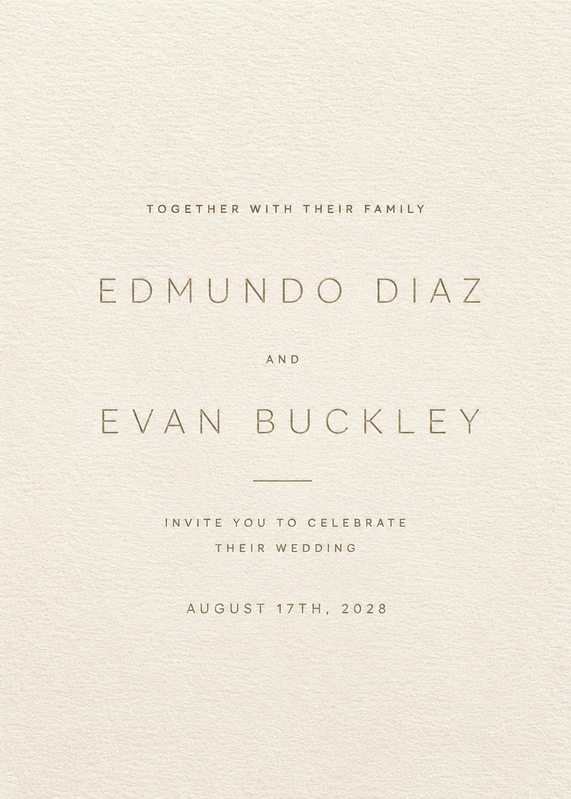
Eddie looks at it for a second.
He looks at the screen, and then he looks at Buck, and then he looks at the screen again.
The corner of his mouth ticks up.
"Buck."
"Mm." Buck grunts back.
"You're sure?"
"About what?"
"About the —" Eddie gestures, vaguely, at the screen. "About Evan."
"Yeah, I am," Buck said simply.
"You sure, Evan?" Eddie said with a slight inflection in his voice.
He says it the way Eddie sometimes says it; playful, light, the corner of his mouth tipping up, the Evan coming out warm and slow and entirely on purpose.
Buck's chest tightens.
He sets the laptop on the coffee table. He looks at his fiancé in the lamplight in their living room, in a soft t-shirt that used to be Buck's, his hair still a little damp from the shower and his face softening the way it does when Eddie is teasing him about something that is not a tease.
Buck has thought about this. He has thought about exactly how he wanted to put his name on the invitation. He has thought about whether Evan Buckley was the right thing or whether it should just be Buck, the way everyone in his life calls him, the way he has signed every official document since 2017.
He decided.
He decided that on a piece of paper that is going to go into the hands of every person who matters to him — the intimate private list of people he has built into the family he has — he wants the name on the invitation to be the name his husband uses for him. The name his sister uses. The name Maddie used when he was nine years old and crying in his bedroom and didn't yet know what his own name could sound like.
The name Eddie said to him in a hospital room years ago and meant it.
He has decided that, in this house, in this life, that Evan is the load-bearing version of him and that Buck is the everyday. The wedding invitation, which is the document that announces to the world that he is starting his official life with the man he loves, is going to have, on it, the Evan version.
He looks at Eddie.
"You can call me Evan if you want."
Eddie's whole face lights up.
He sets down his own laptop. He sets it on the coffee table next to Buck's. He turns sideways on the couch and reaches across the space between them and takes Buck's hand. His thumb brushes the back of Buck's knuckles.
He says, quietly, "Okay, Evan, if that’s what you want."
It's a whisper. It's said into the inch of space between them. It's said the way a name is said when the name is the sentence, when there is nothing else that needs to be added, when the whole thing the speaker wants to communicate has been compressed into a single word delivered with the specific care of a man who has been calling this person by this name for years and is going to be calling him by this name for the rest of his life.
Buck's eyes get wet.
He doesn't fight it.
Eddie leans across the couch and kisses him.
He kisses him slowly. He kisses him the way you kiss a man whose name you have, by some private agreement neither of you ever signed, become the keeper of. His hand comes up to Buck's jaw, and his thumb moves along his cheek, and Buck's whole body vibrates when Eddie kisses him like this.
Buck makes a small sound into his mouth.
Eddie kisses him again, slower, deeper. He pulls back a fraction of an inch and brushes his nose against Buck's nose. Then he says it again, his lips against Buck's mouth, almost into Buck's mouth, like he knows he really means it.
"I love you, Evan."
"I love you too," Buck says, quiet, and then, with that shit-eating grin, “Edmundo Buckley-Diaz."
"Hm, I’m really starting to like the sound of that," Eddie says into a kiss.
"Send the invitations." Buck playfully commands as he pulls his head back.
Eddie laughs. He laughs the laugh Buck has been collecting since 2019, the one Buck has come to think of as his, the one Eddie only ever does in this exact register when they are alone in their house with the lights down low. He kisses Buck one more time. He picks up the laptop.
"On it." Eddie says with a mock salute.
Buck leans into his shoulder, embracing the warmth and that smell that is uniquely, utterly Eddie.
In Theo's room, down the hall, the boys are laughing about something, te wine sits on the coffee table.
Eddie's hand, on the laptop, is the same hand that has, in this house, washed Buck's hair, made Buck's coffee, held Buck's face. It's the same hand that has, over the years, written and erased and rewritten Evan in a hundred small unguarded places in their life together.
Eddie types.
He pauses.
He looks over at Buck.
"Evan?"
"Mm."
"Are you sure about the font?" He asks gently.
"Don't start that again, Edmundo."
"I'm just asking."
"Send the email, Eds."
"All right, all right. If you say so, Evan Buckley-Diaz."
He his send.
Buck closes his eyes, leans his head against Eddie's shoulder and listens to his husband-to-be's breathing.
He thinks, that's what it's supposed to sound like.
That is what my name sounds like when you mean it.