Work Text:
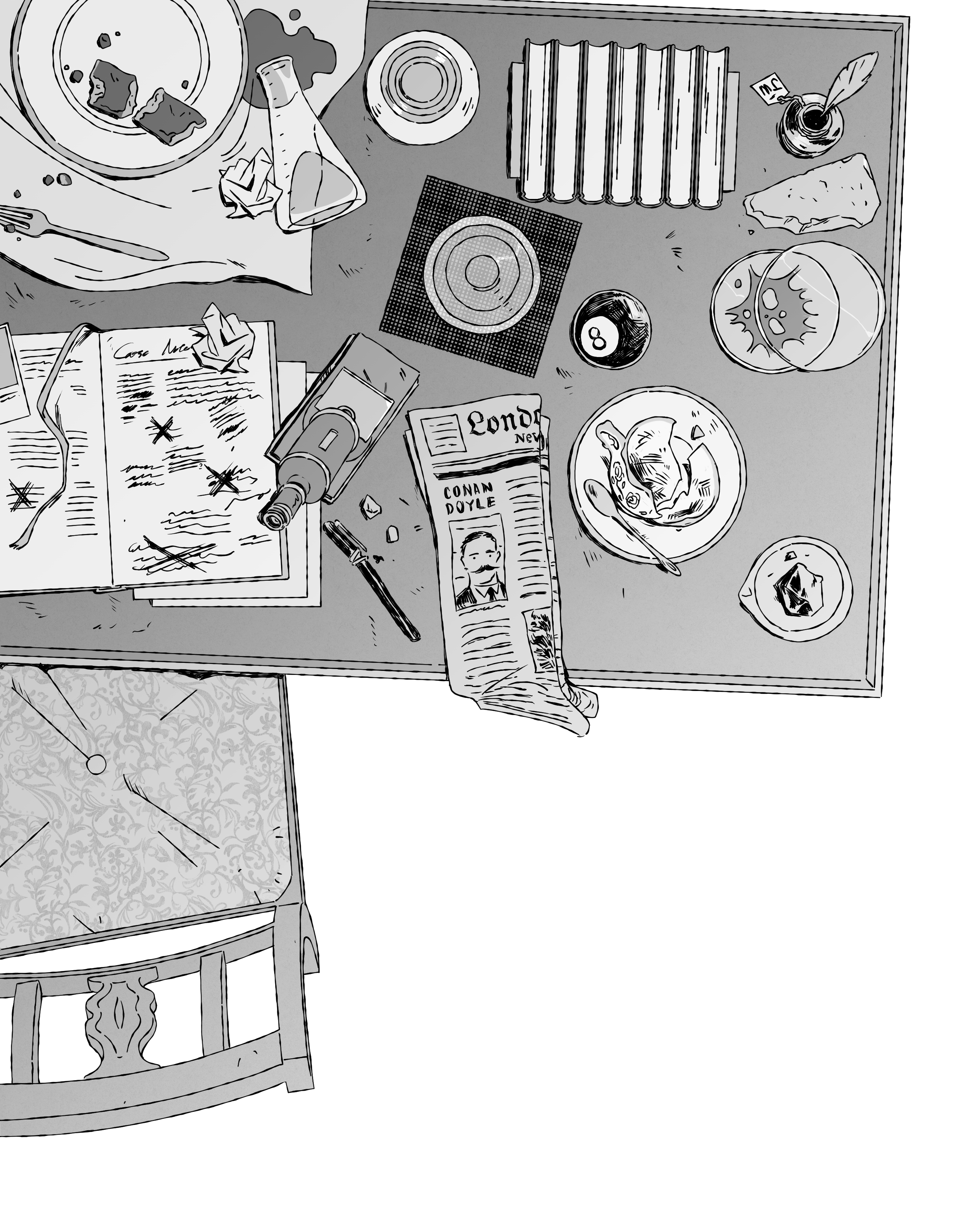
It had been a grueling case, frustrating Lestrade and his men to no end and causing Holmes—often with me in tow—to run back and forth across London night after night. Now that the darbies had been fastened and the Yard left to fill out their reports, I took leave of Holmes to call upon a patient. I had begged off the summons for the last two days, responding that I was consumed with another patient who was possessed by a most vexing condition.
The condition involved depriving himself of sleep for at least three consecutive nights (that he would confess to) while subsisting on nothing but the occasional (and begrudgingly ingested) slice of toast, along with copious quantities of coffee and tobacco. It is a condition made all the more vexing by the frequency of the episodes, and the patient’s insistence on shunning any and all medical advice when in the grips of his affliction.
I have lived with Holmes long enough to know well the pattern which follows such a period. To be fair, there is no danger when the case involves little more than smoking a pipe in his chair and closing his eyes for a few hours in concentration. At the conclusion of those little problems, I have seen him attend a concert, eat nearly an entire meal, or even take a nap.
When occupied with a truly complex investigation—chasing down incongruous clues or the criminal classes throughout London’s labyrinthine streets for nights on end (three consecutive nights, to be precise)—I find that I begin to fall into the role of doctor more than that of friend and colleague.
Holmes has stated previously that his mind is like a racing engine that tears itself to pieces without work. I would suggest a different metaphor: that of a moth, mesmerized by the flickering flame of the unknown. His attention is wholly absorbed. He circles the mystery, ever closer, powerless to withdraw in spite of the danger posed. I spent my share of nights in Kandahar sitting up with the wounded, staring at the insects swarming around the lantern of the surgery tent, contemplating man’s captivation with danger.
When Holmes has solved his puzzle, his mind does not easily accept the loss. I imagine it behaves much like the moth, which can exhaust itself—even die—beating continuously against the pane. He will be physically exhausted from lack of sleep and nourishment while simultaneously overstimulated from caffeine, nicotine, and his syringe. His mind will demand the continued brightness of the flame—any flame—against the impending darkness. He will throw himself into experiments, obscure research, musical composition, a new case—whatever is at hand to occupy his mental faculties and distract him from the encroaching gloom.
As the weariness weighs on him and his body craves sleep, he is liable to fall into a black mood and require several days of rest and silence, cocooned within his bed. And later, like a curious moth, he emerges seeking the light anew.
Medically speaking, little is the matter with Sir Bellingham—my actual patient—save arthritis and age, which prevent him from riding camels throughout the deserts of Egypt in search of antiquities. The affliction is compounded by the accompanying symptoms of boredom and wistfulness for the excitement of his younger days. He resides in a stately townhouse with a fellow aficionado of Egyptian studies, a bright gentleman some decades his junior who serves as companion and assistant. His home is richly appointed, sumptuous without being to the point of ostentation; the eclectic private museum of one who has devoted his life to traveling and collecting. I initially wondered that a man of his means had not sought out a specialist for his ailments, but his persistent questions about my work with the great detective and quick recall of details from A Study in Scarlet made clear he had not sought out just any general practitioner.
There was no harm in putting off my seeing him for a few days as our visits consist mostly of drinking whiskey and soda in his library while he coaxes out stories about Holmes. He requires little in the way of actual medical care and has responded well to the course of therapeutic reminiscences I administer, as they seem to allow him a measure of the vicarious excitement he craves.
Treating him is a welcome reprieve from the incurable cases—whether hypochondriac or consumptive—or the multitude of minor injuries I tend in rented rooms with three children to a bed. I always leave our visits in better spirits than when I arrived, and not only due to his excellent cellar (though I do owe the rather impromptu purchase of Baker Street’s gasogene to at least one of these visits.) His stories of hunting for treasure in the desert never fail to spark a boyish excitement within me, and he enjoys showing off his wonders of the ancient world as much as I delight in seeing them. I appreciate having an eager audience for my own tales, even if they do consist largely of Holmes’ accomplishments, and revel in being the one to provide the denouement, for a change.
My patient was unusually contemplative this evening, ruminating at length about places he is unlikely to see again now that his days of exploration are behind him. I attributed his poor humour to aches and pains to our recent spell of damp weather, which I felt every bit as keenly as my aged patient. His lined face creased deeper from the smile he turned upon his companion who brought another tray of drinks into the library. Sir Bellingham surprised me by turning the topic of conversation from distant lands to that of home.
“You know, at my age, Dr Watson, I have come to realize that the thing is this: A man may travel the world, meet interesting people, experience the exotic, make discoveries, and do all the grand things life has to offer, but at the end of the day, he must be able to return home.”
“Well, of course. We all must lay our heads somewhere,” I responded absently, wondering to myself if Holmes had managed to succumb to sleep at last, or if he was still driving himself to madness at the chemistry bench where I had left him.
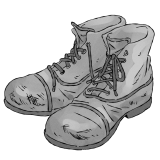
“I’m not just talking about a place to sleep, Dr Watson. No, when I say home, I mean the feeling one gets. That feeling that a man can take his boots off. Do you understand?”
“I believe I do,” I said, suddenly registering my throbbing feet and stiff shoulder. As enjoyable as I found both his company and the contents of my glass as we sat before the fire, it seemed the weariness of the past few days had caught up with me all at once, and I felt a sudden hearty desire to be huddled under my covers at Baker Street. “In fact,” I added with a meaningful look at the clock, “I had better be getting on before it grows any later. Do let me know if the new powders help, won’t you?”
He waved away my question with a gnarled hand and drained his glass, rising slowly to see me out. “It was most enjoyable to hear of Mr Holmes’ latest adventure. You have quite the gift for narration—the way you evoke excitement and drama, how you capture the romance and feeling of the thing! I’m sure Mr Holmes is no end grateful. I forgot to inquire after your patient, the one with the condition which troubled you so?”
“Thank you, Sir Bellingham, you are most kind. Yes, I believe the fellow shall be quite himself soon. Do take care.”
“We’re fortunate to have such a devoted doctor,” he said, shaking my hand, “Get home safely, Doctor Watson.”
Walking back to Baker Street, footsore and fatigued (though consoled by the fine whiskey buzzing in my veins), I felt the sense of relief one feels when duty is done and rest is imminent. It had been satisfying to recount this exploit as concluded. Holmes had handed the Yard their men, and I was settling the ones under my care.
As I turned the key in the door at 221B, I felt the weight of the preceding days drop away. No sound of Yard boots upon the stairs and no midnight manhunts tonight. With any luck, I would sleep a full night and awake to the luxury of an uninterrupted breakfast and perusal of the papers.
I ascended the stairs and caught the scorched, acrid scent of one of Holmes’ experiments hanging in the air. The house was silent, and I knew Mrs Hudson had gone to bed. I prayed that Holmes had done the same as I trudged up our well-worn seventeen steps.
I dropped my bag to its usual spot beside the door and shrugged off my coat. While hanging my hat, I caught sight of one of Mrs Hudson’s favorite teacups upon Holmes’ chemistry table. It was an unusual sight, not merely because he permitted neither food nor drink near his experiments, but because the teacup lay in two pieces.
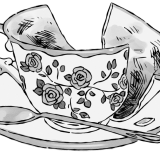
Stepping closer, I picked up the portion which still possessed its handle and saw that while the outside remained a dignified bone white with its familiar pattern of twining pink roses, the inside bore a deep black scorch which did not come away when I rubbed at it with my thumb. Perplexed, I stared at the shard for a moment as if it were one of Sir Bellingham’s mysterious artifacts, until a soft thump behind me drew my attention.
A dark leather slipper lay upon the floor at the end of the settee. Above it, a naked alabaster foot hung in the air, the firelight accentuating the web of blue veins. I stepped around the edge of the furniture and found Holmes sprawled out, one arm hanging so that it trailed the floor, and the other flung over his head. He was deeply asleep.
With his face soft and immobile, he looked at least ten years younger. The past week had made it a rare sight to see his eyes closed without a pipe between his lips. He had been so animated and tense during these last few days that I found myself transfixed by the shocking difference in his countenance.
He did not stir when I returned the slipper gently to his foot. I retrieved his violin and bow from the floor in front of him, then kneeled to pick up the sheets of music scattered haphazardly about the rug and underneath the furniture.
I recognized it as the music I’d purchased some weeks ago following a Sarasate concert. Holmes had hummed and tapped out the songs for days afterwards, and I had thought he would be pleased with the thoughtful gift. But he had accepted the pages without a display of emotion, only a solemn, “Thank you, Watson,” and hadn’t touched them since. It suddenly occurred to me that I had never seen him with sheet music, and wondered if it was possible he could not read it.
I returned the instrument and music to the case by the window before turning to tidy up the last misplaced item in the room.
“Holmes,” I said, grasping his shoulder and shaking gently, “Holmes, wake up. You know you will be miserable if you sleep out here, and Mrs Hudson will make a fuss over you in the morning. Let me help you to bed.”
He groaned and pulled both arms over his face, grumbling something that sounded like, “Your eye.”
“What’s that? Come on, wake up. Do not make me carry you. You know my shoulder will protest as much as you will.”
He flung his arms down and somehow managed to glare at me without opening his eyes. “Hmf… ‘said, ‘you’re right’,” he mumbled like a sulky child before sighing and pushing himself up into a seated position. He swayed for a moment, eyes clenched against the lamplight.
“I’m right, am I? Am I dreaming, or are you? Come on,” I said, leaning down to pull his arm around my shoulders, catching him around the waist with my other hand. I dragged him to his feet, where he swayed again.
His ribs felt pronounced through the thin dressing gown, and I reminded myself to ask Mrs Hudson to prepare some hearty nourishment over the next weeks. Leaning heavily against me, eyes still closed, he dragged one foot in front of the other and allowed me to guide him towards the bedroom.
“Mrs Hudson isn’t going to be happy about the teacup.”
Weakly, he flicked his pale hand and waved away the comment.
“Dare I ask what happened?” I inquired.
He grunted and then mumbled, “Caught fire.”
“It caught fire? Holmes, how does one set a teacup on fire? You could have burned down our home! I hope you realize that.”
He grunted again and dismissed the entire discussion with another flick of his long, pale fingers. “Tempest ‘n a teacup,” he muttered, his lashes deepening the shadows below his closed eyes.
I sighed and released his gaunt form long enough to push the pile of newspapers and books to the floor and pull back the blanket. Holmes fell inelegantly into bed, his face to the pillow, his feet still touching the floor. I knelt and removed his slippers, lifting each leg into bed, before pulling the covers over him.
He murmured his own name, and I believed him to have fallen back asleep until he raised a groggy eyelid and arched an eyebrow, as if waiting for a response.
“Beg pardon? What was that?” I asked.
“Home,” he articulated, petulantly.
“Yes. We’re home.”
“No.”
“Holmes, we are most cert—”
His weary sigh cut me off, and he turned to burrow into his blankets while mumbling, “You said home… not flat ‘r rooms…lodgin’s…”
Leave it to Holmes, half asleep, muttering inarticulately into a pillow, to take note of such a trifle. I sat on the edge of the bed, nudging his knee with my hip so that he accommodated the intrusion.
“I did. I suppose I was thinking of something my patient said this evening.” “Hmmpf… Sur Bel’n’h’m,” Holmes slurred emphatically, demonstrating that he was awake and paying attention despite all evidence to the contrary.
“Yes. He said that home was where a man could take his boots off,” I mused, staring around the room before averting my eyes from the images of the criminals which peered down at me from above the bed. I let my gaze rest instead upon a tattered gray wig which lay upon a pile of yet more newspapers atop a chair.
“I take his meaning. When I was abroad, it was common to sleep fully dressed, including our boots. You never knew when you would need to jump up and be ready for action. And you were never quite awake enough to bother with buttons and laces, so you’d just fall into and out of your cot fully clothed. We were always on guard, never relaxed.”
“Hmphf,” Holmes agreed.
“Exactly. Much like sleeping with a gun in your bedside drawer or a knife under your pillow.”
Holmes mumbled his assent.
“And he said, Sir Bellingham, that home was more of a feeling than a place. I was thinking about how long it had been since I had felt myself home. I mean, there was my boyhood home, but that seems ages ago. And it didn’t always feel like home, when it comes down to it, I suppose. Certainly, there were times when you could not let your guard down… And then school and the army were nothing like a home. An anonymous dormitory or a tent in a sea of other tents. It was a bed. A roof. But it wasn’t a home,” I said, letting my gaze wander over the vast accumulation of objects piled upon the fireplace mantle. I spotted the new bottle of ink which had gone missing from my desk half hidden behind a lone billiard ball and what appeared to be a piece of paving stone.
“Bu’ ‘ere?”
“Well, here is different. Baker Street feels more like home than anyplace else, I suppose. There’s a comfort in returning to these rooms, no matter where we’ve been. There’s Mrs Hudson—I swear, I could pick out the scent of her tea blend anywhere—and there is a soft bed, good warm meals, well-worn chairs by the fire, my books, your violin, my writing desk, your chemistry bench…” I trailed off as he shifted to burrow further into the pillow, noticing the faint curve to his lips. “I can take my boots off here,” I added quietly.
“Hmmff…’s ‘ome,” Holmes agreed, his breath deepening, signaling that he was losing the battle with consciousness.
“Right you are,” I said, squeezing his knee. “Get some rest, my dear Holmes. I’ll make sure you’re not disturbed in the morning. And tomorrow, you must eat something.”
He did not respond to my command, so I rose and walked softly towards the door. Remembering the sheet music, I paused and commented over my shoulder, “I saw the Sarasate. I wasn’t sure you could read sheet music,” I said teasingly.
“Pft,” Holmes huffed, “‘course ‘can.”
“Of course you can. Play it for me tomorrow if you’re up to it. I’ll hide the teacup from Mrs Hudson.”
“Wig'ns,” he sighed.
“Excellent idea. I’ll send one of the Irregulars out to procure a replacement. We’ll just tell her you left it under the bed again when we pretend to find it in a few days. Goodnight, Holmes.”
“G’nigh’ Wa’son,” he murmured into his pillow.
Closing the door, I reminded myself to set aside some items from breakfast to accompany the coin and teacup fragment for Wiggins, or whichever child had taken up his post outside our door. I banked the fire and turned down the lamps before turning to survey the room.
I looked at the bullet holes in the wall, the picture of General Gordon, the bookcase crammed with yellow-back novels nestled between chemistry books, Holmes’ stacks of newspaper clippings piled upon his scrapbooks, the slipper upon the mantle, the fireplace poker which would never be straight again, and the flattened cushions upon our chairs.
I retrieved the fragments of the cup and its saucer, placing them in my gladstone where they would not be discovered. I paused for a moment, listening to the soft snores from the next room. And then I bent to remove my boots.