
Work Text:
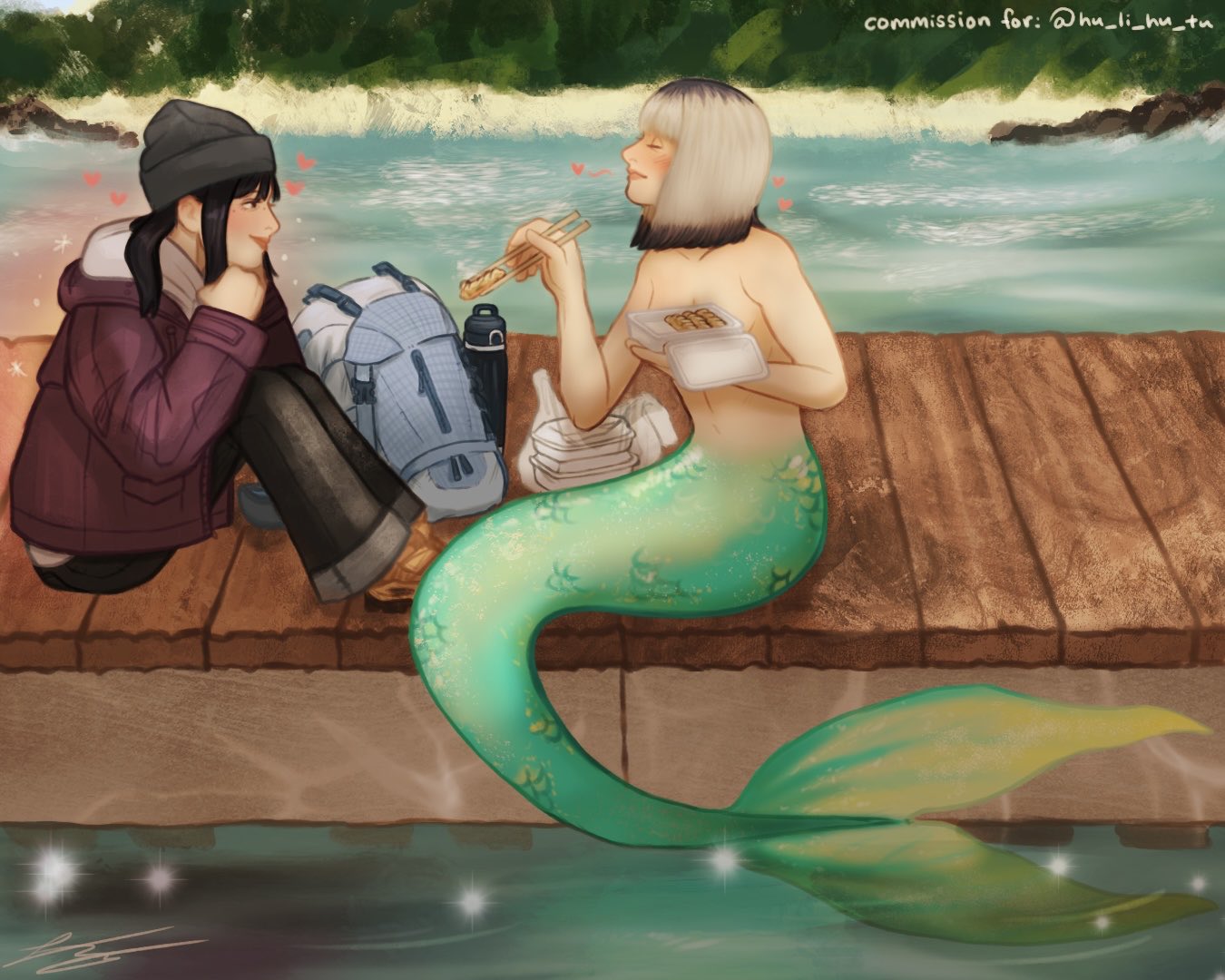
Illustration by the talented @baechemal. Thank you so much!
🐟
Jang Kyujin had never met a fish she didn’t like, and that was the whole problem.
Kyujin had been at the lagoon since four in the afternoon. She’d maneuvered through the pickleweed and sidled two hundred meters past the eelgrass shallows to the inlet. And along the way, she took notes on everything she could see. Snails. Shore crabs. The little gobies that flitted to and fro in the eelgrass. Most of all, Kyujin studied the juvenile smelt, where the brackish water went still and warm, and imagined them grown, leaving the lagoon through the inlet for the open sea.
By seven she’d made her way back to the old dock by the pickleweed, and Kyujin scribbled a rough count of the fish and the snails and the crabs in her waterproof field notebook with her marker. And she measured the pH of the water and took mud samples and tried to be happy. Because by any reasonable metric, the lagoon was doing well. Thriving, even. It was the perfect nursery for its teeming life. Which made it all the more challenging, because nobody else cared.
For eleven months Kyujin had tried to get people in cheap suits to understand that you do not pave over a place where life begins. She’d approached it from every angle. The environmental angle. The humane one. “You like eating sushi?” she’d tried the other day. “You don’t get sushi without fish.” This just made the council hungry.
She knew she wasn’t going to win the fight. People needed houses more than they cared about snails. She knew that, too. So every day she took the 45-minute bus ride to the lagoon, because it was her job, sure, but also because she didn’t know how much longer she could see it.
As the sun set, Kyujin sanitized her hands with the little spray bottle on her bag, and took out a small red container. She’d spent the night before making mandu, after a public consultation that had gone exactly the way all the others had, and packed the mandu in two neat rows. “I’m comforting my future self,” she’d told her roommate. Yoona’d replied that most people just called it meal prep.
Sitting at the end of the dock with her LED lantern and her feet over the water, Kyujin opened the red container and set its lid on the planking beside her. She picked up the first dumpling and looked out over the water, gently pulsating with bioluminescence, microscopic dinoflagellates emitting an emerald glow that always looked drab and murky in the photos she took for her consultations. Kyujin had implored everyone in every meeting to see the lagoon for themselves. Nobody ever had.
Kyujin watched the water she was failing to save for seventeen seconds.
When she looked back down, her container was gone.
Kyujin got up so fast she almost fell in. “Again?” she said to the lagoon, which she knew was insane but said anyway, because her mandu had been there and now they weren’t, and this had been happening for the past three weeks. First it had been her headlamp, off her work boat, and she’d assumed it’d fallen in. Then it was her sneakers, vanished after she’d traded them for muck boots to work in. Then a plethora of others: her field hat, her sunglasses, even her good multitool with the little marlinspike.
And now it was her mandu, her precious homemade mandu, which she’d been counting on to comfort her current self and now were gone without so much as a splash. Her mandu had been taken by the very thing she was trying to protect, and now she stood on a dock, totally incandescent with rage, clutching just a single mandu.
“I know you’re there,” Kyujin said to the lagoon, with a conviction that she knew made no sense. “I really wanted to eat those.”
The emerald water stirred about four meters out. Then it went still.
“This is war, you know,” Kyujin said, stupidly.
She stared at the water a long time, counting the seconds, watching the dinoflagellates glow in the gentle waves. She got to seventy-two before she gave up.
🐟
“So how does one set a trap for a river otter?” Yoona asked the next morning, pouring cereal as Kyujin set up a wildlife camera.
“It’s not a river otter. River otters don’t eat mandu.”
“How do you know?”
“4 years of training and 4 years on the job,” Kyujin replied, testing the motion sensor on Yoona. Yoona posed. The camera snapped a photo. “That should do it.”
“Have you ever offered an otter mandu?” Yoona said, examining the photo on the camera. It was not flattering.
“No.”
“So you don’t —”
“Yoona, it’s not an otter,” Kyujin said, exasperated. “What does an otter want with a headlamp? Or sneakers?”
Yoona considered this while chewing on her off-brand corn flakes. “So are you going to catch it?”
“No,” Kyujin said, packing up her things. “I just want to see it. Who knows? Maybe it’ll be some endangered species. And then the council will have to shut down the whole vote.”
Yoona glanced at her for a moment with the spoon halfway to the cereal. There was a whole paragraph in a glance from Yoona, Kyujin had grown to understand, and Kyujin had practically become fluent in them. This glance said: the vote could help us, though. It said: it’s for affordable housing and aren’t you tired of living in this dump. It said: but I’ll support you no matter what, because I love you.
Yoona put the spoon back in the bowl. She went out into the hall, and came back with her own headlamp, which she used for her night dives and which Kyujin knew she never lent out.
She held it in front of Kyujin. “Bring it back,” she said, which was Yoona for take care of yourself, and she went back to her cereal.
🐟
The entire point of a wildlife camera, Kyujin knew, was that she could set up the camera, leave, and look at the pictures later. Kyujin knew animals didn't behave when she watched them. She knew that she should have left.
But she wanted to stay, Kyujin realized, as she lashed the camera to the dock and placed store-bought mandu on the edge. She wanted to see whatever it was that was taking headlamps and multi-tools and sneakers. For once in her career Kyujin had very little idea what this thing could actually be, and a photograph was not going to be enough for her if it was some brand-new creature. No, she wanted to — she wanted to catch it, she realized, with her hands. Which was not glamorous but certainly scientific. How many times had she heard her professors talk about the importance of getting your hands dirty?
So Kyujin turned off Yoona’s diving headlamp and slipped behind the overlarge safety sign at the end of the dock, holding a net and feeling faintly ridiculous, and waited. She waited a long time, stilling herself, listening to the water gently flow over the eelgrass. And just as she almost dozed off, she heard it: the faintest splash of something emerging from the water, unhurried, coming for her mandu.
Kyujin lunged into the water.
Very quickly she realized her net was not nearly big enough for whatever it was she’d tackled, and she grabbed blindly, managing to seize something that was clearly not an otter. Her brain reeled, comparing the sensation across every single thing it knew lived in this lagoon. It was neither fur, nor shell, nor scale. It was cool and firm and muscled, and it recoiled with such force that Kyujin knew, in the half-second after lunging, that she’d vastly underestimated what she was fighting.
And something wrapped around Kyujin’s legs and dragged her under the water.
She could hardly think as the water engulfed her, but she sunk her nails into whatever she'd grabbed, and felt it release her with what sounded like a shout. She came up coughing, her net long gone, her headlamp over her eyes, and she lurched as something huge slapped her in the back, shouting, furious, in an accent that did not belong to this coast nor this country and certainly not any otter Kyujin had ever seen.
“— tried to catch me with a net, you absolute psychopath, typical human, what is wrong with —”
“You stole my dinner,” Kyujin yelled back, treading water. Her brain had assessed the situation — noting the intruder, the water, the hypothermia risk — and for some reason had decided to argue.
“Your dinner.” The voice pitched into pure outrage, and Kyujin realized it had a face. A girl’s — no, a young woman’s, a face that in any other circumstance Kyujin would have felt something she currently did not have time for. “So you wanted to, what? Catch me and eat me?”
“No! I just wanted to see what’s been taking my stuff all this time, and I—”
Kyujin stopped. Because the bioluminescence in the dark, the dinoflagellates stirred bright by their thrashing, had illuminated past the woman’s face, past her shoulders, past her waist, where as far as Kyujin knew, people had legs.
This person did not have legs.
Below the waist, she shimmered green and silver and impossible, a long length of something scaled and strong trailing into the glow, and Kyujin realized the thing that had wrapped around her legs was attached to this furious woman’s spine, and was, very slowly, fanning to hold her steady in the water. And Kyujin’s brain, already humiliated once, refused to even try identifying it.
“What,” said Kyujin.
“What yourself,” said the mermaid, and she snatched the mandu off the dock, and was gone.
🐟
“Did you find it?” Yoona asked, as Kyujin came home, wet and shivering.
“No,” Kyujin said, placing Yoona’s diving headlamp on the table.
“Oh.”
“It’s okay. I think all that stuff really did just fall in. I’m clumsy like that.”
Yoona stared at the least clumsy person she knew as Kyujin trudged toward the shower without looking back.
🐟
She thought about her. She thought about her as she stood in the shower, washing the lagoon out of her hair. She thought about her in the lab the next day, feeding water samples through the fluorometer. She thought about her while passing environmental brochures to people who didn’t want them.
She’d spent eleven months studying people in cheap suits almost as much as she’d studied the wildlife in the lagoon, and what she knew was this: if the lagoon couldn’t survive contact with these people, this woman — this mermaid — certainly couldn’t, either. Someone with a face like that and a body like that and an accent like that would only survive as long as Kyujin kept her mouth shut.
And so Kyujin, going against everything she had done in auditoriums and town halls and coffee shops for eleven months, resolved to keep her mouth shut.
She deleted the photos from the wildlife camera. They were embarrassing anyway.
🐟
Kyujin went back right before sunset.
For science, she told herself. She left the camera at home, bringing only her notebook, her marker, and a lunchbox full of mandu that she’d made herself, again. She’d also added a tangerine and two of the upside-down peach tarts from the bakery by the lab. For a controlled diet. A controlled diet for an important specimen.
She set the lunchbox on the dock, open, letting the smell waft through the air, and she sat down and waited.
It took a long time. The tide turned and the crabs emerged and she watched them scuttle over the little ponds in the water’s wake, and then she saw it: the dark, long shadow under the water. Slower, now. Cautious.
“I won’t try to catch you this time,” Kyujin said to the water.
A silence. Then, muted, from just below the surface: “That’s exactly what a kidnapper would say.”
“Come on. We both know you could drown me if you wanted to.”
The shadow came in another few meters. Then, a pair of eyes broke the surface, then a nose, the rest of her held under like an alligator. The eyes considered the lunchbox. Then they flicked over to Kyujin. Then they went back to the box.
“There’s more today,” Kyujin said.
“Are they the same as last time’s? Because those weren’t as good.”
“That’s because I didn’t make those. I made these ones.”
“Why?”
Kyujin opened her mouth to speak, but nothing came out. Bait, her brain offered, which was true, but she wasn’t going to say that to someone who had already called her a psychopath. Apology, her brain tried again, which was also true, but. Something else was truer.
“Because you seemed to like them,” Kyujin said. “You came back, didn’t you?” She looked right into her eyes, lingering above the tide. “It’s a peace offering.”
A pause. Then, bit by bit, the mermaid emerged from the water.
In the calm sunset glow, with neither a tail to pull her down nor a lagoon to blur her vision, Kyujin realized that the mermaid looked —
Very healthy, proposed Kyujin’s brain, and this time Kyujin accepted the conclusion in lieu of the one beating fast in her heart. Lush blonde hair down to her shoulders and beads of water flecking her bare chest — which Kyujin was determined not to notice — the mermaid swam closer and closer, until she was just a meter away. Kyujin’s brain noted Kyujin’s body had begun to perspirate and resolved to monitor the situation.
“What do you actually do here?” the mermaid said, clearly trying not to look at the lunchbox.
Kyujin blinked. “What?”
“You’re always here. I see you. You come every day and — what is it that you do exactly?”
Kyujin laughed, despite herself. “Nothing complicated. I count the marine life. I check the eelgrass to see if it’s healthy. I take some samples. And then I write a long report that nobody reads.”
“You also stare at the water.”
“Huh?”
“You do a lot of staring. At the water. It’s a little strange.” The mermaid lifted a hand out of the water — long fingers, webbed faintly at the base, dripping emerald — and pointed at the dock. “Right there. You stop, you crouch, you hold your little book, you stare. I’ve seen you do it for months.” She tilted her head. “I almost thought you knew about us.”
“I’m just — ” Kyujin’s voice caught. She couldn’t say that she was worried about the cheap suits, not now, when she had so much to talk about, so much to learn. “I’m just counting. I didn’t know there was —” she gestured at the mermaid, at all of her, at the impossible tail below the water.
“Well, if you’re counting, there’s only one of me,” the mermaid said. “Here, at least. The others went through the inlet when your people started dredging up the coast. They said it was too loud.” She said it lightly, but Kyujin could hear the edge in it. “I stayed. I like it loud. I like the glow. And the food isn’t bad either.”
She reached out, watching Kyujin for sudden movements, and took the lunchbox off the dock. She flipped it open, looked inside at the mandu and the tangerine and the upside-down peach tarts, and a smile spread across her face that Kyujin realized she would walk into the lagoon every night to see again.
“They’re not my people, you know,” Kyujin said. “I don’t agree with them.”
“I suppose not, since all you do is stare,” the mermaid said, not looking up from the lunchbox. “What should I call you, anyway?”
“Kyujin.”
“I’m Lily.” She picked up the tangerine and turned it over in the bioluminescence. “I don’t know what any of this is, but I’m going to keep coming back for it. Just so you know.” She looked at Kyujin. “And you’re going to keep bringing it.”
“Okay,” Kyujin said.
“Because you tried to net me, and you owe me way more than this.”
Kyujin held back a laugh. “That’s fair.”
Lily nodded, then dove backwards into the emerald water, leaving only Kyujin on the dock, thinking too hard already about what she would bring the next night.
🐟
Yoona did ask, once.
It was the seventh night, or the eighth — Kyujin counted snails, not nights — and Kyujin was at the stove at half past four in the afternoon, pan-frying mandu with the concentration of a Michelin-starred chef. Yoona had already wandered through the kitchen twice. Yoona was always wandering through the kitchen, eating over the sink, staring in the fridge. Six years of living together and when Kyujin imagined Yoona, she wasn’t in her drysuit or in the water freediving. She was in the kitchen, eating.
“Those look nice,” Yoona said, on her third wander through the kitchen. She pointed at a plate of cooked mandu, golden-brown and crisp.
“Thank you.”
“They’re like, nice nice. You even pleated them.” Yoona bent down, examining one, doing a little head shake the way she did when she saw food she wanted to eat. “And they’re, what? Kimchi pork?”
“They’re for my coworkers.”
“I wanna try.” Yoona went to grab a pair of chopsticks.
“They’re for my coworkers, Yoona.”
Yoona stopped opening the chopstick drawer halfway. Kyujin, who had spent eleven months learning to read a room full of cheap suits, couldn’t help but feel that Yoona was now reading her.
“You made mandu on Tuesday, too,” Yoona said.
“We’re monitoring an anomaly at work,” Kyujin said. “It takes a lot of brain food.”
“Hmmm.” Yoona closed the chopstick drawer and crossed her arms. “Okay.”
“Okay?”
“Okay.” And she swiped a mandu off the plate and bit into it, before Kyujin could react. Yoona’s face twitched and her eyes closed shut. “Oh. God. That’s — that’s so not fair. Kyujin, you’ve never made mandu like this for us. You’ve been capable of making this the whole time and you’ve been cooking us 7-Eleven mandu.”
Kyujin sighed. “I’ll make you more another time, okay?”
“You’re making mandu like this for your coworkers?”
“I said I’d make them for you another time.”
Yoona shook her head, smiling. “You’d better.” She put a hand on Kyujin’s shoulder, and started walking out of the kitchen. At the doorway, she paused. “Hey. The other night. When you came back all wet.”
“I fell in.” Kyujin kept pan-frying the mandu.
“Okay.” Yoona said it lightly. “You know the rule, though.”
“I know the rule.”
“Say it.”
“Yoona —”
“Say it, dummy.”
“Never dive alone,” Kyujin said, to the mandu.
“Never dive alone,” Yoona agreed. “People die, you know. It’s not pretty. They run out of oxygen or the pressure gets them or —”
“I know, Yoona.”
“I’m just saying.” And she went.
Kyujin stood at the counter and finished pan-frying the mandu, and didn’t notice until later that Yoona had left her diving headlamp for her on the kitchen counter again.
🐟
Kyujin hadn’t entirely lied. Monitoring a biological anomaly really did take a lot of brain food. In her notebook, she’d written down everything she noticed about Lily, in the most scientific way she could. Webbing recedes toward the tips of her fingers, she wrote. Onions do not appear to be part of her diet, though she consumes tangerines by biting into them, peel and all. Appears to have no societal expectations regarding nudity.
In the margins of that last note, Kyujin had sketched a rough approximation of Lily’s body — a scientific illustration, her brain had said, for the Wikipedia page someday — but had torn it out when she felt her cheeks run hot while drawing her breasts.
Every night, Kyujin would set out a box on the dock and Lily would surface to take it. And every night, Lily would smile at the contents, Kyujin would feel her stomach flip, and they would talk, water to dock.
Lily talked like she hadn’t talked to anyone in months, which Kyujin supposed must have been true. She wanted to know everything about the land, about humans, about the way things were done outside the emerald glow. She wanted to know what the orange lights were, strung across the coast road — “sodium lamps,” Kyujin told her, “they’re on their way out, though, everyone’s switching to LED” — and then Lily wanted to know what LED meant and what sodium was and why a person would put it in a lamp. And Kyujin, calling upon dim memories of an 8 AM electricity and magnetism course, somehow explained gas discharge and atomic emission to a mermaid in a lagoon in the dark.
“So everything that glows,” Lily said, floating on her back with her box on her stomach, “is just — tiny things getting so excited that they let out light.”
“More or less,” said Kyujin, trying to ignore Lily's bare chest.
“Sounds ridiculous.”
“I know. But we think it’s true.”
“Your people are ridiculous. What about this water? Why does it glow?”
“Same thing. Different tiny things, though. Alive ones.”
“Well, that part makes sense, actually,” Lily said. “We’re all connected here in the water. We work together.”
Kyujin thought of the people in cheap suits and didn’t know what to say to that.
As the nights went on, Lily drew closer and closer. On the second week, Lily hauled herself onto the dock to sit beside Kyujin, her tail half in the water, the emerald water drying on the bare body Kyujin’s brain refused to acknowledge. Lily began to ask about Kyujin and not just about sodium, and Kyujin asked about her, and how she once sang for her sisters when the lagoon was quiet, before the construction trucks.
Not every box was good. Kyujin made them badly on bad days, and well on good days, and Lily learned to read her days simply by looking at the fold of her mandu. She would smile every time, though, and Kyujin would feel every upward corner in every part of her body.
One night, a month after they first met, Kyujin was late, held up at the town hall by protestors who had had enough of her meddling. She’d been screamed at by the mayor himself, about how heartless it was that Kyujin cared more for an overgrown marsh than people who needed someplace to live, and six families who had been waiting eleven months for the vote nodded in assent. And Yoona had finally grabbed Kyujin’s hand and pushed aside the crowd, starting the engine of her Kia before Kyujin told her she still had someplace she needed to be.
“Bad day,” Lily noted, when Kyujin finally plopped down on the dock, with mandu from the 7-Eleven down the way. Kyujin hadn’t even tried to dress it up, holding out the paper box, receipt still stuck to its bottom. Lily hoisted herself onto the dock and took it, still smiling.
“Not everyone works together up here,” Kyujin said, lying down on the cold planks. She had never been at the lagoon this late, and she’d forgotten to bring a warm enough coat. Her brain outlined the risks. Elevated blood pressure. Joint stiffness. Involuntary shivering.
Lily looked at her just as Kyujin’s body began to demonstrate the last one. “You’re shaking,” Lily observed.
“I’m fine.”
“Your body is shaking and your lips are a strange color. When things turn strange colors in the water, it’s never good, Kyujin.”
“I’m just a little cold. It’s fine.”
Lily looked at her for a moment. Then she reached over, took Kyujin’s left hand, and placed it flat on her side, beneath her ribs, where her body turned from skin to scale, and held it there.
Kyujin’s entire nervous system stood up at once.
“I don’t feel cold the way you humans do,” Lily said. “I’m the warmest thing in this lagoon and you’ve just been, what? Lying here?”
Under her palm, Kyujin could feel it: warmth coursing through like the ocean current, a body powered by something elemental and indescribable. Just tiny things being very excited, her brain said. Nothing else. Something else in Kyujin, as always, disagreed.
“Can I ask you something?” Kyujin said, to the sky, because she couldn’t look at Lily’s face.
“Are you going to ask me why I stayed?”
Kyujin coughed. “Yes.”
Lily lay back on the dock next to Kyujin, stretching out her full length, gazing at the sky, still holding Kyujin’s hand in her webbed fingers. A car passed on the coast road, swinging its headlights out over the lagoon, and for a second the whole surface lay flat and ordinary, before the dark came back up and the emerald glow with it.
“I was born in this little cove off the coast, maybe a few days’ swim from here. Toward the rising sun. And it was quiet and dark and peaceful, and I would collect shells and look for pearls, and every day was wonderful. And when the dredgers came, it wasn’t anymore. So we had to swim, toward the setting sun, and no matter where we stayed, no matter how dark or peaceful things were at first, the dredgers would keep coming, and we would keep swimming.”
She turned her head toward Kyujin, who had started looking at her without even realizing it.
“And eventually, we made our way here. But we never meant to stay here. Those metal carriages going along the coast, with the lights and the noise and even the way the water glows — it was always too loud for them, too bright. And they said they needed to find somewhere quieter and darker and more peaceful.”
Lily squeezed Kyujin’s hand, still on her waist. “And they did. I even went with them, for a season. But after I’d seen the water glow here, seen your — what was it? — sodium lamps, and even your wretched metal carriages speeding down the path, I couldn’t sleep without them anymore. I needed the loud. I needed the glow.”
“So you came back.”
“I did,” Lily said. “And it was lonely, and still too quiet, sometimes, without my sisters. But one day I saw a girl come onto the marsh, and look at crabs and snails and fish, crouching on the dock and writing things into a little book, and it was less lonely, watching her. And sometimes she’d leave things for me, and it made life a little more interesting.”
“I didn’t leave them for you.”
“And one day, she tried to catch me in a net, like an animal.”
“Alright,” Kyujin said, smiling. “I’m sorry.”
“You’re not.”
“I’m a little sorry.”
Lily laughed, and it went through the hand still in her hand, and Kyujin felt the warmth cascade through her.
“Thank you, unnie,” Kyujin said. It came out before Kyujin had even realized she said it, and Lily looked sharply at her, confused, not sure whether to react.
“What did you call me?” Lily said.
“Er — it’s not — it’s not an insult. It’s just what we call — women who are older than us,” Kyujin mumbled. “And I — well, I don’t know how old you are, but —”
“Oh, I’m older than you.” Lily was smirking now, slow, delighted, merciless. “I’m older than you, I can tell, you have the whole younger sister thing going, you argue like you’re afraid of losing to your big sisters —”
“— I’m not afraid of losing —”
“— so you call me ‘unnie,’ do you?” Lily leaned her face in so close that Kyujin could smell the salt on her, her still-wet hair dripping on her, and Kyujin’s hand slipped without thinking to the small of Lily’s back, just above her tail, and neither of them mentioned it but Kyujin suddenly could not stop thinking about it. “You tried to net me, and then you fed me little wrapped bits of meat, and now I’m your ‘unnie.’”
“Listen, let’s just forget it —”
“Absolutely not. I’ll never forget it. I’m going to be so unbearable about it.” But she was close, so close that Kyujin could count her eyelashes and almost started doing it by habit, and she could feel the electricity between them like so many tiny things getting very excited, and Kyujin’s brain had completely shut down, and now it was something else inside her that screamed at her to go, to close the distance, to feel the ocean crash over her, and right as she pulled herself in, Lily breathed out slow and pushed herself back up, Kyujin’s hand falling to the planks.
“Not here,” Lily said quietly. “Not now, where you’re shivering and cold and — not before I’ve shown you something.” She touched Kyujin’s cheek, once, and slipped back into the water in a single smooth movement that left Kyujin’s cheek cold where the warmth had been.
“Someday,” Lily said, from the water. “When you trust me. I’ll show you something when you trust me.”
“I trust you,” Kyujin said, too fast.
“You don’t,” Lily half-smiled. “And you shouldn’t. But maybe someday.” The glow illuminated Lily’s face, and the smile there was more powerful than it had ever been. “Maybe if you bring a really good box.”
🐟
The next box was not a really good one, and neither was the one after. And each night Kyujin tried to explain why — why the dumplings were just skins with pork spilling out, why the kimbap was just a landslide of rice and fillings — and Lily would listen. She told Lily in pieces, across those nights, about the houses. About the plan to fill the lagoon, to drain the water and truck in the soil and pack it all in like it’d never existed. About how two hundred and forty units would be built on top of it all, affordable units all, the kind that turned a woman with a notebook into the villain of a town that needed someplace to live.
Lily didn’t talk much during those nights. Kyujin suspected she’d seen it all before. But as the boxes got worse and worse, and as Kyujin arrived with deep eyebags and sallow cheeks, Lily began asking more questions.
“Will you win?” Lily said, on a day that had been even more challenging than the other days.
“No,” said Kyujin, staring at the water.
“You sound sure.”
“I’ve been doing this for a year, unnie. I have more data than anyone has ever had about this lagoon. I am more right about this place than I have been about anything else in my life. And I’m going to lose, because caring about snails does not beat two hundred and forty families who need a roof.”
Lily placed a hand on Kyujin’s lap. Kyujin hardly noticed it. “But you’re trying.”
“You know what the worst part is?” Kyujin said, watching the smelt poke at worms in the eelgrass. “I qualify for the houses. I qualify easily. I make almost no money, my grant runs out in the summer — I’ve got applications out to anything with a coastline, Lily, I’ve been applying for months. That’s what you do, you send your CV out to sea like a message in a bottle, and you’re supposed to just count snails while you wait, living in an apartment that was falling apart when you moved in.” She felt her voice go strange, almost like it was underwater. “And I go to the public consultations, and I stand there with my notebook and I talk about snails and fish and I argue against building the only housing I could ever actually afford, because it’s on top of the only place I’ve ever —”
Kyujin swallowed the word. She didn’t need to say it.
“And nobody realizes that, you know? That I’m — that I need a place to live, too. But I’m doing this because this place — because you —”
She had not, Kyujin realized in that moment, ever said this out loud. She hadn’t even let herself think it as a complete sentence. She’d kept it broken into pieces small enough to hide, ignored the looks Yoona gave her every time she mentioned a consultation. That she loved this place, and couldn’t bear to lose it, and yet losing it would be the very thing that let her live a better life.
“Come down,” Lily said, interrupting her spiral.
“What?” Kyujin was sure she had misunderstood.
“Come down with me. Into the water. You’ve stared at it long enough. But you’ve never even —” Lily grabbed Kyujin’s shoulders, suddenly all tide, all forward motion. “You’ve been guarding this place for a year and you’ve only ever seen the top of it. You want to know what you’re actually protecting?” Lily smiled. “Come down and see.”
“Lily,” Kyujin said, exasperated. “I’m human. I can’t breathe underwater.”
“And that’s one of your species’ many serious failings,” Lily said. “But your unnie will handle that part.”
“It’s not just that. I don’t have a drysuit. I’d freeze to death.”
Lily rolled her eyes, which made Kyujin regret teaching her human expressions. “It’s honestly amazing how your people have survived until now. Don’t worry about it, Kyujin. I told you, your unnie will handle it.”
Then she held out her webbed hand and Kyujin looked at the hand and every single signal from her brain was telling her stop, this is how people die, this is why no one in history has ever recorded a meeting with a mermaid — and said:
“Okay.”
🐟
“Let me put something in your eyes,” Lily said, when Kyujin had lowered herself off the dock into the shocking green cold, treading water beside her.
“Why?”
“Because it’s night, and the salt will sting your delicate human eyes, and I’m not bringing you to my home if you can’t even see it. Come here.”
Kyujin waded closer, and Lily raised two cool thumbs toward her eyes. Kyujin instinctively closed them.
“What are you doing?”
“I need to rub your little human eyeballs, Kyujin.”
“With what?”
“Just a little something from my people,” Lily said, patiently. “It keeps our eyes clear in murky water. Which has happened a lot more often thanks to all those people you fight. Open your eyes.”
Kyujin did, forcing her eyes to stay open as Lily rubbed a thin film over her eyes, warm and smelling of seaweed. Kyujin expected it to hurt, and it did, a bit. But when Lily leaned back, Kyujin looked and the night had never been brighter.
“What is this? Chemically this must be —”
“Chemically?” Lily laughed lightly. “It is what it is, Kyujin. Don’t try to take notes on this one, okay? It’s a secret. Are you ready?”
Kyujin thought about the nonexistent Wikipedia page that she could never illustrate and nodded.
“Let me know when you need air. And don’t let go of me.”
Lily held Kyujin’s hand, and Kyujin inhaled, filling her lungs, before Lily took her into the water.
Immediately Kyujin’s brain filed a formal complaint as the water enveloped her, but Kyujin held onto Lily anyway, eyes wide open, unstung, the pulsing water around her glowing emerald green with each powerful kick of Lily’s tail. With whatever Lily rubbed in her eyes, Kyujin could see every single creature she’d ever catalogued and more. Northern snakeheads, spotted and brown, swept the water, looking for prey; crimson three-spined sticklebacks hunted for tadpoles; sea snails with tall, many-whorled spires hid in kelp. She could even see out and above the surface, where whooper swans floated, serene above the water, madly kicking beneath.
My count’s been way off, Kyujin thought. I’m going to have to do this all over again.
Kyujin realized, too, that she no longer felt cold. She’d been grasping Lily’s hand for dear life, as Lily pushed through the sea faster than any engine, and she could feel radiating from Lily a warm ocean current, the same from that night on the dock, tethering her to life. I should hold Lily’s hand more often, Kyujin thought, idly, as she passed three or four fish she didn’t recognize. Her brain, for once, concurred.
Below the eelgrass and the snails and everything Kyujin thought she’d known about the lagoon, through the kelp and the algae and the masses of uncountable fish, the lagoon dropped away into a basin, and Lily led a thoroughly dazed marine biologist into a cave within.
As fast as Lily was, though, Kyujin’s lungs had begun to count down, sending signals to her brain to breathe already, god, isn’t it bad enough that we’re in the water? So Kyujin squeezed Lily’s hand, rapid, pointing to her mouth. And Lily turned back, put both hands on the sides of Kyujin’s face, pressed her mouth to Kyujin’s, and breathed.
It’s not a kiss, it’s not a kiss, Kyujin’s brain said, over and over again, as air pushed warm into Kyujin’s lungs, as Lily’s lips held tight to hers. It’s just — it’s just logistics. Take the breath. We need it. Isn’t that right, lungs? And Kyujin’s lungs concurred, and Kyujin’s blood carried the oxygen, and Kyujin's heart beat faster, carrying the gift from Lily’s lips throughout Kyujin's body, spreading, reviving.
Lily pressed Kyujin’s lips shut, sealing the breath. Kyujin kept her eyes open, gazing at Lily, hair lifting with the current, lit not by moonlight but from billions of tiny, excited things. And for once, Kyujin didn't need to write any of it down.
As they made their way through the cave, Kyujin’s lungs asked for more, and Kyujin squeezed Lily’s hand, going to her the way she went to a heater in a cold room. And Lily gave her more, her mouth to her mouth, her hand to her jaw, the slow warm push of it. And this time, when Lily drew back, Kyujin drew forward, before she caught herself, and Lily saw her catch herself, and Kyujin felt the temperature change in the green-lit water between them.
The next time, she reached for Lily before her lungs had even begun asking, and Lily’s mouth moved against Kyujin’s in a way that vibrated the warmth of the ocean down her chest, giving her both the breath she needed and the kiss she wanted. Then Lily pressed into her more, and Kyujin could feel her bare chest against hers, Lily’s webbed hands mapping her body the way Kyujin had mapped the lagoon, learning the soft places, the yielding ones. The tail that had once pulled Kyujin into the lagoon wound slow and deliberate around her legs, and Kyujin, who had once been afraid of its strength and its strangeness, gave herself over to it, weightless in a long-drowned cave, breathing on loan from the mouth of an impossible woman.
It was strange. Kyujin let it be strange. She had spent her whole life cataloguing strange things, recording things no one else cared to about this lagoon and the things in it, and down here there were even more of them. She’d long since lost any feeling of direction, even simple things like up or down. She only knew that she needed Lily, here in the water, and as long as she was here, she needed — wanted — to place her mouth on hers over and over, just to stay alive. Survival and wanting had been folded into the same gesture, and she no longer had any way of telling them apart. She’d stopped trying to.
Three or four breaths later — though not much further away — Lily stopped at a hollow in the cave.
“This is it,” Lily said, somehow, under the water. Kyujin nodded, and Lily breathed into her one more time, her hand moving slow through Kyujin’s hair in the water. Then they went into Lily’s room.
The room was, charitably, a mess. What must have been decades of salvage lined the walls, tied down with seaweed. Sea glass, sorted by color; a brass telescope from a time Kyujin could scarcely imagine; a doll’s head with the paint long gone. A small museum of things the sea had taken from the land, gathered up by someone who liked strange things, beautiful things. Or simply, Kyujin realized, because that someone preferred to keep things instead of letting them go.
And then, tied to the very top of the room, drifting, were Kyujin’s things.
Her headlamp that had fallen into the sea, and her sunglasses alongside it. Her good multitool with the little marlinspike. Her sneakers, falling apart now, alongside her field hat, which didn’t look much better. And box after box after box, metal and plastic and cheap 7-Eleven takeout boxes.
All illuminated by discarded glass jars holding tiny excited things, so that Lily did not have to live in the dark.
Lily had been cataloguing her, too, Kyujin realized. For weeks before she’d tried to net her, before Lily had plunged her into the lagoon for the first time, Lily had watched her, examined her. She’d looked at the woman with her notebook and her pen, witnessed her mumble as she walked the coastline counting crabs and starfish and more, and she’d wanted so badly to know more that she took a piece of her, and then another, and then another. And Kyujin, drowning in a fury that she no longer remembered, had responded to weeks of being catalogued by trying to catch her cataloguer in a net.
“I know,” Lily said, watching Kyujin take it in, still holding her hand. “I could have just talked to you. But to be fair, you looked very busy.” Lily ran her free hand over her museum of Kyujin's things. “And I didn’t know what to say to you, either. So I just took your things. I wanted to learn about you, too.”
She reached up and shook one of the glowing glass jars, and it glowed brighter. “This is my home,” Lily said, simply. “I wanted you to see it, before they take it away from me. And it’s their home, too. The fish and the snails and the crabs, all of them.”
Lily looked at Kyujin. “I wanted at least one person to know, up there, that it’s not just water down here.” She placed her hand again on Kyujin’s cheek. “It’s somebody’s whole life.”
And that was what Kyujin would carry home, later, as her hair dripped on the bus back to her apartment, as she showered off the salt. She’d carry it heavier than the Lily-sight or the borrowed breath or the love she felt burgeoning in her heart: that the lagoon was someone’s home, was many someones’ homes, and homes were the whole thing the argument was about. And nobody in those cheap suits sitting in folding chairs would ever care about these homes.
Kyujin and Lily lingered in Lily’s room for more breaths than Kyujin could count before Lily finally took her back up.
🐟
She came up gasping at the dock, her hands clutching the planking, and Lily surfaced clean beside her, and for a while neither of them said anything, which was partially because Kyujin was getting used to air that was not Lily’s, and partially because Kyujin didn’t know what to say.
“You alright?” Lily asked, finally.
“Yeah.” Kyujin’s voice cracked. “Yeah.”
“It was strange not hearing you talk down there. I’d forgotten you can’t do that.”
Kyujin laughed. “It was good to just listen for a change anyway.” She climbed onto the dock, suddenly very aware of how cold it was. Lily swung herself up, placed her hand on Kyujin’s, and it was no longer an issue.
“I don’t want them to fill it,” Kyujin said. “But I’m not going to win, unnie.”
“You don’t know that.”
“The vote is next week.”
“Okay.”
“There’s nothing I can — I’ve done everything I —” Kyujin stopped and made herself breathe the air that wasn’t Lily’s. “I don’t know how to win. I can’t win just by being right about it.”
Lily was quiet as she looked out toward her home.
“Remember that cove I told you about? It had this wreck in it. A great big iron ship, from I don’t know how long ago,” she said. “When the sun came through at the right hour the whole inside of it would shine gold. Only that hour. You had to be there or you missed it.” She was still looking at the water. “My sisters used to race me down. I always lost. I always liked looking at things more than I liked swimming to them.”
“Is it still there? The cove.”
“It’s a — what do you call it? It’s a port now.”
She said it casually, the way you’d talk about the weather. But her face looked hard in the glow, and her hand tightened on Kyujin’s.
“Sometimes things just happen, Kyujin. And we don’t get to choose what it is. We just have to do what we can with what we have.” She raised Kyujin’s hand, examining it, the cold-cracked knuckles, the weathering of a labor of love done for eleven months. “But at least you came down. You finally came down and saw our home. So now you know what’s there. Even if something just happens.”
“That’s worse,” Kyujin said. “Knowing’s worse.”
“Yeah,” Lily agreed. “It usually is.” And then, because Lily could see Kyujin’s face falling in the moonlight, she added: “Your mandu was terrible tonight, by the way. I don’t think it was fully cooked.”
Kyujin laughed, half-broken, still grateful. “It was a bad day, okay?”
“That’s why I wanted to turn it into a good one,” Lily smiled, in a way no Wikipedia page could ever capture. “Did it work?”
Kyujin let herself take in all of Lily’s smile before she leaned into her, entwining again her want and her need in a single breath.
🐟
By the time Seol Yoona turned 16, she’d already made six open water dives and earned her certification to dive with a partner. By the time she’d turned 20, she’d logged over a hundred dives, learning to gauge the air she needed by feel alone. These days, she was training for stillness: how to hover in the sea without a single kick, how to empty her lungs just enough to sink, how to close the distance on something so slowly that it never realized you were there.
So of course the fact that Yoona had said nothing about Kyujin for weeks did not mean Yoona did not know what was happening. Yoona knew. She’d seen Kyujin come home every night smelling like salt and pickleweed and something sweet she couldn’t place just yet. She’d noticed how Kyujin had made mandu, but couldn’t tell her what they tasted like, as though she hadn’t actually been eating them. Once, Yoona saw Kyujin actually watch some ad for a Disney movie on YouTube, and she had to say her name twice before she clicked Skip Ad.
But Yoona said nothing. She was simply closing the distance.
One morning, two days before the vote, two months after Kyujin first came home and claimed she’d misplaced her things after all, Kyujin came into the living room with an extravagant lunch box in a neat bow, and stopped short, because Yoona was sitting at the table. Her hands were flat on the surface, with no bowl, no phone, no controller in her hands for her after-dive gaming. She was simply not moving at all.
Kyujin’s brain, which had been working overtime analyzing a biological anomaly for the past two months, produced a single unhelpful conclusion: Yoona is only like this 15 meters below the surface.
“Cute box,” Yoona said.
“It’s my lunch.”
“Sit down.”
“I’ve got to catch the bus —”
“Kyujin.” She didn’t raise her voice. “Sit down.”
Kyujin sat.
“Okay,” Kyujin said. “Okay. I know what this is.”
“Do you?”
“It’s either about the vote, or it’s about where I go every night, and —”
“I’ll always fight for you, and I know you’re seeing someone. This isn’t about any of that.”
Kyujin’s mouth hung open for a half second before she remembered to close it.
“You came home wet again on Thursday.”
Kyujin exhaled again.
“And Sunday. And the Sunday before.” Yoona’s thumb tapped the table gently. “I asked you once in this kitchen. I know I made you say it out loud, like a child, and I’m sorry, I know you hate that. But I needed you to hear it. I told you —”
“Never dive alone.”
“Never dive alone.” Yoona nodded slowly. Then she stopped tapping the table and asked the question she’d clearly been sitting on, and she said it hopefully. “They’re diving with you?”
Kyujin could have lied. But she’d been lying for two months, with middling success, and so her brain made the calculations and offered the truth. “Yes.”
“Okay.” Yoona’s shoulders came down half an inch. “Okay. Good. What’s their cert?”
“Their —”
“Certification. Agency, level. Are they on air or are they freediving?”
“They’re — it’s not like that. They don’t have a card, they’re just — Yoona, they’re the best in the water I’ve ever seen. Better than you.” It was true. Kyujin heard how it sounded, though, and knew how Yoona might take it.
“Better than me,” Yoona said, after a moment. Flatly. “But no card. Okay. So what’s their rescue training? If you black out at depth, what will they do? Walk me through it.”
“They’d get me up.”
“How? What’s the protocol? Do they know your weight? Do they —” She started tapping on the table again. “You don’t know. You don’t know what they’d do. You just know they’d get you up. Kyujin, that’s not — that’s not a dive plan. That’s a feeling.”
“I’m still alive. They’ve gotten me back up every time.”
“Can’t argue with that,” Yoona said. “Although I have to take issue with your suit."
Kyujin’s mouth closed.
“You came home Thursday in your green jumper. Wet through. Wet cotton, Kyujin, in March, at night. You don’t own a suit. And you didn’t borrow mine, because mine was still in the hall.” Both of Yoona’s hands were tapping now, the anxious energy of two months finding a release valve. “So — so whoever this is, this — this uncertified person, this best-in-the-water-I’ve-ever-seen person — they take you into cold black water at night with no exposure protection, no oxygen tank, no light, and you come home wet through, and I’m supposed to believe you’re safe.”
Yoona inhaled deep. “You hear yourself, right? Tell me you hear yourself. Pretend I’m saying it, and then think about what you’d do.”
Kyujin thought about it, and didn’t say it, because she knew she would call the coast guard to keep Yoona safe, no matter what.
“Let me meet them,” Yoona said. “That’s all. One time. I’ll watch — I’ll dive just one time with you. And if they’re half of what you say, I’ll stop. I’ll shut up forever. I’ll bake them something. I’ll be delighted —”
“You can’t.”
“Just let me come. I won’t say anything, I won’t talk to them —”
“You can’t, Yoona. You just can’t.” Kyujin’s voice had gone small but certain, Yoona’s face a wreck. Kyujin had never seen Yoona cry, and she hadn’t yet. But when she spoke, Kyujin had to lean closer to hear.
“Yeah,” she said. “Figures.”
Then she put her palms on the table, pushed herself up, went to the spice cabinet, and took a folded sheet of paper from the top of it.
Kyujin knew what it was before Yoona placed it on the table. She’d seen it a hundred times, on her laptop, at three in the morning, in a tab she opened and closed and opened again.
It was the affordable housing application, printed, filled in with Yoona’s careful handwriting. Waiting only on the parts Kyujin had to complete.
“I did all the boring stuff,” Yoona said. “Income. Character references. I even got a recommendation letter from our old landlord.” She looked right at Kyujin, eyes wet. “Whatever you’re doing. Whoever you’re seeing. I know you’re still fighting for the lagoon. And I’m fighting for you.”
Yoona took a deep breath. Kyujin knew what was coming. She let her say it anyway.
“But — the vote is in two days. And if we lose, they’re going to build someplace you can afford to live. Someplace better than this.” Yoona was quavering now. Kyujin almost couldn’t bear it. “I know you’ve got grant applications out. But Kyujin, grants end. You’ll need someplace to come back to when they do. And I know you’ll be too proud and too sad and too right to apply for that, and I won’t let you do that to yourself.”
Yoona pushed the paper over to Kyujin. She didn’t touch it.
“You don’t know what you’re asking me to sign.”
“How could I? You never tell me anything anymore,” Yoona said, quiet, but sharp. “But I know you’d rather be correct and cold than wrong and warm. And, Kyujin, I’d like you to be warm.”
Kyujin thought about the ocean current rushing into her from a held hand and picked up the form.
“Thanks, Yoona. Really.”
“Okay.”
“I’ll see you tonight.”
“Okay.”
Yoona waved Kyujin off. Kyujin set out.
🐟
“Do you have a plan?” Lily said, on the planks, taking out the mandu, the tangerines, the — new for today — honey-crusted Korean fried chicken. Kyujin watched her start with the chicken and thought, fleetingly, whether this was the healthiest diet for a mermaid.
“I had a plan. The past eleven months were the plan.”
Lily nodded, tearing the meat off the bone with her teeth. “What is this, by the way?”
“Fried chicken. It’s a bird.”
Lily almost choked. “A bird?”
“Plucked, dipped in batter, fried in oil,” Kyujin said, patiently. “Unnie, I’ve seen you tear apart fish while they’re still alive, don’t act high and mighty now.”
“I’m not above it,” grumbled Lily, still eating it. “I was just surprised birds taste so good. I should try the swans. You were saying.”
“The eleven months were the plan. And I don’t think it worked.”
Lily kept chewing.
“So,” Kyujin said. “I think we should talk about what we should do if we lose.”
Lily swallowed. “You think we’ll lose.”
“I know we will.”
Lily started on the tangerine, biting into it, teeth tearing through the peel. “Kyujin. You don’t need to worry about me. I’ve already looked for a new home. There’s a place north. Loud, but that’s fine with me.”
North, Kyujin’s brain noted, and cross-referenced something in a stack of grant applications, and Kyujin told it to be quiet, because that was only a maybe, and she didn’t deal in maybes.
“I can’t take much with me, but I don’t need much. Just promise me—”
“Unnie —”
“— just promise me something. Take one of the houses.”
She was on the mandu now.
“When they build it, you live in it. Let yourself have a roof. Don’t you dare be too proud to take the one thing the lagoon died to give you. That would be the worst possible outcome.” She ate another mandu. “And I’d know. I’d be out there and I’d know you’d be too proud to do it. So. Promise me. Take the house.”
In two days, Kyujin thought, the town council would vote on the measure, and they’d count the yeas just as Kyujin counted the snails, and their numbers would matter. They’d listen to these numbers, the cheap suits in the folding chairs, and they’d send the construction vehicles and the spoil trucks and the drainage pump vehicles, and Lily would flee with what she could carry. And Kyujin would have to watch it all happen.
Lily watched her think and placed her hand over Kyujin’s, and Kyujin felt the warmth — and the fried chicken glaze — and Kyujin knew what she had to say to this impossible biological anomaly.
“Okay,” she said. “I promise. I’ll apply for the house.”
“Good,” said Lily. She patted the remains of the lunchbox, the ribbon carefully placed to the side. “This was very good. Maybe your best one.”
“I tried very hard.”
“And I look forward to more of them. No matter what happens.”
Kyujin’s eyes met Lily’s, and Kyujin did her best to smile. “Yeah,” she said. “Of course. I’ll bring more.”
🐟
They held the vote two days later, and Kyujin, Yoona, Lily, and everything in the lagoon lost.
She’d told Lily, time and time again, that she’d expected to lose. But she hadn’t given up. She’d stood there one last time, in front of two hundred and forty people in folding chairs, and said the true things in the right order. That the eelgrass meadow was one of the last ones on this coast, and killing it would kill the one fish nursery for kilometers. That the population of Pomaulax japonicus, first sighted in 1844, had experienced a rebound in the past 10 years, and filling the lagoon would destroy a decade of progress. And that while they could make new houses and apartments, they would never make a new lagoon, and certainly not one like this.
Kyujin was right. She was completely right. But it wasn’t enough. Because a father came to the microphone after her, a man not much older than her, and he talked about his daughter and his rent and the two-hour commute he made every morning and every night because the only place he could afford was half a province away. And he was right, too. He was completely right.
That was the unbearable part. That there was no villain in the room. There was only a lagoon and a housing shortage and not enough town to hold both. And the vote went the way it did, and they approved the first phase of the project, and Yoona held Kyujin as she broke down in the car, sobbing for a lagoon she’d fought for every night, the snails and the fish and the impossible thing that lived beneath. And Yoona rubbed her back and let Kyujin cry all over her good sweater, eleven months of trying finally reaching their conclusion.
Yoona dropped Kyujin off at the lagoon. She asked if Kyujin wanted her to stay. Kyujin shook her head. “I’ll tell you all about it soon, Yoona,” she said.
“You don’t have to,” Yoona replied. “Just don’t dive alone.”
“I won’t.”
Kyujin trudged to the water with the box she’d made that morning — she’d done it even on the morning of the vote, and she’d made the best box she’d ever made, again — and stopped dead in her tracks.
They’d already put up a fence: a chain-link contractor’s fence, eight feet tall, running the entire shore, driven straight into the eelgrass meadow. Every post a stake through the beds where the juvenile gobies sheltered. And this was just the fence. This was the gentlest thing that would ever happen here again.
In front of the fence, a legion of trucks were staged for Monday, looming over it all.
“Kyujin,” Lily said, from beyond the fence. Her hands grasped the chain-link. Kyujin had the distinct feeling that she was visiting a prisoner.
“Unnie,” whispered Kyujin, running up to the fence, glancing side to side. No onlookers, yet. “It’s broad daylight. Sooner or later —”
“I know,” she said. “That’s why I’m here, though. Before I leave.”
Lily reached out her hand as far as it could go. Kyujin grasped her fingers, tight, feeling the ocean current surge through her. She knew it would drain away soon. But knowing it made it harder.
“I can’t wait around for them to fill up this place, Kyujin. There is such a thing as too loud.” The corners of Lily’s mouth were pulled up, but Kyujin knew her smiles, now, and this wasn’t quite one. “So I’m leaving. Today.”
“The smelt,” Kyujin blurted.
Lily blinked. “What?”
“The smelt. This year’s smelt.” Kyujin felt her voice go underwater and she couldn’t help it. “They’re eight weeks out. Just eight more weeks and they’d have left on their own, through the inlet, like they always have. And they’re going to start draining it next week." Kyujin pointed this way and that, all over the lagoon. “And the gobies. They don’t leave at all. They’re native to the lagoon. They live here their whole lives, they don’t — they don’t even have the instinct to run.”
Kyujin was talking fast, now, far faster than she’d ever spoken in front of the folding chairs, even faster than she could think, her eyes fixed on the lagoon.
“And you know what? I counted them all. For a whole year I counted them all, and I found even more when you took me underwater, and — and after Monday, nobody’s going to care about any of it. I’m just going to stand here at the fence and watch the number go down to zero.”
Kyujin looked at Lily. “You’re right, unnie. You have to leave today. You’re the only thing that can.”
Lily was quiet, but her eyes were still bright. Like they were lit by the emerald glow, even in the daylight.
“You know,” she said. “I’m slow for my people. But I’m still the fastest thing in this lagoon.” Lily’s jaw set. “Fish move when something as big as me chases them. Especially when I’m loud about it. So tonight, before I go, I’ll sweep the lagoon. End to end. Shallows to inlet. Everything that can swim will swim away from me. The smelt, the sticklebacks. Well —” she glanced at the tide pools. “Not the snails. I can’t take everything. I can’t take the meadow. But I won’t be leaving here alone. We work together down here. I told you that the first week.”
Kyujin felt something in her chest come loose, and her brain reorganized itself slowly around a single fact. Which was that she had lost, certainly. The lagoon had lost, and so had Lily. But they wouldn’t lose everything.
“West to east.” Her hands were already moving, the waterproof notebook already out of her bag, the marker uncapped, and her voice shook only a little as she drew a map. “Sweep west to east, not east to west. Else they’ll get stuck in the rock formations. You’ll want to start at slack tide, which is, what, 11:40 tonight for me? I know you can sense it just fine. The gobies should school easily but the juveniles —”
“Kyujin.”
“— maybe just take a second pass, just to be safe. Go slower on that pass, though, because —”
“Kyujin,” Lily squeezed Kyujin’s fingers tight. “You’re smart. You’ve studied the water. But I’ve got it. Trust me.”
Kyujin looked up, map already sketched out. She looked at the mermaid that had spent her whole life in the water, and had known what was underneath long before she ever did.
“Right. Right, yeah, of course. I just— I drew a map.” Kyujin held up her notebook.
“Give me the map,” Lily said.
Kyujin tore the map out, filled with arrows and annotations of where the rocks were, where the fish lived, and pushed it through the fence, and Lily took it, like it was precious.
“A map of how to save everything,” Lily said. “This is what it was all for, you know. You came here every day for a year, counting snails, learning where the gobies lived, seeing the stickleback go about their day. And you were learning to save all of it. You just thought you were going to do it a different way.”
Kyujin’s eyes threatened to do something and Kyujin refused to let them do it. “You’ll need this, too.” And she slid her box through the fence — she had to pry the chain wide — until it fell into Lily’s hands.
“It’s the best one I’ve ever made,” she said, as Lily unwrapped it. “Mandu, fried chicken. Those upside-down peach tarts you like. And more. It’ll get you through your sweep.”
“It better,” Lily said, smiling. Kyujin couldn’t help but try to memorize every detail of her smile, how her eyes crinkled, how her jaw lifted up, how her ever-wet hair framed it all. She tried to photograph it with her brain. Suddenly she wished she had finished that sketch.
Lily tucked the map and box into a sling of woven kelp on her side. Then, she took out a single glass jar. Kyujin recognized it as one of her makeshift lamps, filled with zooflagellates, although in the daylight she could scarcely see it glow at all.
“I’ve got something for you, too,” Lily said, pushing the jar through the fence.
“No, I can’t,” Kyujin said, pushing it back.
“No, Kyujin,” Lily insisted. “I can’t take it all. I’ve been taking and taking and taking from you, and now I’m leaving. It’s about time I give something back. When you get your house —”
“I won’t take a house. I’ve decided. It’s too —”
“— you promised me, Kyujin, so when you get your house, you can keep it in your room. It’ll shine, still, in the dark, if you give them the sun first. And I hope you’ll think of me.”
Kyujin took the jar, trying very hard not to cry. “We’ll see each other again. I’ll find you. Tell me how.”
“I’m going north. Past two headlands. There’s a big boat that comes in twice a day and shakes the whole water, and a big glass tower. And a dock that glows green at the end of it, like here. Loud,” Lily added. “But loud like something good is happening.”
And Kyujin took out what was left of her notebook and she wrote it down like an address. Two headlands north. A boat, twice a day. A glass tower. A green glow at the end of a dock. The way back to Lily.
“I’ll find you. But if I can’t —”
Lily shrugged. “Then you’ll try again. And again. And again. I’ve waited for you before without knowing it was for you. And now I’ll wait for you somewhere loud, with a full stomach and plenty to watch.”
Lily laughed again, and Kyujin’s brain took another photograph.
“I’ll take care of the jar. You take care of yourself.”
“Don’t worry about me. And take as long as you need. I’ve got time.”
Lily let go of Kyujin, slowly, and Kyujin felt the warmth of the ocean drain away. Then Lily held Kyujin’s eyes for three more seconds through the wire, and said:
“See you there, Kyujin. Watch the inlet tonight.”
And then she went under, the way she’d gone that first night, without a splash, with the best box Kyujin had ever made and a map torn from a little book, down into the cold water. And the water closed over the place where she had been, and all that was left was the flat green surface, behind a chain-link fence, guarded by a row of trucks that would fill the land for two hundred and forty units, one of which might belong to a marine biologist with her hands laced through the wire, holding onto nothing but a jar and a promise.
🐟
That night, Kyujin walked the fence line to the inlet mouth, outside the wire where the ocean began, and she sat down on the rocks in the dark, and she waited.
At slack tide, when the water should have become still, it instead began to shiver. And a spill, then a surge, then a flood of silver broke the surface, careening through the lagoon — the smelt first, countless, their mirror-sheen backs breaking the moonlit surface in a single body, and then the loose glittering crowds of everything else, sticklebacks and sand eels and shapes too fast for Kyujin to name, pouring through the gap between the lagoon and the open sea. And behind them, under them, driving them like a hand under silk, something long and fast that Kyujin could not see and did not need to, going west to east in two passes, saving what she could, singing a song that sounded old and strong, loud even from the water in the most beautiful voice she had ever heard.
Kyujin sat there, watching the silver flood wash out into the sea, roaring in the night. And as she watched the lagoon she’d spent so long counting become uncountable, an impossible biological anomaly leapt out, her tail dazzling under the stars, and Kyujin could have sworn she hung in the air like the moon itself. Then Lily gave a casual wave, before slipping back into the water, out of the inlet, and due north into the open sea.
🐟
The letter came in the spring, thirteen months after the trucks.
Kyujin read it four times at the kitchen table, and then a fifth, because the first four were very hard to read on account of her eyes blurring with tears. It was a grant for a stretch of land, nine hours’ drive from the town. With ninety kilometers of coast, eelgrass, and god knew how many snails, in two separate studies.
And then she did what she had forbidden herself to do for thirteen months. She took the survey map and laid her notebook beside it, and ran her finger north along the coast. Past one headland. Past a second. In a bay with a ferry terminal, a research station, and a pier.
She’d applied to that survey half-asleep in the winter before any of this, before Lily, before the vote. She’d realized, after Lily told her, that she could be surveying Lily’s new home. But she hadn’t been guaranteed the position, and after the vote, she’d learned not to hold out hope.
She’d hoped anyway.
“You got it,” Yoona said, eating over the sink. It wasn’t a question. She’d provided logistical support for the fifth readthrough in the form of a tissue box.
“I got it.”
“Okay.” Yoona set her bowl down, came over to Kyujin, and hugged her tight from behind, before shaking her violently by the shoulders.
“You really did it, Kyujin!”
“I did,” Kyujin said, half-addled by the shaking. “I really did, Yoona.”
Yoona hugged her again. “Listen, the house will still be here when your studies are over. That’s the whole point of the house,” she said, into Kyujin’s shoulder. “Just make sure to take your divesuit this time. I know you don’t need it. Take it anyway.”
Over the past year and change, Kyujin had told Yoona everything. Yoona, to her credit, didn’t look surprised at all. If anything, she looked a little jealous. Not of meeting a mermaid, oddly enough. Just of diving with one. And maybe of the fact that Lily didn’t need so many certifications.
At any rate, Kyujin did take the divesuit. She also took her notebook, a meticulously annotated map, her pens and markers, and a cooler that had no business being as full of mandu as it was, even for a nine-hour bus ride. And of course, she took the jar.
The jar had sat on her windowsill for over a year, in that unit she’d signed up for after all. (The whole community was called Lagoon Dreams. Kyujin did not have a say in this.) The jar faced exactly where the water wasn’t anymore, and she had given it the sun every day, and it had given her the emerald glow at night. Every month, though, it had gotten fainter, the tiny things getting less and less excited. Kyujin had refused to measure just how much dimmer it had gotten. Knowing was still worse sometimes.
The bay, when the bus finally crested the headland, was exactly as advertised: loud. The ferry blasted its horn as it cut through the water; dockworkers yelled across the wharf. And at the end of the pier there was a faint green glow. Kyujin imagined standing on the planks, that evening, with a box in her hands and a year of yearning in her chest. No matter how much she’d annotated her map, the map only told her where the bay was. It didn’t tell her whether someone still lived there.
At half past five, the ferry blared its horn again and cruised past the pier. Kyujin waited for the wake to settle, and then she crouched at the edge of the pier, by the faint green light, and set a single perfect box at the edge.
Then she sat, feet swinging over the edge, already in her divesuit. Kyujin watched the water both unfamiliar and familiar at the same time, and she waited. And waited.
Eventually, Kyujin got distracted by a heron she’d never seen before, furiously taking down notes with her waterproof pen and notebook, and when she turned back, she realized the box was gone.
Kyujin got up so fast she almost fell off the pier. And then she saw her: the eyes, then the nose, then the whole face of an impossible biological anomaly, her voice delighted, unhurried, in an accent that did not belong to this coast nor this country nor any otter she had ever seen.
“You’re late,” Lily said.
“I’m —” Kyujin sputtered. “You told me to take my time. And anyway, it took thirteen months for them to send me a reply.”
“That’s so slow.”
“You said you’d wait.”
“I didn’t know I’d be waiting this long,” said Lily, and she came up out of the faint green glow, holding the box. And she was, of course, very healthy, as Kyujin’s brain tried to put it again, before Kyujin overrode it with the truth, which was that Lily was so beautiful she was nearly breathless.
Lily opened the box and gazed over the mandu. “These look delicious, Kyujin. You know how hard it is to get mandu underwater?”
“I assume impossible.”
“You assume correctly. Look how I’ve suffered.”
And Lily did a twirl, in the water, showing off all of her. Kyujin felt her stomach flip again as she reached into her bag, bringing out the jar.
Lily went quiet, looking at it. Even compared to the soft glow by the pier, the jar barely glowed at all. A faint stir, tired, separated forever from its home.
“They’re not very excited,” Kyujin said. “Mostly they’re sad.”
“They are, aren’t they?” Lily said, taking the jar, turning it over. “But in a way, they’re all that’s left of our old home. My old home, at least. Hopefully it’s still your home, because hopefully you’re living there.”
“I am.”
“Good.” Lily looked at Kyujin. “I wouldn’t have forgiven you if the only people who lived there were people who wanted to fill it up.”
Lily opened the jar, and poured it into the sea.
“There. Now they can join their friends and get excited all over again. And now my old home is part of my new home.” Lily grinned. “New home’s not bad, by the way. The water’s good. Louder than the lagoon, a little dirtier. Doesn’t glow as much. But underwater — well.” She winked, tilting her head. “You’ll have to see for yourself. I’ll just say some of the smelt followed me a long way.”
Kyujin laughed, or cried, or some of both, at that. “And now I’ve followed you too. So. What’s next?”
“Hmm. Well," Lily began. "I think you have some eelgrass to check. Maybe you need to count some snails or something. Maybe you’ll even walk around and write things in a little book.”
“I also stare at the water.”
Lily rolled her eyes. Kyujin realized she’d missed it. “That too.” Then she set the jar and the box back on the pier, and held out her hand. Kyujin took it, and the ocean current went through her palm, like a lagoon filling back up after thirteen months of dryness.
“Anything else you’d like to do?” Lily said.
“Well. I’m feeling a little out of breath.”
“Your unnie will handle that,” said Lily, and she pulled Kyujin into the sea.