Chapter Text
— CHAPTER ONE —
Wizards and Witches?
I do not waste sentiment on the past. Introspection and retrospection have their proper uses, but facts demand unvarnished acknowledgment.
My life—if one may reasonably dignify it as such—played out at Number Four, Privet Drive. Rules were absolute; deviation was sin. I was normal. I was overlooked. Precisely as I intended to be.
This was Dudley’s birthday. Which meant a performance. I prepared breakfast, stepped exactly where I was told, and kept my voice low enough to dissolve into the wallpaper. Standard procedure.
Uncle Vernon: a man whose intellect was dwarfed only by his girth—herded us toward the zoo. My attendance was permitted solely because no one else could be found to supervise me. I was a burden. A loose end. I knew my station.
Inside the reptile house, Dudley threw himself against the glass, bellowing at a sleeping boa constrictor. The creature did not stir. He struck the pane. Still nothing. He stamped his feet. No reaction. I stood apart, observing.
“This is boring,” Dudley moaned, shuffling away—more pig than boy, and far less intelligent.
You will just squander your energy, I thought. Foolish to imagine brute noise will rouse something that rests by choice. Loud, clumsy, no endurance. All bark, no bite. Never even dared harass me properly after I knocked his teeth out. Ignore him.
Then the snake lifted its head and winked.
Huh.
It communicated—not in words, but in meaning, as clear as a directive. Thank you. I have endured worse.
Before I could formulate a response, Dudley shoved me aside. “Get out of the way!” He pressed his face to the glass.
And then—the barrier ceased to exist.
One moment the wall was solid. The next, it simply was not. I had not touched it. It did not “break”; it stopped being. The snake glided out, fluid and unhurried. Dudley tumbled forward, flailing into the empty space where the enclosure had been. He shrieked. The glass returned instantly—perfect, seamless, immovable—trapping him inside.
Chaos erupted. Vernon hauled me away, spitting. “You—you—boy—what did you do?”
“I did nothing,” I said, keeping my tone level, my posture correct. “You stood scarcely three feet away. I did not move an inch.”
He did not believe me. But he could not prove it. That is the advantage of the inexplicable: when logic fails, accusation is merely noise.
From that day, surveillance tightened. Every glance was a gauge. Every silence a test. They watched for the unnatural, never grasping that their hunt itself made it inevitable. I did not know what I was. I did not know how this had happened. But I knew this: something had taken notice of me.
Weeks passed…
Then the letters began.
Mr. A. A. Potter
The Cupboard under the Stairs
4 Privet Drive
Little Whinging
Surrey
I turned the envelope over with steady hands. Purple wax seal; a coat of arms—lion, eagle, badger, snake encircling a capital “H.”
Curious.
More curious still: no one had ever written to me. Who would? I had no friends, no other relatives. I used the library diligently, returned books early—no overdue notices, no bureaucratic correspondence of any kind. Yet here it was, addressed with absolute precision. How did the sender know I slept beneath the Dursleys’ staircase? That detail was nonexistent to anyone outside this house.
That first one arrived on a Tuesday. Vernon snatched it before I could read a word. Torn in half, then quarters, then smaller still. “Who’d be writing to you?”
I asked what it contained, since I was evidently denied even possession of mail addressed to me.
“Rubbish. Spam. Nothing for you,” he said. But his jaw tightened. Color climbed his neck.
Fear is such a dreadful liar.
The Dursleys had always treated me as less than family—and I conceded they were not entirely unjustified in doing so since I’m a freeloader. They did not, however, abuse me; I was useful, and utility afforded protection. Which made his urgency striking. He never hesitated to speak his mind, anything, even his disdain aloud. Why conceal this?
The second letter came Wednesday—same hand, same seal, same impossible accuracy. He burned it. The third arrived by return post. The fourth at dawn. They multiplied. By Friday they came in stacks: through the letterbox, beneath the door, until the postman’s hands were full. Vernon sealed the slot; they slid under the frame. He hid them in the bin; they appeared on the kitchen table.
He boarded windows. Confiscated paper. Relocated me—ostensibly to Dudley’s room, in reality to stricter confinement—as if physical containment could make me invisible to whatever was finding me. Inefficient. Desperate. Exactly what one expected from a man who believed the entire world fit within four walls and a steady paycheck.
It did not work, naturally. The letters flowed on, unimpeded.
I felt no resentment toward them—though privately I classified the household as a collective of remarkably dim-witted swine, Dudley chief among them. I did not mean it cruelly; it was simply an assessment. Resentment serves no strategic purpose. Though their stupidity sometimes still stands—like in that very moment.
Then Sunday came—the day post did not run, or so they believed. Letters poured down the chimney in a tidal wave. Drowning in paper, Vernon screamed until we all wondered if reason had finally abandoned him.
Monday—my birthday—he reappeared smiling. Carrying a long, thin package. He did not answer Aunt Petunia when she asked what it held.
“Found the perfect place!” he announced. “Come on—everyone out!”
It was bitterly cold outside the car. He pointed to what looked like a jagged tooth of rock rising from the sea. Perched atop it sat the most wretched hovel imaginable. One fact was immediately certain: there would be no television. A deprivation of the highest order.
“Storm forecast for tonight!” Vernon clapped his hands, gleeful. “And this gentleman’s kindly agreed to lend us his boat!”
A toothless old man shambled over, grinning with a kind of malice, and gestured toward a skiff bobbing in iron-grey water.
“Got rations,” Vernon said. “All aboard!”
Even without full reasoning faculties engaged, the plan was transparently idiotic. If he truly wished to elude whoever sent these letters, we could have travelled further—abroad, even. That he would not commit to so basic a measure undermined his entire rationale.
The boat was freezing. Spray and rain stung our necks; wind whipped through thin clothing. Hours later we reached the rock. Vernon, slipping and stumbling, led the way up to the hovel.
Inside was appalling: thick with seaweed, wind whistling through gaps in the planks, a fireplace damp and dead. Two rooms total.
Rations: one packet of crisps each, four bananas. Way worse than the rations in the front lines during the Second World War, and we are a country joked to not be utilizing enough spices in our food, so that’s saying a lot.
Vernon tried lighting a fire; crisp packets merely smoked and shrivelled.
“Could do with some of those letters now, eh?” He chuckled.
Ah. He had lost his mind.
He was buoyant, convinced no one could reach us in a storm. But having seen letters delivered through brickwork and fireplaces—phenomena that belonged to fiction, not reality—I knew better. This would not simply resolve itself.
How did it come to this? I wonder, lying here on the floor, recollection finally giving way to the cold, damp present.
Night falls deeper—and the promised storm arrives in full force. Spray from towering waves spatters the hut’s walls; a gale howls through, rattling grime-caked windowpanes. Aunt Petunia unearths a handful of mildewed blankets from the second room and arranges Dudley’s bed on a moth-eaten sofa not far from where I lie. She and Uncle Vernon retreat to a lumpy mattress in the next corner, leaving me to locate the least unyielding patch of floor and curl up beneath the thinnest, most threadbare blanket in the pile.
The storm rages harder with every passing hour. Sleep proves impossible. Dudley’s snores, impressively resonant on their own, are swallowed whole by low, rolling thunder that strikes shortly after midnight. Dudley’s watch—its luminous face dangling from his plump wrist over the sofa edge—tells me I turn eleven in exactly ten minutes. I fix my gaze on those glowing digits and watch my own birthday count down.
“Five minutes to go…”
I murmur it aloud, yet find no spark of excitement. Not merely because the last several days have been so thoroughly unhinged that any pretense of normalcy lies in ruins—no. Birthdays have simply never meant celebration to me. They are checkpoints—reminders that I am ticking forward, just like this watch—analog or digital matters not—drawing ever closer to adulthood.
“I’d rather be home… reading,” I whisper.
Then something creaks outside. Given the hovel’s ramshackle condition, my first thought is that the roof is about to give way. Part of me nearly hopes it will; the rubble might actually be warmer than this floor.
Four minutes…
Perhaps Privet Drive will be buried so deep in letters by the time we return I can simply salvage one. That seems plausible, doesn’t it?
Three minutes…
Wait, is that the sea battering the rock so hard? And—two minutes—what is that odd, crunching, grinding sound? Is the foundation itself crumbling into the waves?
One minute until eleven.
Thirty seconds… twenty…
Ten—nine—should I wake Dudley? Just to needle him, as I might have done before. Shake him awake, brandish a fist, lecture him about schoolwork—anything to reclaim a scrap of what passed for routine.
Three—two—one—
BOOM. The entire hut shudders. I jerk upright, reach for my spectacles, and lock my eyes to the door. Someone is outside. Knocking—loudly.
BOOM. They strike again.
From the other room, Uncle Vernon jolts awake. I cannot see him, but his voice carries—loud, dim, and immediate.
“Where’s the cannon?”
Cannon? Really? Public spaces do not field cannons. Howitzers and heavy ordnance for that matter belong to frontlines and military installations. Not really sure why that’s the first thing that comes to his mind.
Something crashes behind us. Uncle Vernon skids into the room, a rifle gripped tight in both hands. So that is what occupied the long, thin package.
“Who’s there?” he shouts. “I warn you—I’m armed!”
A pause…
SMASH.
The door flies inward, struck with such force it tears clean off its hinges and slams flat onto the floor. A giant of a man fills the frame—face nearly buried beneath a shaggy mane and wild, tangled beard, only his eyes visible: glinting like black beetles in the shadow.
He squeezes inside, ducking so his head barely brushes the ceiling. Then he bends, retrieves the door, and slots it back into place as if it weighed nothing. The storm’s roar softens, abruptly contained. He turns to us. “Couldn’t make us a cup o’ tea, could yeh? It’s not been an easy journey…”
Polite. Of all things. Excuse me while I find my sympathy—there is none. Who smashes down a door and then asks for refreshments?
He strides straight to the sofa where Dudley sits frozen. “Budge up, yeh great lump.”
Dudley squeaks and scrambles behind his mother. She in turn cowers behind Uncle Vernon, trembling.
“And here’s Arthur!” The giant’s voice brightens, warm with unmistakable delight.
I crane upward, meeting that fierce, shadowed face. The beetle eyes crinkle—he is smiling.
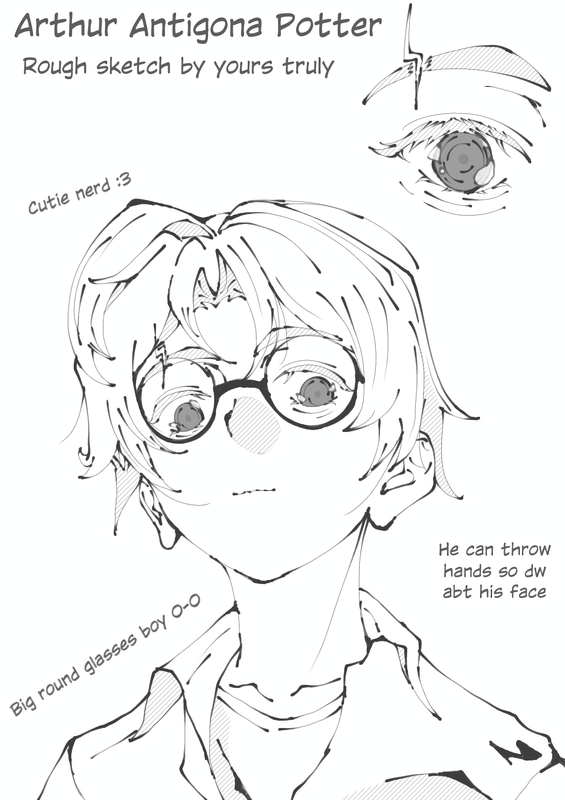
“Las’ time I saw you, you was only a baby. Yeh look a lot like yer mum, but yeh’ve got yer dad’s eyes. And—ah—that jagged scar, lightning bolt right through yer right eyebrow… makes yeh look uncommon grown-up, that does.”
“You seem remarkably familiar with me.”
Before he can reply, Uncle Vernon emits a strangled, rasping sound. “I demand that you leave at once, sir! You are breaking and entering!”
“Ah, shut up, Dursley, yeh great prune.” The giant reaches over the sofa, plucks the rifle from Vernon’s grasp, bends the barrel into a simple knot—effortlessly, as if it were rubber—and tosses it into the corner.
Vernon makes another sound, high and thin, like a mouse stepped upon.
The giant turns back to me. “Anyway—Arthur—a very happy birthday to yeh. Got summat fer yeh here I mighta sat on it at some point, but it’ll taste all right.”
He pulls a box from his overcoat pocket—slightly squashed. I take it, fingers steady despite everything. Inside sits a large, sticky chocolate cake. Happy Birthday Arthur Antigona loops across the top in uneven green icing.
I look up, schooling my expression. He is colossal, absurdly strong, and clearly well-disposed toward me—best not to look entirely incredulous.
“Thank you. Though… basic courtesy usually involves introducing oneself before forcing entry. Not the other way around.”
He rumbles with laughter. “True, I haven’t introduced meself. Rubeus Hagrid, Keeper of Keys and Grounds at Hogwarts.”
“Say what now?”
“How about I explain over that tea then, eh?” He rubs his hands together. “I’d not say no ter summat stronger if yeh’ve got it, mind.”
His gaze falls on the empty grate, crisp packets shrivelled and useless. He snorts, leans over the hearth—we see nothing of what he does—and pulls back to reveal a roaring, dancing fire. Warmth floods the room, wrapping around me like stepping into a heated bath.
He settles onto the sofa, which groans and sags beneath him, and begins emptying his pockets: copper kettle, plump package of sausages, poker, teapot, chipped mugs, and a bottle of amber liquid he takes a direct swig from before setting to work. Soon the hut fills with the rich hiss and savoury scent of frying meat. No one speaks. When he slides the first six fat, juicy, slightly charred sausages onto a plate, Dudley shifts restlessly.
“Don’t touch anything he gives you, Dudley,” Vernon snaps.
Hagrid chuckles darkly. “Yer great puddin’ of a son don’ need fattenin’ further, Dursley—never fear.”
He passes the sausages to me. I blink. I already have a cake; why additional provisions? Birthday practice, perhaps? Still, the sausages are fresh and appetizing—whereas the cake is… well, squashed. I hand them to Dudley. He devours them huddled in his corner, equal parts terrified and ravenous. An impressive display of swine-like efficiency.
“Like I told yeh, I’m Keeper of Keys at Hogwarts—yeh’ll know all about Hogwarts, o’ course.”
“Never heard of it. Sounds… not-so-real.”
Hagrid stares, genuinely stricken.
“Sorry.”
“Sorry?” Hagrid barks, turning to stare at the Dursleys, who shrink back into the shadows. “It’s them as should be sorry! I knew yeh weren’t gettin’ yer letters but I never thought yeh wouldn’t even know abou’ Hogwarts, fer cryin’ out loud! Did yeh never wonder where yer parents learnt it all?”
Ah. So he is the source of those letters. That explains the delivery anomalies—but hold on—
“Learned what?”
“LEARNED WHAT? Now wait jus’ one second!” Hagrid thunders. He surges to his feet, anger swelling until he seems to fill the entire hut. The Dursleys press themselves flat against the far wall. “Do you mean ter tell me that this boy—this boy—knows nothin’ abou’—about ANYTHING?”
Something in that lands wrong. My pride pricks. “That is offensive. I know a great deal. I have ranked at the top of every class I have ever entered. I read extensively—history, mathematics, literature, sciences—”
Hagrid waves the objection aside. “About our world, I mean. Your world. My world. Yer parents’ world.”
My left eye twitches. “What?”
Hagrid looks ready to detonate. “DURSLEY!”
Uncle Vernon, drained of all color, whispers something that sounds suspiciously like “Mimblewimble.”
Hagrid turns on me, gaze wild. “D’yeh even know what yeh are?”
Vernon finds his voice all at once. “Stop! Stop right there, sir! I forbid you to tell the boy anything!”
A braver man would flinch beneath the fury Hagrid levels at him. Every word shakes with restrained wrath.
“You never told him? Never told him what was in the letter Dumbledore left fer him? I was there! I saw Dumbledore leave it, Dursley! An’ you’ve kept it from him all these years?”
This time it is my turn to drag a hand through my hair, fraying fast. “Wait—pause. What in the world is going on?! Both of you—you know something I do not! Who even is Dumbledore?!”
“STOP! I FORBID YOU!” Vernon shrieks, panic raw in his voice.
Aunt Petunia gasps, sharp and horrified.
“Ah, go boil yer heads, both of yeh.” Hagrid waves them off. “Arthur—yer a wizard.”
Silence swallows the hut. Only the sea’s roar and the wind’s thin whistle remain. My mind, despite parsing his thick accent clearly enough, locks up—straight up blue-screened.
“Bullcrap, what the hell is that even supposed to mean?”
“A wizard, o’ course,” Hagrid repeats, settling back onto the sofa which groans and sinks deeper under his weight. “An’ a thumpin’ good’un, I’d say, once yeh’ve been trained up a bit. With a mum an’ dad like yours, what else would yeh be? An’ I reckon it’s abou’ time yeh read yer letter.”
I reach out at last and take the yellowed envelope—addressed in emerald-green ink to Mr. A. A. Potter, The Floor, Hut-on-the-Rock, The Sea. I pull out the single sheet and read:
HOGWARTS SCHOOL OF WITCHCRAFT AND WIZARDRY
Headmaster: Albus Dumbledore
(Order of Merlin, First Class, Grand Sorc., Chf. Warlock,
Supreme Mugwump, International Confed. of Wizards)
Dear Mr. Potter,
We are pleased to inform you that you have a place at Hogwarts School of Witchcraft and Wizardry. Please find enclosed a list of all necessary books and equipment.
Term begins on 1 September. We await your owl by no later than 31 July.
Yours sincerely,
Minerva McGonagall
Deputy Headmistress
Good grief. I’d wondered what could possibly merit letters that breached walls, multiplied, and defied every physical law of delivery—now it makes a modicum of sense. I can suspend disbelief, rationally; one must accommodate new data when the old rules clearly no longer apply. That said—the instruction to send an owl? That part leaves me completely stalled.
“Gallopin’ Gorgons, that reminds me…” Hagrid claps a hand to his forehead with enough force to stagger a draft horse. From yet another pocket in that seemingly infinite coat, he produces an owl—live, feathered, and looking distinctly ruffled—along with a long quill and roll of parchment. He scribbles a note, tongue clamped between his teeth; I do not bother reading it. My mental processing bandwidth is fully occupied simply holding this new reality together.
He rolls the note, fixes it to the owl’s leg, carries it to the door, and releases it into the gale. Then he sits back down as casually as if he had just hung up a telephone.
I cannot help it—my jaw drops. I fight it, but fail. My entire world has inverted in the span of a single night. On my birthday, no less. Where does this even lead? All this talk of witchcraft and wizardry makes my head throb.
“Where was I?” Hagrid blinks, then fixes me with steady resolve. “You’re coming with me, Arthur.”
That is when the sensory flood overwhelms me. Everything blurs—shouting voices, the storm’s howl, images piling too fast to process. Loud environments have never been my strength. As Hagrid, Vernon, and Petunia all begin yelling at once, layered over the wind and crashing waves, I detach—retreating inward to preserve whatever remains of my composure.
I catch fragments. Hagrid calls Vernon and Petunia “Muggles.” Petunia speaks of my mother with venom—calls her unnatural for ever wanting to go to this school. Vernon sneers that my parents were freaks (a judgment I have privately shared, for the record) and insists he will not have me mixing with their kind. Beneath the noise, one truth cuts through the haze: the story they told me—that my parents died in a car crash—was a lie.
They were wizards. They died confronting something… something terrible. For a cause? Not sure. I can’t hear.
What am I supposed to do with that? I should feel something. Gratitude? Grief? Pride? I suppose those are the appropriate reactions. But these are people I never met. Whose hands never held mine. Whose voices I never heard. Their legacy may be great—Hagrid’s reverence makes that clear—but it is not mine. That’s right… not mine.
“I AM NOT PAYING FOR SOME CRACKPOT OLD FOOL TO TEACH HIM MAGIC TRICKS!” Vernon’s shriek snaps me back to the present.
He has gone too far. Hagrid snatches up his umbrella and whirls it overhead. “NEVER—INSULT—ALBUS—DUMBLEDORE—IN—FRONT—OF—ME!”
I step between them before he can act. I school my features—panic serves no purpose. Objectively, this entire dispute concerns me, yet no one has asked what I want. That is unacceptable. I am the one at the center of this absurdity; I must speak.
“I’m not going.”
Silence swallows the hut. Even the storm seems to hush—awkward, sudden, like a boisterous child who has blundered into a room where adults are speaking in earnest. Uncle Vernon and Aunt Petunia stare, clearly baffled that I would choose this.
“What are yeh sayin’, Arthur? Yer a wizard! It’s your destiny—to be as great as yer mum and dad!” Hagrid leans forward, massive hands spread gently, urgent.
I exhale, then draw in a sharp breath. “I do not doubt they were great. But I see no reason to go wherever this place is… I… I never even knew them.”
He steps closer. “But yeh need to see who yeh truly are! How much yeh can be—away from these Muggles, in the world where your parents built their lives and left their mark—!”
“And I needed them.” I cut in, stressing the word, each syllable distinct. “Need-ed. My destiny is not yours to guide, even if your intentions are good. It is simply—”
The words catch. Why can’t I form it? Ah—
“They left me before I even knew they existed.”
“They never plan to die and leave yeh—”
“Yes, I am sure that is true.” My voice tightens, rises. “I do not know what they faced, or why it was not an accident. But I wager they did not plan on staying safe just so I would grow up alone, either!”
My voice, small at first, climbs until it rings out. The giant steps back. I have never felt this—never truly raged at anyone, never harboured resentment, not toward the Dursleys, not toward my absent parents. This is different. It is not about affection or blood. It is about—
A tear slips from my right eye. Surreal. I cannot recall ever crying before. Nothing has changed; I am not hurt, not in any way I can name. And yet—
“The Dursleys were never kind,” I say slowly, gaze dropping away. “But they were here. My parents were not. Why would I leave what I have, when I am content enough with it?”
Hagrid blinks, stunned, then his expression softens entirely. He rests a huge hand upon my shoulder. “Yer parents loved you, Arthur.”
I draw a sharp breath and steady myself. “I believe you. If they had not, I would not be here at all. That said—I still cannot find it in myself to say yes.”
“But don’t yeh want more than this? They keep yeh here not outta love—pure obligation, nothing more—”
He stops. He sees it, then. Absent parents who love me are not, in any practical sense, superior to present guardians who do not. So he sighs, rubbing a temple. The sadness radiating from him is so heavy it feels tangible—enough to unravel anyone already fraying at the edges.
“Arthur… I know yeh say you’re content. But are you fulfilled? With this?”
Indeed—precisely the distinction. Contentment is a beggar given endless plain bread—relief that hunger will not kill them, that they need not steal to survive. It does not mean they relish the bread. Beneath it, something deeper still craves cake. That is fulfillment. But…
I find myself smiling, soft and unshaken. “I have lived eleven years without a real family. I think… I no longer require fulfillment. I simply do what is necessary.”
His expression fractures—shatters into what I can only call ugly, unreserved weeping. I do not understand it. I have said nothing profound. Nothing tragic. I have merely stated fact: my life is stable, my needs are met, my path is clear—contribute what I can, remain useful, and I shall endure. That is not misery—but a good, simple life. I have grown fond even of my cupboard beneath the stairs. It holds my books. My learning. I might even become a respectable adult on my own merits.
“Oh, my dear boy…” Hagrid sobs. Uncle Vernon and Aunt Petunia recoil, terrified—the giant who smashed their door reduced to a shaking, weeping thing. “I knew leaving yeh here was wrong! I thought we could make it right for Lily and James… Oh, how small and hollow your life has become. I never meant to dictate your path for yeh, Arthur… I only wanted yeh to know—to have the chance to see what your parents gave their lives for.”
An absurd reason. Those names—Lily, James—my parents I assume—mean nothing to me. He can speak them a thousand times; I will feel no surge of affection, no grief, no kinship. That is the truth. I have not been broken or abused; I have simply been left to stand on my own. And I have done it. Eleven years, navigating the quiet limbo of Privet Drive, without anyone’s blood to lean on. Why should I need it now?
“I have no reason to go,” I say slowly as he sets me back down. He swipes at his eyes, and my gaze narrows. “Nothing is truly lost either way. I do not crave glory or destiny. Frankly I still scarcely understand what makes me a wizard—but…”
His eyes widen—those beetle-black eyes growing larger, startled. He sees it then: this is not about obligation, nor duty, nor legacy. I simply refuse to be pulled along by someone else’s hope.
Any other child would have leapt for joy at the revelation—magic, a hidden world, a place where they might belong. But I have long since set aside the hunger for more. My life has been steady, small, sufficient. That said—
The world has shifted under my feet. There is something larger out there. And if I go… I go because I choose to step forward. Not for them. Not for magic. Not for any grand story. Simply because I can.
“If you insist I come, there will be a condition,” I say, steady and clear, “every decision will mine. Made by me.”
A low, rumbling chuckle escapes him. “Bloody hell… Lily and James raised one remarkably resolute child.”
I am not entirely sure if that is a compliment—after all, I view my parents as little more than footnotes in my own story. But I meet his gaze and smile anyway. For the first time in my life, I feel something like pride.
Extra
It may appear, at first glance, that the given name I have assigned to this alternate Potter is of a simplicity bordering on indolence. Arthur—the first of his names—draws from the ancient soil of UK, bound by long usage to the memory of a king whose name has become the very symbol of bravery and valour; such is the meaning people have ever fastened to it.
But consider his second name—Antigona—and the matter alters entirely. As I have elsewhere stated, this Potter is not the same as he of the canon; in many things he is his direct contrary. And so Antigona speaks plainly: opposition, it stands as antithesis. Join them together—Arthur Antigona Potter—and the name itself becomes a declaration: “here is a Potter who is not brave,” at least not in the fashion you have been taught to expect. Neat, right?
To this outward mark there is also added: he wears bigger around spectacles, fashioned more in accordance with the novel than with the likenesses displayed upon the films.