
Chapter Text
Campbell-Wellington house, Sunday, September 17th, late evening
When they returned from the MacIver home, leaving Fionnuala with her mother, Heyes and Paula discovered that Mr. MacEachron had been able to send the telegraph to the solicitor, Mr. Kennedy, in spite of it being the Sabbath. The lawyer had replied within the hour, assuring them that he would be with them by mid-day on Monday, driving to Otter Ferry and taking a morning ferry from there to Ardrishaig, where he would be met by Mr. MacEachron and driven the relatively short distance to Kilmichael Glassary. He would expect to stay at least one night, as they could hardly hope to get through all the business which must be discussed in half a day.
In their bed-chamber, going over in her mind all of the matters which would have to be dealt with, and all of the details to be decided, Paula suddenly felt overwhelmed. She had never expected to face this task without her brother’s support. Uncertainly, she turned to her husband. “Hannibal?” she said, almost in a whisper.
He was at her side in an instant. “What is it, dear girl?”
“I … I need you.” She flung her arms around his neck and buried her face in his shoulder.
“Right now?” Heyes put his arms reassuringly around her and held her close.
She looked up sharply into his face, realizing his meaning, then smiled. “Yes, right now.” She hugged him tighter, then released her hold.
“Good.” He began to unbutton the long column of tiny pearl buttons at the centre front of her bodice, then stopped and looked at her. “But I know that wasn’t what you meant. What were you thinking? What’s wrong?”
“Well, you’re right that I wasn’t thinking about that, but by all means, go ahead with what you were doing.”
Heyes grinned and continued to struggle with the buttons. “Tell me.”
“It’s just all this that has to be decided over the next few days. My brother and I own this property, and neither of us will probably ever be here again, so it must be done now, and done right. I feel so inadequate. I know Paul gave me a power of attorney, and he’s depending on me, but it’s just too much. I don’t think I can do it. And I must.”
“Do I have a say in this? In what’s done with the property?”
“Of course you do. We haven’t put your name on any documents for the Scottish property, because it’s not the same set of problems that we’re looking at in England. That’s mostly investments. This is a landed estate. But you’re my husband. Of course you have a say.”
“All right,” said Heyes. “Now I have another question. Have you looked at that power of attorney since your brother had Richard Bancroft prepare it and send it to us in New York?”
“No, how could I? It was waiting under your name, and you just told me what it was and put it away. I never thought of asking to see it. I’m sure Mr. Bancroft drew every thing up correctly.”
“Well, I looked at it, and it’s not made out to you. It’s made out to you and me together. So you listen to me now. I’ll want your advice, and the lawyer’s advice, too, of course—and then I’m going to make the decisions. You can stop worrying about it. I’m taking this burden off your shoulders, where it never should have been in the first place. Do you understand me?” He freed the last button from its buttonhole, placed one hand on her shoulder and the other under her chin, and obliged her to look up at him.
“Yes. Oh, yes! I will have to advise you about some of the special concerns, but …”
“I expect that. But I’m making the decisions.”
“Of course you are! Thank you! I forgot—” She started to say some thing more, but Heyes pressed his lips to hers, preventing further speech.
“You forgot you had a husband? Is that what you were going to say?”
“I know it sounds stupid—”
“We can’t have you forgetting you’re married. I’m going to remind you.”
*** *** ***
In the early morning, Heyes rolled over and looked at his watch, wondering how much time they had before being obliged to get ready for breakfast. Then he remembered that no one had said any thing about breakfast being served at any particular time. “Paula?” He touched her face gently.
“Mmm?”
“It’s half-past six. When do you suppose breakfast will be served? Or do we get our own?”
She opened her eyes fully and turned to look at him. “I expect the MacEachrons will look after themselves, especially since they have the baby to see to, and when we get up, Mrs. MacEachron will make arrangements for us, if she hasn’t already put some thing aside. They’re treating us like the owners of the house—that’s why no one gave us a time.”
“Then we have time for each other.”
Later, Heyes stroked her hair back from her face. “Mad at me?”
“For heaven’s sake! Of course I’m not mad at you! Why should I be?”
“Well, I just thought you might not like what I was doing.” At her astonished stare and giggle, he corrected himself. “That is, what I said last night, about taking responsibility for this property, which I don’t even own a piece of.”
“No, I’m not mad. I told you I needed you, and that was the solution you came up with. It sounds more than reasonable to me. I have the intention, though, of taking Mr. Kennedy aside and explaining that to him, together with the assurance that you are a man of intelligence and sense, and that you may be relied upon to make the best decisions for every body. You’ll need to talk to him anyway—it’s possible that my grandfather’s will took this current possibility into account and made some kind of provision. There may not be as much leeway to act as we think there is.”
He kissed her, and then reluctantly got up and began to dress.
The Scottish lawyer’s contribution
Upon Mr. Kennedy’s arrival, a cold luncheon was served before he announced that it was time they got to the business which had brought him here.
“Mr. and Mrs. Heyes, I shall need both of you to be present, naturally. Mr. MacEachron, since you’re the factor, you should also sit in on the meeting. Bring any documents you think may be of importance.”
As the MacEachrons were leaving the dining table to go in different directions, Heyes spoke up. “Mrs. MacEachron? Wait a minute. I think you should be at this meeting as well.” He was pleased with himself for remembering how to pronounce her surname—similar to ‘Mac Kekron’, he had been told, after he had seen how it was written and realized he’d better ask.
She looked surprised. “Very well, but the baby …”
“Bring the baby’s cradle. We can help keep an eye on him if he wakes up. Please? I’d like you to be there.”
“Of course, Mr. Heyes. Give me a hand with the cradle, Iain,” she said as her husband was leaving the room. He murmured assent and the couple left the dining room together.
Adjourning to the library, where a good fire was burning on the hearth to keep the damp from the books, and to take away the chill of the overcast day, every body took their seats where they could see Mr. Kennedy, who, at Mrs. Heyes’s invitation, had ensconced himself behind the big desk in front of the window.
“Mrs. Heyes, I must tell you that your grandfather’s and your mother’s wills, both of which I have here, do provide some guidance as to what we might do in the current situation, though there was nothing specifically laid out. The property is not entailed. There is sufficient income to maintain it appropriately and to continue the small horse breeding operation that your father started, if that is found to be desirable; there is, however, no great sum of money to inherit and thus no likelihood of any distant relatives desiring to challenge what is decided here.” He spread out the power of attorney that Heyes had handed to him.
“The first thing to get clear, then, is a statement of your intentions—yours, Mr. Heyes, for yourself and your wife, and Paul Campbell-Wellington’s intentions as far as you are aware of them—as to where you plan to settle down and raise your families, and how much time you intend to spend here.”
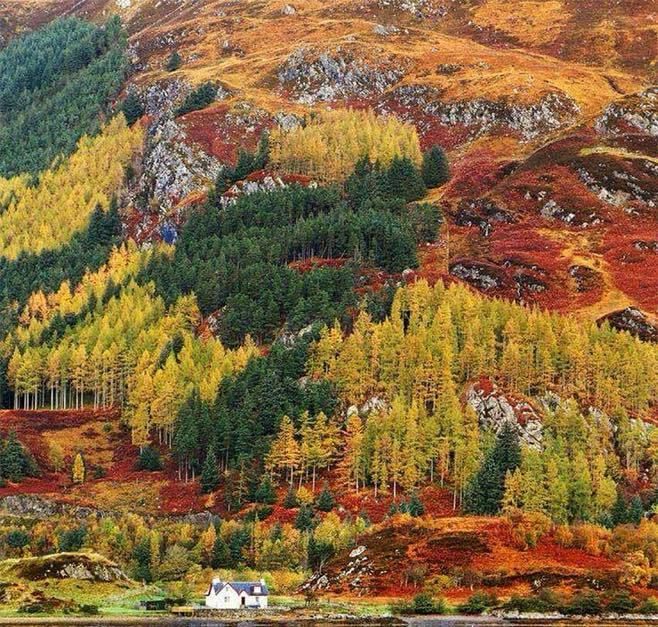
Autumn in the Scottish Highlands
“That’s easy to answer,” said Heyes. “My brother-in-law intends to continue ranching in the Estes Park area in the state of Colorado, in the United States. As far as I know, he has no intention of ever coming back here. That’s borne out by the change of name he did when he became a naturalized American citizen. He dropped the Campbell from his name. So did my wife.” He smiled at her. “And now her name is Heyes, and, well, we don’t want to live here, either. It’s not home for me, and from what she’s told me, it’s not home for her any more.” His eyes went to the window behind the lawyer’s head, taking in the vivid colors as the landscape began to take on its autumn dress. “It’s beautiful, and all that, but I know I wouldn’t feel at home here for very long. Besides, I have a cousin in the States who plans to be married, too. We hope he and his wife will settle down at the C Bar W Ranch or near it, so we can keep in touch.”
“The C Bar W Ranch? That is Mr. Campbell-Wellington’s horse farm?”
Heyes glanced at Paula. She would do better at answering that question.
“That’s right, sir, except that my brother and I own it in joint tenancy, and the papers have been drawn up to add my husband to the property deed and the business partnership. And as Heyes said, my brother is just plain Mr. Wellington now.”
“I beg your pardon, Mrs. Heyes.” The lawyer made a note on the pad of paper in front of him. “You call your husband by his surname?”
“Yes, much of the time. Almost nobody uses his Christian name.”
Settling his spectacles more firmly on his nose, the lawyer looked back at the American. “Is Mr. Wellington married or engaged to be so?”
“No, he’s not married. He’s sort of engaged, but he doesn’t know it yet.”
“How’s that again?”
Grinning cheerfully, Heyes outlined the arrangement which had been agreed upon at the MacIvers’ home the previous day. “So the two MacIver ladies and their cow will be going to America with us. Our steamer reservations are with the White Star line, for the Germania, leaving on the second of October. I could use your help making the arrangements to get the cow and their heavy baggage transported down to London in time, or Liverpool. The ship departs from London, but it calls at Liverpool first, and may be the cow and the baggage could go on board there. If it’s necessary to hire a man to look after the cow on the voyage, and on the rail trip west, I’d better do that before we leave here, or you could.”
“Why, of course, Mr. Heyes. I should be happy to assist. I shall draw up some notes, and discuss them with you before leaving here on the morrow.” Mr. Kennedy withdrew a folded document, tied up with red tape, from his briefcase. “Now that we have cleared up that matter, let us look at Mr. Campbell’s will.
“You see that he says the property should be kept in the family, if possible, or at least in Campbell hands, and to that end he inserted a requirement, fairly common in land inheritance in this part of Scotland, that any man marrying the eldest or only female descendant—naturally he was thinking of his daughter, your mother, Mrs. Heyes—would be expected to take the name of Campbell and hyphenate it with his own before assuming ownership of the property. That was what your father did. I believe that gives us a good picture of your grandfather’s wishes.”
“If our father had died first,” said Paula, after a moment’s silence, “our mother would have finished raising us here, on this estate, and my brother would probably have stayed. He would have shocked certain people in Inverara by marrying Fionnuala MacIver, and they would have stayed on here as Mr. and Mrs. Campbell-Wellington. I don’t know what I should have done in that instance. As it was, with my mother dying before my father, Paul and I were taken to reside in London, where I fell prey to my aunt’s marriage schemes.”
“Mr. Kennedy, do you know what made the twins decide to leave the country so suddenly?” asked Heyes. He touched Paula’s arm soothingly, as the thought of never having met him at all had caused her to clutch his hand and hold it as though she would never let it go.
“I am not familiar with the details, but I am aware they were obliged to leave out of concern for Miss Campbell-Wellington’s safety. They had no time other than what sufficed to confirm Mr. MacEachron in his position as the factor, put all the other business into my hands, and pack up what little they could take with them, taking Mrs. Ramsay and her children along. I had no idea, of course, that they would be away for ten years, but the arrangements were well thought out, and the estate has taken no hurt from the long absence of the owners.”
“Then what we have to figure out is who this property should go to,” Heyes continued. “There are no close relatives, are there?”
“There are the French cousins, descendants of Mr. Campbell’s sister,” replied the lawyer, setting the tips of his fingers precisely together. “I happen to be aware, however, that all the members of the present generation in that family are very much averse to coming here and taking the Campbell name. They have visited here several times, but they have shown no desire to take up residence. It is, of course, very different from Paris or the French countryside. If they were to inherit, they might well take steps to dispose of the property to the highest bidder, and there would be nothing I could do in law to stop them from so doing.”
“That’s no good. So we need to find some body who’s here already. Some body who loves the place and wants to live here.”
“Yes, Mr. Heyes, that would be ideal, but I must admit that I am at a loss.”
“Well, I’m not. Mr. MacEachron, what about you? This is your home already, and I know you care about the property.”
Startled, both MacEachrons gazed at the American in astonishment. “Mr. Heyes, for one thing, MacEachrons are related to Clan Donald. My family’s been in Argyle several generations, but we’re not Campbells.”
“You’ve been here all that time, and the country-side is stuffed with Campbells, and there’s not a Campbell in the bunch? In all your ancestors, I mean?” asked Heyes. He looked from the man to his wife. “What about you, ma’am?”
Mrs. MacEachron was laughing in spite of herself. “I think there are a few Campbells in my husband’s family, after all. But, as it happens, my mother is a Campbell.”
“There you are!” exclaimed Heyes. “And you have a little baby boy, too. I know you have a daughter, but … that’s what’s wanted, isn’t it?” he said, turning to Mr. Kennedy. “A son to inherit?”
“Yes, preferably, but …”
“Well, then,” the American continued persuasively. “I think it’ll work. Unless Mr. MacEachron doesn’t want to add Campbell to his name because of a clan feud or some thing else I don’t know about.”
“I’ve no objection,” said MacEachron slowly. “There are MacDonalds in Argyle who have intermarried locally. Some families have been here since the Glencoe Massacre, when they came to ask the Earl of Argyle for help. You’d not know about that.”
“As a matter of fact, I do know a little. Paula and her brother and Mrs. Ramsay and her sons spent a whole evening two years ago, telling me and my cousin all about Glencoe. Mrs. Ramsay sang us a Gaelic song about it.”[1] Heyes turned back to the lawyer. “Is there any problem with solving things that way?” He shot a quick glance at his wife. “Paula?”
“Bless you, sweetheart!” She was staring at him in some thing very like disbelief.
“For what?”
“For thinking of a way round this problem that probably would not have occurred to any one else. And it perfectly addresses my grandfather’s concerns for the land.”
Mr. Kennedy made another note on his pad. “That is what I was thinking also. The property would stay in the hands of some one with Campbell ancestry, the owners are willing to add the Campbell name to their own, and it would go to some one who loves it and thinks of it as home. I can think of no better solution, always provided, Mr. MacEachron, that you and your wife are willing to abide by the conditions: to take the Campbell name in addition to your own, to undertake to live here for most of the year, and to raise your son with that understanding.”
The couple spoke quietly together for a few moments. “Mr. Kennedy, we’re willing to abide by all those conditions, and to sign any papers you think necessary, but we have a suggestion. My wife and I would like to see the property put in trust or otherwise secured to our son, with precautions written into the arrangement so that he does not fully inherit until he has proven his desire to stay here and make a success of the farm. And if … that is, if for some reason he does not survive to adulthood, we’d have to have that written out, too. Perhaps the property could be left to any children our daughter might have, with the same conditions.”
Mr. Kennedy made additional notes, nodding. “An entail with certain conditions attached would probably fit those requirements. I shall make a draught for you to see.” He turned. “Mr. Heyes? Have you or your wife any other suggestions to put forward? Any objections to what has been discussed?”
Paula squeezed her husband’s hand where it lay on his knee, indicating her approval without any need for speech. Heyes shook his head. “We’d like to go ahead with preparing the papers to transfer ownership to the MacEachrons. We’re satisfied, and I know my brother-in-law will be, too. We’ll need to read and sign every thing before we leave for London next week.”
“At this point, you’ll have me wishing that I had brought one of my clerks, and one of those type-writing machines,” objected the lawyer humorously.
“But we have a type-writing machine here,” said Paula, “or at least, there was used to be one in the room that my father used as a study.”
“It’s still there, Mrs. Heyes,” said Mrs. MacEachron. “I don’t know how to use it, though.”
“I think Mr. Kennedy would say it would be ineligible for you to type these documents up in any case, since you’re so closely concerned,” Paula rejoined. “As it happens, I do know how to use one. My brother insisted that one of us should learn type-writing, so that we could keep the ranch accounts and the horse breeding records in legible form. ‘One of us’ turned out to be me. I’m not very quick with the work, but I was taught to be accurate. I’d be happy to help you draw up the papers, Mr. Kennedy. The alternative is your going back to Dunoon and having to communicate with us by telegraph.”
“Or I could send for my clerk. But if you can act as my type-writer, we should be able to draw up the necessary papers in the next two or three days. The minister and one or two others of the local folk can act as witnesses.”
“That will give us the opportunity to let the villagers know about this, and find out if there are going to be objections from that quarter,” said Mr. MacEachron. “I don’t anticipate any, but it’ll be as well to find that out before Mr. and Mrs. Heyes leave the area. In fact, we could host an informal reception of sorts in the garden here. People want to meet you, Mr. Heyes, and they’ve not yet had the opportunity.”
“Then why don’t we make the garden party a farewell party for the MacIvers, as well?” Heyes looked around the circle. “Or would there be a problem with that?”
“It will surprise some people,” said Paula. “But this family has been doing that for years, I fear. The local folk ought to be accustomed to it by now. The only thing I’d suggest is that they don’t need to know that both of these plans—the property transfer and the MacIvers emigrating—were your idea.”
“I’ll make the arrangements for the party,” murmured Mrs. MacEachron. “Shall we say Friday afternoon, sir?” She looked from Heyes to the lawyer and back. Both men nodded, and the lawyer brought the discussion to a close by rising from his chair to shake hands with the MacEachrons.
*** *** ***
Crossing the entrance hallway a little bit later, Heyes realized his wife and Mr. Kennedy were continuing an informal conversation. Curious, he moved toward the parlour.
“You’ll need to start sending twice as much oat meal in the quarterly shipments you’ve been making to us, now that we’re going to have about five more people living there.”
Kennedy nodded and made a note on his pad of paper.
“Just a minute, Paula,” Heyes interrupted. “Now that oats are being grown in Colorado – in fact, you know they just put some in on the ranch this past spring, for hay – why don’t we just cancel the Scottish oat meal shipments and start eating the oats we grow ourselves?”
Paula hesitated. When her husband put it that way, she realized after a moment’s thought, she really had no choice but to give in, and hope that she would not dislike the Colorado-grown oats as much as she was afraid she would. She assured him, after a moment’s silence, that they could follow his plan, which certainly made sense and would save a lot of trouble and expense.
Confronted with her obvious hesitation, Heyes had the grace to feel slightly ashamed of himself. What he was really after was to have her not hankering after Scotland any more, since she had assured him that she loved him, would go where he went and live where he wanted to live, and was looking forward to living in Colorado with him. Of course, he knew she would always love Scotland, but she had already told him that it was no longer home to her. He had just wanted to see how she would react to the suggestion about the oats.
Relenting, he smiled at her. “I guess we could keep the Scottish shipments coming, and eat the Scottish oats on special occasions. That way Mr. Kennedy wouldn’t have to increase the amount, or may be he could just add a little more, not double the shipment.”
The Scottish lawyer smiled as Mrs. Heyes flung her arms around her husband’s neck and stood on tip-toe to kiss him.
Kilmichael Glassary, Argyle, Scotland, Wednesday, September 20th
Heyes ran a comb through his hair, undressed quickly, and came over to his wife, who was sitting at the small table in her dressing gown, brushing her hair one hundred strokes. It was a task she tried to do nightly, though upon several occasions since their wedding, it had been scamped, or abandoned altogether.
She saw him in the mirror, standing behind her, and paused, tipping her head back to look at him. “What is it, darling?”
“I was just wondering—do you want me to-night?” He hesitated. That had not come out well.
Putting the brush down and turning to look at him in surprise, she said, “Of course I do. You’ve no need to ask, surely? Is some thing wrong?”
“Well, I was looking at the calendar, and … isn’t your course due to start to-day?” He ran his hands down from her shoulders, lightly caressing her bosom through the satin dressing gown. “But it hasn’t, has it?”
She captured his wandering hands and held them. “No. But it’s not unusual for it to be late, or even to miss a month. Any thing can cause that—a change of food or water, unaccustomed exertion, some kind of excitement or worry.”
“Isn’t there some thing else that could cause it?”
“You mean if I were with child? Yes, that would make it start to miss.” She tipped her head back again to look into his face. “But I’m not, as far as I know.”
“How would you know that? You’ve never been married, or had a child, after all.”
“No, and neither have you. But I know what to look for, generally.”
“When would you know?”
“Hannibal, will you stop worrying? If the course doesn’t come this month, and it’s not just late, and if it misses next month as well, we can start thinking about that. I admit it’s a possibility, and I promise I’ll tell you, next month, if any thing like that develops.” She gripped his hand to aid in her rising from the chair, and turned to put her hands on his chest. “Meanwhile, you were asking …”
A smile tugged at one corner of his mouth. “Yeah, I was.” Gently he lifted her off her feet and carried her over to the bed. Then some thing else occurred to him. “If there is a child, I don’t want to do any thing that could hurt him—or her.”
“You won’t.”
“And just how do you know that?”
“I’ll tell you. You remember that silver quaich you bought for me in Oban, with the Robert Burns poem?”
“My Love Is Like a Red, Red Rose. Yes, of course I remember.”
She tried to think of the best way to tell the story, which was most definitely unsuited for mixed company. But Heyes was her husband, after all. “Well, there is a somewhat scandalous anecdote about Robert Burns that bears on our situation. I learnt of it when I was still in the school room—not from my governess, you understand, or you will when I tell you.”
“Paula, you have the most annoying habit—sorry, that slipped out.” Heyes grinned apologetically.
“An annoying habit?”
“An annoying habit of telling me all about some thing before you tell me what it is. Just go on with the story. What did Burns do?”
“Oh. I fear I do indeed do that. I’m sorry.” She smiled up at him. “Burns eventually married a woman named Jean Armour, but before he did so, he got her with child. Twice. Both times with twins.”
Heyes muttered some thing that sounded like “Good God!”
“What I heard was that one of the times he came to her father’s home to see her, she was eight months along with one of the pairs of twins. Burns was not deterred by this, and went ahead with, ah, what he had come for. Her father found them in the barn.”
“And took a horse whip to him, or may be went for his gun?” asked Heyes.
“No, apparently not. But the twins were born healthy—their roll in the hay caused no harm to the mother or the babies.” She smiled up at him. “And I’m not eight months along. So I shouldn’t think you would need to worry.”
“No, I suppose not.” He removed her dressing gown and hung it on a peg. “You should never have been told that story. Honestly, the things some folks think it’s all right to repeat to innocent young girls!”
“Yes, that was what my mother said when I told her. On the other hand, she confirmed the story. She said there were lots of other things about Robbie Burns that weren’t nice to know, but he was a good poet for Lowlanders.” She put her arms around her husband’s neck for a moment. “And he wrote that wonderful poem you found. I shall remember it always, as some thing you said, just for me.”
*** *** ***
At the garden party on Friday afternoon, Heyes watched Paula carefully as she circulated amongst the guests. He knew how much she disliked being a hostess at a party, even a quite informal gathering like this one. She seemed to be more at ease than she had been at their wedding reception, carefully sharing the hostess duties with Mrs. MacEachron, while making sure that every body present had some thing to eat and a place to sit down. Fionnuala and her mother, having locked up their house and been driven over to the Campbell-Wellington home—or the Campbell-MacEachron home, Heyes reminded himself it was now—with all their personal belongings packed in four small trunks, and such pieces of furniture, including a full-sized weaving loom, as they wished to take with them being loaded into a waggon and brought along, had been invited to spend the night before leaving for the south on the morrow. They were assisting in the task of ensuring the party went smoothly.
In some mysterious fashion, the word had spread all over the district that Miss Campbell-Wellington’s new American husband had masterfully arranged things about the transfer of ownership for the property, and had somehow talked Fionnuala MacIver and her mother into emigrating to America at very short notice. Mindful of the warning he had been given, that it would be better if people didn’t know that he was at the back of the changes, Heyes waited, a bit warily, for any hostile reactions from the local folk, but there were none—at least none that he could see. While he knew that they were too polite to say any thing to him directly, he was adept at reading faces and speech for hidden attitudes; as far as he could tell, though, there was no bad feeling.
He walked quietly over to where Mr. MacEachron was sitting, staying out of the way of the people milling about the table where cold food was laid out. “It seems to be going pretty well,” he ventured.
“Yes, it does. They like the idea, and they like you, Mr. Heyes, even though most of them are sad that you’ll be taking Miss Paula away for ever. You’d better go and mingle with the folks a bit. It’s you they want to talk to, though of course no one will say so. Most folks here have never met an American.”
As he was turning away to obey this suggestion, Mrs. MacIver came up to them. Heyes started to ask how things were going, and then realized it was not him she wanted to speak to, but Mr. MacEachron. She held out a large iron key. “You’d best take charge of this. Fionnuala and I have left the house locked up.”
“I’ll take it, Mrs. MacIver. I wish you and your daughter a safe and pleasant journey to your new life. My wife and I will be praying for your welfare, and hers.”
As the older woman thanked him and turned away, Heyes looked curiously at his host. “Why would she give you the key to her house? I suppose you’ll have to find a buyer, or some body will.”
“The MacIvers are tenants to this estate, Mr. Heyes. She was just formally letting me know that they have given up the tenancy. It will be up to me to find another family to take the house, but there is no immediate hurry.”
Heyes whistled softly, a habit he had picked up from Kid Curry. “Would that have caused some kind of social problem, if Paul had stayed here and wanted to marry her daughter?”
“Indeed it would have done, though you heard Mrs. Heyes say, on Monday, that her brother might have done it any way, not caring how many eyebrows it raised. I have always thought that Mrs. Campbell-Wellington would have been glad to see such a thing happen. She surely must have known it was a possibility, when she invited Miss Fionnuala to share her children’s lessons. But it won’t cause trouble in America, will it, now?”
“Oh, no. None at all.” Heyes grinned. “We’ll probably have people saying how romantic it is, as soon as they know the story. And I’m looking forward to seeing Paul’s face when he sees her.”
Mr. MacEachron looked at him gravely. “He’ll marry her? You’re certain?”
“I’m sure of it, even though we plan to surprise him. It was the expression on his face, when he told me that he’d had to leave her behind ten years ago … believe me, he’ll be happy to marry her. I just wonder how he’s going to handle seeing her again after all this time. Has she changed very much?”
“No, hardly at all. She’s grown up, of course, and grown more beautiful, but he won’t have any trouble recognizing her. You’ll be certain to send us a notice of the wedding, won’t you?”
“Sure.”
[1] q.v. the story “The Richest Square Mile on Earth,” by Ida Arminda Moss, available on Archive of Our Own at this link: https://archiveofourown.org/works/19425868/chapters/46231369