
Chapter Text
London, England, August 8th, 1882
Once settled in their suite in the Grand Hotel in Northumberland Road by Trafalgar Square, Heyes glanced at the list he and Paula had made in the express train on the way south from Liverpool. “If you’re not too tired,” he said, “the first thing we have to do is to visit Finney at Scotland Yard, if he’s there. Then I suppose we’d better get started on the legal business connected with your trust, which means going to see your solicitor. I think that’s enough for our first day here.”
His wife—Heyes still got a little thrill out of those words, even after more than two months of marriage—nodded. “We can take a cab to Scotland Yard, or, if you want to see Mr. Finney alone, I can get started on some of the other things which will probably bore you.”
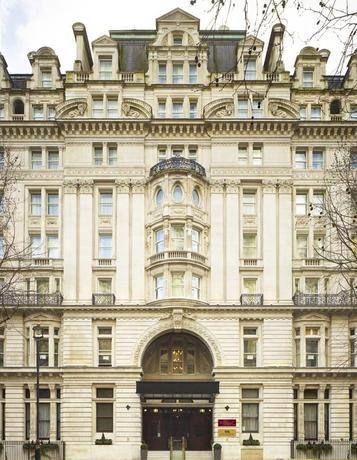
Grand Hotel, just off Trafalgar Square, built in 1880
“No, I want you to meet Finney, and I have to admit I’d kind of like to have you there when I try to explain to him what my real name is and what we’re doing here.”
Taking a hansom cab to Scotland Yard, they approached the constable on duty at the front desk and asked after Detective-Sergeant Kevin Finney. Upon being told that he was not only still with the Yard, but was in the building at that very moment, Heyes gave the constable his visiting card—one of those printed in Denver in the name of Joshua Smith—and asked for Finney to be told that an American businessman and his wife were there to see him. Heyes reflected that Paula had been right—if there were going to be many of these formal social visits, he would need to have cards printed in his real name, some thing which could easily be done in London without the printer asking awkward questions. The constable gave the card to another man, who returned in a very few moments with the news that Finney would be delighted to see them.
They followed the second constable and were shown into a cluttered office, with a book case, table, chairs, and a desk, from behind which Finney, whom Heyes remembered at once even though he had not seen the Irishman in more than two years, rose and came forward with a smile, extending his hand.
“It’s good to see you again,” said Finney, shaking hands.
“My wife, Paula,” said Heyes. The Scotland Yard man took her hand and murmured a greeting, but then turned back to Heyes.
“Congratulations on your marriage! And what brings you to London, Mr. Heyes?” Seeing that Paula showed no surprise at the use of her husband’s true name, and that Heyes himself was temporarily bereft of words, Finney smiled and gestured to chairs. “Please be seated. And let me send out for some tea.”
“That’s very kind of you, Mr. Finney,” said Paula.
Startled at her British accent, Finney wondered where and how Heyes had met her. He stepped to the door and called instructions about the tea to some body down the corridor, shutting the door again behind him as he returned to his seat.
“How did you know my real name?” Heyes asked.
“It was not very difficult,” returned Finney. “You gave yourself away half a dozen times during our trip to the Devil’s Hole area. By the time we returned to town, the only thing I was unsure of was whether the guide who had been hired for us was Hannibal Heyes or Kid Curry. I’d heard of both you and your partner before we started on the trip, of course, but I hadn’t seen your wanted posters or read any descriptions.” He chuckled. “After you left town with your partner...,” He paused. “I presume that Mr. Jones, to whom you introduced me when I found you to give you the four hundred dollars that had been promised to you, was Kid Curry?”
Heyes nodded, a slight smile tugging at the corner of his mouth, in spite of the painful memories that conjured up. Tired, exasperated, and with nerves on edge from the dangerous job of hauling explosives, Kid had hit him when Heyes had confessed that he had been unable to collect the money coming to him for the guide job and had, rather unwisely, invited his partner to hit him if it would make him feel better. Then Curry had apologized, helped him up, and bought them each a beer, which they had been enjoying when Finney came into the saloon to find Heyes and give him the money.
“I went over to the sheriff’s office to look at the posters. The sheriff was a trifle concerned—he wondered if our party had had trouble with any of the outlaws, describing Heyes and Curry as two of the ‘orn’riest critters’ in the Territory.”
“Yeah,” Heyes said, “he told me that, too, when he warned me about how dangerous it was to take a job leading a party—especially that party—up into Devil’s Hole.”
“I told him,” said Finney, “that we had had no trouble with the outlaws. Having examined the wanted posters, given you your money, and watched you and your partner leave town, I also told him, on my second visit to his office, that it was now obvious to me that it had been Hannibal Heyes who had been hired to guide our party.” He grinned at his guests. “You should have seen his face! But you need to know, Mr. Heyes, that before saying that, I told him that it was also obvious you had turned honest and were no longer robbing banks and trains. I then told him that you had left town hours earlier. I asked him not to act on the information I had given him, and he promised me he would not.”[1]
A knock at the door heralded the arrival of the tea, freshly made and arranged on a tray with a snowy linen cloth under a steaming tea pot, a jug of hot water, three cups and saucers, a small pitcher of cream, and a bowl of white sugar cubes. Finney shut the door behind the messenger boy, set the tray on the table, and began to pour out.
Seeing to it that Paula had her tea just the way she liked it—strong, with cream poured into the cup before the tea was added, and no sugar—and sipping his own, with cream and sugar, Heyes thanked their host for his consideration with the Wyoming sheriff, and prompted, “You said I gave myself away?”
“Yes. I did try to warn you that I knew more or less who you were, when we parted the first time at the train station,” Finney replied, delicately refraining from mentioning Julia, the young woman from Boston whom they had been seeing off that day.
“I did catch that. I guess I didn’t realize quite how much you knew, or how early in the trip. And it’s all right,” he added. “My wife knows about Julia. Go on.”
Paula smiled. She was not jealous of the young Englishwoman whom Heyes had met on that trip and had presumably kissed. After all, it was her finger, not Julia’s, which bore the magnificent flame garnet engagement ring, with the plain gold wedding band now worn behind it.
Chuckling at the memory, Finney began, “The first time was when we saw the outlaws watching us. Every body was a little nervous, and very grateful when you offered to ride up and talk to them. Alexander—that is, Ashdown—even offered you a bonus to undertake the dangerous task. You weren’t apprehensive; in fact, you seemed pleased and rather amused at the offer of the bonus, and rode off looking quite confident. When you returned, you were still confident, and you stated that they had promised to leave us alone. You seemed quite certain of it. What man could be certain of such a chancy thing, that a gang of desperate outlaws would agree to a request like that from a supposed stranger, unless he knew that they would take orders from him? I knew at that point that we were dealing with one of the gang’s former leaders. I was quite intrigued as to the reason that you were no longer with them, and apparently living as an honest citizen.”
“Well, they’re not all that desperate,” said Heyes deprecatingly. “I wouldn’t say they’re harmless, exactly. But they’re not likely to hurt any body.” Out of old habit, he avoided telling Finney about the amnesty offer, and then stopped, realizing it would have to be explained before the conversation went any further. Warning Finney that the matter was confidential—at least in the United States—he briefly outlined the arrangement that had been made on their behalf in 1879 with the governor of Wyoming Territory, and the progress, such as it was, that they had been able to confirm with Governor Hoyt upon their meeting with him in June.[2]
Finney asked a number of insightful questions. Mrs. Heyes had begun to outline the conversation they had had with the governor, when a knock fell on the door.
“Come in,” called Finney. The door opened to admit a slight, dark man with a confident bearing, though just now his face wore a worried expression. Upon seeing Finney’s guests, he checked.
_1.jpg)
Detective-Constable Lestrade
“I beg your pardon. I didn’t know you had visitors.”
“It’s quite all right.” Finney had risen, as had Heyes. “This is Mr. and Mrs. Hannibal Heyes, of—” his glance fell on Heyes’s card and he altered what he had been about to say “the state of Colorado, in the United States of America. My colleague, Mr. Lestrade.”[3]
“How do you do?” Heyes shook hands and waited while Lestrade politely greeted his wife.
“Is this your first visit to London, Mr. Heyes?” Lestrade seated himself as Finney gestured to a vacant chair.
“Yes. But my wife was born in Scotland, and grew up in England and Scotland.” Heyes had this down pat now, rather than describing Paula, not entirely accurately, as an Englishwoman. “We just got into Liverpool this morning, as a matter of fact. I met Sergeant Finney in Wyoming two years ago, so we thought we’d look him up.”
“How fortunate!” exclaimed Lestrade. “I had come to ask you, Finney, if you could lend us your assistance in a case that I’m investigating, with the help of Mr. Sherlock Holmes, of 221B, Baker Street. I knew you had spent some time in America and Australia two years ago on that Ashdown diamond theft case. Perhaps Mr. Heyes can advise us as well.”
“Sure, if I can,” replied Heyes.
“We have a clue in that Richmond murder investigation—a gentleman’s tan leather glove. Mr. Holmes has it in his possession at present. We’ve not been able to identify the maker. The name is not familiar to either Mr. Holmes or to me. It is—” He extracted a small notebook from an inner pocket of his coat and consulted it. “Garson’s. Gentlemen’s Clothiers.” He looked from Finney to Heyes. “It might be in America, or Australia …”
Heyes interrupted. “Garson’s of Denver?” He stood up and pulled off his corduroy jacket, exposing the tag sewn to the lining below the collar. “These folks?”
“Extraordinary! It’s the same label,” said Lestrade, examining the tag.
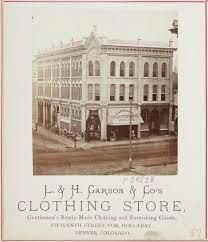
“Thought so.” Heyes donned the jacket again and resumed his seat. “They’re a big gents’ outfitters place in Denver, Colorado. My partner and I’ve been going there for years to buy clothes.”
“Your partner? Are you in business, Mr. Heyes?”
“Well, you might say I’m retired. My wife is part owner of a horse ranch in northern Colorado. Eventually I’ll be helping to manage that.”
Finney intervened. “I believe we’d say ‘colleague’ here to describe your partner, or “associate”. Mr. Curry, who remained in America, is a close friend of Mr. Heyes,” he explained to Lestrade. “They customarily travel and work together.” He glanced back at Heyes, raising his brows. “Mr. Lestrade would be most interested in knowing your former occupation. It might have a bearing on the assistance you can provide in this murder investigation, if it turns out that the perpetrator purchased his gloves in Denver, as now seems likely.”
“I don’t mind, as long as he doesn’t take an official interest.” Heyes was still just a little uneasy about being so friendly with the Scotland Yard men under his real name.
“Ah. I can speak for the Yard, and Mr. Lestrade will concur with me, that even though Great Britain has an extradition treaty with your country, we are officially quite indifferent to the nature of your previous activities, or your current relations with the government of the Territory of Wyoming, especially since I happen to know that you were never involved in a capital crime.” He looked over at Lestrade. “Mr. Heyes and his, ah, associate Mr. Curry are retired bank and train robbers.” He smiled as Lestrade drew in his breath sharply in astonishment. “Of considerable renown, I might add, in that particular part of America. They’ve been promised an amnesty by the governor of Wyoming, but are still wanted by the authorities there until the amnesty is granted. They are no longer engaged in illegal activity—in fact, Mr. Heyes was instrumental in helping me solve a murder which occurred in Wyoming in connection with that Ashdown case. How long has it been, Mr. Heyes, since you retired from your former line of work?”
“About two and a half years now,” replied Heyes, resigning himself to the odd situation of discussing his outlaw past frankly with a couple of law officers. “The last time we held up a train was in October of ’seventy-nine.”
“Held up a train?” Lestrade’s voice failed him for a moment.
“Yeah, you know,” said Heyes cheerfully. “Stop the train by throwing a log across the tracks or ripping up a section of track, point a gun at the crew, and shout some thing suitable.” He waited. A stifled giggle, unconvincingly turned into a cough, came from Paula’s direction.
“Suitable?” prompted Finney.
“Well, I usually said, ‘Stand and dee-liver’, which worked fine. They knew what I meant, anyhow[4], even though I think I was the only outlaw in Wyoming who used that expression.” Heyes kept his face expressionless except for a look of polite inquiry, looking from one to the other of the detectives. Then he grinned, pleased with the result, as first Finney and then Lestrade burst into hearty laughter.
“You’re joking, surely?” Lestrade managed to say. The last time a high-road robber in Great Britain had used that challenge—though with a different syllable emphasized, to be sure—had been almost a century earlier.
“No.” Paula entered the conversation to save her husband from having to boast about himself any further. “He’s not. When he and his gang stopped a train my brother and I were on, four years ago, he said that in just that way. My brother told the law officer in the next town what had happened, and when the man stopped laughing, he told us that made it a certainty the train had been held up by Hannibal Heyes and Kid Curry.” She looked at Finney, blushing. “We didn’t actually meet on that occasion, but that was the first time I saw him.”
“It got every body laughing,” explained Heyes, “which was one of the reasons I did it. If men are laughing, they’re less likely to panic and do some thing stupid. That’s the way people get hurt. The other reason is because we were trying to build up a reputation for ourselves.” He sighed. “Of course, now that we’re going straight, I’m kind of sorry we did that. People all over Wyoming and Colorado remember me, and some times I wish they didn’t. But we never thought about that all those years ago.”
“We seem to have strayed off the track, so to speak,” said Paula, her expression equally innocent and non-committal. “You were saying, sir, that Heyes should accompany you to meet this Mr. Holmes so that he can examine the glove?”
“If you please,” Lestrade concurred. “Today, if you would be so kind.”
Heyes set aside the empty teacup and stood up. “I’d be glad to.” He gave his wife a thoughtful glance. That last pun almost sounded as if … He met her eyes, brimming with laughter, and realized he was right—she had done it on purpose. She rose, too, and tucked her hand into the crook of his left arm.
“You’ll come as well, Finney? I think you’ve not yet made the acquaintance of Mr. Holmes?”
“No, I have not, and after what you and Mr. Gregson have said about him, I’m looking forward to it.”
“We can meet you in Mr. Holmes’s rooms,” said Lestrade, noting down the direction on one of his cards and handing it to Heyes. “You’ll wish to escort Mrs. Heyes back to your hotel first.”
Both spoke at the same moment.
“No.”
“On the contrary,” objected Paula. “I’m coming along.”
“No reason she can’t come with us, is there? Because if there is, we’ll have to figure out some thing different. She stays with me.”
“But …” Lestrade was distressed. “This is no business for a lady. It’s a murder investigation.”
“How long have you two been married, Mr. Heyes?” asked Finney.
Heyes didn’t even have to think about it. “Nine weeks and three days.”
“Oh, I see! You’re on your wedding trip, then,” said Lestrade. “Congratulations to you both!”
“Thank you,” said Heyes, with a smile. “It still doesn’t quite seem possible that we’re really married. But we shouldn’t stand here talking about that,” he added, flushing slightly. “If we’re going to take a look at that glove, let’s get going.”
The Scotland Yard men exchanged glances. Americans were so refreshingly direct.
“By all means,” agreed Lestrade, abandoning any idea he might have had of convincing Heyes to take his wife back to the hotel. He opened the door and held it for Mrs. Heyes to precede him.
*** *** ***
Having sent a telegraph message ahead to ask if it would be convenient to call, with a detective who had worked on an investigation in America, accompanied by the latter’s visiting American friend and the American’s wife, and receiving a reply that Mr. Holmes was in and would be happy to receive the entire party, Lestrade obtained a four-wheeler cab and they proceeded to Baker Street, where he led the way up the steps to the consulting detective’s rooms, followed by the Heyeses and Finney.
Their host had brought extra chairs into the sitting room, enough to accommodate the four visitors, his friend Dr. Watson, and himself. Lestrade performed the introductions and every body sat down.
Rubbing his hands together with enthusiasm, Sherlock Holmes leaned forward, disdaining the customary small talk in favour of opening the main topic of conversation immediately. “Mr. Heyes, I take it Mr. Lestrade has acquainted you with the background of this murder in Richmond?”

“Yeah, a little bit,” replied Heyes. “The man who was murdered lived alone in a large house with servants. A visitor came, and they shut themselves into the study together and said they didn’t want to be disturbed. The owner of the house was found dead several hours later. A glove was found near the body which didn’t belong to the dead man. The visitor may have been the killer, and he may also be the owner of the glove, but no one is sure of that, since the servants report that he left the house quite a while before the dead man was discovered.”
He favoured the company with his engaging smile. “If I can take a look at the glove, may be I can give you some ideas, or narrow down the possibilities.”
Holmes rose and opened a box which was resting on the mantelpiece. Removing a bright tan leather glove from the box, he turned to bring the glove over to the table. “I am a student of unusual markings on clothing and personal accoutrements. Mr. Lestrade may have told you that I am often able to deduce certain things about a man from his clothing, items carried about his person, or certain physical characteristics. For example, Mr. Heyes,” he commented, his gaze flickering briefly over the American’s clothing and the various papers peeping above the opening of his jacket pocket, and the outline of a book in the other pocket, “I know that you only arrived in the country this morning, disembarking in Liverpool from a Cunard liner, that you took a train to London and engaged lodgings at the Grand Hotel near Trafalgar Square, and that this is very probably your first visit to Great Britain. Beyond those facts, and a general indication that you enjoy reading and are a man of some education, though you have not spent a great deal of time in academic or educated circles, I am unable to deduce very much about you. In fact, I must confess to being quite puzzled by some of the marks on your clothing, particularly the rubbed horizontal line on the upper part of your right trouser leg, indicating that a leather cord or thong is frequently tied there. I hope that you will not be averse to answering some questions later, as I do not wish to pass up an opportunity to expand my knowledge. But I am even more puzzled by the marks on this glove, the likes of which I have never seen before.”
He placed the glove flat on the table, palm up. “You can see that there are some marks of wear, though minimal, on the palm and first two fingers. It’s possible the wearer has a preference for the use of the left hand, as you yourself appear to do, Mr. Heyes. But there are other indications—here, and here—that the glove has been worn while the wearer wrote with a pen, which would seem to rule that out. The most inexplicable marks, however, are on the back of the hand.” Holmes turned the glove over, disclosing a flattened band about two and a half inches in diameter, extending diagonally across the width of the glove, and marked at upper and lower edges by a deep, straight, clearly incised indentation. He looked up to observe the American’s face closely as Heyes stepped over to the table.
Picking up the glove, which clearly belonged to some body with rather larger hands then his, Heyes glanced over at his wife. “Except for the size, it could almost be Kid’s.” She nodded. He laid it down again, having seen all he needed. “Gentlemen, if this glove does belong to the man who visited that house earlier in the day, and I think you can assume it does if he turns out to be an American, you’ve got yourselves a serious problem. This glove belongs to a fast draw—I mean,” he added, seeing the Englishmen’s puzzled expressions, “a man who can draw his gun real fast from the holster he carries it in, and walks around every day prepared to do that.”
Dr. Watson exchanged a glance with his friend. Clearly, their visitor had already seen some thing, the significance of which had escaped every body else.
“Pray continue,” Holmes urged. “What brings you to that conclusion?”
“This mark,” said Heyes, tapping the broad band pressed into the leather, “means the glove has been tucked behind a gun belt most of the time, so a man can have that hand free to draw his gun. I’d show you, if I had my own gun and gun belt with me. I’m not as fast as my partner, that is, my cousin Jed Curry, but I could give you an idea.”
Paula spoke up. “Would you like me to take a cab over to the hotel and bring back your revolver and belt?”
“That’s a good idea,” he replied. “Wait, though. I’ve got a better one. I don’t know if it’s too late for lunch, or if there’s usually some other kind of meal that would be served about now, but as a matter of fact, we haven’t eaten since an early breakfast before we left the ship, and I hear our hotel has a really good dining room. Would all of you like to come to the hotel with us, and let us take you to lunch or whatever they’ll serve us? Then you can come up to our rooms, I’ll show you my gun and holster, and we can talk about all this. I can answer that question of yours at the same time, Mr. Holmes, about the mark on my trousers.”
“Please consider yourselves our guests, gentlemen.” Paula seconded her husband’s invitation. “Over luncheon we can explain the customs that led to many men living in the American West carrying weapons openly and developing this fast-draw skill, because I think it likely that none of you, with the possible exception of Mr. Finney, has any idea what Heyes is talking about. If the murderer is from the American West and has those skills, you need to know what you are going up against.”
“We should be delighted,” replied Lestrade.
“Very kind of you,” murmured Watson.
“Yes, indeed,” Sherlock Holmes responded. “Watson, you’ll wish to let your wife know that you might be home late, unless she is not expecting you back at any particular time.”[5]
*** *** ***
Heyes looked back from handing his wife into the cab. The two Scotland Yard detectives were sharing another cab and Holmes and Watson were preparing to mount into it, all, by common consent, leaving the newly wedded couple alone. Ever since Dr. MacKenzie had done so much for his partner in Idaho Springs, however, Heyes had had an increased respect for doctors. In addition, Watson appeared to be roughly the same age he was, in contrast to the rather younger Holmes. He decided to take the opportunity to get to know the doctor better. “Dr. Watson? Would you ride with us?”
“Thank you,” replied Watson. He mounted into the cramped vehicle, which only seated four and that not very comfortably, and took his seat with his back to the horse so that the newly married couple could sit together.
“A doctor saved my partner’s leg, and probably his life, last year,” explained Heyes. “He broke both bones in his right leg just above the ankle, and then it took us almost two hours to get him to the doctor. I splinted the leg as best I could and tied it to the saddle, but it was still real bad. Since then, I’ve always taken the trouble to get to know good doctors.”
“It sounds as though the man who saved your friend’s leg was a far better physician than I shall ever be. I’ve seen injuries such as you describe. Usually, the only thing to be done is to amputate, or at least that was the only choice until very recently, especially if one or both of the fractures is compound. That doctor must be very skilled, and willing to experiment, and your friend a very determined man. There is a great deal of physical effort involved in recovering from such an injury.”
“Yeah, Dr. MacKenzie told us that. He also said we were very fortunate neither of the breaks was compound. My partner—he’s my cousin, not just my partner and friend—was determined, like you said, that if he had any thing to say about it, he’d be as good as new by the end of the year. And he is—he walks without a limp now, and is as active as ever.” Heyes smiled. “I didn’t know until later that my cousin was praying, and his betrothed, and the doctor, and my betrothed, as she was at the time, and probably a whole lot of other people.”
“Prayer is more important than any thing even the best doctor can do,” agreed Watson gravely. “We can only do our best with the skills we have been taught. The actual healing is in the hands of God.”
“I know that now. I’m ashamed to say I wasn’t doing a lot of praying, myself. I … well, I thought there wasn’t any reason for God to listen to me.”
*** *** ***
Over a late luncheon in the spacious dining salon of the Grand Hotel, Finney told the story of how he and Heyes had met, stressing that Heyes was introduced to him as Joshua Smith. He described how he realized that the guide for the archæological party must be one of the two rather well-known outlaws who had been described to him as leaders of the Devil’s Hole gang, and how he had confirmed, after the trip was over, which one of those men had been their guide by consulting the wanted posters in the sheriff’s office.
“So you were wanted by the law at one time, Mr. Heyes?” asked Holmes, fascinated. He had never before had the opportunity to meet and converse with a real outlaw from the American West.[6]
“It’s not that simple,” replied Heyes. “My partner and I went straight about two and a half years ago, and the governor of Wyoming Territory has promised us amnesty if we meet his terms, but as a matter of fact, we’re still wanted by the law. Finney here assures me that Scotland Yard isn’t interested in trying to collect the reward that the railroads are still offering for me; otherwise I wouldn’t be using my real name here in London. When you come up to our rooms, I’ll show you the wanted posters. You do have copies of those with you, don’t you, Paula?”
“Yes, I brought a pair with me to show the solicitor,” she replied. “If you’re going to put on your gun when we go up, there are a few other things we need to talk about.” She looked at the Englishmen. “I’ve been trying to decide how best to explain the fast-draw idea, and I think the best approach is to describe it as an outgrowth of the duelling custom practised here between gentlemen until about sixty years ago.”
Finney’s eyebrows went up. “I hadn’t thought of that, but it is a form of duelling. Many men in the American West have found it necessary to carry firearms on their persons—in a holster, if it’s a handgun—for defence against hostile natives, wild animals, and potential robbers, and the duelling custom developed from that.”
“Yeah, that fits,” said Heyes. “If two men have a disagreement about some thing—cheating in a card game, for example—and one of ’em wants to take it to the point of using a gun, they’ll usually just settle it right there, or take it out in the street.”
His wife amplified, “There is no need for seconds, or a formal challenge, or for comparison of weapons. The man who is able simply to draw and fire his weapon first, accurately, wins the duel.”
“My partner doesn’t like killing,” Heyes added, “so he practises his fast draw every chance he gets. He can usually beat his opponent to the draw and have his own gun out and cocked before the other man even clears leather. He’s found there’s usually no need to fire at that point.”
Holmes exchanged a glance with Watson. The graphic phrase “clears leather” was unfamiliar, but it was easy enough to deduce its meaning once the idea of a holster had been introduced.
*** *** ***
Upstairs in the lavish suite which had been allotted to the Heyeses when they had asked for some thing quiet and not too large, Heyes withdrew his Smith & Wesson Schofield, with its holster and gun belt, from the drawer in the wardrobe where he had put it when unpacking, swinging the gun belt around his waist and buckling it as he walked out to the sitting room where their guests waited. As a final step, he bent down and tied the dangling leather thong around the upper part of his right leg. Paula had gone to retrieve the Heyes and Curry wanted posters from her locked leather-covered journal.
Holmes leaned forward, consumed with curiosity. “Now I see what caused the mark on your trousers, but pray tell me, what is the purpose of the leather thong?”[7]
“That’s to hold the holster steady in one position if I have to draw the gun in a hurry. It also keeps the gun at about the right distance from my hand. Leaving it untied slows the draw speed down quite a bit, and also makes the draw unreliable. You could never be sure your gun was exactly where you expected it to be. This way, it’s right there where I need it. But you have to practise drawing with it tied down for that to work right, because if you’re not used to having it tied, it’ll slow you up at first. It’s a different motion. I’m not any where near as fast as my partner, and probably not as fast as the man who owns that glove, but this’ll give you an idea.” Heyes drew and cocked the Schofield at his best speed, levelling the revolver at an inoffensive spot on the wallpaper.
There was a murmur of astonishment from Dr. Watson, mingled with Lestrade’s exclamation of “Great Scot!”[8] and Sherlock Holmes’s sharp nod of approval. Finney said nothing, but he was impressed, especially knowing that what Heyes said was true—his partner Kid Curry was in all probability much, much faster.
“May we see that again?” Lestrade requested. “You say the man who owns this glove can do that?”
Embarrassed, because he knew how comparatively slow he was even if no one else did, Heyes holstered his gun, showing off a little with a nice back spin as he did so.[9]
Paula said, “Wait a moment. Draw when I say ‘Go’.” She met his eyes with a smile.
“O.K.,” said Heyes, “but this would work better if I actually had some thing to aim at. How about that clock? Ready when you are.”
“Go!”
He drew, cocked, and levelled the pistol in one smooth motion, as Kid had taught him. The speed of the draw was impressive—well, fast enough, Heyes amended silently, to keep him from laughing at me. He had to laugh at himself, though, because the patent admiration of the four men to whom he was demonstrating his skill was rather intoxicating. Much more of this, and he would be in danger of forgetting that he was probably no match at all for the unknown owner of the glove.
Holstering the gun again, this time without spinning it, he looked soberly at Lestrade. “That’s exactly what I’m saying. He’s a fast draw, faster than I am— probably a lot faster. And he has his gun and gun belt here with him, in London. He probably used his revolver to murder your man.”
“But how do you know that just from looking at the glove?”
Heyes picked up the glove. “I’ll show you.” He tucked the glove carefully behind his gun belt on the right side of the buckle, where the diagonal marks corresponded exactly with the width of his gun belt and the slant of it across his body. “A man who carries his right glove like this most of the time, so the glove looks almost new, is a man who’s not only ready to draw, but thinks he may need to any minute. I figure he had it tucked in his gun belt and it fell out where you found it. Which means he wore his gun openly to the house where the murder was done. Which also means he intended to use the gun when he got there—otherwise I don’t think he’d have risked wearing it in the streets and calling attention to himself.” He paused, thinking. “Or may be he didn’t care if he was seen. Who knows? You could ask around a little.” He started to take the glove out from behind the gun belt so he could return it to Holmes or Lestrade.
“Wait a moment,” said Lestrade. He approached and examined the glove and Heyes’s gun belt closely. “That’s quite a remarkable fit with the marks on the glove.” He straightened up and looked the American in the eye.
“My gun belt is a pretty standard width,” replied Heyes. “But the glove’s not mine, and I didn’t kill the man.”
“I’ll admit it doesn’t seem to be yours,” replied Lestrade. “It’s too large.”
Paula got up and went into the bed-chamber, returning in a moment with a pair of worn dark brown leather gloves, which she laid on the table next to the murder glove that Lestrade had just retrieved. “These are my husband’s gloves,” she said quietly. “And in case you were about to ask why a left-handed man carries his gun on his right side and draws it right-handed…,”
“Oh, yeah,” Heyes broke in. “I was taught by some body who was right-handed, and I never bothered to change, or learned to draw with either hand. They made me use my right hand at the Home for Waywards, so I use it for a lot of things besides handling a gun.[10] My folks had already taught me to write with my left hand, so I can do that either way, but not the gun handling. Some men carry two guns, and can draw and use both at the same time.” Some men even do that pretty well, unlike Harry Briscoe, he thought. The Bannerman detective always carried two revolvers with flashy stag horn grips, and had been known to draw and fire with either or both hands, but his accuracy and speed were another matter.
Holmes and the Scotland Yard detectives were examining the brown gloves, comparing the right one to the glove found at the scene of the crime.
Heyes drew his gun and laid it on the table. “Paula, get your revolver, will you?” She vanished into the bed-chamber again, returning with her Colt .44 bearing the words ‘Frontier Six-Shooter’ stamped into the frame. She opened the loading gate, checked the loads in the cylinder, and laid the Colt beside the Schofield. “It’s too bad I don’t have a cartridge that fits my partner’s gun, which takes different ammunition than either of these,” Heyes continued.
“Kid told me that you always carry a few Colt forty-five cartridges,” his wife offered.
“Oh, of course,” exclaimed Heyes. “I don’t know why I forgot. They should be in the very centre back of my belt.”
She stepped behind him and spotted the slightly longer Colt cartridges after a close look. Pulling one free, she put it on the table beside the revolvers.
“Don’t get that mixed up with the shells from her forty-four,” warned Heyes. “They look a lot alike, but this one won’t fit in her gun. It’s for a forty-five calibre 1873 Colt Single Action Army revolver, which is what my cousin carries.”
“Why are you telling us this, Mr. Heyes?” asked Finney. He thought he knew the answer, but he wanted the others to hear it.
“Because,” Heyes paused to look at each of the Scotland Yard men before continuing, “the last thing I want is to be suspected of a murder in England, or any where else. May be Scotland Yard has a way to check the marks a gun leaves on a bullet that’s fired from it?”
Lestrade nodded. “We can do that.”[11]
“All right,” said Heyes. “Then you take both of these with you when you go—as long as you promise to return them as soon as you can. Run whatever checks you need to. Once you’ve done that, I have another suggestion, if you’ve recovered any bullets from the house or the body.”
“Go on, Mr. Heyes,” Lestrade encouraged him, for the moment refraining from confirming whether or not the police had recovered any bullets. The American had an excellent grasp of police work, as Finney had intimated to him earlier.
“Right. You take this Colt forty-five cartridge with you as well. Take it apart, so you can get a good look at the bullet, the powder, every thing about it. Because if that man was shot by an American who carries his gun in a holster and is a fast draw—in other words, the man who dropped that glove—the odds are very high he’ll be carrying one of three kinds of revolvers. My wife and I have two of them here between us, and my partner carries the third kind—the Colt forty-five this cartridge fits. I hate to admit it, but the odds are slightly higher he’ll be carrying a Colt forty-five rather than either a Smith & Wesson Schofield or a Colt forty-four Frontier model.” He tapped each gun as he spoke. “But all three of them are very popular with men who have reputations for speed.”
“So a bullet recovered from the dead man’s house might look like one of these, even if it doesn’t come from your pistol or that of your wife.” Lestrade smiled suddenly. “That will be very useful indeed, Mr. Heyes. And I shall tell you right now—I should have said some thing earlier, of course, and I trust you’ll forgive me for the omission—that you are not a suspect in this murder. According to what you’ve told us, you and Mrs. Heyes only arrived in England this morning. The murder was committed the day before yesterday, which puts you well out at sea at the time of death. I’ll take the name of the ship you arrived on so I can verify the passenger list, but it’s a formality.”
“RMS Servia, Cunard line,” supplied Paula quickly. She had been ever so slightly alarmed for her husband’s safety after the Scotland Yard detective had begun taking such an interest in how the glove fitted under Heyes’s gun belt.
Lestrade made a note of the name, then carefully folded the loose Colt .45 shell into a handkerchief before putting it in his pocket. He picked up the two revolvers and stowed them in the capacious pockets of his coat. “I’ll have these back to you tomorrow,” he assured the couple.
“Before you go,” said Paula, “I thought you might be interested in these.” She unfolded the two wanted posters and laid them out on the table. The Englishmen immediately gathered around to examine them.
Lestrade looked from Heyes’s poster to the man and back. “The description is not very accurate.”
“No,” said Heyes, with a grin. “Neither is Kid’s. That’s why we don’t get caught very often.”
Sherlock Holmes was looking at the other poster. “You said your cousin’s name was Jedidiah. He’s known to the law as ‘Kid Curry’?”
“People who know him real well call him ‘Jed’ some times. But the law doesn’t know that, so ‘Kid Curry’ is what’s on the poster. He’s been going by ‘Kid’ for about ten years now.”
“But it says here that he’s twenty-seven years old,” said Watson. “Isn’t that a trifle old for a man to be called ‘Kid’—assuming that means some body who’s quite young?”
”Well, he’s older than that now. He turned thirty in March, and I’m thirty-two now, not twenty-nine like it says there. Those flyers were put out years ago. But men in the West often call a man ‘Kid’ if he’s the youngest man in a group, or if he looks a lot younger than he is, like my partner does. Doesn’t necessarily mean he’s an outlaw, though it’s a convenient way to conceal your real name from folks who might be hunting you if you happen to be wanted.” Heyes looked over at his wife. “You have one of those photographs that were made of Jed and Lillian right after our wedding, don’t you?”
“Yes, I keep it with the prayer list inside my Bible. I’ll get it.” She went back into the bed-chamber to fetch the cabinet card photograph and returned, laying it on the table.
“You see what I mean, said Heyes. “That was taken just a couple of months ago.”
Lestrade muttered some thing under his breath that sounded like “Great Scot!” again, looking at the absurdly youthful appearance of the man in the photograph.
The two Scotland Yard men began making conventional remarks indicative of their desire to get back to the Yard and proceed with their work. They said farewell to the Heyeses, shaking hands and promising to keep them abreast of developments in the case.
“You have already been of marked assistance, Mr. Heyes,” Lestrade assured him. “We are very grateful. You may be able to assist us further, if we get a lead on a name or description for the visitor. Is it possible you might know or recognize him?”
“The West is a big place,” said Heyes doubtfully. “But if you’re thinking I might know him, or know of him, because he might be an outlaw, or even just because he’s a fast draw and might have a reputation, well, you could be right. I’ll be glad to hear any thing else you find out, anyhow.” He thanked Finney for introducing and vouching for him to Lestrade, accompanied the two men to the door of the suite, and showed them out.
Closing the door, he returned to the sitting room. Dr. Watson was talking with Paula while his friend Mr. Sherlock Holmes listened, making notes on a small pad with a pencil drawn from his breast pocket.
“So you are a Scot by birth, Mrs. Heyes? So am I, though I was reared in England. My middle name is Hamish,” Watson confided.
“Yes, indeed, though I also was partially reared in England. Our mother made certain that we spent summers in Argyle[12], and that we did not forget how to speak the Gaelic. It’s a little unusual—at least, that’s what the English would think—for a woman from a landed family to have had the opportunity to grow up speaking the Gaelic fluently, but her parents felt quite strongly on the matter. My father was English, but he loved the west of Scotland, which he got to know while searching for hardy horses to add to his breeding stock. He was involved with the Oxford Movement at University, and in consequence became acquainted with Scottish Episcopalians of good family, one or two of whom were Gaelic speakers. He approved of our mother’s determination to preserve that part of our heritage.” She smiled ruefully. “You’ve not said what your mother’s family name is, but I suspect you’ve already deduced that we are Campbells on that side, so we shall probably find our families at odds. My clan chief once said, ‘when you come out on top, you make enemies’,[13] which is quite true, of course. My maiden name is actually Campbell-Wellington, but we dropped the first part when we were naturalized as U.S. citizens.”
Heyes did not remember ever having heard this piece of information before, but it explained some thing he had always wondered about. “So that’s why the ranch, and the brand, is called the C Bar W.”
“That’s why.” His wife turned to smile at him. “Didn’t I mention that? Or Paul? I thought he must have told you during that long conversation the two of you had in January of ’eighty-one, while you were still courting me.”
“No, I don’t think either of you did. It’s all right, I was just curious.” He returned her smile. For a moment they were oblivious of their visitors and every thing else around them, simply enjoying one another’s presence.
Nothing could more clearly indicate their newly wedded state, thought Watson. He recalled the first weeks of his own marriage, not quite a year earlier. He was, of course, still very much in love with his wife, Mary Morstan that was, but all the same, there was some thing special about those first weeks, impossible to recapture.
*** *** ***
After the two Englishmen took their leave, Heyes looked at Paula, eyebrows raised. “I think that’s shot our plans for the rest of the day.”
She nodded. “It’s too late now to see the solicitor, or a dress-maker, or a printer, or any of the half-dozen other things we must do. But there’s plenty of time, especially now that you’ve been called in as a consultant on a murder investigation. We’ll want to stay in London until that’s resolved, or until there’s no hope of resolving it.”
“I’ll admit I’d like to find out more about the American who owns that glove, even though I doubt he’s any body I’d want to meet. Do you know,” he added, with a surprised tone, “what a pleasure it is to be introduced to men using my own name, and to have a criminal investigation come up and not be suspected of any thing?”
“I can imagine. It’s wonderful to see you taking your place here as any body else visiting from America would be able to do. By the way, you needn’t worry you’ll meet with any discourtesy or social snubs. Because you’re an American, people know that it’s useless to try and fit you into any particular class or social background, and they’ll tend to be more at ease with you than they would be with a stranger who’s British. Besides, Americans are popular here. Dr. Watson told me that one of the reasons is that they always say more or less what they think. There’s no need to wonder how one is supposed to interpret a particular remark.” She smiled up at him. “Of course, he’s not very well acquainted with you yet, or he might not say that.”
“Hey!” he protested. “I’ve been trying not to do that—been trying since I married you, so at least I could learn to be honest and forthright with you.”
“I know. I appreciate that. But it’s a fairly deeply engrained habit, isn’t it? To cover your thoughts by shifting your expression?”
“Yeah,” Heyes admitted. “Seymour taught me that. I got out of the habit of doing it—no need, really, up in Devil’s Hole—and then, since Kid and I’ve been going straight, not using our real names, having to dodge the law at every turn, well, the habit came back. It comes in handy some times.”
“Yes, it must do,” Paula said, with a note of sadness in her voice. “I just wish you wouldn’t do it with me.”
This required more than a verbal response. When he had finished kissing her, Heyes looked down into her face, his own quite serious. “I’m really trying. It’s just hard, that’s all.”
“It’s all right. Don’t distress yourself, my darling.”
They planned to dine at half-past seven in the hotel dining room and then retire early. Both were some what tired from the events of the day.
[1] See “Kevin Finney Meets an Obligation,” by Ida Arminda Moss, available on Archive of Our Own at this link: https://archiveofourown.org/works/27889285
[2] q.v. “A Visit to the Governor,” by Ida Arminda Moss, available on Archive of Our Own at this link: https://archiveofourown.org/works/29916282/chapters/73630785
[3] According to Dr. Watson’s record of the 1881 case which he published as A Study In Scarlet, Lestrade was not an inspector at this time, but merely a detective constable, making Detective-Sergeant Finney senior to him. While this could have been an error on the part of Watson or his publisher, for the purposes of this story, Finney’s seniority has been assumed.
[4] Though it may sound surprising to modern readers, “anyhow” was used in preference to “anyway” at this time, even in quite formal writing or by quite well educated speakers. Mark Twain, a journalist, uses it regularly in his writing, and in Dr. Watson’s records of Sherlock Holmes’s cases, he recounts its use by Holmes in conversation.
[5] Although Dr. Watson states in The Sign of Four that he did not meet his wife, Mary Morstan, until the summer of 1887, it may be understood from his diary entries and notes that he deliberately inserted incorrect dates into that tale and others (A Scandal in Bohemia, The Five Orange Pips) when published, in order to safeguard the privacy of his wife and her family. The actual date of the Watsons’ marriage, as Hannibal Heyes was able to ascertain during the course of his friendship with the doctor, was in October of 1881.
[6] Holmes’s meeting with Abe Slaney in The Adventure of the Dancing Men will not take place until 1894; the meeting with “Killer” Evans, in The Adventure of the Three Garridebs, will not take place until 1902. In any case, both Slaney and Evans were Chicago gangsters, not Western outlaws, and their interactions were not on a friendly basis, precluding any opportunity for Holmes to ask questions.
[7] The author is ignoring here that it would usually have been necessary to tie down one’s gun only if wearing the buscadero style of holster and gun belt—as Heyes and Curry both do—which was not as common in the American West of this period as one might be led to believe from watching film and television Westerns. It is not true, however, that the buscadero rig was invented only in the 1920s for the use of the film industry. The rig was used in the 1880s—there are scattered references and photographs—but only in Mexico and parts of the United States bordering Mexico. The name appears to be a regional Mexican term referring to a bounty hunter.
[8] Dr. Watson, in his case records, spells this name with only one T, so I have followed his example.
[9] Heyes can indeed spin his gun—Kid Curry is not the only one with that skill—though he is seen doing so only once, in the first-season episode “Stagecoach Seven.”
[10] The author is of the opinion that Pete Duel purposely chose to portray Hannibal Heyes as a changed left-hander, perhaps to symbolically indicate his change from a train robber to an honest man. Mr. Duel himself appears to have been ambidextrous, demonstrating completely equal facility with either hand.
In other roles (e.g., Jim Dewey and Denny Todd, both on The Virginian), Mr. Duel appears to have taken considerable care to conform his hand use to the moral state of the character he was portraying, in accordance with the traditions of English and American drama, so the assumption about Heyes, whose moral state changes during the course of the series, is plausible. These dramatic traditions are exemplified by the filming of the Jeremy Brett Sherlock Holmes episodes, where Professor Moriarty, a villain, is shown using his left hand, and Jeremy Brett, who was left-handed in real life, was filmed with right-handed inserts to show Sherlock Holmes, the hero, as right-handed.
[11] The science of ballistics was in its infancy, and is never mentioned in the published Sherlock Holmes cases of the period, but police forces in larger cities, certainly in Britain and Canada, were already making use of this information. Heyes had probably read about it.
[12] This spelling, “Argyle,” was used through the beginning of the 1850s, when the more recent spelling “Argyll” began to be used under the influence of the 8th Duke, who began to spell his title with two Ls. Both spellings were used more or less interchangeably through the end of the 19th century. Both are pronounced “ar-GUY-ull.”
[13] The 12th Duke of Argyll, Chief of Clan Campbell from 1973 to 2001, made this exact comment in the hearing of the author during a discussion on Scottish historical politics. One may assume that his ancestor the 8th Duke of Argyle, who was the clan chief in 1882 during the period under discussion in the text, might have said some thing similar in his less tactful younger days.