
Chapter Text
Scotland Yard, Wednesday, August 16th, 1882
Kevin Finney waved his guests to chairs. “I sent a cablegram directly to the Governor of Wyoming about you, Heyes. It went off Monday evening. I didn’t give much detail, just that I was indebted to you for your help in the Stephen Ashdown theft and murder case. If he wants more information, I told him to feel free to request it.”
Trying to picture the effect such a communication would have on Governor Hoyt, Heyes chuckled. “Thanks, Finney. I don’t know if it’ll help, but it sure can’t hurt. You didn’t say I was over here, did you?”
“No, I made no reference to where you were, only that you had helped me two years ago, on that trip to the Devil’s Hole area. I suspect it will help. I made sure to authenticate the Scotland Yard origin of the message. That should make him pay attention.
“Speaking of attention,” Finney continued, “Lestrade informs me that James Caldwell, or a man matching his description, has been reported visiting the small lodging house out towards Richmond where we set up a false registration for you. He asked for you, and was told you were out, but Lestrade thought that was very promising. Since he had men watching the place, we should soon get a report on where Caldwell is stopping—that is, if he doesn’t spot the men tailing him.”
“I doubt he will,” said Heyes. “He’s likely to be finding this big city, with all of its traffic, as confusing to his powers of observation as I do, when he’s used to trailing men in open country or in the mountains. As a matter of fact, Lestrade already told me about that when I came over here to see him. But you meant to warn me that Caldwell might find me?”
“It was more to let you know that we are on the verge of finding him. I assume you will wish to be in at the end of the chase. You should hold yourself ready to receive a message from me, or from Lestrade, or even from Mr. Sherlock Holmes, who I know has been pursuing his own lines of enquiry, requesting your presence, possibly as soon as this evening.”
“I will, don’t worry. I do want to be in on it.” Heyes noted the unhappy expression on his wife’s face and realized he was going to have trouble with her later. Well, I’ll deal with that when the time comes.
Offering his arm to Paula, Heyes escorted her back to their hotel on foot, amused, as always, at having to take care to keep from slipping on the pigeon dung coating the pavement in and around Trafalgar Square and becoming slippery when it rained, which it seemed to do every day in London. Even the tall statue of Admiral Nelson, located in the centre of the Square, seemed to always be covered with the stuff.
*** *** ***
In their hotel room, Heyes pulled his tie off and laid out his more casual clothes—the buff trousers and colored shirt that he preferred to wear if there was to be running or riding or shooting. He looked up to find his wife watching him silently. She also had laid out a dress and hat more suited to outdoor activity in the country.
“You’re not going. Caldwell hates me. It’s just plain too dangerous.”
She caught her breath on a sob. Heyes waited for her protest. Instead, she said nothing for a moment, her figure drooping in every line. She put her shoulders back resolutely and walked over to him, putting her hands on his shoulders. “Very well. I shall pray for your safe return. Would you? … that is, I should like to … to be intimate with you before you go. If you were to be killed, that could be our last memory of one another.”
This suggestion had the effect of making Heyes put all other considerations from his mind for the time being. He put the small sign which read ‘Do Not Disturb’, provided by the Grand for the convenience of its guests, on the outer door lever, bolted the door, and led the way to the bed-chamber.
Later, the two of them were sitting close together, his arm around her shoulders, on the settee by the window in the outer sitting room, when a knock came on the door. Glad that he had remembered to remove the little sign, Heyes got up and opened it. As he ripped open the telegraph envelope, he said, “Is a reply expected?”
“I believe so, sir.”
“Come in, then, and wait a minute.” Having read the message, which was a brief intimation from Sherlock Holmes that Caldwell had been located, that he and Watson were going after him, and that Heyes was more than welcome to accompany them and to bring his revolver, Heyes wrote out a brief reply, saying that he would be at 221B, Baker Street in half an hour. He gave the necessary money to the bell boy, together with a generous tip, and turned back to his wife as the door shut behind the boy.
She had read the messages over his shoulder. Without speaking, she flung her arms around his neck and turned up her face for his kiss.
There was a slight pause after the embrace, as Heyes tried to figure out how to say what had just that moment occurred to him. “Ah, Paula … I’ve been thinking.”
“Of course you have.” She gave him a dazzling smile. “That’s what you’re best at. You’ve thought of some thing with regard to Caldwell?”
“No, it’s not that. Well, in a way it’s related. I know I said you couldn’t go, because it’s dangerous. I still think it’s likely to be dangerous, but without Kid here, I’m going to need some back-up—some body who knows how to use a gun—and it just occurred to me that I can’t really rely on Dr. Watson. He’s a good shot, but he’s got that game leg, and he doesn’t know how I’m likely to react in a fight. You do. I think—darling, I don’t know how to say this, but I want you along after all. I’m going to need your gun supporting me. I’ll just have to trust you to keep yourself out of harm’s way—and of course, trust God to keep you safe, just like you’re trusting Him about me.” This last came out in a rush.
Carefully, Paula refrained from laughing, or from suggesting that her husband’s earlier, quite different decision had been merely an excuse to take her to bed for the afternoon. She squeezed her husband’s arm. “I’ll do my best with all of those things.”
“And do what I tell you? Even if it’s to get back out of range?”
“Yes, I promise.”
“Good. Then get your gun and let’s go.”
221B, Baker Street, London, same day
Holmes rubbed his hands with satisfaction. He’d received an answer from Heyes, the American assuring him that he wouldn’t miss the chase. Lestrade had not responded, but Finney had, also indicating that he would join them as soon as he could. Normally Holmes would not have invited official detectives along on such an expedition, but in this case, with a wanted murderer who was a foreign citizen, he wanted to be sure that at least one member of the Metropolitan Police force was present to take him into custody, if they were able to take the man alive.
A few moments later, foot steps were heard on the stairs. Watson opened the door to admit Heyes, and, much to both men’s surprise, Mrs. Heyes. About to shut the door again, Watson observed Finney entering from the street, and waited for him to come up. Finney nodded to Holmes and explained that he had promised to leave word at the Yard for Lestrade, who had been called out on another case.
“Mrs. Heyes, and gentlemen,” Holmes began, spreading out a map of London and environs on the table. “I’m waiting for one more report from my Baker Street Irregulars, and then we shall go. It is they who have been trailing Caldwell for me.”
“Baker Street Irregulars?” The Scotland Yard man’s eyebrows rose.
“Yes. A force of street boys, who know their way about London better than any policeman. They will find any body who must be found, and keep track of the quarry until I get there.” A commotion was heard downstairs in the street, followed by Mrs. Hudson’s expostulations, and then there was a pounding of foot steps on the stairs. A raggedly dressed boy entered and stood to attention, his eyes on Holmes.
“Mister ’Olmes, I left the other lads in the street, like you said. Two on ’em are watchin’ Caldwell.” The boy’s Cockney accent was so strong that Heyes had some difficulty deciphering what was being said. He caught the name Caldwell, however, and listened closely.
“Thank you, Wiggins. That’s excellent.” Holmes paid the boy the agreed amount for the six boys involved in the tracking. “Come over here and show us on the map.”
Wiggins crossed to the table and placed a grubby finger on the map, south of the river and considerably west of their present location. “Down Richmond way, Guv’nor, that’s where ’e is. ’E was stoppin’ in a lodgin’ house west of the town, ’ere, but he’s been comin’ back to keep an eye on that place where he thinks that Mister ’Eyes is.”
Holmes gestured to his guests. “This is Mr. Heyes, Wiggins. And his wife.”
The boy’s eyes quickly took in the American’s clothing, his leather holster and the revolver it contained now worn openly on his hip. “Cor!” he said, with reverence. Then, perceiving that a hand was being held out to him, he wiped his own hand on the seat of his trousers and grasped the hand. “Pleased t’meet yer, Gov’nor.” At Paula’s friendly nod, he ducked his head to her as well, pulling off his cap.
“Holmes, if we delay, we may lose him again,” said Watson urgently.
Holmes nodded briskly. “Come, Wiggins, you shall take us to where your look-outs are waiting.” The entire party descended the stairs to find two four-wheelers, obtained by the efficient Wiggins, waiting in the street.
*** *** ***
After more than two hours, during which they watched the sun set in the west ahead of them, they drew near their destination, travelling by cab, by train, and then again by cab.
Following Wiggins’s directions, the two cabs drew up on a deserted side street. Wiggins was met by one of his lieutenants, who told them exactly where Caldwell was standing, watching the lodging house. The boy thought it was possible, from where they were, to come up behind him without being seen.
Heyes intervened. “If the other boy here can guide me to a corner where I can come at him from the front, I can take cover behind the stone work and still attract his attention. You should be able to jump him from behind after he starts talking to me.”
“Why do you think he’ll talk, rather than simply shooting?” asked Watson. “You said he’d like to shoot you on sight.”
“Well, he could start shooting first, that’s true. But if I call to him, he won’t be able to resist the temptation to answer. We’ll probably yell a few things at each other before he tries to shoot, and I’ll already have my gun out, so I don’t need to worry about his speed.” Heyes spread his hands, unable to explain. “That’s just how it’s done.”
“In accordance with the Western duelling customs you spoke of?”
“Yeah, I guess you could say that. Paula, you wait to see which way we go, then you find yourself a place where you can catch him in a cross-fire if he steps out of shelter to get a clear shot at me. Wiggins can show you after he comes back from taking Holmes and Watson to their position.” He looked at the others. “Check your watches. I’ll give you five minutes to get in place, and then I’ll yell to Caldwell. Paula, you’ll move in closer while we’re talking.”
Finney reminded every body to take care where they fired, if they had to fire, so as not to hit others of the party, and added dryly, “I believe you may be right, Heyes, in expecting that he’ll start shooting. But if shots are fired, we shan’t have much time before a police constable arrives. I’ll wait here to see how the situation develops before taking up a position, so I can warn any constable arriving that guns are in play.”
Heyes nodded. Checking his watch, he met Holmes’s eyes and watched the others follow Wiggins down an alley-way to their left, quickly disappearing into the shadows beyond the street lamp. Following his own guide, he moved forward and to the right, keeping a sharp look-out across the street that lay between him and Caldwell’s position.
Five minutes elapsed. Across the dimly lit street to the right, on the same side as Caldwell, Heyes caught a glimpse of movement as his wife waved her hand to show she was in place. From where she was, she could see both him and Caldwell if they stepped forward, and Caldwell couldn’t see her unless she moved from her position. Good girl, he thought silently.
Taking advantage of the solid stone corner of the high wall to his right, he eased up to the edge of the flagged pavement that ran beside the street in front of him. Only a few yards farther along the street to the right, the paving stones disappeared and the houses, park walls, and other structures became much thinner. Instead, scattered clumps of trees appeared on both sides of the road as it began to cross a wide, open section of ground that Holmes had told them was called Hounslow Heath, once a notorious haunt of highwaymen. Heyes chuckled. Well, he and Caldwell might both fit that description, though neither of them was trying to hold any body up. Not for the first time, he wished he had a horse in reserve.
Carefully, he stepped forward far enough for the street light to reflect off the wrought silver pieces on his hat band. Donning his riding trousers and wearing his gun openly had made him feel like wearing his black Western hat, for the first time since they’d crossed the Mississippi River on the way to New York. Besides, it might help Caldwell recognize him. He saw a sudden movement in the mouth of the street opposite and stepped back behind the edge of the wall. “Waitin’ for me, Caldwell?”
There was silence, followed by a hoarse shout. “Heyes?”
“That’s right. Hannibal Heyes. Been a long time, Caldwell. I thought you were dead.”
“I know you did,” snarled the other. “And you’re gonna be dead. I don’t know what you’re doin’ over here in England, but you won’t be goin’ home again.”
“The local police will object if you try to kill another American here. You’d better just give it up now.”
“In your dreams!” Caldwell shouted back. “Make it easy for you, wouldn’t it? Yeah, I killed Wilcox. He had it comin’. So do you.”
Behind him, unnoticed, Holmes and Watson had been listening closely to the shouted dialogue. They could now bear witness in court to Caldwell’s admission of the killing. “What a curious custom,” breathed Watson softly to his friend, listening to the shouted insults. Both men drew their revolvers and began to advance carefully across the few yards that lay between them and the killer, keeping well to either side of the street so they had a chance of getting to cover in case Caldwell turned.
“I don’t want to kill you, Caldwell,” Heyes called. “I didn’t really want to kill you back in Telluride two years ago. But you tried to kill my partner and then you fired at me when I followed you. I couldn’t just stand there.”
“Your partner? Where is Curry? Is he with you?” Suddenly, Caldwell realized he’d left his back unprotected. If Kid Curry were here, in England, and Hannibal Heyes was in front of him, it would be reasonable to expect that Curry might be behind him. One of his men, back in Telluride, had told him how close the two men were. He started to turn and look.
Heyes took advantage of Caldwell’s distraction to shift his position, darting behind a large square brick pillar, flanked by a wooden walkway and railing, that stood at the entrance to the nearby lane. “No, Curry’s not with me. He’s still in Wyoming. But I’m not alone out here. I came over to England on my honeymoon, Caldwell. My wife’s not far behind you on one side, and she’s got a gun. Two men are behind you on the other side, and they’ve got guns too. And the police are on the way. Give it up.”
This revelation so astonished the bad-man, as Heyes had hoped, that for a moment he abandoned all caution, walking forward into the street to try to catch a glimpse of Heyes’s face. “Your wife?”
Heyes stepped from behind the pillar, moving onto the wooden walkway. Caldwell’s gun was still in its holster, while his own was in his hand, so he had an advantage, however slight. From behind and to Caldwell’s left, Paula called out, “That’s right, Mr. Caldwell. I’m Mrs. Heyes. And I have you right in my sights. Since you’re so obligingly standing beneath the street lamp, I don’t think I could miss.”
Holmes stepped up, only a few feet behind Caldwell now. “Hands up, Caldwell!”
Suddenly every thing happened at once. Caldwell heard two revolvers being cocked, one of them Heyes’s, as he could see, the other behind him from where he had heard the woman’s voice. Drawing his own from its holster, he snapped off a quick shot towards Heyes, missing as his adversary returned fire and dived behind the pillar again.
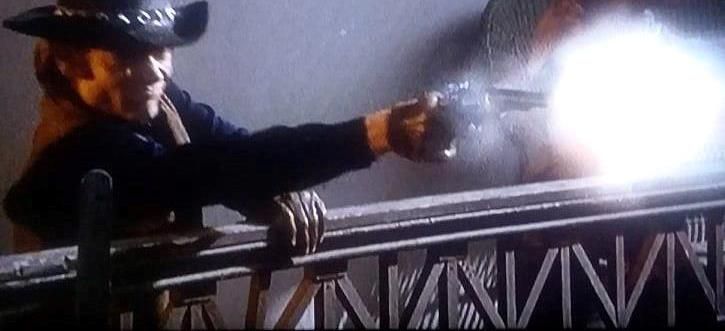
Caldwell swung around, peering into the darkness of the street behind him, unable to see the Englishman who had just commanded him to put his hands up. He fired wildly into the darkness. Two shots came back in answer, one of the bullets plucking at the sleeve of his coat and burning his arm like a hot wire, the other going through his hat.
He turned to his right, back towards the lights of the town, thinking it would be easier to lose himself amongst the buildings, but drew in his breath sharply as he saw a man behind a wall, covering Heyes on that side.
“This is Detective-Sergeant Finney of Scotland Yard,” came the soft Irish voice. “We have you surrounded, Caldwell.”
Thinking that the woman might prove to be the weakest link in the noose drawing tighter around him, Caldwell spun to his left, running directly toward her and the open country beyond.
Paula did not want to kill him—she knew that Scotland Yard would prefer to take him alive and see that he got a fair trial—but she had very little time to decide on her target. The man was running straight for her, making it difficult to choose a good point of aim that wouldn’t prove lethal. She checked to see that the other men weren’t directly behind him, and fired twice in quick succession as he passed her hiding place. One shot apparently missed, but the other drew a cry from Caldwell as it hit—where, she could not tell. The outlaw staggered, picked up his stride again, and put on a burst of speed. Obedient to Heyes’s previous instructions, Paula did not fire again, drawing quickly back out of the way of a possible return shot. A few moments later, Heyes, Watson, and Holmes ran past in pursuit. To the east came the sound of a police constable’s rattle, and running feet.
Heyes slowed, firing again at Caldwell, hoping to wound the outlaw and thus slow him down, and continued to give chase. This reminded him eerily of the chase in the mountains above Telluride. The man was doing just what he had done then—not surrendering, not staying to fight it out, but running away to save his own skin, turning back to shoot at his pursuers occasionally. Heyes wondered how much ammunition Caldwell had with him. Well, we’d better not give him a chance to reload, that’s all.
Holmes, who had been a cross-country runner at University, indicated to Watson that he was going to cut to the south and try to head their quarry off as the road across the heath curved. Watson waved in answer, saving his breath for running. But the pace was too much for his game leg. Suddenly it gave way beneath him, precipitating him onto the surface of the road, fortunately unpaved at this point. He rolled to one side, fetching up under a bush which would give him some concealment. Ahead of him, he saw the fleeing man whirl around and point his revolver at Heyes, who was gaining on him from behind. Watson planted his elbows on the ground, steadied his revolver with both hands, took careful aim, and fired. The sound of his shot almost blended with Caldwell’s. Heyes dived head-first for the nearest patch of shadow, then lifted his gun to fire in Caldwell’s direction, hoping to keep the fleeing outlaw from taking aim at Watson.
At Watson’s shot, Caldwell went down with a cry and lay still. A moment later, a moan and a movement indicated he was still alive. Heyes, gun drawn, advanced carefully as Holmes appeared from the shadows of the land to the south of the road. Together, the two of them knelt beside Caldwell. Heyes kicked the man’s gun aside while Holmes checked for a pulse.
“He’s alive. I can’t see how badly he’s hurt,” said Holmes. “What about Watson?”
“His leg gave way, back there. Gave him a good chance to get a steady shot off from the ground. I think he saved my life,” replied Heyes.
“Watson!” Holmes sprinted down the road in the direction indicated by Heyes’s pointing finger.
“Here, Holmes. I’ll need assistance in rising. The leg twisted and gave way.” As his friend dropped to his knee beside him, Watson added disgustedly, “I’m quite all right. I shall just be stiff, I fear.” As he was assisted to his feet, he clenched his teeth against the pain from the wrenched muscle and leaned on Holmes’s arm. “How is our quarry? I know I hit him.”
Holmes helped the doctor along the road to where the American bad-man lay. Watson sank down beside him and began to examine his patient with sensitive fingers, wishing that they had some moon light so he could see what he was doing. The moon, however, had gone down at half-past seven, and the sun had followed it just after eight. Where they were, on the edge of Hounslow Heath, there was no light at all except what little was supplied by the stars.
A flurry of light footsteps announced Mrs. Heyes’s arrival. “Hannibal? Did he hit you?”
“No, but it wasn’t for lack of trying. You’re all right?”
“I’m fine. And here’s Mr. Finney!” She indicated the Scotland Yard man a few steps away.
Finney was breathing hard from the run. Assessing the situation quickly, he put away his own Webley Bulldog pistol, which he had obtained special permission to carry. “He’s alive?”
“Yes, but I don’t know how badly he’s hurt,” said Watson. “I’ve found two wounds, and there may be a third—ah, yes, here in his right side. If I had some light …”
“Here.” Finney snatched a lantern from the hand of the police constable who was just coming up beside the group, holding the light steady so the doctor could see what he was doing. “I’ve sent for another constable and a police wagon. They’ll be here in a few minutes.”
“We’ll need some bandages to stop the bleeding.” Watson began to unbutton his coat, thinking to use his shirt for the purpose.
“Wait, Doctor. You may have one of my petticoats.” Paula reached up under her skirt and untied the strings, dropping the petticoat to the ground. “Heyes, help me rip it into strips.” Her husband sprang to assist.
“Thank you, dear lady. That will do quite well.” Efficiently, Watson applied rough pressure bandages to the deep wound which his own bullet had made in Caldwell’s upper right leg, the bloody tear in his side, and the sluggishly bleeding graze that crossed the outer edge of his upper left arm. “The bullet is still in this leg wound, I believe, and I daren’t take it out here and now—it’s too close to the femoral artery. I shall need light, and proper instruments, and a place to lay him.” He looked up at Finney. “I suggest we take him to my surgery. This one wound cannot wait, or you might not be able to bring him to trial.”
“Very well, Doctor. I’m happy to rely on your expertise. But are you sure you are up to this? I heard Mr. Holmes say you were hurt.”
“I just twisted my game leg,” replied Watson. “I shall do.”
When the police wagon arrived, they lifted their prisoner into it. A word from Finney, as he took charge of Caldwell’s Colt .45 revolver, sent one of the constables off in a cab to request the attendance of a police surgeon at Dr. Watson’s surgery, to assist in extracting the bullet.
In spite of the Yard man’s assurances that the arrest would be made as soon as the prisoner regained consciousness, and no further help would be needed, Holmes and the Heyeses elected to accompany the party—Holmes because he was worried about Watson, and Heyes because he wanted to be sure that Caldwell ended up behind bars this time, with no chance of escaping. His wife would naturally remain with him until they returned to their hotel. In addition, every body except the single-minded Holmes was now ravenous, the entire party having gone without supper in order to pursue the chase. It would be well past eleven in the evening by the time they arrived at Watson’s surgery, especially if they stopped some where on the way to acquire some food. It was going to be a very long night.