
Chapter Text
With excerpts from the diary of John H. Watson, M.D.
London, England, early September, 1882
Hannibal Heyes turned from viewing the semi-wild park land behind Buckingham Palace, which the windows in the upper storeys of Lord Wellwood’s house overlooked. Paula’s cousin had pressed them to leave their lodgings at the Grand Hotel and come to be his guests while they remained in London. It would be more comfortable, and they were welcome to treat the house, the staff, and the stables as their own during their stay. Adrian Wellwood had explained, ingenuously, that their residence in his house would make both the Church of England confirmation process and the poker lessons much more convenient, and had overborne Paula’s objections by assuring her that his mother was fixed down at Wellwood Place in Cambridge-shire for the summer, and would not disturb them in any way. In fact, Adrian had confided, his mother thought he was mad for spending the hot part of the summer in town, but he had just recently taken his seat in the House of Lords and wanted to remain in the metropolis at the least while the House was in session.
It was certainly more comfortable, mused Heyes, and the high spirits of their young host and his school friends were a relief after the strain of bringing the James Caldwell murder investigation to a successful conclusion. It had been decided that Heyes and his wife were not needed as material witnesses to the killer’s capture, since Detective-Sergeant Finney, Dr. Watson, and Mr. Sherlock Holmes could testify to all that was necessary, including Caldwell’s open boast to Heyes that he had, in fact, committed the murder. Finney told them the trial would result in a conviction and a sentence of hanging, and there was no need for them to be present.
The Heyes had taken the opportunity to go to the opera with Finney to see a performance of Patience, the new Gilbert & Sullivan operetta. They had also seen the solicitor to complete the process of transferring the Wellingtons’ property.
A visit to a tailor to have a suit of morning dress made to Jed Curry’s measurements, in the hope that he would need the suit to be married in, and the discovery of several pieces of Crown Derby to replace Mrs. Utley’s broken dishes, had completed their business in London, and the couple were looking forward to a few lazy days together, doing nothing at all, before going to Scotland to see where Paula had been brought up.
And then their quiet existence was up-ended with the receipt of an urgent message from Sherlock Holmes.
221B, Baker Street, Wednesday, September 6th, 1882
Excerpt from the diary of John H. Watson, M.D.
Mrs. Hudson carried up some tea for us, and we settled ourselves to wait for Holmes’s return. My wife was visiting her sister for the majority of the month of September, so I had returned to my old lodgings in Holmes’s quarters for the time being, giving my practice over to a substitute. The young woman, for I was still ignorant of her name, looked about her with curiosity, but said nothing further to me. I marvelled to myself at the courage she had displayed in coming so far, alone, and unable to communicate even her simplest wants in the language of the country. It was little short of a miracle that no unscrupulous person had taken unfair advantage of her situation. She nodded and smiled when I poured her tea, more at ease than she had been at first.
Holmes returned sooner than I had expected. ‘I have dispatched young Wiggins with a message to Wellwood House. If Mrs. Heyes is there, I have requested her to come at once if possible. If she cannot come, or if she and her husband are no longer residing there, doubtless we shall receive word to that effect.’
*** *** ***
Hannibal and Paula Heyes were in the drawing room when they heard the bell. They were alone, Lord Wellwood having gone out for the evening. Presently the voice of George, the footman, inquired the nature of the caller’s errand. A boy’s voice responded, saying, “I ’ave a message for Mrs. ’Annibal ’Eyes.”
Oh, no, thought Paula to herself. I’m not sure I want to know.
“Very well, I shall see that she receives it.”
“Oh, no, guv’nor, not by ’alf you don’t. I was told to give it to ’er own self, and none other. Beggin’ your pardon,” the boy added as an afterthought.
“Paula,” asked Heyes, “do you know what that’s all about?”
“I think,” she said cautiously, “that it’s Wiggins.”
“Who?”
“Oh, you know, the boy who works for Sherlock Holmes. We met him the night we went after Caldwell. I recognize his voice.”
They heard George say, “Wait here, please.” He came into the sitting room. “I beg your pardon, madam, but there is a Young Person in the hall who insists upon seeing you personally.”
“Certainly. Please show him in.”
“Very well, madam.”
A moment later, the footman reappeared, followed by a boy of perhaps ten years of age, who had obviously straightened his clothes as best he could and combed his hair with his fingers, in order to do justice to the dignity of his errand. “Mrs. ’Annibal ’Eyes?”
“I am Mrs. Heyes,” Paula said, smiling. “I remember seeing you in Mr. Holmes’s chambers. You have a message for me?”
“Yes, mum. A message from Mr. Sherlock ’Olmes, and I was to put it in your own hands myself.” Wiggins gave her the folded paper and let out a small sigh, relieved at having properly discharged his responsibility.
“Were you told to wait for an answer?” she asked him gravely, aware that he was at an age when boys wanted to be taken seriously.
“Only if you couldn’t come, mum, or wasn’t here no more.”
“I see.” She read the message—terse, but impeccably polite. Looking from her curious husband to the fidgeting messenger, she rang the bell. “George, would you take this young man to the kitchen and see if Mrs. Collins can find him some thing to eat?”
After George had departed with Wiggins, Heyes looked back at her, amused. “Well? What’s it all about?”
“It seems that he needs an interpreter. In the Gaelic.”
Heyes frowned. This development almost defied belief. “You mean Holmes has some body there who doesn’t speak any English?”
Paula nodded. “So it would appear. I’d better go, Heyes. I doubt he’ll be able to find any one else to help him, unless he starts looking for Irish policemen who have the Gaelic. Do you mind?”
He grinned. “Not as long as I get to come with you. I don’t want you going around alone at night in this town. Besides, I’m curious. I want to find out what’s going on.”
“Certainly.” She pulled the bell rope again. When the footman reappeared, she requested him to have the brougham brought round, and turned to Heyes. “Ready?” She paused. “I suppose you’d better bring your gun.”
“Of course,” he agreed, touching his coat pocket to be certain it was still where he had put it upon rising that morning.
As far as that went, Paula considered the likely results of calling upon Sherlock Holmes, and decided to take her own pistol in its special pocket in her skirt. One never knew.
Excerpt from the diary of John H. Watson, M.D.
After Wiggins’s departure with the message to Wellwood House, there was little we could do but wait—either for the reply or for the lady herself. My friend Holmes, always resourceful, chose to occupy the time in playing for us upon the violin. Fortunately, he was in an excellent mood and therefore gave us an hour of the most pleasant airs, much to the delight of our visitor, as music is a language which requires no interpreter. Our client (though she understood scarcely a word of what had transpired) was nonetheless a most intelligent young woman; she understood quite well what we were waiting for, and that we had sent for some one who could help us surmount the language barrier.
We heard a carriage in the street below our window, just as my companion finished a lovely piece of Vivaldi’s. I walked to the window and was very gratified to see a young couple disembark from the brougham; I was eagerly anticipating the opportunity to talk with Hannibal and Paula Heyes again, as they had been of great material assistance to Sherlock Holmes in the matter of the creased American glove. ‘Here they are,’ I remarked to Holmes, whereupon he replaced his violin in its velvet case and returned it to its place in the corner.
‘Excellent,’ he said, with the eager look I had learnt to recognize. ‘Then, unless I am much mistaken, we shall soon learn what business has brought our client on such a desperate errand.’
The door opened, and Mrs. Hudson showed in our guests, promising to return with more tea.
Holmes greeted the Heyeses with enthusiastic handshakes. ‘Ah, excellent,’ he exclaimed in his strident voice. ‘So good of you to come at once. This is our hapless client, this young lady who has journeyed so far alone to consult me. I only hope that your kind assistance will enable me to be of help to her. You remember, of course, my dear friend and colleague Dr. Watson. Pray sit down.’
‘Glad to oblige, Mr. Holmes,’ said Hannibal Heyes, nodding in a friendly manner to me, whom he naturally remembered quite well, since we had gone shooting together at my club more than once. His wife nodded in agreement, but her attention was already riveted upon our young client. I had pen, ink, and notebook ready, and awaited developments.
As I may have said in my earlier chronicle, Paula Heyes is one of the most striking women I have ever had the privilege of beholding. Her fair complexion, coal-black tresses, and blue eyes made her a most prepossessing sight. To Sherlock Holmes, however, she was simply an interpreter, a tool which would assist him in yet another investigation.

Paula Wellington Heyes, inexplicably portrayed in modern 20th-century dress (Jessica Stroup photo session)
Mrs. Heyes addressed our client gently in a soft, lilting language which I assumed to be Scottish Gaelic. I must admit to considerable surprise that here in Great Britain towards the end of the nineteenth century, there yet existed persons who could not speak even a few words of the Queen’s English. Given that, the girl’s courage and resourcefulness were remarkable, bringing her accurately to the destination that some one had written out for her on the paper she had shown us.
The young woman’s face lit up with pleasure and heartfelt relief, and she replied in the same language. After another brief exchange, she held out a letter to Mrs. Heyes, who motioned for her to give it to Holmes while she herself explained briefly.
‘The local school master, who is also the minister of the nearby Free Kirk, wrote a letter for you, Mr. Holmes. He has the Gaelic as well as being fluent in English, but it was not possible for him to come to London himself to find you.’
Holmes took the paper. ‘I deduce that the school master suspects some one locally. That is helpful.’ Swiftly he read the letter and then passed it to me.
The writer, who signed himself Aonghais MacGillivray, Dominie, and who wrote in a clear, educated hand, was brief and to the point. Several of the men in their village and surrounding area had disappeared recently. No bodies had been found, no accidents heard of, but they had neither returned home nor communicated with their families. Suspicion centred on the factor of that particular section of the Duke of Argyle’s[1] estates, Robert Duncanson. It was unknown if he were the cause of the vanishings, but the villagers did not trust him and many feared him. The man had little Gaelic at his command and had displayed contempt towards the locals who spoke only that language, apparently judging them to be fools. This was the reason that Mr. MacGillivray had selected the young woman before us for the trip to London to ask my friend’s help, thinking that her absence might go unnoticed. Mr. MacGillivray had attended New College, administered by his church, in Edinburgh, and while there he had heard of a case Holmes had solved for a friend of his. It was his earnest hope that Holmes could help in this exigency. I passed the letter on to Mr. and Mrs. Heyes.
‘I’m sorry,’ I said. ‘My command of Gaelic is non-existent, in spite of my Scottish heritage, and I did not catch the young lady’s name properly.’
‘And I failed to introduce her,’ said Mrs. Heyes, conscience-stricken. ‘This is Oighrig Nic Ghille Mhichael.’ At our hesitant looks, she elaborated. ‘Her given name is pronounced some thing like “OY-rick”, as you heard me say.’ I had not, in fact, gathered any thing close to that pronunciation from what I had heard, but that, after all, was why I had asked.
‘There is no direct English equivalent, I fear, though the name is some times Anglicized as “Euphemia” or “Effie”. Her surname is often Anglicized as “Carmichael”, so I suppose you could address her as Miss Carmichael.’ Mrs. Heyes explained this quickly to the young woman, who smiled and nodded.
Holmes grasped her hand. ‘A pleasure to make your acquaintance, Miss Carmichael.’ He waited while this was translated, and then continued. ‘It is a capital mistake to theorize in advance of one’s data. All that I can gather from this letter is that some danger threatens the men of the town and it is thought that the factor may be responsible, so every effort is being made to keep him in ignorance of the villagers having sent for help. I shall wish to hear every thing that Miss Carmichael can tell us, and then we shall visit the area. For that, we will have to find a plausible excuse for our presence in the region—and for the two of you as well, Mrs. Heyes, if you and your husband will join us.”
Hannibal Heyes spoke for the first time since his arrival. ‘We’d be more than happy to do that, Mr. Holmes. My wife was born in the West of Scotland, so we were planning a trip up that way this month to visit her birth place. We can combine this trip with the one we already planned. May be your plausible reason could have some thing to do with me wanting to visit the area, like a regular tourist.’
‘That will do excellently well,’ replied Holmes.
‘If we’re leaving to-morrow,’ said Mrs. Heyes, ‘Oighrig had best spend the night with us. Meanwhile, please ask what you want to know, Mr. Holmes, and I shall do my best to translate. I am ashamed to say that my Gaelic is somewhat rusty. Of late years, I’ve only spoken it with my housekeeper—formerly my nurse—her sons, and my brother, and that only rarely.’
Holmes did not answer at once, having got up to consult the large map of Great Britain pinned to one wall. The town mentioned in the schoolmaster’s letter, Bun Essan, was not displayed, as was perhaps to be expected.[2] I had noticed before that the map was much more reliable with English geography than with the outlying parts of the British Isles.
Pulling a more detailed atlas from the bookcase, I laid it open on the table and we all gathered round. After a few questions put to Miss Carmichael, Mrs. Heyes laid her finger on the western tip of the island of Mull, off the mainland of Argyle-shire.
‘She says the island of Iona is visible from the coastline just west of where she lives. That would put it some where near here. Here’s Iona, you see. She lives in a tigh dubh; that is, a black house, made of whitewashed stone with a thatched roof. There is no village near there—such houses are widely scattered. But Argyle is where I was born and at least partly reared. That’s Campbell country. Inverara[3] is the county seat.
‘I think we should go to Inverara first, for two reasons. The first is that the town is not all that far from where I was born and will thus make a good central location for Heyes and me. That doesn’t concern you except for the value of having us in the party as tourists, but the other consideration is that my brother and I once had a friend, living south of Inverara, whose Gaelic is rather better than mine. I propose that we find her and ask her to accompany us to the Isle of Mull. It would be a very great help to me, and to you as well, Mr. Holmes.’
Sherlock Holmes nodded briskly, rubbing his hands together. “-‘An excellent suggestion, Mrs. Heyes. More than one Gaelic speaker on this expedition will be most helpful. And your friend—does she speak good English as well?’
‘Yes. She has worked for the Duke of Argyle’s family for some years, and as far as I know, none of them has the Gaelic.’
Holmes located the town of Inverara, in the central portion of the shire, without any difficulty. ‘We can get a train for that place, I believe, or close to it. Yes. The line is through to this town—‘ his finger rested on the town of Dalmally ‘—and we would take road transport from there. We’ll take lodgings in the town and plan our next move, which should be to the coastal town of Oban, after ascertaining if your friend can accompany us.’ He sent a shout echoing for Mrs. Hudson, and when the landlady arrived, asked her to bring more substantial refreshments for all of us. ‘Now, Miss Carmichael. Please take your time. Begin at the beginning, and tell me every thing you can remember which might bear on this mystery.’
Mrs. Hudson arriving a few moments later with a platter of cold meat, a loaf of bread, some butter, and a dish of sliced applies, Holmes waved us all to the table. ‘Pray, help yourselves to this abundance of food. Thank you, Mrs. Hudson!’
Watching our client eat, daintily but with signs of considerable hunger, I realized that it was just possible she had eaten nothing on her long journey to find us. I should certainly have seen to her wants earlier, but the matter was now being remedied.
Miss Carmichael’s story
With many pauses for translation, and for Holmes to put questions in order to elicit more detail on points that seemed important to him, Miss Carmichael told her story.
She and others in the small village near her home had been concerned when the men began disappearing, but no one had given it much thought—after all, the fishing took the men away at odd hours—until it became clear that the families did not know their whereabouts, or knew that they should have been away at the fishing but were not. When her sweetheart failed to meet her for a tryst they had arranged, Effie had talked the matter over with the older women, and then set out to walk to Bun Essan to consult the minister, who was also the local school master. They knew he was a local man who spoke their language and had their best interests at heart, none of which was true of Mr. Duncanson, the factor.
Mr. MacGillivray had heard rumours of the disappearances and had listened carefully to her story. After prayer and some thought, he had recalled what his college friend had said of Sherlock Holmes and his ability to solve mysteries that others found baffling. He had asked Effie if she would have the courage to go all the way to London alone to ask for help, if he were to pay her way and send a letter with her, and a paper with the address written upon it. Upon receiving her assurances, the minister had sat down to compose the letter she would carry, knowing that the document might be the only way she would be able to communicate with the London detective.
The only remaining problem requiring a solution would be to get the messenger off the Isle of Mull and to the mainland without any one, such as the ferry men at Craignure, being able to tell an enquirer that she had left the island. Mr. MacGillivray had a friend in the island of Lismore, north and east of Mull and easily reachable by small boat. If she could get a local man to take her over to Lismore, from there she could take another boat, or even a regularly scheduled ferry, to Oban, whence she could board a train for Callander and London. He had written out brief travel instructions for her, accompanied by notes in English which she was to give to the ticket offices at each stage. Then, counting out the money she would need, he had sent her on her way.
*** *** ***
In the intervals of looking out the window at the unfamiliar English countryside, which had begun to change rapidly once the train neared Carlisle, becoming rougher and more scenic, Hannibal Heyes watched his wife’s face. She had chosen to sit with her back to the engine, giving Heyes the first opportunity to see the northern English and Scottish terrain, while they sat opposite to one another, both thus having the opportunity to look at one another from time to time in preference to the scenery.
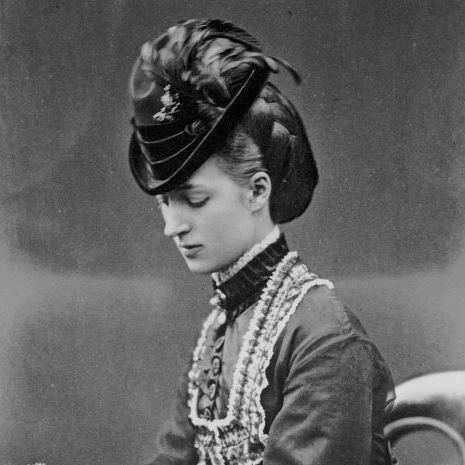
Paula Wellington Heyes dressed for travel (photo of Princess Alexandra of Denmark, 1875)
Oighrig Nic Ghille Mhichael sat across the aisle from them, facing backwards, while Sherlock Holmes and Dr. Watson sat opposite to her. In this way, if further questions occurred to Holmes, he could readily ask Mrs. Heyes to translate for him, while still giving the newly married couple the privacy afforded by the sound of the wheels clicking over the rails.
Heyes leaned forward to touch Paula’s hand. “Are you excited about seeing your home?”
“Yes … that is, as far as that goes.” She favoured him with a dazzling smile underlain by a hint of uncertainty.
He knew her well enough by now to realize that there was more she wanted to say, but that questions were required to bring it out. “What do you mean by ‘as far as that goes’?”
“I’m looking forward to it, yes. But it’s not really home any more. That is, I love it, and I hope you will, too. Mid-Argyle is beautiful. But I think that home is where family is, and although there will probably still be a few friends there who remember me, most especially Fionnuala Nic Iobhar, who I hope will agree to help us with the Gaelic speaking, most of my remaining family, those whom I love best, are in Colorado. And … and you are here, right here with me. In the end, home is where you are.”
Heyes frowned. She had said some thing like this before. Although he naturally expected her, as his wife, to be prepared to accompany him any where he chose to go and to live wherever he chose to live, and he knew that she was so prepared, there were things he didn’t understand. Deciding to see how far he could get by simply asking, he said, “Are you saying you don’t feel at home any where, except may be with me? Surely that’s not quite true, is it?” He looked her right in the eye, silently demanding an answer rather than just an assurance of her devotion.
“No, it’s not that. I loved it in Argyle, but I think it will have changed a great deal since I was last here. It’s not as though I’m really going home. And at the ranch, in Estes Park—well, my brother is there, and Ellen, who’s been like a second mother to me. Until you came along, they were my only family. And Paul and I chose that location for our horse ranch, and we love it there. I hope you’ll be content to settle down there, and Kid and Lillian as well, once the amnesties come through. If … if you don’t, I’ll go wherever you choose, of course, but I do consider the C Bar W home. Before I married you, it’s the home we decided on, my brother and I.”
That’s important, he thought. I should have tried asking her directly earlier. Never can tell when I might learn some thing new. “Paula, I think that’s the first time you’ve let slip that you have a preference.”
“Of course I have a preference!”
“Well, yeah, but you know we haven’t been married very long, and some times I think you hide what you prefer so I won’t think you’re trying to argue with me. Don’t you?”
“Oh.” She blushed. “I suppose you’re right.”
“Uh-huh. I’d really rather have you argue with me some times. That way at least I know what you’re thinking.” He grinned. “I promise I won’t get mad or any thing like that.”
She pressed his hand without speaking. After a few moments, he continued. “So you’re looking forward to seeing where you grew up, but you’re saying Colorado’s still home? Where you want to go back to? Even though we haven’t gotten to Scotland yet?” He waited for her answer with just a tinge of anxiety.
“Yes, Hannibal, that’s right. I want to see Argyle again, and then I want to go home to Colorado—with you.”
He gave a long sigh, took both of her hands in his, and pulled her close, changing his seat for the one next to hers so he could hug her properly. Then some thing else she had said stirred a chord of memory. “This friend you plan to look up …”
“Fionnuala? She’s five years younger than I, but she is a friend, or she was. I hope she’s still there. I’d like to see her again. She used to be sweet on my brother.”
Suddenly Heyes recalled where he’d heard the name before. “She has red hair?”
“Why, yes, she does! How’d you know that?”
He smiled, sure of himself now. “Because your brother told me about her, just a little. It was in Junction City, right before you and I got married. I asked him outright if there wasn’t some special girl for him …”
“And he told you? You never mentioned this before. He doesn’t talk about her. I don’t know how you ever got that out of him!”
“I just asked, and he told me. Of course,” Heyes added cheerfully, “he may have been feeling guilty, because we’d just been discussing your health and state of mind, and he’d said some thing that kinda sounded like he thought I’d taken advantage of you, so that we were obliged to be married. He didn’t mean it that way, and he apologized. I thought it would be a good time to ask that question, while he was kind of off balance.
“He said there’d been one girl, but she was only fourteen when the two of you left for America, so he couldn’t say any thing to her then. He hadn’t written because, after all, she might be married now and have a bunch of kids.”
“Heyes, you’re a scoundrel! Did any one ever tell you that?” Seeing her husband’s confident smile and nod, Paula went on. “As a matter of fact, I thought there was some thing between them, because Paul never spoke of her again after we left Scotland. That tells its own tale.”
“You thought he was in love with her because he never said any thing? I don’t quite follow.”
“Of course you do. Would you talk about a girl you’d had to leave behind because your cousin needed you? Especially to your cousin?”
“Oh. Yeah, I see. You think your brother still cares?”
“I know he does. Especially after he mentioned her to you. Darling, you’re thinking again.”
“Yeah, I am. I’ve got an idea. If we find her, and she isn’t spoken for, and she’s still interested in your brother, why don’t we take her back with us?”
“Take her back? Heyes, it’s not that simple.”
“Why not? I’ve got the money—I can pay for her passage.”
“She wouldn’t leave her widowed mother, for one thing.” Paula stared at her husband in consternation.
“So we bring her mother along as well. O.K., O.K.,” said Heyes, laughing. “We’ll have to wait and find out more. But it’s a good idea, don’t you think? Besides, I owe your brother some thing for consenting to our marriage.”
“But …” She gave up, realizing that she would not be able to convince him there was any thing wrong with one of his brilliant plans. He would have to see it for himself. And perhaps he was right—if Fionnuala was still interested in Paul Wellington, the girl might even consent to this outrageous scheme.
[1] The modern spelling, Argyll, was already being used by the 8th Duke at this date; however, most publications still employed the older spelling. Both spellings were used interchangeably to the end of the 19th century. Both are pronounced “Ar-GUY-ull”.
[2] This takes place several years before Mary MacDonald of Bun Essan wrote the hymn “Leanaibh an Aigh (Infant of Joy)”, thus giving the name of her town to the old tune to which she had set the poem; otherwise, every body would probably have recognized the name. The tune is often found in American hymn books with a different set of words attached, under the title “Morning Has Broken.”
[3] The Anglicized name of the town of Inveraray was spelt without the “Y” which is currently to be found at the end of the name, until close to the middle of the 20th century. This is demonstrated by Robert Louis Stevenson’s spelling of it in his book Kidnapped. It was then, and is now, in the 21st century, pronounced “In-ver-AIR-uh” by the people who live there, or by anyone else who happens to know the local usage. The pronunciation “In-ver-AIR-ee”, given to it nowadays by Scots from other parts of the country, or by English speakers from England and other countries, is not correct. In Scottish Gaelic, the name of the town is Inbhir Aora, and is pronounced similarly to the local English usage.