Chapter Text
Chapter 2: The Things History Forgot
Hogwarts School of Witchcraft and Wizardry — September–October 1992
Hermione Granger had apparently decided that the most productive way to spend a Saturday was to bury herself beneath approximately three hundred years of questionable historical scholarship. Draco Malfoy was beginning to suspect that agreeing to help her had been a mistake.
Not because the subject was uninteresting. Quite the opposite, actually. The prospect of uncovering the truth behind the Arthurian legends was fascinating, particularly now that they had personally spoken to one of the people involved. What Draco objected to was Hermione's apparent belief that every book ever written about Merlin, Morgana, or Arthur needed to be examined individually, regardless of how obviously ridiculous its contents were.
She had just finished reading a particularly enthusiastic account of Arthur Pendragon defeating seventy-three enemy knights with a single swing of his sword. Apparently, the author had considered this entirely plausible.
Draco closed the book. "Seventy-three."
Hermione looked up from her notes. "What?"
"Seventy-three knights. One swing. According to this, Arthur cut through seventy-three fully armored knights with a single movement."
Harry, sitting beside Draco, leaned over to inspect the illustration. "That's a lot of knights."
"An astute observation."
"Maybe he used magic?"
"According to the very next paragraph, Arthur deliberately refrained from using magic because he considered it dishonorable."
Harry frowned. "But wasn't he a wizard?"
"Precisely."
Hermione held out a hand. "Let me see."
Draco passed her the book. Hermione skimmed the passage, frowned, and then turned several pages back.
"That's strange. Earlier it says Arthur used an enchanted sword."
"Ah, yes. The legendary Excalibur," Draco replied dryly. "A blade forged by mysterious powers, capable of defeating armies, cutting through any substance, and presumably preparing breakfast if one asked politely."
Harry grinned. "That would be useful."
"Harry, if you ever acquire a magical sword, I sincerely hope you find more productive uses for it than preparing toast."
"Depends how good the toast is."
Across the table, Ron snorted.
Hermione gave all three of them an exasperated look. "Could we please concentrate? We're supposed to be finding historical records, not criticizing the accuracy of legends."
Draco raised an eyebrow. "Hermione, criticizing the accuracy of legends is quite literally what we're doing."
"Yes, but—"
"And I would argue that a man defeating seventy-three armored knights in a single swing qualifies as something worth criticizing."
"Well, obviously!"
"Excellent. I'm glad we agree."
Hermione sighed and returned to her notes.
Their little investigation had expanded considerably since meeting Morgana. Ron had joined them after hearing Hermione's explanation, although his initial reaction to the revelation that Merlin had married the supposedly wicked sorceress had been rather less scholarly than she might have hoped. Millicent and Blaise had expressed interest as well, though neither seemed particularly eager to spend an entire weekend in the library.
Blaise had suggested that they simply ask Morgana where everything was and save themselves the trouble. Unfortunately, Morgana had spent centuries watching her own history being rewritten by increasingly imaginative strangers. She knew that Arthur's manuscript had survived long enough to be mistaken for historical documentation, but she had no idea where the original had eventually ended up. Nor had she been especially interested in helping them find it.
According to Morgana, the sooner the entire ridiculous thing was forgotten, the better. Hermione disagreed. Quite passionately. Which was why the four students were currently occupying a table near the back of the library, surrounded by books that appeared to become more absurd with every passing hour.
Harry turned another page of the volume he had borrowed. "Here's something about the Round Table."
Ron looked interested. "Wasn't that where all his knights sat?"
"Apparently."
"Sounds sensible. Nobody gets to sit at the head."
Draco looked up. "That particular detail may actually be true."
Hermione straightened. "Really?"
"Well, Morgana did say they frequently sat around a small round table when visiting one another."
Harry glanced at the picture before him, which depicted an enormous hall filled with armored knights. "This doesn't look very small."
"Perhaps Arthur suffered from a tragic inability to distinguish between a pleasant afternoon tea and a gathering of the greatest warriors in history."
Ron laughed.
Hermione frowned thoughtfully. "Or perhaps the original table was simply enlarged for the purpose of the story."
"That would explain the table," Draco agreed. "It would not explain the hundred armed knights."
"Perhaps he knew a lot of people."
"Ron, I sincerely doubt Arthur invited a hundred men in armor to drink tea with his friends."
"Why not?"
Draco considered answering. Then she remembered that she was speaking to Ron Weasley and decided her time would be better spent elsewhere.
She reached for another book. A small cloud of dust escaped when she opened it, causing Harry to sneeze.
"Bless you," Hermione said automatically.
"Thanks."
Draco inspected the title. A Comprehensive Examination of the Authentic Arthurian Manuscripts. That sounded promising.
She turned to the first chapter. Then the second. Her expression gradually changed.
"Hermione."
"Hmm?"
"I think I've found something."
Hermione looked up immediately. "What?"
"This author mentions a surviving copy of Arthur's original manuscript."
Hermione nearly knocked over her inkpot. "Where?"
Draco turned the book around and pointed to a footnote. "Apparently, a copy was preserved in the Hogwarts archives because Arthur attended the school. The author claims to have consulted it personally."
Hermione leaned forward so quickly that Harry pulled his cup of pumpkin juice out of the way.
"Does it say where the copy is now?"
"Not precisely. But it gives an archive reference."
Hermione stared at the small notation. Then she smiled.
"Oh, that's wonderful!"
Ron looked at Harry. Harry looked back. Both boys sighed.
Draco smiled faintly. "I suppose we're about to discover whether Hogwarts possesses a functional archival system."
"Of course it does!" Hermione declared.
Draco glanced at the surrounding shelves. "Given what we've already learned about magical historians, I wouldn't be so confident."
⁂
Madam Pince was not especially pleased to discover four second-year students asking about manuscripts nearly a thousand years old. Her displeasure increased when Hermione explained that they wanted to examine one written by Arthur Pendragon.
"Arthur Pendragon?"
"Yes, Madam Pince."
"The Arthur Pendragon?"
"That's the one."
Madam Pince regarded them suspiciously. "And why, precisely, do four second-year students require access to such a document?"
Hermione drew a deep breath. Draco recognized the warning signs immediately.
Oh, dear.
"We've been researching inconsistencies in the historical accounts surrounding Merlin, Morgan le Fay, and Arthur Pendragon, and we recently discovered that several supposedly authentic accounts may actually be based on Arthur's own fictional manuscript. If we could examine an early copy, preferably one without substantial alterations, we might be able to determine which elements originated from Arthur himself and which were introduced by subsequent historians."
Madam Pince stared at her. Ron shifted uncomfortably. Harry looked impressed. Draco simply waited.
After several moments, the librarian adjusted her spectacles.
"Miss Granger, do you intend to damage this manuscript?"
"Of course not!"
"Remove any pages?"
"Certainly not!"
"Write in it?"
"Never!"
"Allow either of these boys to handle it unsupervised?"
"Oi!" Ron protested.
Hermione hesitated. Draco covered her mouth. Harry looked betrayed.
Madam Pince nodded with grim satisfaction. "Very well. Wait here."
She disappeared behind a narrow door.
Hermione turned toward her friends. "Well, that went rather well."
Ron folded his arms. "You hesitated!"
Hermione blinked. "What?"
"When she asked whether we'd damage it!"
"I was considering the question!"
"You were considering whether Harry and I could be trusted with a book!"
Draco patted his shoulder. "Ron, I wouldn't take it personally. Madam Pince probably wouldn't trust Albus Dumbledore with a book if she thought he might bend the spine."
Harry laughed. Ron remained unconvinced.
Several minutes later, Madam Pince returned carrying a large rectangular case. She placed it upon the table with extraordinary care and unlocked its brass clasps.
Inside lay a manuscript bound in dark leather. Its cover bore an elaborate golden crest depicting a sword surrounded by what appeared to be several rather enthusiastic lions.
Draco stared at it. "Good heavens."
Hermione leaned forward.
Madam Pince held up a warning finger. "Clean hands. No food or drink. No unauthorized spells. And if I see so much as a single bent corner, all four of you will be banned from the library for a month."
Ron looked horrified. "An entire month?"
Madam Pince smiled unpleasantly. "Would you prefer a year?"
"No, Madam Pince."
"Good."
She left them under the watchful supervision of a nearby portrait.
Hermione opened the manuscript. The first page was decorated with an elaborate illuminated letter, followed by a title written in beautifully preserved calligraphy.
The Glorious Chronicle of Arthur Pendragon, Sovereign of Britain, Master of the Unconquered Blade, Defender of the Innocent, and Greatest of All Kings.
Harry stared. Ron whistled. Draco slowly closed her eyes.
"Oh, Arthur."
Hermione looked delighted. "It's an early copy! Look at the handwriting. And the preservation enchantments are extraordinary!"
Draco opened her eyes. "Yes, Hermione. The preservation enchantments are fascinating. The title, meanwhile, suggests that Arthur suffered from a rather serious shortage of modesty."
Harry started laughing.
Ron leaned closer. "Greatest of All Kings? Wasn't Morgana saying he wasn't even a king?"
"Indeed," Draco replied. "Which makes the title considerably more impressive."
Hermione carefully turned the page. An inscription beneath the title identified the manuscript as a near-contemporary copy of Arthur's original work, preserved with minimal alterations to its wording. A later librarian had added a short note regarding its uncertain historical reliability.
Apparently, someone had possessed a functioning sense of skepticism after all. Unfortunately, that person had not been especially influential.
The next several hours proved enlightening.
They learned that Arthur had apparently been an extraordinarily handsome man, admired by everyone he encountered. His enemies trembled before him, his friends worshipped him, and beautiful women routinely abandoned all good sense upon seeing him.
Merlin, meanwhile, was described as a wise but somewhat absent-minded advisor who frequently required Arthur's guidance. Draco found that particularly amusing. Morgana had been rather clear about Merlin's intelligence. Arthur's interpretation appeared to involve Merlin becoming incapable of making important decisions without first consulting his magnificent friend.
The legendary Round Table made its first appearance in a scene describing twelve mighty warriors swearing eternal loyalty to their king.
Harry read the passage twice. Then he looked up.
"Is it just me, or does this sound like a very fancy tea party?"
Draco leaned over. The scene included an elaborate description of Arthur presenting refreshments before his knights discussed the troubles facing their kingdom.
"Oh, that is marvelous."
Ron grinned. "What?"
"Arthur has apparently transformed an afternoon conversation into a meeting of twelve legendary knights."
Hermione looked thoughtful. "The basic arrangement might actually have been preserved from a real gathering."
"Indeed. Except the original gathering probably involved three people, biscuits, and Morgana threatening to hex Arthur for being annoying."
Harry laughed so loudly that Madam Pince glared at him from across the library. He immediately lowered his head.
Draco continued reading. Then she encountered the passage concerning Excalibur. Arthur's magnificent sword had supposedly been bestowed upon him by supernatural forces, its blade shining with incomparable power.
An illustration depicted the weapon.
Draco frowned. "That looks familiar."
Harry leaned closer. "What does?"
"The sword."
Ron looked at it. "Looks like a sword."
"Thank you, Ron. Your expertise is invaluable."
Hermione studied the illustration. Then her eyes widened.
"Wait a moment."
Draco nodded slowly. "It resembles the Sword of Gryffindor."
Harry blinked. "The one in Dumbledore's office?"
"Quite."
The illustration was admittedly stylized, but the resemblance was unmistakable.
Hermione began writing furiously. "This could mean Arthur actually possessed Godric Gryffindor's sword!"
"Or borrowed it," Draco suggested.
"Or stole it," Ron added.
Harry grinned. "Maybe Godric lent it to him and Arthur never gave it back."
Draco considered that possibility. "Given everything we've learned about Arthur so far, I wouldn't rule it out."
By the time they reached the conclusion of the manuscript, they had discovered absolutely nothing that might help locate Merlin's missing portrait.
They had, however, confirmed Morgana's account rather convincingly. Arthur's manuscript was fiction. Extravagant, self-indulgent fiction, admittedly, but fiction nonetheless. And somewhere along the way, generations of historians had apparently decided that its contents represented the authentic history of magical Britain.
Draco leaned back in her chair. "Well."
Harry looked at her. "Well?"
"I think Arthur Pendragon may simply have been the ancient equivalent of Professor Lockhart."
Harry stared. Then he burst out laughing. Ron followed almost immediately. Hermione looked scandalized.
"Draco!"
"What?"
"That's hardly fair!"
"To whom? Arthur or Lockhart?"
"To both!"
Draco raised an eyebrow. "Hermione, we have just finished reading a manuscript in which Arthur repeatedly describes his own extraordinary beauty, intelligence, courage, and popularity. He attributes virtually every successful undertaking to his personal brilliance while portraying his closest companions as dependent upon his wisdom."
Harry was still laughing.
Draco continued. "If we discovered that Professor Lockhart had written this, I doubt anyone would be particularly surprised."
"Professor Lockhart has accomplished a great deal!" Hermione protested.
"According to his own books," Ron muttered.
Hermione glared at him.
Draco smiled sweetly. "Precisely my point."
"That's not the same!"
"Of course not. Lockhart has considerably better hair."
Harry made a strangled noise. Ron bent forward, laughing helplessly. Even Hermione's expression wavered before she caught herself.
"Honestly, you're all impossible."
Draco regarded the manuscript. "Perhaps. But I rather wish Arthur were here. I'd love to ask him whether he knew what eventually happened to his little story."
Harry wiped his eyes. "Didn't Morgana say he thought it was hilarious?"
"She did."
"Then he'd probably be proud."
Draco sighed. "Yes. That is unfortunately what worries me."
⁂
The following weeks settled into an uncomfortable rhythm.
Their investigation continued, although with considerably less success than Hermione had hoped. They consulted catalogues, questioned portraits, and searched for references to Merlin's enchanted likeness in books concerning the history of Hogwarts.
They found numerous mentions of the wizard himself. There were references to his magical achievements, his relationship with the founders, and several ancient enchantments attributed to him. Some accounts were plausible. Others were so obviously embellished that Hermione had begun writing increasingly irritated corrections in the margins of her own notes.
But the portrait remained elusive. Nobody seemed to know where it had gone. At least, nobody willing to tell them.
Meanwhile, Draco had acquired a problem considerably more immediate than medieval historical scholarship.
The diary was making her miserable.
At first, she had attributed her deteriorating mood to ordinary circumstances. Her father had behaved abominably over the summer, Theodore Nott continued to be an insufferable nuisance, and she had returned to Hogwarts with the knowledge that another catastrophe might be approaching.
There were ample reasons to feel unhappy. Yet the longer she kept the diary, the worse things became.
She slept poorly. Her dreams grew unpleasant, filled with distorted memories of the war and images of people she had failed to protect. Sometimes she woke convinced that she had heard someone whispering beside her bed. Other nights, she lay awake for hours without knowing why.
The diary remained hidden beneath her belongings, wrapped in parchment and protected by several elementary concealment charms. She had examined it repeatedly, searching for traces of dangerous magic.
Nothing.
Every detection spell she tried insisted that the book was harmless. Draco found that considerably more alarming than if it had simply begun glowing an unpleasant shade of green.
Harmless objects did not ordinarily appear in Ginny Weasley's belongings immediately after being handled by Lucius Malfoy. And harmless objects certainly did not make their owners feel as though the world had become a rather colder, darker place.
She was beginning to regret taking it.
Not because she thought Ginny should have kept it. Quite the opposite. Draco was increasingly convinced that removing the diary had been the correct decision. She simply wished she had known what to do with it afterward.
One evening, she sat beside Harry in the Slytherin common room, attempting to finish a Charms essay while Blaise complained about the injustice of having to complete homework when more entertaining activities existed.
Millicent was reading beside the fireplace. Harry had already finished his assignment and was watching Draco with growing concern.
"You've written that sentence three times."
Draco looked down. He was right. She had begun the same paragraph repeatedly, crossing it out after only a few words.
"Apparently I dislike it."
"Apparently."
She tried again. Her quill stopped.
Harry leaned closer. "Draco?"
"Hmm?"
"Are you all right?"
She resisted the urge to sigh. "Yes, Harry."
"You've been saying that a lot."
"Because you keep asking."
"Because you look miserable."
Draco set down her quill. "How flattering."
"I'm serious."
She looked at him. His expression was gentle, but there was concern behind it.
A year ago, she might have dismissed that concern with a sharp remark. Now she found herself wishing she could answer honestly.
I've stolen a suspicious magical diary from Ginny Weasley because I believe my father intended to use it for something terrible. I don't know what it does, I don't know how to destroy it, and I suspect it's slowly affecting my mind.
Yes. That would go over wonderfully.
"I'm tired," she said instead.
Harry studied her for another moment. Then he nodded.
"All right."
Draco looked away. For some reason, his acceptance made her feel worse.
⁂
Her first attempt to communicate with the diary took place several nights later.
Draco sat alone behind the curtains of her four-poster bed, the black book resting upon her knees. Its cover was worn and unremarkable. Near the top, faded lettering identified its original owner.
T. M. Riddle.
She had already searched several genealogical references for the name. There was no obvious connection to the Malfoys, the Blacks, or any other family she recognized. The surname sounded distinctly Muggle, although that proved very little.
She had also examined references to Salazar Slytherin's descendants, remembering the message that had appeared when the Chamber opened in her previous life.
Enemies of the heir, beware.
That investigation had led her toward the Gaunt family, but nothing she had found connected them to anyone named Riddle.
It was an irritating dead end.
Draco opened the diary. Every page was blank. She had already established that ordinary ink disappeared when applied to the paper. A small accidental blot had vanished without leaving so much as a stain.
That suggested an enchantment. Possibly a dangerous one.
Unfortunately, she could think of only one obvious way to investigate further. She dipped her quill. After a moment's hesitation, she wrote a single question.
Who are you?
The words vanished.
Draco held perfectly still. Then new writing appeared across the page.
My name is Tom Riddle. Who might you be?
Her pulse quickened.
An enchanted diary capable of responding to written questions. That was unusual. Not impossible, certainly. Magical portraits could preserve personalities, and there were numerous examples of objects capable of responding to their owners.
But something about the diary's answer troubled her. The words were too natural. Too conversational. Almost as though someone were waiting on the other side of the page.
Draco considered her response carefully.
Someone who found your diary.
The ink disappeared.
Then I suppose I ought to thank you for looking after it. Have we met?
She frowned. There was nothing overtly threatening about the exchange. If anything, the diary's apparent owner seemed polite.
But she was not an idiot. She had spent her previous life surrounded by people who understood perfectly well how to make dangerous intentions sound harmless. Lucius Malfoy could turn a threat into an expression of paternal concern without so much as raising his voice.
Tom Riddle's politeness did not impress her.
I don't believe so.
How curious. I had hoped you might be a familiar face.
Draco closed the book.
That was enough for one evening. One conversation. No more.
At least, that was what she told herself.
⁂
The following week brought an entirely different problem.
Draco had been feeling unwell since breakfast, an uncomfortable pressure in her lower abdomen making it difficult to concentrate during lessons. By lunchtime, the pain had worsened.
She assumed it was something she had eaten. Or perhaps exhaustion. Merlin knew she had been sleeping badly enough.
Unfortunately, neither explanation accounted for what happened shortly afterward.
She had just finished washing her hands in the girls' bathroom when she noticed a dark reddish stain upon her clothing. For several seconds, she stared.
Then understanding struck.
Oh.
Of course.
She had known this would happen eventually. She had understood, intellectually, that the body she now inhabited would grow and develop differently from the one she remembered.
Knowing something and experiencing it, however, were two very different matters.
Draco gripped the edge of the sink. This was not supposed to happen to her. Not to the person she still remembered being.
She had already endured the indignities of adapting to a different voice, different clothing, and the expectations placed upon the eldest daughter of House Malfoy. She had endured her father's discussions about marriage alliances and Theodore Nott's increasingly unpleasant assumptions about her future.
But this was different. It was undeniable evidence that her body was changing in ways she had never wanted. And there was absolutely nothing she could do to stop it.
"Draco?"
She turned. Hermione stood near the bathroom entrance, holding a book beneath one arm. Her expression changed immediately.
"What's wrong?"
"Nothing."
Hermione glanced at Draco's white-knuckled grip on the sink. "That doesn't look like nothing."
Draco tried to straighten. Another cramp made her wince.
Hermione stepped closer. "Are you hurt?"
"No."
"Then—"
Her gaze flickered downward. Understanding appeared.
"Oh."
Draco closed her eyes.
Wonderful.
Of all the people who might have discovered her in this humiliating situation, it had to be Hermione. Not that she disliked Hermione. Quite the opposite. That was somehow worse.
She did not want one of her closest friends to see her like this.
Hermione set her book aside. "Draco, it's all right."
"No, it isn't."
Hermione hesitated. Then she nodded.
"All right. It isn't."
The simple agreement caught Draco off guard.
Hermione moved closer, keeping her voice low. "Have you got anything with you?"
Draco shook her head.
"That's fine. I have something in my bag."
She retrieved a small wrapped packet and placed it beside the sink.
Draco stared at it. For a moment, she could not bring herself to move. Hermione did not hurry her. Instead, she explained what the packet contained, how to use it, and which charms could help remove the stains from her clothing.
Her explanation was practical, straightforward, and mercifully free of unnecessary sympathy. Draco found herself grateful for that. It was easier to listen when Hermione treated the situation as something that could be managed rather than a personal catastrophe.
Unfortunately, knowing what to do did not make the experience any less upsetting.
A short while later, Draco emerged from one of the cubicles, looking considerably more composed.
Hermione glanced at her. "Better?"
"Physically."
Hermione accepted the distinction.
They stood beside the sinks for a moment. Then Draco spoke.
"I knew this would happen eventually."
Hermione looked at her. "That doesn't necessarily make it easier."
Draco stared at her reflection. The girl in the mirror had pale hair, sharp grey eyes, and the familiar aristocratic features of the Malfoy family.
She looked almost exactly like the person Draco had spent the previous year learning to recognize. And yet, sometimes, the reflection still felt wrong.
"I hate it," she whispered.
Hermione said nothing.
"I hate that I have to deal with this. I hate that everyone expects me to simply accept it."
Her voice tightened.
"I never asked for any of it."
Hermione's expression softened. "I know you aren't comfortable with some of the things people expect from you."
Draco looked down.
Hermione continued carefully. "I don't know exactly why. And you don't have to tell me."
There was no accusation in her voice. Only concern.
Draco swallowed. For a moment, she considered telling Hermione everything. About the war. About the boy she had once been. About waking in a body that did not feel like her own and realizing that even her second chance had come with conditions she had never agreed to.
But she couldn't. Not yet. Perhaps not ever.
"I don't think I can explain it," she said quietly.
"Then don't."
Draco looked up.
Hermione smiled faintly. "You don't owe me an explanation just because we're friends."
Something in Draco's chest tightened. She had spent much of her first life surrounded by people who expected explanations, obedience, and carefully measured displays of loyalty.
Friendship, she was discovering, could be remarkably different.
"Thank you," she said.
Hermione nodded. "You're welcome."
Then she glanced at Draco's pale face.
"Would you like to visit Madam Pomfrey? She'll probably have something for the cramps."
Draco considered refusing. Another unpleasant twinge persuaded her otherwise.
"Perhaps."
Hermione smiled. "Come on, then."
They left the bathroom together. Neither spoke much as they walked toward the hospital wing, but Draco found the silence surprisingly comfortable.
Later that evening, Hermione quietly checked on her again, bringing a few additional supplies and explaining what symptoms were normal and which would warrant another visit to Madam Pomfrey.
Draco listened. She asked questions. And when Hermione eventually left, she remained seated on her bed for a long time, staring at the curtains.
Her body still felt unfamiliar. Her future remained uncertain. And somewhere beneath her belongings, the black diary waited.
It occurred to her, with a bitter sort of humor, that she had somehow managed to acquire both an ancient magical mystery and an entirely ordinary biological one.
At present, she disliked the ordinary one considerably more.
⁂
Her second conversation with Tom Riddle took place in early October.
Draco had not intended to open the diary again. After her first exchange, she had wrapped it in parchment and buried it beneath several books in her trunk. Yet whenever she passed the trunk, she found herself thinking about the little black volume.
Sometimes she wondered whether Tom Riddle had been a student at Hogwarts. Sometimes she wondered whether he had known her father. And sometimes, disturbingly, she wondered whether he might understand the strange loneliness that had followed her ever since waking in this new life.
That last thought frightened her.
A diary should not inspire such feelings. Certainly not a diary belonging to a complete stranger.
Nevertheless, one evening she opened it again.
Were you a student at Hogwarts?
The answer appeared almost immediately.
Yes. A long time ago. I was very fond of the school.
Draco considered that.
What year did you attend?
I began my studies in 1938.
She frowned. That would place him at Hogwarts during the years preceding Grindelwald's defeat.
Interesting.
What house?
Slytherin.
Draco stared.
Well.
That was certainly convenient.
A mysterious diary belonging to a former Slytherin student, planted by Lucius Malfoy shortly before the Chamber of Secrets was supposed to open.
She disliked coincidences. Particularly those involving her father.
Did you know anything about the Chamber of Secrets?
The words vanished. For several seconds, nothing happened. Then the response appeared.
Why do you ask?
Draco's fingers tightened around her quill.
Not an answer. A question.
I've heard stories.
Hogwarts has many stories. Some are rather unpleasant.
Draco waited. More writing appeared.
Are you frightened of something?
She stared at the words.
The question was innocuous enough. Almost kind. Yet she suddenly felt an overwhelming urge to answer honestly.
To write about the petrifications she remembered. To explain that she had already lived through this year once before. To confess that she was terrified of watching her friends suffer.
Her quill hovered over the page.
Then she stopped.
What am I doing?
She withdrew her hand. The desire to confide in the diary did not disappear immediately. Instead, it lingered, almost like a thought she had forgotten to finish.
Draco closed the book. Her pulse was racing.
She had not felt a spell being cast. There had been no flash of magic, no obvious enchantment, and no sudden pain. But something had tried to draw information from her. Something had made a private confession seem like the most natural thing in the world.
She sat motionless for several minutes. Then she wrapped the diary in parchment again.
Two conversations. That was enough.
This time, she meant it.
⁂
By the middle of October, Hermione's patience with the historical investigation had begun to wear thin.
They had searched nearly every relevant section of the library. They had questioned portraits throughout the castle. Harry had even persuaded Nearly Headless Nick to ask several older ghosts whether they remembered Merlin's portrait.
The results were discouraging.
Most of the portraits were too young to know anything useful. The older ones tended to become evasive whenever the question arose.
One elderly witch claimed she had never heard of Merlin. Draco found this particularly suspicious, considering that the woman had been painted centuries after his disappearance and had spent the previous five minutes complaining about how dreadful modern history lessons had become.
Another portrait admitted that Merlin's likeness had once occupied a position near Morgana's, but insisted that it had been removed long before he himself arrived at Hogwarts.
Nobody could identify the person responsible. Nobody knew where the portrait had gone. And nobody appeared particularly interested in helping them find out.
Hermione eventually slammed a large history book shut.
"This is ridiculous!"
Harry looked up. Draco, who had been staring absently at her own notes, blinked.
"What is?"
"The entire investigation! We've been searching for weeks, and we haven't found anything useful!"
"We found Arthur's manuscript," Harry offered.
"That doesn't help us find Merlin!"
"It was funny, though."
Hermione glared at him.
Draco smiled faintly. "Harry does have a point."
"Draco!"
"Only a small one, admittedly."
Hermione sighed.
Ron, who was attempting to finish another essay, looked up.
"Why don't we just ask Dumbledore?"
There was silence. Hermione blinked. Harry looked thoughtful. Draco slowly turned toward Ron.
"Ron."
"What?"
"That may be the most sensible thing you've suggested all month."
He looked offended. "Thanks. I think."
Hermione frowned. "Well, we could ask him. But he's terribly busy."
"Doing what?" Draco asked.
Hermione stared at her. "What do you mean?"
"Exactly what I said. What does the man actually do all day?"
Harry grinned. "He's the headmaster."
"Yes, I'm aware of his job title."
"Then—"
"But what does that entail?"
Draco leaned back. "Honestly, Harry, have you ever seen him teaching a class?"
"No."
"Supervising students?"
"Not really."
"Handling the endless disputes between houses?"
"Usually McGonagall."
"Precisely."
She folded her arms. "As far as I can tell, Albus Dumbledore spends most of his time sitting in an extraordinarily comfortable office, drinking tea, and occasionally appearing in the Great Hall to make an announcement."
Ron laughed. Hermione looked scandalized.
"Draco! He's one of the greatest wizards alive!"
"I've never disputed that."
"He's also the head of the Wizengamot!"
"Chief Warlock," Draco corrected automatically.
"And the Supreme Mugwump of the International Confederation of Wizards!"
"Indeed."
"Those are important positions!"
Draco considered that. They were important positions. Rather more important than she had initially allowed.
Which raised another question.
How much does the man actually get paid?
Surely the headmaster's salary alone could not account for everything. Did the Ministry compensate him for his work with the Wizengamot? Did the International Confederation provide a separate income? Was there some obscure magical pension arrangement for wizards who had collected enough prestigious titles?
Perhaps Dumbledore simply enjoyed accumulating responsibilities. Or perhaps he required an excuse to avoid teaching classes.
Draco was beginning to suspect that the man had discovered an exceptionally profitable method of delegating all the unpleasant parts of education to Professor McGonagall.
Then she considered his other responsibilities. Keeping the Ministry from interfering with Hogwarts. Managing the political ambitions of various influential families. Preventing dangerous wizards from gaining access to particularly promising students. Protecting Harry from people who might wish to exploit him.
Yes, she supposed that could become a full-time occupation. Especially the last part.
Draco glanced at Harry. Then her thoughts turned toward the previous year. Quirrell. The Philosopher's Stone.
Dumbledore had known that Harry was investigating the mystery. He had known that several first-year students were placing themselves in increasingly dangerous situations.
And he had done remarkably little to prevent them.
Draco's expression darkened.
On second thought, perhaps he wasn't doing such a marvelous job after all.
Harry noticed. "Draco?"
She blinked. "What?"
"You've gone quiet."
"Merely contemplating the terrifying possibility that Weasley has provided us with an excellent idea."
Ron looked pleased. Hermione sighed.
"Well, I suppose asking Professor Dumbledore can't hurt."
Draco raised an eyebrow.
"Famous last words."
⁂
Her third and final conversation with the diary happened that evening.
Draco had returned to her dormitory intending to retrieve a reference book. Instead, she found herself opening her trunk.
The diary lay where she had left it. Wrapped in parchment. Quiet. Unremarkable.
She stared at it for several moments. Then, against her better judgment, she took it out.
She told herself that she needed more information. That she could ask a few carefully chosen questions without revealing anything important. That she had already resisted whatever influence the diary had attempted to exert upon her.
Surely she could manage one more conversation.
She opened the book.
Tom?
The response came quickly.
You're back.
Draco frowned. That was an odd thing for a diary to write.
I have more questions.
Of course. I'm always happy to listen.
She hesitated.
What happened to you?
The ink disappeared. For several seconds, the page remained blank. Then:
What do you mean?
Your diary is very old. Yet you respond as though you're still here.
A pause.
Perhaps, in a way, I am.
Draco's stomach tightened.
Explain.
Magic can preserve many things. Memories. Thoughts. Feelings. Sometimes more.
The answer was carefully worded. Far too carefully.
Draco remembered Morgana's portrait. An enchanted painting could preserve an extraordinary degree of personality and knowledge. But the magic involved was complex and difficult to reproduce.
A diary capable of responding to its owner might be possible. Yet this one seemed to be doing more than repeating stored information. It was asking questions. Judging her responses. Waiting.
Are you lonely?
Draco stared at the words. Her heart gave an uncomfortable lurch.
Why would you ask that?
Because you seem troubled. I remember how difficult it can be to feel that nobody understands you.
She felt a sudden ache in her chest.
It would be so easy to answer. So easy to describe the things she could never tell Harry or Hermione. The memories that separated her from everyone around her. The body that still felt wrong on the worst days. The father she loved despite everything she knew about him. The future she was desperately trying to change.
Nobody else could understand.
But perhaps Tom—
Draco froze.
No.
The thought had not felt entirely like her own. It was too convenient. Too perfectly aligned with the things she most desperately wanted someone to understand.
She withdrew her quill. The page remained blank for a moment. Then another sentence appeared.
You can trust me.
Draco went cold.
There it was.
Not an answer to anything she had asked. Not a harmless response from an enchanted notebook.
An invitation. A demand, almost.
She stared at the words until they faded. Then she closed the diary with enough force to make the nearby candle flicker.
"No," she whispered.
She stood abruptly. Her breathing had quickened, and her hands were trembling.
She had been a fool. An enormous, spectacular fool.
Whatever Tom Riddle had been, whatever enchantment had been placed upon his diary, it was dangerous.
It wanted her to trust it. It wanted her to reveal things. And the longer she held it, the more difficult resisting became.
Draco looked down at the book. For the first time, she wondered whether the miserable dreams, the exhaustion, and the persistent feelings of hopelessness were not merely the result of stress.
Perhaps the diary had been influencing her from the beginning. Even before she wrote in it.
The possibility was horrifying.
She wrapped it in parchment again, then placed it inside a small wooden case. Several locking and concealment charms followed.
Finally, she pushed the case to the bottom of her trunk. And stepped away.
For several minutes, Draco simply stood there. The urge to retrieve it remained. Faint, but unmistakable.
She turned her back.
"No more."
Three conversations. That was all she would permit.
Whatever the diary was, she had learned enough to know she should never write in it again.
She considered destroying it. Burning it. Throwing it into the lake. But something told her that an object capable of exerting such influence would not be so easily disposed of.
And if she attempted to destroy it incorrectly, she might accomplish nothing except provoking whatever magic it contained.
No. She needed advice. Real advice. From someone who understood dangerous enchantments.
Her first thought was Severus. Her second was Dumbledore.
Neither prospect appealed to her.
But perhaps, she thought reluctantly, their upcoming conversation with the headmaster would provide an opportunity. She could ask a hypothetical question. Something about enchanted objects and mental influence.
Without mentioning her father. Without revealing the diary. Without admitting how thoroughly she had mishandled the situation.
Draco sighed.
Wonderful.
She had apparently reached the point where consulting Albus Dumbledore seemed less dangerous than keeping a diary.
That alone ought to have been a warning.
⁂
Professor McGonagall regarded the three students standing before her desk with an expression of patient suspicion.
"Let me understand this correctly."
Hermione nodded eagerly.
"You wish to speak with Professor Dumbledore concerning a missing portrait."
"Yes, Professor."
"Of Merlin."
"Yes."
"Which disappeared from Hogwarts more than five centuries ago."
"Five hundred and twenty-three years," Draco supplied.
McGonagall looked at her. Draco smiled politely.
"Approximately."
The professor removed her spectacles. For a moment, she appeared to be reconsidering several decisions that had led her into teaching.
"Miss Granger, Mr. Potter, Miss Malfoy. I appreciate your enthusiasm for historical research, but Professor Dumbledore has considerable responsibilities."
Draco resisted the urge to comment. Barely.
Hermione clasped her hands. "We understand, Professor. But we believe the portrait may have been deliberately removed, and nobody seems willing to tell us where it went."
McGonagall frowned. "Deliberately removed?"
Harry nodded. "Some of the older portraits act strangely when we ask about it."
"And Lady Morgana hasn't seen Merlin in centuries," Hermione added. "They were married, Professor."
McGonagall went still. "I beg your pardon?"
Draco felt a smile forming.
Oh, this was going to be entertaining.
"Apparently," she explained, "the historical accounts concerning Merlin and Morgan le Fay are somewhat inaccurate."
McGonagall stared. "Somewhat?"
"Rather spectacularly, actually."
Harry grinned. Hermione launched into a condensed explanation of everything they had discovered.
McGonagall listened. Her expression moved from skepticism to surprise, then to something resembling reluctant fascination.
When Hermione finished, the professor sat back.
"Well."
Draco smiled. "Quite."
"I shall admit that I was unaware of this particular historical discrepancy."
"Most people seem to be," Hermione replied.
McGonagall considered the matter. Then she nodded.
"Very well. I shall ask Professor Dumbledore whether he is willing to speak with you."
Hermione beamed. "Thank you, Professor!"
"But I must warn you that he may not have the time immediately."
"Of course."
"And you are not to begin searching restricted areas of the castle on your own."
Harry and Draco exchanged a glance.
McGonagall noticed. "That includes you, Mr. Potter."
Harry straightened. "Yes, Professor."
"And Miss Malfoy."
Draco smiled sweetly. "Naturally."
McGonagall looked profoundly unconvinced.
A response arrived two days later. Professor Dumbledore would be delighted to receive them. He suggested the twenty-fourth of October, shortly after afternoon lessons.
One week before Halloween.
Hermione was thrilled. Harry seemed cautiously optimistic.
Draco was considerably less certain how she felt. She had spent most of the previous year suspecting that Dumbledore knew far more than he admitted. She had eventually discovered that she was correct.
Now she was about to voluntarily enter his office and ask for assistance.
There was something deeply ironic about that.
Still, she supposed it was preferable to attempting to break into the headmaster's archives themselves.
Probably.
⁂
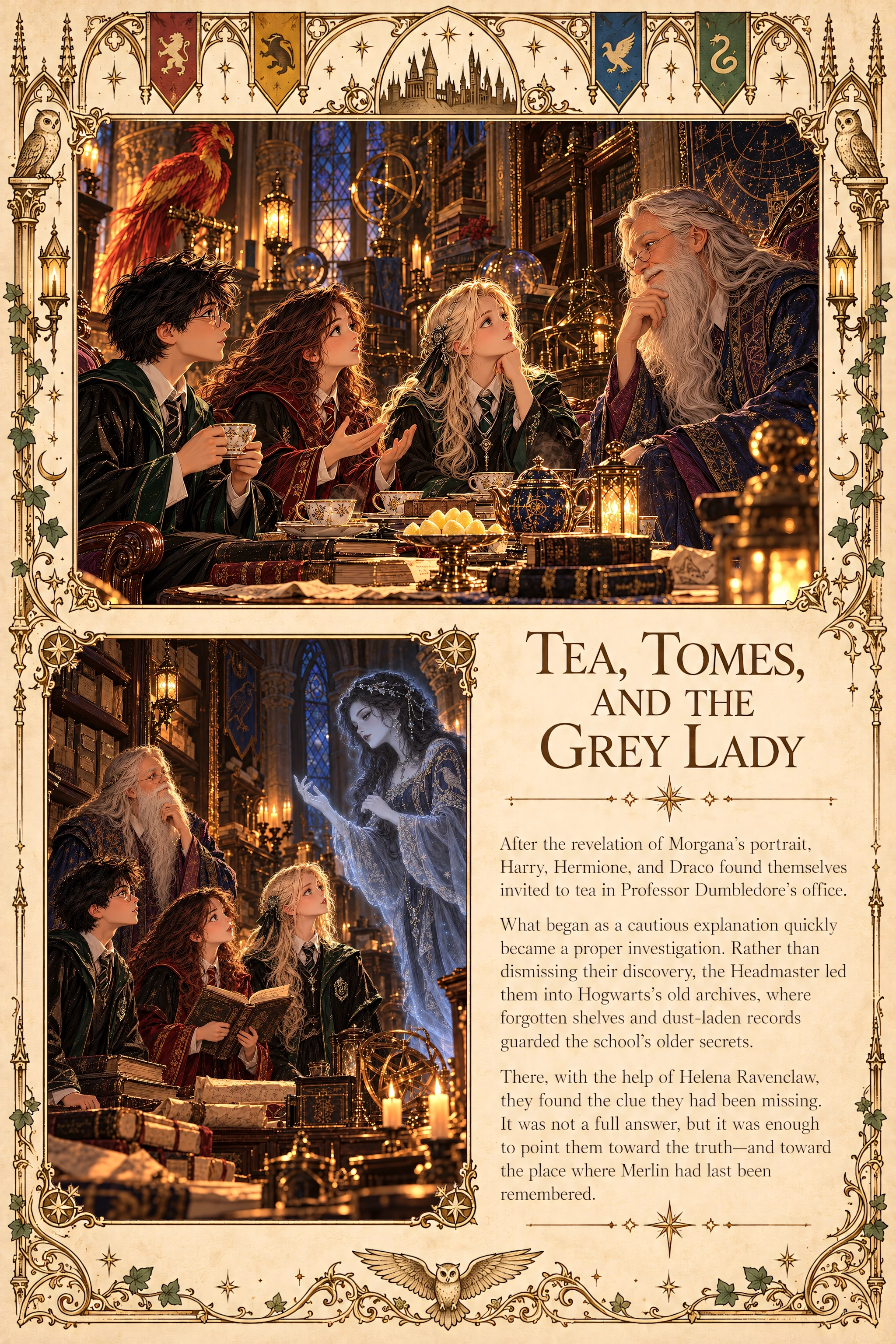
Professor Dumbledore's office was exactly as Draco remembered it.
A large circular room filled with curious instruments, shelves of books, and portraits of former headmasters. Strange silver devices emitted soft noises from their tables, and a magnificent red-and-gold phoenix rested upon a perch near the window.
The air smelled faintly of parchment, polished wood, and something sweet.
Harry looked toward the phoenix immediately.
"Hello, Fawkes."
The bird gave a soft trill.
Dumbledore smiled. "Ah, Harry. I see Fawkes remembers you."
Harry approached the perch, looking delighted when the phoenix leaned toward him.
Hermione was attempting to examine several shelves at once without appearing impolite. Draco, meanwhile, was trying to determine whether the strange silver instrument beside Dumbledore's desk served any practical purpose or merely existed to confuse visitors.
It emitted a small puff of violet smoke. She decided not to touch it.
"Welcome, welcome," Dumbledore said warmly. "Miss Granger, Miss Malfoy, Harry. Please, make yourselves comfortable."
He gestured toward three chairs arranged before his desk.
"Tea?"
Hermione nodded. "Yes, please, Professor."
Harry smiled. "Thanks."
Draco inclined her head. "That would be lovely."
Dumbledore waved his wand. A teapot rose from a nearby table, followed by four cups and a plate of biscuits.
Draco watched the arrangement with faint amusement.
Of course.
The man really did spend his afternoons drinking tea. Apparently, her earlier suspicions had not been entirely unfounded.
Dumbledore settled behind his desk. "Now then. Professor McGonagall informs me that you have made some rather unusual discoveries concerning our school's history."
Hermione practically lit up. "Yes, Professor!"
"Excellent. I confess I have always found history considerably more interesting when someone discovers that the accepted version is wrong."
Draco raised an eyebrow. "Then you must find the Arthurian legends fascinating."
Dumbledore's eyes twinkled. "Oh?"
Hermione explained. She began with Merlin's contradictory historical dates, moved on to the discovery of Morgana's portrait, and eventually described Arthur's original manuscript.
Dumbledore listened with obvious interest. When Hermione mentioned that Morgana had been married to Merlin, his eyebrows rose.
"Is that so?"
"Apparently," Draco replied, "the historical accounts have been concealing a rather important domestic arrangement."
Harry grinned.
Hermione continued. "And King Arthur wasn't actually a king!"
Dumbledore blinked. "Good heavens."
"He wrote a fictional account of himself as a great ruler," Hermione explained. "And somehow people began treating it as history!"
"How extraordinary."
Draco smiled faintly. "Imagine Professor Lockhart's books being mistaken for authentic history a thousand years from now."
Harry laughed. Hermione gave her a warning look.
Dumbledore, however, chuckled. "An interesting comparison, Miss Malfoy."
"I'm glad you think so, Professor."
"Although I suspect Professor Lockhart would be delighted by the prospect."
"That," Draco replied, "is precisely what worries me."
Dumbledore laughed again.
Hermione sighed. "Professor Lockhart has done some very impressive things!"
Harry looked at Draco. Draco looked back. Neither spoke.
Their expressions were apparently sufficient.
Hermione groaned. "Honestly!"
Dumbledore smiled into his tea.
For a while, the conversation remained pleasantly academic. Hermione presented her notes, including the archive reference for Arthur's manuscript and the inconsistencies she had discovered in other historical sources. Dumbledore examined several passages with genuine curiosity.
Draco found that reassuring. Whatever her reservations about the man, he clearly possessed an enormous interest in magical history.
He asked thoughtful questions, listened carefully to their answers, and occasionally contributed details concerning ancient enchantments that neither Hermione nor Draco had encountered before.
Then Hermione reached the subject of Merlin's missing portrait. Dumbledore's expression became more serious.
"Five hundred and twenty-three years, you say?"
"Yes, Professor," Hermione replied. "Lady Morgana told us his portrait disappeared in 1469."
"And she has not seen him since?"
"No."
Dumbledore folded his hands. "That is most unfortunate."
Harry leaned forward. "She seems really upset about it, Professor. Even after all this time."
Dumbledore nodded. "I can imagine."
Draco watched him carefully. "She also believes the portrait may have been deliberately hidden."
"Indeed?"
"Several older portraits have refused to discuss its disappearance," Hermione explained. "And the records we've found don't mention where it went."
Dumbledore considered the information. "That is curious."
Draco sipped her tea. She wanted to ask about the diary. The opportunity was right there.
Dumbledore was knowledgeable, approachable, and apparently in an excellent mood. Surely she could introduce the subject without revealing too much.
Perhaps ask whether an enchanted book might be capable of influencing a person's emotions. Or whether certain objects could preserve personalities in a manner similar to magical portraits.
She glanced toward the headmaster. Then hesitated.
What if he asked where she had found such an object? What if he recognized the diary? What if he realized Lucius was involved?
Her stomach tightened.
She still wanted to prevent her father's ruin. That desire had not disappeared merely because she understood how dangerous his actions could be.
And yet...
She thought of Ginny. Of a little girl unknowingly carrying something that might have harmed her. Of the strange, persuasive voice waiting inside the pages.
Draco lowered her cup.
I should tell him.
The thought was clear. Sensible. Almost unavoidable.
Then Dumbledore spoke.
"Miss Malfoy?"
She blinked. "Yes, Professor?"
"You seem troubled."
Harry glanced toward her. Hermione's expression softened. Draco became acutely aware of both.
"Not particularly," she replied.
Dumbledore regarded her kindly. "One need not solve every difficulty alone, you know."
For a moment, Draco could not answer.
There was something disconcerting about the statement. Not because it was unkind. Quite the opposite.
She had spent years believing that asking for help represented weakness. In her previous life, that belief had cost her dearly.
Yet old habits were difficult to abandon.
"I shall remember that, Professor," she said eventually.
Dumbledore nodded. He did not press her.
Draco was grateful. And, perhaps, a little disappointed.
She returned her attention to the conversation.
Hermione had opened another notebook. "We were hoping to examine the old records concerning Hogwarts' portraits. There must have been some documentation when Merlin's painting was moved."
Dumbledore considered that. "Possibly."
Hermione brightened. "Then we may?"
"I see no reason why not."
Harry grinned. Draco looked surprised.
"Really, Professor?"
"Certainly. History belongs to those willing to examine it, Miss Malfoy. It would be rather unfortunate if Hogwarts discouraged students from investigating its own past."
Hermione looked delighted. "Thank you!"
Dumbledore raised one finger. "However, there is something you should understand."
The three students grew attentive.
"Five hundred years is a considerable span of time. Records are lost. Archives are reorganized. Entire wings of castles fall out of use."
He glanced toward the portraits of former headmasters.
"And sometimes, unfortunately, individuals deliberately ensure that certain matters are not recorded at all."
Draco frowned. "You believe someone may have concealed the portrait intentionally?"
"I cannot say."
Dumbledore's expression remained thoughtful.
"But if an individual wished to hide something, leaving behind a convenient written explanation of where it had been concealed would rather defeat the purpose."
Harry sighed. "So the records might not help."
"That is possible."
Hermione looked determined. "But they're still worth checking."
Dumbledore smiled. "Precisely."
He rose from his chair.
"Come along, then. I believe I know where we might begin."
⁂
The older archives occupied a series of chambers adjoining a narrow passage behind the headmaster's office.
Draco had not expected them to be so extensive. Shelves lined the walls from floor to ceiling, filled with ledgers, scrolls, bound volumes, and boxes containing documents whose labels had long since faded.
The air smelled of old parchment and dust. Hermione looked as though she had discovered paradise.
Harry looked considerably less enthusiastic.
"How many books are in here?"
Dumbledore smiled. "I am afraid I have never counted."
Draco examined the nearest shelf. "Hermione is about to correct that oversight."
Harry laughed. Hermione ignored them.
Dumbledore approached a large cabinet and opened it with a wave of his wand. Several volumes floated out and arranged themselves upon a nearby table.
"These contain records concerning the castle's older furnishings, including enchanted portraits."
Hermione leaned forward eagerly. "Are they organized chronologically?"
"Approximately."
Draco raised an eyebrow. "Approximately?"
Dumbledore chuckled. "Historical recordkeeping was not always as systematic as one might hope."
Hermione looked pained.
Draco smiled. "That seems to be a recurring problem."
For the next hour, the three students examined the records under Dumbledore's supervision.
They found inventories. Maintenance reports. Requests for portraits to be cleaned, repaired, moved, or temporarily stored.
One particularly elaborate record concerned a painting that had apparently spent twenty years insulting every student who passed beneath it. The headmaster at the time had finally ordered the portrait relocated to a less frequently used corridor.
Harry found that amusing. Draco considered it an entirely reasonable administrative decision.
Hermione continued searching. Eventually, they reached the records dating from the fifteenth century.
Her excitement returned.
"Here!"
Draco leaned closer.
The entries were written in cramped handwriting, their ink faded but still legible. Several concerned renovations. Others described changes to the castle's protective enchantments. A few listed portraits that had been moved from their original locations.
Hermione scanned the pages.
"1467... 1468..."
She turned another page.
"1469."
Harry leaned over her shoulder. "Anything?"
Hermione frowned. "There's an entry concerning the western gallery."
Draco moved closer. The record mentioned the reorganization of several paintings and the removal of older furnishings.
But there was no reference to Merlin.
Hermione checked the next page. Then the next.
Nothing.
"That's strange."
Dumbledore approached. "What is?"
"Merlin's portrait isn't listed."
He examined the ledger. "Perhaps it was moved separately."
Draco frowned. "Or the relevant entry was deliberately omitted."
Dumbledore nodded slowly. "Indeed."
Hermione searched several more records. There were references to the storage of damaged paintings, the construction of additional chambers beneath the castle, and the sealing of certain passages that were no longer required.
But nothing connected those activities to Merlin.
No order. No signature. No location.
After another half hour, Hermione sat back with a frustrated sigh.
"Nothing."
Harry rubbed his eyes. "Maybe we should ask Morgana whether she remembers anything else."
"She already told us everything she knows," Draco replied.
Hermione looked down at the ledger. "Someone must have known."
"Certainly," Dumbledore said.
"But nobody wrote it down."
"Not necessarily. The relevant document may simply have been lost."
Draco looked toward the surrounding shelves. "Or destroyed."
Dumbledore regarded her thoughtfully. "That is another possibility."
Hermione closed the ledger. For a moment, nobody spoke.
Then a cold breeze passed through the chamber.
Harry shivered. Draco looked up.
The air near the doorway had begun to shimmer. A translucent figure emerged through the wall.
A young woman in a long, old-fashioned gown floated into the archive, her pale hair falling over her shoulders. Her expression was distant and somewhat sorrowful.
Harry recognized her immediately.
"The Grey Lady!"
The ghost turned. Her eyes moved over the students, then settled upon Dumbledore.
"Headmaster."
Dumbledore inclined his head. "Lady Ravenclaw. How pleasant to see you."
Hermione straightened. "Lady Ravenclaw?"
Draco looked between them.
Of course. The Grey Lady. The ghost of Ravenclaw House.
She had heard of the spirit but had rarely encountered her personally.
Hermione, meanwhile, appeared to have remembered something important.
"Wait. You're Helena Ravenclaw, aren't you?"
The ghost regarded her. "Yes."
Hermione stared. "Rowena Ravenclaw's daughter?"
"Indeed."
Draco raised an eyebrow.
Well.
Apparently, the day had become even more historically significant.
Helena's gaze moved toward the open ledger. Then toward the older records scattered across the table.
"What are you searching for?"
Hermione answered immediately. "Merlin's portrait."
The temperature in the room seemed to drop.
Helena went still. Dumbledore noticed. Draco noticed. Harry looked between them.
"Do you know something about it?" he asked.
Helena did not answer immediately. Instead, she drifted closer to the table. Her expression was difficult to read.
"Why are you looking for Merlin?"
Hermione hesitated. "Because Lady Morgana hasn't seen him in more than five hundred years."
Helena's eyes widened slightly.
"Morgana?"
"Yes."
The ghost looked away. For several moments, she seemed lost in thought.
Then she spoke.
"She is still waiting?"
Draco frowned. "Of course she is."
Helena's expression changed. Something resembling regret passed across her face.
"I see."
Hermione stepped forward. "Do you know where his portrait is?"
Helena remained silent.
Dumbledore studied her carefully. "Lady Ravenclaw, if you possess information concerning Merlin's disappearance, I would be most grateful if you shared it."
The ghost looked toward him. Then toward the students.
Finally, she sighed.
"Yes."
Hermione froze. "Yes?"
"I know where it is."
Harry stared. Draco slowly straightened. Dumbledore's expression sharpened.
For several seconds, nobody said anything.
Then Hermione exclaimed:
"You KNOW?!"
Helena winced. "Must you shout?"
"Sorry! But we've been looking for weeks!"
"I gathered."
Draco stepped closer. "Then why hasn't anyone told Morgana?"
Helena looked uncomfortable. "Because we were instructed not to."
Dumbledore's expression became very serious. "Instructed?"
"Yes."
"By whom?"
Helena hesitated. Then shook her head.
"I will not tell you that."
Hermione stared. "But why?"
"Because I gave my word."
Draco frowned. "A promise made five hundred years ago?"
"Yes."
"To someone who is almost certainly dead?"
Helena's expression tightened. "The passage of time does not automatically erase an oath, Miss Malfoy."
Draco blinked. "You know my name?"
"I am a ghost. We hear more than you might expect."
Dumbledore folded his hands. "Lady Ravenclaw, I respect your reluctance to break a promise. However, it would appear that this particular promise has caused considerable suffering."
Helena looked down. "I know."
Hermione softened. "Lady Morgana has spent centuries wondering what happened to her husband."
The ghost closed her eyes. "Yes."
"Then surely—"
"You misunderstand."
Helena opened her eyes again.
"I am willing to tell you where the portrait was taken."
Hermione stopped. "You are?"
"Yes."
Draco stared. "Then why didn't you tell anyone sooner?"
Helena regarded her. For a moment, the ghost looked almost offended.
Then she gave a small, helpless sigh.
"Because nobody asked me."
Silence.
Harry blinked. Hermione stared. Draco slowly closed her eyes.
"Of course."
Helena continued. "The man responsible ordered those who knew of the portrait's removal to remain silent. At the time, there were reasons people obeyed him."
Dumbledore's expression remained carefully neutral. "Political reasons?"
"Among others."
Helena looked toward the older records.
"Years passed. Then decades. Then centuries. Those who remembered grew fewer, and those who remained had little reason to discuss something that nobody seemed interested in finding."
Draco considered that. She supposed it was possible. After all, she herself struggled to remember certain details from a life she had lived barely a decade earlier.
Five hundred years was a rather different matter.
Still.
"Did it never occur to you that Morgana might want to know?"
Helena lowered her eyes. "I thought she would have found him long ago."
The answer surprised Draco.
"What?"
"Merlin was not an ordinary wizard. Neither was Morgana. I believed that if anyone could overcome whatever enchantments had been placed upon his portrait, it would be one of them."
Her expression became sad.
"But Merlin never returned. And Morgana stopped asking questions where I could hear them."
Hermione frowned. "She told us she tried for centuries."
"I do not doubt it."
Helena looked toward the ceiling.
"Hogwarts is a very large castle, Miss Granger. Even ghosts do not visit every corridor every day."
Harry nodded slowly. "Fair enough."
Draco glanced at him.
He shrugged. "What? It's true."
Helena's expression softened slightly.
"And after a time, the matter became something I remembered only occasionally. A passing thought. An old sorrow among many others."
She paused.
"Until I heard your voices discussing the records."
Hermione looked toward the open ledger. "Then you've remembered now?"
"Yes."
"And you're willing to help?"
"Yes."
Draco crossed her arms. "But not to tell us who ordered Merlin's portrait hidden."
Helena met her gaze.
"No."
There was something final in the answer.
Draco considered pressing the matter. Then decided against it.
They had spent weeks searching for the portrait. They were finally speaking to someone who knew where it was.
The identity of the person responsible could wait.
"Very well," she said. "Where is it?"
Helena turned toward Dumbledore.
"Do you remember the old storage passages beneath the western foundations?"
Dumbledore frowned thoughtfully. "Some of them."
"Not the newer cellars. The original passages, built before the castle was expanded."
"Those have been sealed for centuries."
"Not all of them."
Dumbledore grew still.
Helena continued.
"There is an old stairway beneath what was once the western service corridor. It was concealed when that section of the castle was renovated. At the bottom is a passage leading toward several abandoned chambers."
Hermione was writing furiously. "How do we find the stairway?"
Helena turned toward her.
"Beyond the old storage room beneath the western gallery. There is a narrow alcove where the stonework appears to end."
Dumbledore nodded slowly. "I believe I know the place."
"The passage is concealed behind a section of wall marked with three small stars. They are difficult to see beneath the dust."
Draco leaned forward. "And the portrait?"
"In a chamber at the far end."
Harry frowned. "Just hanging on the wall?"
Helena hesitated. "As far as I know."
Draco exchanged a glance with Hermione.
That sounded suspiciously simple. Far too simple for a portrait that had remained hidden for more than five hundred years.
"Is the chamber protected?" Draco asked.
Helena looked at her. "Yes."
"What kind of protections?"
"Silencing enchantments. Wards intended to prevent the portrait's occupant from leaving. Several other spells whose purposes I never fully understood."
Hermione stared. "They trapped him?"
Helena's expression became sorrowful.
"Yes."
Dumbledore's face hardened. The change was subtle, but Draco noticed it immediately.
The warmth that had characterized their afternoon conversation was still present. But beneath it lay something considerably less pleasant.
"Someone deliberately imprisoned Merlin's portrait," the headmaster said quietly.
Helena nodded. "That is correct."
Harry looked horrified. "But why?"
"I cannot answer that."
Draco frowned. "Cannot or will not?"
Helena met her gaze. "Both."
There was another silence.
Hermione lowered her quill. "Lady Morgana doesn't know any of this."
"No."
"And Merlin has been trapped down there since 1469?"
"Yes."
Harry stared at the floor. "Five hundred and twenty-three years."
Draco looked toward Dumbledore.
"Professor, we have to find him."
Dumbledore nodded slowly. "Indeed, Miss Malfoy."
Hermione straightened. "Then can we go now?"
"Not immediately."
Hermione's face fell. "But—"
"Miss Granger, we are discussing a chamber that has been sealed for more than five centuries and protected by enchantments whose nature remains uncertain."
Dumbledore's voice was gentle but firm.
"Entering without preparation would be unwise."
Draco reluctantly agreed. She knew enough about old magic to understand the dangers involved.
Particularly when the person who designed the wards had apparently been capable of imprisoning Merlin himself. That was not the sort of achievement one accomplished with a simple Locking Charm.
"We'll need to examine the protections," she said.
Dumbledore nodded. "Precisely."
Harry looked between them. "So what happens now?"
Dumbledore considered the question. Then he smiled faintly.
"Now, Harry, I believe we have a rather important appointment with a very old portrait."
Hermione looked delighted. Draco felt a strange mixture of excitement and apprehension.
They had found him. Or at least, they finally knew where to look.
Somewhere beneath Hogwarts, behind centuries-old enchantments, Merlin's portrait had been waiting for someone to discover it.
And Morgana had spent five hundred and twenty-three years believing her husband was lost.
Draco glanced toward Helena Ravenclaw.
"One more question."
The ghost turned. "Yes?"
"Does Morgana know you knew?"
Helena looked away. "No."
Draco sighed. "Oh, dear."
Harry frowned. "What?"
Draco considered the likely reaction of a famously powerful sorceress discovering that someone had known her husband's location for centuries without mentioning it.
Then she looked toward Dumbledore.
"Professor, I believe we should probably find Merlin before informing Morgana about this particular detail."
Dumbledore raised an eyebrow. "An interesting suggestion, Miss Malfoy."
"Purely for everyone's safety."
Harry stared at her. Then understanding dawned.
"Oh."
Hermione blinked. "What?"
Draco smiled thinly. "Hermione, dear, you remember what Morgana said about turning people into frogs?"
Hermione went pale. Helena looked suddenly alarmed.
Dumbledore, however, began to chuckle.
"Ah," he said pleasantly. "Yes. Perhaps a little discretion would be advisable."
Draco looked toward the ancient stone walls. Somewhere beyond them lay the answer to a mystery that had lasted more than five centuries.
And, if she knew anything about the temperaments of powerful witches and wizards, the beginning of an entirely new set of problems.
Still. She smiled.
For once, she was rather looking forward to those problems.
End of Chapter 2.