
Chapter Text
With everything Wood Man had seen and heard, he suspected the homelessness crisis among the nisse population had something to do with Jellybean. If he'd had his wits about him at the time, he would have inquired for more detail when he met the odd pair, but as it stands he has only his suspicions. Too big for a house, Tontu had said, a mere statement of fact which nevertheless made Wood Man wonder if Tontu had already tried it.
Blithely bringing a barghest home. Sounds like something Hilda would do.
In that bond, Wood Man sees something of himself: wholly wild, yet incurably domestic. He'd call it a balancing act if only it didn't come so naturally, the only potential pitfall his personal feelings on the matter. And he's mostly made peace with those, so there's little danger in him having a breakdown just for inhabiting the liminal.
Still, he's curious how the unhoused nisse and Jellybean tie together. Ordinarily he never has cause to wonder about the affairs of spirits; as beings attuned to the ebb and flow of nature, most do not have the luxury of keeping secrets from a nature spirit like Wood Man. He feels the changing of the seasons innately, can sense the migratory patterns of birds and fish like a river's flow against the skin. He can't always see the whole picture, he's not omniscient— just more thoroughly and differently attuned to his surroundings than others.
His preternatural insight may not even be anything more remarkable than centuries of observational experience, accumulated enough to offer something like familiarity. He'd seen countless springs, summers, autumns and winters. After a while, that kind of knowledge seeps into you, and it becomes second nature to know when creatures mate, migrate and hibernate. His domestic insight is more immediately recognizable as a kind of magic, if only because it's something he hasn't always had.
Novelty, in general, disrupts his ease of insight: novel relationships, novel feelings. If several months ago someone had told him his relationship with the bell keeper would become what it had, he would have lightly but pointedly praised their fanciful imagination.
So the mystery of Jellybean and Tontu is one he is ill-equipped to solve, given his lack of experience in that quarter. They shouldn't have ever even met— a mountain spirit and a house spirit!—and yet there they were, and off they went, leaving tens of dozens of unhoused nisse in their wake, no doubt.
If that's what the fallout of unconventional relationships usually looks like, then Wood Man supposes he and the bell keeper are fortunate in their reclusive natures. The most dramatic negative consequence of their acquaintanceship so far has been a few badly-brewed pots of tea.
But, Wood Man supposes, he sympathizes with the nisse. Whether his own growth is a symptom of a larger paradigm shift in the spirit world, or simply coincidence, he has recently undergone a similar upheaval. Unbeknownst to him, Hilda's house had become a load-bearing fixture within Wood Man's sense of self, and its destruction had wrenched him open, sent him stumbling headlong into a world of uncertainty. With the help of the bell keeper, and the analgesic of time, he'd come out of it mostly intact.
But what will the nisse do? Stake pointless claims on cold, filthy alleyways? Turn feral and tear each other to ribbons? Freeze to death when winter rolls in any day now?
Or will they starve before they even see the turning of the season?
Granted, nisse are spirits, and at poker nights Tontu happily drinks Wood Man's twigs and soily water, so despite being mammalian where Wood Man is arboreal they may not actually require food, like other creatures do.
But in the same way Wood Man is nourished by good company, a calm atmosphere, a warm fire and pleasant music, he suspects a spirit in dire straits which requires such things might just starve without them.
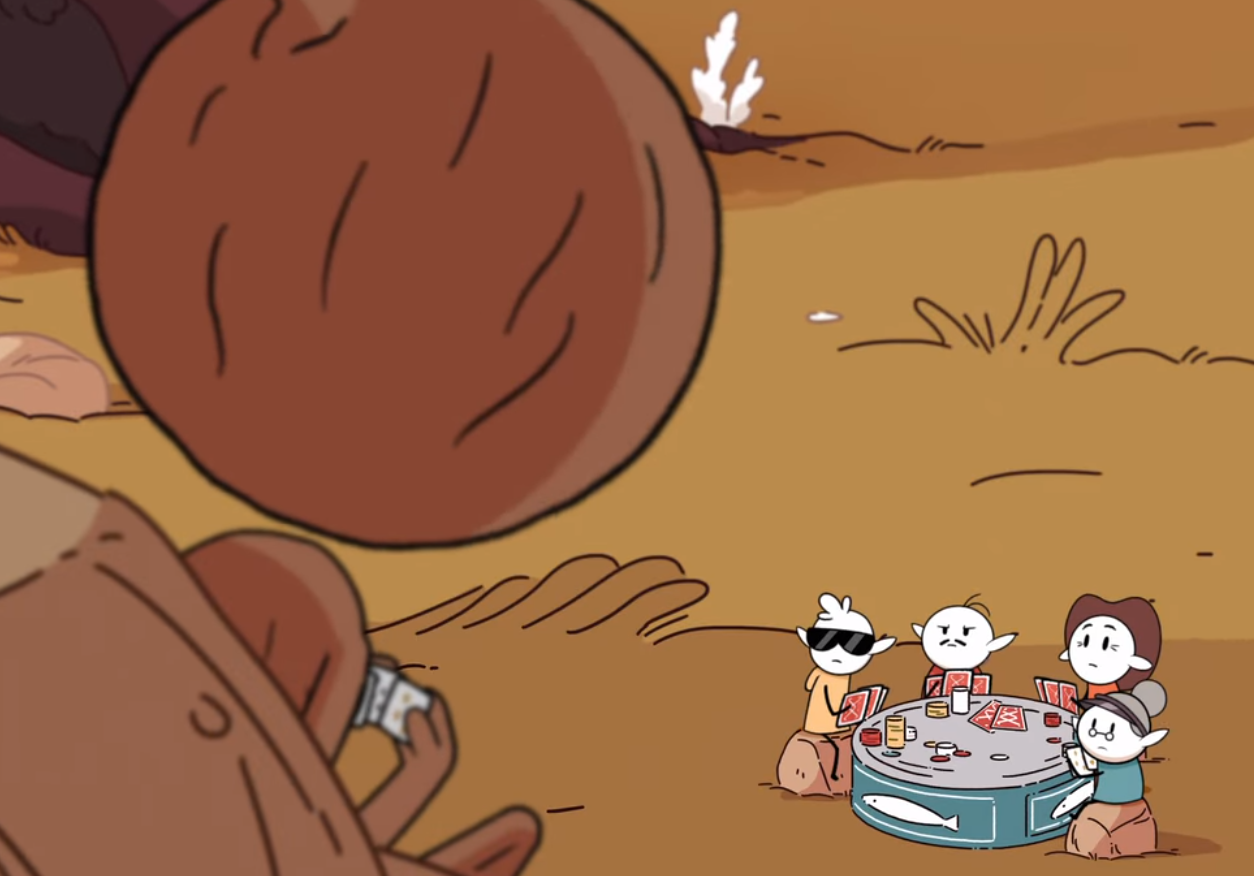
Which is why he engages Tontu on the subject at their next poker night. He even temporarily lifts his stricture against note-taking—the more eyes and minds on this problem, the better, and he can appreciate the elves' academic rigor in this context, if not others.
"I couldn't possibly enter someone's home uninvited," Tontu bashfully demurs.
"Why not?" Wood Man presses.
Tontu shrugs. "Wouldn't be right."
"But it's alright for them to evict you for no reason?"
"Yeah!" Vargur adds with emphatic injustice, as Barch chimes in with outraged solidarity, "Where's the due process in that?"
Edel adds reasonably, "I'll bet you lived there longer than the humans did."
Tontu scratches his nose, embarrassed by their support. "Be that as it may... I'm not sure I could do it."
"What," Wood Man asks, "show up uninvited?"
Tontu huffs with rueful laughter. "That's the one."
"Tontu," Wood Man begins, and Tontu perks up. It's not often Wood Man addresses anyone by name, and the quiet attentiveness Tontu reserves for Wood Man's woodsmoke speech is even more rapt when he makes use of Tontu's. An effective persuasive tool, to be used sparingly—no matter how heady Tontu's undivided attention makes him feel. "The unwritten contract between a nisse and a home-owner has behavioral stipulations for both parties." The elves coo at Wood Man's phrasing, taking hurried notes to preserve this observation for posterity. He is proud of that one, but he resists the urge to get distracted preening. He presses on. "They're supposed to give you offerings, right?"
"Well, not necessarily..."
"But when was the last time that happened?"
Tontu's silence is answer enough. He doesn't remember—or if he does, then it's been so long that giving voice to the actual figure won't serve Tontu's defense of his former humans.
Barch taps his chin with the chewed end of his pencil. "If a nisse's protection of the household is contingent on the receipt of offerings, and the homeowners have been negligent for a long time..."
Grateful for the volley, Wood Man rallies behind the point with a decisive nod and a permissive shrug. "Then surely you're entitled to a little acting out?"
Tontu stiffens. "But I didn't—"
"But that's what your human thinks, isn't it?" Wood Man interrupts. "Sure, they're wrong. But they'd have still been wrong to turn you out, even if they were right."
Tontu's tail flicks like an anxious cat's. "Maybe," he concedes, but the realization that he was wronged doesn't seem to stoke any rebellious self-advocacy in his chest. It just makes him sad.
Wood Man falters. "Tontu," he says again, gentler this time, relieved when he wins back the forlorn nisse's attention. "I'm just saying, humans neglecting offerings, evicting nisse without cause... You don't have to follow the rules if everyone else is breaking them."
The elves look deeply uncomfortable with this pronouncement, but wisely leave their objections unvoiced.
In a rare moment of forthcoming, Tova volunteers, "... Most humans don't take any notice of elves or nisse, anyway. So if you did take up residence without their knowledge, I say, what's the harm?" The other elves gape at Tova, who awkwardly shrugs. "They're no better or worse off than when you left them. So, what's the harm?" they insist, and the group wordlessly concedes the point at the sharp edge of Tova's rhetorical demand.
"I suppose you're right," Tontu says, sounding a little more heartened. "I could just... go back."
"That's the spirit," Wood Man says, patting Tontu's arm in warm consolation. "If you do, let us know how it goes."
Tontu doesn't show up to poker night the following week, leading unavoidably to open speculation as to his whereabouts. Maybe he went home after all, Edel supposes, and wouldn't that be nice for him? Barch laments his eternal search for more players, dutiful as ever, but after a little coaxing agrees that he hopes everything worked out with Tontu. All cozy inside as winter approaches.
Poker nights have been held at Wood Man's more often of late, and he finds he cannot take any comfort in fancifully imagining Tontu is better off elsewhere. The least he could do was let them know, Wood Man thinks, quaffing the tea he'd set out for Tontu with something like vindictive hurt festering in his core.
"I'll miss the guy," Vargur wistfully admits.
Wood Man sighs, shoulders sagging. "Me too."
Wood Man has been experimenting with food lately. Like a child making potions in the backyard, it is tempting to add inedible things, like rocks and raw acorns. He doubts he'll have produced anything suitable for polite company by the time evening arrives and the elves come round for poker, but he considers his progress passable, for someone who has never been formally taught how to cook.
A knock at the door. Wood Man side-eyes it like he suspects it of lying, and it's silent for so long that he's very nearly convinced, until another knock comes—softer, less insistent. Like the silence has worn away his visitor's resolve. Unease takes root in his chest, and he quickly turns off the stove to leave his dubious soup unattended.
Wood Man opens the door.
Tontu scuffs his foot disconsolately on the welcome mat.
Wood Man surges forward, gripping the nisse's sides and landing on his upper arms through the curtain of his hay bale hair. "Tontu," he says, sighing as relief unfurls in his chest. "What happened?"
Tontu stiffens, then relaxes slightly in Wood Man's hold. "It's all gone."
The words don't mean anything to Wood Man yet, but Tontu's tone is so bereft that comprehension comes second to care. "Alright, hold that thought. Why don't you come inside?" Wood Man insists, ushering Tontu across the threshold and into the dining room.
The door closes behind them without needing to be told.
He seats Tontu at the kitchen island beside his fruit bowl full of logs, pulling up a stool to sit beside the nisse radiating such abject misery. "What's all gone?" Wood Man asks.
Tonto shakes his head. "Everything," he murmurs. "Back at my old house."
Wood Man taps the countertop of the kitchen island. "You mean to say the humans moved away?"
Tontu shakes his head. "My nest," he says, voice brittle like Wood Man has never heard it before. "Over the years, nisse accumulate all kinds of forgotten things. Clothes, blankets, the odd sofa abandoned under piles of boxes..."
Wood Man nods, encouraging Tontu to continue until he understands.
"All that stuff ends up in Nowhere Space. What I hadn't realized was that the night I was kicked out, everything in my nest had been up-ended and strewn about the living room. So when I went back..."
Wood Man tries to imagine what that must have looked like: the contents of a whole extra room, dumped unceremoniously on the floor in the middle of the night. The way the mess must have looked to a human in the unforgiving morning light. "They must have junked it," Wood Man realizes. They certainly would have had no use for it.
Tontu sniffles. "Yeah."
Wood Man pats Tontu's arm, eliciting quiet thanks.
After a moment Tontu looks up, attention drawn from his inner turmoil. Wood Man straightens and follows his gaze to the stove, where his questionable pot of mostly-comestibles has just ceased burbling after being brought off the boil. "Are you... cooking?" Tontu timidly asks.
Wood Man gives the stove a sidelong glance, embarrassed by his maiden effort. "That's one word for it," he says wryly. "I'd offer you some, but uh. There's rocks in it."
"What kind of rocks?" Tontu asks with interest.
Feeling foolish, Wood Man admits, "There's a waterfall in the valley, about a mile away. I took them from the river."
Tontu's tail wags, and he turns to Wood Man, amused. "River rock soup, eh?"
Wood Man feels like the fireplace has made a home in his head. He buries his face in his hands. "Don't say that like it's a real recipe," he grumbles. "It's not anything. Stop it." But Tontu persists in radiating interest.
"I want to try," Tontu insists.
Wood Man lifts his head to stare at the nisse. "What."
"Please?" Tontu purrs, tail curling in coy affectation as he beams like golden sunlight off fields of wheat.
Wood Man hops from his stool, requiring no further incentive than that—though he grumbles all the way to the stove.
"There," Wood Man huffs as he sets two bowls between them, seating himself across from Tontu. It's only the knowledge that Tontu just lost everything he's ever known that stops Wood Man from throttling the nisse for laughing. "What's so funny?"
Tontu swipes a finger across his face like he's wiping away tears of laughter, though it's impossible to tell through all that hair. "It's been a long time since I last saw your hospitality offered so grudgingly, Wood Man," Tontu giggles, pulling his bowl closer to his chest, possessive. Covetous for Wood Man's unexpected insecurities. "It's making me a little nostalgic."
Wood Man wipes a hand down his face and sighs. It's not Tontu's fault no one ever taught Wood Man how to make soup, or that an embarrassingly large part of him still insists on making it with rocks, sticks and leaves. Cooking is part intuition, and it's not Wood Man's fault that adding inedible bits of nature comes as naturally as breathing. He just can't help himself.
"Hospitality is a skill," Wood Man eventually lands on as an explanation for his inexplicable discomfort. "One that requires practice. But I'm not exactly practiced at... this, yet."
"Oh, I don't mind you being a poor sport," Tontu teases, making Wood Man bristle like an evergreen. "Arguing with you always cheers me up."
Wood Man's head swarms, indignation and consolation competing irreconcilably. "Eat your river rock soup," he grumbles. He spoons some of his into his mouth and thinks, It's not terrible. But he's well aware that with him there's no accounting for taste.
"What's in it?" Tontu asks, taking a moment to admire the polished wooden spoon Wood Man placed before him. Having carved it himself, Wood Man finds his pride somewhat soothed by this open admiration.
"Potatoes," Wood Man says gruffly. "Carrots. Greens."
"Can't go wrong there," Tontu concedes, nudging the identifiable chunks of vegetable with his spoon.
"Acorns. River rocks."
There is muffled laughter in Tontu's voice when he says, "Admittedly unconventional."
"Yeah," Wood Man sighs. He singles out a potato chunk and tips it into his mouth with a spoonful of broth.
"Anything else?"
"Water...?" Wood Man cautiously offers, unsure what Tontu is fishing for.
"No seasoning?" Tontu asks, though in his mouth it sounds more like fascination than censure.
Wood Man thinks of the way he treats his tea, sometimes so sweet even the bell keeper can't stomach it. "I can't be trusted with the contents of a spice rack."
Tontu chuckles, stirring his soup contemplatively. "Not even a pinch of salt?"
Revulsion sweeps Wood Man in a wave. He taps his spoon with his index finger as he decides how best to phrase this. "I have," he says, "a salt intolerance."
Tontu straightens with interest. "Oh! Because you're a tree?"
"Yes," Wood Man says with infinite patience. "Because I'm a tree."
Tontu rests his chin in his hands. "I didn't expect that. You're a curious creature, Wood Man."
This coming from the homeless house spirit, but Wood Man graciously elects not to bring up Tontu's misfortune by returning the compliment. There's a line between harmless argument and needless cruelty.
"Eat your soup," Wood Man says again.
"Yes, mother."
Ridiculous, Wood Man thinks with a huff. Neither of them have mothers, he's fairly sure. Then again, the particulars of spiritual procreation are not universal. Just because Wood Man probably sprang fully formed from a seed and is several hundred years old doesn't mean Tontu is the same.
"Oh," Tontu sighs so dreamily at his first spoonful that Wood Man stares, suspecting the nisse of dramatizing his reaction to be an ass. Yet his tail sways revealingly, removing any doubt that the reaction is sincere. "You can really taste the river."
Wood Man snorts. "Stop," he says, sure that Tontu must be flattering him. Imagining things.
"I'm serious!" Tontu laughs, waving his spoon with such emphasis that a drop of broth flies, landing on the countertop. "You can't taste that?"
Perturbed that there may in fact be a metaphysical flavor profile he's completely overlooked, Wood Man examines his bowl. He carved these, too, and the wood grain of the bowl whorls like eddies of water beneath the translucent broth. The vegetables drift and bob in aimless leisure. It smells like hot water and earthy carbs. From the potatoes, probably. The carrots are a little sweet, but not especially so. He suspects he undercooked them. When he stirs the mixture with his spoon, the little stones and acorns clatter like buoys against boats.
He holds the bowl up to his mouth and slurps the broth—realizes, suddenly, that it does have a more complex taste than he thought. It tastes like the back garden, and the sunny afternoon on which he collected the acorns, and the rainwater he collects in buckets, and the crisp thrush of the river. Having been the one to source every ingredient, Wood Man had dismissed the initial rush of sense impressions as merely memories, distractions from the experience of taste alone.
"Ah," Wood Man sighs.
"There you are," says Tontu, glowing with satisfaction. "You ought to savor your hard work, Wood Man."
"I thought I was," he says. "I was trying not to let my mind wander."
"Nah, you've got to relax. Don't try so hard to hunt down the flavors." Unspoken is that there is not much flavor in the soup to begin with. But perhaps that only makes more room for the extrasensory experience. "Let them come to you."
That's probably for the best. Trying to focus on something often makes it harder to grasp, like a slippery fish wriggling from your hands and back into a rushing current. He's mostly been frustrated with his results in the kitchen—but why should he be? If river rock soup is good enough for him and Tontu, then his efforts aren't wasted. It's all part of the process.
And if he never gets to the point where he can cook something the bell keeper can eat, it's not the end of the world. They can share other things.
In the meantime, he can share this with Tontu.
Speaking of whom, the nisse has set his spoon aside in mimicry of Wood Man’s example, drinking his soup with a satisfied hum. "For some reason, it's more satisfying drinking straight from the bowl," he observes.
"Table etiquette is overrated," Wood Man agrees. "It's much more fun to challenge convention."
“That's what I like about you, Wood Man,” Tontu admits. “Who gives a fig about rules? Sod them all, I say.”
“I’ll drink to that,” says Wood Man, lifting his bowl.
They lift their bowls in tandem and drink in congenial silence.
A jarring, awful frisson passes through Wood Man at the sudden sound of rocks crunching. Slowly, he sets down his bowl.
“You did not,” he says, aghast.
“What?” says Tontu. “They’re good river rocks.”
Wood Man groans and has to step away, feeling like his teeth would be on edge if he had any. It's a viscerally unpleasant sound--as grating as nails on a chalkboard, or a rusty saw scraping through wood. Tontu takes pity on his host and agrees not to crunch any more rocks in his mouth, "Even though they're the best part." He holds one in his mouth like a mint instead as they retire to the living room, awaiting the arrival of the elves for poker night.
When his guests eventually depart, Wood Man gives Tontu the damn rocks in a cloth bag. The nisse is elated with this offering, and neither spirit offers an explanation to the baffled elves.
A few weeks later, the usual suspects are waiting in Wood Man’s living room for Tontu to arrive for poker night. And then he does—though not by the front door as they've grown accustomed. Instead, he emerges from the couch cushions suddenly, taking up his teacup with placid calm as the assembled spirits rear back in alarm.
"Sorry I'm late," says Tontu. "I was just wrapping up my knitting."
A long quiet lingers as Tontu slurps his tea.
"Tontu," Edel slowly ventures. "Do you and Wood Man live together, now?"
"No," snaps Wood Man, at the same moment Tontu says, "Yes."
Wood Man's head turns slowly, stiff as a brittle branch in a cold snap. "What," he hisses.
"I live here now," Tontu glibly announces.
Confused congratulations go up from the elves. Wood Man clenches his hands around his cup so he doesn't strangle the nisse. "This is the first I'm hearing of it," Wood Man grits out.
“Well, it’s like you all said, isn’t it?” Tontu says, sounding far too satisfied for Wood Man’s liking. “It’s not as if anyone’ll notice if a nisse takes up residence without asking.”
Wood Man is tempted to point out that a fellow spirit would obviously notice such an intrusion, and a human host had been the original context of that suggestion. But the trouble is, he hadn’t noticed. For all the arboreal sympathy Wood Man shares with his home, its Nowhere Space crannies are completely beyond his ken—and he likes it that way. If Wood Man has his druthers, he’ll never enter Nowhere Space, thus avoiding making himself any more like a nisse than he’s already become.
“A lot less awkward to just show up like you’ve always been there, you ask me,” Tontu is saying. “You were the biggest proponent of inviting oneself in unannounced, Wood Man.”
“You’re not supposed to do it to me,” Wood Man protests, setting his mug firmly down on the table. He recognizes he’s being a hypocrite, and he does not care in the slightest.
“Why not?” Tontu asks coyly, and Wood Man growls with frustration, making grabby hands for Tontu's throat. “Tell you what. Beat me at cards, best of three, and I’ll clear out.”
A measure of control over the situation is restored to Wood Man with this offer, and he finds his ire quelling to make way for mischief. “Fine,” he agrees. He picks up his mug and quaffs it, as if that seals the deal.
Tontu’s tail wags with satisfaction. “Very fine,” he agrees.
Wood Man does not win best of three—nor even best of five, after he unsportsmanly demands it of the nisse on an unprecedented winning streak. It occurs to Wood Man that Tontu never seemed especially competitive on prior poker nights, and he has to wonder if the spirit simply never had a strong stake in these games beyond the social element. In retrospect, a nisse has had far more experience watching humans play games of chance than a nature spirit like Wood Man, who has only recently arrived to recreational pastimes like poker in the grand scheme of his lifespan.
Perhaps he never stood a chance.
Wood Man stews in his seat as Tontu navigates the Nowhere Space of his home to hospitably replenish the tea. For their guests.
“Alright, Wood Man?” Barch hesitantly inquires.
“I don’t want to talk about it.” Tontu returns with tea for the assembled spirits, handing over a cup of twigs and soily water. Just how Wood Man likes it. “Thank you,” Wood Man fumes.
“Don’t mention it, roomie,” purrs Tontu.
“You had better sleep with one eye open.”
“You’d have to access Nowhere Space to get the jump on me,” the nisse points out. “Don’t think I haven’t noticed your aversion.”
He’s sure the nisse is already benefiting from a kind of passive domestic insight into Wood Man’s disposition, now that his re-homing is official. Wood Man burns with outrage and appall—and yet, given his habit of home-invading and thoughtless encouragement, Wood Man is quite sure he's reaping what he's sown.
“You’re unusually observant,” Wood Man begrudgingly concedes.
“Thank you,” Tontu says.
“It’s unnerving,” says Wood Man. “Now deal the next hand.”