
Work Text:
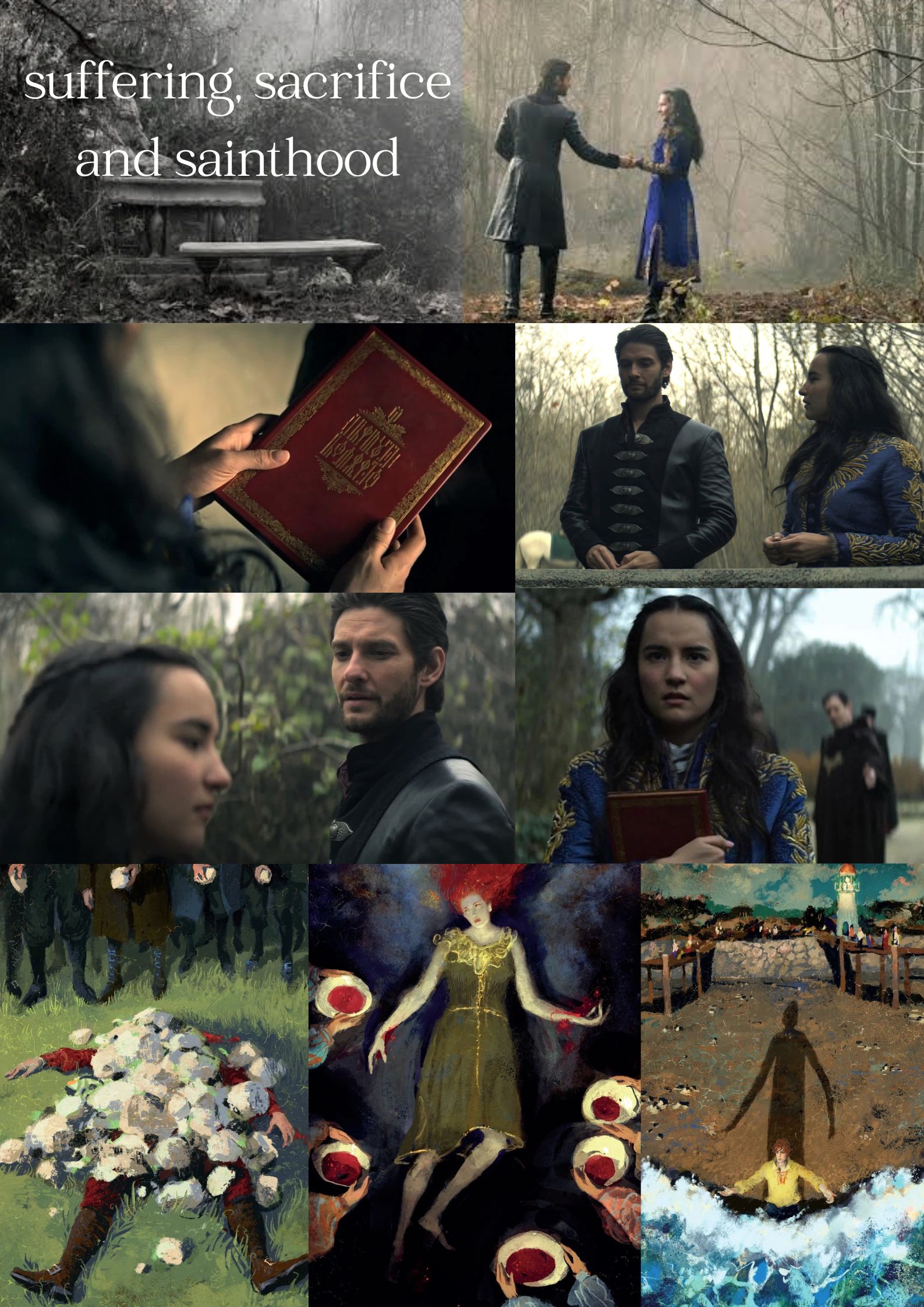
Mostly, the peasants hate the Grisha, but I think it is because the Grisha do not suffer. But you have suffered, haven't you? I think you will suffer more.
The Apparat’s words ring through Alina’s head as she hurries back towards the Little Palace.
He’d smiled, when he told her she would suffer more. Smiled like his words should bring her joy, as if she should be pleased at the thought.
She doesn’t like it, not at all.
Alina is so preoccupied that she doesn’t even notice Aleksander until she runs right into him.
She stumbles, saved from a proper fall by Aleksander’s arms around her waist. However, the Istorii Sankt'ya – the Apparat’s gift, which she has resolved to hide in a drawer and ignore for as long as possible – goes flying out of her hand and lands on the grass.
Aleksander steadies her and then picks up the book, frowning when he sees the cover. He looks over at her and takes in her slightly rattled demeanour, before looking back at the book.
His frown deepens even further.
“Has the Apparat been to see you?”
“How did you know?” she asks him.
“That man,” he spits out, dark eyes flashing furiously, “is obsessed with the saints. He wouldn’t normally dare enter the Little Palace grounds, especially with that book, but I’m afraid the Sun Summoner has always been a particular interest of his, and having you here now is making him uncommonly bold.”
“Istorii Sankt'ya,” Alina reads the title of the book he has picked up, “the lives of the saints. He said … he said peasants hate the Grisha because they haven’t suffered, but that I have suffered and … and I’ll suffer more.”
Aleksander clenches his fist so tightly around the book that his knuckles go white. All around them, the air seems to crackle with power and the shadows gather, darkening the area around them.
“We fight in the same wars as the First Army soldiers,” he says, almost to himself, “and die in them too. Despite what the ignorant think, keftas do not make the Second Army invulnerable, especially with the recent advances in warfare. And then there is the danger Grisha are in simply for existing. They might be taken by the Drüskelle to be burnt on a pyre, or to Shu Han to be experimented on, or to Kerch to be indentured, or to the Wandering Isle to be bled dry by those who think our blood is a miracle cure. Or they might die in Ravka, where they should be safest, by ignorant, jealous, fearful and covetous otkazat’sya.”
He speaks with an old bitterness, a man who has seen and lost far too much.
“I’ll give it back,” she says, “or maybe just send it to him through one of the servants.”
She’d rather not speak to the Apparat again if she doesn’t have to. He gives her the creeps, looks at her like he isn’t seeing her, only her power, only bones and blood that the devout would pay a fortune to own or worship in front of.
Alina wonders if the Apparat sees her at all, or only a future martyr bleeding out in the centre of the Fold to bring them a so-called miracle.
“No,” he shakes his head, offering her his hand, “I’ll deal with it. Let’s go for a walk, Alina. There are some things I want to tell you.”
Alina is supposed to be going to Baghra’s hut for a lesson, but she can’t deny that she’d much rather spend time with Aleksander than get yelled at and whacked with a cane because she’s struggling with accessing her light.
“What do you know of the saints?” he asks as they walk through the forest.
“We had books at the orphanage with the stories. And the priests spoke of them often when Ana Kuya took us to church. They weren’t very happy stories, though.”
She shivers as she remembers the priests in Keramzin, almost as obsessed with the idea of suffering and sacrifice as the Apparat seems to be.
“Every Grisha student at the Little Palace is taught of the saints, but they do not read Istorii Sankt'ya. It is a book full of misery, a distressing reminder that Grisha are seen by many a commodity to be used over and over until they have nothing left to give.”
“Like Sankta Anastasia,” Alina murmurs, “her blood healed her father of the plague and, when the news got out, she offered her blood to anyone who asked to heal them until she had no blood left.”
“We tell the story rather differently to the Istorii Sankt'ya,” Aleksander says tightly, “Anastasia, like all the saints, was Grisha. She had some Healing ability, but she was actually an Alkemi. She lived in a time before the Little Palace existed, when Grisha were hunted in Ravka in much the same way they still are in Fjerda and Shu Han, and she kept her abilities a secret. Her father was her only family, and she could not resist the desire to use her Small Science to save him from the plague. One of the servants saw and told the whole village that Anastasia’s blood could heal.”
He sighs and shakes his head, “contrary to what the Apparat and the Church would have us believe, Anastasia was not a willing sacrifice. She was powerful, but entirely self-taught and had laboured long and hard to save her father. It was desperation that had given her success and it was not a feat that could be easily replicated. Her village, however, did not care about that. They bound and bled her until she had nothing left to give, and then they left her like she was nothing at all – they claimed later that her body was carried away by the wind, but it is sadly more likely that it was simply left for the wild animals.”
“The story says that her blood healed the villagers?”
It’s more a question than a statement. She can see from Aleksander’s expression that nothing about this story is happy.
Aleksander shakes his head, “despite what the Kaelish people believe, Grisha blood cannot cure people. What Anastasia did was an instinctive act to save the life of the one person she loved most, but whether or not her blood played a part in it, it was not the actual cure. As for the villagers who drank her blood, they did not all survive as the book claims. And that plague was not universally fatal, so those who survived probably would have done so without the blood.”
It’s horrific, really. A young woman bled dry for nothing, her life stolen away.
“The Apparat says I’m destined to perform miracles,” Alina whispers.
“We are not witches, no matter what the Fjerdans say. Our power is the Small Science, not magic, and while it might seem like a miracle, we all have our limits, even those of us with the strongest gifts. Sankta Anastasia, Sankt Demyan, Sankt Vladimir, Sankt Emerens, Sankt Petyr, Sankt Feliks and many others – they all performed great feats with their Small Science, usually coerced or forced despite what the Church and Istorii Sankt'ya would have us believe – but all of them died because they were pushed too hard, made to continue on when they simply did not have the energy left.”
“But I thought using our power kept us healthy,” Alina says, not because she disbelieves him, but because she’s confused.
He nods, “regular use of our Small Science prevents us from suffering from Wasting Sickness, but we are still human, Alina, and we get tired just the same as everyone else, even if it might take us longer to tire than the otkazat’sya.”W
Alina has a sudden vision of herself, forced into the Fold before she’s ready, her light spluttering and dying – or, even worse, being unable to call it at all – and finding herself faced with a pack of volcra that tear her to pieces as she screams.
She shivers and Aleksander notices immediately. He takes her arm, gently tugging her closer so that she can feel his warm, solid presence as they walk.
They’re not usually this close and she’s suddenly aware of the solid muscle he’s hiding beneath his kefta. It’s an out-of-place thought to have during such a serious conversation, but not exactly an unwelcome one.
They walk a little further in silence, and Alina realises she recognises the path they’re on, the one that leads to the fountain Aleksander had shown her a few weeks ago.
“Do you ever wonder why there are no modern saints?” Aleksander asks after a few minutes.
Alina tries to remember, and thinks it must be have been at least a century since the Church recognised a new saint. She shakes her head in answer to Aleksander’s question, unsure as to why that might be.
“We walk a fine line,” he explains, “we have to be powerful enough to be useful, but not powerful enough to be considered a threat. And we have to try and avoid emulating the deeds of the saints, lest the otkazat’sya get it into their heads to start bleeding us the way they do in the Wandering Isle. I … strongly encourage the most gifted of my Grisha to avoid showing the full scope of their Small Science except to me and in emergencies. And, although they call us insular and snobbish, I ask the Second Army to be polite to First Army soldiers, but not to engage with them too closely – a group of Grisha are able to defend themselves, but one alone, if faced with a mob or even a smaller group that turn on them suddenly, might easily become another Sankta Anastasia or Sankt Vladimir.”
Alina nods pensively. In the First Army, the soldiers regularly complained about the Grisha, calling them pampered and stand-offish and rude. Alina had generally stayed quiet, but she had still sometimes felt like they might have been right. The longer she is at the Little Palace, however, the more she feels like the Grisha are attacked on all sides, in danger from both their enemies and their own countrymen
“I can’t save every Grisha,” Aleksander ducks his head, his pale face drawn, his dark eyes glittering with a leashed fury that tells her how angry he is about every Grisha he has been unable to keep alive, “but I’ll be damned if I let any of them be torn apart by fanatics looking for miracles.”
He pauses to take her hand and squeeze it gently, “I don’t wish to burden you with all of this, Alina, but I want you to know the truth that the Church likes to ignore. There are no saints. There are only Grisha who were taken advantage of and tricked and murdered, or driven into hiding to avoid the unreasonable expectations and keep themselves safe. The churches who display bones for veneration are not presenting holy relics, they are simply grave robbers still exploiting the men and women that they murdered.”
“Somehow,” Alina murmurs, “I don’t think the Apparat is going to see it from your point of view.”
And she knows that the Apparat has the ear of the tsar and has already tried to persuade him to give Alina over to the Church for what he refers to as proper religious instruction. Only Aleksander’s intervention had persuaded the tsar otherwise.
Aleksander will have to go back on campaign eventually, though, and she worries that the Apparat will make another attempt to wrest her from the Little Palace without the infamous Shadow Summoner close at hand to stop him.
“I will handle the Apparat, Alina,” his voice is hard and cold, a promise written in blood.
They find themselves wandering to the fountain, Alina’s hand still clasped in Aleksander’s.
“I don’t want to be a saint.”
Too much pressure, too high a likelihood that they’ll put her on a pedestal and then knock her off just as quickly, too dangerous.
“When we were last here,” Aleksander says quietly, “I promised you that I would be right by your side, that I would not let them turn on you. And I intend to keep that promise, Alina. You do not owe them a sacrifice and you do not owe them your life. It doesn’t matter what they tell you about your destiny or say about the Fold, I will not let them make you into an icon or a relic or a martyr.”
People make promises they don’t mean all the time. But Alina can tell Aleksander is serious, that this is a sacred vow to him.
And it feels good, to have him in her corner, to know that he won’t let people take and take and take from her until she becomes just a shell of herself.
Aleksander takes out two coins, handing one of them to her.
“Make a wish, Alina,” he tells her with a half-smile as he presses his lips to his own coin.
He closes his eyes and she can see his lips moving for a few seconds before he tosses his coin in the fountain. She can’t tell what he’s saying, but she thinks she catches him whispering her name and it makes her feel warm and giddy inside.
She closes her eyes and tries to think of her own wish. Once, she would have wanted nothing more than for Mal to finally notice her. Now, though, when she tosses the coin, she has new wishes.
To avoid all attempts by the Apparat to turn me into a saint. To travel the world. To make Grisha safer.
To have Aleksander by my side, to have him keep looking at me like he is right now, like I’m precious to him.
When she opens her eyes, Aleksander hands her the Istorii Sankt'ya with a sharp smile.
She tosses it into the fountain without a backwards glance, takes his offered hand and walks away.
MarySibley999 Sun 27 Aug 2023 11:39PM UTC
Comment Actions
Keira_63 Sun 27 Aug 2023 11:48PM UTC
Comment Actions
Elliesmeow Mon 28 Aug 2023 12:06AM UTC
Comment Actions
Keira_63 Mon 28 Aug 2023 08:53AM UTC
Comment Actions
stars_in_the_night_sky_398 Mon 28 Aug 2023 12:30AM UTC
Comment Actions
Keira_63 Mon 28 Aug 2023 08:52AM UTC
Comment Actions
nessalk Mon 28 Aug 2023 02:42AM UTC
Comment Actions
Keira_63 Mon 28 Aug 2023 08:53AM UTC
Comment Actions