
Work Text:
Terra Nil is a game about nothing. No, hold on, let me start again.
Terra Nil is strategy game about ecological transformation, converting initial maps of toxic, lifeless terrain into thriving ecosystems—which means it is predicated on defining certain areas as bad unhealthy land in need of transformation. In theory, this premise poses no particular problem. In practice, the design choices in Terra Nil reflect a selective view about what kinds of ecological features are desirable, what kinds of interventions are beneficial, and the ecological significance of human habitation.
But also, let's not forget: Terra Nil is a game about nothing, in the sense of that it is a game about absence. It is a game about empty, lifeless, uninhabited places, and it is about making something out of nothing, and it is about vacating those spaces to leave nothing behind.
In this post I express some of my personal reflections on Terra Nil. Those reflections, as you will see, emerge out of my own personal geographical background as a dryland dweller living on unceded Indigenous land. Some of the issues I will describe aren't criticisms of the game per se—they're issues that it brought to mind, and what I'm doing here is using the game as a springboard to talk about them. To be explicitly clear, this is not a review of Terra Nil or even a straightforward ideological critique of Terra Nil, a game which I think is overall a welcome breath of fresh air. Billed as a "reverse city-builder," it's a novel take on a genre notorious for its industrial, extractive, and at times dystopic incentives. Terra Nil manages to gamify the process of restoration, rather than destruction, and I do think it deserves a degree of kudos for that.
What is this post, though?
This is a post about nothing, in the sense that it is a post about what is not there.
Visualizing Wasteland
Each level of Terra Nil begins with a plot of toxic land to be the target of your restoration effort, which means the game developers were tasked with designing what "toxic" land looks like in gamified terms. The choices depicted here make sense in isolation, and they can also be recontextualized with reference to certain real-world phenomena of wastelanding. In order to explain what I mean by that, first I need to explain what it is we're looking at.
In Terra Nil, the land tiles categorized as "wasteland" are marked by dryness and death. These tiles feature dry brown soil, dry riverbeds, dead trees, and (in the demo version) a smattering of animal bones. If you've been following my photography blogging, you might recognize that description as something a lot like my own aesthetic preferences. This created a strange tonal dissonance for me in playing Terra Nil: it asked me to uproot and destroy the kinds of landscape features which I like to admire, using those features—all naturally-occurring in their own right—as symbols of toxicity and failure.
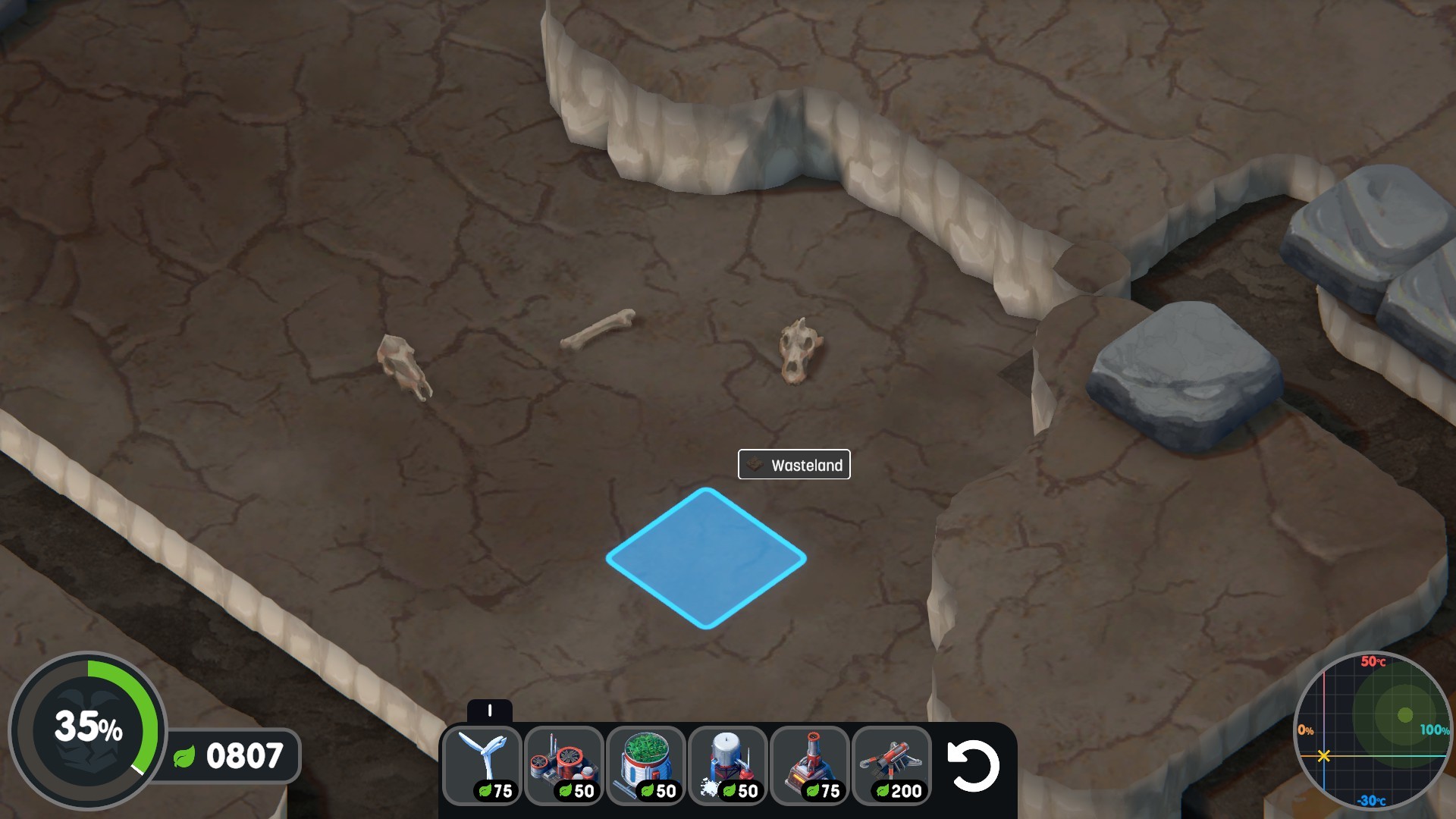
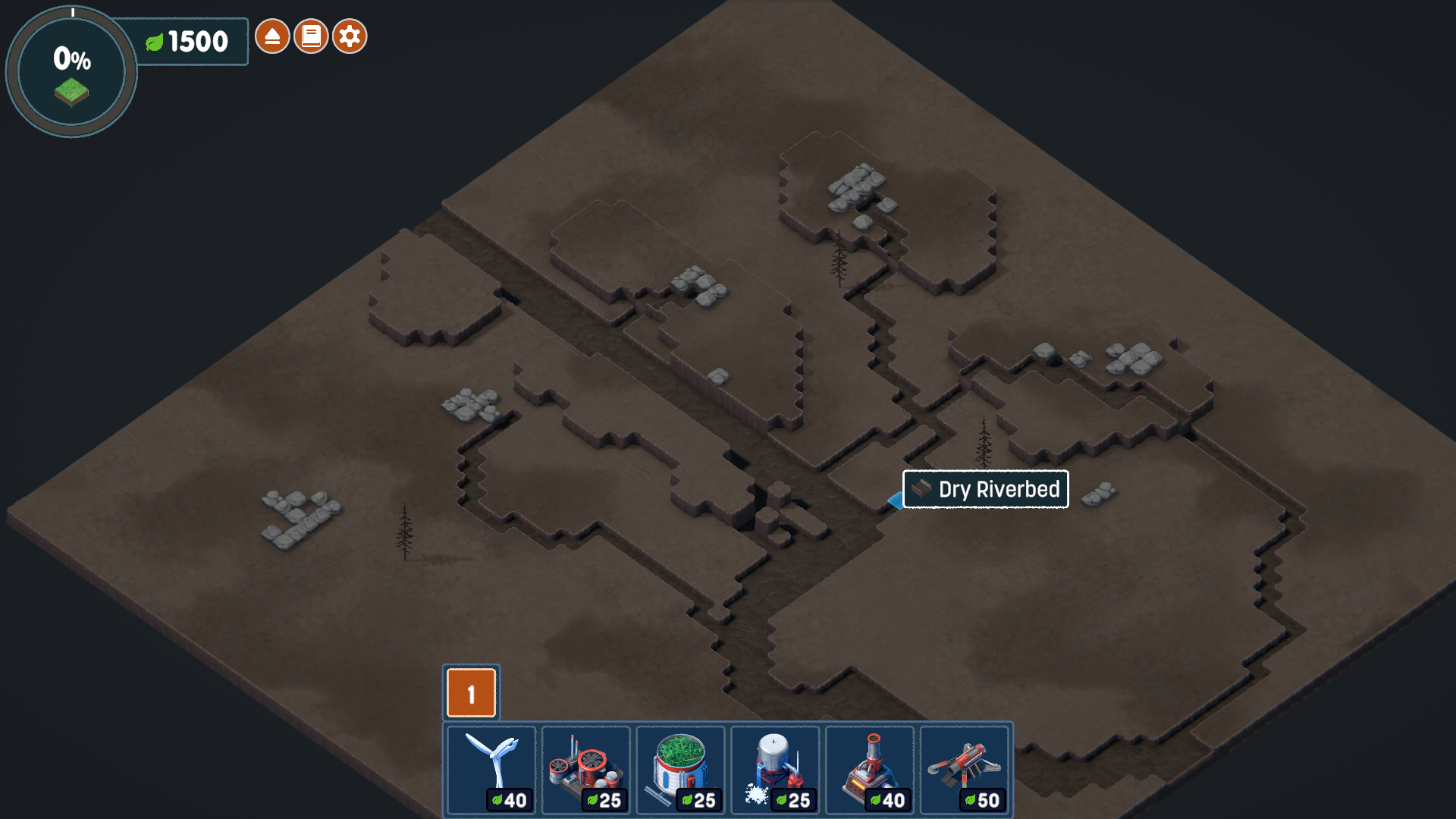
Of course, the density of these features (to the exclusion of all signs of life) does suggest a problem. It's one thing to have a few dead trees; it's something else to have only dead trees, with no living vegetation in sight. It's one thing to have a seasonally dry riverbed (known as an arroyo or wadi); it's another thing for all waterways to have become permanently dry. In these initial landscapes Terra Nil seems to depict the outcome of desertification—the creation of desert out of something that previously was not. This all makes sense, in the abstract.
With that said, the design choices of Terra Nil seem to depict drylands as themselves representative of a problem. Look at the cover art at the end of this reveal trailer: the patch of bright green grass (representing positive change) contrasts starkly against its surroundings of red rock formations, which bear a resemblance to the likes of Red Rock Canyon and Arches National Park. In game, there's a visual color difference between "toxic" land tiles and detoxified tiles, but both of them are brown, and in both cases brown represents a land tile that has not reached its final form. There is still work to do, interventions the game asks you to make, anywhere that you see the color brown. Dry places in this game are positioned as something that is, at best, unfinished—at worst, "wasteland."
As I wrote about in Who Gets To See The Future, arid lands have long been viewed by colonizers as "wasteland," and this is a view with devastating ecological implications. To see land as "wasteland" is to see it as worthless and disposable. In practice, this means viewing it as an always-appropriate site for everything from uranium mining to nuclear detonation. The rhetoric of ecological advocacy for the Chihuahuan, Sonoran, Great Basin, and Mojave Deserts is still fighting an uphill battle to persuade people that this land is precious, valuable, delicate, sacred, ecologically unique, and worth protecting.
So when dry brown terrain gets explicitly labeled in-game as "wasteland"?
Well, as a player, I have a reaction to that.
The Optics of Watering
In the same way that dry brown tiles in Terra Nil are depicted as unfinished, the game presents watering (in the form of irritation machines or rainfall) as always beneficial. This makes sense, in the abstract. The depiction of it, though, involves dry soil being sprayed and transformed into bright green grass, and for reasons I'm about to explain, that gives me pause.
In terms of gameplay, watering in Terra Nil is depicted as only ever a positive way of interacting with the land. It's one of the basic early steps for restoring an area: you set up power sources and toxin scrubbers, and then you spray a bunch of water everywhere to establish fields of fresh green grass. Even once you've moved onto other steps in the process, introducing more water is only ever depicted as a positive contribution, never a bad thing. It turns brown map tiles green.
This is intuitive, in a way. Water is necessary for introducing plants and animals, and environmentally friendly practices have long been referred to by the metaphor of "green." Green stands for healthy plant life and healthy ecosystems in general. Green is good. Or so the thinking goes.
But in arid parts of the world, particularly those affected by drought, bright green grass can carry a... different set of associations. Associations with vanity, negligence, and waste. In these places there's already very little water to go around, which is why settler governments in Las Vegas, Aurora, and Southern California have implemented restrictions and even outright bans on watering ornamental grass. The city of Mesa, Arizona has taken a different approach and tried bribing residents into xeriscaping instead. Utah has, too. But the American attachment to the green English lawn is so entrenched, it's difficult to get everyone on board with reductions in frivolous water use.
Of course, the situation in Terra Nil is different because the water is clearly imported. The riverbeds were already bone dry to begin with, and you as the player bring your own water, so there's no serious depletion happening in-game when you irrigate and grow grass. What I'm responding to here is the use of green grass to visualize the act of restoration.
I think it wouldn't feel as bad if there were other parts of the game devoted to restoring desert habitats, presenting a sandy brown dryland as one form that healthy terrain can take, but there aren't.
Nobody's Land
In Terra Nil, the land you restore is a land of no people. Human habitation during gameplay (your own presence there) is temporary, restricting your interventions there to something finite—something that comes to an end. In a way, this should come as no surprise, given that the name of the game itself, Terra Nil, invokes the concept of "terra nullius."
"Terra Nullius" is an emblem of colonial logic. These words are Latin for "nobody's land," and this concept has been a rhetorical cornerstone of colonial takeover—designating land as up for grabs, as belonging to "no one," because it's easy to say no one lives there if you simply decide that Indigenous people don't count as people.
The name "Terra Nil" swaps out "nobody" (nullius) for "nothing" (nil), but it's a game about there being no people, too. When you first arrive, there are no living people to be found, and when you close out a level, the way you're supposed to do that is by packing up every last piece of your machinery, every building, every direct physical sign you were ever there, and recycling it so that you can leave.
You are not allowed to keep your buildings and stay. To stay is to leave the level unfinished.
While this game design choice is not particularly noteworthy in the abstract—certainly a video game is going to involve some oversimplifications—I think it's worth pointing out how this passively aligns with a separatist outlook on ecology. That is to say, restoration in Terra Nil seems to reflect a sentiment that, past a certain point, the land and the ecosystem are better off without us. I am reminded of what I argued in Mustangs, Freedom, and Settler Nostalgia about how idealizing "Nature" has sometimes been expressed by excluding one species in particular from the scene. This environmental separatism is not just at odds with scientific fact. It is also the broken, genocidal, counterfactual logic of forcible removal, as demonstrated by the history of the Havasupai and the settler conservationists who treated them as a threat to the Grand Canyon.
More broadly, to figure the concept of "Nature" as something that exists separately "out there" is a move that omits responsibility. This is a mentality that would have someone admire a wolf but scorn a coyote, admire a forest but poison a "weed," photograph a mountain but drain a swamp, celebrate nature in the abstract and sing its praises but still pave a prairie into a parking lot. Reading Lauren Van Patter's work on conflict with urban coyotes, I've been reminded how ardently some people can think of their own towns and local areas as something other than and separate from natural ecosystems. To think this way is to shirk the responsibility of being a good neighbor, both to humans and other forms of life.
To the game's credit, there is at least one Indigenous insight Terra Nil takes into account: it portrays fire as not just destructive, but also generative. This fact is approaching common knowledge now, but it's still a significant turn away from 20th century settler conservationist thinking about wildfires as always bad, and so I was pleasantly surprised to see how fire was portrayed in the game. To take this a step further in realism would call for the portrayal of proactive, continual fire management instead of portraying this work as discrete and finite.
But in Terra Nil, the work is finite, and so I return to the name and the way that levels are resolved: Terra Nil. Nothingland. You fix up the place, and then, in order to leave nothing behind, you tear down your buildings and move on, unable to remain as part of the ecosystem yourself.
The land in Terra Nil is the land of no people.
Reduce, Reflect, Reiterate
As a game about removing toxins, restoring a broken ecosystem, and then packing up and leaving, Terra Nil is thoroughly a game about negation and undoing. This is an interesting premise for a game, and there are plenty of things I like about it, but in its execution, I think the game design reflects a gap in their radar. An absence, if you will, of attention to certain angles. Terra Nil categorizes dry terrain as "wasteland," depicts watering as always good, and resolves each level by vacating the premises.
While these are tolerable choices for a simple strategy game, it also gave me cause to reflect on my own understanding of ecological stewardship in the real world and some overlooked aspects of what that entails. In my own local context, part of what ecological stewardship means is pushing people to get over their attachment to wasting water on ornamental grass. Part of the barrier to doing that is convincing people that the alternatives aren't an eyesore to look at—that desert plants and dry earth aren't the ugly mark of "wasteland." Wherever you're reading this from, though, I hope you can take some time to imagine how people might contribute to the continual work of collective wellbeing, rather than cutting ourselves off as something separate.