
Work Text:
Spirit: Stallion of the Cimarron (2002) is a movie that’s been very fondly remembered, if the backlash against the new spinoff is anything to go by.
If you’ve heard about Spirit Untamed (2021), you’ve probably heard of the criticism. On Twitter and Tumblr and even Wordpress, the trailer has been greeted with disdain for removing Native characters and anticolonial themes from the narrative. “They colonized Spirit,” goes the refrain. In contrasting the two films against each other, these critics heap praise on the original, calling it “exceptional” and “unimpeachable” for its “uncompromising” message.
While it is understandable to interpret Spirit as an anticolonial movie, that’s not a perspective I share. The film is not a complete and total a condemnation of colonial logics. It deserves some credit for its unflattering portrayal of the American military (in the year 2002 no less), and at the same time, it also participates in some more insidious forms of colonial myth-making, in particular its emphasis on “freedom” and heavy-handed settler nostalgia. So for this analysis, I want to give you a brief run-down of what the movie does right, followed by an explanation of what the movie does wrong, why that matters, and what it would take to fix it.
[Content Note: This post touches on topics pertaining to real life issues and problems, including ecological issues and animal death.]
Anticolonial Themes
In a considerable break with tradition for a film set in this era, Spirit portrays settler colonial forces as terrible and cruel, allowing a Lakota character to shine as far more respectful and kind. This contrast comes across through the characterization of the U.S. military and its treatment of horses, the parallels drawn between the protagonist and a Lakota man, and how differently we see horses being treated by the Lakota.
The film introduces the U.S. military from the horse protagonist’s point of view, portraying it as a controlling and soul-rending environment. This occurs during the “Can’t Take Me” sequence, which shows Spirit’s wide-eyed confusion and dismay as he is taken into the Fort. The cavalry horses all march in formation. A brief close shot fills the screen with their legs moving all together in time. Spirit calls out to them, but they largely ignore him, obedient to their human riders. Just prior to this, a wide shot places the American flag in the frame as the soldiers drag Spirit by ropes, pairing this symbol of “freedom” alongside the image of captivity and bondage.
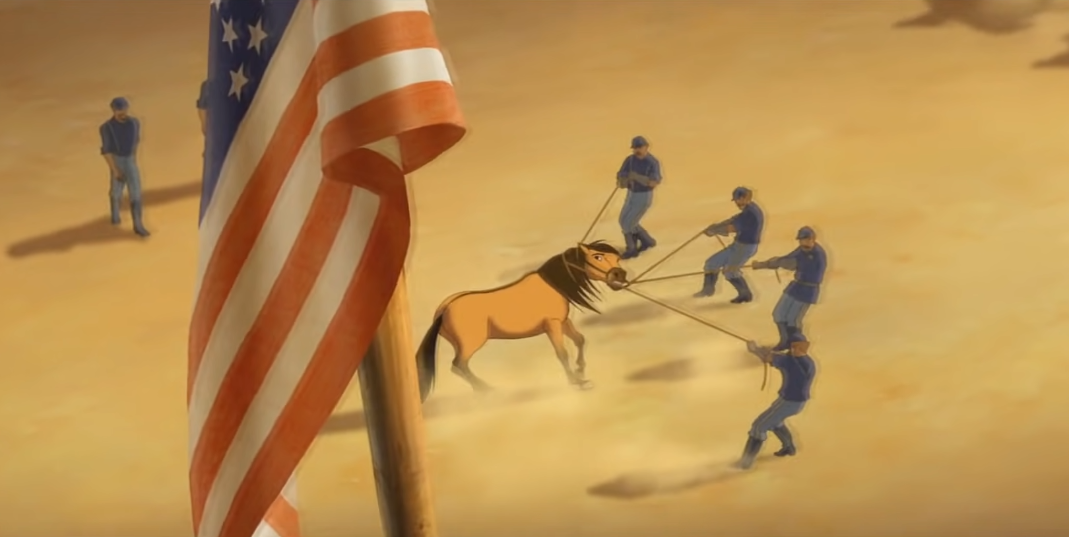
Spirit’s treatment at the hands of the soldiers is cruel. At first, Spirit bucks off anyone who tries to ride him, but then the Colonel (who looks awfully familiar) orders him to be tied up and deprived of food and water for three days. This punishment physically weakens the horse enough to impair his ability to resist.
It’s here at the Fort where the film introduces a Native character and immediately draws parallels between him and Spirit. A young Lakota* man named Little Creek is captured by the U.S. military and taken to the Fort as a prisoner. The Colonel orders him tied up and deprived of food and water, just like Spirit. Little Creek also demonstrates a similar determination to escape, and unlike the soldiers, his attitude toward Spirit is friendly. If all this wasn’t overt enough for you, the Colonel’s speech makes the connection explicit:
There are those in Washington who believe the West will never be settled... the Northern Pacific Railroad will never breach Nebraska... a hostile Lakota will never submit to providence. And it is that manner of small thinking that would say this horse could never be broken.
With these words, “breaking” the horse is likened to settler colonialism and forced assimilation. Yet Spirit is not actually “broken,” and when he escapes, he and Little Creek escape together.
*I am honestly not sure what a band of Lakota was doing out here in an area that looks nothing like Lakota territory, but this movie does play fast and loose with geography.
Following Spirit’s escape, he’s captured by a band of Lakota, which allows the movie to demonstrate the Lakota’s own treatment of horses. Unlike the White men’s horses, the Lakota horses happily accept human adornment (such as warpaint) and are protective of their human friends. The relationship between Little Creek and his mare, Rain, is portrayed as positive and playful. Although Little Creek does try to paint, tame, and ride Spirit (which Spirit does not tolerate), the man shows a sense of humor about it and uses more compassionate methods.
With scenes like these, the movie contrast settler versus Lakota horsemanship in a way that presents the settler characters definitively as the villains. Not only is the Fort a cruel and authoritarian place, but the Colonel even directly likens his perspective on the horse (Spirit) to the Lakota (Little Creek). Since the horse is our sympathetic protagonist, this casts Little Creek in a favorable light. That impression is then affirmed by the cooperation and amicable relationships between the Lakota people and their horses. All of this evidence would seem to affirm the anticolonial reading of the movie.
Now let’s get into the rest of the picture.
Colonial Themes
While the U.S. military itself is (justifiably) characterized as villainous, this movie nonetheless embraces the ideological touchstones of American propaganda. Spirit is a requiem for the “Old West,” framed from the outset in terms of settler nostalgia. In this movie, <Freedom> (not kinship) is paramount. This old American ideograph is invoked throughout to portray feral animal “freedom” as the best possible life, emphasizing independence over interdependence.
Looking Back Through a Lens of Settler Nostalgia
Interestingly enough, it was this Wordpress post that directed me to an academic article about the movie by C. Richard King, which in turn is where I learned about “Imperial nostalgia” by Renato Rosaldo—a perfect term to encapsulate the tone of this movie.
Imperial nostalgia, according to Renato Rosaldo, refers to looking back with a fondness and longing at the early stages of imperial takeover. The concept applies specifically to nostalgia within a colonial frame, meaning not just finding something positive in the past, but specifically “mourning for what one has destroyed.” In this analysis, I’m using “settler nostalgia” to get at the same idea, with an emphasis on the “settler” aspect of settler colonialism. Settler nostalgia is invoked by this movie through its narration, its visuals, and its timeline of human contact. Although superficially innocent, these elements combine to animate certain ideas about the natural world and invite a perspective on the “Old West” as something to be mourned.
To set the stage, the film presents an appreciative but distant view of <Nature>, emphasizing majesty while de-emphasizing habitation. The first shot of the film opens on the sky. A soaring eagle takes the focus, and this eagle escorts the viewer through a canyon, over a river, and across wide open spaces, past and through rock formations recognizable from Monument Valley and Arches National Park, all set to grand orchestral music. This literal bird’s-eye view of the land is elevated—distant—and from this high up, it looks empty—“untouched.” What we are seeing is <Nature> without people, which helps set the stage for what comes next.
After this prelude, the main character begins reminiscing on a bygone era, as articulated in settler-colonial terms. “I was born here,” Spirit says, “in this place that would come to be called the Old West.” He goes on to dispute that “to my kind, the land was ageless,” but the sentence is in past tense, and the entire monologue is presented as looking back on the past. The remark about what this place “would come to be called” is even in passive voice, allowing Spirit to avoid identifying who calls it that. What of the Native names for this place? Unimportant. Maybe Spirit doesn’t know them. All he knows, somehow, is the future settler view of his homeland. Spirit further invokes the settler perspective by saying, “They say the Mustang is the spirit of the West. Whether that West was won or lost in the end, you'll have to decide for yourself.” This is a direct reference to the phrase “how the West was won,” a phrase used to talk about late 1800s colonization. Here Spirit is challenging the notion that the West was “won” and supplying the suggestion that it might have been, conversely, “lost”—while continuing to talk in the mode of settler discourse. In these ways, his narration summons the frame of settler nostalgia.
Curiously absent from Spirit’s recollections is any sign of precolonial human habitation. Spirit’s first encounter with humanity doesn’t occur until adulthood. Investigating a campfire, he discovers a small encampment of White men. From Spirit’s confusion and curiosity, it’s apparent that he has never seen humans before at all. His narration even introduces this scene with “Something new came upon the land that night” and “I wanted to know what strange creatures were here.” Although Spirit does later meet a band of Lakota, it’s noteworthy here how humans, not just Whites, are portrayed as “something new.” Like the opening shots of the movie, this aligns with the vision of the “Old West” as Terra Nullis—empty land. It’s the <Nature>, more than the Natives, that this film is nostalgic for.
Celebrating the Primacy of <Freedom>
Caught up in its adoration of “untouched” wilderness, this movie is nothing if not a celebration of “freedom.” Again and again its supreme value is emphasized, from the opening narration that romanticizes “running free” to the characters’ attitudes on captivity to the “happy ending” (being set free). However, the particulars of that freedom are important here. In the context of Spirit, what <Freedom> stands for isn’t just the absence of authoritarian control, but the absence of humanity entirely, emphasizing the importance of <Nature> kept separate from human interaction.
The opening of this movie does everything in its power to impress upon you the positive value of feral animal “freedom.” After introducing Mustangs as “the spirit of the West,” Spirit’s initial voice-over concludes on this note: “I remember. I remember the sun and the sky and the wind calling my name, in a time when wild horses ran free.” As he says these words, the orchestral music swells, and the frame sinks low to the ground into the path of galloping horses, immersing the viewer in the thick of the action. Between Spirit’s fond narration, the uplifting music, and the dramatic visuals, this scene presents “running free” as something positive and desirable.
In contrast, living with humans is portrayed as something sad and detestable. When Spirit first approaches the White men’s encampment, for instance, one of their horses frowns and motions as if to warn Spirit away. Soon the men wake up and reach for their lassos, and the horses put their ears back and look scared on Spirit’s behalf. Later, the cavalry horses are shown cheering for Spirit’s resistance during “Get Off Of My Back” and cheering for him again after he bucks the Colonel. Here you might counter that these behaviors are only shown with horses kept by White men, not the ones kept by Natives—and that’s why we also need to talk about the Eagle.
The Eagle treats any cross-species involvement as always worse for Spirit than freedom, regardless of the humans involved. Introduced early on, the Eagle is Spirit’s racing buddy, as demonstrated in a scene where they run/fly together to the sound of triumphant music. The Eagle makes a return in the “Can’t Take Me” sequence and calls out to him, but Spirit is held back by the ropes, thereby dramatizing the sense of loss. We next see the Eagle again when Spirit is living with the Lakota. Spirit calls out to the Eagle, but the Eagle sees that he’s in ropes again and turns away. It’s only when Spirit is loose that the Eagle deigns to reunite with him.
Oh, and you remember all that about framing the U.S. military as villainous? You remember that? That doesn’t stick. By the end, the Colonel is redeemed by letting Spirit go and respecting his <Freedom>, undermining what would have been an otherwise unflinching condemnation of the military. At the climax of the film’s final chase sequence, one of the soldiers raises his gun, but the Colonel reaches over and stops him. Then he gives Spirit a slow, respectful nod, purposefully ending his pursuit and letting them go. So the film characterizes him as a graceful loser, utterly dignified in his willingness to stand down and concede. Spirit himself even returns the nod, establishing a mutual respect. A mutual respect. A mutual respect. A MUTUAL—
Most definitive of all is the film’s resolution, with Little Creek choosing to set Spirit “free.” Little Creek is positively portrayed as someone who respects horses, and so after Spirit helps save his life... he decides to release both Spirit and Rain (?!) from his care. Sentimental music underscores the bittersweet goodbye, conveyed with Little Creek removing the feather from Rain’s hair and asking Spirit to take care of her, then allowing the two horses to turn and run off.
Instead of portraying this as bad and irresponsible, like abandoning a box of kittens on the street, the movie celebrates this as exactly the right thing to do. In his narration, Spirit vows, “I’ll never forget that boy—and how we won back our freedom together.” Closing shots show Spirit finding and rejoining his herd in the wild, set to triumphant music. Everything about the cinematic choices here treats this as something to be happy about. The <Freedom> being celebrated with this ending is strictly an independent freedom, characterized by a lack of cross-species involvement.
Real-World Implications
The ending to this movie reminds me of the ending to Hidalgo (2004), and any time I start comparing things to Hidalgo, that alone should be a warning sign. Its problems are both particular and general: particular to Mustangs, but also something that generalizes out to a broader view of ecology and cross-species relations. Simply put, Spirit is more interested in the stunning visual of running horses than it is in the consequences of letting horses go. The emphasis on severing all ties with animals (to set them “free”) is an extremely settler-colonial way of relating to the world—one which is both ecologically unrealistic and destructive, in conflict with more Indigenous perspectives on ecological interdependence.
Here in reality, running “free” is not actually the best life for a Mustang. It’s not just that Spirit downplays what humans have to offer, such as medicine to ward off illness and parasites. It’s also the fact that Mustangs are in trouble. Look around and you can find articles about how the size of their population is putting a strain on their habitat. The Bureau of Land Management has been so desperate to get rid of them, in 2019 they even announced they’d pay you $1,000 to adopt one. The moral of Spirit’s ending is actively telling you not to do this.
With that said, that’s not where the implications end. From a more zoomed out vantage point, the framing of "setting horses free" as a happy ending feeds into certain romanticized ideals about the separation of humanity from <Nature>. People believing in these things wholeheartedly is how you get anti-zoo advocates portraying "freedom" as ideal and captivity as tragic, regardless of the role that zoos play in conservation efforts.
What’s best for the environment does not always align with the conservationist impluse to “leave it alone.” For too long, settlers here have failed too see the value of Indigenous land management; the discourse of Western agriculture hardly even has words for these practices, at best referring to the outcomes as “forest gardens” because of how difficult it is to reconcile our ideals of <Nature> with active human participation. It should not be surprising, then, that “conservationist” groups have sometimes actively opposed repatriation to Indigenous nations. On the West coast, Indigenous peoples have traditionally mitigated the damage from wildfires through the practice of controlled burns. Controlled burns clear out the buildup of fuel, so that when a wildfire does break out, it can’t spread as fast and won’t pose as much danger. These practices were banned by the state of California in the early 1900s. It’s only comparatively recently that settler ecologists have realized their mistake. Across the continent in the Northeast, consider what Robin Wall Kimmerer has found about the black ash tree. When people noticed a decline in the species’ population, the initial theory was that too much of the trees had been harvested for traditional basket making. Yet upon investigation, researchers found the reverse:
Where the tradition of black ash basketry was alive and well, so were the trees. We hypothesized that the apparent decline in ash trees might be due not to overharvesting but to underharvesting. When communities echoed with doonk, doonk, doonk [the sound of harvesting], there were plenty of basket makers in the woods, creating gaps where the light would reach the seedlings and the young trees could shoot to the canopy and become adults. In places where the basket makers disappeared or were few, the forest didn't get opened up enough for black ash to flourish.
Black ash and basket makers are partners in a symbiosis between harvesters and harvested: ash relies on people as the people rely on ash.
--Robin Wall Kimmerer, "Wisgaak Gokpenagen: A Black Ash Basket," Braiding Sweetgrass
Ecological insights like these emphasize the interconnections between beings, and that includes human beings.
Here I would be remiss not to also point out the partnership between the Lakota people and the horse. You can learn more about this in the documentary We Are A Horse Nation (2014); a short version (about 35 minutes) is available on Vimeo, and it delves into the importance of the horse to the Lakota people. Don’t go into it unprepared, though: it also touches on settler violence against horses as a means of harming the Lakota.
In light of this, separating a Lakota character from a horse character should be understood as a political message unto itself.
This is why I cannot write off this movie as if it has nothing to do with anything. Knowing what I know about the current plight of feral horses, I can’t see Spirit’s freedom as a happy ending. More generally, it is ecologically irresponsible to take the separatist approach, seeings as there are many species that can and do benefit from human involvement to the point of suffering in its absence. Yet human-animal interdependence like this is exactly what Spirit positions itself against. At every turn, it valorizes <Nature> as something apart from and best without humanity.
How To Fix It
So if those are the problems, what's the alternative? Mainly what would need to be changed is the opening and the resolution. First off, if Spirit has to have narration, then cut out the “Old West” business and don’t invoke settler nostalgia. If he has to use human words for his homeland, let him use Lakota or other Native place names. Alternatively, don’t have him talk like a human at all. Second, you’d also need to reverse the implications of Terra Nullis. Demonstrate that Spirit has seen humans before, if only at a distance, to avoid implying that his homeland was previously uninhabited by people. Most importantly, though, what do we do about that ending?
It's simple:
Let the Lakota keep the horse.
This is a tried-and-true formula for a horse story. Let there be a difficult horse, but let there be a Good Person who proves themselves. Let Spirit undergo the character growth from “refusing to be tamed” to bonding with and befriending a person who actually appreciates him. Emotionally, the groundwork is all there—the movie portrays Spirit and Little Creek both saving each other’s lives. It would have been so easy to round out the story like this.
But they didn’t.
Takeaways
Spirit: Stallion of the Cimarron (2002) can be looked at as an example of how a story with superficially anticolonial themes can nonetheless employ colonial framing. The point of this analysis isn’t to make a comprehensive ruling about whether Spirit is Good or Bad, but to pick apart some of the ways that different elements of a story can add up to ideological implications. It’s true that Spirit does (initially) characterize the Colonel as a ruthless villain, in contrast to the more compassionate and playful Little Creek. That’s something remarkable in its own right. If you want to argue that the new spinoff is ideologically much worse, I believe you. At the same time, the original story is introduced and framed in terms of settler nostalgia, with a thematic throughline and final conclusion that emphasizes the American value of <Freedom> over Indigenous kinship and interdependence—even to the point of taking the horses away from Little Creek.
In other words, I think that some viewers have given this movie too much credit. To the extent that Spirit has anticolonial themes, the adamant prioritization of independence and species-separatism swing in the other direction, leaving the end result, in a word... compromised.