
Chapter Text
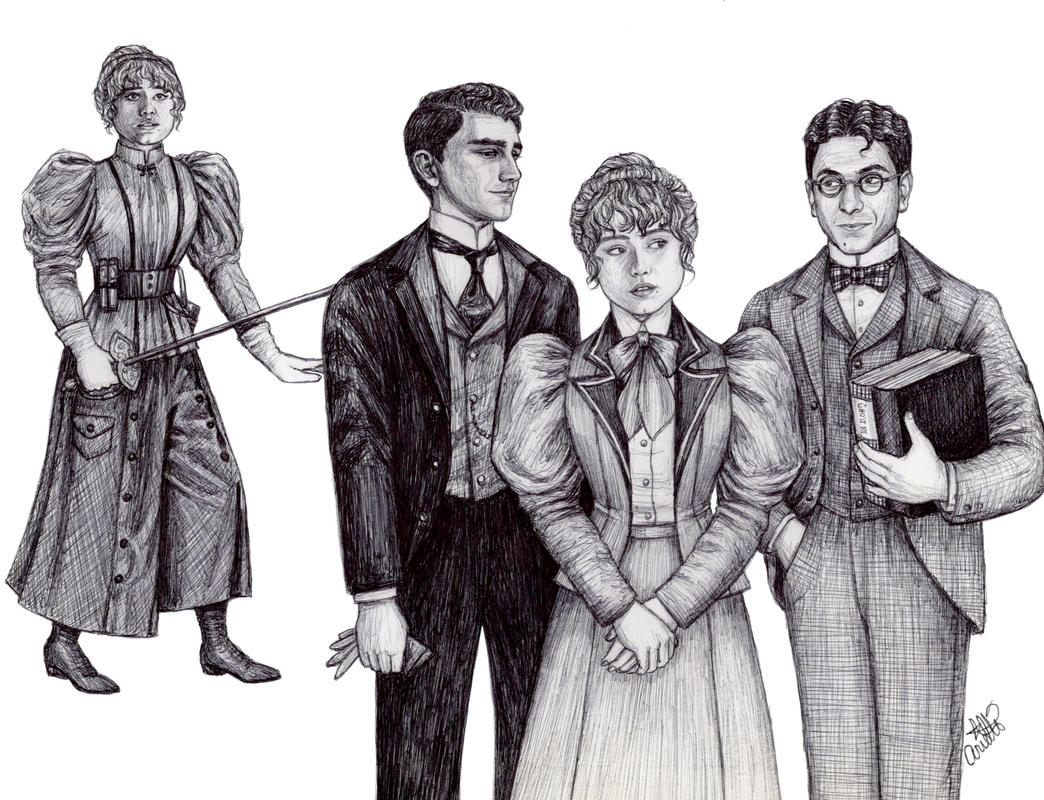
Nocturne
John Davidson 1891
The wind is astir in the town;
It wanders the street like a ghost
In a catacomb's labyrinth lost;
Seeking a path to the heath.
Broad lightnings stream silently down
On the silent city beneath.
But haunting my ear is the tune
Of the larks as they bathe in the light;
And I have a vision of noon
Like a fresco limned on the night:
I see a green crescent of trees;
A slope of ripe wheat is its foil,
The cream of the sap of the soil,
Curdling, but sweet, in the breeze.
The sun hastes, and evening longs
For the moon to follow after;
And my thought has the tenderest scope:
Tears that are happy as laughter,
Sighs that are sweeter than songs,
Memories dearer than hope.
LONDON
1896
Lucy Carlyle was alone, without a friend in the world. She didn’t particularly expect that to change as her train chugged from sleepy Croxford to bustling London, but as long as she found employment, she could manage. Maybe forget about her mother, Wythburn Mill, Norrie…
Lucy blinked back tears as she smoothed the skirt of her navy-blue walking suit, hoping the wool wasn’t noticeably threadbare. She’d mended most of the holes. It was a hand-me-down from Mary, and certainly not anything that could be mistaken for House of Worth. In fact, most of what she was wearing had been given to her, except for the corset, which was quite broken-in and fit like a glove over her combinations. She was glad for that at least; seasoning a new corset would be just one more annoyance.
Lucy reached into her pocket and pulled out a money purse. A quick inspection of the contents confirmed what she already knew from the lack of weight: she didn’t have enough to stay longer than a day in London. If she couldn’t find employment…she didn’t even have enough for a return train journey. No, she had to find something.
There was a paper next to her on the hard wooden seat, and she snatched it up and scanned the advertisements. There were plenty of agencies in need of Talented agents, but they’d all be wanting a Grade Four, which she was unfortunately lacking.
Lucy sighed and fumbled for the small pair of scissors hanging from her chatelaine. She snipped out a few promising adverts. At some point a determined woman with sails for skirts swept by her, making all the little papers whirl through the air like ticker-tape at an American parade. Lucy cursed under her breath and snatched at them, unaware of the one that fluttered into her open purse. She snapped it closed and shoved it into her pocket with the advertisements she had rescued.
There was a call for the station, and Lucy fussed with the ragged piebald feathers on her felt hat and pinned the whole contraption to her pompadour. She’d tried to imitate the hairstyle of a Gibson Girl in a magazine illustration, and although she was sure she’d failed miserably, the hat hid it well enough. She shouldered her rapier bag, picked up her valise, and exited onto the steam-choked platform with the rest of the passengers.
London proved to not be the shining beacon of hope Lucy was expecting. There was no shine where she was anyway; soot and grime caked brick and stone alike, and the air was stale and noisy with the clatter of trains and horse-drawn vehicles. Child labor was out on full display as agents bought ghost-hunting supplies and boys in shabby clothes hawked the evening newspaper from street corners. Adults pushed past Lucy, eager to get to their safe ivory towers before nightfall. At one point she had to flatten herself against the glass of Satchell’s display window when a Hansom cab jumped the kerb, the driver taking no notice of her while he hurled curses at the produce cart that had caused the issue. She took a fortifying breath, straightened her jacket, and pressed on.
Fittes House appeared ahead of her, its pale limestone practically glowing in the golden light of evening. Perhaps this was her beacon. She strode up the steps, feeling a little guilty she was here without Norrie, nervously anticipating what waited within.
“I’m sorry, but without your Grade Four, we can’t hire you. You simply don’t have the qualifications,” the disapproving man behind the desk told her.
“Are you—are you absolutely sure? I promise I’m good enough. If you just saw what I could do—let me show you my Talent—”
“I’m very sorry, miss.” The man waved up the next applicant.
Lucy left in a state of disappointment. It wasn’t ideal, but there was a plethora of agencies in London. One had to take a chance on her.
None did.
Every establishment she visited slammed a physical or metaphorical door in her face. At eighteen going on nineteen, there was no need for her parents’ permission like the younger agents, but a Grade Three just wasn’t good enough.
The day wore into afternoon, the shadows lengthening into intimidating inky shapes that foretold the approaching night. Lucy found a modest cafe and ordered a tea, then slumped dejectedly at a small corner table. She emptied her purse out on its surface to count the remaining change. Not enough to get a room for the night, or even a proper meal. Curfew was in less than two hours, and a nervous lump was growing in her throat. There was more to fear than ghosts on the streets of a big city late at night. Her hands shook, only partially from hunger, as she put the coins back into the purse. A small piece of paper that had been pinned under a shilling caught her attention. She unfolded it.
LOCKWOOD AND CO, the prestigious psychical investigations agency, requires a new Junior Field Operative. Duties will include on-site analysis of reported hauntings and the containment of same. The successful applicant will be SENSITIVE to supernatural phenomena, well dressed, female, NOT above nineteen years in age, and unmarried.
UNSUCCESSFUL APPLICANTS will include time-wasters, fraudsters and persons with criminal records. Apply in writing to: 35 Portland Row, London W1
Unmarried? That wasn’t an unusual request for secretaries and the like, but agencies generally didn’t bother to mention it. Their workforce was mostly children.
Well, they were in luck at least. She wasn’t ready to shoulder the duties of marriage, nor did she think she would ever be. Although her father had died when she was five, what she’d witnessed of his volatile behavior was enough to dissuade her from desiring her own husband.
The divine smell of another patron’s pork pie wafted under her nostrils as it passed. Her stomach rumbled desperately.
Maybe this odd advertisement was worth applying for.
“Are you accusing me of being a charlatan??”
Lockwood regarded the young woman before him with bemusement. Attractive, he supposed, with her flaxen-blond curls, healthy complexion, and flattering pink silk dress, but it wasn’t enough. “Miss, you told me Mr Karim’s toothbrush cup was haunted by a Cold Maiden whose husband used it to kill her.”
The young woman’s mouth opened and closed like a fish. “T-toothbrush cup?”
George sniggered.
The young woman huffed. She stormed out of the parlor, boots stomping loud as thunder. They heard the door slam.
“Well there goes the last one for today.” Lockwood sighed, dropping onto the sofa and stretching out his long legs, thin fingers raking through his dark locks.
“This is madness, Lockwood. Are you sure you need the new agent and wife to be one and the same?” George said. He cleaned his wire-rimmed glasses on the edge of his rumpled apricot waistcoat.
“We’ve been over this. If I’m going to put up with a wife to satisfy the stipulation in my uncle’s will, then I might as well get a sorely-needed employee out of it. Besides, I only have enough room for one extra person, not two. She won’t be sleeping with me.”
“Not all agents live in like I do,” George pointed out.
“But then I’d still have to pay the agent and the wife separately. If I combine them, then it’s two birds with one stone, eh?”
“You aren’t going to find anyone to agree to such an insane proposal. You also can’t just divorce her, and she’s not going to want the kind of marriage you have planned. Finding a good agent is difficult as it is; not one of these girls has been truthful enough about their Talents to even hear the rest of the offer.”
“There has to be an honest woman out there somewhere who doesn’t want to fulfill spousal obligations.”
“Sure. Nuns. Maybe you can go strike up a deal with one of them.”
Lockwood rolled his eyes. “Well we don’t have a choice, do we? I need that inheritance. Unless you would you like to pay the 370 pound fine, that is. And our other debts too.”
“Be reasonable, Lockwood! you’d have to be titled to have that kind of money to burn. Which is basically what you did when you forgot to bring the chains to Mrs Hope’s house.”
“I forgot?? You forgot to put them in the bag when you were done oiling them!”
“I told you I needed more time to research that case before we left. You completely sabotaged my systematic preparations.”
“So it was more your fault than mine.”
George was about to launch into an angry tirade when the doorbell echoed through the house. “I guess there’s one more.”
Lockwood frowned and checked over the list. “No, Ms Dubois was our last applicant for the day.”
“Might be Arif’s girl with the bread delivery,” George said. He stood up and headed for the front door.
Like the wayward Hansom cab earlier, the pretty girl in pink almost plowed Lucy down upon exiting 35 Portland Row. Lucy jumped clear and watched the girl’s departure with wide eyes. Did she not have a Grade Four either? Why else would Mr Lockwood have turned her down? Lucy considered leaving, but the sinking sun convinced her to at least give this last agency a try. Rallying her confidence, she lifted her skirts and climbed the iron-protected front steps of the impressive Georgian townhouse. Hesitantly she rang the bell.
Moments later the blue door creaked open, and a young man with wild black curls and a skeptical expression looked her up and down. “You Arif’s new girl?”
Lucy’s eyebrows scrunched. “Who’s Arif?”
“Runs the corner bakery. He usually sends our bread order for the week about now, but you don’t seem to have any bread, so you’ll be another candidate. I guess we haven’t finished. Name?”
“Lucy Carlyle.” She did her own once-over, scrutinizing the wrinkled state of his brown tweed suit and that lurid apricot waistcoat. “Are you Mr Lockwood?”
“No.”
“Oh. Well, might I speak with him?”
“Don’t see why not. He’s in the parlor.” The young man pulled the door open wider.
Lucy stepped inside and reluctantly took off her hat, which the young man hung on a hook. Her eyes roved over the unusual decor, taking in the Aztec crystal skull lamp on the telephone table and the curios from far-off lands that dotted the wall like an intriguing puzzle.
“Follow me,” the young man instructed.
They entered the parlor. Another young man, who was examining a document, shot up when he saw there was a lady present.
Lucy stopped in her tracks, her breath catching in her throat. Lord he was tall. Lanky too, but with broad shoulders, and assuredness in his stance. Scarcely older than her, she noted. He was wearing a charcoal three-piece suit with a thin black pinstripe, a black tie, and a gold watch tucked in his waistcoat pocket. She didn’t mind the prominent dark circles under his umber eyes and thick brows; they seemed to belong there, even though they enhanced the paleness of his skin. She wasn’t sure how those eyes seemed to be so bright yet so dark at the same time, equally cheering her soul and drawing her in. He had a nice lopsided smile that made her heart skip a solitary beat.
“Hello, I’m Anthony Lockwood.”
Lucy held out her hand. He took it, his long fingers closing easily around it. Her cheeks warmed. “Lucy Carlyle. I don’t have an appointment, but I saw your advert in the paper and I was in the area.”
“You’ve heard of us?” Lockwood asked.
“No.” He looked displeased by this answer, and Lucy hoped she hadn’t already bungled her chances. She dug into her pocket and pulled out a sheet of paper, which she promptly handed to him. “My employment experience.”
His eyes flitted over her appraisingly. “Would you like some tea? Or has George already offered? Oh, Miss Carlyle, this is George Karim, the agency’s researcher.”
“I thought we’d wait till after the first test, see if she’s still here. We’ve wasted enough tea leaves already,” George said flatly, refusing to shake Lucy’s hand.
“Let’s give her the benefit of the doubt and pop the kettle on,” Lockwood told him.
“Okay, but I reckon she’ll be as bad as the last one.” George swept by Lucy on his way to the kitchen.
“Sorry about him,” Lockwood apologized. “He gets very tetchy when he’s hungry. Please; take a seat.”
Lucy set down her rapier bag and settled onto the sofa across from Lockwood. She glanced around at the faded William Morris wallpaper and exotic masks, watching dust motes dance lazily through the weak intermittent sunshine that pulsed through the curtained windows. Everything was old and worn, and for some reason the dusty scent on the air was comforting.
Lockwood read over the paper that detailed her skillset. “I see you’re primarily a Listener.”
Lucy nodded. “I’ve got good Touch, but it sometimes merges with what I hear. Touch can trigger the sounds.”
“George can do a bit of that. Not me. Sight’s my thing; death-glows, trails, all the ghoulish residues of death. It says here you trained up North with a local operative named Jacobs? Got your Grades One to Four, I presume?”
The answer for this was about where previous interviews had ground to a halt, with the interviewer telling Lucy they were very sorry, but they didn’t have an opening for anyone at her current level. Desperation seized her. “That’s right,” she lied.
“Did he give you a reference?”
“No. My last employment ended…abruptly. I could tell you the whole story if you want, but it’s just not something I like dwelling on.” Lucy gulped.
Lockwood scrutinized her, but then smiled. “Some other time, then.” He glanced up when George rejoined them with a tray of tea and biscuits. “Ah, finally! Shall we get on with the tests?”
Lucy froze. “What tests? The advertisement didn’t say anything about tests.”
“Well, frankly, I don’t set much store by references or referrals. I prefer to see Talent with my own eyes.” Lockwood took the biscuit plate from George. “Here, have a biscuit. George will only eat them all.”
Lucy snatched one up and crammed it in her mouth before she even realized what she was doing. She hadn’t eaten since the tiny hot cross bun she’d nicked from her mother’s pantry that morning before absconding to London, and it tasted heavenly. Her stomach growled for more.
Lockwood and George exchanged a surprised expression.
“Now then. What do you think of this?” Lockwood asked, pressing on. He lifted a green polka-dotted scarf from the coffee table between them, revealing a pocketknife.
Lucy took a deep breath and picked it up. She closed her eyes, focusing her Talents. “I can hear…gunshots.”
“Sounds nasty,” George said, looking over the book he was pretending to read.
Lucy shook her head. “No, they’re not violent or sad. There’s no suffering. This belonged to someone…happy, gentle.”
“Very good. My uncle,” Lockwood said. “Used to take it with him on hunting trips. Even had it on him when he keeled over from a stroke. He was a nice bloke; shame.”
“Except for that stipulation,” George muttered.
Lockwood shushed him. “How about this?” He whipped another scarf off the table. There was a gleaming gold pocket watch under it.
Lucy clutched the watch in her hands. She flinched as she heard agonized screams, so many that her eardrums rattled with the sound. “There's death attached to this. A lot of death. It’s vile.” She dropped it back on the table. “I don’t know what this is or where you got it from, but nobody should be holding it, especially in the context of an interview.”
“It’s a memento of my first successful case. Have you ever heard of the mass murderer Harold Beck?” Lockwood inquired.
“No. And I don’t think I want to, thanks very much.” Lucy’s stormy blue-green eyes flashed warningly.
“That’s very sensible. Horrible business.” Lockwood didn’t look particularly perturbed. “Now give this a go.”
The final object was a little turquoise porcelain cup with a relief of white flowers. George put aside his book to watch more closely.
Lucy held it and closed her eyes again, but nothing came, not even a hint of emotion. She frowned. “I…I can’t sense anything.”
“Really? Are you sure?” Lockwood asked.
“Try a little harder why don’t you?” George suggested.
Lucy glared at him but complied. “No, I’m positive. Nothing.”
Lockwood took it from where she’d placed it on the table. “I should hope not. That’s George’s toothbrush cup.” He grinned and tossed it to George, who was giggling.
Lucy set her jaw. Shelter and sustenance be damned. “I didn’t come here to be made fun of,” she snapped, standing. “I don’t know what kind of so-called agency this is, but as far as I can see, it’s about as prestigious as a couple pathetic little schoolboys playing agents before their parents get home.”
“Schoolboys? I’m twenty!” George protested.
“I’ll see myself out.” Lucy headed for the door. She’d regret this later, when darkness fell and she had no place to go, but her pride was taking precedence at the moment.
George whistled. “Feisty.”
Lucy backtracked. “Step over here and I will show you how feisty I am, Mr Karim.”
“Maybe I will, Miss Carlyle.”
“I don’t see you moving.”
“This is a deep armchair. Takes a while to get up.”
“I’ll wait.” Lucy grabbed a biscuit and bit into it menacingly.
Lockwood laughed softly. “Miss Carlyle, I apologize for upsetting you, but I assure you this is a genuine enterprise and that was a serious test, on which you passed with flying colors. You’d be amazed at how many candidates we’ve had come in here and make up some cock-and-bull story. It’d be the most haunted cup in London if even the mildest of their tales were true.”
“You better tell her about the rest of the requirements for the position. And the biscuit rule,” George said, seeming more concerned about the latter. “She can’t go taking two at once like that.”
“Each member of the agency can only take one biscuit at a time in strict rotation. Keeps things fair,” Lockwood explained.
“Each member of the agency? Does that mean I got the position?” Lucy smiled hopefully.
“Well, not quite. There’s another stipulation, which I couldn’t fully mention in the advert.” Lockwood cleared his throat. “The woman who accepts this position must also accept my hand in marriage.”
Lucy just stared at him like he had grown a second head. The advertisement’s wording echoed in her head. Unmarried. Maybe it was another test somehow. “You’re not serious.”
“Unfortunately I am. Miss Carlyle, I’ll be honest with you. My late uncle left the family fortune to me in his will, but I can only inherit if I take a wife. He wanted to make sure the Lockwood name continued on, since I’m the last surviving member. If I don’t inherit, this company will have to close its doors, and I’ll very likely go to a workhouse. We have a sizable fine from—er, a bit of an accident on the job—and debts from before that. Without the wedding, there is no position here for you.”
“So you’re willing to marry a complete stranger to keep your agency afloat?” Lucy said, dumbfounded.
“I am. The only requirements for you would be signing the marriage certificate, taking my name, wearing a ring, and going out into society as my wife. Aside from that you can do whatever you please, even have your own room. You can…er…take lovers, if you wish.” He looked down at his polished Balmoral boots, his cheeks flushing.
Lucy’s eyes widened in shock. “Take lovers? Is that what you’ll be doing?”
Lockwood chuckled unevenly. “I don’t have much time or use for lovers. Too much to do around here, too much to worry about out there.” He jerked his head toward the window.
“So you don’t…you don’t expect me to…” Lucy’s gaze flicked awkwardly to George, who was suddenly very interested in the ceiling, and back to Lockwood. “You don’t want anything carnal.”
He shook his head. “I don’t expect you to run the household either. Well, not that there are servants to order about or anything; George also serves as cook, and we share the rest of the housework.”
“What about continuing the family name like your uncle wanted?”
Lockwood smiled weakly, possibly wistfully, as if he was briefly considering what having children might be like. “Perhaps it’s best if the line ends with me.”
Lucy could understand that. Being raised by terrible parents, growing up in a world that put children on the front lines of a deadly battle, made motherhood seem like it wasn’t the wisest choice for her. She did sometimes wonder, however, what her mindset would be if her life had gone differently. “So it’s really just a title.”
“Just so. And this.” Lockwood reached into his waistcoat pocket and pulled out a a silver band set with a sapphire. It caught a rogue beam of sunlight and sparkled magnificently.
Lucy stared at it for a moment, then looked up into the bearer’s earnest brown eyes. How hopeful they were, not unlike a begging puppy’s. Her resolve started melting away. To be married was to be governed, yet this man—stranger, granted, but still—was offering her safety, a home, a life, free from that.
“Alright, I’ll do it. I’ll be your wife.”