Work Text:
When America woke up on December 27, 1991, it was not to a calm, pleasant morning with snow falling outside his window like he expected. Instead, he was shocked out of his dreams by a TV blaring in the background, and some secretary yelling at him to hurry the fuck up and run to his office because his phone had been ringing incessantly for the past hour.
"What is happening?" Still in his thick woolen pajamas, he poked his head into the living room, trying to comprehend the unintelligible noises coming from the man on the TV screen. His blurry vision slowly cleared, until he was able to distinguish the all-caps letters at the bottom of the screen, bold and highlighted in angry red-
THE SOVIET UNION HAS DISSOLVED.
America blinked. Wait... dissolved? As in...
"GO ANSWER THE PHONE!" His secretary yelled again, and America snapped back to reality, remembering that he had stuff to do. It was going to be a busy day. He'd process this whole thing later.
~~~
Lord, it had been a hectic day. Endless phone calls, endless paperwork... so much... stuff... and he would be spending the next few days going around to meet the fifteen (Seriously? Fifteen? What had Soviet been doing with his free time?) new countries that now occupied the space that once was the Soviet Union - meeting new allies, settling on agreements and overall just introducing new diplomatic relationships.
Now, America sat on his bed, staring at the ceiling, coming to terms with the coldest truth of them all - Soviet was dead. Soviet, America's greatest adversary, the one he constantly fought with, the one who admittedly brought a strange spark of energy into America's every day - was dead. Gone. With the snap of a finger, he was gone. And America felt like he had lost a lifeline.
What seething contempt and pettiness would pull him out of his bed now, on the days where everything seemed cold and bleak and dull with no point moving forward? What fire would light up the darkness in his mind, if not spite and a consistent pressure to be better, beat him, be more? Where would he find his purpose, going forward? Did he even have a purpose, now that he was the sole one on top without anywhere else to climb?
Sighing, America turned his face slightly to look out the window, and small, twinkling stars were blinking back at him from the sky-
Oh.
Oh, no.
It had been a mistake to look at the stars.
Now another darker, more secretive, complicating factor dug itself out of the back of America's mind, sending his already jumbled thoughts into an absolute frenzy. They hadn't- they were hostile most of the time, but not always- there was that one night-
"Soviet, can you dance?"
No! God, no. America didn't want to remember that time. It would just make everything stranger and more convoluted if he acknowledged that fateful night in the spring of 1945 - he was in enough of a tizzy already, still reeling from the death of his worst rival, he didn't want other labels to get in the way-
"Well, I don't really do it much- it's been a while-"
"I'll teach you, then! Here!"
But it was all coming back to him, clear as day despite how drunk he had been after what was absolutely way too much whiskey. He remembered how the stars shined, just like they did now, serenely watching their inebriated encounters with placid, never-changing grace. He remembered the moonlight reflecting off the water, calmly rippling in the background of jubilant, childish screams as they just let go.
Let go.
"Tonight, you're the greatest musician in the universe, and I'm the one who discovers you from somewhere else in space!"
"America-?!"
"Don't you see the starlight?"
"You're talking crazy! The moon?"
"Oh my god, Soviet! Don't you dare let me fall!"
Memories swirled around in America's mind, as he remembered all too well what he was supposed to quickly forget. Couldn't the memory of that night be as evanescent as the night itself, so that America might have less complications and get the shock of Soviet's death quickly off his chest?
Somebody knocked on the door.
Confused, America got up. Who would be at his house at this hour of night?
Turns out, it was just a mailman. Thanking him, America took the package and went back inside, before noticing the name on the box.
To: United States of America
From: Russian Federation
Russian Federation... wasn't that one of Soviet's kids? He was the one who now owned the majority of ex-Soviet land, if America remembered correctly. America had been thinking of how he was going to approach diplomacy with Russia going forward, given that out of the fifteen new countries, Russia looked like he was going to be the most powerful one.
But what was this package about?
America took the package back to his room and opened it with a box cutter. Inside was another package wrapped in paper, and a note on the top.
He opened the note.
America,
My father wanted you to have this. I don't know why, or even what's in the package, but I will not dishonor his dying wishes. I have no control over what you will do with it, but I suggest you treat it wisely. Even though you were his enemy, he held you in high regard. It would be disappointing to learn that you didn't think of him the same.
Best,
Russia
Well, America certainly had no intention of defacing Soviet's apparent gift now... He had to wonder what could be in it, for the late country to not even tell his son. Or did Russia just not ask? America didn't know. He highly doubted this was anything dangerous, however - all his mail was checked before landing on his front porch.
The paper did not tear quietly. America tried to be gentle when unwrapping it, for he could feel that, whatever this thing was, it was delicate. It folded under the press of his fingers, and he could feel a hollow indent in the middle. Still, his hands shook, and whenever he heard the loud noise of the paper's corners ripping apart, he flinched and gently pressed the spot of the tear, trying to make sure he hadn't broken anything inside.
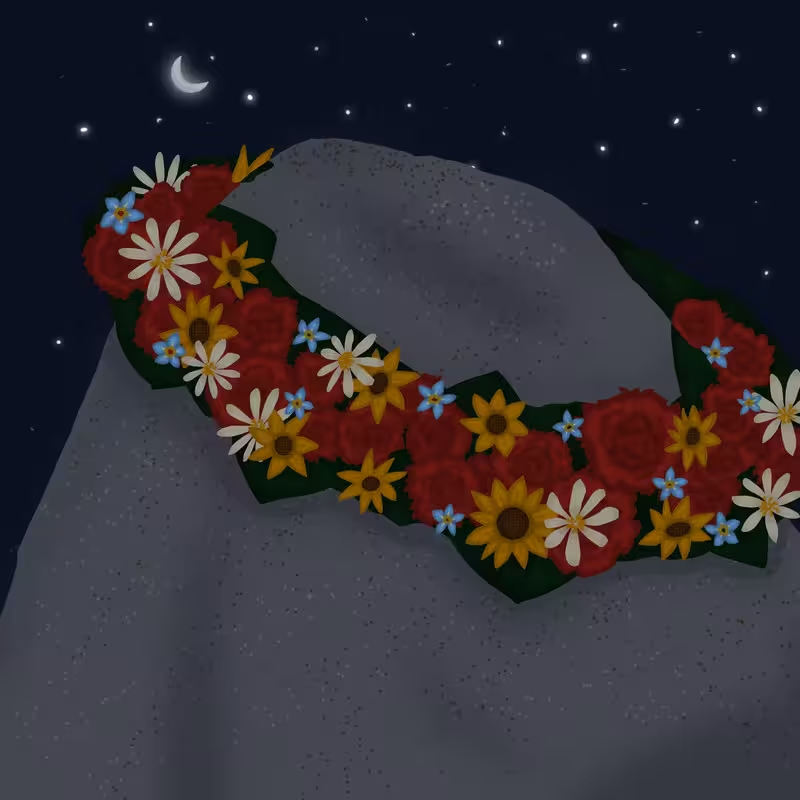
Slowly, the wrapping opened to reveal a wreath of flowers - and it was quite the arrangement. Vibrant red carnations took center stage, lined all around the circle. The red was decorated by yellow, white, and blue - small sunflowers, delicate bloodroots, and silky forget-me-nots in bloom. America spent a while staring at the flower crown. These picks were definitely intentional.
First of all: the carnations. Deep, blood-red carnations. Soviet had been quite forward by choosing to lay these as the base; red carnations were one of the most romantic flowers, not as famously romantic as a rose, yet still expressive of deep admiration and care. America noticed with amusement that Soviet had picked a color that matched both of their flags. He also knew that the red carnation was a symbol of the revolution that led to Soviet's birth in the first place. Perhaps that was why there were so many carnations on the wreath: the color was something that they both shared.
The bloodroots were an unusual choice, which made America appreciate this even more. He smiled, remembering his early days when he would run around in fields of these plants, which were native to his homeland. He traced one of the petals, even older memories resurfacing from centuries back. This was also a romantic flower, however he wondered if Soviet chose this more for its nativity to America's homeland more than anything else. It was also the only white type of flower in the bunch; probably referring to the white of America's skin.
He had to smile when he saw the tiny little sunflowers. Clearly, the bloodroots had been a way to symbolize America; now the yellow petals seemed to represent Soviet himself. Maybe sunflowers had been native to US land, but they were really Soviet's thing now, after his scientists had created breeds to produce oil and that were resistant to disease, effectively rescuing them from obscurity. After that, America had been all too glad to hand the shining yellow flowers over to Eastern hands. He didn't fail to notice the way some of the bloodroot stems were wound around the stems of a few sunflowers, suggesting that the two of them were intertwined. He supposed the depiction was accurate.
And lastly: the forget-me-nots. America supposed that the bulk of their meaning lied in their name. After this careful arrangement of blossoms that inextricably illustrated their convoluted yet tight connection, Soviet decided to top it off with a final plea. Forget me not. These solidified teardrops lived in the Alaskan wilds, a place that had, in some ways, always been a bridge between the freezing wastelands of Soviet's easternmost territory and the wide open plains of America's west. This was Soviet's request to be remembered always, if only by America himself.
The hole in America's chest opened up again, dug out by the news of Soviet's death and now widened by this gift, the last correspondence between them. Soviet must've been thinking about this for quite a long time. He must've made and preserved this some time before his death, picking the flowers carefully and weaving them together with care and skill when he was still strong enough to create art this detailed. America pressed the ring of flowers close to his chest.
Oh, Soviet. My dearest enemy, the light that kept me going, every single day. How could you ever fear that I would forget you?
He sat in that position for a few minutes, holding the flowers tight, one or two cold tears trickling down his face. Then he decided to hang the wreath somewhere safe.
For tonight, it would lean against the wall by America's doorframe. After carefully resting it there and watching it for a few seconds to make sure it didn't fall, America finally decided to go to bed, drawing his curtains shut - leaving that precious starlight blotted out, just like Soviet's life had been.
~~~
Turns out, having a reminder of Soviet hanging over the fireplace in his bedroom was not good for America's mental health. It messed with his ability to get out of bed in the morning, seeing that damned wreath every day as soon as he woke up. Every day was a struggle of fake smiles and trying to pull his frayed nerves into one piece, only for them to break apart again as soon as he got back home, having to see that crown of flowers and being hit all at once by unwelcome memories and emotions, normally leaving him in a heap on the floor. Sometimes he would lay there for hours, tortured by his mind. Grief pulled at him from one side, and the demands of a world that kept turning pulled on the other. He was just the old, ruined rope they played tug-of-war with, pulled taut and always on the verge of snapping, ready to let all that relied on him for strength lose their grip and fall tumbling to the ground.
His staff whispered. What could've caused this sudden instability in their strong, infallible leader? Some brought up Soviet's dissolution as it had happened right before America's spiral, yet they couldn't fathom why that would have anything to do with his new depression. America hated Soviet, right? Shouldn't he be overjoyed to see the commie fall? America heard them whisper that through his door as they walked by his room, where he had been lying on the ground, staring at the wall. His own mind whispered the same questions as the people who worked for him did. America and Soviet had been enemies. Even if their relations had gotten better during the last few years, there was no reason for America to be acting like this.
Eventually, his staff gave up. They had to enlist Canada.
America didn't know about this. Not until he heard a surprising but familiar knock on his door one day, seeing his brother spontaneously visit for no reason that America knew of. "Hey, Can. What's up?" He smiled brightly, but his eyes must've betrayed the pain he was hiding, because Canada's face quickly turned very sober. America got his brother coffee and the two of them sat down on the couch, before Canada finally opened up about what had really brought him here.
"How are you doing, America? I know the past few days have been busy for you."
America leaned back, shrugging. "Eh, fine. Lots of stuff to do, but that's normal. You?"
Canada stayed silent, scrutinizing America's face. With the recent circumstances, if America's response hadn't been I'm absolutely on top of the world, something was very wrong. He'd known that something was probably up already, given that he'd came because of the call from America's secretary worrying about America's emotional state, but this was confirmation that set alarm bells ringing like mad in Canada's head.
"Are you sure?" He finally asked. "Some of your staff called and asked me to come down here because you seemed to be down."
"I don't know what they're talking about, I feel fine." America responded casually, although Canada noticed an uncharacteristic tremble in his voice and how America seemed to be avoiding his eyes.
"..." Unsure of what to say further, Canada let his gaze wander, trailing around the room. He caught sight of a flower wreath hanging on the wall, hosting a plethora of red carnations, dotted with sunflowers, forget-me-nots, and bloodroots. That hadn't been there the last time Canada visited. "What's that?"
America looked up, startled. He'd moved the flower wreath to the living room, given that it was just too much for him to have it in his bedroom. However, the location of the wreath didn't quite change how he felt about it. He just had to wait until he was in his bedroom to have his breakdowns. "That's... a gift."
"From who?"
"..."
Canada stared at the wreath some more. The choice of flowers was odd. Carnations: a symbol of the Russian Revolution. Sunflowers had been very popular in the Soviet Union as well. And forget-me-nots, the state flower of Alaska - the state that had been sold to America, from the Russian Empire, in 1867?
...Oh.
This explained a lot.
Canada turned to his brother, not letting on what he knew. "Was it from Soviet?"
America looked at him, trying to hide his wariness with disbelief. "Why would you think that?"
Canada pointed. "Sunflowers. Plus the fact that it only showed up at your house the day after his death."
America's shoulders sagged. He was unable to hide the truth now. "Yeah, it's from Soviet. His son apparently shipped it to me a few days before he died."
"Why would he give you flowers? Weren't you guys fighting?"
"..." America pulled his knees up to his chest.
"Oh- no, you don't have to tell me if you don't want to- I just want to make sure you're okay-"
"It's fine." America abruptly interrupted him. "Um... yes, we were fighting, but... I... well, he was the other world superpower, right? He was my... competitor, my challenger. I thought our rivalry would always be something that I could count on. Now it's gone." His voice nearly gave out on the last word, hushed and shaking.
Canada nodded slowly. "I... I see." He pondered his brother's statement for a while. "Yeah, you always liked competition. And you guys were... very obsessed with that rivalry for a few decades. I can see why his death is making you feel like the rug got pulled out from under your feet."
If America noticed the backhanded comment, he didn't acknowledge it. "Mhm."
"Then what's up with the wreath?"
"Oh." America said quietly. "He wanted me to have it for some reason. I think he knew he was going to die, and he wanted to... leave me something to remember him by. A final gift."
"... Like a concession? His surrender?"
"Something like that."
Canada stared at his brother some more. Why was America being so vague? Are you sure 'rivals' is the only word you could use to describe your relationship?
America lost himself in thought again. He didn't mention that day when they had met across the Elbe River in 1945. That felt too private, almost like a sacred ritual. Plus, thinking about it just stormed up this whole other stew of feelings, which were simmering somewhere buried deep in his core, and could boil over any minute.
"How do you feel about it?" Canada asked.
"About what?"
"The wreath."
"I mean, it's..." America didn't know what to say. "It's a good reminder of him?"
"... And how do you feel about that?"
"Okay, well-" America sighed. "It's a pretty wreath. It's like a memorabilia of sorts... um..."
"And?"
"I... well, I miss him."
Canada stared at him.
America's shoulders tensed. "Dude, I know- I'm not supposed to miss him- it doesn't make sense to me either, you don't have to-"
"Woah, hey, I'm not judging." Canada held his hands up, backing off. "I'm just trying to help you process this, alright?"
America relaxed, slumping. "Alright."
"So... you miss him." Canada repeated back to him. "Is it helping, then? Having that little memory of him up there?" He gestured to the wreath.
America bit his lip, looking a little conflicted.
Canada waited.
"... I don't know." America finally said. "I see it a lot, and it makes me remember a lot of things... those memories upset me sometimes."
Canada frowned. "Then you should get it out of your house. You're not getting the distance from the situation you need to fully grieve."
"I- I can't." America looked scandalized at the idea of removing it. "It's supposed to be a reminder. It's... I'm pretty sure he made this as a way to ask me to not forget him."
Canada blinked, then wheezed a little. "America... let's say the wreath was gone. Let's say any physical thing you had that was a reminder of Soviet was gone. Even then, do you truly believe that you could ever forget him?"
"I don't know..."
"Dude. You've been at odds with him for decades. I've never seen you obsess over anybody the way you would stress out over him. Let's face it, he was your whole world for a long time. Now, tell me: even when the moon falls into the sun and the clouds turn red from raining blood, could you forget him?"
"I guess not." America offered a weak smile.
"Then you don't need that wreath up there to remind yourself of him. Now of course I'm not saying to throw it away, but it doesn't need to be in your house. You could give it to Bush, I guess. I think he'd appreciate it."
America laughed. "Thanks." Unexpectedly, he hugged Canada, squeezing him tight. "Thank you. I think I needed this conversation."
Canada hugged him back. "That's what brothers are for, no?"
America lightly slapped him on the back. "Now do you plan to stay for dinner or are you going home?"
"As much as I'd like to eat with you, I have a meeting at my place tonight, so I need to go back now." Canada sighed.
"Well then, I'll see you later." America started walking them to the door. He gave Canada one last hug before he left. When he pulled away, he added one more thing: "Also, I know where I'm going to put the wreath."
~~~
Normally on New Year's Eve, America went to a party in the White House.
Not this year, though. A quick phone call with Bush got him excused, and soon, America was making arrangements for a flight to Hamburg, Germany, from where he would take a cab to Elbe.
The cab driver was surely wondering why America wanted to get off at this specific bridge on the east bank of the river in the middle of nowhere, but given that he was driving the literal representative of the United States of America, he didn't say a word.
After paying the driver, America tucked the wreath under his arm and walked up along the bank of the river, looking for the place where his and Soviet's armies had made camp forty-six years ago. It was a long walk, given by the way he frequently stopped to stare at the stars and moon, lost in the memories of the space race and the war, replaying old moments over and over again like a broken record.
The passion... the craziness... the danger... It felt like a fever dream to him now. America didn't think he'd felt so much in a long time, and he wasn't likely to either for a long time after this.
Maybe that's why he missed Soviet.
Where was the line between love and hate? Not the level of intensity both required, obviously. Not the obsession, either. Sometimes, the difference was clear-cut, and sometimes, it was not. America supposed he and Soviet had always been dancing on that line. Which side were they on? He highly doubted he'd ever find out.
That frenzy was a thing of the past. The intertwining of their fates had crumbled, and now America was left with nothing but a bitter, frayed respect for the one man who was capable of driving him up the wall - then disappearing, stranding him there.
He knew he was at the camp point when he saw a familiar tall, indented rock. A memory rose up again, one of Soviet cursing loudly in Russian as he tripped over that very rock, nearly tumbling into the river. He would've, too, if America hadn't pulled him up just before he rolled off the edge.
America had saved him from the fall that time. But over forty years later, he couldn't. In the grand scheme of things, America had swiped for Soviet's hand, but missed, leaving him to be washed away by ruthless currents. He couldn't save him then.
He checked his watch. 11:48 pm.
He walked around the grass near the river, fragments of the night he spent with Soviet here flying through his mind in bits and pieces. Screaming insanities, running and laughing together like kids - the memories of that pure, unfiltered joy lingered at the tip of his tongue, taunting him. America could spend hours forgetting, but he would always remember. He could make a second last forever, but only for that brief, fleeting moment, and then it would come to an end, leaving him grasping at straws, cursing his knowledge of euphoria and true freedom yet never being able to truly live that feeling again. Wind and rain had worn the tips of the indented rock away, until its sharpest edges were just rounded nubs. Good things didn't last. They didn't. They didn't. They happened, and then they were just gone.
He laid the wreath, that precious, wretched wreath atop the rock, letting the flowers bring some life to the cold, emotionless gray. He wished it was that easy to bring life to a soul. He wished he could bring Soviet back by putting flowers on his head, thus restarting the beat of his own cold heart that seemed to have died alongside the infuriating, beautiful communist.
11:53.
Should he try to dance, now...? He remembered the feeling of dancing with Soviet under the stars, and he wanted it back. Could he lose himself again by the banks of the river, even if he was alone?
... Nope. He couldn't do it. The spark wasn't coming to him. To fly away from the world, he had to unlock his chains, and Soviet was the one with the key.
11:55.
He slumped to the ground.
This was... this was it, then. Forty-six years ago, he and Soviet had tied their fates together, consummating a confusing, twisted reign of flames, ones that melded love and hate together seamlessly under the stars. Now the fire had been extinguished, ending at the same place where it began. America kneeled by the wreath, lifting his head to observe the night sky. The stars were in exactly the same place as they had been that night in 1945. Everything that had happened between 1945 and now had practically turned America's whole world upside down, yet the stars remained unchanged. Even two superpowers, locked in a deadly, burning embrace that seemed wild enough to shake galaxies were insignificant to the cosmos, and soon enough, they would be swept away by the waves of time, fading into obscurity as the stars watched on.
One night, America and Soviet had been here, fitting each other like a girl's toy doll and her custom-made clothes. One blink later and the doll was gone, leaving the clothes to hang limp on the neck of a ghost.
America stroked the petal of a carnation one last time, before resolving to get up and start walking away. Tonight was supposed to be his closure, after all. At some point, he actually had to... close it.
He stared at his watch.
Three.
Two.
One.
"..."
A new year commenced, making its entrance to the silence of the deserted land upon which America stood. 1992. It was 1992 now.
Soviet had died on December 26, 1991.
The Soviet Union was now truly a thing of the past.
America felt his heart clench. Indeed, with every passing second, the winds of time carried Soviet further and further away, rotting what was once a blinding, all-consuming present into a graying, dim memory.
He recalled being alone with the communist in a meeting room, sometime in 1974. Hostile, cold words had been exchanged like always, but at some point, Soviet looked up and stared him directly in the eyes, blue burning against gold, and he spoke.
One of us is destined to be nothing more than the other's future history.
America thought he understood it then. But really, he didn't understand the full scope of that statement until now.
He stared mournfully at the moon one last time, before turning around and walking back down his path along the river bank. He left the last physical reminder of his enemy, his love, and his history on the banks of the Elbe River, yet the emotional reminder would never pass on. Regardless of Soviet's human susceptibility to time, America knew with utter conviction that he was immortal in one place forever, and that was in the depths of his own heart.