Chapter Text
He is trapped.
He knows, distantly, that he should be used to this by now, that being kept in cells is something that’s expected of him, that he betrayed his handlers and left them all to die and that being put in a room secured by glass even he can’t break with a clean bed and three meals a day is far from the worst possible outcome for a defective weapon. He knows he should be glad that he hasn’t been recalibrated again, that they haven’t seen fit to wipe him. It hurts. It hurts constantly, thrumming in the back of his head until it inevitably fades and he needs to be wiped again, and having somewhere to sleep and access to food that doesn’t come in carefully designed nutrient packs are luxuries that he’s still getting used to.
He should be glad for it. Better yet, he shouldn’t feel anything about it. He’s supposed to be a weapon, and weapons do not have feelings beyond what serves their missions, and gratitude for a bed and for food that has actual flavor and the ability to actually sleep for more than his required hours does not serve his mission. Happiness and warmth and gratitude are not appropriate emotions for a weapon. He should not feel them. He knows that they are an appropriate response to all of this, that he should be glad to have the things that he has never been allowed before. He is not.
He is angry.
It has to be anger. There’s no other word for it. Anger does not truly serve him, either, not in completing his mission; anger is a powerful motivator, but it makes people sloppy, gets them invested, makes them targets. He is not supposed to be a person. He is supposed to be a weapon. He was made to be a weapon, carefully crafted, designed by expert hands. He has not failed before. He was not supposed to fail this mission, either, but his targets—they confused him. They brought up more of these feelings, these things that he isn’t supposed to have, and they told him he was a person even though he wasn’t supposed to be, and he killed for them. He was supposed to kill them, and he killed for them instead, and they were his mission, he had to keep them alive, keep them there, figure out why the blizzard in his head was getting quieter and why their voices kept echoing in his head like second, third, fourth heartbeats, all of them pulsing between his ribs. He made them his mission.
Their handler promised him that it would be alright. He knows him only through the file his (dead, gone, slaughtered) handlers gave him on the Four Horsemen before he was given his mission, the mysterious leader that remained shrouded from the rest of the world. Dylan Rhodes, it had said at first, the lettering stark and bold against the frighteningly delicate screen, and then Dylan Shrike, the shape of the text itself seeming to shift with the change in the name, as though there was some sort of magic to it. He told him, foolishly, that he could not risk the Horsemen dying, and he used it to bait him into this trap. He trusted him, because he was a handler even if he wasn’t his handler, and he understood missions.
He was supposed to understand. He was not supposed to lead him into a comfortable cell and tell him that he was going to be “helped.” That he was a person and not a weapon. That he was supposed to do something other than follow orders. He is being changed from whatever he was built into, and he does not know whether he should be happy about it, but the anger is easier to understand. It is easier to feel. It’s almost comforting. There is so much for him to be angry about, and it comes so easily, and he lets it drown him.
You took me away, he snarls when the Horsemen come to visit, watches them go wide-eyed and stunned, McKinney’s jaw clenching and May’s footsteps faltering and Reeves’s mouth twisting into a frown and Atlas’s hands twitching. You took me away from my purpose. My mission.
You’re dead. The second I’m free of this place, you’re dead. All of you.
They don’t expect the anger. That’s half the fun of it, really, and it is fun, in an awful sort of way, a way that makes his stomach twist uncomfortably and his heartbeat race out of control. He smells the acrid scent of fear in the air and grins, showing all his teeth. He slams his metal fist into the glass, unnerved by how little it gives under his strength and pleased by the way that they pretend not to balk. He paces back and forth at the edge of the room like a wild animal, and he spits vitriol that he barely understands. Coward, try-hard, traitor, control freak. He hurls the first words that reach his lips at them, watches them land like his knives, sinking deeper in a way that all of his blows never seemed to. They didn’t fear him when he was hunting them. He still doesn’t understand that. He was good at it, he knows, from the way that McKinney still limps and Atlas favors the side that didn’t wind up with a bullet in it and May freezes when he moves too quickly. He was excellent. He was perfect, and they still didn’t fear him.
Now that they have him trapped, they are terrified. Some little voice beyond the blizzard pipes up and calls it irony. He thinks that’s probably right. He doesn’t have much experience with concepts like that, he thinks, but he clings to it all the same. It is ironic. They’re scared of him now that they’ve neutralized the threat. He might as well lean into it. Maybe he’ll figure out a way out before they unmake him again.
That must be what they’re trying to do. It’s all that anyone has ever done when they get him in a cage, and this cage might be nice, and all the people in the white coats ever do is take blood while he’s restrained and ask him questions and show him things and talk about the brain and elasticity and neurology, which is a damn sight better than the chair, but something sickly-sweet and poisonous still fills his mouth when he realizes that he is not the Asset anymore. He has not thought of himself as the Asset since he woke up in this room. It is a sign, he thinks, that they are succeeding. The worst part about it is that he doesn’t hate it. He doesn’t resent it.
He isn’t what they call him instead, though, either. He isn’t—that name. He can’t be. The people asking him questions don’t really seem to care all that much either way, too curious about what’s made him this strong, this fast, this unusual, but the Horsemen clearly do. It’s easy to read the guilt on Shrike’s face when he tells him as much. He doesn’t even try to hide it, which is almost concerning, considering that he knows he’s spent the vast majority of his life pretending to be a different name. He can’t imagine how he succeeded if he’s this obvious about something as irrelevant as guilt. It’s there in his eyes, something haunted and hollow, and in the way he tucks his hands into his pockets when he speaks, shoulders bowed under some weight he cannot fathom carrying.
He is not a very good actor. Not to him, at least. He has been trained too thoroughly on reading a mark, even if infiltration and espionage were never what he was used for, and the tiny shifts in his body language are easy to pick up (though if he’s as good as the file said he was, perhaps Shrike is just letting him see what he wants to see). It is also how he knows that he is not afraid of him.
The others are. They’re terrified. They all hide it, up to a point. He pushes them past it every time, waiting for the moment that they don’t come back. He talks to Reeves about how her pulse felt under his fingers, thready and fluttery like a bird, and how easy it would’ve been to crush her entirely. Snarls at McKinney when he so much as opens his mouth, reminds him that he would’ve cut his tongue out if he hadn’t somehow made him lose his mind. Doesn’t spare a word for May beyond the most basic of insults, because she was annoying, certainly, but she never made him feel unmoored from reality, from his identity, from the Asset. He tells Atlas he wishes that May hadn’t thrown off that shot, that he’d be better off dead before he decided not to make it quick, that he was going to be merciful on the roof but now he’s going to break his fingers one by one and render them unusable before he crushes them to pulp.
They flinch, often, particularly when he slams into the glass, when he tries to break it, when he screams at them for trapping him here and confusing his mission and tearing him away from what he’s supposed to be. He relishes the ringing sound that his knuckles make when they collide with the reinforced barrier, watches them scramble back as he purrs insults. Coward, he tells McKinney, grinning. Try-hard, he drawls to May. Traitor, he tosses towards Reeves, careless and sharp. Control freak, he spits at Atlas, though that one never seems to land the way the others do. Atlas laughs more often than not, a bitter, broken sound.
He wants to tear his vocal cords out so he can’t make that noise again.
He sends them running, time after time. They have a breaking point. He finds it, and he pushes past it, and he watches McKinney shoot back a deliberately careless retort and turn on his heel, his shoulders shaking almost imperceptibly. He watches May’s eyes cloud with tears, hands gripping the hem of her sleeves fiercely before she whirls around and storms out, her irreverent humor inevitably fading. He watches Reeves quietly say that he’s going to have to try harder than that to scare them off, even as she flinches and stares at the ground, one hand clamped over the bandages on her arm. He watches Atlas rock back on his heels, eyes unusually glossy and darting towards the corners of the room, head tilted towards the nearest exit and the side of his body with the biggest wound angled away from him. He watches them all go.
They never stay away, though. He tries, over and over, to hurt them so badly that they’ll never come back, to spit enough poison that they’ll finally turn away from him, and they don’t. Someone always appears after one of them leaves, trading off in perfectly timed shifts. When he overwhelms the other four, then Shrike appears, always guilty, never afraid, no matter what he does or says, and he only leaves when one of the others walks back in.
They always say goodbye before they leave, too. They never just disappear. They talk to him. They don’t ask him to remember things anymore, but they talk to him. They ask what the scientists are up to, and if he’s getting enough to eat, and if he’s sleeping alright, and if there’s anything they can get him—cards, books, whatever they can scrounge up. He never answers without another insult, doesn’t deign to respond, but they don’t quit. They’re stubborn. It’d be admirable if it wasn’t so annoying.
He doesn’t figure out why for a while. Weeks, maybe, or a couple of months. It’s hard to track time in his room. He’s allowed to sleep whenever he wants, now. It’s odd. Not unwelcome, he’ll give them that, but it’s odd. He still does his level best to stay awake and keep an eye on what’s happening. He just…isn’t being ordered to sleep or wake anymore. It’s under his control.
It’s strange to have things under his control.
He doesn’t always sleep, but he does doze, eyes closed and body relaxed and his breathing imitating the slow, steady patterns of true slumber. It’s why, he thinks, the Eye’s scientist doesn’t realize he’s awake when they call the Horsemen over. It’s why they don’t seem to think his enhanced hearing, good enough that he can pick up on murmurings throughout the entire safehouse (but not quite good enough to focus in on any of them) will be an issue. It’s why they broach the subject of “giving up” on him, on letting him be this hollow, angry monster that doesn’t know who he is. It’s why they suggest leaving him here to rot, where he can’t hurt anyone else, because he can’t be fixed.
They don’t use those exact words, but he hears them on their tongue all the same, and something coils in his gut that it takes him a day to identify despite reading it on the faces of his visitors so easily. Shame. Guilt. Neither of which are things that the Asset would feel. He’s no longer the Asset, though. He is not the Asset, and his face is warm with shame when he realizes, and his stomach leaden with guilt. The rage falters, just a little. He has not been kind, by choice, and hearing the words in the mouth of someone who is not his target is enough to rattle him.
He was not built to be a kind thing, a good thing. He knows he has been cruel, deliberately. He wanted to be. He is hollow, and he is angry, and he has been a monster, and this horrible fear starts to brew under the rage until it pierces through it, and there’s the shame, burning him, and the guilt, drowning him, and he waits for them to agree, to send him away, to leave him here to die—
There’s the sound of flesh on flesh, and furious shouting, and Reeves’s voice rises above them all even as the scientist cries out in pain and May yelps, Reeves’s first name flying from her tongue. None of it seems to give her any pause. Her voice crests higher, warm and raspy and real, and she shouts that he’s their friend. That he is one of them , and she doesn’t care what insults she has to sit through or how angry he is, because they left him before and he suffered for it and they’re not leaving him now. She doesn’t care how dangerous it is, he hears her say, and the other Horsemen murmur in assent. If they’re too afraid to try and help someone the way they’re supposed to, they can quit, but she’s not leaving.
Suggest that again and I’ll do a helluva lot more than punch you, she says, and her voice blazes like fire, and some part of him feels warm for the first time in years. The rest of him just sits in that shame, and that guilt, and he very nearly does not move until she comes to visit him again four days later.
He recognizes the sound of her shoes, the scuff of the soles on the floor. Not heels today. Boots. He lifts his head from his position against the back wall, watching her approach. She has the leather jacket again. It’s too broad in the shoulders for her, but she’s wearing it like it’s armor, red hair striking against the black fabric. She’s always striking.
She’s always been striking, says a voice beyond the blizzard, and he snarls instinctively, rocketing to his feet—
And she freezes.
He goes still, shame burning its way into his chest, guilt pooling in his stomach again. That voice takes its opportunity. You’ve been awful to her, and now she’s scared of you, it says, almost gleeful. You were unkind, and she defended you anyways, and now you’ve scared her again. Some friend you are, Wilder.
He shakes his head furiously, easing himself back down onto the floor. That’s not his name. He doesn’t know that name. Reeves knows that name, though. The others all do. It can’t be his, can it? “I—sorry.”
Sorry is not a word that the Asset ever used. The Asset did not feel remorse. He’s not the Asset anymore. He’s not sure he wants to keep being this awful, angry thing he’s become either, even if he’s pretty sure he’s not who they want him to be. “I’m sorry,” he repeats quietly, and he draws his knees to his chest, wraps his arms loosely around them. It’s a comforting position. It feels familiar. “I wasn’t—reacting to you.”
Reeves blinks at him. There’s a flicker of hope across her face, something bright and warm that lights her up from the inside out, and a lump starts to form in his throat. “The others said you’ve been quieter for the last couple days,” she says. Still cautious, still wary, but she takes another step closer. “Are you okay? You look upset?”
You look upset.
She still has stitches from the gashes he left on her arms. He can’t see them now, not with the way they’re hidden under the jacket’s sleeves, but he can smell the copper in the air, the faint haze of pain that still trails after all four of them. There’s a cut splitting her left eyebrow that his knives left. The marks on her throat are gone, healed, but he blinks and they’re back and he blinks again and she’s black and blue and gasping for breath and dying and his hands are covered in blood and she died and it’s his fault and Henley’s dying and he did it, he fulfilled his mission he killed her but Henley’s dead and he killed her and he can’t breathe—
“Why do I know you?” he blurts out. It’s embarrassingly mangled, the words stretching oddly as they force their way past his lips, the world going blurry and the pressure behind his eyes growing worse. He can’t breathe. He’s not sure he can breathe. “Why do I—I don’t know you, but I know you. Why do I know you?” Why does it hurt to think about succeeding?
Reeves’s eyes go wide. They’re nice. Hazel. Warm, like the rest of her, her hair and her voice and the temper he somehow knows is quicker than anyone would expect. They’re filled with tears, too, and that pain in his gut grows worse, aching until he nearly doubles over with a rasping sob, and then she’s sitting in front of the glass, as close as she can get. “We used to be friends,” she says, and her voice is softer than usual. Gentler. He’s not sure if he likes it or not. She sounds sad. “We are friends. We just—Jesus, Jack, you were one of us. A Horseman. And I know that you don’t remember what that means, not to us, but it was—it meant we’d burn the world down for each other, you and me and Daniel and Merritt, and it was supposed to be the four of us at the end of it. I’m sure the people you were with told us about our big show a couple years ago, yeah?”
Of course they did. They were in all the briefings. He was barred from watching the footage, but he had to learn who they were to be able to hunt them. To counter them properly. They did not send him in unprepared.
Reeves’s smile twists a little bit, aching with grief. “There was a trick in the show that no one knew about. No one but us, and Dylan. He set it up. You were gonna have to lead the FBI on a wild goose chase, this epic scene right out of an action movie, and you were going to fake your death.” She takes a slow, shuddering breath. His chest aches again. “But it went wrong. Your car crashed. We thought you died.”
There was fire. He remembers the fire. He remembers smoke and gasoline and hands dragging him out seconds after the shadows at his vision bolted away from the fire and smoke and he remembers crying out and no one heard him, no one—
“We were friends,” Reeves whispers. Her eyes are fixed on him. The tears haven’t fallen, but they’re still there, and he can taste saline as well as the copper of blood when he breathes. “We were a family. And we lost you.”
We lost you.
He blinks, and there’s a city by a river full of towering buildings. He blinks again, and there’s red hair and a fire escape and a chipped mug of something warm in his hands. He blinks again, and there’s lemon soap on his hands and a sink that he’s trying to scrub out to make it usable while someone laughs and flicks water at him. There's nothing more than that, but it's enough. It's enough to start with.
He blinks, and Henley looks back at him.
“High Priestess,” he says automatically, the words tumbling out before he can stop them, syllables running together until they barely sound like words at all. Henley’s eyes go wider, somehow, and he hunches in on himself, embarrassment filtering through the storm of guilt and shame and grief and something like attachment— but she laughs a second later, scrubbing a hand across her face.
“Yeah, that was my card. Shit, you remember that?”
He does. He thinks he does, at least. He remembers a dingy hallway, remembers feeling excitement, warmth, bubbling together in his chest, remembers gloved hands holding up a card. High Priestess. “What was my card?”
Her face clouds a little, and he flinches back instinctively. “You should ask Dylan,” she says, leaning back a little bit. “He’ll explain it better than I can, and you deserve to hear it from him. There’s a lot he’s gonna want to fill you in on once you’re up for it, but that’s a pretty big one.”
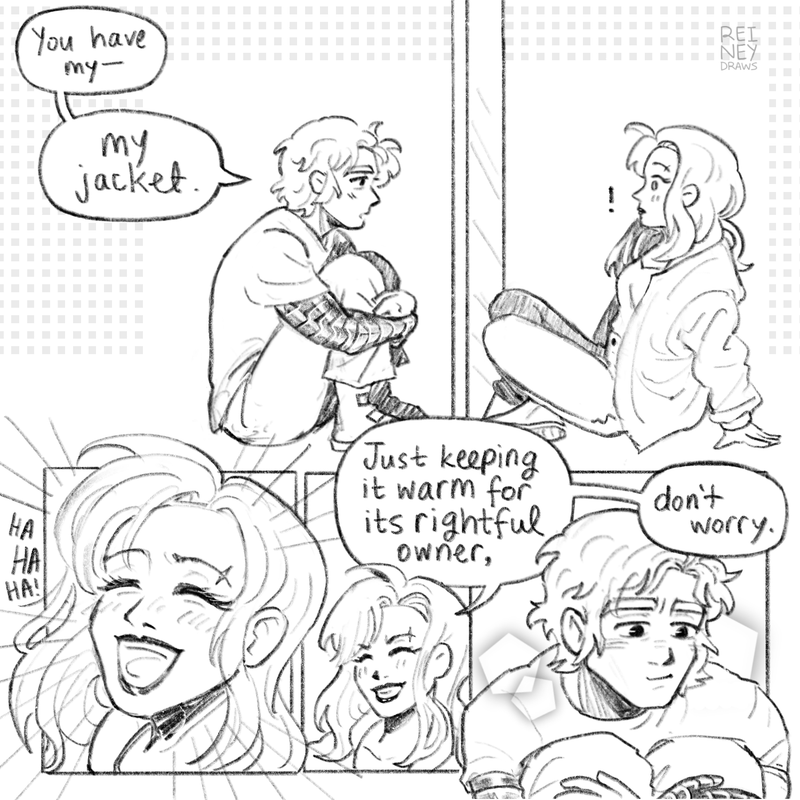
Ask Shrike. Ask Dylan, he corrects after a moment, and he nods slowly. The pressure behind his eyes is still there. He’s not sure how to get it to go away. “You have my—my jacket.”
Henley laughs again, and this one sounds like the one that echoed off of the fire escape, bouncing between brick walls in the back of his mind. There’s none of that awful, heartbroken echo to it. She sounds brighter, happier, bolder than he’s heard her at all. He shouldn’t be able to tell the difference, should he? His chest shouldn’t feel this warm when he realizes that she sounds like she’s actually happy. “Just keeping it warm for its rightful owner, don’t worry.”
That’s a joke, he thinks. He’s not going to get that back. He tries to remember how to smile, how to laugh. It doesn’t really come, but he pulls his face into the closest possible approximation, and Henley’s grin widens, shining like a million stars, and it feels a lot better than being angry.
The next day, he wakes up to the black leather jacket folded neatly at the end of his bed, gleaming faintly in the light. He stares at it, that lump in his throat returning. His hands are trembling when he reaches for it, when he finds unfamiliar burns and familiar water stains, all the little imperfections of something used and loved for years; shaking hands are not permissible, would make it impossible for him to pull a trigger or aim effectively, but he can’t stop them. He’s not the Asset now. Maybe he doesn’t have to.
It’s warm under his hands. The leather is smooth. He pulls it on, the silky lining like a balm against his skin, slipping over the plated metal of his right arm without snagging or catching, and he breathes in the citrusy scent of Henley’s perfume and the smoke-and-gunpowder of the fire and something beyond even that, achingly familiar. It’s the tiniest bit tighter in the shoulders, but he’s worn this thing for years. It’ll adjust. Leather softens, eases over time. It’ll fit the way it’s supposed to again.
He lifts his head when the door creaks open, McKinney and Atlas—Merritt and Daniel—approaching, one with practiced ease and the other quick and unsteady, both moving in tandem. Merritt’s footsteps stutter to a stop when he sees him, his hand snagging at Daniel’s shirt and earning a hiss of pain in response, but the sound fades the second Daniel meets his eyes. Blue-and-blue, he thinks dimly, curling into the safety of the jacket a little more. One pale and knowing, the other icy and piercing. The same color, different shades.
Merritt stares at him for a moment longer, and then his face splits into a wide, gleaming smile, too bright and real to be for show. “Lookin’ good, Jack.”
“Thank God that’s back where it belongs,” Daniel adds, but he’s grinning too, and his eyes are shining. “Henley was more protective of that thing than she was of our safehouses, honestly.”
Jack tucks his hands into the pockets of his jacket and tries to smile again, and it’s just a little bit easier this time.