
Chapter Text
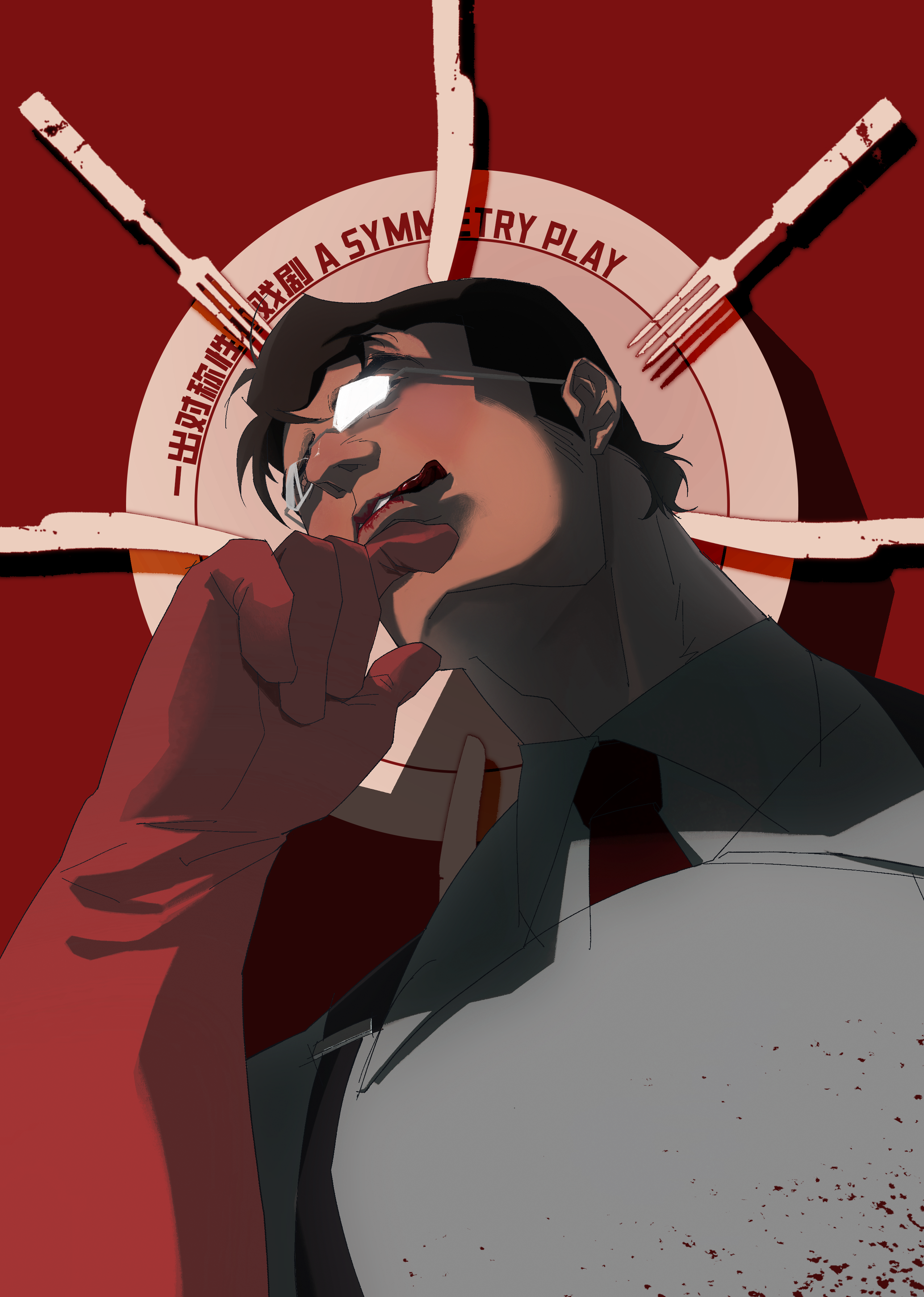
The curtain rises. Only dim overhead lights illuminate the stage. A soft, rhythmic hum can be heard, resembling the sound of a heavy-duty electrical appliance in operation. At the center of the stage, the outline of a long table is visible. The table is made of metal, its smooth surface reflecting a silvery gleam. Uncovered by any tablecloth, it resembles more of a kitchen prep counter in a restaurant’s back kitchen—or perhaps a forensic examiner’s autopsy table—than a dining table. To the right of the table sits a man on a chair, his profile turned toward the audience. In the dim light, his features are indistinct; only his glasses and a long coat are discernible.
Suddenly, the man raises his hand in the darkness, gesturing excitedly and shouting loudly. His voice is flat, shrill, and tinged with an odd accent.
Medic
Hey, hey, over here!
The overhead lights brighten, illuminating the doctor's side of the stage while the rest remains shrouded in darkness. His long coat is now clearly a white lab coat. He shifts in his chair, causing it to rotate halfway to face the audience—revealing that he has been severed at the waist. Only his upper body remains, propped upright on the seat. The lower half of his lab coat is drenched in blood, and the hem of his shirt, soaked through, is tied into a knot—likely to contain his spilling entrails. A vivid red tie hangs from his neck, its lower end tucked into the knotted shirt. He also wears a pair of bright red rubber gloves, smeared with blood.
Medic (cheerfully, delightedly)
There's a cold storage room under my house, about a hundred square meters. I renovated it myself—fits like a glove, incredibly convenient. Finding a place with a basement that could be converted into a cold storage took me ages! Convincing the landlord was another story. Hah, but in the end, I got exactly what I wanted. Put in the effort, and you'll usually get your way eventually.
Do you know how to DIY a cold storage room? Truth be told, I wasn't entirely sure either. But from the start, I had a rough idea in mind. See, you've got this big space, and you divide it into two sections—one large, one small—like a child gleefully daydreaming about how to use a room, reveling in that unbridled joy of imagination. The inner section is bigger, meant for storage and kept at a lower temperature. The outer one's smaller, just enough to fit a dissection table and workspace—it doesn't need to be too cold, and frankly, it's better if it isn't. Cold enough that my fingers won’t freeze, and that’s plenty. For that, you’d place the refrigeration unit in the inner room and build an insulated wall in between, with an insulated door on top. And just like that, you've got the general idea of what the cold storage should look like.
Medic pauses, lost in thought, utterly enchanted.
Medic
I had a colleague help me with some of the work—the cold storage project, I mean. He's an expert. A dear friend too, and like me, a scientist. I do look like a scientist, don't I? Wearing this lab coat, stained with blood. Usually, the blood on me isn't my own—today's an exception. In scientific research, you can't always worry about staying clean. Especially in my line of work.
Have I not mentioned what I need the cold storage for? Oh, this is the main event! Well, well, it's not strictly tied to my research itself. But sometimes, during an experiment, you develop a connection with your subjects—even affection. Humans aren't cold-blooded creatures, after all. Though, come to think of it, "cold-blooded" isn't quite accurate either—their blood isn't cold, and of course, it could even be transfused into our bodies—but I digress.
Once you've formed an attachment, you wouldn't want to just toss them out like trash after the experiment ends—bang!—straight into the bin. Have you ever thought about how this city handles them? If you dump them into the garbage bin outside your house, they'd belong in the "food waste" or "wet waste" category—the green plastic bin. Then, when the garbage truck arrives—always in the dead of night—mechanical arms reach out, grab the bins, and dump their contents into the truck's compartments. And just like that, your test subjects, your beloved test subjects, would sway and stink their way to the waste processing plant on the outskirts of the city. There, they'd be thrown into a giant vat with all the other rubbish, broken apart and shredded by a massive blender—what kind of filth ends up in there! In that vat, their brains would churn into mush alongside half-eaten apples, their limbs would mingle with greasy fried chicken scraps, and their eyes—their blue eyes! Those delicate little hollow blue discs—would be torn apart, skewered on turkey bones. What good could come of that?
Now, I must clarify, I'm not talking about human dignity here. This is purely about scientific rigor. Turning brain matter into smoothie is neither practical nor meaningful. So, to dispose of my leftover experimental materials—and to ensure convenience for future research—I came up with this idea: I'll store my used specimens in the cold storage. That way, when I miss them, I can visit, and when inspiration strikes, I can retrieve them. Isn't that just perfect?
Medic grins, spreading his arms wide and waving them triumphantly. The bloodstains on his coat spread further. Unbothered, he glances down, adjusts the knot in his shirt, and settles his severed torso more securely on the chair.
Medic
Of course, with such readily available low-temperature conditions, the range of experiments I could conduct expanded significantly. Even my friend—the one who helped me renovate the cold storage—occasionally brings his own materials over, just to borrow the temperature-controlled environment. By all accounts, it was a stroke of genius.
Naturally, it didn't take long before my cold storage was filled with the remnants of my experiments. I stored them upright, and sometimes, they almost looked alive. How marvelous! You'd gaze into those eyes, fully aware there was no soul left behind. Ah, but I've long since confirmed that in this miraculous city of ours, through certain methods, a soul can linger in a body that's lost its physiological functions. Or perhaps this is our unique trait—after all, we each have nine souls… Hm. At any rate! My current research has achieved a 60-minute window of soul retention. Though, it requires a complete—or mostly complete—head, a sliver of blue whale pineal gland, and just the right temperature. Not too high, not too low—a standard refrigerator's chilling compartment is perfect, so anyone can try this at home. With further experimentation and the right equipment, I'm confident this duration can be extended. And during that hour? The subject remains fully conscious, with complete control over whatever body remains attached to their head.
I always seize the chance to chat with them during this time. We're so alike! Identical, really. If I could show you my collection, you'd be astounded. Not only do they look exactly like me, their thoughts align perfectly with mine. We share the same soul, the same brain! Before this, we'd never spoken. They belonged to the opposing faction—our interactions were always violent. But after discovering how to bring them home and stabilize their soul, I finally got to converse with them. It's utterly intoxicating! From the very first moment, we clicked. In our earliest talks, I scoured every unique detail of myself, recounting every experience, every surgery, every scar. They'd lived it all too. I couldn't find a single difference between us. Then, I began describing everything I'd done to their corpse—they just smiled. I knew they'd done the same to me.
But due to our city's peculiarities, their soul could never linger long on my operating table. No matter how reluctant, soon enough, they'd revert to an ordinary corpse, their soul fraying strand by strand back into the cycle of rebirth.
Naturally, I conducted every experiment my imagination could conjure on them. Oh, how happy I was then! It was the same exhilaration I'd felt planning the cold storage. And then—do you know what occurred to me after exhausting every possible procedure, every modification I could perform on them—on myself? Yes, at that point, I shed my scientist's skin and reverted to a childlike state, perceiving the world through raw senses. I'd touched them, listened to them, studied them—but I hadn't yet tasted them. That's when I began carving out select portions before storing the body, ensuring the pieces were non-toxic, then cooking him in every conceivable way—experimentally, curiously—until each piece found its way between my teeth.
A new sound layer emerges—the sizzle of oil in a frying pan—barely audible beneath the ever-present hum of machinery. On the dimly lit opposite side of the stage, a silhouette of a man stands at a counter, seemingly cooking. The scene is faint, almost ghostly. Meanwhile, the Medic, bathed in bright light, continues speaking, rapt and euphoric.
Medic
In many times and places, humans have consumed their own kind. Oh, don't look at me like that—you must know this, yes? It's a rather... delicate tradition. Truthfully, before him, the idea of eating a person had never crossed my mind. I've never been one to chase culinary pleasures. My usual meals are just enough to keep me going, and when a colleague is feeling generous, I might even get a bite of their sandwich. That's more than enough for me. There's something profoundly gratifying about sharing food with a friend. On those rare occasions, I savor every crumb.
But him—ah, that's another matter entirely.
Medic pauses briefly, lost in thought.
Medic
Should I tell you what he tasted like? ...Ah, perhaps not. Putting it into words feels too intimate. Even I understand that in human interaction, some things can be said aloud—while others risk causing pain. And now, describing his flavor to you... somehow stings. Funny—I'd never known this premonition of sadness before! A direct stab to the heart—haha, is far more straightforward.
But there are other details I can share...
Once I began attempting to eat him, I came across a 17th-century recipe. I wanted to make him delicious, you see. After all, he had offered up his body—it would've been irresponsible to proceed half-heartedly and conclude, "Well, his taste is underwhelming." Besides, as I mentioned, humans consuming humans is hardly unprecedented. The recipe was written by a German physician. Ha! What a coincidence. Following its instructions, I conducted the most meticulous and elaborate cooking experiment of my life. According to the text, the corpse needed to be pristine—unblemished—and the cause of death had to be hanging, carriage collision, or stabbing. Some requirements were beyond my control: the 17th-century doctor insisted red-haired young men were the ideal ingredient, and I, alas, did not meet the criteria. In the end, after fatally impaling him with a bone saw while preserving his body’s integrity as best I could, I brought him down to the basement. Then, I carved him into small pieces—normally, I only take what I need from his corpse, so this was an act of devotion!—and marinated them in myrrh, aloe, and wine before mashing them into a pulp. The recipe didn't specify red or white wine, so I tried both: a batch with red, a batch with white, and a third with a blend. The red wine stained my fingers purple and seeped into the fibers of his flesh, giving it an unfamiliar hue. Meanwhile, the spices and white wine made him fragrant, almost floral. As I worked, the basement filled with a lovely aroma. Next, I hung the wine-soaked pieces to cure in the cellar's cool darkness. This, again, proved the brilliance of my cold storage design. During those days of patient waiting, the very air in the basement seemed charged with a peculiar magic—perhaps the alchemy of scent, anticipation, and the ritualistic passage of time. I've rarely been happier.
The final product matched the recipe's description perfectly—comparable to smoked meat, utterly devoid of foul odor. The lack of stench might be a general feature of human flesh, though he never carried any unpleasant taste to me. I can't say whether it's because we're essentially the same person, or because humanity has evolved since the 17th century. But my curiosity begins and ends with him—I've no interest in sampling others to test the theory. That said, the recipe claimed this method yielded a unique extract beneficial for wound healing. To verify, I discreetly fed some to my colleagues. No observable effects, alas. A relief, honestly—who has the stamina to prepare him like this every time? Besides, the text implied the medicinal property was exclusive to red-haired men. With our black hair, I suppose we were doomed to be pharmacologically inert from the start.
Medic continues his rambling explanation, but now the lights on the opposite side of the stage have fully brightened. Throughout his speech, the illumination there had been gradually intensifying, and by this point, it matches the brightness of Medic’s side. The sounds of cooking—sizzling, the clink of utensils—have also grown louder.
The man at work is now perfectly visible. Tall and lean, his features are identical to Medic's, with one distinction: his attire—a white dress shirt, a slate-blue wool vest, black trousers, no gloves, and a blue tie. He carries two plates to the table, sets one before Medic, and rotates Medic's chair back to its original position, facing the metal table. Then he returns to the far end, pulls out his own chair, and sits.
Their profiles are nearly indistinguishable—mirror images of the same person—yet they are positioned like host and guest at a formal dinner, separated by a polite distance. Above them, a surgical-style pendant light flickers on (in reality, it's the stage's overhead spotlight), casting a sterile glow over the scene.
Now, the full stage is revealed. At the rear, previously shrouded in darkness, stands a wall adorned with a white lab coat identical to Medic's, alongside a pair of blue rubber gloves. A surgical table is pushed against the wall, flanked by a trolley of gleaming instruments. A heavy, insulated metal door is embedded in the wall, its small square window frosted and unreadable.
Medic (ingratiating, earnest)
Oh, thank you! Is this for me?
Medic (almost bashfully)
Yes. I’ve been hoping you’d try it. For so long.
Medic picks up his knife and fork, cuts a piece, and brings it to his mouth.The man across the table watches him intently, breath held.A rush of blood spills from the severed lower half of his body, pooling beneath his chair.He raises his head. A look of sudden comprehension washes over his pallid face, lending it an uncanny vitality.
Medic
Oh. This is me!
Medic laughed cheerfully. The man across from him smiles in return. They gazed at each other, laughing in unison—their voices eerily identical. After a moment, Medic's laughter gradually faded. His hands go slack. His head droops forward. His severed torso slumps motionless against the chair.
Finally, truly dead.
Blood tap-tap-taps onto the floor.
Medic leans in, examining him with quiet fascination. Then, after a long pause, he rises. He circles the table. Gently, almost reverently, he gathers the lifeless half into his arms. He opens the iron door in the wall—it emitted a loud thunk—and stepped inside. Through the gap in the door, one could see countless identical corpses inside—each bearing the same red markings, each veiled in white frost, each long frozen solid.
The doctor exited the cold storage, shutting the iron door—another resonant thunk. Returning to his seat, he sliced off another piece of steak, placed it in his mouth, and nodded approvingly.
Without finishing what's on his plate, Medic suddenly stands and turns to face the audience. His expression blossoms into delight—eyes sparkling, eyebrows dancing with animation.
He begins pacing excitedly along the stage's edge, his steps light, almost bouncing. Words pour out in that same flat, shrill voice, that peculiar accent twisting each syllable.
Medic
You see, I have this cold storage room in my basement. A hundred square meters—renovated it myself—
Medic's voice fades as the lights dim, one by one.The curtain falls.Yet between the heavy drape and the stage floor, a pair of legs still paces back and forth, back and forth. The speech goes on, it seems—in the darkness beyond sight, in the time between scenes.