
Chapter Text
As historical fantasy goes, How to Train Your Dragon falls down far more on the fantasy side than on the historical. That may not be too surprising, seeing as the entire story started with Vikings riding dragons, but with the development of the movie and television franchise (and games set in the same continuity,School of Dragons and Rise of Berk) the colourfully anachronistic setting has perhaps become more noticeable. Somewhere around Defenders of Berk, I settled on the idea that How to Train Your Dragon was a post-apocalyptic future, and actually found that this idea supplied a number of explanations for the story being told. It is even more marked because Dreamworks puts such effort into the scientific side of their setting, truly grounding their dragons in reality.
Just to be clear, I do not seriously think that Dreamworks are writing a post-apocalyptic story! They are simply telling their (beautiful, incredible) story, and constructing the world as it needs to be for that - with a little rule of cool and/or rule of funny along the way. But I do hope to persuade at least a couple of people that How to Train Your Dragon makes sense as a story of what happens after the world has been markedly changed - a future, not a past.
The broad categories of anachronism are:
- Culture and religion;
- Technology;
- Crops and farming;
- Geography;
- Scientific knowledge;
- The Scourge of Odin
1. Culture and Religion
The Berkians of How to Train Your Dragon (and, in DreamWorks Dragons, the Outcasts and Berserkers) ping us as "Vikings". The runes in which they write, their boats, the axes they carry and the gods by which they swear all make up a sort of vague "Vikingness" that we in popular culture identify without necessarily thinking too deeply about. But many people with some historical knowledge can see immediately that while Berkians may call themselves Vikings, and they fit the trappings of such, they do not fit into an archaeological framework.
My undergraduate degree is in archaeology, but my speciality was human osteoarchaeology (bones and skeletons), so I am neither a historian nor a specialist in the proto-historical period which I am about to discuss. For this, I can only apologise. It is also part of the reason that I will not be going too in-depth in this section. Evidence from this period comes from both archaeological sources and the Icelandic sagas, which were composed in the 9th to 11th centuries CE (i.e. 800-1099).
The Viking era is generally dated as starting in 793 CE (the first dated raid by Scandinavian sailors into England) and finishing in 1066 CE (the Battle of Hastings in English history). It is preceded in Scandinavian archaeology by the Germanic Iron Age, and followed by either the Medieval period or Christianisation depending on the scheme followed. Both of these dates are defined by the start and end of raiding activity upon neighbouring countries, and culturally there was significant overlap at both ends. However, there is a broad cluster of behaviour and culture which we can point to, and which the Vikings of How to Train Your Dragon flatly do not portray.
1.1 Trade and Travel
Historically, one of the things which marks out Vikings was the size of the world in which they moved. Although most Vikings were involved in farming, the culture as a whole was very outward-facing, in both raiding and trading: Vikings settled in America, raided all across North-West Europe, traded with Russia, and worked in Constantinople. In contrast, the Berk that we see is very isolated, with only one outside trader who visits (Trader Johann) and one other island/tribe with whom they have contact in the first two TV seasons (the Berserkers). Out-of-universe, this is probably largely to do with animation costs, but in-universe it paints Berk as very isolated and insular. This would be exceptionally strange for the viking era.

1.2 Religion
I feel the need to make a brief note about religion. There is a background indication of Norse Religion & Lore being in effect within the movie/TV universe - we get references to Thor, Odin and Loki on a fairly regular basis. Historically, the Viking era overlapped with the Christianisation of Scandinavia, but it would not be impossible to not see Christianity within the story as it was introduced by contact with other cultures (and Berk is isolated, as noted in trade and travel).
However, the religious references that we see are actually pretty minimal. Only these three deities are mentioned regularly (apart from one reference to Frigga in Snotlout Gets the Axe, and ones of Freyja in the same and back in Portrait of Hiccup as a Buff Man), despite there being a pretty broad Norse pantheon; there's no nuance, no differentiation between Aesir and Vanir, no reference to the mythological races and creatures that make Norse lore so colourful. There is no reference to seiðr, a form of magic practised in pre-Christian Viking culture. Nobody wears Thor's hammers (torshammere), a protective pendant commonly worn both before and during the Christian era (inverted, it looks a little like a cross!) such as this example found in Købelev, Lolland, and currently in the Danish National Museum.

The overall effect is one that is vaguely reminiscent of pre-Christianised Viking religion, but somehow off, and unfortunately inaccurate.
1.3 Clothing
Clothing, wow, clothing. This is one of the big things that stands out about HTTYD, to me at least. Now, the characters go through various looks, but for the sake of simplicity here I'll use as an example the main cast as they appear in the second film.
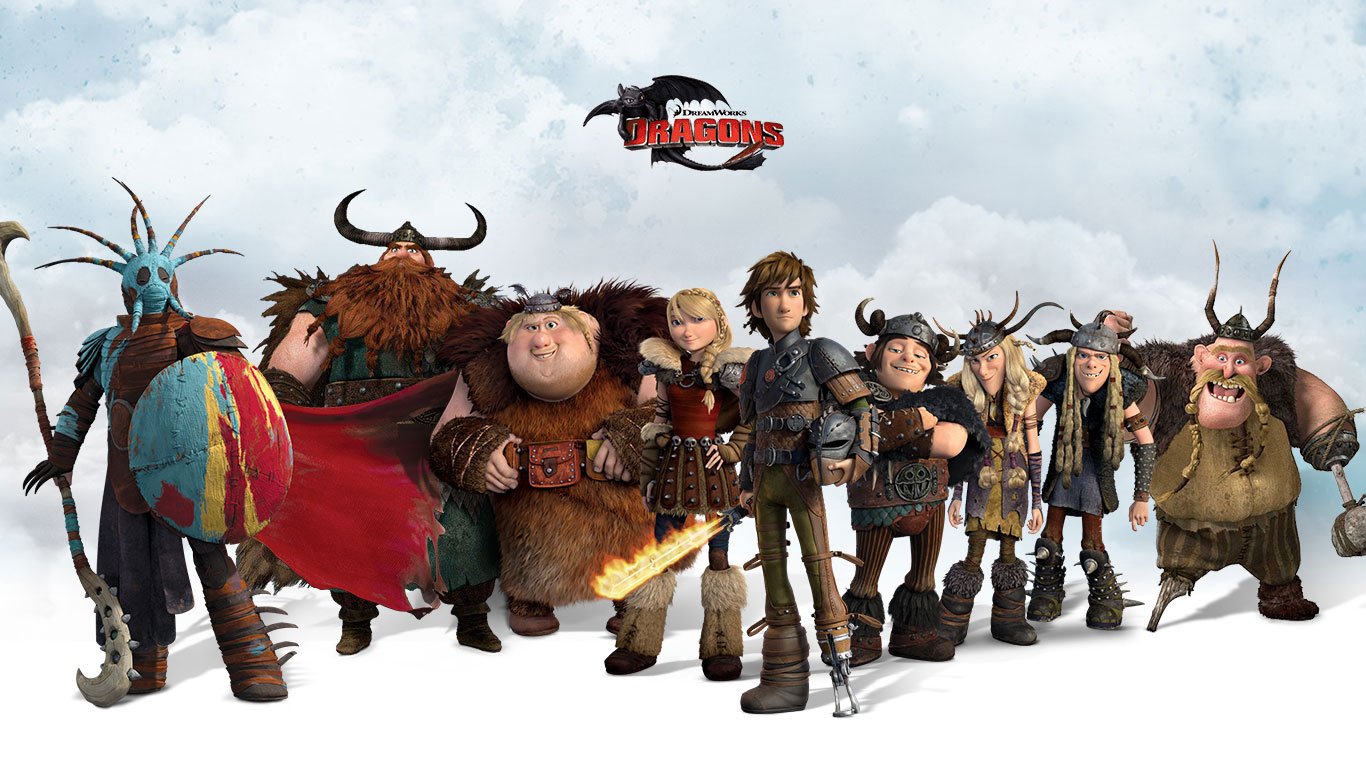
And I'll compare it to some archaeological finds and reconstructions thereof.


From left to right: 1) Original: The Kostrup apron dress; it is generally thought to have been significantly more brightly coloured than this originally. 2) Reconstruction: clothing from the Mammen burial site. Embroidery is speculative. 3) Reconstruction: the Hedeby kaftan.
I'm honestly not sure which parts to call inaccuracies, and which parts to call anachronisms, at this point. In a situation where dragon attacks are regular feature, I'm quite willing to allow for increasingly gender-neutral clothing, as women would need to fight as well in the circumstances. So it isn't too much of a surprise that our female characters aren't wearing clothes like the Kostrup apron dress. And overall, the tunic-and-trousers look is a pretty good default. The biggest issues are helmets and boots, but some items such as Astrid's spiked skirts (which honestly are practically twentieth-century, never mind Viking) and the shoulder armour which various of them wear. Metal shoulder armour, whether called spaulders, pauldrons, munnions or otherwise, was considerably more common in the later Middle Ages, after the Viking Age was over.
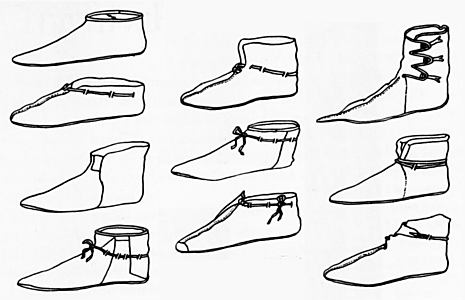
We have pretty good evidence of Viking shoes, with many examples from Hedeby in particular. They are all leather, lightweight and fairly fitted to the foot, with more or less pointed toes. This is nothing like what we see in How to Train Your Dragon, whose boots I cannot honestly compare to any historical period.
Secondly, Vikings did not wear horned helmets. This is something which an increasing number of people are aware of, but which popular culture still links with Vikings. In a more unusual example, this anachronism does not call forward in time - it points backwards. Horned helmets are found in Scandinavian - in the Bronze Age, 1500 to 2000 years earlier than the Viking period. The Denmark National Museum has some great examples, like these ones from Veksø.

2. Technology
This is the area of anachronism which really becomes marked in the TV series. In the first film, the technology at least reads as broadly being from the Viking era, although notable is the large anvil which Gobber and Hiccup can be seen using at various points in the movie, which was not in use until the Medieval period. (I don't know so much about the sharpening stone which Hiccup uses - I have a niggling feeling that this should be checked, but I can't find any sources on the history of sharpening stones of this type.) For the most part, though, it passes a casual glance.


Getting into the series, however, the technology gets a lot more anachronistic. I won't count anything that we see Hiccup or another character inventing, just background technology that isn't touched on. Notable early examples include Hamish the Second's complicated trap system in Riders of Berk: Portrait of Hiccup as a Buff Man. Moving into Race to the Edge, as the worldbuilding increases, so does the anachronism. Even without Hiccup's mad scientist side coming to the fore! Some examples include the massive complexity of the Dragon Eye, the multi-hulled ships of the Dragon Hunters (such ships are not documented outside Austronesia until the nineteenth century, apart from a couple of varieties of Greek ship from the third century BCE), and the complex chemical knowledge which must underpin the conversion of dragon root to an anaesthetic gas as seen in Race to the Edge: Stryke Out.


Obviously, this is only scratching the surface, but it's very clear: although the technological base at first glance appears largely consistent with the Viking Age, there are a lot of things in this world that should not exist even at latest part of the Viking Age.
3. Crops and Farming
Generally speaking, if a plant or animal appears in the movie/TV universe, it's not supposed to be there archaeologically. Unless it's a sheep, or a chicken. Over two years ago, I listed the plants and (food) animals attested to in the How to Train Your Dragon universe at that time; since then, Race to the Edge and How to Train Your Dragon 2 have also been released and do add to the lists.
The pertinent ones are the plants and animals which were not known in North-Western Europe at this time. These are:
- Animals seen: yak.
- Animals referenced: chipmunk (The Terrible Twos), giant clam (Dragon Eye of the Beholder Part 1), turkey (Dragon Eye of the Beholder Part 2), fruit bats (Edge of Disaster Part 1), ring tailed lemur (Last Auction Heroes).
- Plants seen: potato, bitterweed.
- Plants referenced: tomato, coconut (The Zippleback Experience), watermelon (Edge of Disaster Part 1), pineapple (Buffalord Soldier).
- Meals seen or referenced: parfait (The Fright Stuff), figgy pudding (Crushing It), ice cream (The Eel Effect, Crushing It), marshmallows* (Bad Moon Rising).
* Marshmallow-like sweets were made in Ancient Egypt, but were extremely rare until they took their modern form in the 1800s.
- Plants from School of Dragons: squash, black bean, corn, sunflower, tomato, pumpkin, arctic gentian, white pumpkin.
- Animals from School of Dragons: yak, turkey, Ozark cavefish.
Most of these plants and animals are from the Americas, and therefore not known in Europe before 1492 by definition. Others are from Austronesia, and dates of their introduction to Europe vary.
This does not account for those creatures and plants which do not appear in the real world, which include plenty other than dragons! The following plants seem have been created for the universe:
- (Non-Dragon) Animals: bloodbane eel, giant eel, giant electric eel, grimora, giant spider (School of Dragons).
- Plants: dragon nip, bio-luminescent algae, fire fern, blue oleander**, purple oleander, sagefruit, rock blossom, toothache plant (School of Dragons).
** Oleander is a real plant, but its flowers are white-pink-red in colour.
4. Geography
I don't really have so much to say on the geography of the setting, beyond a few observations. An official map exists for the movies and TV series; Berk is generally said to be in the North Sea, somewhere between the British Isles and Scandinavia. However, it is very clear that this to does not map onto an set of islands which currently exists.
Most of the islands and areas are not given real-world names; some of them, we even see Hiccup naming as he goes along (although it is likely that some of them have names which Hiccup does not know!). However, we do get references to real-world places: Tuffnut has referenced Stockholm (Between a Rock and a Hard Place) and Johann's stories have included mentions of Papua New Guinea and Palau. So what looks at first like a fantasy geography has references to real places.
Secondly, on the climatic side of geography, in Zippleback Down Hiccup comments that there is a "dry, hot wind from the north". Plenty of northern European viewers will probably have been confused by that! Generally, a northern wind in north-west Europe means cold dry air, as it is coming down off the Arctic. Most likely this is just a mistake, but for now I'll use it as evidence that the geography of the How to Train Your Dragon world is not quite as well know it!
5. Scientific Knowledge
This is another area which really stands out as anachronistic for a story set anywhere in the Viking era. It's possible that some of the things said and known are a case of 'translation' - for example, the word "clavicle" (used by the twins in Dragon Flower) was not coined until the late medieval/early modern period, but a word for collarbone will have existed before that. However, some of the concepts discussed simply were not known at the time.
Allergies are a plot point on more than one occasion (Dragon Flower, Big Man on Berk). As early as the 1st Century BCE, the Roman Lucretius said "what is food for some may be fierce poisons for others", but a real understanding of allergies did not develop until the nineteenth century. Certainly, specific concepts such as "allergens" would not have been known at this time.
In The Next Big Sting, the teens also discuss evolution, also known as descent with modification. The history of thought on evolution is a lot older than Darwin - it was discussed in pre-Socratic Greece, in Warring States China, and by the Epicurean thought of Greek philosophy including by the same Lucretius mentioned above. It was also discussed within the philosophy of the Islamic Golden Age, which did overlap in time with the Viking Age to the north. However, such discussions were more sporadic, and we don't have evidence that such discussion was taking place in Viking communities. That is not to say that it was not - our texts from that time and area are very sparse - but so far we have no evidence, and it looks unlikely to say the least.
In The Terrible Twos, we also get the naming of the Typhoomerang by combining the words typhoon and boomerang. The word 'typhoon' is specific to the northern Pacific basin as a term for tropical storms, but it is possibly that Viking would know of tropical storms generally from contact with other seafaring cultures (and tropical storms can, very rarely, migrate so far north), making this a translation issue. However, the word 'boomerang' originates specifically from Aboriginal Australian languages; it refers to non-returning as well as returning throwing sticks, which are known in Europe including the prehistoric Netherlands. The fact that they are made of wood makes them less inclined to preservation, which may indicate that they were more prevalent than we are currently aware, and there are (not widely accepted) claims that the game of kubb has Viking origins. However, the word boomerang is definitely an anachronism, and a pretty jarring one at that.
Most interesting, in some ways, is the way in which these specific advanced areas of knowledge contrast with incidents like the lack of understanding of lightning in When Lightning Strikes. There honestly isn't a consistent level of scientific knowledge throughout the movies or TV series settings, and while this adds to the cheerfully fantastical anachronism it does leave questions unanswered.
5. The Scourge of Odin
I'm giving the Scourge of Odin its own section because it is not quite an anachronism: it is something that does not exist in the real world at all. It appears in "Buffalord Soldier" as a disease which had caused plagues in the archipelago in the past but has been thought to have died out some centuries previously. It can be contracted through a scratch, but not through skin-to-skin contact or breathing. Symptoms include coughing, weakness, fainting and pallour, leading in the later stages to greenish skin and death. It takes hold very quickly; "three moons" seems to mean three nights in this setting, and apparently most deaths take place within this time frame. It is stated to have wiped out entire villages.
This is a seriously nasty disease. In terms of death rates, it sounds as if it is close to great dangers like respiratory anthrax or ebola (although note that "wiping out" villages may simply mean that it killed so many that the village was no longer sustainable, and survivors abandoned the settlement) which have historical untreated death rates of up to 85% and 90%. For a disease which does not provoke the same modern terror, despite continuing to exist, the "Black Death" or plague may be comparable, with death rates from 80% (bubonic) to 95% (pneumonic) to almost 100% (septicaemic). The Black Death famously wiped out perhaps as much of half of Europe. So yes, diseases have and do exist which have these sort of death rates, but the time rate is still short. The Black Death generally killed in 6-10 days, Ebola kills in 6-16 days, and anthrax usually appears in 7-10 days and then takes another 2-3 days to kill.
It is not wholly clear how the Scourge of Odin is transmitted. Astrid does not immediately attempt to quarantine or isolate herself, suggesting that she does not believe the others to be in immediate danger from contact, and Hiccup reassures Snotlout that the Scourge cannot be transmitted by breathing (so presumably via coughs or sneezes). Astrid is infected through blood contact, which may suggest an infection type similar to Ebola, and it is not known whether there are animal vectors.
Notably, it seems that the disease has either been existing in areas other than the archipelago, has become epizootic (surviving in animal populations), or has the ability to survive in the wild similar to that of anthrax (which spores can survive for at least decades).
This combination of extreme virulence, specific forms of transmission, possible ability to survive in the wild, and extremely quick kills make this is a dangerous disease, but also an extremely unusual one - and one which at least pushes the edges of what exists in nature even if it might not be impossible.
A Conclusion?
So where does that leave us? We have islands that do not correspond to current or historical locations, religion and science erratically understood and applied, and plants and animals which either do not exist in the real world or exist outside of the times and locations that we would expect.
My solution for this is that the How to Train Your Dragon series is set in a far future, post-apocalyptic world. Changes in sea level and possibly even major war/bombing events have reshaped coastlines, and while some pieces of knowledge remain, others have been lost altogether. Pre-apocalypse human actions included genetic engineering, leading to the diseases, plants and animals which exist in the world... including the dragons.
What can we tell about the history of this setting, though? Is there a world which might provide us the background for how dragons came to be?
Hold onto your hats, folks. Because part two of this meta intends to give an example of just what canon it might be.