
Chapter Text
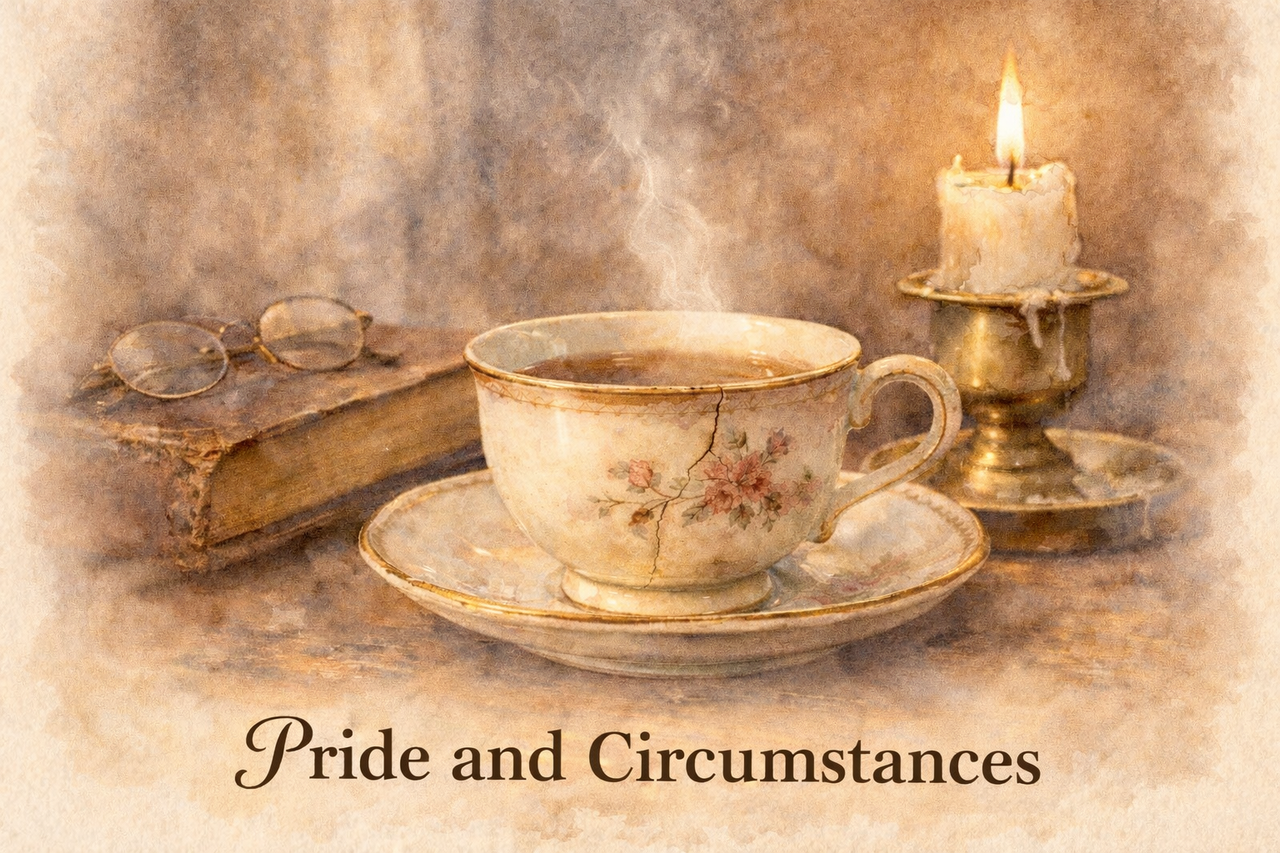
Chapter One, in which we are introduced to the inhabitants of Grimmo Manor and learn that news in the English provinces spreads faster than the plague, though with fewer consequences for one’s health.
It is a truth universally acknowledged by all sensible persons: a young man in possession of a crumbling estate and three and a half pounds of annual income must be in want of a wealthy spouse, a fortuitous acquaintance, or, failing that, a miracle of biblical proportions.
Mr Harry Potter, owner of Grimmo Manor, possessed all three and a half pounds in full measure; however, neither spouse nor fortuitous acquaintances nor miracle-working archangels were to be observed in his immediate circle. What was to be observed was a godfather—a circumstance which, in Mr Potter’s own opinion, quite adequately substituted for a natural disaster, and in the opinion of most neighbouring husbands, constituted a personal affront.
Sirius Black, Esquire, residing at Grimmo Manor in the capacity of either honoured guest, household deity, or family curse—opinions varied on this point—possessed three indisputable virtues: a countenance at the sight of which ladies lost their composure, a temperament at the sight of which their husbands lost theirs, and a talent for getting into scrapes from which his godson was invariably obliged to extract him.
On the morning that shall serve as the starting point of our narrative, Mr Potter was sitting in the library—the sole room where the roof did not leak and draughts did not roam—engaged in an activity which polite society terms “putting one’s affairs in order,” and less polite society terms “calculating how many more weeks the money will last before one must sell the final piece of table silver.”
The table silver, incidentally, amounted to precisely six spoons, a dented milk jug, and a salt cellar which no one wished to purchase on account of its phenomenal ugliness. The salt cellar was a family heirloom, and Mr Potter occasionally wondered whether his entire line had died out precisely because they had been compelled to contemplate this spawn of jewelling nightmare over breakfast each day.
“Master Harry,” creaked a voice from the doorway, and into the library drifted a creature that in any other house would have been taken for an animated mummy, but at Grimmo Manor was respectfully addressed as Kreacher.
Kreacher was the butler. He had been butler to Mr Potter’s grandfather, butler to Mr Potter’s parents, and, by all appearances, intended to remain butler until the very concept of butlers vanished from the face of the earth—and possibly for some time thereafter.
“Master Harry,” Kreacher repeated in a tone that boded nothing good, “Master Sirius has asked me to inform you that breakfast is served.”
Harry glanced at the clock. The clock showed half past eleven, which for Sirius Black was an entirely indecent hour to be awake—as a rule, his godfather did not appear before noon, and on days following particularly successful card games, might sleep until sunset.
“Kreacher,” Mr Potter enquired cautiously, “did Sirius rise of his own accord, or has something happened?”
Kreacher’s physiognomy assumed an expression that in any other person would have meant “I am not paid nearly enough to answer such questions,” but since Kreacher had not been paid at all for some fifteen years—he refused to leave the house on principle—the expression was to be interpreted as “steel yourself, sir.”
“Master Sirius has been pleased to receive a letter,” Kreacher intoned with funereal solemnity. “Master Sirius has been pleased to read the letter. Master Sirius has been pleased to express violent enthusiasm, damaging a floor vase in the process, and to demand champagne with breakfast.”
“We have no champagne,” Mr Potter remarked absently.
“Quite so, sir. Master Sirius has therefore been pleased to make do with ale and awaits your company.”
Mr Potter closed the account book with the heavy sigh of a man who has realised that his already hopeless day has just become considerably worse, and proceeded to the dining room.
The dining room of Grimmo Manor had once, in those blessed times when the Potters had not yet squandered their fortune, been a model of Georgian splendour. Now it was a model of what becomes of Georgian splendour after forty years of economising on everything, including heating. The wallpaper had faded to an indeterminately spectral hue, the curtains had been consumed by moths and despair, and the grand fireplace, capacious enough to accommodate an entire ox, had not been lit since that memorable day when a crow’s nest was discovered in the chimney—crows which, in Kreacher’s opinion, had as much right to lodging as any other inhabitant of the estate.
Amidst this magnificent desolation, at a table covered with a cloth featuring artfully disguised darning, sat Sirius Black, beaming radiantly.
This alone was a troubling sign. Sirius Black smiling before noon meant either a large win or a large problem, and since Harry would certainly have been the first to learn of any win—if only because his godfather would immediately have attempted to borrow money for a hackney to the nearest gaming house in order to triple the stake—only the second option remained.
“Harry!” exclaimed Sirius with the enthusiasm of one preparing to impart momentous news. “You won’t believe it! Netherfield has been let!”
“Netherfield?” Harry echoed, taking his usual seat and accepting from Kreacher a plate of something optimistically termed “breakfast” but which in reality consisted of porridge and vague hope. “The Netherfield that has stood empty these three years?”
“The very same! And do you know who has taken it?”
Harry did not know and, moreover, was not certain he wished to know. His experience suggested that any news capable of putting Sirius in such elevated spirits would inevitably result, for him, Harry, in either additional expenses, additional troubles, or both simultaneously.
“A certain Mr Snape!” Sirius proclaimed with the air of one announcing the arrival of the Prince Regent himself. “With an income of ten thousand pounds per annum!”
Mr Potter choked on his porridge.
Ten thousand pounds. Ten thousand. A sum Harry could not have accumulated even if he lived three hundred years whilst neither eating, drinking, nor heating the house—the last, admittedly, being already a settled matter.
“How do you know?” he asked when he had recovered the power of speech.
“Elphias Doge wrote!” Sirius brandished the letter. “He and this Snape were on some committee together, and the fellow mentioned plans to take a country house away from the urban bustle. Elphias says—rather a gloomy sort, unsociable, but with an impeccable reputation and coffers of gold!”
“And what has that to do with us?” Harry enquired with justified suspicion.
Sirius bestowed upon him a look of genuine astonishment.
“Harry, my dear boy, what has it to do with us? A wealthy bachelor is settling in the neighbourhood! It is a gift from fate!”
“For whom?”
“For you, naturally! You are young, handsome, you have an estate—somewhat dilapidated, perhaps—and an ancient lineage. You must make his acquaintance at once!”
Harry set down his spoon and regarded his godfather with that particular blend of horror and resignation that develops exclusively in persons long compelled to deal with relatives devoid of any sense of propriety.
“Sirius,” he said very calmly, which usually presaged a storm, “are you suggesting I hunt for a wealthy husband?”
“Or wife!” Sirius amended magnanimously. “I do not limit your choices. The main thing is ten thousand a year!”
“We do not even know who this Mr Snape is. He might be an elderly widower with six children.”
“Elphias writes that he is unmarried.”
“He might be ugly as mortal sin.”
“Possibly, but with ten thousand it is entirely immaterial.”
“He might,” Harry raised his voice, “simply not appeal to me!”
Sirius waved away this objection like an irksome fly.
“Nonsense. All persons with ten thousand pounds of annual income are exceedingly agreeable company. It is a scientifically proven fact.”
Harry opened his mouth to object, but at that moment the dining room door opened and Kreacher appeared on the threshold bearing a tray upon which reposed another envelope.
“Master Harry,” he pronounced with the particular intonation usually reserved for announcements of natural disasters, “another letter. From Mrs Longbottom.”
Mr Potter and Mr Black exchanged glances. Augusta Longbottom was the local landowner, the uncrowned queen of county society and, most importantly, the possessor of the most extensive gossip network in the entire shire. A letter from her at such an hour meant only one thing: the news was so momentous that Mrs Longbottom simply could not wait until a decent hour for a visit.
Harry broke the seal.
“What does it say?” Sirius demanded impatiently.
“Netherfield has indeed been let,” Harry read. “To a certain Mr Snape of London. He is accompanied by a party of guests: Mr Lucius Malfoy with his son Draco, Mr Antonin Dolohov, and Lady Bellatrix Lestrange, a widow.”
“A widow!” Sirius perked up.
“Don’t even think about it.” Harry did not raise his eyes from the letter. “Mrs Longbottom informs us that Mrs Lestrange is a notorious fortune-hunter and that we should keep well away from her.”
“Is she concerned about me or about Snape?”
“Knowing Mrs Longbottom—about the morality of society at large.”
Harry read the letter to its end. Mrs Longbottom, with her characteristic thoroughness, had contrived to discover everything that could possibly be discovered about the new neighbours in so short a time: Mr Snape had amassed his fortune trading in some manner of chemical preparations; Mr Malfoy belonged to an ancient aristocratic family and was nearly as indecently wealthy as Snape himself, whilst his son had just completed his studies at Oxford; Mr Dolohov had a reputation as a desperate duellist and gambler; and Mrs Lestrange had buried two husbands and was, by all accounts, in search of a third.
“Chemical preparations,” Sirius mused. “What does that mean—an apothecary? Harry, you cannot marry an apothecary!”
“I have no intention of marrying anyone,” Harry reminded him.
“Not yet. But we must pay a call!”
“Must we?”
“Without question! It is a matter of courtesy. New neighbours, propriety demands that we be the first to—”
“Sirius,” Harry folded the letter and regarded his godfather with the expression of one who has seen everything. “You are not received in a single respectable house in the county. Mr Weasley still threatens to call you out over that business with Mrs Weasley and the mistletoe. Lord Crouch demands repayment of a gambling debt. And Mr Nott has given orders to set the dogs on you if you appear within a mile of his daughter.”
“Trifles!” Sirius dismissed these concerns airily. “Snape doesn’t know any of that. To him, I am a clean slate!”
Harry felt the familiar headache beginning to pulse at his temple.
“And what of the fact that we have no proper clothes for paying calls? No proper carriage? No carriage whatsoever?”
“Details! We shall borrow from the Longbottoms!”
“Neville is currently in London.”
“Then from… from someone!” Sirius did not lose his optimism for a second. “Harry, you don’t understand. This is our chance! Our only chance to escape this…” he gestured around the dining room, “this pit.”
Harry followed his gesture. Faded wallpaper. A leaking ceiling. Curtains that would crumble to dust from too forceful a sneeze.
“This is not a pit,” he said quietly. “This is my home.”
“Which we cannot maintain!” Sirius leaned forward, and for a moment his face lost its habitual insouciance, revealing something more serious and more weary. “Harry, I know I behave like an utter fool most of the time. But I am not blind. You sold your father’s watch last month. Do you think I didn’t notice?”
Harry said nothing.
“Listen,” Sirius’s voice softened. “I am not asking you to marry this Snape. I am asking you simply to make his acquaintance. Simply to appear in society. Perhaps this Mr Snape knows someone who knows someone who is seeking a partner for a venture, or a steward, or… I don’t know. But sitting here counting the remaining spoons will certainly accomplish nothing.”
Harry wanted to object. Wanted to say that pride was all he had left. That he would not demean himself before an enriched purveyor of preparations. That the Potters had never bowed their heads to those with more money.
Instead, he looked at the hideous salt cellar—the last reminder of a once-great family—and said:
“Mrs Longbottom writes that she is hosting a reception in honour of the new neighbours. Next Saturday.”
Sirius broke into a broad smile.
“Splendid! Excellent! Kreacher, we must put my blue coat in order!”
From the corridor came a heavy sigh, indicating that Kreacher had heard every word and was already mourning the fate of the blue coat, the fate of the young master, and, quite probably, the fate of all humanity. Harry silently returned to his porridge. Saturday lay ahead. And, despite all his protestations, he caught himself wondering: what manner of man was this mysterious Mr Snape?