Work Text:
The sun filtered through the canopy of elms lining Main Street, painting the sidewalk in flickers of gold and green. The little town of Geneva, quiet as ever, hummed with a kind of early-summer contentment—screen doors creaked open, the occasional Ford rumbled by, and children darted like dragonflies around porch posts and storefronts. In the midst of this peaceful rhythm walked Brandon Fischer and his granddaughter, Jennifer, a small slip of a child just three years old, with curls the color of corn silk and a straw hat slightly too large for her head.
“Papa, lookie!” Jennifer squealed, pointing a chubby finger at a window display full of toys. Her voice was bright but shy, like someone who had only recently learned to love being loud.
Brandon slowed immediately, indulging her wonder. “Well now,” he said, following the direction of her outstretched arm.
Jennifer’s eyes had locked not on the soldiers or the ducks, but on a large porcelain doll in a pale pink dress, sitting grandly in the window of the general store. Her golden curls—painted but lifelike—framed a face of such serene beauty it made the real child go breathless. The doll had glassy blue eyes that stared forward, forever polite and composed, with lashes so delicate they looked like spider silk. She wore a bonnet trimmed in ribbon and lace, and her hands, frozen in mid-gesture, cradled a tiny parasol.
Jennifer’s breath caught. “Big dollie,” she whispered, pressing her hand to the glass with reverence.
Brandon chuckled, the sound soft and nearly inaudible, like the crackle of old paper turning. His features, already mild and unassuming, took on an even gentler cast in her presence. Something in him always softened around Jennifer—not in a way that diminished him, but in the way iron becomes malleable under the right warmth. He would have stood guard for her against the world’s worst storms, but he would also stop on a quiet Tuesday morning just to let her marvel at a porcelain doll.
“That is a big dolly, isn’t it?” he said, lowering himself to one knee beside her, his joints complaining slightly but his face calm. He tucked one arm over his bent knee and squinted at the doll as if she too had something to say.
Jennifer nodded solemnly, thumb slipping into her mouth as she continued to stare. She was too young for real conversation, still mastering the world’s language one garbled syllable at a time, but her eyes said everything. Awe. Curiosity. Delight. Her gaze flitted from the doll’s dress to her shoes, then to her hands, then back again to those strange, perfect eyes.
“She’s wearin’—” Jennifer mumbled around her thumb, voice hushed as if they were in church. “She’s wearin’ pinkie shoes.”
Brandon leaned a little closer. “So she is. Think she’d like your old red shoes, or would she say they’re too small?”
Jennifer giggled quietly, a short hiccup of sound that made her cheeks rise under the brim of her sunhat. “Dollie too big for mine,” she said, then added, almost conspiratorially, “She big as me.”
Brandon nodded with mock solemnity. “Might be you’re right. Might be you’re the same size and don’t even know it yet.”
Jennifer turned her head and looked up at him, thumb still planted firmly in her mouth, cheeks flushed from excitement. Her eyes were wide with a sort of blissful confusion, the kind only very young children could feel—when the world is too full, too strange, too lovely to process all at once. Everything on the street—the trees, the horseshoes nailed to doors, the cars rattling slowly by, the scent of cinnamon bread from the bakery—was part of her morning magic. And Brandon, steady and quiet as he was, moved through that magic like a grounding presence, the one thing that didn’t shift or surprise.
Brandon gave her a warm smile, the kind that curved in the corners and softened the whole plane of his weather-lined face. “Maybe we’ll come back and see her later,” he said, brushing a strand of hair from her forehead. “She’s not going anywhere.”
Jennifer nodded, satisfied, and leaned into his side, one hand resting gently on his coat. She was still buzzing, still caught up in the wonder of it all, but her thumb drifted back to her mouth and she seemed content to hold the excitement in, nestled against him as though he were part of the town itself—immovable, trusted, her very own shelter.
Brandon rose slowly, carefully, and offered his hand to her once more. “All right, Button. Shoes now?”
“New shoo-shoos,” she echoed, her voice muffled, small, and joyful.
As they left the spell of the doll behind, Jennifer’s small fingers wrapped firmly around Brandon’s hand once more, and they continued their journey down Main Street. The town of Geneva, though modest in size, was thick with life that morning—a humming, good-natured kind of bustle. The baker was setting out loaves still warm from the oven, their crusts golden and fragrant. A young boy with grass-stained knees was dragging a stick along the sidewalk cracks. A pair of women chatted animatedly outside the post office, their voices lilting like birdsong under the eaves.
At home, the hours moved slower, quieter. The house sat dignified on its foundation of stone and memory, wreathed in the smell of lilac from the front bushes and warmed by the lengthening sun that pressed against the curtains. The windows were open to the breeze, and the wind moved through the parlor in soft sighs, brushing against old picture frames and worn books stacked with care.
April stood in the kitchen, hands dusted with flour, preparing dough for the evening meal. The scent of rising bread filled the room with a gentle comfort, the kind that rooted itself in old rituals, the kind one offered to those they loved. She was humming low under her breath—an old folk melody from her childhood in Youngstown—when she heard it: the unmistakable sound of gravel crunching under boots on the walk.
She wiped her hands on a towel and turned toward the front door just as a firm knock echoed through the house.
The sound was not frantic, not cruel, but deliberate. April knew that kind of knock. She had heard it before—during war years, in hard winters, after the mill collapse that had taken her brother. It was the sound of a man arriving not as himself, but as a bearer of someone else’s burden.
She opened the door to find Officer James Richardson standing squarely on the porch, hat in his hands, his eyes steady and expression composed, but with a tautness to his shoulders that betrayed the undercurrent beneath.
“Mrs. Scott,” he said, formal and even.
April nodded, the towel still clutched in her hand. “Come in, Officer.”
He stepped inside, wiping his boots instinctively on the mat, as if to preserve the sanctity of the tidy home. The screen door shut behind him with a sigh. April led him through the parlor without a word, down the hallway toward the kitchen, where the air was thick with bread and the ticking of the clock on the wall.
She gestured to the table. “Sit,” she said quietly. “I’ll make coffee.”
“Ma’am, I don’t mean to trouble you—”
“You wouldn’t be here unless it was trouble,” April said, not sharply, but with the firm calm that people used when they’d long since lost their tolerance for euphemism. “So let’s not pretend otherwise. You’ll tell me when you’re ready.”
Officer Richardson hesitated, then nodded and sat down heavily, the chair creaking beneath the weight of his belt and uniform. April moved with practiced ease, filling the kettle, setting it on the stove, pulling down a pair of mismatched mugs—one white and chipped, the other blue and floral.
He watched her hands work. She was older than he remembered from town meetings or newspaper editorials—older, but not diminished. There was something about her that suggested she had stood in more than one fire and come through not untouched, but tempered.
The coffee pot hissed quietly, and the silence in the room began to stretch thin between them.
“I appreciate you letting me in,” he said finally, his voice lower now. “Some folks… they don’t want to open the door when they see me in uniform.”
“I imagine that depends on what follows.” She poured the coffee, set one mug in front of him, then sat down across the table, her hands folding over the rim of her own.
He looked down at the mug, then up at her. There was sweat at his temples. “What I’ve got to say, I’d rather say gently. And with care.”
April didn’t blink. “Then do.”
But he didn’t—not yet. He looked away toward the open window, where the curtains stirred gently, as if the house itself were holding its breath. He reached for the sugar bowl, added two spoonfuls, then stirred. The ceramic clink of the spoon against the mug was the only sound for a long moment.
April didn’t press him.
She waited, eyes steady, her hands unmoving. Whatever storm was gathering behind his words, she had already braced for it, silently, alone. She had always known that trouble had a way of finding people, even in small towns, even in quiet seasons.
But she also knew that storms passed—and that she, like the house she’d built, would hold.
And everywhere they walked, familiar faces appeared like notes in a long-practiced song.
“Morning, Mr. Fischer,” called old Everett Gable, tipping his newsboy cap.
“Lovely day, Brandon,” chimed in Miss Parson, arranging a crate of strawberries on a wooden stand.
“Good morning to you,” Brandon replied with a gentle nod or a polite smile, his voice low and even.
Some merely waved, others doffed their hats or smiled in that easy Geneva way—polite, neighborly, not prying. Brandon was well-liked but never flashy. Folks respected him the way one respects a well-built bridge: solid, dependable, there when you needed him, asking nothing in return. He was known for being modest, but everyone noticed the way he carried the child beside him. His hand never tugged, only guided. His voice, rarely raised, was full of praise when it turned toward her. And the warmth in his eyes when he looked down at Jennifer—it could melt through a hard winter frost.
Jennifer, still glowing from the toy display encounter, trotted dutifully by his side, her eyes darting from one sight to the next: a calico cat sunbathing on a windowsill, a little girl holding a balloon, the shiny glass bottles in the apothecary window. Everything was a discovery. The sun caught on her hair, and the light breeze made the ribbon on her hat flutter like a little flag.
Then, without warning, Brandon took a whimsical hop forward—one foot lifting high and landing with a gentle skip. Just once.
Jennifer gasped in delight.
“Papa!” she said, eyes wide with laughter.
He looked back at her, playful now. “Think you can do that?”
She nodded eagerly, adjusting her grip on his hand. She bent her knees, concentrated very hard, then gave a tiny hop—her foot barely leaving the ground, but full of effort and pride. She beamed up at him.
“Well I’ll be,” he said, eyes crinkling with affection. “You just about skipped clear into the sky.”
Jennifer giggled and tried again, this time adding a twirl. She stumbled a little, but Brandon steadied her.
“You’re like a tiny Clara Bow,” he said with mock astonishment. “All sass and sparkle.”
“C’wah Boh?” Jennifer repeated, the syllables bouncing oddly in her mouth.
He laughed under his breath, kneeling just enough to whisper in her ear, “She was a movie star. Had the biggest eyes in Hollywood and a way of dancing that made the whole world grin.”
Jennifer gave a pleased squeal and did another skip, nearly knocking her hat sideways. Brandon caught it before it could tumble off, adjusting the strap gently beneath her chin.
“You’re doin’ better than I ever could,” he said, as she tried another gleeful hop. “Pretty soon you’ll be skippin’ right onto the silver screen.”
Jennifer liked the sound of that, even if she didn’t quite understand it. She skipped with a little more confidence now, holding onto his hand for balance, her feet tapping out their own uneven rhythm beside his measured steps. Her cheeks were flushed, her grin impossibly wide.
They passed the barbershop, where the smell of talcum and bay rum wafted out in warm waves. One of the barbers raised his comb in greeting. They passed the library, its steps clean and sunlit, with a little flag fluttering on the rail. A dog barked from behind a picket fence and Jennifer barked back, making Brandon chuckle again. It was a simple walk, no more than five or six blocks, but they could have been traveling a thousand miles for all the joy it carried.
Jennifer's skipping slowed eventually as her legs began to tire, and she tugged gently on his hand, panting a little. Brandon scooped her up without a word, settling her against his hip with the easy grace of a man who’d carried steel and wood and fire—but never anything as precious as this girl.
“Papa,” she murmured sleepily, head nestling into his shoulder. “I’m a Boh.”
“You are.” he said softly. “You’re the best kind.”
The coffee sat between them like an offering neither could accept. April hadn’t touched hers. It steamed quietly, a pale ghost rising above the chipped rim, fogging the bottom of her spectacles. Her hands stayed folded around the base of the cup, not for warmth but for anchoring—something solid beneath her fingers, something to keep her from drifting upward into the space between seconds.
Officer Richardson cleared his throat softly. He hadn’t touched his coffee either.
“It was a call,” he said at last, voice measured but subdued. “Came in this morning from a station just across the border, small town out in western Pennsylvania. Kittanning.” He glanced up at April briefly to gauge her reaction, but her face remained unmoved, unreadable. “They’d been contacted by a motel clerk who hadn’t seen one of the guests in more than a day. She hadn’t checked out when expected. Door was locked from the inside.”
He paused, his fingers resting lightly on the brim of his cap, which he’d set carefully on the table beside him. His shoulders were tight beneath the navy of his uniform, the collar looking suddenly too stiff, the room too warm. He looked down.
“They found her alone,” he continued, “in the room. No signs of violence. No signs of forced entry or struggle.”
The clock on the wall ticked over to the next minute, impossibly loud in the silence.
April’s face did not move, but her hand had tightened almost imperceptibly on the cup. Her breath was even, controlled—but shallow.
Officer Richardson’s voice, when it returned, had gentled. “There were… indications. Her surroundings. Some paraphernalia. Nothing official yet, not until the coroner completes his review. But they think—” He stopped himself. Tried again. “They believe it was likely an overdose.”
He didn’t look at her when he said it. Not out of avoidance, but reverence.
April blinked once, slowly, as if translating each word from a language she had forgotten how to speak. Her lips parted slightly, but no breath came out. She sat straighter in her chair, not slumping, not crumbling, but rising—leaning into the weight, bearing it, holding it upright like a stone.
Richardson sat back, folding his hands together. The professional mask he’d worn since stepping through the door began to slip—not in some dramatic collapse, but in the subtle softening of his jaw, the faint wetness gathering at the corners of his eyes. He looked older than she remembered, or perhaps just more human.
“I’m sorry, April,” he said, no longer as Officer Richardson, but as James—a man who had watched this family from afar over the years, who had seen April speak at labor rallies, who had watched Brandon tinker with farm tools outside the garage, who remembered Sienna as a firebrand girl with a wild grin and music in her limbs.
He swallowed. “I can’t imagine what this costs you to hear. I wouldn’t wish it on anyone.”
April didn’t cry.
She stared at the steam rising from the cup between her hands, her knuckles pale with pressure. There was no wail, no collapse, no grasping at furniture or dramatics—only the stillness of someone who had spent too many years rehearsing the echo of bad news. Of someone who had been both mother and shield, and who had learned to absorb grief without ceremony.
She closed her eyes slowly, for a moment. When they opened again, there was no anger in them—only something ancient. Something that belonged to women who had buried too many of their own. Quiet rage. Quiet pain. And above all, endurance.
“I know it’s not what you want to hear,” James added, gently, almost apologetically. “She had your name on her license. That’s how they knew to call us. You were still listed next of kin.”
April nodded faintly, as if that single fact—her name, still there—held a meaning too layered for speech.
Richardson looked down at the table. “I can stay. As long as you need.”
April didn’t answer immediately. She finally raised the cup to her lips, took one small sip, and placed it back down.
And so they sat—her hands still wrapped around the cup, his cap resting between them, and the light beginning to thin at the windows. The clock ticked on, oblivious.
Her voice, when it came, was soft but unbroken. “I’ll need to tell Brandon when he gets in.”
A long breath followed—held, then released slowly, deliberately, as if the air in her chest had thickened with weight. She did not shift her posture, only loosened her grip slightly on the cup and blinked once. Then, as though remembering a long-forgotten social cue, she lifted her gaze to Officer Richardson’s, and with careful control, she smiled.
It was a stiff thing—small, almost fragile—but unmistakably a smile. Not meant to convey comfort or gratitude in full, but civility. The performance of grace under ruin.
“Thank you,” she said. “For coming yourself.”
Richardson nodded slowly, his own face marked with the awkward conflict of duty and helplessness. He had delivered bad news before—news of accidents, war drafts, evictions—but this felt heavier than most. Not because of the death alone, but because of who sat before him, and the history in the walls that surrounded them both. He knew the name Scott meant something in this town. April was no stranger to grief, nor to shouldering the burdens of others. And yet here she sat, with another heartbreak passed to her like an envelope no one else wanted to open.
“I appreciate your kindness,” she added, gently, fingers brushing along the rim of the cup. “But if it’s all the same to you… I think I’d like to be alone now.”
There was no coldness in it. No sharpness. Just quiet finality—the way a door closes not in anger, but because the room behind it is no longer ready for visitors.
Officer Richardson hesitated, then slowly rose from the chair, placing his cap back on the table just long enough to smooth the brim with his fingers. He watched her for a moment more, his brow lined with the heaviness of all the things he would not say.
April didn’t move. Her gaze had returned to the coffee.
He reached for the cap and straightened his posture with the practiced ease of long service. “Of course,” he said simply. “I’ll leave my card, just in case.”
He set it quietly on the edge of the table, beside the second mug that had gone untouched.
As he turned to go, April spoke again, not lifting her head this time. “Thank you,” she said once more. It was softer now, like a word half-buried in snowfall, but still distinct.
He paused, nodded once more, and left the kitchen without a sound.
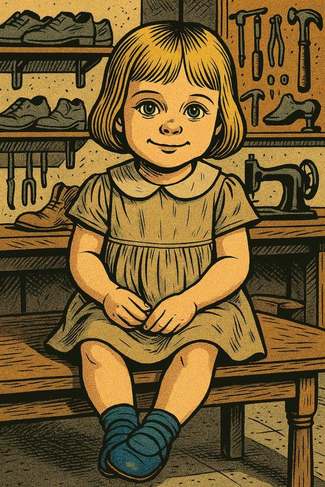
The little bell above the door to the shoe shop jingled with a sound like chimes in a breeze as Brandon pushed it open, holding it just wide enough for Jennifer to toddle inside ahead of him. She paused on the threshold, her new skipping confidence briefly overtaken by the hush of the place—the scent of leather and polish, the way the walls seemed to breathe with quiet patience. She stood very still, wide-eyed, soaking it all in.
“Good morning to you both,” came a voice from behind the counter. It belonged to a man stooped slightly at the shoulders, his spectacles perched low on the bridge of his nose. He looked up from a shoe he was stitching with careful precision, his eyes gentle and pale like worn river stones.
“Morning, Eli,” Brandon said, tipping his hat. “Got a little girl here who’s just about grown out of her red shoes.”
Eli Wilcox—cobbler, repairman, and long-practiced listener—set the shoe aside and gave Jennifer a slow, warm smile. “Is that so?” he asked, rising from his stool with a faint creak of knees. “Well now, I remember when those little red ones still had stuffing in the toes to keep ‘em from slippin’. You’ve grown tall on us, haven’t you, Miss Jennifer?”
Jennifer looked shyly up at Brandon for permission to speak, then whispered, “Uh-huh. They too pinchy.”
“Pinchy?” Eli chuckled, nodding sagely. “Well we can’t have that. No ma’am. Come on over and we’ll find you a pair that’s just right.”
Brandon followed behind her, slow and steady, as Jennifer made her way to the measuring stool. He gave Eli a subtle look as they passed—nothing overt, just the smallest glance, a shared language between two men who understood each other,
Eli nodded in return. He knew, without having to be told, that Brandon wasn’t flush with money. The jobs were fewer, the factories quieter. But he also knew Brandon would never ask for charity. Instead, he had offered what he always did in such cases—a quiet arrangement of trust, dignity, and small payments over time.
Brandon didn’t say a word about it aloud. He simply took a folded piece of paper from his pocket and placed it quietly on the counter as Jennifer was trying on her second pair of shoes—a note of agreement and the first small payment tucked inside. Eli didn’t count it in front of him. He just slipped it into the drawer and returned to the child.
“Now let’s see,” Eli said, crouching down to gently fit a soft leather Mary Jane over Jennifer’s sock. “What do you think of these, young miss?”
Jennifer studied them as if they were sacred. “They got flowers,” she whispered, eyes shining.
“That they do,” he said. “Hand-stitched, just like a garden blooming right on your toes.”
Brandon leaned against the counter, watching the scene with quiet satisfaction. His hands, still and careful, hung at his sides as he watched his granddaughter wiggle her feet, then stand up straighter than usual.
“You’re walkin’ like a lady at a dance,” he said warmly. “Careful now, don’t twirl right off the floor.”
Jennifer did twirl—clumsily, arms out like wings, the little shoes making soft thuds on the polished floor. Eli caught her lightly as she tipped toward the workbench.
“Graceful as a spring breeze,” he said, steadying her with both hands. “You got a twinkle to you, young miss.”
Jennifer, not quite understanding but pleased all the same, grinned and leaned into his leg like a kitten.
Brandon looked at Eli, the lines around his mouth softening. “She’s got that light in her, doesn’t she?”
“She does,” Eli murmured, still crouching beside her. “And this old place… it’s no match for that kind of brightness. She makes everything in here look like it’s woken up.”
She sat on the measuring stool now, feet dangling, hands folded in her lap like a proper little lady, but her shoulders were hunched and her eyes stayed mostly on the scuffed checkerboard floor. With Brandon, she bloomed—skipping, babbling, laughing—but with others she folded inward, unsure of how much of herself to offer.
Eli crouched in front of her with a soft grunt and gave her the kind of smile that wasn’t meant to coax or charm, just to reassure.
“Well, now,” he said gently, brushing off his hands on a cloth. “We got ourselves all kinds of shoes back there, Jennifer. All sizes, all shapes… and all sorts of colors. Do you have a favorite?”
Jennifer stayed quiet, glancing up at Brandon for guidance. Her thumb drifted toward her mouth, but she caught herself, folding her hands tighter. Her little voice came out as a breath more than a word.
“...Colah?”
Eli nodded, patient as ever. “Mm-hmm. You know… black like a piano, white like Sunday lace, brown like Hersheys, or maybe something else altogether. Got some blue ones, too.”
At that, something flickered in Jennifer’s eyes. Her head lifted just a little. “Bwoo?”
Brandon, watching nearby with arms gently crossed, caught the change and smiled to himself. “She likes blue,” he said, softly, almost as if telling a secret he’d been entrusted with.
Eli’s eyes twinkled. “Do you now? Blue like the sky? Or maybe blue like cornflowers in the grass?”
Jennifer squirmed slightly on the stool, her shyness slipping just a little as her small voice emerged again, firmer this time. “Blue… like Mama’s cup.”
Brandon’s face stilled for a moment. April’s old porcelain teacup, pale robin’s-egg blue with a tiny gold rim. A long ago gift that she would sometimes set aside but could never part from herself.
“That’s right,” he said gently. “Mama always liked that cup.”
Jennifer’s legs swung slowly as she gathered courage. “Dey had... b’lue flowies on it,” she added, her voice hushed but proud of the detail.
“Well now,” Eli said, rising carefully to his feet. “That’s a mighty fine color to be lookin’ for. I’ll see what I can find.”
He disappeared into the back, curtains swaying behind him. Jennifer looked over at Brandon and gave a little bounce. “I want the cup shoes,” she whispered with sudden certainty.
Brandon crouched down next to her, smoothing the brim of her sunhat. “You told him just right. That’s how you find the good things in life—you speak it, even if you have to whisper.”
After a moment, Eli returned with a dusty box in hand. He set it gently on the low bench and opened it to reveal a pair of soft blue leather shoes with rounded toes, a small buttoned strap, and the faintest embroidery of petals stitched into the sides. They weren’t flashy, but they were beautiful in that simple, old-world way—like something found in a storybook, worn by a girl on her way to find a wishing well.
Jennifer gasped and placed both hands over her mouth. “Ooooh…”
“I thought these might do,” Eli said, smile tugging at one side of his mouth. “Not quite a teacup, but close, maybe.”
She reached out slowly, reverently, fingers grazing the soft leather. “Dey got flowies.”
“Little blue ones, just like you said.” Eli knelt again. “Would you like to try ‘em on?”
Jennifer nodded eagerly, and for a moment, the shyness vanished completely. She lifted her foot without hesitation, placing it in his palm like she’d known him all her life. Eli handled it carefully, easing the shoe on with the same gentleness he reserved for worn-out boots and wedding slippers alike.
Brandon watched all of it with quiet pride. This—this was what mattered. Not the exact price of the shoes, or how many weeks it would take to pay for them in full, but the look on his granddaughter’s face as she walked the length of the store in her new "cup shoes," as she had now dubbed them, every step a deliberate moment of wonder.
She turned on her heel with a clumsy twirl, giggling softly. “Look, Papa! Dey fwitty!”
“They sure are,” he said, arms crossed loosely, eyes shining. “Just like you.”
As the pair departed, at the door, she paused and turned to wave, her little fingers flapping open and shut. “Tank you, Mr. Shoo-man!” she called out.
April remained seated at the table long after the door clicked shut and the boots receded into silence. The house, once filled with the scent of baking bread and the promise of dinner, felt suspended—quiet but not peaceful, still but not calm. Her coffee had gone tepid. The ticking clock had resumed its steady rhythm. And in the hush that settled behind Richardson’s departure, April sat alone in her kitchen, cup in hand, back straight, eyes on the curling steam that had begun to vanish from her breath.
Upstairs, the bedroom was dim, the light from the west-facing window thinning as the sun began its descent behind the trees beyond the yard. The lace curtain fluttered in the late-day breeze, casting shifting patterns onto the wood floor—an old floor, polished by time, where each creak and groan told stories of years folded into years. A pair of shoes lay neatly beside the bed, a shawl draped over the arm of a low chair. Everything in its place, preserved in the rhythm of quiet domesticity. But nothing felt in place now.
April entered the room in silence. She did not switch on the lamp. She closed the door behind her with a soft click that seemed to echo too loudly in her ears. For a long moment, she stood in the middle of the room with her arms hanging by her sides, as though she had forgotten what her body was supposed to do.
Then, with a kind of mechanical grace, she crossed the room and sank onto the edge of the bed. The mattress dipped beneath her weight, releasing the faintest scent of lavender from the linen spray she used, the same one she’d used since Clara was small, since the days when bedtime had been storybooks and lullabies, not phone calls and officers on the porch with caps in their hands.
She reached out—her fingers trembling now—and gathered the nearest pillow into her arms. It was an old one, slightly flattened in the middle, stitched with faint flowers faded by years of washing. She pulled it toward her chest and folded over it, curling down like a closing flower, her body folding in upon itself as if trying to disappear into its own bones.
And then the sound came—small, low, strangled.
April pressed her face deep into the pillow, clutching it like it might keep her from falling through the floor. The sob that followed was muffled, not because she didn’t want to weep, but because even now—especially now—there were parts of her too proud to howl into the air, too careful to shatter the house with noise. The grief was not lessened for its quietness. It was keener, sharper, compressed.
She wept into the fabric, her hands fisting the edges until her knuckles went white. Her shoulders shook, trembling like leaves in wind. The pillow took the worst of it, drank her sorrow without reply, as if it knew this grief was old, familiar—only deeper now.
Her mind reeled with flashes she couldn’t stop. Sienna’s little feet on the porch steps. Her teenage laughter rattling off the kitchen walls. Her dark eyes that always burned too hot, too fast. And the long silences. The distance. The times she’d vanished for months and come back with hollow eyes and words that made no sense.
April had learned long ago how to weep like this—quietly, efficiently, like a woman who had no luxury to fall apart completely. She had wept when she was fifteen and her brother died under twisted steel. She had wept when Clara confessed her loneliness, and when Clara left, and when Clara came back too changed to recognize herself. She had wept in hospital corridors, in kitchens, in alleyways beside union halls. And now, once more, here, for a daughter lost to a silence that had always been waiting.
The tears soaked the pillow. Her breath came in sharp little gasps now, hiccupping through the fabric. But she did not cry out. She did not scream. The house held its breath with her.
In the corner of the room, the faint ticking of Brandon’s old wind-up clock continued undisturbed, the seconds marching on, indifferent.
Eventually, the sobs slowed, then softened, then fell into the shallow rhythm of breath. Her hands released their grip on the pillow, her fingers still curled but no longer clenched. She lay there in the growing dusk, face hidden, body spent, the heat of sorrow still radiating from her like steam rising off summer asphalt after rain.
The bedroom dimmed to gray.
And still, she didn’t move.
The blue shoes were a delight under Jennifer’s feet, and each step was like an experiment in wonder. She looked down constantly, the tops of her blonde curls bouncing with every motion as she admired the shoes anew—lifting one foot, then the other, turning them inward to see the delicate embroidery. They made a soft little pat-pat on the sidewalk as she and Brandon left the cobbler’s shop, the door closing behind them with a gentle clap.
Brandon held her hand as they walked, letting her set the pace. He could’ve carried her—her legs were still short, and the morning had already been a grand adventure—but he knew how proud she was of her walking, especially now, with the world under her new shoes.
As they turned the corner back onto Main Street, the same toy store window came into view, the morning sun now higher and gleaming across the glass. Jennifer slowed immediately, her steps faltering as she saw the “big dollie” again, resplendent in her pink dress with the parasol nestled in her painted fingers. The doll hadn’t moved, of course, but something about her looked even grander now. Maybe it was the way the light hit her curls, or maybe it was just the way Jennifer’s new shoes made everything feel a little more magical.
“Papa…” she breathed, her voice trailing off in awe. She let go of his hand and stepped forward until her nose nearly touched the glass.
Brandon stopped beside her, smiling down at the rapture on her face. “There she is again,” he said quietly. “Still sittin’ pretty.”
Jennifer nodded slowly, thumb hovering near her mouth but not quite making contact. “She’s still waitin’,” she whispered, as if the doll had a secret purpose she alone could divine.
Brandon crouched down beside her, resting one hand on his knee. “Maybe she is,” he said thoughtfully. “Waitin’ for a parade. Or a tea party. Or maybe just watchin’ over all the other toys to make sure they behave themselves.”
Jennifer’s eyes never left the window. “She needs shoes too,” she said, frowning slightly, deeply concerned. “Her’s not blue.”
“No, ma’am,” Brandon agreed, solemn as a judge. “No shoes at all, far as I can tell. Poor thing.”
Jennifer made a quiet, serious noise—something between a sigh and a hum—and leaned her forehead gently against the glass.
Brandon gave her a moment, watching the way the light reflected on her soft curls, the new shoes peeking out beneath the hem of her cotton dress. Then, with the kind of quiet timing only grandfathers seem to master, he said, “How about some ice cream?”
Jennifer turned her head sharply, the window temporarily forgotten. “’Ceam?”
He nodded. “Thought we might stop by Gus’s stand before we head home. It’s not every day a young lady gets herself a brand-new pair of shoes.”
Jennifer gasped, hopping on the balls of her feet. “Blue shoes and ‘ceam?” she cried, as though the stars themselves had just aligned in her favor.
Brandon stood slowly, his knees creaking in protest, and reached for her hand again. “Well now, you keep callin’ ‘em that and we’ll have to write it on the receipt: one pair of cup-colored shoes, paid in full with joy and hop-skips.”
Jennifer didn’t quite catch all of it, but she laughed anyway, letting her excitement bubble up in tiny, delighted squeals as she skipped beside him. “Papa, I want pink!” she declared. “No! No—mint! I want the green one.”
“You sure about that? It’s cold and tingly. Like a snowflake in your mouth.”
“I like snowflakes in my mouth!” she yelled, already dragging him in the direction of Gus’s stand like her tiny arm had any real pulling power.
The toy store was left behind as they made their way toward the corner where Gus kept his cart shaded under a striped umbrella. The stand was small—just a wooden wagon with metal wheels, a hand-painted sign, and a few stools under a canvas awning—but it was as much a fixture of Geneva as the library steps or the church bells on Sunday.
Gus himself stood behind the counter in his apron, his cap slightly askew, wiping down the handle of his scoop. He looked up and saw them coming, eyes narrowing with a grin. “Brandon Fischer,” he called out. “Looks like you brought the sunshine with you today.”
Brandon tipped his hat. “Can’t take much credit. It’s mostly comin’ off her shoes.”
Jennifer twirled, one hand holding her dress out like a ballerina, the other still clutching Brandon’s hand tightly. “I got blue,” she announced.
Gus played along immediately. “Blue shoes, huh? Well, I guess that means I’ve got to give you the greenest mint I can find.”
She nodded gravely, confirming the contract.
Brandon pulled a few coins from his pocket and placed them on the counter, more than enough to cover one scoop but not enough to make a fuss. Gus didn’t count. He just nodded and turned to his cooler.
As the ice cream was handed over in a shallow little cup, Jennifer took it with both hands and stared at it like it was a sacred treasure. Her blue shoes clicked on the wooden slats of the stool as she climbed up with Brandon’s help, spoon clutched tight in one fist.
Jennifer sat cross-legged on the warm pavement in front of Gus’s cart, her little cup of mint ice cream cradled carefully in her lap. The green scoop was already softening under the sun, tiny rivulets running down the ridged sides of the paper cup, but she didn’t mind. Her cheeks were flushed, both from the warmth of the day and the joy of so many treasures—new shoes, a glimpse of a dollie, and now, the cool sweetness of ice cream dancing across her tongue.
She spooned each bite with deliberate care, the way small children do when they’re not just eating but experiencing something. She swayed a little as she sat, a gentle side-to-side rock, humming between bites, her shoes tapping lightly against one another in a rhythm only she could hear.
Brandon sat nearby on the edge of the low wooden stoop that ran along the front of the general store, close enough to keep an eye on her but far enough to let her have her moment. He watched her fondly, arms resting across his knees, his hat pushed back slightly to keep the sun from his eyes. From time to time, he’d glance at passersby—nodding politely to a familiar face—but his eyes always returned to Jennifer, drinking in her small movements like they were poetry.
After a few more bites, Jennifer paused. She looked at her spoon, then looked up at her grandfather with sudden resolve.
“Papa,” she said firmly, standing up with a wobble and holding the little spoon out toward him. “You wanta turn?”
Brandon blinked, surprised—but only a little. She had always been this way with him, generous with her treasures, whether it was a half-eaten cookie or a daisy from the yard. He smiled and reached over to steady her cup so it wouldn’t spill.
“Well now,” he said softly, “that’s mighty kind of you, Button. But I think I’ll pass this time.”
Jennifer looked puzzled. “Why?” she asked, not hurt, just curious.
Brandon chuckled gently, brushing a lock of hair from her face. “Oh, it’s just a little too cold for me these days,” he said, with the mild embarrassment of someone confessing a small truth. “My teeth get to chattering and my head starts fussin’. You know how it is when you get old—ice cream starts winning the fight.”
Jennifer looked at her spoon, then at him, chewing on that thought.
“But,” Brandon added quickly, tapping her chin with one gentle finger, “what matters most is you offered. That was very generous of you.”
She squinted. “Gen’ous?”
“That means… when you give something nice to somebody, even when you don’t have to. Just ‘cause you want to make them happy.”
Jennifer frowned thoughtfully, eyes darting to her cup of ice cream as if to check whether it was still hers. “I give’d it to you,” she said, softly, “but you no want.”
“And that’s all right,” he said, with an approving nod. “You offered it, and that’s the generous part. You shared, Jennifer. That’s what matters.”
Jennifer seemed to consider that, her brow furrowed with focus as she sat back down with her ice cream, legs folding underneath her. She took another bite, slower this time, then looked up at him again.
“Sharin’ is nice?”
Brandon smiled, and his whole face softened. “It sure is. It’s one of the nicest things a person can do. Makes the world feel a little warmer, even when the ice cream’s cold.”
Jennifer grinned around her spoon, eyes gleaming. “Then I’m nice.”
“You’re the nicest girl I know.”
The sun dipped lower in the sky, casting long shadows over the sidewalk as the two of them sat together—one old, one new, bound by the quiet, strong thread of love that didn’t need many words. And as Jennifer finished the last bite and handed him her empty cup, she looked up and whispered with great importance, “I gen’ous.”
Brandon took the cup from her and tucked it neatly beside him. “Yes, you are,” he said, with a proud nod. “You surely are.”
And in her little blue shoes, with sticky fingers and a minty grin, Jennifer beamed like someone who had just learned one of the great truths of the world—and had every intention of keeping it close, always.
The sun had nearly dipped below the line of maples by the time April emerged from the quiet hush of the house. The light had gone soft and amber, spilling long shadows across the yard and dappling the porch steps in gold. The scent of lilac still hung in the air, heavy and sweet, blending with the earthy scent of the garden soil Brandon had turned earlier in the week. A breeze stirred the hanging chimes above her head, coaxing from them a delicate cascade of notes, soft as breath.
She moved slowly, but with the dignity she’d cultivated all her life—spine straight, eyes clear, every gesture deliberate. Her hair, pinned into its usual coiled twist, had come slightly loose, a few strands slipping down at her temple. She did not tuck them back. She had washed her face, changed her blouse, and applied a touch of lavender water to her wrists—not for anyone else’s sake, but to steady herself. Rituals mattered, even in grief. Especially in grief.
She settled into the wicker chair by the front window, the one with the worn cushion embroidered in poppies. A cool glass of water sat beside her, untouched. Her hands folded in her lap.
The road that led into town was quiet in the descending dusk. Occasionally, a bird would trill from the hedgerow. From time to time, a buggy or an old Ford would pass at a distance, tires whispering along the gravel road, but none slowed. She kept her gaze fixed toward the bend in the lane, where the shape of Brandon and Jennifer might eventually appear—his slow, steady gait, her bright skip-step beside him.
She smiled faintly at the thought of them.
Jennifer would be radiant. No doubt still humming whatever tune she’d invented for herself, cheeks pink from the day’s excitement, the ends of her socks askew and her curls damp from the summer heat. And those blue shoes—April could picture them already, scuffed at the toes from too much twirling. Jennifer never walked when she could leap.
April’s smile deepened for a moment, soft and almost maternal, but as quickly as it came, the expression wavered. Her lips pressed together, and her eyes drifted downward. A shadow passed across her brow—not from the trees or the setting sun, but from the deeper place, the inner corridor where memory and dread often walked together.
She thought of the news she had heard that day, the motel room in Pennsylvania, the calloused voice of a coroner who had said “likely overdose” with clinical gentleness. She thought of the pillow in the upstairs room, still damp, still warm from the storm she had weathered alone. And then she thought of Jennifer—so young, so full of questions and brightness and boundless energy.
And innocence.
Jennifer was not naïve—not exactly. There was a sharpness to the girl, an intelligence that glinted through even her babbling play. She had opinions. She noticed things. She asked questions that startled adults into honesty. But she believed. She trusted. She loved freely and without the armor that April had long ago learned to wear like a second skin.
Jennifer was not soft, no. But she was unweathered.
April’s smile faded entirely now, her hands tightening slightly over one another in her lap. Her gaze drifted back out toward the road, but she wasn’t seeing it anymore.
She was thinking instead of the first time Jennifer would be hurt. The first time she would be disappointed by someone she loved. The first time someone would lie to her face, or leave her, or treat her with cruelty. The world had a way of waiting for just the right moment to show its teeth. April knew that truth intimately. She had lived it in steel towns and union halls, in hospital rooms and hushed phone calls, and now—again—in the cool delivery of an officer in uniform on her doorstep.
The thought of Jennifer facing that kind of darkness filled her with a raw, heavy ache. Not the sharp stab of panic, but the slow, relentless pain of inevitability. She could shelter the girl now—teach her, guide her, wrap her in all the strength and wisdom she’d earned over decades. But it would not be enough. Nothing was ever enough to stop the world from drawing blood.
And when it came—when that first blow landed, whenever and however it might—it would change Jennifer. It would make her older in a single moment, in a way that no passage of birthdays ever could.
April closed her eyes and took a long breath, slow and steady, as the chimes above her clinked gently once more. She felt the weight of every year in her bones, the hard-won clarity of a woman who had learned to mourn without crumbling, to continue forward without forgetting.
She would be there. When the world turned sharp, when the sky turned strange, she would be there. That was the promise of a grandmother—not to prevent pain, but to outlast it. To remain a steady voice in the storm.
She opened her eyes again, and in the distance, finally, the small, bright figure of a child appeared at the bend of the road—skipping, arms swinging, curls bouncing like they carried their own wind. Beside her, Brandon’s silhouette moved at a calm, even pace, one hand surely resting in hers.
April’s heart lifted and ached in the same instant. She sat taller in her chair, hands folded tightly, and waited as the child approached—still innocent, still radiant, still unbroken.
For now.
They walked home through the long afternoon light, the warmth of the sun wrapping around them like a shawl woven from golden thread. The pavement had cooled slightly under the shade of the elms, and the hum of the town had settled into a soft lull—lazy insects floating in the air, screen doors creaking open, distant laughter drifting like music through an open window.
Jennifer skipped beside Brandon, her new shoes tapping out a happy rhythm with every step. The blue leather caught the sunlight like little mirrors, flashing with every hop and twirl she offered to the world. Her cheeks were still pink from the ice cream, her mouth faintly stained green, and the brim of her hat bounced as she moved with boundless, carefree energy. She was not walking so much as dancing—arms swinging, feet barely touching the ground, her whole body alight with the memory of the day.
Brandon kept pace with her slowly, his long shadow trailing behind. He walked not with urgency, but with reverence, his eyes never straying far from the child at his side. There was something in the tilt of his shoulders, the softness at the corners of his mouth, the calm rhythm of his breathing—a quiet joy blooming inside him. He was not a man prone to displays of emotion, but in Jennifer’s brightness he found a rare kind of wonder, something that softened every joint, every memory, every sorrow that had ever lived behind his ribs.
She sparkled, and he watched her shine.
The world seemed, for that brief walk home, untouched by worry. The noise of the newspapers, the ache of old knees, the shadow of things left unsaid—all of it faded beneath the sound of a child’s blue shoes pattering over the sidewalk. Brandon didn’t need to speak, didn’t need to explain the wellspring of feeling inside him. It was enough to be present, to walk beside her as the sun tilted westward and the wind began to hush the town into its evening calm.
The porch of the house came into view, framed in ivy and the soft clatter of wind chimes. Jennifer’s pace quickened with recognition, her body already leaning toward home—but still she danced, still she twirled. Brandon slowed, just enough to watch her take those last few steps ahead of him, her arms outstretched like wings.
And as she bounded up the wooden steps, a little breathless, her laughter trailing behind her like a ribbon caught in air, Brandon paused at the gate and took one last glance down the street.
Then he smiled, slow and full, and followed her inside.
They made their way back through the winding neighborhood lanes, the streets of Geneva slowly exhaling into late afternoon, roofs aglow with slanted sun, chimneys casting shadows like sundials onto whitewashed fences and untended lawns. The world had grown quieter—less the bustle of morning and more the hush of contentment that settled over a town when the chores were done and the windows opened to let in the evening.
Jennifer moved like a spark from a hearth, darting, swirling, always tethered to Brandon by the invisible cord of trust and love. Her new shoes tap-tapped on the sidewalk with a rhythmic patter, small and bright and joyful. She stepped only on the light-colored stones in the pavement, her mind caught in a private game, arms swinging like metronomes, curls bouncing beneath her sunhat with every skip. Every now and then she’d stop and spin herself in a dizzy circle, hands flaring out like the petals of a daisy caught in wind, then look back to see if he was still watching.
He always was.
Brandon followed behind her at his own pace, slow and steady, hands in his coat pockets, his hat low against the sun. His long shadow stretched ahead, often reaching just far enough to touch the heel of Jennifer’s own. The sight of her—this little girl in blue shoes, still sticky-lipped from mint ice cream and brimming with happiness—stirred something so deeply rooted in him it didn’t have a name, only a weightless warmth. The kind of fullness a man might carry once in a life, if he’s lucky.
Each movement she made—each skip, each twirl, each bend to examine a pebble or a ladybug on the curb—seemed charged with light. She wasn’t just a child coming home from a day in town. She was something elemental, radiant. As if joy itself had taken form in a girl with dusty socks and a straw hat slightly askew.
Brandon watched her with a gaze that carried no hurry. It had taken him years to learn that kind of looking—without trying to steer, without trying to teach, just… witnessing. It came from age, perhaps, or sorrow, or the strange grace of second chances. He had not expected to raise another child after Clara. The ache of watching his daughter unravel had hollowed a space inside him that nothing else had ever filled. Until this girl came along.
Jennifer didn’t understand the depth of it, of course. She didn’t need to. Her presence was enough. Her laughter, unburdened by knowledge of what had come before her, rose into the golden sky like birdsong. And he let it lift him.
They passed the park where teenagers played baseball in loose formations, the crack of a bat echoing down the block. They passed Mrs. Kelter’s garden, the one with the trellis overgrown with grapevines and the smell of honeysuckle thick in the air. Jennifer pointed at a butterfly once and stopped to crouch beside a row of dandelions, then rose again as if drawn by some inner music, twirling once more before continuing forward.
She was tireless, enchanted still by the events of the day, and her mood shimmered around her like heat off summer pavement. Her happiness wasn’t loud, but effervescent—soft giggles, darting glances upward, the occasional humming of a half-remembered tune.
Brandon felt it settle in his chest—the quiet miracle of her joy. Not performative, not something crafted to please or impress. It was hers, pure and untouched, the honest kind of happiness that only small children and wild creatures possess. And it was his privilege, his quiet honor, to walk beside it, to guard it, to let it shine.