Work Text:
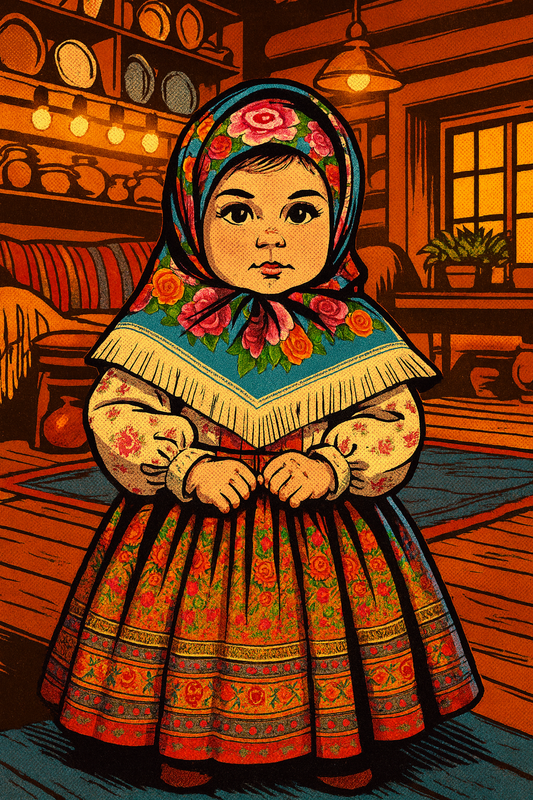
The front room was already dressed for evening—lamps on low, jack-o’-lantern faces in the window catching the last thin slip of October light—and Jess sat in the middle of the brug like a small royal accepting her court. Ten months old, she wore the babushka costume with her unique pride. Glenda had tied it soft under her chin, the scarf all roses and red—so bright it looked warm to the touch—and a little folk-print dress that puffed when she breathed. She was supposed to “sit nice for the picture,” but the colors had her heart in both hands. She bounced in place the way babies do when happiness finds their knees, a light up-and-down that made the scarf’s fringe blink and the dress whisper.
“Okay, okay,” Glenda said, laughing before she could stop herself, the camera pausing halfway to her eye. “Miss Rosebud, hold still one second for Mama.”
Jess looked at her with the practiced gravity she used for ceiling fans and new people, then glanced down at her own chest like she’d just remembered she was the one wearing the festival. She pinched a corner of skirt between thumb and forefinger and shook it so the stitched flowers woke up. The movement thrilled her so much she did the bounce again—tiny springs, soft heel-thumps on the rug, little breathy squeaks that were not quite words and didn’t need to be.
Glenda tried the camera again. It was the family’s little point-and-shoot with a temper, and she had to hold her breath to keep from blurring the moment with her own laughter. “One picture, sugar,” she coaxed, settling into the stance Lucille had impressed upon her—elbows tucked, feet apart, as if photography were a sport with rules. “I’ll give you a copy, of course.”
Jess didn’t know posing etiquette, but she’d already discovered attention. She squared herself to the lens with a solemnity that would have slayed a senate, opened her mouth into a surprised O, and lifted both hands as if to offer the evening her blessing. The scarf’s knot rode high like a peach under her chin. Her socks—white with a scallop—had gotten crooked in all the enthusiasm, and one shoe was pointing left, the other at something only she could see. She was perfect.
Click.
The camera sounded its small plastic whirr, and Glenda dropped it just enough to see her daughter full again. The laugh burst out of her, the kind that lifts your shoulders. “Oh, Jess,” she said, because there wasn’t a better sentence than that. “You’re all my heart needs.”
Jess answered with a vowel that contained all her current vocabulary—delight, question, report—and patted her own belly twice as if to confirm that the costume remained hers. She leaned forward, one palm planted, and tried to stand without exactly deciding to; when her balance argued back she plopped onto the rug and startled herself into a delighted gasp. The scarf shifted, fringe falling across one eye. She pushed it away with a careful hand and found Glenda again, checking her mother’s face the way she checked the light: Is it still good? It was.
On the coffee table the candy bowl waited, plastic pumpkins smiling around it like a council of elders. A church-fair ghost hung from the curtain rod, fishing line invisible, drifting when the floor vents breathed. Somewhere in the house the dryer thumped a late towel. The front room held that pre-porch hush particular to Halloween—the sense that the night had already gathered on the steps and was politely not knocking yet.
She descended from upstairs, already practicing her prowl.
Dana had worked at it in the mirror until the whiskers were twin, tidy commas and the little black triangle on her nose sat sharp and even. The headband ears were felt, stitched by Lucille long ago and retrieved from the dress-up bin; a faint line of glitter traced their edges so they caught the lamplight when she turned her head. She’d pulled a black sweatshirt over a long-sleeve tee and pinned a tail to the back of her jeans with two safety pins crossed like bones—secure enough to sprint, if sprinting happened. Her sneakers were scuffed but serviceable, laces double-knotted. She’d swiped a tiny bit of eyeliner at the outer corners of her eyes, which made her look both more cat and more serious than she meant to. Around her wrist, a thin ribbon with a jingle bell; it made a polite sound when she shook out her hands to get the energy out.
“Me-ow,” she announced, deadpan, stepping into the front room.
Glenda looked up from adjusting Jess’s scarf. “Well, if it isn’t the terror of the neighborhood.” She tipped her head, approving the whiskers, then thumbed a smudge at Dana’s jaw that had more to do with affection than precision. “Turn.”
Dana obliged, tail swaying with intention. She shot a quick grin at Jess and stage whispered. “Hey littlest gramdma.”
Jess—roses tied under her chin, dress puffed like a happy cloud—whistled a vowel and lifted both hands. The scarf fringe blinked; she bounced once, twice, the way her body did when delight needed somewhere to go.
Dana crouched to her level, ears tipped forward, and tapped the bell with a fingertip. “Whatcha think Jess?”, letting the smallest jingle ring, then pretending surprise like the sound had snuck up on them both. Jess squeaked and patted the bell, then the ribbon, then Dana’s whiskers, gently, as if petting a very patient animal.
Glenda’s laugh gentled into something softer. She lowered the camera entirely, letting it hang by its wrist strap, and took in the scene not as a keeper of records but as a person in a room with her family: pumpkins breathing out their candle smoke; the good rug with the threadbare place where feet always turned; Dana’s ridiculous tail; big sisters’ hands ready in case Jess’s bounce turned into a topple; and Jess herself—roses at her chin, hair in a soft, intentional mess, eyes dark and wide as the fact of her own happiness.
Jess found the fringe again, lifted it like a curtain, and looked at the room through roses. The colors stained the air on her side of the cloth, a drenched little world. She made a sound like discovering a secret, then dropped the scarf and turned it into a game: up, rosy world; down, Mama and Sissy in their whole faces again. Up, an eclipse with flowers. Down, home.
“Peek-a-bloom,” Dana whispered, pleased with herself.
“Okay, one more,” Glenda said, because plenty is never quite enough when the subject is your child and the season is brief. She raised the camera and the laugh snuck back into her voice. “Jess, sweetheart—”
Jess beat her to it. She lifted both arms as if hoisting October by its edges and bounced twice with the control of a person who’d recently discovered knees. The scarf hopped. The dress puffed. Her socks lost another degree of alignment. Everything about her said yes.
Click.
By the door, Dana’s paper bag waited—brown kraft, the front covered in her marker work: three black cats of increasing attitude and a crescent moon with eyebrows. A tiny flashlight wrapped in orange cellophane was tucked into the bag’s corner so it would glow like a campfire when she turned it on. Folded tight in her sweatshirt pocket, like a card up a sleeve, sat a spare pillowcase with her name block-printed near the hem. She didn’t touch it, but she knew it was there. She glanced, once, at the corner where the bigger kids always gathered by the mailbox before making their own circuits, and then back to Jess, as if memorizing both maps.
“Ready?” Glenda asked, peeking out through the lace curtain. The street was turning that honey-to-nickel color it gets right before the lamps click on. Porches were awake—pumpkins lit like friendly fires, a witch hat here, a string of orange bulbs there. Somewhere down the block, “Monster Mash” tried to sound confident through a cassette player whose batteries had opinions. The air had a leaf-tea smell and the promise of three degrees cooler after dark.
Dana rolled her shoulders like a runner, then nodded. “We’ll do the loop,” she said, soft, like she was talking to herself. “Yes.” She lifted the bag, tested the grip, then reached for the storm door with the same hand, holding it open with a little flourish. “Your carriage.”
Glenda scooped Jess onto her hip, adjusted the scarf knot with the competence of someone who could tie twelve kinds of bow. She settled Jess on her hip, the baby’s legs gripping her waist, tiny shoes planted, warm as bread against her side.
They stepped out into the soft edge of evening, the kind that makes every sound ring a little clearer—the crunch of Glenda’s heel on the top step, the sigh of the storm door, the whisper of Dana’s tail brushing denim. Across the street, Mr. Blackmon was testing a string of lights that had opinions about circuits; two littler kids in store-bought capes were practicing their “boo” in harmony. The sky still held daylight the way a glass holds the last swallow of tea.
Dana paced herself to Glenda’s stride, bag swinging a practiced inch from her knee. She kept throwing quick looks at Jess, as if checking an instrument—tuned? tuned!—then out toward the street where the first porch lights blinked alive in a staggered wave. When a cluster of older kids—inflatable ninja, zombie football player, a witch whose hat would not stay convinced—loped past on their way to the corner, one of them gave Dana a chin-flick hello. She returned it with a nod that meant later, the bell on her wrist staying quiet on purpose.
Dana, all cat-ears and ribbon-bell, took the lead like a small marshal of ceremonies. It was still more gold than blue outside—streetlights flicking on one by one while birds argued in the hedges. The paper candy bag in Jess’s fist made its bright hush when she bounced, that happy little creek of sound. “Okay,” Glenda said, conspirator light in her voice. “We’ll start with the Thompsons.”
Clara and Arthur’s porch smelled like pecans and memory. Clara had a pie cooling on a rack inside, the kind she’d been famous for since any of them could remember; she opened the door with a laugh like a screen door easing shut, and Arthur hovered behind her with his mechanic’s hands wiped clean for the night. “Look at this angel,” Clara breathed. “Better than any bouquet.”
Jess, riding high on Glenda’s hip, reached for the blue willow dish before she knew what it was—drawn by the shine—and Clara laughed that soft, screen-door laugh and let her “help.” Glenda angled Jess’s hand over the bag, and Clara tipped in butterscotches and caramels one by one—tap, tap, tap. The bag’s voice deepened from papery whisper to creek-over-pebbles. “First of the night,” Arthur said, proud of their place on the route. “You start here, you’ll bring the luck home.”
The teenage boys at the Schultzes’ had rigged fishing line to a ghost that swam across the yard like a jellyfish; Jess watched it with the fixed expression of a scientist clocking a new species. The church secretary two doors down wore a witch hat with a velvet bow and gave out wax lips and smiled till she got crow’s feet. At the corner, a cluster of aerospace engineers who worked out at Redstone Arsenal had made a cardboard Saturn V taller than the mailbox and handed out full-size Twix with the cheerful overkill of people who kept slide rules in their desk drawers.
“C’mon, baby,” Glenda murmured into Jess’s hair as they paused beneath a sycamore that had shed its leaves in a ring like a skirt. “Point us to the next adventure.”
Three doors down, Kevin Reyes had set a chair on his stoop and was idly strumming an old acoustic while a string of soft orange bulbs tried to learn rhythm from him. He grinned when he saw the babushka and the cat. “Y’all want the good stuff or the noisy stuff?” he asked, waggling a bowl in one hand and the guitar pick in the other. “Noisy,” Glenda said, and Jess agreed with a bounce. Kevin obliged with a staccato rain of hard candies so perfect it made Dana whistle. “Knew it,” he said, delighted to have read the room.
They turned the corner into the run of houses that felt like an album you could thumb. Amanda Washington’s porch had paper rockets taped to the rail, each drawn by a small, earnest hand; Jordan waved from behind his mother’s knee, already explaining propulsion to whoever would listen, and Grandma Louise called, “Don’t let that baby catch a chill now,” as if warmth itself bent to her voice. The candies went in—crinkle, clack—and Jess leaned forward to hear the bag’s voice change, eyes gone solemn with science.
They crossed under a maple that had convinced itself it was setting the world on fire and came to the suburban ranch where Henry Baker and Lena Williams-Baker had put out a folding table with two pumpkins and a framed black-and-white of a rocket on the pad. Henry never let a moment pass without a story; tonight it was gentle—just the hush before launch, how the Florida air trembled under your sternum when the engines woke. “Anyone who can keep her hat tied gets two,” Lena said, swift principal’s smile in her mouth even off duty, and made sure Dana’s tail was safety-pinned to survive the night.
At the Patels’, Meera had turned the porch into color—paper lanterns like small moons, rangoli chalk spirals under the mat. Kiran waved from the doorway in a sweater that had seen many Octobers. “For the scientist,” Meera said, choosing candy in the hues of the rainbow and dropping them with care so Jess could watch each one land. Priya, small astronomer, held up a cardboard telescope painted silver and gave Jess a serious nod as if the two of them understood something about looking closely.
They passed a line of houses with pumpkins at different stages of dentistry and came to the McAllisters’—porch light bright, a plywood ghost on a dowel nodding in the yard. Cindy had set out a bowl labeled TAKE TWO in librarian block letters, and Jim stepped into the doorframe, a delighted smile as he looked between the pair, with a wink, dropping three in Jess’ little bag.
Mr. Leroy and Miss Mary’s place had a paper cat in the window and something baking, because of course; Mary pressed a crocheted pumpkin into Dana’s free hand—“for your menagerie”—and Leroy, who could make wood do anything, had whittled a tiny ghost the size of a thimble and gave it to Jess as if it were a passport. “Boo,” he said, in return she gurgled “Buh!” The candies they offered were wrapped in cellophane that made a bright, birdlike chirp when it hit the bag.
Two blocks over, the Lin porch smelled like dried orange peel and the kind of tea you drink when you’re not sick but want to be kept; Mei had tucked a handful of small wrapped sweets into paper cups with tiny paper cranes perched on the rims, and Xiao, who always looked like he had just solved something beautiful, waved them along with a grin. A teenager inside—Kevin Lin, head bent over a half-disassembled toy robot—didn’t look up, but the porch told his story for him in wires and neat rows of labeled screws.
On the corner, the Torres house had turned their school-bus-yellow mailbox into a jack-o’-lantern with electrical tape teeth. Carlos leaned an elbow on it like he’d planned that visual all year and offered Glenda a paper cup of cocoa for the walk; inside, Luz had built a sugar-cube castle on a baking sheet and was interviewing trick-or-treaters about structural integrity. “Safe travels,” Carlos said, one bus driver to another kind of driver, as he dropped in two lollipops just for the stick clack.
They doubled back by the park where Paola’s mural lit the dusk even without a lamp—a ribbon of color about the neighborhood’s history running across the cinderblock wall—and the echo of children’s voices held on the basketball court like a friendly haunting. Jess shook her bag once for the painting, and the beads inside answered the paint with sound.
A tidy brick house they always called “the historian’s” (because Simon’s porch was forever stacked with boxes marked maps and clippings) had a bowl with a handwritten sign: PLEASE TAKE THREE—THE PAST DEMANDS GENEROSITY. Dana observed the rule exactly and then adjusted the sign so the dash lined up with the letters, because some cats were also editors.
The Johnson-Ramirez porch was a party the moment you stepped on the first riser—paper flags, the smell of something good from the kitchen. Maria had dressed as a chef because she was one even out of costume, and Sophia had an apron on that said HISTORIANS MAKE SPOOKY GOOD COMPANY. Daisy answered the door as a superhero whose cape trailed sugar. “For the maestro,” Maria said, opening her palm over the bag like a stage magician, and the pieces landed with a lively patter that made Jess laugh into her own shoulder.
Khalil’s porch light was a soft amber, and the jack-o’-lantern had the kind of linework only a designer would bother with on a Tuesday night. He’d carved it with a box cutter and a calm hand, then taped neat paper bats along the doorframe—clean silhouettes against the paint. “Design is ninety percent subtraction,” he said to Dana, who nodded as if she’d been saying that all along, and he deposited three jewel-bright hard candies that made the bag ring like tiny bells.
Greta and Leo’s place—Schmidt on the mail slot, cinnamon and pretzels in the air from Heidi’s kitchen—had a bowl labeled CHOOSE YOUR OWN ADVENTURE with arrows pointing to chocolate (thud), hard candy (rain), and “mystery pretzel” (shuff). Johan stood behind them in socks, pointing out Saturn to anyone who’d stand still. Jess chose rain. The bag, pleased, answered in fluent weather.
By the time they made the final turn, the street had gone from evening to night—the kind of clean, kind dark that keeps children visible because everyone wants them to be. The houses, twenty-three in all, felt like chapters you could revisit tomorrow and the next day; even the ones whose porch lights had gone out kept their warm rectangles in the windows like book spines on a shelf. Dana slowed her step without meaning to, stretching the night like taffy, but the loop was a loop and home is where it ends.
Inside, Glenda set her down on the rug. Jess set the bag in her lap like a cat, petted it once, then—because babies know when a chapter ends—let it tip over and clambered onto Glenda’s lap. Dana brimming with delight, reached out to receive the camera then lightly stepped across the room to frame the moment.
Jess lifted one hand and patted Glenda’s collarbone twice, the way she did when she wanted the song again. Glenda hummed the tune she always fell back on when her mind got busy—just enough minor chords to sound ancient, just enough swing to sound like walking.
Dana darted past to clear a spot on the coffee table. “For sorting,” she said. Then set Jess’ bag on the coffee table. “Sorting implies touching,” Glenda warned. “We’ll do it quick,” Dana said. “Like a race. She won’t even notice.”
Jess noticed. The bag was her companion; you don’t forget your bandmates. When Dana reached for it, Jess clamped her tiny hands around the rolled lip and let out a warning syllable that was ninety percent polite and ten percent absolute. “Okay, maestro,” Dana said, palms up in surrender. “You keep it then.”
“Tell you what,” Glenda said, disappearing into the kitchen and returning with a silver mixing bowl. She poured a handful of candy into it; the first handful of the night they had actually moved from the bag. It made a deep, ringing pile, a new note. Jess watched the transfer, fascinated by the pour but unmoved by the idea of eating. Glenda took up the bowl and rocked it gently. The candies slid in a circle with a low shush. Jess tilted her head, calibrating.
“What if,” Glenda said, minding the scientist’s value of consent, “we put it back in the bag?”
Jess considered, then nodded—her odd little bobbing nod that meant yes, but careful. Back it all went, one handful at a time, and with every addition Jess shook to test the new composition. Each test produced the gleeful, astonished face again, as if the world kept saying “Yes, also this,” and meaning it.
“Do you want to open one?” Dana asked eventually, holding up a chocolate like a rare bird.
Jess watched her crinkle the wrapper. The wrapper was interesting; the candy, once revealed, was simply brown. Jess looked away, unimpressed, and returned to the bag.
Glenda and Dana exchanged a playfully exaggerated matching expression, Jess’ slight frown of disappointment lingered.
They tried a lollipop—stick to hold, translucent color to admire. Jess turned it in her fingers, held it up to the lamp to see what light did inside it, then placed it carefully in the bag as if to say: you belong in the band.
Jess tried a new thing: she crouched, let the bag touch the rug, then lifted it and let it fall the smallest bit. The contents made a soft thud that thrilled her to her toes. She did it again, a controlled drop, eyes huge. Then she invented a slide—pulling the bag along the rug so the candies murmured. She giggled then giggled more because she had discovered she could make herself laugh too.
They let her play until the bag’s handle grew slick with drool and the paper softened from enthusiasm. When Glenda finally coaxed it away—“Bath time, bandleader”—Jess negotiated a compromise: she would carry the bag to the bathroom door like a trophy. In the tub, she tried to re-create the sound by slapping water; it was not the same, but the splash had its own percussive truth. She accepted it with grace.
Later, pajamaed and warm, Jess sat in Glenda’s lap for a song and story before tucking in. Downstairs, Dana was allowed to pour the candies into three bowls—save, share, Mama’s—while promising not to eat any that had been rejected by the maestro on artistic grounds.
==========================
The front room had settled into its own small hush, the kind that happens when the house remembers how to breathe. The heater clicked and sighed. A car went by and the window glass hummed for a second. On the rug, Jess sat with her legs in a sturdy V, the pink-and-purple bag of Pips in both hands like a treasure she planned to interview.
“Hi, babygirl,” Glenda said from the couch, one foot tucked under, a mug cooling on the table. “You playing your song?”
Jess looked up, checked Glenda’s face the way she checked the lamp—Is it friendly?—then returned to the bag. She pinched the rolled top in her fists and gave it a measured shake.
The room answered. The paper whispered; the candies rattled and clacked and slid over one another—rain on a tin roof, pebbles in a cup, a few bright bell-notes where the hard ones touched just right. Jess’s mouth made an O. She shook again, shorter, as if to ask the sound a follow-up question.
“That’s it,” Glenda murmured, smiling at the seriousness. “Ask it again.”
Jess bounced. Not standing—just that baby bounce that comes from the knees and the spine, a contained spring that traveled up to her cheeks. The bag sang. She bounced harder, as if rhythm could be collected like candy, and the scarf at her throat (still tied from earlier, a little crooked now) bobbed with her.
“Roll, then rattle,” Glenda read softly off the tiny seam print when Jess turned the bag in her hands. “You got it.”
Jess turned the bag again, fascinated by its skin. The rainbow window flashed under the lamplight; pinks and blues slid across her wrist like tiny fish. She lifted the window to her eye, peered through at Glenda, and laughed at the way her mother looked dipped in candy. Glenda crossed her eyes on purpose and Jess squealed, dropped the bag onto her lap, then hurried to scoop it back up as if apologizing to it for the interruption.
“Sorry, orchestra,” Glenda translated. “We were conducting some nonsense.”
Jess found a new grip—one hand on the belly of the bag, one hand on the rolled top—and tried a long, slow shake. The candies inside slithered and settled, a hush like pages turning. She held perfectly still to hear the last piece find its place. When it stopped, she gasped softly, then gave a single approving nod like a tiny foreman.
“Again?” Glenda asked.
Jess answered by tapping the bag against the rug with a gentle thup, then back to shaking—three short, one long—discovering that patterns were a thing she could invent. She stopped between phrases to listen, the way she had stopped for birds, for trains, for ceiling fans since she could sit without tipping. The listening looked older than she was.
“Three short, one long,” Glenda said, leaning her elbows on her knees, enjoying being the audience of one. “Morse code for ‘more, please.’”
The bag had its own vocabulary, and Jess tried all the words. She shook high (so the candies fell farther: brighter). She shook low (so they rolled together: deeper). She leaned the bag forward and dragged it back across the rug, shhhh, eyebrows up because that sound was new—fabric talking to fabric under the candy’s weather. She brought the bag close to her ear and held her breath and the whole room leaned in with her.
“That’s your ocean,” Glenda said. “Put a shell to your ear, it tells you what it knows.”
A single piece slid and clicked against the seam. Jess grinned like the bag had whispered a joke it only told to her. She bounced again, feet flexing like she might launch, and the bag shook in time with the joy in her knees.
“Careful,” Glenda said, halfway rising without meaning to. Then she saw Jess correct herself—palms steadying, weight back, decision made—and she sat again. “You got it.”
Jess tested the bag on Glenda’s shin—light rap, watch Mama’s face, light rap again. The bag replied with a pliant little chorus. Glenda obliged by making a drum-face, eyes mock-solemn, then tapped the bag back with one finger so Jess could hear the difference between tap and thump. Jess laughed, startled at cause and effect, and did it again, slower this time.
Somewhere beyond the window, kids whooped and the sound went away like a flock turning. The lamp held its pool of honey on the rug. Without the clamor of other rooms and voices, the small noises grew large: the papery sigh at the top of Jess’s shake, the mid-rattle clatter when two hard Pips found each other, the sand-soft slide at the end when the last few pieces settled like breath in a sleeping chest.
Glenda picked up the mug and didn’t drink, watching instead. “It’s all right if you’re not ready for eating,” she said conversationally, as if to the bag too. “We can chew later. Tonight we listen.”
Jess had no plans to chew. She angled the bag, pried it open a little with clumsy thumbs, looked into the mouth as if it might show her the inside of sound. The rainbow window put a stripe of color across her cheek. She hummed one note down in her throat—an uncertain, investigating sound—and shook to see what the bag would do with it. The result was chaos and agreement; she loved it.
“Sing with it,” Glenda encouraged, quietly, not to spook the experiment. She hummed the same note, then dropped a third under it—the old habit of making harmony with whatever the room offered. Jess froze, surprised that Mama had joined. Then she smiled so big she lost her seat, tipped sideways, caught herself with a palm, and resumed bouncing, proud to have fallen and proud to have righted. The bag accompanied all of it faithfully.
After a while the shaking turned methodical. Jess made columns of sound: left-hand shake, right-hand shake, both together, rest; left, right, both, rest. Each set got the same solemn face, a brow crease that made her look like a tiny mathematician. She checked in with Glenda after each series, eyes up and asking. Glenda gave the same answer each time—her mouth soft, her smile sure. Yes, baby. Yes.
“Want me to help you roll it?” Glenda asked when Jess’s grip tired and the bag sagged like a nap. She slid off the couch to sit on the rug, ankles tucked to one side. “Just once.”
Jess offered the bag without ceremony, like to a trusted lab assistant. Glenda didn’t pour or show the contents. She just rolled the top one extra turn and gave it back heavier, sturdier in the hand. The next shake was richer; Jess blinked at the difference and looked at Glenda as if to say: What did you do?
“Roll, then rattle,” Glenda smiled, pointing to the tiny words on the seam. “It likes being closed up cozy.”
Jess considered the seam print, frowned in focus, then patted the rolled top twice the way she patted things she loved. She leaned her head to one side and did her three-short, one-long again, and the bag rewarded her with the creek-over-pebbles voice she’d liked best all night. She exhaled through her nose in a tiny satisfied snort, which made Glenda laugh out loud because that was exactly how her own mother sounded when the pie crust behaved.
“Tell you what,” Glenda said, shifting so her knee touched Jess’s toe, wanting the contact without interrupting the work. “That there? That’s your first instrument.”
Jess didn’t know instrument, but she knew mine. She folded her whole body around the bag—one arm over, one under—then shook it once from the center of the hug. The sound was muffled, secretive, like rain remembered from another room. She loved that too. She put the bag to her ear again and listened until the last tiny bead-note died. When it did, she lifted her face and found Glenda’s eyes with a look so sober and pleased it seemed to speak: I heard it all the way to the end.
“You did,” Glenda whispered. “All the way.”
They sat like that a while: Jess inventing and repeating, Glenda echoing or staying quiet according to a baby conductor’s cues. Every so often Jess would pause, as if the room needed to hear itself. The heater sighed. The fridge clicked. Somewhere the neighbor’s screen door corrected its own hinge. Jess would nod, satisfied that the world was keeping time, and begin again.
Jess had found a new obsession: the way Glenda’s keys chimed when they hit the bowl by the door. She stood there on her sturdy feet, hands on the rim, and made a religion out of that tiny bell. The bag lay where she’d left it, its pink-and-purple grin open, contents settling into a softer hush. Everybody laughed at the pivot, that baby certainty: finished with that now, this is my whole job. It endeared the entire evening, like a dog suddenly deciding the real show was the dust in the sunlight.
That night, after Jess was asleep and the house had its pleasant post-holiday mess about it—costume bobby pins on the coffee table, a smear of eyeliner on a napkin, the bag sitting proud above the fireplace—Glenda made tea and sat in the quiet. She listened to the little animal sounds of their home: the fridge throat-clearing, the heater sighing on, Dana narrating to her sisters in the next room. The bag made no sound at all now, but Glenda could hear it anyway, the way you still hear a song after it’s ended.
“She loved the sound more than the sweet,” she said, mostly to herself.
Fabric store air is its own season—sizing and cotton and a thousand bolts standing at attention. The next afternoon, while Jess did her stern work of stacking blocks and then unstacking them as if she’d been hired by gravity, Glenda measured her life into yards: a gradient cotton that ran from magenta to violet like the bag’s sunset, a little strip of silver lamé for the rainbow “window,” pale muslin for an inner pouch, and a packet of tiny clear craft beads from the notions aisle that shushed when you tipped them. “Not rice,” Lucille had advised from Texas.
In the evenings, once dishes dried in their racks and Jess fell into sleep with her hands open like she had decided, finally, to let the day go, Glenda sewed. She drew and redrew a template on freezer paper until the shape looked right in her hands—rounded at the bottom, a soft suggestion of a rolled top. She cut the muslin twice and stitched it into a small, flat pouch with French seams and then top-stitched again, belt-and-suspenders against any future tear. The beads went in with a spoon, each pour a different note. She tested the sound: too much and it thudded; too little and it whispered like someone being polite in a library. She added a scoop, took out a scoop, learned by ear.
“Pip Physics,” Dana said, writing it at the top of a grocery list like it was a lab report. They experimented, the way families do when everybody is in on the project. Dana shook the inner pouch and declared it a “creek day.” Lucille tried a gentler arc and said it sounded like a bead curtain in a summer doorway. Glenda made notes: Small beads = rain. Add three flat sequins for clack. No, sequins too slappy. She settled on beads only, trusting the music she’d heard in Jess’s hands.
Then the pretty part. Glenda cut the gradient cotton so the magenta lived at the bottom, purple near the top. She appliquéd a little oval drumhead of cream fabric and hand-stitched Pip, Pip Hooray in tiny blue letters around it because she couldn’t help herself. She edge-stitched the silver rainbow window and, in a little joke she’d never explain, embroidered roll, then rattle in thread the color of sherbet along the seam that would fold. An extra line of stitches hid inside every seam like a quiet promise. Last, she made a loop of soft ribbon—cherry red, the very same color Mrs. Petrov had tied at Halloween—and tacked it in tight so small hands would have a handle.
On the third night, when the cover was finished, she slid the muslin heart into its skin and ladder-stitched the opening closed so neatly she could imagine it receiving perfect scores.
“Name?” Dana asked, weighing the finished thing in her palms, eyes shining.
“The Hooray,” Glenda said. “Or the Pip Pillow..”
They didn’t give it to Jess right away. That was part of the fun. For a couple of weeks the almost-winter days unspooled—the smell of leaves going from garlic to tea, Jess perfecting her clumsy clap, the porch pumpkins finally giving up and becoming themselves again. The toy sat in the sewing basket sometimes, sat on the arm of the couch at night while Glenda mended a hem, lived in the house like a held breath. When Jess toddled near, Glenda palmed it out of sight—gentle magic, not secrecy—because surprise was a ritual too.
On a Thursday afternoon lit by that pale kind of sun that makes windows into honest mirrors, Glenda set the toy on the coffee table exactly where Jess liked to bang her hand for applause. No fanfare. No “look.” Just placed it there and went to the sink to wash an apple, thumbing the bruise away from a red delicious that had done its own little trip down the market aisle.
Jess spotted it the way she spotted everything—like a hawk and like a poet. Magenta-to-violet, rounded and friendly, ribbon tails asking to be tugged. She toddled over, put her palm on top (the way she always tested a new thing: Is this world hot? Is it mine?), and then lifted it with both hands.
“Buh,” she said, the universal baby syllable for behold.
She shook.
The room said yes. The toy answered—the soft rain-on-tin hush, the bright tumble of beads finding one another, the little consonants of cloth against cloth. It wasn’t the exact bag sound; it was the memory of it made into something you could sleep with. Jess stilled, listening to her own hands. She shook again, a longer roll, and then she laughed, that particular baby laugh that starts in the chest and lifts the hair at the back of your neck.
“Oh,” Glenda said, apple forgotten, dish towel slack in her hand. It came out half prayer, half science.
Dana slid into a sit at Jess’s feet like a roadie for a headliner. “Do you like it? Because if you don’t, I like it, because I am an appreciator of fine instruments.”
Jess ignored her in the specific, loving way children ignore older siblings when they’re busy. She tried the toy low (deeper), high (sharper), quick (rain), slow (waves). She hugged it to her chest and gave it a little bounce; the beads murmured, which pleased her so much she made a satisfied “mmm” and did it again. Then she put it to her ear and listened like the ocean might be inside.
“It’s got the creek,” Lucille said from the doorway, hand over her heart, the camera dangling useless because some minutes are better unphotographed. “You caught the creek.”
Glenda sat on the rug, folding herself down to meet the floor the way you do after a long day and a long plan. “That’s yours,” she told her daughter. “The Hooray. For shaking, not snacking.”
Jess tried the word on, because she tried everything: “Huh.” She tucked the toy in the bend of her elbow the way she cradled her soft rabbit and then patted it twice, a habit from the world of “again.” She shook once more, then—because she was still herself—she dropped it and crossed the room to investigate the sunbeam inching across the ottoman. The toy stayed where it fell. The room now contained both things: a brand-new instrument and a baby who had remembered that light was a toy you didn’t have to hold to play with.
“I love that about her,” Dana said softly. “She’s like, ‘Yes, and also, I’m very busy with sunshine.’”
“That’s the right way round,” Lucille said. “We give, the world gives back, and then somebody sees a moth.”
Later, in the easy blue of early evening, Jess returned to the couch as if drawn by a string. She found the Pip Pillow by herself—no theatrics required—and picked it up with proprietary grace. She rapped it gently against Glenda’s knee. The beads applauded. She rapped it against her own knee and widened her eyes at the fact of cause and effect. Then she balanced it on her head for six triumphant seconds, shook, and cackled when it slid off like a friendly hat.
“That’s the hat version,” Dana observed “Limited release.”