Work Text:
Alice walked with her notebook in her left hand and the pen already uncapped, but today the pages stayed clean. She let the strip announce itself without being trapped in ink.
The place had the Saturday hum of a town that had decided winter was a solved problem. March light behaved—angled and kind—laying a gloss on windshields and smoothing out the tired seams in the asphalt. Banners hung from the awnings, their corners ticking like metronomes in a light breeze, LAST-CHANCE SAVINGS stuttering into shadows and back into sun. A dollar store window threw fistfuls of neon—starbursts promising 2 FOR $1 and a paper chain of highlighter-pink price tags—and the reflection of the parking lot moved across the glass like a faint second world. The shoe outlet had built itself a skyline from white boxes, and the stacks cast perfect square shadows across the tile so that walking past felt like stepping cleanly between piano keys.
The air here was a recipe: warm rubber from the shoe place, plastic and lemon cleaner from the housewares store, a butter-sweet pocket of pretzel stand somewhere upwind, a faint ghost of gasoline that never quite leaves an American parking lot. Farther down, a beauty supply’s door opened and let out a puff of hairspray and talc. The automatic doors exhales were predictable—huff, hush, huff—cool air pooling at her calves when she crossed their reach. A radio nailed under a soffit pushed pop music into the breezeway on a thin ribbon of sound; three storefronts later, a different speaker insisted on a ballad, and the cross-talk made a brief, cheerful argument in midair.
Under the awnings, people sorted themselves into the choreography every retail strip understands. A mother steered a stroller with one hand while her older kid hopscotched between the checkerboard shadows, careful not to tread on the dark squares. Two teenagers practiced walking in borrowed height—heels clacking, hands windmilling when they hit a slick of shade; they caught each other’s elbows and kept going, laughing at nothing they’d admit to later. A man in a feed-store cap leaned back against the soda machine, tapping a pack of cigarettes flat against his palm but not opening it, gazing at nothing like he’d paid admission to stare. At the cart corral, a skinny kid ran a chain of buggies into place with an impact that clanged politely up the breezeway and then died.
Planters the color of oatmeal tried for spring with pansies and petunias; the wind fussed their faces and moved on. Street trees along the curb—Bradford pears in white explosion—snowed a little on every passing shoulder. Pollen had started to powder the world; on a sun-struck windshield it cut the light into soft, grainy diamonds. Somebody had written WASH ME with a fingertip on the back window of a Pontiac and then, below it, added a second line: NO SERIOUSLY.
A barber two doors down had chalked his prices on a sandwich board: BUZZ $6, KIDS $5, TALK FREE. Inside, a man’s laugh punched once and then settled to a purr of conversation. Next to the barbershop, a dry cleaner breathed out steam that smelled faintly of starch and other people’s Tuesdays. Across the way, a discount clothing outlet had hung a promising rack outside—denim with confidence, a row of chambray like a small, windy river, a single sequined jacket glinting without apology.
She didn’t lift the pen. She catalogued the angles instead. This was a friendly light, the kind that forgives faces and makes dust look like effort rather than neglect. The awnings threw long, soft-edged rectangles that would take a person cleanly from shade to sun every three paces; in August, this is where people would choose to talk. At noon the glare would flatten everything, but now the storefronts had depth and the reflections behaved—two panes down from the shoe place, a passing red hatchback skated quiet across glass like a toy. In the distance, a delivery truck used its brakes on a downshift with that sighing, patient sound big machines make when they’ve decided not to complain.
She moved with the small, confident economy of someone who knows there’s nothing to catch and yet everything to absorb. A woman in a pastel suit paused to pinch a dead leaf from a planter geranium; the gesture said she did that wherever she went and could not help it. A boy with a broom learned the physics of corners by pushing grit into them and watching it refuse to leave; he added his foot and prevailed. A cluster of older men set up near the bench by the vending machine and remade the world with the gentle certainty of people who’ve kept the same opinions since 1978: taxes, the Braves, that young governor from Arkansas, the way gas station coffee used to taste like coffee. One of them pushed his cap back to scratch his forehead and revealed a white bar of skin where the sun never wins.
Election year talk traveled like weather here, not like doctrine—thin phrases drifting in and out of earshot, all ellipses and nouns: “…jobs…” “…don’t trust…” “…after that war…” “…Hale…” “…Montgomery…” “…my cousin says…” No banners for candidates yet—March was still tidy—but the bulletin board outside the dollar store held a flyer for a church fish fry, another for a rummage sale, and a third with tear-offs for piano lessons, handwriting that started neat and got optimistic by the bottom.
A deliveryman shouldered past with a stack of boxes taller than his patience and read the tiny cursive on each label by instinct. The plastic tape creaked. In the shadow of the shoe store, a little girl tested the spin of a display rack full of sunglasses, sent the carousel around, and picked up a pair shaped like hearts. Her mother replaced them with a practiced hand without even glancing; the kid accepted the veto and tried on a new face made entirely of pout for three seconds, then forgot to maintain it when a dog barked far away.
Alice tipped her head to clock the wind. It lifted the edge of her hair, tugged once at the skirt, died against the hot skin of brick, and found itself again at the next gap between buildings. If she were rolling, she’d put an ear on the microphone and ride these fades until the room told her where not to stand. Today, no equipment—only the habit of framing. She watched for the places where people naturally paused: the seam where two awnings overlapped and made a richer shade; the lip of concrete near the pretzel cart where the scent caught ankles and made them reconsider their speed; the little eddy at the corner where the breezeway opened to the lot and people chose their car or chose another store and revealed something small about what they believed was worth time.
Over the door to a nail salon, a plastic clock insisted it was ten minutes earlier than everyone else; inside, a technician in a mask catalogued a rack of tiny bottles like a jeweler talking to stones. A young dad, jacket off and tie loosened to sincerity, performed a magic trick for a toddler in a stroller—disappeared a coin, produced it from behind an ear; the kid shrieked the astonishment of someone who hasn’t worked out betrayal yet. A pair of middle-schoolers hovered outside an arcade game in the vestibule of the discount store, empty pockets turned into theatre as they negotiated who owed who a quarter from last time and whether pride could be exchanged for tokens.
She could feel the notebook in her hand, the small itch in her fingers, and left it alone. The world didn’t need to be translated just yet. It was enough to let the strip show her its grammar. Signs spoke in the idiom of the decade—block fonts, neon outlines, promises made on corrugated plastic. The automatic doors all sang the same three-note song, politely, every time someone tested their faith. In the distance, a train put a line of iron sound under everything and kept going.
Alice walked slower than she looked, which is how you keep from missing the one detail that will make sense of the rest. A silver car eased into a space with practiced thrift; the driver killed the engine and sat still a heartbeat longer than they needed to—the small pause of someone subtracting themselves from a day before adding to it again. A woman in a visor counted envelopes beside the blue mailbox, then slipped her letters one at a time into the mouth of the box as if each deserved a moment to be considered. A man in a jacket with a florist’s logo carried a bouquet wrapped in brown paper and held it the way careful people hold babies—forearms precise, chin up, watching for posts and doorframes and chance.
And over all of it, that March light worked as hard as it had to and no harder—rounding edges, laying a coin of brightness on the brow of every passerby, forgiving the winter-chalked cracks and making each storefront, for a few generous seconds at a time, look like a promise kept.
She wasn’t rolling tape today. Scouting only. A pocket full of questions, the camera she’d deliberately left in the car—a small deprivation. Her thoughts would substitute for written word, catching the environment in shorthand: v. light—dusty gold; banners snap; mother w/ stroller (green sippy cup); older man says “Braves’ll choke by June.” A cashier propped open a door with a carton and the smell from inside—cardboard, new rubber, fluorescent heat—stepped out like a person. A local FM station played something bright and unembarrassed from a tinny speaker nailed to a soffit; three stores down, an automatic door exhaled air-conditioning onto her calves—a winter ghost in spring weather.
She saw the pale shape with the angles of attention made still. Huskies have that theater to them—mask, plume, the eye brightness—but this one wore it like a uniform rather than a costume. She sat just outside a storefront that sold housewares and kitchen things; her posture made a square with the door: not blocking, not drifting, a living hinge where people could pass and be tall about it. The leash had been looped around a metal bench in a tidy half-hitch that would hold if a storm decided to vote; the harness was the solid kind that says someone believes in redundancies.
Alice slowed. Not a full stop—the way you slow for a flag—but enough to let the eye make its inventory. The husky’s ears had the angle of a sentence not quite finished; her jaw was loose, not panting; breath went in and out like a metronome. No pleading, no scavenging. Every few seconds, the dog’s gaze made an economical sweep: door, walkway, parking lot, horizon—then back, setting the picture in its frame again. Duty, Alice thought, and the word landed not as a flourish but as a classification, like writing wren under a bird in the margin.
“Hello darling,” she said softly, the way one greets a colleague in a busy hallway. She let the warmth into her voice and kept her hands to herself. The dog’s eyes acknowledged her without making an invitation of it. On second look, the coat was a well-kept map—silver along the spine, cream undercarriage, a darker smudge on one shoulder like a thumbprint from the person who brushed her. The nails were neat, the fur at the collar lay flat where hands had learned how to mean comfort without disorder. The tag on the harness had been polished by friction; it flashed and hid.
Alice tilted her notebook so the dog could see it was a thing, not a trick. She made a quick line on the page—husky, blue-gray gaze; leash knot suggests someone who’s tied boats—and then, under it, a bracketed note: did not pet. The pen left a small dot of ink where she paused, thinking how to describe the exact way the dog kept the doorway clear while still calling the doorway hers. Her reflex—to crouch and offer the back of her hand, to gather a little fur and gratitude—stayed in her pocket. The body language didn’t ask for company; it asked for respect.
A stroller bumped by and the toddler inside lost his grip on a cracker. The dog’s head tracked the arc of the fall, then returned to center, a subtle correction like a pilot ignoring turbulence. A teenager in a ball cap tried out a whistle that didn’t exist; the dog let it pass through her like weather. A man with a sack of onions swung wide, clocked her and said “Pretty girl,” not slowing; the dog did not claim the compliment. The automatic door behind her breathed open and shut as customers came and went, each a small test; the tail didn’t sweep, the haunches didn’t scoot. Whatever command had been given a few minutes ago was holding without argument.
Alice took a quarter step closer and crouched, not to reach, but to see. The eye color was the weird magic huskies get—one ice chip, one lake stone—or maybe they were both the same pale water and the light just cut them differently each second. A tiny line of scar hid in the fur near the right ear, old and tidy; the kind of history you notice only when you’ve earned five more breaths the dog could have used for other tasks. The whiskers at the muzzle were white where the coat wanted to be silver—a frost found without winter. The breath that reached Alice’s knuckles smelled faintly of something meat and honest and of nothing like garbage. Someone fed this dog like they were proud to.
“Good girl,” she murmured. The ear nearest her flicked, just once, and then settled. If a stranger with a notebook was part of the environment, she would be a polite rock.
The storefront reflected the strip’s pageant back at itself: banners trembling, a coed in a red windbreaker teaching her friend how to move in heels without looking like she was imitating a species, a cluster of older men near the vending machine arguing amiably about war and taxes and baseball as if those were three versions of the same problem. In the window glass, the dog’s silhouette was a clean geometry—a triangle of ear, a line of back. Above her head, a handmade sign had been taped a little crooked: NO CHECKS OVER $50—SORRY. Someone had drawn a small smiley face after, as if to cushion policy with charm.
Alice wrote: patience is a posture, not a mood. Then, a second line: if hope had a shape, maybe it would plant its paws and make a doorway safe. She put a tiny question mark in the margin, not because she doubted the sentences, but because she believed in earned metaphors and knew she was only scouting, not filming. The pen had started to tattoo the pad of her middle finger; she adjusted her grip and let the ache be proof of work.
A breeze threaded and lifted the dog’s coat a fraction, laying the hair in a new direction and then letting it fall exactly where it had been before. March in Alabama has the manners to be gentle even when it’s busy. From a storefront two down, the smell of pretzels—somebody’s butter braver than it needed to be—made its case. A boy with a broom swept an old leaf into a new line. Over by the parking lot, a woman in a pastel suit paused to pinch off a dead leaf from a planter petunia; the gesture said she did this wherever she went and could not help it. Election year talk moved like fog: “…jobs…” “…don’t trust…” “…did you hear…” “…Montomgery…” “…war…” The dog did not endorse.
Alice glanced at the harness again—not the kind bought because it was cute, the kind bought because it would stand up. The stitching was double where the stress would be; the D-ring sat high and centered; the strap lay snug over the keel of the chest. Whoever tied the leash knew how to make a knot that won’t cinch tighter when pulled. This animal was somebody’s a dependable tool and good friend. Work first, affection after, when released.
She eased up from her crouch without making it a trick, knees straightening at the pace of courtesy. “You’re doing your job,” she said, and the dog didn’t disagree. The automatic door opened again; a woman with a basket of plastic containers stepped into the light, blinked, made a small sound of delight at seeing the husky, and reached. Alice took a half breath, then watched as the hand stopped, reconsidered, and turned into a little wave instead. The dog glanced at the fingers as if to inventory them and returned her stare to the walkway. Some lessons were contagious.
Notebook back against her hip, Alice took a step to the side so she was no longer directly in the dog’s lane. She let herself grin—couldn’t help it, really—and made a tiny sound in her throat that would have been a coo if she believed dogs needed that from strangers. The dog’s ear twitched, acknowledging the sound the way a professional nods to another across a room and goes on with the thing they were hired to do. She wrote one more line, an entirely personal one: return with camera only if invited.
The housewares store exhaled a breath of plastic and lemon cleaner. Glenda stepped out with a paper sack braced in the crook of one arm and a second bag looped on her wrist. She paused exactly one pace outside the threshold, left shoulder turned toward the walkway, right foot planted. Chloe rose without a sound, the way a word rises at the end of a sentence, and came to attention—nothing dramatic, just a clean line from ear to tail, eyes forward, leash slack as a compliment.
Glenda’s expression made room for several possibilities. The light caught her eyes and didn’t tell on them. There was the hint of a smile in one corner of her mouth that could have been habit or humor or both, and her brow smoothed in that deliberate way people do when they’re reading the fine print of a moment. She noticed the storefront reflections, the line of the walkway, the notebook in the other woman’s hand; she took in Alice.
“You a dog person too?” she asked, not unfriendly. Alice’s pleasure was immediate and unperformed. “Very much,” she said, with the uncomplicated brightness of someone who has just been permitted to talk about something good. She showed her empty palms a little, as if to prove her intentions. “She’s beautiful. I didn’t touch—she’s clearly on duty.”
Glenda’s gaze flicked to the harness, to the tidy knot on the bench leg, back to Alice. The almost-smile edited itself into something real. “She is,” she said. A fingersnap-soft glance at Chloe’s shoulder, a breath that was almost a hm and also almost a thank you. “And she knows it.”
“She looks like somebody whose résumé has bullet points,” Alice said, amused, watching the way the husky’s attention held a tidy perimeter around the door.
“That’s right,” Glenda said, inscrutability now shading into wry. She shifted the paper sack on her hip; it made the shallow rustle of items arranged by a practical hand—coffee filters against apples, bleach nowhere near the bread. “What’s yours?”
“Dog? Shiba inu.” The answer came with the little half-laugh of an owner who has made peace with her choice. “Emily. Fox face, springs for legs, boundless energy in all directions at once. We walk her until the leash is tired.”
Glenda’s eyes showed teeth before her mouth did. “So y’all have a roommate, not a pet.”
The scenes continued all around them—banners twitching, a stroller squeaking somewhere, the shopping cart corral clanging once when a teenager misjudged and then corrected with practiced shame. Chloe held her line, present but nonnegotiable. A boy pointed and said “woof,” and his mother, without looking up from her keys, said “dog,”.
Alice adjusted her notebook in her hand, as much to occupy her fingers as to take a note. “I’m Alice,” she said, and then, reflexively: “Alice Elliot.”
Glenda’s eyebrows tipped up a fraction, mischief arriving like a card turned over. “The Alice Elliot?” she said, dry as a month-old biscuit.
Alice’s eyes widened, a quick, softened breath at the edges. The warmth that moved over her face wasn’t vanity; it was the startled gratitude of a person recognized where she hadn’t expected to be. “Oh—that’s kind,” she said, one hand lifting halfway between a wave and a self-steadying touch at her collarbone. “Thank you.”
Glenda let the kindness land. Then she reached out with a gentler instrument than humor. “We just met,” she said, smoothing the sentence like you smooth a bedsheet and not making a crease of it. “But howdy, Ms. Elliot.”
Alice heard it then—the soft correction, the floor given back. Her smile turned on its heel and set itself down properly. “You’re right,” she said, unembarrassed and quick to the better footing. “Hi.”
“Glenda,” she offered.
“A good name,” Alice said—the line that wanted saying—and let the smile that came with it be unguarded.
After a beat, excitement rose again, polished rather than breathless. “I’m scouting a documentary. Election ’92, but not the podiums. I’m after everyday civics—barbers, PTA moms, machinists on swing shift, pastors who unlock folding chairs. I listen, I collect the ground truth, and later I decide how to stitch it. No camera today—just my ears and this.” She lifted the notebook, its cardboard cover worn to suede at the corners. “If a moment asks to be remembered, I write it down before it slips away.”
Whatever Glenda concluded, it agreed with her. “All right,” she said, shifting the grocery sack against her hip. “I’ve got a list and a clock.”
She turned, and the afternoon rearranged itself around her. Chloe flowed to heel without a sound, aligning her pace to Glenda’s like punctuation locking to a sentence. The leash kept a courteous smile of slack in it. Alice, half a step off, fell into the slipstream—a satellite to a small parade.
The breezeway made a long, bright corridor. A banner cracked once overhead and settled. Somewhere a pretzel kiosk kept a steady butter-sugar weather system going. The shadow of a row of maples cut the pavement into piano keys, and they walked through the measures without breaking time.
“Walk with me,” Glenda said over her shoulder. “You can pepper me while I cross items off.” “Deal,” Alice said, already smiling, already writing the word pepper in the margin like a heading. The pen had a satisfying weight; it left ink that dried fast enough not to tattoo her hand. She tucked in at Glenda’s right, facing the same direction—that small, collegial geometry that lets talk happen without turning it into a duel.
“Where’s first?” Alice asked—confident, crisp, not hurried. “Return at shoes,” Glenda said, tipping her chin toward a boxy storefront up the row. “Then produce.”
Her notebook collected context with the appetite of a good archive: neon starbursts in a dollar store window; a mother negotiating with a stroller and a six-year-old who wanted to be a dolphin this instant; a teenager practicing a whistle that wasn’t a tune and would never become one; the docket chalked on the sidewalk outside a barber—Buzz $6, Kids $5, Talk Free.
They passed a window where a television tuned to soap opera displayed a living room that looked cleaner than any had a right to look. On-screen people argued in low, glamorous voices about inheritances; off-screen, a woman folded T-shirts and murmured mmhmm in the places where a friend on a cordless might need encouragement. Alice’s pen found the cordless and kept it—cordless as a marker of 1992 as surely as shoulder pads.
Chloe’s gait made no commentary on the world; her attention covered doorways, men with swinging sacks of onions, a toddler trailing a cracker like a comet’s tail.
At the shoe store, Glenda paused at the threshold. “Gotta make an exchange. The rest of your minutes are yours.”
Alice smiled, flipping to a clean page. She propped a shoulder on the outer column and listened—not with her ear turned ostentatiously to the room, but with her attention set out like a bowl. The clerk inside said, “Try a half size up, honey—your toes will thank you in August.” Somewhere farther back: the squeak-and-psst of a stockroom door. A girl laced a white sneaker and stood to admire her new height; her mother cried without crying. Alice sketched a sneaker shape, then crossed it out—too cute—and wrote instead: mother measuring future in half sizes.
Glenda reappeared with a simple box. Chloe stood, recalibrated by millimeters, and the three of them slid back into motion. They crossed the seam in the pavement where winter had insisted on itself and spring had negotiated a repair. A breeze cupped cool air under the hem of Alice’s skirt, respectful as a doorman.
“Produce,” Glenda said, and angled toward the annexed corner of a parking lot where crates made a temporary market—onions, apples, oranges, a ridiculous, hopeful stack of plantains that looked like punctuation for a different paragraph of the world. A woman in an Auburn sweatshirt weighed tomatoes with two fingers and a look that said she didn’t trust Florida. A kid invented a game that involved moving potatoes one inch to the left; his father paid for two pounds and did not mention inventory shrinkage.
Alice held her pen like a conductor’s baton, and the day obliged with instruments: the dull clack of the vendor’s hanging scale; the cold thud of oranges shouldering into a paper sack; the soft plastic sigh of a produce bag born for a single, noble task. She didn’t film; she recorded. Whole election cycles could be made from the number of onions a person bought and whether they chose cilantro or parsley. She wrote: dignity is granular.
Glenda chose with the confident speed of a person who had cooked for many mouths in little windows of time. Tap, weigh, nod, bag. Chloe kept a station that let her see three exits and one child with a pretzel who might need rescuing from gravity. The dog blinked in slow time. The harness strap lay exactly where it belonged over the sternum—no chafe, no slop. The person who buckled it loved a creature and believed in systems. Alice wrote that exactly as she felt it and then crossed loved and replaced it with tended. Love was true; tended was useful.
“Not filming today,” Glenda observed as she paid, like someone taking stock rather than fishing for relief.
“Not yet,” Alice said. “I don’t like to point a lens at a room before I know the room is willing. I’ll take notes until the air says yes.”
Glenda admitted a wry smile. “And what does that sound like?”
“Like chairs scraping back from a table,” Alice said. “Like someone offering you coffee without checking if they have enough. Like a dog who relaxes her ears.”
Chloe’s ears, possibly on principle, did nothing at all. Glenda set the produce bag into the bigger grocery sack with the kind of geometry that makes space appear where none existed. “All right, Ms. Elliot,” she said as they stepped back into the main flow. “Ask your questions while I spend my money.”
Alice grinned—clear, unembarrassed. She didn’t rush to the first query; she put the pen where it could sign for anything. Around them, the strip counseled patience and bargains. A barber laughed at his own joke; the shoe clerk found a foot that had been in the stockroom ten minutes ago; the dollar store’s sliding door sighed and let out a miracle: air that smelled like candy and bleach, a theology of its own.
“Permission received,” Alice said. She flipped to a fresh page and wrote, at the top, HUNTSVILLE—ERRANDS, and, under that, a clean number one. “Let’s begin.”
They hit the next storefront—a home goods outlet with fluorescent lights and cartons stacked like skyline blocks. Chloe parked herself at the threshold on command, tail tucked around her paws, ears forward. The dog’s gaze had that steady, gentle intensity of a creature that takes a post and keeps it.
Inside, Glenda moved like a woman who had walked these aisles a hundred times: basket in the crook of her arm, another one snagged with a toe and scooped up without breaking stride. Alice stayed a half-step to the side with her compact camcorder on a handgrip, the red tally light blinking like a polite heartbeat. She didn’t speak at first; she watched.
Dish soap. Two different shampoos. A bulk pack of socks—little ankle ones and taller ribbed ones. A bag of hair elastics in every color. Three packs of plastic cutlery. Paper plates. Instant oatmeal, apple-cinnamon and plain. Alice’s mind built a mental sketch: big table, many hands. She left the thought where it belonged—unspoken.
“All right,” Glenda said, plucking a bottle of bleach off a lower shelf. “Ask what you want, lady writer.”
Alice smiled, the kind of smile that made people feel they’d been invited rather than interrogated. “What do you want this election to be about?”
“Dignity,” Glenda said, dropping the bleach into the basket with the practiced wrist of a grocery athlete. “Rent money. Paychecks that don’t feel like frickin’ sand. Doctors that aren’t a miracle you have to deserve. Schools that don’t bake kids for lack of air-conditioning.”
Alice adjusted her mic level and paced along the endcap. “If you had to teach a candidate one vocabulary word, which one?”
“Solidarity,” Glenda said. “And if they already know it, ‘practice.’”
Alice’s chuckle was quick, pleased. She drifted as Glenda did—past a display of faux-Tupperware toward the end of the aisle where a cardboard sign offered “Manager’s Special: Coffee Filters.” Glenda added two sizes.
“You’ve voted before?” Alice asked.
“Every time,” Glenda said. “Blue. And not because they’re perfect saints. They’re the lever that turns easiest. I’m a socialist in a two-party country. So I vote to move the needle and then I tug it from the sidewalk.”
“And the tug” —Alice lifted her eyebrows— “how does it look this year?”
“Same as always,” Glenda said. “Talking to neighbors. Writing letters. Showing up. The old boring verbs that win.”
They paid out at the register—Glenda’s cash folded crisp, the totals recited like a little liturgy. Outside, Chloe stood when she saw them, not pulling, not whining—just that quiet dog joy that puts softness in the corners of the eyes. A stroller rolled by and a toddler pointed, breath fogging a plastic sippy cup. Chloe flicked an ear and didn’t move.
“What feels different in ’92?” Alice asked.
Glenda rocked back on her heels and set one box aside, another on top of it. “People are tired in public this year,” she said. “Not just at home. They’re yawning at the bus stop. That’s new.”
“Tired of what?”
“Every politician saying the middle class like it’s a password. They say working class under sufferance, man. Like it’s poison. That tells me where we are.”
Alice raised the camera again. “After the war, do you hear different answers when you talk to people?”
Glenda’s eyes shifted, not evasive—sorting. “I hear fear trying to pretend it’s anger,” she said. “I hear folks who agreed to have their kids sent to do something not a damn person on the Hill would’ve agreed to. And now they can’t figure out who to forgive. I want accountability. I want us to take care of the people we send and the people we hurt.
I want ‘peace’ to stop being treated like it’s far as the moon, as if we ain’t got a hope.”
Outside once more, Alice glanced at Chloe. “May I?” she asked.
“Ask her,” Glenda said.
Alice crouched and offered the back of her hand. Chloe’s nose touched, soft and deliberate. Alice scratched the husky’s ruff and grinned like a kid in on a secret.
They reached a small produce outlet that had annexed two parking spaces with crates of oranges, apples, onions, and, improbably, a stack of plantains. Glenda chose with the speed of habit—tap, weigh, nod, bag. Alice watched again, and in her watching there was a care that felt close to affection.
“Where do guns live in your politics?” Alice asked, even, respectful, as Glenda thumbed at a bundle of cilantro.
“Right next to the rest of my rights,” Glenda said. “Not above, not below. I want background checks, I want you to lock it up if you’ve got kids, I want people to take it all seriously.” She handed over a five and tucked the change into a pocket without looking. “Bubbe used to say that if her people had been armed not a force coulda moved them. I don’t trust the state to be the only one that’s allowed to have teeth.”
Alice let a beat run long. “Thank you,” she said simply.
Glenda glanced at her. “You don’t have to agree.”
“I don’t,” Alice said, still warm. “But I understand more than I did five minutes ago.”
They moved on. Chloe fell in. A woman in a visor asked, “Is she a sled dog?” Glenda said, “Well Alaska is one of the few she’s still to visit, think Chloe’s got some family there too.” and the woman laughed all the way to the sunglasses kiosk.
“What would you say to the next president, if they were standing at the end of this row of shops holding a plastic bag like the rest of us?” Alice asked.
“Your job is not to make speeches that my Dana quotes,” Glenda said. “Your job is to make a country my kid can walk through without rehearsing excuses. Raise wages. Stop auctioning us to the highest bidder. If you can’t do that, at least get out of the way of the people who can.”
“Name one thing you want to be able to stop doing,” Alice said, “if the policy goes right.”
“Counting dollars before counting pills,” Glenda said. No flourish, no dramatics—just the fact of it.
They passed a cramped stationery outlet. A clearance sign in the window bragged about cardstock. Glenda slipped inside and came out with a roll of brown paper and a sheet of stickers shaped like stars. Chloe’s ears pricked when she returned, as if the dog could smell the glue through the paper.
“Last one,” Glenda said. “Then I have to go collect my chaos.”
Alice matched her stride. “You’re generous with your time.”
“I try to spend it forward, Alice.”
At the final stop—a discount pharmacy—Chloe set down again at the door, steady as a lamppost. Inside, the aisles were narrower, the music tinnier. Glenda bought a bottle of children’s ibuprofen, a box of bandages with cartoon whales, a cheap nail file, and—after a hesitation that spoke of a private calculus—a disposable camera that promised “27 shots of spring.”
Alice filmed the small pause and the decision, and later, when she would cut things together, she would let that moment breathe.
At the counter, the clerk said, “I love your dog,” and Glenda said, “Me too,” with a warm smile.
“Can I walk you to your car?”
“If you can keep up,” Glenda said.
“Try me.”
They wove through the Saturday crowd. A radio near the pretzel stand drifted something bright and unembarrassed. Chloe’s coat threw off a silver in the sun. At the curb, Glenda opened the trunk and put the bags in with a geometry that made room out of nowhere. Alice watched her do it and, without announcing the feeling to herself, found the rest of the afternoon easier.
“Would you like a copy when it’s finished?” Alice asked, professional and friendly balanced on the same note. Glenda grinned, the kind that makes you feel like you’ve been let in on a joke and a truth at the same time.
Glenda whistled once, short. Chloe sprang into the backseat and turned exactly once before lying down. The door shut with a dignified thunk. Glenda slid behind the wheel, gave Alice a little two-finger salute, and pulled away into the brightness that waited at the exit of the outlet lot, where the road made a promise that wasn’t poetry so much as ordinary life. Alice stood a moment longer, seeking her next question.
Glenda’s smile was easy, a quick crescent that said yes without making a ceremony of it. She popped the rear door; Chloe hopped up, circled once, and settled. Glenda leaned in to thread the chest strap through the loop of the dog’s broad harness, snugging the clip with the brisk, practiced motions of someone who’d strapped in a hundred living treasures—kids, groceries, guitars, now a husky with fog-blue eyes. A light pat to Chloe’s shoulder. Done. Alice slid into the passenger seat, guiding her bag to the floor. Sun pooled on the dashboard in a generous spill.
Ignition. A detonation of guitars. A jag of drums, riffs like steel scraping steel plunged the cabin into a dark river of sound. Alice blinked and then grinned, surprised by the sudden gravity well of it. Glenda’s hand was already to the volume, then not; she gave a small shrug that said this is what it is. “Friend’s recommendation,” she said over the churn, voice amused. “Starting to grow on me.”
She let it play to the very last clipped breath of the track—no fade, just the clean guillotine of an ending—and thumbed the power off. Silence came back like a tide. Glenda dropped the shifter, checked mirrors, eased them out.
Alice watched Huntsville unspool through glass. The outlet mall’s bright rectangles fell away behind them—discount banners, the curlicue steam of a pretzel cart, a mother wrestling a stroller into a trunk with the tender ferocity of a lioness. The lot spat them onto a service road that stitched toward the big artery. On the median, winter-weary grass flashed dull green and then suddenly, defiantly, new green where the sun hit and stayed.
Alice folded her hands over her knee, feeling the road’s hum through the seat rails. The double-kick echoing faintly in the ribcage—until the car’s own rhythm replaced it: tire-whisper, turn-signal metronome, a soft clink from something in the back that tapped with each seam in the asphalt. She glanced at the side mirror: Chloe’s profile, ears up, gaze intent on some private dog horizon. The harness webbing crossed the fur like careful calligraphy.
On the main drag, strip centers gave way to low brick churches with message boards changed by hand—white letters snapped into grooves: LENT IS A JOURNEY, NOT A DIET. A little farther on, a rival board countered: FORGIVE FIRST, ARGUE LATER. Alice tucked those lines into the back of her mind with the same care she gave footage. She could see the B-roll already: marquee to marquee, a slow pan, a cut to a face at a stoplight, the city speaking in its own chiseled, portable theology.
They passed a squat building with a mural of an early model screaming skyward, the paint slightly sun-chalked but still proud. Rocket City. Flags on short poles flicked by—Stars and Stripes, POW/MIA, a high school marching band’s logo that had borrowed thunderbolts from somewhere mythic. The sky was a clean, rinsed blue with a faint milkiness near the horizon; March light, honest and forgiving. Bradford pears were exploding in white along the feeder roads, loveliness with a pollen penalty. Somewhere a mower droned, the first brave cut of the season throwing the scent of sliced green into the air like a promise.
Alice catalogued textures, light angles, the way Glenda drove—not aggressive, not cautious, but fluent. She gripped the wheel at three and nine like a piano player finding the chord without looking. A ring flashed and vanished as they turned; a tiny constellation of nicks along her knuckles caught and released sunlight. A pair of sun-faded cassette shells rattled in the door pocket, their labels softened into hieroglyphs by time and hands. The dash had a small chip near the hazard button; someone had put a narrow strip of clear tape over it, an act of thrift or tenderness or both. Above the mirror, a disposable camera from the pharmacy rode in its little plastic sleeve, as if the car itself had decided to remember more.
The road widened and then narrowed again, a muscle flexing and relaxing. Used-car lots stacked their glinting inventory in outward-facing ranks, each windshield lettered like a cheerleader’s sign: EZ FINANCING, NEW TIRES, COLD A/C. A thrift store had set sweaters to sun on a rolling rack, pant legs fluttering as if they were practicing walking before someone claimed them. A man in a feed cap stood statue-still beside a pickup with a bed full of watermelons that must have come from somewhere south; he held a paper cup and watched the traffic as if it were a river he’d always trusted to run.
At a long light, a cluster of kids on BMX bikes waited at the crosswalk, engines idling in their legs. One boy wore a plastic knight’s helmet, visor up, jaw set with comic-book seriousness, the line of his shoulders broadcasting that this—this crossing—was a quest. When the signal flashed WALK, they surged as a flock, wheels clicking, shadows briefly tangled like jump rope. Alice felt an answering lift in her chest that had nothing to do with the car’s motion.
Billboards shouldered up: a state candidate’s smiling rectangle promising JOBS & VALUES, a smiling dentist asking ARE YOU FLOSSING?, a hand-painted plank for a catfish fry next Saturday with an arrow that pointed not right, not left, but somehow both. Yard signs punctuated the edges of small lawns like exclamation marks—FOR SALE, YARD SALE, VOTE TUESDAY—each a little voice in the civic chorus. On one porch, a woman shook a rug, thumping dust into sunlight; on another, a man in a wheelchair watered a line of geraniums with the attention of a jeweler.
They crossed a creek that flared silver between ranks of naked sycamores and river birch. For a second, the tree limbs made a filigree above the windshield, a cathedral that only existed at forty miles an hour. Alice watched the pattern break and reform, break and reform, as if the world were strobing between frames of itself. She imagined cutting this drive into the film—how to let a viewer feel Alabama under their ribs without a single syllable of explanation. Tires. Trees. Signs. Hands. A dog’s ear flicking. The small republics of Saturday.
The city loosened its grip by degrees—lots got wider, buildings lower, sky larger. The radio stayed off; the residual gravity of the song had dissipated, making room for a different quiet, the kind that had a pulse. The wind worked at a tiny whistle near the passenger window, not a flaw so much as a reminder that the seal had a history. A pale powder of pollen had traced fingertip swirls on the lower right corner of the windshield; as the sun shifted, those swirls went briefly luminous, then hid again.
They turned off the bigger road onto one with a name that sounded like a promise made by a developer at a folding table—something with “Creek” or “Grove” in it—then off that to a street with actual trees enough to make the name honest. A sign announced ALPHAVILLE in modest metal letters set into a low brick wall. Someone had tucked marigolds into the bed beneath it; some of the flowers were still tense buds, some open—tiny suns advertising their contract with warmer weather.
Alice let her gaze walk the houses. Low-slung ranches, a few tri-levels, a couple of hopeful new builds with porches that had not yet learned the weight of rain. Mailboxes wore personalities: a hand-painted cardinal, a NASA meatball, a faded sticker that said I BRAKE FOR YARD SALES. A chalk mural spread across one driveway in wild pastel—whales and stars and a ladder reaching to a blue box labeled SKY. Bicycles slept on their sides in grass. Someone had strung a line from a carport post to a pine and hung tiny shirts to dry; they swung like flags of a small nation that declared itself daily with peanut butter and band-aids.
She noticed the little economies: patched screens, a gutter reattached with two different kinds of screws, a lawn mower with its engine cover propped open, patient as a cow. She noticed the little luxuries: a wind chime crafted from cutlery, a hummingbird feeder catching sun like a drop of stained glass, a ceramic frog on a porch step wearing a crown with the stoicism of a saint.
They turned once more. The road narrowed, then opened onto a curve that felt practiced in the hands. Glenda tapped the brake. Alice filed the motion away—everything about this woman ran on purpose, even the pauses. She let herself think about the metal track again and how it had detonated the cabin in one clean move, and how unbothered Glenda had been by the contrast. A friend’s recommendation, starting to grow on me. The phrase pinged around with pleasant resonance. To let something unfamiliar find a place—what else was an election year but a country trying that on at scale?
A house appeared in the windshield’s frame and then grew, accepting their approach: a weathered porch with a good bench, brick skirting kissed by lichens, a front yard that preferred wildflowers to lawn monoculture. The mailbox wore a neat stripe of reflective tape like a seatbelt. Beside the steps, two clay pots held rosemary and mint; the mint had already decided it lived there. A battered basketball rested with one stubborn half in shade. Wind had brought three pine cones to the walkway and arranged them in a child’s idea of a constellation.
Glenda eased into the driveway and let the engine idle down. Alice felt the car’s last shiver and the tick-tick of heat loosening under the hood. In the rearview, Chloe’s ears pricked toward home with a brightness that needed no translation.
For a few long seconds, nobody moved. The quiet wasn’t empty. It had weight, like a book set open on a table. Alice let it rest there. The lens cap was in her palm, warm now. The neighborhood’s sounds knit themselves together—the distant chuck of a hammer, a radio two houses over playing something twang-bright, a train somewhere far enough away to be more geography than sound.
March air slid in when Glenda cracked her door. The day had tilted toward late without losing its intention.
Chloe kept herself close enough that her flank brushed denim now and then, never crowding, never drifting; when Alice swung the grocery bags clear of the seat, Chloe shifted half a step to give her space without being asked. At the foot of the porch she paused and made a small pivot that left the doorway open for hands full of milk and oranges, head angled toward the street as if keeping time with the neighborhood. Only when Glenda moved did Chloe move, climbing the steps in that tidy, measured cadence that belongs to creatures who already know the whole routine.
Alice hooked two grocery bags in one hand, another in the crook of her elbow, and nudged the car door shut with a hip. The air smelled like warmed pine and the green snap of the mint pot by the steps. Across the street a police cruiser idled with its nose tucked into a driveway, the light bar dead, the mirror tags shining like a fish belly. A cluster of sleeping bags lay in a scatter on the neighbor’s porch, bright colors tumbling over each other like a candy aisle. From somewhere inside came the elastic chorus of girls’ laughter—braids and whispers and a movie turned up too loud and turned down again, the sound of a night extended on purpose.
Glenda laughed under her breath and tipped her chin that way. “The bigs are across the street tonight,” she said, amusement warm and a little grateful. “Pray for Officer Holly.”
Alice grinned. “Consider it done.”
The screen door was soft in Glenda’s hand, the spring singing its skinny note. Inside was Saturday as a scent: laundry with a promise to finish, a pot that had recently held rice, the forward leaf-note of cilantro. The living room was a low, good sprawl—books in practical stacks, a quilt with the faded dignity of a veteran over the back of a couch, a half-finished paper chain snaked across a coffee table with a sheet of star stickers peeled down to its last little constellations.
Two small bodies contacted Glenda’s shins with the momentum of miniature comets. Jess led with a unabashed giggle; Toyah arrived a half-second later, a little more deliberate, face turned up with the open astonishment of the very young. Chloe froze at her side, ears forward, tail conducting tiny, damped wags.
“These are the other puppies,” Glenda announced, as if to a crowd of secret cameras. She bent slightly and wiggled her fingers like a magician about to pull scarves. “They’re very good. They have all their shots and most of their manners.”
Jess squeaked and latched around one leg with both arms; Toyah delivered pat-pat-pat, then leaned her cheek to Glenda’s leg, satisfied. Chloe lowered her head to sniff tiny palms with the ceremony of a diplomat greeting ambassadors.
“Hi, you,” Alice said, moving sideways with her bags so the kids weren’t underfoot. She pitched her voice to that natural, unpatronizing warmth she used on people who hadn’t yet decided what words to use. “I’m Alice.”
Jess, fourteen months and ever wowed by existence, presented a star sticker stuck half-on her thumb. “Star,” she declared, which was both inventory and worldview.
“Delightful” Alice agreed. “Five points. Classic.”
Glenda peeled Jess off her leg in the way grown-ups learn—no tugging, just a little lever motion and a kiss to the near eyebrow. “Back up, littlest ladies. Mama’s gotta get the bags in before we discover the new science experiment.”
The kitchen took the groceries like it had been built to swallow them whole. Alice set her bags on the laminate, then darted back for the stragglers—coffee filters, the roll of brown paper, the shoebox that had the buoyant weight of new sneakers. On the fridge, magnets in the shapes of fruit held up bills, a hand-lettered schedule, and a drawing that was mostly circles but had been carefully captioned JESS by someone with a steadier hand than the artist. An aged radio sat crooked on the counter, silent; a recipe card was tucked under it like a bookmark in a day.
Jess and Toyah toddled after them like parade marshals. Toyah tracked Chloe like she’d been assigned the portfolio of Dog Affairs; Chloe accepted it with the patience of a saint. When Toyah’s hand wandered toward an ear, Glenda said “Gentle” without looking, and Toyah immediately switched from patting to the ridiculous delicacy toddlers can deploy when you believe they can—two fingers, soft as dust.
“Sink is left,” Glenda told Alice, bumping a hip to shut the lower cabinet. “Trash is right.”
Glenda’s groceries unpacked like a field manual: pantry first, cold next, then the little miscellany that wanted corralling. Oatmeal, apple-cinnamon and plain—into a lidded tub with a scoop that had the handle chewed short. Paper plates slid onto a high shelf above a stack of actual plates, insurance against the days that got bigger unexpectedly. Plastic cutlery took up a rationed corner in an old peanut butter jar. Hair elastics went—whip!—into a ceramic cup that might once have been a flowerpot, a rainbow tamed. Bleach under the sink, with a maternal cluck of warning to the toddlers, who were currently attempting to wear the brown paper as a cape.
“Captain Jess,” Alice intoned in a newscaster’s voice, “seen here inventing couture.”
Jess, delighted, spun once and fell with the absolute confidence she would bounce. “Ow,” she said, cheerfully, as if providing narration.
“Up you come,” Glenda said, scooping her like she weighed the same as a warm loaf and grazing her nose with hers. “You are my chaos goblin.”
“Gob,” Jess immediately retorted.
Toyah, having finished a careful inspection of Chloe’s left paw (verdict: very good), discovered the roll of star stickers on the coffee table and toddled to it with the concentration of a scientist discovering fire. She peeled one off—after a struggle, tongue out—and presented it to Alice with both hands. “You,” she said, and tapped the reporter’s shirt.
Alice bent slightly so Toyah could affix it. The star went on crooked and perfect. “I’ve been promoted,” Alice said. “I shall endeavour to.” A pause, thinking better of it, Alice widened her smile and cooed as she affixed it to her collar. “How shiny.” A brisk nod and matching smile from Toyah,
The new sneakers stayed in their box on a chair; Chloe sat beside them like a detail assigned to guard VIP footwear. In the corner by the back door, a green metal cabinet with a dial and a stern label kept its own counsel; the key hung nowhere within sight.
Alice offered a dishtowel without ceremony as Glenda washed apples in a colander. “Payment for the tour,” she said.
“You already paid with carrying the bags,” Glenda replied. She twisted the faucet off with her wrist and set two apples on a plate, then halved one with a practiced pivot of the knife, twist, click. “Little bites,” she told Jess, who nodded like a business partner. “And remember to chew.” A glance aside to Alice, a stage whisper. “So we don’t become purple in the face.”
“Purpo,” Jess promised.
Toyah leaned on the open dishwasher door with an air of administrative authority until Glenda said, “No thanks, ma’am,” and bumped it closed with her knee. Toyah accepted this and returned to affixing stars: one to her shirt, one to Jess’s sock, one to Chloe’s collar.
Chloe went, stair-stepping between toddlers in a tidy S-curve, and folded herself into the square like an origami dog. Her tail did a slow metronome. Toyah sat down just out of reach and stared, thrilled. Jess sat beside her and imitated the dog’s exact posture with intent, then dissolved into laughter at her own joke.
“Do you need me to keep my shoes on?” Alice asked, glancing down, suddenly aware of the threshold etiquette in a house that looked forgiving but also like it had a system.
“Only if they’re nailed,” Glenda said. “We’re a shoes-by-the-door democracy. Majority rule, minority rights, and a broom.”
Alice toed out of her flats and lined them by the mat. A clump of tiny footwear already held court there—Velcro sneakers, sock with no mate, jelly sandals that forecast summer. Upstairs, down the hall, a bedroom door stood partly open; inside, a low dresser wore a line of stuffed animals facing the window like citizens watching a parade. Someone had taped a postcard of a rocket over the light switch.
Alice leaned an elbow on the counter and surveyed the landscape like a surveyor who had fallen a little in love with the map. “You want me to label anything?” she asked, gesturing at the brown paper roll and the sticker sheet.
“Would you put names on the shoe box? ‘Holly’s’ and ‘not Holly’s,’” Glenda said, deadpan.
Alice tore a strip, wrote in tidy capitals with a pen liberated from behind her ear, and stuck it on the cardboard like a proclamation. “Property settlements are my specialty.”
Jess looked up to track the motion with the forensic attention of a small hawk. Alice held the apple still and waited; Jess, testing the limits of jurisprudence, leaned in to sniff and then looked at Glenda. Glenda inclined her head, and Jess took a mouse-sized bite. “Ta,” she said around the apple. “Close,” Glenda said, brushing her hair back with a thumb. “We’ll work on the plural.”
Chloe’s metronome tail slowed, content to simply be. The room settled into a rhythm—bags emptied, small hands redirected, a star found stuck to the underside of a table like treasure. Outside, a train laid a thread of low thunder across the day; across the street someone whooped over a board game victory or a joke that had gotten better in the retelling. The light through the front windows went richer.
Alice tucked the pen back behind her ear and felt the star on her shirt crinkle when she breathed. Her bag waited by the leg of the table, good and quiet. She’d ask about recording in a bit; for now, the house made a better case than any interview—other puppies leaning into a mother’s legs, a dog pinned in place by love and command, a counter full of small, ordinary provisions. The sort of scene elections claim they’re for.
Glenda slid the last of the groceries into place and flicked the radio on low. A guitar shuffled out—something bright and simple.
The kitchen took the pivot from afternoon to evening without clatter. Glenda set a pot on the back burner and a skillet on the front, the choreography of it all second nature: water up to boil for the littles, heavy iron warming for the grown-ups. Chloe drifted to her usual square of rug by the back door and folded herself down, chin on paws, eyes tracking the room in slow sweeps that missed nothing.
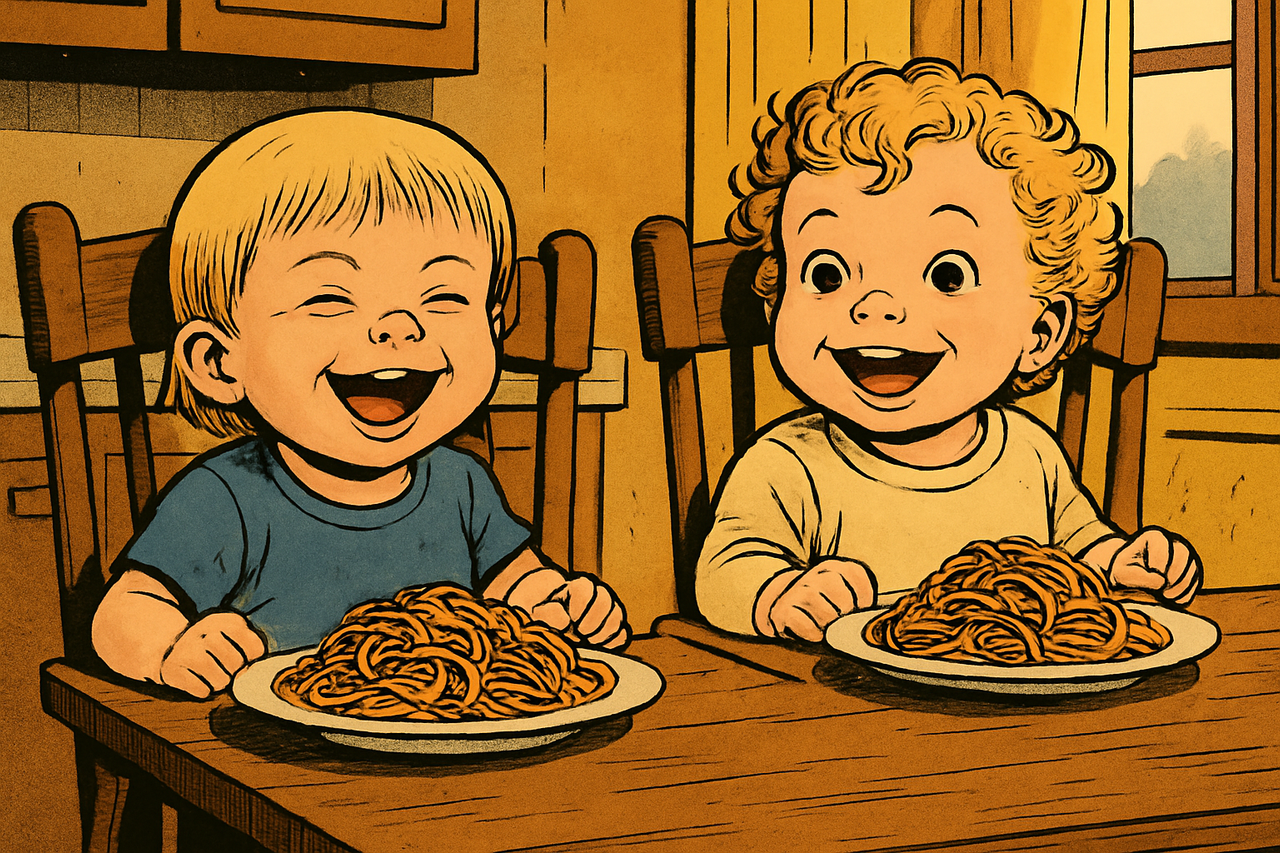
Jess and Toyah, freshly re-bibbed, supervised from their two high seats at the kitchen table—a battered rectangle crowded with pencil dents and a galaxy of sticker ghosts. Glenda’s hand found a packet of spaghetti by touch; she snapped the strands in half over the pot. The break made a satisfying, twiggy pop. Steam rose, and the scent of starch soon followed, that soft, foggy warmth that says dinner is—for sure, no fooling—on the way.
“Sauce or butter?” Glenda asked the room as if polling a constituency.
“Sau!” Jess announced, throwing both hands up as if she had won an election. Toyah clapped because clapping is its own reason.
“Sauce it is.” Glenda lit the second burner and slid on a small pot, tipped in a little glug of olive oil, and let garlic whisper in it until it was almost talking. She added a jar she’d doctored long ago—chunky tomatoes, a touch of grated carrot for sweetness, the memory of basil. The spoon moved in lazy figure eights. Across the room, the sewing machine’s unplugged cord lay curled like a sleeping cat.
Alice washed her hands and reached for a knife without being asked. “You want the cilantro chopped fine or with opinions?”
“With opinions,” Glenda said, grinning. “It’s had a long day.”
Alice rocked the knife, made quick work of the pile, and then moved to the plantains. She scored the peels lengthwise with a fingertip, parted them like careful presents, and sliced the fruit on the bias. The coins fell into a bowl with soft thaps. The skillet took a thin coat of oil and gave back a clean wave of heat. When Alice placed the first slice down, it sighed and agreed to get golden.
Glenda pulled a can of white beans from the pantry with the unerring hand of a person who maps her shelves by feel. She flicked the lid with the manual opener, drained them, and dropped them into the other skillet where onions had just gone translucent. A lemon rolled under her palm; she scraped its zest into the pan and squeezed half its juice in neat, finger-guarded arcs. A small, brave sprig of rosemary—pinched from the pot by the door on her way in—joined the company, crackling like it had a story. Some of the beans she pressed with the back of the spoon until they went creamy; the rest stayed whole, butter-soft but intact.
At the table, Jess and Toyah discussed the great matters of spaghetti. Jess’s legs swung rhythmically, an electrical metronome. Toyah leaned forward, watching the pot with almost scientific focus, then flinched with delight when a bubble burst like a tiny volcano. Glenda’s spoon tapped the pot’s rim as she checked a noodle. She fished one out and broke it, then tasted, then nodded: “Just right.”
She drained the pasta with a tilt and a hiss, halved the portion, and worked quick: one bowl with butter and a drift of grated cheese like new snow, the other with a spooned-on coat of the gentle sauce. She cut the strands with three satisfying chops—the way you do when the eater is still negotiating with gravity—and set the bowls down with the solemnity of a ceremony. “We twirl if we can, we scoop if we must,” she told them. “And we keep our hands out of our hair because we are not raccoons.”
“Ra-coooon,” Jess said as if trying on a magnificent hat.
Toyah gave a noodle the serious look of a librarian, then slurped. A single strand wiggled to her chin and clung there like punctuation. She blinked.
Chloe, unbidden, shifted her gaze two degrees past the table and found an invisible middle distance. The rug held. The tail tip made small scripts on the floor every time a fork tinked.
Alice tended the plantains, turning each slice with the tip of a fork. The coins showed their browned faces one by one, edges sugared into crispness. She sprinkled a dusting of salt, then thought better of it and flicked on just a pinch more—trusting the fruit to hold its sweetness in the face of contrast. The fragrance went sugary and toasty all at once, like a memory of fairgrounds come into a kitchen that had seen a hundred ordinary miracles.
“That smell,” she said, grinning over the pan.
Alice slid the slices along the edge of each bowl, fanned like golden scales. Glenda scattered the cilantro—confident, green—and shaved off wicked little flakes of sharp cheddar to fall like irregular confetti over slices of apple she’d laid on a side plate. The lemon half gave up its last agreeable sigh across the beans. Two eggs went into the just-oiled skillet, spread, whispered, then set; she slipped one onto each bowl, yolks ringed in delicate crisp.
Glenda set the bowls on the table’s adult end. She handed Jess a small, damp washcloth, the preemptive measure against marinara’s spread.
Alice sat and took the sight in before she took the first bite—beans creamy and lemon-bright, egg yolk ready to gloss everything, plantains caramelized at their edges like something that had learned patience. “If your platform was dinner,” she said lightly, “I would canvass.”
“Make sure to get the north side,” Glenda replied, deadpan, then pointed to a shallow bowl with a pinch of flaky salt. “For the apples. Trust me.”
Alice did and felt the way salt can detonate sweetness without killing it. She made a pleased noise and for a while they both just ate, the conversation taking the pace of chewing. The girls provided a soundtrack: Toyah’s occasional triumphant “I did it!” whispered to no one and everyone, Jess’s happy hums that turned into a song with precisely one lyric: “Spa-ge-tti.”
“May I film later?” Alice asked, then caught herself. “Not this—” She gestured at the bowls, the toddlers, Chloe. “I mean, maybe after bedtime. Your rhythms. A bit of quiet.”
“We don’t get quiet,” Glenda said, smile crinkling one eye. “We get softer. But yes. If you need me to move the lamps, that’s just fine too.”
At the far edge of the table, the star stickers had made a return, now carefully rehomed to a sacrificial sheet of brown paper. Toyah peeled one, paused, then pressed it to Glenda’s forearm with all the weight of a medal ceremony. Jess applauded. Chloe allowed a single blink as if to acknowledge the achievement.
Alice let the egg go, the yolk running in a molten line through the beans; her fork chased it, gathered plantain with it, introduced it to the lemon. “How did you learn to cook like this?” she asked, genuinely curious,
“Mama set me on the right track. Even if I wandered away, time to time, always got that north star, y’know?”
Jess had achieved spaghetti moustache and seemed to know on some animal level she was a hilarious figure. She leaned toward Alice and watched for reaction. Alice put down her fork, widened her eyes, and addressed her as if she were a visiting ambassador. “Madam Spaghetti,” she said graciously.
Jess squealed and then hiccuped. Glenda handed over a small plastic cup of water with two hands. “Sip, babygirl,” she said. Jess obeyed with the urgent calm of someone who has learned that hiccups are a force of chaos but that hydration is, sometimes, magic.
Toyah was very busy twirling. She had not twirled before and was now a scientist refining technique. The fork made small circles; a noodle agreed to go along; she grinned, feral with pride, and did the thing again just to prove the universe was consistent.
“As well behaved and fun as you said,” Alice said, nodding at the girls.
“They’re the best,” Glenda said. Chloe padded to her water bowl in the corner, drinking without splash or incident, then returned to the rug as though the water had been a brief detour in a longer, noble journey.
When the littles flagged—there’s a precise minute in toddler mealtime when you can see the tide turn—Glenda wiped faces, rescued curls from sauce, and offered the ancient respite of sliced banana for dessert, which both girls accepted with spirits rekindled. She parked their bowls in the sink and gave Alice an apologetic, not-really-apologetic look. “I’m going to risk a bath run before they mobilize.”
“Go,” Alice said, already standing, already stacking plates with the quiet competence of someone who prefers to be useful. “I’ll clear and start a soak.”
“You’re a guest,” Glenda began.
“Temporarily,” Alice said. “Besides, the union rules require me to scrub a pan for every interview question.”
Glenda tipped a two-finger salute and scooped Toyah and then Jess, one perched on each hip in alternating turns as she vanished down the hallway trailing the smell of baby soap and the sound of small feet negotiating linoleum. Chloe rose, looked after them, then lay back down.
The kitchen changed registers. Water ran in the back rooms, a steady, low river behind walls. The radio, still on a whisper, had found something picked and clear—guitar like clean sheetlightning far away. Alice stacked, rinsed, set plates to drip-dry. The bean pan yielded with a little hot-water persuasion; the plantain pan surrendered its caramel reluctantly and then all at once. She wiped down the table with a cloth that smelled faintly of lemon and history, rescued a star sticker from the underside of a chair, and set it squarely on the corner of the sewing table like a small flag.
She drifted along the counter, fingertips lightly skimming laminate, and saw the disposable camera Glenda had set there. Its paper sleeve promised 27 shots of spring in blocky optimism. Beside it, a pen had left a thin constellation of blue dots on a grocery list: milk, filters (underlined), apples, plantains, bandages (whales), camera? As if the camera had begun as a question and decided to be an answer. Alice didn’t touch it. Some objects you moved; some you let keep their momentum.
The fridge was a domestic archive held up by fruit-shaped magnets: a hand-lettered schedule with two boxes ringed in stars; a bill with a telephone number circled twice; a postcard of a rocket stitched against midnight; the drawing labeled JESS, mostly circles, but the circles were proud. A Polaroid of two teen girls at a crosswalk—mid-stride, mid-giggle—had been wedged under a strawberry magnet. The back of it, peeking, showed a date in someone’s trimmed, upright print: FEB 92. On the edge of the door, a torn calendar page held a quote in pencil: “Be kind, for everyone you meet is fighting a battle.”
On the stove, the skillet was cooling in a faint, metallic sigh. Alice set it, already rinsed, to dry against the backsplash. The radio on the counter had found a late-evening station—low guitar, spaced and clean, the kind of playing that makes room for other things to live. She turned the volume a breath lower and moved into the living room, socks catching on a thread in the rug’s edge; she rubbed it flat with her toe and the thread decided to behave.
The mantel wore a small democracy of frames. In one, Glenda stood younger by a breath, at a picnic table, shoulder jammed to shoulder with several young girls whose faces were all versions of bright and unguarded; behind them, trees leaned in as if they wanted to be counted. In another, a man in fatigues looked slightly left of the camera, sun in his lashes and dust on his boots, a dog at his knee—leaner than Chloe, darker—eyes steady in that way some dogs have when their work is also their nature.
On the low shelf under the window, books kept company with records and cassettes. The books were a rangy brigade—cookbooks with cracked spines, a dog-eared volume of poems that looked handled, a field guide to trees, a paperback with a cracked lightning bolt on its cover that had the posture of a book reread out of season. The records were a short, stubborn stack—sleeves softened to cloth: a Joni with the ocean in her hair; a Neil with a face that knew drought. The cassettes were the messiest—store-boughts with peeled corners, home-recorded tapes in cases with fogged plastic. One had a label written in a rush with a ballpoint that had hiccuped mid-ink: MIX FOR GLENDA — ADDI.
A shallow bowl on the bookshelf’s top held coins and paperclips and a single guitar pick with the logo rubbed to a ghost. Next to it, a mug kept pens and carpenter’s pencils and one stubby crayon that had been returned to adult tools with great confidence. A note peeped from the mug’s rim, torn from a larger page: “Call Ms. Carter re: fundraiser—ask about chairs.” The word chairs had been underlined twice, then circled, as if chairs were the sort of logistics on which revolutions turn.
From the bathroom, the crash-splash of bathwater crescendoed into squeals, then softened into the slow language of rinsing. A calm voice counted to ten in a rhythm that made counting sound like a kindness. In the doorway’s spill of light, steam went briefly golden and then retreated. Chloe’s ears tipped forward, then settled again.
The couch had slipped half an inch out of square. She set a palm to the arm and nudged it even with the rug’s edge, a needless but satisfying geometry. On the coffee table, the paper chain had resumed its loose nap; she refolded one errant link, instinctively matching the fold the last hands had made. The cheap radio breathed a brushed snare and a warm bass line. The clock in the kitchen ticked with the patience of a person who knows everyone will arrive eventually.
The star sticker on her shirt had begun to work one point loose; she pressed it down, and it obeyed, a small, sentimental badge. On the table by the door, a little dish held house keys, a library card freckled with use, and a tiny metal cross that looked like it had lived in pockets and glove compartments and the moments between errands. Next to it, a folded handbill announced a potluck at a church hall, handwritten at the bottom: bring what you can, come as you are.
A pair of flats sat at easy attention by the mat—hers. Beyond them, a rank of small shoes rendered the day’s story in leather and Velcro. One jelly sandal had captured a grain of playground sand in its strap and decided to keep it. Alice’s hand hovered over the little lineup, then retreated, as if not to disturb the arrangement. She liked it exactly as it was: an ordinary parade paused between movements.
The bath noise dimmed; the voice in the bathroom became a story voice, the one that folds the day closed along its seam. Chloe stood without a command, shook once, softly—a rainless weather event—and moved to the hallway like a shadow answering its person’s shift in position. Alice stood where the kitchen met the living room and took one last slow look: the pink-and-purple project waiting its last seam, the disposable camera promising to remember, the cassettes with their crosshatched lives, the green cabinet keeping its counsel, the mantel’s little democracy of faces, the paper chain that had no good reason to exist except joy.
She reached up, found the radio’s volume, and eased it just a hair lower. Not off. Just softer. The kind of volume that lets a house hear itself breathe. Then she rested her palm on the back of a dining chair, the wood warm with the day, and waited for the bathroom door to open and the next movement to begin.
Alice sat with her hands folded on her knees, star sticker bright on her shirt like a badge that meant something only to the people in this room. The couch had that friendly give of furniture that belonged to a family: it sighed, then agreed to hold her. In the doorway, the hallway light laid down a soft spill; from deeper in the house came the little end-of-day sounds—drawers sliding, two tiny voices negotiating for one more thing with the careful logic of the very tired.
The hallway was narrow, the kind that keeps a family close. On one wall, tape held a parade of drawings at knee height—circles, yes, but also the earnest attempt at a house, a dog with heroic proportions, a rectangle of blue that might have been sky and might have been ocean and might have been, gloriously, both. Halfway down, a green metal cabinet with a dial kept its corner with stern discretion. A small paper sign above it said, in tidy capitals, HANDS OFF. The key was nowhere in sight. Alice’s gaze paused a courteous half-second, then went on without tugging. Every house has doors you don’t open and locks that aren’t for you.
Glenda came back barefoot, hair damp and darker at the ends, sleeves pushed to the elbow. There was the faint clean smell of soap and the sweeter trace of baby shampoo that clings to the air like a lullaby. Chloe rose from her post at the corridor and followed to the front room, weight distributed on her paws with that precise economy Alice had already noticed—no flourish, only purpose.
Glenda tipped her chin at the corner where an old television squatted in its wood-grain dignity, a rabbit-ear antenna at a heroic angle. “That set,” she said, “goes back to Eisenhower’s first inauguration. We keep it around out of respect.”
Alice laughed, delighted. “If it ever quits, you can fold it into a coffee table and sell it at a museum.”
“Tempting.” Glenda curled into the far corner of the couch, one knee tucked under, elbow on the top rail, fully at ease. “Besides, I’m more interested in talking to the writer than in watching a parade of detergent commercials.”
“Good,” Alice said. She sat a little straighter, only because she wanted to. “I split my time between fiction and nonfiction. I like the twentieth century because it’s still arguing with us. I write about lesbian lives because mine is one. And I write about hope because I need it, and people keep handing me evidence.” She tapped the star on her shirt with a forefinger. “Sometimes literally.”
Glenda’s smile showed up first in her eyes. “That’s a fine mix to carry in your pockets. How do you make them stand each other—fiction and nonfiction, I mean? Do they fight about whose turn it is?”
“Never.” Alice’s tone was crisp, quicksilver. “Nonfiction collects the receipts, fiction spends them in public. They share a wallet. The trick is not to double-book.”
“Hope as a beat,” Glenda said, tasting the words like a first bite of something interesting. “What does that look like on the page?”
“Sometimes it’s loud—marches, noise, the day the court finally says the thing it should have said all along. Mostly it’s quiet.” Alice inclined her head toward the hallway. “It’s in the way hands are gentle on bad days. It’s in a neighbor who can shepherd four teenagers overnight and still wave from the porch. It’s in dinner you didn’t have to deserve. Hope usually sounds like a house going soft after bedtime.”
Glenda watched her for a breath, changed angles on the couch so she was half-turned, engaged. “Tell me where you like to begin that story.”
“On an ordinary Tuesday.” Alice’s ring flashed once as she folded her hands again. “The afternoon you realize the person you love is the person you’ve been building sentences for without noticing. The time you get the flu and she brings you ginger ale and you marry her in your heart between sips. I’m not against big statements. But I trust small ones more.”
Alice added, not for emphasis so much as for context properly placed.“I’m married. And we share a library, it’s quite a sight. Oh I can describe, of course but it’s something you can experience best in person.”
“All the way in London, huh?” Glenda’s mouth tucked up at one corner, pleased in a way that had nothing to do with performance. Alice paused, a moment’s thought flashed by, she then returned the smile, choosing not to correct or deflate the joke.
Glenda reached for the mug on the low table—a simple diner thing, heavy in the hand—and offered it. “Coffee?” “Please.”
They traded mug for gratitude. Chloe did not beg, did not patrol the carpet. She made a quiet half-circle and settled by Alice’s shin, belt buckle of her harness glinting. Alice rested the side of her ankle against the warm curve of dog and felt the little thrum of a creature who knew who belonged in which room.
“You said the twentieth century is still arguing with us,” Glenda said. “What fights do you hear most when you put your ear to the wall?”
“Who gets counted,” Alice answered. “Which loves we name. What labor we pretend is free. Whether we admit the harm we did when we were busy being certain.” She didn’t shrug; she didn’t need to. “And what a good life is, in a country that keeps trying to confuse value with price.”
“That last one,” Glenda said, a softness that passed for agreement. “Some days I want to put a tip jar on the concept of decency and see if anyone remembers how that’s supposed to work.”
“I’d empty my pockets,” Alice said. “I might leave a note, too.”
“What would it say?”
“Keep going. You’re doing great. Even when you’re not.”
Glenda laughed—low, real, appreciative. She leaned forward, forearms on her knees now, fully committed to being here. “Tell me what hope looks like when you’re burnin’ up,” she said.
“It looks like refusing to let anger choose the tools,” Alice said. “You still fix the thing. You don’t burn down the workshop. And you feed people while you’re working. Rage that starves your neighbors doesn’t get to call itself righteous.”
“That’ll preach,” Glenda said, and took a swallow of coffee. “You carry a camera and a pen. Which one tells more truth?”
“Neither owns it.” Alice tipped her head toward the mantel where the camera sat between the jar of stones and the ceramic lamb. “The camera is honest about what it sees and a liar about what it misses. The pen can tell the parts a lens never catches—the prayer someone thinks but doesn’t say, the way a smell becomes a memory—but it’s tempted to get fancy. I try to pair them like good partners. One keeps the other honest.”
“That sounds like dinner and a porch,” Glenda said. “One fills you, the other lets the air in so you can keep breathing.”
Alice’s smile was quick and bright. “That’s nearly the title of my next book.”
“The porch would like royalties.” Glenda glanced at the window. Across the street, the sleepover had hit its second wind; a flashlight beam jittered against a porch ceiling, and someone threw a blanket like a magnificent cape. “Do you find what you’re looking for over here?”
“I don’t come looking for answers,” Alice said. “I come asking permission to listen. Sometimes people give it. Sometimes a house does.” She let her gaze travel the room and return. “This one has good acoustics.”
Glenda let the compliment land, not as flattery but as an observation to be respected. “If I told you I want to read the stories you haven’t written yet, would that be forward?”
“Welcome forward,” Alice said. “What would you want to read first?”
“Your Tuesday,” Glenda said without hesitation. “And your reasons for hope, listed like a grocery. Lemons, beans, plantains, neighbors, elections that surprise you in the right direction, children who stick stars in the right place cause it ain’t just chance.”
“Add coffee to that list,” Alice said, lifting the mug. “And dogs that keep watch.”
“Always dogs.” Glenda reached down and touched two fingers to Chloe’s head, a brief benediction. “Always somebody awake on the edge of the room.”
A small, shared quiet opened. Alice used it the way she uses good light—she moved into it. “If I asked you about the summers you thought would fix everything,” she said, “where would that take us?”
“To a mixtape that was too loud,” Glenda said, amused, “and to my favorite mistake. And to the place where you learn that fixing is less a season and more a habit.” She tipped her head toward the cassette shelf with its rattled ranks and one spine lettered in two hands. “But you’re not getting that story in one sitting.”
“I’ll let it simmer,” Alice said, gracious in victory. “Nonfiction’s best spice.”
“And fiction’s best alibi,” Glenda shot back, pleased by the volley.
Outside, a train laid down a ribbon of iron sound far enough away to be gentle. Inside, the clock found another minute and set it down. The old television sat in its corner, wearing history like a lap blanket; the rabbit ears leaned at heroic angles toward a sky that didn’t need them anymore. Alice looked at it and imagined pulling a good line anyway—a shot that held on wood grain, then found the reflection of two women talking in its glass.
“You want the porch?” Glenda asked, reading the tilt of Alice’s attention without needing to be told. “Or do you want me to keep asking nosy questions about your books until you give me a reading list?”
“Both,” Alice said. “Porch first. Then I’ll give you ten titles that saved me, and you can tell me which ones your house already owns.”
“Deal.” Glenda stood, fluid, put a hand to the lamp, saw how the room would look with it off, decided it could stay. She picked up the camera from the mantel, then set it back down deliberately. “Not tonight,” she said. “Tonight we just let it be true without proof.”
“Proof is for later,” Alice agreed.
They moved together toward the screen door; Chloe rose and ghosted two paces ahead, then paused with the courtesy of a doorman. On the little table by the door, the folded handbill for the church potluck looked like a tiny mandate. Alice brushed its edge with the back of a finger as she passed—as if to say yes, as if to say I hear you.
The porch received them the way porches do: with air that made the coffee steam visible, with boards that creaked sympathetically, with darkness that wasn’t a threat but a room the world had dimmed for comfort.
“Tell me about your librarian,” Glenda said, settling into the bench with her shoulder finding the spot that fit it.
“She files the world under love and makes exceptions for poetry,” Alice said. “She has a way of shelving people where they can find themselves again.”
“Hold on to her,” Glenda said, gentle and certain.
“I intend to,” Alice said.
They sat shoulder-close and looked out at a street that performed its best version of peace: a moth deciding to live, a sprinkler hiccuping to life two houses down, a constellation of porch lights stippling the block like careful stars. The conversation rolled and rested, rolled and rested. Alice did what she always did—asked and listened, gathered and offered back. Glenda did what she clearly knew how to do—made a stranger feel like a regular, opened a door without asking for thanks, put truth into sentences shaped for carrying.
Behind them, on the sewing table, a needle waited in the selvage of a small future toy. On the mantel, a camera waited for its next job. On the TV’s blank glass, a pair of moving reflections—heads bowed toward each other in talk—could have been any decade, any town. Hope, enjoying the anonymity, took a seat and stayed.
The pull-out made its familiar complaint as Alice shifted—springs speaking in lowercase, a soft metal paragraph under the mattress. The sheet had that clean, line-dried feel, slightly crisp on the shin and warm where her calves had already negotiated body heat. Streetlight from the corner made a pale coin on the TV’s glass; the rabbit ears wore it like a halo.
Chloe did a quiet circuit of the front room, the kind of patrol that was mostly a way of counting everyone who mattered. Satisfied, she landed parallel to the pull-out, forepaws neatly crossed, head down. One ear tilted toward the hallway as if it had a job; the other pointed at Alice like a lamp set to “friendly.”
Alice reached a hand to the low shelf beside the couch and let her fingers read before her eyes did. Spine, spine, soft paper, a cover that had been thumbed to velvet, another that still creaked. She pulled the one that offered itself without argument: a charcoal jacket with title and author pressed in a modest silver that had rubbed thinner at the edges.
A Small Republic of Kindness, by Liora Vale.
Essays. The first page caught the lamp’s puddle in a way that made the paper look almost warm. On the title leaf, an inscription in a narrow, steady hand: For G. — for the days when the hinge squeaks and you open anyway.
It looked like it had been drawn with a ballpoint that had to be convinced to behave.
She smiled at the star on her own shirt—crooked, a little dog-eared at one point—and then she began.
Vale’s voice moved like a slow river you could wade without losing your keys. First essay: “On Folding Chairs.” Alice felt her grin return—she’d seen the note by the pen mug, ask about chairs. The opening line (underlined in pencil, twice): We build the commons a seat at a time and swear it’s nothing. In the margin, a faint Yes. Further down, someone (same hand) had written, in tiny capitals, CHECK CLOSET. Alice pictured the hall closet breathing with metal, the polite clatter of borrowed backs and legs.
She read about basements and parish halls, about the way hope is measured in how many chairs get set before anyone knows if people will come. Vale’s detail was almost impish: the particular thunk of a chair settling square, the shared shame of a bad coffee urn, the fluorescent hum that makes everyone look tired and honest. A corner had been folded. When Alice unfolded it, a sliver of mint leaf fell out, papery and ghost-green. She pressed it back between the pages at the top like returning a sleeping moth to its branch.
Water moved far down the hall—pipes finishing a story. The house settled into its nighttime body. Alice skimmed past the table of contents with a fingertip—“The Uses of Parades,” “Rehearsals for Joy,” “After the Sirens”—and dropped into “Two Women Carry a Couch.” It wasn’t about a couple, not exactly, but it was about how weight shifts when you agree not to let it crush you. In the margin alongside: We did this. (underlined) Next to it, a date. Alice didn’t read the numbers as evidence so much as a proof mark—this house had lifted heavy things before she arrived.
The lamp lent a steady buttery ellipse to the page. She adjusted it a notch lower and felt the room breathe even deeper. The old set in the corner gathered their reflection like a small pond—her hair curtained forward, the line of the pull-out’s metal footpiece, Chloe’s pale mask, eyes moon-dark. A train wrote itself faintly across the night like a pencil line you could erase if you needed to, but wouldn’t.
She turned another page. “Porches, and the Treaty of Night.” Vale argued that a porch is a civic instrument and that rocking chairs are democracy’s metronomes. In the margin beside a line about air moving easily through grief, somebody had drawn a tiny porch: two rectangles for chairs, a line for a rail. Beneath it, a single word: yes. Alice felt something inside answer with its own small echoing yes, a courtesy call to the line that had just knocked.
She read the paragraph about how a neighbor’s wave is a quiet abatement of loneliness—how even the tock of a porch swing chain is a kind of speech. The page carried a thumbprint of tomato sauce that had been respected rather than scrubbed. She liked that. Life had been allowed to sit next to thought without being told to leave.
On the next spread, a grocery receipt peeked from the crease like a kid craning at a parade. She slid it free: apples, bandages (WHALES), instant oatmeal, bleach. A disposable camera. The date at the top wore today like a fresh shirt. She let it mark her place again; some lists were little biographies, and this one had the exact right mix of tenderness and getting on with it.
“Hope isn’t a mood,” Vale wrote in “Counter Service.” “Hope is a chore list we inherit and revise. Wash, sweep, call, check on, show up.” Pencil had underlined inherit and revise. In the margin, stretched to fit between lines, someone had written, in the careful print of a person who teaches children not to panic: Show Up is free. Bring your own hands. Alice looked at her own, spread on the page—ink smudge on the side of the middle finger from earlier notes, a faint line from a box that had tried to be heavier than it was, the stowaway glitter of a star sticker she’d peeled off and somehow failed to absolutely remove. The universe does theme work, she thought, amused.
Chloe took a slow breath and gave it back, the quiet twin of a sigh. Alice slid the book lower for a second and watched the dog’s ribs rise and fall, the harness buckle glinting, the fur at the shoulder dense with health. The ear flicked toward the stair. A floorboard rasped softly overhead—the kind of noise an old house makes when it remembers someone is there, not the kind it makes to wake anybody. Then it settled to its accustomed nocturne.
She found herself in “A Manual for Lullabies You Sing to Strangers.” Vale said lullabies were not all for babies. Some were for neighbors who get home late from bad shifts. Some were for the person at the bus stop who tells you their mother’s name because nobody said it out loud all day. Some lullabies are promised with casseroles and kept with text messages, Vale wrote, refusing italics, trusting the plain case of it all. In the margin: *call Ms. Carter.* The asterisk had a twin on the half-sheet under the pen mug. Logistics as love story.
A pressed yellow flower (thin as a sigh, edges browned) had been married to the inside back cover, trapped by a piece of ancient transparent tape that had gone cigarette-stain beige. Alice touched the tape and it held, brittle but stubborn. The flower could have been anything—a roadside daisy, something pulled from a crack in a sidewalk and carried home like proof. She let it be unnamed. Some evidence does better without an expert.
Back to the text. “The Law of Might Be,” Vale titled the next essay. A slim meditation: most days are framed by might be rather than must. Might be rain, might be better, might be a stranger who sits on your porch and brings their own thermos of coffee and, without warning, becomes part of the architecture of your week. Alice didn’t smile, exactly. She breathed like the sentence had just held the door for her and she’d walked through without having to balance her coffee on her knee to do it.
The sentences were clean enough to eat off. She underlined one with her nail, not hard enough to show, just enough to feel it in the paper: Kindness is a republic because it asks for a vote every day. Somewhere down the block, a car door thumped; a figure passed across the slit of light at a neighbor’s curtain and did not look in.
She let the book sag in one hand and scanned the room again—the sewing lamp pooling its patience over the pink-and-purple project; the cassettish tangle on the shelf with one spine lettered in two distinct hands; the old TV, faithfully reflecting streetlight coins; the green metal cabinet holding its counsel at the hall corner like a veteran who’d learned that sometimes silence is the service you offer.
Alice read three more essays because self-control was for tomorrow. “Saints of the Laundromat” (underlined line: We pin the world together with clothespins and call it a chore, and that’s fine), “The Ethics of Leftovers” (margin note: send some to Holly), and “How to Keep a List” (pencil-drawn checkbox beside a line that advised writing Find joy at the top so you can always tick one off). She turned the pen mug note in her head and pictured a kitchen table tomorrow with chairs pulled close, the disposable camera jumping to a hand, the click-click of a thumb advancing film like a tiny instrument of faith.
The book got heavier—late does that to books—and her eyes did that slow blink that negotiates time with sleep. She dog-eared the page (something she would never do to a library book and always does to a lived-in one) and slid the book under the edge of the couch cushion the way you slide a letter under a door for morning. The star sticker crackled once as she shifted; she pressed it, smiling.
Chloe lifted her head, checked the hallway again, then laid her jaw down so exactly on her paws that it looked like a measurement. Alice reached down and found fur, warm and clean and the kind of soft that takes long walks to earn. The dog accepted the touch with a tiny static-spark of a tail flick that declared, without flourish, that everything was in its place.
The room dimmed a hair when a cloud auditioned for the moon’s part and lost. The train—another one, or the same—threaded the distance with its polite iron thrum. Upstairs, a floorboard whispered, then quit while it was ahead. A night insect tapped the screen once and revised its plan. The old television kept its weather and its ghosts to itself.
Alice lay back, eyes unfocused to the ceiling’s faint stucco constellations. A line from Vale’s book curled in—Kindness is what we do with the air between us—and made itself at home where sentences go when you let them. She rolled onto her side, one arm under the pillow, the other making a loose loaf of hand near the edge for Chloe to sniff if she wanted company. The house breathed, and she matched it, breath for breath, like learning a song by ear.
Before sleep took the pen out of her hand, a little paragraph drafted itself behind her eyes—an opening about a coin of light on old glass, about the way some rooms teach you their grammar without a single stern word, about a republic that can be as small as two mugs cooling on a porch and as large as a block of girls laughing under a borrowed roof. She didn’t reach for the notebook. She trusted the room to hold it for her until morning.
Chloe’s tail drew one last letter on the floorboards and stilled. The star sticker rode her shirt like a tiny flag. On the shelf, A Small Republic of Kindness waited with a mint leaf and a receipt, patient as a chorus that knows its cue. Upstairs, the hinge squeaked once—the good kind, the living kind—and then this house, which had done enough for one day, closed its eyes around the people it was keeping.