
Work Text:
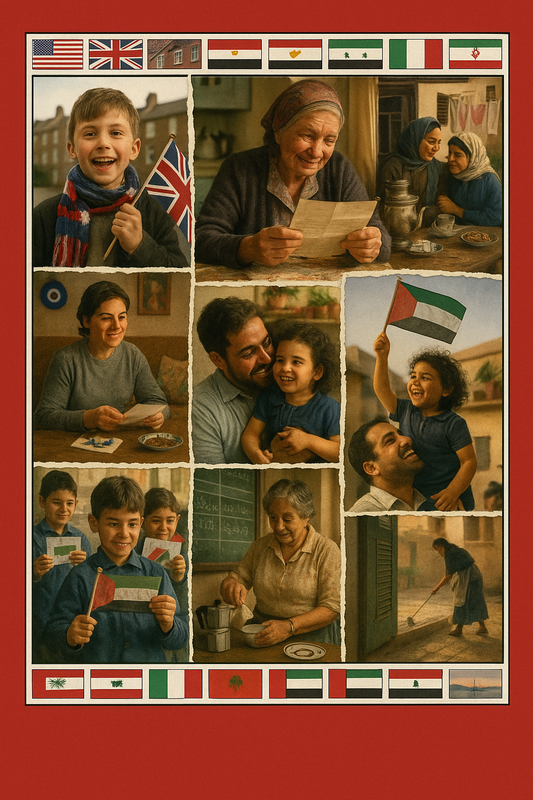
Person of the Year: "Coalition Families" By Michael Brennan, Senior Correspondent
They Waited Together, Even When They Were Apart
How We Chose
We choose a Person of the Year for influence, not virtue; for consequence, not comfort. Most years that points us toward a single name or a small circle of them—presidents who signed papers that moved borders, ministers who stood up when markets sat down, scientists whose proofs leapt from notebooks into policy. This year, every path we followed kept curling back to the same address book: the kitchens and courtyards of the coalition. The decisions that mattered were ratified there first, often silently, in the steadiness with which people agreed to keep getting up, keep answering the phone at odd hours, keep writing letters that said more by what they left out than by what they said. If strategy decided routes, families decided the resolve to stay on them. In that sense, they were not behind the victory so much as beneath it, the substructure that carried weight others only measured.
We define “family” as the people who share the cost of someone’s service. Blood ties qualify, but so do the neighbors who take a turn at the school run, the aunt who keeps keys to three apartments, the baker who slices yesterday’s loaves for the widower down the block, the port pilot who watches the weather on behalf of everyone inland. That definition holds across borders. In the United States—whose doctrine since 1945 has put its weight into airlift, medicine, communications, fuel, and money rather than combat—the sphere of family widens to include church basements where casseroles steam at four in the morning, union halls that swap shifts so a night dispatcher can make a midday parent–teacher conference, and grade schools that learn the time zones of ferry routes. In the United Kingdom, the living room becomes a briefing room where football results double as reassurance codes. In the Soviet Union, a samovar at the center of a two-room flat warms a conversation that keeps fear from getting louder than pride, the habit of coordination born in 1975 now domestic law. In Turkey and Egypt, balconies are both newsroom and pulpit, and in Kuwait the act of replacing a lock—after occupation, before sleep—reads as a referendum on normal life. In Syria and Lebanon, teachers and bakers organize the calm; in Cyprus the quay holds its breath with the tide; in Italy a moka pot whistles on the beat of the telephone; in Jordan a courtyard is rinsed before Friday calls, as if clean stone could steady a voice.
We did not arrive at this choice because it was easy. Our first lists were the usual ones: a short roll of statesmen and their diplomatic architects, a longer one of commanders and quartermasters whose maps show the quiet logic of supply. There were cases to be made. But as we reported in ten capitals and a dozen port towns, as we sat on plastic chairs in school offices and on low stools in kitchens with uneven heat, a pattern emerged that no single name could account for. The permission structure for all of it—the budgets, the patience with shortages, the restraint when provocation flared—was granted at home. The ministers we interviewed admitted it without prompting: their most delicate work was not across a table from other ministries but across a table from their own people. Trust is a domestic currency before it is a diplomatic one. The families minted it.
Influence is quantifiable more often than it looks. We asked each bureau to bring back numbers that live at the edge of narrative: letters processed per week at mail depots; average time from a field clinic’s requisition to delivery; calls answered by chaplaincy and aid hotlines; school exchanges launched and kept; ferry turnarounds; tons lifted by air and moved by hand. The tallies were imperfect, as all tallies are, but the direction was clear enough to hold. A curve you can trace with your finger beats a table of speculative intent. In Glasgow, an intake coordinator showed us a column of call logs where a pencil tick meant a crisis averted, two ticks meant the caller had someone else to sit with them that night. In Alexandria, a pharmacist kept a ledger in which sugar, batteries, and aspirin diverged and converged in steady seasonal rhythms, and the notes in the margins—“Mona’s nephew home Thursday”—were the true indices. In Odessa, a factory floor posted a chart of voluntary overtime where the names of grandparents alternated with the names of teenagers; not a law, a schedule. In Salmiya, Kuwaiti postal workers taped photographs of reopened rooftops to a pillar and made a game of guessing, by the color of the sky at the horizon, which district was getting power back next. Those are not headline figures, but they are the ones that allowed the headlines’ promises to be cashed.
We also counted what cannot be reduced without losing its meaning: the rituals that keep a house from becoming only a waystation for news. Friday calls that begin with weather and end with nothing left unsaid. The way someone says “We’re fine” in English, in Arabic, in Russian, and means the same compact: you can do your work because we are doing ours. The object that steadies a hand: a nazar bead stitched into a coat pocket, a rosary curled in a saucer, a refrigerator magnet in the shape of a flag pinned over the list of who picks up whom from school. We asked translators to keep certain idioms intact because paraphrase would have hidden the mechanism. “The kettle is on” is not about tea, and we did not take it to be.
The cover was the last piece we finished and the first one we imagined. We knew that if our choice was the people at home, we owed them an image that looked like home. Not a parade of uniforms but a formation nonetheless: photographs in ranks, corners taped, edges frayed, glossy prints overlapping matte ones in the accidental geometry of a bulletin board. We asked our photographers for end frames rather than first frames—the moments after the posed smile, after the flag is lowered an inch by a tiring arm, after the glance toward the door becomes a look back at the person across the table. We asked for the scuffed mailbox with its open mouth, for the bus-bench envelope with the softened corners, for the hand on a sill catching a bar of light. And because this was a coalition in fact and not just in branding, we marched the flags along the margin in equal height and equal spacing, two ranks at attention without hierarchy, an honor guard of color whose discipline says as much as their hue. Order comforts; we learned that in our own offices on deadline nights.
Consent was our first rule. Children appear on our pages only with permission; letters appear only with their writers’ knowledge or with their families’, and then only in excerpts we read aloud to them before publication. We changed certain names and blurred certain doorways at request. An Odessa grandmother asked that a phrase she calls lucky never be printed, even though she had told it to us kindly; we honored that, and the luck. A Manchester father asked that we not photograph the iron he uses to press a shirt that is not his, because he did not want the owner to see it before coming home; we left the iron out and kept the ritual in. In Amman, a school asked us to delay the publication of one class’s pen-pal project until the replies had been opened at an assembly; this is why some captions will feel one week late. We believe influence does not need to arrive first to be real.
We did not publish operational details. Several families showed us letters we photographed only in part; we printed the crease and the handwriting at the salutation, not the sentence that would tell anyone more than they needed to know. In Cairo, a balcony hosted conversations that moved faster than the official line; we treated the balcony as a scene, not a source. In Nicosia, a dockworker traced with his finger the way a ferry threads a channel; the photograph shows only his hand and the map, and the caption names the sea rather than the ship. We do not think circumspection weakens a story. It lets it keep doing its other job when our pages are done.
We expect the question we always get when we choose a plurality: is this ducking responsibility to name a person, or is it expanding the definition to the point where it means “everyone”? The answer is neither. We are not inventing a collective to avoid the difficulty of choosing; we are describing the actual seat of influence as we found it this year. The coalition leaders who will read these pages know that their freedom to maneuver lived at home. The relief columns that turned on time did so because a thousand small favors landed when they had to. The patience that underwrote restraint—especially in a year when restraint was not an easy sell—was taught and retaught at dinner tables and on doorsteps. Influence is arguable; consequence is not. We look for the hinge without which the door would not have swung. This year the hinge was domestic.
What about those we did not include in the banner along our border? Coalitions are larger than the summary we can print on one cover. We chose to index the flags most visible in the corridors where families’ decisions bore direct load and where our reporters could witness those decisions at human scale. Other partners appear in the pages that follow, where the stories hold them. We admit the limits of any year-end summing up; humility is not a bad traveling companion for judgment.
Our reporting methods were simple because they had to be. There is no database that counts casseroles or tallies porch-light hours. We relied on bureaus, stringers, translators, mailroom supervisors, clergy, teachers, quartermasters, and the record-keepers of small places. We listened for the sentences that repeat across languages. We looked for common shapes: the taped corner, the alphabet magnet, the flag too big for a child’s hand. We compared ledgers that do not know about each other and trusted the overlap where it appeared. When a number disagreed with a feeling, we sat longer until one or the other gave way; when neither did, we printed the range and said why.
The final test for any choice like this is whether the people at the center recognize themselves when they see the page. We sent proofs where we could. An Italian nonna asked if we would keep the moka pot in frame because “it will whistle when the phone rings,” and we did; a Soviet grandmother asked whether the sugar bowl looked too full because “it’s bad luck to empty it before he’s home,” and we left one cube clearly waiting. A Kuwaiti father held his daughter higher for a second and then let her down so the flag would be at her eye level, not above; in the printed photograph, her arm is bent and equal to the mast. In a Jordanian courtyard, water darkened the stone before the call, and the child who had chalk on his fingers held them up to show us the smudge; you will see the smudge if you look.
If the Person of the Year is, at best, a mirror, we have tried to polish this one without erasing the fingerprints that make it true. The rest of this package—our vignettes from waiting rooms and quay walls, our guided tour through letters and the ways they move, our profiles from ten countries and the things they hold in common—extends the same claim forward: that the decisive acts of 1991 happened in places without microphones, by people whose names will not make an index, in rooms that would be ordinary if the world were not leaning on them. We chose the coalition families because the coalition chose them first, every time a hand reached for a phone, every time a hallway light flicked on before a door opened, every time a note across a kitchen table read, simply, “We are fine.”
The Waiting Rooms
They are not rooms so much as habits with walls. In every city of the coalition there is a place where the phone sits within arm’s reach of the stove, where a letter opener lives in the same drawer as the bread knife, where chairs get pulled closer to the radio when the hour changes. The particulars differ; the choreography does not. Someone at the sink glances toward a clock. Someone else checks that the cord on the handset isn’t trapped beneath a plate. The kettle goes on.
In Manchester, a terrace house takes the 6 a.m. light at a shallow angle that makes the wallpaper’s small roses look almost new. The mother has ironed a shirt she will not wear; it hangs from the doorframe like a promise suspended. The boy at the table taps the side of a cereal bowl with the back of his spoon, listening for an echo he can’t name. His father speaks in the tone families use around fragile objects—tea, glass, news—and says he’ll ring the school if the call comes late. On the sideboard, a postcard from Cyprus leans against a clock, its picture of a harbor smudged where fingers have traced the line of the quay. The phone does not ring yet. The kettle goes on.
In Odessa, the heat is uneven as always, the radiators clanking their vote for attention. An elderly woman warms the white cups with hot water and tips them out in a practiced tilt, sugar cubes stacked like little buildings beside the saucers. Her son’s letter is folded twice and then once again; she opens it along its creases without breaking them, as if the paper were hinged. A granddaughter in wool tights runs a coin along the table’s edge so it rolls and falls into her palm, a trick that produces applause out of proportion to its difficulty. On the sill the glass fogs with steam, then clears to show the harbor and its cranes, black against a white sky. The samovar hisses. The kettle goes on.
In Alexandria, a balcony above a street of tailors and grocers collects the morning’s news before it becomes official. Women lean toward one another and measure rumor by tone, not content; the pharmacist two floors up holds a letter high so the neighbor across the way can count the stamps. A cat threads the railing like a needle. The youngest of the women has tied her scarf so it sits forward and won’t slip when she laughs. She does, suddenly, and covers her mouth with the back of her hand, and the sound turns into a sob halfway through before righting itself. The phone inside the kitchen is slow to answer on purpose—one ring, two, three—to make sure the line is real and not a ghost of the line. When it is, the voice that arrives is shorter than it needs to be and stronger than it feels. The kettle goes on.
In Salmiya, a father holds his daughter at the doorway so she can see the flag he keeps rolled in a drawer. He unrolls it only to the width of her shoulders and no farther, as if its full size might make the room smaller. The child waves a paper version, the stick bending, her arm solemn with the task. On the hallway table, a bundle of instant photos is cinched with a rubber band; rooftops under different evenings, each one labeled in a careful hand with a date and the word “power.” The door’s new lock clicks home with a sound the family still notices. The father sets the girl down; she asks whether the neon will buzz again tonight. “Inshallah,” he says, and means “if the grid holds,” and also “you can sleep.” The kettle goes on.
In Izmir, a seamstress has pushed her worktable against the window so she can see the courtyard where the neighborhood crèche opens at dawn. She stitches a small blue bead into the hem of a child’s coat, not where it will be seen, but where a palm will feel it when the hand is shoved into a pocket against the cold. Her sister arrives with yesterday’s rumor of a ferry delay translated into this morning’s plan for extra snacks. On the wall above the table a calendar shows a landscape that belongs to a month now gone; no one turns the page because the picture is luck. The seamstress listens for the market’s lid-banging that means fresh milk has arrived; she will need it for tea. The kettle goes on.
In Amman, a courtyard is rinsed before the first call window, water turning the stone a deeper color that looks like intention. A chalkboard leans against the wall, names and time zones rewritten in an orderly hand: London, Odessa, Alexandria, Salmiya. The grandfather rewinds the phone cord in neat loops, a tidiness that will last until the second call. The youngest child smears his hands with the chalk he was told not to touch and holds them up for judgment; the verdict is a smile and a damp cloth. A neighbor arrives with figs and the gossip of fuel prices; he leaves with the name of a doctor who will take a late appointment and not ask why. The kettle goes on.
In Nicosia, the café by the quay sets aside the table by the door for those who wait with a view of the harbor. The port pilot comes in at ten past the hour and stands without sitting until the server nods toward the phone behind the counter; a message, not a call, the kind that arrives like a small boat rather than a ferry. He takes it and reads it twice and then sits, the act of folding the paper proportionate to the length of the news written on it. Outside, ropes creak as the wind shifts. The cups are thick; they keep heat as they give it. The kettle goes on.
In Siena, a kitchen tiled in small squares gathers family like a magnet. The moka pot’s gasket has been replaced so many times it is the newest thing in the room. The nonna pauses with her hand on the switch until she hears the telephone’s first trill in the hall; then she lets the coffee build pressure because it has to whistle when someone says “Pronto” in the other room. A rosary lies in a saucer; someone moves it to the left so it will not be stained. The caller is a cousin or a neighbor with a cousin; the news is always both fewer and more things than expected. The coffee blooms its scent; the kettle goes on.
In Beirut, a bakery on a street where balconies lean over the pavement opens before dawn. Two sisters divide the work in half and then in half again until there is a fraction that can be done with one hand while the other holds the phone. Bread moves from peel to shelf in a rhythm that resembles prayer if you listen with the wrong ear. A cedar pendant glints at the hollow of a throat, warmed by skin and by the ovens. Customers speak in shorthand: “Did they cross?” might mean a river, a corridor, a sentence. Answers are given in bread weight, in the price of sesame, in the absence of panic. The kettle goes on.
In Damascus, a schoolyard fills with early arrivals who have learned that the safest time to play is before assembly, when the ground is theirs. A teacher keeps a shoebox of paper flags under her desk; the sticks are pre-taped so they won’t tear the corners. On the notice board a list of pen-pal names looks like a spell. The art room smells of glue and new pencils; someone has drawn a convoy with too many wheels, an overcorrection that makes the vehicles safer on paper. The principal has a hand on the phone and an eye on the gate and a voice for both adults and children. The kettle goes on.
In a Midwestern U.S. city, the dispatcher’s office sits lit like a lighthouse at the hour when night belongs mostly to trucks and to worry. Patrice works the rota with a pencil because a pencil forgives. She wears headphones that cut out everything but the numbers; the world shrinks to what can be lifted, fueled, flown, and met at the other end by people with clipboards and tired eyes. On the bulletin board behind her, the daycare schedule is pinned up with a cartoon magnet; names with arrows point to pick-ups and drop-offs that describe a coalition as well as any press conference could. She buzzes a door for a driver who forgot his badge and hands him a donut without looking up. The kettle goes on.
In London, an old couple who never bought a second phone keep the one in the hallway on a little table that was once for flowers. They take turns pretending they don’t hear it when it rings, the better to let the other answer. The man irons a shirt he will not wear, the row of buttons flattening under the press; he lifts the iron when the voice arrives and leaves it hovering a fraction above the fabric so it does not scorch while the news holds him in place. When he sets it down, the cloth shows no mark. The kettle goes on.
In a village outside Homs, a farmer draws water and pours it over the threshold because his mother did this and because the stone looks faithful when it is darkened, and because the day demands a beginning you can see. His sister spreads a cloth and counts plates aloud, the kind of counting that keeps other numbers at bay. The radio emits a half-sentence, then music, then a report that sounds better at a distance; they set it in the next room and listen through the wall. The kettle goes on.
In Leningrad, a factory floor whistles the change of shift and then whistles again because the man at the lever has a brother abroad and today needs a little ceremony. On a corkboard by the time clock, a handwritten list offers overtime and childcare in alternating lines: Babushka, 16:00; Misha, 18:00; Galina, all day if needed. The new foreman tacks up a sheet with a polite request that everyone leave one sugar cube in the bowl until the month’s end. No one signs; everyone understands. The kettle goes on.
In Ankara, an apartment with a long hallway and a short patience hosts three generations who make space for each other by moving. The television’s sound is down; captions crawl past in a pace that matches the older aunt’s knitting needles. When the call comes it is on the second line, the one they installed because the first kept going dead when it rained. The youngest cousin answers with a word she has been practicing for a week, and the voice at the other end repeats her name as if it were news by itself. After, the aunt snips a loose thread with her teeth and ties it with a knot that will not be seen from the outside. The kettle goes on.
In Kuwait City, a neon sign hums faintly even in daylight, a noise the shopkeeper keeps hearing as proof that things that flicker can also hold. He replaces a pane of glass and keeps the old shards in a bucket behind the counter because throwing them away feels like forgetting. A woman buying a notebook for her child says she will come back for a second when the streetlight outside works again; he promises to hold one aside. Down the block a wall still bears chalk arrows pointing the way to a shelter. Someone rubs them with a damp cloth and leaves a faint memory of direction. The kettle goes on.
In Glasgow, a school secretary keeps two mugs on her desk and uses one as paperweight. The phone lines in the office are old enough to need coaxing; she coaxes. When a teacher asks about the mail, she nods toward a plastic crate of blue-enveloped aerograms, all wings and thin paper, and says they will be sorted by lunch. A student waiting to be sent home early shows her a drawing of a ship with more lifeboats than ships really carry; she does not correct him. At noon she walks to the corner shop and buys a newspaper she will read only the weather in, because the weather is useful. The kettle goes on.
In Palermo by way of Siena—family is a long map—a cousin calls before the bell in the street carves the hour, because time zones are a puzzle she enjoys solving. The children are shushed and then not shushed when the voice on the line laughs; one of them asks whether the stars look different where he is, and he says they look the same because truth is sometimes a kindness you can offer without cost. The moka pot is washed and dried by a towel that smells faintly of lemon; the towel hangs on a hook like a flag resigned to peace. The kettle goes on.
In Limassol, a dockworker shows his son how to coil rope properly, circle upon circle, laying each loop so it does not cross its neighbor. “It remembers,” he says, meaning the rope, meaning the hand, meaning the path a ship takes through a channel if the wind is wrong. The boy nods with the solemnity children bring to tasks that might be stories. The phone at the café rings twice—once for harbor business, once for home—and the man goes to answer. The kettle goes on.
In Aleppo, a grandmother sits with her back to the door so she will not turn too quickly when it opens. Her hands roll prayer beads one by one; she drops two on purpose to break her own rhythm and then finds them again. A neighbor sets a plate of stuffed grape leaves on the table and says, as if it were the weather, that the corridor held last night. The grandmother nods and does not ask for details that will fray in the retelling. She adds a spoon to the sugar bowl and leaves it there as if for a guest. The kettle goes on.
Across these rooms the rules are small and universal. Don’t speak the worst sentence aloud if you can help it. Keep the sugar bowl from emptying before the month’s end. Let the flag be at the child’s eye level, not above. Wait three rings; pick up on four. Tape the corners of the photographs, even if they are already stuck. Use a pencil; it forgives. When you say “We are fine,” mean “You can do your work because we are doing ours.” And when there is nothing left to do but wait, measure the waiting with heat and water, the oldest clock in any house. The kettle goes on.
Letters Home: A Guided Tour
A letter begins as an interruption: a chair pulled closer to a table, a hand smoothing a page that was bought for bills or copied recipes and is now about to carry weight it was not designed for. People write at hours when the house is quiet enough to let sentences find their proper length. They choose pens that do not blot and corners that will take tape twice. They check the way a name looks on an envelope and then check it again. All this before the first word lands.
The old blue aerogram is still the sovereign of distance—thin paper that remembers every crease and shows its memory like a map. In Cairo, a pharmacist turns the flap in and out, testing the glue. In Manchester, a boy draws a margin of small boats because he has heard there are ferries in this story. In Odessa, a grandmother presses a sugar packet flat and slips it between pages so the letter will arrive smelling faintly of café and luck. In Amman, a teacher writes names slowly so the children copying them will be caught by the pleasure of getting them right. In Kuwait City, a father prints one noun at a time, then sits back and reads what he has already written as if it were news from someone else; he adds a line about the neon’s first quiet hum, then crosses it out and writes it again, neater.
Addresses are the first code. Some are exact—street, number, floor, a parenthetical “left of the bakery” that will do more work than a postcode. Some are deliberately vague—care of a field post number, care of a ministry, care of a ship that is never named out loud in a room with windows. A school in Glasgow writes to a school in Damascus and cannot resist drawing a thistle in the corner; the art is a wager that a postal clerk having a long day might choose to be careful. A seamstress in Izmir writes “For the crèche” on her parcel and knows it will find the woman who will open it first.
Once sealed, the letter begins its first walk. It goes to the box on the corner—red in one country, blue in another, green in a third—or it waits for the counter bell at a post office that smells of cardboard and damp ink. In Salmiya, a clerk with a rubber stamp checks the weight with her hand and knows, within a gram, what it will cost to send hope across a border. She sets it on the scale anyway because rules are their own comfort. In Nicosia, a café keeps a stack of envelopes behind the counter because the quay is where people remember what they meant to say; the server promises to add them to the evening bag. In Siena, an old man brings a letter to the tobacconist who has become a postman by habit, then lingers too long over the cigarettes he long ago stopped buying; the shopkeeper rings up the postcard of a beach instead and slips it into the bag as a kindness.
Sorting is the first quiet miracle. Conveyors, bins, labels that look like foreign languages even when they are not, and hands—always hands—that turn stacks into lines. In one depot, a clerk sorts by scent almost as much as by stamp: detergent from a river fleet, oil from a factory floor, cumin from a kitchen that sends recipes inside of news. At another, a supervisor with a ledger writes “overflow” beside a column that will not be contained and draws an arrow that means “find more sacks.” The letters to field post numbers—those composed of digits that point to places without street names—are tied with twine and placed in pouches whose canvas has been mended so often the patches are now the stronger cloth. The sacks are tagged for airports and ferries and once, in a pinch, a school bus that runs up the coast and back with more patience than speed.
Air changes the scale. In a hangar in a Midwestern U.S. city, an airlift crew balances tonnage, fuel, and space, and counts letter bags as part of the weight that matters. A dispatcher adds a pouch to a manifest with the same pencil that reroutes generators, because people who sleep better write better letters, and there is a mathematics to morale as exact as the one that keeps a wing level. At Heathrow, at Sheremetyevo, at Cairo International, at Larnaca, at Marka, the sacks change hands under lights that never go off. A ground worker tucks his own envelope into the side pocket of a bag bound for Odessa; it is addressed to his aunt and contains a photograph of him standing next to a plane with one hand on the fuselage, the better to prove scale. The bag closes with a hiss and a brass snap.
Ship changes time. On ferries between Mersin and Famagusta, between Brindisi and Patras, letters ride in locked boxes beside manifests and a bundle of foreign newspapers. The sea adds its own postmark—a slight buckling at the corners, a salt smell that some recipients swear they can taste. Dockhands pass the boxes hand to hand because cranes are not for this kind of weight. In the port pilot’s office in Limassol, the pouch for Beirut waits for a weather window; no one says aloud that a calm sea is also a luxury of politics.
On the other side of the chain, field posts resemble small cities whose streets are made of routines. In a UN corridor clinic, a chaplain’s desk holds a stack of aerograms printed with guidelines in three languages and a bowl of stubby pencils. A young nurse writes in block letters because she has been told that her handwriting, charming on charts, becomes illegible when copied by fax. A paramedic finishes a shift and dictates to a friend who types because there is only one machine and it feeds on thermal paper that curls like a fern in heat. The chaplain collects what has been written and reads only what he has been asked to read—someone’s grammar, someone’s fear; he keeps both to himself. His signature at the bottom of a form certifies nothing more than the fact of transit, which is what matters most.
Censorship is less a hand with a black pen than a habit of discretion. In Cairo, a postal supervisor moves a letter into a pouch after a quick glance makes clear that the writer has already censored himself; the blank space where a name would go is wide as a pause and more eloquent. In Manchester, a woman rewrites a date to avoid saying which day a unit moved; she leaves the old date visible beneath the new one, in case the person who reads it needs, for reasons of their own, to know the truth. In Damascus, a teacher models omission as a skill: “You can tell the truth without saying everything,” she tells her pen-pal class, and the children learn to write about the color of the sky.
Codes grow around letters the way border flowers grow around a fence—adaptation that looks like ornament. A recipe clipped to the page says “We have time to cook again.” A doodled star in the corner says “Call if you can.” A deliberately crooked stamp means “Someone is reading over my shoulder; read this instead like a picture.” In Izmir, a seamstress stitches a small bead into a coat hem and writes only “Check the left pocket”; the child will find it and know his aunt touched the coat. In Odessa, a grandmother measures sugar cubes and writes the number in the margin; her son will know that the bowl was not emptied before the month’s end and will not need a paragraph to be reassured.
Some letters hitch rides that no manifest records. A convoy driver takes on three envelopes because a baker on the route has a niece in Nicosia and because favors are a currency that never loses value. A flight attendant adds an address to the back of her hand and delivers a note to a woman whose husband once helped her brother find a room in London; the delivery is made at a kitchen table with tea and the kind of silence that follows good news. A dockworker tucks a packet into the coil of a rope because the customs officer on duty is the kind of man who respects work done well and will not look too hard if nothing rattles.
The return leg is faster because people are waiting for it. An office in Glasgow seals a stack of children’s drawings into a manila envelope that will make the trip like a buoy across currents. The art teacher writes a note to the teacher in Damascus—“We have learned the names of your colors”—and draws a small thistle again because it worked last time. In Amman, the principal places the envelope on a desk and tells the class they will open it together. They do, on a morning when the courtyard stone has already been rinsed and the chalkboard names look fresh. Each picture is held up and described; the lifeboats are counted out loud even though they are too many.
Telephones are instant; letters are faithful. A phone call is a voice that exists only while it exists; a letter, even a poor one, remains and allows itself to be read again on a night when sleep refuses to come. In the Midwest, Patrice keeps the first letter that ever arrived addressed to the logistics office under a magnet shaped like an airplane; it says nothing she did not already know and everything she needs to remember. In Siena, the nonna slides her grandson’s letter back into its envelope after reading and puts both under the moka pot’s lid, as if the metal’s weight could press the words deeper into the paper. In Kuwait City, the father arranges his stack of rooftop photographs by sky color and waits for the letter that will let him put the last one on top without worry.
Fax and telex attempt speed’s apology. In Cairo, the pharmacists’ guild has a machine that smells faintly of scorched dust when it warms up; the paper it produces is slick and begins to curl while still warm, as if refusing to lie flat until its message has been read in full. A typed chaplain’s note arrives on such paper at a parish hall in Manchester; the vicar reads it aloud and then tapes it to a corkboard where it will begin to fade in a week. In Odessa, the factory manager receives a telex that is all capitals and no punctuation; the meaning proceeds anyway, like a train through fog. No one loves these messages for themselves; they are bridges to letters.
Now and then a letter is lost. Sacks burst; pouches misroute; a clerk has a bad day. The families have built a tolerance for this, the way sailors accept waves that do not brae the boat but do slop the deck. They write again. They mark the second letter with a small mark in the corner—an asterisk, a dot, a bent staple—to tell the reader this is a replacement but not a copy, and that what matters has not gotten smaller for having to be said twice. When the first letter eventually arrives, weeks late and unembarrassed, it is forgiven and filed with the others as if the stack had always meant to have two pages for this day.
When a letter finally arrives, the house adjusts around it. In Odessa, the samovar lifts its lid a fraction, as if it too were inclined to read. In Manchester, the boy’s cereal goes uneaten until someone remembers to eat it in slow, dutiful spoonfuls while the letter is passed along. In Alexandria, the balcony is a stage where the envelope is held up for others to see—“Two stamps today!”—and the applause is small but sincere. In Amman, the courtyard echoes the exact words that the letter offers, and even those who already knew the news by phone pretend that paper can surprise them. In Kuwait City, the father reads the same line twice for the child’s benefit and then once more for his own.
What moves is not only paper. Inside letters ride clippings, pressed flowers, photographs, bus tickets, a coin taped in place, a skein of thread, a prayer folded to the size of a fingernail. The small weight lifts the page and makes a bulge that a clerk’s hand will notice even if the scale does not. Brennan’s notebooks—our notebooks—record how often someone pointed not to the sentence but to the fold where a token sat, and said, “That is the part that mattered.” These objects do not speak, but they testify; they say someone had this and then thought of me, and now I have it and think of them. This is how families keep a corridor open in both directions.
Every system has a sound. Sorting rooms hum; ferries thrum; hangars ring with voices that make a language of numbers; chaplain’s offices whisper because people lean in when they dictate, the better to find the right word. Houses have their own accompaniment. While letters are written, teapots sing, moka pots hiss, kettles murmur; the phone vibrates against a wood surface with a rattle identical in Istanbul, Glasgow, Odessa, and Amman. Water boils at the same temperature everywhere; letters travel at different speeds. The patience that bridges the two is the oldest technology in the coalition, and the most evenly distributed.
None of this feels heroic to the people doing it. It feels like errands and chores, like the tasks that keep a house open for business. The heroism, such as it is, appears only when you add it up: sacks and sacks of handwriting, the quiet multiplication of stamps, the way a recipe in one place is read as reassurance in another. We visited sorting rooms and kitchens, quays and chaplains’ desks, and traced as best we could the path of words that do not command and yet still move the world a few inches toward steadiness. On our cover, the collage shows you the faces that read these letters. In our pages, the guided tour shows you how the letters got there, and why our year might have turned out differently if they hadn’t.
United States — Patrice works nights because the planes leave when the world is mostly asleep. Her headset makes the room small: a grid of callsigns, a river of tonnage, a clock face broken into lift windows. On the corkboard behind her, the daycare rota shares thumbtacks with a photocopied cartoon and a list of casserole sign-ups; aluminum pans arrive at 04:10 and stack like a relief column in miniature. Luis calls from the hospital ship’s quay at odd hours—never long, always enough. “The generator held,” he’ll say, or “Tell Mrs. Garza her nephew’s letters are getting through,” and she writes it on a Post-it that is read aloud at church and then stuck to a refrigerator so it can be read again. Patrice’s daughter has learned the geography of air corridors by the shape of her mother’s pencil lines. When the pencil breaks, the girl brings the sharpener like a runner with a baton. “We don’t fight,” Patrice says, not as a boast but as a description. “We make sure the people who fight have what they need, and the people who heal have what they need, and the people at home have someone to call.” She keeps the first letter ever addressed to the logistics office under a magnet shaped like an airplane: a thank-you in careful blue ink, the kind of handwriting that steadies you just by being neat.
United Kingdom — The terrace on a Manchester street has a front room that does the work of three. Morning lives here with the ironing board and the cold edge of a pressed collar; evening returns with the football on without sound and a plate left under a tea towel for whoever is last through the door. Their daughter is away with an expeditionary field police unit; her mother has ironed a shirt she will not wear, just to keep her hands from reading the news through the fabric. They speak in codes that were not agreed but arrived like weather: “Two-nil” means a calm day, “extra time” means a delay that is not a worry, not yet. In a drawer by the phone are postcards of seaside places they never visited because there was always someone to fetch, something to mend.
When the chaplain’s fax curls off the machine in the vicar’s office, the paper is warm to the touch; the vicar calls before he reads because he knows the sound of his voice is half the message. The father lifts the iron when the phone rings, hovers it a fraction above the cloth so the heat won’t scorch while the news holds him still, and the shirt leaves no mark when the iron finally descends—discipline made domestic, ritual that keeps one corner of the map flat.
Soviet Union — In Odessa, the sea is a statement at the end of every sentence. The grandmother keeps the samovar at a slow simmer, neither showy nor stern, just enough heat to insist on company. Her son is a factory engineer, proud of his ratios and his habit of checking them twice; when he writes he puts measurements into metaphors because he knows his mother prefers stories that end in people rather than parts. On her wall there is a photograph from 1975, a grainy living-room shot of two leaders shaking hands on a black-and-white television, glasses raised by men who have since gone soft in the shoulders, women in housedresses standing at the back with arms folded like brackets around a new paragraph.
“Peace,” the grandmother says when she taps the frame, and means habit as much as treaty, a way of not letting fear get the louder voice. Sugar cubes stack on a saucer—one always left in the bowl until everyone is home, a superstition justified by its kindness. When she reads aloud, she steers around dates and troop names the way a careful driver steers around potholes; the meaning arrives intact anyway. She wraps her son’s letter in the sleeve of her sweater when she carries it out to the balcony to show a neighbor. Down in the harbor the cranes make their slow script against the sky; the samovar breathes like an old cat from the next room.
Turkey — On a second-floor landing in Izmir, the seamstress’s table is pushed to the window so the courtyard below can be watched without staring. She sews a small blue bead into the hem of a child’s coat, a secret against bad luck placed where a pocket will find it on a cold morning. Her sister runs the neighborhood crèche and keeps two lists: one for snacks, one for news, neither labeled because everyone knows which is which. In the evening, women come to swap rumors in the currency of groceries—milk becomes timetable, tomatoes become ferry schedules, sugar rations translate to “the corridor held.”
A radio lives on the fridge and speaks in headlines even when it is turned off; the habit of listening outlives the current need. The seamstress pins a hand-me-down so skillfully its new owner will call it a gift. “We are not brave,” she says, though the evidence disagrees. “We are stubborn. It is not the same, but it looks similar from a distance.” In a bowl near the door are keys to three apartments; neighbors borrow them as casually as they borrow a ladle. The bead in the hem is stitched twice for luck and once to hold; when the child puts his hand in his pocket later and feels it, he will press on the bead and know his aunt was thinking of him in thread and color.
Egypt — In Cairo the pharmacist’s balcony is where the morning becomes official. The laundry line bows with cotton, an alley cat remembers whose hand tolerates its spine, and the phone waits just inside the kitchen, lifted on the third ring, never the first. She has learned to sort shortages into categories: the kind solved by swapping, the kind solved by waiting, and the kind solved by luck dressed as timing. When a letter comes, she holds it up between thumb and forefinger for the neighbor across the street to count the stamps; if the number is two or more, the women nod together as if agreeing on a price that is fair.
Inside her shop, the counter is clean in a way that tells you everything you need to know about what has passed across it: aspirin counted out like arguments, soaps slid across like fresh starts, bandages stacked like quiet promises. She keeps a pencil by the register to note who owes whom until Friday. “This is not politics,” she says, though everyone knows it is. “This is inventory.” She means the kind that counts breath and sleep, turning rumor into units so worry doesn’t spend itself all at once.
Kuwait — The neon hum is the sound that proves day can stand on its own feet again. In a shop off a street that remembers boot prints in dust, a father replaces a cracked pane and keeps the shards in a bucket because throwing them out feels like telling a lie about what happened. His daughter waves a paper flag the way a person might try out a word, solemn and careful, the stick bending at an angle that says the paper was taped on by small hands. On the hall table at home he keeps a rubber-banded bundle of instant photographs, each rooftop labeled with a date and a shade of sky—pale means uncertain, bruised means outage, clean blue means the grid held all night. He does not unroll the big flag to its full width; he lets it breathe to the size of the room and no larger, a scale that keeps the house from feeling small. When he writes, he prints in square, schoolbook letters. “The lock is new,” he adds on an extra line, not because the person reading does not know but because writing it makes the click move from memory into fact. The girl asks if the neon will hum again tonight. “Inshallah,” he says, which in this house translates to “Sleep.”
Syria — The teacher keeps a shoebox of paper flags under her desk, each stick pre-taped so a hurried hand won’t tear the corner. The schoolyard is safest before assembly; she lets the children run in a way that looks like a drill but is actually freedom. Inside, on the board, names of pen-pals are written in two colors to honor the distance and the bridge that spans it. She teaches omission without making it feel like fear—“Tell them what your sky looked like and what you ate, and tell them what you learned in art. Don’t write the thing that made you frown until you can draw it first.” In the staff room, tea glasses leave round wet stamps on lesson plans, and a pile of envelopes addressed to foreign classrooms sits with a rubber band around it like a small cargo waiting for a small ship. When a letter arrives, she has a talent for suspending time: the room becomes a theater and the envelope a curtain; the class reads news of strangers and, for a few minutes, feels less strange to itself. A student draws a convoy with too many wheels; the teacher does not correct him. “Better to have more,” she says, and the class nods as if she had just defined safety.
Lebanon — In a Beirut bakery where balconies lean over the pavement like old friends, two sisters divide the day into work and waiting and then discover the categories overlap. Bread moves from peel to shelf in a rhythm that doesn’t need counting; customers speak in the shorthand of a city that has learned discretion the hard way. “Did they cross?” might mean a river, a checkpoint, a sentence. Answers come in sesame weight and prices scribbled small, the language of markets that reaffirms what the mouth won’t say aloud. One sister wears a cedar pendant that has warmed to the shape of her collarbone; the other measures flour by hand because cups go missing when the morning rush is loud. They keep a phone on a box of paper bags; when it rings they move as if the oven had called. “We bake for the neighborhood,” one says, then laughs at the obviousness. “And the neighborhood feeds us the news.” At closing they set aside a loaf or three because there is always a late knock and because generosity is a habit that has outlasted its reasons often enough to be mistaken for luck.
Cyprus — The port pilot in Limassol knows the harbor by its noises: the creak when the wind turns mean, the particular slap at the quay when a ferry’s captain has misjudged the angle, the hush that means everyone is waiting on a decision from inland. He walks with a folded paper in his pocket—the day’s tide table printed on the back of a letter he has already read twice and will read again when the sea grows talkative. The café by the door holds a table for those watching the mouth of the harbor; sometimes the phone behind the counter rings for work and sometimes for home, and the server lifts it with the same efficient grace either way. A locked pouch waits at his office for a weather window that is as much politics as barometer; he says nothing about that to the boy who is learning to coil rope properly, loop upon loop, because a rope remembers how it was trained and a channel does too. “We are an island,” he says, and grins to take away the sting. “Which means we are a bridge, most days.”
Italy — In Siena the tiles are small and earnest, squares that ask to be cleaned and are. The nonna counts time in cups and decades in grandchildren. Her grandson writes from a demining unit, technical words translated by care: “We are teaching the ground to forget,” he jokes gently, and she crosses herself because jokes need to be escorted past luck. The moka pot’s gasket is newer than anything else in the kitchen; she waits to flip the switch until she hears the first trill of the telephone because it is a family superstition that coffee should announce news, not the other way around. The rosary lives in a saucer to keep it off the damp; she moves it left so the saucer can be used without disrespect. When she answers, she says “Pronto” as if the answer had been prepared since morning. She writes letters that fold their news into recipes: eggplant sliced thinner for better frying when nerves are high, sugar reduced by one spoon when the price goes up, basil added at the end to keep its voice. “Tell him we are fine,” she instructs the caller who will visit the post, and then adds, as if speaking to the pot as well, “Tell him to eat.”
Jordan — In Amman the courtyard is rinsed with a bucket before the first call window, stone darkening like a freshly ironed shirt. A chalkboard leans with the names of people abroad and the hours they might ring, time zones written in tidy columns as if neatness could persuade a clock. On Fridays the neighborhood gathers for what they call “call-back day”: everyone with family out writes down who they reached and who they did not; the tally is read aloud and divided into visits, errands, prayers. A grandfather loops the phone cord into obedient circles between calls; a child smears chalk on his fingers and holds them up for judgment. The principal from the school down the street stops by to trade envelopes with the family whose courtyard is always cleanest; the trade is ceremony and also speed. When the phone rings and the mother answers, her voice shifts to a tone used for both good news and hard tasks, a register that carries without cracking. After, the chalkboard is revised: a tick by a name, an asterisk beside another, a new arrow drawn between London and Odessa because that is where the next call might come from. They stack cups near the kettle as if expecting company; most weeks, they’re right.
These are only eleven houses and eleven habits, each with a flag that would look fine in a parade and better on a fridge. The distances between them are factual; the similarities are volunteered. No one wrote a manual for how to hold a coalition steady from a kitchen table or a quay office, but the pages exist anyway—inked in casseroles and chalk dust, sugar cubes and stitched beads, pressed between aerograms and tide charts, passed along without the need for signatures. The maps will record what armies did and when; the rooms will remember how families made those dates possible.
The Homefront Economy
The economy that carried a coalition did not look like a campaign map. It looked like a parts list taped to a wall, a ledger with names and arrows, a whiteboard haunted by yesterday’s totals and the promise of more. Factories learned new verbs. Shops remembered old ones. Households became logistics nodes with better cookware. In a year of corridors and checkpoints, the work that mattered most often punched a time clock.
Conversion started where the noise was. In a Detroit building that once made seatbelts, webbing machines now ran narrower and faster, spitting out tourniquets by the mile, the dye lot drifting only as much as the human eye would tolerate. Supervisors counted yards with a grease pencil on the inside of their wrists, wiping and remarking as rolls reached the pallet tie. The union steward, who had spent his best speeches defending auto work as a craft, now joked that the shop had finally become a tailor, and no one found the joke disrespectful. In Leningrad, an optics shop that once polished glass for naval sights tuned its benches to calibrate scopes for field hospitals, lenses tested against a chart of concentric circles that made the whole floor look like a target and felt like an argument in favor of precision. In Manchester, a bus maker bolted together modular bridge segments, the factory line reimagined as a deck that would arrive in pieces and be walked into place by hands that had not shaken since breakfast. “We’re in the business of spans now,” the foreman told us, half-grinning at the new word. On his clipboard, the punch list read like a short hymn: pins, shoes, ramps, rail.
The quiet conversions were smaller and just as real. Turkish textile mills in Izmir cut gauze that would not lint; a Syrian furniture shop in Hama turned out wooden cradles for corridor clinics—smooth rails, no splinters, the kind of joinery that draws a blessing even from secular mouths. In Alexandria, a glassworks shifted part of its capacity to pharmaceutical vials, the furnace fed with sand and care, the inspector’s fingertips learning to feel the difference between “true” and “nearly.” In Siena, a machine shop bored stainless-steel couplers for water pumps destined for towns that had forgotten their old pipes could carry hope as well as water. “Tell him to seat the gasket gently,” the nonna would write in a letter afterward, meaning her grandson, meaning the field, meaning the instinct to be patient with anything that seals.
The United States, out of the fighting since 1945 by doctrine and choice, did what it had trained itself to do: lift, fuel, connect, mend. Logistics barns near Midwestern runways filled with pallets that looked like choreography—plastic-wrapped towers of gauze and gloves, generator parts wrapped in oilskin like gifts from a realistic saint, pallets of satellite dishes carefully nested like white birds. Dispatchers learned to think in ratios: weight to lift window, fuel to headwind, runway length to pilot sleep. The math was intimate and forgiving only to those who treated it with respect. A scheduler could tell you the difference between asking for an extra pallet and asking for trouble.
Invisible overtime made the visible possible. Grandparents became shift captains at home. Teenagers who could not yet drive delivered casseroles and spare keys with a solemnity usually reserved for diplomas. Childcare rotas in church basements read like battle orders composed by people who refused to call themselves anything but neighbors. At a factory in Odessa, the sign-up sheet for extra hours alternated names with “Babushka covers” and “Misha 18:00,” a braided ledger that explained more about production than any graph could. In Amman, the chalkboard in a courtyard listed not only who might call and when, but which household would watch which children on which day, the arrows between names as carefully drawn as any border.
Prices tell a different story than slogans. Sugar tightened and then loosened across cities like a muscle learning a new task. Film went scarce and taught families to weigh the worth of a frame. Batteries became a shared language: “Spare?” meant torchlight for a stairwell, music for an hour, a radio that could tell the truth in a measured voice. A Cairo pharmacist kept a ledger where aspirin, soap, and patience traded places depending on shipment day and rumor. In Beirut, sesame prices rose and fell with the weather and the certainty with which customers asked, “Did they cross?” The answer, when it could not be spoken plainly, came in the weight of the bag, heavier on days when news was light.
Credit moved in circles so small they fit in a palm. IOUs written on the back of receipts stayed attached to the till with a paper clip that knew everyone’s name by the time the week ended. Advances were offered in kind: a bag of flour, a bus pass, three hours off midweek to sit by a phone. In Manchester, the factory canteen began selling tea by the thermos and marking a penny off the price for anyone who brought a clean jar; the difference between thrift and policy narrowed to the width of a lid. In Limassol, dockworkers took turns buying a round of coffees for the men on the day shift with the understanding that generosity was a tide that turned on its own schedule.
The ports felt like hearts. In Cyprus the quay kept time for more cities than seemed fair. The port pilot’s office posted tide tables on a corkboard next to a list of “courtesy holds”—slots kept open for ferries carrying pouches and boxes whose contents were lighter than freight and heavier than pride. Dockhands passed locked mailboxes arm to arm because cranes do not know the weight of news and should not be asked to learn. In Kuwait, the warehouses filling with fixtures and glass and coils of wire accepted their role as staging grounds for the business of normal life. Neon transformers arrived strapped to pallets and left strapped to ladders. A shopkeeper saved a pane of broken glass in a bucket behind his counter because forgetting felt like bad accounting.
There are numbers for some of this, and we collected what could be collected without flattering precision. At the air hubs we visited, flight manifests in the weeks after the first relief corridors opened showed letter pouches counted in tens and then hundreds per day; pallets of medical consumables in the same period moved from dozens to low hundreds per week; modular bridge segments, each the size of a truck bed, traveled in runs of three to eight at a time, depending on the route and the patience of the roads they met. We tracked field clinics by the speed at which their requests came back stamped “filled” rather than “partial”: the change from three weeks to ten days, then to a week, looked like a line, but it felt like a sigh. Hotlines answered calls in the thousands by month, then in the tens of thousands, with volunteer listeners trained to say the useful sentences first and the comforting ones second, or sometimes the other way around. The figures are less romantic than the rooms they describe. They are also the way rooms defend themselves against panic.
The price of patience is not always paid at the register. It is paid in the late hour when someone who works early chooses to stay up one more hour because the call window has moved. It is paid in the second pot of tea set on a back burner to warm, in the half-tank of petrol lent to a neighbor this once, then again next week, then no longer tallied. It is paid by the iron held a fraction of an inch above a shirt so it does not scorch while news holds a man in place. It is paid by hands that carry one more box, tick one more name, wait one more ring, say one more time, “We are fine.”
Some parts of the homefront economy look like luck and are actually design. The peace made habitual in 1975 across the biggest border of all did not simply calm capitals; it created a habit of coordination that factories could inherit without having to relearn it each time a shipment needed to cross an old line. Engineers who had once traded telemetry now traded specifications. Inspection teams that had practiced not insulting each other now practiced moving faster. Hotlines originally built for heads of state had taught switchboards a notion of priority. The muscle memory transferred, an asset with no line on any balance sheet and an outsized return.
Elsewhere, improvisation wrote the manual as it went. In Izmir, the seamstress adding nazar beads to coat hems found herself running a quiet inventory system: two spools of thread, three packets of beads, four coats promised by Friday. She kept the list in her head because paper can be borrowed and memory is less easily mislaid. In Damascus, the teacher who pre-taped flag sticks started cutting tape in strips at night so her morning self would be faster by a minute or two, an efficiency she justified by calling it kindness to her future class. In Odessa, the optics shop foreman hung a sign that read “Quiet, lenses listening,” because humor can be as effective as barked orders at focusing a floor.
The state flexed where it could. Ministries of transport invented lane privileges for supply trucks and offered ferry priority to pouches without ever naming them in the paperwork. Postal services trained clerks to read pouches the way a nurse reads a chart, absorbing the difference between urgent and important and acting accordingly. Energy ministries adopted “corridor hours” during which entire neighborhoods were guaranteed power—four to seven in the evening in one city, nine to noon in another—so that calls, cooking, and laundry could be scheduled with a confidence that took days from gray to livable. Families reoriented around those windows as readily as shops did, proof of the truism policymakers like to write in memos and rarely see in life: predictability is a kind of wealth.
There were corners where the ledger bled. In Cairo, a pharmacist wrote “NO” beside three items for the first time in months and went home angry at the word. In Manchester, a small engineering firm missed a payroll by a day and found five suppliers willing to wait and one who wasn’t; the one went out of business before Christmas, and the owner still sends biscuits to the other five every year. In Beirut, an oven door failed on a rush morning; the sisters made flatbread with a practiced apology and found customers not only tolerant but grateful for a reminder that nothing is guaranteed. The failures belong in the accounting because they show what the rest of the ledger had to carry.
Household economies took on the gloss of public policy because there was no daylight between them. A casserole schedule on a corkboard in a parish hall began to look like procurement. A list of who would take which children on which days began to resemble transportation planning. A group of fathers in Amman who ran a Friday carpool to the clinic began to see themselves as a fleet, and then became one. In Siena, a butcher invented a “Friday bag”—bones, fat, an onion, a heel of bread—for the price of a handshake; the recipe that traveled with it changed weekly and kept a dozen kitchens cooking on weeks when news was heavy and appetite light.
When we asked people what they thought they were doing, the answers were modest to the point of impatience. “Working.” “Being decent.” “Keeping the long things from breaking.” The longer we watched, the more the modesty looked like discipline and the impatience like good management of scarce minutes. The homefront economy is not sentimental. It is skeptical of waste, allergic to theater, quietly proud of a clean ledger at month’s end. It can be moved to tears by a properly tightened bolt, a pallet secured so well it looks like sculpture, a letter pouch rung through a manifest with the flourish of someone who knows the value of a signature.
If you could stack the favors and shifts, the converted parts and borrowed hours, the IOUs and advances made in trust, you would have an infrastructure as real as any bridge. The difference is that when the corridors close and the pouches arrive on time and the neon hums without drawing attention to itself, there will be no ribbon to cut and no plaque to unveil. There will be cupboards with two cans left and a plan to make them do until Thursday. There will be a shop light left on not for security but for reassurance. There will be ledger lines that balance exactly, with just enough left to buy flour and sugar and maybe a roll of film if it appears on the shelf this week. There will be work tomorrow, and the next day, and the sense that work is the opposite of fear.
We sign off this section with a figure that is both inadequate and honest: by conservative count, the coalition’s homefront—shops, factories, households—moved more useful weight than any single air wing or fleet, because it moved the kind that cannot be weighed. It moved patience from one house to another. It moved steadiness along a street. It moved the idea, repeated until it behaved like fact, that if everyone kept their hour, the day would hold. The rest you can see in our photographs: hands on rails, tape on corners, light on a workbench. The work of a year recorded in the smallest possible units and spent without fanfare.
Rituals of Holding On
Rituals bloom where plans run out. They are not doctrine or decree; they are the small agreements a household makes with time so the day does not tilt. Across the coalition they look like faith and also like habit: a hand touching a bead in a pocket; a sugar cube left in a bowl until the month turns; a light kept on in a hallway though everyone is home. People call them different things—custom, luck, manners—but they do the same job. They keep the long things from breaking.
Fridays and Sundays and market Saturdays become scaffolds, not because anyone orders it so, but because the calendar is the only machine that works without electricity. In Amman, the courtyard is rinsed before the first call window, stone darkening as if to steady the voice that will cross it. Neighbors arrive with figs and a name to check; the chalkboard is rewritten until the arrows feel satisfied with their angles. In Manchester, the kettle’s first boil is counted off with the iron’s first press; the shirt that will not be worn becomes a metronome for waiting. In Odessa, the samovar hums in the register of company, and cups are warmed with hot water before they’re filled because hospitality is a ritual that refuses to skip steps. In Cairo, the pharmacist ties her scarf in the mirror, checks the counter’s shine with the flat of her hand, and sets the radio to the volume that means “tell me the truth but don’t shout.” The motion is prayer even when the mouth says nothing sacred.
Objects hold their posts. A nazar bead stitched into a child’s coat hem in Izmir is a rule as much as it is a charm: someone thought of you when you were not in the room. A rosary in Siena lives in a saucer because damp lifts the plating; when the telephone trills in the hallway, the moka pot is switched on so the coffee will whistle a heartbeat after “Pronto.” In Kuwait City, a bundle of instant photos—rooftops under different skies—sits under a rubber band that is replaced before it snaps because superstition dislikes sudden breaks. In Glasgow, a thistle doodled in a corner of an aerogram becomes a talisman that feels, at last, like policy when the letter arrives on time again and again. In Limassol, a tide table folded into a pocket wears through at the crease; the port pilot replaces it only on Mondays, as if the sea might notice impertinence.
Words are rituals too. “Inshallah,” “God willing,” “We’ll manage,” “We’re grand”—each a shorthand for a covenant between the person speaking and the person listening. They are not evasions. They are work permits for worry, stamped and initialed and returned to the pocket to be presented when the hour comes. The sentence that binds the coalition—“We are fine”—is less a statement than a tool; used properly, it pries open a little space in which the other person can do their job. Teachers in Damascus instruct omission as a civic art: tell your pen-pal what your sky looked like, what you painted in art; draw the thing that hurt before you write it. Priests and imams and grandmothers agree across a dozen rooms that gossip and comfort must be measured the way you measure flour for bread: generous, but mindful of what the oven can bear.
Timing itself becomes ceremony. In Manchester and Beirut and Odessa there is a law, unwritten and obeyed: wait three rings, answer on four. It began as courtesy to switchboards that sometimes need a moment to remember a number; it became respect for nerves that tighten at the first sound. In Amman and Nicosia, people stand and sit by a phone as if it were a shared altar; the room quiets not because someone says “hush,” but because liturgy makes its own silence. In a Midwestern dispatch office, Patrice marks the passing of lift windows with a pencil that is always sharp; when the lead breaks, her daughter brings the sharpener without being asked. The point presented for turning is a domestic rite as old as bread.
Rituals of luck have rules and ethics. Do not empty the sugar bowl before the month ends; leave one cube as a promise you intend to keep. Do not unroll the big flag to full width in a small room; let the cloth live at the child’s eye level so the house does not feel smaller than the country. Do not read a letter standing up if you can help it; sit, so the words have somewhere to land. Do not speak the worst possibility aloud unless you must; if you must, say it once, then make tea. In Odessa a grandmother wraps a letter in her sweater sleeve to carry it to the balcony; paper deserves warmth on the way to being shared. In Ankara an aunt snips a loose thread with her teeth and ties a knot that will not show from the outside; all maintenance worth doing leaves the surface calm.
Communal rites look like errands done together. In Beirut the bakery keeps a loaf aside after closing because late knocks are part of the psalter; generosity repeats until it is mistaken for luck. In Cairo, the guild’s fax machine smells faintly of singed dust; notes curl and are taped to a corkboard to be read aloud to those without phones. In Manchester, the vicar calls before reading because voice is half the message. In Siena, a butcher invents a “Friday bag”—bones, fat, an onion, a heel of bread—and a recipe that changes each week; the line that gathers is a congregation with flour on its sleeves. In Glasgow, a secretary uses one mug as a paperweight for aerograms, as if weight could persuade distance.
There are secular sacraments. Coiling rope properly on the Limassol quay; setting the ironing board square to a doorway in Manchester; rinsing a courtyard so the first footprint will be made by someone you love; aligning magnets on a refrigerator so the list of school runs looks more like a plan and less like a plea. Taping the corners of photographs on a wall until the tape itself becomes part of the picture. Phoning the neighbor who keeps the spare keys not to ask for them but to make sure they are still where they should be. Checking the generator with a hand on the housing because machines talk in temperature before they talk in words.
The habit of peace that began in 1975 has its own gestures. In a dozen living rooms, a grainy photograph of two leaders on television sits in a frame, not because anyone needs reminding of faces, but because the glass reflects the room back to itself. “Lift the receiver,” people say when the hour is tense, and they mean call across, not down. The phrase has moved from palaces into kitchens, a domestic shorthand for choosing coordination over theater. Families have absorbed the lesson so completely it no longer feels like politics: if there is a number you can dial that will make two rooms share a sentence, you dial it before the pot boils dry.
Children contribute their own liturgies. A paper flag on a stick pre-taped so the corner won’t tear; a convoy drawn with too many wheels, an overcorrection that comforts more than a lecture on physics; a habit of counting lifeboats on a picture of a ship because counting is control you can carry in a pocket. In Amman, a child holds up chalk-smeared hands for judgment and receives a damp cloth and a kiss on the crown; the absolution is immediate and absolute. In Manchester, a boy taps a cereal bowl and listens for an echo he cannot name; the sound becomes his private weather report.
Not all rituals survive every test. An oven door fails in Beirut; the sisters close early and apologize with flatbread, a loaves-and-fishes trick performed without miracle. A pharmacist writes “NO” beside three items for the first time in months and goes home angry at the word; the next morning she wipes it off and writes “SOON?” instead because hope is more efficient even when it is not more accurate. A dockworker misjudges the coil; a letter rides a day longer than it should; the apology is delivered with coffee and received with a joke, because forgiveness is a lubricant and salt air corrodes without it.
What unites these practices is their refusal of spectacle. They are small on purpose. They waste nothing: not time, not sugar, not courage. When we asked people to name them, they shrugged. “This is how we do.” “This is what keeps the house open.” “This is how we remember the world is not only headlines.” The phrasing changes; the meaning does not. Ritual is a way of telling fear it may stand in the hall but it may not sit at the table.
On our cover the photographs align in ranks like an honor guard, corners taped, edges frayed—the geometry of patience. In the rooms behind those images, rituals do the quiet accounting that policy cannot. A kettle going on is not news and is exactly the news that mattered. A sugar cube left in a bowl is not a treaty and enforces one. A hand hovering a fraction above a shirt so it does not scorch while the phone holds a life still is not strategy and accomplishes what strategy intends. The coalition’s resolve did not arrive from a dais. It was brewed, counted, rinsed, folded, coiled, pressed, stitched, taped. It repeated until it became ordinary. And then it kept repeating, which is how ordinary things survive their hardest year.
Children of the Corridor
They learned the word “corridor” before they knew what to do with it. In classrooms and courtyards and kitchens turned into after-school, the word arrived alongside others—convoy, manifest, hotline—and children treated them the way children treat all new nouns: they tried them on until they fit. In Glasgow a boy used a glue stick to label a shoebox fort “CORIDOR” and then insisted anyone passing through had to show a letter. In Damascus a girl drew a long blue hall and filled it edge to edge with tiny flags, like a carpet pattern no adult would approve at procurement but which made perfect sense when traced with a finger. In Odessa a child asked whether the corridor had windows and, told yes, drew curtains on them in thick red pencil, because corridors without curtains look cold.
What they know is precise and partial. They can list time zones better than uncles can; they can tell you, if you ask without making a performance of it, who calls at three in the afternoon on Fridays and which aunt makes the best biscuits to carry the minutes to four. They know where the phone sits in every house they are allowed to visit; they know how many rings make an adult stand and how many make an adult rehearse a calm face before lifting the receiver. They know that letters live in bowls or baskets or under magnets shaped like airplanes and that envelopes should be handled with dry hands and clean fingers. They know a good stamp when they see one and will forgive a bad drawing if it has a foreign stamp in the corner.
Their drawings conduct a quiet census of feeling. Oceans are colored in hard; the blue pressed to the crayon’s shoulder, the paper dented into small valleys. Ships sprout lifeboats like fruit, too many for physics but correct for comfort. Trucks carry bandages the size of houses. Paper flags go on sticks pre-taped by teachers who have learned which corners tear. A convoy gets extra wheels “so it won’t break,” a solution that earns a nod from a principal who can teach math later. In Amman, when the envelope from Glasgow is opened in the courtyard at assembly, the class counts lifeboats aloud as if roll call might keep the pictures afloat. In Manchester, when a fax curls warm from the vicar’s machine announcing that letters from Damascus are en route, a Year 4 teacher passes around a thistle cut from green paper because the real thing would shed.
They mishear in ways that would be funny if they weren’t so exact. A child in Beirut asks whether a “manifest” is the same as the manifestos his older cousin talks about; the bakery sister says, “One is a list of things that are, the other is a list of things someone wants to be,” and the child accepts both definitions with the generosity of eight. In Cairo a pharmacist’s son thinks a hotline is called that because you must keep it hot with your hand; he is not wrong, and the adults do not correct him. In Siena a girl thinks “corridor hours” means the hallway light must be on for those three hours; her nonna leaves it burning and calls it law.
The games adjust. Hide-and-seek becomes map-and-corridor: the seeker has to move along chalked routes on the floor while the hiders take alleys that only children can see. Tag acquires rules about ferry priorities—small ones move first, big ones wait—because someone’s father said that at dinner and it sounded like justice. In Limassol, a port pilot’s son coils rope with a seriousness beyond his years and declares anyone with a messy coil “off schedule.” In Izmir, children invent “inspection team,” where the bravest one is the one who can keep a straight face when a younger sibling salutes with their left hand. In Kuwait City, the new lock on the door becomes both shield and prize in a game where you win by remembering where the keys are kept; the child who likes order keeps score and calls it “customs.”
The call windows shape days as surely as bells once did. Teachers build lessons with thin seams that can be paused at the second ring and stitched closed again on the fourth, so a class can watch a hand lift a phone and then return to long division without losing the thread. Circle time—imported from clinics and made gentle for schools—follows the same steps everywhere: rumor first, then breath, then turn the rumor into a thing you can hold, preferably paper, sometimes clay. In Damascus, a teacher ends circle with drawing; in Manchester, with reading the weather; in Odessa, with two sugar cubes left in the bowl “for luck,” a phrase explained once and never again. In Cairo, the art teacher keeps an extra box of blue because oceans use it all; she locks it in her desk not out of meanness but to ration hope.
They absorb adult ethics by osmosis. They learn omission as a kindness, not a lie: “Tell your pen-pal what you cooked, not who cried,” says a teacher, and a boy writes a paragraph about frying eggplant thinner so it won’t drink all the oil. They learn the rule of three-rings-answer-on-four like it is scripture. They learn that saying “Inshallah” and “We’ll manage” and “We’re grand” are not evasions but permits to proceed. A child in Odessa knows not to take the last sugar cube. A child in Manchester knows to move the iron cord out of the way without being asked. A child in Amman knows the chalkboard is not to be erased until the arrow from London to Odessa is redrawn by the right hand. These are not chores. They are ways of keeping the house open for business.
Pen-pals become an infrastructure. A shoebox fills with drawings that cross borders faster than grown-up approvals. The paper smells of the rooms it left: cumin, soap, machine oil, kettle steam. A Glasgow child writes “We have learned the names of your colors,” and a Damascus child copies “thistle” slowly, tasting the consonants. A Manchester class sends a photo with everyone standing in two lines like the flags on a magazine cover they will not see for months; a teacher in Amman arranges her students the same way for a reply, a mirror thrown over a sea. In Odessa a boy asks whether the Glasgow children have to tape the corners of their photographs; his grandmother says everyone tapes something, and he is satisfied.
Psych first aid arrives without the name. A vicar learns to ask the useful questions first: Are you eating? Are you sleeping? Can someone sit with you? An imam rehearses the comforting ones second: God sees you. God hears you. We are here. Teachers build rituals with hand signs for those who cannot say things aloud without making them real. A grandmother in Odessa invents a game where you count breaths by sugar cubes; each cube is a promise that will not be broken today. A pharmacist in Cairo discovers that children prefer facts about batteries to facts about borders; she stocks C cells near the register and teaches voltages as if it were a times table. None of this appears on a ministry memo. All of it works.
Misunderstandings travel too, and adults let them. A child in Siena believes the demining unit is “teaching the ground to forget,” and his nonna does not correct the poetry. A boy in Beirut thinks “corridor” is a tunnel under the sea, and the bakery sisters say, “Yes, and it’s lit the whole way,” because metaphor is the only engineering some days can bear. In Kuwait City, a girl declares the neon hum to be a bedtime song; her father leaves the sign on an extra hour because accuracy can wait for better years.
Homes become museums of the year with no plaques. On refrigerators, magnets hold lists, drawings, and one letter that will never be taken down until another arrives to replace it. On walls, photos overlap like shingles; tape becomes part of the composition. In courtyards, chalk dust outlines a day: hopscotch squares that double as evacuation drills if someone says the wrong word; arrows that point toward a telephone and then toward the spot where the person who answers will sit to steady their voice. In dispatch offices, children learn that a pencil can be a wand that moves a pallet from one plane to another with a neat line on paper; Patrice’s daughter studies the shape of air corridors the way others study rivers.
The children’s economy has its own currency. One crayon traded for two stickers. One postcard with a lighthouse traded for a turn pressing the fax button that makes the paper warm on arrival. One sesame cookie for a seat with a view of the harbor phone. In Limassol, the port pilot lets his son answer when it rings for home; the boy says his mother’s name with an importance that requires both hands. In Izmir, the seamstress pays her nephew for patience with a bead he will find later in a pocket; he will touch it during exams and never call it superstition.
The year adds height without asking. Trouser hems come up; sleeves creep down; a child who was carried to the doorway to wave now walks to it and back, clutching a flag with creases that will not smooth. Some speak new words without accents; some pronounce old ones with pride. They will not remember every shortage, every rumor, every number whispered in kitchens. They will remember the smell of glue and hot paper, the taste of sugared tea, the way adults shifted chairs nearer to a radio at the top of the hour and then farther away when music came back. They will remember that “We are fine” is a sentence built to be read aloud and that it is not a lie when spoken as a promise.
At night, corridors turn back into hallways. The taped corners hold. The door lock clicks. Neon hums again or doesn’t; children fall asleep either way. A phone on a table takes its own deep breath and is still. Somewhere a teacher cuts tape into short strips for the morning, a pharmacist counts syringes and then stories, a vicar straightens a stack of curling faxes, a grandmother turns a sugar cube in her fingers and leaves it there for luck. Children sleep with drawings under their beds like passports. The corridor, which all day was a line held open by strangers and scheduling and stubbornness, becomes for a few hours the distance between bedroom and kitchen. In the morning, the word will be huge again. They will carry it with glue and chalk and certainty larger than their hands.
The Red Line
The red line existed before anyone drew it. It lived in cupboards as a bottle of bleach set high, in under-sink buckets, in the ancient rule against mixing what you did not understand. It was a household prohibition long before it became a clause in any treaty—a shared sense that there are ways of making a street unwalkable, a kitchen unusable, a day unlivable, and that such ways are forbidden not by law but by belonging. When the line was crossed, the first to know were not ministers; they were people who smelled it in the air and did not call it by its name.
The news arrived in fragments that moved faster than phones. A factory siren in one district went on at the wrong hour and never found the note it meant to hold. In another, a municipal truck unspooled a hose while a woman across the street shouted the names of children through cupped hands and a scarf. A soldier wearing gear that made him larger than himself stood still in a doorway and waited for orders that would allow him to move through the room without bringing it with him. On a balcony, someone held a cloth to her face and then lowered it to speak a sentence that made sense at any street corner in the world: “Don’t come this way.” The sound traveled farther than the words.
Even before the first communiqué, the homefront understood the arithmetic: evacuate without running; water first, then solution; eyes to sink, hands to bowl; shoes left at the threshold so the threshold can still be trusted. The old advice—do not speak the worst sentence unless you must—gave way to scripts that were plain without being cruel. Parents told children, “We wash because we love our neighbors,” and that sentence proved flexible enough to hold the science. In city squares, fire trucks became classrooms on wheels. The crew chief on one of them, face creased into a gentleness that looked like stubbornness from a distance, demonstrated the motion for pouring slowly, for rinsing not scrubbing, for waiting long enough to let the work work. He said “count to twenty” to hands that needed a job. He said “count to fifty” to the adults.
The coalition’s response split along the seam it had practiced for years: some would strike, some would lift, all would steady. Within hours, British and Turkish sorties—flown under a legal code the pilots could recite and the lawyers could defend—hit storage depots and dispersal sites that inspectors had suspected and satellites had watched. Soviet aircraft followed with a precision that owed as much to doctrine as to metal; the reports that arrived were terse to the point of rudeness, which is the tone the world prefers when the subject is escalation: objective destroyed, secondary fire suppressed, plume direction verified. Italy and Jordan moved ground teams toward clinics along corridors that already existed in rhythm if not on maps. Egypt accelerated the quiet heroism of requisitions; forms that usually took days to stamp were stamped once by a person whose name we do not print and whose pen left a groove in the page.
The United States, bound to the work it had chosen in 1945 and confirmed in 1975, poured itself into the shape of help that does not make headlines and makes victory possible. Airlift schedules went from complicated to audacious; pallets of decontamination kits and burn dressings and ventilators moved in stacks that looked ceremonial until you counted the weight. Medical teams reconfigured decks on hospital ships to hold more beds without breaking the ratio of nurses to rooms; a midwestern manufacturer of negative-pressure tents put a second shift on and then a third. A chaplain sent a note to a vicar to a mosque to a school so the same piece of paper could be read aloud in three buildings on one street: we have what we need to begin.
Inspection teams that had once argued over the language of boilerplate now shared checklists without footnotes. In one warehouse, a British chemist watched a Soviet counterpart label vials and felt a small, useful impatience at how much time they had once spent not doing this together. Chain-of-custody forms multiplied like careful lies—each one insisting that a hand had touched what it said it had touched and nothing else. Samples went out in coolers stenciled with symbols invented to frighten bureaucrats and reassure the rest of us; they arrived in labs where the air itself was organized into zones. If there was a comfort to be had in any of it, it lay in the monotony of procedure: break the seal, say the number, write the number, say the number again.
The streets were their own labs. Bleach solutions bloomed in buckets across balconies from Alexandria to Beirut. In Damascus, a teacher who could have led any subject that day led rinsing drills, paper flags traded for paper towels, the class listening with the sort of attention usually reserved for exams and stories about dragons. In Kuwait City, where the neon had only just relearned its hum, shopkeepers lifted rugs with a reverence normally saved for prayer carpets and took them outdoors to meet clean air. In Odessa, the grandmother with the samovar used the back of a spoon to measure a capful, a habit as old as her youngest; she called across the hall to a neighbor to ask if she had enough solution to be called safe. The neighbor answered with a number and a promise to share.
The first day, rumors outpaced ratios. A vicar in Manchester learned to read a list of symptoms off a curling fax without sounding like he was reading; afterward he poured tea for someone who would not drink it and did not press the cup a second time. An imam in Amman told congregants that fear corrupts faster than bodies do, and that the surest antidote is to give someone a task. He assigned wiping to one person, rinsing to another, reading aloud to a third. He gave a child the job of counting seconds and made a joke about how this was the year of countable things. The joke did its work; people smiled, then moved.
In a dispatch office far from any plume, Patrice built the air corridors as if laying sled tracks for rescue teams: this pallet to that runway, this kit to that clinic, this plane to that fuel stop, this crew to that cot at the end of the shift. She called the hospital ship and listened for the sound of doors opening in the background to gauge whether a corridor was clearing faster than the reporting allowed. When a number came back ugly, she took her pencil and erased a line that had taken her fifteen minutes to get right and drew another one in its place without complaint. “We will fly until they run out of need,” she said to no one in particular, and then into the headset said, “Confirm manifest.”
We have learned over the years that children convert crisis into rules because rules are what a day can carry. The red line taught them new ones. Do not splash. Keep your shoes near the door. When adults say “solution,” they are talking about water that fixes a problem, not a riddle that needs an answer. Do not hug someone in gear until they tell you it is time. If you need to cry, do it facing the sink so the water knows it has company. The rules were improvised and then standardized in a schoolyard; they passed from house to house faster than any broadcast could.
The politics were simpler than political men like to make them. No one wanted to admit that restraint is a form of anger. No one wanted to explain again why a nation that could strike did not and another that could not had to. Families understood without being told: the person who carries a bucket has no hand left for a weapon. The person who keeps a corridor open has no room for theater. The person who writes “We are fine” on a postcard with the corner bent means “We are not fine yet, but we will be,” and expects the reader to know the difference.
There were failures and they matter. A truck took a wrong turn because the sign was clever and the driver was tired; a clinic’s hot water failed just before a shift change; a box of cartridges for monitors went missing and later turned up as a seat in a hallway because a worker had needed to sit and had chosen the nearest stable thing. Each time, someone wrote the mistake down in a notebook with a cover that said LOG and then drew a line beneath it and started the next line with the words DO BETTER. The notebooks look like prayer books in photographs. They are. Their god is the next hour.
Taboos calcify into law when they are broken; that is one of the bitter efficiencies of history. The coalition had words ready before the day demanded them. Statements named chemical weapons as the line that no grievance could approach without forfeiting its right to be heard. Tribunals were promised and then prepared like houses before winter. Inspection teams were given authority to lift lids without asking twice. None of it brought comfort in the first week. The comfort, such as it was, came from the sound of water in basins and the sight of grown people doing small things correctly.
When the air cleared, it did so untheatrically. You could not point to a minute and say “now” any more than you can point to a child and say “grown.” The line reappeared where it had always been—in cupboards, on lists, under sinks. People put away what they had taken down. They folded instructions into recipe books and put them on the shelf with the spine out. They called the person they had promised to call and kept the call short. They took the rugs back inside, each step careful as if the weave remembered. They washed their hands for longer than the song required because superstition insisted on verses no one could sing aloud without crying.
Later, work resumed its earlier rhythm with a new syllable added. In classrooms, teachers slipped a page into the unit on weather—not only wind direction and speed, but what it means when clouds refuse to move the way we want. In shops, pharmacists kept a pencil tucked where a pen had been, because pencils forgive. In dispatch offices, schedulers kept two extra lines clear on their boards for the days when the load grew suddenly heavier; the empty lines were a kind of confidence exerted against the future. On balconies, the talk returned to the price of sesame and batteries and gas; but the bucket and the cloth stayed closer to the door than before, a compromise with memory.
If you ask people now what they remember first, they don’t say “the strike” or “the communiqué.” They say the smell of bleach diluted correctly; they say the patience of counting to fifty while fear fidgeted at their shoulder; they say a neighbor’s hand visible in the next window holding the same cloth at the same height. They say a child at a sink, eyes closed so the water could do its work. They say a phone on a table, waiting for the fourth ring. They say that the red line is not a line on a map or in a speech. It is the place inside a house where you decide what kind of people you are, and then perform that decision until everyone is safe enough to argue about something else.
Critics, Doubts, and the Right to Dissent
The coalition’s resolve did not arrive without argument, and the arguments were not trivial. In every country whose flag marched along our cover’s border, someone stood up—in committee rooms and canteens, at parish halls and quay cafés—and asked whether the line being walked was the right one, and if it was, whether the steps were being counted honestly. The right to dissent did not weaken the homefront; it named the stakes. It was as present in the tidy columns of a city council agenda as it was in a hand-lettered placard held at shoulder height on a wet afternoon.
In Manchester, the terrace that had learned the discipline of three-rings-answer-on-four hosted, on a Tuesday night, a kitchen-table caucus of eight. The topics were specific: how much overtime could a bus works demand in the name of modular bridges before it began to smell like coercion; how many thermoses of tea must a canteen sell at a penny off before someone called it subsidy; whether the phrase “expeditionary field police” was a euphemism for something the speaker did not want to say aloud. The father, who had learned to hover an iron above cloth without scorching it, said that he wanted more numbers and fewer adjectives. The mother, who ironed a shirt she would not wear, said that she would like a promise that when the day came to stop, someone would say so loudly enough to be heard in streets that were not listening. “We can carry,” she said, “but don’t treat us like we can carry forever.”
In Odessa, where cranes write slow script against a white sky, a factory engineer drafted a letter to the local paper that was also a love note to ratios: declare the inspection schedules; print the chain-of-custody numbers; say how many vials, how many signatures, how many hours between sample and lab; let people count along. His mother, who kept a sugar cube in the bowl for luck, told him gently that not everyone is persuaded by arithmetic. “Then tell stories that add up,” he said, not unkindly. He meant stories with clocks in them and rooms in them, not slogans. The paper ran his letter with two others: one from a poet who warned against romanticizing endurance; one from a dockworker who asked for a list of what the city would get back first when the strain eased, and in what order. “Tell me my queue,” he wrote. “I will stand in it without complaint if you tell me the order.”
In Cairo, a pharmacist who could inventory a shelf by scent grew short-tempered with absence. She had written NO beside three items, then rubbed the word away and replaced it with SOON? because hope is more efficient even when it is not more accurate. She told a reporter—we were that reporter—that she would like to see the forms that move faster when the state wishes them to. “I know what an accelerated requisition looks like,” she said. “I’d like to see a citizen’s version.” Her critique was not of the corridor itself but of its shadow: the sense that processes could sprint when they wore a uniform and stroll when they wore an apron. The guild issued a statement with unusual grace: a public spreadsheet, updated Fridays, listing approvals by category. It did not change the queues; it did change the conversation at the balcony, from rumor to rows.
In Beirut, the sisters who divided work and waiting at the bakery did not raise their voices in the street. They argued across the peel and the flour bin. One thought the inspection teams moved too quickly to convince doubters; the other thought moving slowly would be worse. “Bread burns if you stare at it,” said the first. “Bread burns if you get distracted,” said the second. They kept both truths in the oven and did not let either one char. When an inspector came in for a coffee and wrote his name on the receipt as if it were an affidavit, they looked at the loop of his signature to see if it was the kind of man whose attention wandered. He left with a paper bag heavier than he paid for. She tucked a note inside: Thank you for writing the numbers twice.
In Kuwait City, where the neon hum had become a new kind of lullaby, the shopkeeper who saved shards of old glass in a bucket asked a question that will outlive this season: who profits from reconstruction, and how soon do profits start to look like appetite rather than recovery? He was not cynical. He was a man who had replaced a pane and wanted the seal to hold. He wanted tenders published before rumors hardened, contracts awarded in daylight, a moratorium on billboards that spoke of destiny while sidewalks still snagged shoes. At a town meeting, a functionary repeated lines about timetables and capacity. A girl held a paper flag and raised her hand. “If it is ours,” she said, “can you tell us the price before you hang the sign?” The room laughed, then applauded, because the question sounded like a child’s and felt like a citizen’s.
In Amman, where a courtyard is rinsed before calls as if clean stone could steady a voice, a group of fathers who had become a Friday carpool to the clinic began to sound like a union. They wanted fuel coupons not as charity but as recognition that coordination is labor. They wanted corridor hours published a week ahead even if they might change, because predictability is a currency that spends well even when it is small. An official invited them to a ministry conference room and served them tea. A man who rarely raised his voice said, “Do not confuse our patience with consent without expiration.” The official, who had learned the art of keeping a meeting from becoming a grievance, wrote two promises on a whiteboard: fuel vouchers; a grid with seven days on it. The grid began appearing on neighborhood chalkboards. It did not always hold. People liked it anyway.
In Manchester and Glasgow and London, where protest is a muscle that remembers how to flex without breaking things, there were marches. Placards said AID YES, ENTANGLEMENT NO; NO BOOTS, NO BOMBS; INSPECT, DON’T INFER. A woman in a raincoat held a sign that read SHOW YOUR MATH. A man with a pushchair wore a badge that said WE DON’T HAVE TO AGREE TO BE GOOD NEIGHBORS. Television cut between aerial shots and interviews with people who sounded like cousins, not caricatures. “I don’t want my taxes to buy distance from consequences,” said one man, meaning logistics without accountability. “I don’t want my taxes to buy a sense of virtue while someone else’s daughter does the dangerous parts,” said another, meaning allied asymmetries. A member of Parliament who had perfected the face that says I am listening tried it out. It played better on the evening news than it did in the hall.
In the United States, where the doctrine since 1945 has been to lift and tend rather than strike, dissent sounded like questions about budgets and like pride that did not want to be mistaken for war paint. In a Midwestern dispatch office, Patrice rolled her chair back from the board and told a visiting councilman that if he wanted to cut, he should come at night and choose which line to erase. “You will not enjoy it,” she said, and the sentence contained neither threat nor theater. On a talk radio station whose audience prefers its adjectives unembarrassed, a host conjured world-government conspiracies and inspection teams with agendas; callers answered with names of people they knew who sorted letters and mixed bleach solution correctly. The show kept its time slot. The callers kept their tone.
In Turkey, where the seamstress had keys to three apartments in a bowl by the door and a bead for luck in a hem, conscription’s shadow cut across the courtyard. A young man home on leave talked too loudly about the thrill of action. An older woman folded a shirt and told him that thrill is not a policy. In Izmir, a small demonstration outside a government building divided the crowd into those who wanted more decisive strikes and those who wanted fewer. Both sides borrowed the same word—proportionate—and argued about what it meant in human scale. Police kept their distance. A grandmother positioned herself between two lines and handed cups of water forward until the shouting softened into conversation. Her method did not make the evening news. It kept the evening from becoming the news.
In Italy, the nonna who times the coffee to the telephone has a grandson in a demining unit and a daughter who votes left because she distrusts the romance of the martial. At a neighborhood meeting about the use of a training field, the daughter stood and asked whether demonstrations of demining could be made without the running commentary that makes boys’ eyes shine. The officer in charge, to his credit, agreed. The next week the demonstration was quiet, clinical, almost dull; afterward, attendance fell and then stabilized at a number that felt like civic duty rather than a show. “Thank you for being boring,” the daughter told the officer. He smiled as if she had called him brave.
In Cyprus, where a port pilot folds a tide table and listens for a phone that rings for work and for home, dissent took the shape of fatigue. “We are a bridge,” he says, “most days.” On some days the quay felt like a favor being asked too often. Bar stools welcomed sentences like “We can’t be everyone’s porch light” without approving them. A fisherman who had learned patience from weather argued that you cannot switch off a lighthouse at midnight for the sake of principle. A clerk from the ferry office asked for a rota for compassion: one week on, one week off, a civility that shared burdens. The bartender laughed, then wrote names on a chalkboard as if the joke had been an idea. People showed up for their shifts.
In Syria, where a teacher stockpiles tape cut into short strips so morning will not fray, misgivings tended to take the form of protection. She refused a request to put her class on television holding paper flags. “They are not props,” she told the caller. “They are citizens.” The headmaster backed her in the only way that mattered: he took the phone when it rang next. “We are very proud,” he said into the receiver in a voice that managed to sound both deferential and unyielding, “and we are very busy.” The crew did not come. The class kept their morning.
The chemical red line—which this coalition named before it was crossed and named again afterward—generated its own moral arithmetic. Some asked whether the reprisals were proportionate; some whether they were timely; some whether they were honest. In Manchester, a vicar taped two letters to a corkboard, names removed at the writers’ request. One read, in part: “If you strike, do it for the reason you say and not another.” The other read: “If you do not strike, say so without a smirk.” We print the sentences here because they are the only two that mattered in debate after the air cleared. Officials offered briefings as if brevity could prove sincerity; families asked for a word that officials are reluctant to use: sorry, when sorry fit. In two countries, ministers said it aloud for delays that had cost people sleep if not blood. It did not weaken them.
We heard—everywhere we went—a separate class of complaint that ought to be filed under housekeeping rather than politics and that therefore explains more than it seems to. When does the pressure ease? Who decides the order in which the normal returns? Will corridor hours be posted, and if they slip, who will say so and how soon? Can a neighborhood swap its slot for another if a festival or a funeral would be better served by an afternoon than a morning? These are small, procedural questions that bureaucrats are trained to view as trivial and that families experience as the whole point. The governments that answered them plainly saw their approval steady. The ones that responded with loftier paragraphs saw placards in simpler words.
There were missteps, and dissent did the sorting that institutions did not have time to do. Inspectors in one city appeared without enough translators; the first reports came back tone-deaf. They returned with better ears and lower voices. A ministry’s press release used a word that meant one thing in Arabic and another in English and managed to offend both sides of a small street; a school principal explained the difference at an assembly and the ministry apologized with a retraction that climbed a hundred notice boards in an afternoon. A police unit in a European capital blocked a march it could have accompanied; the pictures looked worse than the policy debates the marchers had planned to have. The next week, the same unit stood at a distance and adjusted caps in the rain while people chanted sentences that would have sounded better in a smaller room. The change cost nothing and bought decency.
Dissent’s ethics are always debatable, but its utility is plain when you watch rooms adjust. In a parish hall in Manchester, a woman asked whether anyone had spoken to the men who collected the bins about moving their route so the school would have quiet during a call window. No one had. She did. The route shifted by twenty minutes. In Odessa, a grandmother asked a city clerk whether the water utility could publish a map that colored in the neighborhoods whose corridor hours would be guaranteed; the clerk said they could not and then did, in pencil, in the clerk’s hand. It hung in the hallway and became more accurate over time. In Amman, a neighborhood invented a “Friday bag” for those who had stood too long by a phone to go to market; the butcher wrote recipes on paper torn from a notebook. None of these fixes required ideology. All of them proved a point worth stating: that dissent is not only the right to shout no; it is the right to say how.
We do not pretend that all criticism was well meant. There were the usual opportunists who like the sound of their own certainty; there were the usual papers that sell anxiety as if it were adhesive; there were men who wanted to be photographed more than they wanted to be useful. But even they were constrained by a season that made vanity look unserious. The year rewarded those who brought a number or a rota or a better sentence. The year punished those who brought only posture.
If there is a single line that separates honest doubt from corrosive defeatism, it may be this one: honest doubt keeps the house open for business. It argues about schedules and shares sugar. It insists on receipts and still stirs the soup. It asks that the bucket be where it was promised to be and lends a hand when it is not. It does not call skepticism treason or endurance obedience. It assumes, as a first principle, that neighbors are telling the truth until they prove otherwise, and that if they fail, the remedy is not exile but correction and, if necessary, apology. In the countries we visited, that ethic held more often than not. The flags on our cover stand in ranks without hierarchy; the voices inside this section do not march. They gather and disperse and gather again, like people leaving a meeting where nothing exploded, where some things were decided, and where the kettle, afterward, went on.
The Return
They come home at odd hours that make the clock look sheepish: 02:10, 04:35, a quarter past nothing. Airfields collect families the way beaches collect driftwood—quietly, in piles that make new shapes. Lights hum. A volunteer in a florescent vest practices the art of being useful without being in the way. A sign that once read ARRIVALS becomes, for a morning, a sentence that contains less information than the faces under it. The first through the gate walks slowly because speed feels like disrespect to the ground that carried them back. Someone claps once by accident and then keeps clapping because their hands do not know what else to do.
In Manchester, the terrace that learned the discipline of three-rings-answer-on-four learns a different choreography. The mother who ironed a shirt she would not wear wears it. The father who hovered an iron a fraction above cloth so it would not scorch holds his palms out flat as if calming an animal and then ignores himself and reaches anyway. The daughter—field police, boots dulled by foreign dust that refuses to quit—accepts the mistake of an awkward kiss against the brim of a cap, then tilts her head so the second kiss lands in the right place. They stand too close because there is no other distance acceptable for a full minute and then step apart as if by cue so someone can say the wrong simple thing—“You’re thinner”—and someone else can say the right simple thing—“Tea”—and both will be forgiven.
In Odessa, a platform drowses under a white sky until the whistle decides it should all be winter again for a second. The grandmother carries a thermos because the samovar would be ridiculous on a train. She has chosen cups that will not break if dropped by a shaking hand. The factory engineer son steps down with the caution of a man deplaning on a moving deck; a habit of footing does not fade at the station door. His mother’s first embrace lands around his shoulders because it is where her arms remember him being when he was taller than he had any right to be at twelve. His letter, folded twice and then once again, remains zipped in his pocket because time must pass through other checkpoints first: the look toward the crane line, the count of steps to the bench, the ritual of sugar from the packet into the cup—one, two, and one left in the bowl, for luck, even here.
In Cairo, the pharmacist locks the shop without looking at the lock and walks faster than the heat allows toward a bus stop where the printed timetable is a suggestion. The bus arrives at the exact wrong minute and she boards anyway. At the hospital courtyard, she stands with women who track arrivals by the number of cigarettes smoked by orderlies who say they do not smoke. When he appears, she does not run because she is someone who prints labels straight and running would make them crooked. They touch foreheads, the motion that avoids ruining anyone’s practiced dignity, and then they laugh at the pretense and hug like people who remember how. At home she checks the counter’s shine with the flat of her hand, resets the radio to the volume that means “tell me the truth but don’t shout,” and places the bucket and cloth back by the door, not out of fear, out of muscle memory that has not yet faded.
In Limassol, the ferry tie-up rings like a small bell when the rope finds its cleat. The port pilot folds his tide table even though he is not on duty and allows himself a moment to be the man who waits, not the man who brings others in. He recognizes his brother by the way he steps from ramp to pier: a little too proud for a tired body, a little too careful for a boastful soul. They do not slap backs because movie gestures feel unkind at the quay. They walk shoulder to shoulder to the café that keeps the table by the door for people who need to see the mouth of the harbor while they pretend to watch other things. The phone behind the counter rings once for business and once for home; the server answers with the same efficient grace either way and rests the receiver gently on the cradle, as if roughness would disturb the tide.
In Kuwait City, neon hums a welcome that sounds almost like apology. The girl who practiced waving goes still when the person she waved for appears in the doorway; children understand theater and cannot forgive it in their own house. Her father kneels so the flag can find her eye level; she places it in his hand with the seriousness of a ceremonial exchange and then remembers to be a child again and collides with him. The rubber-banded photographs of rooftops under different skies are left on the hall table because today is a day for live roofs and rooms with walls. The lock that clicks home now does so under a new law: it is still new, but it no longer has to prove it every time.
In Izmir, the seamstress discovers that the bead she stitched into the hem of a child’s coat months ago has become a relic. The boy slides his hand into his pocket and presses the small smooth circle like a button that toggles relief. He hands her a letter from an aunt with a postmark that looks like it was stamped by a tired but honest hand; the stamp is crooked on purpose. In the courtyard the news is a language that translates itself; someone says the word for milk and means timetable, someone says the word for ferry and means neighbor, someone says “Tomorrow” and means “We will make room.” The keys in the bowl by the door are still there. People take one when they need to and bring it back without being reminded.
In Amman, the chalkboard refuses erasure. Names move from the left column to the right with a tick; arrows between time zones are smudged and redrawn and smudged again. “Call-back day” becomes a welcome-home day without surrendering its orderliness. A grandfather has kept the phone cord obedient; it misbehaves once during the first call and no one scolds it. The principal from the school down the street arrives with a manila envelope of drawings from Glasgow—lifeboats counted aloud again, out of superstition, not necessity—and says the whole class will come by next week to sing a song that is mostly clapping. In the courtyard, someone rinses the stone as if the act could cool the weather; a child makes handprints in the wet and declares them flags.
In Siena, the nonna waits three feet from the phone so she can flip the moka pot switch on the first trill. It whistles exactly when it should, as if it had been part of the plan all along. Her grandson, who has learned the patience of teaching ground to forget, arrives in a car that smells of rubber and dust. He kneels to kiss her hand because comedy does the work of pity without the sting. She lifts his chin and announces to the room that he looks badly fed and then feeds him; love is a sequence that has always known its cues. The rosary returns to its saucer; it has never been confiscated, only consulted.
In Beirut, the bakery sisters arrange bread as if arranging the story of a street. One moves a loaf to the side to make room for a paper bag with a name written in a hand that thinks it is a notary; the name belongs to a man who comes home today. He will arrive with a nervous appetite; they will put sesame on both sides of the loaf. When he appears, the street holds its usual high register of noise and then turns down a notch without anyone asking. “Did they cross?” has lost one of its meanings. He eats a piece of bread while it is too hot and pretends it is not. They hand him a receipt with a looped signature and a tiny note tucked into the fold: Welcome. The oven door does not fail.
Not all returns complete themselves in an afternoon. Some come home in layers: a week on, a week off; three days ashore, four at sea; a schedule that looks like a step pattern learned by a foot that says it cannot dance. In a Midwestern dispatch office, Patrice takes a day shift as a favor to a supervisor whose spouse is due at 03:10 and who deserves to be the man holding a cardboard sign with letters heavier than their ink. That night, Luis will call from the quay with the sound of doors opening behind him; later, he will appear in a borrowed car with a small plant that he will pretend he chose and that she will pretend she has always wanted. Their daughter will be offended by how normal the living room looks after months in which it had to do so much. She will stay up later than she should and then fall asleep in a place that has never been a bed and wake without complaint because morning has elastic forgiveness on days like this.
There is a choreography to first hugs and a craft to second days. Day Two is when kit bags open and laundry becomes a ministry. Boots sit by doors and consider whether they are welcome. Children discover that gear that looked like costume on a television makes a parent look like a stranger in a hallway. Partners renegotiate cupboards without turning it into a fight: this shelf for bandages, this one for rice, this one for letters that will not yet be thrown away even though everyone knows they will be eventually. The bucket and cloth near the door do not go back under the sink; they have earned proximity.
Rooms notice the weight of what is put back and what is left out. The scuffed mailbox’s mouth is not as hungry. The bulletin board in a parish hall holds fewer curling faxes and more photographs that look like the proof of a promise kept. A shop in Kuwait that saved shards of glass in a bucket keeps saving them for a while because ritual is a bridge that does not strand you on the far side; one morning the shopkeeper realizes the bucket is full and decides that is evidence, not omen. He tips the shards into a bin and hears the sound as a kind of ceremony—sharp, then gone.
Awkwardness announces itself in small stutters. A hand reaches for a handset on the third ring and stops; no one laughs. A person who has been counting seconds out loud now counts them silently and is complimented for being less dramatic. A boy who spent a summer tapping a cereal bowl to hear whether it echoed taps it once and decides bowls are for eating again. A grandmother who left one sugar cube in the bowl until the month’s end leaves it there anyway; when her son sees it, he says nothing and puts another cube beside it for reasons he does not explain.
Forgiveness makes a quiet living. People forgive furniture for being where it was not; forgive neighbors for asking the same question twice; forgive officials for the photo they needed to take and the microphone they could not resist, provided they do not need a second. They forgive themselves for the moment when a body’s startle reflex blasphemes against a pot dropped in the kitchen. They forgive a partner for saying “We are fine” to a person on the phone and sounding like a liar because honesty and hope share a throat.
Parades happen, and they are colorful and necessary and too loud for some. The better ones end near a place where tea can be poured in a quieter register. The best end with someone carrying a sign home under an arm and leaning it in a corner where it becomes a toy. Corridor hours dissolve back into errands. The Friday grid in Amman remains on the chalkboard; ticks multiply beside names not because someone is away but because keeping track has become a form of gratitude. In Manchester, the iron goes back to being an iron. It holds itself half an inch above cloth only when someone tells a story too good to stop for a crease.
The letters do not stop when the people arrive. They change tense. “I will” becomes “I did” and then, if a house is lucky, “We will.” Aerograms curl on corkboards in parish halls less from heat than from pride; children add drawings without being asked because decoration is a civic act in a year that made acts of state look like errands. In Damascus, the shoebox of pen-pal pictures remains under the teacher’s desk; she adds a note to herself: keep extra tape cut in strips, not for flags this time, for photos.
There are absences that do not end with a gate opening. People hold places in lines and at tables and in sentences longer than is rational and exactly as long as is kind. A bakery keeps a loaf set aside with a name written on a bag because it is easier to change a habit next week than to let it go this one. A quay café’s table by the door stays reserved for a few more days for a family that will not walk in because rituals are how grief spends its first days without going broke. In Odessa, a grandmother’s photograph from 1975—two leaders on a black-and-white television, glasses raised—remains in its frame not as politics but as permission to let relief be domestic.
The new habits that matter look like old ones that refused to quit. A dispatch office keeps two empty lines on a board because blank space is a form of readiness. A pharmacist writes SOON? instead of NO even when the shelf is full; hope is efficient. A port pilot replaces his tide table on Monday morning even if he will not need it until Thursday; paper likes a schedule. A family keeps Friday call hour for four Fridays in a row even though everyone is in the same room, just to discover that ritual tastes different when you don’t need it.
At night, houses rediscover their original proportions. Phones sit without suggesting they might ring. The neon hums or does not, and the difference is not a referendum. Doors click and the click is no longer an argument with a day. Somewhere a kettle goes on because the world is easier to understand when something boils on cue. Somewhere a child sleeps with a flag under a pillow because some comforts do not report to reason. Somewhere a person who spent months staring at a horizon stares at a ceiling and decides the two are not enemies. Somewhere someone tapes another photograph to a wall already more collage than paint, and the corners lift just enough to prove that tape, like resolve, holds best when renewed.
What Endures
What endures is smaller than the maps and larger than the moment. It is the habit of lifting the receiver on the fourth ring, the knowledge that bleach dilutes to a certain scent and not beyond, the reflex to leave one sugar cube in the bowl until the month turns. It is a pencil kept where a pen used to be because pencils forgive. It is a kettle that goes on even when no one is thirsty, because heat at the right time keeps a room in one piece. None of this belongs to policy. All of it is what policy is for.
The year taught a language that does not expire. “We are fine” meant “You may proceed” when it was hardest to proceed; after the corridors opened and the air cleared, the sentence kept its usefulness, shrinking back into a courtesy that still carried the memory of steadiness. “Inshallah,” “God willing,” “We’ll manage,” “We’re grand”—permissions issued in a dozen accents—outlived the emergencies that taught them. Even children who misheard at first kept the shape of the words and grew into their sense; someday they will answer a door politely, because once they answered phones that way.
The tools of the homefront—rope coiled properly on a quay, a gasket that whistles on cue, tape cut into short strips and stuck to a teacher’s wrist for morning—do not retire when the headlines do. Factories remember how to convert without the insult of surprise. Bus works that learned to build bridge segments can return to buses with the new pride of a noun turned verb and back again. Optics benches keep their humor—QUIET, LENSES LISTENING—and keep their calibration. Postal clerks who learned to weigh news by the hand keep that calibration too, and a day comes when it is applied to birthday parcels and visas instead of aerograms. The ledger lines that held in bad months continue to hold when they are merely lines, and there is a pleasure in balancing them that does not depend on crisis for its dignity.
The infrastructure that counted as victory goes on being infrastructure. Hotlines are still staffed; their scripts change. A corridor grid on a courtyard chalkboard becomes a calendar for market days and school concerts; the arrows are redrawn more slowly, but the chalk still rises as dust and settles as order. An air schedule that taught dispatchers to leave two lines empty on the board as a gift to the next hour becomes a lesson about mercies we can plan. Ports keep a courtesy slot in the evening ferry rotation, “for the pouch,” a phrase no longer necessary and still understood. Ministries keep the habit of posting the grid for the week ahead, and when Friday slips to Saturday someone says so out loud before rumor speaks in its stead. The experiment in publishing approvals that began as a concession to doubt becomes a normal page that citizens check like weather.
Even dissent accrues a soft permanence. Placards lean in closets and become toys and then become cardboard under a child’s school project. The sentences painted on them—SHOW YOUR MATH, AID YES—lose their street voice and keep their indoor authority. Officials who learned how to say sorry for a delay that cost people sleep discover that apology travels well; it works for buses and permits and the hundred other small failures that tell a house whether it lives in a town that knows its neighbors. The ethics of proportion and patience, argued across peels and ironing boards and quays, harden into manners. “Do not confuse our patience with consent without expiration,” said once in a ministry conference room, becomes the tone with which citizens ask for their park to be mowed.
The coalition’s old lesson—habitual peace since 1975 as a practiced reflex, not a lucky weather system—proves portable. The handshake that once lived in a grainy photograph over a thousand living-room televisions shows up, decades later, in how inspection teams draft checklists together before anyone drafts an opening statement. Families absorbed that lesson first: lift the receiver and speak across, not down. In the year of corridors, it moved from palaces into kitchens; in the years that follow, it moves into the lesser corridors of a life—between clerk and customer, between school and ministry, between dock and deck—until the reflex is no longer remarkable. The loud proof of peace is parades. The quiet proof is coordination that does not wait for a microphone.
Objects keep their posts longer than anyone expects. A magnet shaped like an airplane holds nothing more consequential than a shopping list and still looks like a pledge. A rubber band around rooftop photographs is replaced once more before the stack is filed in a drawer, and the sound it makes when snapped and renewed is a reminder that renewal is work. A bead stitched into a hem is felt by a child who no longer needs it and pressed anyway for luck before an exam or a game. A rosary in a saucer shifts to make space for a cup because hospitality remains more urgent than memory. Neon hums or it doesn’t; either way, there is bread in the window and glass in the frame.
The rooms themselves endure, which is to say they keep their shape. Waiting rooms are still kitchens, not shrines. Dispatch offices are still offices, not museums; a plant that was not anyone’s idea sits in a window and is watered by whoever remembers. Courtyards still darken under rinsed water on Friday mornings, less for calls now than for company. Balconies are again for laundry and gossip, which is the domestic form of foreign policy and always has been. The ironing board stands where it always stood; the iron hovers half an inch above cloth only when a story is too good to interrupt with a crease. Children who counted lifeboats on drawings count seats at community dinners, volunteer to move chairs, practice an arithmetic that began as comfort and matured into logistics.
The archive is modest and it is everywhere. Letters in bowls, corners soft with handling. Faxes that have curled into scrolls tacked to corkboard in parish halls, their thermal ink nearly gone, their words remembered anyway. Tide tables folded through the same crease until the paper gives out and the habit remains. Ledger pages where SOON? has replaced NO even when the shelf is full. A chalkboard that never quite erases. A bucket and cloth kept near the door, not because they will be needed, but because promise is easier to keep when it has a place to live.
And the collage—our cover—will last longer than the issue it fronts. Families will tear it out and pin it to real bulletin boards with real tape that will lift at the corners just enough to prove they used their hands. The red border will fade to the color of brick. The banner of flags will lose the gloss that makes enamel look like ceremony and will become what it was meant to be: a neat, equal line of colors that says only this—we stood here together. The faces will remain readable: the tear that ran and dried; the smile that shared space with worry; the child mid-wave, solemn with importance; the spouse looking slightly away because distance still lived at the edge of the room. If someone asks, years from now, what 1991 decided, the answer may be on that wall: that victory measured only in maps is brittle, and that victory measured in kitchens and courtyards can be stored.
What endures, finally, is the right to be ordinary after being tested, and the muscle that keeps that right from atrophying. It is the choice to keep two empty lines on the board in case the next hour needs mercy. It is the habit of posting the grid even when the grid is mostly birthdays. It is the instinct to say “We are fine” when fine means “we are willing,” and to say “we’re home” when home means “we can host.” It is the discipline of answering across the hall before you answer across a border. It is restraint remembered not as a pause but as a strength. It is the willingness to stack chairs at the end of a long meeting and to do it without being asked, because someone else will need the room in the morning.
History does not keep the tape pressed down indefinitely. Corners lift. New photographs overlap old. The red border of a magazine becomes, in time, a reminder that every story was once smaller than a page and lived larger than its layout. The flags keep their ranks in our memory whether or not the paper holds them. The kettle goes on. The pencil is sharpened. The corridor shrinks back into a hallway that carries footsteps to a kitchen where someone says, “You’re just in time,” and means it. That is what endured. That is what will.
“If history is a parade, families are the most unsung participants.”