Work Text:
The Astoria Mall rose from its broad parking terraces like a cruise liner at berth—sleek, confident, its facade a disciplined blend of pale stone, mirrored glass, and ribboning bands of brushed metal that caught the autumn sun. A semicircular drop-off lane swept beneath a porte-cochère where brass uplights warmed the underside of the canopy and fat planters of bronze chrysanthemums stood sentry. The vestibule doors glided apart in silent agreement with the weather outside—cool enough to crave warmth, bright enough to make the glass glow. The first breath of interior air carried a bouquet of cinnamon brooms, caramelizing sugar, new leather, and the clean, ozone tinge of conditioned space.
Inside, the atrium presented itself like a stage: three levels of galleries stepped back with generous sightlines, hemmed by polished stone and velvet-dark railings capped in lacquered wood. The floor was a geometric field of creamy limestone and smoky granite, seams aligned with an engineer’s pride; its surface mirrored shoes and ceiling lights alike, turning footsteps into brief, sliding apparitions. Above, a giant oculus skylight, ribbed like a greenhouse, gathered the late-year light and poured it down the center, where a fountain shouldered the role of heartbeat. The water rose in slender organs and fell in ribbons, talkative without being loud, scattering the glow of orange string lights into restless coins.
Astoria’s seasonal dressing was part architecture, part theater. This week, bats swooped in regimented garlands from the second-floor balustrade, their black paper bodies edged with a whisper of silver, so that as they swayed they winked. A smiling moon—cheeky, carved in foam and lacquered to a porcelain shine—hung on near-invisible cables between two pilasters. Pumpkins, the kind that never rot, shone like grand pianos: enamel-orange and candlelit from within by discreet bulbs. Someone with a ruthless eye for symmetry had arranged corn shocks and hay bales at either end of the main sightline, making a harvest tableau that felt both indulgent and coolly curated. A banner arced across the breadth of the atrium—HALLOWEEN AT ASTORIA in a serif as tall as a person—its letters flanked by stars and a politely arched cat. The bottom edge of the vinyl had been weighted to hang plumb; even the kiss of the HVAC couldn’t ruffle it.
Sound traveled in layers. The fountain’s white hush lived closest to the skin. Overhead, the mall’s public-address music—those bright instrumental arrangements that could make anything sound like a promenade—folded in a few spooky season cues: a woodblock heartbeat, a wry theremin glide that kept itself dignified. From the galleries drifted soft thuds of merchandise being boxed, rustles of tissue paper, the neat snick of a cash drawer. When the elevator slid through its glass throat, rollers hummed and cables sighed—machinery with good manners. Escalators murmured in their masonry wells, inlaid safety brushes bristling as they carried people in slow diagonals of chrome.
Storefronts lined the atrium like glossy dioramas. One window had dressed its mannequins in winter’s first seriousness: long charcoal coats draped over camel cashmere, a scarf looped with surgical precision, lapels dusted with a filigree of artificial spiderweb that gleamed under a pinpoint spot. A different boutique—silk, lacquer, mirror—had suspended a flock of velvet bats that swooped between arrangements of ankle-strap heels like attendants at a ball. Somewhere a perfumery released a new campaign on the nose alone: a chandelier of jasmine and bergamot that caught passersby at the ribs and made them curious. A jeweler’s window laid its pieces on ink-blue velvet as if the night sky had been domesticated and tamed under glass; tiny pumpkins carved from tiger’s eye sat guard at the corners.
Between the anchor stores—commanding doorways with their own internal forecourts—the mall placed its smaller dramas. Kiosks came and went with the seasons, but autumn always brought a caramel-apple stand that stacked its glossy domes in a pyramid, each skewered with ribboned sticks. Nearby, a pop-up “Haunted Lane” occupied a glass cube that in summer housed suitcases and beach hats. Now it held a dim carpet of fog, a papier-mâché crypt, and a polite animatronic witch whose cackle had been tuned to a careful volume; her green fingernail flickered with a grain-of-wheat bulb. A chalkboard easel outside a children’s boutique promised a Costume Parade, the handwriting so tidy and looping that it could only belong to the assistant manager. Every few yards, burnished directory pylons stood on their own plinths with the confidence of civic monuments. Under acrylic, a map in cool neutrals named the wings—North Gallery, Fountain Court, The Rotunda—and planted a helpful red star that always knew where you were.
The concierge desk occupied the atrium like an embassy: a low ellipse of walnut, polished to a gloss, with a crystal bowl of peppermints centered like a diplomatic gesture. Behind it, a framed announcement was slotted neatly into place: Lighting of the Great Pumpkin, 5:00 PM, Fountain Court. At the base of the desk, two discreet outlets marked where a temporary podium would be plugged in. The cords had already been coiled and labeled.
Lighting, always Astoria’s secret indulgence, was deployed with a set designer’s discipline. Narrow-beam spots tucked into the soffits picked out displays while leaving their surroundings in flattery. The string lights were vintage-warm, running in graceful curves from railing to railing, the bulbs small enough to suggest stars rather than fairy magic. Along the upper galleries, frosted sconces pushed soft halos onto travertine column faces, making the stone read like suede. Where skylight gave way to solid ceiling, you could tell the difference between day and dusk by how the color temperature settled; as late afternoon leaned in, the mall drifted toward candlelight, which the pumpkins then gathered and threw back.
Past the atrium, the food court sprawled beneath a lower ceiling and a different sociology of noise. Here the floor traded stone for terrazzo and the tables made soft grating sounds as their feet skated across it. Banners hung like pennants over counters—steamed noodles, rotisserie chicken, pretzels knotted like sailor’s rope—each stall defined by its aroma. Buttered popcorn implied a cinema down the wing, and in fact a marquee glowed there, its letters slotted by hand from a slim tin drawer, lines rearranged in neat clicks. Farther along, a neon cone of ice cream flickered with a theatrical wink; a smoothie place churned in a whirring chorus; a coffee stand poured espresso in cups with gold rims. Trays moved, ice clattered, syllables braided together until it was all one human sound, buoyed by the mall’s architectural lungs.
Astoria maintained an affection for greenery that felt slightly old-fashioned and entirely luxurious. Ficus trees, tall as second stories, rose from planters banded in brass. Their leaves took on a polished look under the light and brushed against the railings with a papery hiss when the air handlers exhaled. Dracaenas, kentias, the kind of mall ferns that always seemed on the verge of telling secrets: together they made islands in the flow, places to step aside and recompose. Leather benches with piping like car upholstery flanked these plantings. The benches never creaked, even when someone sat down a little too decisively; Astoria’s pieces were like that—well-made, oil-smooth, confident enough to disappear into their purpose.
Elsewhere, discreet glass housed the machinery that made the place work: a bank of payphones, cords in perfect coils; an ATM with a greenish vacuum-glow; a photo booth curtained in vinyl where strip after strip would be cut and tucked into wallets; a one-hour photo counter built into the corner of the druggist’s, its display case tight with envelopes ordered by last name. Security’s office windows were tinted to a polite tea color. An employee corridor, marked by a door that wanted not to be seen, breathed pallet-jack echoes and the waxy clean of a floor machine that had made quick, wet loops before the day began.
In the mezzanine above the fountain, a gallery space hosted seasonal traditions with the impeccable restraint of a country club. At present, a string quartet station was arranged with four black chairs, music stands, and a slim folding table bearing paper cups and a neat wedge of lemon for each—when not in use, it read as sculpture. Further down, a quiet children’s nook leaned into the season with hay-bale seating and a backdrop of a painted fence under a butter moon. Thick paper leaves dangled from ribbons; felt pumpkins with stitched smiles lined a shelf, their stems looped so small hands could carry them.
The mall’s identity—its logotype, a confident A with a star nested in the crossbar—appeared with a brand’s sense of timing: embossed on elevator plates, etched into the fountain’s stone lip where water made it gleam, ghosted in frosting on the pastry counter. The color palette was autumn even in summer—deep tobacco browns, winter-pear greens, brass everywhere—but during October the place allowed itself a touch of play. Banners framed doorways to certain boutiques: black velvet ropes pinned with tiny brass bats; cobwebbing drawn taut like a string between cues. Even the housekeeping carts wore the season: a little pumpkin clipped to the handle with a binder clip, tidy as you please.
As afternoon matured, the skylight’s brightness diffused into honey. The bats’ silver edges flittered less, and the string lights grew into their full selves, giving the atrium a quiet glow as if the ceiling were falling in love with dawn from the wrong side of the day. The fountain kept talking. Past the concierge, a small steel switchbox sat ready beside an extension cable coiled in a circle neat enough to pass inspection. At five, the Great Pumpkin would blaze from within and throw orange lantern-light up into faces, onto stone, across water; it would claim the atrium’s volume like a bell claims a church. For now, it simply sat in its supremacy of good materials and better wiring, a promise written in enamel and pearl.
Astoria had cultivated a mood that made weather feel ceremonial. On a rainy day, the roof drummed softly and the place felt like shelter; in bright cold, the air inside took on the quality of a winter garden—fragrances pinned to light, the faint clink of bracelets, the tidy architecture of commerce dressed as a holiday village. Even the wayfinding signs seemed to approve: arrows politely curved rather than pointing; the exit lights glowed with a civil gravitas. The mall did not say “luxury” out loud. It demonstrated it by never making you ask where the restrooms were, by ensuring the paper in the directory never bubbled under acrylic, by making sure the animatronic witch’s laughter arrived as a smile at the edge of hearing and not as a shriek.
At closing, when the glass doors whispered together and the rentable lights went dark, Astoria kept a residual glamour. Cleaning crews traced the day’s choreography in reverse, the floor machines sending pale crescents of foam ahead of their squeegee wings. The bats slept on their strings. The pumpkins kept their internal embers banked. The fountain’s pumps throttled down to a private voice. And in the stillness you could hear the place being itself—a building dressed for a holiday not because it had to, but because it could, and because beauty, done precisely, is its own excellent business plan.
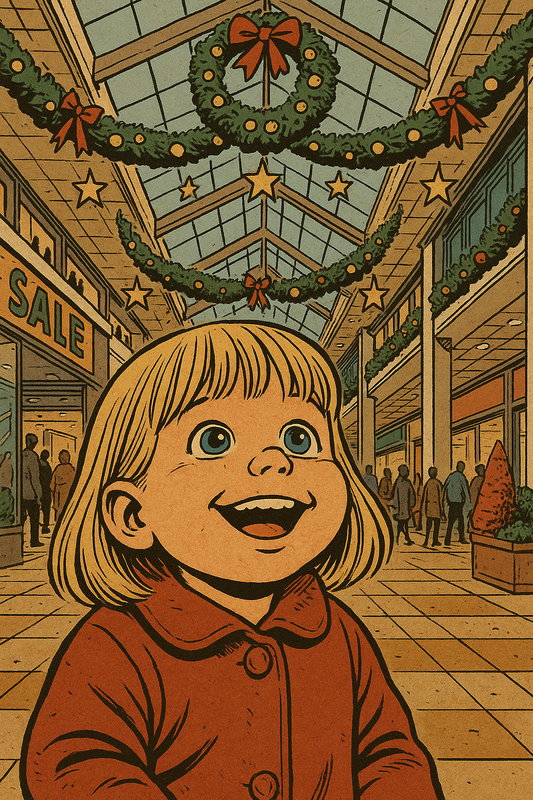
The stroller eased out of the elevator and into the atrium like a small boat pushing off into a bright harbor. Jess sat upright in it, seat-back slightly reclined but ignored, straps snug across her pink overalls. The overalls were a bubblegum shade, soft from many washings, with silver snaps that winked when the string lights caught them; the chest pocket was puckered where a little hand liked to hide and reveal treasures. Her shoes made soft thuds against the footrest as she tested them, one-then-the-other, not in a hurry—just reminding herself they were there. A few strands of hair had escaped her clip and hovered over her forehead, fine as filament. Her mouth was open in a small, amazed O.
Glenda’s hands were light on the stroller handle. She didn’t steer so much as guide, letting the stroller drift toward the center of everything and then pausing with the same patience she used to turn a page. She smiled—a slow, quiet smile that lived mostly in her eyes—and said nothing. The entire pace of her body changed; the usual spring in her step flattened into a glide. When Jess’s head tilted to the left, Glenda eased them that way; when Jess’s gaze climbed, Glenda rocked back the stroller half an inch so the sightline lifted with it.
From Jess’s seat, the world was an orchestra of bigness. The ceiling didn’t just rise; it arced into a glass sky latticed with pale ribs. The fountain didn’t just splash; it stitched water into shiny ropes that went up and down and up again. Bats hung from a rail that seemed as far away as the moon. A banner with letters bigger than grown-up shoulders stretched across air, each glyph so crisp you could run your finger along its edge in your mind. Light moved—bright coins on the floor, little star-points in the rails, beads in a string around the balcony—and then stopped, and then moved again as someone walked through it.
Jess’s head kept turning, a metronome with a secret, all the way right to trace the curve of the concierge desk; all the way left to find the caramel apples stacked like shiny planets; up to follow a flock of silver-edged bats swaying in their invisible breeze; down to watch the bronze tips of Glenda’s boots come and stop, come and stop, like punctuation. Her eyes were wide, the dark of them swallowing reflections whole and then releasing them as a quiet softening at the corners of her mouth.
Glenda steered toward the fountain but halted a few paces early when Jess’s fingers tightened around the stroller bar in a tiny, eager clutch. A musician’s bow rose and fell on the mezzanine nearby; a cello found a low note and held it like a warm hand over the room. Jess’s lashes flickered in time. The thin fog curling out from the Haunted Lane kiosk tried to get brave and then diffused under the orange bulbs, becoming nothing more than a smell—a sweet plastic cinnamon, promising more than it had.
A concierge in a dark blazer drifted near and then drifted past, saw the open-mouth wonder and smiled to himself as if he’d been paid in something better than a paycheck. The neat looped letters on the chalkboard outside the children’s boutique announced a parade Jess couldn’t read yet, but she studied them as if the curves were animal tracks. Her small palm traveled the stroller’s plastic tray and found a faint ridge; she traced it carefully, then tapped once, declarative: this.
They rolled on. A display window to the right had dressed its mannequins in winter coats dipped in the first seriousness of the season, shoulders cobwebbed in silver threads too tidy to be accidental. The glass was clean enough to double the world; Jess’s face materialized there—round, intent, cheeks lit by something orange and patient. For a split second she surprised herself: a baby she knew very well stared back. Her mouth widened in a grin so big it looked like a yawn turned inside out. She patted the air, smudging nothing, certain her hand would meet the other baby’s hand mid-flight. Glenda slowed a half-step more, canted the stroller to give the best angle, held her own smile in check and let Jess stay inside the discovery as long as it lasted.
They slid past the caramel-apple pyramid. Jess’s chin tipped up, nostrils flaring in a not-quite-sniff, learning the physics of sweetness by scent alone. The satin ribbons tied around the sticks looked like something the air could wear. A teenage clerk in a tiny witch hat lifted a tray and stopped, reading the situation: eyes very wide, hands very still. She made her hello with a small waggle of the tray and a silent “Oooh,” mouth rounded. Jess matched the shape without any sound at all and then, satisfied, moved her attention along as if she had pushed a bead across a wire.
They paused again at the animatronic witch. Her motion sensor clicked softly as the machine noticed them, and the witch lifted her plastic hand and touched her plastic broom to the floor. The cackle that followed had been turned down to a tolerant murmur. Jess’s shoulders rose under the straps; her head came forward like a bird’s. She did not flinch this time, only stared. The witch’s fingernails glowed a little. One eyelid seemed a fraction slower than the other, giving the impression of an involuntary wink. Jess blinked back, once, solemnly, then decided the witch had been accounted for and returned to scanning the room’s edges, to the important work of big things.
Glenda let the stroller drift toward the glass elevator shaft with its mural of cables and counterweights (machinery with etiquette). The elevator doors slid open for someone else and Jess got a gleaning of the inside—a mirrored back wall, a brushed-steel rail too high to hold, a floor that would probably hum underfoot. The doors shushed closed again. Jess frowned faintly at the loss of the moving box, then reset herself instantly, pivoting toward the food court where a neon ice-cream cone blinked in a language she was learning at speed.
A vampire-cape teenager, serious about customer service in a way that would look like a joke later and like a virtue eventually, stood near a sample tray of chocolate squares. He leaned down to the stroller’s altitude and flashed a smile that was mostly canines; he didn’t speak, just held up one gloved finger in an exaggerated Is it okay? to the adult and, getting a micro-nod, moved his hand slowly into the plane of Jess’s vision. A chocolate square, small as a postage stamp, gleamed in its wrapper. Jess studied the gleam itself as if it were the true object offered; she reached out with her soft, deliberate hand and took the edge. The vampire did not rush or laugh. Glenda waited, hands still. Jess turned the square this way, then that, tiny face intent, then laid it reverently on the tray of her stroller like a museum donation. The vampire bowed and backed away happily, a transaction completed: marvel for marvel.
Near the fountain, a ficus tree rustled its paper leaves in the conditioned breeze. A leaf twisted and caught the light like a coin. Jess tracked it with pinpoint attention, mouth closing, eyes thinning, and then—there—she smiled again, the tiny curve blooming unannounced. Glenda’s head tilted, a gesture only, as if to sip the moment without disturbing it.
Sound bunched and released around them: the calendar crackle of the PA playing a “spooky” waltz, the musical dribble of the fountain, the hush-flat steps of leather soles, the starch-flutter of tissue. Someone set a shopping bag down, and the bag responded with a whisper of stiff paper. A directory map under acrylic held a red star that declared “You Are Here.” Jess’s gaze caught the star and stuck. She reached for it, and her fingers kissed plastic instead. Her face made a small shape of surprise, then settled into comprehension: not everything that glowed would come away in her hand. That felt fine. There were other glowing things everywhere.
A woman pushing a stroller with an older baby in it pivoted around them in a gentle arc, offered Jess a conspirator’s smile, and passed without words. The older baby thumped a pacifier against his tray and made a sound like a bubble. Jess’s eyebrows shot up, delighted; here she was, and here was another someone who also understood trays and light and bigness. She knocked the heel of one shoe twice against the footrest—her semaphore—and returned to her watch.
They took a corridor no one else noticed until they needed it and came back out into the atrium where the banner ruled the air: HALLOWEEN AT ASTORIA. The cats and stars printed along its length waltzed without moving. Jess lifted both arms a fraction, palms up, old as humanity, asking and praising with the same gesture. Her lips worked around the shape her head had memorized: ho—. No sound yet. She chewed it like a difficult bite, thinking hard with her whole face.
Glenda stopped the stroller directly under the banner and did not say, Look! She didn’t say anything. She set the brake with a quiet click, a promise that they were not leaving the moment until the moment was done. The string lights pitched a warm net over them. The water tossed coins of brightness onto Jess’s pink knees. Somewhere, a shop door chimed and shut; somewhere else, a cashier’s laughter folded itself and put itself away.
The word came like a sudden bird: “Ho-ho!” Jess announced, bright and victorious, and clapped her hands once—one hand landing just off the heel of the other so the sound came out like a little pop bloom. She shivered with pleasure and did it again. “Ho-ho!” The syllables bounced off the polished floor and came back to her; she recognized them as friendly and sent them out again.
“Ho-ho! Ho-ho! Ho-ho!” Jess babbled, her high-pitched voice ringing out above the seep and hush of the fountain and the soft clatter of bags. Her little face scrunched in fierce concentration as she clapped on the off-beat—smack, smack—each enthusiastic “ho-ho!” bouncing off the polished floor and coming back to her as if the mall itself were answering.
Glenda’s hands rested lightly on the stroller handle. She laughed under her breath and tipped the stroller just enough to glide, not rush. “You’re in a good mood today, aren’t you, baby girl?” she said, glancing down with that smile that started in her eyes and took its time getting to her mouth.
“Ho-ho! Ho-ho!” Jess insisted, small shoulders shimmying with the rhythm she’d invented, her pink overalls puffing a little at the tummy with every bounce. The silver snap on her chest pocket winked; the footrest clicked faintly under the toe-tap of one tiny shoe, then the other. She was vibrating with a whole-body certainty, as if the word itself were a little train pulling through her.
“Jumping ahead, are we?” Glenda dropped her tone conspiratorially. “Are we already thinking about the jolly man in the red suit?”
Jess blinked hard as if she’d heard “red suit” and sorted it absentmindedly into a pile of words for later. “Ho-ho!” she repeated with exuberant precision and clapped again, fingers landing a little cross-wise so the sound popped like a bubble.
“Ohhh,” Glenda drawled, grin widening. “Is that your best Santa voice? ‘Ho, ho, ho’?” She made the last one extra round and ridiculous, shaking her shoulders with it like a snow globe someone had to entertain. A passing concierge looked up and smiled; a teenager in a velvet witch hat behind a caramel-apple pyramid stifled a giggle.
Jess’s head swiveled toward the sound of the witch’s hat bells and then back up to the banner, big eyes flicking from letter to letter like a tiny cat watching slow birds. She clapped again—smack, smack—then stopped with her hands still almost touching, palms hovering in a little prayer, and tried to push the word further. “Ho-—ho-—” The second syllable snagged on her tongue. She frowned, not unhappy—working.
A breeze from the vents lifted a lock of Jess’s hair; she shook her head and made a serious little face, as if to free her eyes again from the tickle, and then pointed—first to the banner, then to her own chest, a small, decisive tap-tap with her fist as though to say, That. Me. Us. She took a breath so deep her overalls rose like a bellows. “Ho—” The sound swelled, changed shape in her mouth, and came out new: “Holl—”
Glenda’s chin lifted, just barely, like a listener recognizing the first line of a favorite song. Still silent.
“Holl-ee—” Jess’s eyes shone; the syllables stacked themselves like blocks that finally found their balance. She smacked her hands together once in triumph and delivered the completed treasure. “Holly-ween!”
The word burst out bright, two halves stitched together with pride. She laughed, delighted at her own mouth. “Holly-ween! Ho-Ho Holly-ween!” Now the chant had a tail; she swung it joyously. Her hands clapped in quick little thunderclaps, misaligned enough to sound like popcorn.
All the teasing ran right off Glenda’s face, replaced by warmth so strong it made her look—briefly—like a kid herself. Her hand went to her heart, an involuntary press over the place that had tightened and melted at once. She drew in next to the stroller, knees loosening, and bent until her face was level with Jess’s, until the chandelier of mall light turned both their eyes to dark coins. She didn’t have to ask what Jess meant. The recognition sat between them like a third person.
“Oh, honey,” she murmured at last, voice dropping into that soft register that belongs to nicknames and kitchen-light confessions. The corners of her eyes softened. “Of course.” She turned her head toward the banner and back, a small beam of pride swinging on a hinge. “Of course it is.”
Jess, emboldened by being understood, doubled down. She hugged herself fiercely, tiny fist pressed to the center of her chest, then flung her arm up toward the banner again like flares launched from a ship. “Ho-Ho,” she declared, crisp and sure, and then—because she’d decided connections were made by repetition—“Holly-ween!”
A concierge gliding past with a stack of pumpkin stickers paused, read the scene, and executed the smallest bow as he set one sticker—BOO! in friendly letters—on the stroller tray, a silent offering. Jess didn’t break her rhythm, but her left palm patted the new orange circle three times as if appointing it witness.
“Santa can wait his turn,” Glenda said softly, smiling with her whole face now, the tease turned affectionate memory. “This is somebody else’s night.”
Jess’s hands fell into her lap for a beat, a pause as neat as a rest on a staff. She tipped forward in the harness to look straight up the center line between the draped bats. One wobbled, catching light on its silver edge; she tracked it with laser seriousness, then grinned again at nothing—at everything. “Ho-Ho,” she whispered, testing the sound as if it might behave differently when it was small. The whisper came out warmer. She touched her own chest again, now with the side of her hand, softer, like a pat given before nap time.
Glenda rocked back on her heels and lifted the little camera from the tote that hung snug against the stroller. She didn’t say pose, didn’t say look here. She slid the wrist strap on, thumbed the switch, and shifted the stroller half a foot to center the banner above them. The fountain cast coin-flickers on Jess’s knees; the string lights lifted color out of her overalls. “Ready?” she breathed, the word more exhale than sound.
Jess leaned into the lens as if trying to look inside it and find the other baby that always lived there. “Holly-ween!” she announced again, now to the camera, to the listening mall, to the ceiling that was secretly a sky. The shutter snapped; the film advanced with a friendly hum. Glenda turned the camera and touched her cheek to Jess’s, took another, then one more with her lips pressed to the damp curl of Jess’s hair.
The cello on the mezzanine shifted into a minor key that sounded like leaves turning. The animatronic witch, politely distant, offered her calibrated cackle and a wink lagging by a fraction. Somewhere, a shop door dinged and a laugh fizzed and was gone. A boy with a skeleton hoodie clomped by with his pumpkin pail and, seeing the pink overalls, raised his hand solemnly like a tiny parade marshal. Jess lifted both hands back—two-handed, deluxe—and giggled because it felt fancy.
Glenda tucked the camera away, then slid her fingers into the tote’s side pocket and fished out a penny with the tips of her nails. She bent, turned Jess’s little palm upward, and let the coin settle there. Jess looked at it as if it were a moon she’d been given legal custody of. “Mmm,” she said, the consonant humming on her tongue. The penny made her hand feel heavy and important.
Glenda angled the stroller to the fountain’s lip and didn’t narrate what to do. She just waited. Jess thought—small brow knit, mouth soft. She made a choice. Her hand arced up, wobbled, let go. The penny kissed the water and slipped down through brightness into the galaxy of other wishes, each a story with its tail tucked in.
“Ho-Ho,” Jess said, almost to the water. She didn’t add the rest; she didn’t have to. She watched until the ripples climbed the fountain’s edge and flattened back into a quiet that felt like agreement.
“Good wish,” Glenda murmured.
They lingered in that pocket of stillness where the mall seemed to inhale and hold it. The bats swayed. The banner kept its glossy secret. The BOO! sticker stuck and unstuck under Jess’s exploratory palm. A teenage vampire offering samples sidled into their orbit with the bashful confidence of someone who knew he was silly for a living that day and enjoyed it. He lifted a wrapped square and presented it low without words. Jess accepted it with both hands like an bestowed medal. She turned it, entranced not by chocolate but by the green foil. Glenda’s mouth pulled into a line of fondness she tried not to let turn into a laugh. The vampire nodded, cape whispering as he retreated, mission fulfilled.
“Ho-ho!” Jess tried again, testing the old sound against her new understanding. This time the syllables rolled different, not Santa’s boom but a person’s name wearing its favorite sweater. She pointed at the banner’s cat and declared, “Kit-ee,” because one can love two things at once.
Glenda gave the stroller the tiniest nudge, enough to gather another slice of the atrium into Jess’s view without breaking the spell. “Plenty of kitty,” she said. “Plenty of everything.”
They moved, then paused, then moved again, a tide with a mind. In the glass of a winter-coat window, Jess glimpsed herself and did the double take of someone who never tires of finding a friend in the same place she is. She pressed her hand to the glass; her reflection pressed back. The sales clerk inside—pumpkin-colored lipstick, brows precise as calligraphy—lifted a hand and made the velvet-black cat mannequin nod, just a little. Jess gasped and whispered “Meow,” pressing the “m” into a long hum that made Glenda’s heart bloom all over again.
“Ho-Ho,” Jess added as a postscript, and then, grinning so big her cheeks made parentheses, “Holly-ween.”
They were asked nothing, hurried by no one. The mall’s noise lifted and laid itself down in gentle seams: the escalator’s soft chain-hiss, the papery sigh of tissue in boxes, the modest applause of little shoes on stone. A directory’s red star declared You are here in a way that made sense to both of them for once—no map required. Jess leaned forward, forever in the middle of arriving, her hands at the ready for the next thing that glowed.
Behind them the banner presided, and above them the bats kept dignified company, silver edges winking with every tender breath the building took. Jess’s chant had become a refrain she could set down and pick up at will. She touched the BOO! sticker, tapped the bar, wiggled her toes, and then, as if the idea had flown by and she had caught it by the ribbon, threw her arms up and sang it all together one last time, a vow and a celebration: “Ho-Ho Holly-ween!”
Glenda’s answering smile was as steady as a candle shielded by two hands. She gave the stroller a gentle push, measured, intentional, like turning the page of a beloved book slowly so the picture could fully bloom before the words came.
Jess, elated at being heard, made a shape with her body that said the rest without a single extra word: one little fist pressed to the middle of her chest, a quick tap-tap; then her arm lifted and flung its small certainty toward the banner, toward the bats, toward every orange bulb that felt like belonging. “Ho-Ho!” she declared—a name, not a sound—then, as if laying a wreath where it belonged, “Holly-ween!”
Glenda laughed that small, breathy laugh that’s half-sob and all yes. “Your Ho-Ho,” she said, the nickname warm in her mouth. “Of course.” Her hands found the stroller bar and covered Jess’s, matching tiny fingers with her own for a beat. Behind them, the cello slid into a minor turn that sounded exactly like leaves changing their minds.
A pumpkin sticker materialized on the stroller tray as if conjured—BOO! in friendly letters, delivered by the concierge with a little bow and a you-have-made-my-day grin before he ghosted away. Jess patted the sticker twice, ceremonious, then reached up with both arms for the sky of letters and cats. She was nearly vibrating again, but it was a softer hum now, purpose settled inside the excitement.
“Hang on,” Glenda said, a grin tugging. She reached into her canvas tote and brought out the little point-and-shoot, its wrist strap sliding onto her hand with the ease of muscle memory. No coaxing, no “say cheese”—just the gentlest shuffle to center the banner over them, the tiniest angle to catch the fountain’s coin-light on Jess’s knees. She leaned in until their cheeks brushed and the camera’s cool edge kissed the side of Jess’s face. “Ready?” she breathed, the word all air.
Jess filled the tiny mirror with her certainty and announced to lens, ceiling, and sister across town: “Holly-ween!”
Click. The shutter blinked; the film motor purred. Glenda took another—her lips on the warm curve of Jess’s hair—then lowered the camera and pressed her forehead lightly to Jess’s for the briefest, perfect beat. Above them, a bat tipped on its string so its silver edge winked like a co-conspirator.
“Santa can have December,” Glenda whispered, still grinning, still half-kneeling, eyes shining like she’d been handed something she’d once dreamed and then forgotten to expect. “Today belongs to Ho-Ho.”
Jess nodded with the gravity of a person who had named a star. She touched her chest again—tap-tap—then pointed once more at the banner, a small, decisive arrow of a hand. “Holly-ween,” she said, softer now, not a shout but a vow.
The fountain kept its liquid conversation. The bats swayed in their dignified little breeze. A boy in a skeleton hoodie clomped past and saluted with his pumpkin pail; the teenage vampire at the caramel apples executed a courtly bow in their general direction, cape whispering. Glenda rose, thumbed the camera off, and slid it back into the tote, the strap catching for a friendly second on her wrist before letting go.
She set her hand to the stroller handle again, but didn’t push. Not yet. She let the moment finish deciding itself. Jess tapped the BOO! sticker as if blessing it, then folded her hands for a heartbeat, tiny mayor of the spot they occupied. When Glenda finally eased the brake, she did it like turning a page she wanted Jess to see unfold completely—a gentle glide, no hurry at all—carrying them both forward under the shining letters that now belonged, in the clean, exact way names belong, to family.