Work Text:
The light in the front room of the Robinson home was soft and dappled, filtered through gauzy curtains that swayed slightly in the slow, humming breath of the ceiling fan. Afternoon heat clung to the corners of the house, curling in like a cat, content and unmoving. Jennifer sat cross-legged on the couch, her long, wavy blonde hair spilling over one shoulder, the ends catching the light like threadbare gold.
Her dress—linen, simple, dyed the muted green of pressed sage—gathered softly around her legs. One hem pooled over her ankle; the other rode higher, caught beneath the curve of her thigh. Her bare foot, arched against the worn cushion, flexed once with absent thought, then stilled. She sat perfectly balanced between ease and attentiveness, as if she had practiced the art of being still in the presence of wonder her whole life.
Her shoulders were drawn back, spine long but not stiff. Her gaze was soft but unwavering, eyes fixed on Miracle with the kind of quiet gravity only Jennifer could manage—a blend of tenderness and fierce attentiveness, as if she were watching not just a child, but the blooming of something sacred. It wasn’t that she expected something extraordinary. It was that she already saw it.
Both of her hands rested in her lap, the left gently cradling the right, fingers threaded loosely like folded pages. Her palms faced upward—not by intention, but from the relaxed habit of someone used to receiving stories. The only movement came from her index finger, which tapped with absent rhythm against the hem of her skirt: slow, thoughtful, like a metronome tuned to memory instead of time. Not insistent, not fidgeting—just there, a quiet punctuation to her presence. A heartbeat rendered in gesture.
Across from her, little Miracle was busy—fiercely, joyously, seriously busy—in the way only a three-year-old could be. Her white socks had slipped down around her ankles, her curls were a little frizzy from play, her gaze studious when settled, would then shift rapidly as she arranged something on the floor that Jennifer couldn’t quite see yet.
But Jennifer didn’t need to. She knew this ritual. Knew it as well as any prayer, any lullaby. She’d seen it before—always different, always the same. Every child had their own style of arranging their small world. Their own systems of magic. Their own rules.
Amy tying ribbons around Bunnybun’s floppy ears, Jess arranging cassette cases as if they were chess pieces, Dana trying to choreograph a dance for her dolls that would only work if everyone stood very still and didn’t talk. A lifetime of little girls who brought her their dreams in the form of paper dolls and battered plushies, elaborate names, secret languages, hand-sewn kingdoms tucked under bedsheets. Each child’s imagination was like a fingerprint—entirely theirs, utterly irreplaceable.
But Miracle was different, somehow. Not because she was more imaginative—Jennifer never measured children that way—but because she held her world with a kind of quiet intensity that Jennifer recognized. Wonder bubbling out of her like a song she hadn’t written down yet.
There was a stillness to her when she played, a centeredness that didn’t call for performance or permission. She was entirely present. Entirely whole. She played not to be watched, not to be approved, but because she was carrying out a responsibility—one known only to her and the beings she whispered to beneath her breath.
Miracle’s hands danced through the air, gesturing to whatever story she was weaving. The way she crouched—heels flat, arms moving with delicate intent—reminded Jennifer of someone casting a spell, or maybe negotiating a peace treaty between ancient kingdoms. Her brow was furrowed in concentration, but her mouth curved upward in the faintest smile. She was elsewhere. Deeply, joyfully elsewhere.
Jennifer leaned her chin into her hand and watched, smiling but silent. She didn’t want to interrupt. She never did. That was the thing people didn’t always understand—children weren’t just “playing.” They were building worlds. They were learning the shape of emotion, the way power and gentleness could coexist in the same touch. They were trying on identities, resolving old stories they didn’t have language for yet. And if you were lucky enough to be invited into that world—even just as a witness—you didn’t speak unless asked. You just watched. You honored it.
Miracle shifted to one side, reaching for something behind her, and let out a little triumphant “aha!” that rang through the room like a bell. Then she turned her face briefly toward Jennifer—not all the way, not enough to leave her imaginary stage—and gave a small, knowing nod. Not an invitation, not yet. Just a recognition: I know you’re there. I know you’re watching. I don’t mind.
There was a quiet sort of reverence to the moment. Jennifer didn’t think of it in grand terms. She didn’t need to. It was just good. It was just right. And no matter how many times she saw it—this spark, this unfiltered wonder—it never got old.
She could have watched Miracle for hours.
She hoped she would.
Jennifer had always believed that wonder deserved silence. Not because it needed reverence in the way cathedrals did, but because it bloomed best in space—uninterrupted, unhurried, unjudged. And watching Miracle was like watching a starfish open under moonlight—slow, curious, full of soft mystery.
The tapping of her finger slowed to a stop. Her hands went still. Her breath deepened, softened. And her eyes never left the child.
Miracle was on her belly now, her feet kicking slightly in rhythm as she tilted her head, examining something invisible from a new angle. A single curl had fallen across her brow. Jennifer resisted the urge to smooth it away. There would be time for that later.
At one point, Miracle sat up and looked over her shoulder. She blinked at Jennifer, solemn and still. Her gaze was neither uncertain nor seeking praise. It was the gaze of someone checking—just once—to make sure the world was still holding steady. Jennifer met her eyes and nodded, very gently. Miracle gave a small, satisfied nod, then turned back to her work.
Outside, cicadas began their long, slow crescendo. Inside, Miracle whispered something to her toys that only they would ever hear. And Jennifer, still silent, smiled into the fading afternoon, full of the deep, unshakeable joy of witnessing a life begin to speak.
Miracle crouched over her small arrangement like a curator unveiling a grand exhibit, her tiny fingers hovering just above the figures she had so carefully placed in a ring of sun on the living room rug. The ceiling fan hummed overhead in slow, methodical circles, but the air down here was full of story—of ceremony. She would look up briefly whle she spoke, but otherwise her gaze was fixed, reverent and intensely focused, on the doll cradled in her hands as if it were made of something more delicate than porcelain, more precious than gold.
“She always go to royal balls,” Miracle declared with great authority, lifting Bella carefully under her arms and giving her a dramatic little bounce, as if preparing her for a grand entrance. “She say, ‘Miracle, bring me my crown,’ cause she’s a princes-queen.”
Her voice deepened in pitch for the impression, her eyebrows raising with mock seriousness. Bella’s plastic head wobbled slightly in the exaggerated gesture, but Miracle steadied her immediately, adjusting the tilt of her tiny molded tiara with reverence, even though it was permanently glued in place. She brushed imaginary dust from the doll’s chest, then held her at arm’s length, eyes narrowed in admiration.
Jennifer let out a soft laugh. It was the kind of laugh that lived somewhere between delight and memory. “She sounds like she knows what she wants,” she said warmly.
Miracle looked up, her face serious for a moment, as if weighing the truth of that. Then she wrinkled her nose slightly. “She bossy,” she admitted, drawing the word out like a piece of taffy. “She say, ‘You late. We gotta go. The other princesses are waitin’.’ And then she stomp her shoes like dis.” Miracle made Bella stamp her tiny plastic feet against the rug in an exaggerated, haughty fashion.
Jennifer bit back a smile and offered a sage nod. “I see. A very particular sort of royal.”
“Uh-huh.” Miracle placed Bella upright again, smoothing her dress flat with a practiced hand. “She bossy lotta times. Like, when she don’t got her purse. Or when her dress is wrinkly. Or when she want a snack but it not snack time yet. She say, ‘I am starving,’”—Miracle dramatically clasped her hand to her stomach—“‘and I must have cheese cubes now.’” Her eyes widened as she looked at Jennifer, dead serious. “But I tell her no. No cheese yet. Only pretend crackers.”
“Well,” Jennifer mused, “even queens have to wait for snack time.”
Miracle nodded firmly. “That’s what I tell her. I say, ‘Bella, you not da boss of ev’rything.’”
Then her voice softened. “But she real nice if you sing her songs.”
Jennifer raised an eyebrow gently, interest piqued. “Oh yes?”
Miracle, already seated cross-legged again, cradled Bella against her shoulder like she was comforting her after a particularly stressful diplomatic encounter. “Mmhmm,” she murmured, rocking her ever so slightly. “She get quiet. She listen. She don’t roll her eyes or do da sigh.”
Jennifer smiled. “What kind of songs does she like?”
Without missing a beat, Miracle answered, her voice dropping into a soft, shaky little hum. “Like da slow ones. Like ‘laa-la-laaaa.’” She swayed from side to side, eyes half-lidded in imitation of a dreamy royal being soothed into serenity. “She like it when it got twinkles.”
“Twinkles?”
“Yuh-huh,” Miracle said firmly. “Like sparkles but with your mouth. You go high, like ‘deedle-dee-dee, la-la-looo,’ but soft.” She demonstrated with a voice so airy it barely touched the air. “Like stars singin’ at bedtime.”
Jennifer sat perfectly still, watching her. Not wanting to break the spell. It was no longer just play. This was ritual. This was care.
Miracle went on, her words now half-whisper, half-song. “She close her eyes when I sing. Even if she mad. Even if she wanna be mad still. She try. But she can’t. Cuz the song go right into her heart.”
She looked up again, her expression suddenly earnest. “Songs fix stuff.”
Jennifer’s chest tightened—not with sadness, but with that overwhelming fullness that sometimes comes with witnessing the purest truths. “Yes, sweetheart,” she said softly. “They really do.”
Miracle nodded solemnly. “I sing to all my girls. But Bella need it most. Cuz she act tough. But she still a little sad inside sometimes. Cuz bein’ fancy all da time is tiring.”
Jennifer let out a quiet breath, a laugh without sound, a sigh without weight. She thought of all the women she’d known—herself included—who had put on crowns of one sort or another and told the world they were just fine. That they were elegant and composed and unshakable, even when what they needed most was someone to sing them a silly, twinkling lullaby.
She glanced down at Bella, cradled now in Miracle’s arms, half-asleep in the afterglow of a pretend song.
“She’s lucky to have you,” Jennifer said, her voice thick with warmth.
“I know,” Miracle said simply. “But I’m lucky too. Cuz she let me take care of her. Even when she grumpy.”
She laid Bella gently on her side beside the others, smoothing her dress again with practiced care. Then she leaned close to the doll’s tiny molded ear and whispered something too soft for Jennifer to catch.
A blessing, maybe.
Or a song.
Or just the words every queen really needs to hear.
Next came a smaller doll with a round vinyl head and plush body, Miracle reached for her with both hands, gently, as though the doll were something alive and sleeping—fragile in a way Bella had never been. Bella was for grand entrances and royal decrees; Now in contrast, was for quiet things: soft lullabies, warm bottles, arms that never let go.
“She’s a baby,” Miracle announced in a hush that suggested even the word deserved gentleness. “She li’l.” Her lips puckered slightly on the “l,” as if the word itself were as small and round as the doll she held. “Her name’s Baby June. ‘Coz she borned in June,” she added confidently, though the logic was wholly hers. “Dat’s summer. Summer mean warm. Not coats. Not boots. Jus’ sun and Mama sayin’ ‘get yo water.’”
Jennifer watched, her heart tender and slow. Miracle had shifted her posture without realizing it—sitting now with her legs folded beneath her, rocking Baby June very slightly in her arms, instinctively. The movement wasn’t something learned so much as something remembered from generations of watching other arms do the same.
“She got duckies,” Miracle murmured, pulling the doll a little closer to her face, inspecting her sleeper. “But da duckies all go’d away.” She ran her finger slowly over the worn fabric, where the yellow prints had faded into a faint, ghostly wash. One eye of a duck remained intact—just one—and Miracle pressed it gently, like it was a button that could make something happen.
“She wear dis all day,” she explained solemnly. “It her jammies. She don’t gots real pants.” Her little brow furrowed. “She don’t like pants,” she decided. “She cry if you try pants. She say, ‘nooo pants, dey itchy!’” Miracle’s voice dipped into a tiny wail, then bounced right back to normal, pleased with her own dramatization.
“She drink milk from da bottle, not da big girl cup. An’ she don’t chew,” she added quickly, clearly important. “She jus’ gum gum gum.” She pressed her own bite together with a smacking sound for effect.
Jennifer let herself smile, gently. She didn’t want to break the spell.
“She sleepy a lot,” Miracle continued, now laying Baby June on her back with extraordinary care. “She sleep all day, sometimes. But not when she got dreams. When she dreamin’ she move her legs like ‘dis—” Miracle lifted the doll’s legs with two fingers and bicycled them gently through the air. “Zoom! Zoom!” she giggled. “She thinkin’ she a scooter baby.”
Then Miracle leaned forward and kissed the top of Baby June’s shiny vinyl head, right where a faint crack had begun to form near the soft spot. She didn’t notice the damage.
“She got a mama,” Miracle whispered, her voice dipping into something sweet and secret. “Me. I da mama. But not all da time. Sometimes Bella’s da mama. Or sometimes she got no mama, just da animals.” She nodded, as if this was a completely natural turn of events. “Like da lion, or da fox one. Dey take care of her in da woods. But now she home.”
The idea that Baby June had once lived in the woods did not seem odd to Miracle. In fact, she patted the doll’s side softly and added, “She got bit by da weather. But she ‘kay now.” Then, remembering something, she turned her head slightly and called up toward Jennifer without breaking the rhythm of her rocking: “Auntie Jenny, she got a fever but I taked care of it. I put her in da blanket an’ I singed her da moon song.”
Jennifer nodded slowly, as if receiving a medical report from a trusted nurse. “The moon song’s the best medicine there is,” she said.
Miracle’s face lit up. “Yuh huh! She like when I do da humming part. Not da words. She say da words make her tummy loud.” She paused and squinted, considering this. “Not like bad loud. Like…” she flailed her hands slightly, trying to explain. “Like when da train come. You feel it. Boom boom.”
She set Baby June down beside Bella, very gently, tucking the smaller doll’s arms inward so they looked cradled. “She don’ go to balls,” Miracle clarified, glancing at Bella with an expression both admiring and slightly defensive. “She too li’l. She don’ dance. But she wave. She wave from da window. An’ Bella say ‘hi, baby!’ like dat.” She waved her own hand daintily, then turned it and pressed it against Baby June’s forehead again. “She still hot. But she safe.”
Then, with no announcement, no ceremony, Miracle leaned forward and pressed her own forehead gently to Baby June’s—one moment, one breath—and then sat back.
“She sleepin’ now,” she whispered. “Shhh.”
Lulu the Lamb had once been pristine: a perfect balance of plush and rattle, with silky fleece as soft as a cloud and tiny silver bells stitched delicately inside her limbs and belly. Now, her whiteness had dulled to a warm cream with hints of gray in the corners, and the fleece was patchy in places, pilled and worn thin where fingers had tugged and mouths had gnawed. The bell inside her belly still jingled, though it no longer rang out clean and bright—it made a softer sound now, a sleepy kind of clink, like the memory of a song. Jennifer heard it and knew it by heart.
Miracle cradled Lulu close to her chest, hugging the lamb’s lopsided body with the kind of fierce affection only toddlers could give—an embrace made entirely of instinct, habit, and muscle memory.
“This one’s funny,” she giggled. “Lulu go jingle jingle if you shake her.” She demonstrated with great vigor, the soft bells inside the plush rattle-doll producing a delicate chiming sound. Lulu was half lamb, half toy instrument, with soft fleece and stitched pink cheeks.
Jennifer’s eyes softened. That sound—those tiny bells—had once been the background music to entire months of her life. Long afternoons in Glenda’s living room with the windows open and cicadas whirring, Miracle no more than a gumdrop of a baby, shaking Lulu with both fists like she was summoning springtime. Every nap fight, every post-bath giggle, every lull in conversation had been filled by the steady, joyful rattling of that little lamb.
“She my rattle-lamb,” Miracle explained with reverence, holding Lulu up by her arms so the doll dangled in the air, ears flopping. “But also she a real lamb. Like on da farm. But small.”
Jennifer nodded, utterly serious. “A farm lamb who jingles. Rare. Oh and did Lulu ever get dizzy from all that shaking?”
Miracle tilted her head thoughtfully. “Maybe. But she never throwed up, so I think she’s okay. And she run fast. But she don’t got shoes. Just… feets.” She held up one of Lulu’s stubby legs to demonstrate. “Soft feets. Like… clouds. She don’t go on da hot road. She only go on da grass, ‘kay? An’ she don’t like bein’ dirty.”
“She likes bein’ clean?” Jennifer asked gently.
“Yeah! Clean an’ fluffy!” Miracle paused to sniff the lamb’s head. “Mmm. She smell like…” her nose scrunched thoughtfully. “Like somethin’ nice. Like... ‘quash.” She meant squash, Jennifer guessed, remembering that Glenda had made butternut squash soup just yesterday. Miracle sniffed again, satisfied. “Yup. Like ‘quash soup. Good soup.”
“She got a fam’ly,” Miracle went on, now lowering her voice and placing Lulu gently next to Baby June. “She got a mama, but da mama’s far away on ‘portant business. So she stay wif me now.”
“Important business?” Jennifer asked, brows raised.
Miracle leaned closer, whispering as if what she was about to share was confidential statecraft. “Da mama’s in… Paris. She makin’ cookies for da president.”
“Ah,” Jennifer said, straight-faced. “Diplomatic cookies.”
“Yup. But Lulu don’t miss her too much,” she added, stroking Lulu’s head gently with one thumb. “She got me. I do da cuddles. I do da jinglin’. I know all her stories.”
“What kind of stories?”
“Like…” Miracle tapped Lulu’s belly to summon the bell sound. “She was born in a tree. On a cloud tree. An’ da birds taked care of her, ‘til I finded her in da blanket basket.” She tilted her head proudly. “She picked me. Not da other babies. Me. She say, ‘dat one. Dat girl wif da giggles. I want her.’”
Miracle curled around Lulu slightly now, hugging her against her shoulder. Her voice got quieter, fuzzier around the edges. “She sleep best when I jinga her,” she said, beginning to shake the lamb again, but softly this time. “I shaked her when I was li’l. When I was baby. Mama say I never stopped. I go ‘jinga jinga’ all night.” Her head bobbed with each sound. “I gived her da shakes so she not scared. Not ‘ven once.”
“Brave lamb,” Jennifer murmured.
“She braver when I hold her.” Miracle cooed. “When I hold Lulu, she don’t be lonely. She got her jingle heart. An’ her sleepy song inside.”
And then she did something Jennifer hadn’t seen her do with the other dolls—she pressed Lulu to her cheek, not in a hug, but like she was listening. Like there was something inside that only she could hear.
A long moment passed like that.
Then Miracle whispered, “She say she love me.”
Miracle cradled Rosie close before even introducing her, as though some part of her couldn’t help but give a quick squeeze of affection before continuing. It wasn’t performative; it was reflex. Rosie, like breath or heartbeat, was part of her.
“Now…” Miracle said, drawing out the word with a hushed kind of ceremony, “dis one Rosie.” Her hands reached out with reverence, fingers curling slowly beneath the next doll as if lifting something sacred from an altar. Rosie was different. Not the fanciest or the softest. Not the newest or the noisiest. But Jennifer knew—without Miracle saying a word—that this was the one. The doll.
“I got her when I was… baby,” Miracle explained, eyes wide as she held the doll close enough for their cheeks to touch. “I was li’l li’l. Like dis.” She squatted down low in her spot on the rug, so low her bottom nearly touched her heels. “Six monfs. Mama say so. She say Rosie was mine forever.”
Jennifer leaned forward just slightly, gaze softening. She remembered the story of how Glenda had brought Rosie home—tucked under one arm, already beloved before she ever made it into the crib. Miracle had reached for her instantly, her tiny hand finding the doll with unerring certainty, even before she’d learned to sit up unassisted. That had been the beginning.
And Rosie had never left her side.
She was small—no larger than Miracle’s own forearm—with soft cloth skin rubbed down to a faint, familiar fuzz. Her face had once been painted with neat little features: eyes, a smile, maybe even a blush to the cheeks. Most of it was worn now, kissed and rubbed away through time and use, leaving behind only suggestions. Her dress—a faded floral print, pinks and purples washed to pale by hundreds of washes—had once had a bow that now hung by a single thread. Jennifer recognized that thread. She’d tried to repair it once, but Miracle had said no. “Dat’s Rosie’s wibble bow,” she’d said solemnly. “She likes it wibbly.”
“She da best friend,” Miracle said now, nodding deeply, as if confirming something sacred. “She go ev’where wif me. She go to da store. She go to da bath—no! Not da tub. She sit on da sink. An’ she go bed too. An’ she no cry. Never cry. Coz she brave.”
Jennifer almost said, “Like you,” but didn’t. She knew the quiet rules of this kind of storytelling. You listened. You let it come.
“She sleep wif me on my pillow. She got her spot. She don’ even move.” Miracle’s tone became conspiratorial, a finger raised as she whispered: “If you move her she find her way back. Always. She know where da pillow is.”
She brought Rosie up to her face again, nestling the doll into her neck, and closed her eyes for a second—just a second—breathing in that deep, comforting scent only she could identify. Rosie didn’t smell like squash soup, like Lulu. She didn’t smell like soap or sunshine. Rosie smelled like home. The oldest kind of home. The one you’re born with, the one you carry.
“She don’t talk lots,” Miracle said quietly, shifting the doll so she sat upright in her lap. “She whisper.” Miracle turned her head slightly, as though listening. “She say…” A pause. Then a delighted grin. “‘I love you to da stars an’ back.’ Dat’s what she always say.”
Jennifer’s breath caught gently in her throat. She’d heard Glenda say that. A thousand times, in a hundred rooms, through long nights and sick days and bedtime rituals. To the stars and back. Now it had become Rosie’s voice.
“She do feelings magic. If you sad? She hugs you. If you sleepy? She sing in your head. But soft, so nobody else hear. Just you.”
Jennifer’s hands curled gently around a cushion. She didn’t realize she was holding her breath.
“She knows when I’m ‘fraid,” Miracle said, almost absentmindedly now, eyes trained on Rosie’s faded little smile. “Sometimes I ‘fraid of da window. Or da shadows, when Mama turn off da hall light. But Rosie say, ‘You not ‘lone. I’m here. You mine.’” She nodded, firmly. “She say dat. I say it back. ‘You mine too.’”
The light in the front room tilted warmer as the sun eased past its high point, and the hush that settled around Miracle and Rosie felt heavy, but not with silence—with meaning. With history. Jennifer felt it in her chest: the weight of everything this doll had absorbed. Tears, dreams, tantrums, giggles. The way her little cotton body had been a shield, a lullaby, a witness to a whole life already blooming.
Miracle laid Rosie down gently, not with the distance she’d given Bella or the tucked-in tenderness of Baby June. She curled around her instead, one arm draped over the doll like a protective wing, like something instinctual and ancient.
“She my all-time best one,” Miracle whispered, as if even saying it out loud might make the doll blush. “She know everyfin’. Even da stuff I forget.”
Jennifer smiled warmly. “I think she really does. Such a clever dolly.”
Miracle didn’t answer. She was staring at Rosie now, but not with play in her eyes. With love. Old love, the kind that didn’t need rules or logic. The kind that simply was. She ran a thumb along Rosie’s cheek and smiled, her lashes beginning to flutter with the first signs of sleep.
“She mine forever,” she whispered again. “Even when I big.”
Miracle’s eyes lit up with sudden, almost electric excitement as she reached for the final doll in her circle—a plush mermaid with long yarn hair in fading turquoise and a shimmering, scaly tail that had once gleamed like sunlight on a pond. Zinnia the Mermaid had been squished, hugged, chewed on, and loved almost bald in places, but her tail still sparkled faintly when caught in the right light, like a secret just waiting to be believed in again.
“Oooooh!” Miracle squealed, breathless with joy as she clutched the doll to her chest. “Dis Zinnia! She da water girl!”
She wiggled Zinnia with both hands so the tail flopped back and forth dramatically, making a gentle swish swish sound against her forearms. Then she set her upright with care, tucking the mermaid’s tail beneath her in a swooshy curve, as if she’d just risen from a foam-slicked sea rock.
“She a muh-maid,” Miracle declared, eyes wide with reverence. “But not a scary one. She don’t do nothin’ mean. She not got claws or sharky teeth. She smile soft, like dis.” Miracle mimed a shy, serene smile with her lips pressed together and eyes slightly tilted. “She sings to da fishes. An’ she swim so fast—like whoooosh!” She flung her hand through the air, fingers trailing like a dolphin’s fin. “An’ she gots shimmies on her tail. Dat means magic swimmin’.”
Jennifer let out a soft hum of amusement, watching the girl’s limbs mimic the flow of water, her whole body swaying with the remembered rhythm of waves. Zinnia, though silent and still, was clearly very real to her—a full creature of ocean depths, not just seams and stuffing.
“Zinnia live in da water,” Miracle continued, hugging the doll under one arm like a fish she’d just caught and loved too much to let go. “In da sea. Da big one. She don’ got a house. She got a cave, with sea glass an’ treasure an’ pillows made of jellyfish. Nice jellyfish. She friends wif a whale who help her carry snacks.”
“She sounds very well connected,” Jennifer murmured, and Miracle beamed.
“She is! She know ev’rything in da water. She say, ‘Come in, baby!’ an’ then she help me float.”
Jennifer tilted her head, eyebrows raised. “You mean you swim with her?”
Miracle’s eyes went even wider. “Uh huh! Coz I’m a water baby. Mama say so. I swim since I was just a bean. I go splash splash, an’ never cry. I open my eyes in da tub. I don’ even mind da soap!” She puffed her chest proudly. “I go all da way under. Even my ears!”
Jennifer smiled. “Very brave.”
“Not brave,” Miracle corrected gently. “Just… ‘posed to be there. Like… I belong in da water. Like Zinnia say, ‘you my guest.’ An’ I say ‘okay!’”
She held the mermaid up again, letting the faded glitter tail catch a sliver of sunlight. “She swim from da moon reef,” Miracle explained seriously. “It’s way far out where da stars go sleep. She got her name from da flowers that grow down there. Zinnia flowers. But they got bubbles in ‘em. An’ they sing.” She leaned forward and whispered, “If you pick one, you hear a secret.”
Jennifer leaned forward too, playing along. “What kind of secret?”
Miracle lowered her voice to a dreamy hush. “Like… why dolphins smile. Or where the rain hides when it’s done.”
For a long moment, the two just sat there in the golden hush of the afternoon—Jennifer on the couch, elbows on her knees, and Miracle cross-legged on the rug, Zinnia the Mermaid posed regally in her lap, the light flickering faintly along the doll’s tattered tail. It felt like a kind of communion: woman and child, sea and shore.
“She sing me songs,” Miracle whispered finally, cradling Zinnia close again. “She say I got sea in my heart. That’s why I always splash.”
Jennifer chuckled softly. “You really do.”
“She say I got a tail, but it invisible. Only comes when I go underwater. Then I zoom fast like a seal an’ do flips like a fish girl. She see me, an’ she smile.”
Miracle hugged the doll tight against her cheek. “Zinnia always come back. Even when I go home. I take her in my dreams. We ride turtles an’ slide down coral slides. An’ we go to the sand bakery.”
Jennifer blinked. “Oh my, do go on, Miracle.”
Miracle nodded solemnly. “Where crabs make cookies. But da cookies are wet. Still yummy though.”
“Zinnia go last,” Miracle said, arranging the doll in a perfect curl beside Rosie. “Coz she gots stories dat take long. She always come back from da sea with new stuff to tell. An’ da udder girls, they wait for her. Even Bella.”
Jennifer nodded. “Of course they do.”
“She got da best hugs,” Miracle added, voice softening, lids beginning to droop. “Her tail wrap ‘round me. An’ she say, ‘You safe now, sea girl.’”
Miracle was quiet for a beat, her small hand resting over Rosie’s matted curls, as if listening for some invisible cue from the dolls in her semicircle. Jennifer, legs folded beneath her, sipped at her cooling coffee and watched with fond amusement. The floor creaked gently beneath them—the house settling, or breathing, or remembering.
Miracle was quiet for a beat, her small hand resting over Rosie’s matted curls, not moving, not even twitching, her brow furrowed ever so slightly as if listening to something only she could hear—an invisible cue from the dolls in her semicircle, or perhaps a secret passed between old companions. Jennifer didn’t interrupt. She knew this pause. She’d seen it in a dozen children over the years and in Miracle more times than she could count: the moment before memory sparked, before imagination tipped back into motion like a record needle dropping into place.
Jennifer sat with her legs folded beneath her now, the hem of her skirt tucked neatly under her thighs, one hand curled around a mug of coffee that had long since gone tepid. The drink had been forgotten, left to cool while she watched Miracle with the sort of quiet devotion normally reserved for lullabies or the hush after a child’s first laugh. She sipped it anyway, more out of habit than desire, and let the warmth—faint as it was—settle into her chest.
The floor creaked softly beneath them, that deep wooden sigh that every old house knows how to give. It wasn’t the sound of strain but of presence, of memory: the house remembering footsteps, voices, lullabies hummed into the walls over years and decades. Jennifer liked to think of the Robinson home that way—not just a place where people lived, but a place that lived alongside them. And now it watched another generation of make-believe pass through its rooms like sunlight through leaves.
Suddenly, Miracle’s head popped up. Her eyes lit with urgency, her mouth forming a perfect “O.”
“Oh!” she gasped. “I forgot—wait please!”
She didn’t run, exactly—Miracle rarely did anything that tidy—but she scrambled to her feet in a whirl of socks and curls and hurried out of the room with all the determination of a child on a mission. A muffled thump sounded from down the hall, then a series of light-footed thuds and the scraping of a closet door. Somewhere, something clattered. Jennifer didn’t flinch. She didn’t even blink.
It was the shape of the doll: wide-brimmed hat, stitched smile, boots made of worn corduroy that sparked Jennifer’s curiosity to surge again. She didn’t know what name Miracle had chosen for him—probably something with a drawl, or maybe something whispered to her by the toy itself—but Jennifer knew the type. The cowboy. The horseman. The old-soul guardian.
Glenda was Texas, through and through. Not the flashy kind, not the kind that draped itself in flags or slogans, but the kind that settled into your bones like red clay dust, the kind that gave you a spine and a song and a stubborn streak you’d carry forever. She might’ve lived in Huntsville for years now, but her vowels still curled like porch air, and her boots still stood in the closet next to her heels, not one inch less proud.
Jennifer had always admired that about her. Texas was Glenda’s myth and mirror—her beginning and her battery. And it made Jennifer think, with a faint tug of melancholy, of her own Ohio. Not in rivalry, but in reflection. Wide skies and hardscrabble dignity, long roads lined with ghosts and good intentions. They were different, Texas and Ohio, but they held hands in certain quiet ways—practical stubbornness, loyalty carved deep, the kind of strength that didn’t need explaining.
And so, yes, of course there was a cowboy.
As Miracle gently adjusted the cowboy’s floppy hat—tenderly, as if fixing it just right might help him say exactly what he needed to say—Jennifer watched with the kind of stillness that only ever came over her when something inside was stirring deep and quiet. Her coffee had long gone cold. She didn’t notice. The curve of her mouth held a soft, thoughtful smile, but her eyes had turned inward, not away from the child, but deeper—into memory, into home.
Ohio.
She had spent only a handful of years outside of it—cumulatively maybe three, if she counted the months spent with relatives in Indiana after her mother’s accident, the brief year in her twenties when she tried on the idea of California and found the shoes pinched in all the wrong places, and the time she stayed in Alabama to help Glenda through a hard spell. But none of those places stuck to her bones like Ohio did. None ever had a voice in her blood.
Ohio was not a place that bragged. It didn’t shimmer. It didn’t sell itself. It didn’t need to. It simply was—like a father’s hand steadying your shoulder as you walked, or the hush of snow falling at night when the whole town slept and the only sound was your own breath in your scarf.
Geneva, especially.
The small lakeside town sat there like a secret never meant to be grand, only good. The kind of place where the fog clung to the fields in the morning and the trees always seemed to bow a little in greeting. Where every summer festival felt like the last one on Earth and every neighbor called your name like it was a song. Geneva had shaped Jennifer the way water shapes rock: slowly, lovingly, with a hundred small acts of weather and kindness.
She remembered it all as though it were written into the texture of her skin—the thrift store where her older cousin once dared her to try on a sequined wedding dress; the soft-serve stand that always gave her an extra pump of chocolate dip just because she was polite; the cracked sidewalk in front of the library where she used to lie flat on her back with her sisters and try to guess the shapes in the clouds.
In Geneva, every season had a soul. Autumn arrived like a hymn. Maple leaves went burnt orange overnight, and the air took on the scent of woodsmoke and overripe apples. Winters were long, but not cruel. They taught you to slow down, to knit things, to sit close and share heat. Spring was wet and moody, like a teenager, but if you were patient, you’d wake one morning and find everything had bloomed behind your back. And summer—summer was all bare feet and distant lawnmowers and screen doors that never quite latched.
Even now, far away in Alabama, in a living room filled with dolls and the murmur of a child’s voice, Jennifer could feel Geneva like a heartbeat under her ribs.
She had lived elsewhere, yes. She had loved elsewhere. But no place had ever known her the way Geneva did. Not just the shape of her life, but the rhythm of her thoughts. The soil there didn’t just grow corn or tomatoes—it grew her. And when she was away, as she often had been in her later years, she felt its absence the way a tree might miss its root's cool fingers in the earth. It wasn’t homesickness. It was something deeper. Something cellular.
Geneva was the first place that ever showed her silence didn’t mean loneliness. That quiet could be holy. That smallness didn’t mean insignificance, only intimacy.
She remembered once, as a child, asking her father if people in big cities ever felt sad. He had taken her hand and said, “Everyone feels sad sometimes, sweetheart. Even if the sidewalks are golden.”
But in Geneva, when she was sad, the world noticed. A neighbor might leave a plate of cookies without ringing the bell. The grocer might ask if she was getting enough rest. The lake might hold her reflection a little longer in its rippleless gaze, as if to say: I see you. You’re still here.
Jennifer blinked and came back to the room—the warm pull of the floorboards, the weight of her cooling mug, the glint of sunlight on Zinnia’s tail, and Miracle now cradling Cowboy Ted (as Jennifer had named him privately) in her lap, whispering to him like he’d just ridden in from miles away with dust on his boots and news from the edge of the world.
This house wasn’t Geneva. The trees outside weren’t maples. The air didn’t hold the lake in its lungs. But somehow, sitting here with a child arranging her universe out of plush dolls and whisper-voices, Jennifer felt something close. Something that rhymed with home, if not spelled exactly the same.
Because love looked the same everywhere.
And watching Miracle—so tender, so precise in her affections, so determined to give every doll its voice and place—Jennifer felt, in some quiet corner of her heart, that Ohio was here too. Not in the bricks or the weather, but in her. In the way she listened. In the way she let the quiet be long enough to become beautiful. In the way she saw this child, and was seen in return.
Geneva would always be her origin. Her soul’s accent. And even now, far from its shoreline, she carried it with her like a song hummed under breath.
A song about small places, soft light, and the stories we tell with the people we love best.
She heard the slap-slap of Miracle’s socked feet racing back now, faster than before, the sound accompanied by the soft jingle of something—belt buckle, maybe, or pretend spurs—and then Miracle appeared in the doorway, pink-cheeked and triumphant, holding him high above her head like a trophy returned from distant lands.
“He was hidin’!” she announced breathlessly, eyes glowing as she ran back toward the rug. “He was in da blanket cave!”
She dropped to her knees with a practiced bounce, landing beside the semicircle with the grace of someone who knew exactly where she belonged, and set the doll down with a kind of soft ceremony. His hat flopped a bit to one side. His stitched smile was crooked, his vest slightly askew. But there he was, legs sprawled, arms out like he was ready for a hug or a shootout or both.
Miracle didn’t name him—not yet. She just looked at him with affection that bordered on reverence, her hand smoothing down the front of his flannel shirt with care.
“He go last last,” she explained, glancing up at Jennifer like this decision was strategic, necessary. “Coz he always come after. He ride slow, like clip-clop. Not in a car. He don’ fly. He don’ got a tail. He just rides.”
Jennifer’s smile deepened, eyes crinkling. “That makes sense.”
“He say, ‘Howdy, ladies,’” Miracle said in a low voice, mimicking his cowboy drawl to the best of her ability—an endearing mixture of cartoon and something she must’ve heard in Glenda’s stories. “He tip his hat. He don’ talk a lot. Just nods. Like dis.” She gave a slow, deliberate nod. “Real polite.”
She adjusted his hat carefully—tugging it down over his yarn hair, letting it tilt just right. “He don’ got a horse right now. But he not sad. He say he walk. He say, ‘Reckon I’ll get there when I get there.’”
Jennifer let out a soft laugh through her nose. It was perfect. She could hear Glenda in those words, plain as day.
“He protect da girls,” Miracle added, suddenly solemn. “He sit outside da circle when it’s dark. He got a flashlight. Not a gun,” she clarified quickly. “No bang bang. He say, ‘I don’t need dat. I got light. I got my hat. I got my knowin’.’”
“Smart cowboy,” Jennifer said.
Miracle nodded, proud. “He tell stories. But not loud ones. He say, ‘When you got wind and fire and dirt, you got all da stories you need.’” She looked down at the doll, her voice dipping into something low and dreamy. “He say, ‘Night comes, but so does mornin’. You hold tight, lil one.’”
Jennifer stared at the doll, heart thick in her chest, overcome by something she couldn’t name—something warm and aching and full of time. The way Miracle sat beside him, tiny hand resting on his leg like a promise—it was a picture that would live in her forever. A little girl. Her dolls. A whole world spun from memory, love, and soft-spoken legends.
And the cowboy, always last.
Always arriving just when he needed to.
Always ready to guard the circle.
“This is Cowboy Ted.”
Jennifer smiled warmly as the child settled beside her again, arranging Cowboy Ted in a seat of honor at the center of the group. But as the name fell from Miracle’s lips, something shifted—just faintly—in Jennifer’s chest. A soft, dull ache. She hadn’t heard that name in a long time in that voice: light, unburdened, unaware.
“Cowboy Ted rides horses, but not like in rodeos,” Miracle explained solemnly. “He just rides ‘cause it’s peaceful and he don’t like crowds. And he ain’t loud like other cowboys. He don’t shout ‘Yeehaw.’ He says it quiet, like… ‘yeehaw,’” she demonstrated with the most delicate drawl.
Jennifer’s smile stayed on her lips, but her gaze had drifted. For just a heartbeat—or maybe a whole minute—she was somewhere else.
Miracle had placed Cowboy Ted carefully beside Rosie. “He’s real kind,” she was saying. “He protects all the others. He don’t get mad, even when Bella’s rude or when Lulu rings too loud. He always knows what to do. And Rosie… Rosie loves him, I think.”
Jennifer laughed softly at that. “I see. Are they married?”
“No,” Miracle said matter-of-factly. “But Rosie says when she gets older, maybe. Cowboy Ted don’t rush nothin’. He just says, ‘Whatever you want, darlin’.’” She said it in a slow drawl, perfectly mimicking what she’d imagined.
And Jennifer had to look away, just for a second. Just long enough to press her fingers into her palm and breathe.
The sight of Miracle cradling her little cowboy doll—small denim legs splayed out, floppy hat half-cocked on his threadbare head—sent a subtle ripple through Jennifer. Not a visible one, not the kind you’d clock from across the room, but an inward thrum, like a memory knocking gently on the back door of her heart.
Her Ted.
She remembered his voice. That warm baritone with its gentle dip at the end of a sentence, like he was handing you something rather than just speaking. Ted never spoke to overpower. Not even in rooms where he was expected to. Especially not then.
She remembered the way he’d pause before answering difficult questions, thumb and forefinger on his chin, eyes narrowing not out of cunning but care. Even when he was on top of the world. Even when the cameras were endless and the expectations heavier than weather. He never let the weight make him small. He never let it make him cruel.
Once, at a fundraiser in San Francisco, someone had called him soft. Meant it as a jab. Jennifer had been there—smiling tightly, hands folded—and she remembered how he’d just nodded and said, “Thank you.” No defensiveness. No bite. “Kindness is how I start the day.” Then he added, with that slow grin, “You don’t like soft, you probably shouldn’t be shaking my hand.”
And then came the hard times. The world had turned away as he offered it next to nothing, but Jennifer had been his constant companion throughout it. She remembered how he started walking slower—not just physically, but intentionally. As if the minutes mattered more. As if he knew how numbered they were and wanted to greet each one politely before letting it pass.
She remembered the way he sat on their porch with his shoes off and his pants rumpled, listening to birds like they were foreign dignitaries. How he started humming old tunes under his breath—just little fragments, always off-key, but always hopeful.
How even on the worst days—when the pain made his hands tremble, when his body no longer obeyed his sharp, brilliant mind—he still looked at her like she was the miracle. Like he couldn’t believe his luck.
“Still with me?” he whispered once, breath barely a thread, eyes glassy from meds but still full of light.
“Always,” she’d said.
Always.
She blinked now, her throat thick, her eyes fixed on the little cowboy in Miracle’s lap—his stitched smile, his tiny flannel shirt. Such a silly little toy. And yet… he radiated something. Not nobility. Not heroism. Just… steadiness. The kind that doesn’t ask to be noticed. The kind that says, I’ll watch over you.
Just like her Ted had done. Not for applause. Not for legacy. But because it was who he was. Hope had been his final possession—and kindness, his way of holding it.
And now here was Miracle, telling a story to a cowboy. Giving him a voice. Calling him protector. Making him the quiet sentinel at the edge of her plush circle. Not loud. Not flashy. Just steady. Just there.
He would have loved Miracle. Ted would have crouched down beside her, let her show him every doll, asked thoughtful questions about Rosie and Zinnia and Bella. He would’ve made up a story about a campfire and a horse with a cough and a rabbit who stole someone’s boots. He would have said, “You’re the boss here, Miss Miracle. You tell me what happens next.”
And Miracle would have believed him.
Jennifer blinked slowly, once. The sunlight had shifted.
There were times where she couldn’t speak Ted’s name aloud. Where her grief folded itself into silence and she lived like a song held too tightly in the throat. She didn’t collapse. She carried him forward, gently, like a blanket you never pack away no matter the season. A song too sacred to record, but too beautiful to forget.
She had never remarried. Not because she hadn’t been loved again—but because nothing ever quite felt unwritten. Ted had been her beginning and her horizon. And in moments like this—watching Miracle, watching the slow arrangement of kindness and courage in doll form—she felt his presence not in ghostly echoes, but in rhymes. A little cowboy, steady and kind. A whisper of him.
Jennifer smiled. Not with longing. With fullness.
Love doesn’t leave. It just changes shape. And sometimes, when the light hits just right and a little girl says, ‘He don’ got a horse right now, but he not sad, you see it again.’
Miracle nestled closer to Jennifer, her little body warm and sticky-sweet with the scent of apple juice and outside air. Her curls clung to her forehead, and her cheeks flushed pink with the heat of excitement and the Alabama summer. Cowboy Ted, with his one boot and his faithful squint, had taken his place of honor beside Rosie. Miracle beamed at him.
“He so brave,” she declared, patting Cowboy Ted’s chest with both hands. “He say, ‘Don’t worry lil’ ones, I gotcha,’ and then he fights baddies wif his rope. But not hurt-hurt, just tie-‘em-up an’ then he says, ‘Now say sorry.’”
Jennifer smiled, nodding gently. “Sounds like he’s got a good heart.”
“He got a big heart,” Miracle insisted, spreading her arms wide. “Like this big! He ride da horsie, an’ he carry Rosie too. She don’t like ridin’ so high, but Cowboy Ted say, ‘I hold ya, darlin’.’” Her voice softened as she mimicked him, a slow drawl, full of trust.
Jennifer couldn’t speak right away. Something in her chest stirred painfully, but quietly. Like the ache of a long-healed wound remembering how it first split open. Her hands stayed steady, resting lightly on her knees, but her throat was tight, her breath just a little more fragile. She didn’t interrupt. She never would. She just listened, and listened, and let Miracle's words wrap around her.
“He gots a hat,” Miracle continued, lifting the worn plastic cowboy hat and gently adjusting it on Ted’s head. “He say, ‘Ma’am,’ when he talks to Bella. Even when she bein’ bossy-pants. He so polite.” She paused, considering something. “He don’t never shout. He talk soft. Like Mama when I got scared of da boom-boom thunder.”
Jennifer nodded again, her heart catching on every word.
Miracle’s tiny hands fidgeted with Ted’s legs. “He sleep by Rosie at night. He keep da dark away. I say, ‘Cowboy Ted, you sleepy?’ an’ he say, ‘I don’t sleep ‘til everybody safe.’”
Jennifer closed her eyes briefly. God. That voice. She could almost hear it again. He used to say things like that, in just that tone.
“Jen’fer,” Miracle whispered, leaning close now, conspiratorial. “Cowboy Ted gots secrets.”
“Oh yes?” Jennifer managed. Her voice cracked only slightly.
Miracle nodded hard, curls bouncing. “Yeah-huh. He say… he say he usta be all ‘lone. No Rosie. No horsie. Just walkin’ da desert.” She made a little whooshing sound with her mouth, to evoke wind. “Sand ev’rywhere. But then—then!—he hear someone singin’. An’ he follow da song an’ find Rosie sittin’ on a rock.”
Jennifer swallowed. “He followed her voice?”
“Mhm!” Miracle grinned, delighted by her own storytelling. “She singin’ a lull’by. An’ Cowboy Ted, he sit down real quiet an’ say, ‘That the prettiest song I ever heard.’ An’ Rosie say, ‘Wanna sing wif me?’ An’ he say, ‘Only if ya want me to stay.’”
Jennifer had to turn her head just slightly. Not enough for Miracle to notice, but enough so she could pull in a breath without the girl seeing the shimmer in her eyes. A vivid memory swept over her.
But she couldn’t speak that memory aloud now. Not to Miracle. The girl didn’t know who Ted had been. She wasn’t old enough to understand the shape of longing that never left. Jennifer wouldn’t lay that weight on her. So she just smiled and nodded and listened.
Miracle clutched Cowboy Ted to her chest. “He say… he say he ain’t got no home ‘fore Rosie. But now he do. Now he live wif us.” Her voice lowered to a whisper. “An’ he love her so, so much.”
Jennifer reached out, smoothing Miracle’s curls away from her face, tucking them behind one tiny ear. “I’m glad he found her,” she said softly. “Sounds like he needed her.”
“He did,” Miracle said, nodding hard. “Rosie say he still get a lil’ sad, sometimes. When da wind blow at night. But she hold his hand. An’ he be brave again.”
Jennifer couldn’t stop the tear that slipped down her cheek. Just one. She didn’t wipe it away. It landed on her blouse and vanished into the fabric. Miracle didn’t notice. She was too busy rearranging the dolls so Cowboy Ted and Rosie could sit closer, Lulu curled up beside them like a sleepy dog.
“Wanna sing his song?” Miracle asked suddenly. “The one Rosie sing when he’s feelin’ lonely?”
Jennifer hesitated. “I’d love to hear it.”
Miracle sang then, soft and swaying, her voice high and unsure but filled with feeling:
“Cowboy Ted, don’t cry no more/
Rosie’s here, she close da door/
You don’t gotta ride alone/
This your heart, this your home.”
When the song ended, Miracle beamed. “He feel better now.”
Jennifer took a long breath, steadying herself. Then she nodded and whispered, “So do I.”
They sat in silence for a long while, just the sound of the fan and a mockingbird outside the window. The dolls rested in their careful circle, and Cowboy Ted—well-loved and one-booted—sat beside Rosie, like always.
And Jennifer, her heart both full and aching, simply held that quiet close.
Jennifer couldn’t stop the tear that slipped down her cheek. Just one. She didn’t wipe it away. It landed on her blouse and vanished into the fabric.
Miracle didn’t notice. She was too busy rearranging the dolls so Cowboy Ted and Rosie could sit closer, She turned to the rest of the semicircle with the solemn attention of a director resetting a stage. Bella was re-positioned with a prim nod, her plastic legs crossed elegantly, her head tilted upward like she was ready for a royal portrait. Baby June was tucked in again, her arms carefully arranged in a soft pose of sleep. Zinnia, still radiant despite her frayed shimmer, was turned slightly to face the cowboy, her tail curved protectively toward his feet.Lulu curled up beside them like a sleepy dog.
“That was a beautiful song,” she said, folding her hands in her lap. “Very tender.”
Miracle glanced up with wide eyes, caught between pride and bashfulness. “He like it. Cowboy Ted say it make him feel all soft in his tummy.”
Jennifer smiled, and her next words came slow and careful, like a door being opened just a little. “Do you think… maybe next time, we could sing it together?”
Miracle blinked, processing. “Together?”
Jennifer continued gently, “Well, I’m sure your mama wouldn’t mind if I borrowed her guitar for a little while-”
Miracle’s mouth parted slightly in realization, her eyes lighting with both hope and the thrill of permission-seeking.
Miracle gasped, one hand fluttering to her chest like a socialite receiving thrilling news. Miracle didn’t speak for a moment, just sat there on the rug, nestled among her dolls, blinking in open wonder. Then, carefully—instinctively—she stood, brushed her hands down the front of her dress, and tiptoed closer to the couch. She stopped in front of Jennifer and tilted her head.
As Miracle vanished down the hallway in a flurry of socks and excitement, her little voice echoing—“MAMA! JEN’FER WANNA PLAY DA SONG! GETCHU GUITAR!”—Jennifer remained seated. The smile on her face, which she’d kept up like a lantern through the storm of memory, began to dim—just a little—as the sound of footsteps faded into the next room.
She let her breath out slowly.
She hadn’t expected the chance. This visit to Glenda’s place was meant to be short and sweet, a few days to catch up, share stories, spoil Miracle with dollar store prizes and hugs that smelled like lavender lotion. She’d come by train, packed light—some books, her best blouse, her favorite perfume, but not her guitar. She didn’t want to risk it getting damaged in the luggage hold. Besides, what were the odds she’d need it?
She hadn’t known.
Hadn’t known that Miracle would sing something that would dig straight through time and memory and pluck at her soul. Hadn’t known that the ache of missing Ted would curl up beside her again like an old cat, just hearing a doll named Cowboy Ted described with so much gentle love. Hadn’t known that she’d want—not just need, but want—to share her music again. Especially with someone so young. So open.
So full of story.
She’d meant it as a brief distraction. A kind little detour from a moment that had touched something raw and unguarded inside her. But once the words were out—“I’ll play a tune for you”—she realized it wasn’t a detour at all. It was a step forward.
The idea of singing with Miracle, not just listening to her—of turning that made-up lullaby into something living, full of rhythm and harmony and memory—it made her feel… useful. Reconnected. Like something inside her was waking up that she hadn’t even noticed had dozed off.
And yes, it would help her collect herself too. A guitar in her hands gave her focus. It gave shape to her emotions. Joy, sorrow, memory, longing—everything made more bearable with six strings and a tune.
Then came the sound of returning feet—Miracle’s quick and impatient, Glenda’s slower, steady, amused.
“I said pwease!” Miracle hollered back toward the hallway. “Sorta!”
“You hollered like you were summonin’ judgment,” Glenda replied, laughter dancing in her voice. “But here.”
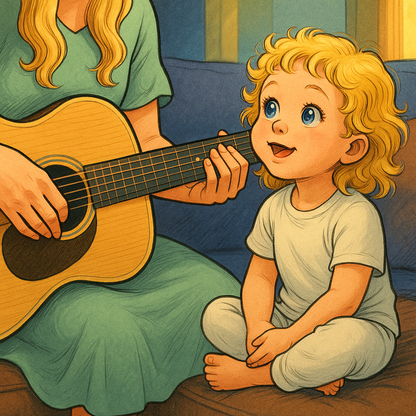
They appeared in the doorway—Miracle flushed and breathless, tugging at her mother’s arm; Glenda holding a well-loved acoustic guitar, its surface darkened by years of use. The pickguard was scratched, and a few stickers decorated the body—little faded stars and hearts, one peeled halfway off. It looked broken in and well-cared for. It looked right.
“Found this lady in the closet,” Glenda said, crossing the room. “She’s still in tune—mostly. Needs a fresh set of strings, but you’ll manage.”
Jennifer reached out, reverent, as Glenda gently placed the guitar into her arms.
The moment it touched her, something settled.
The wood was warm from Glenda’s hands, and the weight familiar in a way that felt like coming home. Jennifer adjusted the strap, tucked it over her shoulder, and ran her fingers along the strings, her thumb brushing the neck as if greeting an old friend.
Miracle dropped beside her, bouncing in anticipation. “You gon’ play Cowboy Ted’s song now? The one I sing’d?”
Jennifer gave a slow, gentle nod. “I sure am. But I’ll need you to sing it again, baby. Help me remember the words.”
Miracle needed no further encouragement. She straightened up and clasped her hands, her face serious with purpose.
Jennifer strummed once, lightly. The sound was warm, a little tinny from the age of the strings, but pure. Her fingers moved without thinking, forming a G chord, then sliding into C, then back again. Easy. Like breathing.
As Miracle sang, Jennifer began to weave a melody beneath her words. Something simple, lilting, with a little country lilt in its bones. A tune that could hold a rocking chair rhythm, or sway gently on the back of a slow pony. She matched the beat to the cadence of Miracle’s voice—gentle, hopeful, earnest.
“Cowboy Ted, don’t cry no more/
Rosie’s here, she close da door…”
Jennifer added a few harmonic flourishes between lines, letting the chords bloom and fade, her touch feather-light.
“You don’t gotta ride alone…”
A pause. A strum like footsteps in dust.
“This your heart… this your home.”
Miracle’s voice trembled at the end, then faded into a smile, looking up at Jennifer with awe.
Jennifer plucked one final soft chord, then let the silence linger.
They looked at each other for a moment, not speaking. Then Miracle leaned her head against Jennifer’s arm.
“I think Cowboy Ted liked it,” she whispered.
Jennifer blinked hard, but smiled. “I think so too.”
From across the room, Glenda watched with arms folded and a soft look on her face. “That was real sweet.”
Jennifer laughed, low and quiet. “Oh it was mostly down to my singing partner.”
“Well,” Glenda said, “sometimes the right song just needs the right little cowgirl to bring it out.”
Miracle grinned proudly, and Jennifer leaned down to press a kiss to the top of her head.