
Chapter Text
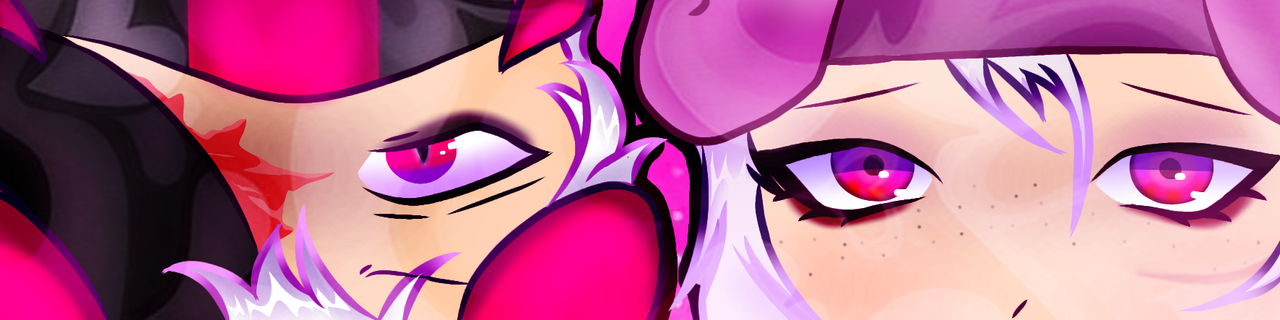
The forest no longer answered her.
It still moved the way it always had, dense and breathing, leaves shifting in slow waves through thick, humid air that clung to everything it touched. Vines coiled and uncoiled along unseen rhythms beneath the canopy of leaves, roots threading through soil like veins in something vast and sleeping. But when Vinestaff reached for it, when she let her wooden arm sink into the earth and tried to feel that familiar pull of life answering life, there was only hessitation. The response came late, dull, and uneven.
She stayed kneeling for a moment longer than she needed to, her fingers half-buried in soil that should have welcomed her. Normally, there would have been immediacy–plants bending toward her presence, roots shifting to accommodate her touch, growth responding like instinct. Instead, there was distance… delay. A resistance she could feel even without fully understanding it. When she finally pulled her arm back, dirt fell away in slow clumps, and the faint glow of the flower embedded in her staff flickered weaker than it should have.
It hadn’t always been like this. The forest had never been kind, not truly, but it had been responsive. It had acknowledged her existence in its own strange way, acknowledging her influence even when it didn’t care for her survival. Now it felt indifferent. Not hostile, not gentle–just absent in a way that made her feel like something had quietly stepped back from her and decided not to return.
Vinestaff rose slowly, brushing dirt from the edge of a grey, worn shirt that wasn’t really hers in any meaningful sense anymore. It hung loose and torn in places, scavenged from somewhere she didn’t remember, just like most things she kept now. Her boots were still intact, the pink laces slightly faded but stubbornly tied, and her socks–soft pink, mismatched with everything else she wore–peeked out above the leather. Small things… familiar things. Things that stayed with her even when everything else didn’t.
The forest around her had begun to feel thinner in more ways than one. Food was harder to find, growth less predictable, even the dangerous inphernal-eating plants that once felt like predictable hazards now behaved as if they had forgotten their own patterns. She had adapted, of course. That was what she did. But adaptation only worked when the world still gave you something to adapt to, and lately, everything felt like it was slipping just slightly out of her reach.
Her gaze lowered to her wooden arm, dark and segmented, the grain shifting subtly beneath the surface as she flexed her fingers. It was still hers, still part of her, but even it felt quieter than it used to, like the connection between her and the things she once controlled so easily had grown thin. She had used to think of it as an extension of her will. Now it sometimes felt like she was asking something else entirely to cooperate.
The thought came without ceremony, without emotional eruption or dramatic realization, just a quiet acknowledgement that had been forming for longer than she wanted to admit: there was nothing left for her here. No waiting presence. No return that would happen if she simply stayed long enough. Even the idea of Shuriken or Slingshot, names that once carried weight, had faded into something distant and unreal, as if they were memories belonging to someone else’s life rather than her own.
So when she finally spoke, her voice was soft and almost uncertain, as if testing whether the sound itself still belonged to her. She said she should go, and the forest did not respond, and that absence was an answer in itself.
Leaving did not feel like a dramatic break so much as a slow stepping away from something that had already stopped accepting her. She followed the thinning edge of the trees where the undergrowth became less dense, where roots stopped tangling so tightly beneath her feet. The deeper she went, the more the world shifted in ways she couldn’t immediately name. The air grew more frigid, the vegetation less familiar, and the subtle sense of connection she had always relied on grew weaker until it was more memory than sensation.
At first, she tried to reach for it anyway. It was instinct. Her wooden fingers brushed against unfamiliar plants, attempting to coax them into movement the way she always had, but the response was sluggish and muted, like she was speaking to something that understood the shape of her language but not its meaning. Eventually she stopped trying so hard, watching instead, learning the environment through sight rather than feeling, which felt almost unnatural to her in a way she couldn’t quite explain.
It was only when she found the first piece of metal half-buried in the ground that she realized how much everything had changed. It was cold, smooth in places, corroded in others, and entirely lifeless in a way that felt almost offensive compared to the living chaos she had grown up in. More fragments appeared as she continued forward– broken structures, scattered remnants of something built rather than grown, the land itself beginning to feel less like wilderness and more like something shaped by a sharp intention she didn’t understand.
By the time she saw the structures on the horizon, she had already begun to feel the weight of exhaustion deeper in her body, not just physical but something more internal, the environment itself was subtly refusing to support her. Massive shapes rose in the distance, dark and angular against the sky, too straight and deliberate to belong to anything she had ever known. She slowed without meaning to, staring at them as her steps faltered slightly.
“What is that..” she whispered, though no answer came.
She moved toward them anyway.
Subspace noticed the irregularity before he ever saw her.
The readings were wrong in a way that didn’t align with any known environmental fluctuation in the sector, and that alone was enough to pull his attention away from the controlled movement of Biografts across the perimeter. He stood still at the edge of Blackrock’s outer systems, interface light reflecting faintly off the surface of his mask as he adjusted his scan parameters, narrowing in on the anomaly. Organic, but unstable. Present, but not accounted for. Something alive that should not have been there in that configuration.
When he finally saw her, the conclusion came instantly, though not entirely in words. She did not belong to this environment in any capacity that made sense. Her presence alone contradicted the patterns of the region. The tattered clothing, the unevenly filed horns, the way she moved with caution rather than understanding..it all marked her as something displaced, something that had crossed boundaries it did not gain permission to. But it was her arm that held his attention longest, the wooden structure integrated into her body in a way that defied standard classification, not mechanical, not purely biological in any known sense, something that made his sharp analysis pause for just a fraction longer than it should have.
He stepped forward..
Her reaction was immediate but not decisive, a hesitation rather than a retreat. She looked at him as if trying to place what she was seeing into a framework she didn’t have, uncertainty tightening her grip on the staff in her hand. Subspace observed that too, the lack of recognition, the absence of contextual understanding. She wasn’t simply lost- she was wandering without intention.
“You are not from this region,” he said finally, voice even, precise, lacking any unnecessary inflection.
“No..” she answered after a pause that suggested she wasn’t entirely sure how much that mattered.
“Obviously,” he replied without emphasis, as if correcting a variable rather than engaging in conversation. His attention drifted back to her arm again, lingering in a way that made his interest unmistakable. “Explain that.”
“My arm?-..”
“Yes.”
“It’s mine,” she said, then hesitated, adding more quietly, “A curse-...”
That detail landed more heavily than her tone suggested. Subspace was silent for a moment, not because he lacked response, but because he was already restructuring his understanding of what he was seeing. When he spoke again, it was not with hesitation but with conclusion. She would not survive here alone. That much was certain. The environment alone would eventually reject her presence, if she did not collapse under it first.
“I will provide shelter,” he said simply, as though offering a condition rather than assistance. “In exchange, you will assist me.”
Her confusion was visible, but exhaustion outweighed it. Whatever questions she might have had were either too numerous or too irrelevant compared to the immediate problem of survival. After a moment, she agreed.
Subspace did not change his expression. He simply turned and began to walk.
She followed.
And as Blackrock closed around them, all structure and silence and distant mechanical hum, Vinesttaff left the forest behind without looking back, stepping into a world that did not recognize her as anything at all.
In his peripheral vision, Subspace glanced once more at the.. anomaly beside him, already thinking not in terms of rescue, but in terms of observation.
Promising.