
Chapter Text
The argument at dinner is about Anthony because it is always about Anthony.
Colin cannot recall what started it this time, only that his eldest brother's voice has taken on that particular tone, the one that makes the water feel ten degrees colder. Something about responsibility. Something about duty. Something about the Bridgerton name and what it means to carry it. Colin has heard this lecture so many times that he could recite it backwards, could mouth the words along with Anthony if he wanted to, but he does not want to. He wants to be anywhere but here.
Across the coral table, Eloise catches his eye. She raises one brow, a question and an invitation to trouble both, and Colin feels the corner of his mouth twitch in response.
"Colin."
His mother's voice cuts through the fog of his distraction. Violet Bridgerton is watching him with that look she reserves for her children when they are physically present but have wandered somewhere else entirely. Colin sees it quite often.
"Yes?"
"You have not touched your kelp."
"I am not hungry."
"You are always hungry."
This is true. Colin cannot argue with facts. But today the food sits heavy in his stomach, or perhaps it is the weight of everything else pressing down on him. The walls of the dining hall feel too close, the voices of his siblings too loud, the expectations of his family too suffocating. He has no title to inherit, no talent to cultivate. He is simply Colin, and sometimes he wonders if that is enough.
Anthony is still talking. Benedict has begun sketching something on a piece of seaweed, his attention elsewhere. Daphne is attempting to mediate, her voice soft and diplomatic, while Eloise has given up entirely and is now examining her nails with exaggerated boredom. Francesca sits in silence, as she often does, and the younger ones have been excused to their rooms.
Colin pushes back from the table.
"Where are you going?" Anthony demands.
"Out."
"Out where?"
"Just out."
Anthony starts to press further, but Violet places a hand on his arm, and the protest dies unspoken. Colin does not wait for another interruption. He turns and begins to swim toward the archway, his tail cutting through the water with a speed that betrays his eagerness to escape.
Behind him, Eloise singsongs, "Tell Penelope I said hello."
Anthony's mouth thins, but he says nothing. He gave up that particular argument years ago.
*
The swim to the surface takes longer than it should.
Colin is not in a hurry, not exactly, but he is aware of the way anticipation builds in his chest the closer he gets to the boundary between worlds. The water grows warmer as he ascends, the pressure easing, the light shifting from the deep blue of the depths to something brighter, more golden. He can feel the sun even before he breaks the surface, the warmth of it calling to him the way it always does.
His kind do not surface often. The old stories say it invites trouble—human nets, human curiosity, human cruelty. Anthony reminds him of this regularly. Colin has never cared, and this is the part of his day he looks forward to most. Not the formal dinners, not the family gatherings, not the endless discussions of politics and alliances and which noble family might make a suitable match for which Bridgerton sibling. This: the slow ascent toward the light. The knowledge of what waits for him above.
Who waits for him above.
The tide has pulled back today, exposing a stretch of sand that is usually submerged and the large flat rock that marks the boundary of their meeting place. Colin surfaces in the shallows and takes a moment to let his eyes adjust to the brightness. The sky is a pale blue, streaked with wisps of cloud, and the air carries the scent of salt and something else, something green and alive that he has come to associate with the human world.
He sees her before she sees him.
Penelope Featherington sits on the sand with her back against the rock, a book open in her lap. Her hair has come loose from whatever arrangement she attempted this morning, red curls escaping to frame her face and catch the light. She is frowning at the page, her brow furrowed in concentration, and her lips move slightly as she reads. She does this sometimes, mouths the words when she thinks no one is watching, and Colin finds it endlessly charming. She would be mortified if she knew he noticed.
He notices everything about her. He always has.
The thought drifts through his mind without examination, a fact as unremarkable as the colour of the sea or the rhythm of the tides. Penelope is his friend. Penelope is important. These are truths as fundamental to his existence as breathing, though he supposes breathing is not quite the right comparison given his current situation. She is also the only human who knows what he is. More than that—she is the only person, human or otherwise, who knows who he is. The restlessness he cannot name. The hunger for something he cannot define. The way he feels like a visitor in his own life, always watching from the edges, never quite belonging.
Eloise found her first, years ago, but Colin is the one who kept coming back.
He watches her for a moment longer, noticing the details without understanding why he feels compelled to do so. The way her shoulders curve inward as she reads. The way she tucks one foot beneath her, bare toes peeking out from under the hem of her dress. The way her fingers grip the book, slightly too tight, as if she is afraid someone might take it from her.
She looks peaceful. She looks like herself—even in a yellow dress her mother forces her into, and he knows she hates, but he has always found her quite lovely in.
Colin cannot help the smile stretching across his mouth as he hauls himself onto the rock.
The sound of him emerging from the water makes Penelope startle, her head snapping up, and for one brief moment, her face is entirely unguarded. There is joy there, plain and unfiltered, before she has time to arrange her features into something more composed. She told him once that that is what society expects of her. What her mother expects of her. Which is a pity, he thinks. Penelope is so pretty when she smiles.
"You are late," she says.
He grins. "I am fashionably delayed."
"That is not an expression.”
"I have said it. Therefore, it is.”
Penelope rolls her eyes, but the corners of her mouth betray her. "Your arrogance knows no bounds."
"One of my many charms."
He stretches out on the rock, letting the sun warm his scales. The surface is smooth from years of tidal erosion, heated by the afternoon light, and he groans a little at the simple pleasure of it. Underwater, warmth is a relative concept. Up here, with the sun beating down and the breeze carrying the scent of wildflowers and gardenias from the shore, warmth is a revelation.
Penelope slowly makes her way fromfron the sand to the rock, tiptoeing in her bare feet in the water until she can climb next to him. Once she is settled, Colin closes his eyes and tips his head back, exhaling slowly. The tension that has been coiled in his chest since dinner begins to loosen, muscle by muscle, bone by bone. The voices of his family fade to a distant murmur, replaced by the gentle lap of waves against the rock and the rustle of pages as Penelope returns to her book.
"What are you reading?" he asks, opening one eye to find her watching him, though she quickly looks away when their gazes meet. Her cheeks pinken, and he watches, bemused, as her ears do too.
"Nothing of consequence."
"You always say that."
"Because it is always true."
Colin pushes himself up on his elbows, angling his head to catch a glimpse of the book's cover. Penelope presses it closer to her chest, which only makes him more curious.
"Is it scandalous?"
"No."
"Your blush suggests otherwise."
"My blush suggests nothing. It is merely warm today."
"Pen."
The nickname slips out without thought, familiar and fond, and he watches the way her expression softens at the sound of it. She holds out for another moment, her jaw set in defiance, before she sighs and holds up the book so he can see.
"The Mysteries of Udolpho," he reads aloud. "I do not know this one."
"It is a gothic novel. There are castles and villains and a great deal of fainting."
"It sounds dreadful."
"It is wonderful," she corrects, and there is a spark in her eyes now, the spark that appears whenever she talks about something she loves. "The heroine is ridiculous, and the plot is absurd, but the atmosphere is exquisite. You feel as though you are there, wandering through those dark corridors, waiting for something terrible to happen."
"And you enjoy that? Waiting for something terrible?"
Penelope considers the question. "I enjoy the anticipation. The knowing that something is coming, even if you cannot yet see its shape. It makes the ordinary moments feel charged with meaning."
Colin thinks about this. He thinks about the way he feels when he swims toward the surface, the way his heart beats faster the closer he gets to the light. The way the ordinary moments of his life underwater feel dull and colourless compared to the hours he has spent here, on this rock, with her.
"I believe I can comprehend that," he says quietly.
Penelope looks at him then, really looks at him, and there is something in her expression that he cannot quite read. It is gone before he can examine it, replaced by her usual wry amusement.
"Do not tell me you are developing a taste for gothic literature."
"I might be developing a taste for exquisite atmospheres."
"That is the most pretentious thing you have ever said."
"I learned from the best."
She laughs, the sound bright and unguarded, and Colin catches himself leaning closer without meaning to. He makes note of it absently, files it away with all the other small observations he collects about her. The sound of her laugh. The way she covers her mouth when it catches her by surprise. The way her whole face changes when she is happy, as though the sun has broken through the clouds.
"Tell me about your day," he murmurs, settling back against the rock.
Penelope's expression shifts, practised neutrality across her features. "It was quite ordinary. My mother was insufferable, as always. Prudence has taken up embroidery and somehow made it into a competitive sport. Philippa burned her finger on a candle and made such a fuss of it that the whole house has been walking on eggshells."
"And what about you?"
"I escaped to read my scandalous novel on the beach." She gestures at the rock, at the sand, at the shimmering line where water meets shore. "As you can see."
"A wise choice."
"It was the only choice that did not end in matricide."
Colin laughs. He shifts on the rock, adjusting his position so he can see her better, and the movement causes the sun to catch the scales of his tail. They shimmer in the light, iridescent blues and greens that have always struck him as rather garish but that Penelope once told him were beautiful. He did not think much about them after that.
"Mine was none too different. My mother wishes to know why I do not eat," he offers. "Anthony wishes to know why I cannot be more serious. Benedict wishes to know nothing at all, which is why he is my favourite."
"I thought Eloise was your favourite."
"Eloise is my favourite sister. Benedict is my favourite brother. They are different categories."
"Ah. I see." Penelope closes her book, keeping one finger between the pages to mark her place. "And where do I rank in this elaborate system?"
The question is light, teasing, the kind of question that expects a light, teasing answer. Colin opens his mouth to provide one. A joke about her being in a category of her own. Something charming and meaningless that will make her roll her eyes and move the conversation forward.
What comes out instead is: "You are my favourite person."
The words hang in the air between them, heavier than he intended. Penelope blinks at him, her lips parting slightly, and for one long moment, neither of them speaks.
Colin is unsure as to why he said it, and why he said it so easily, but it is true, he realises. It is undeniably true. Yet, that does not explain why he felt compelled to say it aloud. He scrambles to soften the admission, to turn it into something safer.
"After my mother, of course. And perhaps Eloise on certain days. And there is a merchant in the northern reef who sells exceptional kelp cakes, so he might also—"
"Colin."
"Yes?"
Penelope is smiling at him, but it is small and tight, and does not quite reach her eyes. "Thank you," she says simply. "You are my favourite person, too."
He grins at her. His chest does something odd, a kind of catch, but he is already talking again before he can notice it properly. "Well," he says slowly, settling back against the rock once more, "now that we have established our mutual superiority to all other living creatures, perhaps you can read to me from your dreadful Gothic novel."
"You mean wonderful," she corrects automatically. "And no. You would only mock it."
"I would never."
"You would absolutely mock it. You mock everything."
"Only the things that deserve it."
Penelope huffs and opens her book again, but she angles it toward him slightly, just enough that he can see the pages if he cranes his neck. He does not crane his neck. He watches her instead, watches the way her eyes move across the lines of text, the way her expression shifts with the story she is reading.
The sun begins its slow descent toward the horizon, painting the sky in shades of blues and reds. Colin knows he should return before dark, before his absence becomes cause for concern, but he cannot bring himself to move. Not yet. Not when the warmth is so pleasant and the company so comfortable and the world above the water so much brighter than the one below.
He closes his eyes and lets the sound of the waves wash over him. Beside him, Penelope reads to him softly.

*
The sky has deepened to pure violet when he hears the voice.
"Penelope? Are you down here?"
He feels the shift immediately, hears Penelope’s book snap shut, and before Colin can fully register the change, she is on her feet. She scans the path that winds down from the cliffs, her jaw tight, her shoulders drawn up toward her ears.
"Who is that?" he asks quietly.
"My cousin," she whispers without looking at him, her voice barely carrying. "Marina. She has been staying with us since the spring. She has suffered a loss, and she is… not herself,” she tells him, moving toward the waterline, lifting her skirts so she can wade into the water, positioning herself between him and whoever is approaching.
"Penelope!"
The voice is closer now, accompanied by footsteps on the rocky path. Colin does not wait for Penelope to tell him. He slides off the rock and into the shallows, the water closing around him. The cold is a relief after the warmth of the sun-heated stone, and he sinks low, letting the waves lap at his chest. From here, his tail is hidden.
Penelope glances back at him, a quick flicker of her eyes, and then she turns away and raises her hand in greeting.
"Over here, Marina."
A figure rounds the bend and comes into view, and Colin’s first thought is that she is beautiful. Striking even. She is tall and waif-like, her unruly dark curls pulled back from her face in a knotted plait. Her dress is pale, almost white, with yellow flowers dotted on the hems, and the contrast against her dark skin sets her aglow. She is beautiful, certainly, but it is not her beauty that holds his attention.
It is the way she looks at the sea.
She has stopped walking. Her gaze has drifted past Penelope, past him, toward the horizon where the last of the light bleeds into the water.
"There you are." Marina's voice is low, distracted. She pulls her attention back to Penelope with visible effort. "Your mother sent me to fetch you. She says supper will not wait."
"She says that every evening, and yet it always waits." Penelope's tone is light. Her posture is not. "I was merely reading. I lost track of the hour."
"So I see."
Marina glances at the rock, at the sand, at the book tucked under Penelope's arm. Her gaze drifts toward the water. Toward him. There is a brief flicker of surprise as her gaze lands on him, then nothing. Her expression settles back into that distant sadness, as though he is merely part of the scenery.
"I did not realise you had company," Marina says.
"Hardly company." Penelope waves a hand dismissively. "A local. That is all. He swims here most evenings. We do not—we do not speak."
Marina nods, accepting this explanation without interest. She has already looked away, her gaze returning to the horizon. The light is fading rapidly now, the sun half-swallowed by the sea, and she watches it sink as he watches her.
He should not speak. He knows this. Penelope has placed herself between them for safety’s sake, and he should respect the effort, respect her. His kind learned long ago to keep their distance from the world above. The elders speak of a time before, when mer-folk and humans shared the shorelines freely, when love crossed the boundary between sea and land as easily as the tide. But humans are not built for mystery. What they do not understand, they come to fear. What they fear, they seek to destroy. The stories passed down through generations are full of nets and harpoons, of mer-folk dragged onto beaches and left to die in the sun, of children taken from their mothers to be displayed in landlocked tanks like exotic fish.
Now, the mer-folk keep to the deep. They surface rarely, and never where human eyes might find them. To be seen is to court disaster. To be known is to be hunted.
Penelope is different. Penelope has always been different. She found Eloise tangled in a fishing net when they were both children, half-drowned and terrified, and instead of screaming, instead of running, she had cut the ropes with a knife from her pocket and helped Eloise back into the water. She has kept their secret for years. She has never once betrayed them.
But Penelope is singular. Penelope is the exception that proves the rule.
This woman is a stranger.
The wise thing would be to stay silent, to let Penelope manage the encounter, to remain unremarkable. To be nothing more than a man swimming in the shallows on a warm evening. Forgettable. Safe.
But she looks so terribly sad.
He watches her gaze drift back to the horizon, to whatever she has lost there, and he feels it in his own body—a sympathetic ache, a pull beneath his ribs. He does not know her. And yet he wants to surface fully, to walk out of the water and stand beside her, to ask what the sea has taken from her and whether he might help her carry the weight of its absence.
He cannot do any of these things. His tail anchors him to the shallows, to secrecy, to the world below.
Yet—
"Good evening," he says.
Marina's attention shifts to him. For a moment, she truly looks at him, and Colin feels the weight of her gaze like a physical thing. Her eyes are dark, and deep, and full of a me he does not understand but desperately wants to.
"Good evening," she replies. Her voice catches on the words, just slightly, and Colin wonders when she last slept. When she last smiled. When she last felt anything other than this quiet devastation she is carrying so openly.
"The sea is rather fine this evening," he offers. It is an absurd thing to say. He does not care.
Marina's mouth curves, but it is a ghost of a smile. "The sea is cruel," she says. "It takes and does not give back."
The words are spoken not to him, but to the horizon, to the water, to whatever he believes she has lost that keeps drawing her gaze towards the place where the sky meets the waves. And yet, the desire to help her overwhelms him.
"We should go," Penelope says. Her voice sounds strange. Flat. "Before Mama sends out a search party."
Marina nods, already turning toward the path. She does not look at Colin again. She does not say goodbye. She simply walks away, her pale dress fading into the gathering dark.
Penelope lingers, her weight shifting back and forth on her heels as she chews her cheek.
"Tomorrow, then? At the usual time?"
Colin drags his attention back to her. She is already different, with her shoulders drawn in and her spine straightened. The girl who laughs at gothic novels has been folded away into someone smaller. This is the Penelope who walks among humans. He has seen her do this before, this quiet disappearing, but he has never thought to ask why.
"I would not miss it."
Penelope nods. She opens her mouth as though she might say something more, then closes it. Turns. Follows the woman up the path and does not look back.
Colin stays in the water until the stars emerge. The tide pulls at him gently, urging him home, but he cannot bring himself to leave.
*
Of all his siblings, it is Eloise who understands.
They discovered this about each other young, before Penelope, before the surface became a habit. Colin was the first to break the boundary, the first to feel the sun on his face and the air in his lungs and know he would never be content solely with the depths again. He told no one except Eloise, because even then, even as children, she was the only one who would not think him mad.
And he was correct, she did not think him mad. She demanded he take her with him.
They surfaced together for months after that, exploring the shoreline, collecting human trinkets, inventing stories about the world above. Colin still remembers the day Eloise brought Penelope to their rock, triumphant and defiant, announcing that she had found them a human and they were going to keep her.
They did keep her. Or, perhaps, she kept them.
Eloise still surfaces, but less often now. She has found other rebellions—books that scandalise their mother, opinions that infuriate Anthony, causes that the mer-court finds unseemly. Colin has only this. The shore, the rock, the girl who waits for him with a book in her lap and a sharpness in her tongue that makes him feel known.
Still, when he has something he cannot hold inside, it is Eloise he seeks. He finds her now in her chambers, sprawled across a chaise with a book propped against her tail. She does not look up when he enters, merely waves a hand in his general direction.
"Go away. I am at a very important part."
Colin ignores this. He swims past her, circles the room once, twice, then throws himself onto the settee opposite with enough force to send a small current rippling through the water.
Eloise sighs and lowers her book. "What?"
"I have met someone."
"You meet people constantly. It is one of your more irritating qualities."
"This is different."
Eloise raises an eyebrow. She sets the book aside with exaggerated care, folding her hands in her lap expectantly. "Proceed."
Colin does not know where to begin. He has been composing this speech the entire swim home, arranging the words in his head so he did not talk too much, but now that he is here, now that Eloise is watching him with that familiar mix of amusement and impatience, the words scatter.
"She is beautiful," he starts dreamily.
"They usually are."
"No, you do not understand. She is—" He stops. Tries again. "I have never seen anyone like her. She has this sadness about her, this weight she carries, and when she looked at the sea, Eloise, it was as though she were waiting for something. Or someone. And I know it sounds absurd, but I felt—I felt as though I understood her. As though I could help her."
Eloise's expression does not change. "You felt this after speaking with her for how long, exactly?"
"That is not the point."
"That is entirely the point. Colin, you cannot simply—"
"She said the sea was cruel." He is not listening. He cannot stop. "That it takes and does not give back. And I thought, what if I could be the one to give something back? What if I could be the reason she stops looking at the horizon like that?"
Eloise stares at him for a long moment. Then she laughs, her whole body shaking with the movement and the sound not at all kind.
"You are ridiculous," she gasps between bouts of it. "You are aware of this, yes? You have spoken to this woman for less than a minute. You do not know her name, her family, her circumstances. You know nothing about her except that she is sad and beautiful, and somehow you have convinced yourself that you are destined to save her."
"That is not—"
"It is exactly what you have done. I know you, Colin. I have watched you fall in love with every pretty thing that crosses your path since we were children. This is no different."
"It is different."
"How?"
He opens his mouth. Closes it. The truth is, he does not know how to explain it. He only knows that when Marina looked at him, when her gaze met his for that single, fleeting moment, he felt a tug inside his chest. He does not have words for it, not ones that Eloise would accept, so he says the only thing he can think of.
"I want to go to her."
Eloise's smile fades. "What do you mean?"
"I want to be with her. On land. As a human. I think—I think I could help her.”
The silence that follows is deafening. Eloise stares at him, and for the first time, her expression holds no mockery.
Finally, she scoffs. "Colin, surely you jest.”
"I do not.”
"Colin." She sits up, her tail curling beneath her. "Do you understand what you are saying? To become human, there is only one way. There is only Charlotte."
"I know."
"Charlotte does not give gifts. She makes deals. And her prices—"
Colin huffs. "I know what they say about her prices, Eloise."
"Then you know that you may be gambling with something precious. Something you cannot name until it is already gone." Eloise's voice has lost its sharpness. "Please. Whatever you are feeling, it will pass. It always passes. Do not do something foolish because a pretty stranger looked sad on a beach."
Colin shakes his head. "You do not understand."
"Then help me understand."
But he cannot. He does not have the language for the restlessness that has plagued him his entire life, for the sense that he is meant for something more. He does not know how to explain that Marina's grief called to him in a way nothing else ever has, that for the first time in his life, he sees a purpose within reach.
"I am going to speak with Charlotte," he says quietly. "I need to know what she would ask."
"Colin—"
"Just to ask. Nothing more."
Eloise starts to argue, but before she can speak, the door to her chambers swings open.
Anthony fills the doorway. "You were seen."
His voice is low, tight with fury. Colin feels his spine stiffen automatically.
"Anthony—"
"Do not." Anthony swims into the room, and the water seems to chill in his wake. "I have just come from a conversation with Lord Ashford, who happened to mention that his daughter spotted a merman in the shallows near the Featherington shore when she surfaced briefly today. A merman who was speaking with humans. Tell me, Colin, how many mer-folk do you imagine frequent that particular stretch of coast?"
Colin says nothing.
"I have tolerated your friendship with the Featherington girl," Anthony continues. "Against my better judgment, I have allowed it because Mother asked me to, because Eloise swore she could be trusted, because you gave me your word that you would be careful. And now I learn that you have been surfacing where anyone might see? That you have been conversing with strangers?"
"It was one person. One conversation."
"One is enough. One is all it takes for the wrong person to see, for word to spread, for hunters to come looking. Do you not understand this? Do you not care?"
"Of course I care—"
"You do not." Anthony's voice rises. "You never have. You float through life without a thought for consequence, without a care for anyone but yourself. You have no responsibilities. You have no duties. You contribute nothing to this family, and yet you demand the freedom to endanger us all."
The words land like harpoons, each one finding its mark. Colin feels his jaw clench, his hands curl into fists at his sides.
"You are not Father," he says quietly. "Stop pretending you are."
Anthony goes very still. The water between them seems to thicken. Colin knows he has struck a nerve. He also knows he does not care.
"No," Anthony says finally. His voice has dropped, gone cold in a way that is somehow worse than the shouting. "I am not Father. But I know what he would think if he could see you now. Reckless. Selfish. Chasing after humans like a lovesick fool while your family suffers for your carelessness."
"Anthony." Eloise's voice cuts in, sharp with warning. "That is enough."
Anthony ignores her. "Father would be so disappointed in you." His eyes remain fixed on Colin, dark and furious. "You have spent your entire life waiting for something to happen to you. Waiting for meaning to find you. And now you have convinced yourself that some sad human girl you have barely even met is your destiny because it is easier than admitting you have none."
The words hang in the water between them, and a fissure runs through whatever patience Colin has left. Anger and panic rise in his throat, propel him to flee—
"Colin." His mother's voice now, soft and urgent. He had not heard her enter, but she is there, hovering in the doorway, her face pale with concern. "Colin, whatever this is, we can discuss it. Please. Just stay and talk to us."
He looks at her. At Anthony, still rigid with fury. At Eloise, who has gone grey with fear and is shaking her head in tiny, frantic movements.
"There is nothing to discuss," he says.
And then he is rushing past them, out of Eloise's chambers, down the corridor, towards his own chambers. He moves by memory, pulling the satchel from its hook by the door—worn leather, salt-stained, full of human trinkets he has collected over the years. He does not know why he takes it. He only knows he cannot risk leaving it behind.
He hears Eloise call his name, hears his mother’s voice, high and frightened, hears Anthony’s Yes, Colin, run, you are quite good at that but he does not answer any of them. He just keeps swimming.
*
The water grows colder as he descends.
Colin has heard stories about the deep places. Every mer-child has. The elders speak of the trenches the way humans write of haunted woods in those books Penelope reads to him—places where the light does not reach, where the pressure can crush bone, where things live that have forgotten what the sun looks like. Sensible mer-folk do not go there. Sensible mer-folk stay in the shallows, the reefs, the comfortable middle depths where the water is warm and the dangers are known.
Alas, Colin has never been particularly sensible.
He can feel it as he swims downward, the prickling at the back of his neck and the weight settling in his stomach. The water this deep is different, thick and cold, tasting of bitter minerals. He keeps swimming, and swimming, his lungs resisting the pressure as the light fades by degrees the deeper he travels.
The thought arises suddenly, in Anthony’s voice, that he should turn back.
He keeps swimming.
And then, without warning, the darkness ends.
Light blooms ahead of him, warm and golden, so unexpected that he stops mid-stroke. It spills from an opening in the rock face, flickering like firelight. Gone is the bitter taste of minerals, and instead, he tastes warm sweetness. It pulls at him gently, a current that wants him to follow, and he does. It feels wrong immediately, because he knows nothing in the deep should glow like a hearth fire, but it beckons him, and he swims towards it anyway.
The passage opens into a cavern, and the sight before him is completely unexpected. He had imagined something dark and terrible, perhaps bones and shadows composing the lair of a monster. What he finds instead is a palace.
The walls are crusted with gold. Not flecks of it, but sheets of hammered gold that catch the bioluminescent light and throw it back tenfold. Pearls the size of his fist are set into the stone in spiralling patterns. Gemstones glitter from every surface, rubies and sapphires and things he has no name for, colours that do not exist in his world above. Chandeliers of salvaged crystal hang from the ceiling, human glass repurposed into something alien and beautiful. A throne of carved coral dominates the far wall, its arms shaped like reaching hands, its back like the spread of a fin.
Treasures are displayed everywhere. A ship's figurehead, her painted face still smiling. Chests spilling coins and chains. Bolts of rotting silk that must once have been magnificent. A collection of human shoes arranged on a shelf, inexplicable and meticulous.
It is breathtaking.
"You are late."
The voice comes from everywhere and nowhere. Colin spins, searching, and finds her watching him from the throne. It is unclear how he missed her, for she is not small and not at all hiding. She is simply so still that his eyes must have slid past her, but now that he sees her, he cannot look away.
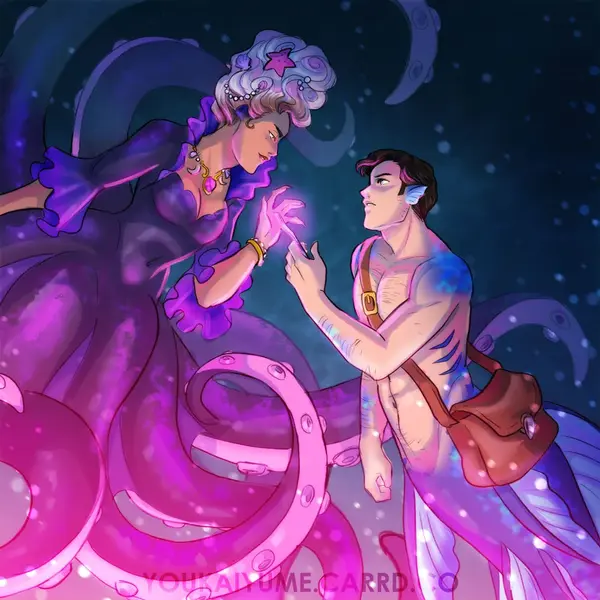
Colin has heard the tales, of course. They date back centuries, or so he has been told, and he knows Charlotte is old, though her face is smooth and her eyes are bright. Her hair is silver and piled elaborately atop her head, threaded with strings of pearls. She wears gold at her throat, her wrists, her fingers, and her tentacles are dark, nearly black, the skin so fine it looks like velvet fanning out beneath her in every direction, draping over the throne and across the floor like the train of a gown that never stops moving. She looks like a queen. She also, he notes, looks like something that eats queens.
"I—I was not aware I was expected," Colin stutters.
"Were you not?" Charlotte's mouth curls at the corners. "A Bridgerton boy, swimming toward my domain in a fury, clutching his little bag of treasures.” She shakes her shoulders as if she is absolutely delighted. “I felt you coming from a league away. The water carries intention, child, and yours was loud enough to wake the dead."
Alarmed, Colin clutches the satchel tighter against his side.
"Come closer," Charlotte says. "I do not bite… Well, not without reason."
Slowly, he swims forward, though every instinct tells him to flee, and Charlotte watches his approach with the patient interest of someone examining a snailfish.
"Sit," she says, gesturing to a smaller seat before her throne. It is made of bone, he realises. Whale bone, perhaps, or something older. He sits anyway.
"Now." Charlotte leans back, her fingers steepled beneath her chin. "Tell me what it is you want."
It startles him, her lack of preamble. So rarely is he met with the opportunity to simply state what he means or his desire. In a family of eight children and one living parent, so much of his time is spent calculating his wants against those of others, softening his desire to fit the ideals he attempts to fit into.
"I want to be human," he says simply, quietly, although the words are steadier than he feels.
Charlotte does not react. She simply watches him, her expression unchanged, waiting for more.
"There is a woman," Colin continues. "On land. She is—she has suffered some great loss. I can see it in her. And I want to help her. I want to be with her."
Charlotte inspects the very long, pointy fingernails on her left hand. "How noble.”
"It is not about nobility—"
"It is always about nobility, with your kind." Charlotte waves a hand, dismissive. "You see a pretty face twisted by melancholy, and you think: I could fix that. I could be the one to make her smile again. You do not ask whether she wants to be fixed. You do not consider that her feelings belong to her. You simply decide that you are the answer to a question she never asked."
Anthony’s words, bright and ugly, rear in his mind’s eye on a continuous loop. He shakes his head to rid himself of them. Begins to speak—
"No matter," Charlotte continues. "Your reasons are your own. I do not require noble intentions, only clear ones. You wish to be human. You wish to walk on land, to breathe air, to court this sad woman of yours. Yes?"
"Well, I—Yes."
"And you are aware, are you not, that such transformations do not come freely?"
His mouth opens, and again, he hesitates. He has heard the stories of Mer-folk who sought out Charlotte and returned changed in ways they had not anticipated. Mer-folk who did not return at all. The details vary with each telling, but the shape of the warning is always the same: Charlotte gives you what you ask for, and takes something you did not know you were offering.
"I understand," he says, though his voice shakes along the edges.
"Do you?" Charlotte leans forward, just slightly. "There is still time to leave, child. To swim back to your family. No one would fault you for it. Caution is not cowardice… even if it is rather pedantic."
For a moment, he wavers. He closes his eyes and sees the rock, sun-warmed and familiar. He sees Penelope with her book, her red hair catching the light. He sees the life he is about to leave behind. He opens them and hears Anthony once more.
"I understand," he says again, steadier now. "I wish to proceed."
A single, perfectly arched eyebrow raises for a beat, just before Charlotte settles back. "Very well," she says at last. "I will give you what you ask. Legs instead of a tail. Lungs that breathe air instead of water. A human form, complete in every way."
Colin feels his heart lift. "Thank you —"
"I am not finished."
His mouth snaps shut.
"I will allow you three days to receive true love’s kiss," Charlotte says. "You seem quite confident, so it shall be more than enough time to woo your lady, if you are clever about it. Time enough to fail, if you are not."
Colin clears his throat. "And if I succeed?"
"If you succeed, you will live out the rest of your days with your love."
Colin nods. "And if I fail?"
Charlotte's smile widens. "If you fail, if you do not receive true love’s kiss by the sunset on the third day, you return to the sea. Your legs will become tail once more, your lungs will remember water, and you will be as you were."
"That does not seem so terrible."
"I was not finished." Charlotte's voice does not change, but the pressure of the water surrounding them does. "If you fail, I will collect on your debt whenever and however I deem appropriate, with no limits to the collection.”
Colin frowns. "I do not know the cost of my ask beforehand?”
"No." Charlotte examines her fingernails, as though his fate is of no more consequence than a bit of sediment beneath them. "You do not."
"That hardly seems fair."
"Fair." Charlotte laughs, and the sound is not kind. "You come to me seeking transformation, seeking love and purpose, and yet you wish to haggle over terms? Tell me, boy, is there a cost to true love?"
The rebuttal dies on his tongue, his mind whirling with Anthony's voice, cold and cutting: You have spent your entire life waiting for meaning to find you.
What is the cost of finally finding it?
"I accept your terms," he says quietly.
Charlotte's smile widens, and there is something ancient in it, something that has watched a thousand foolish young mer-folk make this same choice and has never once been surprised by the outcome.
"Then we will come to the matter of payment." She extends her hand, palm up. "I require something precious. Something tied to who you are. The thing you would miss most."
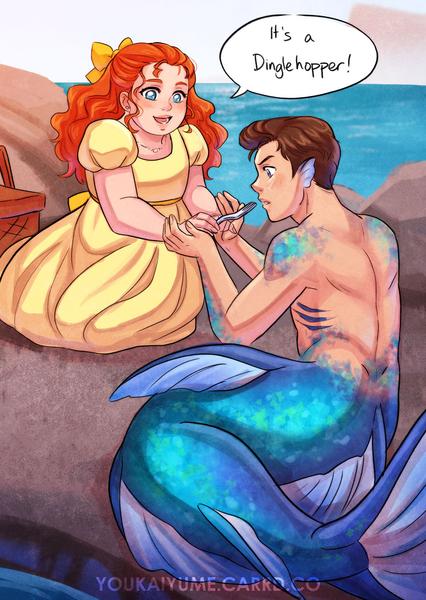
Colin reaches for the satchel at his hip. His fingers move past shells and sea glass, a tarnished button, a scrap of ribbon. All the small human things he has gathered over the years. And there, at the bottom, where it always is, his most prized possession of all. He cannot remember when he started carrying it. He only knows that Penelope gave it to him years ago, laughing as she explained what it was for. Humans use these to eat, she had said. He had thought it absurd—a tiny trident for spearing food when one could just use their hands—and she had shown him how to hold it, her tiny fingers folding around his, and when he fumbled the metal she laughed, and the laugh seared itself into his memory.
He does not know why he kept it. He only knows that he always has.
Tentatively, he holds it out to Charlotte. She takes it, turns it over in her long fingers. Her brow arches once more. “This is your most prized possession?” Colin nods. "And what is this, child?"
"A dinglehopper."
Charlotte's mouth curves. For a moment, her composure cracks into what looks almost like genuine delight.
"A dinglehopper," she repeats, clearly savouring the word. "How charming. Do you know what it is actually called?"
"It is a human tool. For eating."
"A fork, child. Humans call it a fork." She examines the tarnished prongs, the worn handle. "And who gave you this precious dinglehopper?"
"A friend."
"A friend." Charlotte's smile does not fade, but the delight in her eyes shifts into something predatory. "I do hope your obliviousness continues to be a joy to you, and not your downfall."
Colin begins to ask what she means, but before he can speak, Charlotte closes her hand around the fork.
"This will do."
The words are simple and the finality of them settles between Colin’s gills, though he cannot say why. He has given her a fork. A silly human trinket. It should not feel like he has given her anything at all. And yet his hand feels empty in a way it should not. He thinks of Penelope pressing it into his palm all those years ago, her fingers small and warm, her laughter bright. He thinks of how he has carried it ever since without ever asking himself why, and he thinks, for just a mere moment, that perhaps he should not give this piece of himself away, but Charlotte’s voice cuts through his thoughts.
"Now," Charlotte says, rising from her throne. She is taller than he realised, her tentacles unfurling beneath her like dark silk. "Shall we begin?"
Colin nods. He does not trust his voice.
Charlotte circles him slowly, appraising. "This will not be pleasant," she says, almost conversationally. "The body does not like to be remade. It will fight. You will want to scream. I suggest you do not—water in the lungs is unpleasant even for those who can breathe it."
"I understand."
"No," Charlotte says. "You do not. But you will."
She reaches for him, and Colin's whole body goes rigid. This is the last moment. The final threshold. Once she touches him, there is no going back. He will be changed, or he will be dead, and either way, he will not be himself anymore.
Stop, a voice whispers that sounds like Penelope’s. Stop, please, think about what you are doing—
Charlotte's hand closes on his shoulder. Her touch is cold, colder than the water, colder than anything he has felt in his life. The cold spreads from her fingers down through his scales, into his bones. Colin gasps, tries to pull away, but his body will not obey him.
"Hush," Charlotte murmurs. "It is only pain. Pain ends."
The cold becomes heat. The heat becomes fire. Colin feels his tail splitting, feels the scales tearing away, feels his bones reshaping themselves into configurations they were never meant to hold. His mouth parts to scream, and water rushes in, and he cannot breathe, he cannot breathe, he cannot—
Darkness.
When it clears, the world is different.
Colin floats in the water, but he is no longer part of it. His lungs burn. His chest spasms. He needs air, he realises frantically, looking down to find legs where his tail used to be. Two of them, pale and strange, ending in feet he does not know how to use.
“Best run along," Charlotte says. She has settled back onto her throne, watching him with distant amusement. "The surface is that way. I suggest you swim quickly. Humans are not meant to hold their breath for long."
Colin kicks. The motion is clumsy, inefficient, nothing like the powerful strokes of his tail. But it moves him upward, toward the light, toward the air his new lungs are screaming for.
🧜♂️ 🔱 🧜♂️
Colin breaks the surface, gasping. Air floods his lungs sharply, and for a moment, all he can do is float there, choking on the very thing his body now requires. The sky above him is pale in the early morning. He does not remember the swim. He does not remember anything after the darkness except the desperate, instinctive need to reach the light.
His legs hang beneath him, useless. He kicks and he kicks and he kicks, the motion moving him toward the shore, toward the stretch of sand he knows better than any other place in either world. Out of the corner of his eye, he catches sight of the rock, their rock. The tide is low, exposing the flat surface where he has spent so many afternoons with Penelope. He drags himself toward it, arms aching, legs trailing behind him like dead weight. When his hands finally touch sand, he nearly weeps with relief.
He has no other choice but to crawl, his new limbs refusing to cooperate, folding and buckling beneath him as he hauls himself out of the water. The sand is cold against his bare skin, and he realises, distantly, that he is naked. Charlotte did not see fit to provide clothing along with his transformation because, of course, she did not. Why would she? With exhaustion, he collapses against the base of the rock, his chest heaving as he stares up at the brightening sky.
He has legs. He is human. He is—
"You absolute fool."
The voice comes from the water. Colin turns his head, sand grinding against his cheek, and finds Eloise watching him from the shallows. Her tail flicks beneath the surface, agitated, and her expression holds no warmth at all.
"Eloise." His voice comes out rasped, scraped raw. "What are you—"
"I came to warn Penelope." Eloise swims closer, stopping where the water grows too shallow to hide her tail. "I thought perhaps she should know what you have done before she stumbles upon the consequences. But I see I am too late."
Colin pushes himself up onto his elbows. The movement is harder than it should be, his body strange and uncooperative. "How did you know I would be here?"
"Where else would you go?" Eloise's mouth twists. "You know nothing of the human world except this beach and the girl who waits for you on it. Of course, you came here, you imbecile."
She is right. He has no argument to offer and, quite honestly, he is too tired to make one anyway.
"I went to Charlotte," Eloise continues. "After you left. I wanted to know what you had given her."
Colin's stomach drops. "Eloise—"
"She was delighted to tell me. She found it very amusing." Eloise's voice is flat, but her eyes are bright with both fury and fear. "A dinglehopper, she said. Given to you by a friend."
"It is just a human trinket—”
"It is not just a trinket." Eloise's tail slaps the water, sending spray across the sand. "Do you understand nothing about how Charlotte's magic works?! I have read every account of Charlotte's deals I could find, Colin. Every record in the archives, every elder's testimony. She does not trade in objects. She trades in connections. In meaning. The trinket was a tether."
"A tether to what?"
"To whom," Eloise snaps, and Colin watches the fury drain from her face, replaced solely by fear. "The fork was a tether to Penelope. If you fail, if you do not receive true love's kiss by the end of the third day, she forgets you. She forgets everything about you, about us, about her life!”
For a moment, Colin does not understand. The words are sounds without shape, syllables that refuse to cohere. And then they do, and suddenly his new skin feels too tight and too hot, his insides too hollow.
"No." The word comes out before he can stop it. "No, that cannot—Charlotte said I would return to the sea. She said I would be as I was."
"You will be as you were. Penelope will not." Eloise's voice cracks. "You wagered her memories on a woman you met for thirty seconds. You gave away the most precious thing you had, and you did not even know it."
Colin attempts to explain, to say that he did not understand, that Charlotte tricked him, that he never would have agreed if he had known. But the words never fully form, because Eloise is right. He gave Charlotte the dinglehopper because it was the thing he would miss most. He did not ask himself why. Did not wonder what made a tarnished fork more precious than the shells in his satchel, the sea glass, the button he found on a shipwreck and kept for no reason. He simply reached into the bag, and his hand found the fork the way it always does, the way it has for years, and he handed it over without a single question because it is important to him, because Penelope is important to him, because he likes to carry it close to him, like he has had their friendship since the day they met.
The memory circles over and over: Penelope laughing, her small fingers folding around his, showing him how to hold it properly. Penelope, who is the only person in any world who knows who he truly is. Penelope, whom he has just handed to a sea witch in exchange for a pair of legs and a chance to save a woman he does not know. She will forget him. Forget their rock, their afternoons, the years of their friendship. She will look at him and see a stranger, and it will be his fault, because he is reckless and stupid, just like Anthony has always said—
Unless—
"I have to find Marina." He tries to stand, and his legs buckle immediately, sending him sprawling back onto the sand. "I have to—I have three days. Charlotte said three days."
"Less than that now." Eloise watches him struggle with no move to help.
Less than three days to make a woman fall in love with him. A woman he does not even know, and if he cannot, Penelope will look at him and see a stranger, and he will lose the truest thing in his life.
"I cannot do this alone." Colin grabs at the rock, trying to pull himself upright. His arms shake with the effort. "I do not know how to walk. I do not know how to dress. I do not know anything about the human world beyond what Penelope has told me."
"Then I suggest you learn quickly."
"Eloise, please—"
"I cannot help you." Her voice breaks on the words. "I cannot walk on land, Colin! I cannot follow you into her world! The only person who can help you now is the very person you are about to destroy."
The cruelty of it settles into his chest. He needs Penelope to help him win another woman's heart. And every moment she spends helping him is another moment she does not know what he has wagered.
Footsteps on the path.
Colin's head snaps up. Eloise sinks lower in the water, only her eyes visible above the surface.
A figure rounds the bend, red hair catching the early light, a book tucked under one arm. Penelope is walking quickly, her skirts gathered in her free hand, and her expression is the one she wears when she is escaping something. Colin has seen it before. He has never thought to ask what she is escaping from.
She stops when she sees him.
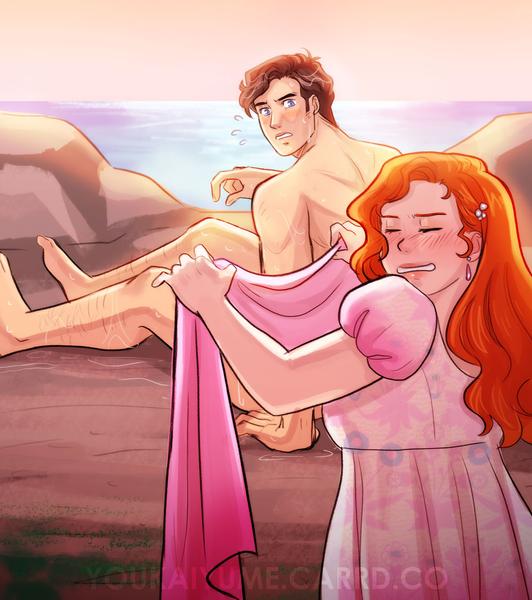
For a long moment, no one speaks. Penelope stares at him, at his bare legs stretched out on the sand, at his chest heaving with exertion, at the obvious absence of his tail. Her lips part. Her book slips from under her arm and lands in the sand with a soft thud.
"Colin?"
"Penelope." His voice comes out strangled. "I can explain."
"You have legs."
"Yes." He looks down at them, still unnerved by the sight. Two pale, ungainly limbs where his tail should be, and between them— "Penelope, what is— there is something—"
Penelope looks at him. Looks down. Her face goes crimson and she looks away very quickly.
"I see Charlotte's generosity did not extend to trousers."
"What are trousers? Penelope, is this meant to be here? It does not seem—"
"Stop talking." Penelope unties her shawl with fingers that are not quite steady and holds it out to him, her gaze fixed firmly on the horizon. "Put this around your— around yourself. We will address the rest once I can look at you without wanting to drown myself."
Colin takes the shawl and arranges it over the mysterious anatomy, which at least stops Penelope from looking like she might burst into flames.
"Is it dangerous?" he asks.
"Only to my sanity." Penelope presses a hand to her forehead. "How do you have legs, Colin? Start from the beginning. And do not— do not gesture at anything while you explain."
"I made a deal with Charlotte."
The colour drains from Penelope's face. "What kind of deal?"
Eloise surfaces slightly, drawing Penelope's attention. "He traded his tail for a chance at true love's kiss. If he succeeds, he remains human. If he fails, he returns to the sea."
"That seems—" Penelope swallows. "That seems like quite a hasty desicion."
"It is," Eloise agrees tiredly. "Made greater by the fact that he cannot walk, cannot dress, and cannot navigate your world without assistance."
Penelope looks at Colin. He looks back at her, aware suddenly of how pathetic he must appear. Naked on the sand, unable to stand, begging for help with his eyes because his mouth cannot seem to form the words.
"True love's kiss," Penelope says slowly. "With whom?"
Colin forces himself to meet her gaze. "Marina.” He swallows. “Your cousin."
“Yes,” Penelope snaps, “I am well aware of who she is.” She presses her mouth into a thin line and schools her expression as she brushes off her skirts. “I see.”
"Penelope—"
"You wish to court my cousin." She bends to retrieve her book, brushing sand from its cover with precise, controlled movements. "You have given up your tail, your world, your family, in order to court a woman you have spoken to once."
"It is not—I know how it sounds—"
"Do you?" She straightens, and her composure is perfect now, every trace of shock smoothed away. She looks like she does when her mother is watching. Small and contained and nothing like herself. "It sounds as though you have made a very foolish decision for reasons you cannot articulate, and now you require my help to see it through."
Colin has no response to this. It is, after all, precisely what has happened.
"Will you help me?"
The question hangs between them. Penelope looks at him, and for a moment, he sees past the careful mask to the girl who laughs at gothic novels, who reads with her lips moving, who once told him he was her favourite person. There is hurt there, buried deep, and he does not understand where it comes from.
"Yes," she says finally. "I will help you."
The relief that floods through him is so intense it borders on pain, and with it, surprise. For she said yes so quickly, as though she had already decided before he asked. As though she would always say yes to him, no matter what he asked of her, and that specific thought sits uncomfortably in his chest for a moment before he pushes it aside because he does not have time to lollygag, to parse the texture of Penelope’s kindness. He has three days, or he loses her forever.
"Thank you. Penelope, I—"
"Do not thank me." She moves toward him, setting her book on the rock, and offers her hand. “For what else am I to do? Allow you to fail?”
He takes her hand. Her fingers are small and warm, and when she pulls, he staggers upright on shaking legs. The world tilts. He grabs at her shoulder to steady himself, and she braces against his weight, solid and patient.
"First step," she says. "We find you clothing. I will not have you walking naked through the village."
"I—” he feels his skin heat, looks down to see an unfamiliar redness paint itself across his chest. “I do not know how to walk."
"Then you will learn." She adjusts her grip, sliding her arm around his waist to support him. "One step at a time. Start with the right foot."
He tries. His leg swings forward, ungainly, and his weight shifts wrong, and he stumbles against her. She catches him. Holds him steady.
"Again," she says.
He tries again.
In the shallows, Eloise watches them. Colin glances toward her, and their eyes meet across the sand.
"I will cover for you," Eloise says quietly. "With Anthony. With Mother. For as long as I can."
"Eloise—"
"Do not thank me either." Her voice is sharp. "I am not doing this for you.”
Colin nods. He does not trust his voice.
"Three days," Eloise says. "Do not waste them."
She holds his gaze for a moment longer. Then she sinks beneath the surface, her tail flashing once in the morning light before disappearing entirely.
Colin stands on the beach, Penelope's arm around his waist, his legs trembling beneath him. The sun is rising. The day is beginning. Somewhere beyond the cliffs, Marina waits for a man she does not know she is supposed to love.
And Penelope looks toward the path that leads up from the beach, toward the life she will return to, and Colin sees the weariness in her expression before she smooths it away.
"Make haste," she says. "We have work to do."
She does not look back at the sea.
*
The path from the beach is longer than Colin imagined. He has swum past these cliffs a thousand times, watching humans traverse the narrow trail that winds up from the shore. It never looked difficult. It was a gentle slope, a few switchbacks, nothing that should require much effort. But that was before he had legs, and legs, he is discovering, are fundamentally unreliable.
As they walk, Penelope keeps her arm around his waist, her shoulder braced beneath his. She is far smaller than he by at least a head, and yet she bears his weight without complaint, adjusting her grip each time he stumbles. Which is quite often, as his feet do not seem to understand that they are meant to work in coordination with each other and instead tangle and catch, refusing to land where he tells them to.
"Left foot," Penelope instructs. "Then right. It is not complicated."
"It is, in all honesty, extremely complicated."
She huffs. "Children manage it."
"Children have had years of practice." He lurches sideways, grabbing at a rock to steady himself, and nearly takes them both down. Penelope makes a sound of half-exasperation, half barely suppressed laughter.
They rest twice before they reach the top. Colin's legs are shaking by the time the path levels out, his muscles burning with a fatigue he has never experienced. In the water, he could swim for hours without tiring. Here, a short walk has reduced him to trembling.
"Not much farther," Penelope says, though her breathing has gone ragged from the effort of supporting him. "There is an outbuilding near the edge of the property. The groundskeeper used it before he died. No one goes there now."
"How reassuring. A haunted cottage."
She huffs out a laugh. "It is not haunted. Mr Hendricks was a very dull man. I cannot imagine his ghost would be any more interesting."
"And yet you propose to hide me there."
"Would you prefer the main house?" She tilts her head up to look at him, and there is a familiar spark in her eyes that endears her to him so very much. "I am sure my mother would be delighted to meet a naked man who cannot walk or speak properly. She might even find you a suitable match for one of my sisters."
Colin shudders. "The cottage. Definitely the cottage."
"Wise choice."
*
The outbuilding is small and weathered, tucked behind a stand of overgrown hedges. Penelope shoulders the door open and helps him inside. It is dim and dusty, furnished with a narrow cot, a wooden chair, and a table that has seen better decades. Cobwebs lace the corners, and it smells, Colin thinks, like rotting wood.
"Wait here," Penelope says, lowering him onto the cot. "I will find you clothes."
"Where will you—"
But she is already gone, the door swinging shut behind her.
Colin sits in the silence and looks down at his legs. They are pale and strange, covered in fine hair he does not remember asking for. His feet are bizarre, the toes too small and too many, and between his legs— He has tried not to think about it. The anatomy is deeply confusing. He prods at it experimentally and then decides, firmly, not to do that again.
He misses his tail. His tail made sense. His tail did not require constant management. And it did not cost Penelope her memories.
The thought arrives unbidden, sharp-edged. He is sitting in a dead man's cottage with legs he cannot use, waiting for a woman to bring him a dead man's clothes, and if he fails—if he cannot make Marina love him in three days—Penelope will forget everything. She will forget him.
He cannot fail. He will not fail.
The door opens, and Penelope slips back inside, her arms full of fabric. She dumps the pile on the table and begins sorting through it.
"These were my father's," she says, not looking at him. "My mother still has not brought it upon herself to get rid of his belongings.”
Colin remembers. He remembers Penelope at the water's edge the summer her father died, her eyes red-rimmed and her silences longer than usual. He had floated beside her for hours without speaking, simply content keeping her company while the tide came in and went out again.
"I remember," he says quietly. "You came to the rock every day. You did not want to talk. You just wanted to sit."
Penelope’s hands pause on the fabric. "And you stayed anyway."
"Of course, I did."
Something crosses her face, there and gone. She returns to sorting. "He was not a very nice man. Foolish with money, careless with us. And yet…" She trails off, holding up a pair of breeches, eyeing them critically. "These should fit. You are of a similar height."
She tosses them to him, the linen hitting him square in the face. Colin catches them and stares.
"You put your legs through the holes," Penelope says. "One leg per hole."
"I understand the concept."
"Do you?” She tilts her head to the side. “Because you are holding them upside down."
He is, in fact, holding them upside down. He rights them and attempts to stand. His legs buckle. He sits back down.
"Perhaps," Pen says carefully, "you should remain seated for this."
It takes him four attempts to get the breeches on. The fabric is stiff and unfamiliar, and his legs refuse to cooperate. He gets one foot through and then cannot find the other hole. He gets both feet through and then cannot pull the waistband up because he is sitting on it. By the time he finally manages it, he is sweating, and Penelope has turned to face the wall, her shoulders shaking.
“Penelope Anne!” he admonishes in mock seriousness. "You are laughing at me."
"I am not."
"I can see your shoulders!"
"I am thinking of something amusing. It is entirely unrelated. I assure you, Colin."
The shirt is easier, but the buttons are not. They are small and slippery, and his fingers are too large for the delicate work of pushing them through the holes. Eventually, Penelope takes pity on him and crosses the room, still not quite meeting his eyes.
"Hold still," she murmurs.
Her fingers are quick and efficient, working up the line of buttons without hesitation. Colin watches the top of her head, the way her hair curls at her temples, the furrow of concentration between her brows. She smells of something clean and bright. Ink, perhaps. Paper? The particular scent of someone who spends a great deal of time with books, with a hint of citrus. She smells, he realises, exactly how he always imagined she would, and it is startling to realise he has imagined such things.
"There." She steps back. "Now the cravat."
"The what?"
She holds up a length of white fabric. "This goes around your neck."
"Why?"
"Because it is fashionable."
"It looks as though it would strangle me."
She smirks. “I will be careful not to tie it too tightly.”
The cravat defeats them both. Penelope tries three different knots, each one collapsing into a shapeless lump the moment she releases it. Colin's neck is apparently the wrong shape for human fashion—at least that is what she tells him in a genuine huff. In the end, she ties it in a simple bow and declares it good enough.
"You look… almost respectable," she says, studying him. "If one does not examine you too closely."
"Your flattery overwhelms me,” he quips.
"I am here to help, not to flatter." She pulls the chair over and sits across from him. "Now. Walking. You must be able to cross a room without falling before I can introduce you to anyone."
They practice for an hour. Back and forth across the small cottage, Penelope’s hand on his arm, her voice steady with instruction. Heel first, then toe. Keep your weight centred. Do not look at your feet; it makes you unsteady. Colin falls twice, catches himself on the wall once, and knocks over the chair four times. But by the end, he can manage a reasonable approximation of walking. It is not graceful. It would not fool anyone watching closely. But it is walking.
"Good," Penelope says, then pauses before continuing, "Well, perhaps it is…good enough." She disappears again and returns with a tray covered by a cloth. "You need to eat. I suspect you have never had human food before."
She sets the tray on the table and removes the cloth, and all Colin can do is stare. He has seen humans eat from a distance, watched them bring food to their mouths, and sigh in contentment, but he has never understood the appeal. Mer-folk eat kelp and fish and the occasional unlucky crab. Food is sustenance, not pleasure. But this—this looks like pleasure. There is something golden-crusted and soft, steaming faintly. Beside it, a pale yellow wedge that glistens in the warmth. Something pink and shiny that smells rich and savoury in a way that makes his mouth water without his permission. And a round red thing, smooth-skinned and impossible, like nothing he has ever seen beneath the waves.
"What is all of this?" he asks.
"Bread. Cheese. Ham. An apple." She gestures to each in turn. "Human food. You will need to eat if you wish to have any energy at all."
"It smells..." He finds that his mouth is watering, his stomach rumbling. "It smells as though I need to put it in my mouth immediately."
"That is the general idea, yes," Penelope says through laughter.
Next to the plate is a piece of cloth, folded inside it a familiar item, with tarnished prongs and a slim handle. Colin picks it up, his fingers a bit clumsy as they grasp. "You told me this was called a dinglehopper."
Penelope's mouth twitches. "Did I?"
"You did. You were very insistent." He narrows his eyes at her playfully. "Were you mocking me, Pen?”
Her cheeks tint the most pretty shade of pink. “I was merely… educating you. It is not my fault you were a willing student." She presses the fork into his hand. "Now. Use it properly, or I shall tell you the spoon is called a flibbertigibbet and watch you embarrass yourself at dinner."
"Penelope!” he gasps in mock offence. “What a barb."
She shrugs a shoulder. "I contain multitudes."
Colin does not take the fork. He reaches for the bread, tears off a chunk, and shoves it into his mouth. And moans. The bread is warm and soft and slightly sweet, and it dissolves on his tongue like nothing he has ever tasted. He swallows and immediately tears off another piece. And another. The bread vanishes in moments, and then he reaches for the cheese, and the cheese is sharp and creamy and makes his eyes water with how good it is, and Penelope is saying something, but he cannot hear her over the blood rushing in his ears because the meat! He must try the meat. He grabs it with both hands and bites into it, and it is rich and savoury and yields beneath his teeth in a way that kelp never has. Juice runs down his chin. He does not care. He cannot care. He is too busy chewing.
"Colin." Penelope's voice is somewhere far away. "Colin, that was meant to last you until morning."
He reaches for the fruit. She moves the tray out of his reach.
"You need to slow down. You are going to make yourself ill."
"More," he manages, still chewing.
"There is no more. That was all I could take without being noticed."
He swallows and looks at the empty tray. The bread is gone. The cheese is gone. The meat is a memory. Only the fruit remains, clutched protectively in Penelope's hands.
"I will share the apple with you," she says slowly, "if you promise to eat it with the fork."
"I do not need a fork. Give me the apple."
"Fork."
Colin takes the fork. His grip is wrong, and Penelope sighs and reaches over, her fingers folding around his to correct the angle. The touch sends a strange jolt through him, but before he can examine it, she is releasing him and cutting the apple into slices and placing one on the tines of his fork.
He eats the apple slice. It is sweet and tart and crisp, and he needs more immediately.
He eats all of the apple. Penelope watches him with an expression he cannot read.
"Well," she says sardonically. "At least you are not difficult to feed."
*
Colin is dying. He is lying on the cot, arms wrapped around his stomach as he makes sounds of profound distress. Something inside him has gone terribly, terribly wrong. His abdomen feels distended and angry, making noises he has never heard before.
"I am dying," he announces.
"You are not dying." Penelope is sitting in the chair, watching him with what he suspects is amusement poorly concealed as concern. He cannot be burdened with the effort of opening his eyes to look. "You are experiencing consequences to your actions."
"I am experiencing death."
"You ate an entire meal meant for four people in under ten minutes. What did you imagine would happen?"
He groans and rolls onto his side, wincing as his stomach protests the movement. Something bitter rises in the back of his throat. "Why did you not stop me?" he moans.
"I tried. Twice. You growled at me."
"I did not growl."
"You bared your teeth and pulled the cheese closer to your chest. That is absolutely the definition of a growl."
Colin wants to argue, but another wave of cramping steals his breath. He presses his face into the thin pillow and moans again. Loudly.
"The worst will pass within the hour," Penelope says, a softness in her voice now that was not there before. "Your body is not accustomed to this kind of food. You must learn to eat slowly. In small amounts. Like a civilised person."
"I am a civilised person."
"You ate cheese as if you were a feral cat, Colin.”
He moans again, his mind void of any retort because he can do nothing but lie there, miserable, while she moves about the cottage. He hears her tidying, hears the scrape of the chair, hears her settle somewhere nearby. When he opens his eyes, she is sitting on the floor beside the cot, her back against the wall, a book in her lap.
"You do not have to stay," he manages.
"I know." She turns a page. "I am choosing to."
He watches her read. Her lips move slightly as her eyes track across the page. A curl has escaped her pins and hangs against her cheek, and the late afternoon light catches the red in her hair and turns it to fire, and the last thing he thinks about before his mind goes blank and he drifts off into sleep is how pretty a shade her hair is.
*
By evening, when Colin is able to stand without swaying and walk without clutching the furniture, and his stomach has somewhat settled, Penelope deems him fit for introduction.
"Remember," Penelope says quietly as they walk toward the main house, his arm looped through hers for stability. "You are the nephew of my mother's old school friend, Mrs Dorchester. You are making your way along the coast and require lodging. My mother arranged this weeks ago."
"Did she now?"
"Of course, she did not, but she will not remember that." Penelope stops suddenly, turning to face him as she reaches up to fiddle with the fabric at his throat. "Trust me."
The words are simple and practical, yet Colin finds himself looking down at her, at her fingers still fussing with the fabric at his throat, at the furrow of concentration between her brows, and feels his breath catch.
"I do," he says quietly. "I always have. With everything."
Penelope's hands go still. She looks up at him, and for a moment her careful composure cracks, revealing a rawness beneath that surprises him. Her lips part, and her breath catches too, and Colin watches the flush climb from her throat to her cheeks, watches her eyes search his face.
The moment stretches and stretches, and he is aware he should say something, should look away, but he cannot bring himself to.
It is Penelope, then, who breaks first, stepping back and smoothing her hands down her skirts.
When she speaks again, her voice is almost too bright. "Yes. Well. That is—that is good. Trust is important." She clears her throat. "We should go. Mama does not like to be kept waiting."
She takes his arm and pulls him forward, and Colin lets himself be led with a flutter in his belly.
The Featherington house is larger than Colin expected. It looms against the evening sky, red brick with ivy growing along the sides and perfectly manicured hedges. Penelope's grip on his arm tightens as they approach, and he glances down at her, noting immediately how different she looks the closer they meander towards her home. Her spine has straightened, and her chest has lifted, and suddenly her features have been smoothed into careful blankness. The Penelope he knows folded away into someone smaller and more contained.
The door opens before they reach it. A woman stands in the frame, her hair a shade or two of red darker than Penelope’s. Her expression is pinched with what Colin can already deduce is perpetual dissatisfaction. It reminds him instantly of Anthony.
"Penelope. You have been gone all day. And who is—" She stops, squinting at Colin. "Who is this?"
"Mama." Penelope's voice is sweet and elevated. "Surely you remember. Mr. Bridger. He is the nephew of your old friend Mrs Dorchester. You arranged for him to stay with us while he recovers from his carriage accident." She turns to Colin with wide, innocent eyes. "Was it not thoughtful of Mama to offer?"
Colin, catching on, nods gravely. "Most generous, Mrs Featherington. I am so deeply grateful for your generosity."
Mrs Featherington's mouth opens, closes, her eyes darting between them. "Mrs Dorchester," she repeats slowly.
"From your leading string days." Penelope tilts her head, her brow furrowing with gentle worry. "Mama, you do remember Mrs Dorchester? You spoke of her just last week. You said her nephew was coming to stay, and you hoped it would not inconvenience the household too greatly during Marina's season."
Mrs Featherington's face cycles through various emotions before settling upon careful neutrality. “Of course, I remember," she snaps. "I am not senile, Penelope."
"No, of course not." Penelope's voice is soothing. "Though I have read that women of a certain age sometimes experience small lapses. Something to do with the… change? Perhaps some seaweed in your tea? I understand it is very beneficial for the constitution."
Mrs Featherington's face goes an alarming shade of pink. "I do not need seaweed, Penelope."
"As you say, Mama." Penelope smiles. "Shall I show Mr Bridger to the blue room?"
"Yes. Fine. Do that." Mrs Featherington waves her hand dismissively, already retreating into the house. "And tell Cook we will have a guest for dinner. Apparently."
The door closes behind her. Colin stares at Penelope.
"Did you just—"
"Do not ask questions you do not wish to know the answers to." Penelope takes his arm and steers him inside. The entrance hall alone is larger than the entire cottage. "The blue room is on the second floor.
It takes them ten minutes to climb to the second floor, Colin gripping the bannister with white knuckles while Penelope murmurs encouragement. By the time they reach the blue room, his legs are shaking again.
"Rest," Penelope says, opening the door. "I will come for you before dinner. We dine at eight."
"Pen."
She pauses, half-turned toward the hall.
"Thank you. For all of this."
Her expression flickers. That same rawness he saw on the beach, there and gone before he can grasp it.
"Thank me when it is over, and you have what you wished for," she says quietly, and then she is gone.
*
The dining room is long and formal, dominated by a table that could seat twenty but holds only six tonight. Colin is seated between Penelope and one of her sisters, also with characteristic red hair a shade darker than Penelope's, who is cheerful, but whose name he has already forgotten. Across from him sits another sister, darker-haired and sullen. At the head of the table, Mrs Featherington presides very seriously.
And beside her, quiet and distant, is Marina. She gives no sign of recognising him from the cove, and Colin suspects the encounter meant so little to her that it barely registered at all. Which is no matter, he thinks, and probably for the best. She pushes food around her plate, nods when spoken to, and Colin finds himself drawn to her. Not because she is beautiful, although she is—Colin had nearly convinced himself otherwise, had wondered if his memory had exaggerated her—but because there is such a sadness about her. She does not look at him, does not look at anyone really, simply sits there, eating in small, mechanical bites, her gaze fixed on some middle distance.
Colin watches her, and watches her, and waits to feel what he felt on the beach. The pull. The certainty. The sense that he had finally found something worth reaching for.
It does not come.
"Mr Bridger." Mrs Featherington's voice cuts through his thoughts. "How is your dear aunt? Mrs Dorchester and I were such friends at school. I do hope she is well."
Colin freezes. He has no idea who Mrs Dorchester is, what she looks like, or whether she is alive or dead, or even real. He looks helplessly towards Penelope, who actively does not look back at him, but does nod her head in encouragement.
"She is... recovering," he says carefully.
"Recovering? From what?"
"A chill." He glances at Penelope for help. "A rather persistent one."
"She mentioned it in her letter," Penelope adds smoothly. "The one you received last month, Mama. You said it was most concerning."
Mrs Featherington's eyes narrow. "Yes. Well. I do hope she improves. And how long did I say you would be staying, Mr Bridger?"
"Just a few days, I believe."
"A few days,” Mrs Featherington repeats, her nose wrinkling almost imperceptibly. "How... generous of me."
"Might I trouble someone for the bread?" Penelope asks brightly and loudly, swiftly changing the topic.
The cheerful sister passes the basket. Penelope takes a roll and hands one to Colin with a pointed look that he does not know the meaning of. He takes the bread from her, his skin warming where their fingers touch. Beside the basket sits a small dish containing a pale-yellow substance, soft and glistening. He watches Penelope take a knife, spread some across her roll, and bite into it with evident satisfaction.
He does the same. The bread is good—he already knows this—but the topping transforms it into something transcendent. It is rich and creamy and melts on his tongue, coating the bread in a way that makes his eyes flutter closed.
"What is this?" he whispers urgently to Penelope.
"Butter."
"It is amazing."
He looks at the dish. There is so much of it, just sitting there, untouched. Clearly, no one else at this table understands what a treasure they possess. He picks up his fork, cuts off a generous chunk of the butter, and pops it directly into his mouth.
The table goes very quiet.
Penelope's hand lands on his arm, her grip firm. "It is for spreading," she murmurs through a fixed smile. "Not for eating."
Colin swallows the butter. It is, he must admit, somewhat overwhelming when consumed in that quantity. "I see,” he mutters, his ears and cheeks now red from the attention drawn to him. Beside him, Penelope’s eyes are bright with suppressed laughter, her smile kind, and he feels himself calm instantly.
Mrs Featherington clears her throat. "Mr Bridger. Do they not have butter in... wherever it is you are from?"
"We have butter," Colin says. "I simply... appreciate it more than most."
“Very well then,” Mrs Featherington drawls.
The rest of dinner passes in a blur of questions Colin cannot answer and social niceties he does not understand. He watches Penelope navigate the conversation with practised ease, deflecting her mother's sharper comments, filling the silences her sisters leave behind. She is good at this. She is good at making herself invisible while still keeping everything running smoothly.
He wonders if anyone has ever noticed. He wonders if anyone has ever thanked her. Likely not, he surmises.
After dinner, the party retires to an even larger room, and Colin finds himself standing near the window, uncertain of the protocol, watching Penelope’s sisters cluster around the pianoforte. Off to the side, Marina stands alone by the fireplace. Beside him, Penelope catches his line of sight and sighs. Then promptly shoves him away from her, muttering well go on then.
He stumbles a bit, but catches and rights himself before he is in front of Marina.
"Miss Thompson,” he greets, a bit flustered, and even more flustered as she turns and meets his eyes, and he braces himself for the pull he felt on the beach, the certainty that had propelled him to Charlotte's domain, and it does not arrive.
"Mr Bridger," she says, curtseying half-heartedly. Her gaze drifts past him, toward the window, toward the darkness beyond.
After several beats of awkward silence, he tries, "I hope dinner was not too tedious.”
"Dinner is always tedious." A ghost of a smile crosses her face. "Forgive me. That was unkind. The Featheringtons have been generous."
"And yet?"
She tilts her head, studying him as if trying to decide whether she should continue, and must decide affirmatively because she says, "And yet generosity given with expectation is its own kind of weight, and—” She pauses, frowning slightly. “Excuse me, Mr Bridger, you look rather familiar. Have we met before?”
Colin's heart leaps. She remembers. Some part of her remembers the beach, the sunset, the moment their eyes met across the sand. Perhaps the connection he felt was not entirely one-sided. Perhaps—
"I do not believe so," he says carefully. "I have only just arrived in the area."
Marina shakes her head, the frown clearing. "Strange. I could have sworn... No matter. The mind plays tricks when one is tired."
The hope collapses as quickly as it rose. She does not remember him. She felt nothing. He was simply a stranger in the shallows, and whatever spark he imagined was his alone.
He clears his throat. "Do you not sleep well?"
"I do not do anything well, Mr Bridger." The words are flat, automatic, almost, and Marina seems to hear them a moment after she speaks. She blinks, then offers him a thin smile. "Forgive me. I am poor company this evening… I am poor company most evenings, if I am honest."
"I do not mind poor company," Colin says gently. "I have been told I am quite poor company myself."
"I doubt that." She looks at him properly now, her dark eyes assessing. "You are not what I expected, Mr Bridger."
"What did you expect?"
"I do not know. Someone duller, perhaps. Mrs Featherington's guests usually are."
Colin laughs, surprised. "I shall take that as a compliment."
"You should. I do not give them freely." The ghost of her smile lingers, and she tilts her head, studying him curiously. "You know, I cannot decide if you are very clever or very foolish."
"Can I not be both?"
"I suppose you can." And there it is—the flicker of warmth, a crack in the careful composure. For just a moment, she looks like someone who used to laugh easily. "I think I rather like you, Mr Bridger. That does not happen often."
"Then I shall treasure it."
They talk, and to Colin's surprise, conversation with Marina is easy in a way he did not expect. She is sharp in a quiet way, her observations precise. She is not as clever or witty as Penelope, but she is pleasant company. She asks about his travels along the coast, and Colin fumbles through lies he has not had time to rehearse, and she catches him in at least two of them, but does not press, merely raises an eyebrow before moving along.
Throughout their conversation, she tells him of the book she has been reading, an essay on botanical illustration, and her eyes brighten as she describes the plants, the way the artist captured the curl of a petal, the exact gradation of colour where stem meets leaf. She speaks of a man who spent three years documenting every flower in a single county, who died before he could finish the second volume, and there is something in her voice when she says this that sounds almost like recognition. As though she understands, intimately, what it means to pour yourself into something you may never complete.
She is intelligent, and she appears kind. She is exactly the sort of woman Colin always imagined himself loving, the sort of woman he swam to Charlotte's domain to find, and yet when he searches for the pull he felt on the beach, the electric certainty that propelled him to trade his tail for legs, he cannot find it. His chest does not ache. His heart does not race. She is beautiful and interesting, and yet he feels nothing of note when he looks at her now.
It is the first day, he reminds himself, watching the firelight play across her features. Exhaustion and overwhelm, and a body that has only just learned to walk, plague him. Love does not arrive fully formed, after all. He simply needs more time.
"You have gone quiet, Mr Bridger."
Colin blinks. "Forgive me. It has been a long day."
"I imagine it has." Marina's gaze drifts toward the window. "I find long days are rather the speciality of this house."
"Are you not happy here?"
"Happiness is a strong word." She turns back to him, her expression now guarded. "I am grateful. That will have to suffice."
She excuses herself shortly after, drifting toward the window and the darkness beyond, and Colin watches her go with the hollow certainty that tomorrow must be different, that tomorrow the spark will catch, and the pull will return, and he will feel what he is supposed to feel.
Now, he only feels that pull across the room, towards Penelope. She stands near the door, half-hidden by a curtain, her face cast in shadow. When their eyes meet, she looks away, and his pulse stutters, just for a moment, and he does not understand why the sight of Penelope looking away affects him so profoundly, but before he can apply logic, or even second guess, she is slipping out of the room, and his new legs are carrying him towards her before he has even made the conscious choice to move.
Colin finds her in the hallway, leaning against the wall with her eyes closed, and for a breath, he simply watches her, taking in the way the tension sits in her shoulders, the way her hands are pressed flat against the wallpaper as though she needs something solid to hold her upright.
"Pen?"
She startles, straightens, and the mask slides back into place so quickly he might have imagined its absence.
"You should return to the drawing room," she says, her voice carefully light. "It will seem odd if you disappear."
Colin shakes his head. “Never mind that. Are you all right?"
"I am fine."
She is lying, he knows. Colin can see it in the set of her jaw, the tightness around her mouth, the way she will not quite meet his eyes. But he does not know how to ask, does not know what question might unlock whatever she is holding so carefully contained behind that composed exterior he is not accustomed to seeing.
"Marina is—" He stops, grasping for words that refuse to come to fill the silence. "Interesting. Intelligent. But I did not feel—" The sentence falters, unfinished, because he does not know how to name what he did not feel, only that its absence unsettles him.
"Did not feel what?"
"What I expected to feel." He shakes his head. "It does not matter. It is only the first day. These things take time."
Penelope's expression flickers for a beat before she averts her gaze, pressing her mouth into a thin line. "Yes," she says quietly. "I imagine they do."
There is something in her voice, some undercurrent he cannot quite parse, and before he can ask what it means, she is pushing off from the wall, smoothing her skirts with hands that he notes are not entirely steady.
"Get some rest," she says without looking at him. "Tomorrow will be long. You have much to learn. Much to do before you... Get your happily ever after, Colin."
She disappears around the corner, her footsteps fading into the depths of the house, and a moment later, Colin hears a door close somewhere far away.
He stands alone in the hallway, his new legs aching beneath him, his stomach still tender from its earlier rebellion. He thinks of Marina's sharp wit, her guarded smile, the way she caught him in his lies and chose not to press. And yet his mind keeps drifting back to this hallway. To Penelope's closed eyes. To the tension coiled in her shoulders as she hides whatever it is she refuses to let him see, and why it matters so much that she will not show him.
He returns to the blue room. He lies on the soft bed, sinking into the mattress, staring up at a ceiling he does not recognise, and tells himself that tomorrow will be different. Tomorrow the spark will catch. Tomorrow, everything will make sense.
He closes his eyes, exhaustion claiming him readily, and when he dreams, he dreams of the sea. Of the deep blue currents of his home. He dreams of Penelope reading on the rock, her hair catching the light, red and gold against the grey stone, and in the dream, she looks up at him and smiles.
*
Colin wakes in the morning to light filtering through the window, soft and grey hues as dawn begins to edge the sky. He rises and crosses to the window, watching the sun break the horizon. He has never seen this before—not like this. Underwater, sunrise is a distant brightening, a shift from black to blue. Here, it is colour. Impossible, vibrant colour. The sky bleeds from grey to pink to gold, and the light spills across the gardens and the rooftops and the distant line of the sea, and Colin stands there with his hand pressed to the glass and watches as the sun fully crests the horizon, turning the sky a copper that reminds him of Penelope’s hair.
Then he remembers why he is here, and the wonder fades into resolve as he thinks: Today.
Today must be the day.
He dresses himself this time, fumbling through the buttons with marginally more success than yesterday. The cravat remains a disaster, but he manages a knot that does not immediately collapse. When he examines himself in the small mirror above the washstand, he looks almost human. Almost passable. He smiles at his reflection with pride, then realises, quite instantly, that he will be able to see Penelope today with very little effort.
While searching the gardens for her, he finds Marina. She is walking the paths alone, adorning another pale dress as she ghosts between the hedgerows. Colin watches her for a moment before approaching, forcing a smile to stretch across his mouth as he braces for that pull, for that certainty.
"Miss Thompson."
She turns slowly, her expression polite. "Mr Bridger. You are up early."
"I am an early riser,” he shrugs. "Might I walk with you?"
Marina inclines her head in permission, and they fall into step together. The garden is well-kept, the paths lined with flowers Colin cannot name. He has never seen flowers like this before, not up close, and he finds himself stopping to take in the beauty surrounding him—much to Marina’s chagrin, it appears. He does not allow himself to do it again.
"Do you enjoy gardens?" he asks.
"I enjoy solitude." Marina glances at him, and there is a faint grimace on her features as she continues, "Present company excepted, I suppose."
"I shall—Well,” he trails off, laughing uncomfortably. “I shall endeavour to be unobtrusive, then."
"You are not particularly built for unobtrusiveness, Mr Bridger."
His eyes widen in surprise. "Is that a compliment or a criticism?"
"An observation." She bends to examine a bloom, her fingers hovering near the petals but not touching. "You have a presence. It enters a room before you do. Some people find that overwhelming."
"And you?"
"I find it interesting." She straightens, and her eyes meet his. "You are not what you seem."
Colin's chest tightens. For a moment, he is certain she knows what he is. That she can see the sea still clinging to him, the strangeness he cannot scrub away. "What do I seem?"
"Charming. Careless. The sort of man who has never wanted for anything." Marina resumes walking, and he follows, trying to parse whether he should be taking offence. "But there is something else, I think. You are looking for something, Mr Bridger, and you have not found it yet."
He does not know what to say to this. She is right, of course. She is more right than she knows. He thought he was looking for her, only now, as he exists alongside her during this quiet morning, he realises that is likely not the truth. For a while, they simply walk in silence, footsteps falling in tandem as Colin tries to notice things about her. The way she holds herself is straight-backed and contained. The graceful line of her neck. The intelligence in her eyes when she looks at him. She is beautiful and perceptive and exactly the sort of woman he should want.
He waits for the wanting to arrive.
It does not.
"There was someone," Marina says quietly after a particularly long bout of silence. "Before. A man I loved. His name is George, and I miss him very much."
Colin's attention sharpens. "What happened to him?"
"He was a sailor. His ship went down in a storm." Her voice does not waver, but something in her face closes. "They never found him. Sometimes I think that is the worst part. The not knowing. The endless possibility that he might still be out there, somewhere, waiting for me to find him."
He thinks, unbidden, of Penelope forgetting him. Of becoming unknown to her.
"I am—My deepest condolences.”
"Everyone is sorry." Marina stops walking. They have reached a stone bench at the edge of the garden, overlooking the sea. She does not sit. She simply stands there, staring at the water, and Colin watches her profile and thinks: she is still waiting for him. She will always be waiting for him.
"Do you think you will ever stop?" he asks.
"Stop what?"
"Waiting."
Marina turns to look at him. Her expression is gentle and sad and completely closed.
"No," she says. "I do not think I will."
She excuses herself shortly after. Colin watches her walk back toward the house, her pale dress disappearing between the hedges, and he feels nothing except a vague sympathy and the hollow certainty that he has been chasing the wrong thing.
But what else can he do? Penelope's memories hang in the balance. He has two days left. If Marina is not his true love, then who?
The sky this morning had been copper, he remembers. Copper and gold, bleeding across the horizon, and he had thought of Penelope's hair, had stood at the window with his hand pressed to the glass and thought of her, not of Marina, not of the woman he is supposed to love.
He does not know what that means, and does not have time to waste thinking about it, so he does what he always does: he pushes the thought aside and walks back toward the house, searching for Penelope.
He finds her with little effort, in the small parlour near the gardens. She is bent over a letter she is writing. She looks up when he enters, and her expression shifts through several things too quickly for him to track before settling into a small smile.
"You were with Marina this morning."
Colin nods. "I was."
"And?"
Colin lowers himself into the chair across from her. His legs still ache from yesterday's exertions, the muscles protesting movements they were never designed to make, but walking is surprisingly easy today.
"She is remarkable," he says. "Intelligent and perceptive. She saw right through me."
Penelope's pen stills on the paper. "Did she?"
"Not— not that.” Colin drops his voice as he says, “Not what I am. She simply said I was searching for something. That I had not found it yet."
"How astute of her."
There is an edge to Penelope's voice that Colin cannot discern. He watches her return to her letter, her quill scratching across the paper with more force than necessary.
"Pen, I—"
"We should practise your dancing today." She does not look up. "There is a small ball tomorrow evening. If you wish to court Marina properly, and…” she pauses, swallowing thickly, “Receive true love’s kiss, you will need to be able to waltz without maiming her."
"I do not maim."
"You stepped on my feet eleven times yesterday while simply walking across a room."
"I was learning!”
Penelope's mouth twitches, and for a moment she looks like herself again. Then the careful mask slides back into place, and she sets down her pen.
"The garden," she says. "One hour. Do not be late."
*
In the full light of day and in the presence of alternative company, the garden is different. Colin follows the path Penelope indicated, past the hedgerows and the flower beds, to a clearing surrounded by climbing roses. The sun is warm on his face, and the air is thick with something he has never experienced before—a vast array of new scents. Underwater, smell does not exist the way it does here, and the difference is astounding. There are traces of it in the water, ways of sensing things at a distance, but nothing like this. Nothing like the overwhelming sweetness pouring from the roses, layered with something sharper from the lavender borders, something green and fresh from the grass beneath his feet. He stops in the middle of the clearing and simply breathes, filling his lungs with it.
"You look like you have never seen a garden before."
Penelope has appeared at the edge of the clearing, watching him with raised brows.
"I have never smelled one." He gestures at a bush with dark green leaves and waxy white petals. "What is this one? It is — there is nothing like this below."
"Gardenia." Penelope’s expression softens. "They are my favourite."
Colin reaches out and plucks one of the blooms before he can think better of it. He brings it to his nose, and the scent hits him like a wave—sweet and heady and achingly familiar. He knows this smell. He has always known it, though he never had a name for it until now. It is Penelope's. It is every afternoon on the rock, every conversation, every moment she leaned close to show him something in her book. It is the scent of her hair when she buttons his shirt, the warmth of her skin when she corrects his grip on a fork. It is her, distilled into a single white flower, and the realisation staggers him.
He holds the bloom out to her without a word.
Penelope takes it, and their fingers brush, and Colin feels the contact like a jolt, a current that runs from his hand straight to his chest and settles there, warm and insistent. Her eyes meet his, and for a moment neither of them moves. The touch lingers longer than it should. He does not pull away. Neither does she, not until she tucks the flower behind her ear and looks away, her cheeks faintly pink.
"I forget, sometimes. How new everything must be for you. Take your time, Colin. Enjoy."
"It is overwhelming. Constantly." He turns in a slow circle, taking it all in, though his pulse is still unsteady. The colours. The textures. The way the light falls through the leaves and dapples the grass and the lines of her jaw. "Yesterday I ate cheese and nearly wept."
"Yesterday you ate cheese and then lay on a cot groaning for an hour."
"The two are not mutually exclusive."
Penelope laughs. It is quiet, almost reluctant, but it is real, and Colin feels it in his chest like a hook catching.
"Come here," she says, stepping into the clearing. "We have work to do."
She shows him the position. His right hand on her waist. Her left hand on his shoulder. Their free hands clasped and extended. They are close enough that he can see the freckles scattered across her nose, and he hates that he never knew they were there before. That he has never been able to be this close to her without a boundary of water between them.
"The waltz is simple," she says. "Three beats. One-two-three, one-two-three. You step forward on one, I step back. Then we rotate. Try not to think about your feet."
"What should I think about instead?"
"The music. The conversation. Your partner."
He is—well, he is already thinking about his partner, he realises. He also realises it is a bit of a problem.
They begin to move. Colin counts under his breath, trying to remember the pattern Penelope demonstrated. Forward, side, together. Forward, side, together. His hand presses against her waist, and he can feel the warmth of her through the thin fabric of her dress. She is guiding him gently, correcting his posture with small adjustments, and every touch sends a jolt through him that he does not know how to interpret.
"You are too tense," Penelope murmurs. "Relax your shoulders."
"I do not know how to relax my shoulders."
"Pretend you are floating."
He laughs despite himself. "Floating, I can do."
Something shifts. The tension in his body eases, and suddenly the movement makes sense. Forward, side, together. Rotate. Forward, side, together. He is dancing. He is actually dancing, and Penelope is in his arms, and the roses and gardenia are blooming around them, and the sun is warm, and for one perfect moment, everything is exactly right.
He steps on her foot.
"Ow!”
"Sorry. Sorry." He steadies her, his hand tightening reflexively on her waist. "Are you hurt?"
"I will survive." But she is smiling, her face tipped up toward his, and her eyes are bright with amusement. "You were doing so well."
"I was thinking too hard."
"You were thinking about your feet."
"I was thinking about—"
He stops, his mouth snapping shut, for he was not thinking about his feet; he was thinking about her. About the way she fits against him. About the freckles on her nose and the curve of her mouth and the way she smells of ink and paper and gardenia.
Penelope tilts her head. "About what?"
"Nothing. Er—nothing…Shall we try again?"
They try again. And again. He clears his throat and attempts to clear his mind as they begin to move in unison once more. Despite his best efforts, Colin steps on her feet three more times, but fewer than yesterday when he was simply learning to walk, and by the end of the second hour, he can manage a passable waltz without looking down. Penelope is patient and precise, correcting him without mockery, and he watches her as they move and wonders why his belly swoops so constantly when she is near.
It is gratitude, he tells himself. She is helping him. She is giving up her time, her energy, her entire life to help him win another woman. Of course, he feels something. It would be strange if he did not. They are friends. Yet, gratitude and friendship do not explain how easily it is to allow his hand to linger on her waist when they stop moving. It does not explain the way he notices the sheen of sweat on her temple, the flush in her cheeks, the way her breath comes slightly faster from the exertion. It does not explain why, when she steps back and smooths her skirts and murmurs that is all for today, he feels bereft from the distance.
"Penelope."
She looks up, expectantly, and there is a question right there, right on the tip of his tongue, but he feels foolish for thinking it, for even wanting to ask it, so he merely asks, “Are you happy? Here, I mean. On land. With your family."
The question surprises them both. Colin did not plan to ask it. But he has been watching her. He has been noticing the way she changes when she enters her mother's house, the way she folds herself smaller, the way her voice goes light and false and nothing like the sharp, warm tone she uses with him.
Penelope is very still.
l"Happiness is a complicated thing," she says carefully.
"That is not an answer."
"It is the only answer I have." She turns away, bending to retrieve her shawl from the bench where she left it. "We should return. Mama will wonder where I have gone."
"Penelope—"
"The ball is tomorrow evening." Her voice is brisk now, business-like. "You should rest this afternoon. Practice the steps in your room. And perhaps—" She hesitates. "Perhaps think about what you will say to Marina when you ask her to dance."
She leaves before he can respond. Colin stands alone in the garden, breathing in the impossible sweetness of blooming flowers, and watches her go. The gardenia is still tucked behind her ear. He can see it, white against rust, until she disappears around the hedge.
Two days. He has two days to kiss Marina, to feel something, to make this work—not for himself, but for Penelope. Because if he fails, she loses everything. Every memory. Every afternoon. Every moment they have ever shared. And he will have to watch her look through him as if he is nothing, because he was too stupid to understand what Charlotte was taking until it was already gone.
He cannot fail. He will not fail.
He just wishes he understood why the thought of losing Penelope feels worse than the thought of losing his tail, his family, his entire world beneath the waves.
*
Dinner passes much as it did the night before. Colin sits beside Penelope and makes conversation with Marina across the table, and waits for something to shift inside him. Nothing shifts. He watches Marina's mouth move as she speaks and feels nothing. He watches Penelope's hand reach for her lemonade, watches her mouth as it curls around the rim of her glass, and feels everything.
Afterwards, the family disperses. Mrs Featherington retires to her correspondence. The sisters drift toward the pianoforte. Marina takes her usual place by the window, watching the dark, and Colin watches her watch it and knows, with certainty, that she is thinking of George. She will always be thinking of George.
He slips into the hallway without saying goodnight, in search of something he does not know he is looking for until he finds it. Penelope is in the small parlour at the back of the house, the one with the worn settee and the windows that overlook the garden. A single candle burns on the table beside her, casting her aglow. She is not reading, but rather sitting, hands folded in her lap, her gaze fixed on nothing.
"Pen?"
She startles and immediately, the mask slides into place, but slower than usual, as though she is too tired to hold it steady.
"You should be resting." Her voice is carefully light. "The ball is tomorrow."
"I know." He steps into the room and closes the door behind him. "I was looking for you."
The words are out before he can stop them. Penelope blinks, and something flickers across her face before she smooths it away.
"Well," she says quietly. "You found me."
He does not know what to say to that, so he simply crosses the room and sits beside her on the settee. The cushion dips beneath his weight. He is close enough to catch the scent of gardenia, close enough to see her body tense, ready to pull away, but ultimately decides not to.
"You look tired," she says after a moment, and there is something soft in her voice now.
"I am tired." He leans his head back against the settee. "Everything is exhausting. Walking. Eating. Pretending to be something I am not."
"You are not pretending with me."
Colin turns his head to look at her. She is watching him with an expression he cannot read, and he thinks: no. He is not pretending. He has never had to pretend with her. That is the whole of it.
"Though I confess," she says, glancing at him sideways, "I rather like seeing you in human clothes. You look—" She stops. The flush is already climbing her cheeks.
"I look what?"
"Different."
"Good different or bad different?"
She does not answer. She is looking at her hands again, her fingers twisting in her lap, and Colin watches the candlelight catch the copper in her hair and thinks about the sunrise this morning. About how the sky had turned that same colour, and he had thought of her.
"Pen,” he finds himself murmuring for no other reason than he has always loved the way that single syllable feels in his mouth, and she looks up, and—
Perhaps there were words he meant to say, but they have dissolved now, burned away by the closeness of her, by the soft part of her lips and the brightness of her eyes in the flickering light. The gardenia is wilting behind her ear, its petals curling at the edges, but the scent of it still clings to her, sweet and heavy, mingling with the ink on her fingers and the warmth of her skin. He can feel her breath. He can feel the space between them thinning, collapsing, becoming something too small to hold them both. He should pull back. He should say something, anything, to break the tension that is coiling tighter with every passing second. He does not. He cannot.
Instead, he leans closer, and when she does not move away, he leans in closer still, and when she still does not pull away, his hand rises toward her face without his permission, his fingers grazing the line of her jaw, and the touch of his skin against hers is electric.
"Colin."
Her voice is barely a whisper.
"Yes?"
She does not answer. Her gaze has dropped to his mouth, and he watches it happen, watches her look at him the way he has been looking at her, and something in his chest cracks open. He is looking at her mouth now, at the soft curve of her lower lip, and the distance between them is shrinking without either of them choosing to close it. He can feel her breath against his skin. He can feel the warmth of her, so close now that a single shift would bring them together. His fingers are still resting against her jaw, her pulse fluttering beneath his touch, and he tilts her chin up, just slightly, and she lets him, and she is leaning in, and he is leaning in, and the space between them is nothing now, a breath, less than a breath, and—
"I cannot."
The words are so quiet he almost misses them, but then she is pulling back, her hand pressing against his chest to hold him at a distance. His gaze searches her frantically, his throat tightening at the tears that pool at the corners.
"Pen—"
"I cannot." She stands abruptly, her skirts rustling as she moves away from the settee. Her back is to him. Her shoulders are shaking. "I am sorry, Colin, but I—I cannot."
Colin sits very still. His hand is still raised, still reaching for something that is no longer there. "Did I—" He swallows.
"No." Her voice is thick. "You did nothing wrong. I simply—" She takes a breath. "I cannot.”
The words hollow him out, though he cannot say why. She said she could not, and he should accept that, and yet something in him insists she is wrong. That whatever stopped her was not the absence of feeling but the presence of too much of it. But that is a dangerous thought, the kind of thought that leads to hoping, and hoping is a luxury he cannot afford. Not with so much at stake. Not when he has already made such a mess of everything. He pushes the thought aside and finds, beneath it, something worse: the realisation of just how often Penelope occupies his every thought. How his mind turns to her in response to the simplest, most mundane things. How the first thing he wanted to do this morning was find her, and the last thing he will do tonight is think of her, and every moment in between has been oriented around her like a compass needle swinging north.
"The ball is tomorrow." Her voice is quiet and steady, and her back is still to him. "You should get some rest, Colin."
And then she is gone, disappearing down the hallway, leaving him alone in a space that once held both of them and possibility, and he can do nothing but stare at the doorway through which she disappeared.
She could not kiss him. That was all she had said, and she had said it three times, each repetition quieter and more final than the last. She had not offered a reason. She had not needed to. Colin turns this over in his mind, over and over, and finds only one explanation: Penelope did not want to kiss him at all. The tears were pity, because his Pen is kind and good, and she would not hurt him if she could help it.
Well, it does not matter, does it?
Tomorrow, he will ask Marina to dance. Tomorrow he will try harder, he must try harder because Penelope does not want him, and wanting her is a luxury he cannot afford, and if he fails—
If he fails, she forgets him.
Colin closes his eyes and longs for sleep that does not find him.

🧜♂️ 🔱 🧜♂️