
Chapter Text
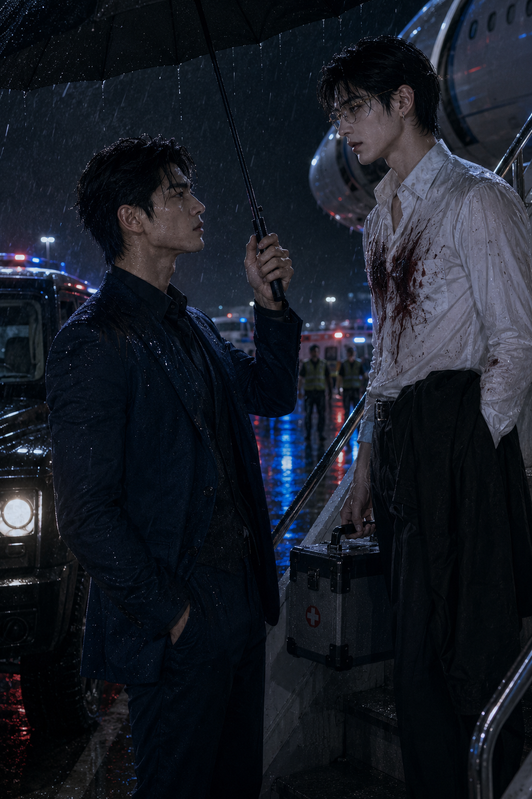
Flight BA217 hit the storm front without warning.
The first jolt was mild—just enough to ripple through the cabin floor and vibrate the metal frame beneath the seats. Most passengers barely looked up. Turbulence was expected when a plane entered a thunderstorm.
For Ewan Vane, however, the sensation felt disturbingly familiar—the opening pulse of a migraine.
The vibration crawled through the aircraft's skeleton and into his body, multiplying as it traveled, until countless tiny impacts were stacking inside his head and pressing against nerves already stretched close to their limit.
He had been resting with his eyes closed until a second shockwave rolled up from the belly of the aircraft.
Outside the window, the world had vanished behind towering storm clouds. A jagged flash of lightning tore through the darkness, illuminating the entire sky for a fraction of a second and throwing his pale reflection into sharp relief against the glass.
Exhaustion lingered around his eyes, but there was nothing unfocused about his gaze. His fingers tightened slightly around the armrest just as the aircraft suddenly dropped beneath him.
A collective gasp swept through the cabin.
The sensation of weightlessness lasted only seconds, yet panic spread far more quickly. Overhead compartments rattled violently, a loose suitcase slammed repeatedly against its latch, and the cabin lights flickered as oxygen masks dropped from the ceiling in a cascade of yellow plastic and shrill alarms.
Hundreds of people were drowning in fear. To him fear was never merely visible in shaking hands or raised voices. Every accelerated heartbeat, every fractured breathing pattern, every involuntary tremor produced by adrenaline arrived as information. The emotions of an entire cabin surged toward him simultaneously, colliding and overlapping until they became a single overwhelming torrent crashing through his senses.
His breathing faltered.
The ringing in his ears surged so abruptly that his vision blurred at the edges. It felt as though someone had forced a thousand radios into his skull and tuned every one of them to a different frequency, layering voices, static, panic, and noise on top of one another until thought itself became difficult to hold onto.
Instinctively, he lifted a hand to the silver bell-shaped ear cuff on his left ear and pressed hard against it.
Pain answered immediately.
Sharp.
Clean.
Grounding.
Warm blood slipped behind his ear and traced a narrow line down his neck, but the effect was instantaneous. The pain functioned like a circuit breaker. Some of the noise vanished. The silver bell trembled faintly against his skin, its vibration traveling through bone and dampening the torrent flooding his mind. The ringing remained, but it no longer tore him apart.
For the moment, that was enough. He closed his eyes briefly and waited for the dizziness to recede.
A shout cut through the cabin as he looked up.
"The captain's hurt!"
"Is there a doctor on board? We need a doctor!"
The words were fragmented by turbulence and drowned beneath alarms, but he heard them clearly.
Without hesitation, he unbuckled his seatbelt and stood.
The aircraft lurched again.
Passengers clung desperately to seatbacks and armrests. Some had fallen into the aisle. Parents curled around crying children. The narrow cabin left little room for him to move.
As Ewan grabbed the tops of the seats to move forward, another violent downdraft struck without warning, rolling the aircraft sharply to one side and throwing him into the metal doorframe. Pain shot through his shoulder and down his arm, but he barely registered it. Using the aircraft's return swing to recover his balance, he pushed forward through the last few steps of the aisle and caught himself against the cockpit bulkhead.
The cockpit door stood partially open. Alarms blared from within, competing with the storm outside, but the smell of blood reached him before anything else.
He stepped inside.
A web of cracks spread across the windshield, and air hissed through damaged seals with a thin, continuous whistle. The glass was still holding—for the moment—but the captain was not. Blood poured from a wound at the side of his neck, splattering the instrument panel with every shudder of the aircraft. Beside him, the first officer fought to maintain control with one hand on the yoke while the other reached instinctively toward the injured man.
"Don't touch him."
Ewan's voice was quiet, yet something in its certainty stopped the first officer cold.
Dropping to the floor beside the captain, Ewan drove one knee into shattered glass. A sharp sting shot up his leg, but his attention never left the wound. His hand found the source of the bleeding immediately, fingers pressing down with practiced precision as his eyes swept across the instrument panel.
"The windshield hasn't failed completely," he said. "Cabin pressure's still holding."
Blood surged between his fingers, warm and relentless.
"Correct the aircraft first. Worry about the masks later."
Without waiting for a response, he adjusted his grip to avoid embedded shards of glass and slid his free hand beneath the captain's neck to stabilize it. Outside the cockpit, passengers were still screaming; warning alarms continued to shriek through the cabin, and the aircraft itself groaned under the strain of the storm. Yet none of it seemed capable of reaching him. His focus remained fixed on the wound beneath his hands, the pressure required to slow the bleeding, and the pulse that continued to beat—thin but stubborn—against his fingertips.
Thirty seconds later, the bleeding finally began to slow.
Only then did Ewan spare a glance for the first officer. The man's face had gone ashen, and the hand gripping the controls was trembling badly enough to be visible even in the intermittent red glow of the warning lights. Across the instrument panel, altitude and vertical-speed indicators continued to swing through dangerous ranges as the aircraft fought the storm.
"You're dropping at thirty-two hundred feet per minute," Ewan said, his voice calm despite the alarms still screaming around them. "Pressure fluctuations like this can trigger pulmonary air embolisms."
The first officer stared at him.
Another warning tone shrieked through the cockpit.
Ewan didn't look away. "Do you want him to die from the injury," he asked evenly, tightening his grip against the captain's neck, "or do you want all of us to die crashing the runway?"
For a moment, the only response was the howl of the wind beyond the fractured windshield. Then the first officer drew in a sharp breath and forced his attention back to the controls. His grip steadied. The aircraft still shuddered beneath them, but its movements gradually became less erratic as he began correcting the attitude and reducing the descent rate.
It wasn't a dramatic recovery. Nothing suddenly became safe. Yet little by little the numbers stopped spiraling, and the flight path eased back toward something manageable.
Ewan then returned his full attention to the captain.
The storm continued to batter the aircraft, warning lights continued to flash across the cockpit, and rain streaked endlessly across the cracked windshield, but Ewan barely noticed any of it. His focus remained fixed on the pulse beneath his fingers and the gradual rhythm of the captain's breathing as the aircraft pushed through the worst of the weather.
By the time they finally broke free of the storm cell, the turbulence had eased enough for the sudden stillness to feel almost unreal. The cockpit remained washed in intermittent red light, and rain still tracked uneven paths across the damaged glass, yet compared to the violence of the previous twenty minutes the aircraft now seemed suspended in a strange, fragile calm.
Ewan kept steady pressure on the wound and watched the flight instruments over the first officer's shoulder. Only when the aircraft descended beneath the final layer of cloud and the runway lights appeared ahead—blurred by rain but unmistakably there—did he allow himself to believe they might actually make it.
The wheels struck the tarmac with a jarring impact.
A shudder ran through the fuselage as rubber met asphalt, and the aircraft surged forward under heavy braking. Outside, emergency vehicles raced alongside the runway as their flashing lights cut through the darkness while sheets of rain swept across the airfield. The deceleration seemed to last forever before the aircraft finally slowed, rolled the last stretch, then came to a stop.
For several seconds, nobody moved.
Then relief swept through the cabin with almost the same force as panic had before it. People burst into tears. Nervous laughter broke out in scattered pockets. Others remained frozen in their seats, staring straight ahead as though they still hadn't quite accepted that they were alive.
Ewan stayed where he was.
The captain was transferred to the emergency response team almost immediately after landing. The first officer was already speaking rapidly into a headset, his voice hoarse with exhaustion and adrenaline, while crew members moved through post-landing procedures around them.
None of it required him any longer.
The crisis was over.
And that was usually when the real problem began.
Leaning back against the cockpit wall, Ewan finally shrugged off his jacket. The fabric had stiffened with drying blood, and as he peeled it away from his shoulders he became aware, for the first time in what felt like hours, of the cold sweat soaking through the shirt beneath. Exhaustion settled heavily into his limbs now that necessity was no longer holding it at bay, leaving behind a deep ache that seemed to reach all the way into his bones.
Closing his eyes, he kept one hand against the silver bell at his ear.
Experience had taught him that the aftermath was always worse.
People liked to imagine that fear reached its peak during a disaster, but emotions rarely worked that way. In the middle of a crisis, survival imposed its own kind of order. The mind narrowed. Decisions became simple. Everything unnecessary fell away. It was only afterward, once danger had passed and relief finally arrived, that the barriers people had erected around their emotions began to fail. Shock, grief, disbelief, gratitude, terror delayed by circumstance—all of it returned at once. Every accelerated heartbeat, every surge of adrenaline with nowhere left to go, every emotional aftershock became another signal flooding into his awareness.
Usually, that was the moment when control slipped.
So he waited.
The familiar collapse never came.
A minute passed before Ewan opened his eyes again, a faint crease forming between his brows. Beyond the cockpit door, passengers were already being guided toward the exits. Rain continued to hammer against the fuselage, ambulance sirens echoed somewhere across the airfield, and crew members moved rapidly through post-landing procedures. Everything sounded exactly as it should.
Yet something felt wrong.
It took him several seconds to understand why.
The noise was still there. He could hear the rain striking metal, the engines winding down, the murmur of voices, hurried footsteps, distant crying. None of it had disappeared. Yet all of it seemed strangely muted, as though an invisible boundary had settled between him and the rest of the world, pushing the endless torrent of information just far enough away to become bearable.
The sensation was so unfamiliar that he remained motionless for a moment before stepping out of the cockpit.
The aircraft door had already been opened. Wind and rain swept through the cabin, carrying the scent of wet asphalt and jet fuel. Emergency personnel crossed the tarmac beneath flashing blue and red lights, their reflections breaking apart across the rain-slick ground.
Amid all that movement, one figure stood perfectly still.
A man beneath a black umbrella.
Tailored suits. Straight posture. Unhurried.
He stood at the foot of the mobile staircase as though he had been there for some time, untouched by the urgency surrounding him.
The moment the stranger entered Ewan's awareness, the pressure that had been building behind his eyes eased almost imperceptibly.
Not vanished.
Simply withdrawn, like a tide receding from shore.
His steps slowed.
For as long as he could remember, people had never been silent. Every person carried noise with them—heartbeats, emotions, impulses, fleeting thoughts that bled into instinct. Even the calmest individuals generated countless subtle fluctuations that his senses could pick apart without effort.
This man did not.
Standing beneath the umbrella, he occupied the world differently from everyone else around him. Not hollow. Not absent. Simply untouched by the constant static that accompanied every living mind.
Rain slid steadily from the edge of the umbrella.
Airport floodlights scattered across the wet tarmac, dissolving beneath passing vehicles and hurried footsteps, yet the man remained where he was, calm and immovable amid the chaos.
Ewan found himself staring.
As though sensing the attention, the stranger lifted his gaze.
Across the rain-soaked distance, their eyes met for the first time.
Hazel eyes with dark gray tone.
Clear. Steady. Unusually sharp.
There was nothing outwardly remarkable about the moment. The man neither spoke nor moved, and yet something inside Ewan loosened. The muscles across his shoulders relaxed by the smallest degree. The ringing in his ears receded another step. Even the silver bell against his skin had fallen completely still.
Only then did he become aware of the dried blood on his hands, the ache in his knees, and the exhaustion settling over him with the weight of something long deferred.
For the first time since entering the storm, he felt all of it.
The man remained standing in the rain, watching him from the foot of the staircase.
Ewan did not know who he was.
He knew only that, among hundreds of people, this was the first person he had ever encountered whose presence brought silence instead of noise.
And for reasons he could not explain, he found himself unable to look away.