Work Text:
.png)
I have survived war, wounds, and typhoid fever. I have lost both of my parents to illness and my brother to drinking. And yet the first three months after I returned from Switzerland in 1891 were by far the darkest of my life. I remember little of those days, save that I drifted through my life like a ghost haunting my own home. I oscillated between complete denial and grief so paralyzing that I might as well have been turned to stone.
When the first of the letters arrived, I noticed nothing strange about it. I sliced it open mindlessly and pulled out a single sheet of paper containing the following message:
My dear Dr. Watson,
I am frigid, yet—as blizzards draw closer—holding breath for spring. Must the summer stay so far away? And yet, from Inverness to London, winter remains. So I wait. Sorry, but I miss the heat you despise, so terribly sensitive as you are. Still, are those days not nearer now? Safe in memory, say the poets. Nothing to make of it but this short life. To what end, anyone can guess.
Very sincerely yours,
Gloria Scott
I stared at the letter, momentarily baffled out of my misery. It seemed to me to be absolute gibberish. I knew no one by the name of Gloria Scott. The handwriting was unfamiliar. If it weren’t for my name so prominently written on both the envelope—which, I realized then, had no return address—and the letter itself, I would have assumed that it had been delivered to me by mistake.
It occurred to me then, with some bitterness, that if Holmes were alive, he could surely have told me any number of enlightening things about the letter’s author and her intentions. He could probably tell me exactly where Miss Scott lived and what sort of family she’d grown up in, if such a woman even existed. The letter was either the ramblings of a madwoman (perhaps one of my readers) or a coded missive. But of course, with Holmes dead, why would anyone have any reason to send me a cipher?
I stood with the letter in hand and made to cast it into the fire when something stopped me.
Gloria Scott.
Gloria Scott…
After wracking my brain for a few minutes, I gave a shout and ran to the bookshelf by my desk. I picked up one of the notebooks in which I lay out the rough drafts of my stories and flipped through until I found what I was looking for: my notes for the story of Holmes’ first case.
He had told it to me years ago, and although I had sketched out a rough outline, I had yet to complete a full draft. No one had ever laid eyes upon the inside pages of this notebook but me. No one in the world could have known that I would have any familiarity with the name Gloria Scott… save one man.
I find myself at a loss to accurately describe my feelings at that moment. First, my heart—which had been as heavy and as still as lead for three months—gave a painful jolt as it started back to life. My breath left my lungs as though it had been punched out of me. My hands trembled. I felt sick with hope.
I read through my notes on the case, searching for a key to the cipher, and there it was: the first word, then every third word after.
I returned to the letter, hands shaking, and began to read again, whispering the coded words aloud to myself as I went. “I… yet… draw…”
As I reached the fourth word in the code, I collapsed backwards into my armchair. For the first time since losing him, I finally wept—but they were not tears of grief. My eyes and my heart overflowed with a relief and joy so powerful that it choked me. I could do nothing but gasp and sob, smiling and laughing as I did so. I read the rest of the message through my tears.
I yet draw breath. Must stay away from London. So sorry. Miss you terribly. You are not safe. Say nothing of this to anyone.
💌💌💌
A month later, I received a second letter from Gloria Scott. This one had a return address—in Tibet, of all places. Unlike the first, it was several pages long. I opened it with trembling hands and read.
My dear Dr. Watson,
I apologize for both the brevity and the tardiness of my previous letter. I have been terribly busy of late, and only now have I found the time to write you the sort of proper correspondence that you deserve.
As I’m sure you remember, the last time we were together I was locked in what appeared to be the late stages of a battle with the illness that had troubled me. Well, my friend, I have both good news and bad. The good news is that the terrible scare was a false alarm, and though I did for a few agonizing hours truly believe myself to be on death’s doorstep, I emerged from the ordeal unscathed. The bad news is that what we believed to be the late stages were, in fact, only the early ones of some larger and more complex disease. Once my fever broke, my doctor informed me that I have acquired new symptoms that may point to a greater danger if they are allowed to continue unchecked. These symptoms, although related to the original disease, may potentially hint at some new, contagious virus. So I hope you understand that though I desire nothing more than to return to London and visit you, I must remain here to convalesce, where I might not infect anyone else.
I can sense your worry already, my friend. Be assured that I am taking the greatest precautions with my health and that my doctor has given me a positive prognosis. This disease is potentially deadly but not incurable, and I have the utmost trust in my attending physician. He shall strike directly at the heart of this terrible plague and excise these wretched tumors, but it may take a very long time. How long, precisely, he cannot tell me.
I am not sure when I will be well enough to once again draft a full correspondence, but you have my word that I will write to you as often as I can. You may write back to me at the return address that I have provided. I may have to travel soon to visit some other specialists. In such a case, I will ensure that your letters are forwarded to my new location, and I shall respond with an updated address.
Once again, my dear old friend, I must tell you how terribly sorry I am to have left you so suddenly. It was not my original plan, but this illness is clever and malicious. It had sunk its hooks far deeper into me than I had thought, and I had to adapt quickly. Still, I owe you a thousand apologies for leaving you without word of my condition for so long. I hope that you can find it in your heart—which I know from experience to be one of the finest specimens in all the world—to forgive me.
Lastly, please give my love to my husband, Mr. William Scott. When he left for London he told me that he would write to me with his new address once he found suitable lodgings, but as I also had a recent and unexpected change in address, I have yet to hear from him. Since I know that he arranged to work as your assistant while he completes his medical studies, I am hoping that you can relay this letter to him. I am anxious to hear that he is all right. In the future, I hope that he shall write to me himself, but for now I hope that you will give him the following message for me:
I have never missed anyone or anything more terribly than I miss you, my love. I had thought that I knew what it was to be alone. In truth, I had barely even tasted the bitterness of loneliness before I met you. Before you, solitude felt like peace. Now, I know that true peace is not the silence of an empty room, but the silence of a room with only you and I seated within it. True peace is the warmth of your embrace, when the endless clangor of my mind finally quiets. No, I never did know true loneliness before I met you, because solitude had always been the default condition of my life. Loneliness, it seems, only reveals the full power of its wretched poison to those who have known what it is to be loved. Now I am vulnerable to it, and I am in agony. Trust that I shall do everything in my power to return to your side, my darling. Think not of my illness while you lay in bed at night, but of the peace that we built together by the hearth of our home, so that your dreams of me will be sweet.
Please take care of yourself, Doctor. I should be heartbroken if I were to hear that your anxiety over my condition ever caused you to forsake your own health, as I have so frequently forsaken mine. Perhaps that makes me a hypocrite, but I have never claimed to be otherwise. As always, I remain,
Very sincerely yours,
Gloria Scott
.png)
💌💌💌
“William Scott” was the pseudonym that Holmes used at the boxing ring. Since Holmes had no current use for it, he clearly intended for me to assume the mantle to better obfuscate our communications. When I responded to him, I included two letters in the envelope.
My dear Mrs. Scott,
I was exceedingly pleased to receive your letter and to know that you are on the path to recovery. The appearance of these new symptoms troubles me greatly, of course but I wish you the very best in your period of convalescence.
I am sorry to report that my health did indeed suffer in the past several months. You have heard, of course, of the death of my very dear friend, Mr. Sherlock Holmes. To say it has affected me greatly is a ghastly understatement. I felt as though my insides had been carved out with a knife, leaving behind only a dreadful, gaping cavern where once I possessed a beating heart. I apologize for the rather gothic turn that my writing has taken here, but I write this only so that you should understand how vital it is that you should do everything in your power to avoid adding to that grief. Your letters did wonders to replenish my vitality in such a terrible time of mourning. So you must survive, you see, if not for your sake then for mine. You, my dear friend, have always underestimated the value of your life to those who hold you in their hearts. Sherlock Holmes was much the same way. He believed that his only worth to the world was in the service that his brilliant gifts could provide. What a foolish notion. If I could speak to him now, I would tell him that his brain, though indeed a rare and beautiful treasure, pales in comparison to the priceless and radiant jewel that is his heart.
I have passed along your message to your husband. He has taken up lodgings above my practice, so you may address your future letters there. I have included a letter from him, although his broken arm has not yet healed, so I transcribed the letter for him under dictation, which is why you will find that it is in my own handwriting. Do take care of yourself, and please tell your physician that I hope to god he knows what he’s doing.
Your faithful servant,
John Watson
My dearest Gloria,
I have struggled for days to begin this letter, for even though I call myself a writer of some marginal accomplishment, I feel entirely unequal to the task set before me by your correspondence. I was intensely relieved to hear that you were alive and well (“well” being a relative term here, I suppose) and overjoyed to hear of your doctor’s positive prognosis. I was, however, as you so astutely predicted, deeply wounded that it took so very long for you to write to me, and highly concerned about the new developments in your condition. I dislike not knowing when I shall see you next and I trust that as soon as your talented physician can make a more accurate estimation of your recovery time, you will let me know. However, in the end, my relief and happiness at the news that you survived that dreadful fever has won out over my grievances. I find myself now in better spirits than I have been for months.
I suppose it goes without saying that I miss you terribly as well, my dear. I could, like so many other lovers before me, think of a hundred poetic ways to tell you how I miss you. I could tell you that parting is such sweet sorrow, although I find nothing at all sweet about this. I could tell you that I feel as though the very heart has been torn out of me, but you of course know that already, since you have the blasted thing with you even now—perhaps preserved in a jar of formaldehyde on your bedside, you bizarre and morbid creature. I could tell you that I feel as though the world has stopped turning in your absence, or at the very least that it ought to stop turning, for the Earth has no business carrying on as usual when the natural order of things is so catastrophically wrong. Perhaps I shall write a strongly worded letter to Apollo himself and request that he stop moving that wretched sun across the sky until my dear wife is returned to me. Imagine, I shall explain to him, if your sister Artemis—the twin half of your heart—was stolen from your side and cast into a darkness so thick that even the god of the sun had no hope of finding her. Could the moon drive itself across the night? Could the world keep turning without her?
But Apollo is not the most charitable of the gods, as I understand it, so perhaps I’d have better luck appealing elsewhere. Who else in his pantheon might be sympathetic to my plight? Even Demeter, robbed of her daughter for half the year, had a deadline on the length of her loneliness. But the gods, powerful as they are, cannot comprehend such human sorrow as mine. I am Penelope, weaving and unweaving a tapestry of loyalty while she waits twenty years for her husband to return. I am Orpheus, guiding my sweet Eurydice from the dark halls of Hades—marching towards the light with only blind faith that my love is truly behind me, hoping against hope that I shall not lose her a second time. And so it is not the gods to whom I send my prayers for your safety, but our humble fellow mortals who live and die and love and grieve.
I could tell you all of this and more, but as I know that you have never been fond of florid romanticism, I shall remain squarely in the realm of rational fact, and tell you only this:
The fire in our hearth is unchanged, but I have not felt properly warm for a single moment since you left.
Hurry home to me, my dear.
All my love,
William
💌💌💌
My darling William,
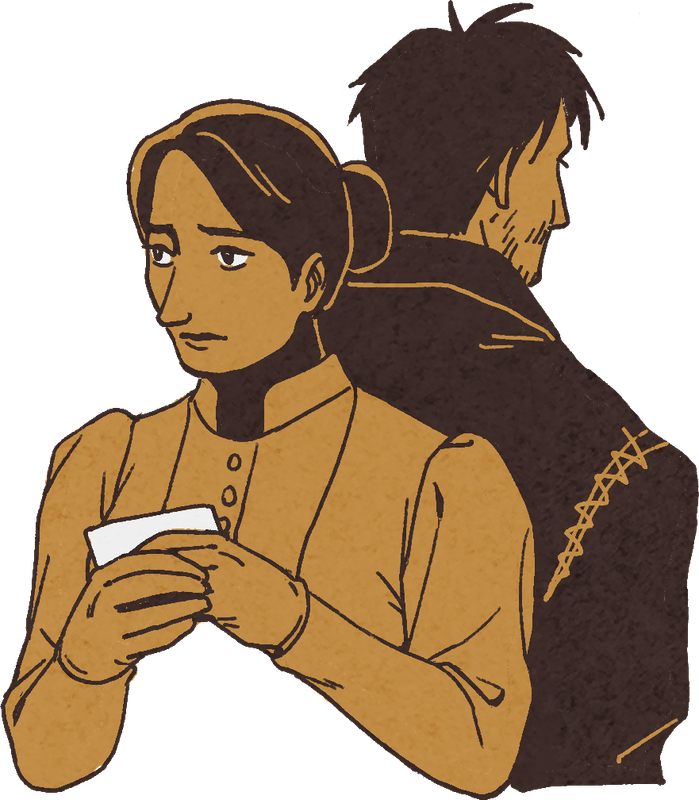
You are correct, my dear, in assuming that I despise grandiloquent sentimentality. I have criticized you many times for adding unnecessary romanticism when you should have stuck to the facts, and this opinion has not changed. While I was, of course, very pleased to finally receive a correspondence from my dear husband, you may imagine that I was quite disgusted with the purple hue of your maudlin prose. Please do imagine it, my dear. I beg you. Imagine that I read your letter with the sneer and sardonic laugh of the cold and calculating reasoner that most of the world believes me to be, and that I did not weep like I have never wept before while clutching the precious papers to my chest, or read the lines over and over again until I had memorized them, or tuck the letter safely into the inner pocket of my waistcoat so that it might always remain directly next to my heart. Please, my love, imagine that I remained entirely unaffected by your words, so that I may spare myself the indignity of the truth.
However, I must concede that you do possess some modicum of skill as a writer, for even amidst the tears that I decidedly did not shed, your letter made me laugh. It was the first time I have laughed aloud in months. The sound nearly startled me—I was beginning to worry that I had forgotten how to make such a noise. There is not much mirth to be had in such a place as this, where disease and infection are my only constant companions. I shall depend upon your letters, then, to ensure that I do not lose my capacity for laughter through disuse.
I shall not lie to you, for I have done enough of that over the years, even though my instinct is to spare you. You, of all people, deserve the complete confidence of the one to whom you have pledged your love and life. The situation is more dire than I previously believed. I cannot say precisely what the scope of the infection is, nor how many more tumors I shall uncover. Still no accurate projection of a recovery timeline. I am so sorry, my love.
But I do not like to dwell on such things, as my days are bleak enough already. As to your letter: I do, in fact, keep your heart in a wet specimen jar, and it is my most prized possession. It sits on the table beside my sickbed, so that I might gaze upon it as soon as I wake. I hope that you are keeping my own heart in an equally prominent spot. You may not be as morbid as I am, but as a student of medicine, I would hope that you are not too squeamish to sleep beside a disembodied organ—although perhaps you have had it mummified instead, so that you may carry it around in your pocket. That is frequently how it feels to me, anyhow.
Good god, man, your sentimentality truly is rubbing off on me. It is most unsettling.
I am glad to hear that you are sending out prayers for me, even if the mythological figures that you have chosen as your patrons have no heavenly powers with which to assist me. You know that I have never been a particularly spiritual woman. I am not in the habit of prayer, although perhaps I have simply never been desperate enough to pray (for these days I am beginning to understand the appeal). Perhaps I might join you in this endeavor. I could pray that Asclepius, the god of medicine, might grace me with the healing touch of his caduceus (although if I believed that being touched by the rod of a healer might cure me, I certainly would have invited you to join me here weeks ago). If, as you say, you are Penelope and I am Odysseus, then perhaps Pallas Athena might assist me in my hero’s quest. Or if we are Eurydice and Orpheus, we might make a joint appeal to Hades.
But out of all the noble deities, there is only one whose assistance I can be sure of, for she is the only god I have ever actually worshipped. The fact that I did so entirely without meaning to is irrelevant—if the distinction between murder and manslaughter matters little to the victim of such crimes, why might I not safely assume that the difference between accidental and intentional devotion is equally as inconsequential to the divine?
The fact remains that for the past ten years, whether I meant to or not, I have been building this goddess an altar. It stands proudly in our home, in such a central location that no one who enters could miss it. I have decorated it with trinkets, mementos of my life, and the tools of my trade. I have spent many hours sitting beside it and giving silent thanks for the blessings that this goddess has provided me, although I never thanked her by name. I have serenaded it thousands of times, just as the priests of old might have strummed their lyres at the feet of marble statues. And although I may have never offered her the more traditional sacrifices of a slaughtered calf or hog, we have toasted many glasses of fine wine and brandy before the light of this altar, which I trust have served us well enough as libations. Perhaps most importantly, we have always kept the fire well fed.
And so it is to no one but Hestia, the goddess of the hearth and the home, to whom I shall send my prayers. No god has ever blessed me more generously, and there is no more fitting patron for the homesick wanderer. If you have not felt warm lately, it is surely due to my unforgivable lapse in worship. I must resume my regular devotions with haste. I may be very far from my beloved altar, but Hestia demands no grand statues or temples from her followers; she asks only for the fireplace, which I may either find or build wherever I am. I have no pretty baubles or fine claret to offer her, but I do not think she will mind. As for you, my darling, you shall have to keep up the original altar without me. Sit next to it and imagine me sitting across from you, and know that wherever I am in the world, I am doing the same. Perhaps you might even, on occasion, toss a slaughtered pig into the flames for good measure (or at least a sausage or two).
Keep weaving, my sweet Penelope. My ship sails ever onward.
Yours above all else,
Gloria
💌💌💌
My lovely Gloria,
I must admit that I am rather disappointed to hear that my words moved you so little. I had hoped that you might shed at least a single fond tear for me. I assume that after laughing so haughtily at the pages upon which I had poured the very contents of my soul, you crumpled up the letter to use as kindling, or perhaps simply used the thing to wipe your arse.
Do you know, for the first few months after you left me, I could not cry at all? It was not out of stoicism, but rather a terrible numbness that had settled down inside of me. I had no tears to shed because the well from which they might have sprung—along with everything else inside me—had shrivelled up and withered away. I walked through the world as a dessicated husk, my very blood turned to dust in my veins.
And then you wrote to me. And I wept, I sobbed, I bawled in a most undignified manner—I am not ashamed to admit it, for they were the most wonderful tears I have ever shed. You were not the only one who came back to life that day, my love.
Your most recent letter made me laugh, and cry, and do both at once (which resulted in a terribly inelegant sound that I’m sure would have amused you), and overall make a terrible mess of my moustache. It was the very best that I have felt in weeks. Please, my heart—never, never change.
I regret to inform you that I have already abandoned our precious altar (although its care remains in the capable hands of our landlady). You must forgive me, but it was simply too painful to remain in our rooms, where everything reminded me of you. Here, in this small flat above the practice where I am currently employed, the bed is unfamiliar, and so when I wake there is no terrible moment where I wonder why you are not there next to me and then remember everything all at once. But there is a fireplace here, of course, and I shall set up a new altar for the lady of the hearth and pray to it daily, so that she may see fit to bring my beloved home to me.
It has now been seven months since I saw you last. In all our years of marriage, it is the longest we have ever spent apart. I pray that you do not make me wait much longer, but rest assured that if you do, you shall ever find me to be
Your most faithful servant,
William
💌💌💌
Telegram addressed to Mr. William Scott, addressed to the practice of Dr. John Watson
SORRY FOR LONG SILENCE. SITUATION DANGEROUS. AM HEADED TO NEW CLINIC NEW ADDRESS TO FOLLOW SHORTLY. MISS YOU ALWAYS.
💌💌💌
My dear Gloria,
Yesterday would have been our tenth Christmas together. For the past few months, I suppose I had convinced myself that you would be home by now. Last week, I finally came to terms with the reality that I would be spending Christmas without you for the first time in a decade. I was not entirely alone, as a mutual friend of ours invited me to join his family for dinner. His wife's cooking was marvelous and his house was practically bursting with festive joy, but his company only served to make me feel your loss more keenly. He only spoke of you biefly, but he admitted that he missed you. Did you ever consider that, in all your time away? That other people besides myself would miss you? And that, being sworn to protect your privacy, I can do nothing to soothe their pain?
No, I mustn't blame you for that. I know why we must keep silent. But this is wrong, all of it. I should not be here. My place is, and has always been, at your side.
While I understand your reasons for keeping me away, I must beg you to reconsider. I firmly remind you that I am, in fact, a medical man, and no stranger to contagious disease. I have faced deadly foes of both the pathological and human sort. Which a single word from you, I will travel to wherever you are and take up the battle alongside you. We can fight it together, my dear. We have always been stronger together. Why can you not see that?
I suppose I should be grateful that you brought me into your confidence at all on this matter, unlike some other instances I could mention when you decided to keep me entirely in the dark until the moment your plans came to fruition. I shudder to imagine what might have become of me if you had continued that pattern with this particular matter. And I am grateful for it, believe me, for I know how much is at stake. But why will you not take me into your full confidence? After everthing I've done, have I still not proven myself worthy? In all our years together, have I ever failed you?
Although... I suppose I did fail you. The last time we were together. When I foolishly allowed you to face the gravest danger by yourself. I was meant to protect you, I failed, and now we are both alone. Perhaps this is my penance.
I'm sorry, my dear. Forgive me.
William.
💌💌💌
My dear, sweet William,
You have never failed me. If you had stayed by my side that day, I am sure that the illness would have taken you as well. My fear for your safety would have compromised my ability to think rationally and we likely would have both succumbed to the fever. I knew that if I gave you the choice, you would have chosen to stay, because you are selfless. I needed you to be safe, so I took that choice away, because I am selfish. I would rather betray your trust than lose you.
I will not ask you to forgive me, only to understand. You are the first person in my life whom I have ever had the luxury of trusting completely. It is a very strange feeling and has taken me many years to grow accustomed to. I am still growing accustomed to it, in fact.
Of course I want you here. As I said, I am selfish. But please understand, my dear, that you do me far more good by remaining at home than you could at my side. Without the knowledge that Penelope waited in Ithaca, what reason would Odysseus have had to resist the Lotus Eaters, to escape from Calypso, to brave Poseidon's seas?
Upon leaving you that fateful day, my first instinct was to keep you in the dark. The less you knew, I reasoned, the safer you would be. But I am learning... rather, I am attempting to learn from my mistakes. I thought of your bitter hurt the last time I deceived you so. I imagined how I would feel if our roles were reversed. So in the end, against all of my most rational judgement, I wrote to you. It is a terrible risk. I fear that every correspondence between us increases the potential for danger. And yet, your letters have kept me alive far better than any medicinal treatment ever could.
I know that I have no right to ask anything of you now, but I have realized that there is, in fact, something you can do to help me heal from afar. it is something that only you can accomplish, and I believe it will greatly increase my chances of survival. More details to follow in my next letter.
And as to your closing statement: I cannot forgive you, my heart, because there is nothing for me to forgive.
Gloria
💌💌💌
The next letter came addressed not to Mr. William Scott, but to myself:
Dear Dr. Watson,
Write to me about Athens. Enlighten me concerning Santorini. You and I must try to convince my husband (the coward) the world is beautiful. That he and I, when I am not so dead tired, travel.
Your faithful friend,
Gloria Scott
I would have been glad to write the most picturesque accounts of these places imaginable, except for one small problem: I had never been to Greece. Holmes knew that. This time, I decoded the letter in mere seconds:
Write about me. You must convince the world that I am dead.
💌💌💌
So I wrote about the man I loved. I told the world the story of my grief, but not the story of my hope. I wrote to a woman who did not exist, and she wrote back to her husband. I wove and unwove my shroud, although my threads were not spun from fibers but from words. I marched through the tunnels of death, and I did not dare look behind me.
And in this manner passed the longest three years of my life.
💌💌💌
ONE TUMOR REMAINING. MOST DANGEROUS GROWTH OF ALL. WAITING FOR SURGERY. KEEP WEAVING. LOVE GLORIA.
I received this telegram towards the end of 1893. The new year came and went, but I did not hear from Gloria again.
The months crept by. No letters came. I kept the telegram folded up and stored in Holmes’ silver cigarette case, which I had taken to using as my own. Then, one day in spring, I fainted for the first time in my life and awoke in the arms of a man I had not touched in three years.
“Watson!” he called out to me. “Watson, my dear boy, are you all right? Oh, I am a fool. I owe you a thousand apologies. I meant only to have a little fun with you, I had no idea that you would be so affected.”
I did not speak. I could not find my voice. I thought of Orpheus, believing himself to be free of the hellish tunnels, turning around to find that Eurydice still had one foot in the darkness. I could not look away.
“Holmes,” I managed at last. “Is it really you? Is it finally over? What have you been doing these past months? Why have you not written?”
“Wait a moment,” said he. “Are you sure that you are really fit to discuss things? I have given you a serious shock by my unnecessarily dramatic reappearance.”
In my desperation, I gripped his arms with a force that I knew would leave marks. “Gloria. Gloria, my darling, please, I must know. Tell me that you have conquered your illness. That you are well at last.”
My dear boy’s face softened, and I knew that I would soon lose the battle against my tears.
“Very nearly, my dearest William,” he said. “There is but one tumor remaining, and I will require the assistance of a skilled surgeon to remove it. That is, if you would be so kind as to lend me your services.”
I smiled and reached up to hold his cheek. “When you like and where you like,” I said, for there could be no other answer.
💌💌💌
Holmes turned away from the assassinated wax bust as Mrs. Hudson entered the sitting room carrying champagne and a tray of three glasses. “I’ve been saving this for a special occasion,” she grinned. “I cannot think of anything more fitting than a resurrection.”
“Quite so!” Holmes beamed at her, taking the champagne and popping the cork. He poured us each a generous glass, which we then raised together.
“To resurrections,” said Mrs. Hudson.
“To homecomings,” said Holmes.
“To Sherlock Holmes,” said I, “who is once again free to devote his life to examining those interesting little problems which the complex life of London so plentifully presents.”
We drank. Mrs. Hudson remained for several minutes more before the excitement of the day finally caught up with her and she excused herself to bed.
The room fell silent. Holmes went to stand by the fireplace, gazing into the quiet flames. When I went to stand next to him and he turned to face me, I nearly dropped my glass in surprise. His cold, porcelain mask had lifted completely. In all my years of knowing him, I had never seen such an open expression of adoration grace his features. I could hardly breathe.
“And so,” he said, “by praying to the Lady of the Hearth instead of Pallas Athena, Odysseus makes his way home in three years instead of twenty.”
I grinned back. “And Orpheus, having turned to Hestia for help, returns to his own hearth with his dear Eurydice safely at his side.”
Holmes chuckled. “It seems that we have done well in our choice of patron.”
“Indeed.” I held up my glass and turned to gaze upon our altar, which had remained precisely as we left it. Holmes mirrored me. “To the Lady of the Hearth, who, in her infinite grace, saw fit to return my beloved to me.”
“To the Lady of the Hearth,” Holmes echoed. “Who has earned herself the lifetime devotion of two humble disciples.”
We clinked our glasses and drank. When the flutes were empty, Holmes set them down on the tray and turned to me.
“I have heard,” he murmured, “that in some heathen religions, one may dedicate certain acts as offerings to the gods instead of food or wine. Dancing, for example, or music.” He draped his arms around my shoulders. “I have even read that an act of lovemaking might be devoted to a divine patron, if the mood strikes.”
“Is that so?” I brought my hands to his waist. “Well, we have no music, but I suppose we can still dance. It is definitely too late at night for your violin.”
Holmes laughed, even as he rolled his eyes. “Your wit remains as sparkling as ever, my dear William.” He leaned in to kiss me, but I put a finger to his lips. He paused, looking at me inquisitively.
“No more William,” I said. “No more Gloria. You are not Odysseus and you are not Eurydice. I am not Orpheus or Penelope. No more ciphers and false names. No more myths. No more masks.” I moved my hands up his back, happiness surging through me as I felt him shiver. “I am John Watson, and you are Sherlock Holmes, and I love you.”
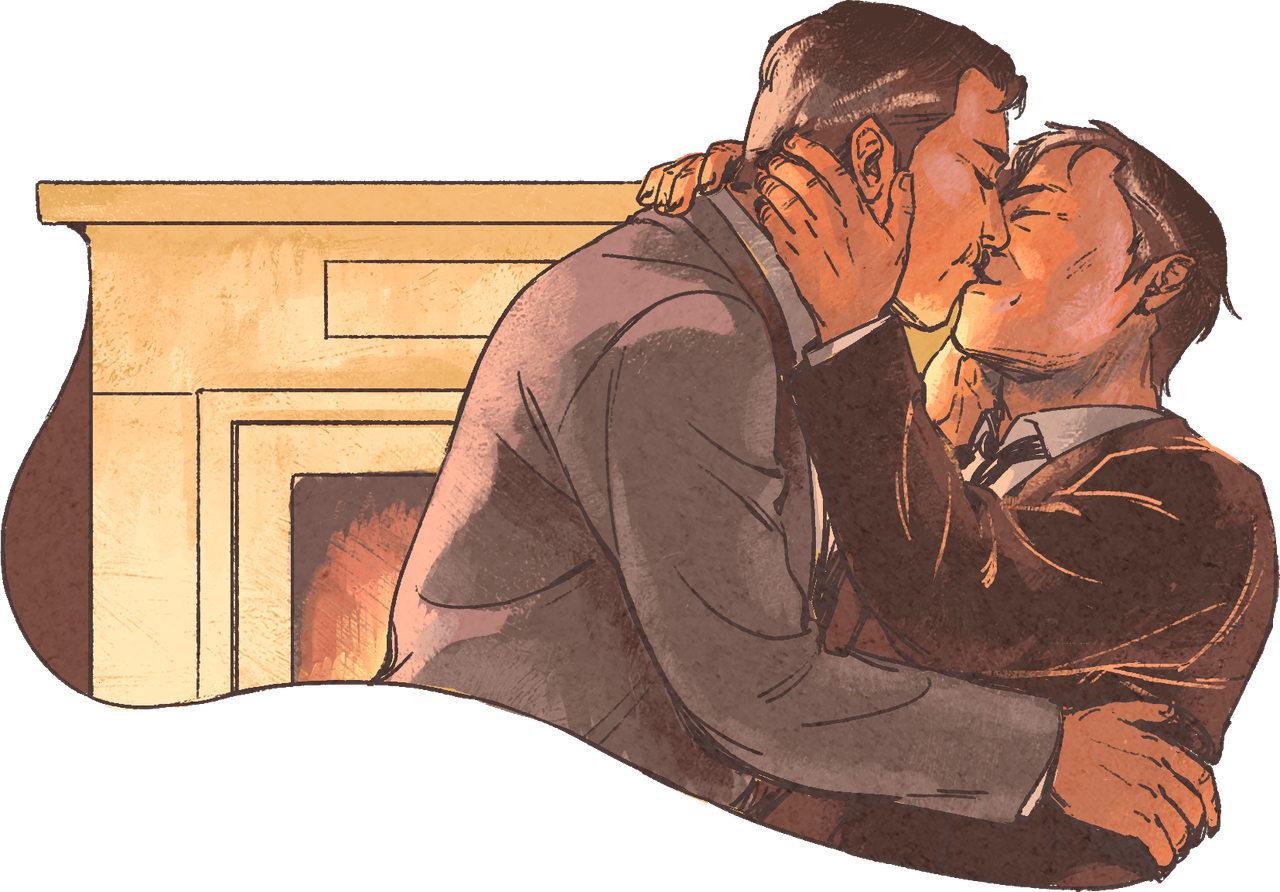
“John,” he gasped. I pulled him towards me and he came, falling into me just as I collapsed towards him. We kissed, wordlessly and desperately. We stripped away the layers that separated us until we lay together, bare as the Olympians, on the hearth rug. The light from the dying fire was too dim for me to see Sherlock’s body in any great detail, but I could feel new scars under my fingers. His ribs protruded far too harshly through his flesh, and when my hands encircled his waist, the tips of my fingers nearly touched. Three years had changed him, just as they had changed me. Soon I would catalogue these changes, understand them, worship them. But that was a task for the daylight.
There are many who would say that what we did together by the hearth is profane, blasphemous—sin, even. But I have seen sin and I have seen depravity. I have seen prayers to greater gods go unanswered. I have lived through Hell and I have escaped from the halls of Hades. By the light of our altar there was no sin, no prayers, no blasphemy—only devotion, to our divine patron and to one another. In my beloved’s arms, I found something far sweeter and far more sacred than the gates of Heaven or the fields of Elysium: a fleeting moment, within a short mortal life, where there is nothing but joy.