
Chapter Text
The low, rhythmic hum of the mixing board was the only thing keeping the silence of the studio at bay, a dull, physical vibration that Martin felt deep in his chest.
He groaned, the rough, synthetic fabric of the studio couch scratching against his cheek as he forced his eyes open. The air in the room was stale, smelling of cold takeout and copper wire. The space was almost entirely dark, save for the dull blue standby lights of the rack gear, the pulsing green indicator of the interface, and the stark, blinding glare of his phone screen vibrating violently against the wooden armrest.
His head throbbed behind his temples. He’d fallen asleep mid-mix sometime after midnight, a half-empty, lukewarm can of energy drink resting precariously near his pedalboard on the floor.
He squinted against the sudden assault of light, reaching out a stiff, calloused hand to grab the device. He always kept his phone on a strict, permanent Do Not Disturb schedule when he was locked in the studio—social media, label emails, and casual texts were strictly silenced to keep him from losing his mind. The only contacts allowed to bypass the filter and actually make his phone buzz in the dead of night were Keonho and James.
Which meant if his phone was actively vibrating at 03:14 AM, something was seriously wrong.
His lock screen was a solid, scrolling wall of notifications, all of them breaking through the DND barrier from a group chat shared with his two closest friends.
-SMAU-i-OS-Template-Kit-by-fieryblooms.png)
Martin rubbed his face with his free hand, his throat dry and tasting like metal. What did he do now? Did a promoter cancel his upcoming showcase? Did some local band accuse him of ripping off a riff?
He unlocked the phone, the bright interface burning his tired eyes, and instinctively swiped over to Twitter.
Because his notifications were muted for everyone else, he hadn't received the hundreds of direct tags piling up. But when he opened the app, he didn't even have to type his own name into the search bar. Under the "Trending in Music" tab, nestled right beneath a massive international pop release and a trending festival lineup, sat a single word: MARTIN.
Martin’s stomach did a slow, nauseating flip. His thumb hovered over the screen, trembling slightly, before he tapped on the tag. The feed refreshed, a torrent of tweets cascading down the screen in real-time.
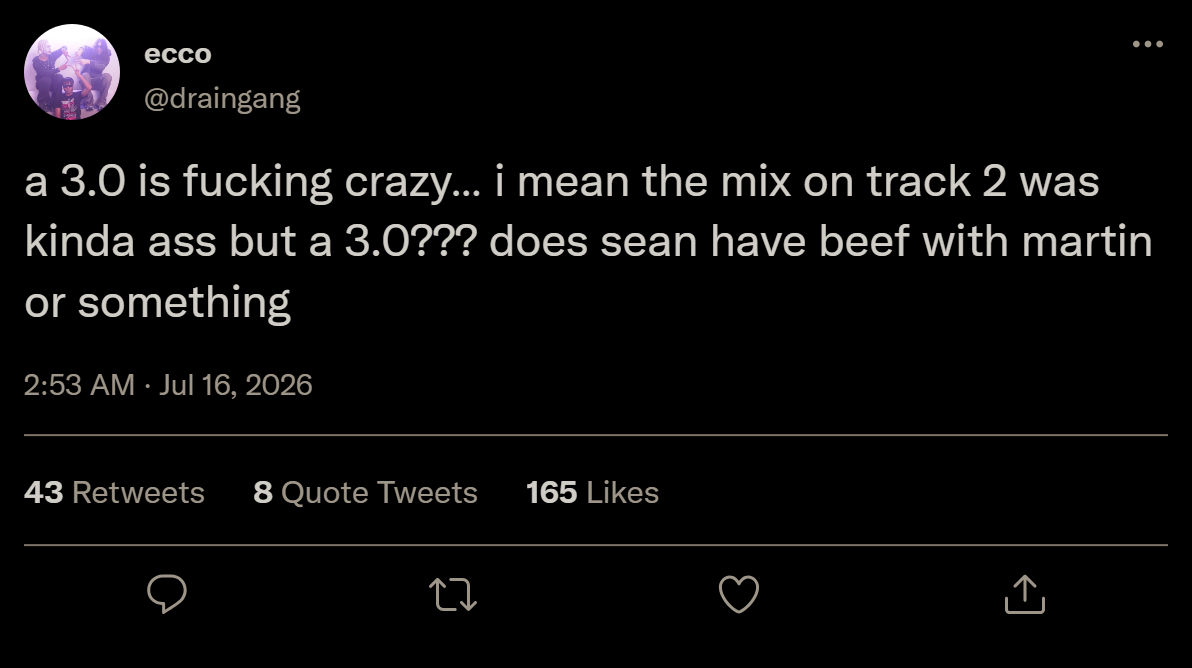
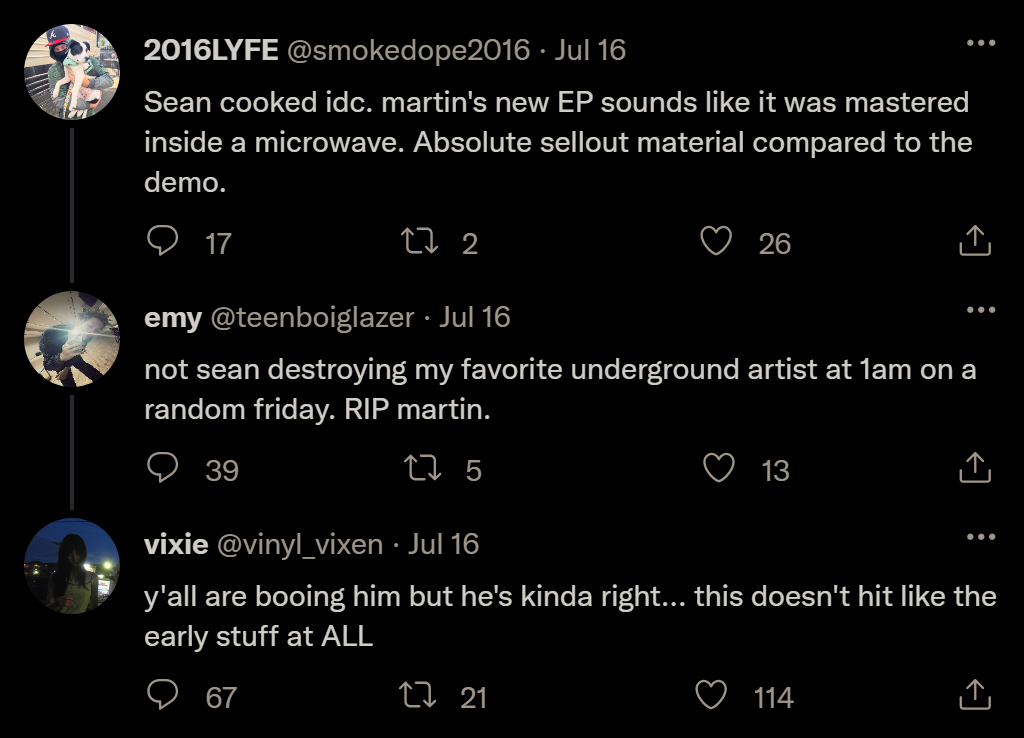
"What?" Martin whispered, his voice cracking, the sound lost in the empty room.
He scrambled back to the group chat, his thumbs flying across the keyboard as a cold sweat began to break out on the back of his neck.
To: friends
Fri, 16 Jul 03:02 AM
Keonho:
martin-hyung wake up
dude please tell me you’re not asleep in the studio
James-hyung:
don't look at twitter man. seriously just put the phone down
Keonho:
respectfully, james-hyung stfu now he’s definitely going to look
marti-hyungn seriously call me when you see this. we're at james-hyungs's place.
Fri, 16 Jul 03:15 AM
what is this
what review are they talking about
Keonho:
hyung. do not read it. seriously. you know how sean is, he’s a pretentious prick who writes for clicks. he's just trying to stir up controversy because your release was hyped.
James-hyung:
The Needle’s Edge — Martin: ‘False Spring’ EP Review
Keonho:
JAMES HYUNG I SWEAR TO GOD WHY WOULD YOU SEND HIM THE LINK
// Text marked as: Seen
-end of chat-
Martin didn't bother reading the rest of Keonho's incoming texts. His eyes were locked on the blue underline of the hyperlink. He tapped it.
The screen flashed white, illuminating the dark corners of the studio before loading the sleek, minimalist interface of The Needle's Edge, the premier publication for the city's underground music scene. Right at the top, under the editorial banner, was his own face—a high-contrast, grainy black-and-white press photo he’d taken in the alleyway behind the studio, looking tired but determined.
THE NEEDLE'S EDGE
MARTIN
False Spring EP
3.0
There is a particular kind of disappointment reserved for watching a singular underground artist receive the resources they always deserved—only to lose the very qualities that made them exceptional.
When Martin first surfaced in the underground scene eighteen months ago, his music felt volatile in the best possible way. The early bedroom recordings were gloriously unrefined: guitars clipping into distortion, drums that sounded as though they had been recorded through a single battered microphone in a concrete basement, and vocals delivered with a reckless urgency that seemed moments away from collapsing entirely. Nothing was polished, yet every flaw amplified the emotional impact. Listening to those songs wasn't a passive experience; it felt like being caught in the middle of someone else's emotional implosion. Martin possessed a rare sincerity that made his solo work feel indispensable in an increasingly predictable indie landscape.
False Spring, however, marks a dispiriting departure from that identity. Across four tracks, the EP buries its strongest qualities beneath immaculate, overworked production that scrubs away every trace of the chaos that once defined his sound.
The transformation is immediate. The title track replaces the dense, abrasive low end of Martin's earlier recordings with an immaculate digital mix where every instrument occupies its own carefully controlled space. Technically, it's impressive. Emotionally, it's lifeless. The guitars, once jagged and overwhelming, have been compressed into clean, inoffensive textures that drift politely through the mix instead of cutting through it. Everything is balanced, everything is controlled, and almost nothing leaves an impression. Rather than embracing the unpredictability that made Martin compelling, the production seems determined to sand away every rough edge in pursuit of accessibility.
That loss is most apparent on the EP's centerpiece, "Tracing Lines." Martin's voice once carried an almost alarming sense of desperation, straining against itself in ways that felt impossible to fake. Here, it has been smoothed into near anonymity. Whether through excessive tuning, compression, or simply an overcautious approach to production, the vocal performance emerges flattened and emotionally restrained. The imperfections that once made his delivery unforgettable have been polished into something technically cleaner but artistically anonymous.
Ironically, the songwriting continues to reach for the same themes of isolation, anxiety, and emotional collapse that powered his earliest material. Yet the pristine production constantly undermines those ideas. Lyrics about unraveling lose their weight when they're delivered through a mix that feels engineered to eliminate every trace of discomfort. The emotional vulnerability begins to feel strangely performative—not because the writing lacks sincerity, but because the presentation refuses to let that sincerity breathe.
The greatest disappointment is that False Spring doesn't sound like an artist deliberately reinventing himself. It sounds like an artist being reshaped into something more commercially digestible. The tension, unpredictability, and abrasion that once made Martin impossible to ignore have been exchanged for professional polish and broad accessibility. The result isn't offensive or incompetent—it is simply forgettable.
If this EP signals the future of Martin's solo work, then the underground has lost one of its most distinctive voices. False Spring ultimately feels less like an honest document of emotional turmoil and more like a carefully packaged version of it, assembled for consumption rather than expression.
Martin’s heart dropped straight into his chest, heavy as lead. A cold numbness washed over his limbs, making the warm studio feel suddenly freezing. A 3.0. That wasn't just a bad grade; that was a career-stunting execution.
His eyes scanned the paragraphs, his brain forcibly registering the words even as his mind tried to reject them.
"...immaculate, overworked production that scrubs away every trace of the chaos... The guitars, once jagged and overwhelming, have been compressed into clean, inoffensive textures that drift politely through the mix instead of cutting through it... The emotional vulnerability begins to feel strangely performative—not because the writing lacks sincerity, but because the presentation refuses to let that sincerity breathe."
Strangely performative.
Martin let out a ragged, trembling breath, the phone nearly slipping from his damp palm onto the concrete floor.
Performative?
Sean—the critic whose real name, Seonghyeon, was buried deep in the site's directory, but who went by his professional, razor-sharp pen name online—had absolutely no idea. He didn't know about the screaming matches Martin had with the label representatives in their sterile office. He didn't know about the threats to pull his touring budget and cancel his physical pressings if he didn't compress the vocals to make them "radio-friendly." He didn't know that Martin had spent three days straight locked in this exact room, staring at a mixing board by himself, trying to salvage what little of his soul they’d let him keep while complying with a contract he had been too naive to reject. He hadn't wanted to sand down the rough edges. He had been forced to.
And this guy, sitting in some comfortable, quiet apartment, had just dismantled months of agonizing solo work in a few paragraphs. He had called his pain a packaged commodity.
Confused, hurt, and suffocatingly angry, Martin scrambled to the bottom of the page. He hit the author bio with a violent tap of his thumb. Under the clean, stylized circular avatar of the critic, there was a brief description, and right there, in small, neat font, was the contact email listed on Sean's profile: [email protected].
Martin locked his phone, threw it onto the couch, and marched over to his desk. He slammed his laptop open, the screen's harsh white light catching the dark circles under his eyes. He didn't care that it was 3:20 AM. He didn't care that his hands were shaking, or that he was acting on pure, unadulterated adrenaline.
He popped open a fresh browser tab, logged into his burner email—the one he used to submit demos before anyone knew his name—and hit Compose.
Sean,
It must be easy to write essays about "authenticity" from the comfort of your desk when your livelihood doesn't depend on the songs you're dissecting. If you genuinely believe False Spring is exactly how I wanted it to sound—that I happily watched my own music get polished into something unrecognizable—then you're giving yourself far too much credit as a critic.
You have absolutely no idea what those six months looked like. You weren't in the meetings. You weren't reading contracts. You weren't the one arguing over every mix revision or trying to keep pieces of the record from being stripped away. You're confident enough to explain my intentions to everyone else, yet you couldn't be further from the truth.
The irony is that you accuse me of sacrificing honesty while confidently inventing a story about who I am and why this record exists. It's easy to reduce an album to some grand statement about selling out when you never have to deal with the compromises that come from trying to make a living. Sometimes survival doesn't leave room for artistic purity.
But sure, call my work "performative." Call it a "packaged version of emotional turmoil" to get your engagement metrics up for the week. I'm happy my worst months could be repurposed into compelling criticism. I only hope writing about my sincerity felt as authentic as you wanted everyone to believe it was.
Sincerely,
- Martin Edwards Park
He didn't proofread. He didn't hesitate, knowing that if he waited even a minute, his anxiety would claw its way back and stop him.
Martin slammed his finger down on the trackpad, hitting Send, and watched the message vanish into the digital ether.