
Work Text:
They say, if you’re lucky to meet death from the natural cause of “old age”, you see the shades of those loved ones who have gone before you, come to ease your transition to the other side. Those who meet death or survive such a near sudden encounter say that there’s a moment when time slows down and in the blink of an eye your life flashes before you. I know both are true, and the same thing, just played at different speeds.
But what if you could slow down that experience for the dying?
What would happen then?
That was a question I should have left unanswered. I wish I had left it unanswered. Perhaps then, maybe it would be easier to forget everything, or to just accept that he is gone.
But I never knew when to leave things well enough alone.
I thought I was buying him time. That’s what I told myself, anyway. Just a few more days together after years of separation. Separation that I’d flung myself into. A few more conversations – chances to say the things we’d both avoided for decades.
But slowing death is not the same as stopping it.
And once I slowed it down, there was no way to unsee what came next.
DAY ONE
It started with a phone call that woke me before the dew had settled on the grass.
“Johnny?” I heard my old man wheeze over the phone.
“Yeah Dad, what is it?” I mumbled as I lay my head back down on the pillow and brought my cellphone up to my ear.
“I’m dying.”
For over the last fifteen years my father had been in and out of hospitals for various conditions. Heart trouble. Knee replacements. Kidney trouble. Prostate cancer that went into remission. Blood pressure that behaved like a toddler on a sugar high. Every few months there was a new scare, a new specialist, a new set of instructions he followed for a few weeks I hounded him but then largely was ignored the moment I turned my back.
So, when he said “I’m dying,” I didn’t sit bolt upright. I didn’t panic. I didn’t even turn on the light.
I just sighed into the phone and said, “Okay, what is it this time?”
But he didn’t answer right away. I heard him breathing — slow, uneven, like each inhale had to be negotiated.
“Johnny,” he whispered, “I think this is the real thing.”
And something in his voice — not the words, but the way he said them — made me swing my legs out of bed. It wasn’t whining, cantankerous, or melodramatic like I normally heard over these calls. No, he sounded… resigned.
I sat there for a second, elbows on my knees, phone pressed to my ear, listening to him breathe like the air was thickening around him.
“Where are you?” I asked, even though I already knew. He hadn’t left the house in weeks.
“Home,” he rasped. “Chair by the window. Sun’s coming up soon.”
That was wrong. My father hated mornings. Every opportunity he had to sleep in he took, ever since I was a little kid. He said he hated seeing the sunrise, he’d always said it made him feel like he was late for something.
“I’m coming over,” I said as I stood up and pulled open my chest of drawers, already grabbing items of clothes I needed.
“Don’t rush,” he murmured, and there was a softness in his voice I hadn’t heard since I was a kid — a softness that scared me more than any wheeze or cough ever had. “I’ve got time.”
But the way he said it made me move faster.
I grabbed my jeans off the floor, pulled them on, shoved my feet into the well-worn pair of sneakers I usually took a morning jog in, and was halfway to the door before I remembered the vial.
It was still where I’d hidden it months ago — taped behind the false panel in the bathroom cabinet, wrapped in an old sock like that made it less illegal.
I hesitated, hand hovering over the panel. I’d stolen it on impulse, back when the trials were still in the early animal phase and the higher‑ups were whispering about “selective access” and “priority candidates.”
Which was corporate speak for: the rich old bastards who paid for it get first dibs.
The drug wasn’t meant to save anyone. It wasn’t even meant to heal. It was designed to slow the dying process — to hold a body in the narrow space between life and death, a chemically induced stasis that could be reversed with the right cocktail.
A pause button for mortality.
Cryogenics without the ice.
The rats had tolerated it well. Too well. Enough that the funders were already circling like vultures, eager to freeze themselves at the edge of the grave until someone figured out how to roll them backward into youth.
Human trials were scheduled to begin later this year with “select candidates” already lined up.
I told myself I’d taken the vial because I didn’t trust them. Because I wanted a safeguard. Because someone needed to keep the science honest.
But standing there in the half‑dark, listening to my father’s breath crackle through the phone, I realized the truth:
I’d taken it for him.
And now the moment I’d been pretending would never come was here.
I opened the panel. Took the vial and syringe. Slipped both into my pocket.
“I’m on my way,” I told him.
And for the first time in my life, I prayed I wasn’t already too late.
Dad still lived in the old ranch house that he and Mom had bought just before I was born. Half the reason he could still stay there despite being eighty-eight was because it was all one level, and I’d found the best nursing assistants that I could afford to supplement what Medicare wouldn’t cover completely.
Dad had said I was wasting my money on him instead of laying down roots for my own children—but I was nearing forty-five in a few months, already older than when he’d had me. The idea of having a kid had long left the train station. I had long ago realized I was too much of a workaholic, and my father’s ill health had made it impossible for me to take having a relationship seriously, let alone have children. I’d reconciled myself to having my work be my legacy.
And then our labs were bought by a subsidiary of Aqua Vitae, whose conglomerate name we later found out was a goal as much as a name.
Now the idea of having kids seemed like a less dubious way of leaving something behind, but I’m afraid that ship left harbor years ago.
The drive to his house took fifteen minutes, but it felt like I was moving through syrup. The sky was still that bruised pre‑dawn color, the kind that makes everything look older, softer, like the world hasn’t quite decided to wake up yet.
I kept one hand on the wheel and the other in my jacket pocket, fingers brushing the vial like it might burn me. I’d imagined this moment a hundred times — the emergency call, the rush to his bedside — but never with the weight of stolen science pressing against my palm.
When I pulled into his driveway, the porch light was on. He never used it. Not even when he’d smoked outside at my mother’s insistence. He said it attracted moths and made the electric bill jump too wildly. But tonight, it glowed like a beacon beckoning me like the moth. Dad couldn’t have turned it on himself—not with how he’d sounded. Carmen, his evening nurse, must have left it on when she left—but that meant it must have been on for hours.
I got out of the car and stood there for a second, listening. The neighborhood was quiet. No sirens. No ambulance. No nurses’ cars. Just the faint hum of the streetlamp and the soft rustle of the trees.
Too quiet.
I walked up the path, the concrete still cools from the night, and unlocked the door with the key he’d given me years ago — “for emergencies,” he’d said, though he’d never admitted he meant this kind.
I unlocked the door and stepped inside, and flipped the switch for the outside light. I half expecting to hear the TV blaring some late‑night rerun of some old western he’d grown up watching or the oxygen machine hissing in its usual uneven rhythm. The house was quiet. Not peaceful quiet — the kind that settles after a long day — but the hollow quiet of a place waiting for something to end.
The house smelled the same as always: old wood, stale coffee, and the faint medicinal tang of the oxygen machine. But there was something else underneath it, something I couldn’t name yet — like the air had shifted, like the room was holding its breath.
“Dad?” I called softly.
A low groan answered me from the living room.
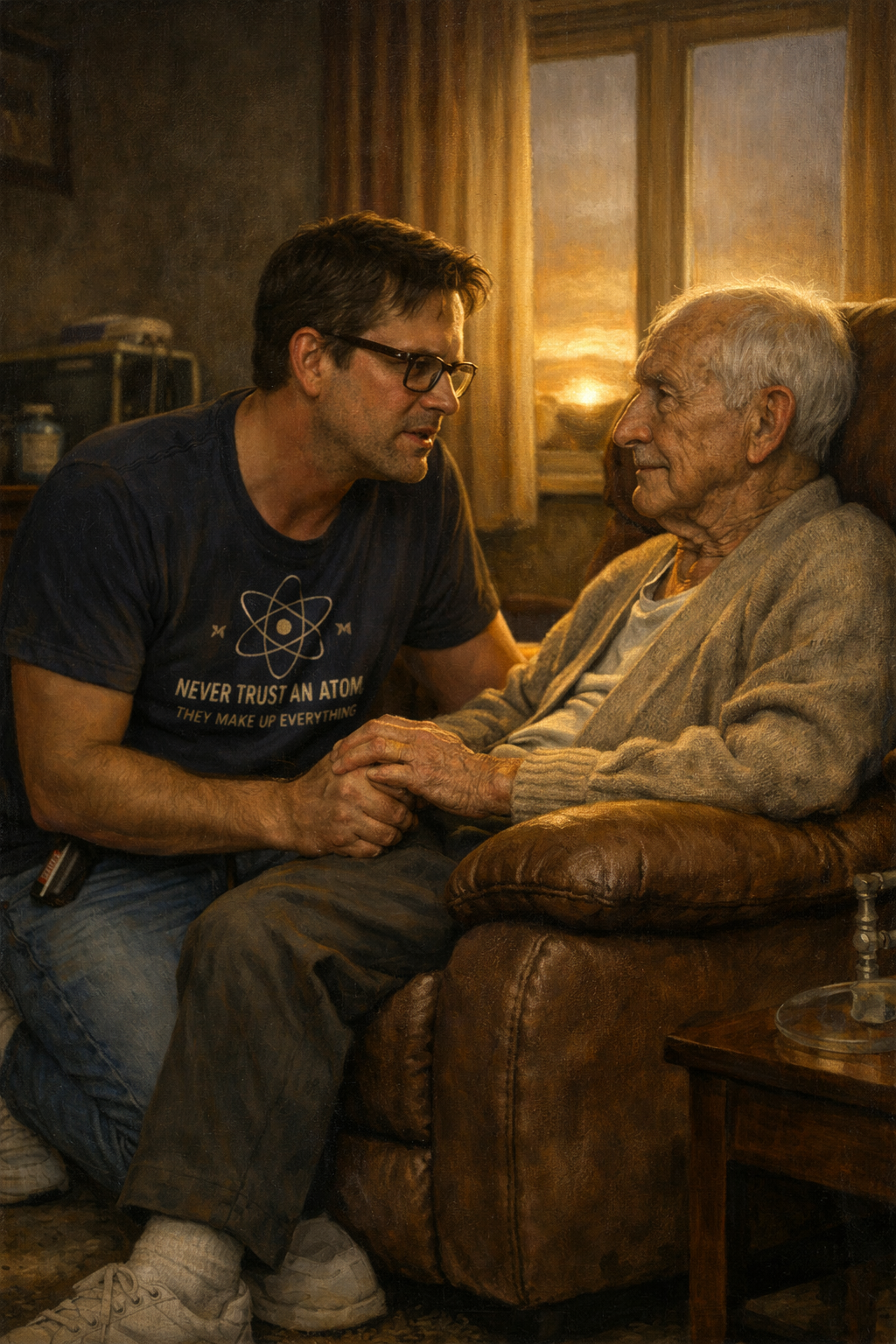
I found him in the lift recliner by the window, just like he’d said. The first thin line of sunrise was creeping over the horizon, painting his face in pale gold. He looked… small. Smaller than I’d ever seen him. His skin hung loose on his bones, his eyes half‑lidded, his breath shallow and rattling.
But he was still him. Still eighty‑eight. Still the man I’d been losing inch by inch for years.
“Hey,” I whispered, kneeling beside him.
His eyes fluttered open. “You made it.”
“Of course I did.”
He tried to smile, but it came out crooked, like his face had forgotten how. “I thought it’d be over by now… I didn’t want you to see me like this… but I didn’t want you to get the call from that morning girl either.”
“Too late,” I said, and my voice cracked in a way I didn’t expect.
He reached for my hand — slow, trembling — and I took it. His fingers were cold. Not end‑of-life cold, not yet, but close enough that fear crawled up my spine.
“Johnny,” he murmured, “I think I’m slipping.”
And that was the moment — the exact moment — when the thought hit me like a punch to the chest:
If I didn’t use the vial now, I knew that I never would.
I felt it in my pocket, heavy as a confession.
I could let him go. Just numbly sit here, hold his hand, and let nature take him the way it takes everyone.
Or I could do the thing I’d been pretending I would never do. The thing I’d justified a hundred different ways to myself, but really there was only one justification that mattered: him.
“Dad,” I said quietly, “do you to trust me?”
His eyes opened a little wider — not in fear, but in that old, familiar way he used to look at me when I was a kid and he was trying to be brave for both of us.
“Always,” he whispered.
And that was all the permission I needed.
I pulled the vial from my pocket and held it in my palm for a long moment, the glass catching the thin morning light. It looked harmless. Like something you’d find in a first‑aid kit.
“Dad,” I said quietly, “I need to tell you something before I do anything.”
His eyes flicked to the vial, then back to me. He didn’t flinch. He didn’t tense. He just waited.
“This is experimental,” I said. “My lab’s been testing it on animals. It’s meant to slow the dying process — not stop it, not reverse it. Just… slow it down. Put the body in a kind of chemical stasis.”
He blinked, slow and heavy. “Like that cryogenics stuff in the movies?”
“Sort of,” I said. “But without the freezing. More like… pausing. Giving the body time. Giving us time.”
He let out a breath that rattled in his chest. “Time for what?”
I swallowed. “To say what you need to say… make sure you’re comfortable. Time to… not lose you so fast.”
He closed his eyes, and for a second, I thought he’d drifted off. But then he spoke, voice thin as paper.
“Johnny… I don’t have the strength to argue with you.”
That hit harder than anything else he’d said. My father could argue with a brick wall and win. He’d fought doctors, nurses, insurance companies, Mom, me. God, we’d argue these past several years as often as I’d come running over to make sure he was taken care of for this new medical emergency. Hell, he’d fought his own body for years.
Hearing him say he couldn’t fight anymore made something inside me crack.
“Dad,” I whispered, “I don’t know if this will help. I don’t know if it’ll hurt. I don’t know if it’ll do anything at all. We haven’t even started human trials… but I can’t just sit here and watch you slip away.”
His hand twitched, reaching for mine. I took it. His grip was weak, but it was there.
“You’re the doctor,” he murmured. “You always were. Even before you had the degree.”
“I’m not a medical doctor,” I said, voice shaking.
“You’re still my son,” he corrected. “And I trust your judgment.”
That was the last moment before everything changed.
I uncapped the vial. Drew the liquid into the syringe. My hands were steady, but my heart wasn’t.
“Okay, Dad,” I whispered. “Here we go.”
And I pressed the needle into his arm.
Dad’s breathing steadied into a slow, even rhythm — not stronger, but less frantic. His eyelids fluttered, then lifted just enough for him to look at me.
“Johnny,” he murmured, voice thin but clear, “you ever think about being a father?”
I let out a groan before I could stop myself. “Dad, not this again.”
“What?” he said, almost offended. “It’s a fair question.”
“It’s a question you’ve asked me every Thanksgiving, every birthday, every time you see a baby in a goddamn grocery store.”
He gave a weak chuckle. “Well, maybe you never gave me a good answer.”
I rubbed my face with my free hand. “Dad, I’m forty‑five in a few months. By the time any kid I have is graduating high school, I’d be—”
“Old,” he finished. “So what? I was old.”
“You were forty‑three when I was born,” I reminded him.
“Exactly,” he said, with a ghost of his old stubbornness. “And I still did a damn good job.”
“You did,” I said. “But you were younger than I am now.”
He gave a soft snort. “Barely.”
“Barely still counts. And besides… I saw how tired and worn down you got compared to all the other Dads growing up. You were always off to the side feeling awkward interacting with men young enough to be your sons as peers. Other boys got to roughhouse and wrestle with their dads. We tried it once and you pulled a back muscle that Mom had to massage out.”
A faint smile tugged at the corner of his mouth. “I remember that. Hurt like hell.”
“You’d said you were fine.”
“I lied,” he admitted, eyes half‑closed. “Didn’t want you thinking your old man was fragile.”
“Dad, you were almost fifty and you needed Bengay. That’s not fragile. That’s… older.”
“Older,” he echoed, “not worse.”
I sighed. “I know. I’m not saying you were a bad father by being older. I’m saying I don’t want to be the dad who can’t get down on the floor without making a noise. I’ve lived that—I was the son of dad like that… I wouldn’t want any kid I have to live through that… I’d want to give my kid more than that.”
He frowned slightly. Great, just what he needed on his deathbed, a thorough teardown of his fatherhood, chewed up and spat back in his face. What a grateful son I was.
Just twist the knife further why don’t ya?
“Johnny,” he murmured, “every dad makes a noise getting off the fucking floor. Even the young ones. They just pretend they don’t. The old ones just stop caring about hiding the noise. The only ones who don’t groan when they get up off the floor are teenagers—and be glad I didn’t have you then… plenty of my friends made that… choice, and most of their marriages didn’t survive it.”
I huffed a laugh despite myself.
He huffed a laugh despite himself, the sound thin but real. “Christ, Johnny… you think I didn’t feel awkward around those young dads? Half of them looked at me like I was their uncle. One even called me ‘sir’ once. I almost punched him.”
“You would’ve thrown your shoulder out,” I said.
“Probably,” he admitted.
His breathing hitched, then steadied again — that strange, even rhythm the drug had wrapped around him. Not peaceful. Not painful. Just… held.
His hand tightened around mine again — a small, trembling squeeze. “Did you really think being tired made me love you less? That my being older made you miss out on things?”
“No,” I said quietly. “I just think it made everything harder for you. That it makes it harder for anyone over forty who becomes a parent.”
“Everything worth doing is hard,” he whispered. “Being your father was the best hard thing I ever did, right along with staying married to your mother.”
I swallowed, throat tight.
His eyes drifted toward the window again, toward the thin line of sunrise creeping up the sky. “Johnny… I didn’t feel old when you were born. I felt scared. I felt lucky. Your mother and I had tried for years—we’d had a miscarriage seven years before you were born. You should’ve had an older sister. Your mother… needed time after that before we could try again. So, when you were finally born… I felt like I’d been given something I didn’t deserve…”
“Dad…”
“Being forty‑three didn’t make me a worse father,” he said. “I think it made me a better one. I knew what mattered by then. I knew what I didn’t want to repeat. And I wasn’t fumbling around like those young bucks trying to figure out what mattered in life. I already knew… I held you in my arms and knew it instantly.”
I swallowed hard. “I’m not you.”
“No,” he whispered. “You’re better.”
“And when you finally pull your head out of your ass,” he added, voice thinning, “you will be a damn good father. Better than me.”
“Dad…”
“You will,” he insisted, though the strength behind the words was fading. “You’ve got more patience than I ever did—I thank God everyday for your mother for that. You also have more heart. More kindness… more everything.”
“You had all of those things,” I countered, recalling when he’d listen to me blubber on about something that had upset me on the schoolyard—he’d been patient then. In fact, the more I thought on it, he’d always stopped to listen to me speak, and that had always meant the world to me. We may not have always agreed—in fact the older I got the more we didn’t—but he still listened raptly.
“More than my old man perhaps… he was a piece of work.”
For a moment a silence held between us.
“I wasn’t saying that being an older father made you worse, I just meant that I didn’t want that for my kid… that’s all.”
He opened his eyes a little wider, studying me with a clarity that made my chest tighten. “I knew it! You do still want a kid.” His grin lit up his face like he was a child in a candy store. But that fleeting sense of vindication faltered as he continued, “But Johnny, don’t let my piss poor performance hold you back. Do you think I didn’t wish I could’ve done more with you? That I didn’t want to run around the yard or teach you how to throw a football without needing an ice pack afterward?”
“I know you did,” I said softly.
“I did,” he whispered. “Every damn day. But you know what mattered more than all that?”
“What?”
“I showed up.” His voice was barely a breath, but the words landed like a weight. “I showed up, Johnny. Even when I was tired. Even when I hurt. Even when I didn’t know what the hell I was doing. I showed up. And you knew I loved you.”
I swallowed hard. “I did.”
“Then that’s all that matters,” he murmured. “Not how old you are. Not how fast you get off the floor. Not whether you can wrestle a kid without throwing your back out. Just… showing up. And you’ve proven to me, no matter how much of an ornery old bastard I’ve been—it’s the truth, we both know it—that you show up.”
His hand loosened in mine again, not slipping away — just relaxing, like he’d finally said the thing he’d been carrying for years. His eyes drifted shut again, but he kept talking, softer now, like he was speaking from a place halfway between waking and sleep.
“You don’t need to be young to be a good dad. You just need to be willing to be there for your kid—to show up, no matter what. Everything else doesn’t matter as much as that.”
“I never said I was against having kids,” I said. “I just never found—”
“You were scared,” he finished. “Same as I was.”
I shook my head, but he kept going, his voice gaining a thin thread of strength.
“You think you’ve missed your chance. You didn’t. You could’ve adopted. You still could.”
“Dad…”
“What’s wrong with adoption?” he pressed. “You could adopt a kid tomorrow and make me a happy grandpa before I die—and I’d love the kid regardless, just knowing you had someone to love after me.”
I sighed.
“What?”
“I hardly have enough time to—”
He scoffed at me. “There’s never enough time, and if you wait for there to be enough, you’ll die alone.”
“I was taking care of you,” I said, sharper than I meant.
His face softened. “And I’m grateful. But I never wanted to be the reason you didn’t live your own life.”
“You weren’t,” I said. “You aren’t.”
“Then don’t let my dying be the thing that keeps you from living,” he whispered.
His hand tightened around mine — a faint, trembling squeeze.
His hand loosened in mine again, not slipping away — just relaxing, like he’d finally said the thing he’d been carrying for years.
He let out a long, slow exhale. “God, I’m tired.”
“I know,” I whispered.
His eyelids fluttered, then settled. His chest rose and fell in that same suspended rhythm — steady, unnatural, like the drug had wrapped him in cotton.
“Johnny…”
It was barely a sound.
“I’m here,” I said.
“Don’t… don’t let fear make your choices for you.”
My throat tightened. “Okay.”
“And don’t let my dying… be the thing that keeps you from living.”
“I won’t,” I said, though I wasn’t sure it was true.
He gave the faintest nod — or maybe it was just the weight of his head giving in to gravity.
Then his eyes closed fully. His breathing stayed steady, and the chemical coma had taken him.
And as I sat there holding his hand, the room still and waiting around us, I realized with a cold, sinking certainty:
I had no idea what I had just set in motion.
His hand slackened in mine, the last bit of tension melting out of his fingers. Not limp. Not lifeless. Just… surrendered. Like his body had finally stopped fighting itself.
I watched his chest rise and fall — slow, even, mechanical. Too even. Too measured. Like someone had taken the jagged edges of dying and sanded them down.
“Dad?” I whispered.
Nothing. Not even a flinch.
I leaned closer, listening for any change in his breathing, any sign that he was drifting into sleep instead of whatever this was. But the rhythm didn’t shift. It didn’t deepen. It didn’t lighten. It just… held.
Suspended.
I checked his pulse. It was weak, but steady. Steadier than it had been in days.
His eyelids didn’t flutter. His jaw didn’t clench. His fingers didn’t twitch. He wasn’t awake. He wasn’t asleep. He wasn’t dying.
He was paused in a chemical stillness. A body waiting for instructions it no longer knew how to follow.
I sat back on my haunches slowly, my hand still wrapped around his, my heart thudding in a way that felt too loud for the quiet room.
This was what the drug was supposed to do. I told myself that this was the goal. This was the miracle the funders wanted.
But seeing it in a human being — in him — was something else entirely.
He looked… gone from me in every way that mattered.
“Dad,” I whispered again, even though I knew he couldn’t hear me. “I’m right here.”
Everything felt held in place, like the world had been caught mid‑breath.
And sitting there, in that impossible stillness, I felt the first flicker of fear curl low in my stomach.
Not because he was dying.
But because I had stopped him from doing it.
And whatever came next — whatever I had slowed, whatever I had stretched — was going to happen on my watch.
I squeezed his hand gently, more for me than for him.
“I’m here,” I said again.
I don’t know how long I sat there holding his hand — minutes, maybe. The sunrise had crept a little higher, turning the room a soft, washed‑out gold. Dad didn’t stir. Didn’t twitch. Didn’t make a sound.
Then the front door opened.
“Señor Williams?” Alejandra called, her voice bright in that way nurses learn to be at ungodly hours. “Buenos días, it’s Ale—”
She stepped into the living room and froze.
Her son, Mateo, barreled in behind her, clutching a red toy truck in both hands. “Mister Williams! I brought—”
He stopped too, staring at my father slumped in the recliner.
Alejandra’s face went pale. “Ay Dios mío…” She rushed forward, brushing past me, her fingers already at his neck, checking for a pulse. Her movements were quick, practiced, efficient.
She found it. I saw the relief flicker across her face — brief, but real.
Then her expression tightened. “He’s unresponsive. I have to call the hospital.”
“No,” I said, standing quickly. “No, you don’t.”
She looked up at me, startled. “Señor Williams—”
“He called me this morning,” I said, forcing my voice to stay steady. “He asked me to come. He wanted me here. He didn’t want to die in a hospital. He wanted to be home.”
Alejandra hesitated. “But he is not waking. This is not normal. I must report—”
“I’ll take care of him,” I said. “I’ll stay with him. I’ll handle everything. Please. Just… honor his wishes.”
She studied me for a long moment — weighing protocol against compassion, rules against the reality in front of her. Finally, she exhaled and pulled out her phone.
“I still have to call in,” she said. “I have to tell my supervisor.”
She stepped aside and began speaking rapid‑fire Spanish into the phone, pacing near the hallway. I caught fragments — no responde, pulso estable, hijo está aquí, no hospital todavía.
Meanwhile, Mateo had wandered closer to the recliner. He tugged gently at my father’s sleeve.
“Mister Williams?” he whispered. “You said you wanted to see my truck today.”
Dad didn’t move.
Mateo’s little face crumpled. “Mister Williams…?”
I knelt beside him, placing a hand on his small shoulder. “Hey,” I said softly. “He’s just really tired today. He’s resting, okay? He’d want you to show me the truck instead.”
Mateo looked up at me, uncertain, then held out the toy. “It’s red,” he said, voice wobbling. “He said red was his favorite.”
“It is,” I said. “He’ll be happy you brought it.”
Alejandra hung up the phone and hurried over, gently guiding her son back. “Mateo, mi amor, let Mister Williams rest. Come on.”
He clutched the truck to his chest and nodded, though his eyes lingered on my father.
Alejandra turned to me. “My supervisor says… since you are here, and since he wished to stay home, we will respect that. But I will call tomorrow morning to check in. If anything changes, you must call emergency services.”
“I will,” I said.
She gave me a long, searching look — the kind that said she knew something wasn’t right, but also knew grief when she saw it. “Lo siento,” she murmured. “He is a good man.”
“He is,” I said.
She gathered Mateo’s hand, and together they left, the door clicking softly behind them.
The house fell silent again.
Too silent.
I sat back down beside my father, took his hand in mine, and felt the unnatural steadiness of his pulse.
The world outside was still moving.
But in this room, time had already begun to slow.
I went into the kitchen because I needed something to do with my hands. Something normal. Something that didn’t involve staring at my father’s unnaturally steady breathing and wondering if I’d just rewritten the laws of biology.
I cracked eggs into a bowl, whisked them, added a splash of milk the way he always insisted made them “fluffier.” Muscle memory. Habit. A ritual older than my adult life.
The pan hissed as the eggs hit it.
And then, from the living room, the television clicked on.
A clean, deliberate click.
Followed by the familiar twang of an old Western theme song.
I froze, spatula in hand.
Dad hadn’t touched the remote in months. Half the time he couldn’t even find it. And he sure as hell hadn’t moved since the drug took him.
I turned off the stove and walked back into the living room.
He was sitting up.
Not fully upright — but no longer slumped, no longer slack‑jawed, no longer suspended in that eerie chemical stillness. His eyes were open. His color was better. His breathing was stronger.
He looked… good. Not healed, but better than he had in years.
“Dad?” I said, barely above a whisper.
He glanced over at me like I’d just walked in from the grocery store. “Where’s that new girl? Alexandra? Ally? Whatever her name is. She was supposed to come this morning.”
I blinked. “Alejandra. And I gave her the day off.”
He waved a dismissive hand. “Why’d you go and do a thing like that?”
“Because I… wanted to spend some time with you. I’ll stay tonight even.”
He lit up like a Christmas tree, but then frowned, “But what about your job?”
“I’ll call off. I’ve got more than enough PTO stored up, and we haven’t spent a lot of time together lately, not outside of emergencies and doctor’s visits. When was the last time we spent a day just… together?”
“Before COVID… thank god they have that vaccine now.”
The way he said that struck me as odd, but I dismissed it.
“So, how are you feeling?” I asked.
“Hungry,” he said. “I could eat a horse, but I’ll settle for scrambled eggs. And don’t make my eggs too runny. My teeth aren’t bad enough to chew yet. Besides I life them fluffy.”
I stared at him.
I stood there for a long moment, spatula still in my hand, watching him watch the TV like nothing was wrong. Like he hadn’t been half‑dead half-an-hour ago. Like he hadn’t slipped into a chemical coma I’d induced.
He scratched his cheek absently. “You burnin’ those eggs, or what?”
“I—no,” I said. “I just… Dad, are you sure you feel okay?”
He rolled his eyes. “I’m sitting up, aren’t I? Breathing. Watching my show. What more do you want?”
That wasn’t an answer. Not from the man who’d spent the last year complaining about every ache, every twinge, every shift in his oxygen levels.
He stared back, impatient.
“What?” he snapped. “You forget how to cook?”
I moved closer, reaching for his wrist. “I just want to check your vitals—”
He jerked his arm away with surprising strength. “Jesus, Johnny, I’m not one of your lab rats.”
The words hit me like a punch. Because I’d crossed a line I could never uncross.
He didn’t notice my flinch.
He turned back to the TV. “You gonna finish breakfast or stand there gawking at me all morning?”
I swallowed. “Yeah. I’ll finish.”
“Good. And don’t forget the butter on the toast before the jam — it makes it taste better.”
“‘Taste better,’” I echoed automatically, the words slipping out of me in perfect unison with him.
Because he’d said that my entire life—ever since I’d been a tiny toddler curious as to why he buttered his toast and then added the jam when Mom only put the jam on for me.
He nodded, satisfied. “Damn right it does.”
I returned to the kitchen and finished making breakfast. I plated the eggs — not rubbery, not runny, exactly the way he liked them — and set them in front of him. He ate with a hearty appetite I hadn’t seen in years.
I wasn’t hungry anymore, but I forced myself to take a few bites. I needed the calories. I needed something normal in my body.
Halfway through chewing, I realized I hadn’t called work.
I wiped my hands on a dish towel, pulled out his phone, and stepped into the hallway.
The call rang twice.
“Hey, John,” Jason, my supervisor answered. “Everything okay?”
No. Nothing would ever be okay again.
“I… I need to take a few days,” I said. “Family emergency. My dad’s… he’s not doing well.”
Jason’s tone softened. “Take whatever you need. I’ll mark it as PTO for the rest of the week.”
“Thanks,” I said, though the word felt small. “I appreciate it.”
I hung up and leaned against the wall for a moment, breathing. The house was quiet again — too quiet — except for the faint sound of the Western theme song drifting from the living room.
I walked back in.
Dad was sitting up straighter now, fork in hand, eating the eggs like a man who hadn’t had an appetite in years.
“Not bad,” he said between bites. “You finally learned not to burn ’em.”
I stared. “Dad… you haven’t eaten like this in months.”
He shrugged. “Guess I was hungry.”
He took another bite, chewed thoughtfully, then pointed his fork at me.
“You know what I miss? Your grandmother’s chicken croquettes. Haven’t had those since she passed.”
I blinked. “Dad… I didn’t know Grandma made chicken croquettes.”
“Well, I’m mentioning them now,” he said. “Think you can make ’em for dinner?”
“I… I don’t know how.”
He scoffed. “You watched your grandmother make them a hundred times when you were little.”
“I was six when she passed.”
“And? You’ve got a brain. Use it.”
I sighed. “I’ll look up a recipe.”
“Christ,” he muttered, “next you’ll need instructions to tie your shoes.”
I almost smiled. Almost.
“But first I’ll go and grab some stuff from my place,” I said. “Think you’ll be good on your own for an hour or so?”
“Go! The sooner you go the sooner you’ll be back. I’ve got my cane if I need to get up, and I’ve got a Lone Ranger marathon to keep me entertained until you get back.”
I rolled my eyes and grabbed my keys. At the front door, I paused and looked back.
He was sitting there, absorbed in the TV — the exact posture I remembered from childhood weekends, when he’d sit in that same chair with a bowl of popcorn and tell me to stop blocking the screen.
I shook my head. Maybe the drug really was aqua vitae.
After packing over a week’s worth of clothes and wrestling my cat Lucky into her carrier — she fought like I was trying to stuff her into a wood chipper — I drove back to Dad’s house.
I opened the door and stepped inside.
Dad was halfway across the living room, using his cane to steady himself as he lowered back into his recliner.
He hadn’t moved like that in years… not without someone hovering behind him like a spotter.
But now he moved with… not ease, exactly, but competence. Confidence like a man nearly a decade younger.
“I see you brought your new kitten,” Dad scowled, eyeing the carrier like it contained a bomb.
“She’s not new,” I said. “She’s almost ten years old. She’s a middle-aged queen.”
He snorted. “Still new to me.”
Lucky hissed at him through the mesh.
Dad hissed back.
He’d always pretended to hate cats. But somehow every feline I’d ever owned would worm their way into his lap, and he’d look me dead in the eye as he said “I hate cats” while petting them tenderly as they purred like engines.
I sighed. “Dad…”
“What? She started it.”
He settled into his chair, adjusting the blanket over his lap with a practiced motion he hadn’t managed in months. His breathing was steady. His color was good. Too good.
He looked up at me, eyebrows raised.
“Well? Don’t just stand there. You gonna unpack or let that cat suffocate in there?”
Lucky yowled in congenial protest, as if they’d coordinated a point of attack against me.
Dad smirked.
And I stood there in the doorway, holding the carrier, realizing with a cold, creeping certainty: This was the drug doing more than it had ever been intended.
After depositing my suitcase in my old room and letting Lucky loose, I gave her a bowl of water and set up her litterbox in the bathroom. She immediately glared at me like I’d ruined her life, then strutted off to explore.
When I returned to the living room, I plopped onto the couch.
The Lone Ranger marathon had given way to the local news station — except the anchor on screen was a man I hadn’t seen since childhood. He’d been one of the early COVID casualties. Yet here he was, alive and well, reporting on the fall of Aleppo.
In the lower right-hand corner of the local news station, the year ended with a sixteen.
I stared at it for a long moment, then at my phone.
Twenty‑six.
Back at the screen.
Sixteen.
My stomach twisted. Given such a paradox, I did as my education had best prepared me for such a contradiction.
I rolled with it.
I tried a million different explanations in my head – relativity, time dilation, hallucination, a stroke, hell even a glitch in the digital feed – but none of them fit.
None of them explained him, and the way reality seemed to seem slippery around him.
I sat down across from him. “Dad… can I ask you something?”
He didn’t look up from his plate. “If it’s about my will, it’s in the top drawer of the desk.”
“No. It’s… what do you remember about yesterday?”
He shrugged like it was obvious. “Your Uncle Robert came by. We sat out on the porch for a while. Talked about the old neighborhood. He still thinks that damn maple tree’s gonna fall on his shed.”
My stomach dropped.
Uncle Robert died in 2017.
Correcting him felt… pointless. Cruel, even. Like trying to drag him up a hill he wasn’t standing on anymore.
So I nodded slowly. “Yeah? How’s he doing?”
Dad brightened. “Good. Good. He looks better than I’ve seen him in years. Brought over that awful instant coffee he likes.”
I swallowed. “Sounds like him.”
“Damn right it does,” Dad said, stabbing another piece of egg. “Told him he needs to stop buying that cheap crap. He said I’m too picky. Same argument we’ve had since ’72.”
He chuckled, shaking his head.
And I just sat there, watching him — this man who was eighty‑eight an hour ago and now remembered a conversation from a decade earlier like it had happened this morning.
I didn’t argue, I just… met him where he was.
Because whatever was happening — whatever I’d done — reality was bending around him, not the other way around.
And I wasn’t sure dragging him back to my version of the world would do anything but hurt us both.
After a quick lunch, Lucky settled headbutted her way onto Dad’s lap and he began to pet her as she glared at me.
Dad kept eating for a moment, humming under his breath — a habit he hadn’t had since before Mom got sick. I watched him, trying to memorize every detail, because I didn’t know how long this version of him would last.
Then, without looking up, he said, “Whatever happened to that girl you were seeing? Emily. The one with the dark hair.”
My stomach tightened. “Dad… that was years ago.”
“So?” he said, stabbing at his eggs. “You still talk to her?”
I hesitated. Correcting him felt pointless. Cruel, even. Like telling a drowning man he should try breathing differently.
So, I met him where he was.
“No,” I said. “We don’t talk anymore.”
He snorted. “Her loss.”
I rubbed the back of my neck. “She left the company when Aqua Vitae bought us out. Said she couldn’t work for them.”
He nodded like this was brand‑new information. “Smart girl. Too smart for you, maybe.”
“Thanks,” I muttered.
“I’m just saying,” he went on, waving his fork. “You laughed more with her. You should laugh more.”
I didn’t know what to do with that. I hadn’t thought about Emily in a long time — not really. Not in a way that mattered. But hearing him say her name, so casually, so confidently, like she’d been in my life yesterday…
It hit me harder than I expected.
Dad kept talking. “She was good for you. Kept you from living in that damn lab. You need someone like that.”
I swallowed. “She’s married now.”
He shrugged. “People get married. Doesn’t mean they picked right.”
I blinked. “Dad.”
“What?” he said, finally looking at me. “I’m old, not blind. You two had something. You think I didn’t see it?”
I didn’t answer.
He leaned back, studying me with that same sharp, assessing look he used to give me when I was a teenager trying to lie about where I’d been.
“You miss her,” he said.
It wasn’t a question.
I opened my mouth — to deny it, to deflect, to say something — but nothing came out.
He nodded, satisfied. “Thought so.”
He turned back to the TV, as if the conversation were over. As if he hadn’t just reached into a part of my life I’d sealed off and cracked it open with a single sentence.
I sat there, staring at him, feeling the ground shift under my feet.
He was remembering a version of me — of us — that hadn’t existed in years.
We sat there for most of the rest of the day, watching old black and white reruns, Dad complaining that The Lone Ranger had been better when it was on the radio. I researched the damn croquettes recipe, it didn’t look hard. I just prayed he had everything needed for it. But mostly, it was good to talk to my Dad like we hadn’t in years. Everything felt almost normal and I’d forgotten ever injecting him with the serum.
That was until I stood to clear the lunch plates, when he said:
“You’ve watching me all morning like I’m gonna disappear.”
My breath caught. “I’m just… worried.”
“About what?”
“About you.”
He studied me for a long moment.
“Johnny… what did you do?” He wasn’t angry or accusing as he asked that. Worse, he was just… perceptive.
“Nothing,” I said. “I’m just… tired.”
He didn’t push. He just nodded.
“You always were a terrible liar.”
I let out a shaky breath.
He yawned, settling back into the recliner. “Wake me when dinner’s ready. And don’t screw up the croquettes.”
“I won’t.”
DAY TWO
I woke to the sound of someone puttering around in the kitchen.
For a moment, in that soft, blurry space between sleep and waking, I thought I was dreaming. The clatter of pans. The scrape of a chair. The low, tuneless humming of a man who’d always hummed when he cooked.
A sound I hadn’t heard in years.
Then something crashed — a pan hitting the floor — and I bolted upright.
“Dad?”
I stumbled out of the bedroom, heart pounding, half expecting to find him collapsed, half expecting to find the house empty, half expecting… I don’t know. Something impossible.
Instead, I found something worse.
He was standing at the stove.
Standing.
No cane. No oxygen tank. No trembling hands. Just… standing there in his faded plaid pajama pants, poking at a frying pan like he was trying to intimidate it into cooking faster. And what’s more he was standing just fine while Lucky slinked between his legs begging for his attention.
He glanced over his shoulder. “Morning, sleepyhead.”
My mouth went dry. “Dad… what are you doing?”
“Making breakfast,” he said, as if this were the most obvious thing in the world. “What’s it look like?”
“It looks like you’re—” I swallowed. “—standing.”
He snorted. “Well, I’m not levitating.”
He turned back to the stove, humming again. A familiar melody. Too familiar. I couldn’t place it at first — something bright, warm, modern. Something that didn’t belong in this kitchen, in this decade, in this moment.
Then I realized what it was.
He wasn’t humming.
He was matching the radio. The radio I hadn’t turned on. The radio that was quietly leaking a few seconds of a song that hadn’t been on the air in over a decade.
“…home… let me come home… home is where I belong with you…”
The melody flickered, warped, dissolved into static.
Dad smacked the side of the radio. “Damn thing’s always cutting out.”
I stared at him. “Dad… that song hasn’t been on the radio in years.”
He frowned at me like I’d said the sky was green. “What are you talking about? It came out last year.”
My stomach dropped as I realized that yesterday’s sudden revival wasn’t a miraculous fluke, but the beginning of a long unwinding. One that I would have to bear witness for.
He turned back to the stove, oblivious.
“Coffee’s on,” he said. “Though you bought the cheap stuff again. Tastes like burnt cardboard.”
I didn’t move.
I couldn’t.
He was younger. Not in a dramatic, sci‑fi way — not dramatically de‑aged — but in the way he held himself. The way he breathed. The way he moved. The way he existed in the room.
He looked like a man in his late sixties or early seventies—just before the frailty of life catches up with the body.
Not a man in his eighties.
“Dad,” I said softly, “are you sure you’re okay?”
He rolled his eyes. “If I were any better, I’d be dangerous.”
He plated the eggs — badly — and set them on the table. “Sit. Eat. You look like you’ve seen a ghost.”
I sat. I ate. I watched him eat with an appetite even stronger than yesterday.
He talked about coworkers who’d retired a decade ago. About Charlie, who he claimed he’d fleeced out of his Social Security check in poker down at the Senior Center — despite Charlie being six feet under for seven years. He asked about my job like I was still fresh out of school and not pushing forty. And then he asked after a girl I hadn’t thought about in years — and remembered details he had no business remembering.
“Whatever happened to Becky,” he said, pointing his fork at me. “You know, the one with the pierced tongue?”
It took me a second. Then he mentioned the tongue piercing and it all came rushing back.
“She was the shy one with the slight speech impediment, remember? Well — shy on the surface. A ball of angry fury underneath,” I said.
“Vaguely.”
“Well, after she got her tongue pierced, suddenly she could speak normally. Like magic. Her confidence shot through the roof and she dumped my skinny nerd ass and made up for lost time with the jocks of the world.”
“Don’t put yourself down like that,” my father growled.
“What?” I blinked.
“You were hardly a skinny nerd who didn’t exercise.”
“All right, I ran track and cross‑country, but you’re right — all the girls really go for the runners,” I said, rolling my eyes.
“You were never some scrawny little nothing,” he said, voice low and edged. “You ran six miles before school every damn day. You worked harder than half those meatheads she chased after.”
“Dad—”
“No,” he snapped, jabbing a finger at me. “You listen. I won’t have you talking about yourself like you’re some kind of loser. And especially not as part of some piss-poor joke. Not in my house.”
It hit me like a punch — not the words, but the force behind them. The protectiveness. The pride. The sudden, startling fierceness of it. This was a version of my dad I’d hardly ever seen, a younger man’s fire breaking through the cracks of time. And I didn’t quite know how to respond to it.
“All right,” I said quietly. “Okay.”
He grunted, satisfied, and went back to his eggs like he hadn’t just verbally body‑checked my entire worldview.
But something in me must’ve cracked open anyway, because when the radio cut to a commercial, Dad glanced over and let out a long, put‑upon sigh.
“Oh, for God’s sake,” he muttered. “Don’t make that face.”
“What face?” I said, though my voice sounded thin even to me.
“That one,” he said, waving a hand at me like he was shooing away a fly. “The kicked‑puppy one. You always did that when you were trying not to cry.”
I blinked. “I’m not—”
“Johnny,” he said, leveling me with a look that could still cut through me like a hot knife, “I raised you. I know what your face looks like, and how to read it.”
I shut my mouth.
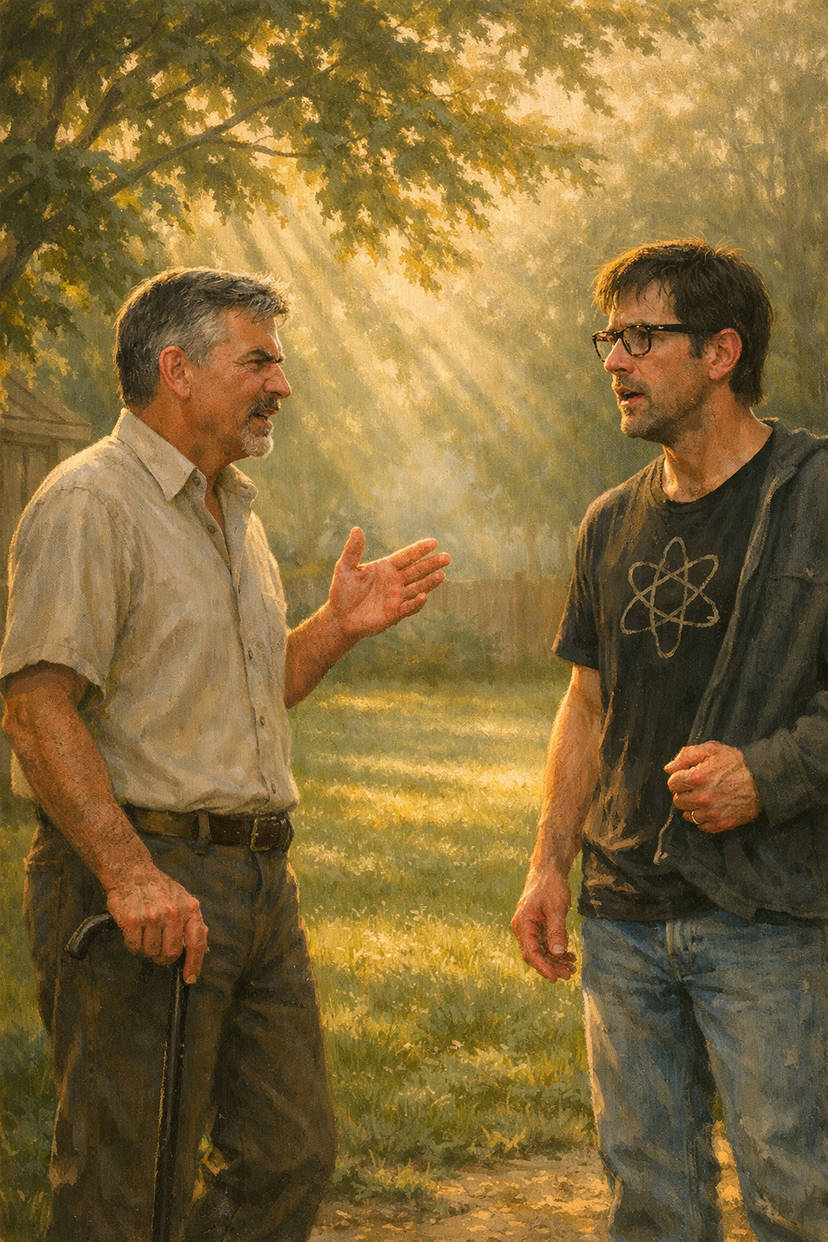
After breakfast, he insisted on going outside.
“I need air,” he said. “And I’m not asking permission.”
He walked the yard with surprising steadiness, leaning on the cane only out of habit. He pointed out the maple tree like it was still a sapling planted last year and not in 2005. He talked about neighbors who’d moved away years ago. He remembered Mom with a clarity that made my chest ache.
Then he slowed.
His gaze drifted toward the tree line, softening in a way I hadn’t seen since I was a kid.
“You know…” he said quietly, “sometimes I wonder what she’d be like now.”
I blinked. “Who?”
“Your sister. The girl your mother miscarried before you were born. She’d be thirty now if she’d lived.”
The world tilted.
He kept talking, gentle, reflective, like he was thinking aloud.
“She’d be seven years older than you. Probably bossing us both around.”
A small smile tugged at his mouth.
“Your mother always said she had your eyes. Funny thing to say about a baby we never got to meet.”
I felt something twist deep in my chest.
“I think about her sometimes,” he said. “Not in a sad way. Just… wondering. What job she’d have taken. Where she’d have gone to school.”
“She’d had have Mom’s looks and your personality,” I offered, thinking of my friends with a boy‑and‑girl pair and the general trend. She’d be the inverse of me: Mom’s temperament, Dad’s face.
Dad chuckled. “God help us… she definitely would’ve had both of us under her thumb.”
I added on, imagining what a thirty‑year‑old version of her might be like. “She’d probably have made you a grandfather already. Nailed down her career on coffee grinds and a pack of cigarettes. And she’d look at me and tell ‘baby brother’ to toughen up and try for something a little more ambitious with my life.”
Dad’s smile faltered.
Then melted.
Then vanished entirely.
He blinked at me — once, slow — and when his eyes focused again, they were sharper than they’d been all morning.
“Johnny,” he said, voice low, steady, and suddenly very serious. “If your sister had my personality… then you think—”
He cut himself off, jaw tightening.
Then he turned fully toward me, the air shifting with him, the way it used to when he was about to say something important — something he’d been holding back for years.
“Don’t you ever talk about yourself like that,” he said. Not angry. Not scolding. Convicted. “Not as the one who fell short or who didn’t measure up.”
I opened my mouth, but nothing came out.
He kept going, softer now, but with that same fierce clarity:
“You were never the weak one. You were never the one lagging behind. You hear me? You were the one who kept going. The one who tried. The one… the one who stayed when many would have just tossed me into a nursing home and thrown away the key.”
He swallowed, the muscles in his throat working.
“And if you think for one second that your mother or I ever looked at you and thought you weren’t enough…” He shook his head. “…then I didn’t do my job right.”
The words hit me like a blow — not because they hurt, but because they landed exactly where the bruise already was.
Dad always saw it. Even slipping backward through time.
He let out a breath, long and tired.
“Johnny,” he said again, quieter this time. “You’ve spent your whole damn life talking about yourself like you’re second best. And I should’ve stopped that sooner.”
I didn’t trust my voice, so I didn’t say anything. I just walked beside him, feeling the weight of his words settle into places I’d kept locked up for years.
When we stepped back onto the porch, the radio inside the house caught a few seconds of another song — something soft, aching, familiar.
“…if you’re gone… maybe it’s time to come home…”
Then static swallowed it.
Dad didn’t notice.
I did.
We went inside. He sat in his recliner, rubbing his thumb along the armrest — that nervous gesture I hadn’t seen since childhood.
“Johnny,” he said, “sit down a minute.”
I sat on the couch.
He stared at his hands. His jaw worked. His breath hitched.
“I wasn’t always… easy,” he said.
“Dad—”
“No. Let me say this.”
He didn’t look at me. He looked at the wall, or the past, or something only he could see.
“You know that. I yelled. I pushed. I expected too much sometimes. But I never—” His voice cracked. “I never meant for you to walk around thinking you weren’t enough.”
I swallowed hard.
He rubbed his thumb along the armrest again — that old tell, the one he only had when something mattered.
“You were a good kid,” he said. “A damn good kid. Smart. Kind. Worked harder than anyone I knew. And somewhere along the line, you got it in your head that you were second best. That you had something to prove. That you had to earn your place.”
He shook his head, eyes shining.
“That’s on me,” he said. “I should’ve told you more. I should’ve said it plain… made sure you knew.”
My throat tightened.
““Knew what?” I whispered.
“That you were enough,” he said. “Exactly as you were. Exactly as you are.”
He kept going, softer now, but with that same fierce conviction:
“I leaned on you too much after your mother died. I made you grow up too fast. I let you carry things a kid shouldn’t have had to carry. And I didn’t see what it did to you. I didn’t see how heavy it got.”
He looked away, blinking hard.
“I’m sorry for that,” he said. “For all of it. For the things I said. For the things I didn’t say. For the things I should’ve said every damn day. For not saying how damn proud you made me each and every day.”
He turned back to me.
“You deserved better from me,” he said. “And I’m telling you now, before I forget again.”
The words hung between us — heavy, warm, impossible.
And for the first time in years, I didn’t have a joke ready.
He cleared his throat, wiped his eyes, and waved a hand like he was shooing away a fly.
“There,” he muttered. “I said it. Don’t make a big deal out of it.”
But it was a big deal.
We spent the afternoon watching TV. He dozed. When he woke, he was a little younger again — not visibly, but in the way he spoke, the way he remembered, and the way he carried himself.
He asked me to make grilled cheese and tomato soup for dinner. I did and slightly charred the bread. He critiqued them like a man in his fifties.
After dinner, he yawned, settling back into the recliner.
“You know, Robbie…” he said softly, eyes half‑closed, “it was good catching up with you. I can’t tell you how Johnny’s schedule has got me running him around all over creation. The kid’s in too many damn extracurriculars… but Sue says it’ll all be worth it on his college application. Anyway, it was nice spending the day with you. A bit of a break.”
My breath caught.
He didn’t notice.
He drifted off, breathing slow and steady.
“Times have changed and times are strange… here I come, but I ain't the same…”
And I sat there in the dim light of the living room, listening to the faint hum of the radio, wondering how many more days I had before he slipped out of my reach entirely.
DAY THREE
I woke to the sound of someone singing.
It was a man’s voice, warm and confident, drifting down the hallway like it belonged to someone decades younger.
“…take me home tonight…”
I sat up too fast, heart thudding. The room spun for a second before settling. The house smelled like coffee — real coffee, not the weak stuff Dad had been drinking for years. And something else. Toast? Bacon?
I followed the music to the kitchen.
Dad was standing at the counter, barefoot, wearing jeans and a T‑shirt I hadn’t seen since I was a kid. His hair was salt and pepper and he’d acquired a heavy mustache on his face I vaguely remembered from early elementary school. He was flipping pancakes with the casual ease of a man who still had full strength in his shoulders.
He looked like he was in his late forties.
Maybe early fifties.
He looked… good.
He glanced over his shoulder. “Morning, Robbie.”
My stomach dropped.
He didn’t correct himself. He just turned back to the stove, singing along with the radio like it was 1986.
“…I don’t wanna let you go until you see the light…”
I swallowed. “Dad—uh, Gene?”
He didn’t turn around. “Coffee’s ready. Grab a mug.”
I did. My hands shook.
He plated the pancakes — perfectly golden, perfectly round — and set them on the table. “Eat. You look like hell.”
I sat. I ate. I watched him move around the kitchen with the ease of a man who hadn’t yet been worn down by time, grief, or illness.
He sat across from me, fork in hand, and said, “So. How’s the job hunt going?”
I blinked. “The what?”
“You said you were thinking of leaving the plant,” he said. “Trying something new. Something with better hours.”
I stared at him.
He stared back, waiting.
He wasn’t talking to me.
He was talking to Uncle Robert.
I forced a nod. “Right. Yeah. Still thinking about it.”
He grunted approvingly. “Good. You’re too damn smart to stay stuck there forever.”
I didn’t know what to do with that.
He kept eating, oblivious to the way my world was tilting.
After breakfast, he grabbed his jacket — the old brown one he wore when I was little — and said, “Come on, Robbie. Let’s get some air before the kid wakes up again.”
The kid.
Me.
My stomach tightened, but I followed him outside.
He walked with long, confident strides, hands in his pockets, shoulders loose. He looked like the man from the old photo albums — the man who carried me on his shoulders at the county fair, the man who fixed the porch steps himself, the man who still had a full head of hair and a future he hadn’t yet lived.
He let out a long sigh. “Johnny’s been a handful lately.”
I blinked. “Oh?”
“Teething,” he said, rubbing his jaw in sympathy. “Up half the night. Screaming like a banshee. Poor Sue’s exhausted.”
Hearing my mother’s name spoken so casually — so presently — made something in my chest twist.
He kept going, unaware of the emotional landmines he was stepping on.
“And he’s clingy as hell right now. Won’t let her out of his sight. I can’t even take a shower without him banging on the bathroom door like the world’s ending.”
I swallowed somehow feeling guilty for actions I didn’t remember. “Sounds… rough.”
He huffed a laugh. “He’s a good kid. Sweet kid. Just… lonely, I think.”
That made me stop walking.
Lonely?
He didn’t notice. He kept talking, voice softening.
“I feel bad for him, you know. Growing up all by himself. No big brother to show him the ropes. No big sister to boss him around. Just us. And god help him when we’re gone…”
My throat tightened.
He shoved his hands deeper into his pockets. “We wanted that for him. A sibling. Someone to grow up with. Someone to fight with and make up with and learn from or maybe teach.”
He paused.
“But now Sue’s started menopause,” he said quietly. “So that’s out.”
The words hit me like a blow.
He kept going, voice low and tired.
“We talked about adoption,” he said. “But we’re not really in a place to do that. Money’s tight. Hours at the plant are all over the place. And Sue’s worried she wouldn’t have the energy for two.”
He shook his head, staring at the ground.
“I just… I don’t want him to feel alone.”
I had to look away.
He wasn’t talking to me.
He was talking about toddler me, a little boy I barely remembered being. The boy he was trying so hard to raise right.
He sighed again, long and heavy.
“I worry he’ll grow up thinking he’s too much,” he said. “Or not enough. Or that he’s missing something everyone else has.”
My breath caught.
He kept walking, unaware of the way his words were slicing me open.
“I just want him to know he’s loved,” he said. “Even if he never gets a brother or sister. Even if it’s just us.”
He looked up at the sky, his brown eyes soft.
“He deserves the world, Robbie. I just hope I’m giving him enough of it.”
I couldn’t speak.
Not because I didn’t know what to say — but because I finally understood something I’d never known:
My father had worried about me. Not in the way he showed or that I remembered, but in a quiet, private way he never talked about, at least with me.
A car passed us as we walked and as it did the radio changed channels and modern song morphed into an early 80s hit.
“our house… in the middle of our street…”
Dad looked exhausted by the time we’d lapped the development an hour or so later. A car passed which
“The baby doesn’t sleep,” he muttered, rubbing his face with both hands. “I’m convinced of it. You had the right idea after all — I should’ve never had the little sleep‑depriving gremlin…”
He trailed off, then huffed a laugh, shaking his head.
“…but then he smiles at me, and I forget I haven’t slept in three days.”
My chest tightened.
He kept going, voice softening into something warm and worn‑in.
“He’s got Sue wrapped around his finger. Hell, he’s got me wrapped around his finger. Kid cries, and I’m halfway across the house before I even realize I moved.”
He smiled to himself — a young man’s smile, full of pride and disbelief.
“Never thought I’d be that guy,” he said. “The dad who melts the second his kid looks at him.”
He kicked a pebble down the sidewalk; hands shoved deep in his jacket pockets.
“I just… I want to do right by him, Robbie. I want him to grow up knowing he’s loved. Knowing he’s safe. Knowing he’s got someone in his corner.”
He exhaled, long and slow.
“I didn’t have that growing up. You know that. Dad was… Dad.” There was a short pause. “And I’m trying like hell not to be him.”
I swallowed hard.
He was talking about me and he was telling the truth — the truth he never said out loud when I was old enough to hear it.
We reached the house again. He paused at the door, rubbing his eyes.
“God, I need a nap,” he muttered. “But if I lie down, he’ll wake up the second my head hits the pillow. Kid’s got a sixth sense for when I’m about to rest.”
He opened the door and stepped inside, calling out automatically:
“Sue? You need anything?”
Silence answered him.
He didn’t notice.
He walked into the living room, dropped onto the couch, kicked off the sneakers he’d wore, and let out a groan that came from somewhere deep in his spine.
“Just five minutes,” he said, eyes already closing. “Five damn minutes…”
He was already asleep — breathing slow, steady, peaceful in a way I’d never seen.
I stood there in the doorway, watching him, listening to the house hum with the wrong decade, and wondered how much of my father I’d get to meet before he slipped even further away.
A soft crackle came from the radio on the side table, the kind of sound you’d miss if you weren’t listening for it. The station drifted, wavered, and then settled into a harmonica line that eased out, soft and melancholy and then gained steam like a steam engine.
“Playing a part in a picture-show… well, take the long way home…”
Gene stirred on the couch.
Not the slow, heavy stirring of a man waking from a deep sleep — but the disoriented twitch of someone who’s just been dropped into the wrong year. He blinked, rubbed his face, and sat up with a groan that didn’t belong to the man who’d just walked home from the diner with a one‑year‑old on his hip.
He exhaled, long and tired, and stared at the ceiling like it held answers he’d been chasing for years.
“You know…” he said, voice rough with sleep and something heavier, “when we cleaned out Dad’s house, I found something.”
My stomach tightened.
“You never see what you wanna see… forever playing to the gallery…”
He didn’t look at me — he thought he was talking to Robbie.
The harmonica kept playing, threading through the moment like a memory.
Gene rubbed his eyes again, then leaned back into the couch cushions, the weight of the past settling on him like dust from an attic box finally opened.
“There was this box,” he said. “Up in the attic. Buried under coats and tax papers from the sixties. I almost didn’t open it.”
He huffed a humorless laugh.
“Wish I hadn’t.”
He paused, jaw tightening.
“There was a medal,” he said. “For the Battle of the Bulge.”
My breath caught.
“Does it feel that your life's become a catastrophe? … oh, it has to be for you to grow, boy…”
Gene didn’t notice.
“I didn’t even know he’d been there,” he said. “He never said a damn thing. Not one word. Not to us. Not to Mom. Not to anyone.”
He shook his head, eyes distant.
“And there was this photo. Him and his squad. Ten guys. All smiling. All alive.”
He swallowed.
“Six of the names on the back had X’s next to them.”
He tapped the arm of the couch — once for each ghost.
“Six out of ten, Robbie. Six.”
The song drifted under his words, soft and weary.
Gene’s voice softened.
“And then there was this picture of him and Mom. Dancing. Young. Happy. And behind them was this banner — ‘1933 Pine Ford Dance Marathon.’”
He let out a breath that sounded like it hurt.
“Dad. At a dance marathon. Dad dancing at all.”
He rubbed his face with both hands.
“And suddenly it all made sense. The silence. The distance. The way he’d just… disappear into himself. The way he’d look at us like he was trying to remember who we were.”
He looked at me — at the man he thought was his brother — and misread my silence instantly.
“You think I’m jumping to conclusions,” he said. “You think I’m trying too hard to make a story out of scraps.”
I opened my mouth — nothing came out.
Gene nodded, bitter.
“Yeah. I know. But what else am I supposed to do? He took everything with him. Every answer. Every reason. Every goddamn secret.”
The song swelled, the line about taking the long way home floating through the room like a sigh.
Gene’s voice cracked.
“I’m just trying to understand him,” he whispered. “I’m just trying to understand the man who raised us.”
He looked down at his hands — hands that would one day hold me, steady me, teach me, fail me, love me.
“I’m just trying to understand why he couldn’t love us the way we needed.”
Gene let out a breath — sharp, embarrassed — and looked away, shaking his head like he regretted saying anything at all.
“Forget it,” he muttered. “I’m doing it again. Trying to make sense of a man who never said a goddamn thing.”
He pushed himself forward on the couch, hands sliding into his pockets like he needed something to hold onto. For a moment I thought he was just fidgeting.
But then his fingers closed around something small.
He hesitated — a long, fragile pause — then pulled out a tiny, worn sepia photograph. He didn’t hand it over right away. He just stared at it, thumb brushing the softened edge like he’d done it a thousand times.
“This was in the box too,” he said quietly. “At the bottom. Wrapped in an old handkerchief.”
He swallowed.
“It’s Aunt Betty.”
I blinked.
“Aunt Betty?”
Gene looked up, surprised — almost offended.
“Yeah. Dad’s sister. Betty Williams. The one who died when he was a kid.”
He kept going, assuming I knew exactly what he meant.
“You remember — her grave’s right next to Grandma’s. Little stone. Just says Elizabeth Ann Williams, 1913–1924. You and I found it one Memorial Day. You must’ve been… what, nine?”
“I… don’t remember that,” I said carefully.
He didn’t hear the truth in my voice — he thought I meant I didn’t remember the day, not the person.
Gene sighed, tired and sad.
“Yeah. You always were the one who forgot things.”
He hesitated, like handing it over meant admitting something he’d never said aloud. Then he placed it in my hand.
It was a small backyard snapshot — the kind taken with a cheap box camera in the early 1920s. The exposure was long enough that neither child smiled. They stood stiffly, solemnly, in front of a crooked fence and a wash line.
Betty stood behind him, one hand resting protectively on his shoulder. She looked to be about eleven years old and already looking like she understood the world better than she should.
And “Georgie” — ten, hair parted too neatly, shirt buttoned crooked — stood in front of her. Unsure, unsmiling, but somehow at ease. Because she was there.
The edges of the photo were worn soft.
A faint crease ran diagonally across it — the mark of being carried in a pocket for years.
On the back, in a child’s handwriting:
“Betty & Georgie — 1924.”
My throat tightened.
Gene watched me, misreading my silence again — but this time not as dismissal.
This time as understanding.
“He kept that his whole life,” Gene said, voice barely above a whisper. “Never showed it to anyone. Never talked about her. Never talked about… anything.”
He rubbed his face with both hands.
“I think he loved her more than he ever loved any of us. And when she died… I think the part of him that knew how to love died with her.”
The song faded into the background, leaving only the hum of the house and the weight of everything Gene had never said aloud.
“You took the long way home…”
I looked back at the photo — at the boy who would become the man who would become my father’s father — and for the first time, I saw George not as the cold, distant figure from my childhood, but as a ten‑year‑old boy who lost the person who made him feel safe.
And I realized:
Dad had been trying to understand his father too.
And failing, just like I had.
Because just like Dad, all I had were these brief snippets of his life – flashes of light in a long dark unknowable night – but not the through narrative.
The radio in the kitchen shifted again, drifting into something older, softer.
“When I think of home… I think of a place where there's love overflowing… I wish I was home…”
He looked… different now. Younger, but not young. His hair darker. His face smoother. His mustache trimmed into the neat, squared‑off style from the photos from before I was born.
He sat up with a groan. “Robbie? Christ, I didn’t hear you come in. How long was I out?”
“Five minutes,” I said. Though he looked like he’d shed five years.
He laughed, rubbing his face. “Feels like it. I swear, I close my eyes for a second and the whole damn day disappears.”
He pushed himself off the couch and wandered toward the kitchen, humming something soft and familiar — something from the late 70s.
“Maybe there's a chance for me to go back there… now that I have some direction…”
He stopped at the counter, bracing his hands on the laminate like he needed to steady himself.
“You know,” he said, voice drifting, “Sue and I were talking last night.”
My breath caught.
He kept going, unaware of the way the floor had dropped out beneath me.
“About… trying again.”
He looked to me as if looking for my thoughts… my approval.
“And just maybe I can convince time to slow up… giving me enough time in my life to grow up… time be my friend, let me start again…”
“I mean… I think you should, why shouldn’t you? You’re not getting any younger,” I said, feeling awkward at the interaction, but saying what I thought Uncle Robert might have said.
Gene rubbed the back of his neck, embarrassed and hopeful and scared all at once.
“I mean, we’re not kids anymore,” he said. “We’re pushing forty. Hell, with how I’m on my feet all day and bending over at the plant, my back and feet feel forty‑five most days. And after… after what happened last time…”
He trailed off, swallowing hard.
The miscarriage.
“Suddenly my world has changed it's face… but I still know where I'm going…”
He cleared his throat, trying to sound casual and failing.
“Sue keeps saying maybe it’s not too late,” he said. “But I don’t know. I keep thinking… what if we’re past the point where it makes sense? What if we’re too old to start? What if we don’t have the energy for a baby anymore?”
I bit my lip to keep from saying anything. He kept going, the words tumbling out now — familiar words, painfully familiar.
“What if I can’t keep up?” he said. “What if I’m already too tired? What if I’m the dad who can’t get down on the floor without cramping? What if I’m the old guy at the playground who can’t wrangle my kid without throwing his back out?”
He wasn’t quoting me—he couldn’t be. But he was saying everything I had said to him — every fear, every excuse, every self‑protective argument — just reframed through the lens of a man who wanted a child desperately and was terrified he’d missed his chance. And that hit hard… and stung deep.
“And what if the kid ends up alone anyway?” he said. “What if we only get one? What if they grow up without a sibling? Without someone to lean on? Could we be enough for them?”
He was talking about the life he hadn’t lived yet — the life that would eventually lead to me.
“Tell us, should we run away… should we try and stay…”
He paced the kitchen, restless.
“And men our age aren’t having kids anymore. So that means I’ll be stuck around the younger dads. Oh god…” he said. “What if they look at me like I’m their uncle? What if some PTA Mom thinks I’m grandpa come to pick up my kid? What if I’m standing there at Little League feeling like the odd man out because everyone else is twenty‑eight and I’m… not?”
He laughed once, humorless.
“Christ, I can already hear one of them calling me ‘sir.’ I’d probably throw my shoulder out trying to punch him.”
My chest twisted.
He kept going, voice softer now, more vulnerable.
“And what if being older makes me miss things?” he said. “What if I’m too tired to play? What if I’m too worn down to be present? What if I’m not the father a kid deserves at my age?”
He stopped pacing and leaned against the counter, staring at the floor.
“I just don’t want to screw it up,” he said. “I don’t want to be like Dad. I don’t want to be the kind of father who… who leaves a kid feeling alone.”
He swallowed hard.
“I want to give her a family,” he said. “I want to give us a family. But I don’t know if we can do it. Not at our age. Not after everything.”
He looked up at me, eyes shining with fear and hope and exhaustion.
“What do you think, Robbie?” he asked. “Should we try again?”
I tried hard to steady myself, forcing my voice to sound reassuring and confident in what it was saying.
“I think,” I said softly, “you’ll regret if you don’t try. But ultimately, it’s not my place to tell you whether you should or not—that’s only something you two can figure out together.”
He let out a shaky breath, nodding slowly.
“Yeah,” he whispered. “Yeah. Maybe you’re right.”
He smiled — a tired, hopeful smile.
“Thanks, Robbie,” he said putting a hand on my shoulder and looking at me as if I was his sage older brother who’d never steer him wrong. “I… I needed to hear that.”
The radio static picked up again, drawing my attention to it as a twangy country song with the earnest vocals of John Denver filtered through the radio.
“The light in your eyes that makes me warm… hey, it's good to be back home again…”
Gene’s face softened at the sound — not with nostalgia, but with recognition.
Like he’d heard it on the radio that morning.
Like it belonged to now.
He blinked, swayed a little, and when he steadied himself, he looked younger again.
Not dramatically — just enough that the lines around his eyes eased and the tiredness in his shoulders lifted.
He let out a breath that trembled with something too big to hold.
“Robbie,” he said, voice suddenly bright and breathless, “you’re not gonna believe this.”
My stomach tightened.
He didn’t wait for me to answer.
He grabbed my arm with both hands, practically vibrating.
“She’s pregnant,” he said. “Sue’s pregnant.”
The words hit me like a blow. He didn’t notice. He was glowing — incandescent with joy.
“Eight years,” he said, laughing in disbelief. “Eight goddamn years of trying and failing and doctors shrugging their shoulders — and now? Now it finally happened.”
He moved around the kitchen with the restless, buoyant energy of a man whose life had just cracked open in the best possible way.
“I’ve been carrying this around all day,” he said, reaching into the cabinet above the fridge. He pulled out a dusty box, opened it, and revealed a single cigar. “Been saving this for when it finally happened.”
He held it up like a trophy.
“Figured I’d share it with my big brother,” he said. “Because who else am I gonna tell first?”
“Right… who else?” I echoed.
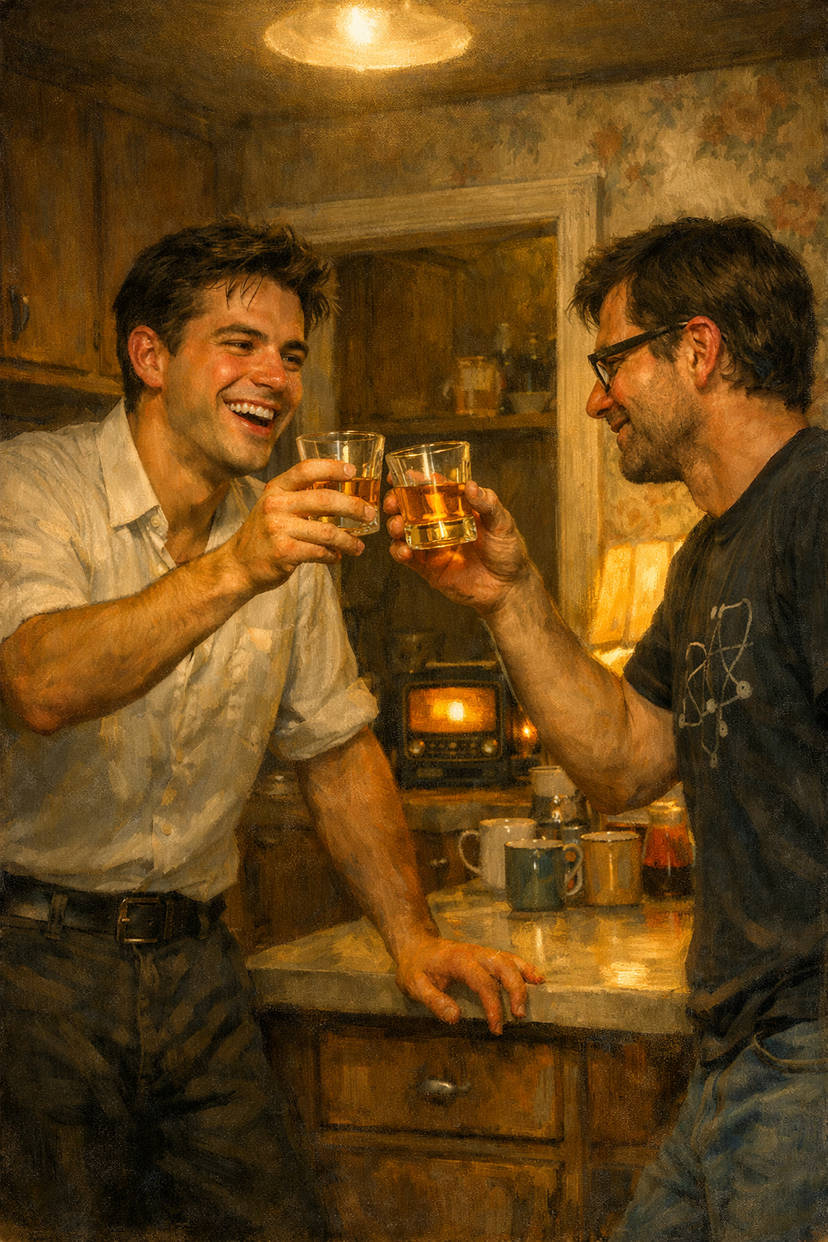
He rummaged again and pulled out a bottle — cheap whiskey, the kind he and Uncle Robert used to drink whenever they thought I was asleep and Mom was working late.
He set two glasses on the counter.
“Come on,” he said, voice thick with joy. “We gotta celebrate. I’m gonna be a dad.”
He poured the drinks with shaking hands.
“I mean, can you believe it?” he said. “Me. A dad. After all this time.”
He wiped his mouth with the back of his hand, still smiling.
“I can’t wait to meet them,” he said. “I can’t wait to hold them. I can’t wait to be a dad.”
The radio crackled again — a soft pop, a hiss, a shift — and suddenly the warm John Denver glow faded into something more earnest, more plaintive, more unmistakably early‑70s.
“…and you, of tender years, can’t know the fears that your elders grew by…”
Gene flinched at the sound like it hit a bruise.
He was younger again — not by much, but enough. His shoulders less weighed down by years of trying and failing.
He sat at the kitchen table with the half‑empty bottle of cheap whiskey in front of him, staring at the label like it had personally offended him.
“Another false alarm,” he muttered.
“I’m sorry,” I said.
“What for? Did you cause Sue to bleed out?” he joked darkly.
He was talking to Robbie — the brother who’d been there for every disappointment.
“Sue’s at her mother’s,” he said, rubbing his eyes with the heel of his hand. “Didn’t want me to see her cry again.”
He let out a humorless laugh. “Like I don’t know what she looks like when she cries.”
He reached for the whiskey, took a long swallow, and set it down harder than he meant to.
“Four years,” he said. “Four goddamn years of this. Every month, we get our hopes up. Every month, we get kicked in the teeth.”
He leaned back in the chair, staring at the ceiling.
“I don’t know how many more times we can do this.”
The radio hummed behind him, Crosby, Stills, Nash & Young harmonizing like they were narrating the moment.
“…and so become yourself, because the past is just a goodbye…”
Gene snorted.
“The past is never a goodbye,” he said. “The past sticks to you like tar.”
He grabbed the bottle again, took another drink, and finally looked at me — eyes tired, red‑rimmed, and too young to be carrying this much grief.
“You ever feel like you’re being punished?” he asked. “Like no matter how hard you try, something out there’s keeping score?”
He shook his head.
“I keep thinking maybe it’s me,” he said. “Maybe I’m the problem. Maybe I’m not meant to be a father.”
My chest tightened.
He kept going, voice cracking around the edges.
“I mean, look at me,” he said. “I’m already tired all the time. I’m already worn down. I’m already… old.”
I couldn’t help but snort, earning me a knowing look.
He wasn’t old. He was thirty‑two if I had my math right. But he had felt old and defeated in this moment. He’d felt like time was slipping through his fingers.
He rubbed his face again, harder this time.
“And what if I turn into him?” he whispered.
“Him?” I echoed.
He sighed.
“Yeah… what if I’m too much like Dad?” he said. “What if I get angry like he did? What if I shut down like he did? What if I can’t say the right things? What if I can’t say anything at all?”
He laughed — a small, broken sound.
“He never said he was proud of us,” he said. “Not once. Not even when we did something worth being proud of.”
He looked down at his hands.
“I don’t want to be that man,” he said. “I don’t want my kid to grow up wondering if I ever loved them.”
He swallowed hard.
“But what if I can’t help it? What if it’s in me? What if it’s baked in?”
The radio kept playing, soft and relentless.
“…and you of tender years, can’t know the fears that your elders grew by…”
Gene let out a shaky breath.
“I don’t want to pass this on,” he said. “I don’t want to hand down the same silence. The same distance. The same… emptiness.”
He looked at me — really looked — and for a moment, he wasn’t talking to Uncle Robert. He was talking to the son he didn’t know he had yet.
“I want to be better,” he whispered. “I want to be better than him.”
He wiped his eyes quickly, like he didn’t want anyone to see.
“But I don’t know if I can be.”
He reached for the bottle again, but his hand shook too much to pick it up.
He let it fall back to the table.
“Robbie,” he said, voice barely holding together, “what if I’m not enough?”
The radio hummed the answer he couldn’t hear.
“…teach your children well…”
And I sat there, watching my father — thirty‑two years old, grieving a child who never existed, terrified of becoming the man who raised him, not knowing what the hell to do or say besides take a drink with him and sit with him as the radio turned to static again.
The radio crackled again — a soft pop, a hiss, a shift — and suddenly the warm harmonies of Crosby, Stills, Nash & Young dissolved into something cleaner, simpler, unmistakably mid‑60s.
“…I’m sittin’ in the railway station, got a ticket for my destination…”
Gene blinked, swayed, and when he steadied himself, he looked younger than I’d ever seen him. Twenty‑eight. He suddenly looked hopeful, nervous and alive in a way I’d only seen in photographs.
He ran a hand through his dark hair — thick, full, not yet touched by gray — and let out a breath that trembled with excitement.
“Robbie,” he said, voice bright and breathless, “she said yes!”
My stomach tightened—sloshing with the decent amount of whiskey I’d already consumed.
He didn’t wait for me to answer. Instead, he grabbed my shoulders with both hands, shaking me like he couldn’t contain the joy in his body.
“She said yes!” he repeated, laughing. “Sue said yes!”
He let go only to pace the kitchen, running his hands through his hair again, grinning like a man who’d just been handed the rest of his life.
“I asked her outside the diner,” he said. “Right there in the parking lot. I didn’t even plan it — I just… I looked at her, and I knew. I knew I didn’t want to spend another day without her.”
He stopped pacing, eyes shining.
“And she said yes,” he whispered. “Just like that. Like it was the easiest thing in the world.”
The radio hummed behind him, Paul Simon and Art Garfunkel’s voices threading through the moment like a memory I’d never lived.
“…Home where my love lies waitin'… Silently for me…”
Gene laughed, wiping at his eyes.
“I’m gonna marry her, Robbie,” he said. “I’m really gonna marry her.”
He reached into the cabinet above the fridge — the same place he’d kept the cigar in 1974 — and pulled out another bottle of cheap whiskey.
“I’ve been saving this,” he said. “Didn’t know for what. Guess I know now.”
He grabbed two mismatched glasses from the counter and poured, spilling half of it because his hands were shaking too much to aim.
He shoved a glass toward me.
“To Sue,” he said. “To the rest of my damn life.”
I swallowed hard and lifted my glass.
“To Sue,” I echoed.
We drank.
He wiped his mouth with the back of his hand, grinning.
“You’ll stand up with me, right?” he asked. “At the wedding?”
He wasn’t asking me, he was asking Uncle Robert, I reminded myself.
I forced a nod. “Yeah. Of course.”
He let out a relieved laugh — the kind that comes from a man who’s been holding his breath for years.
“Good,” he said. “I… I don’t think I could do it without you, Robbie.”
He poured more whiskey — too much, too fast — and we drank again.
And again.
And again.
The kitchen blurred around the edges all the while the radio kept playing, soft and steady.
“…I need someone to comfort me…”
Gene leaned back in his chair, smiling at nothing.
“She’s my home, Robbie,” he murmured. “Wherever she is… that’s home.”
His head drooped forward.
I reached out to steady him — but the room tilted, warm and slow, and my own body gave out beneath me.
We slid down together, two men from two different decades, collapsing onto the linoleum floor of a kitchen that didn’t belong to either of us anymore.
The radio hummed on.
“…I’m homeward bound…”
Gene’s breathing slowed, deep and even.
“…home… where my thought’s escapin’…”
My eyes drifted shut.
“…home… where my music’s playin’…”
The last thing I heard before sleep took me was Gene’s voice, soft and slurred and full of wonder.
“She said yes, Robbie… she really said yes…”
And then everything went dark.
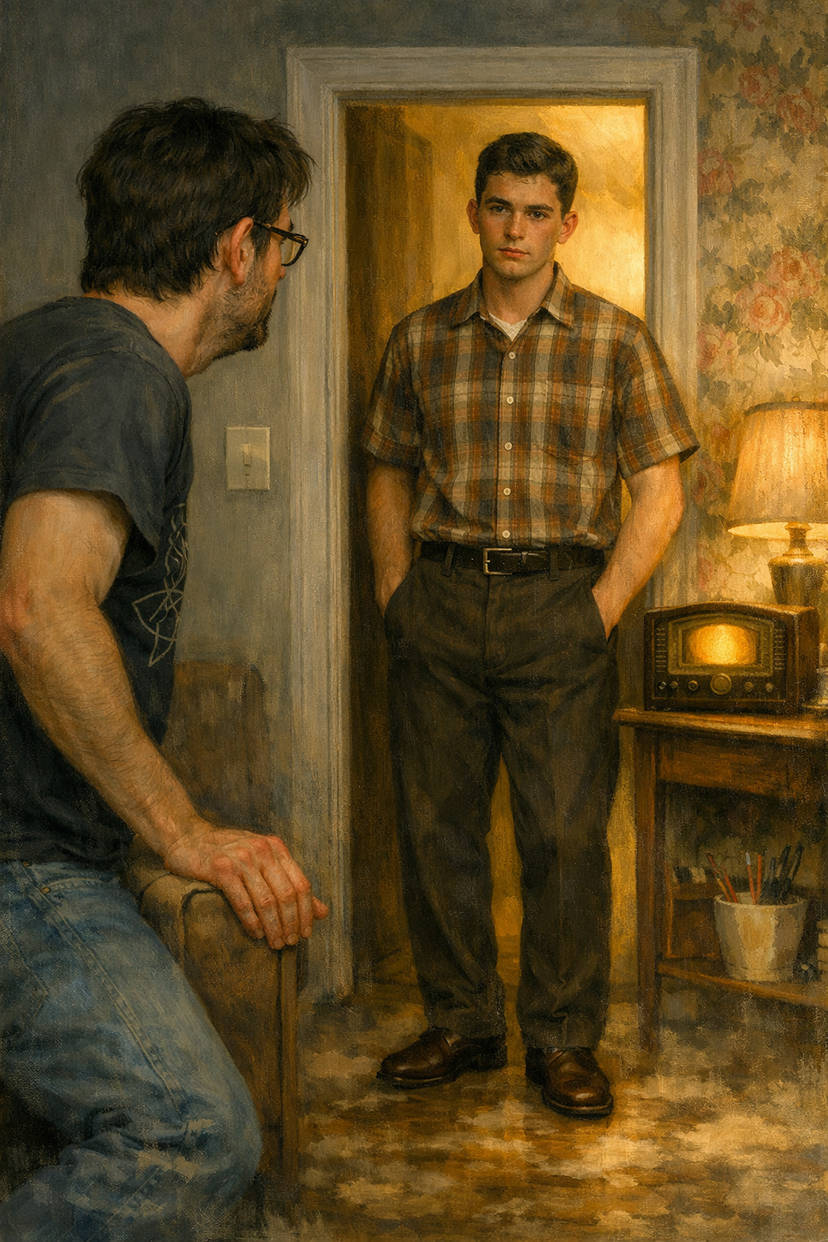
DAY FOUR
I woke first.
My head throbbed. My mouth tasted like cheap whiskey and bad decisions. The kitchen floor was cold under my cheek, and for a moment I couldn’t remember what decade I was supposed to be in.
Then I saw him.
Dad… Gene.
Younger again — not by much, but enough to tell the difference.
He looked, if I had to guess, somewhere around twenty‑five. The age where you’re technically an adult but still feel like a kid pretending and hoping no one notices.
His hair was darker, shorter and clean cut. His face smoother with no sign of any facial hair. His body was leaner, wirier, still carrying the tension of a man who hasn’t yet learned how to breathe.
He was sprawled on the linoleum like he’d been dropped there. Dried vomit from at some point stretched out across the linoleum next to him.
I nudged him gently with my foot. “Gene. Hey. Wake up.”
He groaned, low and miserable. “Jesus… Robbie, turn off the sun…”
I huffed a laugh despite the pounding in my skull. “We’re inside.”
He cracked one eye open, and he froze as he looked up at me — a forty-four‑year‑old man standing over him — and his whole body went rigid.
He reacted like a young man caught drunk by someone with… authority.
His face drained of color.
“Oh shit,” he whispered. “Dad— I— I wasn’t— I didn’t mean—”
He wasn’t talking to me, but to the man he thought I was.
He scrambled upright too fast, winced, tried to straighten his shirt, tried to look less like a man who’d passed out drunk in his parents’ kitchen.
He wouldn’t meet my eyes.
“I’m sorry, sir,” he blurted. “I didn’t think you’d be up. I wasn’t trying to… disappoint you.”
I winced as I realized that he thought I was my grandfather, George. My mind jumped to the scraps he’d given me yesterday — George the war veteran who lost over half his squad. The Depression kid who met his wife at a dance marathon. Georgie, the boy whose sister Betty died at eleven. The patchwork quilt my dad had stitched together to explain the man who raised him.
I reached out a hand and he flinched.
Not dramatically — just a tiny, instinctive recoil, the kind you develop when kindness was never the default. The kind of flinch you learn from a father who never raised his hand — only his expectations.
“It’s okay,” I said softly. “Come on. Let’s get you up.”
He stared at my hand like it was something dangerous.
Then, slowly, he took it.
I pulled him to his feet. He swayed, grabbed the counter, and blinked hard.
“You’re… not mad?” he asked, voice small.
“No,” I said. “I’m not mad.”
He swallowed, confused. “You’re… helping me.”
“Yeah,” I said. “I am.”
He didn’t know what to do with that.
He stood there, stunned, as I filled a glass with water and set it in front of him. His mouth dropped as I cracked two eggs into a mug, added Worcestershire, salt, pepper — the hangover cure he’d taught me decades later.
He watched every movement like it was something sacred.
“You don’t have to do this,” he murmured. “I can take care of myself.”
But he didn’t sound convinced.
I slid the glass toward him. “Drink.”
He obeyed without argument.
And that’s when the radio — the ever‑present, decade‑slipping radio — gave a soft crackle followed with a warm hum.
And then:
“…he isn’t much in the eyes of the world…”
Gene froze.
His eyes widened.
“…but he is the world to me…”
Paul Petersen’s voice filled the kitchen — earnest, tender, painfully sincere.
Gene’s breath hitched.
He looked at me — at the man he thought was his father — and something in his face cracked open.
“I… I didn’t think you cared,” he whispered.
My throat tightened. I wasn’t prepared for this version of him — the one who still believed his father could break him with silence.
He kept going, voice trembling.
“You never… you never did this. Not when I was sick. Not when I messed up. Not when I…”
He swallowed hard.
“…not ever.”
The song kept playing, soft and relentless.
“…my dad, now here is a man…”
Gene’s eyes filled.
“I always wanted you to…”
He stopped, shaking his head. “Never mind.”
He took another sip of the hangover cure, hands shaking.
“I don’t know what to do with this,” he admitted. “With you being… kind.”
I swallowed hard.
“Just let me help,” I said.
He nodded, small and uncertain, like a boy who’d never been taken care of before.
And as the song drifted through the kitchen, Gene leaned against the counter, eyes closed, breathing slow and uneven — a man caught between decades, between identities, between the father he had and the father he wanted to be.
“…my dad…”
Gene kept his eyes closed for a long moment, breathing like each inhale cost him something. The song drifted through the kitchen, soft and syrupy, the kind of thing a 1963 radio would play without irony.
“…he’s the reason I’m this way, my dad…”
His jaw tightened.
He didn’t look at me when he spoke.
“You know,” he said quietly, “I used to think… if I could just do everything right… maybe you’d see me.”
I stopped mid‑drink, nearly choking on my own hangover cure.
“But here I was passed out on Mom’s kitchen floor, having spilled my guts all over her linoleum, and it turns out I just had to mess up enough for you to do something for me. If I’d known that…”
He let out a humorless laugh.
“…I’d have fucked up more growing up.”
Fuck, did I just mess something up?
He swallowed hard.
“I tried,” he said. “God, I tried. I worked hard. I didn’t talk back. I kept my head down. I did everything you wanted. And it was never enough.”
He let out a shaky breath.
“You always looked at Robbie like he hung the moon,” he said. “And me? I was just… there.”
He rubbed his face with both hands, embarrassed by the confession even as it spilled out of him.
“I know I shouldn’t say that,” he muttered. “I know it sounds childish. I know I should be over it by now.”
He wasn’t over it, and I now knew he’d never been over it. My heart ached for him.
And the song kept playing, soft and relentless, like it was narrating the moment:
“my dad…oh, I love him so…”
Gene’s shoulders curled inward, like the music itself was too much.
He kept talking, but quieter now, like he was afraid of being heard.
“I used to lie awake at night,” he said, “trying to figure out what I was doing wrong. Why you didn’t look at me the way you looked at him. Why nothing I did ever seemed to matter.”
He laughed again — small, bitter, self‑protective.
“Robbie could breathe wrong and you’d pat him on the back. I could rebuild an engine and you’d tell me to mow the lawn.”
He shook his head.
“I know it’s stupid. I know I sound like a kid. But it’s the truth.”
He looked at me — at the man he thought was his father — and the fear in his eyes was so raw it didn’t belong on a grown man.
“And I only hope that someday…”
“I didn’t think you cared,” he whispered. “Not about me.”
“my own son will say…”
“Gene, I—”
What could I say that grandpa hadn’t? I couldn’t just let him stand there spilling his guts and not say anything.
“my dad…”
He crossed his arms expectantly as if waiting for me to give him an answer that would explain everything.
“That’s not true, I’m sure I expressed how much I cared how I felt comfortable doing.”
“Yeah… never.”
Something in him was about to give way — I could feel it.
Gene’s breath hitched — a sharp, fragile inhale — and then the radio clicked, like someone had nudged the dial from inside the wall.
There was static followed by a soft hum from the strings, and then that voice — warm, aching, too big for the room.
“I’ll take you home again, Kathleen…”
The opening line drifted through the air like a ghost brushing past us.
Gene flinched with a tiny recoil, the kind a man makes when a memory hits him in a place he didn’t know was still tender.
The lighting in the room shifted, not brighter or darker, just… older.
And Gene changed with it.
His shoulders tightened — the posture of someone bracing for a blow he’d already taken once. His face looked younger, not just in the skin but in the fear behind it.
He rubbed his face again, but this time it wasn’t embarrassment. It was regret and fear mixed together in the unmistakable shape of a slight twenty-year-old boy trying to hold himself together.
“I shouldn’t’ve said all that,” he muttered. His voice was lighter now, pitched wrong for the man standing in front of me. “Forget it, Dad. I was… I was worked up… sir.”
He started pacing — that restless, angry pacing young men do when they want to look grown but still feel like kids in trouble.
The song kept threading through the moment, soft and relentless:
“…Your voice is sad when you speak…”
Gene swallowed hard.
“I didn’t mean to mouth off,” he said. “I know you don’t want to hear that crap.”
He stopped pacing and his hands dropped to his sides.
“I shouldn’t’ve gone out tonight,” he said quietly. “I know that.”
I heard myself ask, “Where were you?”
“Oh, I will take you back, Kathleen…”
Gene’s voice cracked.
“Out on Death Highway — but I wasn’t racing! I was just watching. I swear. I wasn’t doing anything wrong.”
He said it like he’d rehearsed it.
Like he’d stood in front of a mirror practicing the defense he knew wouldn’t matter.
He looked at me — at the man he thought was George Williams — and the fear in his eyes didn’t belong on a twenty‑year‑old. It belonged on a child.
“To where your heart will feel no pain…”
“I know you don’t believe me,” he whispered.
I opened my mouth, but he rushed on, panicked.
“I wasn’t drinking. I wasn’t racing. I wasn’t— I wasn’t being stupid. I just— I just wanted to see it.”
His hands shook.
“I just wanted to feel like—”
He couldn’t finish.
The song filled the silence:
“…I'll take you to your home again…”
He clenched his jaw.
“I know I messed up,” he whispered. “I know you’re mad.”
I stepped toward him, softening my voice instinctively.
“Gene,” I said, “Stop.”
He absolutely froze, because George had never said that word gently to him before.
His eyes snapped up to mine — wide, confused, hopeful, terrified.
Gene shrank emotionally and he whispered:
“Please don’t be mad.”
And I felt the floor tilt under us as the room flickered again.
The neon tint deepened and the air warmed. This time the kitchen shifted as a faint smell of fryer oil sharpened how I perceived it, and the radio — the real one in the house — shifted stations on its own.
There was a moment of static, a slight scratch and then Eddie Fisher’s voice, rich and aching, drifted through the air like a memory trying to hold itself together.
A single line drifted out, heavy as a confession:
“I see a lotta things along the way… and I did a lotta thinkin’ on the way…”
Gene straightened his shirt which seemed to bag a little as he got skinner, and a little lankier. He smoothed his greased hair and sat up like he was in a booth instead of his kitchen table.
“I rode by a house… with the windows lighted up…”
He kept glancing at me like I still was his father—I could tell from that nervous hopeful look that didn’t belong on a grown man’s face, but it belonged on an eighteen‑year‑old boy who wanted his father to be proud.
“Dad,” he said, voice lighter, younger, “I didn’t think you’d… y’know. Take me out like this.”
“Lookin’ brighter than a Christmas tree…”
Gene then cleared his throat like he was about to give a speech. Not a confident one — the kind a kid gives when he’s terrified of getting it wrong.
He laughed — a thin, nervous sound — and rubbed the back of his neck.
“I mean, I know you’re busy. And tired. And you don’t… you don’t have to do stuff like this.”
He kept glancing at me like he was checking a script he didn’t trust himself to remember.
Gene swallowed hard.
“I, uh… I know the welding thing isn’t… it’s not like getting into college or winning a football game or anything like… Robbie. But the judges said my bead was the cleanest they’d seen from a student.”
He said it like he wasn’t sure he was allowed to be proud of it.
He looked at me again — at George — waiting for something.
Approval. A nod. Some sign that he hadn’t imagined the warmth earlier.
I felt the weight of it — the way the whole memory leaned toward me, waiting for the line my grandfather, George Williams had never said.
Gene rushed on before I could speak.
“I practiced a lot,” he said quickly. “Like… a lot. After school. Before school. I even stayed late in the shop on Fridays. Mr. Donnelly said I had a real eye for it.”
He laughed again, but it cracked this time.
“I know you probably don’t care about that. I know it’s not— it’s not important or anything.”
Gene kept going, words tumbling out faster now.
“I just— I wanted to do something right. Something you’d… I dunno. Something you’d think was worth something.”
He looked down at his hands.
“I didn’t want to embarrass you and Mom.”
That one hit me like a punch.
He was trying to prove he deserved to be here — in this booth that wasn’t a booth.
He lifted his head again, eyes bright with hope he didn’t know how to hide.
“I thought maybe… maybe you’d be proud.”
Gene didn’t blink. The neon hum of the memory flickered like it was waiting for me to say the line George never said.
I opened my mouth — and Gene leaned forward, desperate.
“Dad,” he whispered, “I did good today. Didn’t I?”
And that was the moment I realized:
He wasn’t trying to impress George.
He was trying to earn him.
I didn’t get a chance to answer.
Because she appeared.
A teenage girl stepped into the room like she’d been there all along — just waiting for the memory to catch up. She was dressed in saddle shoes, a plaid skirt, buttoned up blouse, and a cardigan. She flickered at the edges, like a photograph developing too fast. The sight of her fading in like that shocked me silent.
“Gene!” she said, delighted. “I didn’t know you were here!”
“And I said to myself…”
Gene went red instantly. He sat up straighter, then slouched, then straightened again — a boy caught between pride and panic.
“As I rode by myself…”
“Uh— hey, Mary,” he stammered. “I— I didn’t think you were working tonight.”
Mary laughed, warm and oblivious to the emotional landmine she’d just stepped on.
“I’m not, but I had to come congratulate you!” she said, stepping closer. “Everyone’s talking about your weld. They said it was the cleanest bead they’ve seen from a student. Congratulations on winning the competition—I told you that you could do it!”
She grabbed his hand comfortably, as if she were used to holding it.
Gene’s eyes flicked to me again. He looked like he might pass out. In that one moment I could read this moment instantly. I’d see that same worry on my own teenage self many times:
This was supposed to be perfect. This was the one-night Dad was proud of him, and the perfect someone, his girlfriend — the one he never told his father about — was standing right here unintentionally destroying the moment.
Gene swallowed. Smiled at her and then looked nervously at me—or George.
“Dad… this is Mary. Mary, this is my father, George Williams.”
I noticed that for some reason he left off her last name, which I thought odd, but regardless held out my hand to shake Mary’s. She looked to Gene and then took it.
“Ev'rybody’s got a home but me…”
She finally turned to me.
“Mr. Williams,” she said, all polite sweetness. “My name’s Mary O’Keefe. It’s really nice to meet you.”
I opened my mouth — to say what, I don’t know — and she gave me the smallest, sharpest look. A flicker. Gone in an instant.
Then she smiled again, bright as ever the moment Gene looked at her.
“Gene’s been looking forward to tonight,” she said lightly.
There was weight under it, a cue I didn’t understand yet.
Gene beamed at me, waiting for something — anything — that would keep this moment intact.
I hesitated.
Mary stepped closer, still smiling at Gene, but her voice dipped just enough for me to hear.
“Just follow his lead and stay in character,” she murmured.
“What?” I whispered back, confused.
She frowned at me — a tiny crease, gone the second Gene looked her way. He didn’t notice. He was too busy trying not to die of embarrassment.
Mary turned back to him, softening.
“I’m sorry if I interrupted,” she said. “I didn’t mean to barge in. I can come back later if you want.”
Gene shook his head too fast.
“No! No, it’s— it’s fine. I just— Dad and I were—”
He couldn’t finish. He didn’t know how to finish. He was terrified of ruining the one good moment he ever had with his father.
Mary saw it. She softened even more.
“You did great today, Gene,” she said gently. “Really.”
Then she glanced at me again — and this time the cue was unmistakable, even if it was still wrapped in sweetness.
“You were just about to tell him something important, weren’t you, Mr. Williams?”
Her eyes held mine for a heartbeat.
It was a warning of some sort—something for me, not George, like she could see more than my own father. What was she? Where had she come from? Who was she, really?
I didn’t have time to ask.
She stepped back, giving Gene space, giving me the chance to step into the role he needed.
Gene was still looking at me — at him — waiting for the line he’d never gotten. His hands were flat on the table, knuckles white.
“Dad,” he said, voice trembling with hope he didn’t know how to hide, “I did good today. Didn’t I?”
The air shifted.
Gene’s eyes flicked to my face, searching for the expression he remembered — or wanted to remember.
And then I felt it. Like the memory was trying to place a line in my mouth.
George had leaned forward that night. Just enough for Gene to think something was coming.
And he’d said:
“Gene… there’s something I should tell you.”
I felt the rest of the sentence hovering in the air, unfinished, unsaid, but heavy enough to bend the moment around it.
He’d meant to say something like:
“I’m proud of you.”
“You’re becoming a man.”
“I see you trying.”
But my grandfather it seemed wasn’t a man who could cross the distance between intention and speech.
I could feel the memory leaning toward me, waiting for the line my grandfather had never said, and I panicked.
Something in me lurched — the instinct to fix it, to comfort him, to give him the thing he’d never gotten.
So, I pushed back.
“Gene,” I said softly, “of course you’re doing good—”
His whole face changed.
Not with shock or disbelief, but with something worse — something deeper: relief.
He breathed out like he’d been holding that air since 1956.
“You… you mean it?” he whispered.
He leaned forward, shoulders loosening, eyes shining. He looked younger — not just in the way a boy looks when he finally hears the thing he’s been starving for.
For a second, the diner overlay to the kitchen brightened, and the neon steadied.
And Eddie Fisher’s voice smoothed into a warm hum:
“When I’m talkin’ to myself… and there’s no one there to disagree…”
The memory wanted this. Hell, Gene wanted this. And somehow, I knew that that was the problem.
Mary moved fast. She was still the sweetly smiling perfect 1950s girl to glance at her, but her eyes — her eyes were sharp with panic.
She stepped between us just slightly, angled so Gene wouldn’t notice, and said brightly:
“Mr. Williams, I think what you meant was—”
I blinked.
“What?”
Her smile didn’t move, but her voice dropped to a whisper only I could hear:
“Not like that.”
Gene didn’t hear her. He was still staring at me like I’d handed him the moon.
“I knew it,” he said, voice trembling. “I knew you were proud. I knew—”
Mary cut in again, louder this time, still cheerful, still in character:
“Gene, honey, your dad was just saying how hard you worked. Isn’t that right, Mr. Williams?”
Her eyes locked onto mine — a warning, a plea, a command. For me to play the part. Don’t give him something he never got.
But it was too late, Gene was already leaning into the warmth, drinking it in like water.
“I am free… and I’m happy to be free…”
“I knew you saw me,” Gene whispered. “I knew you did.”
Mary’s smile tightened.
“Mr. Williams,” she said, voice bright but brittle, “why don’t you tell Gene what you were really about to say?”
I opened my mouth — I didn’t know what was supposed to come out — and Gene leaned closer, desperate.
“Dad,” he said, “please. Say it again.”
The room lurched.
Eddie Fisher stuttered unnaturally:
“To be free in the—way I—want to be—”
Mary stepped in sharply, still smiling, still pretending nothing was wrong.
“Gene,” she said gently, “let your dad finish.”
But the damage was already spreading. Because Gene had tasted something he never got. And the memory or whatever this was didn’t know how to hold it.
“I look up and I cry… to the big empty sky…”
His face flickered — hope, confusion, fear — and then he whispered:
“Dad… why are you being nice?”
“Won’t there ever be a home for me… somewhere?”
The diner overlay to the kitchen shuddered as the neon dimmed, and the sound of Eddie Fisher’s crooning cut to static.
Mary’s smile faltered for the first time.
“Mr. Williams,” she said urgently, “you need to—”
But Gene was already slipping. His shoulders curled inward, his voice dropped, and his eyes went wide and young.
“Please don’t be mad,” he whispered.
And I don’t know how else to describe it other than the age fell out of him like sand as he shifted younger.
And I felt it hit me — not like a realization, but like a bruise blooming under the skin. I hadn’t broken the memory. I’d broken him.
I’d given him a kindness he’d never gotten, and the whole world around us had buckled under the weight of it. The collapse wasn’t random. It was my fault.
That couldn’t happen again. Not because of me.
So, I resolved, no matter how much it hurt, I’d play along and stay in character.
Just so I wouldn’t break him again.
The radio crackled again — a sharper, older sound, like the air itself was thinning — and the kitchen seemed to fade around the edges. The colors dulled. The light shifted. The room felt smaller, older, like a memory wearing itself thin. Gene was no longer sitting across from me.
“…for the holidays, you can’t beat home sweet home…”
My stomach dropped.
Dad always hated this song. He changed the station every time, and I never knew why.
But I guess now I would.
A cupboard slammed behind me.
I turned.
Gene stood there — sixteen, lanky, hair too long in the front, cheeks still soft with baby‑fat he’d lose in a few years. He wore a white undershirt and work pants, belt half‑buckled like he’d thrown them on in a hurry. His socks didn’t match.
He froze when he saw me.
He looked afraid.
“Dad—” he blurted, straightening so fast he nearly knocked over the mixing bowl. “I wasn’t in the way, I swear. Mom just needed me to— I’m getting out of the kitchen.”
He backed up until he hit the counter, hands raised slightly like he was trying to show he wasn’t holding anything dangerous.
He looked at the half‑finished hangover cure I’d left behind on the counter what felt a decade ago.
His shoulders dropped in relief.
“Oh. You’re… you’re already up.”
He gave a brief pause.
“Do you want me to make you another?”
He said it casually, like he’d asked it a hundred times.
“Uhh… sure,” I answered, feeling that same expectation to say something that affirmed the creation of the cure to keep the memory going. I kept my tone flat, careful — the way George would. I couldn’t risk another slip.
He stepped closer, careful, cautious, like approaching a sleeping dog.
“Mom said to keep you comfortable,” he said. “She’s trying to get the turkey in without you… without you needing the kitchen.”
He swallowed hard.
“Robbie’s out with his friends, so… it’s just me.”
He gestured toward the living room.
“Come on. You should sit. You always sit this time of day.”
I followed him, because what else could I do?
He led me to the recliner — the same one Dad had sat in at the start of all this. Gene hovered beside it, waiting for me to lower myself into it like it was a throne.
“Do you want the blanket?” he asked.
“Or the paper?”
“Or— I can change the station if you want.”
He said it all too fast, too eager, too practiced.
Sixteen and already a son who believed his job was to manage his father’s emotions.
I sat.
He exhaled in relief.
“…for the holidays, you can’t beat home sweet home…”
Gene flinched at the lyric — not visibly, not dramatically, but enough that I saw it.
He didn’t hate the song.
He hated what it promised.
He hovered again, wringing his hands.
“Do you… need anything else?” he asked. “I can get whatever you want.”
I looked at him — really looked — and saw the boy my father used to be.
A boy who still believed he could earn love if he worked hard enough.
He hovered beside the recliner like a nervous waiter, hands twisting nervously in their own grasp.
“Do you need anything else?” he asked again. “I can get whatever you want.”
I let the question hang a moment. This was a chance to know more about my father than I’d ever known before, but I was stuck in the one role where asking questions might cause him to shut down if I wasn’t careful. If I wanted answers, I’d have to be George.
I lowered my voice, flattening it, sanding off the warmth. George wouldn’t ask questions with curiosity. He asked them like he already knew the answer.
“Where’s your brother?”
Gene straightened immediately.
“Robbie’s out with Peggy, sir. He said he’d be home before dinner.”
“And your mother.”
“She needed the kitchen. She’s cooking. She said to keep you comfortable.”
I nodded once.
“And you’ve been doing that.”
“Yes, sir.”
I looked at the hangover cure I’d made when he was twenty-five and wondered if he recognized it and took a chance.
“You make that?”
“Yes, sir.”
“You’ve made it before.”
“…yes.”
“You do this often.”
Gene swallowed.
“I help when I’m needed.”
“That wasn’t the question.”
He froze.
I let the silence stretch.
Then:
“Why you?”
He blinked, startled — because there was no easy answer.
“…Robbie’s got school,” he said. “He’s got a lot going on. He’s applying places. He’s… he’s busy.”
“And you’re not.”
He flinched.
“I help more,” he whispered. “Mom says I’m better at it.”
“Better at what.”
He hesitated.
“…keeping things calm.”
I nodded slowly, the way George would.
But something in me cracked. A sixteen‑year‑old boy shouldn’t have to “keep things calm.” He shouldn’t have to manage a grown man’s moods.
And before I could stop myself, I said it:
“That’s a lot to put on you.”
Gene froze.
Absolutely froze.
His eyes snapped to mine, wide and terrified.
Because George Williams would never acknowledge a burden.
Gene’s voice went small.
“…what do you mean?”
I remembered the diner and tried to recover, flattening my tone.
“I mean you’re doing a job. That’s all.”
But the damage was done.
Gene’s breathing quickened — not anger, not confusion.
Fear.
He thought he’d been caught complaining.
“I’m not— I’m not saying it’s hard,” he rushed out. “I’m not saying I can’t do it. I’m not— I didn’t mean—”
“Gene,” I said, too gently again.
Another slip.
He flinched like I’d raised a hand.
“Sir,” he corrected himself. “I mean— sir.”
I forced myself back into George’s tone.
“What do you want out of all this.”
Gene blinked, thrown off balance by the sudden shift back to coldness.
“I just want things to go right,” he said. “I want Mom to be okay. I want Robbie to have a good Christmas. I want—”
“That’s not what I asked.”
He froze.
I lowered my voice.
“What do you want.”
He swallowed.
“I don’t know.”
“You do.”
He shook his head, panicked.
“No, sir, I— I don’t think about that.”
“Why not?”
“Because it doesn’t matter.”
“Answer the question.”
His breath stuttered.
“…I want you to be proud of me.”
There it was.
Gene’s voice cracked as he kept talking, the words spilling out faster than he could control them.
“I know Robbie’s the one you brag about,” he whispered. “I know he’s the one you’re proud of. I know he’s the one who’s going places.”
His eyes shone — not with tears, but with the effort of holding them back.
“But I’m trying too,” he said. “I’m trying so hard. I know my grades will never be the best, but I don’t plan on going to college. And I’m doing everything right besides that. I’m helping. I’m staying out of trouble. I’m doing what Mom asks. I’m doing what you want.”
His voice thinned to a thread.
“So why isn’t it enough?”
The radio hummed behind him, cheerful and oblivious:
“…for the holidays, you can’t beat home sweet home…”
Gene flinched — a tiny, involuntary recoil — like the lyric had brushed against a bruise.
He looked at me — at the man he thought was his father — and something in him folded.
His face went soft in the worst way — the way a kid looks when he finally stops pretending he’s not hurt.
His voice came out small.
“Why can’t I make you happy?”
It wasn’t a question, not really. It was more a conclusion. A truth that he’d already decided was his fault.
He blinked once, slow and heavy, like the weight of it was dragging him down from the inside.
“I do everything right,” he whispered. “I do everything you want. I don’t ask for anything. I don’t cause trouble. I don’t… I don’t make things worse.”
His breath hitched.
“So why isn’t it enough.”
The radio crackled again, the lyric repeating like an accusation:
“…home sweet home…”
And I felt it — the same sick drop in my stomach as the diner collapse — because this wasn’t just a memory.
This was the moment my father learned he wasn’t allowed to want anything.
And he was asking me — me — to confirm it.
I couldn’t look him in the eye and become the drunk bastard my grandfather must have been to him. I couldn’t be the man who taught him wanting was a mistake.
So, I broke rank and said what I thought he needed to hear.
“Gene,” I said — not flat, not cold, not George — “you’re enough. You’ve always been enough.”
He froze with disbelief.
His mouth opened, but no sound came out.
His eyes went glassy, wide, stunned — like I’d spoken a language he’d never heard but somehow understood.
I stepped toward him before I could think better of it.
And then I did the thing George Williams never did. I pulled him into a hug.
He made a sound — a tiny, broken inhale — and then he collapsed against me like a boy who’d been holding himself upright for years.
His arms wrapped around me instantly, desperately, fingers clutching the back of my shirt like he was afraid I’d disappear if he let go.
“Dad…” he whispered, voice cracking open. “Dad—”
And then it happened.
He shrank. Not all at once, but in my arms — subtly, horribly, heartbreakingly — like time was sliding backward under my hands.
His shoulders narrowed. His chest softened. His head fit differently against me. His breath hitched in a younger rhythm. And he clung harder.
Fifteen.
“Please don’t stop,” he whispered — and his voice was already a year younger.
The room flickered. The radio warped, and the light dimmed around the edges.
But I held him tighter.
Because for the first time in his life — and the first time in mine — my father was being held by someone who loved him.
He kept shrinking.
Fourteen.
His fingers curled into my shirt—clinging like the child he was becoming. He didn’t let go. He pressed his face into my chest like he was trying to memorize the feeling.
“Please,” he whispered, voice breaking into something even younger, “don’t be mad at me.”
“I’m not,” I said. “I’m not. I never was.”
His breath hitched in a younger rhythm each time, his fingers tightening in the fabric of my shirt like he was afraid gravity itself might pull him away from me.
“Dad…” he whispered, voice thinning, cracking. “Don’t let go.”
“I’m not,” I said. “I’m right here.”
The room flickered again — the living room furniture flickering through different layouts — like the memory couldn’t decide which version of reality to cling to. The radio sputtered between static and melody, like it was losing its grip on the decade.
Gene pressed his face into my chest, and I felt the shape of him change again.
His shoulders narrowed. His arms shortened. His weight shifted higher against me.
Thirteen.
He made a small, startled sound — not pain, not fear, something closer to confusion, like he didn’t understand why his body felt wrong.
“Dad?” he whispered, voice breaking into something unmistakably preteen. “What’s happening?”
I held him tighter.
“It’s okay,” I said. “I’ve got you.”
But the memory didn’t care what I said.
It kept pulling him backward.
Gene clung harder, his fingers now small enough that they barely curled around the fabric of my shirt.
“Please don’t be mad,” he whispered again — but now it was a child’s plea, thin and trembling.
Twelve.
He shrank so suddenly I had to adjust my grip, one arm sliding under him automatically, instinctively, while he nervously clung tighter to me. I held him the way you hold a kid who’s too old to be carried but too young to stand on his own. His legs dangled awkwardly. For some odd reason his socks didn’t match. And his hair fell into his eyes in a way that made him look like a school photo I’d never seen.
He looked up at me — and the face staring back was heartbreakingly young.
He had rounder cheeks. Wide, frightened eyes. And a mouth that kept trying not to tremble.
“Dad,” he whispered, “I’m sorry. I’m really sorry. I didn’t mean to mess anything up.”
My throat closed.
He wasn’t talking about the memory. He was apologizing for existing wrong.
I felt him shake — a tiny, involuntary tremor — and he buried his face in my shoulder like he was trying to disappear into me.
“I’ll be good,” he whispered. “I promise. I’ll be good. Just don’t be mad.”
The radio crackled again, the melody warping into something older, something tinny from an old-time crooner, something that sounded like it was coming from a different decade entirely. I could have sworn it sounded like Nat King Cole, but I couldn’t be sure.
“When shadows fall and trees whisper day is ending… my thoughts are ever wending home…”
The living room shifted with the change in music. The recliner’s fabric changed texture. The curtains shortened. The Christmas decorations flickered out of existence as the season changed. I became dizzy turning from tracking all this change, so much that I fell back onto the couch, which caught Gene and I with an unceremonious plop.
Twelve‑year‑old Gene clung to me like I was the only solid thing left in the world. And I held him — because I was the only thing not changing.
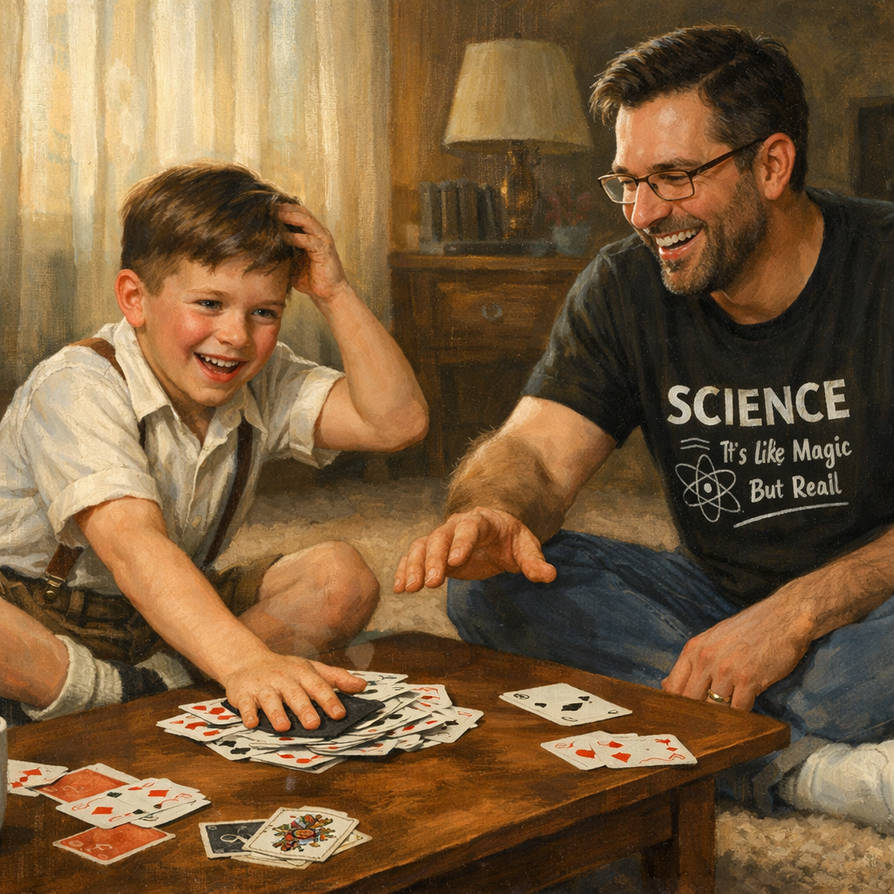
DAY FIVE
I woke up to warmth.
Not from the blanket or couch, but from him.
Gene was curled against my body, breathing slow and even, his hand fisted in the fabric of my shirt like he’d fallen asleep afraid I might disappear if he let go.
For a moment I didn’t move. I didn’t dare breathe either, so I wouldn’t disturb his sleep.
The living room around us had shifted again overnight — not dramatically, not like the violent lurches of the diner scene from yesterday, but subtly, like the house had exhaled.
The couch felt older beneath me. The carpet was a duller shade. The curtains were thinner, patterned with tiny faded flowers. And the air carried that faint coolness of late spring mornings — the kind that slips in through cracked windows before the day warms up.
Birds were singing outside.
Soft, distant, ordinary.
The radio — the big wooden stand‑up one — hummed a soft song faintly in the corner, warming itself like it was waiting for someone to turn the dial. A woman’s smooth voice came out of its speakers.
“I remember the night and the Tennessee Waltz…”
Gene stirred.
His fingers tightened in my shirt before his eyes even opened, like some part of him was checking to make sure I was still there.
“Now I know just how much I have lost…”
Then Gene blinked up at me.
For a second he looked confused — not scared, not startled, just… unsure.
Like he didn’t know if last night had been real or a dream he wasn’t supposed to have.
“Morning,” I said softly.
He froze.
“Are you…” His voice cracked, embarrassingly high. He cleared his throat and tried again. “Are you mad?”
God.
“No,” I said. “Not even a little.”
He let out a breath so shaky it hurt to hear.
He didn’t pull away, or try to sit up. He just stayed there, small and warm and unsure, his cheek pressed against my chest.
I felt him gather the courage to speak again.
“Did I… did I fall asleep on you?”
“Yeah,” I said. “You did.”
He swallowed. “Sorry.”
“You don’t have to be sorry.”
He blinked at that, like the words didn’t make sense.
Like no one had ever said them to him before.
The morning light crept across the floor, soft and gold, catching the dust in the air. The house was quiet — the kind of quiet that feels like it’s waiting for something gentle, not something dangerous.
Gene shifted, sitting up just enough to look at me properly.
His dark brown hair stuck up in the back. His plaid shirt was wrinkled.
He looked like a kid who’d fallen asleep during a movie night and hadn’t been carried to bed — except he’d never had a night like that.
“Are we…” He hesitated, chewing on the inside of his cheek. “Are we okay today?”
The question wasn’t about the morning. It wasn’t about last night or even about me.
It was about permission. Seeking permission to be close, a kid, to want… anything at all.
“Yeah,” I said. “We’re okay.”
He nodded, trying not to smile too big and look relieved. He tried not to look like he’d been waiting his whole life to hear that, and my heart broke at the realization of it.
“Yes, I lost my little darling on the night they were playing… the beautiful Tennessee Waltz…”
He sat up fully then, rubbing his eyes with the back of his hand — a gesture far too young for twelve, but I didn’t call attention to it.
“Um,” he said, voice shy, “are you hungry? I can… I can make breakfast. Or help. Or— I dunno. Whatever you want.”
I could hear the old instinct in his voice — the caretaker role he’d been forced into too young.
But today wasn’t about that.
“How about we make breakfast together?” I said.
He blinked.
“Together?”
“Yeah.”
A slow smile spread across his face — small, cautious, but real.
“Okay,” he whispered.
He slid off the recliner, feet hitting the carpet with a soft thump, and waited for me to stand like he wasn’t sure he was allowed to move without permission.
I stood.
He relaxed.
And for the first time in his life — and mine — we walked into the kitchen like a father and son starting a normal day.
A good day.
The kitchen felt different in the morning light.
Not younger, not older — just… lived‑in. The kind of kitchen where someone had made a thousand quiet breakfasts without anyone yelling or slamming a door. Sunlight spilled across the counter in a soft rectangle, catching dust motes drifting lazily in the air. Outside, birds were loud in that late‑spring way, like they were trying to out‑sing each other.
Gene hovered in the doorway.
Not in the way a kid hovers when he’s waiting for instructions — in the way a kid hovers when he’s waiting to see if he’s welcome.
“You wanna crack the eggs?” I asked.
He blinked, startled by the invitation.
“Me?”
“Yeah.”
A shy smile tugged at his mouth — the kind he tried to hide by ducking his head. He padded over to the counter, socks whispering against the linoleum, and picked up an egg like it was something fragile and important.
He tapped it on the bowl’s edge, too soft at first, then too hard. The shell crumbled in his fingers.
“Shoot—sorry—sorry, I didn’t mean—”
“It’s fine,” I said. “Try again.”
He froze, like he was waiting for the other shoe to drop. When it didn’t, he let out a tiny breath and reached for another egg. This time he cracked it cleanly, the yolk sliding into the bowl in one smooth motion.
His face lit up.
“I did it,” he whispered, almost to himself.
“You did.”
He cracked the next one with more confidence, then another. By the fourth, he was humming under his breath — a little off‑key, a little too soft to identify, but happy. Actually happy.
I handed him a whisk.
“You wanna mix?”
He nodded, gripping it with both hands like a tool he wasn’t sure he was allowed to use. He whisked carefully at first, then faster, shoulders loosening as the eggs turned golden and frothy.
“You’re good at this,” I said.
He went still.
Not because he didn’t believe me — because he did, and he didn’t know what to do with that.
“Thanks,” he murmured, cheeks pink.
I moved to the stove, heating the pan. Gene hovered beside me, close enough that our arms brushed. He didn’t pull away. He didn’t apologize. He just stayed there, like he was trying to memorize the feeling of standing next to someone who wasn’t angry.
“Can I… pour it?” he asked.
“Go ahead.”
He poured the eggs into the pan with exaggerated care, tongue poking out slightly in concentration. The sizzle made him jump, then laugh — a small, surprised sound that hit me harder than it should have.
He grabbed a spatula.
“Do I stir it now?”
“Whenever you think it’s ready.”
He looked up at me, checking if I meant it.
I did.
So he stirred — slow, gentle circles, watching the eggs firm up. The smell filled the kitchen, warm and familiar. He leaned into my side without realizing it, shoulder brushing my arm, and I didn’t move away.
“Mom never lets me cook,” he said quietly. “She says I’ll make a mess.”
“You’re doing fine.”
He swallowed, eyes fixed on the pan.
“I just don’t want to get in the way,” he added, even quieter.
I didn’t say anything. I didn’t have to. He kept stirring, shoulders relaxing with each pass of the spatula.
When the eggs were done, he scraped them onto two plates. He hesitated before handing me mine, like he was bracing for criticism.
I took a bite.
“They’re perfect,” I said.
He froze.
Then — slowly, cautiously — he smiled. A real smile. The kind that reached his eyes and softened his whole face.
“Really?”
“Really.”
He sat across from me, legs swinging under the chair, eating his eggs with the kind of quiet pride that made my chest ache.
Halfway through, he looked up.
“Can we… do this again tomorrow?”
His voice was small. Hopeful. Terrified.
“Yeah,” I said. “We can.”
He beamed — bright, unguarded, childlike — and for the first time in his life, breakfast wasn’t something to survive.
It was something to enjoy.
The air outside was crisp, the kind of late‑spring morning that still smelled faintly of dew. Gene walked beside me, close enough that our arms brushed. He didn’t pull away.
He kicked at pebbles and swung his arms a bit. He asked shy questions as we walked.
“Were you scared of anything when you were a kid?”
“Plenty,” I said.
He nodded like that made sense.
By the time we looped back toward the house, he looked younger — not dramatically, just… softer. His voice had a lighter lilt. His steps had a bounce.
He looked ten, maybe ten‑and‑a‑half, I guessed. But I didn’t have time to process that as he grabbed my hand and wanted to show me something he could do.
“Mom says I’m good at fixing things,” he said, trying to sound casual.
He tightened a loose hinge on a cabinet door, tongue poking out in concentration. When it clicked into place, he looked up at me, waiting.
“That’s good work,” I said.
He glowed.
He talked more after that — animated, eager, proud. His sleeves looked longer on him. His face looked rounder.
After lunch, Gene got quiet — thoughtful, hesitant. He kept glancing at the small radio in the kitchen.
“What’s on your mind?” I asked.
He swallowed.
“Could we… maybe listen to a program? The Lone Ranger comes on around now.”
The TV flickered — then shifted form into a tall wooden stand‑up radio, warm amber dials glowing softly in response.
“Sure,” I said.
He lit up.
We sat in the recliner together. Gene curled against my side, head resting lightly on my arm. The radio hummed, then the orchestral swell of the trumpets from the William Tell Overture began, soon accompanied by the gallop of a horse.
Gene relaxed completely upon hearing that opening.
“Hi-yo Silver!” he cheered together with the radio impetuously, before freezing and looking up at me to see if he was allowed to talk along with the radio.
I gave him a big firm reassuring smile. In all the years I’d suffered through my father watching reruns of the television version of this show, I’d never seen him get so excited about the program. It was odd, but seeing his childish glee and delight in the simple repetitive entertainment brought a smile to my face.
He gasped at dramatic moments, like when the stagecoach had been stopped by two masked bandits firing guns, or the kid for the episode, Billy Bradford, had fallen off the stagecoach and knocked unconscious from a hit to his head badly, needing medical attention immediately—and needed to be taken six miles to the closest ranch for care.
He giggled at side characters like the old prospector who spoke with a caricatured dialect and was coded as the local drunk, and yet still had a steady hand when needed.
Every few minutes he glanced up at me, checking if I was enjoying it too.
I ruffled his hair, mussing it up a bit to reassure him, and he melted.
By the end of the episode, I could tell he was nine.
When the program was over he slid off me and hurried over to an end table, pulled open a drawer, and grabbed a pack of playing cards.
“Can we play cards, please?” he asked eagerly, bouncing slightly on the balls of his feet. I recalled the hours he’d spent of my own childhood glued to a computer screen playing Freecell, Solitare, and other computer card games, and figured he had to have learned somehow.
“Sure we can… how about I teach you how to play Egyptian Ratscrew?” I proffered, recalling a card game from my own junior high years when field trips on busses were long enough to still warrant a deck of cards to pass the time.
Gene’s face screwed up at the suggestion.
“I’ve never played that before…” he said, hesitantly.
“There’s a few rules, but it’s really simple. The whole point of the game is to try and collect the entire deck of cards before anyone else does. Think you can do that?”
Gene thought about it and then nodded as I then proceeded to explain how the deck was split, we tossed cards into the middle to try and build a pile, and we slapped the pile whenever there was a “face or an ace” or one of the various other circumstances when you slapped the pile like doubles, sandwiches, top and bottom, four in a row, and marriages. At the end of the explanation he looked unsure and hesitant.
“Don’t worry, you’ll catch on quick. I’m sure of it,” I said as I began to deal the cards.
Soon we were playing, slapping, and collecting piles of cards. Gene was cautious to slap the deck at first.
“Did I… did I do it right?” he asked after his first slap, brushing his hair out of his eyes.
“Yeah, ya did,” I reassured with a smile.
Soon was looking for an excuse to steal every and any card he could. He laughed — loud, unguarded, bright. He wiggled when he got excited. And I laughed along with him. I hadn’t laughed like this in years, and truth be told, I hadn’t known I’d needed this until now.
I didn’t let him win—I was too sore from years of playing the game to just roll over and let someone win, but there were times I could have moved faster to slap the deck, or I let a potential slap moment pass. Just seeing Gene play and enjoy himself was more fun than winning the card game.
“Are you mad I won?” he asked at the end when he’d taken my last card: the ace of spades.
“No bud, it’s only a game—why would I be mad?”
He bit his lip and then pushed his pile back over to me and leaned against me without noticing.
I looked down and saw he looked eight‑and‑a‑half.
At dinner he sat next to me at the table, not across. He didn’t flinch when I reached for the salt. He talked about school, friends, silly things. Well, at least they started as silly things.
“And Charlie brought his Uncle’s ears with him to school, and we put it in Betty Ann’s desk.”
“Wait a minute, Charlie’s Uncle’s ears come off?” I asked.
“No, Dad… they’re the ears he cut off in the war. Charlie’s uncle brought it back from the Pacific. He said it was a souvenir,” said Gene calmly as if severed ears were just a common thing to bring home.
For a moment I just stared horrified at the thought that anyone… ANYONE would think severing ears off of a dead body and bringing them home as war trophies to show their nephew was all right. Gene bit his lip and glanced at me, quick and nervous. It was as though my silence said more than my words to him.
“I… I bet that was a surprise for Betty Ann when she opened her desk,” I added as I dished out some lumpy mashed potatoes he’d helped make with an old-fashioned masher that had appeared in the kitchen at dinner. I imagined an old wooden lift-top desk with an inkwell hole in the upper right-hand corner as he told his story. I focused on the potatoes and the desk of the story, hoping to keep my mind from wondering what old severed ears look like months after they’d been cut from the body.
Gene’s legs swung under the chair as he blushed.
“Well… when class started and she lifted her desk top up and screamed, Miss Horsham came over and saw the ears. When Charlie and I laughed, Miss Horsham paddled us.”
And the quiet casual way he’d said it, like it was no big deal spoke louder than anything else. It was small moments like that, that reminded me of just how different and casually violent of a world Gene had come from, from the one I grew up in.
He got sleepy early — emotionally exhausted from being loved.
He leaned on me on the couch, head on my shoulder, breath warm against my shirt. His thumb drifted toward his mouth. His hair tickled my chin.
“’m tired,” he mumbled.
“I know,” I said.
He lifted his head once, as if in defiance of falling asleep before he gave in to the Sandman’s demands and set sail with Winken, Blinken and Nod to dreamland.
God, where had that come from?
His breath hitched once, then evened out. He was small and warm and just a little eight-year-old boy.
The house was quiet. The large stand-up radio hummed softly in the corner as Perry Como’s sultry smooth voice sang an unseasonal Christmas song against the cool spring air.
“I'll be home for Christmas… you can plan on me…”
I looked down at him — my father, eight years old, asleep against my chest — and realized something I hadn’t understood until now.
He hadn’t been shrinking all day because he was breaking. He was shrinking because he finally felt safe enough to stop holding himself up. And for the first time in his life, someone was holding him through it—and that someone was me.
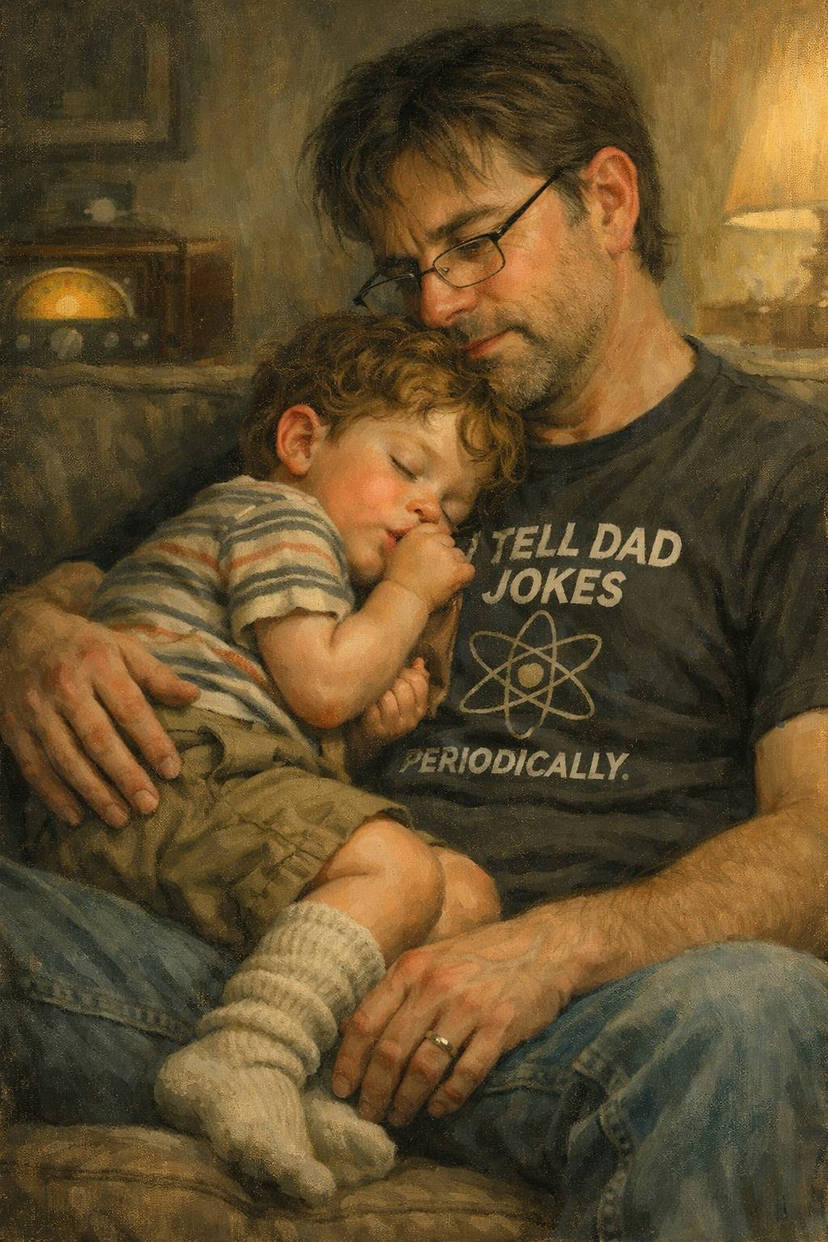
DAY SIX
I woke to music. I should have been used to that by now, but it still felt jarring.
A soft, warbling tenor drifting from the stand‑up radio in the corner, the kind of sound that belonged to a house older than either of us. The melody was warm and tinny, like it was being played through time itself.
“You always hurt the one you love… the one you shouldn't hurt at all…”
And then I felt the weight against my chest.
Dad… Gene.
He was small, and warm. Breathing slow and even. My arm shifted under him automatically — the way a parent adjusts a sleeping child without thinking.
I looked down and saw a little boy younger than he’d been when he’d fallen asleep — six years old, maybe a touch younger — curled against me like he’d been grown to fit there. His hand was still fisted in my shirt. His cheek was pressed to my ribs. His hair stuck up in soft tufts.
He was sleeping the way only a child who feels completely safe sleeps.
“You always break the kindest heart… with a hasty word you can't recall…”
The living room had shifted again overnight. The furniture seemed taller. The wallpaper looked different — softer colors, rounder shapes, like the house was remembering a gentler decade. The air was cooler, carrying the faint smell of late‑spring mornings drifting through a cracked window.
I didn’t move. I just watched him breathe.
Eventually, he stirred. His fingers tightened in my shirt before his eyes even opened — a reflex, a check, a question.
Then he blinked up at me.
“Hi, Dad,” he whispered, voice small and raspy with sleep. He rubbed his cheek against my shirt like an insistent cat against a chair leg.
Dad…even though he’d said it yesterday it still hit me deeply each time. Just from how he said it with no fear or hesitation. Just plain and simple trust.
“Morning, buddy,” I said.
He stretched like a little kid, arms reaching up, toes pointing, a soft grunt escaping him. Then he sat up in my lap, rubbing his eyes with the back of his hand.
“Is it morning?” he asked.
“It is.”
“Are we gonna do anything fun today?”
“Yeah,” I said. “We are.”
He smiled — wide, bright, unguarded — and something in my chest cracked open.
“If I broke your heart last night… it's because I love you most of all…”
I decided to take him out for breakfast.
The walk to the diner felt like stepping through a memory I’d never lived. Storefronts shifted subtly as we passed — signage fading into older fonts, colors dulling, window displays simplifying.
I carried him to the diner because he was still soft with sleep, his arms looped around my neck, his cheek warm against my collarbone. He didn’t protest. Six‑year‑olds rarely do when they’re still halfway in dreams.
The morning air was cool, the kind that smells like wet grass and the promise of summer. Nothing warped or shifted as we stepped outside as if the world was steady enough to hold the scene together from some unseen machinery.
The diner appeared at the end of the street the way things did now: suddenly, seamlessly, like it had always been there. A squat little building with chrome trim and big windows fogged from the heat inside. A neon sign buzzed faintly above the door and a blue star flag in the window.
I pushed it open with my shoulder, Gene still clinging to me.
Warmth hit us immediately — the smell of bacon, coffee, and something sweet on the griddle. The kind of smell that makes a kid bury his face in your shirt and inhale like he’s memorizing it.
A bell jingled overhead.
A waitress in a pale blue uniform looked up from behind the counter and smiled like she’d been expecting us. The waitress’s face had that soft, unfocused quality of someone half‑remembered.
“Morning, hon. Booth or counter?”
Gene’s eyes went huge.
“Can we sit in a booth?” he asked bouncing in my arms, suddenly a ball of energy.
“Booth,” I said, shifting Gene in my arms.
“Of course.” She nodded toward one by the window.
I put Gene down and he scrambled into the seat, kneeling to see over the table in that way little boys do.
I slid into the vinyl seat with Gene beside me. He scooted close, pressing into my side, his small hand finding the fabric of my sleeve like it was instinct.
And then I heard it.
The radio behind the counter — soft, crackling, warm — playing a song I knew even before the first line finished drifting through the air.
“Everytime we say goodbye, I die a little…”
The singer’s voice floated through the diner, wistful and aching. The melody curled around us like smoke.
Gene turned his head and somehow, I could tell from the frown and the tilt of his head that he didn’t know the song. But he definitely felt it.
He looked up at me, eyes big and still a little sleepy.
“Is it sad?” he asked.
“A little,” I said.
“Why?” he asked, perfectly innocent.
I swallowed.
“Because it’s about someone who doesn’t want to say goodbye.”
He nodded like that made perfect sense.
The waitress came over with menus, but Gene didn’t take his. He leaned into me instead, head resting against my arm.
“What do you want for breakfast, buddy?”
He thought hard, brow furrowing.
“Pancakes,” he said finally. “With… with the butter that melts in the middle.”
“Done.”
“And bacon?”
“Of course.”
He smiled — small, shy, hopeful.
The waitress finished scribbling and then leaned in to me.
“Just so you know,” she said to me, tapping the page with her pencil, “bacon’s gone up again. Rationing, you know how it is.”
I glanced down at the price and saw the new price which was scrawled over the struck out old one was a measly eight cents more. In 2026, inflation meant groceries felt like luxury items. Compared to that, eight cents felt like a joke. But in 1944? I sighed as I conceded eight cents was a real increase.
“I think I can manage it,” I said.
She brightened. “Good man.”
The radio kept playing, the song drifting into the part where the melody lift and fell — the part that always felt like a heart stretching too far.
“When you're near, there's such an air of spring about it… I can hear a lark somewhere, begin to sing about it…”
The waitress returned with coffee for me and a glass of milk for him. Gene wrapped both hands around the glass like it was precious.
Gene took a sip of milk, then looked up at me again.
“Dad?”
“Yeah?”
His eyes grew big and wide and wet as he asked, “You won’t say goodbye today, right?”
My chest tightened.
“No buddy,” I said. “Not today.”
He nodded, satisfied, and leaned against me again.
Gene swung his legs under the booth, humming tunelessly, syrup on his fingers, hair sticking up in soft morning tufts.
He looked up at me with absolute trust.
“Dad? Can we do something fun after this, like go to the park?”
“Yeah,” I said. “We can.”
His smile could’ve lit the whole diner.
The pancakes arrived — fluffy, steaming, with a pat of butter melting into a golden pool. I cut his pancakes without thinking. He didn’t even notice.
Gene dug in with the single‑minded joy only a six‑year‑old can muster, happy and messy and alive. Syrup dripped down his chin. He didn’t notice. I wiped it with a napkin. He didn’t notice that either.
Gene looked over at my lone coffee cup that was my sole source of sustenance this morning—just from the simple fact that I didn’t feel that hungry. It was strange. I hadn’t eaten anything yesterday at all, I should be starving, and yet I wasn’t.
“Dad,” came a warbly little voice from next to me.
I looked down to see a fork with a speared piece of pancake on it. He pushed a syrup‑soaked piece toward me. “You can have some if you want.”
I almost said I wasn’t hungry to him, but then I saw those big brown eyes, and I knew I couldn’t say no.
“Sure, buddy,” I said, and took the offered piece from the end of his fork and popped it into my mouth. I licked my sticky fingers clean and oddly enough Gene looked oddly at ease to see me eat something. It almost reminded me of… well of course it would remind me of Dad, Gene was Dad. How had I almost forgotten that?
And then I realized:
I was parenting him in public. And somehow it felt right… like a second nature that came naturally to me.
He was too busy being a safe happy child.
The song on the radio faded into static, then into another tune from the same era — something bright and brassy in a way that only the Andrews Sisters could be, a tonal shift so abrupt it almost felt intentional.
“Shoo, shoo, shoo, baby… shoo, shoo, shoo, baby…”
But despite the cheerful big band beats, the message persisted, as I realized a little later in the song:
“Seems kinda tough now… to say goodbye this way…”
And as he leaned into me, warm and small and impossibly alive, I realized something sharp and painful:
Every day with him was a goodbye in slow motion.
And I wasn’t ready.
After breakfast, we walked to the park, just as he’d asked.
We stepped out of the diner into a morning that felt softer than it had any right to be. The air had that cool, clean smell of late spring—wet earth, cut grass, a hint of something blooming. The kind of morning a six‑year‑old would remember as perfect.
Gene slipped his hand into mine without looking, like it was the most natural thing in the world. His fingers were small, warm, sticky with syrup. He swung our joined hands as we walked, humming the Andrews Sisters under his breath in a way that didn’t match the rhythm at all.
The street looked older now—cleaner, quieter, simpler. Cars were spaced farther apart, boxier, painted in muted wartime colors. A delivery truck rumbled past with a big BUY WAR BONDS poster on the side. A woman in a housedress swept her stoop. A boy about Gene’s age pedaled by on a bike with a baseball card clipped to the spokes.
None of it felt magical. It felt… remembered as if the scene were on the other side of a thin cheesecloth or gauze.
The world had the soft edges of a childhood recollection—details crisp where they mattered, blurred where they didn’t. A streetlight too tall. A mailbox too shiny. A storefront sign with lettering that looked hand‑painted but not quite legible.
Gene didn’t notice any of it. He was too busy being a six-year-old little boy.
“Dad, look!” he said, pointing at a robin hopping across the sidewalk. “He’s got a worm!”
The bird tugged at something in the dirt, victorious. Gene giggled, delighted, and tugged my hand so I’d see it too.
We passed the corner drugstore—its window full of glass jars of penny candy, though the sign taped to the glass read LIMIT ONE PER CHILD. Rationing again. Even Gene’s subconscious couldn’t escape the war.
He pressed his face to the window anyway, breath fogging the glass.
“Do you think… maybe… after the park… could we get something?” he asked, voice small, hopeful, careful.
I didn’t know if any of this was real, but the hope in his voice was.
“Yeah, buddy,” I said. “We can.”
He beamed—pure, incandescent joy—and skipped the next three steps, tugging me along.
The park came into view at the end of the block, exactly the way a child would remember it: bigger than it should be, greener than it should be, the grass impossibly bright. The swings creaked in a slow, lazy rhythm. A metal slide glinted in the sun. A seesaw rocked gently even though no one was on it.
Gene squeezed my hand.
“Dad,” he whispered, like he was sharing a secret, “this is my favorite place.”
Of course it was. It was a place where the world had been simple, even if only for a moment.
We stepped through the gate, and Gene let go of my hand only long enough to run ahead a few feet—then stopped, turned, and waited for me to catch up.
He didn’t want distance. He just wanted momentum.
“Come on, Dad!” he called, bouncing on his toes. “Let’s play!”
“Let me sit for a minute,” I said, eyeing the closest park bench to the playground.
Gene frowned a little but didn’t complain. I watched him climb and slide and laugh as the child he now was. And as I watched him, I realized something that I hadn’t expected:
I liked being his father.
Then he called again:
“Dad! Come on!”
I grinned to see his boundless joy which somehow gave me renewed energy to keep going.
“All right, all right. But what should we play?” I asked.
Gene bounced in place, practically vibrating with excitement.
“Hide‑and‑seek! Come on, Dad! You count!”
I pushed myself up from the bench, joints stiff from sitting too long in one position. He grabbed my hand and tugged, not hard, just insistently — the way a child does when they’re sure you’ll follow.
“All right, all right,” I said, letting him pull me toward the center of the playground. “But you better find a good hiding spot.”
He grinned, all teeth and sunshine.
“I will!”
He darted off — legs pumping, arms flailing in that loose, uncoordinated way six‑year‑olds run. His laughter trailed behind him like a ribbon.
The first round was easy.
I pretended not to see him crouched behind the merry‑go‑round, his little sneakers sticking out, his giggles giving him away. When I finally “found” him, he shrieked with delight and launched himself at me, arms around my waist, face bright with triumph.
“Again!” he demanded.
And how could I say no?
“All right,” I said. “But this time I’m really going to look.”
He grinned, eyes sparkling.
“Count to twenty!”
He darted off again — legs pumping, hair flying, laughter trailing behind him like a ribbon.
I leaned against the slide ladder and covered my eyes.
“One… two… three…”
I listened for him. For the scuffle of shoes. The creak of the swings, or even the rustle of bushes.
“…seventeen… eighteen… nineteen… twenty. Ready or not—”
I opened my eyes.
And the world felt… wrong. Like something were missing from it that you couldn’t quite put your finger on what was missing. The playground looked the same. But Gene wasn’t anywhere obvious.
“Gene?” I called, trying to keep my voice light. “I’m coming to find you…”
I checked behind the trash can. Nothing.
A cold, thin thread of fear pulled tight in my chest.
I checked behind the slide. Nothing.
“Gene?”
My voice cracked.
This wasn’t playful silence like before. It felt like the kind of absence that didn’t belong in a child’s memory.
I walked faster now, scanning every corner of the playground, heart pounding in my throat.
“Gene! Buddy, where are you?”
Still nothing.
The world around me felt too quiet — like a radio station slipping out of tune. The colors seemed a little washed out. The edges of things a little too soft. The air too still.
“Gene!”
I was shouting now.
I didn’t care.
I rounded the back of the slide again, breath tight, vision blurring at the edges—
And then I heard it a tiny hiccup followed quickly with a sniff.
I spun.
There — behind the low hedge near the fence — a small shape curled in on itself, knees pulled to chest, hands over ears.
Gene.
He didn’t look like he was hiding or giggling. Instead, he looked like he was crying.
I dropped to my knees beside him.
“Hey—hey, buddy, I’m here. I’m right here.”
He flinched at my voice, then looked up, eyes wide and wet and terrified.
“I… I couldn’t find you,” he sobbed, his voice higher and softer than it had been. “I looked and looked and you weren’t there and I thought— I thought—”
His breath hitched, sharp and panicked.
“I thought you said goodbye.”
Oh.
Oh God.
He hadn’t been hiding from me. He’d been looking for me. As I looked at him now, his face and belly looked a little rounder with baby fat, his hands smaller as well. He definitely wasn’t six-years-old any more. The game had slipped out of his mind the moment his age did.
I held out my arms and slowly gathered him into my grasp, and he clung to me with desperate, shaking clumsy hands, burying his face in my shirt, tucking his head under my chin. The world steadied as soon as he was in my arms.
“I’m here,” I whispered, rocking him gently. “I’m here. I’m not going anywhere.”
His small body trembled against mine.
Relief at having him back hit me so hard my knees went weak. I held him too tightly that he squirmed until I let up a little.
And then the thought I’d been avoiding until now broke through:
How is this going to end?
Once it entered, I couldn’t push it away.
I held him tighter.
I carried him out of the park because he wouldn’t let go. His arms were wrapped tight around my neck, his face pressed into my shoulder, his breath warm and hiccuping against my collarbone. He was lighter now — not just in weight, but in the way he held himself. Softer. Smaller. Younger.
Five, maybe.
Maybe even a little younger than that.
The world around us felt steadier again, like Gene’s mind had pulled the memory back into focus now that he was in my arms. The colors sharpened. The air warmed. The street regained its shape.
He clung to me the whole way, his fingers curled in the fabric of my shirt like he was afraid I’d disappear if he loosened his grip.
We passed the corner drugstore again — the one with the penny candy jars in the window. The sign still read LIMIT ONE PER CHILD, the letters slightly crooked, like they’d been taped up in a hurry.
Earlier, he’d pressed his face to the glass and asked if we could get something after the park.
Now he lifted his head from my shoulder, eyes puffy and red, and pointed weakly at the window.
“Dad… can we get… those?” he asked.
But he wasn’t pointing at the penny candy.
He was pointing at the little cardboard display beside it — the one filled with wax animals in bright colors: tiny wax bottles, wax fish, wax dinosaurs, wax dogs. The kind you bite the top off of to get to the sugary liquid inside.
Of course he’d want those.
They were a 1940s kid’s dream — cheap, silly, sweet, and just dangerous enough to feel exciting.
“You want the wax animals?” I asked gently.
He nodded, rubbing his eyes with a fist.
“The… the ones with the juice inside,” he said, voice small and wobbly. “Can I have one? Please?”
He wasn’t asking for candy.
He was asking for comfort.
And he was asking permission the way a much younger child does — careful, hopeful, afraid of being told no.
“Yeah, buddy,” I said softly. “You can have one.”
He relaxed against me, his whole body melting into mine in relief.
I pushed open the drugstore door with my shoulder. A little bell jingled overhead — the same soft, tinny sound from a hundred childhood memories. The air inside smelled like talcum powder, floor wax, and the faint medicinal sweetness of cough syrup.
The clerk behind the counter barely looked up.
I carried Gene to the display, and he lifted his head just enough to look.
The wax animals were arranged in neat rows — bright reds, blues, yellows, greens. Some shaped like little bottles. Some like fish. Some like tiny dogs with round ears.
Gene pointed at a blue dog with a stubby tail.
“That one,” he whispered.
“You sure?”
He nodded, then tucked his head back under my chin, as if choosing had taken all the energy he had left.
I picked it up and carried him to the counter. The clerk rang it up without comment. Two cents. I handed over a nickel and didn’t bother waiting for the change.
Outside, Gene lifted his head again, eyes still wet but curious now.
“Can I… can I have it now?” he asked.
“Yeah,” I said. “But you have to stay right here with me while you eat it.” Imagining him biting off a bit of wax and it getting caught in his throat.
He nodded solemnly — the way little kids do when they’re promising something very important. I realized, with a jolt, that I was thinking like a parent — choking hazards, supervision, rules.
And it felt natural.
I handed him the wax dog.
He held it with both hands, studying it like it was the most precious thing he’d ever been given.
Then he bit the top off — a tiny, decisive chomp — and sucked the sugary liquid out with a soft slurp.
As he sucked on his wax dog, his shoulders relaxed, his breathing steadied, and his grip on my shirt loosened just a little. He wasn’t even pretending to be brave. He was just a little boy who’d been scared he’d lost his dad.
And as I carried him the rest of the way home, his head resting on my shoulder, sticky wax candy in his hand, I felt the truth settle heavy in my chest:
He was slipping away piece by piece, and I was losing him.
Back home, the living room had shifted again — not dramatically, not like a scene change, but like a memory settling into place. The edges softened. The colors warmed. The furniture looked a little bigger, a little higher off the ground, the way it does when you’re small.
There now was a small box of crayons sat on the coffee table, with a coloring book with thick black outlines, and a few simple toys — a wooden pull‑along duck, a tin car, a cloth doll missing one button eye. Just the kind of things a child would remember owning.
Gene slid out of my arms and toddled toward the crayons, still sniffling but calmer now. He sat cross‑legged on the rug — the way little kids do, knees splayed, posture loose — and began coloring with intense concentration.
Gene colored beside me, humming softly. And then oddly enough, the stand-up radio turned on next to us and began playing the song he’d been humming. It was an a capella song with a warm rich baritone supported by a collection of all the other voice types:
“You'll never know just how much I miss you… you'll never know just how much I care…”
He switched crayons often — blue to red to green to yellow — without any real plan, just following whatever impulse flickered through his mind.
Every few minutes he’d hold up a page.
“Daddy, look!”
And I’d praise each one — the scribbled house, the lopsided sun, the stick‑figure dog with three ears. He beamed every time, leaning against my arm without noticing he’d done it.
Then he started a new page.
He gripped the crayon in his fist — not the tripod grip of a six‑year‑old, but the clumsy, earnest hold of a five‑year‑old trying very hard. His tongue poked out between his teeth as he concentrated.
I watched him draw two stick figures on a sidewalk, one of whom was riding what looked to be like a crude interpretation of a bike with training wheels, while the other stick figure held the seat.
At first I thought it was just another child’s fantasy — a dad teaching a kid to ride.
But then I saw the details. Details that my eyes had glazed over at first, convinced they were just the random scribbles of a five-year-old’s clumsy crayon gripers.
The bike’s front wheel was crooked and red paint was chipped—just like the old one my Dad had found at a yard sale for me to learn had been.
The sidewalk curved around a big brown vertical squiggle that my mind quickly recognized as the maple tree near the end of the block, and just beyond it was a black scribble in the middle of the sidewalk that could’ve been a little dip in the pavement—the same one where I’d skinned my knee. But the most damning thing of all was the rider didn’t have blue hair like I’d originally thought. No, that blue was the exact shade of blue of my childhood helmet my Dad had grumbled about buying and I’d only worn to keep Mom happy.
My breath caught.
This wasn’t his memory.
It was mine. For a second I thought I was imagining it. But looking at it again… it was undeniable.
He finished the picture with a proud flourish and held it up to me, eyes shining.
“Daddy, look! You’re helping.”
I stared at the drawing, my throat tightening.
“Gene… buddy… when did you… how did you…?”
He blinked up at me, confused by my reaction, then scooted closer until his shoulder pressed against my ribs.
“You helped me,” he said simply, as if that explained everything.
“If there is some other way to prove that I love you…”
But he hadn’t been the child in that memory.
I had.
He shouldn’t have remembered it. Unless…
“I swear I don't know how…”
He leaned his head against my arm, already losing interest in the picture, already reaching for another crayon to scribble again—the crayons slipping in his grasp as if the crayon became suddenly bigger in his hands all of a sudden.
“You'll never know if you don't know now…”
But I couldn’t look away from it.
He got tired halfway through eating lunch. It was a simple peanut butter and jelly — all I could make, since all the lunchmeats had vanished from the fridge.
He wasn’t bored. He just grew tired. His jaw slowed. His eyelids drooped. His whole body sagged forward like the effort of chewing was suddenly too much.
He held out his sandwich with both hands, arms trembling a little from the effort.
“Daddy, can you cut it?”
Daddy.
Not Dad or John.
Daddy.
The word hit me like a physical blow — soft, small, instinctive. A word he hadn’t used since he was tiny. A word that came from a place he didn’t remember consciously anymore.
My stomach dropped.
“Yeah, buddy,” I murmured, taking the sandwich.
I cut it into tiny squares — smaller than I’d made for him earlier, smaller than a five‑year‑old would need. The kind of pieces you make for a preschooler who still sometimes forgets to chew all the way.
He picked up one square, nibbled it, then abandoned the rest in favor of climbing into my lap. No hesitation. No self‑consciousness. Just pure, automatic seeking of comfort.
He settled sideways across my thighs, head resting on my shoulder, his little body warm and heavy against my chest. His legs didn’t reach my knees anymore.
He curled up against me the moment I sat beside him, tucking himself into my side like he’d done it a thousand times. His thumb drifted toward his mouth. He paused — a flicker of old self‑awareness — then gave in and slipped it between his lips.
He fell asleep instantly — the sleep of a child who feels completely safe.
His breathing shifted into that soft toddler rhythm.
I held him, feeling the smallness of him, the trust, the weight of what was coming. His hand, curled against my chest, was tiny — the size of a child who still needed help with buttons and shoelaces. His hair tickled my chin. His breath warmed the hollow of my throat.
He slept like that for a long time, his body molding to mine, trusting me completely.
When he finally stirred, it wasn’t with words.
It was with a soft whimper and outstretched arms.
He blinked up at me, eyes heavy with sleep, cheeks flushed, hair mussed.
“Carry me,” he said, arms lifting automatically.
It wasn’t a request. It was a need.
I gathered him up. He wrapped his arms around my neck, legs around my waist, head on my shoulder — the full‑body cling of a four‑year‑old who hasn’t yet learned to be embarrassed by how much he needs you.
He didn’t want me out of sight or to play alone. And he didn’t want to be put down.
Evening settled over the house in that soft late‑spring way — the light going gold, then amber, then blue around the edges. Gene was curled in my lap again, small and warm, his head tucked under my chin. His hair tickled my throat every time he breathed.
The radio clicked softly as the last program ended, and then a new song drifted through the room — warm, velvety, impossibly nostalgic.
“You'd be so nice to come home to…”
A song Gene would’ve heard on the radio as a little boy, long before he ever knew what it meant.
He hummed along without thinking, the melody settling into him like muscle memory. His fingers played absently with mine, tracing the lines of my knuckles, the way little kids do when they’re safe and sleepy.
I felt him relax completely — his whole body going soft, his breathing slowing into that steady rhythm toddlers have when they’re drifting toward sleep.
The song filled the room, warm and crackling, like it was being played from another lifetime.
“You'd be so nice you'd be paradise… to come home to and love…”
Gene sighed, a tiny contented sound, and burrowed closer.
“Daddy?” he murmured, voice thick with sleep.
“Yeah, buddy?”
“Don’t go.”
My throat closed.
“I’m not going anywhere,” I said.
He nodded against my chest, already half-asleep, trusting me completely. The trust of a four‑year‑old. The trust of a child who had never been held like this in his real life.
The trust of someone who didn’t know tomorrow was coming.
The song swelled, soft and romantic and heartbreakingly gentle, and I felt something inside me twist — because the lyrics weren’t about lovers anymore. Not here. Not now.
They were about him.
He was the one who was nice to come home to. He was the one who made the house feel warm. He was the one who made this place feel alive.
And I knew — with a sudden, sharp clarity — that this was the last night I’d have him like this: small, warm, trusting, and unquestioningly mine.
Tomorrow he’d be younger.
And the day after that, if he lasted that long… I didn’t want to think about it.
I held him tighter as the song played on, wishing I could freeze the moment, wishing I could keep him here, wishing I could be the father he needed for more than just this borrowed day.
But the song kept going.
And Gene kept sinking into sleep.
And the night kept moving forward.
And I knew — with a kind of quiet dread — that time was running out.
I held him tighter, knowing I couldn’t stop what was coming, and I would give anything to keep him like this just a little longer.
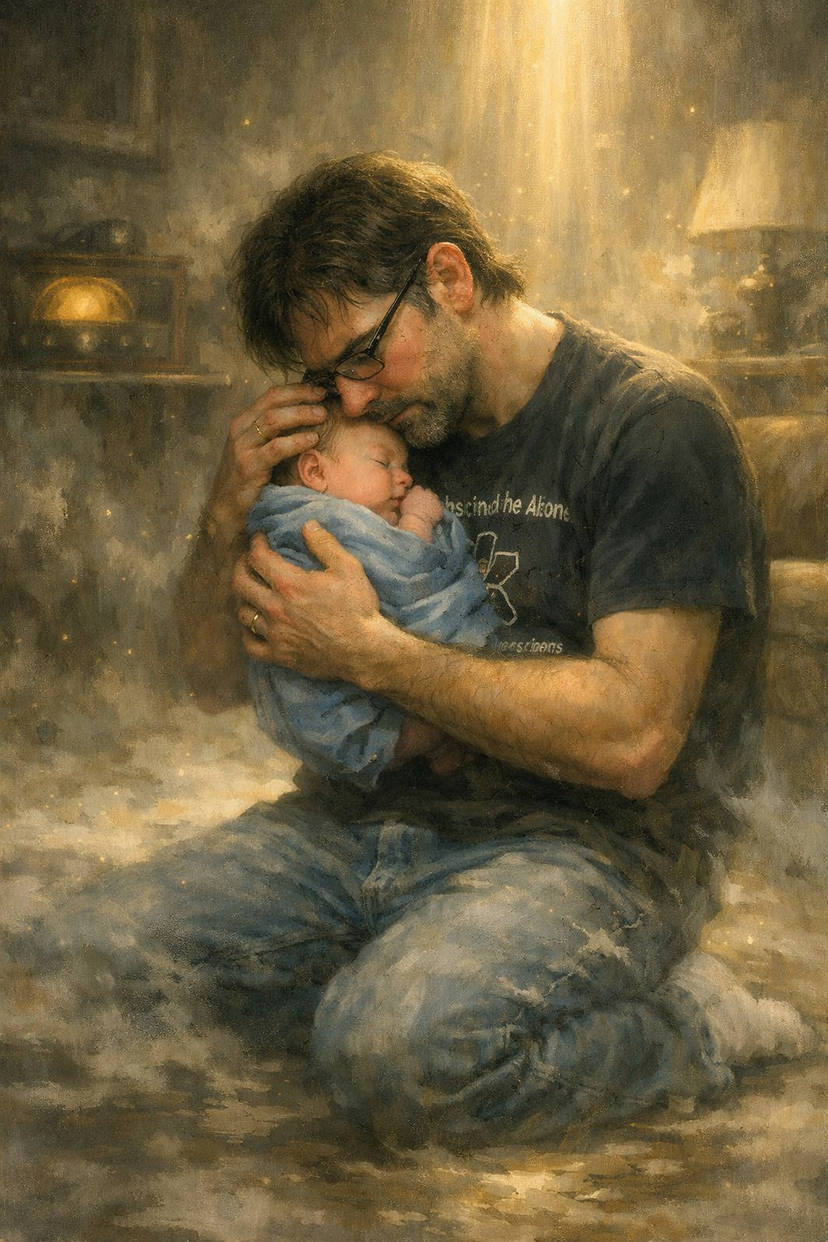
DAY SEVEN
I woke up late.
Far later than I meant to. Later than I ever had when I’d slept over here.
Something tugged at my sleeve — small fingers, insistent but gentle — and for one blissful second, I thought:
He didn’t get younger.
Gene was sitting beside me on the couch, cross‑legged, hair sticking up in soft tufts, wearing a shirt that hung off one shoulder. He looked… the same as last night. Four, maybe four‑and‑a‑half. Small, but not smaller. Still my little boy.
He blinked up at me, sleepy and warm.
“Daddy, you waked up,” he said, proud of himself.
Relief washed through me so hard I almost laughed.
Maybe it had stopped. Maybe today he would hold steady. Maybe I’d get one more day — just one — with him like this.
He crawled into my lap without asking, curling against me like he’d been doing it his whole life. I wrapped my arms around him, breathing him in — the faint smell of sleep and spring air and something sweet from yesterday’s candy.
For a moment, everything was perfect.
Then the radio clicked on. Like someone had thrown a switch.
A burst of static filled the room — sharp, electric — and then a voice, warm and familiar and impossibly wrong for this moment, drifted through the speaker.
“We’ll meet again…”
My heart stopped.
I knew it from the end of Dr. Strangelove — Dad had always guffawed at that scene, laughing as Vera Lynn’s voice floated over images of nuclear mushroom clouds. He’d said he’d grown up hearing that schmaltzy song all over the place during the war — you couldn’t turn on a radio without hearing it. A pre‑war tune that became popular because of circumstance and tragedy.
Gene froze in my lap, like the sound had reached inside him and pulled a thread loose.
And then he began to shrink.
It was instant — a jolt, a lurch, like the world had grabbed him by the spine and yanked him backward through time.
His legs pulled up and his arms shortened. His face rounded, softening more fully into toddlerhood.
“Gene—” My voice cracked as I tightened my grip. “Hey, hey, look at me—”
He slipped from four to three in seconds. He whimpered, confused, clutching at my shirt with hands that were suddenly too small, too soft, too uncoordinated. He pressed closer to me as if he could hide from the change.
“Don’t know where, don’t know when…”
The song floated through the room, warm and nostalgic and absolutely horrifying.
“No, no, no—” My voice cracked. “Not yet. Not today.”
His shirt swallowed him. His hands became tiny fists against my chest. His breath hitched in little gasps.
Panic rose like a wave.
Because I knew this song and the era it was from, but I didn’t know the exact year. I knew it was from before the war — but I didn’t know how far before.
And that ignorance hit me like a punch.
Gene was born in 1938.
If the song was older than that—
If it was from 1937 or 1936 or—
He shrank again — three years old now, barely more than a toddler, legs curling into my lap, head fitting under my chin like it had been made for that spot.
“Daddy,” he whimpered, voice high and thin.
“I’m here,” I said, holding him tighter. “I’m right here.”
But inside, I was unraveling.
This could be the last moment before he disappeared into infancy and then nothing all in my arms.
I wasn’t ready for this to end.
“Please,” I whispered, voice breaking. “Please don’t take him yet.”
But the song kept playing:
“But I know we’ll meet again some sunny day…”
Gene shrank again — two years old now, a toddler with chubby hands and wide, frightened eyes. His shirt swallowed him. His legs kicked weakly against my stomach.
I held him like he was the most precious thing in the world.
Because he was.
“Daddy,” he whimpered, voice high and thin, confused by the speed of it, by the world tilting under him.
“I’ve got you,” I whispered, voice shaking. “I’ve got you, buddy.”
But the song kept going.
“Keep smiling through… just like you always do…”
“I’m here,” I said, holding him tighter. “I’m right here.”
But fear had overtaken me inside as he continued to shrink in my arms.
“'Til the blue skies drive the dark clouds far away…”
I wasn’t ready to stop being a father. His father.
I wanted more time with him. More mornings and breakfasts. More walks and laughter. Just more of him.
I wanted him.
The song swelled, bright and terrible:
“They'll be happy to know that as you saw me go… I was singin' this song…”
Gene shrank again — one year old now, a baby in my arms, soft and helpless and blinking up at me with wide, confused eyes. His hair a flimsy mop of brown curls over rounded baby fat.
His fingers curled around mine — tiny, instinctive, trusting.
And then—
He stopped.
The shrinking slowed and then stilled completely.
“We'll meet again… don't know where, don't know when…”
The song kept playing, but Gene didn’t get any younger.
He stayed one year old. So small, warm, and thankfully alive.
He wasn’t gone. Not yet. Relief hit me so hard I nearly sobbed.
“But I know we'll meet again some sunny day!”
The song faded into static.
It wasn’t the end. Thank God.
Because in that moment — holding my father as a baby, terrified I was losing him — I finally understood something I hadn’t let myself feel until now:
I didn’t just want more time with him being his father. I wanted more time to love him the way he’d never been loved.
And our time was almost up.
Gene blinked up at me — a baby, but still him, still present, still here — and reached for my face with a tiny, clumsy hand.
“Da,” he said softly.
My throat closed.
I shifted him carefully, supporting his head even though he didn’t quite need it yet — but I needed it. I needed to feel like I was doing this right. Like I could keep him safe. Like I could hold onto him for as long as this place would let me. He was so light it scared me — like he could disappear if I loosened my grip.
He fussed, a soft whimper, and pressed his face into my shirt.
“Hey, hey,” I murmured, bouncing him gently. “It’s okay. I’ve got you.”
And I did.
God, I did.
He clung to my shirt with both hands, tiny fists bunching the fabric. His fingers curled and uncurled against my collarbone, searching for something to hold onto. His legs kicked weakly against my stomach, more reflex than intention. His breath hitched in little hiccuping sobs — not from pain, but from confusion, from the suddenness of the change.
I rocked him, instinctively, the way I’d seen parents do a thousand times.
The way I’d always imagined doing someday.
The way I never thought I’d get to do with him.
His crying softened into little whines, then into soft, rhythmic breaths. He rested his head against my chest, cheek warm through my shirt.
I felt his heartbeat. It was fast, fluttering, and small.
He smelled like sleep and milk and something sweet from yesterday’s candy store — a faint sugary note that made him seem even younger.
I carried him to the couch and sat down slowly, settling him in my lap. He curled into me immediately, like he’d been waiting for this position his whole life. His thumb brushed his lips, but he didn’t quite know what to do with it yet.
“Hey, buddy,” I whispered. “You’re okay. I’m right here.”
He blinked up at me, eyes huge and trusting.
And something inside me cracked open.
Because this wasn’t pretend, a half-distorted memory or a hallucination.
This was my father as a baby, trusting me with everything he had.
I brushed a hand over his hair — soft, fine, barely there — and he leaned into the touch, eyes fluttering.
He was hungry.
I didn’t know how I knew. I just… did.
“Okay,” I murmured. “Let’s figure this out.”
I carried him to the kitchen, holding him with one arm, opening cabinets with the other. The house had shifted again — bottles appeared in the cupboard, simple glass ones with rubber nipples, the kind from the late 1930s. A tin of powdered formula sat beside them, label faded but legible.
I stared at it for a moment.
“This stuff,” I whispered. “You really want me to do this?”
Gene fussed again, tiny hands reaching.
“All right, all right,” I said, mixing the formula with water, testing the temperature on my wrist like I’d seen parents do. “I’m learning on the job here.”
He latched onto the bottle immediately, sucking greedily, eyes half‑closed in relief. His jaw worked in that slow, steady rhythm babies have, the kind that makes you want to match your breathing to theirs.
And I felt something I hadn’t expected.
Joy. Not the big, overwhelming kind. The quiet kind. The kind that settles in your chest and warms you from the inside.
I held him close, supporting his head, watching him drink like it was the most important thing in the world.
When he finished, he let out a tiny burp that startled him. He blinked up at me, confused, then giggled — a soft, breathy sound that hit me like a punch.
I laughed too because I couldn’t help it.
“You’re killing me,” I whispered, kissing the top of his head. “You’re absolutely killing me.”
He curled against me again, thumb drifting toward his mouth, eyelids drooping.
He was one year old now.
And the next song — whenever it came — would take him even further back.
I held him tighter, rocking him gently as he drifted toward sleep.
“Stay with me,” I whispered. “Just a little longer.”
His tiny hand found my collar.
“Da,” he breathed. It wasn’t a word. It was a claim.
He finished the bottle with a soft, satisfied sigh, his tiny fingers still curled around mine. I shifted him upright against my shoulder, patting his back gently until he let out a small burp that startled him.
He blinked up at me, confused for half a second — then giggled, a breathy little sound that made my chest ache.
I stood to adjust him in my arms, and that’s when I noticed it: The weight, bulk and the soft rustle of fabric of a cloth diaper.
A simple square of white cotton, folded and pinned with a pair of old‑fashioned metal diaper pins shaped like tiny ducks. The kind I’d only ever seen in old photos or antique shops.
It hit me harder than I expected.
Because this wasn’t symbolic anymore. This wasn’t metaphor or a memory playing dress‑up. This was my father as a real one‑year‑old in a cloth diaper, in my arms.
And I was responsible for him.
He shifted, pressing his face into my collarbone, and I felt the warmth of him through the thin cotton. The diaper sagged slightly with the unmistakable heaviness of a baby who’d been too busy shrinking through time to stay dry.
“Oh,” I whispered, half laughing, half choking on the emotion of it. “Okay. All right. We’re doing this.”
He didn’t understand the words, but he understood the tone. He relaxed against me, trusting me completely.
I carried him back to the living room, scanning the space — and of course, the house had shifted again. A small wicker basket sat beside the couch, filled with neatly folded cloth diapers, soft cotton squares, a tin of baby powder, and a stack of old‑fashioned rubber pants.
The sight of it nearly undid me.
He wasn’t just a baby, but somehow, I had the tools to care for him. It was like something was giving me the chance to be a father to an infant.
“Okay, buddy,” I murmured, laying him gently on the couch. “Let’s get you cleaned up.”
He kicked his legs, babbling softly, completely unbothered by any of this. Completely trusting. Completely mine.
I unpinned the diaper carefully — terrified of poking him — and he giggled again, grabbing at his toes. The smell hit me, but I didn’t care. I’d never cared less about anything in my life.
I cleaned him with the soft cloths the house had provided, powdered him lightly, and folded a fresh diaper under him the way I’d seen in old instructional videos. My hands shook, not from disgust, but from the terrifying tenderness of it — the realization that he depended on me for everything.
And that I wanted this — all of it — more than I’d ever wanted anything.
When I fastened the pins, he squealed happily and reached for me, arms up.
“Da!”
I lifted him, holding him close, feeling the clean diaper against my arm, the warmth of his small body, the steady rhythm of his breathing.
And that’s when the truth hit me — sharp, undeniable, terrifying:
I didn’t just want more time with him.
I wanted to be his father for real.
For a moment, the world felt too still — like it was holding its breath, and I held him tighter, rocking him gently as he rested his head on my shoulder.
“Stay with me,” I whispered. “Just a little longer.”
His tiny hand patted my cheek.
“Da,” he said again, soft and certain.
For a while, it was easy to forget the terror of the unknown song, whenever it would arrive.
Gene was warm and clean and fed, curled in the crook of my arm with that soft, heavy trust only babies have. His diaper was fresh, pinned neatly, the cotton warm against my forearm. He smelled like powder and milk and something faintly sweet — the ghost of yesterday’s candy store.
He blinked up at me, eyes huge and curious, and reached for my face with a tiny, clumsy hand.
“Da,” he said again, breathy and certain.
I felt something in my chest twist.
I shifted him upright, supporting his back, and he squealed — a delighted, bubbling sound that made him kick his legs and wave his arms. His movements were uncoordinated, all instinct and joy, and I couldn’t help laughing.
“You like that, huh?” I said, bouncing him gently.
He giggled harder, grabbing at my collar with both hands, pulling himself closer. His forehead bumped my chin. He didn’t mind. He just wanted contact. Warmth. Me.
I lifted him a little higher, and he squealed again, kicking his feet so hard his clean cloth diaper rustled. He was so small and light. So alive.
I kissed the top of his head — soft hair, barely there — and he melted against me, cheek pressed to my shoulder, tiny fingers curling into my shirt.
This was fatherhood.
A baby in my arms. He was both my father and my son at once.
I played with him — gently bouncing, making soft sounds, letting him grip my fingers and pull them toward his mouth. He babbled nonsense syllables, delighted with every new sound he made. He slapped my chest with an open palm, startled himself, then laughed like it was the funniest thing in the world.
I laughed too.
I couldn’t help it.
“You’re incredible,” I whispered. “You know that?”
He didn’t understand the words, but he understood the tone. He leaned in, pressing his whole tiny body against me, trusting me completely.
And I thought — for one dangerous moment — that maybe I could keep him like this. Maybe the world would give me just a little more time, but then the doorbell rang.
A sharp, sudden chime that cut through the quiet like a blade.
Gene startled violently, his whole-body jerking in my arms. His hands clenched in my shirt. His breath hitched, and he let out a frightened wail — high, thin, panicked.
“It’s okay,” I whispered, heart pounding. “It’s okay, buddy. I’ve got you.”
But my own pulse was racing.
Because no one should be here.
The doorbell rang again.
Gene cried harder, burying his face in my chest, tiny fists trembling.
I stood slowly, holding him tight, rocking him instinctively.
“It’s okay,” I murmured, though I didn’t believe it. “It’s okay, I’m here.”
The doorbell rang a third time. And then… just as I was about to reach for the doorknob, the door opened on its own. A warm draft brushed past my legs, like the house exhaled.
A man and a woman were standing on the porch, bathed in soft late‑spring light. Not ghosts. Not quite people. Something in between. Their edges shimmered faintly, like heat rising off pavement.
The man wore a simple work shirt and suspenders, sleeves rolled up, hair neatly combed. His face was strong, kind, familiar in a way that hit me like a punch.
The woman wore a floral dress, her hair pinned back, her eyes warm and bright. She looked like every old photograph of a mother from the 1930s — except she was more vivid, more alive, more present than any photograph could ever be. I recognized them both from old photographs of them in these exact clothes, standing exactly like this.
They were my grandparents, George and Rose Williams, who were both long dead.
Rose smiled first, warm and soft, eyes shining with a tenderness that made my throat tighten.
George didn’t smile.
He just nodded — a small, stiff gesture, the kind of acknowledgment a man gives when he feels more than he knows how to say.
Gene whimpered in my arms, tiny fists clutching my shirt.
Rose stepped forward.
“Oh, sweetheart,” she whispered, voice trembling. “Look at you.”
Her hand hovered near his cheek, not touching, but close enough that Gene leaned toward it instinctively.
George’s voice came next — low, steady, quiet in that way that felt like a man who’d spent his whole life swallowing his emotions.
“You’ve done right by him,” he said.
It took me a second to realize he meant me.
I swallowed hard. The words hit harder than I expected — like a blessing I didn’t know I’d been waiting for.
“You’re… George,” I said. “And you’re Rose.”
Rose nodded gently.
George didn’t.
He just looked at me — assessing, measuring, the way a man who’d lived through the Depression and a war looks at everything.
“We’re not really them,” Rose said. “You could say we’re… memories of them.”
George’s jaw tightened.
Not offended — just accepting.
“We’re what he carried,” he said. “What he remembered. What he forgot. What he hoped we’d be, and what we could satisfy him in life. All of it mixed together.”
Rose added, “The point is, we’re enough of who we were to help him through this next part.”
They stepped inside without waiting for permission.
And the strangest thing happened:
They moved like they belonged here.
Rose walked straight to the kitchen, touching the counter with a familiarity that made my stomach twist. George crossed the living room and rested a hand on the back of the recliner like it was his favorite chair.
And as Rose put on an apron over her dress and George found a folded-up newspaper tucked next to the recliner that hadn’t been there a moment ago, I suddenly felt like I was the intruder in their home.
Like I didn’t belong here unless I kept holding Gene.
So, I held him tighter.
“What’s happening?” I asked, fear edging into my voice more than I wanted it to.
Rose turned back toward me.
“The mind saves its strength for beginnings and endings,” she said softly. “Most of its power lies dormant until it’s needed to bring someone into the world… or ease them out of it.”
George nodded once.
I felt Gene’s tiny heartbeat against my chest, fluttering like a bird’s.
“People say we don’t use all of our brains,” he said. “Truth is, the parts that get underused are saved for this.”
I stared at him. “You… talk more than I expected.”
He huffed — not quite a laugh, not quite a sigh.
“Not really,” he said. “Just got less to lose now.”
That hit harder than I expected.
I shifted Gene in my arms. He was getting smaller again — not dramatically, but enough that his head fit more neatly under my chin. His diaper felt heavier, his breathing softer.
Rose noticed.
“It’s starting,” she murmured.
I swallowed.
“Before it does… can I ask something? For him?”
George looked at me — that same steady, unreadable look he must’ve given his sons a thousand times.
“You can ask,” he said. “Don’t mean I’ll answer.”
I nodded.
“When he was older, he tried desperately to understand you. And there seemed to be something more about your sister… Betty, that he couldn’t figure out,” I said quietly. “What… what happened to her?”
I half expected him to not answer, but I felt that I had to ask anyway, to solve some mystery of his father’s for him.
This George — this memory‑George — closed his eyes.
And when he opened them, they were wet.
“Scarlet fever,” he said. “We both had it. I lived. She didn’t.”
His voice didn’t break. It just… thinned. Like the words were being pulled out of him. The grief was in the silence between the words.
Rose stepped closer, touching his arm.
“She was only eleven,” she whispered. “And he was ten. It was very common back then, many children died from it.”
George nodded.
“Ma never got over it,” he said. “Not really. Not ever. I was arguing with her through the Depression when a swindler said he’d copy a painting of her for cash—but he skipped town and likely sold the painting instead.”
He looked at me then — really looked — and for the first time, I saw the boy he’d been. The boy who’d lost his sister. The boy who’d survived when she didn’t. The boy who’d carried that guilt into manhood, into fatherhood, into silence.
“I told the boys once,” he said. “At the grave. Robbie remembered. Gene… he was too little.”
He swallowed.
“But he felt it. All his life. Even if he didn’t know why.”
I held Gene closer, my heart breaking for a child who’d carried a ghost he couldn’t name.
Rose stepped toward me, her voice soft.
“You’ve given him something precious,” she said.
“What?” I whispered.
“A gentle ending.”
I felt tears burn my eyes.
“I want more time,” I said. “I want more time with him. I want more time being his father.”
George’s expression didn’t change.
But something in his eyes did.
“That’s how we know you’re ready,” he said.
“For what?” I whispered.
Rose’s voice was barely above a breath.
“For the last part.”
The doorbell rang again.
A soft, almost polite chime — nothing like the sharp, uncanny ring from before.
But it still made my heart jump.
George and Rose both turned toward the door, not startled, not confused — expectant.
Like they’d been waiting for this.
I tightened my hold on Gene, who whimpered and pressed his face into my collarbone. His tiny hands clutched my shirt, his diaper warm against my arm, his breath hiccuping in frightened little bursts.
I turned toward the door and it opened on its own again.
And she stepped inside.
My mother. Sue.
Not the frail, fading woman from the hospital bed in 2006--the version I’d held as she slipped away.
She wasn't the ghost that I’d carried in my heart for the last twenty years.
This was her as I remembered her when I was five in 1986:
She was forty‑five, vibrant & warm. Her hair was curled the way she wore it in old photos. And her eyes were bright and alive.
She looked exactly like the mother who’d knelt beside me to tie my shoes, who’d kissed my forehead when I had nightmares, who’d laughed at my terrible knock‑knock jokes.
I broke.
Not slowly or gracefully.
I broke like something inside me had been waiting for this moment to shatter.
“M—Mom?” I choked.
She smiled — that same soft, knowing smile from my childhood — and stepped inside like she belonged here. Like she’d always belonged here.
“Rose,” she said warmly, crossing the room to hug her. “George. I hope I’m not too late.”
They embraced her like old friends. Like this was the most natural thing in the world.
I stood frozen, baby‑Gene trembling in my arms, watching my dead mother move through the house like she’d lived here her whole life.
Then she turned to me.
Her face softened.
“Oh, sweetheart,” she whispered.
And she came to me.
I didn’t move. In truth I couldn’t. I was afraid that if I blinked she’d disappear.
She reached up and cupped my cheek. Her hand was warm — warmer than any memory had a right to be.
“Mom,” I whispered, voice breaking. “Is it… is it really you?”
She smiled sadly.
“I’m everything your father remembered of me,” she said. “Every moment, every feeling, every piece of love he carried. Just like George and Rose.”
My breath hitched.
“So, you’re not—”
“I’m not the woman who died in 2006,” she said gently. “But I’m the mother you knew. And the wife he loved. And the memory he held onto.”
I swallowed hard.
“Why are you here?”
She glanced at Gene — tiny, warm, drifting toward newbornhood — then back at me.
“Your father sent me,” she said softly. “To help you. To help you say goodbye.”
“No,” I said immediately. “No, I’m not— I can’t— I’m not ready.” The words felt like they were being torn out of me.
She stepped closer, placing a hand over mine where it held Gene.
“I know,” she whispered. “I know, sweetheart.”
“I just got him,” I said, voice cracking. “I finally— finally connected with him. I finally understand him. I finally feel like— like he’s mine. And now he wants me to let go?”
Mom’s eyes glistened.
“He doesn’t want you to let go,” she said. “He wants you to know you can.”
She didn’t say it like a command. She said it like a truth I’d been running from.
I shook my head.
“I can’t. I can’t lose him. Not now. Not after all this.”
She brushed her thumb across my cheek — the same gesture she used when I was little and crying over scraped knees.
“You’ve already taken more time with him than most people ever get,” she said softly. “More than he ever expected. More than he ever thought he deserved.”
I swallowed hard.
“He gave you a gift,” she continued. “The last gift he had to give.”
“What gift?” I whispered.
“The joy of knowing what it is to be a father.”
My breath caught.
“He wanted you to feel it,” she said. “To know it in your bones. To understand it the way he never could say. He wanted you to have this — this love, this tenderness, this instinct — before he left.”
And I had. God help me, I had.
I looked down at Gene — tiny, warm, trusting — and felt tears spill over.
Mom placed her hand over my heart.
“He wanted you to know,” she whispered, “that you’re ready.”
I shook my head, sobbing.
“I’m not.”
She smiled — sad, proud, certain.
“You are.” She said it with the certainty only a mother can have.
Mom’s hand was still on mine when Gene stirred with a tiny mewing sound — not a cry, not a coo — something smaller.
I looked down. Gene was shrinking again. Not quickly, but steadily, like a candle melting under its own heat.
His legs curled tighter. His fingers lost their coordination. His face softened into something rounder, more fragile. His breaths came in short, fluttering bursts.
“No,” I whispered, tightening my hold. “Not yet. Please, not yet.”
Mom squeezed my shoulder.
“It’s time,” she said softly.
I shook my head, tears burning hot.
“I just got him. I just— I finally—”
My voice cracked, unable to finish my thought.
“I know,” she whispered. “I know.”
Behind her, George and Rose moved toward us — not floating, not gliding, but walking with the quiet familiarity of people who had lived in this house for decades. They didn’t ask permission. They didn’t hesitate.
They simply belonged.
And I felt, more than ever, like I didn’t.
Rose knelt beside me, her eyes soft and shining.
“He’s almost at the beginning,” she murmured.
George stood behind her, hands in his pockets, shoulders slightly hunched — the posture of a man who’d spent his whole life carrying weight he never talked about.
He cleared his throat.
Then he began to sing:
“I ain't got no home, I'm just a-roamin' 'round…”
He didn’t sing loudly, but instead like a man who had sung to himself in the dark, in the cold, in the trenches, in the fields, in the long lonely stretches of his life.
“Just a wandrin' worker, I go from town to town…”
It was a low, rough voice with gravel in it that had seen too much.
“The police make it hard wherever I may go…”
Rose joined him — her reedy alto voice warm and steady, smoothing the edges of his.
“And I ain't got no home in this world anymore…”
The radio clicked on by itself.
A faint guitar line drifted out — thin, tinny, distant, like it was being played from another world.
The combination was… wrong, uncanny, beautiful, and terrifying all at once. The room felt too still as they sang. The air was too thick, and the light too soft.
“My brothers and my sisters are stranded on this road…”
Gene whimpered — a tiny, newborn sound — and curled into my chest, his body shrinking again, his diaper now comically large on him.
“A hot and dusty road that a million feet have trod…”
“Dad,” I whispered, voice cracking. “Dad, please—stay with me.”
But he was slipping.
“Rich man took my home and drove me from my door…”
His limbs drew in as his head grew smaller within my hand. His breaths became soft, rapid puffs against my shirt.
“And I ain't got no home in this world anymore…”
Mom knelt beside me, placing a hand on my back.
“Sweetheart,” she murmured, “he’s not in pain. He’s not afraid. He’s going home.”
“I’m not ready,” I choked. “I’m not ready to lose him.”
George’s voice wavered on a note — just slightly — and for the first time, I saw the man behind the memory.
“My wife took down and died upon the cabin floor…”
The boy who’d lost his beloved sister. The young man who’d danced through exhaustion and exploitation in a marathon for money he never saw. The soldier who’d watched six friends die in the snow. The father who’d never known how to say he was proud. And the man who’d died alone with secrets he never shared.
“And I ain't got no home in this world anymore…”
He looked at me — really looked — and the singing softened. He paused while Rose and Mom kept singing.
“You ain’t losing him,” he said quietly. “You’re letting him rest.”
I shook my head, sobbing.
“I want more time.”
“You had more time,” Mom whispered. “More than anyone ever gets. More than he ever expected to give you.”
Rose touched Gene’s tiny foot — now no bigger than her thumb.
“He gave you everything he had left,” she said. “And you gave him something he never had.”
“What?” I whispered.
“A father’s love,” she said.
The song reached its final verse — George’s voice thinning, Rose’s voice steadying it, the radio’s guitar line trembling like it was barely holding together.
“Now as I look around, it's mighty plain to see…”
Gene let out a soft, final sigh.
And then he was a newborn.
A tiny, pink, impossibly fragile newborn curled in my arms, wrapped in the oversized cloth diaper, eyes closed, mouth making small rooting motions against my shirt.
I held him like he was the whole world. Because he was, for me.
“And I ain't got no home in this world anymore.”
George and Rose’s voices faded into silence.
The radio clicked off, and the room was too quiet.
It wasn’t silent — my newborn‑Dad made tiny, fluttering breaths against my chest, and the house still hummed faintly with the last echoes of the radio and my grandparents dusty voices — but quiet in that way that feels like the world is holding its breath.
Dad was so small now. He was barely bigger than my forearm. His head fit entirely in my palm. His cloth diaper had shifted into a blue blanket wrapped around him, limbs curled in, eyes closed, mouth making soft rooting motions against my shirt.
I held him like he was the last warm thing in the world.
Mom stood beside me, her hand on my back, steady and warm.
George and Rose stood a few feet away — not looming, not rushing, just waiting patiently.
Rose’s eyes were soft, shining with a tenderness that made my throat tighten.
George’s face was unreadable — the same quiet, stoic expression I’d seen in old photos and in the few memories I had of him. But there was something else there too. Something like… reverence.
Mom squeezed my shoulder.
“It’s time,” she whispered.
I shook my head immediately.
“No. No, I’m not— I can’t—”
“You can,” she said softly. “And you will.”
I looked down at Dad — tiny, warm, impossibly fragile — and felt my chest cave in.
“I just got him,” I whispered. “I finally— finally connected with him. I finally understand him. And now I have to let him go?”
Mom’s voice broke.
“He knows,” she said. “He knows you love him. He knows you held him. He knows you stayed.”
I swallowed hard, tears blurring my vision.
“I don’t want to say goodbye.”
Rose stepped closer, her voice gentle.
“Goodbye is just the last part of love,” she said. “And you’ve given him so much of it.”
George cleared his throat — a small, rough sound.
“You did right by him,” he said quietly.
The words hit me like a blow because they were true. They came from a man who had never known how to say them in life.
I looked at him
He nodded once. A small, stiff, heartbreaking gesture.
“Let me take him,” he said. His voice was steady, but his hands weren’t.
My arms tightened instinctively around Dad.
“No,” I whispered. “Just— just one more moment.”
Mom stepped in front of me, cupping my face in both hands.
“Then take it,” she said softly. “Take your moment.”
I looked down at Dad, trying to preserve this moment in my mind forever.
His tiny face. His soft breaths. His impossibly small fingers curled against my shirt.
I bent my head and kissed his forehead. His skin was warm, impossibly soft — the kind of softness you only get once in a lifetime.
“Goodbye, Dad,” I whispered. “I love you.”
My voice broke as I spoke.
Mom wrapped an arm around me as I straightened, supporting me as my knees threatened to give out.
George and Rose stepped forward together.
Rose held out her arms first — gentle, steady, maternal in a way that felt older than memory.
George stood beside her, hands slightly outstretched, awkward but earnest, like a man trying to remember how to hold something precious.
I hesitated.
Mom’s hand tightened on mine.
“It’s okay,” she whispered. “Remember, he’s going home.”
I exhaled — a long, shaking breath — and placed newborn‑Gene into Rose’s waiting arms.
He fit there perfectly.
She cradled him with a tenderness that made my chest ache.
George leaned in, adjusting the blanket around him with clumsy, careful hands.
They fussed over him — quietly, lovingly — the way parents do when they think no one is watching.
And then they turned toward the front door.
The house began to dim gently, like dusk settling over a field.
The walls softened as the furniture blurred, and the light thinned into warm shadows.
Mom stayed beside me, her arm around my shoulders, holding me upright as George and Rose walked slowly toward the door, newborn‑Gene nestled between them.
They didn’t look back.
The door opened on its own — a soft, warm glow spilling through it, brighter than the fading house, brighter than anything I’d ever seen. Their shadows stretched long behind them, thinning as the light grew brighter.
Rose stepped through first.
George followed.
And newborn‑Gene — my father, my son, my baby — disappeared into the light between them.
The door closed behind them with a soft click. The click was soft, final, and unbearably gentle.
The house went dark.
And Mom held me as I broke.
Her arm stayed around me, steadying me as my legs threatened to give out. I stared at the door — at the faint outline of light that had spilled through it, at the space where George and Rose had carried Dad away.
My chest felt hollow.
Empty in a way I didn’t know a person could feel.
Mom didn’t speak, she just held me, her hand warm on my back, the way she used to when I was a child and the world felt too big.
I don’t know how long we stood there. Perhaps a minute or an hour—a lifetime even.
Then I noticed it.
The house wasn’t just growing dim now, it was fading.
The edges of the room softened first — the corners losing their sharpness, the lines of the furniture blurring like a watercolor left in the rain. The colors drained slowly, like someone was turning down the saturation on the world.
The radio flickered — a brief spark of static — then dimmed, its shape dissolving into the air like smoke. The faint smell of warm tubes and dust vanished with it.
The couch beneath me thinned, the fabric losing texture, the cushions flattening until I could feel the floor beneath my knees.
I reached out instinctively, trying to steady myself on the coffee table — but my hand passed through it like it was made of fog.
Mom tightened her hold on me.
“It’s all right,” she murmured. “This is what happens when the mind lets go of the world it’s built.”
I swallowed hard.
“It feels like everything’s dying.”
She shook her head gently.
“No. It’s just ending.”
A sob escaped me.
I felt her reassuring hand on my back, rubbing circles. “Don’t fear the end, John. For we all must come to it, eventually.”
The walls were almost gone now — just faint outlines, like chalk sketches on a dark board. The windows flickered, the view outside dissolving into soft, indistinct light.
The air grew thinner.
Quieter.
Still.
I turned to Mom, panic rising again.
“Are you leaving too?”
She smiled — sad, warm, inevitable.
“Yes,” she said. “When the memory goes, I go with it.”
My throat tightened.
“I don’t want to lose you again.”
She cupped my cheek, thumb brushing away a tear.
“You’re not losing me,” she said softly. “We’ll see each other again. Fear not. I’ll be there to help you when your time comes… as your father will be too.”
The floor beneath us flickered — the wood grain dissolving into darkness, the boards thinning until they were barely more than shadows.
Mom’s hand slipped from my cheek.
“Mom—”
She stepped back, her outline shimmering.
“Sweetheart,” she whispered, “you did everything right.”
The room dimmed further — the last traces of furniture fading into black, the ceiling dissolving into nothing.
Mom’s voice grew softer, farther away.
“Your father loved you. In his way. And he wanted you to know what love feels like when it’s given freely.”
I reached for her — my hand passing through her fading form.
“Mom— please—”
She smiled one last time.
“You’re ready.”
And then she was gone.
The house followed.
The last thing to disappear was the front door — the one George and Rose had carried Dad through. Its outline flickered, thinned, and dissolved into the darkness.
And then there was nothing.
Just the endless darkness and me.
Alone.
I woke to darkness.
Not the soft, warm darkness of the memory dissolving — this was heavier, colder, real. The kind of dark that comes with rainclouds pressing against the windows.
For a moment I didn’t move.
My body felt heavy, like I’d been dropped from a great height. My chest ached. My arms twitched, tightening around nothing. They felt empty in a way that made my breath catch.
Empty.
I reached instinctively for the weight that should’ve been there — the tiny, warm body curled against me — but my hands met only blankets.
The room was unfamiliar for only a moment before I recognized it as Dad’s guest room.
Rain tapped softly against the window — steady, gentle, the kind of rain that makes the world feel smaller. The air smelled like old wood and dust and the faint, lingering scent of my father’s aftershave.
I sat up slowly.
My head spun as my heart hammered, and my arms still felt the ghost‑weight of a newborn. For a moment I didn’t know what was real, and then I remembered.
The door closing.
And I knew. It had happened.
I swung my legs over the side of the bed. My feet hit the floorboards — cool, solid, grounding. I stood, unsteady, and walked toward the door.
The hallway was dim, lit only by the gray morning light filtering through the rain. The house was quiet. Too quiet.
I moved toward the living room.
Each step felt heavier than the last.
The closer I got, the more the air seemed to thicken — like the house itself knew what waited for me.
I reached the doorway and stopped at the sight that greeted me.
My father was there, eighty-eight as he should have been, slumped in his recliner. His head was tilted slightly to the side. His eyes were closed and his hands were resting loosely on the armrests.
He was perfectly still. So terribly, unmistakably still. The stillness was the only thing that betrayed him.
The room tilted.
I grabbed the doorframe to keep myself upright.
“Dad?” I whispered, though I knew the answer I’d receive.
No answer.
I stepped forward — slow, hesitant, like approaching a wild animal that might bolt. But he didn’t move. He didn’t breathe. He didn’t do anything.
He was truly gone.
The truth hit me like a blow to the chest, and my knees buckled.
I fell beside the recliner, hands shaking as I reached for him — touching his arm, his shoulder, his hand. His skin was cool. Not cold. But cool in that unmistakably lifeless way. The carpet pressed into my knees, grounding me in a world I didn’t want to be in.
“Dad,” I said again, voice breaking. “Dad, please—”
But there was no flicker of recognition, or twitch of breath left in him.
There was just silence, and the sound of the rain picking up as it hit the windows with more fury.
All that was left was just the body of the man who raised me.
The sob tore out of me before I could stop it.
I pressed my forehead to his arm, gripping his sleeve like a lifeline, shaking with the force of it. All the grief I’d held back — through the regression, through the songs, through the handover — crashed through me at once.
“I’m sorry,” I choked. “I’m so sorry. I should’ve— I should’ve been here. I should’ve come sooner. I should’ve spent more time—”
My voice broke completely.
“I wasn’t ready,” I whispered. “I’m still not ready.”
The rain kept falling, soft and steady, like the world was grieving with me.
I don’t know how long I stayed there — kneeling beside him, crying into the fabric of his shirt, holding onto the body that no longer held him.
But eventually, through the grief, through the shaking, through the hollow ache in my chest, a single truth rose to the surface:
I had said goodbye.
Not here, but to the man he was and the child he had been. To the father he tried to be, and to the baby I held in my arms.
And the memory — the impossible, miraculous memory — had given me something I never thought I’d get:
A chance to love him, understand him, and let him go.
I pressed my forehead to his arm one last time.
“I love you, Dad,” I whispered. “I always did. I may not have always said it as much as I should, but I did.”
I don’t know how long I stayed on the floor beside the recliner.
Time didn’t feel real. The rain outside was the only thing that moved — soft, steady, unchanging. The kind of rain that makes the world feel smaller, quieter, like it’s trying to cushion the blow.
My father’s body sat slumped in the chair, head tilted slightly, hands resting loosely on the armrests. He looked… peaceful. More peaceful than I’d ever seen him in life. Lucky, my cat, sat curled up in his lap in a perfect circle.
Eventually, through the fog of grief, or maybe due to the pawing of Lucky at my shirt, a thought surfaced:
I have to call someone.
My hands shook as I reached for my phone. The screen blurred through tears. I dialed the funeral home — the one he’d chosen years ago, the one whose brochure I’d found in his desk drawer.
A calm voice answered.
I tried to sound like a person who wasn’t falling apart, but I’m sure I sounded distraught and hardly capable of talking.
“I… I found my father,” I managed. “He’s… he passed.”
The woman on the line spoke gently, professionally, asking the questions she needed to ask. I answered them mechanically, like I was reading from a script someone else had written.
She said they’d send someone. It would be about an hour and that I didn’t have to do anything else.
I hung up.
The house felt too big and quiet. Too empty.
I sat on the floor again, leaning against the recliner, close enough to touch him but not quite able to bring myself to do it again.
The numbness settled in slowly — a heavy, muffling blanket that dulled everything except the ache in my chest.
I stared at his hands.
The same hands that had held tools, fixed engines, built fences. The same hands that had clapped Uncle Robert on the back with admiration. The same hands that had rested on the steering wheel during long, silent drives.
I thought of the newborn I’d held in the memory — tiny, warm, trusting — and the way George had taken him from my arms with an aching tenderness.
I thought of the boy Dad had been. How eager and trusting he could be. The losses he’d carried. The grief he’d never spoken aloud. The love he’d only ever known how to show gruffly.
And I realized something that made my breath catch:
He had been a child once—a boy who needed comfort since he’d been starved for affection. And I had held that boy and given him that comfort as he slipped away.
The rain kept falling.
I wiped my face with the back of my hand, but the tears kept coming — slow, steady, like the rain outside.
I whispered into the quiet:
“I’m sorry I didn’t know you sooner.”
There was no answer, but the silence felt different: final.
I sat with him until the funeral home arrived.
Two men in dark suits under drenched rain slickers knocked softly, speaking in low voices, respectful and gentle. They asked if I wanted a moment before they moved him.
I nodded.
I stood beside the recliner, looking down at him — at the man who had been my father, the man I had finally understood only at the end.
I placed a hand on his shoulder.
“Goodbye,” I whispered. “For real this time, Dad.”
Then I stepped back. Their shoes left wet prints on the floor — the only sign that time was still moving.
They lifted him carefully, with a dignity he would have appreciated, and carried him out into the rain.
The door closed behind them, and I was alone in the house. The click was soft, final, and unbearably gentle.
The funeral was small.
It felt strange, almost wrong, how small it was — how quiet, how contained, how ordinary. After everything I’d lived through in that collapsing memory‑world, I half‑expected something cosmic. A sign. A shimmer. A final echo.
But funerals aren’t for the dead.
They’re for the living.
And the living who remembered and cared about him were few.
Linda came. She was a mother of one of my friends I’d grown up with, twenty years younger than my Dad had been, and had seen his obituary when I’d posted it online. She told me how sorry she was for my Dad’s passing before making a clumsy attempt to invite me to dinner as a roundabout way of setting me up with her recently divorced daughter, my old friend who I hadn’t talked to in over twenty years. I tuned her out not long after that, my attention turning to her hands. She gripped my hand too hard, like she was trying to prove something. Her husband stood beside her, polite and distant. A couple of neighbors came. One of Dad’s old coworkers that he’d trained before retiring. And a man from the Senior Center who remembered him from when he’d visited Charlie.
That was it. It struck me how few people knew him, and how many versions of him I had just held.
The rain from the morning had stopped, but the sky stayed gray — a soft, heavy gray that felt like it was pressing down on all of us. The air smelled like wet grass and old flowers.
The pastor was from my church as Dad hadn’t been particularly religious. He said the usual things: a few words about peace, rest, and a life lived. A good enough performance for his pay.
I barely heard any of it.
I kept staring at the casket — simple, wooden, and closed, exactly what Dad wanted — and all I could think about was the newborn version of him I’d held. The tiny breaths. The soft rooting motions. The way he’d fit in my arms like he’d been made for that space.
I kept expecting the casket to flicker or shift. For everything to dissolve and leave me alone in the darkness that I felt still surrounded me.
But it didn’t.
When it was over and he was buried in the ground, people drifted away in small clusters, murmuring condolences that felt like they were meant for someone else. Mr. Thompson clapped me on the shoulder, said something about my “Dad being proud,” and left before I could respond.
And then I was alone. Just me, the grave, and the quiet.
I stayed until the groundskeeper gently told me they needed time to close up the grave.
I nodded, numb, and walked back to the car.
I didn’t go home.
I drove aimlessly for a while — through back roads, past fields, past houses with lights in the windows. Families eating dinner. Kids playing in yards. Dogs barking at nothing.
Life going on.
Eventually I pulled into a small park — the kind with a single swing set and a bench that had seen better days. The air was cool. The sky was turning from gray to blue‑black.
I sat on the bench and let the quiet settle around me. The bench was cold, grounding me in a world that suddenly felt too big.
And as I sat there, it hit me like a simple undeniable truth. The truth didn’t arrive like a revelation. It settled, quiet and certain, like a hand on my shoulder.
I wanted to be a father.
Not someday or in some abstract theoretical way.
Now.
I wanted the weight of a child in my arms and the soft breaths against my chest. But more than that, I also wanted the late‑night feedings, the diaper changes, the giggles, the tears, the whole messy, beautiful experience of fatherhood.
I wanted what I had felt in that collapsing house — the instinct, the tenderness, the love.
And I realized Dad had known I needed this. That’s why he’d never let the damn subject go, year after year.
He had known I was afraid and holding myself back. And somehow through that drug and his mind he had given me the only thing he had left:
The chance to feel it.
And now that I knew it. I wanted it desperately.
I wiped my face with the back of my hand.
“I get it,” I whispered into the quiet. “I get it now.”
The wind rustled the leaves overhead — soft, steady, like a sigh.
I took a long, shaky breath.
Then I pulled out my phone.
My hands trembled as I typed the number — the one I’d looked up weeks ago but never had the courage to call:
The adoption agency.
I pressed “call.”
The phone rang once.
Twice.
And then a warm voice answered:
“Hello, this is Pine County Family Services. How can I help you today?”
I swallowed hard. My voice shook, but it didn’t falter.
“Hi, my name is John Williams,” I said. “And… I’d like to start the process to adopt.”
The words felt right, like I was stepping into the life I was meant to have—the life my father had shown me that I was more than capable of living.